Preserved article · Animals
California Newt Symbolism | Pagan Meaning & Magic
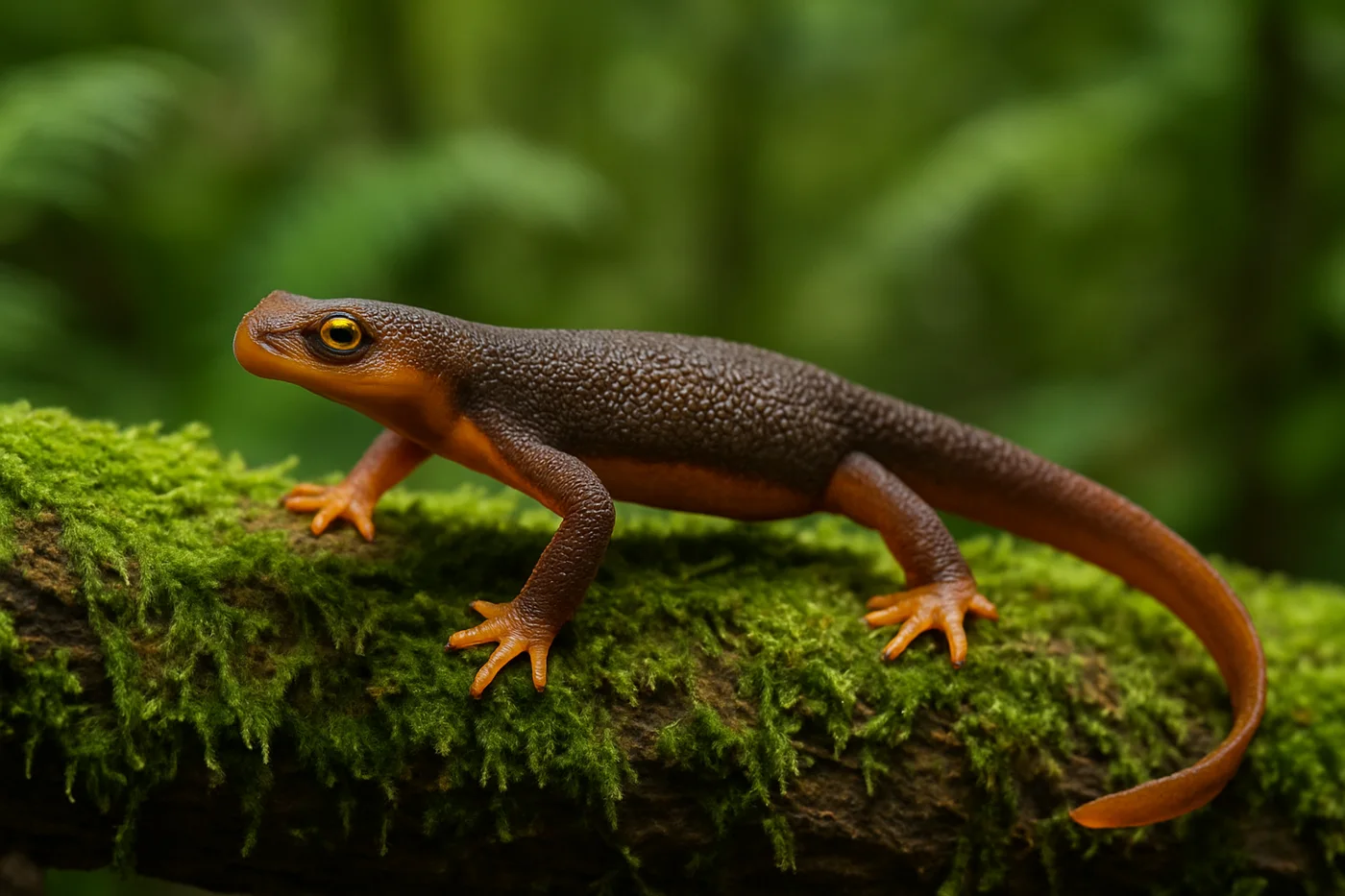
You smell ozone before the winter sky opens over California chaparral. Rain darkens oak leaves, wakes seasonal creeks, and draws the California newt (Taricha torosa) from the hidden ground into a changed landscape. With rough brown skin, golden eyes, and a warm orange underside, this amphibian carries the slow assurance of a creature whose body is defended by tetrodotoxin. The newt does not need to be touched to be understood. It is a living threshold between dry earth and running water, concealment and warning, dormancy and return.
California newt symbolism belongs to the wet edge of transformation. In modern Pagan practice, its rain-season emergence can hold questions of boundary, patience, and the hard wisdom of remaining intact. Its toxic defense makes the correspondence especially sharp: protection is not always a wall or a fight. Sometimes it is an unmistakable warning, a refusal to be consumed, and the discipline to leave a wild being alone.
TL;DR
California newt symbolism joins the liminal life of Taricha torosa with modern Pagan work around boundaries, endurance, and seasonal return. Its tetrodotoxin defense, rain-linked movements, and orange warning colors make it a potent contemporary emblem for protection that does not seek a fight. Pliny's famous salamander of fire is a separate ancient literary creature, while the California newt belongs to its own California ecology and should be observed without handling.
Key Facts
- Scientific identity: The California newt is Taricha torosa, an amphibian in the salamander family, Salamandridae.
- Range and habitat: It occurs in California coastal and foothill habitats, including woodland, chaparral, and waters used for breeding.
- Material defense: Its skin secretions contain tetrodotoxin, a powerful neurotoxin that can harm animals and people if enough is ingested or transferred through a mucous membrane or a cut.
- Seasonal rhythm: Rain and breeding water shape the newt's visible movements, making winter and early spring especially resonant seasons for local observation.
- Modern correspondence: Contemporary practice can associate the newt with liminality, clear boundaries, weather-worn endurance, and the return of life after drought.
Q&A
What does the California newt symbolize in modern witchcraft?
The California newt symbolizes a boundary that is visible, self-contained, and not offered for negotiation. Modern Pagan practice can use it as an image for withdrawing from a harmful demand, surviving a dry season, or moving carefully through a life change without making the animal a tool or an omen machine.
Why is the California newt associated with the poison path?
The California newt is associated with the poison path because its skin carries tetrodotoxin, a real defense whose danger gives modern practitioners a sober language for consequence and restraint. In this context, poison-path work means studying limits, warning signs, and the difference between protection and harm, never handling wildlife or preparing toxic substances.
Can I handle a California newt for a ritual or photograph?
California newts should not be handled for ritual or photography because their toxin can enter through mucous membranes or broken skin, and close handling disturbs a vulnerable amphibian. Observe from a respectful distance, take a photograph without blocking its path, and wash hands if accidental contact occurs.
Poison-Path Symbolism and Modern Boundaries
The poison path in modern California newt symbolism is a practice of consequence, not an invitation to poison, curse, or intimidate another person. Taricha torosa moves openly through wet leaf litter while carrying a defense that tells predators to stop. That image can support a plain spiritual discipline: identify the line that cannot be crossed, state it without embellishment, and step away from any situation that ignores it.
The newt's power lies in containment. It does not pursue what threatens it, and it does not need to advertise a private wound. Its body gives a visible warning only when necessary. In a contemporary working, orange and brown can become colors for a boundary journal, a rain-season altar, or a private rite of ending access. The practical act must be equally clear: mute the message thread, decline the invitation, lock the door, or seek help from people who can keep a boundary real.
This is not an inherited California ritual. It is a modern correspondence rooted in the species' actual ecology. The spiritual meaning becomes stronger when the practitioner remembers the small animal under the symbol: cold-blooded, rain-dependent, vulnerable to roads and habitat loss, and best honored by being left to continue its journey.
Salamanders, Pliny, and the Fire Myth
Pliny the Elder's salamander of fire is an ancient Roman literary image, not a description of the California newt. In The Natural History, Pliny repeats a claim that a salamander's coldness could extinguish flame. The image endured because people sometimes saw amphibians rush from wet or rotting wood placed near a fire, then turned that startling emergence into a story about creatures born from flame.
That old salamander is useful only when kept distinct from Taricha torosa. The California newt is not a fire animal. It belongs to winter rain, leaf litter, pools, and streams. Its modern magic is not about commanding flame or borrowing a classical beast by name. It is about the moment after heat has broken: the first wet night, the return of movement, and the life that waits beneath ground no one thought to watch.
For a Pagan reader, the contrast itself carries meaning. Fire mythology can speak to persistence through ordeal; the newt's rain-season body speaks to survival through withdrawal, rest, and reappearance. Put a bowl of clean water beside a journal during a storm if that image helps, then let the actual animal remain outside the ritual and outside your hands.
Rain Magic and the Liminal Season
Rain magic finds a local companion in the California newt because the species' visible life is tied to wet weather and breeding water. California's dry months can make amphibian life feel absent, but absence is not death. The newt waits in a landscape that appears exhausted, then returns when moisture changes the terms of survival.
This makes Taricha torosa a precise symbol for a person living through a hard pause. The correspondence is not a promise that a storm will arrive on command. It is a way to meet the season already present. When rain begins, note the smell of soil, the sound on roof tiles, and the routes where water gathers. Ask what has been held underground too long, what needs a safer habitat, and what should emerge slowly rather than be forced.
The newt also teaches respect for thresholds. A roadside ditch, a culvert, a seasonal creek, and an oak-lined slope may look ordinary until the rains return. These are not empty spaces. They are moving corridors. Leave them unblocked, drive slowly on wet nights where wildlife crosses, and give any newt encountered on the ground enough room to choose its own direction.
The California Newt: Natural History of Taricha torosa
The California newt is a terrestrial and aquatic amphibian whose life follows a seasonal exchange between land and breeding water. California Herps describes adults with poisonous skin secretions containing tetrodotoxin, distributed through much of the body. The toxin repels many predators and can be dangerous to people if ingested in sufficient quantity, which makes a hands-off encounter the only sensible one.
Its brown back and orange underside are more than decorative colors. They make the animal legible in two different worlds: camouflage among wet leaves and a bright warning when the underside is revealed. Newts of the genus Taricha are often discussed alongside garter snakes because some snake populations have evolved resistance to tetrodotoxin. Brodie and Brodie's 1999 study examines the evolutionary costs of exploiting poisonous prey, a reminder that defenses and adaptations are never abstract ideas when another body must live with them.
The newt's slow movement is not permission to intervene. It can be tempting to lift an animal from a road or pose it for a photograph, but a brief encounter can become a hazard for both animal and person. Slow down, watch the ground on wet nights, keep pets away, and contact a qualified local wildlife authority if an injured animal needs help.
Material and Spiritual Anatomy
The California newt's anatomy gives modern Pagan symbolism a material anchor in real rain-season behavior and real limits.
| Feature | Natural-history context | Modern spiritual correspondence |
|---|---|---|
| Tetrodotoxin-bearing skin | A chemical defense that deters many predators. | Clear consequences, protective limits, and refusing consumption. |
| Orange underside | A contrasting warning color visible during defensive display. | Making a boundary legible before a situation becomes dangerous. |
| Amphibious life | Seasonal movement between terrestrial habitat and breeding water. | Liminality, transition, and changing form without losing identity. |
| Rain-season emergence | Moist conditions make movement and breeding more visible. | Return after dormancy, patience, and renewal after drought. |
| Garter-snake resistance research | Some snake populations show tetrodotoxin resistance in the wider Taricha relationship. | Discernment, adaptive pressure, and boundaries that need more than one form. |
Conservation at the Edge of the Road
California newt conservation begins with protecting wet-night movement routes and the waters that make breeding possible. Roads, fast traffic, altered creeks, polluted runoff, and habitat fragmentation can turn a seasonal crossing into a lethal barrier. A newt's defense works against many predators, not against tires, storm drains, or a shrinking corridor between woodland and water.
The most grounded newt devotion is practical. Keep toxic chemicals out of drains and creeks. Do not collect wild newts or their eggs. Leave stones, logs, and wet leaf cover in place when possible, because amphibians use such shelter to keep moisture close. Support local habitat restoration and road-crossing projects, and report observations through the regional wildlife or naturalist programs that track amphibians.
The ritual lesson remains fierce without becoming violent. The newt does not need an altar crowded with borrowed body parts. It needs rain, cover, water, and a route through the human world that does not end under a wheel. Let the orange underside remain a warning written by the animal itself.
Sources
- Author: Robert C. Stebbins and Samuel M. McGinnis. Title: Field Guide to Amphibians and Reptiles of California. Publisher/Archive: University of California Press. Date/Era: 2012.
- Author: California Herps. Title: Taricha torosa - California Newt. Publisher/Archive: A Guide to the Amphibians and Reptiles of California. Date/Era: Undated web record, accessed 2026.
- Author: Pliny the Elder, translated by John Bostock and H. T. Riley. Title: The Natural History of Pliny. Publisher/Archive: H. G. Bohn, preserved by Perseus Digital Library. Date/Era: 1855.
- Author: Edmund D. Brodie III and Edmund D. Brodie Jr. Title: Costs of Exploiting Poisonous Prey: Evolutionary Trade-Offs in a Predator-Prey Arms Race. Publisher/Archive: Evolution, Oxford Academic. Date/Era: 1999.