Preserved article · Animals
Owl Symbolism | Spiritual Meaning, Mythology & Folklore
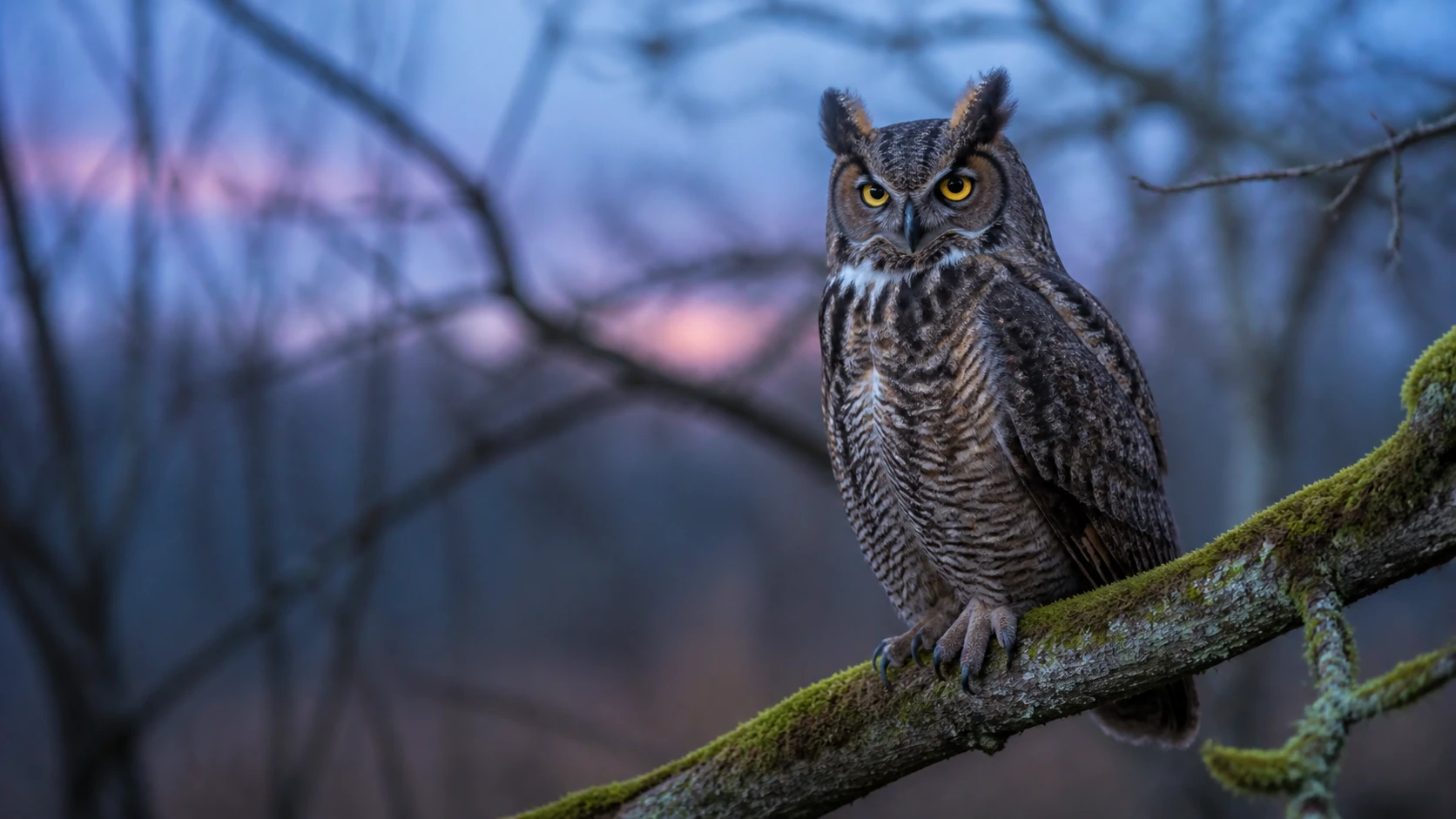
Owl symbolism begins with a living night hunter, not a floating sign. An owl’s silent approach, forward-facing eyes, and sudden call can make an encounter feel charged, yet the bird is also a particular animal with a territory, prey, nesting season, and need for distance. In contemporary Pagan and witchcraft practice, the owl can be a correspondence for discernment, threshold work, concealed knowledge, and the patience to wait until a pattern becomes clear. Those are modern spiritual uses, not claims that every owl delivers a message or that every culture assigns the bird the same meaning.
The order Strigiformes includes the barn owls and the many species gathered in the family Strigidae. The current Cornell source at the end of this article identifies the American Barn Owl as Tyto furcata, after a 2024 split of the older, broad Tyto alba treatment. Their physical adaptations give the symbol its force: many species use facial discs and asymmetrical ear openings to locate prey by sound, while soft-edged feathers help reduce flight noise. The best reading holds both layers together. Study the animal first, name the historical tradition precisely, and let a present-day practice remain honestly present-day.
TL;DR
Owl symbolism can support modern work with discernment, night, boundaries, and difficult knowledge, but it is not a universal omen. Roman strix folklore, the Welsh story of Blodeuwedd, and ancient Mesopotamian visual culture each carry their own contexts; they should not be blended into one inherited “owl meaning.” Natural history grounds the image in real raptors whose survival depends on intact habitat, quiet nesting sites, and respectful observation.
Key Facts
- Scientific identity: Owls belong to the order Strigiformes; Cornell’s current source identifies the American Barn Owl as Tyto furcata.
- Modern correspondence: Discernment, night vision in a metaphorical sense, boundaries, study, and patient attention.
- Roman folklore anchor: Pliny the Elder records the strix as a fearsome night bird in Natural History.
- Welsh myth anchor: In the Fourth Branch of the Mabinogi, Blodeuwedd is transformed into an owl after betraying Lleu Llaw Gyffes.
- Practice boundary: Observe living owls without calls, baiting, nest disturbance, or collecting feathers; use a journal, image, or field observation instead.
Q&A
What does an owl symbolize in modern witchcraft and Pagan practice?
In modern practice, an owl can symbolize discernment when a situation is unclear, a boundary when attention needs to become more selective, and the willingness to sit with an unanswered question. A quiet night walk, a page of notes, or an owl image can support that reflection without claiming supernatural certainty or treating an animal as a ritual tool.
Who is the strix in Roman folklore?
The strix is a frightening nocturnal bird of Roman literary folklore, not a reliable description of one modern owl species. Pliny the Elder’s Natural History places it among ominous night beings, and later European stories developed the term in different directions. Reading the strix as a Roman record of fear, hunger, and vulnerability is more accurate than presenting it as a timeless fact about owls.
Can I collect owl feathers for an altar or spell?
Leave feathers where they are and do not disturb an owl, its roost, or its nest. Feather ownership and wildlife rules vary by place, while the least extractive option works everywhere: photograph the setting, make a sketch, write a field note, or use an ethically made image as a devotional focus.
Modern Owl Symbolism and the Night Threshold
Modern owl practice works best as an ethic of attention rather than a promise of hidden powers. The bird appears when ordinary visual certainty is reduced: dusk, a shaded barn, a wooded edge, or the pause before dawn. That setting makes the owl a useful personal image for reviewing what has been ignored, separating evidence from fear, and taking one careful next step rather than forcing an answer.
For a simple observance, begin with a factual note. Write the date, weather, place, and species if known; then write the question that feels obscured. Set a limit for the practice: no coercion, no demand for a prophecy, and no attempt to attract or handle wildlife. This keeps the correspondence rooted in personal reflection. The owl becomes a companion image for patience, not proof that an outside force has endorsed a decision.
This distinction matters in divination as well. An owl card, statue, or dream may be meaningful to the practitioner, but it does not override consent, evidence, medical care, or safety planning. A useful interpretation asks, “What have I not looked at closely?” It does not tell another person what they must do, diagnose them, or turn uncertainty into a certainty that cannot be checked.
Roman Strix Folklore and Night Fear
Roman strix folklore preserves a darker literary register for the night bird. In Pliny the Elder’s Natural History, the strix is associated with ominous cries and stories of predation on infants. The text is a historical source for what a Roman author reported and repeated, not a zoological field guide or evidence that an owl behaves that way.
That boundary gives the story its real power. The strix gathers human fear around darkness, sickness, infancy, and the limits of the household. Modern readers may find a correspondence here for naming anxiety instead of feeding it: light a candle, list what is known, list what is imagined, and seek practical help when the situation demands it. This is not “blood magic,” and it is not a license to romanticize harm. It is a way to meet an old fear-story with clear eyes.
The word also deserves care because later uses shift across languages and genres. A Roman strix, a medieval witch accusation, and a living owl are not interchangeable. Keeping those categories separate protects both the historical record and the animal from becoming a single, sensational symbol.
Blodeuwedd Myth and the Owl Curse
The Welsh tale of Blodeuwedd belongs to the Fourth Branch of the Mabinogi, preserved in medieval manuscripts and translated by Patrick K. Ford. Blodeuwedd is made from flowers as a wife for Lleu Llaw Gyffes, later joins with Gronw Pebr against him, and is transformed by Gwydion into an owl after the betrayal is exposed. The tale is not simply a moral label attached to a bird; it is a complex story of making, constraint, desire, violence, and consequence.
In a modern devotional reading, Blodeuwedd can prompt questions about agency and the stories imposed on a person. What does it mean to be fashioned for someone else’s purpose? Where has a role become a cage? The useful work is not to claim a Welsh rite or speak for contemporary Welsh people. It is to read the translated tale, name it as Welsh medieval literature, and let it sharpen a personal reflection on autonomy and accountability.
The owl form in this story has daylight consequences. Blodeuwedd is not a generic “wise owl”; she becomes a creature set apart, unable to meet the ordinary world in the same way. That makes the episode a potent but difficult correspondence for examining exile, reputation, and the cost of broken trust. It should not be flattened into an aesthetic of feminine danger or used to excuse cruelty.
Mesopotamian Images, Owls, and Uncertainty
Ancient Mesopotamian visual culture is often pulled into modern owl symbolism through images such as the Burney Relief, a terracotta plaque showing a winged female figure flanked by owls. Identifications of the figure have been debated, including proposals connecting her with Ishtar, Ereshkigal, or Lilith. The presence of owls does not settle the question, and the plaque cannot be used as uncomplicated proof of a single goddess, cult, or modern magical correspondence.
Jeremy Black and Anthony Green’s reference work is valuable here because it encourages attention to named deities, symbols, and periods rather than a one-word association. For modern practice, uncertainty can itself be the lesson: write down what the object visibly shows, what an interpretation proposes, and what remains contested. A symbol becomes more useful when its gaps are admitted instead of filled with borrowed certainty.
This approach also resists the habit of treating every ancient image as public ritual instruction. A museum object, a dictionary entry, and a personal altar are different things. Study can be devotional without pretending that an archaeological image authorizes a reconstructed ceremony.
Owl Anatomy, Hearing, and Hunting
Owl anatomy explains why these birds have so often seemed uncanny. The forward-facing eyes support binocular vision, but an owl’s apparent “ear tufts” are usually feathers rather than external ears. In many species, the facial disc directs sound toward the ear openings, and asymmetry in those openings can help a bird judge where a sound originates. These adaptations make an owl’s stillness purposeful: it can be listening with extraordinary concentration.
Silent flight is another material source for the image. Soft, fringed feather edges reduce the turbulence that makes other wings conspicuously loud. Owls are predators, not emblems of death detached from ecology. Their prey, habitat, seasonal behavior, and nesting needs differ by species. The barn owl is a familiar example of a bird whose pale face and rasping call can inspire folklore, while its actual life is built around hunting small mammals and finding secure roosting places.
For a practitioner, this biology offers a grounded metaphor. Listening is not passivity. It can mean gathering enough information to act with care, lowering unnecessary noise, and refusing to confuse an attractive symbol with expertise. No ritual is needed to receive that lesson; an accurate guide, a respectful observation, and a willingness to remain quiet may be the whole practice.
Table: Material Adaptation and Modern Correspondence
Owl anatomy supports carefully limited modern correspondences, while each cultural meaning remains specific to its own historical record.
| Owl feature | Natural-history role | Modern, nonhistorical correspondence |
|---|---|---|
| Facial disc | In many species, it helps direct sound toward the ears. | Listening before responding. |
| Soft-edged flight feathers | They help reduce flight noise. | Moving deliberately and without needless display. |
| Forward-facing eyes | They support binocular vision. | Focusing on what can be examined directly. |
| Nocturnal or crepuscular activity | Many species are active when light is low; schedules vary by species. | Working patiently with uncertainty. |
| Protected nest and roost sites | They support breeding, rest, and safety. | Maintaining personal boundaries and a safe home. |
Ethical Owl Practice and Conservation
Ethical owl practice begins by leaving the bird in control of the encounter. Do not use playback to force a response, approach a nest, bait a wild owl, or pursue a bird for a photograph. Keep lights low, remain on permitted paths, and follow the directions of land managers and rehabilitation organizations. A real observation can be brief and still be meaningful.
Habitat care is the practical side of reverence. Protecting mature trees, quiet roost sites, and prey-rich open ground helps more than collecting symbolic objects ever could. On a property, avoid broad toxic pest control, reduce unnecessary night lighting, and learn which local species need particular protections. These actions do not require a claim to an ancient tradition; they are an honest response to the living animal.
If no owl is present, use a book, a licensed photograph, a drawing, or a list of local conservation groups. The point is not to manufacture a dramatic encounter. The point is to make an encounter, whether physical or imaginative, leave the animal and its habitat safer than before.
Sources
- Author: Patrick K. Ford, translator. Title: The Mabinogi and Other Medieval Welsh Tales. Publisher/Archive: University of California Press. Date/Era: 1977; later editions listed by the publisher.
- Author: Cornell Lab of Ornithology. Title: Barn Owl (Tyto alba), now presented as American Barn Owl (Tyto furcata). Publisher/Archive: All About Birds. Date/Era: Contemporary species account, accessed 2026.
- Author: Pliny the Elder, translated by John Bostock and H. T. Riley. Title: The Natural History. Publisher/Archive: Perseus Digital Library. Date/Era: 1855 translation.
- Author: Paul A. Johnsgard. Title: North American Owls: Biology and Natural History. Publisher/Archive: Smithsonian Institution Press. Date/Era: 1988.
- Author: Jeremy Black and Anthony Green. Title: Gods, Demons and Symbols of Ancient Mesopotamia: An Illustrated Dictionary. Publisher/Archive: University of Texas Press. Date/Era: 1992.