Preserved article · Animals
Raven Symbolism | Spiritual Meaning, Mythology & Folklore
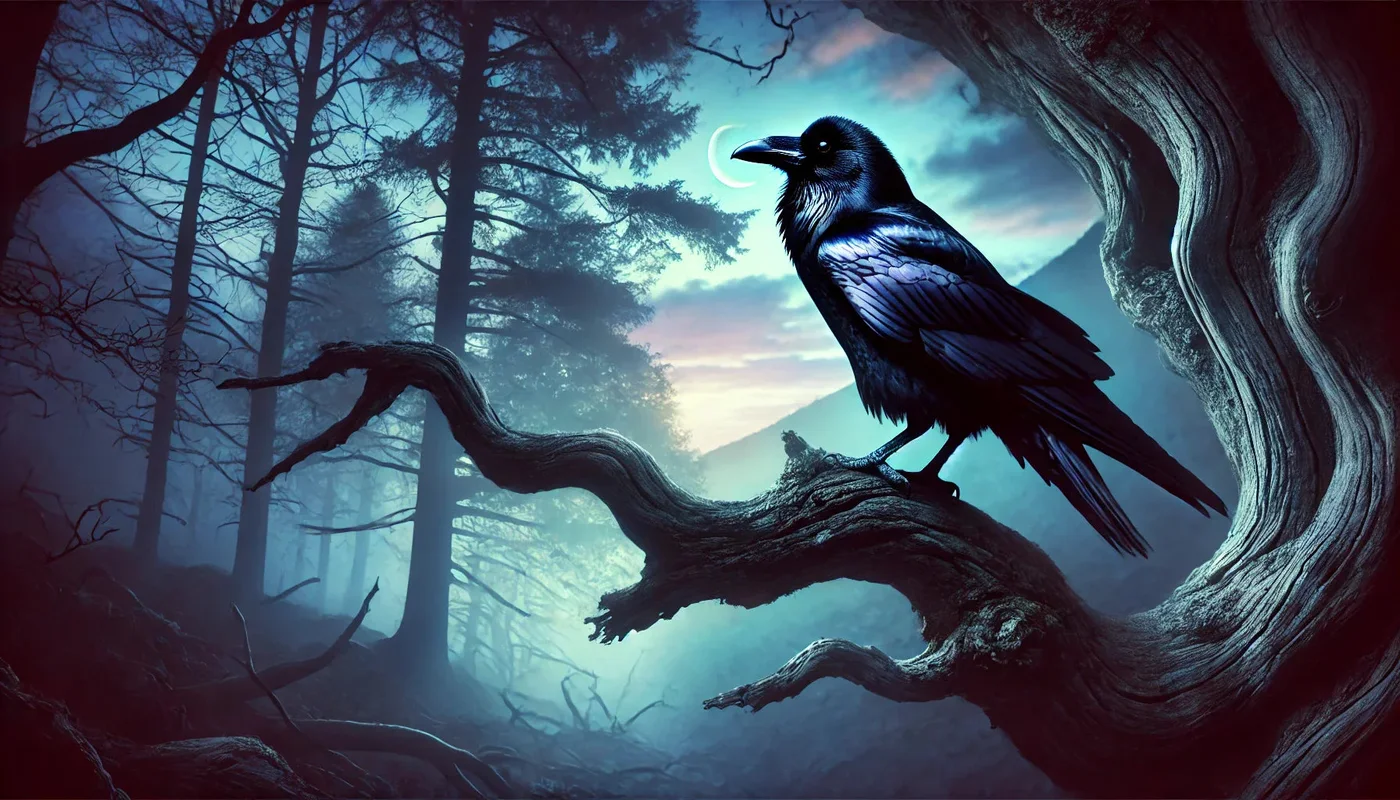
You hear it before you see it: a deep, wooden croak carried through wet pine, cold stone, and fog. The common raven (Corvus corax) is no delicate woodland messenger. It is a large, black corvid built for long flights, harsh weather, and an opportunistic diet that includes carrion. Its black feathers can flash blue or purple in hard light; its call can seem to come from a hidden place. In modern Pagan practice, that physical presence gives raven symbolism its force: attention at the edge of change, clear sight in difficult terrain, memory that does not soften what it has seen.
Raven symbolism gathers around prophecy, death, intelligence, and transformation, but no single meaning belongs to every people who tell raven stories. Norse poems, medieval Irish literature, and recorded Tlingit narratives place the bird in different worlds with different obligations. A modern practitioner can meet the raven as a correspondence for honest reckoning and boundary-crossing without collapsing those traditions into one borrowed ritual.
TL;DR
Raven symbolism centers on watchfulness, memory, change, and the hard work of seeing what has been concealed. Norse poetry gives Odin Thought and Memory in raven form, while medieval Irish narrative links the Morrígan and battle-crow imagery to sovereignty, conflict, and death; recorded Tlingit Raven narratives present Raven as a powerful, hungry transformer whose acts shape the world. For modern Pagan practice, the raven can be a sober emblem for shadow work, ancestral reflection, and truth-telling, grounded in respect for a living wild bird.
Key Facts
- Scientific identity: The common raven is Corvus corax, a member of the crow family, Corvidae.
- Range and habitat: Ravens occur across much of the Northern Hemisphere, from coasts and forests to tundra, mountains, and desert country.
- Norse folklore anchor: Grímnismál names Huginn and Muninn, Odin's ravens, whose names are commonly rendered Thought and Memory.
- Irish literary anchor: The Morrígan and Badb appear in the Táin Bó Cúailnge within a landscape of sovereignty, conflict, and death.
- Modern correspondence: Raven work can support journaling, grief tending, protective boundaries, and careful observation. It does not confer authority over living Indigenous traditions or wild animals.
Q&A
What does the raven symbolize in modern witchcraft?
In modern witchcraft, the raven often symbolizes clear perception, memory, liminal travel, and the willingness to face an ending before beginning again. It suits private work with difficult truths, grief, ancestral remembrance, and the release of stale patterns. These are contemporary correspondences, not a claim that every raven sighting carries a supernatural command.
How is the raven connected to Odin?
The Old Norse poem Grímnismál says that Huginn and Muninn fly over the world each day and return to Odin. Their names, Thought and Memory, make the raven a fitting image for attention that travels outward and knowledge brought home. The poem's image is particular to Norse literary tradition, not a universal raven belief.
Is the raven a sign of death?
Ravens feed on carrion and appear in stories of battle, winter, and loss, so death is one enduring part of their symbolism. It is not the whole of it. Raven stories also hold creation, intelligence, appetite, survival, and the return of light. A modern reading can treat the bird as a companion to endings and transformation without turning a living animal into a fixed omen.
The Morrígan and Irish Raven Folklore
In the medieval Irish narrative Táin Bó Cúailnge, the Morrígan moves through a world of cattle raiding, rivalry, prophecy, and violent struggle. She is associated with battle and sovereignty, and Badb, a figure closely connected with the Morrígan in later tradition, carries the force of a battle-crow. Those bird forms belong to a specific Irish literary and mythic landscape. They should not be flattened into a generic label for all black birds or all modern spellwork.
The most arresting scene comes at the death of Cú Chulainn. In Thomas Kinsella's translation, the hero binds himself upright to a standing stone after receiving mortal wounds. A bird settling on him marks the stillness that follows the fight. The image is not gentle consolation. It makes sovereignty visible through the body at its limit, with the bird as witness rather than a decorative accessory.
For a modern Pagan reader, this Irish raven symbolism can open a disciplined reflection on conflict, consequence, and personal sovereignty. It does not authorize imitation of an ancient battle rite. A black candle, a raven drawing, or a page of unvarnished journal writing can hold the question more honestly: where has a conflict ended, what truth remains, and what must be carried forward without denial?
Odin's Ravens in Norse Mythology
Norse raven symbolism is inseparable from Odin's two birds, Huginn and Muninn. In Grímnismál, Odin says that they fly over the world daily and tells of his fear for their return, especially for Memory. The scene gives the birds a demanding role. They are not passive omens that decorate a god. They range outward, gather what they find, and return with knowledge.
The raven also belongs to the harsh visual field of Old Norse verse: ships, wolves, weapons, weather, battlefields, and the dead. That context explains why the bird can feel grave and martial without becoming a simple emblem of evil. The raven survives where the feast has ended. It sees what remains when boast, illusion, and noise have been stripped away.
Modern practice can receive this image through study and reflection. Read a passage from Grímnismál, then write two columns labeled Thought and Memory. Put the immediate fact in one column and the longer pattern in the other. The work is not divination by command. It is a way of refusing to confuse a passing reaction with the knowledge that experience has earned.
Tlingit Raven Narratives and the Theft of Light
In the Tlingit narratives recorded by John R. Swanton, Raven is not a European death omen dressed in a different costume. Raven is a major transformer whose hunger, cunning, and restless movement shape the world. The stories are rooted in Tlingit places, kinship, language, and oral tradition. They belong to Tlingit cultural life, not to a universal occult catalogue.
The Raven-and-light cycle is especially well known across the Northwest Coast, where Raven's acts release what had been withheld and alter the conditions of human life. The force of these narratives lies in Raven's complexity. He can be hungry, foolish, audacious, and capable of making something new. Creation does not arrive as a polished moral lesson. It comes through appetite, risk, trickery, and consequences.
That distinction matters for contemporary raven symbolism. A practitioner can recognize Raven as an image of necessary change while leaving Tlingit ceremonial and cultural authority with Tlingit people. Rather than borrowing a story as a spell, let it sharpen a personal question: what has been enclosed too tightly, what needs daylight, and what consequences follow when power changes hands?
Raven Symbolism in Modern Pagan Practice
Modern Pagan and witchcraft practice often turns to the raven during thresholds: the end of a relationship, a difficult act of truth-telling, grief that needs witness, or a season when old identities no longer fit. The bird's dark sheen and rough voice make it a compelling companion for shadow work, but shadow work here means examination rather than spectacle. Name the fear, resentment, or story that has been left to rot. Ask what can be composted, what must be mourned, and what cannot be carried into the next season.
Raven correspondences can be kept simple. Sit with a raven image, a field observation, or a black feather drawn on paper. Keep a record of what was actually seen and what was personally felt. If an ancestor is remembered, speak the name with care and let memory be the offering. If protection is the need, make the boundary concrete: decline a demand, close a draining conversation, or remove an object that keeps an old harm present.
The raven is not a prop for claiming secret status. Its strongest modern lesson is intelligent restraint. Watch first. Learn the terrain. Speak only when the words have weight. Let the animal remain wild, and let the spiritual correspondence remain accountable to the person practicing it.
The Common Raven: Natural History of Corvus corax
The common raven is among the largest passerines. Cornell's common-raven profile describes a bird with a thick bill, shaggy throat feathers, a wedge-shaped tail in flight, and a repertoire that reaches far beyond one familiar croak. Ravens can soar, tumble, glide, and make low, resonant calls that carry over open country. Their range across the Northern Hemisphere helps explain why they occupy such varied human imaginations.
They are opportunistic omnivores and scavengers. Carrion is part of their diet, especially where winter or open country makes a carcass visible, but ravens also take insects, eggs, fruit, grain, small animals, and food left by people. Their attention to food, social relationships, and changing conditions is part of why corvid intelligence has become so memorable in both observation and story.
Marzluff and Angell's In the Company of Crows and Ravens follows the long relationship between people and corvids, including the ways these birds learn, adapt, and respond to human landscapes. The raven's material reality is not an afterthought to its symbolism. A bird that survives cold, recognizes opportunity, remembers places, and turns its whole body into a question mark in the wind has already supplied the raw language from which human stories grow.
Material and Spiritual Anatomy
The raven's body and behavior give modern spiritual correspondences a living, material anchor rather than a generic black-bird image.
| Feature | Natural-history context | Modern spiritual correspondence |
|---|---|---|
| Thick, curved bill | Useful for a broad diet that includes tough food and carrion. | Getting to the hard fact beneath a polished story. |
| Low, varied voice | Ravens make a wide range of calls and sounds. | Careful speech, listening, and messages that need interpretation. |
| Wedge-shaped tail in flight | A useful field mark when the bird is overhead. | A clear line through uncertainty and changing weather. |
| Dark iridescent plumage | Black feathers can show blue or purple sheen in direct light. | Hidden depth, concealment, and what becomes visible only at the right angle. |
| Adaptable diet and range | Ravens use many habitats and food sources across the Northern Hemisphere. | Resourcefulness, endurance, and transformation after loss. |
Ecological Care and Raven Conservation
Ravens are not altar objects. They are wild birds whose lives depend on intact habitat, clean food webs, and distance from human pressure. A scavenger can be harmed by poisoned prey, discarded waste, lead fragments in carrion, and casual attempts to feed or tame it. The best material offering to a raven is restraint: secure trash, avoid toxic rodenticides, keep pets from disturbing nesting areas, and give a perched bird room to leave.
That care belongs inside raven practice. The same bird that becomes an emblem of transformation is a real animal navigating wind, roads, hunger, breeding seasons, and changing land. Watch from a distance. Learn its call without trying to own it. Let a sighting remain a sighting before it becomes a symbol. The mystery is not diminished by this discipline. It becomes harder, truer, and more alive.
Sources
- Author: John M. Marzluff and Tony Angell. Title: In the Company of Crows and Ravens. Publisher/Archive: Yale University Press. Date/Era: 2005.
- Author: Cornell Lab of Ornithology. Title: Common Raven (Corvus corax). Publisher/Archive: All About Birds, Cornell Lab of Ornithology. Date/Era: Undated institutional record, accessed 2026.
- Author: Jackson Crawford, translator. Title: The Poetic Edda. Publisher/Archive: Hackett Publishing Company. Date/Era: 2015 translation; expanded second edition, 2025.
- Author: Thomas Kinsella, translator. Title: The Táin: Translated from the Irish Epic Táin Bó Cúailnge. Publisher/Archive: Oxford University Press, catalogued by the National Library of Ireland. Date/Era: 1969 translation; Oxford edition, 1979.
- Author: John R. Swanton. Title: Tlingit Myths and Texts. Publisher/Archive: Smithsonian Institution, Bureau of American Ethnology Bulletin 39. Date/Era: 1909.