Preserved article · Animals
Red Fox Symbolism | Spiritual Meaning, Folklore & Mythology
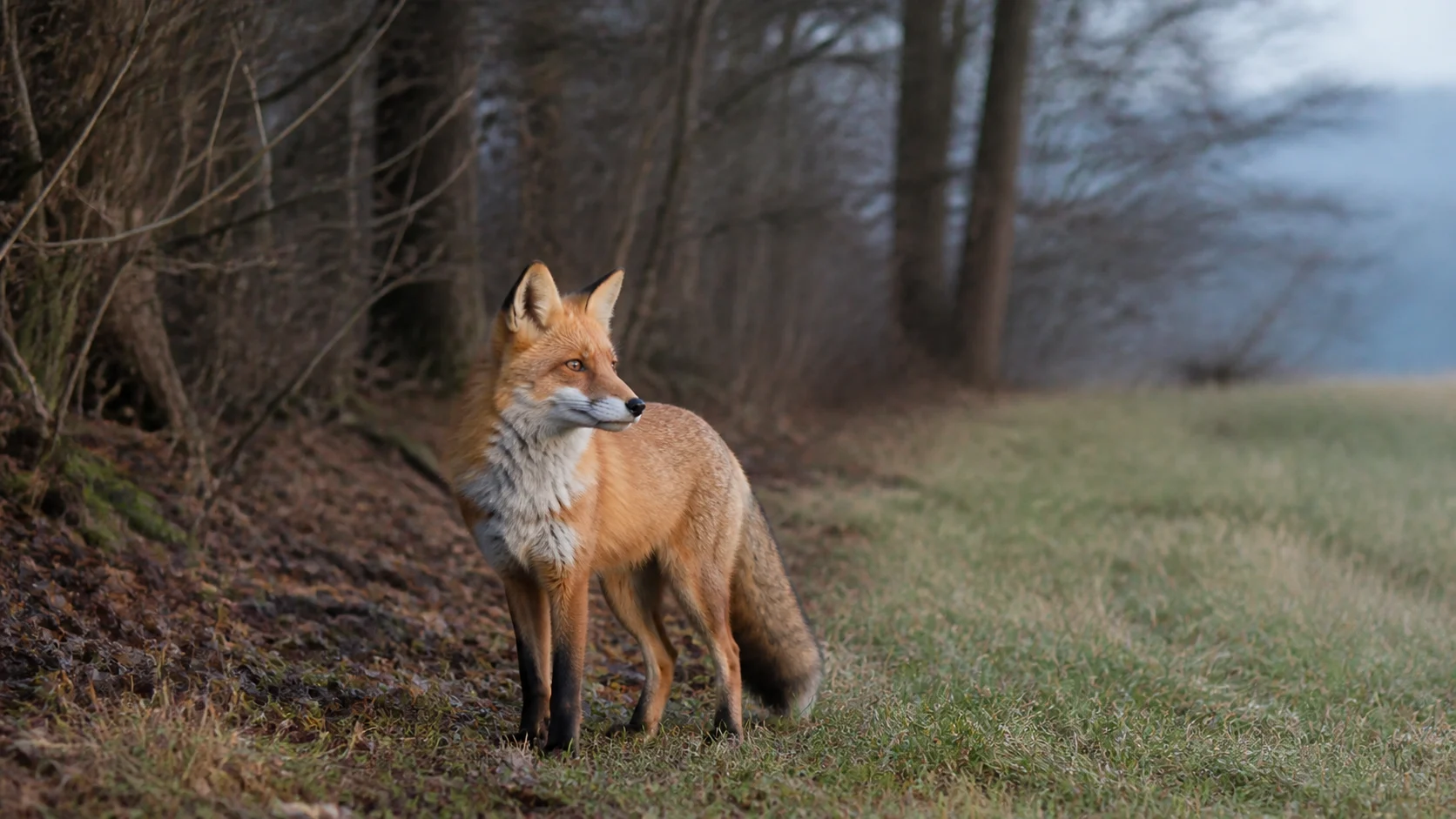
Red fox symbolism begins at the boundary where a hedge meets a field, a railway verge meets a garden, or a dark treeline meets the lights of a town. The red fox, Vulpes vulpes, is a canid of the order Carnivora whose alert ears, sudden turns, and adaptable habits have made it a lasting figure for timing, cleverness, and the art of finding a way through. In modern Pagan practice, the fox can be a correspondence for discernment, flexible planning, glamour as self-presentation, and the nerve to change course when direct force would fail.
That correspondence belongs to the practitioner, not to a universal animal omen. Japanese kitsune stories, medieval Reynard imagery, and a fox moving through a suburban edge are not one interchangeable tradition. Their power grows sharper when each is named in its own place and period, while the living fox remains a wild predator with den sites, prey, seasonal needs, and a right to be left undisturbed.
TL;DR
Red fox symbolism can support modern reflection on adaptability, threshold work, and clear-eyed strategy, but it does not make deception or harm a spiritual obligation. Japanese kitsune tales and medieval European Reynard traditions have distinct histories, while Vulpes vulpes grounds the image in a real canid adapted to varied landscapes. The most enduring fox practice protects cover, avoids interference with wildlife, and turns cunning toward careful choices rather than control of other people.
Key Facts
- Scientific identity: Vulpes vulpes is a canid in the order Carnivora and one of the most widely distributed terrestrial mammals.
- Modern correspondence: Timing, adaptation, private thought, boundary awareness, and finding an overlooked route.
- Japanese folklore anchor: Kitsune are fox beings in Japanese tales and religious imagery; white foxes are associated with Inari in Shinto contexts.
- Medieval European anchor: Reynard appears in French, Dutch, German, and English literary and visual traditions as a socially disruptive trickster.
- Natural-history anchor: A 2011 study of hunting red foxes proposed that magnetic alignment may improve mousing accuracy under snow or dense vegetation.
- Practice boundary: Watch from a distance, do not feed or bait foxes, and keep dens, kits, and resting cover undisturbed.
Q&A
What does the red fox symbolize in modern witchcraft and Pagan practice?
In modern Pagan practice, the red fox often symbolizes adaptable intelligence, careful timing, and the ability to read a threshold before crossing it. A fox correspondence can support a journal prompt, a planning ritual, or a protective boundary without becoming permission to manipulate, stalk, or deceive another person.
What is the relationship between kitsune and Inari?
Kitsune are fox beings in Japanese folklore, literature, and visual culture, while white foxes appear as messengers of Inari in Shinto religious settings. Inari traditions are living religious traditions, so a modern practitioner can study named tales and visit public educational materials without claiming a Shinto role, shrine practice, or inherited Japanese custom.
Do red foxes use Earth’s magnetic field to hunt?
A 2011 Biology Letters study observed that red foxes hunting under snow or high vegetation often directed successful attacks toward north and proposed magnetic alignment as one explanation. The paper presents a hypothesis about directional preference, not a license to describe a fox as possessing supernatural sight or a mechanical targeting ring.
Modern Red Fox Symbolism and Liminal Practice
Modern red fox practice centers on the moment before an action, when a person can still notice the terrain, change direction, and choose a quieter path. The fox is not a patron of cruelty. It is a vivid image for refusing false binaries: one can be alert without being paranoid, private without becoming isolated, and strategic without treating every relationship as a contest.
A useful fox observance can be simple. At dusk, set down an image, stone, or handwritten word that represents a boundary needing attention. Name the actual boundary, such as work and rest, public and private speech, obligation and resentment, or a route that has become unsafe. Then write two possible exits from the situation. The work lies in making a practical choice with clearer timing, not in trying to make another person act against their will.
The color of the fox matters in modern imagination because russet fur flashes against snow, leaf litter, grass, and pavement. That visual contrast makes the animal a strong correspondence for selective visibility. Some situations require speaking plainly; others require holding a plan close until conditions are right. A fox symbol can remind a practitioner to distinguish secrecy that protects dignity from secrecy that enables harm.
Kitsune Folklore and Inari’s Fox Messengers
Kitsune tales from Japan portray fox beings as intelligent, changeable figures whose motives range from benevolent aid to mischief, seduction, correction, and danger. Royall Tyler’s collection of medieval Japanese tales offers a literary doorway into a world of spirits, monks, travelers, animals, and shifting identities, but it cannot collapse many centuries of Japanese religious life into a single occult archetype.
Inari is a major kami associated with rice, prosperity, and agricultural abundance in Shinto tradition. White foxes commonly appear as Inari’s messengers in shrine iconography, a relationship that deserves more care than the phrase “fox spirit guide” can carry. The fox statues at Inari shrines are not generic decorations for personal spellwork; they sit within a living network of offerings, place, ritual, and community.
Some Japanese stories describe yako, wild foxes whose behavior is unsettled or dangerous, while other tales make foxes lovers, protectors, fools, or benefactors. Nine-tailed fox imagery and kitsunebi, or fox fire, belong to particular storytelling strands rather than a guaranteed list of powers. A modern correspondence can honor the fox’s ambiguity by studying a translation, learning the name of an Inari shrine, or holding a private reflection on appearances and consequence, without claiming to summon or possess a kitsune.
Reynard the Fox in Medieval European Art
Reynard the Fox is a trickster figure in medieval European animal narratives, especially the French Roman de Renart tradition and its later Dutch, German, and English relations. In these stories, Reynard repeatedly unsettles a court of animal nobles, exposing greed, vanity, appetite, and bad judgment. The fox survives not because he is morally pure, but because the social order around him is already compromised.
Kenneth Varty’s study traces fox imagery in medieval English carvings, glass, manuscripts, and other visual forms. Those images show that the fox was not confined to a single written tale. Foxes preaching to geese, playing music, standing trial, or wearing clerical clothing allowed artists and audiences to stage satire through an animal body. Such scenes can be comic, hostile, religiously charged, and politically sharp at once.
For a modern Pagan reader, Reynard is most useful as a warning about the stories told to gain trust. The fox does not need to become a model for lying. Instead, the trickster can sharpen attention to flattery, false urgency, and the way a powerful figure may disguise appetite as virtue. The corresponding practice is discernment: ask who benefits, what is omitted, and whether the seemingly clever path leaves someone else carrying the risk.
Vulpes vulpes: Hearing, Mousing, and Adaptation
Vulpes vulpes survives across forests, grasslands, farmland, coasts, and city margins by shifting its diet and behavior to local conditions. It hunts small mammals, insects, fruit, carrion, and other available food, and its large ears help it attend to small sounds in grass, leaf litter, snow, or darkness. That adaptability is material, not mystical: a fox lives because it reads cover, wind, prey movement, and the presence of people.
The high pounce often called mousing is one of the fox’s most recognizable hunting movements. A fox can pause, listen, judge a likely location, leap, and land with its forepaws over prey concealed by vegetation or snow. The 2011 research by Jaroslav Červený and colleagues recorded a directional preference in such attacks and proposed that magnetic alignment might improve accuracy under conditions where visual information is limited. It is an intriguing proposal, not proof that every fox follows a compass or that a person can acquire fox-like certainty.
Fox vocalizations also create much of the animal’s eerie reputation. A vixen’s scream, barks, yelps, and other calls serve communication rather than a supernatural warning. The sound can be startling in a quiet winter neighborhood, but it belongs to courtship, territory, contact, and the ordinary pressures of a social canid’s life. Knowing that does not flatten the encounter. It makes the cry more immediate: another animal is speaking across the dark.
Table: Fox Traits and Modern Correspondences
Red fox traits can inspire modern personal correspondences when their biological function is kept separate from historical folklore claims.
| Fox trait | Natural-history role | Modern, nonhistorical correspondence |
|---|---|---|
| Acute hearing | Locates small prey and social signals in varied cover. | Listening for what a plan has overlooked. |
| Mousing pounce | Allows a fox to strike prey concealed by vegetation or snow. | Waiting until an action has a clear, practical opening. |
| Flexible diet | Supports survival in changing local conditions. | Adapting methods without abandoning core values. |
| Use of edge habitat | Connects cover, prey, movement routes, and denning space. | Noticing where two obligations or identities meet. |
| Vocal range | Supports contact, territory, courtship, and alarm. | Choosing when direct speech is necessary. |
Ecological Magic at the Wild Edge
Fox care begins with the dense, untidy places that make escape, rest, and denning possible. Hedgerows, brush piles, rough grass, old walls, and connected green corridors provide cover for foxes and many smaller animals. A clipped lawn or brightly lit yard offers less refuge than a landscape with layered native growth and dark passageways.
Do not feed wild foxes to manufacture an encounter. Food habituation can draw animals into traffic, conflict with neighbors, and unsafe dependence. Secure household waste, keep companion animals supervised, and give a fox room to leave. If a fox appears injured, trapped, or unusually tame, contact a licensed local wildlife rehabilitator rather than attempting to handle it.
The fox’s place in practice can be protective without being possessive. Let its image mark a boundary in a notebook, leave a patch of habitat unlit, or support a local conservation and rescue group. The deepest correspondence is not a claim of command over a wild animal. It is the decision to leave a route through the world a little safer for the creature that already knows how to use it.
Sources
- Author: David W. Macdonald. Title: Running with the Fox. Publisher/Archive: Unwin Hyman. Date/Era: 1987.
- Author: Royall Tyler, editor and translator. Title: Japanese Tales. Publisher/Archive: Pantheon Books. Date/Era: 1987.
- Author: Kenneth Varty. Title: Reynard the Fox: A Study of the Fox in Medieval English Art. Publisher/Archive: Leicester University Press. Date/Era: 1967.
- Author: Jaroslav Červený, Sabine Begall, Petr Koubek, Petra Nováková, and Hynek Burda. Title: Directional preference may enhance hunting accuracy in foraging foxes. Publisher/Archive: Biology Letters, Royal Society. Date/Era: 2011.
- Author: Martin Wallen. Title: Fox. Publisher/Archive: Reaktion Books. Date/Era: 2006.