Preserved article · Plants & Herbs
Dittany of Crete | Magical Properties, Folklore & History
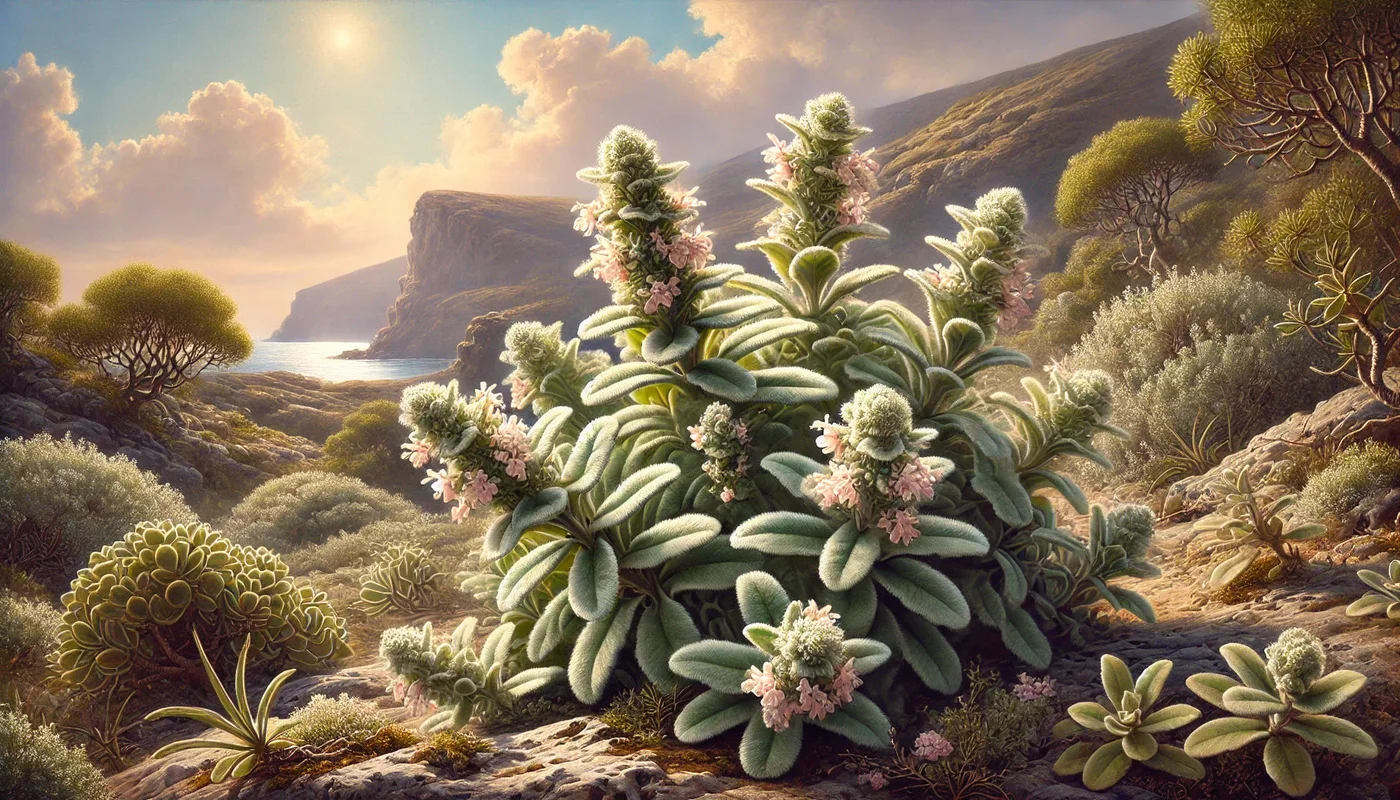
Wind catches the woolly gray-green leaves of Origanum dictamnus against the limestone heights of its native island. This aromatic perennial belongs to the Lamiaceae, or mint, family, and its downy foliage, pink bracts, and cliffside geography have made it one of the most charged plants in Mediterranean herbal lore. Ancient writers imagined it drawing iron from a wound; modern practitioners can approach that image as a severe symbol of extraction, release, and the refusal to keep what has lodged too deeply in a life. The plant's power begins with its actual place: Crete, rock, wind, and a species that should be known before it is named in a spell.
TL;DR
This Cretan herb brings Origanum dictamnus into modern Pagan work around removal, boundaries, and difficult recovery. Pliny the Elder reports an ancient arrow-expelling animal legend, and Virgil depicts Venus using Cretan dittany in Aeneid XII, while neither text provides modern medical instruction. The living herb is native to Crete and should be appreciated through ethical cultivation or nonextractive study, not by collecting from wild cliff habitats.
Key Facts
- Scientific identity: Origanum dictamnus is a perennial aromatic plant in the Lamiaceae family.
- Geographic identity: The species is native to Crete and is associated with rocky, sun-exposed Cretan habitats.
- Classical anchor: Pliny reports tales of wounded animals seeking dittany, while Virgil places Cretan dittany in Venus's care of Aeneas.
- Modern correspondence: Contemporary practice can associate the herb with removal, guarded thresholds, recovery, and naming what must leave.
- Practical limit: Do not forage an unfamiliar or wild plant, ingest essential oil, or use ancient medical stories as present treatment.
Q&A
What does Dittany of Crete symbolize in modern witchcraft?
In modern witchcraft, the herb symbolizes the removal of what has become embedded, unwanted, or difficult to name. A practitioner may work with a photograph, a botanical drawing, or ethically cultivated dried material while writing down a fear, habit, or obligation that needs to be released. The correspondence concerns personal boundaries and honest action, not forcing a spirit, illness, or another person to obey.
What is the arrow legend about dittany?
The arrow legend is an ancient literary and natural-history tradition, not evidence that the herb can remove a weapon or cure a wound. Pliny relates that wounded deer and Cretan goats sought dittany after an arrow strike, and Virgil depicts Venus gathering Cretan dittany for Aeneas after his wound. The tale gives the plant a vivid mythic role as an image of extraction, while modern wounds require qualified medical care.
Is Dittany of Crete safe to harvest or burn?
Wild populations of this species should not be collected without clear legal permission and current local conservation guidance. Its restricted Cretan range makes wild populations especially unsuitable for casual harvesting, and an unfamiliar aromatic plant should never be burned or ingested. A living cultivated specimen, an image, or an unburned leaf from a reliable grower can support ritual reflection without risking a misidentified plant or a fragile habitat.
Classical Lore and the Expulsion of Iron
Pliny the Elder presents dittany as a plant of astonishing extraction in a story about wounded animals and lodged arrowheads. In The Natural History, he repeats the report that deer or hinds ate dittany after being struck, and that the herb caused the weapon to come free. The scene is memorable because it turns a narrow leaf into a force against what has entered the body by violence. It belongs to ancient natural-history storytelling, where observation, inherited tale, and medicine often stand close together without being the same thing.
Virgil gives the image an even more dramatic setting in Aeneid XII. Aeneas is wounded in battle, and Venus gathers Cretan dittany from Mount Ida, described with downy leaves, stems, and purple flowers. The poem says that mountain goats know the plant when an arrow clings to their haunch, then makes the herb part of Aeneas's recovery. Virgil depicts divine care and heroic rescue, not a recipe that can be separated from the poem and applied to a present wound.
For modern devotion, the old story can become a boundary ritual without pretending to be medicine. Write the name of the thing that has stayed too long, then ask what practical act begins its removal: a conversation, a closed account, a doctor's appointment, a cleaned room, or a request for help. The plant's legendary extraction becomes a demand for precision. What exactly is the arrow, and what must be done to stop carrying it?
Cretan Place, Folklore, and Living Boundaries
Crete gives Origanum dictamnus its distinctive spiritual ground because the species belongs to a specific island landscape rather than to a generic Mediterranean fantasy. Limestone faces, gorge walls, and dry, bright slopes set the scene for a plant whose foliage looks soft but whose habitat can be difficult to reach. That contrast supports a modern correspondence of guarded tenderness: a living thing may be delicate in texture while still requiring distance, patience, and respect.
Stories of daring cliff harvesters have followed the herb through travel writing and herbals, but they should not become an invitation to imitate dangerous collection. A cliff population is not a prop for a home altar. The right relationship begins with leaving wild plants where they grow, learning the species name, and recognizing that a common name can travel far beyond the island that shaped it.
This Cretan specificity also changes the meaning of protection. Protection is not always a wall built against the world. Sometimes it is the choice to leave a place, species, or person beyond reach. In a household rite, a picture of the plant can sit beside a written boundary as a reminder that access is not owed to everyone who wants it.
Modern Devotion and Ritual Application
Modern devotion to dittany works best as a rite of release, recovery, and clear limits rather than as a promise of violent supernatural control. Place an unburned leaf from a reliable cultivated source, or an image of the plant, beside a page that names one attachment ready to be removed. Then write the next real step. The rite gains force when it is joined to conduct outside the ritual space.
The plant can also hold a place in divination without being treated as a substance that manufactures visions. Before cards, lots, or dream work, name the question that has been avoided. Ask what truth has become lodged beneath a comforting story. The answer may be inconvenient, but the ritual is for meeting it, not for demanding a prediction on command.
Smoke is unnecessary for this correspondence. A dried leaf can be placed under a stone, returned to household compost where appropriate, or kept in a sealed container with a written intention until the promised action is complete. The hard edge of the work comes from carrying out the boundary, not from making the room harder to breathe.
Botanical Reality: Anatomy and Ecology of Origanum dictamnus
Origanum dictamnus is a woolly-leaved aromatic plant whose form suits dry, exposed parts of Crete. Its dense hairs give leaves and stems a soft silver-green appearance, while pinkish bracts gather around the flowers. The plant's scented foliage has long attracted gardeners, cooks, herbal writers, and collectors, but its material identity must remain separate from the literary powers given to it by Pliny and Virgil.
The species belongs to the same broad mint family as oregano and marjoram, yet it is not interchangeable with every plant sold under an oregano-like name. Botanical identity matters in a jar, a garden, and a ritual. A labeled nursery specimen or responsibly sourced dried herb provides a safer connection than a bag of unnamed leaves offered as something rare or exotic.
Current IUCN data list the species as Near Threatened, a conservation signal that sharpens the ethical lesson. That status does not turn every cultivated plant into forbidden material, but it does make careless collection and wild-harvest romance especially hollow. A plant adapted to a limited island range deserves attention to provenance, cultivation, and the conditions that let wild populations continue.
Tabular Breakdown: Material and Spiritual Anatomy
The material features of Origanum dictamnus offer a grounded vocabulary for modern ritual interpretation without making a botanical trait into a supernatural guarantee.
| Botanical feature | Material context | Modern spiritual correspondence |
|---|---|---|
| Woolly leaves and stems | Dense hairs create the plant's soft gray-green surface. | Guarded tenderness, shielding, and choosing what may come close. |
| Cretan rock habitat | The species is native to a limited island landscape with dry, rocky settings. | Specificity, sovereignty, and respect for a boundary that is not yours to cross. |
| Aromatic foliage | Leaves carry the scent that made the plant notable in gardens and herbals. | Focused attention, memory, and preparing a quiet ritual space. |
| Pink bracts and flowers | Flowering growth adds a softer color to the silver-green plant. | Recovery, visible change, and beauty after a hard season. |
| Perennial growth | The plant returns through successive seasons when its conditions are respected. | Endurance, patient repair, and a boundary maintained over time. |
Ethical Cultivation and Ecological Defense
Ethical cultivation begins by refusing the romance of the inaccessible wild plant. Seek a nursery-grown Origanum dictamnus with a clear botanical label, or use an image when a physical specimen is unavailable. Do not take material from cliffs, protected places, or another person's garden. The tradition becomes stronger when the living habitat is left intact rather than treated as raw material for a private working.
In cultivation, the plant benefits from bright light, drainage, and restraint with water, conditions that echo its Cretan origin without demanding that a garden reproduce a cliff. Let it establish before pruning, harvest lightly, and do not reward a seller who cannot say where the plant was grown. Such care does not dilute the plant's character. It gives a ritual relationship roots in an actual, living organism.
The spiritual lesson remains sharp. The legend of extraction can teach a person to remove what is harmful, but it also teaches restraint: no one is entitled to tear a rare plant from its hold on stone. Dittany's strongest modern magic may be the decision to protect a vulnerable place while doing the difficult inner work of release at home.
Sources
- Author: Grieve, Margaret. Title: A Modern Herbal. Publisher/Archive: Harcourt, Brace & Company. Date/Era: 1931.
- Author: Pliny the Elder. Title: The Natural History. Publisher/Archive: Translated by John Bostock and H. T. Riley, Taylor and Francis. Date/Era: 1855 translation.
- Author: Virgil. Title: Aeneid, Book XII. Publisher/Archive: Perseus Digital Library, Theodore C. Williams translation. Date/Era: 1910 translation.
- Author: International Union for Conservation of Nature (IUCN). Title: Origanum dictamnus Red List Assessment. Publisher/Archive: IUCN Red List of Threatened Species. Date/Era: Current assessment.