Preserved article · Plants & Herbs
Egyptian Blue Lotus | Spiritual Meaning, History & Symbolism
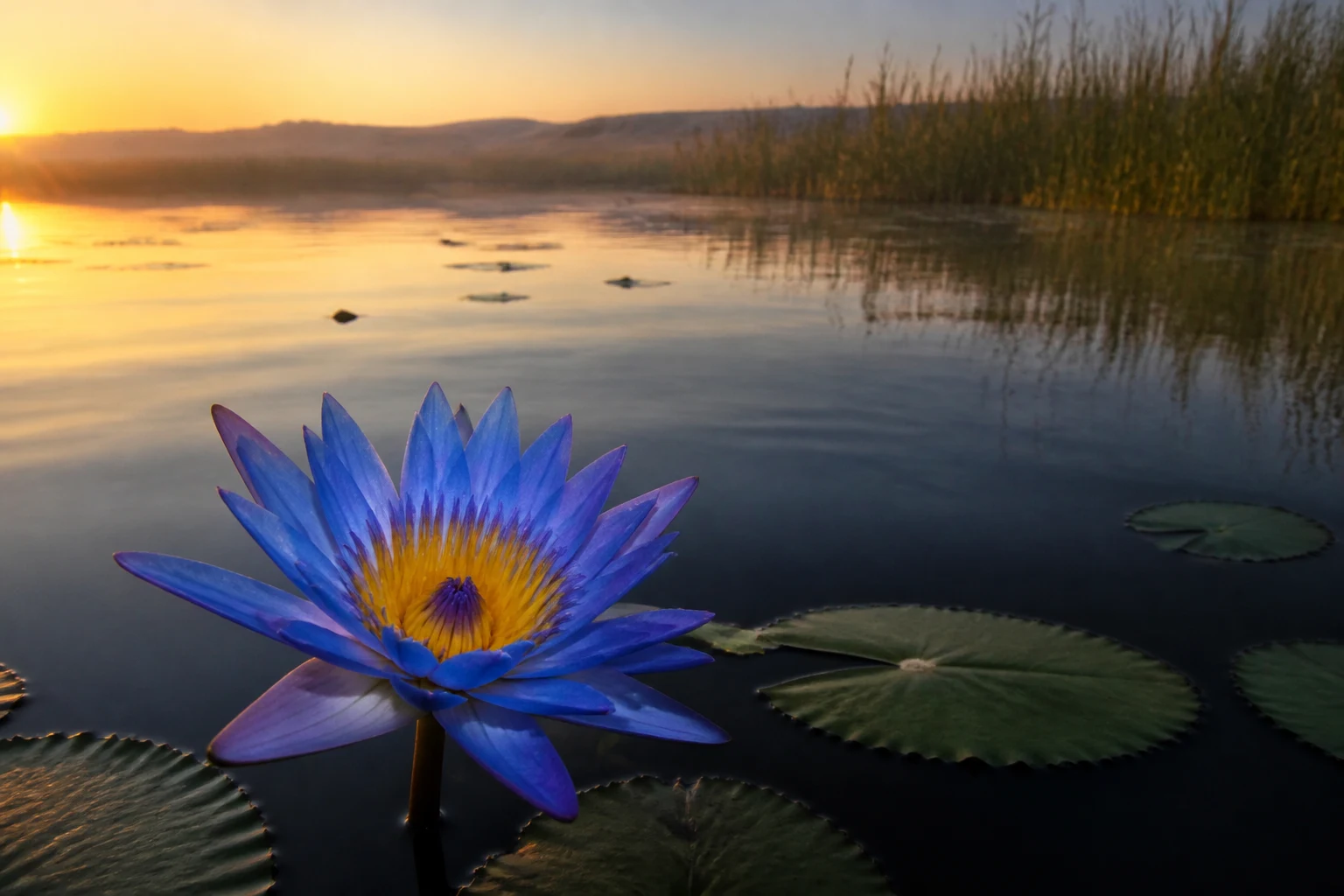
The blue flower rises from warm, dark water and opens toward the first hard light of morning. Widely called Nymphaea caerulea, it is a water lily rather than a true lotus of the genus Nelumbo; Plants of the World Online accepts the name Nymphaea nouchali var. caerulea. In ancient Egyptian imagery, the flower's emergence from water offered a powerful language for dawn, renewal, fragrance, and becoming. Its spiritual gravity comes from that repeated motion: a closed bud, a returning sun, and a form that appears again after darkness.
TL;DR
Egyptian blue lotus symbolism centers on renewal, solar emergence, fragrant beauty, and the postmortem transformation named in Book of the Dead Spell 81. The blue water lily has a real botanical identity and a complicated modern trade history, so contemporary witchcraft is strongest when it distinguishes present-day correspondence from ancient Egyptian religion and avoids ingesting, inhaling, or concentrating unregulated products.
Key Facts
- Scientific identity: The flower commonly sold as Egyptian blue lotus is widely known as Nymphaea caerulea; Kew accepts Nymphaea nouchali var. caerulea in the water-lily family, Nymphaeaceae.
- Living habitat: Kew records its native range from Egypt to southern Africa, the southern Arabian Peninsula, and Comoros, in wet tropical settings.
- Historical anchor: Book of the Dead Spell 81 is a spell for assuming the form of a lotus, joining floral form with a deceased person's transformation.
- Egyptian religious imagery: The flower's dawn opening and watery setting supported solar and rebirth imagery in ancient Egyptian art and mortuary material.
- Modern correspondence: Present-day Pagan practice often uses its image for dreamwork, renewal, creative return, and reflective descent, without claiming an unchanged ancient ritual.
- Material limit: Products labeled blue lotus vary substantially; botanical names and labels do not establish what a commercial extract or vaping liquid contains.
Q&A
What does Egyptian Blue Lotus symbolize in modern witchcraft?
In modern witchcraft, the blue water lily symbolizes return after darkness, the recovery of a buried image, and the discipline of meeting dawn with a changed mind. Its correspondence can hold dream journals, seasonal renewal, quiet altar work, and creative repair because the flower's historic visual language joins water, opening, and the renewed sun. That is a contemporary spiritual use, not a claim that the plant compels visions or controls the dead.
What does Book of the Dead Spell 81 say about the flower?
Book of the Dead Spell 81 is a spell for assuming the form of a lotus, placing floral transformation within an Egyptian funerary text. The spell matters because it gives rebirth symbolism a named textual home: the deceased speaks through a change of form rather than through an abstract promise of immortality. It does not prove that the flower was a chemical key to an altered state or that every image of a lotus records the same rite.
Is Egyptian Blue Lotus safe to ingest, burn, or vape?
Blue lotus products should not be ingested, burned, inhaled, or treated as predictable botanical preparations. Modern analyses found major differences between authentic extracts and commercial products, while forensic investigations have identified synthetic cannabinoids in some seized vaping materials associated with blue-lotus labeling. A photograph, botanical illustration, living cultivated plant, or unprocessed symbolic offering can carry the correspondence without turning uncertain material into a bodily experiment.
Egyptian Myth: Spell 81 and the Form of the Lotus
Book of the Dead Spell 81 places the lotus in a precise Egyptian funerary context: it is a spell for assuming the form of a lotus. The ancient Egyptian Book of the Dead was not one fixed volume but a changing collection of texts placed with individuals across long periods; that variety matters when reading any single spell. In this spell, the flower is not a generic decoration. It is a form through which the deceased imagines movement, emergence, and renewed presence.
The image carries force because a water lily rises from mud and water into light without denying the water beneath it. Egyptian religion made repeated use of creation, dawn, and regeneration images, and the lotus became one visible vessel for those themes. A modern reader can feel the severity in that motion: rebirth does not mean skipping death, grief, or night. It means taking a new shape after passing through them.
The spell also calls for restraint. It does not authorize a fantasy of ancient Egyptian priests brewing a universal trance drink or forcing access to an underworld. Ancient Egyptian mortuary religion had its own sacred texts, objects, places, and ritual specialists. Its lotus imagery deserves to remain particular to those worlds even when it inspires present-day reflection.
Nefertem, Dawn, and Lotus Symbolism
Nefertem's connection with the lotus joins floral fragrance and first sunlight in ancient Egyptian religious imagery. The god appears in several periods and places as a figure of perfume, beauty, and the bloom that rises from primeval water. This is why the flower's opening is more than a pretty scene: it can signal a world made fresh at dawn, with light arriving from the wet depth beneath it.
Objects make that symbolism material. A string of blue lotus flowers and lily pendants from Amarna, dated about 1347 to 1330 BCE, shows that floral forms moved through adornment as well as painted tomb and temple imagery. A Book of the Dead papyrus at the Metropolitan Museum likewise depicts a lotus on an offering table within a mortuary composition. Such objects support a specific conclusion: lotus imagery belonged to Egyptian visual and funerary worlds. They do not license a single flattened meaning for every flower, every dynasty, or every person.
For modern Pagan devotion, Nefertem's flower can become a correspondence for beginnings that have weight. Blue cloth, a water vessel, a drawing of a lily, and a dawn-written intention can mark a return to breath after a hard season. The practice belongs openly to the present. It honors the old image by refusing to pretend that a private altar reconstructs ancient Egyptian temple religion.
Modern Dreamwork and Devotional Practice
Modern dreamwork with the blue water lily works best as a symbolic discipline of attention, memory, and return. The flower can stand beside a journal before sleep, a clean bowl of water at sunrise, or a sketch made after a difficult dream. In each case, the object is a reminder to notice what surfaced, what remained closed, and what deserves another morning before it is interpreted.
This correspondence has an edge. Water does not reveal everything at once, and a bud does not become a blossom by being torn apart. Practitioners may use the image when creativity has gone still, when grief has narrowed the inner horizon, or when a dream repeats without yielding its meaning. The work is to record, wait, and return, not to demand a prophecy on command.
The Egyptian blue water lily also invites a boundary around claims of inheritance. It is appropriate to say that a contemporary practitioner finds renewal or dreamwork in the flower. It is not appropriate to say that an undocumented modern method is a preserved Egyptian rite, that a commercial product grants sacred authority, or that a plant can replace care for trauma, illness, or crisis. Clear naming keeps devotion vivid instead of turning it into borrowed certainty.
Botanical Identity and the Question of Names
Botanical identity begins with a useful correction: Egyptian blue lotus is a water lily, not a true lotus. The name Nymphaea caerulea remains common in scholarship, trade, and popular writing, while Kew's Plants of the World Online accepts Nymphaea nouchali var. caerulea. Both names appear because taxonomy and ordinary language do not always travel at the same pace.
The accepted Kew record places the plant in Nymphaeaceae, with a native range spanning Egypt to southern Africa, the southern Arabian Peninsula, and Comoros. It is an aquatic herb with rhizomes, floating leaves, and flowers carried above water. The common phrase "blue lotus of the Nile" therefore carries history and atmosphere, but it should not erase the plant's wider African and Arabian range or turn a trade label into a guaranteed identity.
Correct naming is part of the flower's magic in the oldest sense: it identifies what is being addressed. A photograph of a blue water lily, a pressed floral image, or a cultivated specimen can invite contemplation without requiring a wild-collected plant. The more precisely the plant is named, the less room there is for lookalikes, misleading labels, and manufactured mystique.
Material Record, Chemistry, and Product Variability
Modern chemical research shows that products sold as blue lotus cannot be assumed to share one reliable profile. A 2023 analysis of six authentic extracts and eleven commercial products found that the commercial samples did not resemble the authentic extracts in aroma or composition. The same study reported apomorphine as absent and nuciferine as present only in trace amounts in the authentic extracts it tested, which directly challenges sweeping claims that every flower or extract reliably produces a particular state.
That difference matters because internet descriptions often present a plant name as if it guaranteed potency, purity, or an ancient recipe. It does not. A label can name a species, an imagined effect, or a marketing category while concealing a mixture with a different composition. The relevant fact is not that the flower is weak or strong in the abstract. It is that material identity, plant part, extraction, and commercial handling all change what is actually present.
The flower's spiritual correspondence does not need inflated chemistry to remain potent. Its blue petals, round leaves, waterborne roots, and daily opening already offer a complete material language for renewal. Respect for the plant begins with refusing to make its name carry promises that research cannot support.
Correspondence Table: Water, Dawn, and Return
The table below separates observable botanical or historical material from present-day spiritual correspondence.
| Material or record | Documented context | Modern spiritual correspondence |
|---|---|---|
| Water-lily identity | Nymphaea nouchali var. caerulea is accepted by Kew; Nymphaea caerulea remains widely used. | Naming what is actually present before assigning meaning. |
| Rising flower | The plant's flowers open above water, a visible feature behind its long visual association with emergence. | Renewal, surfacing, and returning to a difficult truth. |
| Book of the Dead Spell 81 | The spell is for assuming the form of a lotus in an Egyptian funerary text. | Transformation after loss, without claiming control over death. |
| Nefertem and lotus imagery | Egyptian religious imagery connects the flower, fragrance, and the first light of dawn. | Dawn devotion, beauty with discipline, and creative reawakening. |
| Commercial label | Chemical studies show considerable variation between materials sold under blue-lotus names. | Discernment, boundaries, and refusing false certainty. |
Safe Reverence and Product Boundaries
Safe reverence for Egyptian blue lotus means leaving unregulated extracts, resins, and vaping liquids outside devotional practice. A 2024 forensic study examined seized materials connected with blue-lotus or valerian-root labeling and found synthetic cannabinoids in some cases; it does not establish that every product is adulterated, but it makes labels an inadequate safety guarantee. Unknown product chemistry belongs to the laboratory and medical setting, not an altar experiment.
The strongest way to keep this flower close is also the least extractive. Study a museum object, keep a botanical illustration, grow a correctly identified aquatic plant where it is legal and appropriate, or set a bowl of clear water beside a written intention. These acts preserve the core correspondence of water, light, and return while protecting bodies from unverified substances.
The flower asks for a clear threshold. It can be a sign of rebirth without becoming a shortcut to transcendence, a source of beauty without becoming a commodity, and a living symbol without becoming a claim about another person's religion or health. That limit is not a retreat from magic. It is the line that lets the image remain bright, specific, and alive.
Sources
- Author: Thomas George Allen. Title: Spells 80-81. Publisher/Archive: University of Chicago Institute for the Study of Ancient Cultures. Date/Era: 1974 edition.
- Author: Royal Botanic Gardens, Kew. Title: Nymphaea nouchali var. caerulea. Publisher/Archive: Plants of the World Online. Date/Era: Current institutional taxonomic record, accessed 2026.
- Author: The Metropolitan Museum of Art. Title: String of blue lotus flowers and lily pendants. Publisher/Archive: The Met Collection. Date/Era: New Kingdom, Amarna Period, ca. 1347-1330 BCE.
- Author: Dosoky, N. S., et al. Title: Chemical Composition, Market Survey, and Safety Assessment of Blue Lotus Extracts. Publisher/Archive: Molecules. Date/Era: 2023.
- Author: Ellis, A. L., et al. Title: Synthetic Cannabinoid Identification in Cases Associated with Blue Lotus and Valerian Root Vaping Products. Publisher/Archive: Journal of Analytical Toxicology. Date/Era: 2024.