Preserved article · Plants & Herbs
Holly Symbolism | Pagan Meaning, Protection & Folklore
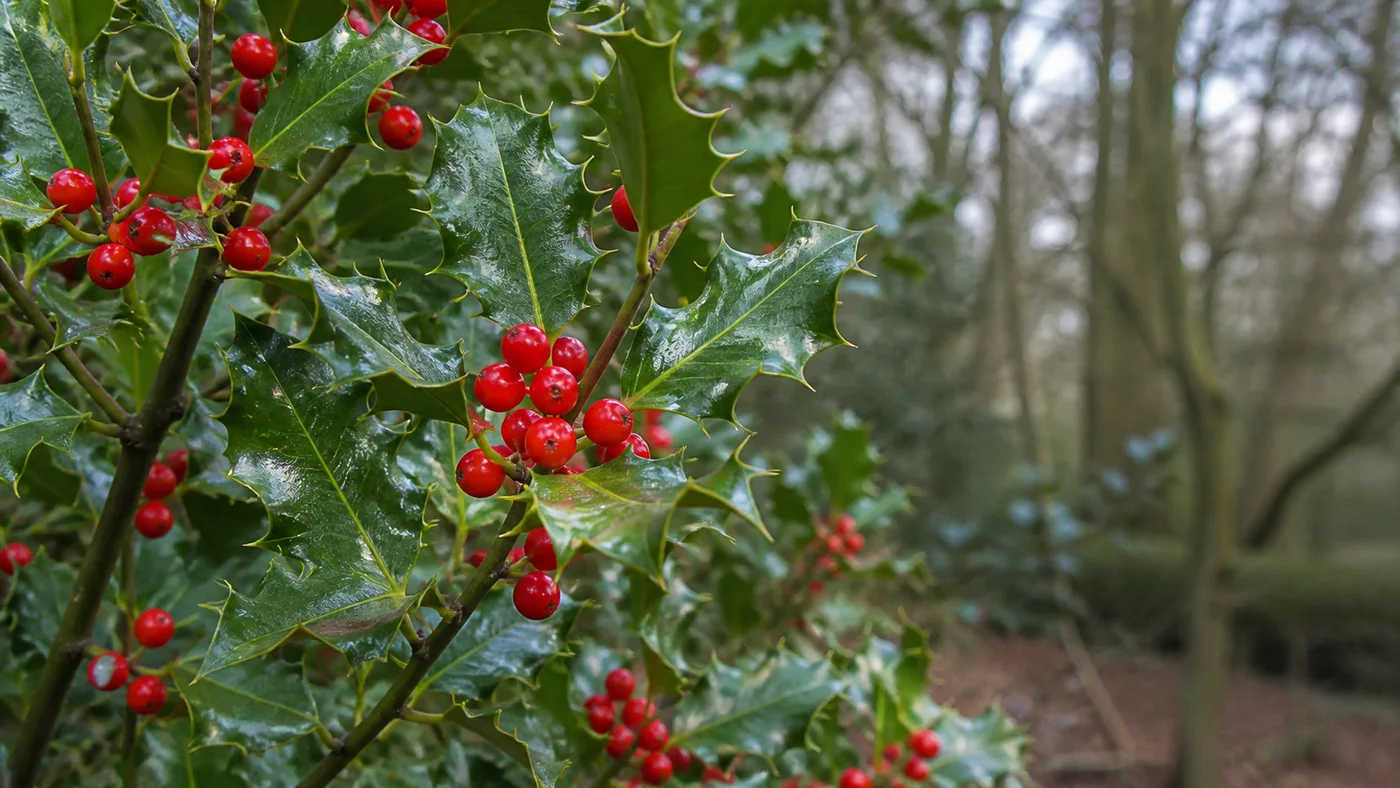
Holly symbolism begins with a winter boundary: dark, glossy leaves that stay present when much of the surrounding hedge is bare, and red fruit that makes the branch conspicuous against low light. Common holly, Ilex aquifolium, is the evergreen European species behind much British and Irish seasonal imagery. In modern Pagan practice, it is often read as a correspondence for endurance, guardedness, sovereignty, and the work of holding a line through the difficult half of the year. That is a living spiritual interpretation, not a claim that the plant guarantees protection or carries a single ancient meaning.
The sharpness of holly’s image is part of its force. A leaf can look polished and celebratory from a distance, then demand care when it is picked up. For a practitioner, that contrast can become a useful discipline: beauty need not mean access; welcome can exist beside a clear perimeter. Historical sources give holly a different, more complicated record. Roman writers used the name aquifolius for a thorny evergreen, while later commentators questioned whether every classical use can be identified with modern Ilex aquifolium. Modern stories of a Holly King and Oak King are later Pagan constructions, shaped especially by twentieth-century writing, rather than a securely documented ancient Celtic myth.
TL;DR
Holly symbolism in contemporary witchcraft commonly concerns boundaries, winter endurance, and guarded welcome. Its historical record includes Roman aquifolius lore and later British seasonal custom, while the Holly King is best described as a modern Pagan seasonal image rather than an ancient Celtic certainty.
Key Facts
- Scientific identity: Common holly is Ilex aquifolium L., an evergreen shrub or small tree in the family Aquifoliaceae.
- Range and form: Plants of the World Online records the species as native to Europe and north-west Africa; the Royal Horticultural Society describes its dark, glossy, often strongly spiny leaves.
- Roman source: Margaret Grieve’s A Modern Herbal reports Pliny’s claims for aquifolius, while also noting that later commentators disputed the exact botanical identification.
- Modern correspondence: Boundary-setting, resilience, seasonal change, and watchfulness are present-day Pagan associations, not universal historical facts.
- Holly King caution: The Holly King/Oak King polarity belongs to modern Pagan and Wiccan storytelling influenced by Robert Graves and later writers.
- Safety boundary: Holly fruit is ornamental, not food. Handle prickly foliage with protection and keep berries away from children and animals.
Q&A
What does holly symbolize in modern witchcraft?
In modern witchcraft, holly often symbolizes a defended threshold: the choice to be hospitable without becoming unprotected. Its evergreen leaves can support reflection on steadiness in winter, while their spines make an apt visual metaphor for consent, limits, and the right to refuse intrusion. These are contemporary correspondences; individual traditions may use them differently.
What does Pliny say about holly?
Pliny the Elder is reported by Margaret Grieve to have attributed protective and medicinal powers to a thorny evergreen called aquifolius. That report is valuable as evidence of a Roman-era plant tradition, but it is not evidence that the claims work, and Grieve records that later commentators disputed whether the plant was precisely the common holly recognized today.
Is common holly safe to handle?
Common holly is best handled as an ornamental plant with sharp foliage rather than as a food or remedy. The Royal Horticultural Society advises that its decorative fruits should not be eaten and recommends protective handling. If a person or animal may have eaten berries, contact local poison-control or veterinary advice promptly.
Roman Aquifolius and the Language of Protection
Roman aquifolius lore shows how a plant can gather protective meaning without proving a supernatural mechanism. In A Modern Herbal, Margaret Grieve summarizes claims attributed to Pliny: branches of aquifolius were said to offer protection against misfortune and to influence weather or wild beasts. Read carefully, those statements tell us that Roman natural-history writing joined observation, remedy, omen, and protective custom in the same textual world. They do not establish that a holly branch can control weather, repel danger, or alter an animal’s behavior.
That distinction matters for modern folk practice. The historical record can be approached with respect without being made into a promise. A branch used as a seasonal emblem can invite a person to consider where they need shelter, what obligations are becoming invasive, or how to endure a hard season. It cannot replace practical safety, medical care, legal help, or a direct conversation with someone who has crossed a boundary.
The identification itself also deserves restraint. The Latin word aquifolius has been connected to the spiny-leaved holly known in Britain, and the resemblance is compelling. Yet Grieve explicitly notes disagreement among later commentators about the classical plant. Good folklore writing leaves that uncertainty visible. Instead of treating a Roman passage as a perfect taxonomic label, it can say: this is a historical tradition attached to a thorny evergreen, transmitted through a source with an identification question.
For Pagan readers, this is not a weakness in the story. It is an invitation to be exact about the kind of authority at hand. The authority is textual and cultural: people wrote down a protective reading of a particular kind of evergreen. The authority is not a laboratory result, nor a universal instruction for every holly species, nor proof that modern ritual uses reproduce a Roman practice.
British Isles Winter Folklore and Seasonal Custom
British Isles holly folklore is strongest when described as a layered winter custom rather than a single unbroken religion. Common holly became familiar in hedges, woodland margins, gardens, and winter decorations. Its leaves remain green through cold weather, and fruit on female plants can stand out in red after pollination. Those visible qualities made it especially available for seasonal symbolism: persistence, colour amid scarcity, and a living edge around a home or path.
Grieve records a later explanation that Romans used evergreen boughs during Saturnalia and that this custom helped shape later Christmas greenery. That is a useful historical lead, but it should not be turned into a simple claim that every modern holly decoration is a direct Roman survival. Customs move through trade, church calendars, local habit, gardening, and family memory. The same plant can mean welcome in one household, grief in another, and nothing ritual at all in a third.
Folklore also works through place. A holly tree growing in a managed hedge, a clipped garden specimen, and a wild-looking tree on a woodland edge all produce different encounters. In a winter landscape, the plant’s visual steadiness may be enough to create an association with survival. It is not necessary to add invented priesthoods, sacrificial scenes, or a universal pre-Christian law to make that observation spiritually useful.
If you keep a seasonal journal, holly can be a prompt rather than a command. Notice where you have encountered it, what the weather was like, and what the plant’s form suggested in that particular place. Record the difference between something you observed, something a source documented, and a meaning you personally made. That practice preserves the plant’s presence without pretending that every private association is ancient folklore.
The Holly King as a Modern Pagan Myth
The Holly King is a modern Pagan seasonal image, not a securely attested ancient Celtic deity or a documented Iron Age ritual cycle. The familiar tale of a Holly King and Oak King exchanging power at the solstices is often linked to Robert Graves’s 1948 book The White Goddess and was developed further in later Wiccan and Pagan writing. It has become meaningful to many people, but its modern formation should remain part of the story.
That transparency makes the image more usable, not less. The Holly King can be treated as a poetic figure for winter’s protective, inward-looking qualities: preserving strength, keeping a smaller fire, taking stock, and making limits visible. The Oak King can then be a paired image for expansion, outward growth, and a later season. Neither figure needs to be presented as an ancient historical personage for the contrast to help a modern practitioner mark the year.
The danger comes when a compelling story is made to erase living cultures or historical complexity. “Celtic” is not a catch-all label for every practice that feels old, green, or northern. The peoples, languages, and religious histories of the British Isles and continental Europe were varied, changed over time, and were recorded unevenly. A careful modern devotee can say, “I work with the Holly King as a contemporary seasonal symbol,” instead of claiming an unbroken inheritance that the evidence does not establish.
This approach also leaves room for disagreement. Some practitioners may find the paired kings deeply resonant; others may prefer to work with actual local weather, trees, ancestors, or saints’ days without assigning a masculine ruler to the season. A correspondence is an offered lens. It should support attention, not demand belief.
Used this way, the myth is a seasonal vocabulary rather than a historical test. It gives a group or solitary practitioner a way to speak about contraction and return while leaving real history open to correction, fuller evidence, and many local voices.
Modern Devotion and Boundary Practice
Modern devotion with holly is most grounded when it names the work plainly: setting a boundary, keeping a promise to oneself, or acknowledging that rest is protective. The plant’s spined leaf offers a visual language for those matters. It can accompany reflection on a relationship that needs clearer terms, a household practice that creates calm, or a decision to make fewer demands on oneself during a hard season.
The key is to keep symbol and action in their proper places. A holly correspondence may help a person articulate a boundary; the boundary itself may still require a written message, a changed password, a conversation, professional support, or distance from someone unsafe. Ritual language should sharpen practical judgment, not replace it.
For a low-impact practice, a photograph, botanical drawing, or responsibly obtained fallen leaf can be used as a focus for journaling. Ask what is being protected, what is welcome, and where the limit belongs. Then write one practical, non-magical step that respects the answer. No cutting, burning, ingesting, smoke work, or special preparation is required to engage the image.
This is also a useful place to resist the market habit of making every herb into a product. Holly is not a guarantee of protection, a treatment, or a substitute for a safety plan. Its value in modern Pagan practice can be contemplative: it trains the eye to see the difference between an open door and an undefended one.
Botanical Reality of Ilex aquifolium
Common holly is an evergreen member of the order Aquifoliales and the family Aquifoliaceae. Plants of the World Online accepts the scientific name Ilex aquifolium L. and records a native range in Europe and north-west Africa. The species is separate from American holly, Ilex opaca, which belongs to the same genus but has a different native range and should not be silently substituted in a discussion of British and Irish seasonal lore.
The Royal Horticultural Society describes common holly as a large evergreen shrub or small tree with dark, glossy leaves that are often strongly spiny. Plants are usually male or female. Female plants can carry red berries after pollination, so a branch full of fruit is not merely “winter decoration”; it is part of the reproductive life of the plant. That detail is worth keeping in view when gathering material or photographing a tree.
Not every leaf on one plant has identical spines. Holly leaves can vary with age and position, which is one reason the plant has such a recognizable yet changeable silhouette. Its visual defenses are not an instruction to mythologize every feature. They are, however, a clear material basis for why modern readers connect holly with guardedness and a protected edge.
Botany can deepen correspondence without being forced to prove it. The evergreen habit gives us a visible fact: holly remains leafy through winter. The spiritual interpretation is a separate human response: persistence, watchfulness, or renewal. Keeping the two statements distinct lets the plant remain real while leaving room for meaning.
Correspondence Table: Material Features and Modern Meanings
The following table offers modern, optional correspondences rather than claims about ancient universal belief or botanical effects.
| Material feature | Documented botanical context | Modern Pagan reflection |
|---|---|---|
| Evergreen leaves | Ilex aquifolium retains dark, glossy foliage through winter. | Endurance, continuity, and keeping what is essential. |
| Often spiny margins | The RHS describes leaves as often strongly spiny. | Boundaries, discernment, and a defended threshold. |
| Red fruit on female plants | Female plants can bear berries after pollination. | Visibility in darkness, seasonal change, and the consequences of care. |
| Hedge and woodland presence | The species is familiar in European landscapes and cultivation. | Home, place-based attention, and protecting a shared edge. |
| Variation within the plant | Leaf shape and spines can vary across a tree. | Flexible boundaries: firm where needed, gentle where safe. |
The word “correspondence” is important here. It describes a chosen relationship between a material feature and a spiritual idea. It does not say that a spine automatically creates energetic protection or that a berry carries a promised outcome. A correspondence becomes ethical when it stays honest about its source and does not make health, legal, financial, or interpersonal guarantees.
Safe Handling and Winter Habitat
Holly belongs first to living habitat. If you encounter it outdoors, leave enough foliage and fruit for the plant, for the landscape, and for wildlife. Do not harvest from protected land, private gardens, or public plantings without permission. If seasonal greenery is wanted, choose material from a verified grower or use a durable non-plant representation such as a drawing, print, or photograph.
The berries should not be eaten. The Royal Horticultural Society lists common holly’s fruits as ornamental and advises protective handling; its sharp leaves can also scratch skin. Wear gloves or other suitable protection when pruning, arranging, or disposing of prickly material, and keep loose berries and cuttings inaccessible to children and pets. Avoid treating a plant article as medical, veterinary, or poison-control advice.
If ingestion is suspected, do not wait for a spiritual interpretation to settle the question. Contact your local poison-control service, healthcare professional, or veterinarian and follow their instructions. In an emergency, use local emergency services. That practical limit is wholly compatible with holly’s modern symbolic lesson: real protection begins with clear attention to what is actually in front of you.
Sources
- Author: Royal Botanic Gardens, Kew. Title: Ilex aquifolium L.. Publisher/Archive: Plants of the World Online. Date/Era: accessed 2026.
- Author: Royal Horticultural Society. Title: Ilex aquifolium. Publisher/Archive: RHS. Date/Era: accessed 2026.
- Author: Grieve, Margaret. Title: Holly. Publisher/Archive: A Modern Herbal. Date/Era: 1931.
- Author: Pliny the Elder. Title: The Natural History, Book XVI. Publisher/Archive: Perseus Digital Library, translated by John Bostock and H. T. Riley. Date/Era: Roman imperial period; translation 1855.
- Author: Graves, Robert. Title: The White Goddess. Publisher/Archive: Penguin Books. Date/Era: 1948.