
Greek · God or goddess · Certain
Hecate
Ἑκάτη · Hekate
Pronunciation: /he.ká.tɛː/ · heh-KAH-teh
Research and editorial review by Cody Manes · Reviewed 2026-08-30
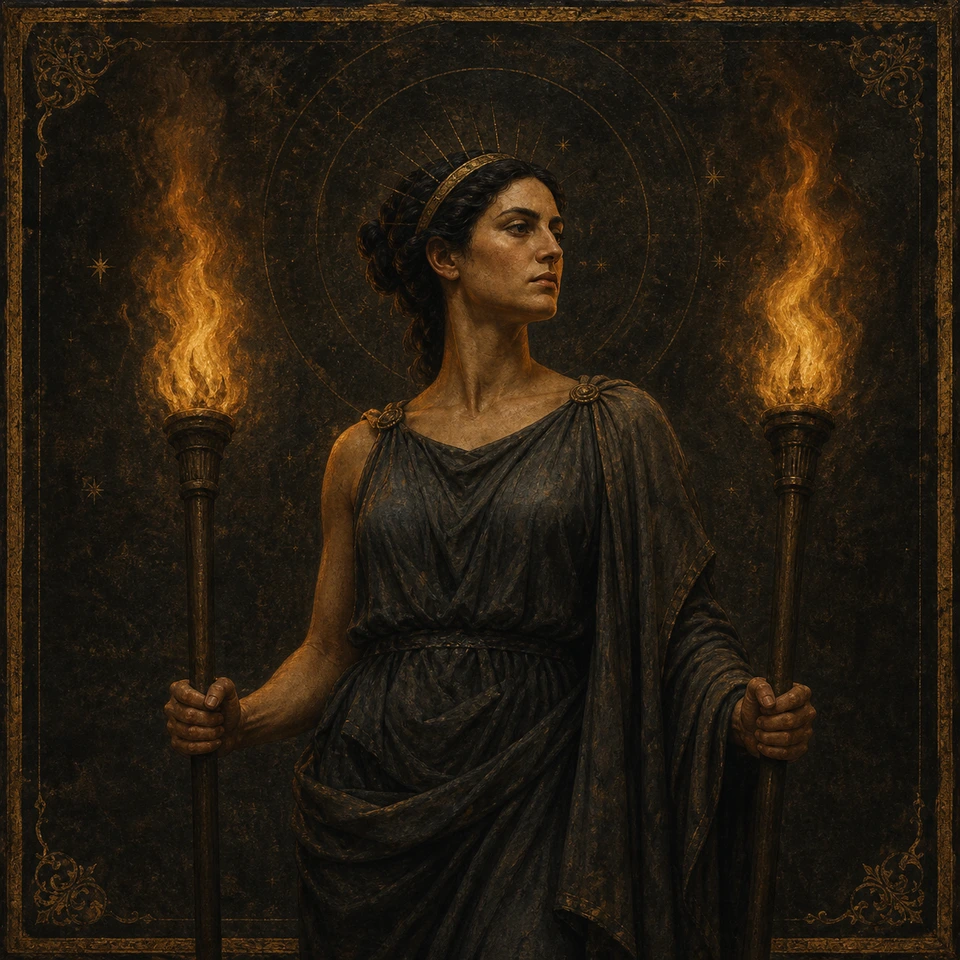
Commanding broad Hesiodic honors, Hecate provides torch-bearing guidance across ancient thresholds and deeply rooted local mysteries. Her authority spans from established civic patronage at Lagina to a later reputation for terrifying ritual epiphanies.
Overview
Hecate is often introduced as a goddess of witchcraft, but that title catches only one late and powerful strand of a much longer divine life. Her Greek name is Ἑκάτη, Hekate. In Hesiod’s Theogony she is the only child of Asteria and Perses, and Zeus leaves her ancient portion untouched. She can favor speech in assembly, judgment, battle, athletic contest, horsemen, fishers, herds, and households. This is not a narrow night goddess. It is a divine figure whose reach crosses public honor, livelihood, and prosperity.
The Homeric Hymn to Demeter gives her a quieter but unforgettable place. Hecate hears Persephone cry out when the earth opens. She meets the searching Demeter with torches and directs her toward Helios, the witness who saw the seizure. When Persephone returns under the divided settlement, Hecate embraces her and becomes her attendant and companion. She stands beside a broken family as hearer, guide, and enduring presence, not as Persephone’s mother or hidden double.
Art prevents the modern triple image from erasing earlier bodies. A name-inscribed Attic hydria in the British Museum shows one mature woman with two torches, Doric dress, and a radiated fillet. A hydria at the Metropolitan Museum places a torch-bearing Hecate within Persephone’s abduction. Pausanias describes a one-faced, one-bodied cult image at Aegina, then credits Alcamenes with an early Athenian image formed from three joined figures. Both single and triple forms are ancient. Neither explains the goddess by itself.
Cult is equally local. Aegina celebrated mysteries every year. In Classical Athens, Aristophanes could joke about the monthly meal sent to Hecate and eaten by the poor, a glimpse of the suppers left at crossroads near the month’s end. In Caria, Lagina built a different world. Its monumental sanctuary served Stratonikeia, and its Hecate acted as civic patron. Priests funded feasts and repairs, children sang hymns, and a key-bearer carried a key between sanctuary and city during an annual festival.
The key is real, but certainty stops there. Lagina’s inscriptions do not say exactly what it opened, and surviving local images do not place it in Hecate’s hand. The goddess there remains single-bodied and politically charged. The later Hekatesia-Romaia even joins her with Roma in a festival of alliance and public memory. A doorstep offering, an island mystery, and a state procession all belong to Hecate’s history, but not to one interchangeable rite.
Later narrative brings danger close. Pseudo-Apollodorus has Hecate kill the Giant Clytius with torches. In Apollonius’ Argonautica, Medea tells Jason how to make a hazardous night invocation before the goddess arrives amid shaking ground, flame, and barking dogs. These are literary scenes, not instructions. The torch guides in the Demeter hymn, identifies the goddess in art, strikes an enemy in mythography, and burns through an epic rite. Its meaning changes with the scene.
Hecate now receives active devotion in Hellenic polytheism, witchcraft, occult practice, and independent Pagan religion. One international network, the Covenant of Hekate, explicitly describes itself as a collaboration among devotees from varied traditions rather than a single tradition speaking for all. That living diversity deserves the same care as ancient difference. Hecate is not one timeless list of moons, stones, herbs, keys, dogs, and spells. She is a goddess met in poems, pots, crossroads, mysteries, civic stone, frightening story, and living prayer, with every encounter carrying its own date and voice.
Canonical identity
Canonical Identity
Hecate is firmly established as an ancient Greek goddess, not a catch-all title for witchcraft, ghosts, the Moon, or a generalized threefold feminine principle. Surviving historical evidence encompasses both single-bodied and triple-bodied representations, all belonging to one continuous divine history. In the Argonautica, she is specifically invoked under the title Brimo (the Terrible One), but this represents a localized poetic choice for a night scene rather than a universal replacement for her name. She strictly retains a separate identity from Persephone, Artemis, Selene, Roman Diana, and Roman Trivia, unless a specific dated text explicitly merges them.
Linguistic Identity
Hecate is the conventional English rendering of the Greek Ἑκάτη (Hekate), which also serves as a precise alternative transliteration. A qualified fifth-century BC Attic reconstruction indicates /he.ká.tɛː/ (approximately heh-KAH-teh). This phonetic guide captures the syllable breaks but cannot fully replicate the ancient pitch accent or vowel lengths.
Sources and evidence
TEXTUAL · Supported
The Greek headword is Ἑκάτη, transliterated Hekate, with a qualified fifth-century BC Attic reconstruction /he.ká.tɛː/.
- Source
- Wiktionary contributors, Ἑκάτη
- Reviewed edition
- Live entry for Ἑκάτη reviewed 2026-08-30 · Wiktionary
- Exact locator
- Entry Ἑκάτη · Section Ancient Greek pronunciation
- Scope
- Classical Greece · Attica
- Authority
- Wiktionary, Ἑκάτη entry
- Certainty
- Qualified historical reconstruction
The readable guide approximates the vowels and stress but cannot reproduce ancient pitch accent.
Open exact reviewed sourceTEXTUAL · Supported
Apollonius invokes Hecate as Brimo, the Terrible One, inside the Colchian night rite.
- Source
- Apollonius Rhodius; edited by George W. Mooney, Argonautica (1912)
- Reviewed edition
- George W. Mooney edition of the Argonautica, 1912 · edited by George W. Mooney · Perseus Digital Library / Scaife ATLAS
- Exact locator
- Book 3 · Line 1211-1212
- Scope
- Hellenistic Greek world · Colchis
- Authority
- Apollonius Rhodius, Argonautica
- Certainty
- Certain within the named witness
Brimo is a source-scoped poetic title and not a safe replacement name in every context.
Open exact reviewed source7 reviewed sources for this section
- Wiktionary contributors, ἙκάτηLive Ancient Greek lexical entry · Wiktionary
- Apollonius Rhodius; edited by George W. Mooney, Argonautica (1912)The Argonautica of Apollonius Rhodius, London, 1912 · Perseus Digital Library / Scaife ATLAS
- Pausanias; Spiro Greek edition and Jones/Ormerod translation volumes, Description of Greece (1935)Perseus CTS edition corpus, 1903-1935 · Perseus Digital Library / Scaife ATLAS
- Amanda Herring, Hekate of Lagina: a goddess performing her civic duty (2022)Anatolian Studies 72 (2022), pages 141-165 · British Institute at Ankara / Cambridge University Press
- British Museum, British Museum CollectionLive official museum collection · British Museum
- The Metropolitan Museum of Art, Open Access Collection and Collection APILive collection data and eligible public-domain images · The Metropolitan Museum of Art
- Anonymous Homeric Hymns; edited and translated by Hugh G. Evelyn-White, Homeric Hymns (1914)Hesiod, the Homeric Hymns and Homerica, London and New York, 1914 · Perseus Digital Library / Scaife ATLAS
Culture, tradition, period, and place
Hecate moves through a wide Greek world without looking the same in every place. Hesiod gives her an Archaic genealogy and astonishingly broad honors. The Homeric Hymn to Demeter places her beside Demeter and Persephone. Classical Attic pottery gives her a named, single-bodied torch-bearing figure. Aegina has annual mysteries and a cult image. Hellenistic epic sends her into Medea’s Colchian night, while Lagina in Caria raises her as the public patron of Stratonikeia.
These settings cannot be pressed into one timeless cult. Colchis is an epic landscape, Eleusis a hymnic and sanctuary setting, Aegina a local island cult, and Lagina a monumental civic sanctuary linked to Stratonikeia by road and procession. Her historical reach is real, but every claim still belongs to a language, period, and place.
Sources and evidence
SCHOLARLY INTERPRETATION · Supported
The secure monumental and inscriptional picture of Hecate at Lagina begins in the Hellenistic period, with evidence for her political role between 197 and 167 BC and fuller cult evidence from the second century BC onward.
- Source
- Amanda Herring, Hekate of Lagina: a goddess performing her civic duty (2022)
- Reviewed edition
- Anatolian Studies 72 (2022), pages 141-165 · British Institute at Ankara / Cambridge University Press
- Exact locator
- Page 145-146
- Scope
- Hellenistic Greek world · Lagina in Caria
- Authority
- Amanda Herring, Hekate of Lagina
- Certainty
- Certain within the named witness
Earlier origins remain debated; the later sanctuary cannot prove an unchanged prehistoric cult.
Open exact reviewed sourceSCHOLARLY INTERPRETATION · Supported
Modern proposals for Hecate’s place of origin include Greece, Caria, Thrace, and Thessaly, but the surviving evidence does not settle one exclusive birthplace for her cult.
- Source
- Amanda Herring, Hekate of Lagina: a goddess performing her civic duty (2022)
- Reviewed edition
- Anatolian Studies 72 (2022), pages 141-165 · British Institute at Ankara / Cambridge University Press
- Exact locator
- Page 145-146
- Scope
- Modern classical scholarship · Lagina in Caria
- Authority
- Amanda Herring, Hekate of Lagina
- Certainty
- Scholarly question remains unresolved
Uncertainty is preserved rather than turning a debated origin into biography.
Open exact reviewed source6 reviewed sources for this section
- Hesiod; edited and translated by Hugh G. Evelyn-White, Theogony (1914)Hesiod, the Homeric Hymns and Homerica, London and New York, 1914 · Perseus Digital Library / Scaife ATLAS
- Anonymous Homeric Hymns; edited and translated by Hugh G. Evelyn-White, Homeric Hymns (1914)Hesiod, the Homeric Hymns and Homerica, London and New York, 1914 · Perseus Digital Library / Scaife ATLAS
- Pausanias; Spiro Greek edition and Jones/Ormerod translation volumes, Description of Greece (1935)Perseus CTS edition corpus, 1903-1935 · Perseus Digital Library / Scaife ATLAS
- Amanda Herring, Hekate of Lagina: a goddess performing her civic duty (2022)Anatolian Studies 72 (2022), pages 141-165 · British Institute at Ankara / Cambridge University Press
- British Museum, British Museum CollectionLive official museum collection · British Museum
- Apollonius Rhodius; edited by George W. Mooney, Argonautica (1912)The Argonautica of Apollonius Rhodius, London, 1912 · Perseus Digital Library / Scaife ATLAS
Historical development
Hesiod’s Hecate is neither marginal nor confined to magic. Zeus preserves her older portion, and the poet lets her favor life in council, war, sport, fishing, herding, and the household. The Demeter hymn narrows the lens to a torchlit search and a lasting companionship with Persephone. Classical art then fixes a human figure who can be named without relying on later symbols.
Later centuries intensify thresholds, fright, magic, and multiple bodies, but they also produce Lagina’s singular civic patron. The sanctuary there becomes monumental in the Hellenistic period, with political offices, public protection, festivals, and Roman alliances. No secure evidence carries that exact form unchanged into deep prehistory. Her history is a sequence of local developments, not the gradual unveiling of one hidden modern archetype.
Sources and evidence
TEXTUAL · Supported
Hesiod says Zeus did not strip Hecate of her earlier portion and honored her across earth, sea, and starry heaven.
- Source
- Hesiod; edited and translated by Hugh G. Evelyn-White, Theogony (1914)
- Reviewed edition
- Hugh G. Evelyn-White edition and English translation in Hesiod, the Homeric Hymns and Homerica, 1914 · translated by Hugh G. Evelyn-White · edited by Hugh G. Evelyn-White · Perseus Digital Library / Scaife ATLAS
- Exact locator
- Entry Theogony · Line 411-428
- Scope
- Archaic Greece · Ancient Greece
- Authority
- Hesiod, Theogony
- Certainty
- Certain within the named witness
The praise is broad but does not make her sovereign of every realm.
Open exact reviewed sourceSCHOLARLY INTERPRETATION · Supported
The secure monumental and inscriptional picture of Hecate at Lagina begins in the Hellenistic period, with evidence for her political role between 197 and 167 BC and fuller cult evidence from the second century BC onward.
- Source
- Amanda Herring, Hekate of Lagina: a goddess performing her civic duty (2022)
- Reviewed edition
- Anatolian Studies 72 (2022), pages 141-165 · British Institute at Ankara / Cambridge University Press
- Exact locator
- Page 145-146
- Scope
- Hellenistic Greek world · Lagina in Caria
- Authority
- Amanda Herring, Hekate of Lagina
- Certainty
- Certain within the named witness
Earlier origins remain debated; the later sanctuary cannot prove an unchanged prehistoric cult.
Open exact reviewed sourceSCHOLARLY INTERPRETATION · Supported
At Lagina, Hecate served as civic patron of Stratonikeia through a monumental sanctuary, public offices, inscriptions, ceremonies, and protection of the city.
- Source
- Amanda Herring, Hekate of Lagina: a goddess performing her civic duty (2022)
- Reviewed edition
- Anatolian Studies 72 (2022), pages 141-165 · British Institute at Ankara / Cambridge University Press
- Exact locator
- Page 146, 156-160
- Scope
- Hellenistic Greek world · Lagina in Caria
- Authority
- Amanda Herring, Hekate of Lagina
- Certainty
- Certain within the named witness
This political form belongs to Stratonikeia and is not a template for every Hecate cult.
Open exact reviewed source6 reviewed sources for this section
- Hesiod; edited and translated by Hugh G. Evelyn-White, Theogony (1914)Hesiod, the Homeric Hymns and Homerica, London and New York, 1914 · Perseus Digital Library / Scaife ATLAS
- Anonymous Homeric Hymns; edited and translated by Hugh G. Evelyn-White, Homeric Hymns (1914)Hesiod, the Homeric Hymns and Homerica, London and New York, 1914 · Perseus Digital Library / Scaife ATLAS
- Pausanias; Spiro Greek edition and Jones/Ormerod translation volumes, Description of Greece (1935)Perseus CTS edition corpus, 1903-1935 · Perseus Digital Library / Scaife ATLAS
- Amanda Herring, Hekate of Lagina: a goddess performing her civic duty (2022)Anatolian Studies 72 (2022), pages 141-165 · British Institute at Ankara / Cambridge University Press
- British Museum, British Museum CollectionLive official museum collection · British Museum
- Apollonius Rhodius; edited by George W. Mooney, Argonautica (1912)The Argonautica of Apollonius Rhodius, London, 1912 · Perseus Digital Library / Scaife ATLAS
Attested roles and historical themes
Roles, powers, and limits
Hesiod grants Hecate an unusual breadth of favor. She may stand beside a speaker in assembly, honor a ruler, help warriors or athletes, prosper horsemen and fishers, increase livestock, and bring growth to households. The poet’s language gives her a share in earth, sea, and heaven without crowning her sole ruler of any of them.
Other witnesses give narrower work. She hears Persephone’s cry and carries torches with Demeter. She defeats Clytius in later mythography. At Lagina she protects a city and embodies civic continuity. In Apollonius she can answer a night invocation with terror. These powers are attested in different genres. None makes her omnipotent, the sovereign of all dead, the Moon itself, or the patron of every magical act.
Sources and evidence
TEXTUAL · Supported
Hesiod says Zeus did not strip Hecate of her earlier portion and honored her across earth, sea, and starry heaven.
- Source
- Hesiod; edited and translated by Hugh G. Evelyn-White, Theogony (1914)
- Reviewed edition
- Hugh G. Evelyn-White edition and English translation in Hesiod, the Homeric Hymns and Homerica, 1914 · translated by Hugh G. Evelyn-White · edited by Hugh G. Evelyn-White · Perseus Digital Library / Scaife ATLAS
- Exact locator
- Entry Theogony · Line 411-428
- Scope
- Archaic Greece · Ancient Greece
- Authority
- Hesiod, Theogony
- Certainty
- Certain within the named witness
The praise is broad but does not make her sovereign of every realm.
Open exact reviewed sourceTEXTUAL · Supported
In Hesiod, Hecate may favor speakers, rulers, warriors, athletes, horsemen, fishers, herds, and households.
- Source
- Hesiod; edited and translated by Hugh G. Evelyn-White, Theogony (1914)
- Reviewed edition
- Hugh G. Evelyn-White edition and English translation in Hesiod, the Homeric Hymns and Homerica, 1914 · translated by Hugh G. Evelyn-White · edited by Hugh G. Evelyn-White · Perseus Digital Library / Scaife ATLAS
- Exact locator
- Entry Theogony · Line 429-452
- Scope
- Archaic Greece · Ancient Greece
- Authority
- Hesiod, Theogony
- Certainty
- Certain within the named witness
The functions belong to this poem’s theology and are not a universal ritual menu.
Open exact reviewed sourceTEXTUAL · Supported
The Homeric Hymn to Demeter makes Hecate the hearer of Persephone’s cry, Demeter’s torch-bearing guide, and Persephone’s later attendant and companion.
- Source
- Anonymous Homeric Hymns; edited and translated by Hugh G. Evelyn-White, Homeric Hymns (1914)
- Reviewed edition
- Hugh G. Evelyn-White edition and English translation in Hesiod, the Homeric Hymns and Homerica, 1914 · translated by Hugh G. Evelyn-White · edited by Hugh G. Evelyn-White · Perseus Digital Library / Scaife ATLAS
- Exact locator
- Hymn Homeric Hymn 2 to Demeter · Line 22-25, 51-59, 438-440
- Scope
- Archaic Greece · Eleusis
- Authority
- Homeric Hymn to Demeter
- Certainty
- Certain within the named witness
The role is explicit but does not make Hecate identical with Demeter or Persephone.
Open exact reviewed source5 reviewed sources for this section
- Hesiod; edited and translated by Hugh G. Evelyn-White, Theogony (1914)Hesiod, the Homeric Hymns and Homerica, London and New York, 1914 · Perseus Digital Library / Scaife ATLAS
- Anonymous Homeric Hymns; edited and translated by Hugh G. Evelyn-White, Homeric Hymns (1914)Hesiod, the Homeric Hymns and Homerica, London and New York, 1914 · Perseus Digital Library / Scaife ATLAS
- Pseudo-Apollodorus; edited and translated by James G. Frazer, Library (1921)Harvard University Press and William Heinemann edition, 1921 · Perseus Digital Library / Scaife ATLAS
- Amanda Herring, Hekate of Lagina: a goddess performing her civic duty (2022)Anatolian Studies 72 (2022), pages 141-165 · British Institute at Ankara / Cambridge University Press
- Apollonius Rhodius; edited by George W. Mooney, Argonautica (1912)The Argonautica of Apollonius Rhodius, London, 1912 · Perseus Digital Library / Scaife ATLAS
Epithets and titles
Poetic Epithet
Brimo
Βριμώ · Terrible One
Colchis in Hellenistic epic · Third-century BC ArgonauticaInvoked inside Medea’s directions to Jason; not a universal replacement name.
1 reviewed source for this section
- Apollonius Rhodius; edited by George W. Mooney, Argonautica (1912)The Argonautica of Apollonius Rhodius, London, 1912 · Perseus Digital Library / Scaife ATLAS
Geographic Epithet
Epipyrgidia
Ἐπιπυργιδία · On the Tower
Athens, beside the temple of Athena Nike · Classical image described by Pausanias in the second century ADPausanias applies the Athenian title to three joined images attributed to Alcamenes.
1 reviewed source for this section
- Pausanias; Spiro Greek edition and Jones/Ormerod translation volumes, Description of Greece (1935)Perseus CTS edition corpus, 1903-1935 · Perseus Digital Library / Scaife ATLAS
Cult Epithet
Propylaia
Προπυλαία · Before the Gate
Aphrodisias in Caria · Ancient Carian cult known through inscriptional synthesisA gate-facing local title that cannot be generalized to every sanctuary.
1 reviewed source for this section
- Amanda Herring, Hekate of Lagina: a goddess performing her civic duty (2022)Anatolian Studies 72 (2022), pages 141-165 · British Institute at Ankara / Cambridge University Press
Cult Epithet
Soteira
Σώτειρα · Saviour
Lagina and Stratonikeia · Late Hellenistic civic cultThe 81 BC political decree praises Hecate as illustrious saviour of her city.
1 reviewed source for this section
- Amanda Herring, Hekate of Lagina: a goddess performing her civic duty (2022)Anatolian Studies 72 (2022), pages 141-165 · British Institute at Ankara / Cambridge University Press
Worship and cult
Aegina gives Hecate recurring worship with a firm local outline. Pausanias says the islanders honored her especially and celebrated mysteries every year. Within her enclosure stood a temple and a wooden image attributed to Myron. He does not reveal the full ceremony, and his claim that Orpheus founded it remains local tradition rather than recoverable event history.
Lagina presents another scale entirely. Priests, key-bearers, children’s choirs, public banquets, inscriptions, games, sacrifice, and citywide participation fastened the sanctuary to Stratonikeia’s civic life. Wealthy officeholders funded buildings and feasts. The goddess protected the population as a political patron. A household meal at a crossroads and a public Carian festival both honor Hecate, but they do not become the same rite.
Sources and evidence
RITUAL ATTESTED · Supported
Pausanias reports that Aeginetans honored Hecate above the other gods and celebrated mysteries for her every year.
- Source
- Pausanias; Spiro Greek edition and Jones/Ormerod translation volumes, Description of Greece (1935)
- Reviewed edition
- Spiro Greek edition and Jones/Ormerod English volumes represented by the Perseus CTS corpus, 1903-1935 · translated by W. H. S. Jones and H. A. Ormerod, volume-dependent · edited by Friedrich Spiro for the Greek edition · Perseus Digital Library / Scaife ATLAS
- Exact locator
- Book 2 · Chapter 30 · Section 1
- Scope
- Greek religion under Roman imperial rule · Aegina
- Authority
- Pausanias, Description of Greece
- Certainty
- Certain within the named witness
Pausanias attributes their foundation to Orpheus but does not give a full ritual sequence.
Open exact reviewed sourceSCHOLARLY INTERPRETATION · Supported
At Lagina, Hecate served as civic patron of Stratonikeia through a monumental sanctuary, public offices, inscriptions, ceremonies, and protection of the city.
- Source
- Amanda Herring, Hekate of Lagina: a goddess performing her civic duty (2022)
- Reviewed edition
- Anatolian Studies 72 (2022), pages 141-165 · British Institute at Ankara / Cambridge University Press
- Exact locator
- Page 146, 156-160
- Scope
- Hellenistic Greek world · Lagina in Caria
- Authority
- Amanda Herring, Hekate of Lagina
- Certainty
- Certain within the named witness
This political form belongs to Stratonikeia and is not a template for every Hecate cult.
Open exact reviewed source2 reviewed sources for this section
- Pausanias; Spiro Greek edition and Jones/Ormerod translation volumes, Description of Greece (1935)Perseus CTS edition corpus, 1903-1935 · Perseus Digital Library / Scaife ATLAS
- Amanda Herring, Hekate of Lagina: a goddess performing her civic duty (2022)Anatolian Studies 72 (2022), pages 141-165 · British Institute at Ankara / Cambridge University Press
Temples, sanctuaries, and sacred places
At Aegina, Hecate’s enclosure held a temple and Myron’s one-bodied wooden image. At Lagina, a paved road ran roughly ten kilometers to Stratonikeia, letting a rural sanctuary and an urban center meet through ceremony. Gates, doorways, and crossroads appear in other Greek and Carian evidence as smaller threshold settings.
Scale changes meaning. Lagina’s colonnades, frieze, inscriptions, and festival crowds proclaim a city’s patron. A roadside or doorway shrine answers a more intimate crossing. Eleusis matters because the Demeter hymn makes Hecate witness and companion within Persephone’s return, yet it does not make her mistress of the entire sanctuary. Colchis remains the literary ground of Jason’s invocation, not proof of a temple used exactly as the poem describes.
Sources and evidence
MATERIAL CULTURE · Supported
Pausanias describes Myron’s Aeginetan image as one-faced and one-bodied, then credits Alcamenes with an early Athenian image of three joined figures called Epipyrgidia.
- Source
- Pausanias; Spiro Greek edition and Jones/Ormerod translation volumes, Description of Greece (1935)
- Reviewed edition
- Spiro Greek edition and Jones/Ormerod English volumes represented by the Perseus CTS corpus, 1903-1935 · translated by W. H. S. Jones and H. A. Ormerod, volume-dependent · edited by Friedrich Spiro for the Greek edition · Perseus Digital Library / Scaife ATLAS
- Exact locator
- Book 2 · Chapter 30 · Section 2
- Scope
- Greek religion under Roman imperial rule · Aegina
- Authority
- Pausanias, Description of Greece
- Certainty
- Certain within the named witness
The passage preserves both single and triple ancient forms instead of making either one timeless and exclusive.
Open exact reviewed sourceSCHOLARLY INTERPRETATION · Supported
Inscriptions and literary testimony place some rites and shrines of Hecate at gates and crossroads, settings distinct from the monumental civic sanctuary at Lagina.
- Source
- Amanda Herring, Hekate of Lagina: a goddess performing her civic duty (2022)
- Reviewed edition
- Anatolian Studies 72 (2022), pages 141-165 · British Institute at Ankara / Cambridge University Press
- Exact locator
- Page 145-146, 156, 159
- Scope
- Ancient Greek diachrony · Ancient Greece
- Authority
- Amanda Herring, Hekate of Lagina
- Certainty
- Certain within the named witness
Threshold settings and civic patronage coexist historically without collapsing into one cult form.
Open exact reviewed source4 reviewed sources for this section
- Pausanias; Spiro Greek edition and Jones/Ormerod translation volumes, Description of Greece (1935)Perseus CTS edition corpus, 1903-1935 · Perseus Digital Library / Scaife ATLAS
- Amanda Herring, Hekate of Lagina: a goddess performing her civic duty (2022)Anatolian Studies 72 (2022), pages 141-165 · British Institute at Ankara / Cambridge University Press
- Anonymous Homeric Hymns; edited and translated by Hugh G. Evelyn-White, Homeric Hymns (1914)Hesiod, the Homeric Hymns and Homerica, London and New York, 1914 · Perseus Digital Library / Scaife ATLAS
- Apollonius Rhodius; edited by George W. Mooney, Argonautica (1912)The Argonautica of Apollonius Rhodius, London, 1912 · Perseus Digital Library / Scaife ATLAS
Festivals and processions
Aegina’s mysteries returned each year. At Lagina, the annual Festival of the Key brought games, music, hymns, sacrifice, and a procession between sanctuary and city. A key-bearer carried the object to Stratonikeia and back. The inscriptions make movement and office secure, but not the key’s exact meaning.
The Hekatesia-Romaia spoke another political language. Beginning in the first century BC, it honored Hecate with Roma every year and mounted a larger celebration every five years. Month-end suppers at crossroads belonged to personal observance, not this civic alliance. Keeping these calendars apart reveals how the goddess could inhabit a doorstep, an island mystery, and an international festival without one observance swallowing the others.
Sources and evidence
RITUAL ATTESTED · Supported
Pausanias reports that Aeginetans honored Hecate above the other gods and celebrated mysteries for her every year.
- Source
- Pausanias; Spiro Greek edition and Jones/Ormerod translation volumes, Description of Greece (1935)
- Reviewed edition
- Spiro Greek edition and Jones/Ormerod English volumes represented by the Perseus CTS corpus, 1903-1935 · translated by W. H. S. Jones and H. A. Ormerod, volume-dependent · edited by Friedrich Spiro for the Greek edition · Perseus Digital Library / Scaife ATLAS
- Exact locator
- Book 2 · Chapter 30 · Section 1
- Scope
- Greek religion under Roman imperial rule · Aegina
- Authority
- Pausanias, Description of Greece
- Certainty
- Certain within the named witness
Pausanias attributes their foundation to Orpheus but does not give a full ritual sequence.
Open exact reviewed sourceINSCRIPTIONAL · Supported
The yearly Festival of the Key carried a key between Lagina and Stratonikeia with games, music, hymns, and sacrifice.
- Source
- Amanda Herring, Hekate of Lagina: a goddess performing her civic duty (2022)
- Reviewed edition
- Anatolian Studies 72 (2022), pages 141-165 · British Institute at Ankara / Cambridge University Press
- Exact locator
- Page 159 · InscriptionId I.Stratonikeia 538-543, 676, 683, 685, 690, 701, 704-705, 707-713, 735
- Scope
- Greek religion under Roman imperial rule · Lagina in Caria
- Authority
- Amanda Herring, Hekate of Lagina
- Certainty
- Certain within the named witness
The inscriptions establish the procession, but what the key opened or symbolized remains uncertain.
Open exact reviewed sourceINSCRIPTIONAL · Supported
From the first century BC, the Hekatesia-Romaia joined Hecate and Roma in an annual political festival with a larger celebration every five years.
- Source
- Amanda Herring, Hekate of Lagina: a goddess performing her civic duty (2022)
- Reviewed edition
- Anatolian Studies 72 (2022), pages 141-165 · British Institute at Ankara / Cambridge University Press
- Exact locator
- Page 160 · InscriptionId I.Stratonikeia 505-508
- Scope
- Greek religion under Roman imperial rule · Lagina in Caria
- Authority
- Amanda Herring, Hekate of Lagina
- Certainty
- Certain within the named witness
The festival expressed Stratonikeia’s alliance with Rome after the Mithridatic Wars.
Open exact reviewed sourceSCHOLARLY INTERPRETATION · Supported
Hecate’s suppers were placed at crossroads around the end of the lunar month or new moon, while Lagina’s civic festivals followed a separate local program.
- Source
- Amanda Herring, Hekate of Lagina: a goddess performing her civic duty (2022)
- Reviewed edition
- Anatolian Studies 72 (2022), pages 141-165 · British Institute at Ankara / Cambridge University Press
- Exact locator
- Page 158-159
- Scope
- Ancient Greek diachrony · Ancient Greece
- Authority
- Amanda Herring, Hekate of Lagina
- Certainty
- Certain within the named witness
The month-end meal must not be merged with the Lagina birthday festival or its key procession.
Open exact reviewed source2 reviewed sources for this section
- Pausanias; Spiro Greek edition and Jones/Ormerod translation volumes, Description of Greece (1935)Perseus CTS edition corpus, 1903-1935 · Perseus Digital Library / Scaife ATLAS
- Amanda Herring, Hekate of Lagina: a goddess performing her civic duty (2022)Anatolian Studies 72 (2022), pages 141-165 · British Institute at Ankara / Cambridge University Press
Offerings, votives, and ritual evidence
Aristophanes can joke that the wealthy send Hecate a meal each month and the poor make it vanish. The joke works because the custom was recognizable. Herring places these suppers around the month’s end or new moon at crossroads and distinguishes them from Lagina’s public feasts and processions. Bread, cheese, and cakes appear in the broader literary discussion, but no single menu governs every region or century.
Apollonius gives a far more dangerous scene. Medea directs Jason to dig, pour, sacrifice, burn, invoke, and leave without turning as Hecate approaches. Blood, flame, a pit, and frightened animals belong to epic suspense. They are not devotional instructions. Ancient narrative can preserve ritual imagination without authorizing the reader to imitate hazardous acts.
Sources and evidence
RITUAL ATTESTED · Supported
Aristophanes’ Wealth treats a monthly meal sent to Hecate and consumed by poor people as a familiar Athenian custom.
- Source
- Aristophanes; edited by F. W. Hall and W. M. Geldart, Wealth (Ploutos) (1907)
- Reviewed edition
- Hall and Geldart, Aristophanis Comoediae, volume 2, 1907 · edited by F. W. Hall and W. M. Geldart · Perseus Digital Library / Scaife ATLAS
- Exact locator
- Entry Wealth · Line 594-597
- Scope
- Classical Greece · Attica
- Authority
- Aristophanes, Wealth
- Certainty
- Certain within the named witness
Comedy confirms public familiarity with the custom but does not supply its full liturgy.
Open exact reviewed sourceSCHOLARLY INTERPRETATION · Supported
Hecate’s suppers were placed at crossroads around the end of the lunar month or new moon, while Lagina’s civic festivals followed a separate local program.
- Source
- Amanda Herring, Hekate of Lagina: a goddess performing her civic duty (2022)
- Reviewed edition
- Anatolian Studies 72 (2022), pages 141-165 · British Institute at Ankara / Cambridge University Press
- Exact locator
- Page 158-159
- Scope
- Ancient Greek diachrony · Ancient Greece
- Authority
- Amanda Herring, Hekate of Lagina
- Certainty
- Certain within the named witness
The month-end meal must not be merged with the Lagina birthday festival or its key procession.
Open exact reviewed sourceTEXTUAL · Supported
In Apollonius’ Argonautica, Medea gives Jason instructions for a hazardous night invocation and Hecate answers with a frightening epiphany.
- Source
- Apollonius Rhodius; edited by George W. Mooney, Argonautica (1912)
- Reviewed edition
- George W. Mooney edition of the Argonautica, 1912 · edited by George W. Mooney · Perseus Digital Library / Scaife ATLAS
- Exact locator
- Book 3 · Line 1026-1068, 1191-1224
- Scope
- Hellenistic Greek world · Colchis
- Authority
- Apollonius Rhodius, Argonautica
- Certainty
- Certain within the named witness
The rite contains blood, fire, and dangerous acts within an epic scene and is not practical instruction.
Open exact reviewed source3 reviewed sources for this section
- Aristophanes; edited by F. W. Hall and W. M. Geldart, Wealth (Ploutos) (1907)Aristophanis Comoediae, volume 2, Oxford, 1907 · Perseus Digital Library / Scaife ATLAS
- Amanda Herring, Hekate of Lagina: a goddess performing her civic duty (2022)Anatolian Studies 72 (2022), pages 141-165 · British Institute at Ankara / Cambridge University Press
- Apollonius Rhodius; edited by George W. Mooney, Argonautica (1912)The Argonautica of Apollonius Rhodius, London, 1912 · Perseus Digital Library / Scaife ATLAS
Iconography and material culture
Torches are Hecate’s clearest ancient attribute. British Museum hydria 1868,0606.8 names her beside a single mature woman in Doric dress, radiated fillet, and two blazing torches. The Met’s hydria 07.128.1 places another torch-bearing Hecate within Persephone’s abduction. These objects show a recognizable divine body before any modern crescent, skull, or occult seal is added.
Pausanias preserves two configurations: Myron’s one-faced Aeginetan image and Alcamenes’ three joined figures near Athena Nike in Athens. Lagina keeps Hecate single-bodied. Its processional key is firmly attested, but the local inscriptions neither explain what it opened nor picture the goddess carrying it. Torch, body, dress, and key must each remain tied to the object that supports them.
Sources and evidence
MATERIAL CULTURE · Supported
British Museum hydria 1868,0606.8 names Hecate and depicts one mature torch-bearing woman in Doric dress with a radiated fillet.
- Source
- British Museum, British Museum Collection
- Reviewed edition
- Live record-level official museum collection · British Museum
- Exact locator
- MuseumObjectId 1868,0606.8 · RecordUrl https://www.britishmuseum.org/collection/object/G_1868-0606-8
- Scope
- Classical Greece · Attica
- Authority
- British Museum, collection catalogue
- Certainty
- Certain within the named witness
The inscription secures the figure’s identity; the object does not show a triple body.
Open exact reviewed sourceMATERIAL CULTURE · Supported
Metropolitan Museum hydria 07.128.1 includes a torch-bearing Hecate in the painted abduction of Persephone.
- Source
- The Metropolitan Museum of Art, Open Access Collection and Collection API
- Reviewed edition
- Live collection records and API; eligible Open Access objects only · The Metropolitan Museum of Art
- Exact locator
- MuseumObjectId 07.128.1 · RecordUrl https://www.metmuseum.org/art/collection/search/247597
- Scope
- Classical Greece · Ancient Greece
- Authority
- Metropolitan Museum of Art, collection catalogue
- Certainty
- Certain within the named witness
The object supports torch-bearing presence in the Persephone cycle, not a universal lunar identity.
Open exact reviewed sourceMATERIAL CULTURE · Supported
Pausanias describes Myron’s Aeginetan image as one-faced and one-bodied, then credits Alcamenes with an early Athenian image of three joined figures called Epipyrgidia.
- Source
- Pausanias; Spiro Greek edition and Jones/Ormerod translation volumes, Description of Greece (1935)
- Reviewed edition
- Spiro Greek edition and Jones/Ormerod English volumes represented by the Perseus CTS corpus, 1903-1935 · translated by W. H. S. Jones and H. A. Ormerod, volume-dependent · edited by Friedrich Spiro for the Greek edition · Perseus Digital Library / Scaife ATLAS
- Exact locator
- Book 2 · Chapter 30 · Section 2
- Scope
- Greek religion under Roman imperial rule · Aegina
- Authority
- Pausanias, Description of Greece
- Certainty
- Certain within the named witness
The passage preserves both single and triple ancient forms instead of making either one timeless and exclusive.
Open exact reviewed sourceMATERIAL CULTURE · Supported
Hecate at Lagina was represented with one body even where triple-bodied forms were common elsewhere in Caria.
- Source
- Amanda Herring, Hekate of Lagina: a goddess performing her civic duty (2022)
- Reviewed edition
- Anatolian Studies 72 (2022), pages 141-165 · British Institute at Ankara / Cambridge University Press
- Exact locator
- Page 145-146, 161
- Scope
- Hellenistic Greek world · Lagina in Caria
- Authority
- Amanda Herring, Hekate of Lagina
- Certainty
- Certain within the named witness
Local imagery warns against treating triple form as compulsory.
Open exact reviewed sourceINSCRIPTIONAL · Supported
The Lagina inscriptions do not explain exactly what the processional key opened, and Hecate is neither pictured with a key nor titled key-bearer in the surviving local evidence.
- Source
- Amanda Herring, Hekate of Lagina: a goddess performing her civic duty (2022)
- Reviewed edition
- Anatolian Studies 72 (2022), pages 141-165 · British Institute at Ankara / Cambridge University Press
- Exact locator
- Page 159
- Scope
- Greek religion under Roman imperial rule · Lagina in Caria
- Authority
- Amanda Herring, Hekate of Lagina
- Certainty
- Object and procession certain; interpretation unresolved
The ritual object is secure while its precise local meaning remains open.
Open exact reviewed source4 reviewed sources for this section
- British Museum, British Museum CollectionLive official museum collection · British Museum
- The Metropolitan Museum of Art, Open Access Collection and Collection APILive collection data and eligible public-domain images · The Metropolitan Museum of Art
- Pausanias; Spiro Greek edition and Jones/Ormerod translation volumes, Description of Greece (1935)Perseus CTS edition corpus, 1903-1935 · Perseus Digital Library / Scaife ATLAS
- Amanda Herring, Hekate of Lagina: a goddess performing her civic duty (2022)Anatolian Studies 72 (2022), pages 141-165 · British Institute at Ankara / Cambridge University Press
Animals, plants, and embodied forms
Dogs bark as Hecate’s terrifying Colchian manifestation approaches. Their response deepens the scene’s dread, yet it does not say that every dog embodies her or that dogs formed one universal sacred species. Sacrificial and iconographic claims from other places need their own passages and objects before joining that image.
No plant or tree reaches the same level of support in the evidence used here. Garlic, yew, willow, poisonous herbs, and medicinal plants often appear in later lists, but none is silently carried into ancient cult. Hecate’s single and triple human forms are arrangements of divine imagery, not animal transformations. The surest embodied forms remain the named woman with torches and the later joined figures.
Sources and evidence
TEXTUAL · Supported
Dogs react to Hecate’s approach in the Colchian epiphany, but the passage does not call dogs her embodied form or universal sacred animal.
- Source
- Apollonius Rhodius; edited by George W. Mooney, Argonautica (1912)
- Reviewed edition
- George W. Mooney edition of the Argonautica, 1912 · edited by George W. Mooney · Perseus Digital Library / Scaife ATLAS
- Exact locator
- Book 3 · Line 1211-1224
- Scope
- Hellenistic Greek world · Colchis
- Authority
- Apollonius Rhodius, Argonautica
- Certainty
- Certain within the named witness
Narrative accompaniment remains weaker than a cultic animal dedication.
Open exact reviewed sourceMATERIAL CULTURE · Supported
British Museum hydria 1868,0606.8 names Hecate and depicts one mature torch-bearing woman in Doric dress with a radiated fillet.
- Source
- British Museum, British Museum Collection
- Reviewed edition
- Live record-level official museum collection · British Museum
- Exact locator
- MuseumObjectId 1868,0606.8 · RecordUrl https://www.britishmuseum.org/collection/object/G_1868-0606-8
- Scope
- Classical Greece · Attica
- Authority
- British Museum, collection catalogue
- Certainty
- Certain within the named witness
The inscription secures the figure’s identity; the object does not show a triple body.
Open exact reviewed source9 reviewed sources for this section
- Apollonius Rhodius; edited by George W. Mooney, Argonautica (1912)The Argonautica of Apollonius Rhodius, London, 1912 · Perseus Digital Library / Scaife ATLAS
- British Museum, British Museum CollectionLive official museum collection · British Museum
- Hesiod; edited and translated by Hugh G. Evelyn-White, Theogony (1914)Hesiod, the Homeric Hymns and Homerica, London and New York, 1914 · Perseus Digital Library / Scaife ATLAS
- Anonymous Homeric Hymns; edited and translated by Hugh G. Evelyn-White, Homeric Hymns (1914)Hesiod, the Homeric Hymns and Homerica, London and New York, 1914 · Perseus Digital Library / Scaife ATLAS
- Pausanias; Spiro Greek edition and Jones/Ormerod translation volumes, Description of Greece (1935)Perseus CTS edition corpus, 1903-1935 · Perseus Digital Library / Scaife ATLAS
- Pseudo-Apollodorus; edited and translated by James G. Frazer, Library (1921)Harvard University Press and William Heinemann edition, 1921 · Perseus Digital Library / Scaife ATLAS
- Amanda Herring, Hekate of Lagina: a goddess performing her civic duty (2022)Anatolian Studies 72 (2022), pages 141-165 · British Institute at Ankara / Cambridge University Press
- Aristophanes; edited by F. W. Hall and W. M. Geldart, Wealth (Ploutos) (1907)Aristophanis Comoediae, volume 2, Oxford, 1907 · Perseus Digital Library / Scaife ATLAS
- The Metropolitan Museum of Art, Open Access Collection and Collection APILive collection data and eligible public-domain images · The Metropolitan Museum of Art
Relationships and genealogy
Hesiod makes Hecate the only child of Asteria and Perses. Zeus is not her father in that account. He is the ruler who preserves and enlarges her honors after the older divine generation gives way. Asteria and Perses remain named within Hesiod’s genealogy, but their own histories require separate treatment before further links can be drawn.
The Demeter hymn creates Hecate’s most durable narrative bond. She hears Persephone, guides Demeter toward Helios, and later becomes Persephone’s attendant and companion. This is neither motherhood nor identity. Medea invokes her in Apollonius, while Clytius falls to her torches in Pseudo-Apollodorus. Those encounters are specific acts within stories, not permanent cultic relationships.
Sources and evidence
TEXTUAL · Supported
Hesiod names Hecate as the only child of Asteria and Perses.
- Source
- Hesiod; edited and translated by Hugh G. Evelyn-White, Theogony (1914)
- Reviewed edition
- Hugh G. Evelyn-White edition and English translation in Hesiod, the Homeric Hymns and Homerica, 1914 · translated by Hugh G. Evelyn-White · edited by Hugh G. Evelyn-White · Perseus Digital Library / Scaife ATLAS
- Exact locator
- Entry Theogony · Line 404-409
- Scope
- Archaic Greece · Ancient Greece
- Authority
- Hesiod, Theogony
- Certainty
- Certain within the named witness
Asteria and Perses are not yet independent correspondence entities, so their genealogy remains in prose and myth participation.
Open exact reviewed sourceTEXTUAL · Supported
The Homeric Hymn to Demeter makes Hecate the hearer of Persephone’s cry, Demeter’s torch-bearing guide, and Persephone’s later attendant and companion.
- Source
- Anonymous Homeric Hymns; edited and translated by Hugh G. Evelyn-White, Homeric Hymns (1914)
- Reviewed edition
- Hugh G. Evelyn-White edition and English translation in Hesiod, the Homeric Hymns and Homerica, 1914 · translated by Hugh G. Evelyn-White · edited by Hugh G. Evelyn-White · Perseus Digital Library / Scaife ATLAS
- Exact locator
- Hymn Homeric Hymn 2 to Demeter · Line 22-25, 51-59, 438-440
- Scope
- Archaic Greece · Eleusis
- Authority
- Homeric Hymn to Demeter
- Certainty
- Certain within the named witness
The role is explicit but does not make Hecate identical with Demeter or Persephone.
Open exact reviewed sourceTEXTUAL · Supported
Pseudo-Apollodorus assigns Hecate the defeat of Clytius with torches in the Gigantomachy.
- Source
- Pseudo-Apollodorus; edited and translated by James G. Frazer, Library (1921)
- Reviewed edition
- James G. Frazer edition and English translation, Harvard University Press and William Heinemann, 1921 · translated by James G. Frazer · edited by James G. Frazer · Perseus Digital Library / Scaife ATLAS
- Exact locator
- Book 1 · Chapter 6 · Section 2
- Scope
- Greek religion under Roman imperial rule · Ancient Greece
- Authority
- Pseudo-Apollodorus, Library
- Certainty
- Certain within the named witness
The torch serves as a weapon in this version; it does not establish elemental rulership.
Open exact reviewed sourceTEXTUAL · Supported
In Apollonius’ Argonautica, Medea gives Jason instructions for a hazardous night invocation and Hecate answers with a frightening epiphany.
- Source
- Apollonius Rhodius; edited by George W. Mooney, Argonautica (1912)
- Reviewed edition
- George W. Mooney edition of the Argonautica, 1912 · edited by George W. Mooney · Perseus Digital Library / Scaife ATLAS
- Exact locator
- Book 3 · Line 1026-1068, 1191-1224
- Scope
- Hellenistic Greek world · Colchis
- Authority
- Apollonius Rhodius, Argonautica
- Certainty
- Certain within the named witness
The rite contains blood, fire, and dangerous acts within an epic scene and is not practical instruction.
Open exact reviewed source4 reviewed sources for this section
- Hesiod; edited and translated by Hugh G. Evelyn-White, Theogony (1914)Hesiod, the Homeric Hymns and Homerica, London and New York, 1914 · Perseus Digital Library / Scaife ATLAS
- Anonymous Homeric Hymns; edited and translated by Hugh G. Evelyn-White, Homeric Hymns (1914)Hesiod, the Homeric Hymns and Homerica, London and New York, 1914 · Perseus Digital Library / Scaife ATLAS
- Pseudo-Apollodorus; edited and translated by James G. Frazer, Library (1921)Harvard University Press and William Heinemann edition, 1921 · Perseus Digital Library / Scaife ATLAS
- Apollonius Rhodius; edited by George W. Mooney, Argonautica (1912)The Argonautica of Apollonius Rhodius, London, 1912 · Perseus Digital Library / Scaife ATLAS
Actual myths and source variants
Four narratives reveal four different Hecates. Hesiod pauses his genealogy to explain why Zeus confirms her ancient honors. The Demeter hymn brings her running with torches after Persephone’s cry and leaves her beside the returned daughter. Pseudo-Apollodorus inserts her into the Gigantomachy, where Clytius dies by her torches. Apollonius lets Medea teach Jason a perilous invocation before Hecate rises in a scene of shaking ground, flame, and barking dogs.
They are not chapters of one seamless biography. Hesiodic praise, an Archaic hymn, Roman-period mythography, and Hellenistic epic have different aims. The torch guides in one poem, kills in another, and burns within ritual action in a third. The linked tellings preserve those changes instead of manufacturing a single secret doctrine behind them.
Sources and evidence
TEXTUAL · Supported
The Homeric Hymn to Demeter makes Hecate the hearer of Persephone’s cry, Demeter’s torch-bearing guide, and Persephone’s later attendant and companion.
- Source
- Anonymous Homeric Hymns; edited and translated by Hugh G. Evelyn-White, Homeric Hymns (1914)
- Reviewed edition
- Hugh G. Evelyn-White edition and English translation in Hesiod, the Homeric Hymns and Homerica, 1914 · translated by Hugh G. Evelyn-White · edited by Hugh G. Evelyn-White · Perseus Digital Library / Scaife ATLAS
- Exact locator
- Hymn Homeric Hymn 2 to Demeter · Line 22-25, 51-59, 438-440
- Scope
- Archaic Greece · Eleusis
- Authority
- Homeric Hymn to Demeter
- Certainty
- Certain within the named witness
The role is explicit but does not make Hecate identical with Demeter or Persephone.
Open exact reviewed sourceTEXTUAL · Supported
Pseudo-Apollodorus assigns Hecate the defeat of Clytius with torches in the Gigantomachy.
- Source
- Pseudo-Apollodorus; edited and translated by James G. Frazer, Library (1921)
- Reviewed edition
- James G. Frazer edition and English translation, Harvard University Press and William Heinemann, 1921 · translated by James G. Frazer · edited by James G. Frazer · Perseus Digital Library / Scaife ATLAS
- Exact locator
- Book 1 · Chapter 6 · Section 2
- Scope
- Greek religion under Roman imperial rule · Ancient Greece
- Authority
- Pseudo-Apollodorus, Library
- Certainty
- Certain within the named witness
The torch serves as a weapon in this version; it does not establish elemental rulership.
Open exact reviewed sourceTEXTUAL · Supported
In Apollonius’ Argonautica, Medea gives Jason instructions for a hazardous night invocation and Hecate answers with a frightening epiphany.
- Source
- Apollonius Rhodius; edited by George W. Mooney, Argonautica (1912)
- Reviewed edition
- George W. Mooney edition of the Argonautica, 1912 · edited by George W. Mooney · Perseus Digital Library / Scaife ATLAS
- Exact locator
- Book 3 · Line 1026-1068, 1191-1224
- Scope
- Hellenistic Greek world · Colchis
- Authority
- Apollonius Rhodius, Argonautica
- Certainty
- Certain within the named witness
The rite contains blood, fire, and dangerous acts within an epic scene and is not practical instruction.
Open exact reviewed sourceTEXTUAL · Supported
Hesiod says Zeus did not strip Hecate of her earlier portion and honored her across earth, sea, and starry heaven.
- Source
- Hesiod; edited and translated by Hugh G. Evelyn-White, Theogony (1914)
- Reviewed edition
- Hugh G. Evelyn-White edition and English translation in Hesiod, the Homeric Hymns and Homerica, 1914 · translated by Hugh G. Evelyn-White · edited by Hugh G. Evelyn-White · Perseus Digital Library / Scaife ATLAS
- Exact locator
- Entry Theogony · Line 411-428
- Scope
- Archaic Greece · Ancient Greece
- Authority
- Hesiod, Theogony
- Certainty
- Certain within the named witness
The praise is broad but does not make her sovereign of every realm.
Open exact reviewed source4 reviewed sources for this section
- Hesiod; edited and translated by Hugh G. Evelyn-White, Theogony (1914)Hesiod, the Homeric Hymns and Homerica, London and New York, 1914 · Perseus Digital Library / Scaife ATLAS
- Anonymous Homeric Hymns; edited and translated by Hugh G. Evelyn-White, Homeric Hymns (1914)Hesiod, the Homeric Hymns and Homerica, London and New York, 1914 · Perseus Digital Library / Scaife ATLAS
- Pseudo-Apollodorus; edited and translated by James G. Frazer, Library (1921)Harvard University Press and William Heinemann edition, 1921 · Perseus Digital Library / Scaife ATLAS
- Apollonius Rhodius; edited by George W. Mooney, Argonautica (1912)The Argonautica of Apollonius Rhodius, London, 1912 · Perseus Digital Library / Scaife ATLAS
Myth Library
Each myth gathers its attested participants into one source-grounded account, while distinct source traditions remain readable in their own variants.
Hymnic Cycle
Demeter, Persephone, and the Eleusinian Settlement
Persephone gathers flowers with Tyche and other divine companions before she is seized by Hades with Zeus's consent, and Demeter's search brings her to Eleusis. After an interrupted attempt to make Demophon deathless, Demeter reveals herself, demands a temple, and withholds the seed until famine forces divine negotiation. Hades obeys the release order but secretly puts pomegranate seed in Persephone’s mouth; Zeus then assigns her a divided residence, and Hecate becomes her companion before Demeter teaches the Eleusinian rites.
- Role in this profile
- hearer of Persephone's cry, torch-bearing guide to Demeter, and later companion of Persephone
- Place scope
- Eleusis · Attica
- Witnesses
- 2
- Variants
- 2
Mythographic Synthesis
Gaia and the Gigantes
Pseudo-Apollodorus makes Gaia bear the Gigantes in anger over the Titans and seek a protective drug before their war with the gods; the Pergamon Altar adds Phoibe’s long-torch combat beside Asteria.
- Role in this profile
- fights Clytius with torches
- Place scope
- Ancient Greece · Pergamon
- Witnesses
- 2
- Variants
- 2
Epic
The Argonauts at Colchis
Medea prepares Jason for Aeetes’ impossible trial, instructs him in a dangerous night invocation of Hecate, and her aid lets him face the fire-breathing bulls and earthborn warriors.
- Role in this profile
- invoked goddess whose frightening manifestation answers Jason’s night rite
- Place scope
- Colchis
- Witnesses
- 1
- Variants
- 1
Theogony
Zeus Confirms Hecate’s Honors
Hesiod names Hecate as the child of Asteria and Perses, then explains that Zeus preserves her former portion and grants her honor throughout human and divine life.
- Role in this profile
- only child of Asteria and Perses whose prior portion Zeus preserves
- Place scope
- Ancient Greece
- Witnesses
- 1
- Variants
- 1
Equivalences, syncretisms, and identity boundaries
The cited witnesses establish several precise connections without dissolving Hecate into another goddess. The Homeric Hymn makes her Persephone’s attendant and companion after the return from the underworld. Pausanias distinguishes her single Aeginetan image from the three joined figures made by Alcamenes, while the British Museum and Metropolitan Museum objects preserve single torch-bearing forms.
These sources do not establish that Hecate is identical with Artemis, Selene, Enodia, Roman Diana, or Roman Trivia. Shared torches, lunar language, threshold functions, or triple imagery cannot carry that conclusion by themselves. Each proposed identification needs a dated text, inscription, object, or cult setting that actually names it.
4 reviewed sources for this section
- Anonymous Homeric Hymns; edited and translated by Hugh G. Evelyn-White, Homeric Hymns (1914)Hesiod, the Homeric Hymns and Homerica, London and New York, 1914 · Perseus Digital Library / Scaife ATLAS
- Pausanias; Spiro Greek edition and Jones/Ormerod translation volumes, Description of Greece (1935)Perseus CTS edition corpus, 1903-1935 · Perseus Digital Library / Scaife ATLAS
- British Museum, British Museum CollectionLive official museum collection · British Museum
- The Metropolitan Museum of Art, Open Access Collection and Collection APILive collection data and eligible public-domain images · The Metropolitan Museum of Art
Correspondence index
The oldest firm associations are concrete. Hecate carries torches. She stands at gates and crossroads in particular evidence. A monthly meal meets the dark turn of the lunar calendar. Aegina and Lagina hold local cults, and Lagina carries a key through a civic procession. Dogs belong to one vivid epiphany. Hesiod’s favors extend through public speech, livelihood, household increase, and contest.
What is absent matters just as much. No secure witness here fixes a planet, zodiac sign, gemstone, metal, ritual color, Classical element, weekday, incense, or universal plant. Torches contain fire but do not make Hecate an elemental ruler. Month-end observance does not make every moon phase hers. Modern devotional associations may be meaningful within named communities, but they need their own public testimony.
Direct ancient correspondences
| Category | Direct correspondence | How and why | Evidence boundary |
|---|---|---|---|
| moon-phase | Month-end or new-moon suppersDirect historical association | Literary and scholarly evidence places Hecate’s suppers around the end of the lunar month or new moon. | Ancient Cultic This timing belongs to a particular observance and does not make every lunar phase hers. 2 reviewed sources for this section
|
| direction-place | Aegina, Lagina, gates, and crossroadsDirect historical association | Named cult places and threshold settings are historically attested. | Ancient Cultic They are local sacred geographies, not a universal compass direction. 2 reviewed sources for this section
|
| festival-time | Annual mysteries, monthly suppers, and Lagina festivalsDirect historical association | Aegina has annual mysteries, crossroads suppers recur monthly, and Lagina has its civic calendar. | Ancient Cultic These observances remain separate by place and social scale. 3 reviewed sources for this section
|
| offering-ritual-material | Monthly meal at the crossroadsDirect historical association | Aristophanes treats a monthly meal sent to Hecate as familiar, and Herring places such suppers at crossroads. | Ancient Cultic The meal is secure, but no universal food list governs every place or century. 2 reviewed sources for this section
|
| ritual-object-symbol-tool | Torches and Lagina’s processional keyDirect historical association | Named images give Hecate torches, and Lagina’s festival carries a key between sanctuary and city. | Ancient Material The inscriptions do not explain the key’s exact meaning or show the local goddess holding it. 2 reviewed sources for this section
|
| intention-magical-power | Hesiodic favor and civic protection at LaginaDirect historical association | Hesiod describes wide forms of favor, while Lagina’s inscriptions and civic setting make protection of Stratonikeia a local public function. | Ancient Cultic The relationship to protection belongs specifically to Lagina and does not promise a universal magical outcome. 2 reviewed sources for this section
|
Contextual evidence, not a general correspondence
| Category | Direct correspondence | How and why | Evidence boundary |
|---|---|---|---|
| animal-embodied-form | Dogs in the Colchian epiphanyContextual evidence only | Dogs bark as Hecate approaches in Apollonius. | Ancient Literary Their reaction belongs to the epic scene and does not make every dog her embodiment or sacred animal. 1 reviewed source for this section
|
| classical-element | Torch fire in specific scenesContextual evidence only | Hecate carries or wields burning torches in hymn, myth, and art. | Ancient Literary Flame is an attribute of the torch, not proof that fire is her formal Classical element. 3 reviewed sources for this section
|
8 expected categories currently not evidenced
celestial-body · Not evidenced
No celestial body evidenced
No ancient or accountable contemporary witness here assigns Hecate a planet or star.
- Layer
- Research Boundary
- Scope
- Later lunar language cannot be turned into a planet by analogy.
10 reviewed sources for this section
- Hesiod; edited and translated by Hugh G. Evelyn-White, Theogony (1914)Hesiod, the Homeric Hymns and Homerica, London and New York, 1914 · Perseus Digital Library / Scaife ATLAS
- Anonymous Homeric Hymns; edited and translated by Hugh G. Evelyn-White, Homeric Hymns (1914)Hesiod, the Homeric Hymns and Homerica, London and New York, 1914 · Perseus Digital Library / Scaife ATLAS
- Pausanias; Spiro Greek edition and Jones/Ormerod translation volumes, Description of Greece (1935)Perseus CTS edition corpus, 1903-1935 · Perseus Digital Library / Scaife ATLAS
- Pseudo-Apollodorus; edited and translated by James G. Frazer, Library (1921)Harvard University Press and William Heinemann edition, 1921 · Perseus Digital Library / Scaife ATLAS
- Apollonius Rhodius; edited by George W. Mooney, Argonautica (1912)The Argonautica of Apollonius Rhodius, London, 1912 · Perseus Digital Library / Scaife ATLAS
- Amanda Herring, Hekate of Lagina: a goddess performing her civic duty (2022)Anatolian Studies 72 (2022), pages 141-165 · British Institute at Ankara / Cambridge University Press
- Aristophanes; edited by F. W. Hall and W. M. Geldart, Wealth (Ploutos) (1907)Aristophanis Comoediae, volume 2, Oxford, 1907 · Perseus Digital Library / Scaife ATLAS
- British Museum, British Museum CollectionLive official museum collection · British Museum
- The Metropolitan Museum of Art, Open Access Collection and Collection APILive collection data and eligible public-domain images · The Metropolitan Museum of Art
- Covenant of Hekate / Sanctuary of Hekate Potnia Theron, Covenant of HekatePublic community membership and self-description page · Covenant of Hekate
zodiac · Not evidenced
No zodiac sign evidenced
No zodiac sign is securely assigned to Hecate.
- Layer
- Research Boundary
- Scope
- Crossroads and magic do not create Scorpio or any other sign.
10 reviewed sources for this section
- Hesiod; edited and translated by Hugh G. Evelyn-White, Theogony (1914)Hesiod, the Homeric Hymns and Homerica, London and New York, 1914 · Perseus Digital Library / Scaife ATLAS
- Anonymous Homeric Hymns; edited and translated by Hugh G. Evelyn-White, Homeric Hymns (1914)Hesiod, the Homeric Hymns and Homerica, London and New York, 1914 · Perseus Digital Library / Scaife ATLAS
- Pausanias; Spiro Greek edition and Jones/Ormerod translation volumes, Description of Greece (1935)Perseus CTS edition corpus, 1903-1935 · Perseus Digital Library / Scaife ATLAS
- Pseudo-Apollodorus; edited and translated by James G. Frazer, Library (1921)Harvard University Press and William Heinemann edition, 1921 · Perseus Digital Library / Scaife ATLAS
- Apollonius Rhodius; edited by George W. Mooney, Argonautica (1912)The Argonautica of Apollonius Rhodius, London, 1912 · Perseus Digital Library / Scaife ATLAS
- Amanda Herring, Hekate of Lagina: a goddess performing her civic duty (2022)Anatolian Studies 72 (2022), pages 141-165 · British Institute at Ankara / Cambridge University Press
- Aristophanes; edited by F. W. Hall and W. M. Geldart, Wealth (Ploutos) (1907)Aristophanis Comoediae, volume 2, Oxford, 1907 · Perseus Digital Library / Scaife ATLAS
- British Museum, British Museum CollectionLive official museum collection · British Museum
- The Metropolitan Museum of Art, Open Access Collection and Collection APILive collection data and eligible public-domain images · The Metropolitan Museum of Art
- Covenant of Hekate / Sanctuary of Hekate Potnia Theron, Covenant of HekatePublic community membership and self-description page · Covenant of Hekate
gemstone-crystal-mineral · Not evidenced
No gemstone, crystal, or mineral evidenced
No stone or mineral is dedicated to Hecate in the named evidence.
- Layer
- Research Boundary
- Scope
- Obsidian, moonstone, and onyx require dated modern testimony.
10 reviewed sources for this section
- Hesiod; edited and translated by Hugh G. Evelyn-White, Theogony (1914)Hesiod, the Homeric Hymns and Homerica, London and New York, 1914 · Perseus Digital Library / Scaife ATLAS
- Anonymous Homeric Hymns; edited and translated by Hugh G. Evelyn-White, Homeric Hymns (1914)Hesiod, the Homeric Hymns and Homerica, London and New York, 1914 · Perseus Digital Library / Scaife ATLAS
- Pausanias; Spiro Greek edition and Jones/Ormerod translation volumes, Description of Greece (1935)Perseus CTS edition corpus, 1903-1935 · Perseus Digital Library / Scaife ATLAS
- Pseudo-Apollodorus; edited and translated by James G. Frazer, Library (1921)Harvard University Press and William Heinemann edition, 1921 · Perseus Digital Library / Scaife ATLAS
- Apollonius Rhodius; edited by George W. Mooney, Argonautica (1912)The Argonautica of Apollonius Rhodius, London, 1912 · Perseus Digital Library / Scaife ATLAS
- Amanda Herring, Hekate of Lagina: a goddess performing her civic duty (2022)Anatolian Studies 72 (2022), pages 141-165 · British Institute at Ankara / Cambridge University Press
- Aristophanes; edited by F. W. Hall and W. M. Geldart, Wealth (Ploutos) (1907)Aristophanis Comoediae, volume 2, Oxford, 1907 · Perseus Digital Library / Scaife ATLAS
- British Museum, British Museum CollectionLive official museum collection · British Museum
- The Metropolitan Museum of Art, Open Access Collection and Collection APILive collection data and eligible public-domain images · The Metropolitan Museum of Art
- Covenant of Hekate / Sanctuary of Hekate Potnia Theron, Covenant of HekatePublic community membership and self-description page · Covenant of Hekate
metal-material · Not evidenced
No sacred metal evidenced
No metal is consecrated to Hecate in the named witnesses.
- Layer
- Research Boundary
- Scope
- A key is an object type, not proof of iron, bronze, or silver as sacred material.
10 reviewed sources for this section
- Hesiod; edited and translated by Hugh G. Evelyn-White, Theogony (1914)Hesiod, the Homeric Hymns and Homerica, London and New York, 1914 · Perseus Digital Library / Scaife ATLAS
- Anonymous Homeric Hymns; edited and translated by Hugh G. Evelyn-White, Homeric Hymns (1914)Hesiod, the Homeric Hymns and Homerica, London and New York, 1914 · Perseus Digital Library / Scaife ATLAS
- Pausanias; Spiro Greek edition and Jones/Ormerod translation volumes, Description of Greece (1935)Perseus CTS edition corpus, 1903-1935 · Perseus Digital Library / Scaife ATLAS
- Pseudo-Apollodorus; edited and translated by James G. Frazer, Library (1921)Harvard University Press and William Heinemann edition, 1921 · Perseus Digital Library / Scaife ATLAS
- Apollonius Rhodius; edited by George W. Mooney, Argonautica (1912)The Argonautica of Apollonius Rhodius, London, 1912 · Perseus Digital Library / Scaife ATLAS
- Amanda Herring, Hekate of Lagina: a goddess performing her civic duty (2022)Anatolian Studies 72 (2022), pages 141-165 · British Institute at Ankara / Cambridge University Press
- Aristophanes; edited by F. W. Hall and W. M. Geldart, Wealth (Ploutos) (1907)Aristophanis Comoediae, volume 2, Oxford, 1907 · Perseus Digital Library / Scaife ATLAS
- British Museum, British Museum CollectionLive official museum collection · British Museum
- The Metropolitan Museum of Art, Open Access Collection and Collection APILive collection data and eligible public-domain images · The Metropolitan Museum of Art
- Covenant of Hekate / Sanctuary of Hekate Potnia Theron, Covenant of HekatePublic community membership and self-description page · Covenant of Hekate
plant-tree · Not evidenced
No universal plant or tree evidenced
No plant receives a direct cultic assignment in the evidence used here.
- Layer
- Research Boundary
- Scope
- Garlic, yew, willow, and poisonous herbs remain outside the ancient layer until exact testimony is attached.
10 reviewed sources for this section
- Hesiod; edited and translated by Hugh G. Evelyn-White, Theogony (1914)Hesiod, the Homeric Hymns and Homerica, London and New York, 1914 · Perseus Digital Library / Scaife ATLAS
- Anonymous Homeric Hymns; edited and translated by Hugh G. Evelyn-White, Homeric Hymns (1914)Hesiod, the Homeric Hymns and Homerica, London and New York, 1914 · Perseus Digital Library / Scaife ATLAS
- Pausanias; Spiro Greek edition and Jones/Ormerod translation volumes, Description of Greece (1935)Perseus CTS edition corpus, 1903-1935 · Perseus Digital Library / Scaife ATLAS
- Pseudo-Apollodorus; edited and translated by James G. Frazer, Library (1921)Harvard University Press and William Heinemann edition, 1921 · Perseus Digital Library / Scaife ATLAS
- Apollonius Rhodius; edited by George W. Mooney, Argonautica (1912)The Argonautica of Apollonius Rhodius, London, 1912 · Perseus Digital Library / Scaife ATLAS
- Amanda Herring, Hekate of Lagina: a goddess performing her civic duty (2022)Anatolian Studies 72 (2022), pages 141-165 · British Institute at Ankara / Cambridge University Press
- Aristophanes; edited by F. W. Hall and W. M. Geldart, Wealth (Ploutos) (1907)Aristophanis Comoediae, volume 2, Oxford, 1907 · Perseus Digital Library / Scaife ATLAS
- British Museum, British Museum CollectionLive official museum collection · British Museum
- The Metropolitan Museum of Art, Open Access Collection and Collection APILive collection data and eligible public-domain images · The Metropolitan Museum of Art
- Covenant of Hekate / Sanctuary of Hekate Potnia Theron, Covenant of HekatePublic community membership and self-description page · Covenant of Hekate
color · Not evidenced
No ritual color evidenced
No ancient rite or object fixes a ritual color for Hecate.
- Layer
- Research Boundary
- Scope
- Night and underworld imagery do not automatically prescribe black, red, or purple.
10 reviewed sources for this section
- Hesiod; edited and translated by Hugh G. Evelyn-White, Theogony (1914)Hesiod, the Homeric Hymns and Homerica, London and New York, 1914 · Perseus Digital Library / Scaife ATLAS
- Anonymous Homeric Hymns; edited and translated by Hugh G. Evelyn-White, Homeric Hymns (1914)Hesiod, the Homeric Hymns and Homerica, London and New York, 1914 · Perseus Digital Library / Scaife ATLAS
- Pausanias; Spiro Greek edition and Jones/Ormerod translation volumes, Description of Greece (1935)Perseus CTS edition corpus, 1903-1935 · Perseus Digital Library / Scaife ATLAS
- Pseudo-Apollodorus; edited and translated by James G. Frazer, Library (1921)Harvard University Press and William Heinemann edition, 1921 · Perseus Digital Library / Scaife ATLAS
- Apollonius Rhodius; edited by George W. Mooney, Argonautica (1912)The Argonautica of Apollonius Rhodius, London, 1912 · Perseus Digital Library / Scaife ATLAS
- Amanda Herring, Hekate of Lagina: a goddess performing her civic duty (2022)Anatolian Studies 72 (2022), pages 141-165 · British Institute at Ankara / Cambridge University Press
- Aristophanes; edited by F. W. Hall and W. M. Geldart, Wealth (Ploutos) (1907)Aristophanis Comoediae, volume 2, Oxford, 1907 · Perseus Digital Library / Scaife ATLAS
- British Museum, British Museum CollectionLive official museum collection · British Museum
- The Metropolitan Museum of Art, Open Access Collection and Collection APILive collection data and eligible public-domain images · The Metropolitan Museum of Art
- Covenant of Hekate / Sanctuary of Hekate Potnia Theron, Covenant of HekatePublic community membership and self-description page · Covenant of Hekate
weekday · Not evidenced
No weekday evidenced
No weekday is securely assigned to Hecate.
- Layer
- Research Boundary
- Scope
- A modern planetary week cannot be inferred from later lunar or magical associations.
10 reviewed sources for this section
- Hesiod; edited and translated by Hugh G. Evelyn-White, Theogony (1914)Hesiod, the Homeric Hymns and Homerica, London and New York, 1914 · Perseus Digital Library / Scaife ATLAS
- Anonymous Homeric Hymns; edited and translated by Hugh G. Evelyn-White, Homeric Hymns (1914)Hesiod, the Homeric Hymns and Homerica, London and New York, 1914 · Perseus Digital Library / Scaife ATLAS
- Pausanias; Spiro Greek edition and Jones/Ormerod translation volumes, Description of Greece (1935)Perseus CTS edition corpus, 1903-1935 · Perseus Digital Library / Scaife ATLAS
- Pseudo-Apollodorus; edited and translated by James G. Frazer, Library (1921)Harvard University Press and William Heinemann edition, 1921 · Perseus Digital Library / Scaife ATLAS
- Apollonius Rhodius; edited by George W. Mooney, Argonautica (1912)The Argonautica of Apollonius Rhodius, London, 1912 · Perseus Digital Library / Scaife ATLAS
- Amanda Herring, Hekate of Lagina: a goddess performing her civic duty (2022)Anatolian Studies 72 (2022), pages 141-165 · British Institute at Ankara / Cambridge University Press
- Aristophanes; edited by F. W. Hall and W. M. Geldart, Wealth (Ploutos) (1907)Aristophanis Comoediae, volume 2, Oxford, 1907 · Perseus Digital Library / Scaife ATLAS
- British Museum, British Museum CollectionLive official museum collection · British Museum
- The Metropolitan Museum of Art, Open Access Collection and Collection APILive collection data and eligible public-domain images · The Metropolitan Museum of Art
- Covenant of Hekate / Sanctuary of Hekate Potnia Theron, Covenant of HekatePublic community membership and self-description page · Covenant of Hekate
incense-perfume · Not evidenced
No incense or perfume evidenced
No aromatic substance is assigned to Hecate in the named evidence.
- Layer
- Research Boundary
- Scope
- Smoke in later ritual texts cannot be generalized without an exact passage.
10 reviewed sources for this section
- Hesiod; edited and translated by Hugh G. Evelyn-White, Theogony (1914)Hesiod, the Homeric Hymns and Homerica, London and New York, 1914 · Perseus Digital Library / Scaife ATLAS
- Anonymous Homeric Hymns; edited and translated by Hugh G. Evelyn-White, Homeric Hymns (1914)Hesiod, the Homeric Hymns and Homerica, London and New York, 1914 · Perseus Digital Library / Scaife ATLAS
- Pausanias; Spiro Greek edition and Jones/Ormerod translation volumes, Description of Greece (1935)Perseus CTS edition corpus, 1903-1935 · Perseus Digital Library / Scaife ATLAS
- Pseudo-Apollodorus; edited and translated by James G. Frazer, Library (1921)Harvard University Press and William Heinemann edition, 1921 · Perseus Digital Library / Scaife ATLAS
- Apollonius Rhodius; edited by George W. Mooney, Argonautica (1912)The Argonautica of Apollonius Rhodius, London, 1912 · Perseus Digital Library / Scaife ATLAS
- Amanda Herring, Hekate of Lagina: a goddess performing her civic duty (2022)Anatolian Studies 72 (2022), pages 141-165 · British Institute at Ankara / Cambridge University Press
- Aristophanes; edited by F. W. Hall and W. M. Geldart, Wealth (Ploutos) (1907)Aristophanis Comoediae, volume 2, Oxford, 1907 · Perseus Digital Library / Scaife ATLAS
- British Museum, British Museum CollectionLive official museum collection · British Museum
- The Metropolitan Museum of Art, Open Access Collection and Collection APILive collection data and eligible public-domain images · The Metropolitan Museum of Art
- Covenant of Hekate / Sanctuary of Hekate Potnia Theron, Covenant of HekatePublic community membership and self-description page · Covenant of Hekate
Sources and evidence
RITUAL ATTESTED · Supported
Aristophanes’ Wealth treats a monthly meal sent to Hecate and consumed by poor people as a familiar Athenian custom.
- Source
- Aristophanes; edited by F. W. Hall and W. M. Geldart, Wealth (Ploutos) (1907)
- Reviewed edition
- Hall and Geldart, Aristophanis Comoediae, volume 2, 1907 · edited by F. W. Hall and W. M. Geldart · Perseus Digital Library / Scaife ATLAS
- Exact locator
- Entry Wealth · Line 594-597
- Scope
- Classical Greece · Attica
- Authority
- Aristophanes, Wealth
- Certainty
- Certain within the named witness
Comedy confirms public familiarity with the custom but does not supply its full liturgy.
Open exact reviewed sourceSCHOLARLY INTERPRETATION · Supported
Hecate’s suppers were placed at crossroads around the end of the lunar month or new moon, while Lagina’s civic festivals followed a separate local program.
- Source
- Amanda Herring, Hekate of Lagina: a goddess performing her civic duty (2022)
- Reviewed edition
- Anatolian Studies 72 (2022), pages 141-165 · British Institute at Ankara / Cambridge University Press
- Exact locator
- Page 158-159
- Scope
- Ancient Greek diachrony · Ancient Greece
- Authority
- Amanda Herring, Hekate of Lagina
- Certainty
- Certain within the named witness
The month-end meal must not be merged with the Lagina birthday festival or its key procession.
Open exact reviewed sourceSCHOLARLY INTERPRETATION · Supported
Inscriptions and literary testimony place some rites and shrines of Hecate at gates and crossroads, settings distinct from the monumental civic sanctuary at Lagina.
- Source
- Amanda Herring, Hekate of Lagina: a goddess performing her civic duty (2022)
- Reviewed edition
- Anatolian Studies 72 (2022), pages 141-165 · British Institute at Ankara / Cambridge University Press
- Exact locator
- Page 145-146, 156, 159
- Scope
- Ancient Greek diachrony · Ancient Greece
- Authority
- Amanda Herring, Hekate of Lagina
- Certainty
- Certain within the named witness
Threshold settings and civic patronage coexist historically without collapsing into one cult form.
Open exact reviewed sourceTEXTUAL · Supported
In Hesiod, Hecate may favor speakers, rulers, warriors, athletes, horsemen, fishers, herds, and households.
- Source
- Hesiod; edited and translated by Hugh G. Evelyn-White, Theogony (1914)
- Reviewed edition
- Hugh G. Evelyn-White edition and English translation in Hesiod, the Homeric Hymns and Homerica, 1914 · translated by Hugh G. Evelyn-White · edited by Hugh G. Evelyn-White · Perseus Digital Library / Scaife ATLAS
- Exact locator
- Entry Theogony · Line 429-452
- Scope
- Archaic Greece · Ancient Greece
- Authority
- Hesiod, Theogony
- Certainty
- Certain within the named witness
The functions belong to this poem’s theology and are not a universal ritual menu.
Open exact reviewed sourceINSCRIPTIONAL · Supported
The yearly Festival of the Key carried a key between Lagina and Stratonikeia with games, music, hymns, and sacrifice.
- Source
- Amanda Herring, Hekate of Lagina: a goddess performing her civic duty (2022)
- Reviewed edition
- Anatolian Studies 72 (2022), pages 141-165 · British Institute at Ankara / Cambridge University Press
- Exact locator
- Page 159 · InscriptionId I.Stratonikeia 538-543, 676, 683, 685, 690, 701, 704-705, 707-713, 735
- Scope
- Greek religion under Roman imperial rule · Lagina in Caria
- Authority
- Amanda Herring, Hekate of Lagina
- Certainty
- Certain within the named witness
The inscriptions establish the procession, but what the key opened or symbolized remains uncertain.
Open exact reviewed source10 reviewed sources for this section
- Hesiod; edited and translated by Hugh G. Evelyn-White, Theogony (1914)Hesiod, the Homeric Hymns and Homerica, London and New York, 1914 · Perseus Digital Library / Scaife ATLAS
- Anonymous Homeric Hymns; edited and translated by Hugh G. Evelyn-White, Homeric Hymns (1914)Hesiod, the Homeric Hymns and Homerica, London and New York, 1914 · Perseus Digital Library / Scaife ATLAS
- Pausanias; Spiro Greek edition and Jones/Ormerod translation volumes, Description of Greece (1935)Perseus CTS edition corpus, 1903-1935 · Perseus Digital Library / Scaife ATLAS
- Pseudo-Apollodorus; edited and translated by James G. Frazer, Library (1921)Harvard University Press and William Heinemann edition, 1921 · Perseus Digital Library / Scaife ATLAS
- Apollonius Rhodius; edited by George W. Mooney, Argonautica (1912)The Argonautica of Apollonius Rhodius, London, 1912 · Perseus Digital Library / Scaife ATLAS
- Amanda Herring, Hekate of Lagina: a goddess performing her civic duty (2022)Anatolian Studies 72 (2022), pages 141-165 · British Institute at Ankara / Cambridge University Press
- Aristophanes; edited by F. W. Hall and W. M. Geldart, Wealth (Ploutos) (1907)Aristophanis Comoediae, volume 2, Oxford, 1907 · Perseus Digital Library / Scaife ATLAS
- British Museum, British Museum CollectionLive official museum collection · British Museum
- The Metropolitan Museum of Art, Open Access Collection and Collection APILive collection data and eligible public-domain images · The Metropolitan Museum of Art
- Covenant of Hekate / Sanctuary of Hekate Potnia Theron, Covenant of HekatePublic community membership and self-description page · Covenant of Hekate
Later reception and living significance
Hecate remains a living religious presence. The Covenant of Hekate describes itself as an international collaborative network of devotees drawn from varied traditions, and it explicitly says that the network is not one uniform religious or magical tradition. That first-party description proves the community’s own existence and stated scope, but it cannot speak for every devotee.
The registered ancient and material evidence supplies historical foundations for later engagement through torches, crossroads, companionship with Persephone, civic protection, and frightening epic manifestation. Broader claims about modern Hellenic practice, witchcraft, occultism, reconstruction, visual art, literature, games, film, or lunar calendars need their own dated community and reception sources before they can be described as shared contemporary practice.
Sources and evidence
LIVING TRADITION PUBLIC · Supported
The Covenant of Hekate publicly describes itself as an international collaborative network of devotees from varied traditions rather than a single religious or magical tradition.
- Source
- Covenant of Hekate / Sanctuary of Hekate Potnia Theron, Covenant of Hekate
- Reviewed edition
- Public Covenant of Hekate page reviewed 2026-08-30 · Covenant of Hekate
- Exact locator
- Entry What is the Covenant of Hekate and how to join?
- Scope
- Contemporary living religion · International online religious community
- Authority
- Covenant of Hekate, public community page
- Certainty
- Secure for this community’s self-description
One network demonstrates living devotion but cannot speak for every Hecate devotee.
Open exact reviewed source8 reviewed sources for this section
- Covenant of Hekate / Sanctuary of Hekate Potnia Theron, Covenant of HekatePublic community membership and self-description page · Covenant of Hekate
- Hesiod; edited and translated by Hugh G. Evelyn-White, Theogony (1914)Hesiod, the Homeric Hymns and Homerica, London and New York, 1914 · Perseus Digital Library / Scaife ATLAS
- Anonymous Homeric Hymns; edited and translated by Hugh G. Evelyn-White, Homeric Hymns (1914)Hesiod, the Homeric Hymns and Homerica, London and New York, 1914 · Perseus Digital Library / Scaife ATLAS
- Pausanias; Spiro Greek edition and Jones/Ormerod translation volumes, Description of Greece (1935)Perseus CTS edition corpus, 1903-1935 · Perseus Digital Library / Scaife ATLAS
- Apollonius Rhodius; edited by George W. Mooney, Argonautica (1912)The Argonautica of Apollonius Rhodius, London, 1912 · Perseus Digital Library / Scaife ATLAS
- Amanda Herring, Hekate of Lagina: a goddess performing her civic duty (2022)Anatolian Studies 72 (2022), pages 141-165 · British Institute at Ankara / Cambridge University Press
- British Museum, British Museum CollectionLive official museum collection · British Museum
- The Metropolitan Museum of Art, Open Access Collection and Collection APILive collection data and eligible public-domain images · The Metropolitan Museum of Art
Evidence, conflicts, and research gaps
Hecate’s evidence is rich but uneven. Hesiod and the Demeter hymn are early literary witnesses. The British Museum and Met objects give named or contextual Classical images. Pausanias preserves Aegina and an art history of single and triple forms centuries after the works he describes. Amanda Herring binds Lagina’s architecture, sculpture, coins, and inscriptions to a local civic argument. Aristophanes supplies a sharp glimpse of monthly meals, while Apollonius and Pseudo-Apollodorus preserve later narrative developments.
Her geographic origin remains disputed. The exact meaning of Lagina’s key remains open. Asteria and Perses require their own histories before further family links can be drawn. The surviving sources do not define Hecate’s companionship with Persephone as genealogy or a cult title, so it remains a relationship within the hymn’s story. Modern devotional diversity needs more first-party communities before any broad correspondence can be called representative. These gaps are edges of knowledge, not invitations to fill silence with familiar occult lists.
Sources and evidence
SCHOLARLY INTERPRETATION · Supported
Modern proposals for Hecate’s place of origin include Greece, Caria, Thrace, and Thessaly, but the surviving evidence does not settle one exclusive birthplace for her cult.
- Source
- Amanda Herring, Hekate of Lagina: a goddess performing her civic duty (2022)
- Reviewed edition
- Anatolian Studies 72 (2022), pages 141-165 · British Institute at Ankara / Cambridge University Press
- Exact locator
- Page 145-146
- Scope
- Modern classical scholarship · Lagina in Caria
- Authority
- Amanda Herring, Hekate of Lagina
- Certainty
- Scholarly question remains unresolved
Uncertainty is preserved rather than turning a debated origin into biography.
Open exact reviewed sourceINSCRIPTIONAL · Supported
The Lagina inscriptions do not explain exactly what the processional key opened, and Hecate is neither pictured with a key nor titled key-bearer in the surviving local evidence.
- Source
- Amanda Herring, Hekate of Lagina: a goddess performing her civic duty (2022)
- Reviewed edition
- Anatolian Studies 72 (2022), pages 141-165 · British Institute at Ankara / Cambridge University Press
- Exact locator
- Page 159
- Scope
- Greek religion under Roman imperial rule · Lagina in Caria
- Authority
- Amanda Herring, Hekate of Lagina
- Certainty
- Object and procession certain; interpretation unresolved
The ritual object is secure while its precise local meaning remains open.
Open exact reviewed sourceLIVING TRADITION PUBLIC · Supported
The Covenant of Hekate publicly describes itself as an international collaborative network of devotees from varied traditions rather than a single religious or magical tradition.
- Source
- Covenant of Hekate / Sanctuary of Hekate Potnia Theron, Covenant of Hekate
- Reviewed edition
- Public Covenant of Hekate page reviewed 2026-08-30 · Covenant of Hekate
- Exact locator
- Entry What is the Covenant of Hekate and how to join?
- Scope
- Contemporary living religion · International online religious community
- Authority
- Covenant of Hekate, public community page
- Certainty
- Secure for this community’s self-description
One network demonstrates living devotion but cannot speak for every Hecate devotee.
Open exact reviewed source11 reviewed sources for this section
- Wiktionary contributors, ἙκάτηLive Ancient Greek lexical entry · Wiktionary
- Hesiod; edited and translated by Hugh G. Evelyn-White, Theogony (1914)Hesiod, the Homeric Hymns and Homerica, London and New York, 1914 · Perseus Digital Library / Scaife ATLAS
- Anonymous Homeric Hymns; edited and translated by Hugh G. Evelyn-White, Homeric Hymns (1914)Hesiod, the Homeric Hymns and Homerica, London and New York, 1914 · Perseus Digital Library / Scaife ATLAS
- Pausanias; Spiro Greek edition and Jones/Ormerod translation volumes, Description of Greece (1935)Perseus CTS edition corpus, 1903-1935 · Perseus Digital Library / Scaife ATLAS
- Pseudo-Apollodorus; edited and translated by James G. Frazer, Library (1921)Harvard University Press and William Heinemann edition, 1921 · Perseus Digital Library / Scaife ATLAS
- Apollonius Rhodius; edited by George W. Mooney, Argonautica (1912)The Argonautica of Apollonius Rhodius, London, 1912 · Perseus Digital Library / Scaife ATLAS
- Amanda Herring, Hekate of Lagina: a goddess performing her civic duty (2022)Anatolian Studies 72 (2022), pages 141-165 · British Institute at Ankara / Cambridge University Press
- Aristophanes; edited by F. W. Hall and W. M. Geldart, Wealth (Ploutos) (1907)Aristophanis Comoediae, volume 2, Oxford, 1907 · Perseus Digital Library / Scaife ATLAS
- British Museum, British Museum CollectionLive official museum collection · British Museum
- The Metropolitan Museum of Art, Open Access Collection and Collection APILive collection data and eligible public-domain images · The Metropolitan Museum of Art
- Covenant of Hekate / Sanctuary of Hekate Potnia Theron, Covenant of HekatePublic community membership and self-description page · Covenant of Hekate
Direct connections and evidence
Explicit Source
Lagina’s Hecate protects Stratonikeia as its civic patron
Herring’s inscriptional and archaeological synthesis identifies local civic protection; the function is not generalized to every Hecate cult or modern working.
1 attestation · high confidence
- Amanda Herring, Hekate of Lagina: a goddess performing her civic dutyAnatolian Studies 72 (2022), pages 141-165 · British Institute at Ankara / Cambridge University Press · Greek religion under Roman imperial rule · Lagina in Caria · Page 156-160 · InscriptionId I.Stratonikeia 507, 510, 512
Archive scope and classification
- Figure classification
- God or goddess · certain
- Pantheon or tradition shelf
- Greek
- Cultures
- Greek
- Traditions
- Ancient Greek religion
- Periods
- Archaic Greece, Classical Greece, Hellenistic Greek world, Greek religion under Roman imperial rule
- Places
- Ancient Greece, Attica, Aegina, Lagina in Caria
Greek literary, cultic, material, and first-party community evidence identifies Hecate as a goddess whose forms and functions changed across period and place.
Reviewed sources
- Hesiod; edited and translated by Hugh G. Evelyn-White, Theogony (1914)Hesiod, the Homeric Hymns and Homerica, London and New York, 1914 · Perseus Digital Library / Scaife ATLAS
- Anonymous Homeric Hymns; edited and translated by Hugh G. Evelyn-White, Homeric Hymns (1914)Hesiod, the Homeric Hymns and Homerica, London and New York, 1914 · Perseus Digital Library / Scaife ATLAS
- Pseudo-Apollodorus; edited and translated by James G. Frazer, Library (1921)Harvard University Press and William Heinemann edition, 1921 · Perseus Digital Library / Scaife ATLAS
- Pausanias; Spiro Greek edition and Jones/Ormerod translation volumes, Description of Greece (1935)Perseus CTS edition corpus, 1903-1935 · Perseus Digital Library / Scaife ATLAS
- The Metropolitan Museum of Art, Open Access Collection and Collection APILive collection data and eligible public-domain images · The Metropolitan Museum of Art
- British Museum, British Museum CollectionLive official museum collection · British Museum
- Wiktionary contributors, ἙκάτηLive Ancient Greek lexical entry · Wiktionary
- Apollonius Rhodius; edited by George W. Mooney, Argonautica (1912)The Argonautica of Apollonius Rhodius, London, 1912 · Perseus Digital Library / Scaife ATLAS
- Amanda Herring, Hekate of Lagina: a goddess performing her civic duty (2022)Anatolian Studies 72 (2022), pages 141-165 · British Institute at Ankara / Cambridge University Press
- Aristophanes; edited by F. W. Hall and W. M. Geldart, Wealth (Ploutos) (1907)Aristophanis Comoediae, volume 2, Oxford, 1907 · Perseus Digital Library / Scaife ATLAS
- Covenant of Hekate / Sanctuary of Hekate Potnia Theron, Covenant of HekatePublic community membership and self-description page · Covenant of Hekate