
Planet · Certain
Jupiter
Research and editorial review by Cody Manes · Reviewed
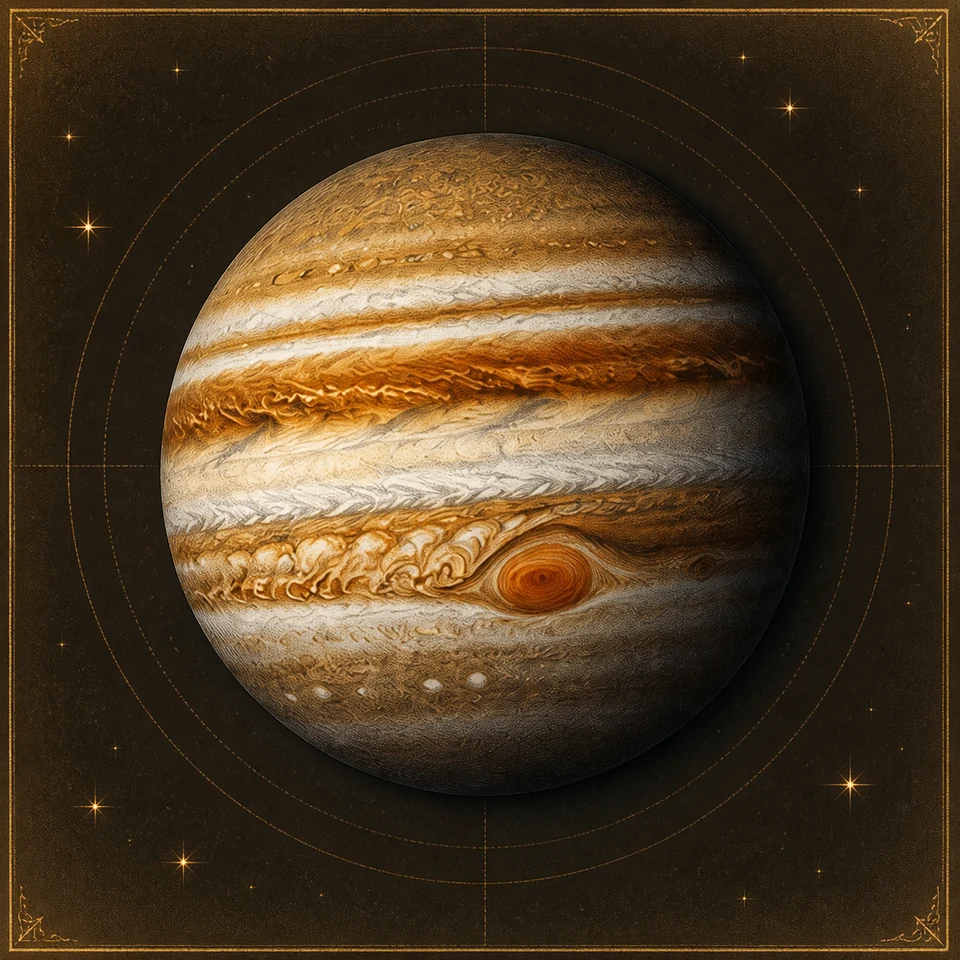
The classical planet Jupiter in historical correspondence systems.
Overview
Jupiter is the great classical planet of increase, breadth, order, generosity, and cultivated authority. Ptolemy describes it as temperate, warm, and moist, classifies it as benefic, and assigns it Sagittarius and Pisces. Later sources add Jovial plants, resins, stones, Thursday, tin, and celestial blue.
Historical and Astrological Context
Jupiter’s slow, bright passage gave it a durable place in astrological systems concerned with growth, law, honor, and abundance. Its natural correspondences differ by author: Agrippa and Culpeper can agree on some herbs while differing elsewhere, and each attribution remains independently visible.
Traditional and Modern Rulerships
Ptolemy assigns Sagittarius and Pisces to Jupiter in Book I, Chapter XX. Modern Western astrology may add Neptune as a co-ruler of Pisces, while Jupiter remains the traditional ruler.
Traditional Qualities
Ptolemy places Jupiter in a temperate mixture of warmth and moisture, with warmth predominant, and numbers it among the benefics. The terms describe a classical astrological influence, not the physical atmosphere of the planet.
Plants, Stones, Metals, and Ritual Materials
Agrippa’s Jovial layer includes air, basil, mint, violet, oak, hazel, ash, olive, mastic, storax, sapphire, and emerald. Culpeper assigns agrimony to Jupiter. The Key of Solomon connects the planet with Thursday, tin, and celestial blue.
Modern Practice
Jovial practice often concerns growth, opportunity, justice, learning, generosity, status, and prosperity. The database keeps disputed plant attributions such as mint visible as alternatives rather than averaging them into a single answer.
Identity Boundary
Jupiter the planet and Jupiter the Roman deity are separate records with a true name collision. A shared name is an identity issue, not an automatic correspondence edge.
Safety and Physical Boundaries
Planetary records describe symbolic and historical relationships. They do not authorize ingestion, burning, topical use, or handling of connected materials. Each physical entity carries its own safety review, and hazardous records are excluded from default ritual candidates.
Sources
Claudius Ptolemy, Tetrabiblos; Heinrich Cornelius Agrippa, Three Books of Occult Philosophy; Nicholas Culpeper, The Complete Herbal; S. L. MacGregor Mathers, The Key of Solomon.
Direct connections and evidence
Explicit Source
element under Jupiter
1 attestation · high confidence
- Heinrich Cornelius Agrippa, Three Books of Occult Philosophy, Book OneBook One, English edition based on the 1651 J. F. translation · Library of Congress · Renaissance Europe, c. 1533 · Renaissance Europe · Book Book One · Chapter XXVI · Section Of those things which are under the power of Jupiter · Page 100-101
Explicit Source
plant or tree under Jupiter
1 attestation · high confidence
- Heinrich Cornelius Agrippa, Three Books of Occult Philosophy, Book OneBook One, English edition based on the 1651 J. F. translation · Library of Congress · Renaissance Europe, c. 1533 · Renaissance Europe · Book Book One · Chapter XXVI · Section Of those things which are under the power of Jupiter · Page 100-101
Explicit Source
plant or tree under Jupiter
Agrippa's Jovial attribution is preserved alongside his solar attribution and Culpeper's Venusian attribution; the database does not reconcile the alternatives.
1 attestation · high confidence
- Heinrich Cornelius Agrippa, Three Books of Occult Philosophy, Book OneBook One, English edition based on the 1651 J. F. translation · Library of Congress · Renaissance Europe, c. 1533 · Renaissance Europe · Book Book One · Chapter XXVI · Section Of those things which are under the power of Jupiter · Page 100-101
Explicit Source
plant or tree under Jupiter
1 attestation · high confidence
- Heinrich Cornelius Agrippa, Three Books of Occult Philosophy, Book OneBook One, English edition based on the 1651 J. F. translation · Library of Congress · Renaissance Europe, c. 1533 · Renaissance Europe · Book Book One · Chapter XXVI · Section Of those things which are under the power of Jupiter · Page 100-101
Explicit Source
plant or tree under Jupiter
1 attestation · high confidence
- Heinrich Cornelius Agrippa, Three Books of Occult Philosophy, Book OneBook One, English edition based on the 1651 J. F. translation · Library of Congress · Renaissance Europe, c. 1533 · Renaissance Europe · Book Book One · Chapter XXVI · Section Of those things which are under the power of Jupiter · Page 100-101
Explicit Source
plant or tree under Jupiter
1 attestation · high confidence
- Heinrich Cornelius Agrippa, Three Books of Occult Philosophy, Book OneBook One, English edition based on the 1651 J. F. translation · Library of Congress · Renaissance Europe, c. 1533 · Renaissance Europe · Book Book One · Chapter XXVI · Section Of those things which are under the power of Jupiter · Page 100-101
Explicit Source
plant or tree under Jupiter
1 attestation · high confidence
- Heinrich Cornelius Agrippa, Three Books of Occult Philosophy, Book OneBook One, English edition based on the 1651 J. F. translation · Library of Congress · Renaissance Europe, c. 1533 · Renaissance Europe · Book Book One · Chapter XXVI · Section Of those things which are under the power of Jupiter · Page 100-101
Explicit Source
plant or tree under Jupiter
1 attestation · high confidence
- Heinrich Cornelius Agrippa, Three Books of Occult Philosophy, Book OneBook One, English edition based on the 1651 J. F. translation · Library of Congress · Renaissance Europe, c. 1533 · Renaissance Europe · Book Book One · Chapter XXVI · Section Of those things which are under the power of Jupiter · Page 100-101
Explicit Source
aromatic material under Jupiter
1 attestation · high confidence
- Heinrich Cornelius Agrippa, Three Books of Occult Philosophy, Book OneBook One, English edition based on the 1651 J. F. translation · Library of Congress · Renaissance Europe, c. 1533 · Renaissance Europe · Book Book One · Chapter XXVI · Section Of those things which are under the power of Jupiter · Page 100-101
Explicit Source
stone under Jupiter
1 attestation · high confidence
- Heinrich Cornelius Agrippa, Three Books of Occult Philosophy, Book OneBook One, English edition based on the 1651 J. F. translation · Library of Congress · Renaissance Europe, c. 1533 · Renaissance Europe · Book Book One · Chapter XXVI · Section Of those things which are under the power of Jupiter · Page 100-101
Explicit Source
stone under Jupiter
1 attestation · high confidence
- Heinrich Cornelius Agrippa, Three Books of Occult Philosophy, Book OneBook One, English edition based on the 1651 J. F. translation · Library of Congress · Renaissance Europe, c. 1533 · Renaissance Europe · Book Book One · Chapter XXVI · Section Of those things which are under the power of Jupiter · Page 100-101
Explicit Source
aromatic material under Jupiter
1 attestation · high confidence
- Heinrich Cornelius Agrippa, Three Books of Occult Philosophy, Book OneBook One, English edition based on the 1651 J. F. translation · Library of Congress · Renaissance Europe, c. 1533 · Renaissance Europe · Book Book One · Chapter XXVI · Section Of those things which are under the power of Jupiter · Page 100-101
Explicit Source
governed by Jupiter
1 attestation · high confidence
- Nicholas Culpeper, The Complete HerbalNew edition with additions by Thomas Kelly · Project Gutenberg · Seventeenth-century England · England · Entry Agrimony · Section Government and virtues · Page 4
Explicit Source
weekday of Jupiter
1 attestation · high confidence
- S. L. MacGregor Mathers, translator and editor, The Key of Solomon the King (Clavicula Salomonis)First edition · Wellcome Collection · British occult revival, 1889 edition · Britain · Section Table of the Archangels, Angels, Metals, Days of the Week, and Colours attributed to each Planet · Page 8 · Table Days and planets
Explicit Source
metal ruled by Jupiter
1 attestation · high confidence
- S. L. MacGregor Mathers, translator and editor, The Key of Solomon the King (Clavicula Salomonis)First edition · Wellcome Collection · British occult revival, 1889 edition · Britain · Book Book I · Chapter XVIII · Section Concerning the Holy Pentacles or Medals · Page 56
Explicit Source
color ruled by Jupiter
1 attestation · high confidence
- S. L. MacGregor Mathers, translator and editor, The Key of Solomon the King (Clavicula Salomonis)First edition · Wellcome Collection · British occult revival, 1889 edition · Britain · Book Book I · Chapter XVIII · Section Concerning the Holy Pentacles or Medals · Page 56-57
Explicit Source
traditional ruler of Sagittarius
Classical domicile rulership recorded directly from Ptolemy; later and modern co-rulership layers remain separate.
1 attestation · high confidence
- Claudius Ptolemy; J. M. Ashmand, translator, Tetrabiblos; or, QuadripartiteW. Foulsham 1900 printing of Ashmand’s 1822 English version · Project Gutenberg · Second century CE · Roman Egypt · Book Book I · Chapter Chapter XX — The Houses of the Planets · Section The Houses of the Planets · Page 28–29
Explicit Source
traditional ruler of Pisces
Classical domicile rulership recorded directly from Ptolemy; later and modern co-rulership layers remain separate.
1 attestation · high confidence
- Claudius Ptolemy; J. M. Ashmand, translator, Tetrabiblos; or, QuadripartiteW. Foulsham 1900 printing of Ashmand’s 1822 English version · Project Gutenberg · Second century CE · Roman Egypt · Book Book I · Chapter Chapter XX — The Houses of the Planets · Section The Houses of the Planets · Page 28–29
Reviewed sources
- Heinrich Cornelius Agrippa, Three Books of Occult Philosophy, Book One (1898)Book One, English edition based on the 1651 J. F. translation · Library of Congress
- Nicholas Culpeper, The Complete Herbal (1850)New edition with additions by Thomas Kelly · Project Gutenberg
- S. L. MacGregor Mathers, translator and editor, The Key of Solomon the King (Clavicula Salomonis) (1889)First edition · Wellcome Collection
- Claudius Ptolemy; J. M. Ashmand, translator, Tetrabiblos; or, Quadripartite (1900)W. Foulsham 1900 printing of Ashmand’s 1822 English version · Project Gutenberg