
Planet · Certain
Mercury
Research and editorial review by Cody Manes · Reviewed
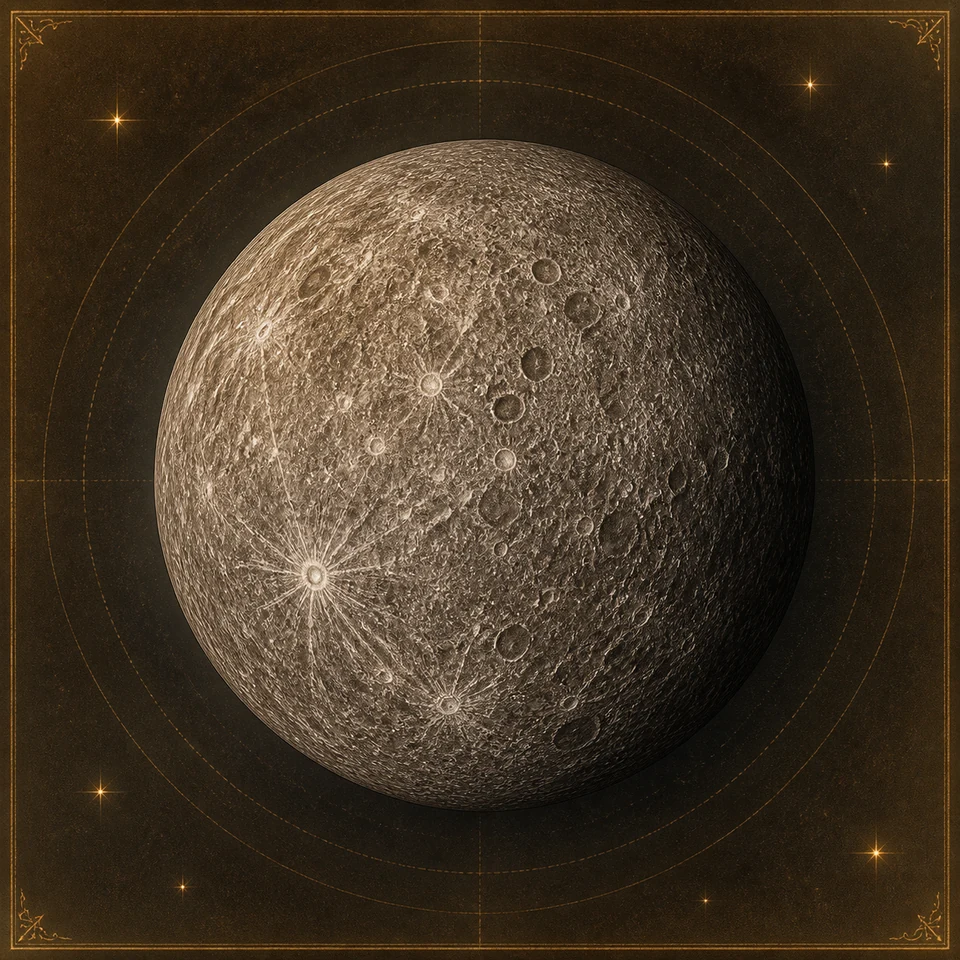
The classical planet Mercury in historical correspondence systems.
Overview
Mercury is the swift classical planet of exchange, interpretation, movement, and mutable connection. Ptolemy gives it alternating dry and moist powers and a common influence, and assigns it Gemini and Virgo. Renaissance and Solomonic sources add herbs, stones, Wednesday, mixed metals, and mixed colors.
Historical and Astrological Context
Mercury’s rapid motion and closeness to the Sun helped shape its historical reputation for speed and changeability. Its correspondence history is layered: Ptolemy supplies planetary qualities and zodiacal houses, Agrippa supplies natural and material associations, and the Key of Solomon supplies weekday, metal, and color tables.
Traditional and Modern Rulerships
Ptolemy assigns Gemini and Virgo to Mercury in Book I, Chapter XX. Both are direct classical house assignments in the cited passage.
Traditional Qualities
Ptolemy describes Mercury as alternating between dryness and moisture with equal vigor and classifies it as common in influence. The record therefore preserves variability rather than forcing Mercury into a single elemental quality.
Plants, Stones, Metals, and Ritual Materials
Agrippa associates Mercury with water, hazel, pimpernel, marjoram, parsley, agate, topaz, and elemental mercury. The Key of Solomon uses Wednesday, mixed metals, and a mixed-color scheme. Elemental mercury is a toxic heavy metal and remains a separate, hazard-marked record.
Modern Practice
Mercurial practice often concerns messages, study, trade, travel, wit, and dexterity. Historical sources do not agree on one material list, so the visible graph retains the exact authorship of each connection.
Identity Boundary
Mercury is a true three-way name collision in this archive: planet, Roman deity, and chemical metal. Those records share a word but not an identity, and no relationship is inferred from the name alone.
Safety and Physical Boundaries
Planetary records describe symbolic and historical relationships. They do not authorize ingestion, burning, topical use, or handling of connected materials. Each physical entity carries its own safety review, and hazardous records are excluded from default ritual candidates.
Sources
Claudius Ptolemy, Tetrabiblos; Heinrich Cornelius Agrippa, Three Books of Occult Philosophy; S. L. MacGregor Mathers, The Key of Solomon; Nicholas Culpeper, The Complete Herbal.
Direct connections and evidence
Explicit Source
element under Mercury
1 attestation · high confidence
- Heinrich Cornelius Agrippa, Three Books of Occult Philosophy, Book OneBook One, English edition based on the 1651 J. F. translation · Library of Congress · Renaissance Europe, c. 1533 · Renaissance Europe · Book Book One · Chapter XXIX · Section Of those things which are under the power of Mercury · Page 103-104
Explicit Source
plant or tree under Mercury
1 attestation · high confidence
- Heinrich Cornelius Agrippa, Three Books of Occult Philosophy, Book OneBook One, English edition based on the 1651 J. F. translation · Library of Congress · Renaissance Europe, c. 1533 · Renaissance Europe · Book Book One · Chapter XXIX · Section Of those things which are under the power of Mercury · Page 103-104
Explicit Source
plant or tree under Mercury
1 attestation · high confidence
- Heinrich Cornelius Agrippa, Three Books of Occult Philosophy, Book OneBook One, English edition based on the 1651 J. F. translation · Library of Congress · Renaissance Europe, c. 1533 · Renaissance Europe · Book Book One · Chapter XXIX · Section Of those things which are under the power of Mercury · Page 103-104
Explicit Source
plant or tree under Mercury
1 attestation · high confidence
- Heinrich Cornelius Agrippa, Three Books of Occult Philosophy, Book OneBook One, English edition based on the 1651 J. F. translation · Library of Congress · Renaissance Europe, c. 1533 · Renaissance Europe · Book Book One · Chapter XXIX · Section Of those things which are under the power of Mercury · Page 103-104
Explicit Source
plant or tree under Mercury
1 attestation · high confidence
- Heinrich Cornelius Agrippa, Three Books of Occult Philosophy, Book OneBook One, English edition based on the 1651 J. F. translation · Library of Congress · Renaissance Europe, c. 1533 · Renaissance Europe · Book Book One · Chapter XXIX · Section Of those things which are under the power of Mercury · Page 103-104
Explicit Source
stone under Mercury
1 attestation · high confidence
- Heinrich Cornelius Agrippa, Three Books of Occult Philosophy, Book OneBook One, English edition based on the 1651 J. F. translation · Library of Congress · Renaissance Europe, c. 1533 · Renaissance Europe · Book Book One · Chapter XXIX · Section Of those things which are under the power of Mercury · Page 103-104
Explicit Source
stone under Mercury
1 attestation · high confidence
- Heinrich Cornelius Agrippa, Three Books of Occult Philosophy, Book OneBook One, English edition based on the 1651 J. F. translation · Library of Congress · Renaissance Europe, c. 1533 · Renaissance Europe · Book Book One · Chapter XXIX · Section Of those things which are under the power of Mercury · Page 103-104
Explicit Source
metal under Mercury
1 attestation · high confidence
- Heinrich Cornelius Agrippa, Three Books of Occult Philosophy, Book OneBook One, English edition based on the 1651 J. F. translation · Library of Congress · Renaissance Europe, c. 1533 · Renaissance Europe · Book Book One · Chapter XXIX · Section Of those things which are under the power of Mercury · Page 103-104
Explicit Source
governed by Mercury
1 attestation · high confidence
- Nicholas Culpeper, The Complete HerbalNew edition with additions by Thomas Kelly · Project Gutenberg · Seventeenth-century England · England · Entry Fennel · Section Government and virtues · Page 73-74
Explicit Source
weekday of Mercury
1 attestation · high confidence
- S. L. MacGregor Mathers, translator and editor, The Key of Solomon the King (Clavicula Salomonis)First edition · Wellcome Collection · British occult revival, 1889 edition · Britain · Section Table of the Archangels, Angels, Metals, Days of the Week, and Colours attributed to each Planet · Page 8 · Table Days and planets
Explicit Source
metal ruled by Mercury
1 attestation · high confidence
- S. L. MacGregor Mathers, translator and editor, The Key of Solomon the King (Clavicula Salomonis)First edition · Wellcome Collection · British occult revival, 1889 edition · Britain · Book Book I · Chapter XVIII · Section Concerning the Holy Pentacles or Medals · Page 56
Explicit Source
color ruled by Mercury
1 attestation · high confidence
- S. L. MacGregor Mathers, translator and editor, The Key of Solomon the King (Clavicula Salomonis)First edition · Wellcome Collection · British occult revival, 1889 edition · Britain · Book Book I · Chapter XVIII · Section Concerning the Holy Pentacles or Medals · Page 56-57
Explicit Source
traditional ruler of Gemini
Classical domicile rulership recorded directly from Ptolemy; later and modern co-rulership layers remain separate.
1 attestation · high confidence
- Claudius Ptolemy; J. M. Ashmand, translator, Tetrabiblos; or, QuadripartiteW. Foulsham 1900 printing of Ashmand’s 1822 English version · Project Gutenberg · Second century CE · Roman Egypt · Book Book I · Chapter Chapter XX — The Houses of the Planets · Section The Houses of the Planets · Page 28–29
Explicit Source
traditional ruler of Virgo
Classical domicile rulership recorded directly from Ptolemy; later and modern co-rulership layers remain separate.
1 attestation · high confidence
- Claudius Ptolemy; J. M. Ashmand, translator, Tetrabiblos; or, QuadripartiteW. Foulsham 1900 printing of Ashmand’s 1822 English version · Project Gutenberg · Second century CE · Roman Egypt · Book Book I · Chapter Chapter XX — The Houses of the Planets · Section The Houses of the Planets · Page 28–29
Reviewed sources
- Heinrich Cornelius Agrippa, Three Books of Occult Philosophy, Book One (1898)Book One, English edition based on the 1651 J. F. translation · Library of Congress
- Nicholas Culpeper, The Complete Herbal (1850)New edition with additions by Thomas Kelly · Project Gutenberg
- S. L. MacGregor Mathers, translator and editor, The Key of Solomon the King (Clavicula Salomonis) (1889)First edition · Wellcome Collection
- Claudius Ptolemy; J. M. Ashmand, translator, Tetrabiblos; or, Quadripartite (1900)W. Foulsham 1900 printing of Ashmand’s 1822 English version · Project Gutenberg