
Planet · Certain
Moon
Research and editorial review by Cody Manes · Reviewed
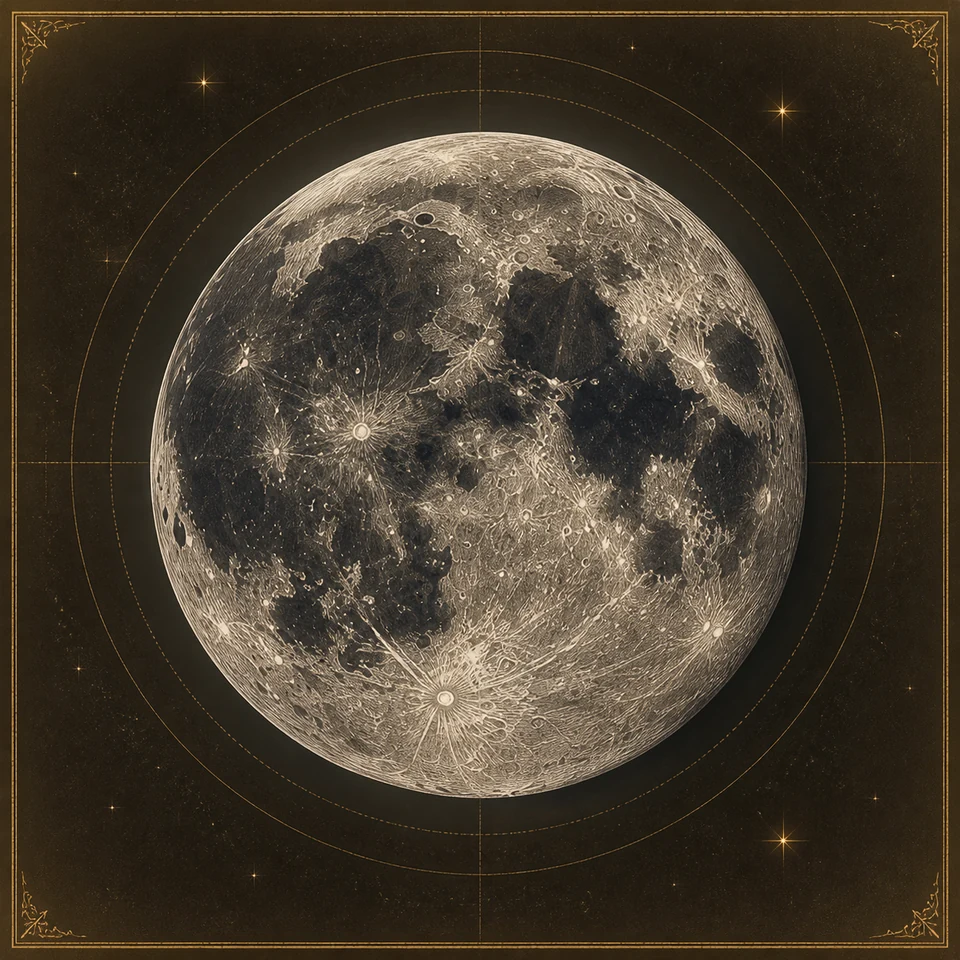
The lunar luminary in historical planetary correspondence systems.
Overview
The Moon is the changing luminary of the classical planetary order, long observed through phases, tides of light, and nightly motion. Ptolemy describes it as moist and moderately warm, benefic, and ruler of Cancer. Renaissance and Solomonic sources connect it with water and earth, lunar plants and stones, Monday, silver, and argentine color.
Historical and Astrological Context
The Moon’s visible phases made it a natural measure of change, return, and nocturnal time. Historical astrology counts it among the seven planets because “planet” there means a wandering celestial light. The database also holds modern phase records, but a phase-to-intention convention is not silently promoted into a direct Moon-to-intention claim.
Traditional and Modern Rulerships
Ptolemy assigns Cancer to the Moon in Book I, Chapter XX. This classical domicile remains distinct from modern lunar-phase conventions and from divine figures whose identities cannot be reduced to the astronomical Moon.
Traditional Qualities
Ptolemy gives the Moon a chiefly moist influence with moderate warmth and classifies it among the benefics. These terms belong to classical astrology and are not statements about the Moon’s geological surface or temperature.
Plants, Stones, Metals, and Ritual Materials
Agrippa’s lunar correspondences include water and earth, rosemary, olive, palm, rock crystal, and historically identified beryl. The Key of Solomon connects the Moon with Monday, silver, and an argentine color. Uncertain historical stone names retain their cautions.
Modern Practice
Modern lunar practice commonly attends to waxing, fullness, waning, and darkness as distinct ritual times. Mystic keeps those phase relationships non-default and source-scoped so that modern convention does not overwrite the historical planetary layer.
Safety and Physical Boundaries
Planetary records describe symbolic and historical relationships. They do not authorize ingestion, burning, topical use, or handling of connected materials. Each physical entity carries its own safety review, and hazardous records are excluded from default ritual candidates.
Sources
Claudius Ptolemy, Tetrabiblos; Heinrich Cornelius Agrippa, Three Books of Occult Philosophy; S. L. MacGregor Mathers, The Key of Solomon; NASA phase references for astronomical identity.
Direct connections and evidence
Explicit Source
element under Moon
1 attestation · high confidence
- Heinrich Cornelius Agrippa, Three Books of Occult Philosophy, Book OneBook One, English edition based on the 1651 J. F. translation · Library of Congress · Renaissance Europe, c. 1533 · Renaissance Europe · Book Book One · Chapter XXIV · Section Of those things which are under the Moon · Page 95-97
Explicit Source
element under Moon
1 attestation · high confidence
- Heinrich Cornelius Agrippa, Three Books of Occult Philosophy, Book OneBook One, English edition based on the 1651 J. F. translation · Library of Congress · Renaissance Europe, c. 1533 · Renaissance Europe · Book Book One · Chapter XXIV · Section Of those things which are under the Moon · Page 95-97
Explicit Source
plant or tree under Moon
1 attestation · high confidence
- Heinrich Cornelius Agrippa, Three Books of Occult Philosophy, Book OneBook One, English edition based on the 1651 J. F. translation · Library of Congress · Renaissance Europe, c. 1533 · Renaissance Europe · Book Book One · Chapter XXIV · Section Of those things which are under the Moon · Page 95-97
Explicit Source
plant or tree under Moon
1 attestation · high confidence
- Heinrich Cornelius Agrippa, Three Books of Occult Philosophy, Book OneBook One, English edition based on the 1651 J. F. translation · Library of Congress · Renaissance Europe, c. 1533 · Renaissance Europe · Book Book One · Chapter XXIV · Section Of those things which are under the Moon · Page 95-97
Explicit Source
plant or tree under Moon
1 attestation · high confidence
- Heinrich Cornelius Agrippa, Three Books of Occult Philosophy, Book OneBook One, English edition based on the 1651 J. F. translation · Library of Congress · Renaissance Europe, c. 1533 · Renaissance Europe · Book Book One · Chapter XXIV · Section Of those things which are under the Moon · Page 95-97
Explicit Source
stone under Moon
1 attestation · high confidence
- Heinrich Cornelius Agrippa, Three Books of Occult Philosophy, Book OneBook One, English edition based on the 1651 J. F. translation · Library of Congress · Renaissance Europe, c. 1533 · Renaissance Europe · Book Book One · Chapter XXIV · Section Of those things which are under the Moon · Page 95-97
Explicit Source
stone under Moon
1 attestation · high confidence
- Heinrich Cornelius Agrippa, Three Books of Occult Philosophy, Book OneBook One, English edition based on the 1651 J. F. translation · Library of Congress · Renaissance Europe, c. 1533 · Renaissance Europe · Book Book One · Chapter XXIV · Section Of those things which are under the Moon · Page 95-97
Explicit Source
governed by the Moon
1 attestation · high confidence
- Nicholas Culpeper, The Complete HerbalNew edition with additions by Thomas Kelly · Project Gutenberg · Seventeenth-century England · England · Entry Adder's Tongue or Serpent's Tongue · Section Government and virtues · Page 3
Explicit Source
weekday of Moon
1 attestation · high confidence
- S. L. MacGregor Mathers, translator and editor, The Key of Solomon the King (Clavicula Salomonis)First edition · Wellcome Collection · British occult revival, 1889 edition · Britain · Section Table of the Archangels, Angels, Metals, Days of the Week, and Colours attributed to each Planet · Page 8 · Table Days and planets
Explicit Source
metal ruled by Moon
1 attestation · high confidence
- S. L. MacGregor Mathers, translator and editor, The Key of Solomon the King (Clavicula Salomonis)First edition · Wellcome Collection · British occult revival, 1889 edition · Britain · Book Book I · Chapter XVIII · Section Concerning the Holy Pentacles or Medals · Page 56
Explicit Source
color ruled by Moon
1 attestation · high confidence
- S. L. MacGregor Mathers, translator and editor, The Key of Solomon the King (Clavicula Salomonis)First edition · Wellcome Collection · British occult revival, 1889 edition · Britain · Book Book I · Chapter XVIII · Section Concerning the Holy Pentacles or Medals · Page 56-57
Explicit Source
astronomical phase of the Moon
This edge defines phase identity only. It carries no spiritual correspondence claim.
1 attestation · high confidence
- NASA Science Editorial Team, Moon PhasesNASA Science web resource, accessed 2026-08-26 · NASA · Current astronomical terminology · Global astronomical observation · Section All Moon Phases · Entry New Moon
Explicit Source
astronomical phase of the Moon
This edge defines phase identity only. It carries no spiritual correspondence claim.
1 attestation · high confidence
- NASA Science Editorial Team, Moon PhasesNASA Science web resource, accessed 2026-08-26 · NASA · Current astronomical terminology · Global astronomical observation · Section All Moon Phases · Entry Waxing Crescent
Explicit Source
astronomical phase of the Moon
This edge defines phase identity only. It carries no spiritual correspondence claim.
1 attestation · high confidence
- NASA Science Editorial Team, Moon PhasesNASA Science web resource, accessed 2026-08-26 · NASA · Current astronomical terminology · Global astronomical observation · Section All Moon Phases · Entry First Quarter
Explicit Source
astronomical phase of the Moon
This edge defines phase identity only. It carries no spiritual correspondence claim.
1 attestation · high confidence
- NASA Science Editorial Team, Moon PhasesNASA Science web resource, accessed 2026-08-26 · NASA · Current astronomical terminology · Global astronomical observation · Section All Moon Phases · Entry Waxing Gibbous
Explicit Source
astronomical phase of the Moon
This edge defines phase identity only. It carries no spiritual correspondence claim.
1 attestation · high confidence
- NASA Science Editorial Team, Moon PhasesNASA Science web resource, accessed 2026-08-26 · NASA · Current astronomical terminology · Global astronomical observation · Section All Moon Phases · Entry Full Moon
Explicit Source
astronomical phase of the Moon
This edge defines phase identity only. It carries no spiritual correspondence claim.
1 attestation · high confidence
- NASA Science Editorial Team, Moon PhasesNASA Science web resource, accessed 2026-08-26 · NASA · Current astronomical terminology · Global astronomical observation · Section All Moon Phases · Entry Waning Gibbous
Explicit Source
astronomical phase of the Moon
This edge defines phase identity only. It carries no spiritual correspondence claim.
1 attestation · high confidence
- NASA Science Editorial Team, Moon PhasesNASA Science web resource, accessed 2026-08-26 · NASA · Current astronomical terminology · Global astronomical observation · Section All Moon Phases · Entry Last Quarter
Explicit Source
astronomical phase of the Moon
This edge defines phase identity only. It carries no spiritual correspondence claim.
1 attestation · high confidence
- NASA Science Editorial Team, Moon PhasesNASA Science web resource, accessed 2026-08-26 · NASA · Current astronomical terminology · Global astronomical observation · Section All Moon Phases · Entry Waning Crescent
Explicit Source
traditional ruler of Cancer
Classical domicile rulership recorded directly from Ptolemy; later and modern co-rulership layers remain separate.
1 attestation · high confidence
- Claudius Ptolemy; J. M. Ashmand, translator, Tetrabiblos; or, QuadripartiteW. Foulsham 1900 printing of Ashmand’s 1822 English version · Project Gutenberg · Second century CE · Roman Egypt · Book Book I · Chapter Chapter XX — The Houses of the Planets · Section The Houses of the Planets · Page 28–29
Reviewed sources
- Heinrich Cornelius Agrippa, Three Books of Occult Philosophy, Book One (1898)Book One, English edition based on the 1651 J. F. translation · Library of Congress
- Nicholas Culpeper, The Complete Herbal (1850)New edition with additions by Thomas Kelly · Project Gutenberg
- S. L. MacGregor Mathers, translator and editor, The Key of Solomon the King (Clavicula Salomonis) (1889)First edition · Wellcome Collection
- NASA Science Editorial Team, Moon PhasesNASA Science web resource, accessed 2026-08-26 · NASA
- Claudius Ptolemy; J. M. Ashmand, translator, Tetrabiblos; or, Quadripartite (1900)W. Foulsham 1900 printing of Ashmand’s 1822 English version · Project Gutenberg