
Planet · Certain
Saturn
Research and editorial review by Cody Manes · Reviewed
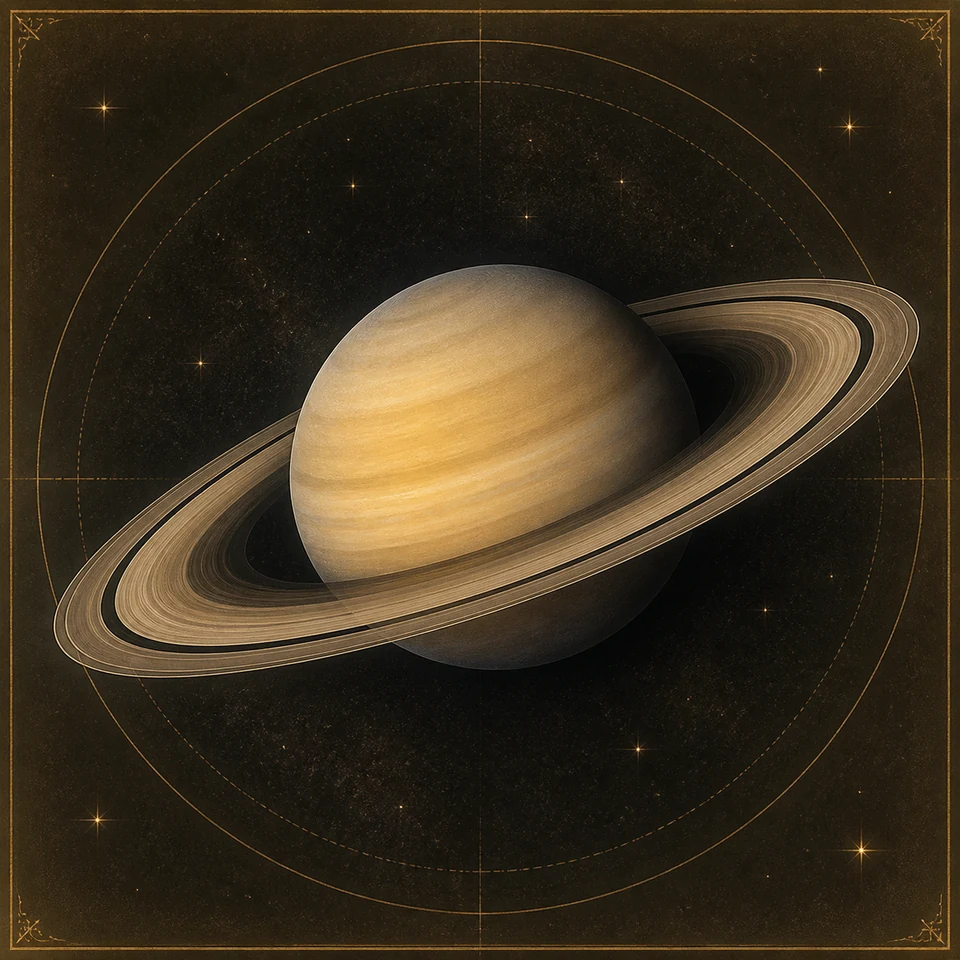
The classical planet Saturn in historical correspondence systems.
Overview
Saturn is the slow outer boundary of the classical planetary order, associated with limit, endurance, gravity, time, and consequence. Ptolemy describes it as cold and dry, classifies it as malefic, and assigns it Capricorn and Aquarius. Later sources add Saturnian plants and stones, Saturday, lead, and black.
Historical and Astrological Context
Before the telescopic planets were known, Saturn marked the visible edge of the planetary sequence. Its slow motion supported a correspondence field concerned with age, duration, confinement, structure, and hard-earned permanence. Historical terms can sound severe, but their meaning remains contextual rather than moralized.
Traditional and Modern Rulerships
Ptolemy assigns Capricorn and Aquarius to Saturn in Book I, Chapter XX. Modern Western astrology may add Uranus as a co-ruler of Aquarius; that later layer does not replace Saturn’s traditional rulership.
Traditional Qualities
Ptolemy describes Saturn as cold and dry, with cold the stronger power, and places it among the malefics. These are classical technical categories, not physical descriptions of Saturn as measured by astronomy.
Plants, Stones, Metals, and Ritual Materials
Agrippa associates Saturn with earth and water, rue, daffodil, cypress, onyx, sapphire, and magnetite. Culpeper assigns cornflower to Saturn. The Key of Solomon connects Saturn with Saturday, lead, and black; lead’s toxicity remains separately and prominently recorded.
Modern Practice
Saturnian practice often emphasizes restraint, boundaries, patience, endings, durable structure, and confrontation with limits. Material safety takes precedence over symbolic tradition, especially for lead and smoke-producing substances.
Identity Boundary
Saturn the planet and Saturn the Roman deity are separate records. Their shared name is disclosed without adding a deity to recommendation paths.
Safety and Physical Boundaries
Planetary records describe symbolic and historical relationships. They do not authorize ingestion, burning, topical use, or handling of connected materials. Each physical entity carries its own safety review, and hazardous records are excluded from default ritual candidates.
Sources
Claudius Ptolemy, Tetrabiblos; Heinrich Cornelius Agrippa, Three Books of Occult Philosophy; Nicholas Culpeper, The Complete Herbal; S. L. MacGregor Mathers, The Key of Solomon.
Direct connections and evidence
Explicit Source
element under Saturn
1 attestation · high confidence
- Heinrich Cornelius Agrippa, Three Books of Occult Philosophy, Book OneBook One, English edition based on the 1651 J. F. translation · Library of Congress · Renaissance Europe, c. 1533 · Renaissance Europe · Book Book One · Chapter XXV · Section Of those things which are Saturnine · Page 97-100
Explicit Source
element under Saturn
1 attestation · high confidence
- Heinrich Cornelius Agrippa, Three Books of Occult Philosophy, Book OneBook One, English edition based on the 1651 J. F. translation · Library of Congress · Renaissance Europe, c. 1533 · Renaissance Europe · Book Book One · Chapter XXV · Section Of those things which are Saturnine · Page 97-100
Explicit Source
plant or tree under Saturn
1 attestation · high confidence
- Heinrich Cornelius Agrippa, Three Books of Occult Philosophy, Book OneBook One, English edition based on the 1651 J. F. translation · Library of Congress · Renaissance Europe, c. 1533 · Renaissance Europe · Book Book One · Chapter XXV · Section Of those things which are Saturnine · Page 97-100
Explicit Source
plant or tree under Saturn
1 attestation · high confidence
- Heinrich Cornelius Agrippa, Three Books of Occult Philosophy, Book OneBook One, English edition based on the 1651 J. F. translation · Library of Congress · Renaissance Europe, c. 1533 · Renaissance Europe · Book Book One · Chapter XXV · Section Of those things which are Saturnine · Page 97-100
Explicit Source
plant or tree under Saturn
1 attestation · high confidence
- Heinrich Cornelius Agrippa, Three Books of Occult Philosophy, Book OneBook One, English edition based on the 1651 J. F. translation · Library of Congress · Renaissance Europe, c. 1533 · Renaissance Europe · Book Book One · Chapter XXV · Section Of those things which are Saturnine · Page 97-100
Explicit Source
stone under Saturn
1 attestation · high confidence
- Heinrich Cornelius Agrippa, Three Books of Occult Philosophy, Book OneBook One, English edition based on the 1651 J. F. translation · Library of Congress · Renaissance Europe, c. 1533 · Renaissance Europe · Book Book One · Chapter XXV · Section Of those things which are Saturnine · Page 97-100
Explicit Source
stone under Saturn
1 attestation · high confidence
- Heinrich Cornelius Agrippa, Three Books of Occult Philosophy, Book OneBook One, English edition based on the 1651 J. F. translation · Library of Congress · Renaissance Europe, c. 1533 · Renaissance Europe · Book Book One · Chapter XXV · Section Of those things which are Saturnine · Page 97-100
Explicit Source
stone under Saturn
1 attestation · high confidence
- Heinrich Cornelius Agrippa, Three Books of Occult Philosophy, Book OneBook One, English edition based on the 1651 J. F. translation · Library of Congress · Renaissance Europe, c. 1533 · Renaissance Europe · Book Book One · Chapter XXV · Section Of those things which are Saturnine · Page 97-100
Explicit Source
governed by Saturn
1 attestation · high confidence
- Nicholas Culpeper, The Complete HerbalNew edition with additions by Thomas Kelly · Project Gutenberg · Seventeenth-century England · England · Entry Blue-Bottle · Section Government and virtues · Page 28
Explicit Source
weekday of Saturn
1 attestation · high confidence
- S. L. MacGregor Mathers, translator and editor, The Key of Solomon the King (Clavicula Salomonis)First edition · Wellcome Collection · British occult revival, 1889 edition · Britain · Section Table of the Archangels, Angels, Metals, Days of the Week, and Colours attributed to each Planet · Page 8 · Table Days and planets
Explicit Source
metal ruled by Saturn
1 attestation · high confidence
- S. L. MacGregor Mathers, translator and editor, The Key of Solomon the King (Clavicula Salomonis)First edition · Wellcome Collection · British occult revival, 1889 edition · Britain · Book Book I · Chapter XVIII · Section Concerning the Holy Pentacles or Medals · Page 56
Explicit Source
color ruled by Saturn
1 attestation · high confidence
- S. L. MacGregor Mathers, translator and editor, The Key of Solomon the King (Clavicula Salomonis)First edition · Wellcome Collection · British occult revival, 1889 edition · Britain · Book Book I · Chapter XVIII · Section Concerning the Holy Pentacles or Medals · Page 56-57
Explicit Source
traditional ruler of Aquarius
Classical domicile rulership recorded directly from Ptolemy; later and modern co-rulership layers remain separate.
1 attestation · high confidence
- Claudius Ptolemy; J. M. Ashmand, translator, Tetrabiblos; or, QuadripartiteW. Foulsham 1900 printing of Ashmand’s 1822 English version · Project Gutenberg · Second century CE · Roman Egypt · Book Book I · Chapter Chapter XX — The Houses of the Planets · Section The Houses of the Planets · Page 28–29
Explicit Source
traditional ruler of Capricorn
Classical domicile rulership recorded directly from Ptolemy; later and modern co-rulership layers remain separate.
1 attestation · high confidence
- Claudius Ptolemy; J. M. Ashmand, translator, Tetrabiblos; or, QuadripartiteW. Foulsham 1900 printing of Ashmand’s 1822 English version · Project Gutenberg · Second century CE · Roman Egypt · Book Book I · Chapter Chapter XX — The Houses of the Planets · Section The Houses of the Planets · Page 28–29
Reviewed sources
- Heinrich Cornelius Agrippa, Three Books of Occult Philosophy, Book One (1898)Book One, English edition based on the 1651 J. F. translation · Library of Congress
- Nicholas Culpeper, The Complete Herbal (1850)New edition with additions by Thomas Kelly · Project Gutenberg
- S. L. MacGregor Mathers, translator and editor, The Key of Solomon the King (Clavicula Salomonis) (1889)First edition · Wellcome Collection
- Claudius Ptolemy; J. M. Ashmand, translator, Tetrabiblos; or, Quadripartite (1900)W. Foulsham 1900 printing of Ashmand’s 1822 English version · Project Gutenberg