
Greek · God or goddess · Certain
Asclepius
· Asklēpiós
Pronunciation: /as.klɛː.pi.ós/ · ahs-kleh-pee-OSS
Research and editorial review by Cody Manes · Reviewed 2026-08-30
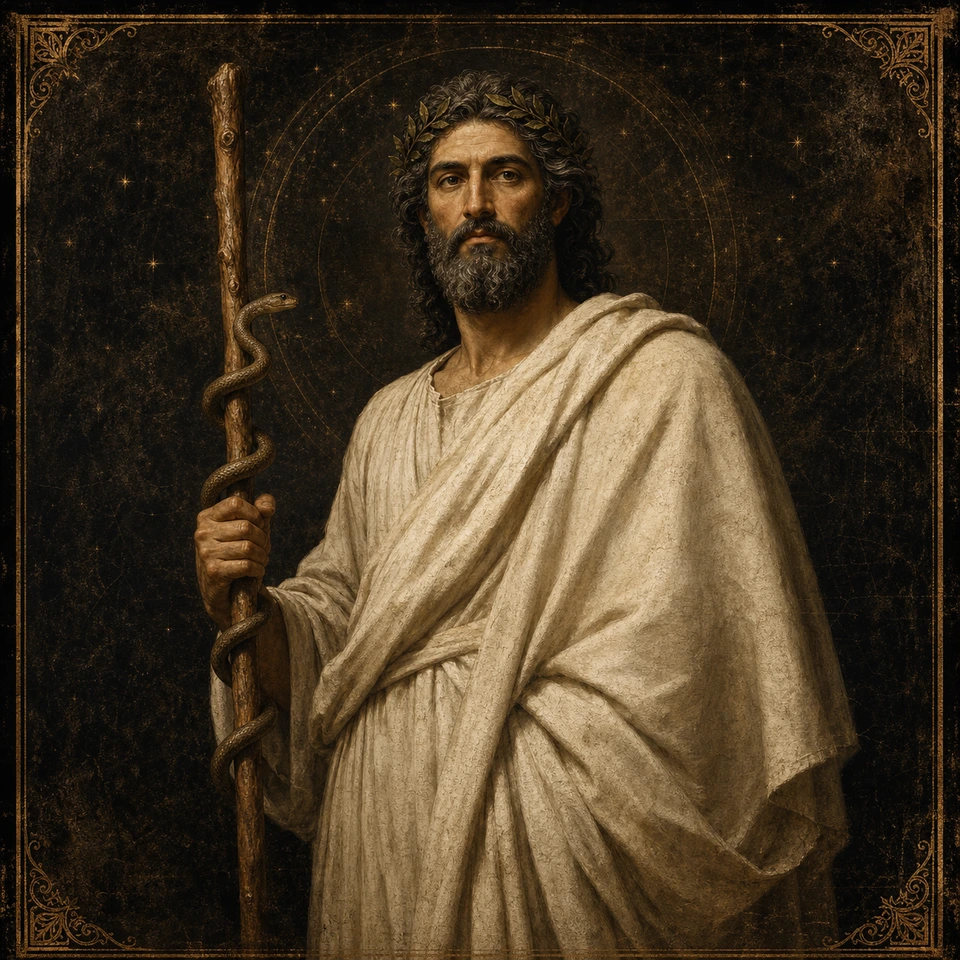
Pushing medical mastery to the very boundary of death, Asclepius stands as the definitive ancient healer bearing the iconic one-serpent staff. His sacred sites woven through Epidaurus, Athens, and Titane blended intricate architecture with sacred sleep and tangible cure testimony.
Overview
At Epidaurus, the healing god was encountered through stone boundaries, sleeping halls, offerings, images, and stories of cures. The sanctuary that grew in the Argolid by the sixth century BC became a major therapeutic center of the Greek and Roman worlds. Its fourth-century buildings included the temple of Asclepius, the Tholos, the Enkoimeterion, baths, accommodation, and a theater. Here healing was not an abstract label. It was a religious institution embedded in architecture, civic prestige, pilgrimage, and the bodies of people who came seeking relief.
Asclepius, Ancient Greek Ἀσκληπιός and transliterated Asklēpiós, is securely a Greek deity rather than merely a heroic doctor or modern medical emblem. Pindar's third Pythian ode makes him the child of Apollo and Coronis, rescues him from his mother's pyre, and sends him to Chiron for instruction. Pausanias records a competing Epidaurian account in which the infant is exposed in the local landscape, nourished by a goat, and guarded by a dog. These stories agree on neither scene nor sequence. Together they show communities using birth narrative to claim where the god belonged.
His power is immense but bounded. Pindar describes a healer who addresses wounds and diseases, then crosses a line by accepting payment to restore a dead person. Euripides and Pseudo-Apollodorus preserve other versions of that transgression and its consequence. Zeus kills Asclepius with a thunderbolt, and Apollo's retaliation against the Cyclopes begins a further chain of punishment and mortal suffering. The myths do not diminish ancient healing religion, but they insist that even divine medicine could be imagined under the authority of death and Zeus.
Material images give him a mature bearded face, heavy curling hair, Greek drapery, and a staff with one serpent. Pausanias saw the Epidaurian cult image seated with the staff in hand, a serpent beneath the other hand, and a dog nearby. A Hellenistic coin from Pergamon joins a laureate head to snake and temple-key imagery. These are historical attributes, not permission to confuse the single-serpent staff with Hermes's winged caduceus.
The cult also spread and changed. Homer already names Machaon and Podalirius as sons of Asclepius within heroic medicine, while Pausanias moves among Epidaurus, Titane, Athens, and Pergamon. UNESCO's archaeological synthesis describes Epidaurus as influential across Greek Asklepieia and later Roman sanctuaries of Aesculapius. Greek Asclepius and Roman Aesculapius remain separate records because transmission is history, not identity collapse.
Modern readers often inherit Asclepius through hospitals, medical seals, and the Rod of Asclepius. That reception is powerful, but it must not turn ancient cult into a promise of treatment or replace professional care. No planet, zodiac sign, gemstone, metal, color, weekday, lunar phase, direction, element, incense, or universal offering list is established here. The enduring force of Asclepius lies in something more exact: ancient communities built places where sickness, hope, ritual, story, and observation met under the sign of one serpent wound around one staff.
Canonical identity
Canonical Identity
Asclepius is classified with absolute certainty as a deity within ancient Greek religion. Pindar identifies him as the son of Apollo, wielding extraordinary healing capabilities, while Pausanias meticulously details the sanctuaries, sacred rules, offerings, and cult images devoted to his worship. He possesses a distinct historical boundary, meaning Chiron, Hygieia, Machaon, Podalirius, Imhotep, Eshmun, and Hermes are not alternate aliases for him. The authentic Rod of Asclepius features a single serpent without wings, completely separate from the caduceus utilized by Hermes and Mercury.
Linguistic Identity
Asclepius serves as the canonical English display name for the Ancient Greek Ἀσκληπιός, which transliterates as Asklēpiós. The qualified fifth-century BC Attic reconstruction yields /as.klɛː.pi.ós/, approximated for readers as ahs-kleh-pee-OSS. While this phonetic reconstruction offers useful historical orientation, it cannot definitively represent the pronunciation of every Greek dialect and period. Roman Aesculapius emerged from the transmission of Asclepius's worship, yet Roman communities fully integrated the god into their own distinct language and religious ecosystem.
Sources and evidence
TEXTUAL · Supported
The Ancient Greek name is Ἀσκληπιός, transliterated Asklēpiós, with the qualified Attic reconstruction /as.klɛː.pi.ós/.
- Source
- Wiktionary contributors, Ἀσκληπιός
- Reviewed edition
- Live Ancient Greek lexical entry and pronunciation section reviewed 2026-08-30 · Wiktionary
- Exact locator
- Entry Ancient Greek Ἀσκληπιός, pronunciation section
- Scope
- Classical Greece · Attica
- Authority
- collaborative historical lexicon
- Certainty
- Qualified reconstruction
The guide does not reproduce pitch accent or every dialect.
Open exact reviewed sourceRITUAL ATTESTED · Supported
Pausanias describes sanctuaries, cult images, offerings, and sacred rules for Asclepius, securely establishing divine cult status.
- Source
- Pausanias; Spiro Greek edition and Jones/Ormerod translation volumes, Description of Greece (1935)
- Reviewed edition
- Spiro Greek edition and Jones/Ormerod English volumes represented by the Perseus CTS corpus, 1903-1935 · translated by W. H. S. Jones and H. A. Ormerod, volume-dependent · edited by Friedrich Spiro for the Greek edition · Perseus Digital Library / Scaife ATLAS
- Exact locator
- Entry Description of Greece 1.21.4; 2.11.5-8; 2.26.3-2.27.2
- Scope
- Greek religion under Roman imperial rule · Ancient Greece
- Authority
- ancient periegesis
- Certainty
- Secure within reported cult settings
The classification is not inferred from modern medical symbolism.
Open exact reviewed sourceTEXTUAL · Supported
The Epidaurian cult image holds one staff beside one serpent, a form distinct from the two-serpent winged caduceus.
- Source
- Pausanias; Spiro Greek edition and Jones/Ormerod translation volumes, Description of Greece (1935)
- Reviewed edition
- Spiro Greek edition and Jones/Ormerod English volumes represented by the Perseus CTS corpus, 1903-1935 · translated by W. H. S. Jones and H. A. Ormerod, volume-dependent · edited by Friedrich Spiro for the Greek edition · Perseus Digital Library / Scaife ATLAS
- Exact locator
- Entry Description of Greece 2.27.2
- Scope
- Greek religion under Roman imperial rule · Ancient Greece
- Authority
- ancient eyewitness-style description
- Certainty
- Secure for the Epidaurian image
Modern emblem use does not alter the ancient object count.
Open exact reviewed source3 reviewed sources for this section
- Wiktionary contributors, ἈσκληπιόςLive collaborative lexical entry reviewed 2026-08-30 · Wiktionary
- Pindar; translated by Diane Arnson Svarlien, Odes of Pindar (1990)1990 translation hosted by the Perseus Digital Library · Tufts University
- Pausanias; Spiro Greek edition and Jones/Ormerod translation volumes, Description of Greece (1935)Perseus CTS edition corpus, 1903-1935 · Perseus Digital Library / Scaife ATLAS
Culture, tradition, period, and place
Asclepius belongs to ancient Greek religious traditions, with evidence ranging from Archaic and Classical poetry to Hellenistic objects and Roman-imperial travel writing. Epidaurus in the Argolid is central, but not solitary. Pausanias also describes worship at Titane in Sicyonia and a sanctuary on the south slope of the Athenian Acropolis, and he traces the Epidaurian cult's movement to Pergamon through a healed worshipper.
Each place preserves its own scale and memory. Epidaurus tied divine birth to its landscape and built a vast therapeutic institution. Titane maintained local images and rites. Athens housed the god within an urban sacred landscape beneath the Acropolis. Pergamon represented a later transmission. These settings form a network of Greek healing cults, not one timeless ritual manual.
Sources and evidence
RITUAL ATTESTED · Supported
Pausanias records Asclepian sanctuaries or images at Athens, Titane, and Epidaurus as distinct local settings.
- Source
- Pausanias; Spiro Greek edition and Jones/Ormerod translation volumes, Description of Greece (1935)
- Reviewed edition
- Spiro Greek edition and Jones/Ormerod English volumes represented by the Perseus CTS corpus, 1903-1935 · translated by W. H. S. Jones and H. A. Ormerod, volume-dependent · edited by Friedrich Spiro for the Greek edition · Perseus Digital Library / Scaife ATLAS
- Exact locator
- Entry Description of Greece 1.21.4; 2.11.5-8; 2.26.3-2.27.2
- Scope
- Greek religion under Roman imperial rule · Ancient Greece
- Authority
- ancient periegesis
- Certainty
- Secure as reported regional evidence
No one location is made a universal model.
Open exact reviewed sourceTEXTUAL · Supported
Pausanias attributes the Pergamene cult's origin to Archias after his healing at Epidaurus.
- Source
- Pausanias; Spiro Greek edition and Jones/Ormerod translation volumes, Description of Greece (1935)
- Reviewed edition
- Spiro Greek edition and Jones/Ormerod English volumes represented by the Perseus CTS corpus, 1903-1935 · translated by W. H. S. Jones and H. A. Ormerod, volume-dependent · edited by Friedrich Spiro for the Greek edition · Perseus Digital Library / Scaife ATLAS
- Exact locator
- Entry Description of Greece 2.26.8
- Scope
- Greek religion under Roman imperial rule · Ancient Greece
- Authority
- ancient periegesis
- Certainty
- Secure within Pausanias's transmission account
This is one ancient foundation tradition, not a complete institutional history.
Open exact reviewed source2 reviewed sources for this section
- Pausanias; Spiro Greek edition and Jones/Ormerod translation volumes, Description of Greece (1935)Perseus CTS edition corpus, 1903-1935 · Perseus Digital Library / Scaife ATLAS
- UNESCO World Heritage Centre, Sanctuary of Asklepios at Epidaurus (1988)World Heritage List entry 491 · United Nations Educational, Scientific and Cultural Organization
Historical development
The Iliad gives an early epic horizon through Machaon and Podalirius, warriors and healers named as sons of Asclepius. The poem does not yet describe the great sanctuary system that later made their father one of the most visible healing gods of the Mediterranean. Pindar's fifth-century BC ode presents a developed divine healer whose gifts, training, and death already carry moral and cosmic weight.
By the sixth century BC at the latest, the Epidaurian cult had developed from the older setting of Apollo Maleatas into the official cult of the city-state. The fourth-century sanctuary joined temple, sleeping hall, Tholos, baths, theater, accommodation, and other facilities in a single sacred complex. Pausanias later records regional sanctuaries and stories, while Roman Aesculapius extends the history into another language, polity, and cult system. Continuity was real, but it never meant that every place practiced the same rites or told the same myths.
Sources and evidence
TEXTUAL · Supported
The Iliad names Machaon and Podalirius as sons of Asclepius and presents Machaon treating Menelaus.
- Source
- Homer; Monro and Allen Greek edition with edition-specific translations, Iliad (1920)
- Reviewed edition
- Monro and Allen Greek edition represented by the Perseus CTS corpus, Oxford, 1908-1920 · edited by David Binning Monro and Thomas William Allen · Perseus Digital Library / Scaife ATLAS
- Exact locator
- Entry Iliad 2.729-733; 4.193-219
- Scope
- Archaic Greece · Ancient Greece
- Authority
- archaic epic poetry
- Certainty
- Secure epic lineage and action
The passage is not itself a sanctuary history.
Open exact reviewed sourceARCHAEOLOGICAL · Supported
The Epidaurian Asclepius cult developed by the sixth century BC at the latest from an older Apollo Maleatas setting.
- Source
- UNESCO World Heritage Centre, Sanctuary of Asklepios at Epidaurus (1988)
- Reviewed edition
- World Heritage List entry 491, English Description and Outstanding Universal Value · United Nations Educational, Scientific and Cultural Organization
- Exact locator
- Entry Description and Outstanding Universal Value, Brief synthesis
- Scope
- Archaic Greece · Ancient Greece
- Authority
- institutional archaeological synthesis
- Certainty
- Secure institutional chronology with qualification
The date is a latest-bound development statement, not an absolute first attestation.
Open exact reviewed sourceARCHAEOLOGICAL · Supported
The fourth-century BC Epidaurian complex included the temple, Tholos, Enkoimeterion, Propylaia, theater, baths, accommodation, and healing facilities.
- Source
- UNESCO World Heritage Centre, Sanctuary of Asklepios at Epidaurus (1988)
- Reviewed edition
- World Heritage List entry 491, English Description and Outstanding Universal Value · United Nations Educational, Scientific and Cultural Organization
- Exact locator
- Entry Outstanding Universal Value, Brief synthesis and Criteria iii-iv
- Scope
- Classical Greece · Ancient Greece
- Authority
- institutional archaeological synthesis
- Certainty
- Secure site-level synthesis
Building functions are attached to the Epidaurian site and period.
Open exact reviewed source4 reviewed sources for this section
- Homer; Monro and Allen Greek edition with edition-specific translations, Iliad (1920)Perseus CTS edition corpus; Greek edition, Oxford, 1908-1920 · Perseus Digital Library / Scaife ATLAS
- Pindar; translated by Diane Arnson Svarlien, Odes of Pindar (1990)1990 translation hosted by the Perseus Digital Library · Tufts University
- UNESCO World Heritage Centre, Sanctuary of Asklepios at Epidaurus (1988)World Heritage List entry 491 · United Nations Educational, Scientific and Cultural Organization
- Pausanias; Spiro Greek edition and Jones/Ormerod translation volumes, Description of Greece (1935)Perseus CTS edition corpus, 1903-1935 · Perseus Digital Library / Scaife ATLAS
Attested roles and historical themes
Roles, powers, and limits
Healing is Asclepius's clearest attested function. Pindar describes treatment of wounds, ulcers, fevers, and bodily afflictions by remedies, incisions, and incantatory means. The variety matters: ancient divine healing could encompass practices that modern categories would separate into prayer, drug treatment, surgery, and bedside care.
The same ode draws a hard boundary around death. When the healer accepts payment to restore a dead person, Zeus strikes him down. Euripides remembers the raising of the dead without Pindar's payment motive, while Pseudo-Apollodorus supplies yet another list of restored figures. No version makes Asclepius omnipotent. His myths imagine medical brilliance under divine law. Ancient religious healing is not a clinical claim, treatment instruction, or replacement for professional care.
Sources and evidence
TEXTUAL · Supported
Pindar presents Asclepius treating wounds and disease with remedies, incisions, and incantatory means.
- Source
- Pindar; translated by Diane Arnson Svarlien, Odes of Pindar (1990)
- Reviewed edition
- Diane Arnson Svarlien English translation, 1990 · translated by Diane Arnson Svarlien · Tufts University
- Exact locator
- Entry Pythian 3.47-53
- Scope
- Classical Greece · Ancient Greece
- Authority
- classical Greek lyric
- Certainty
- Secure within Pindar's ode
Ancient treatments are described historically, not recommended.
Open exact reviewed sourceTEXTUAL · Supported
Pindar makes Zeus kill Asclepius after the healer accepts payment to restore a dead person.
- Source
- Pindar; translated by Diane Arnson Svarlien, Odes of Pindar (1990)
- Reviewed edition
- Diane Arnson Svarlien English translation, 1990 · translated by Diane Arnson Svarlien · Tufts University
- Exact locator
- Entry Pythian 3.54-58
- Scope
- Classical Greece · Ancient Greece
- Authority
- classical Greek lyric
- Certainty
- Secure within Pindar's moral framing
Other witnesses preserve different motives and restored persons.
Open exact reviewed sourceARCHAEOLOGICAL · Supported
Ancient narrative and cult evidence documents religious healing but does not establish a modern diagnosis, treatment, or cure promise.
- Source
- UNESCO World Heritage Centre, Sanctuary of Asklepios at Epidaurus (1988)
- Reviewed edition
- World Heritage List entry 491, English Description and Outstanding Universal Value · United Nations Educational, Scientific and Cultural Organization
- Exact locator
- Entry Outstanding Universal Value, healing-cult and history-of-medicine synthesis
- Scope
- Classical Greece · Ancient Greece
- Authority
- institutional archaeological synthesis
- Certainty
- Secure historical scope boundary
Professional medical care is not replaced by spiritual history.
Open exact reviewed source3 reviewed sources for this section
- Pindar; translated by Diane Arnson Svarlien, Odes of Pindar (1990)1990 translation hosted by the Perseus Digital Library · Tufts University
- Euripides; translated by David Kovacs, Alcestis (1994)1994 translation hosted by the Perseus Digital Library · Perseus Digital Library
- Pseudo-Apollodorus; edited and translated by James G. Frazer, Library (1921)Harvard University Press and William Heinemann edition, 1921 · Perseus Digital Library / Scaife ATLAS
Epithets and titles
No securely localized Asclepius epithet with an exact primary or institutional locator is included here; sanctuary names and healing functions are not silently converted into titles.
2 reviewed sources for this section
- Pausanias; Spiro Greek edition and Jones/Ormerod translation volumes, Description of Greece (1935)Perseus CTS edition corpus, 1903-1935 · Perseus Digital Library / Scaife ATLAS
- UNESCO World Heritage Centre, Sanctuary of Asklepios at Epidaurus (1988)World Heritage List entry 491 · United Nations Educational, Scientific and Cultural Organization
Worship and cult
At Epidaurus, worship surrounded the sick person with sacred space. Pausanias records a bounded grove in which birth and death were excluded, offerings were consumed within the sanctuary, and suppliants slept near the temple. The practice of sleeping in the sacred precinct placed the worshipper inside a ritual setting where divine encounter and healing could be sought.
The archaeological complex shows how much infrastructure gathered around that hope. Temples, sleeping halls, baths, water systems, accommodation, performance space, and engraved cure records made the sanctuary both religious and civic. These features do not prove that every visitor underwent one standard treatment. They show a durable institution in which pilgrimage, ritual, healing testimony, and public display reinforced one another.
Sources and evidence
RITUAL ATTESTED · Supported
The Epidaurian grove excluded birth and death, and offerings were consumed within its boundary.
- Source
- Pausanias; Spiro Greek edition and Jones/Ormerod translation volumes, Description of Greece (1935)
- Reviewed edition
- Spiro Greek edition and Jones/Ormerod English volumes represented by the Perseus CTS corpus, 1903-1935 · translated by W. H. S. Jones and H. A. Ormerod, volume-dependent · edited by Friedrich Spiro for the Greek edition · Perseus Digital Library / Scaife ATLAS
- Exact locator
- Entry Description of Greece 2.27.1
- Scope
- Greek religion under Roman imperial rule · Ancient Greece
- Authority
- ancient periegesis
- Certainty
- Secure for reported Epidaurian practice
The rule is local and source-dated.
Open exact reviewed sourceRITUAL ATTESTED · Supported
Pausanias places the sleeping place of the god's suppliants opposite the Epidaurian temple.
- Source
- Pausanias; Spiro Greek edition and Jones/Ormerod translation volumes, Description of Greece (1935)
- Reviewed edition
- Spiro Greek edition and Jones/Ormerod English volumes represented by the Perseus CTS corpus, 1903-1935 · translated by W. H. S. Jones and H. A. Ormerod, volume-dependent · edited by Friedrich Spiro for the Greek edition · Perseus Digital Library / Scaife ATLAS
- Exact locator
- Entry Description of Greece 2.27.2
- Scope
- Greek religion under Roman imperial rule · Ancient Greece
- Authority
- ancient periegesis
- Certainty
- Secure reported sanctuary arrangement
The passage supports sacred sleep at Epidaurus, not a universal dream recipe.
Open exact reviewed sourceARCHAEOLOGICAL · Supported
Epidaurus combined temples, sleeping space, baths, water systems, lodging, hospital facilities, and public monuments around healing cult.
- Source
- UNESCO World Heritage Centre, Sanctuary of Asklepios at Epidaurus (1988)
- Reviewed edition
- World Heritage List entry 491, English Description and Outstanding Universal Value · United Nations Educational, Scientific and Cultural Organization
- Exact locator
- Entry Outstanding Universal Value, Brief synthesis and Criteria iii-vi
- Scope
- Classical Greece · Ancient Greece
- Authority
- institutional archaeological synthesis
- Certainty
- Secure site-level synthesis
The complex does not imply one uniform patient pathway.
Open exact reviewed source2 reviewed sources for this section
- Pausanias; Spiro Greek edition and Jones/Ormerod translation volumes, Description of Greece (1935)Perseus CTS edition corpus, 1903-1935 · Perseus Digital Library / Scaife ATLAS
- UNESCO World Heritage Centre, Sanctuary of Asklepios at Epidaurus (1988)World Heritage List entry 491 · United Nations Educational, Scientific and Cultural Organization
Temples, sanctuaries, and sacred places
The sanctuary at Epidaurus occupied two related sacred zones: the older Apollo Maleatas sanctuary on Mount Kynortion and the later Asclepian center in the plain. By the fourth century BC, the lower sanctuary held the temple of Asclepius, the Tholos, the Enkoimeterion, the Propylaia, a theater, baths, and buildings for lodging and treatment. Stone and water made a landscape in which divine healing could be approached collectively.
Athens and Titane preserve different local faces of the cult. The Athenian sanctuary stood below the Acropolis, while Titane maintained its own sanctuary, images, and ritual details. Pausanias also credits a healed man with carrying the cult from Epidaurus to Pergamon. Sacred geography here is historical movement: a local god became widely present without losing the names and practices of particular places.
Sources and evidence
ARCHAEOLOGICAL · Supported
The temple of Asclepius, Tholos, Enkoimeterion, Propylaia, and theater formed a major fourth-century BC sacred ensemble.
- Source
- UNESCO World Heritage Centre, Sanctuary of Asklepios at Epidaurus (1988)
- Reviewed edition
- World Heritage List entry 491, English Description and Outstanding Universal Value · United Nations Educational, Scientific and Cultural Organization
- Exact locator
- Entry Outstanding Universal Value, Criterion iv
- Scope
- Classical Greece · Ancient Greece
- Authority
- institutional archaeological synthesis
- Certainty
- Secure site-level chronology
The architecture belongs to the Epidaurian sanctuary.
Open exact reviewed sourceRITUAL ATTESTED · Supported
Pausanias describes an Athenian sanctuary below the Acropolis and a distinct Asclepian sanctuary at Titane.
- Source
- Pausanias; Spiro Greek edition and Jones/Ormerod translation volumes, Description of Greece (1935)
- Reviewed edition
- Spiro Greek edition and Jones/Ormerod English volumes represented by the Perseus CTS corpus, 1903-1935 · translated by W. H. S. Jones and H. A. Ormerod, volume-dependent · edited by Friedrich Spiro for the Greek edition · Perseus Digital Library / Scaife ATLAS
- Exact locator
- Entry Description of Greece 1.21.4; 2.11.5-8
- Scope
- Greek religion under Roman imperial rule · Ancient Greece
- Authority
- ancient periegesis
- Certainty
- Secure reported local sanctuaries
The local cult settings are not collapsed into Epidaurus.
Open exact reviewed source2 reviewed sources for this section
- UNESCO World Heritage Centre, Sanctuary of Asklepios at Epidaurus (1988)World Heritage List entry 491 · United Nations Educational, Scientific and Cultural Organization
- Pausanias; Spiro Greek edition and Jones/Ormerod translation volumes, Description of Greece (1935)Perseus CTS edition corpus, 1903-1935 · Perseus Digital Library / Scaife ATLAS
Festivals and processions
The monumental Epidaurian theater stood inside a sanctuary whose buildings joined healing, pilgrimage, lodging, and public life. Its scale places performance space beside temple and sleeping hall, showing that the sacred center served a gathered community rather than an isolated shrine room.
A secure primary or institutional source for the exact title, recurring date, and full program of an ancient Asklepieia festival is still needed. The presence of a theater cannot supply a calendar by itself. Modern observance dates likewise require accountable community evidence and cannot be backdated from a reconstructed ancient schedule.
Sources and evidence
ARCHAEOLOGICAL · Supported
A monumental theater stood within the Epidaurian sanctuary complex, showing that performance space belonged to the public life of the healing center.
- Source
- UNESCO World Heritage Centre, Sanctuary of Asklepios at Epidaurus (1988)
- Reviewed edition
- World Heritage List entry 491, English Description and Outstanding Universal Value · United Nations Educational, Scientific and Cultural Organization
- Exact locator
- Entry Outstanding Universal Value, Brief synthesis and Criterion iv
- Scope
- Classical Greece · Ancient Greece
- Authority
- institutional archaeological synthesis
- Certainty
- Secure architectural presence
The exact ancient festival title, date, and program remain open.
Open exact reviewed sourceSCHOLARLY INTERPRETATION · Blocked
The sources reviewed here do not close an exact recurring date and complete program for an ancient Asklepieia festival.
- Source
- UNESCO World Heritage Centre, Sanctuary of Asklepios at Epidaurus (1988)
- Reviewed edition
- World Heritage List entry 491, English Description and Outstanding Universal Value · United Nations Educational, Scientific and Cultural Organization
- Exact locator
- Entry Description and Outstanding Universal Value, festival detail absent
- Scope
- Classical Greece · Ancient Greece
- Authority
- bounded corpus review
- Certainty
- Not evidenced in the sources reviewed here
A future inscriptional or institutional source can resolve the gap.
Open exact reviewed source1 reviewed source for this section
- UNESCO World Heritage Centre, Sanctuary of Asklepios at Epidaurus (1988)World Heritage List entry 491 · United Nations Educational, Scientific and Cultural Organization
Offerings, votives, and ritual evidence
Pausanias states that offerings made by Epidaurians or strangers were consumed within the sanctuary boundary. He does not give a single timeless list of substances in that rule, so the ritual act and its spatial restriction are firmer than any proposed ingredient. The same passage excludes birth and death from the enclosure, marking the sanctuary as a controlled religious environment.
Engraved cure stelai, preserved in the museum and noted in the institutional site record, made healing testimony public. Such inscriptions belonged to sanctuary memory and authority. They must be read as ancient religious evidence, not as reproducible clinical trials. Wine, honey, milk, herbs, gemstones, incense, and modern devotional offerings require their own direct locators before they can be treated as attested.
Sources and evidence
RITUAL ATTESTED · Supported
Pausanias states that Epidaurian and visiting offerers consumed offerings inside the sanctuary boundary.
- Source
- Pausanias; Spiro Greek edition and Jones/Ormerod translation volumes, Description of Greece (1935)
- Reviewed edition
- Spiro Greek edition and Jones/Ormerod English volumes represented by the Perseus CTS corpus, 1903-1935 · translated by W. H. S. Jones and H. A. Ormerod, volume-dependent · edited by Friedrich Spiro for the Greek edition · Perseus Digital Library / Scaife ATLAS
- Exact locator
- Entry Description of Greece 2.27.1
- Scope
- Greek religion under Roman imperial rule · Ancient Greece
- Authority
- ancient periegesis
- Certainty
- Secure local rule, unspecified substances
The passage supports a spatial rule, not a universal ingredient list.
Open exact reviewed sourceINSCRIPTIONAL · Supported
Engraved healing stelai preserved at Epidaurus formed part of the sanctuary's public record of cures.
- Source
- UNESCO World Heritage Centre, Sanctuary of Asklepios at Epidaurus (1988)
- Reviewed edition
- World Heritage List entry 491, English Description and Outstanding Universal Value · United Nations Educational, Scientific and Cultural Organization
- Exact locator
- Entry Outstanding Universal Value, Criterion vi
- Scope
- Classical Greece · Ancient Greece
- Authority
- institutional archaeological synthesis
- Certainty
- Secure site-level attestation
Religious cure records are not modern clinical trials.
Open exact reviewed source2 reviewed sources for this section
- Pausanias; Spiro Greek edition and Jones/Ormerod translation volumes, Description of Greece (1935)Perseus CTS edition corpus, 1903-1935 · Perseus Digital Library / Scaife ATLAS
- UNESCO World Heritage Centre, Sanctuary of Asklepios at Epidaurus (1988)World Heritage List entry 491 · United Nations Educational, Scientific and Cultural Organization
Iconography and material culture
A marble head from Kos shows Asclepius as a mature bearded deity with thick curling hair, moustache, strong features, and shoulder drapery. A Hellenistic Pergamene coin gives him a laureate head and places a snake and temple key on the reverse. These objects ground a human, dignified healer rather than a modern physician in costume.
Pausanias describes the Epidaurian cult image seated, grasping a staff, holding the other hand above a serpent, with a dog beside the seat. The staff and single serpent became the most enduring sign of the god. It is visually and historically distinct from the caduceus, whose two serpents and wings belong to Hermes or Mercury. The portrait shown here is a modern grimoire painting, not archaeological evidence.
Sources and evidence
MATERIAL CULTURE · Supported
British Museum 1868,0620.3 identifies a second-century BC marble head from Kos as mature, bearded Asclepius with thick curling hair and drapery.
- Source
- British Museum, British Museum Collection
- Reviewed edition
- Live record-level official museum collection · British Museum
- Exact locator
- MuseumObjectId British Museum 1868,0620.3
- Scope
- Hellenistic Greek world · Ancient Greece
- Authority
- institutional museum catalog
- Certainty
- Secure object identification
Object-specific appearance is not universalized.
Open exact reviewed sourceMATERIAL CULTURE · Supported
British Museum 1895,0703.11 is a Pergamene coin with a laureate Asclepius head and snake and temple-key imagery.
- Source
- British Museum, British Museum Collection
- Reviewed edition
- Live record-level official museum collection · British Museum
- Exact locator
- MuseumObjectId British Museum 1895,0703.11
- Scope
- Hellenistic Greek world · Ancient Greece
- Authority
- institutional museum catalog
- Certainty
- Secure object identification
The temple key is object-specific, not a universal ritual tool.
Open exact reviewed sourceTEXTUAL · Supported
The Epidaurian cult image sat with a staff in one hand, a serpent beneath the other, and a dog beside the seat.
- Source
- Pausanias; Spiro Greek edition and Jones/Ormerod translation volumes, Description of Greece (1935)
- Reviewed edition
- Spiro Greek edition and Jones/Ormerod English volumes represented by the Perseus CTS corpus, 1903-1935 · translated by W. H. S. Jones and H. A. Ormerod, volume-dependent · edited by Friedrich Spiro for the Greek edition · Perseus Digital Library / Scaife ATLAS
- Exact locator
- Entry Description of Greece 2.27.2
- Scope
- Greek religion under Roman imperial rule · Ancient Greece
- Authority
- ancient cult-image description
- Certainty
- Secure for Pausanias's Epidaurian report
The description controls staff, serpent, and dog without reconstructing the lost statue.
Open exact reviewed source2 reviewed sources for this section
- British Museum, British Museum CollectionLive official museum collection · British Museum
- Pausanias; Spiro Greek edition and Jones/Ormerod translation volumes, Description of Greece (1935)Perseus CTS edition corpus, 1903-1935 · Perseus Digital Library / Scaife ATLAS
Animals, plants, and embodied forms
The serpent is an attested attribute beside Asclepius and around his staff, but the reviewed sources do not make the god himself take serpent form. The dog appears in the Epidaurian birth tradition as the animal that guards the exposed infant, and Pausanias also saw a dog beside the cult image. A goat nourishes the infant in the same local story.
These animals carry different kinds of evidence. Serpent and dog occur in cult-image or sanctuary testimony; goat and dog act inside a local birth narrative. None becomes a universal sacrifice, pet prescription, or magical animal list. No sacred plant or tree is securely attested here. The olivewood named in the modern image prompt is an artistic material choice and not a historical plant correspondence.
Sources and evidence
TEXTUAL · Supported
Serpent and dog occur beside Asclepius in the Epidaurian cult image, and the dog also guards him in the local birth story.
- Source
- Pausanias; Spiro Greek edition and Jones/Ormerod translation volumes, Description of Greece (1935)
- Reviewed edition
- Spiro Greek edition and Jones/Ormerod English volumes represented by the Perseus CTS corpus, 1903-1935 · translated by W. H. S. Jones and H. A. Ormerod, volume-dependent · edited by Friedrich Spiro for the Greek edition · Perseus Digital Library / Scaife ATLAS
- Exact locator
- Entry Description of Greece 2.26.3-7; 2.27.2
- Scope
- Greek religion under Roman imperial rule · Ancient Greece
- Authority
- ancient periegesis
- Certainty
- Secure within Epidaurian accounts
Neither animal is turned into a universal sacrifice.
Open exact reviewed sourceTEXTUAL · Supported
A goat nourishes the exposed infant Asclepius in the Epidaurian birth tradition reported by Pausanias.
- Source
- Pausanias; Spiro Greek edition and Jones/Ormerod translation volumes, Description of Greece (1935)
- Reviewed edition
- Spiro Greek edition and Jones/Ormerod English volumes represented by the Perseus CTS corpus, 1903-1935 · translated by W. H. S. Jones and H. A. Ormerod, volume-dependent · edited by Friedrich Spiro for the Greek edition · Perseus Digital Library / Scaife ATLAS
- Exact locator
- Entry Description of Greece 2.26.3-7
- Scope
- Greek religion under Roman imperial rule · Ancient Greece
- Authority
- ancient local narrative
- Certainty
- Secure within the Epidaurian variant
Narrative nourishment is not a general cult correspondence.
Open exact reviewed sourceTEXTUAL · Blocked
The reviewed Asclepius passages do not securely identify a sacred plant or tree.
- Source
- Pausanias; Spiro Greek edition and Jones/Ormerod translation volumes, Description of Greece (1935)
- Reviewed edition
- Spiro Greek edition and Jones/Ormerod English volumes represented by the Perseus CTS corpus, 1903-1935 · translated by W. H. S. Jones and H. A. Ormerod, volume-dependent · edited by Friedrich Spiro for the Greek edition · Perseus Digital Library / Scaife ATLAS
- Exact locator
- Entry Description of Greece 1.21.4; 2.11.5-8; 2.26.3-2.27.2, plant assignment absent
- Scope
- Greek religion under Roman imperial rule · Ancient Greece
- Authority
- bounded primary-source review
- Certainty
- Not evidenced in reviewed passages
Modern image-prompt olivewood is excluded from evidence.
Open exact reviewed source2 reviewed sources for this section
- Pausanias; Spiro Greek edition and Jones/Ormerod translation volumes, Description of Greece (1935)Perseus CTS edition corpus, 1903-1935 · Perseus Digital Library / Scaife ATLAS
- British Museum, British Museum CollectionLive official museum collection · British Museum
Relationships and genealogy
Pindar and Pseudo-Apollodorus make Apollo and Coronis the parents of Asclepius, and the pyre traditions send the rescued child to Chiron for training. Homer names Machaon and Podalirius as sons of Asclepius, placing healing skill in a heroic family whose members also fight and suffer at Troy.
These relationships do not form one exhaustive family tree. Pausanias records a local dispute over whether Arsinoe rather than Coronis was the mother, then reports an oracle favoring the Epidaurian Coronis tradition. Later sources expand the household further, but those genealogies require their own exact locators before they can be stated as direct relationships. Zeus is Asclepius's killer in death myths, not a genealogical relation. Roman Aesculapius is a historical continuation and equivalent, not a second spelling merged into the Greek record.
Sources and evidence
TEXTUAL · Supported
Pindar makes Apollo and Coronis the parents of Asclepius.
- Source
- Pindar; translated by Diane Arnson Svarlien, Odes of Pindar (1990)
- Reviewed edition
- Diane Arnson Svarlien English translation, 1990 · translated by Diane Arnson Svarlien · Tufts University
- Exact locator
- Entry Pythian 3.5-46
- Scope
- Classical Greece · Ancient Greece
- Authority
- classical Greek lyric
- Certainty
- Secure within Pindar's witness
This witness explicitly names Coronis as his mother.
Open exact reviewed sourceTEXTUAL · Supported
Pindar entrusts the rescued Asclepius to Chiron for training in healing.
- Source
- Pindar; translated by Diane Arnson Svarlien, Odes of Pindar (1990)
- Reviewed edition
- Diane Arnson Svarlien English translation, 1990 · translated by Diane Arnson Svarlien · Tufts University
- Exact locator
- Entry Pythian 3.43-53
- Scope
- Classical Greece · Ancient Greece
- Authority
- classical Greek lyric
- Certainty
- Secure within Pindar's witness
Training does not imply cult equivalence.
Open exact reviewed sourceTEXTUAL · Supported
The Iliad names Machaon and Podalirius as sons of Asclepius.
- Source
- Homer; Monro and Allen Greek edition with edition-specific translations, Iliad (1920)
- Reviewed edition
- Monro and Allen Greek edition represented by the Perseus CTS corpus, Oxford, 1908-1920 · edited by David Binning Monro and Thomas William Allen · Perseus Digital Library / Scaife ATLAS
- Exact locator
- Entry Iliad 2.729-733
- Scope
- Archaic Greece · Ancient Greece
- Authority
- archaic epic poetry
- Certainty
- Secure epic genealogy
The sons are preserved here without pretending that this passage supplies complete biographies for them.
Open exact reviewed sourceTEXTUAL · Disputed
Pausanias reports a Messenian Arsinoe maternity claim and an Epidaurian oracle that favors Coronis.
- Source
- Pausanias; Spiro Greek edition and Jones/Ormerod translation volumes, Description of Greece (1935)
- Reviewed edition
- Spiro Greek edition and Jones/Ormerod English volumes represented by the Perseus CTS corpus, 1903-1935 · translated by W. H. S. Jones and H. A. Ormerod, volume-dependent · edited by Friedrich Spiro for the Greek edition · Perseus Digital Library / Scaife ATLAS
- Exact locator
- Entry Description of Greece 2.26.7
- Scope
- Greek religion under Roman imperial rule · Ancient Greece
- Authority
- ancient periegesis preserving local dispute
- Certainty
- Secure report of conflicting local genealogy
The oracle does not erase the existence of the Messenian claim.
Open exact reviewed source5 reviewed sources for this section
- Pindar; translated by Diane Arnson Svarlien, Odes of Pindar (1990)1990 translation hosted by the Perseus Digital Library · Tufts University
- Pseudo-Apollodorus; edited and translated by James G. Frazer, Library (1921)Harvard University Press and William Heinemann edition, 1921 · Perseus Digital Library / Scaife ATLAS
- Homer; Monro and Allen Greek edition with edition-specific translations, Iliad (1920)Perseus CTS edition corpus; Greek edition, Oxford, 1908-1920 · Perseus Digital Library / Scaife ATLAS
- Pausanias; Spiro Greek edition and Jones/Ormerod translation volumes, Description of Greece (1935)Perseus CTS edition corpus, 1903-1935 · Perseus Digital Library / Scaife ATLAS
- UNESCO World Heritage Centre, Sanctuary of Asklepios at Epidaurus (1988)World Heritage List entry 491 · United Nations Educational, Scientific and Cultural Organization
Actual myths and source variants
Three linked narratives define the surviving mythic arc. The first tells Asclepius's birth through incompatible pyre-rescue and Epidaurian-exposure traditions. The second follows the healer as he crosses the boundary of death and is killed by Zeus. The third begins with Apollo's grief, moves through the killing of the Cyclopes, and ends in Apollo's service to Admetus and the deadly bargain that Alcestis accepts.
The variants change moral emphasis. Pindar condemns payment, Euripides emphasizes the raising of the dead, and Pseudo-Apollodorus lists restored figures and a fear that mortals might learn the art. Pausanias uses birthplace tradition to anchor Epidaurian sacred geography. Reading the myths together reveals a god whose healing can preserve life, challenge death, and trigger violence among gods, while reading the witnesses separately prevents one smooth modern story from erasing their disagreements.
Sources and evidence
TEXTUAL · Supported
Asclepius appears in a birth narrative, a death narrative, and the Apollo retaliation and Admetus continuation as three distinct shared myths.
- Source
- Pindar; translated by Diane Arnson Svarlien, Odes of Pindar (1990)
- Reviewed edition
- Diane Arnson Svarlien English translation, 1990 · translated by Diane Arnson Svarlien · Tufts University
- Exact locator
- Entry Pythian 3.5-58
- Scope
- Classical Greece · Ancient Greece
- Authority
- cross-witness narrative synthesis
- Certainty
- Secure structure with source-specific variants
Myth participation does not imply additional historical correspondences.
Open exact reviewed sourceTEXTUAL · Supported
Pindar, Euripides, and Pseudo-Apollodorus disagree about payment, restored persons, motive, and narrative sequence in Asclepius's death.
- Source
- Pindar; translated by Diane Arnson Svarlien, Odes of Pindar (1990)
- Reviewed edition
- Diane Arnson Svarlien English translation, 1990 · translated by Diane Arnson Svarlien · Tufts University
- Exact locator
- Entry Pythian 3.47-58, compared with Alcestis 1-27 and Library 3.10.3
- Scope
- Classical Greece · Ancient Greece
- Authority
- cross-witness primary-text comparison
- Certainty
- Secure disagreement among named witnesses
No composite patient list or motive is presented as universal.
Open exact reviewed source4 reviewed sources for this section
- Pindar; translated by Diane Arnson Svarlien, Odes of Pindar (1990)1990 translation hosted by the Perseus Digital Library · Tufts University
- Euripides; translated by David Kovacs, Alcestis (1994)1994 translation hosted by the Perseus Digital Library · Perseus Digital Library
- Pseudo-Apollodorus; edited and translated by James G. Frazer, Library (1921)Harvard University Press and William Heinemann edition, 1921 · Perseus Digital Library / Scaife ATLAS
- Pausanias; Spiro Greek edition and Jones/Ormerod translation volumes, Description of Greece (1935)Perseus CTS edition corpus, 1903-1935 · Perseus Digital Library / Scaife ATLAS
Myth Library
Each myth gathers its attested participants into one source-grounded account, while distinct source traditions remain readable in their own variants.
Divine Genealogy
Coronis and the Birth of Asclepius
Pindar, Pseudo-Apollodorus, and Pausanias preserve incompatible accounts of Coronis, Apollo, and Asclepius, including violent death and rescue from a funeral pyre in some tellings and a local Epidaurian birth tradition in another.
- Role in this profile
- child rescued from the pyre or exposed and guarded near Epidaurus
- Place scope
- Ancient Greece
- Witnesses
- 3
- Variants
- 3
Divine Healing And Punishment
Asclepius Raises the Dead and Is Killed
Pindar, Euripides, and Pseudo-Apollodorus preserve different accounts of Asclepius restoring the dead and being killed by Zeus, with conflicting motives, patients, and moral emphasis.
- Role in this profile
- healer who restores the dead and is killed by Zeus
- Place scope
- Ancient Greece
- Witnesses
- 3
- Variants
- 3
Mythographic Synthesis
The Cyclopes, Apollo's Service to Admetus, and the Fates
After Zeus kills Asclepius, Apollo kills the Cyclopes and serves Admetus; he gains a death-substitution condition from the Fates, while Aeschylus preserves the Erinyes’ accusation that he corrupted an older allotment.
- Role in this profile
- Apollo's dead son whose killing provokes retaliation
- Place scope
- Pherae
- Witnesses
- 4
- Variants
- 3
Equivalences, syncretisms, and identity boundaries
The Roman Aesculapius cult belongs to the historical expansion of Asclepian healing, and UNESCO's Epidaurus dossier explicitly links the sanctuary's influence to Roman sanctuaries of Aesculapius. That connection supports a Roman-equivalent relationship while preserving two records, two cultural settings, and separate source histories.
The single-serpent Rod of Asclepius must also remain distinct from the caduceus of Hermes and Mercury. Similarity of modern medical use does not create divine identity. Imhotep and Eshmun are likewise independent healing figures whose comparison requires explicit historical evidence. Hygieia, Chiron, Machaon, and Podalirius have their own identities and relationships; none is an alias or detachable aspect of Asclepius.
Sources and evidence
ARCHAEOLOGICAL · Supported
The Epidaurian sanctuary influenced Greek Asklepieia and later Roman sanctuaries of Aesculapius, supporting a historical Roman-equivalent connection without collapsing their identities.
- Source
- UNESCO World Heritage Centre, Sanctuary of Asklepios at Epidaurus (1988)
- Reviewed edition
- World Heritage List entry 491, English Description and Outstanding Universal Value · United Nations Educational, Scientific and Cultural Organization
- Exact locator
- Entry Outstanding Universal Value, Criterion ii
- Scope
- Greek religion under Roman imperial rule · Ancient Greece
- Authority
- institutional archaeological synthesis
- Certainty
- Secure historical transmission, distinct identities
Greek Asclepius and Roman Aesculapius remain historically connected without being collapsed into one identity.
Open exact reviewed sourceTEXTUAL · Supported
WHO identifies its one-snake staff emblem with Asclepius, while the caduceus remains the separate staff of Hermes or Mercury.
- Source
- World Health Organization, The WHO Logo and Emblem
- Reviewed edition
- Official WHO publishing-policy page, live English version · World Health Organization
- Exact locator
- Entry The WHO Logo and Emblem, emblem history
- Scope
- Modern institutional medicine
- Authority
- first-party institutional emblem record
- Certainty
- Secure for WHO's emblem and explanation
The claim does not assign the caduceus to Asclepius.
Open exact reviewed source3 reviewed sources for this section
- UNESCO World Heritage Centre, Sanctuary of Asklepios at Epidaurus (1988)World Heritage List entry 491 · United Nations Educational, Scientific and Cultural Organization
- Pausanias; Spiro Greek edition and Jones/Ormerod translation volumes, Description of Greece (1935)Perseus CTS edition corpus, 1903-1935 · Perseus Digital Library / Scaife ATLAS
- British Museum, British Museum CollectionLive official museum collection · British Museum
Correspondence index
The strongest correspondences are historical and concrete: healing as an attested cultic function, the one-serpent staff as an associated object, serpent and dog as locally attested animals, and offerings consumed within the Epidaurian sanctuary boundary even though their materials are not named in the passage. Each connection remains attached to its text, object, place, and period.
No planet, zodiac sign, gemstone, metal, plant, color, classical element, weekday, moon phase, direction, season, festival date, incense, or universal modern offering is supported. Modern lists that assign such values may be meaningful inside their own named systems, but none has been responsibly sourced here. Healing language remains spiritual and historical; it is not a diagnosis, treatment, or promise of bodily recovery.
Direct ancient correspondences
| Category | Direct correspondence | How and why | Evidence boundary |
|---|---|---|---|
| animal-embodied-form | Serpent and dogDirect historical association | Pausanias places a serpent under Asclepius's hand and a dog beside the Epidaurian cult image; the dog also guards the exposed infant in local tradition. | Ancient Cultic Second-century AD report of Epidaurian image and local story; not a universal sacrifice or pet rule. 1 reviewed source for this section
|
| offering-ritual-material | Sanctuary offerings, substances unspecifiedDirect historical association | Pausanias states that offerings made by residents or strangers were consumed within the Epidaurian boundary. | Ancient Cultic Epidaurus in a second-century AD report; the passage does not provide a universal list of materials. 1 reviewed source for this section
|
| ritual-object-symbol-tool | One-serpent staffDirect historical association | Pausanias describes the cult image grasping a staff beside a serpent, and Pergamene coinage joins Asclepius to snake imagery. | Ancient Material Iconographic attribute, not a caduceus and not a universal ritual tool instruction. 2 reviewed sources for this section
|
| intention-magical-power | Healing and treatmentDirect historical association | Pindar describes Asclepius treating wounds and disease, while Epidaurian sanctuary evidence documents an organized healing cult. | Ancient Cultic Historical religious function only; no medical diagnosis, cure promise, or replacement for professional care. 2 reviewed sources for this section
|
12 expected categories currently not evidenced
celestial-body · Not evidenced
No celestial body or planet evidenced
No reviewed source directly assigns Asclepius to a planet or celestial body.
- Layer
- Research Boundary
- Scope
- Do not infer a planet from Apollo, medicine, or modern emblems.
zodiac · Not evidenced
No zodiac sign evidenced
No reviewed source assigns Asclepius to a zodiac sign.
- Layer
- Research Boundary
- Scope
- Zodiac correspondences cannot be inherited from another deity.
gemstone-crystal-mineral · Not evidenced
No stone or mineral evidenced
No reviewed source directly links a stone or mineral to Asclepius.
- Layer
- Research Boundary
- Scope
- Sanctuary building stone and sculptural media are not gemstone correspondences.
metal-material · Not evidenced
No metal or material correspondence evidenced
Gold, ivory, marble, and bronze occur as object media, not as universal divine correspondences.
- Layer
- Research Boundary
- Scope
- Material presence in one image or coin does not create a magical metal assignment.
plant-tree · Not evidenced
No plant or tree evidenced
No reviewed source securely identifies a sacred plant or tree for Asclepius.
- Layer
- Research Boundary
- Scope
- The olivewood shown in the modern portrait was an artistic choice, not evidence of an ancient sacred tree.
color · Not evidenced
No color evidenced
No reviewed source directly assigns Asclepius a ritual or magical color.
- Layer
- Research Boundary
- Scope
- White drapery or natural serpent color in modern art is not a historical color system.
classical-element · Not evidenced
No classical element evidenced
No reviewed source links Asclepius to earth, air, fire, or water as a correspondence.
- Layer
- Research Boundary
- Scope
- Baths and water systems at a sanctuary do not create an elemental rulership.
weekday · Not evidenced
No weekday evidenced
No reviewed source assigns Asclepius to a weekday.
- Layer
- Research Boundary
- Scope
- No day is inherited from Apollo or a planet.
moon-phase · Not evidenced
No moon phase evidenced
No reviewed source assigns Asclepius to a lunar phase.
- Layer
- Research Boundary
- Scope
- Healing and sleep do not imply a moon-phase practice.
direction-place · Not evidenced
No direction evidenced
No reviewed source directly gives Asclepius a ritual direction.
- Layer
- Research Boundary
- Scope
- The geography of Epidaurus is not a directional correspondence.
festival-time · Not evidenced
No season or universal festival time evidenced
Festival performance is attested, but an exact recurring date and universal seasonal assignment are not closed.
- Layer
- Research Boundary
- Scope
- Do not invent a modern calendar date.
1 reviewed source for this section
- UNESCO World Heritage Centre, Sanctuary of Asklepios at Epidaurus (1988)World Heritage List entry 491 · United Nations Educational, Scientific and Cultural Organization
incense-perfume · Not evidenced
No incense or resin evidenced
No reviewed source directly names an incense or resin for Asclepius.
- Layer
- Research Boundary
- Scope
- No burning practice or safety instruction is implied.
Sources and evidence
RITUAL ATTESTED · Supported
Healing, serpent and dog, sanctuary offerings, and the one-serpent staff have direct historical support in named ancient or material witnesses.
- Source
- Pausanias; Spiro Greek edition and Jones/Ormerod translation volumes, Description of Greece (1935)
- Reviewed edition
- Spiro Greek edition and Jones/Ormerod English volumes represented by the Perseus CTS corpus, 1903-1935 · translated by W. H. S. Jones and H. A. Ormerod, volume-dependent · edited by Friedrich Spiro for the Greek edition · Perseus Digital Library / Scaife ATLAS
- Exact locator
- Entry Description of Greece 2.26.3-2.27.2
- Scope
- Greek religion under Roman imperial rule · Ancient Greece
- Authority
- cross-source historical correspondence review
- Certainty
- Secure for explicitly bounded terms
Each term retains its place, evidence form, and limit.
Open exact reviewed sourceTEXTUAL · Blocked
No surviving Greek witness establishes planetary, zodiacal, mineral, botanical, chromatic, elemental, calendrical, directional, seasonal, incense, or universal modern-offering assignments for Asclepius.
- Source
- Pausanias; Spiro Greek edition and Jones/Ormerod translation volumes, Description of Greece (1935)
- Reviewed edition
- Spiro Greek edition and Jones/Ormerod English volumes represented by the Perseus CTS corpus, 1903-1935 · translated by W. H. S. Jones and H. A. Ormerod, volume-dependent · edited by Friedrich Spiro for the Greek edition · Perseus Digital Library / Scaife ATLAS
- Exact locator
- Entry Asclepius cult passages 1.21.4; 2.11.5-8; 2.26.3-2.27.2, category assignments absent
- Scope
- Greek religion under Roman imperial rule · Ancient Greece
- Authority
- bounded multi-source absence review
- Certainty
- Not evidenced in surviving Greek testimony
Any later system that assigns these correspondences needs to be dated and named on its own terms.
Open exact reviewed sourceARCHAEOLOGICAL · Supported
Asclepian healing language is historical and spiritual context, not medical diagnosis, treatment instruction, or a cure promise.
- Source
- UNESCO World Heritage Centre, Sanctuary of Asklepios at Epidaurus (1988)
- Reviewed edition
- World Heritage List entry 491, English Description and Outstanding Universal Value · United Nations Educational, Scientific and Cultural Organization
- Exact locator
- Entry Outstanding Universal Value, healing-cult and history-of-medicine context
- Scope
- Classical Greece · Ancient Greece
- Authority
- institutional historical synthesis
- Certainty
- Secure safety demarcation
Professional care is not replaced.
Open exact reviewed source3 reviewed sources for this section
- Pindar; translated by Diane Arnson Svarlien, Odes of Pindar (1990)1990 translation hosted by the Perseus Digital Library · Tufts University
- Pausanias; Spiro Greek edition and Jones/Ormerod translation volumes, Description of Greece (1935)Perseus CTS edition corpus, 1903-1935 · Perseus Digital Library / Scaife ATLAS
- British Museum, British Museum CollectionLive official museum collection · British Museum
Later reception and living significance
The Rod of Asclepius remains one of the most recognizable medical emblems in the modern world. Its persistence carries the memory of a Greek healing god into hospitals, professional insignia, and public-health imagery, often far beyond explicit worship. The World Health Organization adopted a staff-and-serpent emblem in 1948 and identifies its origin with Asclepius. Confusion with the caduceus shows how reception can preserve a name while altering the object.
No accountable public Hellenic source has yet documented a community-wide modern devotional practice specific to Asclepius. Contemporary devotion therefore remains an open field rather than a generic ritual script. The historical sanctuary can still matter deeply to modern Pagans, Hellenic polytheists, healers, and patients, but private meaning is not converted into a universal practice, and sacred respect does not replace evidence-based medical care.
Sources and evidence
MATERIAL CULTURE · Supported
WHO adopted an emblem in 1948 that places a snake-coiled staff over the United Nations symbol and identifies the staff's origin with Asclepius.
- Source
- World Health Organization, The WHO Logo and Emblem
- Reviewed edition
- Official WHO publishing-policy page, live English version · World Health Organization
- Exact locator
- Entry The WHO Logo and Emblem, emblem chosen in 1948
- Scope
- Modern institutional medicine
- Authority
- first-party institutional emblem record
- Certainty
- Secure for WHO's own emblem
The protected WHO logo is not copied or treated as Pagan ritual evidence.
Open exact reviewed sourceTEXTUAL · Blocked
No accountable community-public source has yet documented a community-wide modern devotional practice specific to Asclepius.
- Source
- World Health Organization, The WHO Logo and Emblem
- Reviewed edition
- Official WHO publishing-policy page, live English version · World Health Organization
- Exact locator
- Entry Institutional medical reception page, not a devotional source
- Scope
- Contemporary living religion
- Authority
- bounded source-closure review
- Certainty
- Living-practice evidence not yet closed
Private practice is neither denied nor generalized.
Open exact reviewed source2 reviewed sources for this section
- World Health Organization, The WHO Logo and EmblemOfficial publishing-policy page reviewed 2026-08-30 · World Health Organization
- UNESCO World Heritage Centre, Sanctuary of Asklepios at Epidaurus (1988)World Heritage List entry 491 · United Nations Educational, Scientific and Cultural Organization
Evidence, conflicts, and research gaps
The strongest evidence combines ancient poetry, mythography, travel writing, epic, museum objects, and institutional archaeology. Pindar, Euripides, Pseudo-Apollodorus, and Pausanias disagree about birth, blame, motive, and the people restored from death. Their disagreements are historical evidence, not defects to be repaired by blending.
Several gaps remain explicit. The pronunciation is a qualified collaborative reconstruction awaiting an academic phonology source. A secure primary or institutional source for the exact title, date, and program of an Asklepieia festival is still needed. The later extended family of Epione, Hygieia, Panacea, and other children needs direct locators before direct relationship claims are added. Accountable community-public evidence is required for modern devotional practice. These gaps do not weaken the secure core: Asclepius was a Greek healing deity with major sanctuaries, a rich material identity, regional cults, and myths that placed medicine against the final boundary of death.
Sources and evidence
TEXTUAL · Supported
Primary witnesses disagree about Asclepius's birth, killer of Coronis, restored patients, motive, and sequence of death and retaliation.
- Source
- Pindar; translated by Diane Arnson Svarlien, Odes of Pindar (1990)
- Reviewed edition
- Diane Arnson Svarlien English translation, 1990 · translated by Diane Arnson Svarlien · Tufts University
- Exact locator
- Entry Pythian 3.5-58, compared with Alcestis 1-27, Library 3.10.3-4, and Pausanias 2.26.3-7
- Scope
- Classical Greece · Ancient Greece
- Authority
- cross-witness primary-text comparison
- Certainty
- Secure source conflict
Variants remain readable and separate.
Open exact reviewed sourceSCHOLARLY INTERPRETATION · Blocked
Academic pronunciation, exact Asklepieia program, extended family locators, and accountable modern devotional evidence remain open research needs.
- Source
- Wiktionary contributors, Ἀσκληπιός
- Reviewed edition
- Live Ancient Greek lexical entry and pronunciation section reviewed 2026-08-30 · Wiktionary
- Exact locator
- Entry Ancient Greek pronunciation entry and explicit qualification
- Scope
- Classical Greece · Attica
- Authority
- bounded dossier gap review
- Certainty
- Explicit unresolved coverage
These uncertainties do not overturn the securely attested cult, healing role, and myths.
Open exact reviewed source6 reviewed sources for this section
- Pindar; translated by Diane Arnson Svarlien, Odes of Pindar (1990)1990 translation hosted by the Perseus Digital Library · Tufts University
- Euripides; translated by David Kovacs, Alcestis (1994)1994 translation hosted by the Perseus Digital Library · Perseus Digital Library
- Pseudo-Apollodorus; edited and translated by James G. Frazer, Library (1921)Harvard University Press and William Heinemann edition, 1921 · Perseus Digital Library / Scaife ATLAS
- Pausanias; Spiro Greek edition and Jones/Ormerod translation volumes, Description of Greece (1935)Perseus CTS edition corpus, 1903-1935 · Perseus Digital Library / Scaife ATLAS
- UNESCO World Heritage Centre, Sanctuary of Asklepios at Epidaurus (1988)World Heritage List entry 491 · United Nations Educational, Scientific and Cultural Organization
- Wiktionary contributors, ἈσκληπιόςLive collaborative lexical entry reviewed 2026-08-30 · Wiktionary
Direct connections and evidence
Explicit Source
Pindar makes Asclepius the child of Apollo and Coronis
Pindar names Coronis as Asclepius's mother, and her part in the genealogy remains explicit.
1 attestation · high confidence
- Pindar; translated by Diane Arnson Svarlien, Odes of PindarDiane Arnson Svarlien English translation, 1990 · translated by Diane Arnson Svarlien · Tufts University · Classical Greece · Ancient Greece · Entry Pythian 3 · Line 5-46
Explicit Source
Epidaurian Asklepieia influenced later Roman sanctuaries of Aesculapius
Historical cult transmission connects them, but it does not erase the differences between Greek Asclepius and Roman Aesculapius.
1 attestation · contextual confidence
- UNESCO World Heritage Centre, Sanctuary of Asklepios at EpidaurusWorld Heritage List entry 491, English Description and Outstanding Universal Value · United Nations Educational, Scientific and Cultural Organization · Greek religion under Roman imperial rule · Ancient Greece · Entry Outstanding Universal Value, Criterion ii
Archive scope and classification
- Figure classification
- God or goddess · certain
- Pantheon or tradition shelf
- Greek
- Cultures
- Greek
- Traditions
- Ancient Greek religion
- Periods
- Archaic Greece, Classical Greece, Hellenistic Greek world, Greek religion under Roman imperial rule
- Places
- Ancient Greece, Athens
Identity, cult, sanctuaries, myths, material witnesses, correspondence families, relationships, and evidence limits are reviewed. Greek Asclepius remains distinct from Roman Aesculapius and from the caduceus of Hermes or Mercury.
Reviewed sources
- Homer; Monro and Allen Greek edition with edition-specific translations, Iliad (1920)Perseus CTS edition corpus; Greek edition, Oxford, 1908-1920 · Perseus Digital Library / Scaife ATLAS
- Pseudo-Apollodorus; edited and translated by James G. Frazer, Library (1921)Harvard University Press and William Heinemann edition, 1921 · Perseus Digital Library / Scaife ATLAS
- Pausanias; Spiro Greek edition and Jones/Ormerod translation volumes, Description of Greece (1935)Perseus CTS edition corpus, 1903-1935 · Perseus Digital Library / Scaife ATLAS
- British Museum, British Museum CollectionLive official museum collection · British Museum
- Pindar; translated by Diane Arnson Svarlien, Odes of Pindar (1990)1990 translation hosted by the Perseus Digital Library · Tufts University
- Euripides; translated by David Kovacs, Alcestis (1994)1994 translation hosted by the Perseus Digital Library · Perseus Digital Library
- UNESCO World Heritage Centre, Sanctuary of Asklepios at Epidaurus (1988)World Heritage List entry 491 · United Nations Educational, Scientific and Cultural Organization
- Wiktionary contributors, ἈσκληπιόςLive collaborative lexical entry reviewed 2026-08-30 · Wiktionary
- World Health Organization, The WHO Logo and EmblemOfficial publishing-policy page reviewed 2026-08-30 · World Health Organization