
Greek · God or goddess · Certain
Apollo
Ἀπόλλων · Apóllōn
Pronunciation: /a.pól.lɔːn/ · ah-POL-lawn
Research and editorial review by Cody Manes · Reviewed 2026-08-31
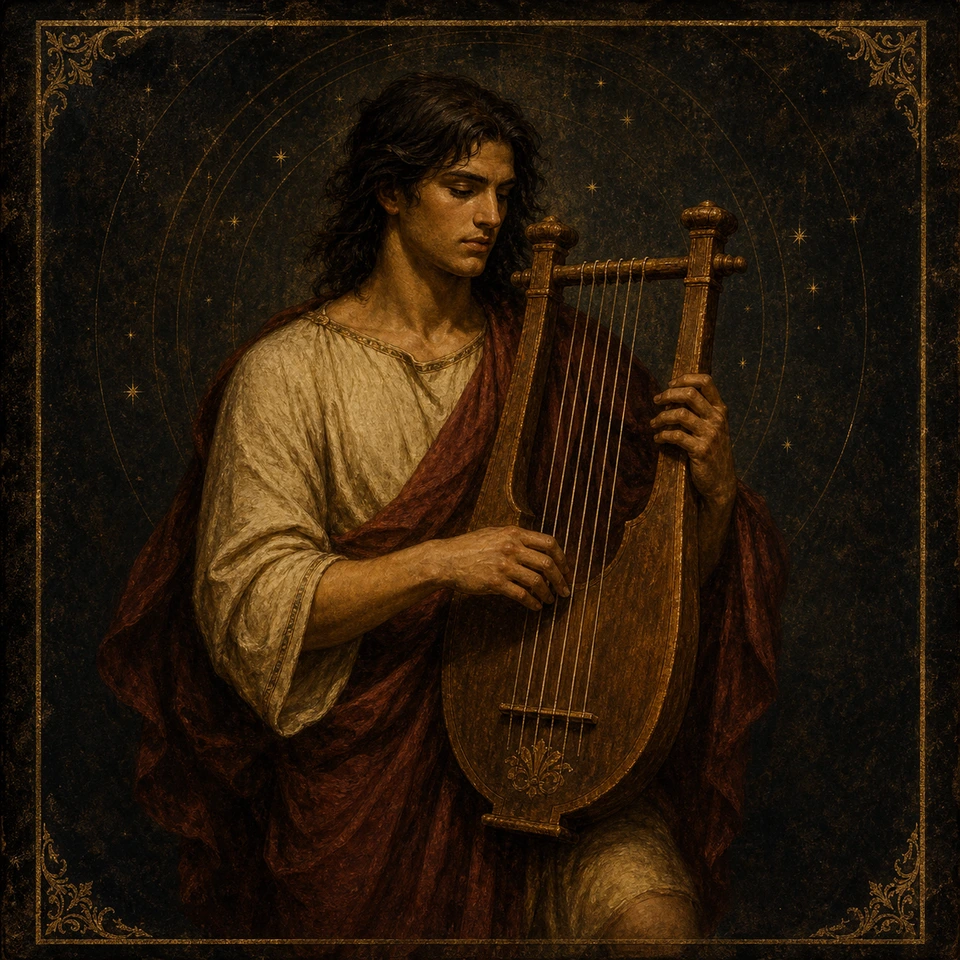
Striking the delicate balance between plague and protection, Apollo wields absolute authority over prophecy, music, and archery. His worship shaped ancient Greece through culturally distinct local cults, leaving permanent marks at sanctuaries like Delphi, Delos, and Bassae.
Overview
At Delphi, a visitor approaching Apollo entered a sanctuary built from centuries of stone, dedications, civic rivalry, and remembered divine speech. The Pythia sat at the center of an institution consulted by cities and individuals, while the temple visible today belonged to a fourth-century rebuilding after earthquake destroyed an earlier structure. Apollo was not an abstract emblem of light hovering above this place. He was the god whose answer had to be sought through a particular sanctuary, whose favor was thanked in objects and monuments, and whose authority could reach from a mountain valley into war, colonization, purification, and civic decision.
Delos tells a different beginning. In the Homeric hymn, Leto wanders because no land wants to risk receiving the powerful child. The small island agrees only after demanding an oath that Apollo will honor it. Beside the palm, after divine delay and difficult labor, the newborn claims the bow, the lyre, and the right to declare Zeus' will. The island later filled with altars, treasuries, temples, sacred embassies, contests, and songs. Myth and cult do not duplicate each other, but together they explain why the god's birth could become a geography visited, built upon, purified, and politically controlled.
Apollo's powers resist a gentle summary. In the Iliad he sends plague through arrows because Agamemnon dishonors Chryses, then accepts restitution, sacrifice, prayer, and paean. In Aeschylus he purifies Orestes and defends him at Athens. He can be musician, archer, oracle, healer, herdsman, city-founder, father, destroyer, and advocate. These are not separate modern job titles. Each emerges from a poem, sanctuary, local epithet, ritual memory, or image. The same authority that protects can punish, and the same prophetic gift that reveals truth can become cruelty in Cassandra's story.
No single sanctuary owns him. Didyma enclosed a sacred spring inside an enormous open court. Claros accumulated inscriptions, statues, altars, and facilities for large sacrifice. Amyclae placed his festival beside Hyacinthus' altar-tomb. Athens distinguished Patroos and Alexikakos. Bassae knew Epicourios. Letoon joined Apollo with Leto and Artemis in a Lycian federal and multilingual landscape. These local Apollos belong to one deity without becoming interchangeable.
Ancient artists also deny the narrow modern stereotype of a naked golden sun god. Attic painters show Apollo long-haired and fully clothed in a long chiton, working both hands across a large kithara. Other images give him bow, quiver, phiale, laurel, or the poised body later famous as the Apollo Belvedere. The long-chitoned musician is not an invention: it comes directly from securely identified ancient objects and shows that music in Greek art is something the god does.
The contradictions must remain visible. Greek Apollo is historically related to Roman Apollo but not swallowed by him. Apollo remains distinct from Helios despite a later literary identification. Paian, Paieon, and Apollo shift by source rather than collapsing into one timeless healer. Stories of Creusa, Cassandra, Daphne, Coronis, Marsyas, Niobe, and Hyacinthus cannot disguise coercion, punishment, or grief. What emerges is not a clean god of sunlight, but a historically layered divine power through whom Greek and later communities confronted revelation, order, beauty, disease, violence, song, and the dangerous cost of divine attention.
Canonical identity
Canonical Identity
Apollo enters ancient Greek evidence as a complex deity wielding multiple unified powers, rather than functioning simply as a sun god awaiting further development. Hesiod establishes his lineage as the son of Zeus and Leto, and the brother of Artemis. The Homeric Hymn to Apollo dramatizes this family dynamic, detailing Leto's desperate search for a sanctuary, Delos's conditional acceptance of the dangerous birth, and the newborn god's immediate claim over the bow, the lyre, and prophetic declaration. While these elements provide a foundational entrance into his identity, they do not exhaust his historical definition.
Linguistic Identity
The Greek name Ἀπόλλων transliterates as Apóllōn. The reconstructed fifth-century BC Attic pronunciation represents a specific scholarly model rather than claiming every ancient Greek community sounded the name identically. Titles such as Phoibos, Delios, Pythios, and the Far-shooter belong to distinct poetic contexts and local worship, revealing how Greek speakers engaged him directly. Greek Apollo remains historically distinct from the Roman Apollo, as shared spelling does not erase the profound differences in place, period, and cultic history.
Sources and evidence
TEXTUAL · Supported
The Ancient Greek name is Ἀπόλλων, transliterated Apóllōn, with a qualified fifth-century BC Attic reconstruction /a.pól.lɔːn/.
- Source
- Wiktionary contributors, Ἀπόλλων
- Reviewed edition
- Wiktionary live revision reviewed 2026-08-29 · Wiktionary
- Exact locator
- Entry Ancient Greek Ἀπόλλων, pronunciation section
- Scope
- Classical Greece · Attica
- Authority
- collaborative historical lexicon
- Certainty
- Provisional
The reconstruction is not generalized to every Greek dialect or century.
Open exact reviewed sourceTEXTUAL · Supported
Hesiod names Apollo and Artemis as the children of Zeus and Leto.
- Source
- Hesiod; edited and translated by Hugh G. Evelyn-White, Theogony (1914)
- Reviewed edition
- Hugh G. Evelyn-White edition and English translation in Hesiod, the Homeric Hymns and Homerica, 1914 · translated by Hugh G. Evelyn-White · edited by Hugh G. Evelyn-White · Perseus Digital Library / Scaife ATLAS
- Exact locator
- Entry Theogony · Line 918-920
- Scope
- Archaic Greece · Ancient Greece
- Authority
- primary Greek hexameter poetry
- Certainty
- Secure
This is an early poetic genealogy, not a complete family tree.
Open exact reviewed sourceTEXTUAL · Supported
Homeric Hymn 3 describes Leto's difficult search for a birth place, Delos' consent, Apollo's birth by the palm, and the god's immediate claim to lyre, bow, and prophecy.
- Source
- Anonymous Homeric Hymns; edited and translated by Hugh G. Evelyn-White, Homeric Hymns (1914)
- Reviewed edition
- Hugh G. Evelyn-White edition and English translation in Hesiod, the Homeric Hymns and Homerica, 1914 · translated by Hugh G. Evelyn-White · edited by Hugh G. Evelyn-White · Perseus Digital Library / Scaife ATLAS
- Exact locator
- Hymn Homeric Hymn 3 to Apollo · Line 25-48; 89-139
- Scope
- Archaic Greece · Delos
- Authority
- primary Greek hymn
- Certainty
- Secure within the hymn
The hymn's narrative is not a universal account of every local birth tradition.
Open exact reviewed sourceTEXTUAL · Supported
Callimachus opens his Hymn to Apollo with Phoebus and the Delian title, while the Homeric hymn separately develops Delian and Pythian identities.
- Source
- Callimachus; translated by A. W. Mair, Hymns (1921)
- Reviewed edition
- A. W. Mair English translation, Loeb Classical Library · translated by A. W. Mair · Perseus Digital Library
- Exact locator
- Hymn Hymn 2 to Apollo · Line 1-5
- Scope
- Hellenistic Greek world · Ancient Greece
- Authority
- primary Hellenistic Greek hymn
- Certainty
- Secure
Phoibos is poetic; Delios is geographic.
Open exact reviewed source4 reviewed sources for this section
- Wiktionary contributors, ἈπόλλωνLive collaborative lexical entry reviewed 2026-08-29 · Wiktionary
- Hesiod; edited and translated by Hugh G. Evelyn-White, Theogony (1914)Hesiod, the Homeric Hymns and Homerica, London and New York, 1914 · Perseus Digital Library / Scaife ATLAS
- Anonymous Homeric Hymns; edited and translated by Hugh G. Evelyn-White, Homeric Hymns (1914)Hesiod, the Homeric Hymns and Homerica, London and New York, 1914 · Perseus Digital Library / Scaife ATLAS
- Callimachus; translated by A. W. Mair, Hymns (1921)1921 Loeb edition hosted by the Perseus Digital Library · Perseus Digital Library
Culture, tradition, period, and place
Apollo belonged to no single Greek city and no single kind of institution. At Delphi, communities and individuals consulted an oracle whose sanctuary became a pan-Hellenic center. On Delos, sacred embassies arrived with gifts, buildings, altars, performances, and festival competition for Apollo, Artemis, and Leto. Didyma and Claros developed their own monumental oracular landscapes in western Anatolia. Amyclae and Sparta knew Apollo through local festivals and titles, while Athens placed Patroos and Alexikakos in a civic setting. Bassae remembered Epicourios as a local protector.
These places should not be treated as branches of one uniform organization. Delphi's Pythia, Delos' island gatherings, the open court and sacred spring at Didyma, the inscribed monumental complex at Claros, and the joint Lycian sanctuary at Letoon each joined Apollo to a different community and history. The evidence ranges from archaic poetry through Classical civic practice, Hellenistic architecture, and Roman-period reception. A useful profile therefore follows the god across places and periods while refusing to make one sanctuary's ritual, one city's title, or one poet's image universal.
Sources and evidence
ARCHAEOLOGICAL · Supported
The current official Delphi history places the sanctuary's archaeological establishment within about 1000 to 800 BC and describes it as functioning as a cult center of Apollo from about 860 BC.
- Source
- Hellenic Ministry of Culture, Archaeological Site of Delphi
- Reviewed edition
- Digital Delphi official archaeological portal · Hellenic Ministry of Culture
- Exact locator
- Page Site History · Entry The Cult of Apollo
- Scope
- Greek Early Iron Age · Delphi
- Authority
- official archaeological authority
- Certainty
- Secure
The archaeological chronology is distinct from the hymn's Python narrative.
Open exact reviewed sourceARCHAEOLOGICAL · Supported
The official Delos record describes the sanctuary as a major Ionian religious center receiving theoric missions, festivals, buildings, altars, and gifts for Apollo, Artemis, and Leto.
- Source
- Hellenic Ministry of Culture, Archaeological Site of Delos
- Reviewed edition
- Ephorate of Antiquities of Cyclades official site entry · Hellenic Ministry of Culture
- Exact locator
- Page The Archaeological Site and Museum of Delos · Entry Sanctuary of Apollo and Ionian religious missions
- Scope
- Ancient Greek diachrony · Delos
- Authority
- official archaeological authority
- Certainty
- Secure
The sanctuary included several divine recipients and is not reduced to Apollo alone.
Open exact reviewed sourceARCHAEOLOGICAL · Supported
Didyma was an Apollonian oracular sanctuary whose monumental temple enclosed an open court, a naiskos, and a sacred spring.
- Source
- Republic of Türkiye Ministry of Culture and Tourism, Didim Apollo Temple
- Reviewed edition
- Turkish Museums live archaeological-site record · Republic of Türkiye Ministry of Culture and Tourism
- Exact locator
- Page Didim Apollo Temple · Entry Temple description, open courtyard, naiskos, holy spring, and oracle
- Scope
- Hellenistic Greek world · Didyma
- Authority
- official archaeological authority
- Certainty
- Secure
The current monumental form is not projected unchanged into every earlier period.
Open exact reviewed sourceARCHAEOLOGICAL · Supported
The official Claros record identifies an oracular sanctuary with a Hellenistic temple, altar, monumental statues of Apollo, Artemis, and Leto, and extensive inscriptions.
- Source
- Republic of Türkiye Ministry of Culture and Tourism, Klaros Archaeological Site
- Reviewed edition
- Turkish Museums live archaeological-site record · Republic of Türkiye Ministry of Culture and Tourism
- Exact locator
- Page Klaros Archaeological Site · Entry Description, paragraphs 1-5
- Scope
- Hellenistic Greek world · Claros
- Authority
- official archaeological authority
- Certainty
- Secure
The record supports the site's material history, not every legendary foundation claim.
Open exact reviewed sourceARCHAEOLOGICAL · Supported
At the Lycian federal sanctuary of Letoon, three temples were dedicated to Leto, Artemis, and Apollo; a trilingual inscription dated 337 BC also preserves the region's Lycian, Greek, and Aramaic setting.
- Source
- UNESCO World Heritage Centre, Xanthos-Letoon (1988)
- Reviewed edition
- World Heritage List entry 484, English site description · United Nations Educational, Scientific and Cultural Organization
- Exact locator
- Entry World Heritage property 484, Description and Outstanding Universal Value; detail: Letoon temples and 337 BC trilingual inscription
- Scope
- Lycian Classical and Hellenistic periods · Letoon
- Authority
- international heritage authority
- Certainty
- Secure
Lycian evidence is not treated as proof of a single origin theory.
Open exact reviewed source5 reviewed sources for this section
- Hellenic Ministry of Culture, Archaeological Site of DelphiDigital Delphi official archaeological portal · Hellenic Ministry of Culture
- Hellenic Ministry of Culture, Archaeological Site of DelosEphorate of Antiquities of Cyclades official site record · Hellenic Ministry of Culture
- Republic of Türkiye Ministry of Culture and Tourism, Didim Apollo TempleTurkish Museums live site record · Republic of Türkiye Ministry of Culture and Tourism
- Republic of Türkiye Ministry of Culture and Tourism, Klaros Archaeological SiteTurkish Museums live site record · Republic of Türkiye Ministry of Culture and Tourism
- UNESCO World Heritage Centre, Xanthos-Letoon (1988)World Heritage List entry 484 · United Nations Educational, Scientific and Cultural Organization
Historical development
Apollo is securely visible in archaic poetry and early Greek material culture, but his deeper origin remains debated. The name Apollo is not securely attested in the surviving Linear B record, while a form related to Paean appears at Mycenaean Knossos. That difference matters because it prevents an easy claim that the later god can simply be read backward into every earlier healing name. A Boeotian bronze dedicated around 700 to 675 BC invokes the Far-shooter, bearer of the Silver Bow, and Phoibos, although scholars still debate whether its small male figure depicts Apollo or the human dedicator.
By the eighth century BC, Delphi was developing as Apollo's cult center, and Delos had become inseparable from the story of his birth and from Ionian gathering. Later rebuilding changed what worshippers saw. Delphi's surviving temple belongs to the fourth century BC after an earthquake destroyed its predecessor. Hellenistic and Roman works continued to reshape Apollo's image, from Cypriot and Cyrenaean statues to the Roman marble now called the Apollo Belvedere. The god's history is therefore not a march toward one finished form. It is a long accumulation of local cults, literary arguments, political uses, images, and later reinterpretations.
Sources and evidence
SCHOLARLY INTERPRETATION · Supported
The Oxford Classical Dictionary notes that Apollo's name is absent from Linear B while Paean appears as Paiawon at Mycenaean Knossos.
- Source
- Fritz Graf, Apollo (2015)
- Reviewed edition
- Oxford Classical Dictionary online entry extract · Oxford Academic
- Exact locator
- Section Extract · Entry Linear B absence and Paiawon at Knossos; paragraph: 2
- Scope
- Modern classical scholarship · Knossos
- Authority
- academic classical reference
- Certainty
- Qualified
This uneven Mycenaean evidence does not by itself prove a single origin for Apollo or settle his relationship to Paian.
Open exact reviewed sourceARCHAEOLOGICAL · Supported
The current official Delphi history describes the site as functioning as a cult center of Apollo from about 860 BC within an archaeological establishment dated broadly to 1000 to 800 BC.
- Source
- Hellenic Ministry of Culture, Archaeological Site of Delphi
- Reviewed edition
- Digital Delphi official archaeological portal · Hellenic Ministry of Culture
- Exact locator
- Page Site History · Entry The Cult of Apollo
- Scope
- Greek Early Iron Age · Delphi
- Authority
- official archaeological authority
- Certainty
- Qualified
This is the site's current archaeological interpretation, not a universal first attestation.
Open exact reviewed sourceTEXTUAL · Supported
Thucydides records the Athenian purification of Delos during the Peloponnesian War and the renewed quinquennial festival, while recalling an older Ionian gathering attested through the Delian hymn tradition.
- Source
- Thucydides; translated by Richard Crawley; revised by Richard Feetham, History of the Peloponnesian War (1910)
- Reviewed edition
- Richard Crawley translation, revised by Richard Feetham, 1910 Dent and Dutton edition · translated by Richard Crawley · edited by Richard Feetham · Perseus Digital Library
- Exact locator
- Book 3 · Section 104
- Scope
- Classical Greece · Delos
- Authority
- primary Greek historiography
- Certainty
- Secure as Thucydides' report
The older hymn passage and the fifth-century renewal are kept chronologically distinct.
Open exact reviewed sourceMATERIAL CULTURE · Supported
The Apollo Belvedere is a Roman marble made in the first decades of the second century AD after a Greek bronze model dated about 330 BC.
- Source
- Vatican Museums, Apollo Belvedere
- Reviewed edition
- Vatican Museums live collection record · Vatican Museums
- Exact locator
- Entry Ancient copy and Greek model; object: Apollo Belvedere
- Scope
- Greek religion under Roman imperial rule · Rome
- Authority
- official museum object record
- Certainty
- Secure
The Roman marble and the lost Classical Greek model remain distinct material layers; rediscovery belongs to a separate reception claim.
Open exact reviewed sourceMATERIAL CULTURE · Supported
Museum of Fine Arts object 03.997 is a Boeotian bronze of about 700 to 675 BC whose archaic dedication invokes the Far Shooter, bearer of the Silver Bow, and Phoibos.
- Source
- Museum of Fine Arts, Boston, Mantiklos ‘Apollo’
- Reviewed edition
- Museum of Fine Arts, Boston live collection record for object 03.997 · Museum of Fine Arts, Boston
- Exact locator
- Entry Date, provenance, medium, and inscription translation; object: Mantiklos ‘Apollo’, accession 03.997
- Scope
- Archaic Greece · Thebes in Boeotia
- Authority
- accessioned museum object and archaic dedication
- Certainty
- Secure for object, date range, provenance, and inscription
The inscription supplies early epithets, while the identity of the represented human figure remains debated.
Open exact reviewed source5 reviewed sources for this section
- Fritz Graf, Apollo (2015)Oxford Classical Dictionary online entry extract · Oxford Academic
- Hellenic Ministry of Culture, Archaeological Site of DelphiDigital Delphi official archaeological portal · Hellenic Ministry of Culture
- Thucydides; translated by Richard Crawley; revised by Richard Feetham, History of the Peloponnesian War (1910)1910 Dent and Dutton revision digitized by the Perseus Project · Perseus Digital Library
- Vatican Museums, Apollo BelvederePio Clementino Museum collection record · Vatican Museums
- Museum of Fine Arts, Boston, Mantiklos ‘Apollo’MFA collection object 03.997 · Museum of Fine Arts, Boston
Attested roles and historical themes
Roles, powers, and limits
Apollo can send plague and end it. He can protect a city, yet also destroy bodies with arrows. He speaks through oracles, purifies bloodguilt in tragedy, plays the kithara, receives festival song, watches over herds in one Hellenistic hymn, and appears as the father of healers, founders, and civic ancestors. These roles are connected by the sources, but they should not be reduced to a modern list of powers.
The opening of the Iliad shows the danger of simplification. Apollo hears Chryses, strikes the Achaean camp, and stops only after the captive woman is returned and the community performs prayer and sacrifice. In Aeschylus, the same god purifies Orestes and argues for him at Athens. Callimachus gathers archery, music, lots, seers, healing knowledge, and city-founding into a Hellenistic praise poem. Each source explains a particular Apollo. Together they show divine authority that can reveal, avert, punish, restore, and order, but none promises that every worshipper in every place approached him for all these purposes at once.
Sources and evidence
TEXTUAL · Supported
In Iliad 1, Apollo answers Chryses by sending plague through his arrows against the Achaean camp and ceases only after restitution, sacrifice, and prayer.
- Source
- Homer; Monro and Allen Greek edition with edition-specific translations, Iliad (1920)
- Reviewed edition
- Monro and Allen Greek edition represented by the Perseus CTS corpus, Oxford, 1908-1920 · edited by David Binning Monro and Thomas William Allen · Perseus Digital Library / Scaife ATLAS
- Exact locator
- Book 1 · Line 8-52; 430-474
- Scope
- Archaic Greece · Troy and the Achaean war camp
- Authority
- primary Greek epic
- Certainty
- Secure within the epic
The scene supports both destructive plague and the restoration of favor, not generic medical advice.
Open exact reviewed sourceTEXTUAL · Supported
Homeric Hymn 3 repeatedly joins Apollo's bow, lyre, and declaration of Zeus' will, culminating in the foundation of his Pythian sanctuary and priesthood.
- Source
- Anonymous Homeric Hymns; edited and translated by Hugh G. Evelyn-White, Homeric Hymns (1914)
- Reviewed edition
- Hugh G. Evelyn-White edition and English translation in Hesiod, the Homeric Hymns and Homerica, 1914 · translated by Hugh G. Evelyn-White · edited by Hugh G. Evelyn-White · Perseus Digital Library / Scaife ATLAS
- Exact locator
- Hymn Homeric Hymn 3 to Apollo · Line 131-139; 214-546
- Scope
- Archaic Greece · Delphi
- Authority
- primary Greek hymn
- Certainty
- Secure within the hymn
Mythic foundation and historical sanctuary development remain separate layers.
Open exact reviewed sourceTEXTUAL · Supported
Aeschylus presents Apollo as purifier, protector, and advocate of Orestes, sending him from Delphi to Athens and testifying at the Areopagus trial.
- Source
- Aeschylus; translated by Herbert Weir Smyth, Eumenides (1926)
- Reviewed edition
- Herbert Weir Smyth English translation of Aeschylus, Eumenides, Volume 2, William Heinemann and G. P. Putnam's Sons, 1926, Perseus eng2 component modernized by Perseus · translated by Herbert Weir Smyth · edited by Herbert Weir Smyth · Perseus Digital Library
- Exact locator
- Line 64-93; 179-234; 576-777 · Entry play: Eumenides
- Scope
- Classical Greece · Delphi
- Authority
- primary Greek tragedy
- Certainty
- Secure within the play
The play's theology is not treated as a transcript of universal ritual law.
Open exact reviewed sourceTEXTUAL · Supported
Callimachus assigns Apollo archery, music, lots, seers, healing knowledge, and guidance in founding cities within a Hellenistic hymnic synthesis.
- Source
- Callimachus; translated by A. W. Mair, Hymns (1921)
- Reviewed edition
- A. W. Mair English translation, Loeb Classical Library · translated by A. W. Mair · Perseus Digital Library
- Exact locator
- Hymn Hymn 2 to Apollo · Line 32-65
- Scope
- Hellenistic Greek world · Ancient Greece
- Authority
- primary Hellenistic Greek hymn
- Certainty
- Secure within the hymn
The hymn's broad synthesis is not backdated without earlier witnesses.
Open exact reviewed sourceTEXTUAL · Supported
Pausanias saw Apollo Patroos in Athens and an Apollo Alexikakos whose title was explained through the averting of plague after a Delphic oracle.
- Source
- Pausanias; Spiro Greek edition and Jones/Ormerod translation volumes, Description of Greece (1935)
- Reviewed edition
- Spiro Greek edition and Jones/Ormerod English volumes represented by the Perseus CTS corpus, 1903-1935 · translated by W. H. S. Jones and H. A. Ormerod, volume-dependent · edited by Friedrich Spiro for the Greek edition · Perseus Digital Library / Scaife ATLAS
- Exact locator
- Book 1 · Chapter 3 · Section 4
- Scope
- Greek religion under Roman imperial rule · Athens
- Authority
- primary Greek periegesis
- Certainty
- Secure as Pausanias' report
Patroos and Alexikakos are distinct Attic cult titles.
Open exact reviewed sourceTEXTUAL · Supported
Callimachus calls Apollo Nomios because he tended Admetus' mares by the Amphrysus and describes flourishing cattle, goats, sheep, and milk under his gaze.
- Source
- Callimachus; translated by A. W. Mair, Hymns (1921)
- Reviewed edition
- A. W. Mair English translation, Loeb Classical Library · translated by A. W. Mair · Perseus Digital Library
- Exact locator
- Hymn Hymn 2 to Apollo · Line 47-54
- Scope
- Hellenistic Greek world · Pherae
- Authority
- primary Hellenistic Greek hymn
- Certainty
- Secure within the hymn
Nomios is a source-attested pastoral title, not a universal livestock rite.
Open exact reviewed sourceTEXTUAL · Supported
Euripides' Ion makes Apollo the hidden father of Ion and places the child's upbringing at Delphi within an Athenian civic genealogy, while exposing divine coercion and concealment.
- Source
- Euripides; translated by Robert Potter; edited by Whitney J. Oates and Eugene O'Neill Jr., Ion (1938)
- Reviewed edition
- Robert Potter English translation in The Complete Greek Drama · translated by Robert Potter · edited by Whitney J. Oates and Eugene O'Neill Jr. · Perseus Digital Library
- Exact locator
- Line 1-81 · Entry play: Ion
- Scope
- Classical Greece · Athens
- Authority
- primary Greek tragedy
- Certainty
- Secure within the play
The union is described as forced and is not romanticized.
Open exact reviewed source6 reviewed sources for this section
- Homer; Monro and Allen Greek edition with edition-specific translations, Iliad (1920)Perseus CTS edition corpus; Greek edition, Oxford, 1908-1920 · Perseus Digital Library / Scaife ATLAS
- Anonymous Homeric Hymns; edited and translated by Hugh G. Evelyn-White, Homeric Hymns (1914)Hesiod, the Homeric Hymns and Homerica, London and New York, 1914 · Perseus Digital Library / Scaife ATLAS
- Aeschylus; translated by Herbert Weir Smyth, Eumenides (1926)1926 Loeb edition hosted by the Perseus Digital Library · Perseus Digital Library
- Callimachus; translated by A. W. Mair, Hymns (1921)1921 Loeb edition hosted by the Perseus Digital Library · Perseus Digital Library
- Pausanias; Spiro Greek edition and Jones/Ormerod translation volumes, Description of Greece (1935)Perseus CTS edition corpus, 1903-1935 · Perseus Digital Library / Scaife ATLAS
- Euripides; translated by Robert Potter; edited by Whitney J. Oates and Eugene O'Neill Jr., Ion (1938)1938 Complete Greek Drama translation hosted by the Perseus Digital Library · Perseus Digital Library
Epithets and titles
Poetic Epithet
Phoibos
Φοῖβος · Phoibos, often rendered Bright or Pure
Greek hymnic poetry · Archaic and Hellenistic witnessesA poetic address with a long reception; it is not by itself proof of solar identity.
1 reviewed source for this section
- Callimachus; translated by A. W. Mair, Hymns (1921)1921 Loeb edition hosted by the Perseus Digital Library · Perseus Digital Library
Geographic Epithet
Delios
Δήλιος · Delian
Delos and Delian poetry · Archaic through Hellenistic witnessesA title rooted in Apollo's Delian birth place and cult, not a universal title for every sanctuary.
1 reviewed source for this section
- Callimachus; translated by A. W. Mair, Hymns (1921)1921 Loeb edition hosted by the Perseus Digital Library · Perseus Digital Library
Poetic Epithet
Far-shooter
Far-shooting archer
Greek epic, hymn, and early dedication · Archaic witnessesThe title joins poetic archery to an early inscribed dedication.
2 reviewed sources for this section
- Anonymous Homeric Hymns; edited and translated by Hugh G. Evelyn-White, Homeric Hymns (1914)Hesiod, the Homeric Hymns and Homerica, London and New York, 1914 · Perseus Digital Library / Scaife ATLAS
- Museum of Fine Arts, Boston, Mantiklos ‘Apollo’MFA collection object 03.997 · Museum of Fine Arts, Boston
Geographic Epithet
Pythios
Πύθιος · Pythian
Delphi and Pythian tradition · Archaic and later Greek witnessesA Delphic title tied to Pytho and the sanctuary tradition.
2 reviewed sources for this section
- Anonymous Homeric Hymns; edited and translated by Hugh G. Evelyn-White, Homeric Hymns (1914)Hesiod, the Homeric Hymns and Homerica, London and New York, 1914 · Perseus Digital Library / Scaife ATLAS
- Pausanias; Spiro Greek edition and Jones/Ormerod translation volumes, Description of Greece (1935)Perseus CTS edition corpus, 1903-1935 · Perseus Digital Library / Scaife ATLAS
Cult Epithet
Delphinios
Δελφίνιος · Of the dolphin
Delphic foundation narrative · Archaic hymnic witnessThe hymn connects the title to Apollo's dolphin form and Cretan priests without making him a universal sea god.
1 reviewed source for this section
- Anonymous Homeric Hymns; edited and translated by Hugh G. Evelyn-White, Homeric Hymns (1914)Hesiod, the Homeric Hymns and Homerica, London and New York, 1914 · Perseus Digital Library / Scaife ATLAS
Cult Epithet
Smintheus
Σμινθεύς · Smintheus
Troad setting in epic · Archaic epic witnessThe Iliad securely supports the title. Mouse symbolism and agricultural protection require separate evidence.
1 reviewed source for this section
- Homer; Monro and Allen Greek edition with edition-specific translations, Iliad (1920)Perseus CTS edition corpus; Greek edition, Oxford, 1908-1920 · Perseus Digital Library / Scaife ATLAS
Cult Epithet
Karneios
Κάρνειος · Carneian
Sparta and Dorian cult settings · Classical and later witnessesA local cult title whose histories vary by place and source.
2 reviewed sources for this section
- Pausanias; Spiro Greek edition and Jones/Ormerod translation volumes, Description of Greece (1935)Perseus CTS edition corpus, 1903-1935 · Perseus Digital Library / Scaife ATLAS
- Pindar; translated by Diane Arnson Svarlien, Odes of Pindar (1990)1990 translation hosted by the Perseus Digital Library · Tufts University
Geographic Epithet
Amyklaios
Ἀμυκλαῖος · Of Amyclae
Amyclae in Laconia · Imperial-period description of older cultThe title belongs to the Amyclaean sanctuary and Hyakinthia setting.
1 reviewed source for this section
- Pausanias; Spiro Greek edition and Jones/Ormerod translation volumes, Description of Greece (1935)Perseus CTS edition corpus, 1903-1935 · Perseus Digital Library / Scaife ATLAS
Cult Epithet
Lykeios
Λύκειος · Lykeios
Athens and Argos · Classical cult remembered by PausaniasThe title is secure, but its relation to wolves, Lycia, or light is not settled here.
1 reviewed source for this section
- Pausanias; Spiro Greek edition and Jones/Ormerod translation volumes, Description of Greece (1935)Perseus CTS edition corpus, 1903-1935 · Perseus Digital Library / Scaife ATLAS
Cult Epithet
Patroos
Πατρῷος · Ancestral
Athens · Classical civic cult remembered by PausaniasAn Athenian civic title, not a universal claim that Apollo was every lineage's ancestor.
1 reviewed source for this section
- Pausanias; Spiro Greek edition and Jones/Ormerod translation volumes, Description of Greece (1935)Perseus CTS edition corpus, 1903-1935 · Perseus Digital Library / Scaife ATLAS
Functional Title
Alexikakos
Ἀλεξίκακος · Averter of evil
Athens · Local cult remembered by PausaniasA local averting title associated with plague memory, not a guarantee of healing.
1 reviewed source for this section
- Pausanias; Spiro Greek edition and Jones/Ormerod translation volumes, Description of Greece (1935)Perseus CTS edition corpus, 1903-1935 · Perseus Digital Library / Scaife ATLAS
Functional Title
Epicourios
Ἐπικούριος · Helper
Bassae and Phigalia · Classical cult with later testimonyA local protective title connected with Phigalian memory of plague and invasion.
2 reviewed sources for this section
- Pausanias; Spiro Greek edition and Jones/Ormerod translation volumes, Description of Greece (1935)Perseus CTS edition corpus, 1903-1935 · Perseus Digital Library / Scaife ATLAS
- UNESCO World Heritage Centre, Temple of Apollo Epicurius at Bassae (1986)World Heritage List entry 392 · United Nations Educational, Scientific and Cultural Organization
Theological Title
Paian or Paieon
Παιάν / Παιήων · Paean or healer
Greek epic and hymnic traditions · Archaic through Hellenistic witnessesCallimachus can address Apollo as Paeon, while Homer also names Paieon as a healer distinct in that passage.
2 reviewed sources for this section
- Callimachus; translated by A. W. Mair, Hymns (1921)1921 Loeb edition hosted by the Perseus Digital Library · Perseus Digital Library
- Homer; Monro and Allen Greek edition with edition-specific translations, Iliad (1920)Perseus CTS edition corpus; Greek edition, Oxford, 1908-1920 · Perseus Digital Library / Scaife ATLAS
Worship and cult
At Delphi, consultation was an institution rather than a private flash of inspiration. The Pythia delivered Apollo's oracle from the sanctuary, and visitors entered a setting shaped by temple officials, dedications, civic missions, and the reputation of the god's responses. Delos likewise depended on organized movement: cities sent sacred embassies, offerings, performers, and competitors to an island crowded with monuments. Worship made Apollo public. It also made him political, because access, prestige, purification, and festival display could bind communities together or set them in competition.
Local cult titles disclose different needs. Athenians distinguished Apollo Patroos from Alexikakos, the averter of evil. The Phigalians connected Epicourios with protection from plague and invasion. At Claros, a monumental altar zone and an installation for many sacrificial animals point to large-scale rites, but they do not tell us to import Delphic procedure there. Evidence for ancient sacrifice is historical description, not a modern instruction. Current public practice also needs its own label. Hellenion's documented libation belongs to that named modern community and cannot stand in for all contemporary devotees or for ancient continuity.
Sources and evidence
RITUAL ATTESTED · Supported
At Delphi the Pythia delivered Apollo's oracle seated on a tripod, and the sanctuary received communities and individuals within an organized pan-Hellenic cult setting.
- Source
- Hellenic Ministry of Culture, Archaeological Site of Delphi
- Reviewed edition
- Digital Delphi official archaeological portal · Hellenic Ministry of Culture
- Exact locator
- Page The Beginnings of the Sanctuary; Archaeological Site of Delphi · Entry Pythia on the tripod and pan-Hellenic oracle
- Scope
- Ancient Greek diachrony · Delphi
- Authority
- official archaeological authority
- Certainty
- Secure
The public description does not disclose one unchanging procedure across the sanctuary's whole history.
Open exact reviewed sourceRITUAL ATTESTED · Supported
Delos received formal sacred embassies, gifts, altars, buildings, festivals, and performances for Apollo and his family, showing organized interstate worship rather than an isolated birth shrine.
- Source
- Hellenic Ministry of Culture, Archaeological Site of Delos
- Reviewed edition
- Ephorate of Antiquities of Cyclades official site entry · Hellenic Ministry of Culture
- Exact locator
- Page The Archaeological Site and Museum of Delos · Entry Theoric missions, festivals, gifts, altars, and buildings
- Scope
- Ancient Greek diachrony · Delos
- Authority
- official archaeological authority
- Certainty
- Secure
Apollo, Artemis, and Leto retain distinct recipient identities.
Open exact reviewed sourceARCHAEOLOGICAL · Supported
The Phigaleians dedicated the fifth-century BC temple at Bassae to Apollo Epicurius in a tradition crediting him with protection from plague and invasion.
- Source
- UNESCO World Heritage Centre, Temple of Apollo Epicurius at Bassae (1986)
- Reviewed edition
- World Heritage List entry 392, English description and Outstanding Universal Value · United Nations Educational, Scientific and Cultural Organization
- Exact locator
- Entry Outstanding Universal Value, Brief synthesis; paragraph: Temple date, dedication, plague and invasion
- Scope
- Classical Greece · Bassae
- Authority
- international heritage authority
- Certainty
- Qualified
The protective explanation is the recorded local dedication tradition.
Open exact reviewed sourceTEXTUAL · Supported
Pausanias distinguishes the Athenian temple of Apollo Patroos from nearby images including Apollo Alexikakos, preserving separate civic and averting titles in one urban landscape.
- Source
- Pausanias; Spiro Greek edition and Jones/Ormerod translation volumes, Description of Greece (1935)
- Reviewed edition
- Spiro Greek edition and Jones/Ormerod English volumes represented by the Perseus CTS corpus, 1903-1935 · translated by W. H. S. Jones and H. A. Ormerod, volume-dependent · edited by Friedrich Spiro for the Greek edition · Perseus Digital Library / Scaife ATLAS
- Exact locator
- Book 1 · Chapter 3 · Section 4
- Scope
- Greek religion under Roman imperial rule · Athens
- Authority
- primary Greek periegesis
- Certainty
- Secure as Pausanias' report
Local titles are not merged into a single generic civic epithet.
Open exact reviewed sourceRITUAL ATTESTED · Supported
Claros preserves a monumental cult ensemble with Apollo, Artemis, and Leto statues, two sacrifice tables, and an archaeological installation for a hecatomb.
- Source
- Republic of Türkiye Ministry of Culture and Tourism, Klaros Archaeological Site
- Reviewed edition
- Turkish Museums live archaeological-site record · Republic of Türkiye Ministry of Culture and Tourism
- Exact locator
- Page Klaros Archaeological Site · Entry Temple, altar, cult statues, and hecatomb blocks
- Scope
- Hellenistic Greek world · Claros
- Authority
- official archaeological authority
- Certainty
- Secure
The two sacrifice tables were dedicated separately to Apollo and Dionysus.
Open exact reviewed source5 reviewed sources for this section
- Hellenic Ministry of Culture, Archaeological Site of DelphiDigital Delphi official archaeological portal · Hellenic Ministry of Culture
- Hellenic Ministry of Culture, Archaeological Site of DelosEphorate of Antiquities of Cyclades official site record · Hellenic Ministry of Culture
- UNESCO World Heritage Centre, Temple of Apollo Epicurius at Bassae (1986)World Heritage List entry 392 · United Nations Educational, Scientific and Cultural Organization
- Pausanias; Spiro Greek edition and Jones/Ormerod translation volumes, Description of Greece (1935)Perseus CTS edition corpus, 1903-1935 · Perseus Digital Library / Scaife ATLAS
- Republic of Türkiye Ministry of Culture and Tourism, Klaros Archaeological SiteTurkish Museums live site record · Republic of Türkiye Ministry of Culture and Tourism
Temples, sanctuaries, and sacred places
Delphi and Delos dominate Apollo's surviving map, but they do so in different ways. Delphi joined a mountain sanctuary, an oracle, treasuries, monuments, and the Pythian Games. Its visible fourth-century temple rose after earlier phases had been destroyed and rebuilt. Delos made a small island into a sacred center through birth narrative, altars, temples, stoas, treasuries, gifts, and the repeated arrival of visitors by sea. Thucydides' account of Athenian purification and festival renewal shows that control of sacred space could also be an act of power.
Farther east, Didyma enclosed a sacred spring and a smaller shrine within the open court of an immense Ionic temple. Claros preserved an altar, cult statues, sacrifice installations, and unusually dense inscriptions. Letoon placed Apollo beside Leto and Artemis in a multilingual Lycian federal sanctuary. Bassae set a remote protective cult inside an architecturally innovative temple. Amyclae joined Apollo to the tomb and festival of Hyacinthus. These sanctuaries do not merely illustrate a god already fully known from books. Their buildings, objects, routes, and local names are evidence for the different ways communities made Apollo present.
Sources and evidence
ARCHAEOLOGICAL · Supported
The visible Temple of Apollo at Delphi dates to about 330 BC after the earthquake of 373 BC, while an earlier temple completed around 510 BC belonged to a different architectural phase.
- Source
- Hellenic Ministry of Culture, Archaeological Site of Delphi
- Reviewed edition
- Digital Delphi official archaeological portal · Hellenic Ministry of Culture
- Exact locator
- Page The Temple of Apollo · Entry Archaic temple, 373 BC earthquake, and fourth-century rebuilding
- Scope
- Ancient Greek diachrony · Delphi
- Authority
- official archaeological authority
- Certainty
- Secure
The extant ruins do not stand in for every earlier Delphic temple.
Open exact reviewed sourceARCHAEOLOGICAL · Supported
Delos developed a dense sacred landscape of temples, altars, treasuries, porticoes, and votive monuments around the Sanctuary of Apollo.
- Source
- Hellenic Ministry of Culture, Archaeological Site of Delos
- Reviewed edition
- Ephorate of Antiquities of Cyclades official site entry · Hellenic Ministry of Culture
- Exact locator
- Page The Archaeological Site and Museum of Delos · Entry Sanctuary monuments and sacred landscape
- Scope
- Ancient Greek diachrony · Delos
- Authority
- official archaeological authority
- Certainty
- Secure
Chronology and dedications vary by monument.
Open exact reviewed sourceARCHAEOLOGICAL · Supported
Didyma's unusually large dipteral Ionic temple surrounded an unroofed courtyard containing a naiskos and sacred spring.
- Source
- Republic of Türkiye Ministry of Culture and Tourism, Didim Apollo Temple
- Reviewed edition
- Turkish Museums live archaeological-site record · Republic of Türkiye Ministry of Culture and Tourism
- Exact locator
- Page Didim Apollo Temple · Entry Dipteral plan and open-top courtyard
- Scope
- Hellenistic Greek world · Didyma
- Authority
- official archaeological authority
- Certainty
- Secure
The architecture is described without inventing a complete consultation rite.
Open exact reviewed sourceARCHAEOLOGICAL · Supported
At Claros the Doric temple begun in the early third century BC stood with a Hellenistic altar and colossal cult statues, while its inscribed steps preserve unusually dense visitor evidence.
- Source
- Republic of Türkiye Ministry of Culture and Tourism, Klaros Archaeological Site
- Reviewed edition
- Turkish Museums live archaeological-site record · Republic of Türkiye Ministry of Culture and Tourism
- Exact locator
- Page Klaros Archaeological Site · Entry Temple chronology, altar, statues, and inscriptions
- Scope
- Hellenistic Greek world · Claros
- Authority
- official archaeological authority
- Certainty
- Secure
The site's long date range is not compressed into one moment.
Open exact reviewed sourceARCHAEOLOGICAL · Supported
The Temple of Apollo Epicurius at Bassae was built about 420 to 400 BC and combines Doric, Ionic, and Corinthian orders, including the earliest surviving Corinthian capital.
- Source
- UNESCO World Heritage Centre, Temple of Apollo Epicurius at Bassae (1986)
- Reviewed edition
- World Heritage List entry 392, English description and Outstanding Universal Value · United Nations Educational, Scientific and Cultural Organization
- Exact locator
- Entry Outstanding Universal Value, Brief synthesis and Criterion (i); paragraph: Architecture and date
- Scope
- Classical Greece · Bassae
- Authority
- international heritage authority
- Certainty
- Secure
UNESCO's solar wording is not used as proof of early solar identity.
Open exact reviewed sourceARCHAEOLOGICAL · Supported
Apollo's temple at Letoon formed one part of a three-temple Lycian federal sanctuary with Leto and Artemis near Xanthos.
- Source
- UNESCO World Heritage Centre, Xanthos-Letoon (1988)
- Reviewed edition
- World Heritage List entry 484, English site description · United Nations Educational, Scientific and Cultural Organization
- Exact locator
- Entry World Heritage property 484, Description; paragraph: Letoon sanctuary and three temples
- Scope
- Lycian Classical and Hellenistic periods · Letoon
- Authority
- international heritage authority
- Certainty
- Secure
The local Lycian setting remains visible.
Open exact reviewed source6 reviewed sources for this section
- Hellenic Ministry of Culture, Archaeological Site of DelphiDigital Delphi official archaeological portal · Hellenic Ministry of Culture
- Hellenic Ministry of Culture, Archaeological Site of DelosEphorate of Antiquities of Cyclades official site record · Hellenic Ministry of Culture
- Republic of Türkiye Ministry of Culture and Tourism, Didim Apollo TempleTurkish Museums live site record · Republic of Türkiye Ministry of Culture and Tourism
- Republic of Türkiye Ministry of Culture and Tourism, Klaros Archaeological SiteTurkish Museums live site record · Republic of Türkiye Ministry of Culture and Tourism
- UNESCO World Heritage Centre, Temple of Apollo Epicurius at Bassae (1986)World Heritage List entry 392 · United Nations Educational, Scientific and Cultural Organization
- UNESCO World Heritage Centre, Xanthos-Letoon (1988)World Heritage List entry 484 · United Nations Educational, Scientific and Cultural Organization
Festivals and processions
Apollo's festivals were not one generalized season of sunlight or music. At Delos, the Homeric hymn imagines an Ionian gathering of athletics, dance, song, and the astonishing performance of the Delian Maidens. Thucydides later describes Athenian purification of the island and renewal of a quinquennial festival with musical, athletic, and equestrian contests. At Delphi, Pausanias distinguishes early musical contests from the reorganized Pythian Games and their expanded program.
Spartan evidence requires even sharper separation. At Amyclae, the Hyakinthia honored Hyacinthus before sacrifice to Apollo, preserving a ritual order in which hero and god could not be collapsed. The Karneia belonged to another Dorian and Spartan setting. Modern scholarship has proposed that the Hyakinthia, Gymnopaidiai, and Karneia formed stages in a rite-of-passage cycle, but that is an interpretation built from distinct festivals, not an ancient statement that they were a single program. The safest picture is richer: Apollo's calendars joined mourning, competition, civic display, song, sacrifice, and local memory in different combinations.
Sources and evidence
TEXTUAL · Supported
Thucydides says Athens purified Delos and renewed a quinquennial festival with musical, athletic, and equestrian contests, distinct from the older Ionian gathering he associates with the hymn to Apollo.
- Source
- Thucydides; translated by Richard Crawley; revised by Richard Feetham, History of the Peloponnesian War (1910)
- Reviewed edition
- Richard Crawley translation, revised by Richard Feetham, 1910 Dent and Dutton edition · translated by Richard Crawley · edited by Richard Feetham · Perseus Digital Library
- Exact locator
- Book 3 · Section 104
- Scope
- Classical Greece · Delos
- Authority
- primary Greek historiography
- Certainty
- Secure as Thucydides' report
No universal modern date is inferred from the ancient festival.
Open exact reviewed sourceTEXTUAL · Supported
Pausanias distinguishes earlier musical contests at Delphi from the reorganized Pythian games and their later athletic program.
- Source
- Pausanias; Spiro Greek edition and Jones/Ormerod translation volumes, Description of Greece (1935)
- Reviewed edition
- Spiro Greek edition and Jones/Ormerod English volumes represented by the Perseus CTS corpus, 1903-1935 · translated by W. H. S. Jones and H. A. Ormerod, volume-dependent · edited by Friedrich Spiro for the Greek edition · Perseus Digital Library / Scaife ATLAS
- Exact locator
- Book 10 · Chapter 7 · Section 2-8
- Scope
- Greek religion under Roman imperial rule · Delphi
- Authority
- primary Greek periegesis
- Certainty
- Secure as Pausanias' account
The festival's phases are not blended into one timeless program.
Open exact reviewed sourceRITUAL ATTESTED · Supported
At Amyclae, Pausanias describes the Hyakinthia as honoring Hyacinthus before the sacrifice to Apollo, with offerings passed through a bronze door into the hero's altar-tomb.
- Source
- Pausanias; Spiro Greek edition and Jones/Ormerod translation volumes, Description of Greece (1935)
- Reviewed edition
- Spiro Greek edition and Jones/Ormerod English volumes represented by the Perseus CTS corpus, 1903-1935 · translated by W. H. S. Jones and H. A. Ormerod, volume-dependent · edited by Friedrich Spiro for the Greek edition · Perseus Digital Library / Scaife ATLAS
- Exact locator
- Book 3 · Chapter 19 · Section 3-5
- Scope
- Greek religion under Roman imperial rule · Amyclae
- Authority
- primary Greek periegesis
- Certainty
- Secure as Pausanias' report
The sequence preserves Hyacinthus' distinct heroic recipient status.
Open exact reviewed sourceTEXTUAL · Supported
Pausanias distinguishes Apollo Carneius of the House at Sparta from a broader Dorian account linking the Carneian cult to the seer Carnus and bloodguilt.
- Source
- Pausanias; Spiro Greek edition and Jones/Ormerod translation volumes, Description of Greece (1935)
- Reviewed edition
- Spiro Greek edition and Jones/Ormerod English volumes represented by the Perseus CTS corpus, 1903-1935 · translated by W. H. S. Jones and H. A. Ormerod, volume-dependent · edited by Friedrich Spiro for the Greek edition · Perseus Digital Library / Scaife ATLAS
- Exact locator
- Book 3 · Chapter 13 · Section 3-5
- Scope
- Greek religion under Roman imperial rule · Sparta
- Authority
- primary Greek periegesis
- Certainty
- Secure as Pausanias' report
Local Spartan and broader Dorian accounts are not harmonized.
Open exact reviewed sourceSCHOLARLY INTERPRETATION · Supported
Pettersson reviews the Hyakinthia, Gymnopaidiai, and Karneia through their separate cult structures before advancing a modern interpretation of the three festivals as stages in a Spartan rite-of-passage cycle.
- Source
- Michael Pettersson, Cults of Apollo at Sparta: The Hyakinthia, the Gymnopaidiai and the Karneia (1992)
- Reviewed edition
- Skrifter utgivna av Svenska institutet i Athen, 8°, 12 · Editorial Committee of the Swedish Institutes at Athens and Rome
- Exact locator
- Page ECSI institutional abstract · Chapter Chapters 4-5, synthetic rite-of-passage interpretation · Entry paragraph: Research summary
- Scope
- Modern classical scholarship · Sparta
- Authority
- specialist academic monograph
- Certainty
- Qualified
The cycle thesis is a modern interpretation, not a statement spoken by the ancient witnesses.
Open exact reviewed sourceTEXTUAL · Supported
Homeric Hymn 3 depicts an Ionian gathering at Delos with athletic contests, dancing, singing, and the Delian Maidens' choral performance.
- Source
- Anonymous Homeric Hymns; edited and translated by Hugh G. Evelyn-White, Homeric Hymns (1914)
- Reviewed edition
- Hugh G. Evelyn-White edition and English translation in Hesiod, the Homeric Hymns and Homerica, 1914 · translated by Hugh G. Evelyn-White · edited by Hugh G. Evelyn-White · Perseus Digital Library / Scaife ATLAS
- Exact locator
- Hymn Homeric Hymn 3 to Apollo · Line 140-178
- Scope
- Archaic Greece · Delos
- Authority
- primary Greek hymn
- Certainty
- Secure within the hymn
The hymn passage is not simply equated with every later Delia program.
Open exact reviewed source4 reviewed sources for this section
- Thucydides; translated by Richard Crawley; revised by Richard Feetham, History of the Peloponnesian War (1910)1910 Dent and Dutton revision digitized by the Perseus Project · Perseus Digital Library
- Pausanias; Spiro Greek edition and Jones/Ormerod translation volumes, Description of Greece (1935)Perseus CTS edition corpus, 1903-1935 · Perseus Digital Library / Scaife ATLAS
- Michael Pettersson, Cults of Apollo at Sparta: The Hyakinthia, the Gymnopaidiai and the Karneia (1992)Acta Instituti Atheniensis Regni Sueciae, series in 8°, volume XII · Editorial Committee of the Swedish Institutes at Athens and Rome
- Anonymous Homeric Hymns; edited and translated by Hugh G. Evelyn-White, Homeric Hymns (1914)Hesiod, the Homeric Hymns and Homerica, London and New York, 1914 · Perseus Digital Library / Scaife ATLAS
Offerings, votives, and ritual evidence
Ancient witnesses show offerings in action. In Iliad 1, the Achaeans return Chryseis, prepare sacrifice, pour wine, pray, burn portions for the god, feast, and sing a paean until Apollo is propitiated. At Amyclae, offerings first passed through a bronze door to Hyacinthus' altar-tomb before sacrifice was made to Apollo. Aeschylus' Pythian priestess speaks of consultants entering by lot, but tragedy gives a shaped dramatic scene rather than a complete manual for Delphic procedure.
Material evidence adds scale and texture. Claros preserves altar tables and blocks associated with tethering a hecatomb. Painted vessels show a phiale, kithara, altar, and other objects within particular visual scenes. None of these items is interchangeable, and none should be turned into a timeless magical tool kit. The modern Hellenion page names libation, frankincense, and laurel leaves for its own communal observance. That public modern layer is useful precisely because it is attributed. It tells us what one community does now, not what every ancient Greek did or what every modern devotee must do.
Sources and evidence
RITUAL ATTESTED · Supported
Aeschylus' Pythian priestess says consultants enter in turn by lot and that she prophesies as Apollo leads, a dramatic witness to ordered consultation rather than a full ritual manual.
- Source
- Aeschylus; translated by Herbert Weir Smyth, Eumenides (1926)
- Reviewed edition
- Herbert Weir Smyth English translation of Aeschylus, Eumenides, Volume 2, William Heinemann and G. P. Putnam's Sons, 1926, Perseus eng2 component modernized by Perseus · translated by Herbert Weir Smyth · edited by Herbert Weir Smyth · Perseus Digital Library
- Exact locator
- Line 1-33 · Entry play: Eumenides
- Scope
- Classical Greece · Delphi
- Authority
- primary Greek tragedy
- Certainty
- Qualified
The dramatic prologue cannot establish every historical consultation procedure.
Open exact reviewed sourceRITUAL ATTESTED · Supported
At the Hyakinthia, offerings went first to Hyacinthus through a bronze door in his altar-tomb before sacrifice was made to Apollo.
- Source
- Pausanias; Spiro Greek edition and Jones/Ormerod translation volumes, Description of Greece (1935)
- Reviewed edition
- Spiro Greek edition and Jones/Ormerod English volumes represented by the Perseus CTS corpus, 1903-1935 · translated by W. H. S. Jones and H. A. Ormerod, volume-dependent · edited by Friedrich Spiro for the Greek edition · Perseus Digital Library / Scaife ATLAS
- Exact locator
- Book 3 · Chapter 19 · Section 3
- Scope
- Greek religion under Roman imperial rule · Amyclae
- Authority
- primary Greek periegesis
- Certainty
- Secure as Pausanias' report
The sequence marks distinct recipients and must not be converted into generic offering advice.
Open exact reviewed sourceARCHAEOLOGICAL · Supported
Claros preserves an archaeological block installation for tethering one hundred sacrificial animals and two altar tables separately associated with Apollo and Dionysus.
- Source
- Republic of Türkiye Ministry of Culture and Tourism, Klaros Archaeological Site
- Reviewed edition
- Turkish Museums live archaeological-site record · Republic of Türkiye Ministry of Culture and Tourism
- Exact locator
- Page Klaros Archaeological Site · Entry Altar tables and hecatomb blocks
- Scope
- Hellenistic Greek world · Claros
- Authority
- official archaeological authority
- Certainty
- Secure
The installation is historical evidence, not a contemporary ritual recommendation.
Open exact reviewed sourceLIVING TRADITION PUBLIC · Supported
Hellenion documents its own current communal libation to Apollon on the second Saturday in May and lists libation, frankincense, and laurel leaves among that community's offerings.
- Source
- Hellenion, Libation to Apollon
- Reviewed edition
- Live Hellenion worship page reviewed 2026-08-29 · Hellenion
- Exact locator
- Page Libation to Apollon · Entry Second Saturday in May; common offerings
- Scope
- Contemporary living religion · International online religious community
- Authority
- first-party public living-religion source
- Certainty
- Secure for Hellenion
This is not called an ancient custom or a universal contemporary rule.
Open exact reviewed source4 reviewed sources for this section
- Aeschylus; translated by Herbert Weir Smyth, Eumenides (1926)1926 Loeb edition hosted by the Perseus Digital Library · Perseus Digital Library
- Pausanias; Spiro Greek edition and Jones/Ormerod translation volumes, Description of Greece (1935)Perseus CTS edition corpus, 1903-1935 · Perseus Digital Library / Scaife ATLAS
- Republic of Türkiye Ministry of Culture and Tourism, Klaros Archaeological SiteTurkish Museums live site record · Republic of Türkiye Ministry of Culture and Tourism
- Hellenion, Libation to ApollonLive organizational worship page reviewed 2026-08-29 · Hellenion
Iconography and material culture
Apollo's most persistent attributes are active things. The bow can carry plague or mark distance and sudden force. The kithara is played, not merely held, and it places the god inside song, performance, competition, and divine exchange. The tripod belongs to the Delphic oracle. The phiale appears as a libation vessel. The omphalos belongs to the sanctuary's visual and religious landscape. These objects share a deity, but they do not share one function.
Ancient art also changes the familiar modern image. Attic vases show a youthful, long-haired Apollo in a long-sleeved chiton, sometimes seated at an altar and playing a large kithara. A Hellenistic Cypriot figure uses the Lykeios type and its distinctive topknot. A Roman statue from Cyrene carries kithara and quiver. The Apollo Belvedere presents a very different nude, active body and belongs to Roman copying and later European reception. The securely identified clothed kithara player offers a necessary corrective: Apollo was not always imagined as a naked golden archer.
Sources and evidence
MATERIAL CULTURE · Supported
British Museum 1873,0820.267, E785, shows a long-haired Apollo in long-sleeved chiton and trefoil mantle carrying a large kithara in an Attic red-figure composition of about 500 to 480 BC.
- Source
- British Museum, British Museum Collection
- Reviewed edition
- Live record-level official museum collection · British Museum
- Exact locator
- Entry Object description and production date; object: 1873,0820.267 (E785)
- Scope
- Archaic Greece · Athens
- Authority
- accessioned museum object
- Certainty
- Secure
This object controls the preserved image's long chiton, mantle, kithara, and active music-making.
Open exact reviewed sourceMATERIAL CULTURE · Supported
Metropolitan Museum 06.1021.191 depicts long-chitoned Apollo with a kithara in an Attic red-figure scene of the mid-fifth century BC.
- Source
- The Metropolitan Museum of Art, Open Access Collection and Collection API
- Reviewed edition
- Live collection records and API; eligible Open Access objects only · The Metropolitan Museum of Art
- Exact locator
- Entry Apollo with kithara; object: Pelike, accession 06.1021.191
- Scope
- Classical Greece · Athens
- Authority
- accessioned museum object
- Certainty
- Secure
This independent object supports the image's ancient kithara and long-garment controls.
Open exact reviewed sourceMATERIAL CULTURE · Supported
British Museum 1893,1115.1 shows beardless, long-haired, laurel-wreathed Apollo seated at an altar, playing a large kithara and holding a phiale.
- Source
- British Museum, British Museum Collection
- Reviewed edition
- Live record-level official museum collection · British Museum
- Exact locator
- Entry Attic red-figure kylix interior description; object: 1893,1115.1
- Scope
- Archaic Greece · Athens
- Authority
- accessioned museum object
- Certainty
- Secure
The phiale and altar are scene-specific ritual imagery, not universal tools.
Open exact reviewed sourceMATERIAL CULTURE · Supported
British Museum 1861,0725.1 is a second-century AD Roman marble from Apollo's temple at Cyrene, copying a Hellenistic Apollo with kithara, quiver, and himation.
- Source
- British Museum, British Museum Collection
- Reviewed edition
- Live record-level official museum collection · British Museum
- Exact locator
- Entry Marble statue from Cyrene, description and date; object: 1861,0725.1
- Scope
- Greek religion under Roman imperial rule · Cyrene
- Authority
- accessioned museum object
- Certainty
- Secure
The Roman copy and Hellenistic model remain separate chronological layers.
Open exact reviewed sourceMATERIAL CULTURE · Supported
Metropolitan Museum 74.51.2672 is a Hellenistic Cypriot limestone Apollo holding a kithara and wearing the characteristic topknot of the Lykeios statue type.
- Source
- The Metropolitan Museum of Art, Open Access Collection and Collection API
- Reviewed edition
- Live collection records and API; eligible Open Access objects only · The Metropolitan Museum of Art
- Exact locator
- Entry Object description and date; object: Limestone statuette of Apollo, accession 74.51.2672
- Scope
- Hellenistic Greek world · Cyprus
- Authority
- accessioned museum object
- Certainty
- Secure
The Lykeios iconographic type does not by itself explain the cult title's etymology.
Open exact reviewed sourceMATERIAL CULTURE · Supported
The Vatican record interprets the Apollo Belvedere as the god just after shooting an arrow, while identifying the marble as a Roman copy after a fourth-century BC Greek bronze.
- Source
- Vatican Museums, Apollo Belvedere
- Reviewed edition
- Vatican Museums live collection record · Vatican Museums
- Exact locator
- Entry Pose, Roman copy, and Greek model; object: Apollo Belvedere
- Scope
- Greek religion under Roman imperial rule · Rome
- Authority
- official museum object record
- Certainty
- Qualified
The pose belongs to this sculptural type and is not a complete Apollo iconographic rule.
Open exact reviewed sourceMATERIAL CULTURE · Disputed
The Mantiklos bronze is a solid-cast male figure with lost attributes; scholars have debated whether it represents Apollo or the dedicator who offered it.
- Source
- Museum of Fine Arts, Boston, Mantiklos ‘Apollo’
- Reviewed edition
- Museum of Fine Arts, Boston live collection record for object 03.997 · Museum of Fine Arts, Boston
- Exact locator
- Entry Description, condition, and identification discussion; object: Mantiklos ‘Apollo’, accession 03.997
- Scope
- Archaic Greece · Thebes in Boeotia
- Authority
- official museum object record
- Certainty
- Debated identification
Bronze is the medium of this votive object, not evidence for a universal sacred metal correspondence.
Open exact reviewed source4 reviewed sources for this section
- British Museum, British Museum CollectionLive official museum collection · British Museum
- The Metropolitan Museum of Art, Open Access Collection and Collection APILive collection data and eligible public-domain images · The Metropolitan Museum of Art
- Vatican Museums, Apollo BelvederePio Clementino Museum collection record · Vatican Museums
- Museum of Fine Arts, Boston, Mantiklos ‘Apollo’MFA collection object 03.997 · Museum of Fine Arts, Boston
Animals, plants, and embodied forms
Laurel, dolphin, swan, palm, and the title Smintheus appear in different kinds of evidence. Callimachus opens his hymn with Apollo's laurel branch trembling and a swan singing as the god approaches. The Homeric Hymn to Apollo sets the birth beside the Delian palm, then later makes Apollo take dolphin form, seize a Cretan ship, and lead its sailors toward Delphi. Each image has a story and a setting.
The dolphin transformation supports Delphinios in that hymn, but it does not make Apollo a universal sea god. The Delian palm marks the birth place without becoming a general offering rule. Callimachus' swan is a poetic companion, not proof of an exclusive sacred species. Chryses addresses Apollo as Smintheus in the Iliad, but that title alone does not establish a mouse emblem or an agricultural theology. Their value lies in the particular scenes they illuminate, not in forcing them into one timeless animal and plant system.
Sources and evidence
TEXTUAL · Supported
Callimachus opens the Hymn to Apollo with the god's laurel branch trembling in the shrine.
- Source
- Callimachus; translated by A. W. Mair, Hymns (1921)
- Reviewed edition
- A. W. Mair English translation, Loeb Classical Library · translated by A. W. Mair · Perseus Digital Library
- Exact locator
- Hymn Hymn 2 to Apollo · Line 1-5
- Scope
- Hellenistic Greek world · Ancient Greece
- Authority
- primary Hellenistic Greek hymn
- Certainty
- Strong contextual association
Hellenion's present-day use of laurel is attested separately and is not projected backward.
Open exact reviewed sourceTEXTUAL · Supported
In Homeric Hymn 3 Apollo takes dolphin form, leaps onto a Cretan ship, and guides its sailors to become his priests at Delphi.
- Source
- Anonymous Homeric Hymns; edited and translated by Hugh G. Evelyn-White, Homeric Hymns (1914)
- Reviewed edition
- Hugh G. Evelyn-White edition and English translation in Hesiod, the Homeric Hymns and Homerica, 1914 · translated by Hugh G. Evelyn-White · edited by Hugh G. Evelyn-White · Perseus Digital Library / Scaife ATLAS
- Exact locator
- Hymn Homeric Hymn 3 to Apollo · Line 388-546
- Scope
- Archaic Greece · Delphi
- Authority
- primary Greek hymn
- Certainty
- Secure within the hymn
Dolphin form is a narrative transformation, not proof of marine rulership.
Open exact reviewed sourceTEXTUAL · Supported
Callimachus places a singing swan in the air as Apollo approaches the shrine, making it a Hellenistic poetic companion to his music.
- Source
- Callimachus; translated by A. W. Mair, Hymns (1921)
- Reviewed edition
- A. W. Mair English translation, Loeb Classical Library · translated by A. W. Mair · Perseus Digital Library
- Exact locator
- Hymn Hymn 2 to Apollo · Line 1-5
- Scope
- Hellenistic Greek world · Ancient Greece
- Authority
- primary Hellenistic Greek hymn
- Certainty
- Secure within the hymn
The passage does not call the swan a universal sacred animal.
Open exact reviewed sourceTEXTUAL · Supported
Chryses invokes Apollo as Smintheus in Iliad 1.
- Source
- Homer; Monro and Allen Greek edition with edition-specific translations, Iliad (1920)
- Reviewed edition
- Monro and Allen Greek edition represented by the Perseus CTS corpus, Oxford, 1908-1920 · edited by David Binning Monro and Thomas William Allen · Perseus Digital Library / Scaife ATLAS
- Exact locator
- Book 1 · Line 37-42
- Scope
- Archaic Greece · Chryse in the Troad
- Authority
- primary Greek epic
- Certainty
- Secure title, debated interpretation
The epithet is secure, but its etymology and local meanings remain debated; this passage alone does not establish a mouse symbol or agricultural protection.
Open exact reviewed sourceTEXTUAL · Supported
Pausanias reports that the Athenian Lyceum was sacred to Apollo and that the god was first called Lykeios there, without settling whether the title relates to wolves, Lycia, or light.
- Source
- Pausanias; Spiro Greek edition and Jones/Ormerod translation volumes, Description of Greece (1935)
- Reviewed edition
- Spiro Greek edition and Jones/Ormerod English volumes represented by the Perseus CTS corpus, 1903-1935 · translated by W. H. S. Jones and H. A. Ormerod, volume-dependent · edited by Friedrich Spiro for the Greek edition · Perseus Digital Library / Scaife ATLAS
- Exact locator
- Book 1 · Chapter 19 · Section 3
- Scope
- Greek religion under Roman imperial rule · Athens
- Authority
- primary Greek periegesis
- Certainty
- Secure title, disputed etymology
No wolf correspondence is inferred from the contested etymology alone.
Open exact reviewed source4 reviewed sources for this section
- Callimachus; translated by A. W. Mair, Hymns (1921)1921 Loeb edition hosted by the Perseus Digital Library · Perseus Digital Library
- Anonymous Homeric Hymns; edited and translated by Hugh G. Evelyn-White, Homeric Hymns (1914)Hesiod, the Homeric Hymns and Homerica, London and New York, 1914 · Perseus Digital Library / Scaife ATLAS
- Homer; Monro and Allen Greek edition with edition-specific translations, Iliad (1920)Perseus CTS edition corpus; Greek edition, Oxford, 1908-1920 · Perseus Digital Library / Scaife ATLAS
- Pausanias; Spiro Greek edition and Jones/Ormerod translation volumes, Description of Greece (1935)Perseus CTS edition corpus, 1903-1935 · Perseus Digital Library / Scaife ATLAS
Relationships and genealogy
Apollo's family changes with the story being told. Zeus, Leto, and Artemis form the most stable divine household in early Greek poetry. Hermes enters as a younger brother, thief, rival, inventor, and finally exchange partner in the long hymn about the cattle and the lyre. Asclepius is Apollo's son by Coronis in Pindar, rescued from the pyre and entrusted to Chiron. Pindar also makes Apollo the partner of Cyrene and father of Aristaeus, while Euripides makes him the hidden father of Ion by Creusa.
These relationships carry conflict as well as descent. Leto's children kill Niobe's children after her boast. Apollo's treatment of Cassandra and Creusa centers broken consent, coercion, punishment, concealment, and unequal power. Marpessa chooses the mortal Idas because she fears an immortal lover will abandon her in age. Greek Helios is not a family member or alternate name simply because a later text identifies them in one setting. Every relationship remains attached to its witness, and contradictory or morally difficult traditions stay visible rather than being softened into a harmonious divine family tree.
Sources and evidence
TEXTUAL · Supported
Hesiod gives Zeus and Leto as Apollo's parents and Artemis as his sibling.
- Source
- Hesiod; edited and translated by Hugh G. Evelyn-White, Theogony (1914)
- Reviewed edition
- Hugh G. Evelyn-White edition and English translation in Hesiod, the Homeric Hymns and Homerica, 1914 · translated by Hugh G. Evelyn-White · edited by Hugh G. Evelyn-White · Perseus Digital Library / Scaife ATLAS
- Exact locator
- Entry Theogony · Line 918-920
- Scope
- Archaic Greece · Ancient Greece
- Authority
- primary Greek hexameter poetry
- Certainty
- Secure
This early genealogy controls the direct parent relationships.
Open exact reviewed sourceTEXTUAL · Supported
The Hymn to Apollo treats Artemis as Apollo's sister within its Delian setting.
- Source
- Anonymous Homeric Hymns; edited and translated by Hugh G. Evelyn-White, Homeric Hymns (1914)
- Reviewed edition
- Hugh G. Evelyn-White edition and English translation in Hesiod, the Homeric Hymns and Homerica, 1914 · translated by Hugh G. Evelyn-White · edited by Hugh G. Evelyn-White · Perseus Digital Library / Scaife ATLAS
- Exact locator
- Hymn Homeric Hymn 3 to Apollo · Line 14-18; 158-164
- Scope
- Archaic Greece · Delos
- Authority
- primary Greek hymn
- Certainty
- Secure within the hymn
Hesiod independently names Apollo and Artemis as children of Zeus and Leto in Theogony 918-920.
Open exact reviewed sourceTEXTUAL · Supported
Pindar makes Asclepius the unborn child of Apollo and Coronis whom Apollo rescues from the funeral pyre and gives to Chiron to be taught healing.
- Source
- Pindar; translated by Diane Arnson Svarlien, Odes of Pindar (1990)
- Reviewed edition
- Diane Arnson Svarlien English translation, 1990 · translated by Diane Arnson Svarlien · Tufts University
- Exact locator
- Line 5-46 · Entry ode: Pythian 3
- Scope
- Classical Greece · Ancient Greece
- Authority
- primary Greek lyric
- Certainty
- Secure within Pindar
Coronis' death differs in other witnesses and remains source-scoped.
Open exact reviewed sourceTEXTUAL · Supported
Pindar's Pythian 9 makes Apollo the partner of Cyrene and father of Aristaeus within a poem linking the union to Libya and Cyrene's civic landscape.
- Source
- Pindar; translated by Diane Arnson Svarlien, Odes of Pindar (1990)
- Reviewed edition
- Diane Arnson Svarlien English translation, 1990 · translated by Diane Arnson Svarlien · Tufts University
- Exact locator
- Line 5-70 · Entry ode: Pythian 9
- Scope
- Classical Greece · Cyrene
- Authority
- primary Greek lyric
- Certainty
- Secure within Pindar
The poem's colonial praise frame remains visible.
Open exact reviewed sourceTEXTUAL · Supported
Euripides' Ion names Apollo and Creusa as Ion's parents, while the god conceals his paternity and arranges the child's Delphic upbringing.
- Source
- Euripides; translated by Robert Potter; edited by Whitney J. Oates and Eugene O'Neill Jr., Ion (1938)
- Reviewed edition
- Robert Potter English translation in The Complete Greek Drama · translated by Robert Potter · edited by Whitney J. Oates and Eugene O'Neill Jr. · Perseus Digital Library
- Exact locator
- Line 10-81 · Entry play: Ion
- Scope
- Classical Greece · Athens
- Authority
- primary Greek tragedy
- Certainty
- Secure within the play
The coercion and exposure are retained rather than softened into romance.
Open exact reviewed sourceTEXTUAL · Supported
Homeric Hymn 4 makes Hermes Apollo's younger brother and rival in the cattle theft, then binds their reconciliation to Hermes' gift of the lyre and Apollo's reciprocal gifts.
- Source
- Anonymous Homeric Hymns; edited and translated by Hugh G. Evelyn-White, Homeric Hymns (1914)
- Reviewed edition
- Hugh G. Evelyn-White edition and English translation in Hesiod, the Homeric Hymns and Homerica, 1914 · translated by Hugh G. Evelyn-White · edited by Hugh G. Evelyn-White · Perseus Digital Library / Scaife ATLAS
- Exact locator
- Hymn Homeric Hymn 4 to Hermes · Line 17-61; 242-396; 418-502
- Scope
- Archaic Greece · Ancient Greece
- Authority
- primary Greek hymn
- Certainty
- Secure within the hymn
The exchange is a narrative and relational event, not a genealogy shortcut.
Open exact reviewed source4 reviewed sources for this section
- Hesiod; edited and translated by Hugh G. Evelyn-White, Theogony (1914)Hesiod, the Homeric Hymns and Homerica, London and New York, 1914 · Perseus Digital Library / Scaife ATLAS
- Anonymous Homeric Hymns; edited and translated by Hugh G. Evelyn-White, Homeric Hymns (1914)Hesiod, the Homeric Hymns and Homerica, London and New York, 1914 · Perseus Digital Library / Scaife ATLAS
- Pindar; translated by Diane Arnson Svarlien, Odes of Pindar (1990)1990 translation hosted by the Perseus Digital Library · Tufts University
- Euripides; translated by Robert Potter; edited by Whitney J. Oates and Eugene O'Neill Jr., Ion (1938)1938 Complete Greek Drama translation hosted by the Perseus Digital Library · Perseus Digital Library
Actual myths and source variants
Apollo's myths repeatedly ask what happens when divine authority meets a boundary. Delos bargains before accepting his birth. Python guards the place where the Pythian sanctuary will stand. Hermes steals cattle and forces a settlement through invention and exchange. Chryses' prayer turns an insult to a priest into plague across an army. Orestes' purification moves bloodguilt from Delphi to an Athenian trial. Heracles seizes the tripod when the oracle refuses him. Marsyas challenges divine music and suffers a brutal punishment. Cassandra receives prophecy but is made unbelievable.
Other stories expose the cost of Apollo's desire and kinship. Coronis dies before Asclepius is saved from her pyre. Creusa bears and abandons Ion after sexual violence, then nearly kills the son she does not recognize. Daphne flees and is transformed in Ovid's Roman poem. Hyacinthus dies in a discus accident in one Greek mythographic witness, while later poetry reshapes the loss. No single biography contains all these episodes. Reading each narrative beside its own witnesses and variants allows contradiction to reveal changes of place, genre, and purpose instead of treating it as a flaw to be edited away.
Sources and evidence
TEXTUAL · Supported
The Delian movement of Homeric Hymn 3 narrates Leto's wandering, Delos' negotiated consent, divine attendance, Apollo's birth, and his first declaration of bow, lyre, and prophecy.
- Source
- Anonymous Homeric Hymns; edited and translated by Hugh G. Evelyn-White, Homeric Hymns (1914)
- Reviewed edition
- Hugh G. Evelyn-White edition and English translation in Hesiod, the Homeric Hymns and Homerica, 1914 · translated by Hugh G. Evelyn-White · edited by Hugh G. Evelyn-White · Perseus Digital Library / Scaife ATLAS
- Exact locator
- Hymn Homeric Hymn 3 to Apollo · Line 25-139
- Scope
- Archaic Greece · Delos
- Authority
- primary Greek hymn
- Certainty
- Secure within the hymn
The canonical myth preserves the Delian witness without claiming it is the only birth tradition.
Open exact reviewed sourceTEXTUAL · Supported
Pseudo-Apollodorus says Apollo killed the serpent Python, took possession of the oracle after Themis, and killed Tityos for assaulting Leto.
- Source
- Pseudo-Apollodorus; edited and translated by James G. Frazer, Library (1921)
- Reviewed edition
- James G. Frazer edition and English translation, Harvard University Press and William Heinemann, 1921 · translated by James G. Frazer · edited by James G. Frazer · Perseus Digital Library / Scaife ATLAS
- Exact locator
- Book 1 · Chapter 4 · Section 1
- Scope
- Greek religion under Roman imperial rule · Delphi
- Authority
- later Greek mythography
- Certainty
- Secure within this mythography
The Homeric Hymn presents a different sequence involving Telphusa and a female dragon; the two accounts remain distinct.
Open exact reviewed sourceTEXTUAL · Supported
Homeric Hymn 4 narrates Hermes' invention of the lyre, theft of Apollo's cattle, confrontation before Zeus, and reconciliation through exchange of the instrument and divine gifts.
- Source
- Anonymous Homeric Hymns; edited and translated by Hugh G. Evelyn-White, Homeric Hymns (1914)
- Reviewed edition
- Hugh G. Evelyn-White edition and English translation in Hesiod, the Homeric Hymns and Homerica, 1914 · translated by Hugh G. Evelyn-White · edited by Hugh G. Evelyn-White · Perseus Digital Library / Scaife ATLAS
- Exact locator
- Hymn Homeric Hymn 4 to Hermes · Line 17-61; 68-153; 242-396; 418-502
- Scope
- Archaic Greece · Ancient Greece
- Authority
- primary Greek hymn
- Certainty
- Secure within the hymn
The lyre transfer is not rewritten as Apollo inventing the instrument.
Open exact reviewed sourceTEXTUAL · Supported
The Iliad gives Apollo separate Trojan-war actions: plague in Book 1, shielding Aeneas in Book 5, striking and disarming Patroclus in Book 16, and preserving Hector's body in Book 24.
- Source
- Homer; Monro and Allen Greek edition with edition-specific translations, Iliad (1920)
- Reviewed edition
- Monro and Allen Greek edition represented by the Perseus CTS corpus, Oxford, 1908-1920 · edited by David Binning Monro and Thomas William Allen · Perseus Digital Library / Scaife ATLAS
- Exact locator
- Book 1; 5; 16; 24 · Line 1.8-52; 5.344-453; 16.698-711 and 783-817; 24.18-21
- Scope
- Archaic Greece · Troy and the Achaean war camp
- Authority
- primary Greek epic
- Certainty
- Secure within the epic
The poem presents these actions in separate books and scenes, not as a continuous life story.
Open exact reviewed sourceTEXTUAL · Supported
Pindar's Pythian 3 tells how Coronis carries Apollo's child, dies after taking another lover, and how Apollo rescues Asclepius from her pyre.
- Source
- Pindar; translated by Diane Arnson Svarlien, Odes of Pindar (1990)
- Reviewed edition
- Diane Arnson Svarlien English translation, 1990 · translated by Diane Arnson Svarlien · Tufts University
- Exact locator
- Line 5-46 · Entry ode: Pythian 3
- Scope
- Classical Greece · Ancient Greece
- Authority
- primary Greek lyric
- Certainty
- Secure within Pindar
Later mythography differs over the killer, sequence, and motive.
Open exact reviewed sourceTEXTUAL · Supported
Pseudo-Apollodorus makes Marsyas challenge Apollo in music and suffer flaying after defeat.
- Source
- Pseudo-Apollodorus; edited and translated by James G. Frazer, Library (1921)
- Reviewed edition
- James G. Frazer edition and English translation, Harvard University Press and William Heinemann, 1921 · translated by James G. Frazer · edited by James G. Frazer · Perseus Digital Library / Scaife ATLAS
- Exact locator
- Book 1 · Chapter 4 · Section 2
- Scope
- Greek religion under Roman imperial rule · Ancient Greece
- Authority
- later Greek mythography
- Certainty
- Secure within this mythography
The violence is explicit and not aestheticized.
Open exact reviewed sourceTEXTUAL · Supported
Pseudo-Apollodorus says Apollo accidentally kills Hyacinthus with a discus.
- Source
- Pseudo-Apollodorus; edited and translated by James G. Frazer, Library (1921)
- Reviewed edition
- James G. Frazer edition and English translation, Harvard University Press and William Heinemann, 1921 · translated by James G. Frazer · edited by James G. Frazer · Perseus Digital Library / Scaife ATLAS
- Exact locator
- Book 3 · Chapter 10 · Section 3
- Scope
- Greek religion under Roman imperial rule · Amyclae
- Authority
- later Greek mythography
- Certainty
- Secure within this mythography
Zephyrus is absent from the reviewed Greek mythographic passage and is not imported into it.
Open exact reviewed sourceTEXTUAL · Supported
Ovid's Metamorphoses gives a full surviving narrative of Daphne's pursuit, refusal, flight, and transformation into laurel within Augustan Roman literature rather than early Greek cult history.
- Source
- Ovid; Hugo Magnus Latin edition and Brookes More translation, Metamorphoses (1922)
- Reviewed edition
- Perseus/Scaife corpus with Hugo Magnus Latin and Brookes More English components, 1892-1922 · translated by Brookes More for the registered English component · edited by Hugo Magnus for the registered Latin component · Perseus Digital Library / Scaife ATLAS
- Exact locator
- Book 1 · Line 452-567
- Scope
- Augustan Roman literature
- Authority
- primary Augustan Latin poetry
- Certainty
- Secure within Ovid
The pursuit is not romanticized and is not projected backward as an archaic cult account.
Open exact reviewed sourceTEXTUAL · Supported
In Aeschylus' Agamemnon, Cassandra says Apollo gave her prophecy after she assented to him and then punished her broken promise by making her truthful speech unpersuasive.
- Source
- Aeschylus; translated by Herbert Weir Smyth, Agamemnon (1926)
- Reviewed edition
- Herbert Weir Smyth English translation of Agamemnon · translated by Herbert Weir Smyth · Perseus Digital Library
- Exact locator
- Line 1202-1213 · Entry play: Agamemnon
- Scope
- Classical Greece · Troy and the Achaean war camp
- Authority
- primary Greek tragedy
- Certainty
- Secure within the play
The sexual and punitive power imbalance remains explicit.
Open exact reviewed sourceTEXTUAL · Supported
Aeschylus' Eumenides makes Apollo Orestes' purifier at Delphi, guide to Athens, defender against the Furies, and witness at the Areopagus trial.
- Source
- Aeschylus; translated by Herbert Weir Smyth, Eumenides (1926)
- Reviewed edition
- Herbert Weir Smyth English translation of Aeschylus, Eumenides, Volume 2, William Heinemann and G. P. Putnam's Sons, 1926, Perseus eng2 component modernized by Perseus · translated by Herbert Weir Smyth · edited by Herbert Weir Smyth · Perseus Digital Library
- Exact locator
- Line 64-93; 179-234; 576-777 · Entry play: Eumenides
- Scope
- Classical Greece · Delphi
- Authority
- primary Greek tragedy
- Certainty
- Secure within the play
The drama's legal and theological arguments remain source-specific.
Open exact reviewed sourceTEXTUAL · Supported
In Euripides' Alcestis, Zeus kills Asclepius, Apollo retaliates against the Cyclopes, serves Admetus as punishment, protects his house, and tricks the Fates to delay Admetus' death.
- Source
- Euripides; translated by David Kovacs, Alcestis (1994)
- Reviewed edition
- David Kovacs English translation · translated by David Kovacs · edited by David Kovacs · Perseus Digital Library
- Exact locator
- Line 1-27 · Entry play: Alcestis
- Scope
- Classical Greece · Pherae
- Authority
- primary Greek tragedy
- Certainty
- Secure within the play
The myth includes servitude, death substitution, and divine family conflict.
Open exact reviewed sourceTEXTUAL · Supported
Iliad 24 recalls Apollo and Artemis killing Niobe's sons and daughters after her boast against Leto, then allowing burial after nine days.
- Source
- Homer; Monro and Allen Greek edition with edition-specific translations, Iliad (1920)
- Reviewed edition
- Monro and Allen Greek edition represented by the Perseus CTS corpus, Oxford, 1908-1920 · edited by David Binning Monro and Thomas William Allen · Perseus Digital Library / Scaife ATLAS
- Exact locator
- Book 24 · Line 602-617
- Scope
- Archaic Greece · Ancient Greece
- Authority
- primary Greek epic
- Certainty
- Secure within the epic
The scene is retained as punitive divine violence, not a moral instruction.
Open exact reviewed sourceTEXTUAL · Supported
Pindar's Pythian 9 tells how Apollo sees Cyrene wrestling a lion, consults Chiron, carries her to Libya, and fathers Aristaeus within a praise poem for Cyrene.
- Source
- Pindar; translated by Diane Arnson Svarlien, Odes of Pindar (1990)
- Reviewed edition
- Diane Arnson Svarlien English translation, 1990 · translated by Diane Arnson Svarlien · Tufts University
- Exact locator
- Line 5-70 · Entry ode: Pythian 9
- Scope
- Classical Greece · Cyrene
- Authority
- primary Greek lyric
- Certainty
- Secure within Pindar
The poem's colonial and encomiastic setting is kept visible.
Open exact reviewed sourceTEXTUAL · Supported
In Iliad 1 Apollo answers the priest Chryses with plague, then ends it after restitution, prayer, sacrifice, and a paean.
- Source
- Homer; Monro and Allen Greek edition with edition-specific translations, Iliad (1920)
- Reviewed edition
- Monro and Allen Greek edition represented by the Perseus CTS corpus, Oxford, 1908-1920 · edited by David Binning Monro and Thomas William Allen · Perseus Digital Library / Scaife ATLAS
- Exact locator
- Book 1 · Line 33-52; 430-474
- Scope
- Archaic Greece · Chryse in the Troad
- Authority
- primary Greek epic
- Certainty
- Secure within the epic
The scene is a source-bounded narrative of divine violence and restored favor, not medical or ritual instruction.
Open exact reviewed sourceTEXTUAL · Supported
In Iliad 21 Poseidon recalls that he built Troy's wall for Laomedon while Apollo herded the king's cattle, after which Laomedon withheld their wages and threatened them.
- Source
- Homer; Monro and Allen Greek edition with edition-specific translations, Iliad (1920)
- Reviewed edition
- Monro and Allen Greek edition represented by the Perseus CTS corpus, Oxford, 1908-1920 · edited by David Binning Monro and Thomas William Allen · Perseus Digital Library / Scaife ATLAS
- Exact locator
- Book 21 · Line 434-457
- Scope
- Archaic Greece · Troy and the Achaean war camp
- Authority
- primary Greek epic
- Certainty
- Secure within the epic
Apollo's herding and Poseidon's construction remain distinct labors.
Open exact reviewed sourceTEXTUAL · Supported
Euripides' Ion makes Apollo the absent father of Creusa's exposed child, who grows up at Delphi and is finally identified through the tokens in his basket and Athena's disclosure.
- Source
- Euripides; translated by Robert Potter; edited by Whitney J. Oates and Eugene O'Neill Jr., Ion (1938)
- Reviewed edition
- Robert Potter English translation in The Complete Greek Drama · translated by Robert Potter · edited by Whitney J. Oates and Eugene O'Neill Jr. · Perseus Digital Library
- Exact locator
- Line 1-81; 301-330; 407-565; 789-1228; 1335-1540; 1552-1622 · Entry play: Ion
- Scope
- Classical Greece · Delphi
- Authority
- primary Greek tragedy
- Certainty
- Secure within the play
Creusa's account of sexual violence, concealment, and attempted killing is not softened.
Open exact reviewed sourceTEXTUAL · Supported
Pseudo-Apollodorus says Heracles seized the Delphic tripod when the oracle refused him, fought Apollo for it, and yielded when Zeus separated them with a thunderbolt.
- Source
- Pseudo-Apollodorus; edited and translated by James G. Frazer, Library (1921)
- Reviewed edition
- James G. Frazer edition and English translation, Harvard University Press and William Heinemann, 1921 · translated by James G. Frazer · edited by James G. Frazer · Perseus Digital Library / Scaife ATLAS
- Exact locator
- Book 2 · Chapter 6 · Section 2
- Scope
- Greek religion under Roman imperial rule · Delphi
- Authority
- later Greek mythography
- Certainty
- Secure within this mythography
The tripod is the contested oracular object, not a generic weapon or modern tool.
Open exact reviewed sourceTEXTUAL · Supported
Pseudo-Apollodorus says Zeus allowed Marpessa to choose between Apollo and Idas, and that she chose the mortal Idas because she feared Apollo would abandon her when she grew old.
- Source
- Pseudo-Apollodorus; edited and translated by James G. Frazer, Library (1921)
- Reviewed edition
- James G. Frazer edition and English translation, Harvard University Press and William Heinemann, 1921 · translated by James G. Frazer · edited by James G. Frazer · Perseus Digital Library / Scaife ATLAS
- Exact locator
- Book 1 · Chapter 7 · Section 8-9
- Scope
- Greek religion under Roman imperial rule · Ancient Greece
- Authority
- later Greek mythography
- Certainty
- Secure within this mythography
Iliad 9.553-564 supplies only Idas's armed confrontation with Apollo and Marpessa's mourning when Apollo carried her off.
Open exact reviewed sourceTEXTUAL · Supported
Odyssey 11 sees Tityos stretched in the underworld while vultures tear his liver because he assaulted Leto on her journey to Pytho.
- Source
- Homer; translated by A. T. Murray, Odyssey (1919)
- Reviewed edition
- A. T. Murray English translation, London: William Heinemann; New York: G. P. Putnam's Sons, 1919 · translated by A. T. Murray · Perseus Digital Library / Scaife ATLAS
- Exact locator
- Book 11 · Line 576-581
- Scope
- Archaic Greece
- Authority
- primary Greek epic
- Certainty
- Secure within the underworld vision
Pseudo-Apollodorus instead makes Apollo and Artemis shoot Tityos while defending Leto.
Open exact reviewed sourceTEXTUAL · Supported
Herodotus reports a Delian tradition that Hyperborean offerings wrapped in wheat straw passed through a chain of peoples to Delos, while he distinguishes what he accepts from what he doubts.
- Source
- Herodotus; translated by A. D. Godley, The Histories (1925)
- Reviewed edition
- A. D. Godley English translation, Loeb Classical Library volumes I-IV, 1920-1925 · translated by A. D. Godley · edited by A. D. Godley · Perseus Digital Library / Scaife ATLAS
- Exact locator
- Book 4 · Section 32-36
- Scope
- Classical Greece · Delos
- Authority
- primary Greek historiography
- Certainty
- Secure as Herodotus' attributed report
The named maidens, tomb rites, and geographic chain belong to a Delian-reported tradition, not proof of a universal winter journey by Apollo.
Open exact reviewed source11 reviewed sources for this section
- Anonymous Homeric Hymns; edited and translated by Hugh G. Evelyn-White, Homeric Hymns (1914)Hesiod, the Homeric Hymns and Homerica, London and New York, 1914 · Perseus Digital Library / Scaife ATLAS
- Pseudo-Apollodorus; edited and translated by James G. Frazer, Library (1921)Harvard University Press and William Heinemann edition, 1921 · Perseus Digital Library / Scaife ATLAS
- Homer; Monro and Allen Greek edition with edition-specific translations, Iliad (1920)Perseus CTS edition corpus; Greek edition, Oxford, 1908-1920 · Perseus Digital Library / Scaife ATLAS
- Pindar; translated by Diane Arnson Svarlien, Odes of Pindar (1990)1990 translation hosted by the Perseus Digital Library · Tufts University
- Ovid; Hugo Magnus Latin edition and Brookes More translation, Metamorphoses (1922)Perseus / Scaife edition corpus, 1892-1922 components · Perseus Digital Library / Scaife ATLAS
- Aeschylus; translated by Herbert Weir Smyth, Agamemnon (1926)1926 Loeb edition hosted by the Perseus Digital Library · Perseus Digital Library
- Aeschylus; translated by Herbert Weir Smyth, Eumenides (1926)1926 Loeb edition hosted by the Perseus Digital Library · Perseus Digital Library
- Euripides; translated by David Kovacs, Alcestis (1994)1994 translation hosted by the Perseus Digital Library · Perseus Digital Library
- Euripides; translated by Robert Potter; edited by Whitney J. Oates and Eugene O'Neill Jr., Ion (1938)1938 Complete Greek Drama translation hosted by the Perseus Digital Library · Perseus Digital Library
- Homer; translated by A. T. Murray, Odyssey (1919)A. T. Murray English translation, London: William Heinemann; New York: G. P. Putnam's Sons, 1919 · Perseus Digital Library / Scaife ATLAS
- Herodotus; translated by A. D. Godley, The Histories (1925)A. D. Godley English translation, Loeb Classical Library volumes I-IV, 1920-1925; Perseus eng2 component · Perseus Digital Library / Scaife ATLAS
Myth Library
Each myth gathers its attested participants into one source-grounded account, while distinct source traditions remain readable in their own variants.
Divine Birth
The Birth of Apollo at Delos
Leto finds refuge on Delos and gives birth to Apollo after the island receives a sworn promise of honor; Callimachus later reshapes the birth through Delos's wanderings, Hera's resistance, and the island's fixing in place.
- Role in this profile
- newborn god whose promised sanctuary and honors transform Delos
- Place scope
- Delos
- Witnesses
- 2
- Variants
- 2
Sanctuary Foundation
Apollo Founds His Oracle at Delphi
Greek witnesses give competing accounts of Apollo’s Delphic establishment: the Homeric Hymn’s search and coerced Cretan service, Python’s killing in mythography, Aeschylus’s peaceful succession, and Pausanias’s Eumolpia transfer through Themis with compensation to Poseidon.
- Role in this profile
- seeker, conqueror, or inheritor of the Delphic prophetic seat, depending on the witness
- Place scope
- Delphi
- Witnesses
- 5
- Variants
- 5
Divine Conflict And Exchange
Hermes Steals Apollo's Cattle and Gives Him the Lyre
The infant Hermes steals Apollo's cattle, conceals his tracks, and finally reconciles with Apollo through musical and pastoral exchanges, above all the lyre.
- Role in this profile
- owner of the stolen cattle who accepts the lyre and negotiates a lasting exchange
- Place scope
- Ancient Greece
- Witnesses
- 2
- Variants
- 2
Epic Divine Intervention
Chryses, the Plague, and Apollo's Restitution
After Agamemnon rejects the priest Chryses and refuses his daughter's ransom, Apollo sends plague through the Achaean camp; restitution, sacrifice, prayer, and a paean end the crisis.
- Role in this profile
- god who sends plague after his priest is dishonored and removes it after restitution
- Place scope
- Chryse in the Troad
- Witnesses
- 2
- Variants
- 0
Epic Cycle
Apollo's Interventions in the Trojan War
The Iliad gives Apollo several distinct Trojan interventions: he rescues Aeneas from Diomedes, strikes and disarms Patroclus before his death, and preserves Hector's corpse from damage.
- Role in this profile
- Trojan protector who rescues Aeneas, disables Patroclus, and guards Hector's corpse
- Place scope
- Troy and the Achaean war camp
- Witnesses
- 3
- Variants
- 0
Epic Allusion
Apollo, Poseidon, and Laomedon
The Iliad recalls that Apollo herded cattle for Laomedon while Poseidon built Troy's wall, after which the king withheld their agreed wage and threatened them.
- Role in this profile
- divine servant who herds Laomedon's cattle on Mount Ida
- Place scope
- Troy and the Achaean war camp
- Witnesses
- 1
- Variants
- 0
Divine Punishment
Apollo, Artemis, and the Children of Niobe
Greek and Roman sources tell how Apollo and Artemis kill Niobe's children after her offense against Leto, but disagree over the children's number, survivors, and the story's setting and aftermath.
- Role in this profile
- avenger of Leto who kills Niobe's sons in the early epic account
- Witnesses
- 3
- Variants
- 3
Divine Genealogy
Coronis and the Birth of Asclepius
Pindar, Pseudo-Apollodorus, and Pausanias preserve incompatible accounts of Coronis, Apollo, and Asclepius, including violent death and rescue from a funeral pyre in some tellings and a local Epidaurian birth tradition in another.
- Role in this profile
- father of Asclepius who learns of Coronis's other union and rescues the child in pyre traditions
- Place scope
- Ancient Greece
- Witnesses
- 3
- Variants
- 3
Mythographic Synthesis
The Cyclopes, Apollo's Service to Admetus, and the Fates
After Zeus kills Asclepius, Apollo kills the Cyclopes and serves Admetus; he gains a death-substitution condition from the Fates, while Aeschylus preserves the Erinyes’ accusation that he corrupted an older allotment.
- Role in this profile
- bereaved father, killer of the Cyclopes, punished servant, and protector of Admetus
- Place scope
- Pherae
- Witnesses
- 4
- Variants
- 3
Tragic Prophecy
Cassandra and Apollo
Aeschylus and Pseudo-Apollodorus connect Cassandra's prophetic power to Apollo and her refusal of him, but differ in how disbelief and the failed exchange are narrated.
- Role in this profile
- giver of prophecy whose frustrated claim leaves Cassandra disbelieved
- Place scope
- Troy and the Achaean war camp
- Witnesses
- 2
- Variants
- 2
Tragic Purification And Trial
Apollo, Orestes, and the Trial at Athens
In Aeschylus's Eumenides, Apollo accepts Orestes at Delphi after matricide, confronts the pursuing Erinyes, and defends him before Athena's court at Athens; Pausanias later reports Orestes' trial on the Areopagus and his altar to Athena Areia after acquittal without mentioning Apollo.
- Role in this profile
- purifier, protector, and advocate who defends his command before Athena's court
- Place scope
- Delphi · Athens
- Witnesses
- 5
- Variants
- 2
Tragic Family Recognition
Creusa, Apollo, and Ion
Euripides' Ion confronts Apollo's sexual violence against Creusa, the exposure of their child, and a Delphic recognition that establishes Ion's maternal identity while leaving the god offstage.
- Role in this profile
- absent divine father whose assault, oracle, and concealed plan drive the tragedy
- Place scope
- Athens · Delphi
- Witnesses
- 1
- Variants
- 1
Foundation And Genealogy
Apollo and Cyrene
Pindar's ninth Pythian ode makes Apollo see the Thessalian huntress Cyrene wrestling a lion, consult Chiron, carry her to Libya, and enter a marriage welcomed by Aphrodite, leading toward Aristaeus's birth and the future city of Cyrene.
- Role in this profile
- observer, questioner, abductor, and father within Pindar's Cyrenaean foundation praise
- Place scope
- Cyrene · Cyrenaica
- Witnesses
- 1
- Variants
- 1
Musical Contest And Punishment
Apollo and Marsyas
Pseudo-Apollodorus and Ovid tell of a musical contest between Apollo and Marsyas followed by Marsyas's flaying, but their instruments, contest details, and narrative focus differ.
- Role in this profile
- musical opponent and victor who imposes Marsyas's lethal punishment
- Place scope
- Ancient Greece
- Witnesses
- 2
- Variants
- 2
Death And Cult Memory
Apollo and Hyacinthus
Pausanias links Hyacinthus's tomb and pre-Apollonian offerings to the Amyclaean cult, while mythography and Ovid narrate the youth's death during a discus game and preserve different explanations and transformations.
- Role in this profile
- beloved companion, accidental killer, mourner, and central god of the Amyclaean sanctuary
- Place scope
- Amyclae
- Witnesses
- 3
- Variants
- 3
Sanctuary Conflict
Heracles and the Delphic Tripod
After the Delphic oracle refuses him an answer, Heracles seizes the tripod and struggles with Apollo until Zeus separates them; Pausanias later identifies a Delphic dedication showing the contest.
- Role in this profile
- guardian of the Delphic tripod who fights Heracles for its return
- Place scope
- Delphi
- Witnesses
- 2
- Variants
- 2
Courtship Conflict
Marpessa Chooses Idas over Apollo
The Iliad recalls Idas facing Apollo with his bow and Marpessa mourning after Apollo carried her away; Pseudo-Apollodorus gives Zeus's arbitration, Marpessa's choice of Idas, and her fear of divine abandonment in old age, while Pausanias preserves local genealogy and a distinct visual scene.
- Role in this profile
- god who carries Marpessa off and later loses her choice to Idas in mythography
- Place scope
- Ancient Greece
- Witnesses
- 4
- Variants
- 3
Assault And Punishment
Tityos Attacks Leto
The Odyssey sees Tityos punished eternally for assaulting Leto, while Pseudo-Apollodorus makes Apollo and Artemis kill him in their mother's defense and Pausanias describes a Spartan throne image of the combat.
- Role in this profile
- defender who shoots Tityos in later Greek mythography and Amyclaean imagery
- Place scope
- Ancient Greece
- Witnesses
- 3
- Variants
- 3
Ritual Aetiology
Hyperborean Offerings and the Delian Maidens
Herodotus reports a Delian tradition that a Hyperborean tribute for Eileithyia passed through a chain of peoples to Delos, where Hyperoche and Laodice were honored near Artemis's sanctuary and Delian youths dedicated their hair.
- Role in this profile
- Delian god connected to the broader sacred context and to one disputed interpretation of the gods accompanying Arge and Opis
- Place scope
- Delos
- Witnesses
- 1
- Variants
- 1
Mythographic Synthesis
Gaia and the Gigantes
Pseudo-Apollodorus makes Gaia bear the Gigantes in anger over the Titans and seek a protective drug before their war with the gods; the Pergamon Altar adds Phoibe’s long-torch combat beside Asteria.
- Role in this profile
- shoots one of Ephialtes’ eyes while Heracles strikes the other
- Place scope
- Ancient Greece · Pergamon
- Witnesses
- 2
- Variants
- 2
Divine Performance
The Charites in Apollo's Divine Dance
Apollo’s arrival on Olympus gathers the Charites into a linked divine dance with the Horai, Harmonia, Hebe, Aphrodite, Artemis, Ares, and Hermes.
- Role in this profile
- lyre player whose arrival and music animate the gathering
- Place scope
- Ancient Greece
- Witnesses
- 1
- Variants
- 1
Comic Divine Conflict
Ares, Hephaestus, and the Net
Helios sees Ares and Aphrodite having sex in Hephaestus' house and tells the wronged husband. Hephaestus traps the pair in invisible bonds, exposes them to the gods, and releases them only after Poseidon guarantees that Ares will pay.
- Role in this profile
- divine spectator who questions Hermes about enduring the bonds
- Place scope
- Ancient Greece
- Witnesses
- 1
- Variants
- 1
Divine Oath And Honor
Hestia's Oath and Honors
Hestia refuses Apollo and Poseidon, swears before Zeus to remain unmarried, and receives central household and temple honors.
- Role in this profile
- seeks marriage with Hestia and is refused
- Place scope
- Ancient Greece
- Witnesses
- 1
- Variants
- 1
Heroic Death And Divine Transport
Hypnos and Thanatos Carry Sarpedon
After Sarpedon falls, Apollo prepares his body and the twin brothers Sleep and Death bear him home to Lycia.
- Role in this profile
- cleanses, anoints, dresses, and entrusts Sarpedon to the brothers
- Place scope
- Lycia
- Witnesses
- 1
- Variants
- 1
Tragic Substitution And Rescue
Thanatos Comes for Alcestis
Thanatos comes to claim Alcestis, but Heracles ambushes and physically overpowers Death at her tomb, compelling Alcestis’s release.
- Role in this profile
- arranged the substitution, disputes with Thanatos, and foretells rescue
- Place scope
- Ancient Greece
- Witnesses
- 1
- Variants
- 1
Divine Mortal Union
Aphrodite and Anchises
Zeus makes Aphrodite desire the Trojan herdsman Anchises, so she crosses from Paphos to Mount Ida in mortal disguise. After they have sex she reveals her divinity, foretells Aeneas, and warns Anchises that boasting of their union will bring punishment.
- Role in this profile
- god who receives and continues the protection of Aeneas after Aphrodite is wounded
- Place scope
- Mount Ida in the Troad
- Witnesses
- 2
- Variants
- 2
Heroic Labor Cycle
The Twelve Labors of Heracles
Pseudo-Apollodorus orders ten commands into twelve credited labors after Eurystheus rejects the Hydra and Augean tasks. The cycle depends on companions, divine conditions, bargaining, travel, strategy, and violence as much as bodily strength.
- Role in this profile
- appears with Artemis in the Ceryneian hind confrontation
- Place scope
- Ancient Greece
- Witnesses
- 1
- Variants
- 1
Equivalences, syncretisms, and identity boundaries
Apollo's shared names and overlapping functions produced real historical identifications, but resemblance is not identity. Rome adopted Apollo's cult during a fifth-century BC plague and developed Apollo Medicus long before the Augustan Palatine cult. That history supports a relationship between Greek and Roman Apollo while preserving the differences between them. Ovid's Phoebus belongs to Augustan Latin poetry and cannot replace archaic Greek hymn, epic, or local cult evidence.
Apollo and Helios require the same care. Hesiod gives them different parents and places them in separate genealogies. A later star-myth text reports that Orpheus addressed Helios as Apollo, which limits the identification to that particular tradition rather than proving that early Greeks universally treated Apollo as the sun. Paian or Paieon also shifts by source: Callimachus can address Apollo with Paeon, while the Iliad names Paieon as a healer without calling him Apollo in that passage. Similar claims involving Aplu, Resheph, Grannus, or other gods remain excluded until a historical witness supports the exact relationship.
Sources and evidence
TEXTUAL · Supported
Pseudo-Eratosthenes' Katasterismoi says that Orpheus regarded Helios as the greatest god and addressed Helios as Apollo, a source-bounded literary identification rather than a universal cult equation.
- Source
- Elena Bianchelli, editor; University of Georgia contributors, The Children of Zeus: Apollo (page 87 lower), Gantz Early Greek Myth companion (2021)
- Reviewed edition
- University of Georgia Gantz companion, Apollo page 87 lower · University of Georgia
- Exact locator
- Page The Children of Zeus: Apollo (page 87 lower) · Entry Pseudo-Eratosthenes, Katasterismoi 24; Mythographi Graeci 3.1, pages 28-30, Olivieri 1897; translation T. N. Gantz
- Scope
- Greek religion under Roman imperial rule
- Authority
- edited University of Georgia companion with displayed translation
- Certainty
- Qualified literary identification
Hesiod preserves separate genealogies for Helios and Apollo, so the later wording remains source-specific.
Open exact reviewed sourceTEXTUAL · Supported
Hesiod gives Helios a separate parentage from Hyperion and Theia, while Apollo is born to Zeus and Leto hundreds of lines later.
- Source
- Hesiod; edited and translated by Hugh G. Evelyn-White, Theogony (1914)
- Reviewed edition
- Hugh G. Evelyn-White edition and English translation in Hesiod, the Homeric Hymns and Homerica, 1914 · translated by Hugh G. Evelyn-White · edited by Hugh G. Evelyn-White · Perseus Digital Library / Scaife ATLAS
- Exact locator
- Entry Theogony · Line 371-374; 918-920
- Scope
- Archaic Greece · Ancient Greece
- Authority
- primary Greek hexameter poetry
- Certainty
- Secure
Early distinctness controls the default identity boundary.
Open exact reviewed sourceTEXTUAL · Supported
Callimachus addresses Apollo with the repeated cry Paeon in his Hellenistic hymn.
- Source
- Callimachus; translated by A. W. Mair, Hymns (1921)
- Reviewed edition
- A. W. Mair English translation, Loeb Classical Library · translated by A. W. Mair · Perseus Digital Library
- Exact locator
- Hymn Hymn 2 to Apollo · Line 17-22; 97-104
- Scope
- Hellenistic Greek world · Ancient Greece
- Authority
- primary Hellenistic Greek hymn
- Certainty
- Secure within Callimachus
The title or refrain is not treated as proof that every figure called Paian or Paieon is Apollo.
Open exact reviewed sourceTEXTUAL · Supported
The Iliad names Paieon as the divine healer who applies medicines to the wounded Ares, without calling that healer Apollo in the passage.
- Source
- Homer; Monro and Allen Greek edition with edition-specific translations, Iliad (1920)
- Reviewed edition
- Monro and Allen Greek edition represented by the Perseus CTS corpus, Oxford, 1908-1920 · edited by David Binning Monro and Thomas William Allen · Perseus Digital Library / Scaife ATLAS
- Exact locator
- Book 5 · Line 899-904
- Scope
- Archaic Greece
- Authority
- primary Greek epic
- Certainty
- Secure within the passage
The archaic epic and Hellenistic hymn preserve different uses that should not be flattened.
Open exact reviewed sourceTEXTUAL · Supported
Ovid's Daphne episode presents Apollo and Phoebus within Augustan Latin poetry; that Roman literary treatment does not replace the earlier Greek cult, epic, hymn, and material witnesses.
- Source
- Ovid; Hugo Magnus Latin edition and Brookes More translation, Metamorphoses (1922)
- Reviewed edition
- Perseus/Scaife corpus with Hugo Magnus Latin and Brookes More English components, 1892-1922 · translated by Brookes More for the registered English component · edited by Hugo Magnus for the registered Latin component · Perseus Digital Library / Scaife ATLAS
- Exact locator
- Book 1 · Line 452-567
- Scope
- Augustan Roman literature
- Authority
- primary Augustan Latin poetry
- Certainty
- Secure within Ovid
Greek and Roman traditions share a name while retaining their own places, periods, and local meanings.
Open exact reviewed sourceSCHOLARLY INTERPRETATION · Supported
Graf's publisher description traces Apollo's healing cult from Greece to Rome and the Roman West while also emphasizing later transformations in literature, philosophy, art, and astrology.
- Source
- Fritz Graf, Apollo (2009)
- Reviewed edition
- Routledge publisher preview of the 2009 first edition · Taylor and Francis Group
- Exact locator
- Page Preview PDF page 1 · Entry Cover description, paragraphs 1-2, healing arrival in Rome and later transformations
- Scope
- Modern classical scholarship
- Authority
- scholarly monograph publisher preview
- Certainty
- Qualified historical transmission
The historical transmission does not erase the distinct cult settings and material histories of Greek and Roman Apollo.
Open exact reviewed sourceSCHOLARLY INTERPRETATION · Supported
Fritz Graf dates Apollo's Roman arrival to 433 BC, when the Romans adopted Medicus Apollo during a plague and established an early healing cult that preceded the later Augustan Palatine Apollo.
- Source
- Fritz Graf, Apollo (2014)
- Reviewed edition
- The Oxford Companion to Classical Civilization, second edition · edited by Simon Hornblower and Antony Spawforth; assistant editor Esther Eidinow · Oxford University Press
- Exact locator
- Page Printed page 56; preview PDF page 84 · Entry Medicus Apollo, 433 BC Roman adoption, early temple, and Augustan Palatine cult
- Scope
- Roman Republican period · Rome
- Authority
- academic classical reference
- Certainty
- Secure within the cited historical synthesis
Historical adoption connects the cults without erasing their distinct Greek and Roman settings.
Open exact reviewed source7 reviewed sources for this section
- Elena Bianchelli, editor; University of Georgia contributors, The Children of Zeus: Apollo (page 87 lower), Gantz Early Greek Myth companion (2021)University of Georgia online companion page edited January 2021 · University of Georgia
- Hesiod; edited and translated by Hugh G. Evelyn-White, Theogony (1914)Hesiod, the Homeric Hymns and Homerica, London and New York, 1914 · Perseus Digital Library / Scaife ATLAS
- Callimachus; translated by A. W. Mair, Hymns (1921)1921 Loeb edition hosted by the Perseus Digital Library · Perseus Digital Library
- Homer; Monro and Allen Greek edition with edition-specific translations, Iliad (1920)Perseus CTS edition corpus; Greek edition, Oxford, 1908-1920 · Perseus Digital Library / Scaife ATLAS
- Ovid; Hugo Magnus Latin edition and Brookes More translation, Metamorphoses (1922)Perseus / Scaife edition corpus, 1892-1922 components · Perseus Digital Library / Scaife ATLAS
- Fritz Graf, Apollo (2009)Routledge publisher preview · Taylor and Francis Group
- Fritz Graf, Apollo (2014)The Oxford Companion to Classical Civilization, second edition · Oxford University Press
Correspondence index
Apollo's strongest correspondences grow from particular texts, cults, and objects. The bow, kithara, tripod, phiale, and omphalos are direct but functionally different attributes. Laurel and the Delian palm belong to specific poetic or narrative settings. Dolphin form is explicit in the hymn. Divination, purification, and local plague-aversion are historical or literary functions, not promises of a desired result. Delia, the Pythian Games, Hyakinthia, and Karneia are separate local calendars rather than one universal season.
The empty categories are equally important. No reviewed evidence supports a zodiac sign, gemstone, magical metal, ritual color, classical element, weekday, moon phase, or cardinal direction for Apollo. Marble and bronze describe artworks. Radiance does not prove yellow or gold as a ritual color. A later Apollo and Helios identification does not create an ancient planet or fire correspondence. Hellenion's frankincense and laurel belong to one named modern community. Keeping direct, contextual, modern, and absent relationships apart turns correspondence into a guide to history instead of a decorative list.
Direct ancient correspondences
| Category | Direct correspondence | How and why | Evidence boundary |
|---|---|---|---|
| festival-time | Delia, Pythian Games, Hyakinthia, and KarneiaDirect historical association | Apollo received distinct festivals and contests at Delos, Delphi, Amyclae, and Sparta. | Ancient Cultic These local calendars cannot be flattened into one universal Apollo season. 2 reviewed sources for this section
|
| offering-ritual-material | Barley meal, wine, libation, animal sacrifice, and paeanDirect historical association | Epic and hymnic witnesses describe offerings, prayer, sacrifice, feasting, and song in source-specific ancient scenes. | Ancient Literary Historical description is not a modern ritual prescription, and each rite remains attached to its literary or local setting. 2 reviewed sources for this section
|
| ritual-object-symbol-tool | Bow, kithara, tripod, phiale, and omphalosDirect historical association | Texts, sanctuary records, and ancient images repeatedly place these objects with Apollo. | Ancient Material Weapon, instrument, oracle seat, libation vessel, and sanctuary stone have different functions and are not interchangeable magical tools. 4 reviewed sources for this section
|
Contextual evidence, not a general correspondence
| Category | Direct correspondence | How and why | Evidence boundary |
|---|---|---|---|
| celestial-body | Helios or the sun in a later literary identificationContextual evidence only | A later star-myth text reports that Orpheus addressed Helios as Apollo. | Later Historical Helios remains a separate Greek deity, and this witness does not establish an early universal solar identity or a planet correspondence. 1 reviewed source for this section
|
| plant-tree | Laurel and the Delian palmContextual evidence only | Callimachus gives Apollo a trembling laurel branch, while the Homeric hymn places his birth beside the Delian palm. | Ancient Literary Laurel and palm belong to different poems and contexts. The palm is not automatically an offering, and neither plant supplies a timeless ritual rule. 2 reviewed sources for this section
|
| animal-embodied-form | Dolphin form, singing swan, and the title SmintheusContextual evidence only | Apollo takes dolphin form in the Homeric hymn, while Callimachus places a singing swan at his approach and the Iliad addresses him as Smintheus. | Ancient Literary The witnesses do not make dolphin, swan, or mouse one universal animal system. Smintheus alone does not prove mouse symbolism. 3 reviewed sources for this section
|
| incense-perfume | Frankincense in Hellenion public practiceContextual evidence only | Hellenion lists frankincense for its own current communal libation to Apollon. | Modern Public This is one named modern organization's practice, not evidence for ancient continuity or a universal modern rule. 1 reviewed source for this section
|
| intention-magical-power | Divination, purification, protection, and plague-aversionContextual evidence only | Apollo gives oracles, purifies Orestes in tragedy, and bears local protective or averting titles. | Ancient Cultic These are historical and literary functions. They do not promise outcomes, replace medical care, or provide a generic modern procedure. 3 reviewed sources for this section
|
8 expected categories currently not evidenced
zodiac · Not evidenced
No zodiac sign evidenced
No reviewed ancient cult, literary, astrological, or material witness assigns Apollo a zodiac sign.
- Layer
- Research Boundary
- Scope
- Later solar identification cannot be converted into a zodiac rulership without its own source.
gemstone-crystal-mineral · Not evidenced
No stone or mineral evidenced
No reviewed source gives Apollo a gemstone, crystal, or mineral correspondence.
- Layer
- Research Boundary
- Scope
- Temple stone and the materials of sculpture describe objects and buildings, not magical mineral relationships.
metal-material · Not evidenced
No metal or material correspondence evidenced
Bronze, terracotta, limestone, and marble appear as materials of particular Apollo images.
- Layer
- Research Boundary
- Scope
- The substance of an artwork does not establish a universal sacred metal or ritual material.
color · Not evidenced
No ritual color evidenced
No reviewed source establishes a universal ritual color for Apollo.
- Layer
- Research Boundary
- Scope
- Painted garments, gold-toned art, sunlight, and poetic radiance cannot be converted into a color correspondence by resemblance.
classical-element · Not evidenced
No Classical element evidenced
No reviewed ancient witness assigns Apollo to the formal Classical element fire, air, water, or earth.
- Layer
- Research Boundary
- Scope
- A later solar identification does not establish fire as Apollo's ancient universal element.
weekday · Not evidenced
No weekday evidenced
No reviewed source supports a weekday assignment for Apollo.
- Layer
- Research Boundary
- Scope
- A day cannot be borrowed from later solar language without an explicit astrological or devotional witness.
moon-phase · Not evidenced
No moon phase evidenced
No reviewed source assigns Apollo a lunar phase.
- Layer
- Research Boundary
- Scope
- Artemis, Helios, light, and calendar festivals do not create a moon-phase correspondence for Apollo.
direction-place · Not evidenced
No ritual direction evidenced
No reviewed source gives Apollo a cardinal or ritual direction.
- Layer
- Research Boundary
- Scope
- Travel to Delos, Delphi, or Anatolia describes geography, not an abstract direction correspondence.
Sources and evidence
TEXTUAL · Supported
Callimachus associates Apollo with the bow, lyre, lots, seers, healing knowledge, and the founding of cities within a Hellenistic hymn.
- Source
- Callimachus; translated by A. W. Mair, Hymns (1921)
- Reviewed edition
- A. W. Mair English translation, Loeb Classical Library · translated by A. W. Mair · Perseus Digital Library
- Exact locator
- Hymn Hymn 2 to Apollo · Line 32-65
- Scope
- Hellenistic Greek world · Ancient Greece
- Authority
- primary Hellenistic Greek hymn
- Certainty
- Secure within the hymn
Other functions and objects are preserved with their own local, textual, or material evidence.
Open exact reviewed sourceLIVING TRADITION PUBLIC · Supported
Hellenion's current Apollon practice names libation, frankincense, and laurel leaves, a living community layer that is neither universal nor evidence for ancient ritual continuity.
- Source
- Hellenion, Libation to Apollon
- Reviewed edition
- Live Hellenion worship page reviewed 2026-08-29 · Hellenion
- Exact locator
- Page Libation to Apollon · Entry Common offerings
- Scope
- Contemporary living religion · International online religious community
- Authority
- first-party public living-religion source
- Certainty
- Secure for Hellenion
Current practice is never backdated.
Open exact reviewed source2 reviewed sources for this section
- Callimachus; translated by A. W. Mair, Hymns (1921)1921 Loeb edition hosted by the Perseus Digital Library · Perseus Digital Library
- Hellenion, Libation to ApollonLive organizational worship page reviewed 2026-08-29 · Hellenion
Later reception and living significance
The Apollo Belvedere shows how later admiration can transform the meaning of an ancient work. The Roman marble was rediscovered in the late fifteenth century, entered the Vatican collection, was restored, and became a model of ideal beauty for European artists and theorists. That fame encouraged a narrow image of Apollo as the perfect nude male body, even though vase painting, votive bronze, cult statues, and other ancient media offer very different bodies, clothes, postures, and attributes.
Literature created another long afterlife. Ovid's Roman versions of Daphne, Marsyas, and Hyacinthus shaped later painting, poetry, opera, and popular retelling, sometimes overshadowing Greek witnesses or turning violence into romance. Modern Pagan and Hellenic religious communities also approach Apollo today. Accountable public material such as Hellenion's published libation can describe one community without speaking for private devotees or all reconstructionist traditions. Reception explains why many readers first meet an Apollo who is solar, beautiful, prophetic, or tragic, while the ancient evidence remains more local, varied, and often harsher.
Sources and evidence
TEXTUAL · Supported
Ovid's Augustan Metamorphoses gave later readers influential versions of Daphne, Marsyas, and Hyacinthus that must remain Roman literary receptions rather than substitutes for Greek witnesses.
- Source
- Ovid; Hugo Magnus Latin edition and Brookes More translation, Metamorphoses (1922)
- Reviewed edition
- Perseus/Scaife corpus with Hugo Magnus Latin and Brookes More English components, 1892-1922 · translated by Brookes More for the registered English component · edited by Hugo Magnus for the registered Latin component · Perseus Digital Library / Scaife ATLAS
- Exact locator
- Book 1; 6; 10 · Line 1.452-567; 6.382-400; 10.162-219
- Scope
- Augustan Roman literature
- Authority
- primary Augustan Latin poetry
- Certainty
- Secure within Ovid
Greek and Roman versions are never harmonized.
Open exact reviewed sourceMATERIAL CULTURE · Supported
The Apollo Belvedere was rediscovered in Rome in 1489, entered the Vatican collection in 1508, received restoration in 1532 to 1533, and later became a touchstone of European classicism.
- Source
- Vatican Museums, Apollo Belvedere
- Reviewed edition
- Vatican Museums live collection record · Vatican Museums
- Exact locator
- Entry Discovery, Vatican display, restoration, and Winckelmann reception; object: Apollo Belvedere
- Scope
- Early modern European reception · Rome
- Authority
- official museum object and reception record
- Certainty
- Secure
This is a later reception history, not an ancient cult claim.
Open exact reviewed sourceLIVING TRADITION PUBLIC · Supported
Hellenion publicly documents a current second-Saturday-in-May libation to Apollon for its own members and participants.
- Source
- Hellenion, Libation to Apollon
- Reviewed edition
- Live Hellenion worship page reviewed 2026-08-29 · Hellenion
- Exact locator
- Page Libation to Apollon · Entry Date and community practice
- Scope
- Contemporary living religion · International online religious community
- Authority
- first-party public living-religion source
- Certainty
- Secure for Hellenion
The date is not described as universal or ancient.
Open exact reviewed source3 reviewed sources for this section
- Ovid; Hugo Magnus Latin edition and Brookes More translation, Metamorphoses (1922)Perseus / Scaife edition corpus, 1892-1922 components · Perseus Digital Library / Scaife ATLAS
- Vatican Museums, Apollo BelvederePio Clementino Museum collection record · Vatican Museums
- Hellenion, Libation to ApollonLive organizational worship page reviewed 2026-08-29 · Hellenion
Evidence, conflicts, and research gaps
The surviving picture of Apollo draws on epic, hymns, lyric poetry, tragedy, mythography, travel writing, archaeology, museum catalogues, official site records, and modern scholarship. Those sources do different jobs. A museum catalogue can establish material, date, provenance, and visible attributes, but not a whole theology. A hymn can narrate divine claims without proving that every detail was enacted in ritual. Pausanias preserves local memories centuries after some cults began. Current site authorities clarify buildings and chronology while reflecting the state of modern archaeological interpretation.
Important gaps remain visible. Apollo's pre-Homeric origins and proposed Anatolian connections cannot be settled by the absence of his name from Linear B. The relation between Apollo, Paian, and Paieon varies by witness. Lykeios has disputed explanations, so wolf, Lycia, and light cannot be treated as one solved etymology. The later Branchus story requires a securely bound locator before it can be included responsibly. The displayed Attic pronunciation remains qualified. These limits do not diminish the god. They show where the surviving evidence is strong, where it changes by region and genre, and where a confident modern sentence would outrun its source.
Sources and evidence
SCHOLARLY INTERPRETATION · Disputed
Graf's publisher preview describes Apollo as having Ancient Near Eastern ties while rejecting a simple story in which an Eastern god was merely brought to Greece; the contents separately frame prehistory, Mycenaean antecedents, and Near Eastern influence as questions of origin.
- Source
- Fritz Graf, Apollo (2009)
- Reviewed edition
- Routledge publisher preview of the 2009 first edition · Taylor and Francis Group
- Exact locator
- Page Preview PDF pages 1 and 10 · Entry Cover description, paragraph 2; chapter 6 contents, Origins, pages 104-113
- Scope
- Modern classical scholarship
- Authority
- scholarly monograph publisher preview
- Certainty
- Open
No Anatolian, Dorian, Mycenaean, or Near Eastern origin hypothesis is treated as settled.
Open exact reviewed sourceTEXTUAL · Supported
Pausanias says the Didyma oracle existed before the Ionian settlement, but his passage does not tell the later story of Branchus.
- Source
- Pausanias; Spiro Greek edition and Jones/Ormerod translation volumes, Description of Greece (1935)
- Reviewed edition
- Spiro Greek edition and Jones/Ormerod English volumes represented by the Perseus CTS corpus, 1903-1935 · translated by W. H. S. Jones and H. A. Ormerod, volume-dependent · edited by Friedrich Spiro for the Greek edition · Perseus Digital Library / Scaife ATLAS
- Exact locator
- Book 7 · Chapter 2 · Section 6
- Scope
- Greek religion under Roman imperial rule · Didyma
- Authority
- primary Greek periegesis
- Certainty
- Secure for oracle antiquity, incomplete for Branchus
A kiss, healing gift, or laurel transmission is not supplied without a checked witness.
Open exact reviewed source2 reviewed sources for this section
- Fritz Graf, Apollo (2009)Routledge publisher preview · Taylor and Francis Group
- Pausanias; Spiro Greek edition and Jones/Ormerod translation volumes, Description of Greece (1935)Perseus CTS edition corpus, 1903-1935 · Perseus Digital Library / Scaife ATLAS
Direct connections and evidence
Explicit Source
Hesiod names Zeus as Apollo's father
Hesiod names Zeus and Leto together as Apollo's parents.
1 attestation · high confidence
- Hesiod; edited and translated by Hugh G. Evelyn-White, TheogonyHugh G. Evelyn-White edition and English translation in Hesiod, the Homeric Hymns and Homerica, 1914 · translated by Hugh G. Evelyn-White · edited by Hugh G. Evelyn-White · Perseus Digital Library / Scaife ATLAS · Archaic Greece · Ancient Greece · Entry Theogony · Line 918-920
Explicit Source
Hesiod names Leto as Apollo's mother
The Delian birth hymn gives Leto's labor and Apollo's birth a separate narrative setting.
1 attestation · high confidence
- Hesiod; edited and translated by Hugh G. Evelyn-White, TheogonyHugh G. Evelyn-White edition and English translation in Hesiod, the Homeric Hymns and Homerica, 1914 · translated by Hugh G. Evelyn-White · edited by Hugh G. Evelyn-White · Perseus Digital Library / Scaife ATLAS · Archaic Greece · Ancient Greece · Entry Theogony · Line 918-920
Explicit Source
Hesiod names Apollo and Artemis as children of Zeus and Leto
The shared parentage supports a sibling relationship. This passage does not itself call them twins.
1 attestation · high confidence
- Hesiod; edited and translated by Hugh G. Evelyn-White, TheogonyHugh G. Evelyn-White edition and English translation in Hesiod, the Homeric Hymns and Homerica, 1914 · translated by Hugh G. Evelyn-White · edited by Hugh G. Evelyn-White · Perseus Digital Library / Scaife ATLAS · Archaic Greece · Ancient Greece · Entry Theogony · Line 918-920
Explicit Source
Pindar makes Asclepius the child of Apollo and Coronis
Pindar names Coronis as Asclepius's mother, and her part in the genealogy remains explicit.
1 attestation · high confidence
- Pindar; translated by Diane Arnson Svarlien, Odes of PindarDiane Arnson Svarlien English translation, 1990 · translated by Diane Arnson Svarlien · Tufts University · Classical Greece · Ancient Greece · Entry Pythian 3 · Line 5-46
Explicit Source
Romans adopted Medicus Apollo during a fifth-century BC plague
Historical adoption connects the cults while their Greek and Roman histories remain distinct.
1 attestation · high confidence
- Fritz Graf, ApolloThe Oxford Companion to Classical Civilization, second edition · edited by Simon Hornblower and Antony Spawforth; assistant editor Esther Eidinow · Oxford University Press · Roman Republican period · Rome · Page Printed page 56; preview PDF page 84 · Entry Medicus Apollo, Roman adoption in 433 BC, early temple, and Palatine cult
Explicit Source
Pseudo-Eratosthenes preserves a literary identification of Helios as Apollo
Hesiod's separate genealogies control the earlier boundary; this identification remains source-specific.
1 attestation · contextual confidence
- Elena Bianchelli, editor; University of Georgia contributors, The Children of Zeus: Apollo (page 87 lower), Gantz Early Greek Myth companionUniversity of Georgia Gantz companion, Apollo page 87 lower · University of Georgia · Greek religion under Roman imperial rule · Page The Children of Zeus: Apollo, page 87 lower · Entry Pseudo-Eratosthenes, Katasterismoi 24; Mythographi Graeci 3.1, pages 28-30
Explicit Source
A later literary identification of Apollo with Helios creates a contextual solar association
The association belongs to later reception and does not turn early Apollo into the Sun by default.
1 attestation · contextual confidence
- Elena Bianchelli, editor; University of Georgia contributors, The Children of Zeus: Apollo (page 87 lower), Gantz Early Greek Myth companionUniversity of Georgia Gantz companion, Apollo page 87 lower · University of Georgia · Greek religion under Roman imperial rule · Page The Children of Zeus: Apollo, page 87 lower · Entry Pseudo-Eratosthenes, Katasterismoi 24; Helios addressed as Apollo
Explicit Source
Homeric Hymn 3 makes Apollo declare Zeus' will at his Pythian sanctuary
A cultic and hymnic function, not a promise of personal divinatory accuracy.
1 attestation · high confidence
- Anonymous Homeric Hymns; edited and translated by Hugh G. Evelyn-White, Homeric HymnsHugh G. Evelyn-White edition and English translation in Hesiod, the Homeric Hymns and Homerica, 1914 · translated by Hugh G. Evelyn-White · edited by Hugh G. Evelyn-White · Perseus Digital Library / Scaife ATLAS · Archaic Greece · Delphi · Hymn Homeric Hymn 3 to Apollo · Line 131-139; 214-546
Explicit Source
Pausanias reports Athenian Apollo Alexikakos as an averter of plague
The local plague-averting title does not support a medical promise or universal protective formula.
1 attestation · contextual confidence
- Pausanias; Spiro Greek edition and Jones/Ormerod translation volumes, Description of GreeceSpiro Greek edition and Jones/Ormerod English volumes represented by the Perseus CTS corpus, 1903-1935 · translated by W. H. S. Jones and H. A. Ormerod, volume-dependent · edited by Friedrich Spiro for the Greek edition · Perseus Digital Library / Scaife ATLAS · Greek religion under Roman imperial rule · Athens · Book 1 · Chapter 3 · Section 4
Explicit Source
Aeschylus presents Apollo as Orestes' purifier at Delphi
The tragedy separates ritual purification from the later judicial settlement at Athens.
1 attestation · contextual confidence
- Aeschylus; translated by Herbert Weir Smyth, EumenidesHerbert Weir Smyth English translation of Aeschylus, Eumenides, Volume 2, William Heinemann and G. P. Putnam's Sons, 1926, Perseus eng2 component modernized by Perseus · translated by Herbert Weir Smyth · edited by Herbert Weir Smyth · Perseus Digital Library · Classical Greece · Delphi · Line 64-93; 179-234; 276-306; 576-777 · Entry play: Eumenides
Explicit Source
Homeric Hymn 4 presents Hermes and Apollo as brothers who settle their conflict by exchange
The sibling relation is explicit within the hymn; their cattle dispute does not create a generic rivalry edge.
1 attestation · high confidence
- Anonymous Homeric Hymns; edited and translated by Hugh G. Evelyn-White, Homeric HymnsHugh G. Evelyn-White English translation of Homeric Hymn 4, To Hermes, 1914 · translated by Hugh G. Evelyn-White · edited by Hugh G. Evelyn-White · Perseus Digital Library / Scaife ATLAS · Archaic Greece · Ancient Greece · Entry Homeric Hymn 4 to Hermes · Line 435-568b
Explicit Source
Apollo appears as Moiragetes beside the Moirai at Delphi
Pausanias distinguishes Apollo as Guide of Fate from the Moirai beside him.
1 attestation · high confidence
- Pausanias; Spiro Greek edition and Jones/Ormerod translation volumes, Description of GreeceW. H. S. Jones and H. A. Ormerod English translation volumes, 1918-1935 · translated by W. H. S. Jones and H. A. Ormerod, volume-dependent · Perseus Digital Library / Scaife ATLAS · Greek religion under Roman imperial rule · Delphi · Book 10 · Chapter 24 · Section 4
Archive scope and classification
- Figure classification
- God or goddess · certain
- Pantheon or tradition shelf
- Greek
- Cultures
- Greek
- Traditions
- Ancient Greek religion
- Periods
- Archaic Greece, Classical Greece, Hellenistic Greek world, Greek religion under Roman imperial rule, Augustan Roman literature, Contemporary living religion
- Places
- Ancient Greece, Delphi, Delos, Didyma, Claros, Athens, Amyclae, Sparta, Bassae, Letoon, Cyrene
The completed dossier preserves local cult forms, source-scoped myths, difficult violence and consent boundaries, material evidence, Greek and Roman identity separation, later Apollo and Helios identification, and modern public practice as distinct evidence layers.
Reviewed sources
- Hesiod; edited and translated by Hugh G. Evelyn-White, Theogony (1914)Hesiod, the Homeric Hymns and Homerica, London and New York, 1914 · Perseus Digital Library / Scaife ATLAS
- Anonymous Homeric Hymns; edited and translated by Hugh G. Evelyn-White, Homeric Hymns (1914)Hesiod, the Homeric Hymns and Homerica, London and New York, 1914 · Perseus Digital Library / Scaife ATLAS
- Homer; Monro and Allen Greek edition with edition-specific translations, Iliad (1920)Perseus CTS edition corpus; Greek edition, Oxford, 1908-1920 · Perseus Digital Library / Scaife ATLAS
- Homer; translated by A. T. Murray, Odyssey (1919)A. T. Murray English translation, London: William Heinemann; New York: G. P. Putnam's Sons, 1919 · Perseus Digital Library / Scaife ATLAS
- Pseudo-Apollodorus; edited and translated by James G. Frazer, Library (1921)Harvard University Press and William Heinemann edition, 1921 · Perseus Digital Library / Scaife ATLAS
- Pausanias; Spiro Greek edition and Jones/Ormerod translation volumes, Description of Greece (1935)Perseus CTS edition corpus, 1903-1935 · Perseus Digital Library / Scaife ATLAS
- The Metropolitan Museum of Art, Open Access Collection and Collection APILive collection data and eligible public-domain images · The Metropolitan Museum of Art
- British Museum, British Museum CollectionLive official museum collection · British Museum
- Ovid; Hugo Magnus Latin edition and Brookes More translation, Metamorphoses (1922)Perseus / Scaife edition corpus, 1892-1922 components · Perseus Digital Library / Scaife ATLAS
- Herodotus; translated by A. D. Godley, The Histories (1925)A. D. Godley English translation, Loeb Classical Library volumes I-IV, 1920-1925; Perseus eng2 component · Perseus Digital Library / Scaife ATLAS
- Hellenic Ministry of Culture, Archaeological Site of DelphiDigital Delphi official archaeological portal · Hellenic Ministry of Culture
- Hellenic Ministry of Culture, Archaeological Site of DelosEphorate of Antiquities of Cyclades official site record · Hellenic Ministry of Culture
- UNESCO World Heritage Centre, Xanthos-Letoon (1988)World Heritage List entry 484 · United Nations Educational, Scientific and Cultural Organization
- Hellenion, Libation to ApollonLive organizational worship page reviewed 2026-08-29 · Hellenion
- Wiktionary contributors, ἈπόλλωνLive collaborative lexical entry reviewed 2026-08-29 · Wiktionary
- Thucydides; translated by Richard Crawley; revised by Richard Feetham, History of the Peloponnesian War (1910)1910 Dent and Dutton revision digitized by the Perseus Project · Perseus Digital Library
- Michael Pettersson, Cults of Apollo at Sparta: The Hyakinthia, the Gymnopaidiai and the Karneia (1992)Acta Instituti Atheniensis Regni Sueciae, series in 8°, volume XII · Editorial Committee of the Swedish Institutes at Athens and Rome
- UNESCO World Heritage Centre, Temple of Apollo Epicurius at Bassae (1986)World Heritage List entry 392 · United Nations Educational, Scientific and Cultural Organization
- Republic of Türkiye Ministry of Culture and Tourism, Didim Apollo TempleTurkish Museums live site record · Republic of Türkiye Ministry of Culture and Tourism
- Republic of Türkiye Ministry of Culture and Tourism, Klaros Archaeological SiteTurkish Museums live site record · Republic of Türkiye Ministry of Culture and Tourism
- Pindar; translated by Diane Arnson Svarlien, Odes of Pindar (1990)1990 translation hosted by the Perseus Digital Library · Tufts University
- Aeschylus; translated by Herbert Weir Smyth, Eumenides (1926)1926 Loeb edition hosted by the Perseus Digital Library · Perseus Digital Library
- Aeschylus; translated by Herbert Weir Smyth, Agamemnon (1926)1926 Loeb edition hosted by the Perseus Digital Library · Perseus Digital Library
- Euripides; translated by David Kovacs, Alcestis (1994)1994 translation hosted by the Perseus Digital Library · Perseus Digital Library
- Euripides; translated by Robert Potter; edited by Whitney J. Oates and Eugene O'Neill Jr., Ion (1938)1938 Complete Greek Drama translation hosted by the Perseus Digital Library · Perseus Digital Library
- Callimachus; translated by A. W. Mair, Hymns (1921)1921 Loeb edition hosted by the Perseus Digital Library · Perseus Digital Library
- Vatican Museums, Apollo BelvederePio Clementino Museum collection record · Vatican Museums
- Fritz Graf, Apollo (2015)Oxford Classical Dictionary online entry extract · Oxford Academic
- Fritz Graf, Apollo (2009)Routledge publisher preview · Taylor and Francis Group
- Elena Bianchelli, editor; University of Georgia contributors, The Children of Zeus: Apollo (page 87 lower), Gantz Early Greek Myth companion (2021)University of Georgia online companion page edited January 2021 · University of Georgia
- Homeric Hymn to Apollo; translated by Rodney Merrill, The Homeric Hymn to ApolloCenter for Hellenic Studies online translation · Harvard University Center for Hellenic Studies
- Museum of Fine Arts, Boston, Mantiklos ‘Apollo’MFA collection object 03.997 · Museum of Fine Arts, Boston
- Fritz Graf, Apollo (2014)The Oxford Companion to Classical Civilization, second edition · Oxford University Press