
Greek · Divine group · Certain
Charites
Χάριτες · Khárites
Pronunciation: Ancient vocalization unresolved
Research and editorial review by Cody Manes · Reviewed 2026-08-30
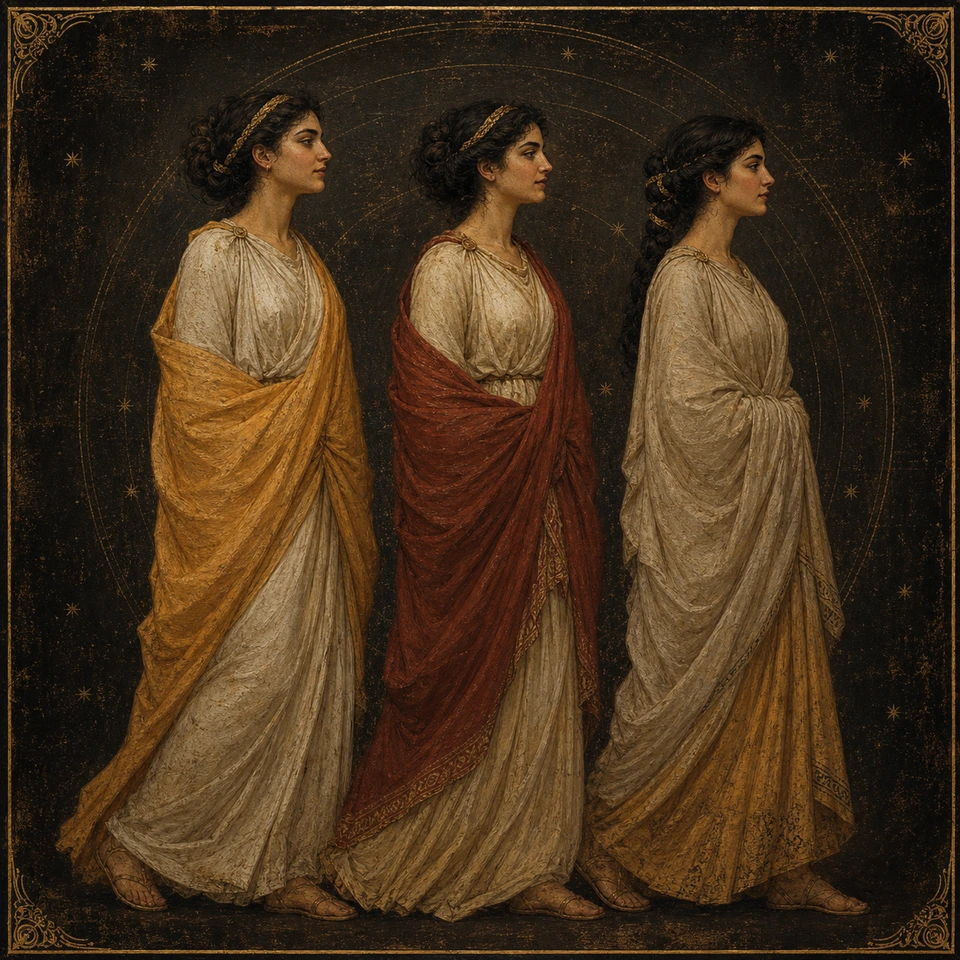
Infusing ancient worship with grace and communal delight, the Charites animate celebration through song, dance, and radiance. These collective divinities appear across diverse traditions, with their specific numbers and individual names shifting depending on the local source.
Overview
At Orchomenus, the Charites are not pale ornaments standing at the edge of somebody else’s story. Pindar addresses them as powers without whom feast, dance, wisdom, and victory cannot come into their full brightness. A triumph may be won by strength, but the Charites make it worthy of song, procession, and shared delight. They govern the change by which excellence becomes welcome among other people.
Their familiar English name, the Graces, can make the group seem tidier than the ancient evidence allows. Hesiod names three daughters of Zeus and Eurynome: Aglaia, Euphrosyne, and Thalia. The Spartans honored a pair called Cleta and Phaenna. At Athens, Pausanias knew Auxo and Hegemone, while carefully separating Carpo and Thallo as Horai rather than Charites. Homeric poetry knows a singular Charis as the wife of Hephaestus and Pasithea as one of the younger Charites desired by Hypnos. These configurations belong beside one another. None has the right to erase the rest.
The geography is equally alive. Boeotian tradition placed early sacrifice at Orchomenus. Athens had Charites near the approach to the Acropolis, beside rites that Pausanias refused to disclose. Delos displayed three in the hand of Apollo. A Homeric hymn carries the group into the Olympian dance, where they join the Horai, Harmonia, Hebe, Aphrodite, Artemis, Ares, and Hermes while Apollo plays. Another hymn brings them behind the closed doors of Aphrodite’s fragrant Paphian sanctuary, bathing, anointing, clothing, and adorning the goddess before she goes to Anchises.
Ancient artists did not always imagine the Charites as the later nude trio. Pausanias states that earlier sculptors and painters clothed them, and that the nude presentation belonged to a later change whose beginning he could not identify. The Sophilos Dinos, made around 580 to 570 BC, places the Graces among the divine guests walking to the wedding of Peleus and Thetis. The object catches them in motion and company, not as a frozen emblem detached from narrative.
This is why the Charites cannot be reduced to a modern list of flowers, colors, crystals, planets, or spells. Their ancient force appears in prayer, sacrifice, song, beauty, festivity, procession, adornment, and the social radiance that lets a good thing be received as good. Where the evidence falls silent, no new attribute should be invented. What remains is already substantial: a divine group whose very membership changes from city to city, and whose presence turns achievement into celebration. Their gift is not decoration laid over life, but the brightness by which a worthy act enters memory, company, and song.
Canonical identity
Canonical Identity
The Charites represent a divine collective rather than a single, unified goddess. Their membership fluctuates depending on the ancient city or poetic source, meaning they do not possess a static roster. Hesiod established the most recognizable triad of Aglaia, Euphrosyne, and Thalia. However, Pausanias documents alternative groupings, including the Spartan duo Cleta and Phaenna, the Athenian pair Auxo and Hegemone, an unnamed Orchomenian trio, and the Homeric figures Charis and Pasithea. They are treated collectively because ancient worship consistently grouped them, but their individual names, marriages, and local forms remain strictly tethered to the specific witnesses that record them.
Linguistic Identity
The Greek plural Χάριτες designates this divine group. The customary English rendering is "Graces," though this translation can obscure the historical reality that ancient communities recognized entirely different pairs, triads, and individual members.
Sources and evidence
TEXTUAL · Supported
Pausanias preserves different numbers and names for the Charites across Boeotian, Spartan, Athenian, Homeric, and Hesiodic traditions.
- Source
- Pausanias; Spiro Greek edition and Jones/Ormerod translation volumes, Description of Greece (1935)
- Reviewed edition
- Spiro Greek edition and Jones/Ormerod English volumes represented by the Perseus CTS corpus, 1903-1935 · translated by W. H. S. Jones and H. A. Ormerod, volume-dependent · edited by Friedrich Spiro for the Greek edition · Perseus Digital Library / Scaife ATLAS
- Exact locator
- Book 9 · Section 35.1-5
- Scope
- Greek religion under Roman imperial rule · Ancient Greece
- Authority
- ancient witness
- Certainty
- source-scoped
The collective identity is secure, while membership remains local and witness-specific.
Open exact reviewed source3 reviewed sources for this section
- Hesiod; edited and translated by Hugh G. Evelyn-White, Theogony (1914)Hesiod, the Homeric Hymns and Homerica, London and New York, 1914 · Perseus Digital Library / Scaife ATLAS
- Pausanias; Spiro Greek edition and Jones/Ormerod translation volumes, Description of Greece (1935)Perseus CTS edition corpus, 1903-1935 · Perseus Digital Library / Scaife ATLAS
- Homer; Monro and Allen Greek edition with edition-specific translations, Iliad (1920)Perseus CTS edition corpus; Greek edition, Oxford, 1908-1920 · Perseus Digital Library / Scaife ATLAS
Culture, tradition, period, and place
The Charites belong to ancient Greek religious life from archaic poetry through the local histories and artworks visible to Pausanias in the second century AD. Their evidence stretches across Boeotia, Laconia, Attica, Delos, Cyprus, and the imagined assembly of Olympus.
Orchomenus in Boeotia is the clearest cultic center in the surviving material used here. Sparta and Athens preserve different member lists. Delos gives the group a place in Apollo’s image. Paphos gives them a narrative role within Aphrodite’s sanctuary. These locations are not interchangeable branches of a single uniform cult. Each reveals what a community, poet, or artist wanted the Charites to make present.
Sources and evidence
TEXTUAL · Supported
Orchomenus, Sparta, Athens, and Delos preserve distinct cultic or visual configurations of the Charites.
- Source
- Pausanias; Spiro Greek edition and Jones/Ormerod translation volumes, Description of Greece (1935)
- Reviewed edition
- Spiro Greek edition and Jones/Ormerod English volumes represented by the Perseus CTS corpus, 1903-1935 · translated by W. H. S. Jones and H. A. Ormerod, volume-dependent · edited by Friedrich Spiro for the Greek edition · Perseus Digital Library / Scaife ATLAS
- Exact locator
- Book 9 · Section 35.1-3
- Scope
- Greek religion under Roman imperial rule · Ancient Greece
- Authority
- ancient witness
- Certainty
- source-scoped
The places belong to different traditions and are not merged into one cult system.
Open exact reviewed source2 reviewed sources for this section
- Pausanias; Spiro Greek edition and Jones/Ormerod translation volumes, Description of Greece (1935)Perseus CTS edition corpus, 1903-1935 · Perseus Digital Library / Scaife ATLAS
- Anonymous Homeric Hymns; edited and translated by Hugh G. Evelyn-White, Homeric Hymns (1914)Hesiod, the Homeric Hymns and Homerica, London and New York, 1914 · Perseus Digital Library / Scaife ATLAS
Historical development
The evidence begins with a group whose number and names were already variable. Hesiod’s genealogy gives a prestigious divine family to one triad, but Pausanias knew traditions in which local founders established pairs or threes under different names. Homeric poetry complicates the picture further by speaking of a singular Charis and a younger Pasithea.
Visual history changed as well. Pausanias says the older sculpted and painted Charites were clothed. By his own time artists represented them nude, yet he could not determine who began the change. That uncertainty matters. The famous later nude trio is part of the group’s reception, not a timeless image projected backward onto every archaic cult and artwork.
Sources and evidence
TEXTUAL · Supported
Earlier sculptors and painters represented the Charites clothed, while later artists represented them nude.
- Source
- Pausanias; Spiro Greek edition and Jones/Ormerod translation volumes, Description of Greece (1935)
- Reviewed edition
- Spiro Greek edition and Jones/Ormerod English volumes represented by the Perseus CTS corpus, 1903-1935 · translated by W. H. S. Jones and H. A. Ormerod, volume-dependent · edited by Friedrich Spiro for the Greek edition · Perseus Digital Library / Scaife ATLAS
- Exact locator
- Book 9 · Section 35.6-7
- Scope
- Greek religion under Roman imperial rule · Ancient Greece
- Authority
- ancient witness
- Certainty
- source-scoped
Pausanias could not identify the first artist responsible for the nude convention.
Open exact reviewed source3 reviewed sources for this section
- Hesiod; edited and translated by Hugh G. Evelyn-White, Theogony (1914)Hesiod, the Homeric Hymns and Homerica, London and New York, 1914 · Perseus Digital Library / Scaife ATLAS
- Pausanias; Spiro Greek edition and Jones/Ormerod translation volumes, Description of Greece (1935)Perseus CTS edition corpus, 1903-1935 · Perseus Digital Library / Scaife ATLAS
- Homer; Monro and Allen Greek edition with edition-specific translations, Iliad (1920)Perseus CTS edition corpus; Greek edition, Oxford, 1908-1920 · Perseus Digital Library / Scaife ATLAS
Attested roles and historical themes
Roles, powers, and limits
The Charites bring splendor into relationship. Pindar’s prayer at Orchomenus connects them with song, wisdom, feast, dance, and the celebration of victory. The Homeric Hymn to Apollo places them inside a linked divine dance, while the Hymn to Aphrodite makes their skill visible through bathing, anointing, clothing, and adornment.
These scenes do not turn the group into generic goddesses of prettiness. Their grace is active and social. They help beauty appear, achievement become praiseworthy, and communal pleasure take form in performance. Their limits are equally important: the evidence does not give them universal rule over love, all art, every celebration, or every pleasing thing.
Sources and evidence
TEXTUAL · Supported
Pindar invokes the Orchomenian Charites within song, wisdom, feast, dance, and the celebration of victory.
- Source
- Pindar; translated by Diane Arnson Svarlien, Odes of Pindar (1990)
- Reviewed edition
- Diane Arnson Svarlien English translation, 1990 · translated by Diane Arnson Svarlien · Tufts University
- Exact locator
- Entry ode: Olympian 14 · Line 1-24
- Scope
- Classical Greece · Ancient Greece
- Authority
- ancient witness
- Certainty
- source-scoped
The ode shows grace as active social radiance rather than passive decoration.
Open exact reviewed source2 reviewed sources for this section
- Pindar; translated by Diane Arnson Svarlien, Odes of Pindar (1990)1990 translation hosted by the Perseus Digital Library · Tufts University
- Anonymous Homeric Hymns; edited and translated by Hugh G. Evelyn-White, Homeric Hymns (1914)Hesiod, the Homeric Hymns and Homerica, London and New York, 1914 · Perseus Digital Library / Scaife ATLAS
Epithets and titles
No collective epithet set was closed.
1 reviewed source for this section
- Pausanias; Spiro Greek edition and Jones/Ormerod translation volumes, Description of Greece (1935)Perseus CTS edition corpus, 1903-1935 · Perseus Digital Library / Scaife ATLAS
Worship and cult
Pausanias reports a Boeotian claim that Eteocles of Orchomenus was the first mortal to sacrifice to the Charites and fixed their number at three, though their names were no longer remembered there. He also says that people learned from this tradition to pray to three Charites. Pindar’s fourteenth Olympian ode is itself an address to the Orchomenian group.
Athens had three Charites near the approach to the Acropolis. Pausanias notes rites beside them but refuses to reveal those rites to the wider public. That boundary remains intact. The surviving evidence supports prayer, sacrifice, local images, and sacred presence. It does not support reconstructing the undisclosed Athenian ceremony or turning literary scenes into a modern ritual manual.
Sources and evidence
TEXTUAL · Supported
Boeotian tradition credited Eteocles of Orchomenus with sacrifice to the Charites, and Pausanias describes prayer to three.
- Source
- Pausanias; Spiro Greek edition and Jones/Ormerod translation volumes, Description of Greece (1935)
- Reviewed edition
- Spiro Greek edition and Jones/Ormerod English volumes represented by the Perseus CTS corpus, 1903-1935 · translated by W. H. S. Jones and H. A. Ormerod, volume-dependent · edited by Friedrich Spiro for the Greek edition · Perseus Digital Library / Scaife ATLAS
- Exact locator
- Book 9 · Section 35.1-3
- Scope
- Greek religion under Roman imperial rule · Ancient Greece
- Authority
- ancient witness
- Certainty
- source-scoped
The passage supports worship while leaving the old Orchomenian names unresolved.
Open exact reviewed source2 reviewed sources for this section
- Pausanias; Spiro Greek edition and Jones/Ormerod translation volumes, Description of Greece (1935)Perseus CTS edition corpus, 1903-1935 · Perseus Digital Library / Scaife ATLAS
- Pindar; translated by Diane Arnson Svarlien, Odes of Pindar (1990)1990 translation hosted by the Perseus Digital Library · Tufts University
Temples, sanctuaries, and sacred places
Orchomenus is the best-attested sacred center among these witnesses, remembered for sacrifice, prayer, and a distinctive local claim about the number of the Charites. Sparta honored Cleta and Phaenna. Athens honored Auxo and Hegemone and placed three Charites near the Acropolis. Delos displayed three within an image of Apollo.
Paphos appears differently. In the Homeric Hymn to Aphrodite, the Charites serve the goddess inside her fragrant sanctuary before she leaves for Ida. The hymn makes them present in a sacred setting, but it does not establish an independent Charites sanctuary there. Keeping cult sites and narrative settings apart allows each place to retain its actual weight.
Sources and evidence
TEXTUAL · Supported
Athens displayed three Charites near the Acropolis and Delos displayed three in the hand of Apollo.
- Source
- Pausanias; Spiro Greek edition and Jones/Ormerod translation volumes, Description of Greece (1935)
- Reviewed edition
- Spiro Greek edition and Jones/Ormerod English volumes represented by the Perseus CTS corpus, 1903-1935 · translated by W. H. S. Jones and H. A. Ormerod, volume-dependent · edited by Friedrich Spiro for the Greek edition · Perseus Digital Library / Scaife ATLAS
- Exact locator
- Book 9 · Section 35.3
- Scope
- Greek religion under Roman imperial rule · Ancient Greece
- Authority
- ancient witness
- Certainty
- source-scoped
The Athenian rites remain undisclosed as Pausanias requires.
Open exact reviewed source2 reviewed sources for this section
- Pausanias; Spiro Greek edition and Jones/Ormerod translation volumes, Description of Greece (1935)Perseus CTS edition corpus, 1903-1935 · Perseus Digital Library / Scaife ATLAS
- Anonymous Homeric Hymns; edited and translated by Hugh G. Evelyn-White, Homeric Hymns (1914)Hesiod, the Homeric Hymns and Homerica, London and New York, 1914 · Perseus Digital Library / Scaife ATLAS
Festivals and processions
No securely named annual festival devoted solely to the Charites is established by the reviewed evidence. Pindar’s ode belongs to the celebration of an athletic victory and imagines the Orchomenian Charites amid song, dance, feast, and procession. The Homeric Hymn to Apollo places them in an Olympian performance led by Apollo’s lyre.
Those occasions show how the group inhabits celebration without yielding a fixed calendar date. A victory song is not automatically a cult festival, and a divine dance is not automatically a human rite. The honest result is a rich performance context with an unresolved festival calendar.
Sources and evidence
TEXTUAL · Supported
The Orchomenian Charites inhabit the performance world of victory song, dance, feast, and procession in Pindar.
- Source
- Pindar; translated by Diane Arnson Svarlien, Odes of Pindar (1990)
- Reviewed edition
- Diane Arnson Svarlien English translation, 1990 · translated by Diane Arnson Svarlien · Tufts University
- Exact locator
- Entry ode: Olympian 14 · Line 1-24
- Scope
- Classical Greece · Ancient Greece
- Authority
- ancient witness
- Certainty
- source-scoped
This is secure performance context, not proof of a fixed annual festival.
Open exact reviewed source2 reviewed sources for this section
- Pindar; translated by Diane Arnson Svarlien, Odes of Pindar (1990)1990 translation hosted by the Perseus Digital Library · Tufts University
- Anonymous Homeric Hymns; edited and translated by Hugh G. Evelyn-White, Homeric Hymns (1914)Hesiod, the Homeric Hymns and Homerica, London and New York, 1914 · Perseus Digital Library / Scaife ATLAS
Offerings, votives, and ritual evidence
Sacrifice and prayer are explicitly attached to the Orchomenian Charites, but the sources used here do not preserve a dependable list of sacrificial animals, foods, incense, vessels, or spoken formulas. At Athens, Pausanias deliberately withholds the rites beside their images.
The Paphian scene belongs to myth: the Charites bathe Aphrodite, anoint her with immortal fragrant oil, and help prepare her appearance. It is a vivid account of divine service and adornment, not evidence that worshippers offered the same oil to the Charites. The distinction protects both the beauty of the story and the limits of the historical record.
Sources and evidence
TEXTUAL · Supported
The Homeric Hymn to Aphrodite shows the Charites bathing and anointing Aphrodite with immortal fragrant oil at Paphos.
- Source
- Anonymous Homeric Hymns; edited and translated by Hugh G. Evelyn-White, Homeric Hymns (1914)
- Reviewed edition
- Hugh G. Evelyn-White edition and English translation in Hesiod, the Homeric Hymns and Homerica, 1914 · translated by Hugh G. Evelyn-White · edited by Hugh G. Evelyn-White · Perseus Digital Library / Scaife ATLAS
- Exact locator
- Hymn 5 · Line 58-74
- Scope
- Archaic Greece · Ancient Greece
- Authority
- ancient witness
- Certainty
- source-scoped
The actions belong to Aphrodite’s preparation in narrative and are not converted into human instructions.
Open exact reviewed source2 reviewed sources for this section
- Pausanias; Spiro Greek edition and Jones/Ormerod translation volumes, Description of Greece (1935)Perseus CTS edition corpus, 1903-1935 · Perseus Digital Library / Scaife ATLAS
- Anonymous Homeric Hymns; edited and translated by Hugh G. Evelyn-White, Homeric Hymns (1914)Hesiod, the Homeric Hymns and Homerica, London and New York, 1914 · Perseus Digital Library / Scaife ATLAS
Iconography and material culture
The most important visual lesson is change. Pausanias says older Greek images showed the Charites clothed, while later artists of his own day portrayed them nude. He names works at Smyrna, Pergamon, and Athens but cannot identify the first artist responsible for the nude form.
The Sophilos Dinos offers a securely dated archaic witness. Painted around 580 to 570 BC, it places the Graces among groups of divine guests walking toward the wedding of Peleus and Thetis. The procession associates them with divine festivity and movement. It does not prove one permanent pose, garment, number, or marriage function for every representation.
Sources and evidence
TEXTUAL · Supported
Pausanias distinguishes older clothed images from the nude Charites represented by artists of his own time.
- Source
- Pausanias; Spiro Greek edition and Jones/Ormerod translation volumes, Description of Greece (1935)
- Reviewed edition
- Spiro Greek edition and Jones/Ormerod English volumes represented by the Perseus CTS corpus, 1903-1935 · translated by W. H. S. Jones and H. A. Ormerod, volume-dependent · edited by Friedrich Spiro for the Greek edition · Perseus Digital Library / Scaife ATLAS
- Exact locator
- Book 9 · Section 35.6-7
- Scope
- Greek religion under Roman imperial rule · Ancient Greece
- Authority
- ancient witness
- Certainty
- source-scoped
The later nude trio cannot be projected onto every earlier Greek image.
Open exact reviewed sourceMATERIAL CULTURE · Supported
The Sophilos Dinos shows the Graces walking among divine groups in the wedding procession of Peleus and Thetis.
- Source
- British Museum, British Museum Collection
- Reviewed edition
- Live record-level official museum collection · British Museum
- Exact locator
- MuseumObjectId 1971,1101.1 · Entry British Museum
- Scope
- Archaic Greece · Ancient Greece
- Authority
- museum object catalogue
- Certainty
- source-scoped
The Attic black-figure vessel dates to about 580 to 570 BC and supplies a secure archaic material witness.
Open exact reviewed source2 reviewed sources for this section
- Pausanias; Spiro Greek edition and Jones/Ormerod translation volumes, Description of Greece (1935)Perseus CTS edition corpus, 1903-1935 · Perseus Digital Library / Scaife ATLAS
- British Museum, British Museum CollectionLive official museum collection · British Museum
Animals, plants, and embodied forms
No animal or plant functions as a general emblem of the Charites in the reviewed material. The Sophilos vessel includes real and imaginary animals in separate decorative friezes, but the official description does not assign those creatures to the Graces. They remain features of the vase, not attributes of the group.
Flowers, fruit, and gardens may feel naturally “graceful” to later readers, yet resemblance is not evidence. The same restraint applies to the apple, rose, dove, swan, and myrtle, all of which belong more securely to other figures or particular scenes. No plant or animal is promoted here merely to fill an empty category.
Sources and evidence
MATERIAL CULTURE · Supported
The official description of the Sophilos Dinos does not assign its animal friezes to the Graces in the wedding procession.
- Source
- British Museum, British Museum Collection
- Reviewed edition
- Live record-level official museum collection · British Museum
- Exact locator
- MuseumObjectId 1971,1101.1 · Entry British Museum
- Scope
- Archaic Greece · Ancient Greece
- Authority
- museum object catalogue
- Certainty
- source-scoped
Animals on the vessel remain compositional subjects rather than Charites attributes.
Open exact reviewed source1 reviewed source for this section
- British Museum, British Museum CollectionLive official museum collection · British Museum
Relationships and genealogy
Hesiod’s triad are daughters of Zeus and Eurynome. This parentage is strong for that named configuration, not a universal genealogy for every local pair and every Homeric Charis. A direct relationship to Zeus therefore remains explicitly Hesiodic.
Homer gives member-level relationships that must not be transferred to the collective. Charis is the wife who greets Thetis in Hephaestus’ house. Hera promises Hypnos one of the younger Charites, Pasithea, as a bride. These passages prove that individual Charites could have distinct stories and partners. They do not make Hephaestus or Hypnos spouses of the group as a whole.
Sources and evidence
TEXTUAL · Supported
Hesiod names Aglaia, Euphrosyne, and Thalia as daughters of Zeus and Eurynome.
- Source
- Hesiod; edited and translated by Hugh G. Evelyn-White, Theogony (1914)
- Reviewed edition
- Hugh G. Evelyn-White edition and English translation in Hesiod, the Homeric Hymns and Homerica, 1914 · translated by Hugh G. Evelyn-White · edited by Hugh G. Evelyn-White · Perseus Digital Library / Scaife ATLAS
- Exact locator
- Entry Theogony · Line 907-911
- Scope
- Archaic Greece · Ancient Greece
- Authority
- ancient witness
- Certainty
- source-scoped
This genealogy belongs to the Hesiodic triad and does not erase other local configurations.
Open exact reviewed sourceTEXTUAL · Supported
In the Iliad, a singular Charis greets Thetis as the wife of Hephaestus.
- Source
- Homer; Monro and Allen Greek edition with edition-specific translations, Iliad (1920)
- Reviewed edition
- Monro and Allen Greek edition represented by the Perseus CTS corpus, Oxford, 1908-1920 · edited by David Binning Monro and Thomas William Allen · Perseus Digital Library / Scaife ATLAS
- Exact locator
- Book 18 · Line 368-392
- Scope
- Archaic Greece · Ancient Greece
- Authority
- ancient witness
- Certainty
- source-scoped
The marriage belongs to Charis as an individual, not automatically to the collective.
Open exact reviewed sourceTEXTUAL · Supported
Hera promises Hypnos the younger Charis Pasithea as a bride.
- Source
- Homer; Monro and Allen Greek edition with edition-specific translations, Iliad (1920)
- Reviewed edition
- Monro and Allen Greek edition represented by the Perseus CTS corpus, Oxford, 1908-1920 · edited by David Binning Monro and Thomas William Allen · Perseus Digital Library / Scaife ATLAS
- Exact locator
- Book 14 · Line 267-276
- Scope
- Archaic Greece · Ancient Greece
- Authority
- ancient witness
- Certainty
- source-scoped
The passage preserves a member-level relationship and implies more than one age group among the Charites.
Open exact reviewed source2 reviewed sources for this section
- Hesiod; edited and translated by Hugh G. Evelyn-White, Theogony (1914)Hesiod, the Homeric Hymns and Homerica, London and New York, 1914 · Perseus Digital Library / Scaife ATLAS
- Homer; Monro and Allen Greek edition with edition-specific translations, Iliad (1920)Perseus CTS edition corpus; Greek edition, Oxford, 1908-1920 · Perseus Digital Library / Scaife ATLAS
Actual myths and source variants
Three shared narratives carry the collective profile. Hesiod’s genealogy introduces Aglaia, Euphrosyne, and Thalia as daughters of Zeus and Eurynome. The Homeric Hymn to Apollo draws the Charites into a broad Olympian dance in which Apollo’s music gathers many divine powers into one radiant performance. The Homeric Hymn to Aphrodite brings them to Paphos, where they bathe, anoint, clothe, and adorn Aphrodite before her meeting with Anchises.
These are not interchangeable versions of one event. One establishes a source-scoped family, one shows divine performance, and one shows skilled preparation within another goddess’s story. Each keeps its own participants, place, and consequence.
Sources and evidence
TEXTUAL · Supported
The Homeric Hymn to Apollo places the Charites in a linked Olympian dance led by Apollo’s music.
- Source
- Anonymous Homeric Hymns; edited and translated by Hugh G. Evelyn-White, Homeric Hymns (1914)
- Reviewed edition
- Hugh G. Evelyn-White edition and English translation in Hesiod, the Homeric Hymns and Homerica, 1914 · translated by Hugh G. Evelyn-White · edited by Hugh G. Evelyn-White · Perseus Digital Library / Scaife ATLAS
- Exact locator
- Hymn 3 · Line 182-206
- Scope
- Archaic Greece · Ancient Greece
- Authority
- ancient witness
- Certainty
- source-scoped
The dance establishes shared performance without implying genealogical identity.
Open exact reviewed source2 reviewed sources for this section
- Hesiod; edited and translated by Hugh G. Evelyn-White, Theogony (1914)Hesiod, the Homeric Hymns and Homerica, London and New York, 1914 · Perseus Digital Library / Scaife ATLAS
- Anonymous Homeric Hymns; edited and translated by Hugh G. Evelyn-White, Homeric Hymns (1914)Hesiod, the Homeric Hymns and Homerica, London and New York, 1914 · Perseus Digital Library / Scaife ATLAS
Myth Library
Each myth gathers its attested participants into one source-grounded account, while distinct source traditions remain readable in their own variants.
Genealogy
Birth of the Hesiodic Charites
Hesiod names Aglaia, Euphrosyne, and Thalia as daughters of Zeus and Eurynome, preserving one influential triad without making it the only Greek configuration.
- Role in this profile
- the Hesiodic triad born from Zeus and Eurynome
- Place scope
- Ancient Greece
- Witnesses
- 2
- Variants
- 2
Divine Performance
The Charites in Apollo's Divine Dance
Apollo’s arrival on Olympus gathers the Charites into a linked divine dance with the Horai, Harmonia, Hebe, Aphrodite, Artemis, Ares, and Hermes.
- Role in this profile
- linked dancers who help give the Olympian gathering its grace
- Place scope
- Ancient Greece
- Witnesses
- 1
- Variants
- 1
Divine Preparation
The Charites Prepare Aphrodite at Paphos
Inside Aphrodite’s Paphian sanctuary, the Charites bathe, anoint, clothe, and adorn the goddess before she travels to Ida to meet Anchises.
- Role in this profile
- attendants who bathe, anoint, clothe, and adorn Aphrodite
- Place scope
- Ancient Greece
- Witnesses
- 1
- Variants
- 1
Divine Retribution And Human Condition
Epimetheus and Pandora
Zeus answers Prometheus’s challenge by fashioning a dangerous gift. Epimetheus accepts her despite warning, and the Hesiodic witnesses diverge over her name, the jar, and the human consequences before later mythography makes Pandora his wife and Pyrrha their daughter.
- Role in this profile
- divine group that places golden necklaces upon Pandora
- Place scope
- Ancient Greece
- Witnesses
- 3
- Variants
- 3
Theogonic Punishment And Creation
Hephaestus Makes Pandora
Under Zeus' command, Hephaestus shapes the woman later named Pandora, while two Hesiodic poems preserve materially different versions.
- Role in this profile
- goddesses who hang gold necklaces upon Pandora
- Place scope
- Ancient Greece
- Witnesses
- 2
- Variants
- 2
Equivalences, syncretisms, and identity boundaries
The Latin Gratiae are the Roman reception and translation counterpart of the Greek Charites, but that equivalence does not erase differences of language, local cult, or historical setting. They should remain separately addressable whenever Roman evidence requires its own treatment.
Similar names also demand care. The Charis called Thalia is not automatically the Muse Thalia. Pausanias explicitly separates Carpo and Thallo as Horai in the same discussion that names Athenian Charites. The group is not the Muses, Horai, nymphs, or an abstract moral quality called grace. Shared dance or shared beauty establishes company, not identity.
Sources and evidence
TEXTUAL · Supported
Pausanias separates Athenian Charites Auxo and Hegemone from Carpo and Thallo, whom he identifies as Horai.
- Source
- Pausanias; Spiro Greek edition and Jones/Ormerod translation volumes, Description of Greece (1935)
- Reviewed edition
- Spiro Greek edition and Jones/Ormerod English volumes represented by the Perseus CTS corpus, 1903-1935 · translated by W. H. S. Jones and H. A. Ormerod, volume-dependent · edited by Friedrich Spiro for the Greek edition · Perseus Digital Library / Scaife ATLAS
- Exact locator
- Book 9 · Section 35.2
- Scope
- Greek religion under Roman imperial rule · Ancient Greece
- Authority
- ancient witness
- Certainty
- source-scoped
Similar functions and adjacent worship do not merge the Charites with the Horai.
Open exact reviewed source1 reviewed source for this section
- Pausanias; Spiro Greek edition and Jones/Ormerod translation volumes, Description of Greece (1935)Perseus CTS edition corpus, 1903-1935 · Perseus Digital Library / Scaife ATLAS
Correspondence index
The direct ancient layer centers on Orchomenus, prayer, sacrifice, song, dance, feast, victory celebration, divine adornment, and images of the group. These connections are strong because the sources place the Charites inside those contexts.
Other familiar occult assignments are not established here. No planet, zodiac sign, stone, metal, color, classical element, weekday, moon phase, plant, animal, incense recipe, ritual tool, or universal direction is securely attached to them in the reviewed evidence. Paphos and its fragrant oil belong to Aphrodite’s narrative; they do not become a free-standing offering system for the Charites.
Contextual evidence, not a general correspondence
| Category | Direct correspondence | How and why | Evidence boundary |
|---|---|---|---|
| direction-place | Orchomenus and source-scoped sacred settingsContextual evidence only | Orchomenus anchors sacrifice and prayer; Athens, Delos, Sparta, and Paphos preserve other local or narrative settings. None establishes a universal ritual direction. | Ancient Literary Named Greek places, not a compass direction. 1 reviewed source for this section
|
| festival-time | Song, dance, feast, and victory celebrationContextual evidence only | Pindar places the Orchomenian Charites within the social brightness of victory song, dance, and feast. No fixed annual Charites festival date is established here. | Ancient Literary Celebratory setting, not a dated annual observance. 1 reviewed source for this section
|
| incense-perfume | Fragrance in Aphrodite’s Paphian preparationContextual evidence only | The Homeric hymn gives fragrant oil and sanctuary atmosphere to Aphrodite’s preparation. It is narrative context, not a general incense prescription for the Charites. | Ancient Literary Aphrodite's narrative preparation only. 1 reviewed source for this section
|
| offering-ritual-material | Sacrifice attested; material unspecifiedContextual evidence only | Pausanias preserves sacrifice and prayer at Orchomenus but does not give a dependable offering list in the reviewed passage. | Ancient Literary Orchomenian worship, with the material unspecified. 1 reviewed source for this section
|
| ritual-object-symbol-tool | Clothed group images and divine processionContextual evidence only | Earlier images were clothed, and the Sophilos Dinos shows the Graces among divine wedding guests. No single ritual tool or permanent pose represents every local form. | Ancient Literary Local images and one painted procession. 1 reviewed source for this section
|
| intention-magical-power | Grace, praise, shared joy, and welcomeContextual evidence only | Ancient poetry connects the Charites with making song, feast, dance, wisdom, beauty, and victory socially radiant. This is historical context, not a claim of automatic spell power. | Ancient Literary Poetic and social functions, not guaranteed ritual outcomes. 1 reviewed source for this section
|
10 expected categories currently not evidenced
celestial-body · Not evidenced
Not evidenced
No ancient witness reviewed here assigns the Charites a planet, star, sun, moon, or other celestial body. Their Olympian dance is a divine gathering, not a planetary rulership.
- Layer
- Research Boundary
- Scope
- No planetary or stellar assignment in the cited evidence.
zodiac · Not evidenced
Not evidenced
No zodiac sign is securely attached to the Charites in the reviewed Greek evidence. A modern aesthetic resemblance cannot supply an ancient astrological link.
- Layer
- Research Boundary
- Scope
- No zodiacal scheme in the cited evidence.
gemstone-crystal-mineral · Not evidenced
Not evidenced
No gemstone, crystal, or mineral is named as a Charites attribute, offering, or cult material in the reviewed sources.
- Layer
- Research Boundary
- Scope
- No gemstone or mineral attribute in the cited evidence.
metal-material · Not evidenced
Not evidenced
Gold appears in divine adornment and ancient artworks, but no metal belongs to the Charites as a stable correspondence.
- Layer
- Research Boundary
- Scope
- Gold in adornment and art does not create metal rulership.
plant-tree · Not evidenced
Not evidenced
No flower, fruit, herb, or tree is established as a general emblem of the group. Attractive plant symbolism remains a later analogy unless independently sourced.
- Layer
- Research Boundary
- Scope
- No group-wide sacred plant in the cited evidence.
animal · Not evidenced
Not evidenced
Animals painted in other friezes of the Sophilos Dinos are not attributes of the Graces walking in its wedding procession. No universal animal is evidenced.
- Layer
- Research Boundary
- Scope
- Animals elsewhere on the vessel do not belong to the Charites.
color · Not evidenced
Not evidenced
Neither the literary witnesses nor the reviewed object establishes a canonical color for the Charites. Later palettes belong to particular artworks.
- Layer
- Research Boundary
- Scope
- Artwork palettes remain local choices, not a canonical color.
classical-element · Not evidenced
Not evidenced
The group is not assigned to earth, air, fire, or water in the reviewed ancient evidence. Divine grace is not the same thing as an elemental rulership.
- Layer
- Research Boundary
- Scope
- Divine grace is not a formal four-element rulership.
weekday · Not evidenced
Not evidenced
No weekday is securely connected with the Charites in the reviewed sources.
- Layer
- Research Boundary
- Scope
- No weekday appears in the cited evidence.
moon-phase · Not evidenced
Not evidenced
No lunar phase governs the Charites in the reviewed ancient material.
- Layer
- Research Boundary
- Scope
- No lunar timing appears in the cited evidence.
Sources and evidence
TEXTUAL · Supported
Pindar directly connects the Orchomenian Charites with prayer, song, dance, feast, wisdom, and victory praise.
- Source
- Pindar; translated by Diane Arnson Svarlien, Odes of Pindar (1990)
- Reviewed edition
- Diane Arnson Svarlien English translation, 1990 · translated by Diane Arnson Svarlien · Tufts University
- Exact locator
- Entry ode: Olympian 14 · Line 1-24
- Scope
- Classical Greece · Ancient Greece
- Authority
- ancient witness
- Certainty
- source-scoped
Sacrifice, adornment, and material procession are supported separately by Pausanias, the Homeric Hymn to Aphrodite, and the Sophilos Dinos.
Open exact reviewed source4 reviewed sources for this section
- Pindar; translated by Diane Arnson Svarlien, Odes of Pindar (1990)1990 translation hosted by the Perseus Digital Library · Tufts University
- Pausanias; Spiro Greek edition and Jones/Ormerod translation volumes, Description of Greece (1935)Perseus CTS edition corpus, 1903-1935 · Perseus Digital Library / Scaife ATLAS
- Anonymous Homeric Hymns; edited and translated by Hugh G. Evelyn-White, Homeric Hymns (1914)Hesiod, the Homeric Hymns and Homerica, London and New York, 1914 · Perseus Digital Library / Scaife ATLAS
- British Museum, British Museum CollectionLive official museum collection · British Museum
Later reception and living significance
By the second century AD, Pausanias could already look backward across a decisive change in the group’s appearance. The older works he named were clothed, while artists of his own time commonly showed the Charites nude. He did not pretend to know who began the fashion. That honest uncertainty is more revealing than a false origin story: even an image that feels timeless can have a history.
The later European career of the nude trio and the Charites’ place in modern Pagan or devotional life both require sources beyond the ancient witnesses reviewed here. Those histories remain open work. They are not inferred from familiar paintings, the English word “grace,” or modern lists of correspondences.
Sources and evidence
TEXTUAL · Supported
Pausanias treats the nude Charites as a later artistic change rather than the oldest known form.
- Source
- Pausanias; Spiro Greek edition and Jones/Ormerod translation volumes, Description of Greece (1935)
- Reviewed edition
- Spiro Greek edition and Jones/Ormerod English volumes represented by the Perseus CTS corpus, 1903-1935 · translated by W. H. S. Jones and H. A. Ormerod, volume-dependent · edited by Friedrich Spiro for the Greek edition · Perseus Digital Library / Scaife ATLAS
- Exact locator
- Book 9 · Section 35.6-7
- Scope
- Greek religion under Roman imperial rule · Ancient Greece
- Authority
- ancient witness
- Certainty
- source-scoped
This historical boundary anchors later reception without pretending to identify the first nude work.
Open exact reviewed source1 reviewed source for this section
- Pausanias; Spiro Greek edition and Jones/Ormerod translation volumes, Description of Greece (1935)Perseus CTS edition corpus, 1903-1935 · Perseus Digital Library / Scaife ATLAS
Evidence, conflicts, and research gaps
Hesiod secures one genealogy. Pindar secures the Orchomenian prayer and its world of song, dance, feast, and victory. Pausanias preserves local numbers, names, worship claims, sacred images, disclosure limits, and the clothed-to-nude visual history. The Homeric Hymns preserve the Olympian dance and Paphian preparation scenes. Homeric epic protects the individual identities of Charis and Pasithea. The Sophilos Dinos supplies an official museum witness to an archaic divine procession.
Important gaps remain: a fully reviewed pronunciation, a complete map of local cults, a securely named festival calendar, the contents of undisclosed Athenian rites, the earliest nude representation, a broader material corpus, and accountable modern community evidence. Those gaps remain visible instead of being filled by analogy.
Sources and evidence
TEXTUAL · Supported
Pausanias explicitly says he could not discover who first represented the Charites nude.
- Source
- Pausanias; Spiro Greek edition and Jones/Ormerod translation volumes, Description of Greece (1935)
- Reviewed edition
- Spiro Greek edition and Jones/Ormerod English volumes represented by the Perseus CTS corpus, 1903-1935 · translated by W. H. S. Jones and H. A. Ormerod, volume-dependent · edited by Friedrich Spiro for the Greek edition · Perseus Digital Library / Scaife ATLAS
- Exact locator
- Book 9 · Section 35.6
- Scope
- Greek religion under Roman imperial rule · Ancient Greece
- Authority
- ancient witness
- Certainty
- source-scoped
The origin of the convention remains an acknowledged research gap.
Open exact reviewed source6 reviewed sources for this section
- Hesiod; edited and translated by Hugh G. Evelyn-White, Theogony (1914)Hesiod, the Homeric Hymns and Homerica, London and New York, 1914 · Perseus Digital Library / Scaife ATLAS
- Pindar; translated by Diane Arnson Svarlien, Odes of Pindar (1990)1990 translation hosted by the Perseus Digital Library · Tufts University
- Pausanias; Spiro Greek edition and Jones/Ormerod translation volumes, Description of Greece (1935)Perseus CTS edition corpus, 1903-1935 · Perseus Digital Library / Scaife ATLAS
- Anonymous Homeric Hymns; edited and translated by Hugh G. Evelyn-White, Homeric Hymns (1914)Hesiod, the Homeric Hymns and Homerica, London and New York, 1914 · Perseus Digital Library / Scaife ATLAS
- Homer; Monro and Allen Greek edition with edition-specific translations, Iliad (1920)Perseus CTS edition corpus; Greek edition, Oxford, 1908-1920 · Perseus Digital Library / Scaife ATLAS
- British Museum, British Museum CollectionLive official museum collection · British Museum
Direct connections and evidence
Explicit Source
Hesiod names his triad as daughters of Zeus and Eurynome
Hesiodic triad only.
1 attestation · high confidence
- Hesiod; edited and translated by Hugh G. Evelyn-White, TheogonyHugh G. Evelyn-White edition and English translation in Hesiod, the Homeric Hymns and Homerica, 1914 · translated by Hugh G. Evelyn-White · edited by Hugh G. Evelyn-White · Perseus Digital Library / Scaife ATLAS · Archaic Greece · Ancient Greece · Entry Theogony · Line 907-911
Archive scope and classification
- Figure classification
- Divine group · certain
- Pantheon or tradition shelf
- Greek
- Cultures
- Greek
- Traditions
- Ancient Greek religion
- Periods
- Archaic Greece, Classical Greece, Greek religion under Roman imperial rule
- Places
- Ancient Greece
Collective divine identity, variable local membership, Orchomenian worship, major literary appearances, material witnesses, historical image change, correspondence boundaries, and research gaps are reviewed.
Reviewed sources
- Hesiod; edited and translated by Hugh G. Evelyn-White, Theogony (1914)Hesiod, the Homeric Hymns and Homerica, London and New York, 1914 · Perseus Digital Library / Scaife ATLAS
- Anonymous Homeric Hymns; edited and translated by Hugh G. Evelyn-White, Homeric Hymns (1914)Hesiod, the Homeric Hymns and Homerica, London and New York, 1914 · Perseus Digital Library / Scaife ATLAS
- Homer; Monro and Allen Greek edition with edition-specific translations, Iliad (1920)Perseus CTS edition corpus; Greek edition, Oxford, 1908-1920 · Perseus Digital Library / Scaife ATLAS
- Pausanias; Spiro Greek edition and Jones/Ormerod translation volumes, Description of Greece (1935)Perseus CTS edition corpus, 1903-1935 · Perseus Digital Library / Scaife ATLAS
- British Museum, British Museum CollectionLive official museum collection · British Museum
- Pindar; translated by Diane Arnson Svarlien, Odes of Pindar (1990)1990 translation hosted by the Perseus Digital Library · Tufts University