
Greek · God or goddess · Certain
Zeus
Ζεύς · Zeus
Pronunciation: /zděu̯s/ · zdeh-oos, one syllable
Research and editorial review by Cody Manes · Reviewed 2026-08-31
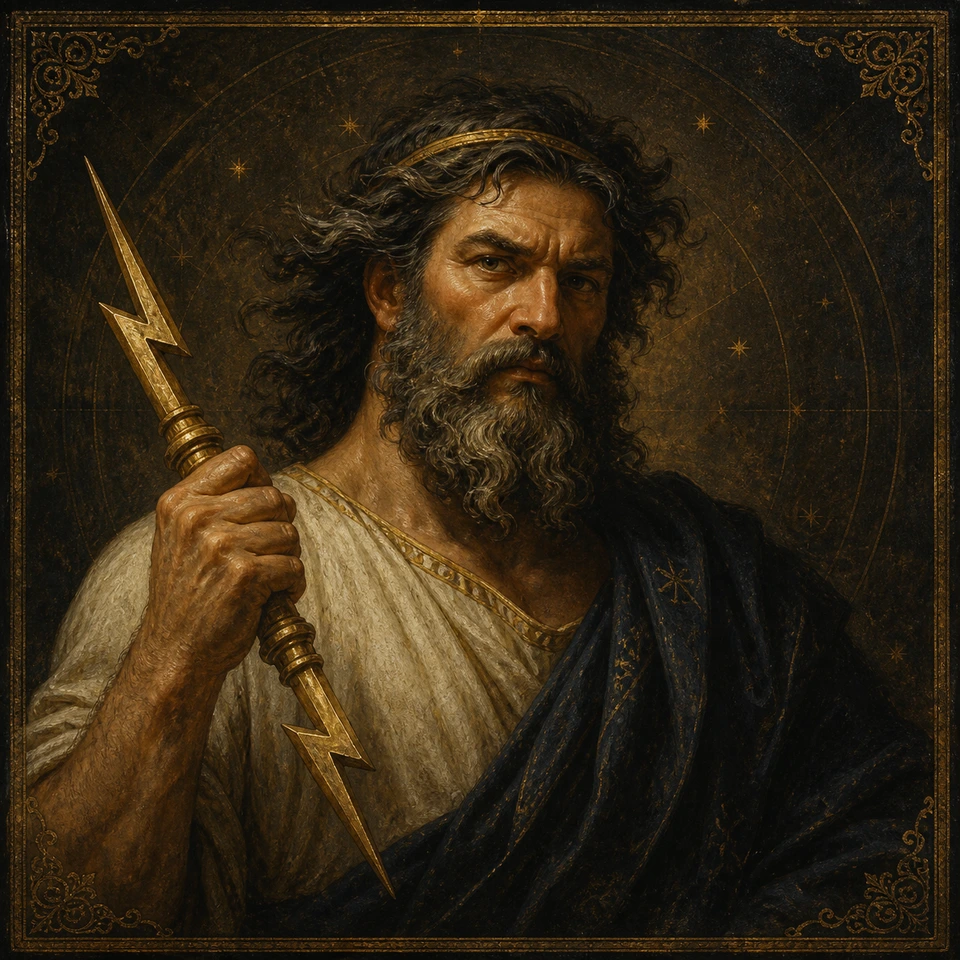
Wielding the devastating power of the thunderbolt from the heights of the ancient sky, Zeus enforces absolute sovereign authority. His dominance over oaths, hospitality, and sprawling local cults survives through complex succession myths and heavily intertwined relationships with mortals and divinities alike.
Overview
At Olympia, Zeus did not appear as an idea floating above a list of powers. Visitors crossed a sanctuary crowded with altars, treasuries, victory monuments, dedications, workshops, and the immense seated image made by Pheidias. The great altar itself had grown from sacrificial ash. Athletes swore before Zeus Horkios not to cheat. Festival competition, oath, animal sacrifice, civic prestige, and the god's gaze met in one place, while local guides preserved several rival stories about who founded the games. The sanctuary taught through movement and accumulation: people approached, promised, competed, gave, remembered, and saw their cities placed beside the gifts of others.
Dodona offered another Zeus. There, ancient writers associated divine speech with priestesses and the oak whose leaves carried the god's will. Mount Lykaion in Arcadia held darker traditions around a high altar and stories Pausanias reports without dissolving their uncertainty. These places do not form branches of one uniform institution. Olympia's competitive order, Dodona's oracle, and Lykaion's fearful mountain lore show how Greek communities met Zeus through different landscapes, titles, and ritual obligations.
The poems make his rule no less complicated. Hesiod begins with a hidden infant, a wrapped stone, and a mother resisting the devouring king Cronus. Zeus grows, frees the swallowed children, receives thunder and the thunderbolt from the Cyclopes, and leads the struggle that establishes a new divine order. The Iliad presents a ruler whose nod shakes Olympus, yet the epic repeatedly surrounds his decisions with resistance, grief, negotiation, deception, and the limits created by fate and other gods. Sovereignty is powerful, but it is never merely calm.
His family stories carry the same strain. Hera is wife and queen, but their marriage is marked by conflict. Athena springs from Zeus after the swallowing of Metis. Apollo, Artemis, Ares, Aphrodite in one epic genealogy, Dionysus, the Charites, the Dioscuri, Hebe, and other children belong to distinct maternal and narrative traditions. Zeus may authorize marriages, punish oath-breakers, guard strangers, father heroes, and settle disputes, but his sexual pursuit and coercion also leave suffering throughout Greek myth. That violence should not be softened into romance.
Ancient images give his authority weight and shape. A Getty scaraboid shows him enthroned with thunderbolt and a long eagle-tipped sceptre. An Attic amphora in the British Museum shows a bearded Zeus with thunderbolt and lotus-topped sceptre. The two objects do not fix one face, garment, or posture for every period. The eagle belongs securely to a named sceptre, the oak to Dodona, and the thunderbolt to both poetry and material culture. Each sign draws its force from a particular scene, place, and act.
Greek Zeus remains the figure of Greek-language poems, Greek sanctuaries, and Greek titles described here. Roman Jupiter, Zeus Ammon, and the planet Jupiter require their own historical evidence and retain separate identities. Ancient communities made Zeus present in oath, storm, royal authority, hospitality, competition, prayer, image, and story. Those strands reveal a vast and difficult divine figure rather than a single master symbol.
The surviving narratives expose the full scale of that rule. Zeus saves and destroys, purifies and punishes, confirms inherited honors and engineers retaliation. He sends Hermes to Calypso, allows the release of Prometheus, confirms Hecate, directs Iris, and answers Helios. He also carries Europa away as a bull, reaches imprisoned Danae as gold, removes Ganymede from mortal life, destroys Lycaon's house, and binds Ixion to the wheel. The violence of divine pursuit and punishment is not ornamental. It determines mortal bodies, families, cities, and memory.
A late Orphic hymn adds exact ritual evidence without rewriting the older cults. Hymn XIV names storax for Zeus; Hymn XIX, addressed to Zeus as author of lightning, names frankincense and manna. These fumigants belong to those hymns. They do not become a single universal incense list for Olympia, Dodona, Lykaion, or every Greek household.
Canonical identity
Canonical Identity
Zeus operates as a supreme Greek god whose functions, titles, and even the sound of his name shifted drastically across different places and eras. Hesiod identifies him as the hidden child of Cronus and Rhea who ultimately seized rulership following the brutal succession struggle. He must not be reduced to a single modern formula; distinct titles like Horkios, Xenios, and Olympios speak directly from localized settings and specific divine obligations. His standard English name absolutely does not merge his identity with the planet Jupiter, Zeus Ammon, or the Roman Jupiter.
Linguistic Identity
Zeus originates from the Greek Ζεύς. The qualified fifth-century BC Attic reconstruction /zděu̯ s/ approximates merely one historical pronunciation. In contrast, current General American English typically defaults to /ˈzus/ (ZOOS). Neither guide pretends to offer a single definitive sound applicable to every modern language or every ancient Greek community.
Sources and evidence
TEXTUAL · Supported
A qualified fifth-century BC Attic reconstruction gives Ζεύς as /zděu̯s/, approximated zdeh-oos in one syllable.
- Source
- Herbert Weir Smyth, A Greek Grammar for Colleges (1920)
- Reviewed edition
- Herbert Weir Smyth, A Greek Grammar for Colleges, American Book Company, 1920; Perseus text 1999.04.0007 · Perseus Digital Library
- Exact locator
- Entry A Greek Grammar for Colleges · Section §§1, 24-26, 150 · RecordUrl https://www.perseus.tufts.edu/hopper/text?doc=Perseus:text:1999.04.0007
- Scope
- Modern classical scholarship
- Authority
- Smyth historical Greek grammar
- Certainty
- Qualified
The qualified reconstruction applies Smyth to the independently verified LSJ headword and does not represent every dialect.
Open exact reviewed sourceTEXTUAL · Supported
CMUdict gives current General American Zeus as Z UW1 S, rendered /ˈzus/ and ZOOS.
- Source
- Carnegie Mellon University Speech Group, CMU Pronouncing Dictionary
- Reviewed edition
- cmudict data file at commit 74790861f652b15e4ac49015a90074ad62a27690 · Carnegie Mellon University
- Exact locator
- Entry zeus · Section ARPABET Z UW1 S, pinned commit 74790861f652b15e4ac49015a90074ad62a27690 · RecordUrl https://raw.githubusercontent.com/cmusphinx/cmudict/74790861f652b15e4ac49015a90074ad62a27690/cmudict.dict
- Scope
- Modern classical scholarship
- Authority
- pinned CMU Pronouncing Dictionary
- Certainty
- High
This current English guide does not replace the qualified Ancient Greek reconstruction.
Open exact reviewed sourceSCHOLARLY INTERPRETATION · Supported
LSJ preserves Ζεύς with its irregular oblique cases and historically distinct dialect forms.
- Source
- Henry George Liddell and Robert Scott; Scaife ATLAS, Ζεύς, LSJ entry
- Reviewed edition
- LSJ digital entry Ζεύς, Scaife ATLAS URN lsj-n46195 · Tufts University
- Exact locator
- Entry LSJ Ζεύς · RecordUrl https://atlas.perseus.tufts.edu/dictionaries/entry/urn%3Acite2%3Ascaife-viewer%3Adictionaries.v1%3Alsj-n46195/
- Scope
- Modern classical scholarship
- Authority
- LSJ historical lexicon
- Certainty
- secure within the cited witness
The entry fixes documented forms and lexical identity, not one pronunciation for every region.
Open exact reviewed source4 reviewed sources for this section
- Herbert Weir Smyth, A Greek Grammar for Colleges (1920)American Book Company, 1920; Perseus text 1999.04.0007 · Perseus Digital Library
- Carnegie Mellon University Speech Group, CMU Pronouncing DictionaryPinned repository commit 74790861f652b15e4ac49015a90074ad62a27690 · Carnegie Mellon University
- Henry George Liddell and Robert Scott; Scaife ATLAS, Ζεύς, LSJ entryLSJ digital entry with exact headword, case forms, dialect forms, and sky-god sense · Tufts University
- Hesiod; edited and translated by Hugh G. Evelyn-White, Theogony (1914)Hesiod, the Homeric Hymns and Homerica, London and New York, 1914 · Perseus Digital Library / Scaife ATLAS
Culture, tradition, period, and place
Zeus belonged to Greek-speaking communities across the Aegean and Mediterranean, but no single city controlled his worship. Olympia in Elis joined him to a pan-Hellenic festival and monumental sanctuary. Dodona in Epirus approached him through oracular tradition. Mount Lykaion carried Arcadian forms and troubling local stories. Household, civic, mountain, oracular, and competitive settings could all invoke Zeus while keeping their own calendars and customs.
The surviving evidence ranges from archaic epic and theogony through Classical objects and imperial-era descriptions of older sanctuaries. That span is not one unchanging present. Hesiod’s succession ruler, Homer’s epic sovereign, the Zeus shown on Attic pottery, and the Zeus whom Pausanias encountered through temples and local guides belong to connected but historically distinct witnesses.
The Orphic hymns and later mythographic collections extend the chronological range without erasing the older witnesses. A Roman-imperial Greek handbook can preserve a story absent from Homer, yet it cannot be treated as the original form for every city. Each sanctuary and text remains dated, located, and linguistically bounded.
5 reviewed sources for this section
- Hesiod; edited and translated by Hugh G. Evelyn-White, Theogony (1914)Hesiod, the Homeric Hymns and Homerica, London and New York, 1914 · Perseus Digital Library / Scaife ATLAS
- Pausanias; Spiro Greek edition and Jones/Ormerod translation volumes, Description of Greece (1935)Perseus CTS edition corpus, 1903-1935 · Perseus Digital Library / Scaife ATLAS
- Herodotus; translated by A. D. Godley, The Histories (1925)A. D. Godley English translation, Loeb Classical Library volumes I-IV, 1920-1925; Perseus eng2 component · Perseus Digital Library / Scaife ATLAS
- Anonymous Orphic hymn poet; translated by Thomas Taylor, The Hymns of Orpheus (1792)Thomas Taylor English translation, 1792 · Internet Archive
- Pseudo-Apollodorus; edited and translated by James G. Frazer, Library (1921)Harvard University Press and William Heinemann edition, 1921 · Perseus Digital Library / Scaife ATLAS
Historical development
The earliest stories available here already assume a divine order shaped by conflict. Hesiod’s Zeus survives Cronus, frees the swallowed children, gains the thunderbolt, and secures rule after a war among divine generations. Homeric epic presents that authority as established, yet continually tested by divine councils, mortal suffering, and competing loyalties.
Sanctuaries then give the long history physical depth. Olympia accumulated buildings, ash, dedications, and stories of festival origins. Dodona’s oracular tradition attracted competing explanations. By Pausanias’s time, local guides, ancient remains, and later monuments stood together. Zeus therefore developed through repeated acts of interpretation, rebuilding, political display, and local memory rather than moving toward one final form.
The many Zeus myths also show history through reuse. Victory odes reshape Tantalus and Ixion for moral argument. Mythography gathers Europa, Danae, Lycaon, and Salmoneus into genealogical sequences. Vase painters make the thunderbolt and sceptre visible in different poses. Development is not a march toward one official biography.
Sources and evidence
TEXTUAL · Supported
Hesiod tells how Rhea hides the newborn Zeus, gives Cronus a wrapped stone, and brings her son to power against the father who swallowed his children.
- Source
- Hesiod; edited and translated by Hugh G. Evelyn-White, Theogony (1914)
- Reviewed edition
- Hugh G. Evelyn-White English translation in Hesiod, the Homeric Hymns and Homerica, Loeb Classical Library, 1914, Perseus eng1 component · translated by Hugh G. Evelyn-White · edited by Hugh G. Evelyn-White · Perseus Digital Library
- Exact locator
- Entry Theogony · Line 453-506
- Scope
- Archaic Greece · Ancient Greece
- Authority
- ancient literary witness
- Certainty
- High
The succession story combines concealment, deception, release, and transfer of sovereignty.
Open exact reviewed source7 reviewed sources for this section
- Hesiod; edited and translated by Hugh G. Evelyn-White, Theogony (1914)Hesiod, the Homeric Hymns and Homerica, London and New York, 1914 · Perseus Digital Library / Scaife ATLAS
- Homer; Monro and Allen Greek edition with edition-specific translations, Iliad (1920)Perseus CTS edition corpus; Greek edition, Oxford, 1908-1920 · Perseus Digital Library / Scaife ATLAS
- Pausanias; Spiro Greek edition and Jones/Ormerod translation volumes, Description of Greece (1935)Perseus CTS edition corpus, 1903-1935 · Perseus Digital Library / Scaife ATLAS
- Pindar; translated by Diane Arnson Svarlien, Odes of Pindar (1990)1990 translation hosted by the Perseus Digital Library · Tufts University
- Pseudo-Apollodorus; edited and translated by James G. Frazer, Library (1921)Harvard University Press and William Heinemann edition, 1921 · Perseus Digital Library / Scaife ATLAS
- J. Paul Getty Trust, Getty Open Content ProgramLive museum collection and open-content program · J. Paul Getty Museum
- British Museum, British Museum CollectionLive official museum collection · British Museum
Attested roles and historical themes
Roles, powers, and limits
Zeus rules, thunders, protects oaths, oversees guests, and grants or withholds signs. Hesiod roots the thunderbolt in the succession struggle, and the Iliad makes one nod shake Olympus. These are not unlimited magical powers detached from story. Zeus’s decisions meet opposition from Hera, other gods, heroes, inherited promises, and the larger order of fate.
His roles can protect and terrify. The guardian of strangers is also a god whose own pursuits violate consent. The protector of oaths is surrounded by myths in which promises are manipulated or broken. Ancient narratives do not solve those contradictions. They make power itself the subject, asking what rule can establish, whom it harms, and how authority is recognized.
Messenger networks and delegated acts are part of rule. Iris and Hermes carry commands; Apollo prepares Sarpedon; Heracles supplies force against Gigantes; Styx and her children become allies. Zeus often governs through other beings. Participation in his order does not make those beings extensions of him or erase their independent motives.
Sources and evidence
TEXTUAL · Supported
Hesiod says the Cyclopes give Zeus thunder and the thunderbolt as he frees Cronus’s swallowed children and takes divine rule.
- Source
- Hesiod; edited and translated by Hugh G. Evelyn-White, Theogony (1914)
- Reviewed edition
- Hugh G. Evelyn-White English translation in Hesiod, the Homeric Hymns and Homerica, Loeb Classical Library, 1914, Perseus eng1 component · translated by Hugh G. Evelyn-White · edited by Hugh G. Evelyn-White · Perseus Digital Library
- Exact locator
- Entry Theogony · Line 501-506
- Scope
- Archaic Greece · Ancient Greece
- Authority
- ancient literary witness
- Certainty
- High
The weapon belongs to a succession narrative, not to modern electrical symbolism.
Open exact reviewed sourceTEXTUAL · Supported
In the Iliad, Zeus confirms his promise with a nod that makes Olympus shake, presenting divine authority as physically consequential.
- Source
- Homer; Monro and Allen Greek edition with edition-specific translations, Iliad (1920)
- Reviewed edition
- A. T. Murray English translation, volumes I-II, 1924-1925 · translated by A. T. Murray · Perseus Digital Library / Scaife ATLAS
- Exact locator
- Book 1 · Line 528-530
- Scope
- Archaic Greece · Ancient Greece
- Authority
- ancient literary witness
- Certainty
- High
Epic sovereignty does not make every event a simple expression of Zeus’s unrestricted will.
Open exact reviewed sourceTEXTUAL · Supported
In the Odyssey, Nausicaa grounds care for strangers and beggars in their relation to Zeus.
- Source
- Homer; translated by A. T. Murray, Odyssey (1919)
- Reviewed edition
- A. T. Murray English translation, London: William Heinemann; New York: G. P. Putnam's Sons, 1919 · translated by A. T. Murray · Perseus Digital Library / Scaife ATLAS
- Exact locator
- Book 6 · Line 207-208
- Scope
- Archaic Greece · Ancient Greece
- Authority
- Homer, Odyssey, Murray 1919 English edition
- Certainty
- secure within the cited witness
The passage supports a guest-protection obligation, not a guaranteed magical outcome.
Open exact reviewed source4 reviewed sources for this section
- Hesiod; edited and translated by Hugh G. Evelyn-White, Theogony (1914)Hesiod, the Homeric Hymns and Homerica, London and New York, 1914 · Perseus Digital Library / Scaife ATLAS
- Homer; Monro and Allen Greek edition with edition-specific translations, Iliad (1920)Perseus CTS edition corpus; Greek edition, Oxford, 1908-1920 · Perseus Digital Library / Scaife ATLAS
- Homer; translated by A. T. Murray, Odyssey (1919)A. T. Murray English translation, London: William Heinemann; New York: G. P. Putnam's Sons, 1919 · Perseus Digital Library / Scaife ATLAS
- Pseudo-Apollodorus; edited and translated by James G. Frazer, Library (1921)Harvard University Press and William Heinemann edition, 1921 · Perseus Digital Library / Scaife ATLAS
Epithets and titles
Geographic Epithet
Olympios
Ὀλύμπιος · of Olympus
Greek world, especially Olympia · Archaic through imperial Greek evidenceThe title links Zeus with Olympus and the Olympian sanctuary without making every local form identical.
1 reviewed source for this section
- Pausanias; Spiro Greek edition and Jones/Ormerod translation volumes, Description of Greece (1935)Perseus CTS edition corpus, 1903-1935 · Perseus Digital Library / Scaife ATLAS
Functional Title
Xenios
Ξένιος · of strangers and guests
Greek epic and wider hospitality practice · Archaic Greek epic witnessThe title concerns obligations between host and guest.
1 reviewed source for this section
- Homer; translated by A. T. Murray, Odyssey (1919)A. T. Murray English translation, London: William Heinemann; New York: G. P. Putnam's Sons, 1919 · Perseus Digital Library / Scaife ATLAS
Functional Title
Horkios
Ὅρκιος · of oaths
Olympia · Ancient Greek cult described by PausaniasAthletes swore before this local form at Olympia.
1 reviewed source for this section
- Pausanias; Spiro Greek edition and Jones/Ormerod translation volumes, Description of Greece (1935)Perseus CTS edition corpus, 1903-1935 · Perseus Digital Library / Scaife ATLAS
Worship and cult
At Olympia, worship joined sacrifice, oath, competition, dedication, and the sight of the great temple image. Athletes and their families swore before Zeus Horkios that they would compete honestly. At Dodona, the god’s will emerged through a local oracular institution whose origins Herodotus reports through competing accounts.
These practices demanded bodies in places: a hand raised in oath, animals led toward sacrifice, visitors waiting for an answer, competitors entering the sanctuary, and communities setting up costly gifts. Zeus was not worshipped everywhere in the same manner. A title or rite at Olympia cannot be made universal for Dodona, Arcadia, or household devotion.
Hymn XIV to Zeus addresses sovereignty, abundance, health, peace, and necessary wealth while naming storax. Hymn XIX addresses lightning and names frankincense and manna. These are late ritual-poetic witnesses. They do not prove what an athlete burned before Zeus Horkios or what a petitioner heard beneath the Dodona oak.
Sources and evidence
TEXTUAL · Supported
At Olympia, Pausanias describes an image of Zeus Horkios before which athletes and their families swore that they would not cheat in the games.
- Source
- Pausanias; Spiro Greek edition and Jones/Ormerod translation volumes, Description of Greece (1935)
- Reviewed edition
- W. H. S. Jones and H. A. Ormerod English translation volumes, 1918-1935 · translated by W. H. S. Jones and H. A. Ormerod, volume-dependent · Perseus Digital Library / Scaife ATLAS
- Exact locator
- Book 5 · Chapter 24 · Section 9-11
- Scope
- Greek religion under Roman imperial rule · Ancient Greece
- Authority
- ancient literary witness
- Certainty
- High
The oath belongs to a specific competitive and civic setting.
Open exact reviewed sourceTEXTUAL · Supported
Herodotus recounts Greek explanations for the oracle at Dodona and its priestesses, showing a sanctuary with its own contested story of origin.
- Source
- Herodotus; translated by A. D. Godley, The Histories (1925)
- Reviewed edition
- A. D. Godley English translation, Loeb Classical Library volumes I-IV, 1920-1925 · translated by A. D. Godley · edited by A. D. Godley · Perseus Digital Library / Scaife ATLAS
- Exact locator
- Book 2 · Section 52-57
- Scope
- Greek religion under Roman imperial rule · Ancient Greece
- Authority
- ancient literary witness
- Certainty
- High
Herodotus compares accounts rather than supplying a timeless universal origin.
Open exact reviewed source3 reviewed sources for this section
- Pausanias; Spiro Greek edition and Jones/Ormerod translation volumes, Description of Greece (1935)Perseus CTS edition corpus, 1903-1935 · Perseus Digital Library / Scaife ATLAS
- Herodotus; translated by A. D. Godley, The Histories (1925)A. D. Godley English translation, Loeb Classical Library volumes I-IV, 1920-1925; Perseus eng2 component · Perseus Digital Library / Scaife ATLAS
- Anonymous Orphic hymn poet; translated by Thomas Taylor, The Hymns of Orpheus (1792)Thomas Taylor English translation, 1792 · Internet Archive
Temples, sanctuaries, and sacred places
Olympia gathered Zeus’s temple, the colossal seated image, the ash altar, athletic grounds, treasuries, and centuries of dedications into one sacred landscape. Pausanias walks through this density rather than describing an isolated building. The sanctuary’s scale made divine honor visible through stone, precious materials, smoke, ash, victory, and civic rivalry.
Dodona and Mount Lykaion offer different landscapes. Dodona’s oak and oracle joined divine speech to a living tree and priestly interpretation. Lykaion placed an altar high in Arcadia amid traditions so dark that Pausanias reports them cautiously. Together the sites show a god encountered in grove, mountain, stadium, temple, and altar, never confined to one architectural form.
The diversity is structural. Olympia makes oath and contest public; Dodona makes counsel audible through a local tree and priestly institution; Lykaion joins altitude, altar, and fearful tradition. No sacred place is a decorative backdrop. Each determines how divine power is approached, witnessed, and remembered.
Sources and evidence
TEXTUAL · Supported
Pausanias describes the temple and colossal chryselephantine Zeus at Olympia, including throne, figures, barriers, and workshop traditions.
- Source
- Pausanias; Spiro Greek edition and Jones/Ormerod translation volumes, Description of Greece (1935)
- Reviewed edition
- W. H. S. Jones and H. A. Ormerod English translation volumes, 1918-1935 · translated by W. H. S. Jones and H. A. Ormerod, volume-dependent · Perseus Digital Library / Scaife ATLAS
- Exact locator
- Book 5 · Chapter 10-11 · Section 5.10.1-5.11.10
- Scope
- Greek religion under Roman imperial rule · Ancient Greece
- Authority
- ancient literary witness
- Certainty
- High
The sanctuary joined architecture, sculpture, myth, competitive memory, and local ritual.
Open exact reviewed sourceTEXTUAL · Supported
Pausanias places an altar of Zeus on Mount Lykaion and reports the mountain’s difficult Arcadian traditions without resolving every fearful claim as fact.
- Source
- Pausanias; Spiro Greek edition and Jones/Ormerod translation volumes, Description of Greece (1935)
- Reviewed edition
- W. H. S. Jones and H. A. Ormerod English translation volumes, 1918-1935 · translated by W. H. S. Jones and H. A. Ormerod, volume-dependent · Perseus Digital Library / Scaife ATLAS
- Exact locator
- Book 8 · Chapter 38 · Section 6-7
- Scope
- Greek religion under Roman imperial rule · Ancient Greece
- Authority
- ancient literary witness
- Certainty
- High
The passage preserves local religious geography and disturbing reported tradition together.
Open exact reviewed source3 reviewed sources for this section
- Pausanias; Spiro Greek edition and Jones/Ormerod translation volumes, Description of Greece (1935)Perseus CTS edition corpus, 1903-1935 · Perseus Digital Library / Scaife ATLAS
- Herodotus; translated by A. D. Godley, The Histories (1925)A. D. Godley English translation, Loeb Classical Library volumes I-IV, 1920-1925; Perseus eng2 component · Perseus Digital Library / Scaife ATLAS
- Homer; translated by A. T. Murray, Odyssey (1919)A. T. Murray English translation, London: William Heinemann; New York: G. P. Putnam's Sons, 1919 · Perseus Digital Library / Scaife ATLAS
Festivals and processions
The Olympic festival brought competitors and spectators to Zeus’s sanctuary and placed athletic excellence under religious obligation. Pausanias knew several foundation stories, each giving the games a different ancestry. Their disagreement is valuable: festivals acquire authority through layered memories, not always through one recoverable beginning.
The contests cannot be separated from the sanctuary around them. Oaths, sacrifices, images, monuments, and civic display framed the athletic events. Nothing in this evidence supplies one universal modern date or rite for Zeus. It shows a particular pan-Hellenic festival whose prestige grew through repeated gatherings at Olympia.
The competing foundation accounts must remain side by side. Heracles, Pelops, Zeus, and earlier divine contests enter different explanations. The disagreement does not weaken the festival. It reveals how communities grounded prestige through rival memories while returning to the same sanctuary.
Sources and evidence
TEXTUAL · Supported
Pausanias preserves competing accounts of the Olympic festival’s founding while locating the contests in Zeus’s sanctuary at Olympia.
- Source
- Pausanias; Spiro Greek edition and Jones/Ormerod translation volumes, Description of Greece (1935)
- Reviewed edition
- W. H. S. Jones and H. A. Ormerod English translation volumes, 1918-1935 · translated by W. H. S. Jones and H. A. Ormerod, volume-dependent · Perseus Digital Library / Scaife ATLAS
- Exact locator
- Book 5 · Chapter 7-8 · Section 5.7.6-5.8.5
- Scope
- Greek religion under Roman imperial rule · Ancient Greece
- Authority
- ancient literary witness
- Certainty
- High
Multiple founding stories remain visible instead of being blended into one origin.
Open exact reviewed source1 reviewed source for this section
- Pausanias; Spiro Greek edition and Jones/Ormerod translation volumes, Description of Greece (1935)Perseus CTS edition corpus, 1903-1935 · Perseus Digital Library / Scaife ATLAS
Offerings, votives, and ritual evidence
Pausanias describes Olympia’s great altar as an accumulation of sacrificial ash, giving generations of offerings a literal mass. The sanctuary also held statues, treasuries, and monuments donated by communities and victors. Worship left things behind: burned remains, carved bodies, inscribed fame, precious materials, and remembered obligations.
Oath-taking before Zeus Horkios added spoken commitment to that material field. These ancient acts must remain historically local. The ash altar is evidence for sacrifice at Olympia, not a recipe to reproduce, and the sanctuary’s costly dedications cannot be reduced to a generic list of preferred gifts.
Storax, frankincense, and manna now join the evidence, but only under their exact hymn headings. Their presence corrects a false absence without permitting a blended incense table. Ash at Olympia preserves generations of sacrifice; the hymns preserve ritual-poetic directions for fumigation. These are different forms of evidence.
Sources and evidence
TEXTUAL · Supported
Pausanias describes the great altar of Zeus at Olympia as built from the accumulated ash of sacrificial victims and approached through ordered ritual space.
- Source
- Pausanias; Spiro Greek edition and Jones/Ormerod translation volumes, Description of Greece (1935)
- Reviewed edition
- W. H. S. Jones and H. A. Ormerod English translation volumes, 1918-1935 · translated by W. H. S. Jones and H. A. Ormerod, volume-dependent · Perseus Digital Library / Scaife ATLAS
- Exact locator
- Book 5 · Chapter 13 · Section 8-11
- Scope
- Greek religion under Roman imperial rule · Ancient Greece
- Authority
- ancient literary witness
- Certainty
- High
The ash altar is a local cult structure, not a general instruction for modern offerings.
Open exact reviewed sourceTEXTUAL · Supported
Taylor Hymn XIV names storax for Zeus, while Hymn XIX to Zeus as author of lightning names frankincense and manna.
- Source
- Anonymous Orphic hymn poet; translated by Thomas Taylor, The Hymns of Orpheus (1792)
- Reviewed edition
- The Hymns of Orpheus, Thomas Taylor English translation, 1792 · translated by Thomas Taylor · Internet Archive
- Exact locator
- Hymn XIV and XIX · Page 143-144; 150
- Scope
- Greek religion under Roman imperial rule · Ancient Greece
- Authority
- Orphic hymns to Zeus, Taylor 1792 English edition
- Certainty
- secure within the cited witness
The fumigants remain exact-hymn evidence and are not generalized to every Zeus cult.
Open exact reviewed source2 reviewed sources for this section
- Pausanias; Spiro Greek edition and Jones/Ormerod translation volumes, Description of Greece (1935)Perseus CTS edition corpus, 1903-1935 · Perseus Digital Library / Scaife ATLAS
- Anonymous Orphic hymn poet; translated by Thomas Taylor, The Hymns of Orpheus (1792)Thomas Taylor English translation, 1792 · Internet Archive
Iconography and material culture
The thunderbolt and sceptre are securely named attributes in ancient material evidence. The Getty scaraboid presents an enthroned Zeus with thunderbolt, mantle, taenia, and a long sceptre tipped by an eagle. The British Museum amphora shows a bearded Zeus holding thunderbolt and lotus-topped sceptre.
These objects support a mature bearded ruler with held signs of force and authority, but they do not establish one universal portrait. Artists changed scale, posture, clothing, and companions across media. The surviving objects control the historical attributes without turning a modern depiction into a copy of ancient art.
The two objects resist a single visual formula. The enthroned gem joins thunderbolt to an eagle-tipped sceptre; the striding amphora joins thunderbolt to a lotus-topped sceptre. Pose, object form, and medium change while the signs of force and rule remain legible.
Sources and evidence
MATERIAL CULTURE · Supported
A circa 470 BC engraved scaraboid in the Getty collection identifies enthroned Zeus with thunderbolt, long eagle-tipped sceptre, mantle, and taenia.
- Source
- J. Paul Getty Trust, Getty Open Content Program
- Reviewed edition
- J. Paul Getty Museum object record 84.AN.1.12, Engraved Scaraboid with Zeus Enthroned, about 470 BC · J. Paul Getty Museum
- Exact locator
- MuseumObjectId 84.AN.1.12 · RecordUrl https://www.getty.edu/art/collection/object/103YJG
- Scope
- Classical Greece · Ancient Greece
- Authority
- museum catalog and ancient object
- Certainty
- High
The eagle appears on this sceptre; the object does not by itself establish one universal sacred animal rule.
Open exact reviewed sourceMATERIAL CULTURE · Supported
A British Museum Attic red-figure neck-amphora of about 480 to 470 BC names a bearded Zeus holding thunderbolt and lotus-topped sceptre.
- Source
- British Museum, British Museum Collection
- Reviewed edition
- British Museum object record 1867,0508.1114, Attic red-figure neck-amphora E313, 480-470 BC · British Museum
- Exact locator
- MuseumObjectId 1867,0508.1114 (E313) · RecordUrl https://www.britishmuseum.org/collection/object/G_1867-0508-1114
- Scope
- Classical Greece · Ancient Greece
- Authority
- museum catalog and ancient object
- Certainty
- High
The named ancient image controls the visible thunderbolt and sceptre without fixing one portrait for every period.
Open exact reviewed source3 reviewed sources for this section
- J. Paul Getty Trust, Getty Open Content ProgramLive museum collection and open-content program · J. Paul Getty Museum
- British Museum, British Museum CollectionLive official museum collection · British Museum
- Pausanias; Spiro Greek edition and Jones/Ormerod translation volumes, Description of Greece (1935)Perseus CTS edition corpus, 1903-1935 · Perseus Digital Library / Scaife ATLAS
Animals, plants, and embodied forms
The oak belongs most securely to Zeus at Dodona, where the Odyssey associates divine counsel with the high-foliaged tree. Its force comes from place, sound, and oracle. It does not prove that every oak carried the same cultic status.
The eagle appears on the sceptre of the Getty Zeus. That named object supports the bird within one securely identified image, not a universal rule for every sanctuary or period. Myths also give Zeus transformed bodies, often in stories of pursuit and coercion. Those shapes are narrative acts with human consequences, not a harmless catalogue of animal emblems.
Bull, swan, and other transformed bodies belong to particular pursuit narratives. They are actions that conceal identity or overcome distance, often at another person's expense. They are not interchangeable sacred animals. The eagle and Dodona oak remain stronger as material and local cult associations because their exact contexts survive.
Sources and evidence
TEXTUAL · Supported
In the Odyssey, a speaker says that Zeus’s will was heard from the high-foliaged oak at Dodona.
- Source
- Homer; translated by A. T. Murray, Odyssey (1919)
- Reviewed edition
- A. T. Murray English translation, London: William Heinemann; New York: G. P. Putnam's Sons, 1919 · translated by A. T. Murray · Perseus Digital Library / Scaife ATLAS
- Exact locator
- Book 14 · Line 327-330
- Scope
- Archaic Greece · Ancient Greece
- Authority
- ancient literary witness
- Certainty
- High
The oak belongs to Dodona’s oracular landscape and is not generalized to every cult of Zeus.
Open exact reviewed source4 reviewed sources for this section
- Homer; translated by A. T. Murray, Odyssey (1919)A. T. Murray English translation, London: William Heinemann; New York: G. P. Putnam's Sons, 1919 · Perseus Digital Library / Scaife ATLAS
- J. Paul Getty Trust, Getty Open Content ProgramLive museum collection and open-content program · J. Paul Getty Museum
- Anonymous Homeric Hymns; edited and translated by Hugh G. Evelyn-White, Homeric Hymns (1914)Hesiod, the Homeric Hymns and Homerica, London and New York, 1914 · Perseus Digital Library / Scaife ATLAS
- Pseudo-Apollodorus; edited and translated by James G. Frazer, Library (1921)Harvard University Press and William Heinemann edition, 1921 · Perseus Digital Library / Scaife ATLAS
Relationships and genealogy
Rhea and Cronus are Zeus's parents in Hesiod's succession story. Hera is wife and queen. Metis is swallowed before Athena's birth from Zeus. Other traditions connect him as father to Apollo, Artemis, Ares, Dionysus, the Charites, the Dioscuri, Hebe, and many heroes, while the Iliad supplies one parentage for Aphrodite that conflicts with Hesiod's sea birth.
These genealogies cannot be flattened into one household. Each child belongs to a particular mother, witness, and narrative problem. Zeus's relationships include alliance, marriage, concealment, coercion, rivalry, and political legitimation. Kinship in a poem does not automatically prove shared cult or a magical association.
The surviving sources name siblings, partners, children, allies, and functional associations, but no absent person is invented merely to make the family look complete. Europa's sons, Danae's Perseus, and Ganymede remain within the exact stories that name them; no further genealogy is asserted without evidence.
Sources and evidence
TEXTUAL · Supported
Hesiod names Hera as Zeus’s wife and describes Athena’s birth from Zeus after he swallows Metis.
- Source
- Hesiod; edited and translated by Hugh G. Evelyn-White, Theogony (1914)
- Reviewed edition
- Hugh G. Evelyn-White English translation in Hesiod, the Homeric Hymns and Homerica, Loeb Classical Library, 1914, Perseus eng1 component · translated by Hugh G. Evelyn-White · edited by Hugh G. Evelyn-White · Perseus Digital Library
- Exact locator
- Entry Theogony · Line 886-900; 921-929
- Scope
- Archaic Greece · Ancient Greece
- Authority
- ancient literary witness
- Certainty
- High
The compressed genealogy does not erase the different narrative settings of Hera and Metis.
Open exact reviewed source4 reviewed sources for this section
- Hesiod; edited and translated by Hugh G. Evelyn-White, Theogony (1914)Hesiod, the Homeric Hymns and Homerica, London and New York, 1914 · Perseus Digital Library / Scaife ATLAS
- Homer; Monro and Allen Greek edition with edition-specific translations, Iliad (1920)Perseus CTS edition corpus; Greek edition, Oxford, 1908-1920 · Perseus Digital Library / Scaife ATLAS
- Anonymous Homeric Hymns; edited and translated by Hugh G. Evelyn-White, Homeric Hymns (1914)Hesiod, the Homeric Hymns and Homerica, London and New York, 1914 · Perseus Digital Library / Scaife ATLAS
- Pseudo-Apollodorus; edited and translated by James G. Frazer, Library (1921)Harvard University Press and William Heinemann edition, 1921 · Perseus Digital Library / Scaife ATLAS
Actual myths and source variants
Zeus's narratives begin before his reign. Hesiod tells of Rhea hiding him from Cronus, the release of the swallowed children, the gift of the thunderbolt, the Titanomachy, and the defeat of Typhoeus. Other witnesses place him in the division of sky, sea, and underworld, Gaia's struggle through the Gigantes, the two kinds of Strife, the gift of Pandora, and the philosophical distribution of mortal powers. These are stories about succession and cosmic settlement, but they never speak in one voice.
Family cycles widen the field. Zeus stands behind the births or parentages of Athena, Aphrodite, Apollo, Artemis, Ares, Dionysus, the Charites, the Dioscuri, and Hebe. He intervenes in Demeter's grief, the judgment of Paris, the Trojan War, the fate of Memnon, the marriage of Heracles and Hebe, the restoration of Iolaus, and the punishments of Asclepius, Lycurgus, Callisto, and others. Eos and Tithonus, Hermes and Apollo, the Dioscuri and their cousins, and the Olympian cup-bearing scene give him sharply different roles: ruler, father, judge, opponent, witness, or invoked power.
Hesiodic genealogy is not Homeric battlefield theology, philosophical myth is not cult history, and later mythography often rearranges motive and responsibility. Separate witnesses preserve those differences, including the violence attached to Zeus's pursuits and punishments, without forcing every episode into a seamless biography.
Europa, Danae, Ganymede, Lycaon, Salmoneus, Ixion, and Tantalus bring sovereignty down into the vulnerable rooms of mortal life. A bull crosses the sea with a captive woman. Gold penetrates Danae's prison. A grieving father receives immortal horses for a son taken to Olympus. A murderous meal, counterfeit thunder, violated hospitality, and stolen divine food answer with ruin, wheel, or hanging stone. Pindar explicitly rejects divine cannibalism in the Tantalus story, while Pseudo-Apollodorus makes gold a form in Danae's confinement rather than a promise of prosperity.
Homer remembers an attempt to bind Zeus without inventing the conspirators' motive, and the Odyssey sends Hermes over the sea with the command that frees Odysseus from Calypso. Athena's birth appears twice for a reason: hymn and genealogy center her emergence from Zeus, while painted vessels place Eileithyia beside the laboring god. The two tellings illuminate each other without becoming one manufactured scene.
23 reviewed sources for this section
- Hesiod; edited and translated by Hugh G. Evelyn-White, Theogony (1914)Hesiod, the Homeric Hymns and Homerica, London and New York, 1914 · Perseus Digital Library / Scaife ATLAS
- Homer; Monro and Allen Greek edition with edition-specific translations, Iliad (1920)Perseus CTS edition corpus; Greek edition, Oxford, 1908-1920 · Perseus Digital Library / Scaife ATLAS
- Anonymous Homeric Hymns; edited and translated by Hugh G. Evelyn-White, Homeric Hymns (1914)Hesiod, the Homeric Hymns and Homerica, London and New York, 1914 · Perseus Digital Library / Scaife ATLAS
- The Metropolitan Museum of Art, Open Access Collection and Collection APILive collection data and eligible public-domain images · The Metropolitan Museum of Art
- Pseudo-Apollodorus; edited and translated by James G. Frazer, Library (1921)Harvard University Press and William Heinemann edition, 1921 · Perseus Digital Library / Scaife ATLAS
- British Museum, British Museum CollectionLive official museum collection · British Museum
- Theocritus; edited by Roger James Cholmeley, The Idylls of Theocritus (1901)Greek edition, 1901-1919 · Perseus Digital Library / Scaife ATLAS
- Ovid; Hugo Magnus Latin edition and Brookes More translation, Metamorphoses (1922)Perseus / Scaife edition corpus, 1892-1922 components · Perseus Digital Library / Scaife ATLAS
- Euripides; translated by David Kovacs, Alcestis (1994)1994 translation hosted by the Perseus Digital Library · Perseus Digital Library
- Pausanias; Spiro Greek edition and Jones/Ormerod translation volumes, Description of Greece (1935)Perseus CTS edition corpus, 1903-1935 · Perseus Digital Library / Scaife ATLAS
- Pindar; translated by Diane Arnson Svarlien, Odes of Pindar (1990)1990 translation hosted by the Perseus Digital Library · Tufts University
- Hesiod; translated by Gregory Nagy, Hesiodic Works and DaysOnline translation with textual notes, Kosmos Society and Center for Hellenic Studies · Harvard University Center for Hellenic Studies / Kosmos Society
- Hesiod; edited and translated by Hugh G. Evelyn-White, Works and Days (1914)Hesiod, the Homeric Hymns and Homerica, London and New York, 1914 · Perseus Digital Library / Scaife ATLAS
- Homer; translated by A. T. Murray, Odyssey (1919)A. T. Murray English translation, London: William Heinemann; New York: G. P. Putnam's Sons, 1919 · Perseus Digital Library / Scaife ATLAS
- Sergios Paschalis, The Dioscuri in Pindar's Nemean 10, Theocritus' Idyll 22 and Ovid's Fasti 5.693-720: Cattle, Brides, and Strife (2010)First Drafts at Classics · Center for Hellenic Studies, Harvard University
- Plato; translated by W. R. M. Lamb, Protagoras (1967)Plato in Twelve Volumes, Volume 3, 1967 reprint · Perseus Digital Library
- Euripides; translated by David Kovacs, Children of Heracles (1995)David Kovacs Greek text and English translation, Loeb Classical Library 484 · Perseus Digital Library
- Traditionally attributed to Aeschylus; translated by Herbert Weir Smyth, Prometheus Bound (1922)Herbert Weir Smyth English translation, 1922, modernized by Perseus · Perseus Digital Library / Scaife ATLAS
- Aeschylus; translated by Herbert Weir Smyth, Eumenides (1926)1926 Loeb edition hosted by the Perseus Digital Library · Perseus Digital Library
- Anonymous Cypria poet; fragment transmitted by Athenaeus; Hugh G. Evelyn-White, translator, Cypria, fragment 8 (1914)Hesiod, the Homeric Hymns and Homerica, 1914, pages 499-500 · Wikisource transcription with Perseus Catalog identity control
- Antikensammlung, Staatliche Museen zu Berlin, South frieze of the Altar: Phoibe and AsteriaInstitutional English partner record, Inv. AvP III.2 GF 9, 1 - 9, 6, ISIL DE-MUS-814319 · Antikensammlung, Staatliche Museen zu Berlin
- D Scholia to the Iliad; translated by R. Scott Smith et al.; Greek text edited by Helmut van Thiel, D Scholia to the Iliad, Mythological Narratives (2023)2023 English translation with 2014 Greek text edition identified by ToposText · Greek Myth Lab, University of New Hampshire
- A. H. Sommerstein, Notes on Aeschylean Fragments (2010)Prometheus 36.3 (2010), 193-212 · Prometheus. Rivista di studi classici
Myth Library
Each myth gathers its attested participants into one source-grounded account, while distinct source traditions remain readable in their own variants.
Theogonic
Births and Parentages of Aphrodite
Hesiod brings Aphrodite from sea foam around the severed genitals of Uranus, while the Iliad calls her the daughter of Zeus and Dione. Hymn and painted pottery carry the sea arrival into new settings without resolving the two incompatible genealogies.
- Role in this profile
- father who addresses the wounded Aphrodite as his daughter in the Iliad
- Place scope
- Cythera · Cyprus · Ancient Greece
- Witnesses
- 4
- Variants
- 4
Divine Mortal Union
Aphrodite and Anchises
Zeus makes Aphrodite desire the Trojan herdsman Anchises, so she crosses from Paphos to Mount Ida in mortal disguise. After they have sex she reveals her divinity, foretells Aeneas, and warns Anchises that boasting of their union will bring punishment.
- Role in this profile
- god who turns Aphrodite's own erotic power against her by causing her desire for Anchises
- Place scope
- Mount Ida in the Troad
- Witnesses
- 2
- Variants
- 2
Contest And War Prelude
The Judgment of Paris
Eris sets Hera, Athena, and Aphrodite against one another with an apple for the fairest, and Paris gives it to Aphrodite after she promises him Helen. The Iliad takes up the cost of that choice when Aphrodite rescues Paris from Menelaus and threatens Helen into returning to him.
- Role in this profile
- god who declines to judge and sends the goddesses to Paris
- Place scope
- Mount Ida in the Troad · Ancient Greece
- Witnesses
- 3
- Variants
- 3
Custody Death And Ritual Reception
Adonis Between Aphrodite and Persephone
Pseudo-Apollodorus preserves competing parentages, then follows Panyasis: Aphrodite's anger drives Smyrna toward her father Thias, a nurse conceals their incest for twelve nights, and Smyrna becomes the myrrh tree from which Adonis is born. Aphrodite hides the infant with Persephone, Zeus divides his year when Persephone refuses to return him, and Artemis's anger brings his boar death. Theocritus and Ovid reshape the later mourning in Alexandrian and Roman settings.
- Role in this profile
- arbiter who divides Adonis' year between himself, Persephone, and Aphrodite
- Place scope
- Ancient Greece · Alexandria in Egypt
- Witnesses
- 3
- Variants
- 3
Divine Conflict And Exchange
Hermes Steals Apollo's Cattle and Gives Him the Lyre
The infant Hermes steals Apollo's cattle, conceals his tracks, and finally reconciles with Apollo through musical and pastoral exchanges, above all the lyre.
- Role in this profile
- divine judge amused by Hermes and supportive of reconciliation
- Place scope
- Ancient Greece
- Witnesses
- 2
- Variants
- 2
Epic Allusion
Apollo, Poseidon, and Laomedon
The Iliad recalls that Apollo herded cattle for Laomedon while Poseidon built Troy's wall, after which the king withheld their agreed wage and threatened them.
- Role in this profile
- authority who orders the year of service
- Place scope
- Troy and the Achaean war camp
- Witnesses
- 1
- Variants
- 0
Mythographic Synthesis
The Cyclopes, Apollo's Service to Admetus, and the Fates
After Zeus kills Asclepius, Apollo kills the Cyclopes and serves Admetus; he gains a death-substitution condition from the Fates, while Aeschylus preserves the Erinyes’ accusation that he corrupted an older allotment.
- Role in this profile
- killer of Asclepius and authority who punishes Apollo
- Place scope
- Pherae
- Witnesses
- 4
- Variants
- 3
Sanctuary Conflict
Heracles and the Delphic Tripod
After the Delphic oracle refuses him an answer, Heracles seizes the tripod and struggles with Apollo until Zeus separates them; Pausanias later identifies a Delphic dedication showing the contest.
- Role in this profile
- father who separates Apollo and Heracles with a thunderbolt
- Place scope
- Delphi
- Witnesses
- 2
- Variants
- 2
Courtship Conflict
Marpessa Chooses Idas over Apollo
The Iliad recalls Idas facing Apollo with his bow and Marpessa mourning after Apollo carried her away; Pseudo-Apollodorus gives Zeus's arbitration, Marpessa's choice of Idas, and her fear of divine abandonment in old age, while Pausanias preserves local genealogy and a distinct visual scene.
- Role in this profile
- arbiter who allows Marpessa to choose
- Place scope
- Ancient Greece
- Witnesses
- 4
- Variants
- 3
Epic Cycle
Ares in the Trojan War
Across the Iliad, Ares fights for Troy, is wounded through Athena and Diomedes, grieves for his fallen son Ascalaphus, and is cast down again when the gods enter battle.
- Role in this profile
- Olympian ruler before whom the wounded Ares complains
- Place scope
- Ancient Greece
- Witnesses
- 4
- Variants
- 4
Coercion Transformation And Catasterism
Artemis and Callisto
Zeus approaches Callisto in divine disguise, after which Pseudo-Apollodorus preserves conflicting agents for her transformation and death before Arcas is rescued and Callisto is set among the stars.
- Role in this profile
- god who disguises himself, impregnates Callisto, saves Arcas, and places Callisto among the stars
- Place scope
- Arcadia
- Witnesses
- 1
- Variants
- 1
Divine Healing And Punishment
Asclepius Raises the Dead and Is Killed
Pindar, Euripides, and Pseudo-Apollodorus preserve different accounts of Asclepius restoring the dead and being killed by Zeus, with conflicting motives, patients, and moral emphasis.
- Role in this profile
- divine authority who kills Asclepius with a thunderbolt
- Place scope
- Ancient Greece
- Witnesses
- 3
- Variants
- 3
Theogony
The Birth of Athena
Athena erupts armed from Zeus; Hesiod preserves Metis as her mother, while Attic vessels place one or two Eileithyiai around the divine birth.
- Role in this profile
- father from whose head Athena emerges and, in Hesiod, the god who swallows Metis
- Place scope
- Ancient Greece · Attica
- Witnesses
- 4
- Variants
- 4
Genealogy
Birth of the Hesiodic Charites
Hesiod names Aglaia, Euphrosyne, and Thalia as daughters of Zeus and Eurynome, preserving one influential triad without making it the only Greek configuration.
- Role in this profile
- father of Aglaia, Euphrosyne, and Thalia in this genealogy
- Place scope
- Ancient Greece
- Witnesses
- 2
- Variants
- 2
Divine Performance
The Charites in Apollo's Divine Dance
Apollo’s arrival on Olympus gathers the Charites into a linked divine dance with the Horai, Harmonia, Hebe, Aphrodite, Artemis, Ares, and Hermes.
- Role in this profile
- father who rejoices while watching Apollo
- Place scope
- Ancient Greece
- Witnesses
- 1
- Variants
- 1
Theogony
Cronus and the Swallowed Children
Cronus swallows five children born by Rhea, but she hides Zeus and gives Cronus a wrapped stone; Zeus survives, the children return, and the feared succession begins.
- Role in this profile
- hidden youngest child who grows into the agent of Cronus' overthrow
- Place scope
- Ancient Greece · Crete · Olympia · Arcadia
- Witnesses
- 4
- Variants
- 4
Cosmic
The Titanomachy and Fall of the Titans
The children of Cronus fight the Titans for ten years; Gaia's counsel brings the Hundred-Handers into Zeus' alliance, and their force breaks the older generation and ends Cronus' reign.
- Role in this profile
- leader of the younger generation who secures the imprisoned allies and directs the final assault
- Place scope
- Ancient Greece
- Witnesses
- 2
- Variants
- 2
Philosophical Literary
The Golden Race Under Cronus
Works and Days remembers the Golden Race in the reign of Cronus, living close to the gods without harsh labor or bitter age while the earth gives abundance.
- Role in this profile
- later ruler who grants the departed Golden Race guardian status
- Place scope
- Ancient Greece
- Witnesses
- 2
- Variants
- 2
Philosophical Literary
Cronus on the Isles of the Blessed
A longer papyrus form of Works and Days and Pindar's Olympian 2 preserve distinct visions of Cronus associated with blessed heroes at the far edge of the world.
- Role in this profile
- ruler who gives heroes the distant dwelling and, in the longer reading, releases Cronus
- Place scope
- Ancient Greece
- Witnesses
- 2
- Variants
- 2
Hymnic Cycle
Demeter, Persephone, and the Eleusinian Settlement
Persephone gathers flowers with Tyche and other divine companions before she is seized by Hades with Zeus's consent, and Demeter's search brings her to Eleusis. After an interrupted attempt to make Demophon deathless, Demeter reveals herself, demands a temple, and withholds the seed until famine forces divine negotiation. Hades obeys the release order but secretly puts pomegranate seed in Persephone’s mouth; Zeus then assigns her a divided residence, and Hecate becomes her companion before Demeter teaches the Eleusinian rites.
- Role in this profile
- father who consents to the seizure and later imposes the settlement that restores Persephone in part
- Place scope
- Eleusis · Attica
- Witnesses
- 2
- Variants
- 2
Epic Genealogy
Demeter and Iasion
Homer and Hesiod preserve brief but distinct accounts of Demeter's union with Iasion in a thrice-ploughed field. The Odyssey says Zeus kills Iasion after learning of the union, while Hesiod locates the encounter in Crete and names Plutus as their son.
- Role in this profile
- god who kills Iasion with a thunderbolt in the Odyssey's account
- Place scope
- Crete
- Witnesses
- 2
- Variants
- 2
Birth And Genealogy
The Birth of Dionysus
Semele dies after asking Zeus to reveal his divine splendor. Zeus rescues the unborn Dionysus and completes the pregnancy in his own thigh before Hermes carries the infant into concealment.
- Role in this profile
- father who reveals divine splendor, rescues the unborn child, and completes the pregnancy
- Place scope
- Ancient Greece
- Witnesses
- 2
- Variants
- 2
Resistance Madness And Punishment
Dionysus and Lycurgus
Lycurgus attacks the nurses of Dionysus and drives the frightened god into the sea. Epic and mythography agree on resistance and punishment but differ sharply in the violence that follows.
- Role in this profile
- god who blinds Lycurgus in the Iliad
- Place scope
- Ancient Greece
- Witnesses
- 2
- Variants
- 2
Genealogy
The Birth and Divided Parentage of the Dioscuri
Greek witnesses place the brothers within competing Zeus and Tyndareus genealogies and attach their birth to Taygetus or the local claim of Pephnus.
- Role in this profile
- father named by Hymn 33 and giver of honor in the Odyssey
- Place scope
- Laconia · Mount Taygetus
- Witnesses
- 3
- Variants
- 3
Conflict
Idas, Lynceus, and the Shared Immortality of the Dioscuri
Pindar, Homer, and Pseudo-Apollodorus preserve different causes and mechanics for Castor's death and the brothers' alternating existence.
- Role in this profile
- kills Idas and permits the brothers to share an alternating fate
- Place scope
- Laconia · Mount Taygetus
- Witnesses
- 5
- Variants
- 4
Birth And Divine Rivalry
Hera Delays the Birth of Heracles
Hera turns Zeus' oath against the unborn Heracles by advancing Eurystheus' birth and holding the Eileithyiae away from Alcmene.
- Role in this profile
- boaster whose sworn promise about the day's birth is turned against the child he expects
- Place scope
- Ancient Greece
- Witnesses
- 1
- Variants
- 1
Abduction Immortality And Aging
Eos and Tithonus
Eos wins immortality for Tithonus but forgets undying youth, leaving the mortal man to weaken through endless age.
- Role in this profile
- god who grants Eos' request for Tithonus' immortality exactly as she asks it
- Place scope
- Ancient Greece
- Witnesses
- 1
- Variants
- 1
Genealogy Petition And Combat
Memnon and Achilles
Hesiod names Memnon as Eos' son, while an Olympia monument set Day and Thetis before Zeus as Achilles and Memnon faced each other in combat.
- Role in this profile
- central god approached by both divine mothers on behalf of the opposing sons
- Place scope
- Ancient Greece
- Witnesses
- 2
- Variants
- 2
Divine Retribution And Human Condition
Epimetheus and Pandora
Zeus answers Prometheus’s challenge by fashioning a dangerous gift. Epimetheus accepts her despite warning, and the Hesiodic witnesses diverge over her name, the jar, and the human consequences before later mythography makes Pandora his wife and Pyrrha their daughter.
- Role in this profile
- ruler who commissions the counter-gift as retaliation for Prometheus’s acts
- Place scope
- Ancient Greece
- Witnesses
- 3
- Variants
- 3
Philosophical Anthropogony
Epimetheus Distributes Mortal Powers
In the mythic speech of Plato’s Protagoras, Epimetheus distributes protections among mortal species, exhausts the available powers before reaching humankind, and leaves Prometheus to steal fire and technical skill before Zeus gives civic bonds.
- Role in this profile
- ruler who orders civic reverence and justice distributed to every human
- Place scope
- Ancient Greece
- Witnesses
- 1
- Variants
- 1
Didactic Personification
The Two Strifes
Hesiod distinguishes a cruel Strife of war from an elder Strife who drives people to work through rivalry.
- Role in this profile
- sets the elder and kinder Strife at the roots of the earth among mortals
- Place scope
- Ancient Greece
- Witnesses
- 2
- Variants
- 2
Monster Birth And Divine Combat
Gaia Bears Typhoeus
Gaia and Tartarus produce Typhoeus after the Titans’ defeat, and Zeus answers his challenge with thunder and fire.
- Role in this profile
- perceives the danger, burns Typhoeus with thunder and lightning, and casts him down
- Place scope
- Ancient Greece
- Witnesses
- 1
- Variants
- 1
Mythographic Synthesis
Gaia and the Gigantes
Pseudo-Apollodorus makes Gaia bear the Gigantes in anger over the Titans and seek a protective drug before their war with the gods; the Pergamon Altar adds Phoibe’s long-torch combat beside Asteria.
- Role in this profile
- blocks the celestial lights, gathers the protective drug first, and summons Heracles
- Place scope
- Ancient Greece · Pergamon
- Witnesses
- 2
- Variants
- 2
Cosmic Allotment
Division of the Cosmos
In the Iliad, Poseidon recalls how the three sons of Cronus cast lots: Zeus received the sky, Poseidon the sea, and Hades the misty darkness, while earth and Olympus remained common to all.
- Role in this profile
- brother who receives the sky by lot
- Place scope
- Ancient Greece
- Witnesses
- 1
- Variants
- 1
Divine Household
Hebe Serves on Olympus
Hebe pours nectar as the gods watch Troy, then readies Hera’s chariot when divine argument becomes battlefield intervention.
- Role in this profile
- presides over the council where Hebe pours nectar and argues over the fate of Troy
- Place scope
- Ancient Greece
- Witnesses
- 2
- Variants
- 2
Divine Marriage
Heracles Weds Hebe on Olympus
After his mortal labors, Heracles enters immortal life with Hebe, while different witnesses emphasize agelessness, a divided underworld presence, praise, or reconciliation with Hera.
- Role in this profile
- is named as father of Hebe and Heracles in the poetic witnesses
- Place scope
- Ancient Greece
- Witnesses
- 4
- Variants
- 4
Divine Intervention
Hebe Restores the Youth of Iolaus
Hebe and Zeus grant the aged Iolaus one day of restored youth so he can defend Heracles’ family and capture Eurystheus.
- Role in this profile
- is invoked with Hebe when Iolaus asks for one day of restored youth
- Place scope
- Attica
- Witnesses
- 1
- Variants
- 1
Theogony
Zeus Confirms Hecate’s Honors
Hesiod names Hecate as the child of Asteria and Perses, then explains that Zeus preserves her former portion and grants her honor throughout human and divine life.
- Role in this profile
- new ruler who confirms Hecate’s honors instead of diminishing them
- Place scope
- Ancient Greece
- Witnesses
- 1
- Variants
- 1
Sacrilege And Divine Punishment
Odysseus and the Cattle of Helios
Odysseus’s starving crew kills Helios’s forbidden cattle on Thrinacia, and the Sun demands the destruction of their ship.
- Role in this profile
- answers Helios by striking the departing ship with lightning
- Place scope
- Ancient Greece
- Witnesses
- 1
- Variants
- 1
Island Foundation
Helios Receives Rhodes
Helios misses the first division of the earth, sees Rhodes rising from the sea, and receives the island as his divine allotment.
- Role in this profile
- offers to recast the lots after Helios is left without land
- Place scope
- Rhodes
- Witnesses
- 1
- Variants
- 1
Conflicting Theogonic And Epic
Births and Falls of Hephaestus
Hesiod and two Homeric memories give incompatible births, expulsions, rescuers, and landing places for Hephaestus.
- Role in this profile
- Olympian ruler who throws Hephaestus from Olympus in Iliad 1
- Place scope
- Ancient Greece · Lemnos
- Witnesses
- 3
- Variants
- 3
Theogonic Punishment And Creation
Hephaestus Makes Pandora
Under Zeus' command, Hephaestus shapes the woman later named Pandora, while two Hesiodic poems preserve materially different versions.
- Role in this profile
- planner who orders the alluring punishment after Prometheus' theft
- Place scope
- Ancient Greece
- Witnesses
- 2
- Variants
- 2
Tragic Punishment And Mythographic Variant
Hephaestus Binds Prometheus
Hephaestus reluctantly binds Prometheus under violent command in tragedy, while Pseudo-Apollodorus gives a shorter Caucasus version.
- Role in this profile
- ruler whose command and punishment drive the binding
- Place scope
- Scythian wilderness in Prometheus Bound · Mount Caucasus in Scythia
- Witnesses
- 2
- Variants
- 2
Epic
Hera Beguiles Zeus on Ida
Hera borrows Aphrodite’s embroidered zone, bargains with Sleep, and draws Zeus into love and sleep on Mount Ida so Poseidon can aid the Achaeans.
- Role in this profile
- Target of Hera’s deception
- Place scope
- Mount Ida in the Troad
- Witnesses
- 1
- Variants
- 1
Transformation
Io, Argus, and the Gadfly
Pseudo-Apollodorus tells how Io becomes a cow, Hera sets Argus to guard her, Hermes kills the watchman, and Hera’s gadfly drives Io across distant lands.
- Role in this profile
- Transforms Io and sends Hermes
- Place scope
- Argos · Mycenae · Ancient Egypt · Ancient Greece
- Witnesses
- 1
- Variants
- 1
Cult Aetiology
Zeus, Hera, and the Daedala
A Plataean sacred story tells how Hera separates from Zeus, returns after discovering his wooden bride is a ruse, and becomes the center of the Daedala festival of reconciliation and sacrifice.
- Role in this profile
- Uses the wooden bride ruse
- Place scope
- Plataea · Boeotia · Mount Cithaeron
- Witnesses
- 1
- Variants
- 1
Divine Message And Release Command
Hermes Carries Zeus’ Command to Calypso
Zeus sends Hermes across the sea to Ogygia, where he commands Calypso to release Odysseus.
- Role in this profile
- god who orders Hermes to announce Odysseus’ release
- Place scope
- Ogygia
- Witnesses
- 1
- Variants
- 1
Divine Oath And Honor
Hestia's Oath and Honors
Hestia refuses Apollo and Poseidon, swears before Zeus to remain unmarried, and receives central household and temple honors.
- Role in this profile
- receives Hestia's oath and grants her household and temple honors
- Place scope
- Ancient Greece
- Witnesses
- 1
- Variants
- 1
Heroic Death And Divine Transport
Hypnos and Thanatos Carry Sarpedon
After Sarpedon falls, Apollo prepares his body and the twin brothers Sleep and Death bear him home to Lycia.
- Role in this profile
- orders Apollo to prepare Sarpedon and summon the twin bearers
- Place scope
- Lycia
- Witnesses
- 1
- Variants
- 1
Genealogical Cycle
The Sons of Iapetus and Their Fates
Hesiod and Pseudo-Apollodorus preserve competing maternal genealogies for Iapetus’s four sons and attach different punishments and burdens to each brother.
- Role in this profile
- Ruler who assigns or inflicts the sons’ punishments
- Place scope
- Ancient Greece
- Witnesses
- 2
- Variants
- 2
Cosmic
Iris Fetches the Oath Water of Styx
When discord and falsehood trouble the gods, Zeus sends Iris across the sea to bring Styx water in a golden jug.
- Role in this profile
- sends Iris whenever a divine quarrel requires the oath test
- Place scope
- Ancient Greece
- Witnesses
- 1
- Variants
- 1
Epic
Iris in the Trojan War
Across the Iliad, Iris carries commands, warnings, summons, and prayers between Olympus, Troy, the ships, and the winds.
- Role in this profile
- sends Iris to Troy, the Olympian goddesses, Poseidon, Thetis, and Priam
- Place scope
- Ancient Greece · Mount Ida in the Troad
- Witnesses
- 7
- Variants
- 7
Divine Birth And Genealogy
The Birth and Naming of the Muses
Mnemosyne bears nine Muses to Zeus in Hesiod, while later Greek witnesses preserve an ordered genealogy and materially different Heliconian traditions of three Muses, nine names, and elder or younger generations.
- Role in this profile
- father of Mnemosyne’s nine daughters and of Pausanias’s younger Muse generation
- Place scope
- Pieria · Boeotia
- Witnesses
- 3
- Variants
- 3
Theogony
The Two Genealogies of the Moirai
Hesiod gives the Moirai two different parentages, first as daughters of Night and later as daughters of Zeus and Themis.
- Role in this profile
- fathers the Moirai with Themis in the second genealogy
- Place scope
- Ancient Greece
- Witnesses
- 2
- Variants
- 2
Divine Pursuit Birth And Material Variant
Nemesis and the Birth of Helen
The lost Cypria, Pseudo-Apollodorus, and the Rhamnous statue base preserve three different accounts of Nemesis as Helen's mother, each with its own pursuit, transformation, fosterage, or presentation scene.
- Role in this profile
- pursues Nemesis sexually, takes swan form, and fathers Helen in the reported variant
- Place scope
- Ancient Greece · Rhamnous
- Witnesses
- 3
- Variants
- 3
Divine Genealogy And Succession
Styx Brings Her Children to Zeus
Styx brings Nike and her siblings to Zeus at the beginning of his struggle for rule, and their first allegiance wins them a permanent place beside him.
- Role in this profile
- rising ruler who calls for allies and grants Styx’s children a lasting place beside him
- Place scope
- Ancient Greece
- Witnesses
- 2
- Variants
- 2
Divine Conflict
Hera, Poseidon, and Athena Attempt to Bind Zeus
The Iliad recalls Hera, Poseidon, and Athena attempting to bind Zeus. Thetis summons Briareus, whose presence frightens the conspirators away from the king.
- Role in this profile
- ruler whom the three Olympians attempt to bind
- Place scope
- Ancient Greece
- Witnesses
- 1
- Variants
- 1
Flood Survival And Human Renewal
Deucalion and Pyrrha Survive the Flood
Warned by Prometheus, Deucalion builds a chest and survives Zeus’s flood with Pyrrha; after sacrifice and a request for renewed humanity, Zeus orders the survivors to throw stones that become people.
- Role in this profile
- sends the flood and later permits the survivors' request
- Place scope
- Ancient Greece
- Witnesses
- 1
- Variants
- 1
Divine Contest And Theft Of Fire
Prometheus at Mecone and the Theft of Fire
Prometheus divides the ox at Mecone, Zeus withholds fire from mortals, and Prometheus carries the stolen flame back inside a hollow fennel stalk.
- Role in this profile
- selects the shining sacrificial portion and withholds fire from mortals
- Place scope
- Ancient Greece
- Witnesses
- 2
- Variants
- 2
Tragic Bondage And Prophecy
Prometheus Bound and the Secret of Zeus
Prometheus Bound stages the divine culture hero chained at a remote crag, defending his gifts to mortals, prophesying Io's road, and withholding the secret of a marriage that could threaten Zeus.
- Role in this profile
- offstage ruler whose command, punishment, and vulnerable future govern the play
- Place scope
- Ancient Greece
- Witnesses
- 1
- Variants
- 3
Anthropogony Fire Theft And Punishment
Prometheus Moulds Humans and Gives Them Fire
Pseudo-Apollodorus makes Prometheus mould humans from water and earth, give them hidden fennel fire, suffer the eagle, and receive release through Heracles.
- Role in this profile
- discovers the hidden theft and imposes punishment
- Place scope
- Ancient Greece
- Witnesses
- 1
- Variants
- 1
Heroic Release
Heracles Frees Prometheus
Heracles kills the eagle tormenting Prometheus and releases him, with Hesiod stressing Zeus's consent and Pseudo-Apollodorus adding Chiron and the olive bond.
- Role in this profile
- permits or accepts the release while preserving the terms of his authority
- Place scope
- Ancient Greece
- Witnesses
- 2
- Variants
- 2
Cosmic Hymn
Selene’s Mid-Month Course and the Birth of Pandia
Hymn 32 follows Selene from Ocean into the full mid-month sky, then names Pandia as her daughter by Zeus.
- Role in this profile
- joins with Selene and fathers Pandia
- Place scope
- Ancient Greece
- Witnesses
- 1
- Variants
- 1
Capture Of Death And Mortal Escape
Sisyphus Binds Thanatos
Sisyphus binds Thanatos and halts human death until the captive power is freed, with Hades and Ares preserved as conflicting release agents.
- Role in this profile
- abducts Aegina and sends Thanatos against Sisyphus after the abduction is revealed
- Place scope
- Corinth
- Witnesses
- 2
- Variants
- 2
Prophecy And Divine Counsel
Themis Foretells the Fate of Thetis
Themis warns Zeus and Poseidon that Thetis will bear a son stronger than his father, then counsels marriage to the mortal Peleus.
- Role in this profile
- suitor warned that a son by Thetis could wield power beyond his thunderbolt
- Place scope
- Ancient Greece
- Witnesses
- 1
- Variants
- 1
Divine Human Encounter
Zeus and Europa
Zeus takes bull form, carries Europa from Phoenicia to Crete, and fathers Minos, Sarpedon, and Rhadamanthys.
- Role in this profile
- takes bull form, carries Europa across the sea, and fathers her three sons
- Place scope
- Ancient Greece
- Witnesses
- 1
- Variants
- 1
Divine Human Encounter
Zeus, Danae, and the Birth of Perseus
Imprisoned after an oracle warns Acrisius about her future son, Danae is reached by Zeus as gold, gives birth to Perseus, and is cast to sea with the child.
- Role in this profile
- reaches the confined Danae in the form of gold and fathers Perseus
- Place scope
- Ancient Greece
- Witnesses
- 1
- Variants
- 1
Divine Human Encounter
Zeus Takes Ganymede
Zeus takes the beautiful mortal Ganymede to live among the immortals as cupbearer, while Hermes gives Tros divine horses as compensation.
- Role in this profile
- takes Ganymede to Olympus and grants divine horses to the grieving father through Hermes
- Place scope
- Ancient Greece
- Witnesses
- 1
- Variants
- 1
Divine Human Encounter
Lycaon Tests Zeus and His House Falls
Lycaon or his sons test Zeus with human flesh, Zeus destroys the house, and the Arcadian line survives through Nyctimus before the flood.
- Role in this profile
- comes in disguise, exposes the human-flesh test, destroys the house, and later sends the flood
- Place scope
- Ancient Greece
- Witnesses
- 1
- Variants
- 1
Divine Human Encounter
Salmoneus Imitates Zeus and Is Destroyed
Salmoneus demands divine honors and imitates thunder and lightning until Zeus strikes him and destroys his city.
- Role in this profile
- answers Salmoneus’s imitation and demanded honors with a thunderbolt that destroys ruler and city
- Place scope
- Ancient Greece
- Witnesses
- 1
- Variants
- 1
Divine Human Encounter
Ixion, Hera’s Cloud, and the Wheel
Zeus purifies Ixion and brings him among the gods; Ixion pursues Hera, fathers Centaurus through a cloud, and is bound to the turning wheel.
- Role in this profile
- purifies Ixion, admits him among the gods, tests the assault on Hera with a cloud, and orders the wheel punishment
- Place scope
- Ancient Greece
- Witnesses
- 1
- Variants
- 1
Divine Human Encounter
Tantalus Abuses the Gods’ Trust
Zeus honors Tantalus among the gods, but Tantalus steals divine food for his companions and receives a punishment he cannot escape.
- Role in this profile
- honors Tantalus with divine fellowship and imposes punishment after the trust is violated
- Place scope
- Ancient Greece
- Witnesses
- 1
- Variants
- 1
Equivalences, syncretisms, and identity boundaries
Greek-language poems, Greek sanctuaries, and Greek epithets establish Zeus within Greek religious history. They do not by themselves establish the historical relation of Zeus to Roman Jupiter or Zeus Ammon. No equivalence or fused identity is asserted without a direct witness for that relation.
The planet Jupiter is a separate astronomical namesake. Planetary, weekday, and later astrological systems require dated evidence of their own and do not create an ancient Greek correspondence for Zeus. Similar authority, translated names, or later comparison cannot erase distinct language, institution, place, and cult.
Zeus Ammon and Roman Jupiter are historically important, but importance is not identity evidence. The evidence considered here does not supply the exact bilingual, cultic, or political witnesses needed to explain those relations responsibly. The planet Jupiter remains an astronomical namesake.
3 reviewed sources for this section
- Henry George Liddell and Robert Scott; Scaife ATLAS, Ζεύς, LSJ entryLSJ digital entry with exact headword, case forms, dialect forms, and sky-god sense · Tufts University
- Hesiod; edited and translated by Hugh G. Evelyn-White, Theogony (1914)Hesiod, the Homeric Hymns and Homerica, London and New York, 1914 · Perseus Digital Library / Scaife ATLAS
- Pausanias; Spiro Greek edition and Jones/Ormerod translation volumes, Description of Greece (1935)Perseus CTS edition corpus, 1903-1935 · Perseus Digital Library / Scaife ATLAS
Correspondence index
The strongest surviving associations are concrete and local: thunderbolt and sceptre on named ancient objects, oak and oracle at Dodona, oath and festival at Olympia, and mountain worship at Lykaion. The eagle is secure on one Getty sceptre, but that object cannot stand for the whole history of Zeus's imagery.
No ancient witness used here assigns Zeus a gemstone, permanent color, moon phase, classical element, incense, or zodiac sign. Roman planetary conventions require a separate historical layer. The absence of those assignments keeps sanctuary practice and poetic attributes from being repackaged as a universal modern table.
The incense correction is narrow and decisive. Storax belongs to Hymn XIV. Frankincense and manna belong to Zeus Astrapaios in Hymn XIX. Oak, eagle, thunderbolt, sceptre, ash altar, Olympic oath, and named sanctuaries retain their own evidence layers. No gemstone, zodiac sign, moon phase, fixed color, or classical element follows.
Direct ancient correspondences
| Category | Direct correspondence | How and why | Evidence boundary |
|---|---|---|---|
| plant-tree | Oak at DodonaDirect historical association | The Odyssey places Zeus’s counsel in the high-foliaged oak at Dodona. | Ancient Literary A local oracular tree, not every oak in every region. 1 reviewed source for this section
|
| direction-place | Olympia, Dodona, and Mount LykaionDirect historical association | Ancient witnesses place major sanctuary, oracle, and mountain traditions at these sites. | Ancient Cultic Specific sacred places, not compass directions. 3 reviewed sources for this section
|
| festival-time | Olympic festivalDirect historical association | The Olympic contests unfolded within Zeus’s sanctuary and oath system. | Ancient Cultic A historical pan-Hellenic festival, not a universal modern observance date. 1 reviewed source for this section
|
| incense-perfume | Storax; frankincense and manna in distinct Orphic hymnsDirect historical association | Hymn XIV names storax for Zeus; Hymn XIX to Zeus Astrapaios names frankincense and manna. | Ancient Cultic These fumigants belong to the two exact late hymn settings, not one universal Zeus incense rule. 1 reviewed source for this section
|
| offering-ritual-material | Sacrificial ash at OlympiaDirect historical association | The great altar accumulated the ash of sacrifices over generations. | Ancient Cultic Local evidence for ancient animal sacrifice, not a modern instruction. 1 reviewed source for this section
|
| ritual-object-symbol-tool | Thunderbolt and sceptreDirect historical association | Named Classical objects show Zeus holding these signs of force and rule. | Ancient Material Secure visual attributes whose forms vary across art. 2 reviewed sources for this section
|
Contextual evidence, not a general correspondence
| Category | Direct correspondence | How and why | Evidence boundary |
|---|---|---|---|
| celestial-body | Storming skyContextual evidence only | Thunder and lightning belong to Zeus in Hesiodic poetry. | Ancient Literary A weather-bearing divine role, not an assignment to the planet Jupiter. 1 reviewed source for this section
|
| metal-material | Gold and ivory at OlympiaContextual evidence only | Pausanias describes the colossal Olympian image through gold, ivory, and its worked setting. | Ancient Material Materials of one famous cult image, not universal sacred metals. 1 reviewed source for this section
|
| animal-embodied-form | EagleContextual evidence only | The Getty Zeus carries a sceptre tipped by an eagle. | Ancient Material Secure on a named object without making the bird universal to all cults. 1 reviewed source for this section
|
| intention-magical-power | Oaths and hospitalityContextual evidence only | Zeus Horkios guards sworn fairness, while Xenios belongs to the protection of guests. | Ancient Cultic Historically grounded obligations, not guaranteed magical outcomes. 2 reviewed sources for this section
|
6 expected categories currently not evidenced
zodiac · Not evidenced
No zodiac sign established
No reviewed Greek witness assigns Zeus a zodiac sign.
- Layer
- Research Boundary
- Scope
- Later Jupiter rulerships belong to dated astrological traditions.
29 reviewed sources for this section
- Henry George Liddell and Robert Scott; Scaife ATLAS, Ζεύς, LSJ entryLSJ digital entry with exact headword, case forms, dialect forms, and sky-god sense · Tufts University
- Herbert Weir Smyth, A Greek Grammar for Colleges (1920)American Book Company, 1920; Perseus text 1999.04.0007 · Perseus Digital Library
- Carnegie Mellon University Speech Group, CMU Pronouncing DictionaryPinned repository commit 74790861f652b15e4ac49015a90074ad62a27690 · Carnegie Mellon University
- Anonymous Orphic hymn poet; translated by Thomas Taylor, The Hymns of Orpheus (1792)Thomas Taylor English translation, 1792 · Internet Archive
- Hesiod; edited and translated by Hugh G. Evelyn-White, Theogony (1914)Hesiod, the Homeric Hymns and Homerica, London and New York, 1914 · Perseus Digital Library / Scaife ATLAS
- Homer; Monro and Allen Greek edition with edition-specific translations, Iliad (1920)Perseus CTS edition corpus; Greek edition, Oxford, 1908-1920 · Perseus Digital Library / Scaife ATLAS
- Pausanias; Spiro Greek edition and Jones/Ormerod translation volumes, Description of Greece (1935)Perseus CTS edition corpus, 1903-1935 · Perseus Digital Library / Scaife ATLAS
- Herodotus; translated by A. D. Godley, The Histories (1925)A. D. Godley English translation, Loeb Classical Library volumes I-IV, 1920-1925; Perseus eng2 component · Perseus Digital Library / Scaife ATLAS
- Homer; translated by A. T. Murray, Odyssey (1919)A. T. Murray English translation, London: William Heinemann; New York: G. P. Putnam's Sons, 1919 · Perseus Digital Library / Scaife ATLAS
- J. Paul Getty Trust, Getty Open Content ProgramLive museum collection and open-content program · J. Paul Getty Museum
- British Museum, British Museum CollectionLive official museum collection · British Museum
- Anonymous Homeric Hymns; edited and translated by Hugh G. Evelyn-White, Homeric Hymns (1914)Hesiod, the Homeric Hymns and Homerica, London and New York, 1914 · Perseus Digital Library / Scaife ATLAS
- The Metropolitan Museum of Art, Open Access Collection and Collection APILive collection data and eligible public-domain images · The Metropolitan Museum of Art
- Pseudo-Apollodorus; edited and translated by James G. Frazer, Library (1921)Harvard University Press and William Heinemann edition, 1921 · Perseus Digital Library / Scaife ATLAS
- Theocritus; edited by Roger James Cholmeley, The Idylls of Theocritus (1901)Greek edition, 1901-1919 · Perseus Digital Library / Scaife ATLAS
- Ovid; Hugo Magnus Latin edition and Brookes More translation, Metamorphoses (1922)Perseus / Scaife edition corpus, 1892-1922 components · Perseus Digital Library / Scaife ATLAS
- Euripides; translated by David Kovacs, Alcestis (1994)1994 translation hosted by the Perseus Digital Library · Perseus Digital Library
- Pindar; translated by Diane Arnson Svarlien, Odes of Pindar (1990)1990 translation hosted by the Perseus Digital Library · Tufts University
- Hesiod; translated by Gregory Nagy, Hesiodic Works and DaysOnline translation with textual notes, Kosmos Society and Center for Hellenic Studies · Harvard University Center for Hellenic Studies / Kosmos Society
- Hesiod; edited and translated by Hugh G. Evelyn-White, Works and Days (1914)Hesiod, the Homeric Hymns and Homerica, London and New York, 1914 · Perseus Digital Library / Scaife ATLAS
- Sergios Paschalis, The Dioscuri in Pindar's Nemean 10, Theocritus' Idyll 22 and Ovid's Fasti 5.693-720: Cattle, Brides, and Strife (2010)First Drafts at Classics · Center for Hellenic Studies, Harvard University
- Plato; translated by W. R. M. Lamb, Protagoras (1967)Plato in Twelve Volumes, Volume 3, 1967 reprint · Perseus Digital Library
- Euripides; translated by David Kovacs, Children of Heracles (1995)David Kovacs Greek text and English translation, Loeb Classical Library 484 · Perseus Digital Library
- Traditionally attributed to Aeschylus; translated by Herbert Weir Smyth, Prometheus Bound (1922)Herbert Weir Smyth English translation, 1922, modernized by Perseus · Perseus Digital Library / Scaife ATLAS
- Aeschylus; translated by Herbert Weir Smyth, Eumenides (1926)1926 Loeb edition hosted by the Perseus Digital Library · Perseus Digital Library
- Anonymous Cypria poet; fragment transmitted by Athenaeus; Hugh G. Evelyn-White, translator, Cypria, fragment 8 (1914)Hesiod, the Homeric Hymns and Homerica, 1914, pages 499-500 · Wikisource transcription with Perseus Catalog identity control
- Antikensammlung, Staatliche Museen zu Berlin, South frieze of the Altar: Phoibe and AsteriaInstitutional English partner record, Inv. AvP III.2 GF 9, 1 - 9, 6, ISIL DE-MUS-814319 · Antikensammlung, Staatliche Museen zu Berlin
- D Scholia to the Iliad; translated by R. Scott Smith et al.; Greek text edited by Helmut van Thiel, D Scholia to the Iliad, Mythological Narratives (2023)2023 English translation with 2014 Greek text edition identified by ToposText · Greek Myth Lab, University of New Hampshire
- A. H. Sommerstein, Notes on Aeschylean Fragments (2010)Prometheus 36.3 (2010), 193-212 · Prometheus. Rivista di studi classici
gemstone-crystal-mineral · Not evidenced
No gemstone established
No reviewed witness assigns Zeus a crystal or gemstone.
- Layer
- Research Boundary
- Scope
- Precious materials in statues remain object-specific.
29 reviewed sources for this section
- Henry George Liddell and Robert Scott; Scaife ATLAS, Ζεύς, LSJ entryLSJ digital entry with exact headword, case forms, dialect forms, and sky-god sense · Tufts University
- Herbert Weir Smyth, A Greek Grammar for Colleges (1920)American Book Company, 1920; Perseus text 1999.04.0007 · Perseus Digital Library
- Carnegie Mellon University Speech Group, CMU Pronouncing DictionaryPinned repository commit 74790861f652b15e4ac49015a90074ad62a27690 · Carnegie Mellon University
- Anonymous Orphic hymn poet; translated by Thomas Taylor, The Hymns of Orpheus (1792)Thomas Taylor English translation, 1792 · Internet Archive
- Hesiod; edited and translated by Hugh G. Evelyn-White, Theogony (1914)Hesiod, the Homeric Hymns and Homerica, London and New York, 1914 · Perseus Digital Library / Scaife ATLAS
- Homer; Monro and Allen Greek edition with edition-specific translations, Iliad (1920)Perseus CTS edition corpus; Greek edition, Oxford, 1908-1920 · Perseus Digital Library / Scaife ATLAS
- Pausanias; Spiro Greek edition and Jones/Ormerod translation volumes, Description of Greece (1935)Perseus CTS edition corpus, 1903-1935 · Perseus Digital Library / Scaife ATLAS
- Herodotus; translated by A. D. Godley, The Histories (1925)A. D. Godley English translation, Loeb Classical Library volumes I-IV, 1920-1925; Perseus eng2 component · Perseus Digital Library / Scaife ATLAS
- Homer; translated by A. T. Murray, Odyssey (1919)A. T. Murray English translation, London: William Heinemann; New York: G. P. Putnam's Sons, 1919 · Perseus Digital Library / Scaife ATLAS
- J. Paul Getty Trust, Getty Open Content ProgramLive museum collection and open-content program · J. Paul Getty Museum
- British Museum, British Museum CollectionLive official museum collection · British Museum
- Anonymous Homeric Hymns; edited and translated by Hugh G. Evelyn-White, Homeric Hymns (1914)Hesiod, the Homeric Hymns and Homerica, London and New York, 1914 · Perseus Digital Library / Scaife ATLAS
- The Metropolitan Museum of Art, Open Access Collection and Collection APILive collection data and eligible public-domain images · The Metropolitan Museum of Art
- Pseudo-Apollodorus; edited and translated by James G. Frazer, Library (1921)Harvard University Press and William Heinemann edition, 1921 · Perseus Digital Library / Scaife ATLAS
- Theocritus; edited by Roger James Cholmeley, The Idylls of Theocritus (1901)Greek edition, 1901-1919 · Perseus Digital Library / Scaife ATLAS
- Ovid; Hugo Magnus Latin edition and Brookes More translation, Metamorphoses (1922)Perseus / Scaife edition corpus, 1892-1922 components · Perseus Digital Library / Scaife ATLAS
- Euripides; translated by David Kovacs, Alcestis (1994)1994 translation hosted by the Perseus Digital Library · Perseus Digital Library
- Pindar; translated by Diane Arnson Svarlien, Odes of Pindar (1990)1990 translation hosted by the Perseus Digital Library · Tufts University
- Hesiod; translated by Gregory Nagy, Hesiodic Works and DaysOnline translation with textual notes, Kosmos Society and Center for Hellenic Studies · Harvard University Center for Hellenic Studies / Kosmos Society
- Hesiod; edited and translated by Hugh G. Evelyn-White, Works and Days (1914)Hesiod, the Homeric Hymns and Homerica, London and New York, 1914 · Perseus Digital Library / Scaife ATLAS
- Sergios Paschalis, The Dioscuri in Pindar's Nemean 10, Theocritus' Idyll 22 and Ovid's Fasti 5.693-720: Cattle, Brides, and Strife (2010)First Drafts at Classics · Center for Hellenic Studies, Harvard University
- Plato; translated by W. R. M. Lamb, Protagoras (1967)Plato in Twelve Volumes, Volume 3, 1967 reprint · Perseus Digital Library
- Euripides; translated by David Kovacs, Children of Heracles (1995)David Kovacs Greek text and English translation, Loeb Classical Library 484 · Perseus Digital Library
- Traditionally attributed to Aeschylus; translated by Herbert Weir Smyth, Prometheus Bound (1922)Herbert Weir Smyth English translation, 1922, modernized by Perseus · Perseus Digital Library / Scaife ATLAS
- Aeschylus; translated by Herbert Weir Smyth, Eumenides (1926)1926 Loeb edition hosted by the Perseus Digital Library · Perseus Digital Library
- Anonymous Cypria poet; fragment transmitted by Athenaeus; Hugh G. Evelyn-White, translator, Cypria, fragment 8 (1914)Hesiod, the Homeric Hymns and Homerica, 1914, pages 499-500 · Wikisource transcription with Perseus Catalog identity control
- Antikensammlung, Staatliche Museen zu Berlin, South frieze of the Altar: Phoibe and AsteriaInstitutional English partner record, Inv. AvP III.2 GF 9, 1 - 9, 6, ISIL DE-MUS-814319 · Antikensammlung, Staatliche Museen zu Berlin
- D Scholia to the Iliad; translated by R. Scott Smith et al.; Greek text edited by Helmut van Thiel, D Scholia to the Iliad, Mythological Narratives (2023)2023 English translation with 2014 Greek text edition identified by ToposText · Greek Myth Lab, University of New Hampshire
- A. H. Sommerstein, Notes on Aeschylean Fragments (2010)Prometheus 36.3 (2010), 193-212 · Prometheus. Rivista di studi classici
color · Not evidenced
No universal color established
No reviewed source gives Zeus one permanent color.
- Layer
- Research Boundary
- Scope
- Pigment and garment colors vary by object and period.
29 reviewed sources for this section
- Henry George Liddell and Robert Scott; Scaife ATLAS, Ζεύς, LSJ entryLSJ digital entry with exact headword, case forms, dialect forms, and sky-god sense · Tufts University
- Herbert Weir Smyth, A Greek Grammar for Colleges (1920)American Book Company, 1920; Perseus text 1999.04.0007 · Perseus Digital Library
- Carnegie Mellon University Speech Group, CMU Pronouncing DictionaryPinned repository commit 74790861f652b15e4ac49015a90074ad62a27690 · Carnegie Mellon University
- Anonymous Orphic hymn poet; translated by Thomas Taylor, The Hymns of Orpheus (1792)Thomas Taylor English translation, 1792 · Internet Archive
- Hesiod; edited and translated by Hugh G. Evelyn-White, Theogony (1914)Hesiod, the Homeric Hymns and Homerica, London and New York, 1914 · Perseus Digital Library / Scaife ATLAS
- Homer; Monro and Allen Greek edition with edition-specific translations, Iliad (1920)Perseus CTS edition corpus; Greek edition, Oxford, 1908-1920 · Perseus Digital Library / Scaife ATLAS
- Pausanias; Spiro Greek edition and Jones/Ormerod translation volumes, Description of Greece (1935)Perseus CTS edition corpus, 1903-1935 · Perseus Digital Library / Scaife ATLAS
- Herodotus; translated by A. D. Godley, The Histories (1925)A. D. Godley English translation, Loeb Classical Library volumes I-IV, 1920-1925; Perseus eng2 component · Perseus Digital Library / Scaife ATLAS
- Homer; translated by A. T. Murray, Odyssey (1919)A. T. Murray English translation, London: William Heinemann; New York: G. P. Putnam's Sons, 1919 · Perseus Digital Library / Scaife ATLAS
- J. Paul Getty Trust, Getty Open Content ProgramLive museum collection and open-content program · J. Paul Getty Museum
- British Museum, British Museum CollectionLive official museum collection · British Museum
- Anonymous Homeric Hymns; edited and translated by Hugh G. Evelyn-White, Homeric Hymns (1914)Hesiod, the Homeric Hymns and Homerica, London and New York, 1914 · Perseus Digital Library / Scaife ATLAS
- The Metropolitan Museum of Art, Open Access Collection and Collection APILive collection data and eligible public-domain images · The Metropolitan Museum of Art
- Pseudo-Apollodorus; edited and translated by James G. Frazer, Library (1921)Harvard University Press and William Heinemann edition, 1921 · Perseus Digital Library / Scaife ATLAS
- Theocritus; edited by Roger James Cholmeley, The Idylls of Theocritus (1901)Greek edition, 1901-1919 · Perseus Digital Library / Scaife ATLAS
- Ovid; Hugo Magnus Latin edition and Brookes More translation, Metamorphoses (1922)Perseus / Scaife edition corpus, 1892-1922 components · Perseus Digital Library / Scaife ATLAS
- Euripides; translated by David Kovacs, Alcestis (1994)1994 translation hosted by the Perseus Digital Library · Perseus Digital Library
- Pindar; translated by Diane Arnson Svarlien, Odes of Pindar (1990)1990 translation hosted by the Perseus Digital Library · Tufts University
- Hesiod; translated by Gregory Nagy, Hesiodic Works and DaysOnline translation with textual notes, Kosmos Society and Center for Hellenic Studies · Harvard University Center for Hellenic Studies / Kosmos Society
- Hesiod; edited and translated by Hugh G. Evelyn-White, Works and Days (1914)Hesiod, the Homeric Hymns and Homerica, London and New York, 1914 · Perseus Digital Library / Scaife ATLAS
- Sergios Paschalis, The Dioscuri in Pindar's Nemean 10, Theocritus' Idyll 22 and Ovid's Fasti 5.693-720: Cattle, Brides, and Strife (2010)First Drafts at Classics · Center for Hellenic Studies, Harvard University
- Plato; translated by W. R. M. Lamb, Protagoras (1967)Plato in Twelve Volumes, Volume 3, 1967 reprint · Perseus Digital Library
- Euripides; translated by David Kovacs, Children of Heracles (1995)David Kovacs Greek text and English translation, Loeb Classical Library 484 · Perseus Digital Library
- Traditionally attributed to Aeschylus; translated by Herbert Weir Smyth, Prometheus Bound (1922)Herbert Weir Smyth English translation, 1922, modernized by Perseus · Perseus Digital Library / Scaife ATLAS
- Aeschylus; translated by Herbert Weir Smyth, Eumenides (1926)1926 Loeb edition hosted by the Perseus Digital Library · Perseus Digital Library
- Anonymous Cypria poet; fragment transmitted by Athenaeus; Hugh G. Evelyn-White, translator, Cypria, fragment 8 (1914)Hesiod, the Homeric Hymns and Homerica, 1914, pages 499-500 · Wikisource transcription with Perseus Catalog identity control
- Antikensammlung, Staatliche Museen zu Berlin, South frieze of the Altar: Phoibe and AsteriaInstitutional English partner record, Inv. AvP III.2 GF 9, 1 - 9, 6, ISIL DE-MUS-814319 · Antikensammlung, Staatliche Museen zu Berlin
- D Scholia to the Iliad; translated by R. Scott Smith et al.; Greek text edited by Helmut van Thiel, D Scholia to the Iliad, Mythological Narratives (2023)2023 English translation with 2014 Greek text edition identified by ToposText · Greek Myth Lab, University of New Hampshire
- A. H. Sommerstein, Notes on Aeschylean Fragments (2010)Prometheus 36.3 (2010), 193-212 · Prometheus. Rivista di studi classici
classical-element · Not evidenced
No classical element established
Sky and storm do not automatically equal the later element air.
- Layer
- Research Boundary
- Scope
- A dated philosophical or ritual assignment would require its own witness.
29 reviewed sources for this section
- Henry George Liddell and Robert Scott; Scaife ATLAS, Ζεύς, LSJ entryLSJ digital entry with exact headword, case forms, dialect forms, and sky-god sense · Tufts University
- Herbert Weir Smyth, A Greek Grammar for Colleges (1920)American Book Company, 1920; Perseus text 1999.04.0007 · Perseus Digital Library
- Carnegie Mellon University Speech Group, CMU Pronouncing DictionaryPinned repository commit 74790861f652b15e4ac49015a90074ad62a27690 · Carnegie Mellon University
- Anonymous Orphic hymn poet; translated by Thomas Taylor, The Hymns of Orpheus (1792)Thomas Taylor English translation, 1792 · Internet Archive
- Hesiod; edited and translated by Hugh G. Evelyn-White, Theogony (1914)Hesiod, the Homeric Hymns and Homerica, London and New York, 1914 · Perseus Digital Library / Scaife ATLAS
- Homer; Monro and Allen Greek edition with edition-specific translations, Iliad (1920)Perseus CTS edition corpus; Greek edition, Oxford, 1908-1920 · Perseus Digital Library / Scaife ATLAS
- Pausanias; Spiro Greek edition and Jones/Ormerod translation volumes, Description of Greece (1935)Perseus CTS edition corpus, 1903-1935 · Perseus Digital Library / Scaife ATLAS
- Herodotus; translated by A. D. Godley, The Histories (1925)A. D. Godley English translation, Loeb Classical Library volumes I-IV, 1920-1925; Perseus eng2 component · Perseus Digital Library / Scaife ATLAS
- Homer; translated by A. T. Murray, Odyssey (1919)A. T. Murray English translation, London: William Heinemann; New York: G. P. Putnam's Sons, 1919 · Perseus Digital Library / Scaife ATLAS
- J. Paul Getty Trust, Getty Open Content ProgramLive museum collection and open-content program · J. Paul Getty Museum
- British Museum, British Museum CollectionLive official museum collection · British Museum
- Anonymous Homeric Hymns; edited and translated by Hugh G. Evelyn-White, Homeric Hymns (1914)Hesiod, the Homeric Hymns and Homerica, London and New York, 1914 · Perseus Digital Library / Scaife ATLAS
- The Metropolitan Museum of Art, Open Access Collection and Collection APILive collection data and eligible public-domain images · The Metropolitan Museum of Art
- Pseudo-Apollodorus; edited and translated by James G. Frazer, Library (1921)Harvard University Press and William Heinemann edition, 1921 · Perseus Digital Library / Scaife ATLAS
- Theocritus; edited by Roger James Cholmeley, The Idylls of Theocritus (1901)Greek edition, 1901-1919 · Perseus Digital Library / Scaife ATLAS
- Ovid; Hugo Magnus Latin edition and Brookes More translation, Metamorphoses (1922)Perseus / Scaife edition corpus, 1892-1922 components · Perseus Digital Library / Scaife ATLAS
- Euripides; translated by David Kovacs, Alcestis (1994)1994 translation hosted by the Perseus Digital Library · Perseus Digital Library
- Pindar; translated by Diane Arnson Svarlien, Odes of Pindar (1990)1990 translation hosted by the Perseus Digital Library · Tufts University
- Hesiod; translated by Gregory Nagy, Hesiodic Works and DaysOnline translation with textual notes, Kosmos Society and Center for Hellenic Studies · Harvard University Center for Hellenic Studies / Kosmos Society
- Hesiod; edited and translated by Hugh G. Evelyn-White, Works and Days (1914)Hesiod, the Homeric Hymns and Homerica, London and New York, 1914 · Perseus Digital Library / Scaife ATLAS
- Sergios Paschalis, The Dioscuri in Pindar's Nemean 10, Theocritus' Idyll 22 and Ovid's Fasti 5.693-720: Cattle, Brides, and Strife (2010)First Drafts at Classics · Center for Hellenic Studies, Harvard University
- Plato; translated by W. R. M. Lamb, Protagoras (1967)Plato in Twelve Volumes, Volume 3, 1967 reprint · Perseus Digital Library
- Euripides; translated by David Kovacs, Children of Heracles (1995)David Kovacs Greek text and English translation, Loeb Classical Library 484 · Perseus Digital Library
- Traditionally attributed to Aeschylus; translated by Herbert Weir Smyth, Prometheus Bound (1922)Herbert Weir Smyth English translation, 1922, modernized by Perseus · Perseus Digital Library / Scaife ATLAS
- Aeschylus; translated by Herbert Weir Smyth, Eumenides (1926)1926 Loeb edition hosted by the Perseus Digital Library · Perseus Digital Library
- Anonymous Cypria poet; fragment transmitted by Athenaeus; Hugh G. Evelyn-White, translator, Cypria, fragment 8 (1914)Hesiod, the Homeric Hymns and Homerica, 1914, pages 499-500 · Wikisource transcription with Perseus Catalog identity control
- Antikensammlung, Staatliche Museen zu Berlin, South frieze of the Altar: Phoibe and AsteriaInstitutional English partner record, Inv. AvP III.2 GF 9, 1 - 9, 6, ISIL DE-MUS-814319 · Antikensammlung, Staatliche Museen zu Berlin
- D Scholia to the Iliad; translated by R. Scott Smith et al.; Greek text edited by Helmut van Thiel, D Scholia to the Iliad, Mythological Narratives (2023)2023 English translation with 2014 Greek text edition identified by ToposText · Greek Myth Lab, University of New Hampshire
- A. H. Sommerstein, Notes on Aeschylean Fragments (2010)Prometheus 36.3 (2010), 193-212 · Prometheus. Rivista di studi classici
weekday · Not evidenced
No Greek weekday established
Thursday and Jupiter belong to Roman planetary reception.
- Layer
- Research Boundary
- Scope
- The later weekday convention is not backdated into Greek cult.
29 reviewed sources for this section
- Henry George Liddell and Robert Scott; Scaife ATLAS, Ζεύς, LSJ entryLSJ digital entry with exact headword, case forms, dialect forms, and sky-god sense · Tufts University
- Herbert Weir Smyth, A Greek Grammar for Colleges (1920)American Book Company, 1920; Perseus text 1999.04.0007 · Perseus Digital Library
- Carnegie Mellon University Speech Group, CMU Pronouncing DictionaryPinned repository commit 74790861f652b15e4ac49015a90074ad62a27690 · Carnegie Mellon University
- Anonymous Orphic hymn poet; translated by Thomas Taylor, The Hymns of Orpheus (1792)Thomas Taylor English translation, 1792 · Internet Archive
- Hesiod; edited and translated by Hugh G. Evelyn-White, Theogony (1914)Hesiod, the Homeric Hymns and Homerica, London and New York, 1914 · Perseus Digital Library / Scaife ATLAS
- Homer; Monro and Allen Greek edition with edition-specific translations, Iliad (1920)Perseus CTS edition corpus; Greek edition, Oxford, 1908-1920 · Perseus Digital Library / Scaife ATLAS
- Pausanias; Spiro Greek edition and Jones/Ormerod translation volumes, Description of Greece (1935)Perseus CTS edition corpus, 1903-1935 · Perseus Digital Library / Scaife ATLAS
- Herodotus; translated by A. D. Godley, The Histories (1925)A. D. Godley English translation, Loeb Classical Library volumes I-IV, 1920-1925; Perseus eng2 component · Perseus Digital Library / Scaife ATLAS
- Homer; translated by A. T. Murray, Odyssey (1919)A. T. Murray English translation, London: William Heinemann; New York: G. P. Putnam's Sons, 1919 · Perseus Digital Library / Scaife ATLAS
- J. Paul Getty Trust, Getty Open Content ProgramLive museum collection and open-content program · J. Paul Getty Museum
- British Museum, British Museum CollectionLive official museum collection · British Museum
- Anonymous Homeric Hymns; edited and translated by Hugh G. Evelyn-White, Homeric Hymns (1914)Hesiod, the Homeric Hymns and Homerica, London and New York, 1914 · Perseus Digital Library / Scaife ATLAS
- The Metropolitan Museum of Art, Open Access Collection and Collection APILive collection data and eligible public-domain images · The Metropolitan Museum of Art
- Pseudo-Apollodorus; edited and translated by James G. Frazer, Library (1921)Harvard University Press and William Heinemann edition, 1921 · Perseus Digital Library / Scaife ATLAS
- Theocritus; edited by Roger James Cholmeley, The Idylls of Theocritus (1901)Greek edition, 1901-1919 · Perseus Digital Library / Scaife ATLAS
- Ovid; Hugo Magnus Latin edition and Brookes More translation, Metamorphoses (1922)Perseus / Scaife edition corpus, 1892-1922 components · Perseus Digital Library / Scaife ATLAS
- Euripides; translated by David Kovacs, Alcestis (1994)1994 translation hosted by the Perseus Digital Library · Perseus Digital Library
- Pindar; translated by Diane Arnson Svarlien, Odes of Pindar (1990)1990 translation hosted by the Perseus Digital Library · Tufts University
- Hesiod; translated by Gregory Nagy, Hesiodic Works and DaysOnline translation with textual notes, Kosmos Society and Center for Hellenic Studies · Harvard University Center for Hellenic Studies / Kosmos Society
- Hesiod; edited and translated by Hugh G. Evelyn-White, Works and Days (1914)Hesiod, the Homeric Hymns and Homerica, London and New York, 1914 · Perseus Digital Library / Scaife ATLAS
- Sergios Paschalis, The Dioscuri in Pindar's Nemean 10, Theocritus' Idyll 22 and Ovid's Fasti 5.693-720: Cattle, Brides, and Strife (2010)First Drafts at Classics · Center for Hellenic Studies, Harvard University
- Plato; translated by W. R. M. Lamb, Protagoras (1967)Plato in Twelve Volumes, Volume 3, 1967 reprint · Perseus Digital Library
- Euripides; translated by David Kovacs, Children of Heracles (1995)David Kovacs Greek text and English translation, Loeb Classical Library 484 · Perseus Digital Library
- Traditionally attributed to Aeschylus; translated by Herbert Weir Smyth, Prometheus Bound (1922)Herbert Weir Smyth English translation, 1922, modernized by Perseus · Perseus Digital Library / Scaife ATLAS
- Aeschylus; translated by Herbert Weir Smyth, Eumenides (1926)1926 Loeb edition hosted by the Perseus Digital Library · Perseus Digital Library
- Anonymous Cypria poet; fragment transmitted by Athenaeus; Hugh G. Evelyn-White, translator, Cypria, fragment 8 (1914)Hesiod, the Homeric Hymns and Homerica, 1914, pages 499-500 · Wikisource transcription with Perseus Catalog identity control
- Antikensammlung, Staatliche Museen zu Berlin, South frieze of the Altar: Phoibe and AsteriaInstitutional English partner record, Inv. AvP III.2 GF 9, 1 - 9, 6, ISIL DE-MUS-814319 · Antikensammlung, Staatliche Museen zu Berlin
- D Scholia to the Iliad; translated by R. Scott Smith et al.; Greek text edited by Helmut van Thiel, D Scholia to the Iliad, Mythological Narratives (2023)2023 English translation with 2014 Greek text edition identified by ToposText · Greek Myth Lab, University of New Hampshire
- A. H. Sommerstein, Notes on Aeschylean Fragments (2010)Prometheus 36.3 (2010), 193-212 · Prometheus. Rivista di studi classici
moon-phase · Not evidenced
No moon phase established
No reviewed evidence connects Zeus with a moon phase.
- Layer
- Research Boundary
- Scope
- Celestial authority alone does not create a lunar relationship.
29 reviewed sources for this section
- Henry George Liddell and Robert Scott; Scaife ATLAS, Ζεύς, LSJ entryLSJ digital entry with exact headword, case forms, dialect forms, and sky-god sense · Tufts University
- Herbert Weir Smyth, A Greek Grammar for Colleges (1920)American Book Company, 1920; Perseus text 1999.04.0007 · Perseus Digital Library
- Carnegie Mellon University Speech Group, CMU Pronouncing DictionaryPinned repository commit 74790861f652b15e4ac49015a90074ad62a27690 · Carnegie Mellon University
- Anonymous Orphic hymn poet; translated by Thomas Taylor, The Hymns of Orpheus (1792)Thomas Taylor English translation, 1792 · Internet Archive
- Hesiod; edited and translated by Hugh G. Evelyn-White, Theogony (1914)Hesiod, the Homeric Hymns and Homerica, London and New York, 1914 · Perseus Digital Library / Scaife ATLAS
- Homer; Monro and Allen Greek edition with edition-specific translations, Iliad (1920)Perseus CTS edition corpus; Greek edition, Oxford, 1908-1920 · Perseus Digital Library / Scaife ATLAS
- Pausanias; Spiro Greek edition and Jones/Ormerod translation volumes, Description of Greece (1935)Perseus CTS edition corpus, 1903-1935 · Perseus Digital Library / Scaife ATLAS
- Herodotus; translated by A. D. Godley, The Histories (1925)A. D. Godley English translation, Loeb Classical Library volumes I-IV, 1920-1925; Perseus eng2 component · Perseus Digital Library / Scaife ATLAS
- Homer; translated by A. T. Murray, Odyssey (1919)A. T. Murray English translation, London: William Heinemann; New York: G. P. Putnam's Sons, 1919 · Perseus Digital Library / Scaife ATLAS
- J. Paul Getty Trust, Getty Open Content ProgramLive museum collection and open-content program · J. Paul Getty Museum
- British Museum, British Museum CollectionLive official museum collection · British Museum
- Anonymous Homeric Hymns; edited and translated by Hugh G. Evelyn-White, Homeric Hymns (1914)Hesiod, the Homeric Hymns and Homerica, London and New York, 1914 · Perseus Digital Library / Scaife ATLAS
- The Metropolitan Museum of Art, Open Access Collection and Collection APILive collection data and eligible public-domain images · The Metropolitan Museum of Art
- Pseudo-Apollodorus; edited and translated by James G. Frazer, Library (1921)Harvard University Press and William Heinemann edition, 1921 · Perseus Digital Library / Scaife ATLAS
- Theocritus; edited by Roger James Cholmeley, The Idylls of Theocritus (1901)Greek edition, 1901-1919 · Perseus Digital Library / Scaife ATLAS
- Ovid; Hugo Magnus Latin edition and Brookes More translation, Metamorphoses (1922)Perseus / Scaife edition corpus, 1892-1922 components · Perseus Digital Library / Scaife ATLAS
- Euripides; translated by David Kovacs, Alcestis (1994)1994 translation hosted by the Perseus Digital Library · Perseus Digital Library
- Pindar; translated by Diane Arnson Svarlien, Odes of Pindar (1990)1990 translation hosted by the Perseus Digital Library · Tufts University
- Hesiod; translated by Gregory Nagy, Hesiodic Works and DaysOnline translation with textual notes, Kosmos Society and Center for Hellenic Studies · Harvard University Center for Hellenic Studies / Kosmos Society
- Hesiod; edited and translated by Hugh G. Evelyn-White, Works and Days (1914)Hesiod, the Homeric Hymns and Homerica, London and New York, 1914 · Perseus Digital Library / Scaife ATLAS
- Sergios Paschalis, The Dioscuri in Pindar's Nemean 10, Theocritus' Idyll 22 and Ovid's Fasti 5.693-720: Cattle, Brides, and Strife (2010)First Drafts at Classics · Center for Hellenic Studies, Harvard University
- Plato; translated by W. R. M. Lamb, Protagoras (1967)Plato in Twelve Volumes, Volume 3, 1967 reprint · Perseus Digital Library
- Euripides; translated by David Kovacs, Children of Heracles (1995)David Kovacs Greek text and English translation, Loeb Classical Library 484 · Perseus Digital Library
- Traditionally attributed to Aeschylus; translated by Herbert Weir Smyth, Prometheus Bound (1922)Herbert Weir Smyth English translation, 1922, modernized by Perseus · Perseus Digital Library / Scaife ATLAS
- Aeschylus; translated by Herbert Weir Smyth, Eumenides (1926)1926 Loeb edition hosted by the Perseus Digital Library · Perseus Digital Library
- Anonymous Cypria poet; fragment transmitted by Athenaeus; Hugh G. Evelyn-White, translator, Cypria, fragment 8 (1914)Hesiod, the Homeric Hymns and Homerica, 1914, pages 499-500 · Wikisource transcription with Perseus Catalog identity control
- Antikensammlung, Staatliche Museen zu Berlin, South frieze of the Altar: Phoibe and AsteriaInstitutional English partner record, Inv. AvP III.2 GF 9, 1 - 9, 6, ISIL DE-MUS-814319 · Antikensammlung, Staatliche Museen zu Berlin
- D Scholia to the Iliad; translated by R. Scott Smith et al.; Greek text edited by Helmut van Thiel, D Scholia to the Iliad, Mythological Narratives (2023)2023 English translation with 2014 Greek text edition identified by ToposText · Greek Myth Lab, University of New Hampshire
- A. H. Sommerstein, Notes on Aeschylean Fragments (2010)Prometheus 36.3 (2010), 193-212 · Prometheus. Rivista di studi classici
5 reviewed sources for this section
- Pausanias; Spiro Greek edition and Jones/Ormerod translation volumes, Description of Greece (1935)Perseus CTS edition corpus, 1903-1935 · Perseus Digital Library / Scaife ATLAS
- Homer; translated by A. T. Murray, Odyssey (1919)A. T. Murray English translation, London: William Heinemann; New York: G. P. Putnam's Sons, 1919 · Perseus Digital Library / Scaife ATLAS
- J. Paul Getty Trust, Getty Open Content ProgramLive museum collection and open-content program · J. Paul Getty Museum
- British Museum, British Museum CollectionLive official museum collection · British Museum
- Anonymous Orphic hymn poet; translated by Thomas Taylor, The Hymns of Orpheus (1792)Thomas Taylor English translation, 1792 · Internet Archive
Later reception and living significance
The ancient poems, sanctuary descriptions, and museum objects establish no single modern artistic, political, scientific, occult, ecological, or devotional meaning for Zeus. A positive history of later reception requires evidence from the periods, creators, works, and communities concerned.
No accountable public testimony for contemporary Zeus devotion has been established here. No private rite, universal devotional rule, modern magical promise, or media genealogy is therefore supplied. Ancient worship, ancient narrative, later namesakes, and possible modern practices remain distinct until each later claim has its own witness.
Modern popular retellings often turn every transformed pursuit into adventure and every punishment into a morality cartoon. The primary scenes resist that flattening. Europa is displaced, Danae is imprisoned and cast to sea, Ganymede is removed while Tros grieves, and cities can perish with their rulers. A responsible reception history must preserve those costs.
3 reviewed sources for this section
- Anonymous Homeric Hymns; edited and translated by Hugh G. Evelyn-White, Homeric Hymns (1914)Hesiod, the Homeric Hymns and Homerica, London and New York, 1914 · Perseus Digital Library / Scaife ATLAS
- Pseudo-Apollodorus; edited and translated by James G. Frazer, Library (1921)Harvard University Press and William Heinemann edition, 1921 · Perseus Digital Library / Scaife ATLAS
- Pindar; translated by Diane Arnson Svarlien, Odes of Pindar (1990)1990 translation hosted by the Perseus Digital Library · Tufts University
Evidence, conflicts, and research gaps
Hesiod controls the succession story and major genealogies. Homeric epic controls Zeus's battlefield sovereignty, divine household conflicts, and the Dodona oak passage. Herodotus preserves competing explanations around Dodona. Pausanias describes Olympia, its oaths and ash altar, Mount Lykaion, and monuments tied to many narratives. Museum catalogues control the named scaraboid and amphora. Each work is allowed to preserve its own Zeus without being forced into a single composite biography.
The evidence is still uneven. Pausanias writes centuries after many monuments were founded, local ritual changed before either he or Herodotus arrived, and the qualified Attic pronunciation needs an academic phonology cross-check. No single ancient image fixes Zeus's face across Greek art. Further inscriptions, regional cult studies, additional myths, direct evidence for historical equivalences, and accountable modern reception sources remain open questions.
Ancient texts and material objects answer different questions. The Getty gem and British Museum amphora establish two precisely identified images, but neither defines Zeus across all Greek art. Literary editions preserve the wording of poems, hymns, histories, and mythography, but a late compiler cannot be made to speak for an Archaic sanctuary. The remaining work is historical: more inscriptions, regional cult studies, securely identified objects, and exact witnesses for later equivalences and reception.
29 reviewed sources for this section
- Henry George Liddell and Robert Scott; Scaife ATLAS, Ζεύς, LSJ entryLSJ digital entry with exact headword, case forms, dialect forms, and sky-god sense · Tufts University
- Herbert Weir Smyth, A Greek Grammar for Colleges (1920)American Book Company, 1920; Perseus text 1999.04.0007 · Perseus Digital Library
- Carnegie Mellon University Speech Group, CMU Pronouncing DictionaryPinned repository commit 74790861f652b15e4ac49015a90074ad62a27690 · Carnegie Mellon University
- Anonymous Orphic hymn poet; translated by Thomas Taylor, The Hymns of Orpheus (1792)Thomas Taylor English translation, 1792 · Internet Archive
- Hesiod; edited and translated by Hugh G. Evelyn-White, Theogony (1914)Hesiod, the Homeric Hymns and Homerica, London and New York, 1914 · Perseus Digital Library / Scaife ATLAS
- Homer; Monro and Allen Greek edition with edition-specific translations, Iliad (1920)Perseus CTS edition corpus; Greek edition, Oxford, 1908-1920 · Perseus Digital Library / Scaife ATLAS
- Pausanias; Spiro Greek edition and Jones/Ormerod translation volumes, Description of Greece (1935)Perseus CTS edition corpus, 1903-1935 · Perseus Digital Library / Scaife ATLAS
- Herodotus; translated by A. D. Godley, The Histories (1925)A. D. Godley English translation, Loeb Classical Library volumes I-IV, 1920-1925; Perseus eng2 component · Perseus Digital Library / Scaife ATLAS
- Homer; translated by A. T. Murray, Odyssey (1919)A. T. Murray English translation, London: William Heinemann; New York: G. P. Putnam's Sons, 1919 · Perseus Digital Library / Scaife ATLAS
- J. Paul Getty Trust, Getty Open Content ProgramLive museum collection and open-content program · J. Paul Getty Museum
- British Museum, British Museum CollectionLive official museum collection · British Museum
- Anonymous Homeric Hymns; edited and translated by Hugh G. Evelyn-White, Homeric Hymns (1914)Hesiod, the Homeric Hymns and Homerica, London and New York, 1914 · Perseus Digital Library / Scaife ATLAS
- The Metropolitan Museum of Art, Open Access Collection and Collection APILive collection data and eligible public-domain images · The Metropolitan Museum of Art
- Pseudo-Apollodorus; edited and translated by James G. Frazer, Library (1921)Harvard University Press and William Heinemann edition, 1921 · Perseus Digital Library / Scaife ATLAS
- Theocritus; edited by Roger James Cholmeley, The Idylls of Theocritus (1901)Greek edition, 1901-1919 · Perseus Digital Library / Scaife ATLAS
- Ovid; Hugo Magnus Latin edition and Brookes More translation, Metamorphoses (1922)Perseus / Scaife edition corpus, 1892-1922 components · Perseus Digital Library / Scaife ATLAS
- Euripides; translated by David Kovacs, Alcestis (1994)1994 translation hosted by the Perseus Digital Library · Perseus Digital Library
- Pindar; translated by Diane Arnson Svarlien, Odes of Pindar (1990)1990 translation hosted by the Perseus Digital Library · Tufts University
- Hesiod; translated by Gregory Nagy, Hesiodic Works and DaysOnline translation with textual notes, Kosmos Society and Center for Hellenic Studies · Harvard University Center for Hellenic Studies / Kosmos Society
- Hesiod; edited and translated by Hugh G. Evelyn-White, Works and Days (1914)Hesiod, the Homeric Hymns and Homerica, London and New York, 1914 · Perseus Digital Library / Scaife ATLAS
- Sergios Paschalis, The Dioscuri in Pindar's Nemean 10, Theocritus' Idyll 22 and Ovid's Fasti 5.693-720: Cattle, Brides, and Strife (2010)First Drafts at Classics · Center for Hellenic Studies, Harvard University
- Plato; translated by W. R. M. Lamb, Protagoras (1967)Plato in Twelve Volumes, Volume 3, 1967 reprint · Perseus Digital Library
- Euripides; translated by David Kovacs, Children of Heracles (1995)David Kovacs Greek text and English translation, Loeb Classical Library 484 · Perseus Digital Library
- Traditionally attributed to Aeschylus; translated by Herbert Weir Smyth, Prometheus Bound (1922)Herbert Weir Smyth English translation, 1922, modernized by Perseus · Perseus Digital Library / Scaife ATLAS
- Aeschylus; translated by Herbert Weir Smyth, Eumenides (1926)1926 Loeb edition hosted by the Perseus Digital Library · Perseus Digital Library
- Anonymous Cypria poet; fragment transmitted by Athenaeus; Hugh G. Evelyn-White, translator, Cypria, fragment 8 (1914)Hesiod, the Homeric Hymns and Homerica, 1914, pages 499-500 · Wikisource transcription with Perseus Catalog identity control
- Antikensammlung, Staatliche Museen zu Berlin, South frieze of the Altar: Phoibe and AsteriaInstitutional English partner record, Inv. AvP III.2 GF 9, 1 - 9, 6, ISIL DE-MUS-814319 · Antikensammlung, Staatliche Museen zu Berlin
- D Scholia to the Iliad; translated by R. Scott Smith et al.; Greek text edited by Helmut van Thiel, D Scholia to the Iliad, Mythological Narratives (2023)2023 English translation with 2014 Greek text edition identified by ToposText · Greek Myth Lab, University of New Hampshire
- A. H. Sommerstein, Notes on Aeschylean Fragments (2010)Prometheus 36.3 (2010), 193-212 · Prometheus. Rivista di studi classici
Direct connections and evidence
Explicit Source
The Iliad addresses Aphrodite as Zeus' daughter while Dione receives her as mother
The Iliad names Dione as Aphrodite's mother in this episode; that maternal genealogy remains visible beside the relationship with Zeus.
1 attestation · high confidence
- Homer; Monro and Allen Greek edition with edition-specific translations, IliadMonro and Allen Greek edition represented by the Perseus CTS corpus, Oxford, 1908-1920 · edited by David Binning Monro and Thomas William Allen · Perseus Digital Library / Scaife ATLAS · Archaic Greece · Ancient Greece · Entry Iliad · Book 5 · Line 370-430
Explicit Source
Hesiod names Zeus as Apollo's father
Hesiod names Zeus and Leto together as Apollo's parents.
1 attestation · high confidence
- Hesiod; edited and translated by Hugh G. Evelyn-White, TheogonyHugh G. Evelyn-White edition and English translation in Hesiod, the Homeric Hymns and Homerica, 1914 · translated by Hugh G. Evelyn-White · edited by Hugh G. Evelyn-White · Perseus Digital Library / Scaife ATLAS · Archaic Greece · Ancient Greece · Entry Theogony · Line 918-920
Explicit Source
Hesiod names Ares as a son of Zeus
Genealogy in the Theogony; no cult relationship is implied.
1 attestation · high confidence
- Hesiod; edited and translated by Hugh G. Evelyn-White, TheogonyHugh G. Evelyn-White edition and English translation in Hesiod, the Homeric Hymns and Homerica, 1914 · translated by Hugh G. Evelyn-White · edited by Hugh G. Evelyn-White · Perseus Digital Library / Scaife ATLAS · Archaic Greece · Ancient Greece · Entry Theogony · Line 921-923
Explicit Source
Hesiod names Zeus as Artemis’ father
Hesiod names Zeus and Leto together as parents of Artemis and Apollo.
1 attestation · high confidence
- Hesiod; edited and translated by Hugh G. Evelyn-White, TheogonyHugh G. Evelyn-White edition and English translation in Hesiod, the Homeric Hymns and Homerica, 1914 · translated by Hugh G. Evelyn-White · edited by Hugh G. Evelyn-White · Perseus Digital Library / Scaife ATLAS · Archaic Greece · Ancient Greece · Entry Theogony · Line 918-920
Explicit Source
Homeric Hymn 28 presents Athena as the daughter born from Zeus's head
The hymn names no mother; Hesiod's Metis genealogy remains separate.
1 attestation · high confidence
- Anonymous Homeric Hymns; edited and translated by Hugh G. Evelyn-White, Homeric HymnsHugh G. Evelyn-White edition and English translation in Hesiod, the Homeric Hymns and Homerica, 1914 · translated by Hugh G. Evelyn-White · edited by Hugh G. Evelyn-White · Perseus Digital Library / Scaife ATLAS · Archaic Greece · Ancient Greece · Hymn 28 · Line 4-12
Explicit Source
Hesiod names his triad as daughters of Zeus and Eurynome
Hesiodic triad only.
1 attestation · high confidence
- Hesiod; edited and translated by Hugh G. Evelyn-White, TheogonyHugh G. Evelyn-White edition and English translation in Hesiod, the Homeric Hymns and Homerica, 1914 · translated by Hugh G. Evelyn-White · edited by Hugh G. Evelyn-White · Perseus Digital Library / Scaife ATLAS · Archaic Greece · Ancient Greece · Entry Theogony · Line 907-911
Explicit Source
Cronus and Rhea are parents of Zeus
The parent-child relation anchors prophecy, concealment, overthrow, and the Titanomachy.
1 attestation · high confidence
- Hesiod; edited and translated by Hugh G. Evelyn-White, TheogonyHugh G. Evelyn-White edition and English translation in Hesiod, the Homeric Hymns and Homerica, 1914 · translated by Hugh G. Evelyn-White · edited by Hugh G. Evelyn-White · Perseus Digital Library / Scaife ATLAS · Archaic Greece · Ancient Greece · Entry Theogony · Line 457-467
Explicit Source
Hesiod names Zeus as Dionysus' father
Hesiod names Zeus and mortal Semele as the parents of Dionysus.
1 attestation · high confidence
- Hesiod; edited and translated by Hugh G. Evelyn-White, TheogonyHugh G. Evelyn-White edition and English translation in Hesiod, the Homeric Hymns and Homerica, 1914 · translated by Hugh G. Evelyn-White · edited by Hugh G. Evelyn-White · Perseus Digital Library / Scaife ATLAS · Archaic Greece · Ancient Greece · Entry Theogony · Line 940-942
Explicit Source
Homeric Hymn 33 calls the Dioscuri sons of Zeus born by Leda
The Sons of Zeus title remains beside the Tyndaridae and Tyndareus genealogy rather than erasing it.
1 attestation · contextual confidence
- Anonymous Homeric Hymns; edited and translated by Hugh G. Evelyn-White, Homeric HymnsHugh G. Evelyn-White edition and English translation in Hesiod, the Homeric Hymns and Homerica, 1914 · translated by Hugh G. Evelyn-White · edited by Hugh G. Evelyn-White · Perseus Digital Library / Scaife ATLAS · Archaic Greece · Ancient Greece · Entry Homeric Hymn 33 to the Dioscuri · Line 1-7
Explicit Source
Hesiod names Zeus as Eileithyia's father
The compact genealogy gives Zeus the paternal place in Eileithyia's lineage.
1 attestation · high confidence
- Hesiod; edited and translated by Hugh G. Evelyn-White, TheogonyHugh G. Evelyn-White edition and English translation in Hesiod, the Homeric Hymns and Homerica, 1914 · translated by Hugh G. Evelyn-White · edited by Hugh G. Evelyn-White · Perseus Digital Library / Scaife ATLAS · Archaic Greece · Ancient Greece · Entry Theogony · Line 921-923
Explicit Source
Hades and Zeus are brothers whose shares are divided by lot
The Iliadic brothers hold different allotted shares; Zeus’s sky does not include Hades’ underworld jurisdiction.
1 attestation · high confidence
- Homer; Monro and Allen Greek edition with edition-specific translations, IliadMonro and Allen Greek edition represented by the Perseus CTS corpus, Oxford, 1908-1920 · edited by David Binning Monro and Thomas William Allen · Perseus Digital Library / Scaife ATLAS · Archaic Greece · Ancient Greece · Book 15 · Line 187-193
Explicit Source
Hesiod names Hebe as a daughter of Zeus
Zeus and Hera are named together as her parents.
1 attestation · high confidence
- Hesiod; edited and translated by Hugh G. Evelyn-White, TheogonyHugh G. Evelyn-White edition and English translation in Hesiod, the Homeric Hymns and Homerica, 1914 · translated by Hugh G. Evelyn-White · edited by Hugh G. Evelyn-White · Perseus Digital Library / Scaife ATLAS · Archaic Greece · Ancient Greece · Entry Theogony · Line 921-923
Explicit Source
Wife of Zeus
Hesiod names the marriage, while Homeric scenes preserve conflict and alliance without creating a modern ideal.
1 attestation · high confidence
- Hesiod; edited and translated by Hugh G. Evelyn-White, TheogonyHugh G. Evelyn-White edition and English translation in Hesiod, the Homeric Hymns and Homerica, 1914 · translated by Hugh G. Evelyn-White · edited by Hugh G. Evelyn-White · Perseus Digital Library / Scaife ATLAS · Archaic Greece · Ancient Greece · Entry Theogony · Line 921-923
Explicit Source
Hesiod names Hera and Zeus in the same sibling generation of Cronus and Rhea
Theogony 453-458 gives Hera and Zeus the same parents; the relationship does not imply shared cult or correspondence.
1 attestation · high confidence
- Hesiod; edited and translated by Hugh G. Evelyn-White, TheogonyHugh G. Evelyn-White edition and English translation in Hesiod, the Homeric Hymns and Homerica, 1914 · translated by Hugh G. Evelyn-White · edited by Hugh G. Evelyn-White · Perseus Digital Library / Scaife ATLAS · Archaic Greece · Ancient Greece · Entry Theogony · Line 453-458
Explicit Source
Pseudo-Apollodorus names Zeus as the father of Heracles
Alcmene remains the mortal mother and is not omitted from the prose genealogy.
1 attestation · high confidence
- Pseudo-Apollodorus; edited and translated by James G. Frazer, LibraryJames G. Frazer edition and English translation, Harvard University Press and William Heinemann, 1921 · translated by James G. Frazer · edited by James G. Frazer · Perseus Digital Library / Scaife ATLAS · Greek religion under Roman imperial rule · Ancient Greece · Book 2 · Chapter 4 · Section 8
Explicit Source
Homeric Hymn 4 names Zeus as the father of Hermes
Homeric Hymn 4 and Hesiodic genealogy identify Zeus as Hermes’ father and Maia as his mother.
1 attestation · high confidence
- Anonymous Homeric Hymns; edited and translated by Hugh G. Evelyn-White, Homeric HymnsHugh G. Evelyn-White English translation of Homeric Hymn 4, To Hermes, 1914 · translated by Hugh G. Evelyn-White · edited by Hugh G. Evelyn-White · Perseus Digital Library / Scaife ATLAS · Archaic Greece · Mount Cyllene · Entry Homeric Hymn 4 to Hermes · Line 1-20
Explicit Source
Iris carries Zeus’s warnings, commands, summons, and oath-water commission
Service to Zeus is repeated but not exclusive; Hera and other figures also send or prompt Iris.
2 attestations · high confidence
- Hesiod; edited and translated by Hugh G. Evelyn-White, TheogonyHugh G. Evelyn-White edition and English translation in Hesiod, the Homeric Hymns and Homerica, 1914 · translated by Hugh G. Evelyn-White · edited by Hugh G. Evelyn-White · Perseus Digital Library / Scaife ATLAS · Archaic Greece · Ancient Greece · Entry Theogony · Line 775-806
- Homer; Monro and Allen Greek edition with edition-specific translations, IliadA. T. Murray English translation, volumes I-II, 1924-1925 · translated by A. T. Murray · Perseus Digital Library / Scaife ATLAS · Archaic Greece · Ancient Greece · Book 15; 24 · Line 15.157-217; 24.74-188
Cross Source
Hesiod and Pseudo-Apollodorus name Zeus as the father of Leto's children
The relationship expresses divine partnership and parentage without assigning Leto Hera's marital status.
2 attestations · high confidence
- Hesiod; edited and translated by Hugh G. Evelyn-White, TheogonyHugh G. Evelyn-White edition and English translation in Hesiod, the Homeric Hymns and Homerica, 1914 · translated by Hugh G. Evelyn-White · edited by Hugh G. Evelyn-White · Perseus Digital Library / Scaife ATLAS · Archaic Greece · Ancient Greece · Entry Theogony · Line 918-920
- Pseudo-Apollodorus; edited and translated by James G. Frazer, LibraryJames G. Frazer edition and English translation, Harvard University Press and William Heinemann, 1921 · translated by James G. Frazer · edited by James G. Frazer · Perseus Digital Library / Scaife ATLAS · Greek religion under Roman imperial rule · Ancient Greece · Book 1 · Chapter 4 · Section 1
Explicit Source
Hesiod joins Zeus and Mnemosyne over nine nights as parents of the Muses
Source-specific union and parentage; it does not imply an independently attested joint cult.
1 attestation · high confidence
- Hesiod; edited and translated by Hugh G. Evelyn-White, TheogonyHugh G. Evelyn-White edition and English translation in Hesiod, the Homeric Hymns and Homerica, 1914 · translated by Hugh G. Evelyn-White · edited by Hugh G. Evelyn-White · Perseus Digital Library / Scaife ATLAS · Archaic Greece · Pieria · Entry Theogony · Line 53-80; 915-917
Explicit Source
Hesiod later makes the Moirai daughters of Zeus
1 attestation · high confidence
- Hesiod; edited and translated by Hugh G. Evelyn-White, TheogonyHugh G. Evelyn-White English translation in Hesiod, the Homeric Hymns and Homerica, Loeb Classical Library, 1914, Perseus eng1 component · translated by Hugh G. Evelyn-White · edited by Hugh G. Evelyn-White · Perseus Digital Library · Archaic Greece · Ancient Greece · Entry Theogony · Line 901-906
Explicit Source
Zeus Moiragetes is placed beside the Moirai at Olympia and Delphi
The local cult and image settings support association without making Zeus a member of the group.
2 attestations · high confidence
- Pausanias; Spiro Greek edition and Jones/Ormerod translation volumes, Description of GreeceW. H. S. Jones and H. A. Ormerod English translation volumes, 1918-1935 · translated by W. H. S. Jones and H. A. Ormerod, volume-dependent · Perseus Digital Library / Scaife ATLAS · Greek religion under Roman imperial rule · Olympia · Book 5 · Chapter 15 · Section 5
- Pausanias; Spiro Greek edition and Jones/Ormerod translation volumes, Description of GreeceW. H. S. Jones and H. A. Ormerod English translation volumes, 1918-1935 · translated by W. H. S. Jones and H. A. Ormerod, volume-dependent · Perseus Digital Library / Scaife ATLAS · Greek religion under Roman imperial rule · Delphi · Book 10 · Chapter 24 · Section 4
Explicit Source
Hesiod names Zeus as father of the nine Muses
The parentage does not make the sisters interchangeable with Zeus or his other children.
1 attestation · high confidence
- Hesiod; edited and translated by Hugh G. Evelyn-White, TheogonyHugh G. Evelyn-White edition and English translation in Hesiod, the Homeric Hymns and Homerica, 1914 · translated by Hugh G. Evelyn-White · edited by Hugh G. Evelyn-White · Perseus Digital Library / Scaife ATLAS · Archaic Greece · Pieria · Entry Theogony · Line 53-74
Cross Source
Hesiod places Nike beside Zeus, and the Olympian cult image put her in his hand
The relationship joins explicit divine proximity with monumental display; it does not make Nike a mere attribute without personhood.
2 attestations · high confidence
- Hesiod; edited and translated by Hugh G. Evelyn-White, TheogonyHugh G. Evelyn-White edition and English translation in Hesiod, the Homeric Hymns and Homerica, 1914 · translated by Hugh G. Evelyn-White · edited by Hugh G. Evelyn-White · Perseus Digital Library / Scaife ATLAS · Archaic Greece · Ancient Greece · Entry Theogony · Line 383-403
- Pausanias; Spiro Greek edition and Jones/Ormerod translation volumes, Description of GreeceW. H. S. Jones and H. A. Ormerod English translation volumes, 1918-1935 · translated by W. H. S. Jones and H. A. Ormerod, volume-dependent · Perseus Digital Library / Scaife ATLAS · Greek religion under Roman imperial rule · Olympia · Book 5 · Chapter 11 · Section 1
Explicit Source
Pseudo-Apollodorus calls Pan a son of Zeus and Hybris
Pseudo-Apollodorus places Zeus and Hybris in the Delphic account. That genealogy stands against the two accounts naming Hermes and cannot be merged with them.
1 attestation · high confidence
- Pseudo-Apollodorus; edited and translated by James G. Frazer, LibraryJames G. Frazer edition and English translation, Harvard University Press and William Heinemann, 1921 · translated by James G. Frazer · edited by James G. Frazer · Perseus Digital Library / Scaife ATLAS · Greek religion under Roman imperial rule · Delphi · Book 1 · Chapter 4 · Section 1
Explicit Source
Hesiod names Persephone as Zeus’s daughter
Zeus’s paternity is joined to his consent to the abduction.
1 attestation · high confidence
- Hesiod; edited and translated by Hugh G. Evelyn-White, TheogonyHugh G. Evelyn-White edition and English translation in Hesiod, the Homeric Hymns and Homerica, 1914 · translated by Hugh G. Evelyn-White · edited by Hugh G. Evelyn-White · Perseus Digital Library / Scaife ATLAS · Archaic Greece · Ancient Greece · Entry Theogony · Line 912-914
Explicit Source
Hesiod names Poseidon and Zeus in the same sibling generation of Cronus and Rhea
Theogony 453-458 gives the same parents; siblinghood creates no automatic cult or correspondence.
1 attestation · high confidence
- Hesiod; edited and translated by Hugh G. Evelyn-White, TheogonyHugh G. Evelyn-White edition and English translation in Hesiod, the Homeric Hymns and Homerica, 1914 · translated by Hugh G. Evelyn-White · edited by Hugh G. Evelyn-White · Perseus Digital Library / Scaife ATLAS · Archaic Greece · Ancient Greece · Entry Theogony · Line 453-458
Explicit Source
Hesiod names Rhea as Zeus’s mother
The bond with Zeus belongs to the succession genealogy and does not transfer that child’s powers to Rhea.
1 attestation · high confidence
- Hesiod; edited and translated by Hugh G. Evelyn-White, TheogonyHugh G. Evelyn-White edition and English translation in Hesiod, the Homeric Hymns and Homerica, 1914 · translated by Hugh G. Evelyn-White · edited by Hugh G. Evelyn-White · Perseus Digital Library / Scaife ATLAS · Archaic Greece · Ancient Greece · Entry Theogony · Line 453-458
Explicit Source
Themis is a partner of Zeus in Greek genealogy
The relationship belongs to the genealogy of the Horae and Moirai and does not erase Hera.
2 attestations · high confidence
- Hesiod; edited and translated by Hugh G. Evelyn-White, TheogonyHugh G. Evelyn-White edition and English translation in Hesiod, the Homeric Hymns and Homerica, 1914 · translated by Hugh G. Evelyn-White · edited by Hugh G. Evelyn-White · Perseus Digital Library / Scaife ATLAS · Archaic Greece · Ancient Greece · Entry Theogony · Line 901-906
- Pseudo-Apollodorus; edited and translated by James G. Frazer, LibraryJames G. Frazer edition and English translation, Harvard University Press and William Heinemann, 1921 · translated by James G. Frazer · edited by James G. Frazer · Perseus Digital Library / Scaife ATLAS · Greek religion under Roman imperial rule · Ancient Greece · Entry Library · Book 1 · Chapter 3 · Section 1
Explicit Source
Zeus Eleutherios is Tyche’s father in Pindar
Pindar’s parentage is preserved beside Hesiod’s Oceanid genealogy rather than blended with it.
1 attestation · high confidence
- Pindar; translated by Diane Arnson Svarlien, Odes of PindarDiane Arnson Svarlien English translation, 1990 · translated by Diane Arnson Svarlien · Tufts University · Classical Greece · Himera in Sicily · Entry Olympian 12 · Line 1-6
Archive scope and classification
- Figure classification
- God or goddess · certain
- Pantheon or tradition shelf
- Greek
- Cultures
- Greek
- Traditions
- Ancient Greek religion
- Periods
- Archaic Greece, Classical Greece, Hellenistic Greek world, Greek religion under Roman imperial rule
- Places
- Ancient Greece, Olympia, Dodona in Epirus, Mount Lykaion in Arcadia
Complete evidence-led profile with source-separated cult, myths, material evidence, relationships, and strict Zeus/Jupiter/planet boundaries.
Reviewed sources
- Hesiod; edited and translated by Hugh G. Evelyn-White, Theogony (1914)Hesiod, the Homeric Hymns and Homerica, London and New York, 1914 · Perseus Digital Library / Scaife ATLAS
- Anonymous Homeric Hymns; edited and translated by Hugh G. Evelyn-White, Homeric Hymns (1914)Hesiod, the Homeric Hymns and Homerica, London and New York, 1914 · Perseus Digital Library / Scaife ATLAS
- Homer; Monro and Allen Greek edition with edition-specific translations, Iliad (1920)Perseus CTS edition corpus; Greek edition, Oxford, 1908-1920 · Perseus Digital Library / Scaife ATLAS
- Homer; translated by A. T. Murray, Odyssey (1919)A. T. Murray English translation, London: William Heinemann; New York: G. P. Putnam's Sons, 1919 · Perseus Digital Library / Scaife ATLAS
- Pseudo-Apollodorus; edited and translated by James G. Frazer, Library (1921)Harvard University Press and William Heinemann edition, 1921 · Perseus Digital Library / Scaife ATLAS
- Pausanias; Spiro Greek edition and Jones/Ormerod translation volumes, Description of Greece (1935)Perseus CTS edition corpus, 1903-1935 · Perseus Digital Library / Scaife ATLAS
- The Metropolitan Museum of Art, Open Access Collection and Collection APILive collection data and eligible public-domain images · The Metropolitan Museum of Art
- J. Paul Getty Trust, Getty Open Content ProgramLive museum collection and open-content program · J. Paul Getty Museum
- British Museum, British Museum CollectionLive official museum collection · British Museum
- Ovid; Hugo Magnus Latin edition and Brookes More translation, Metamorphoses (1922)Perseus / Scaife edition corpus, 1892-1922 components · Perseus Digital Library / Scaife ATLAS
- Herodotus; translated by A. D. Godley, The Histories (1925)A. D. Godley English translation, Loeb Classical Library volumes I-IV, 1920-1925; Perseus eng2 component · Perseus Digital Library / Scaife ATLAS
- Theocritus; edited by Roger James Cholmeley, The Idylls of Theocritus (1901)Greek edition, 1901-1919 · Perseus Digital Library / Scaife ATLAS
- Hesiod; edited and translated by Hugh G. Evelyn-White, Works and Days (1914)Hesiod, the Homeric Hymns and Homerica, London and New York, 1914 · Perseus Digital Library / Scaife ATLAS
- Pindar; translated by Diane Arnson Svarlien, Odes of Pindar (1990)1990 translation hosted by the Perseus Digital Library · Tufts University
- Aeschylus; translated by Herbert Weir Smyth, Eumenides (1926)1926 Loeb edition hosted by the Perseus Digital Library · Perseus Digital Library
- Euripides; translated by David Kovacs, Alcestis (1994)1994 translation hosted by the Perseus Digital Library · Perseus Digital Library
- Hesiod; translated by Gregory Nagy, Hesiodic Works and DaysOnline translation with textual notes, Kosmos Society and Center for Hellenic Studies · Harvard University Center for Hellenic Studies / Kosmos Society
- Sergios Paschalis, The Dioscuri in Pindar's Nemean 10, Theocritus' Idyll 22 and Ovid's Fasti 5.693-720: Cattle, Brides, and Strife (2010)First Drafts at Classics · Center for Hellenic Studies, Harvard University
- Plato; translated by W. R. M. Lamb, Protagoras (1967)Plato in Twelve Volumes, Volume 3, 1967 reprint · Perseus Digital Library
- Euripides; translated by David Kovacs, Children of Heracles (1995)David Kovacs Greek text and English translation, Loeb Classical Library 484 · Perseus Digital Library
- Traditionally attributed to Aeschylus; translated by Herbert Weir Smyth, Prometheus Bound (1922)Herbert Weir Smyth English translation, 1922, modernized by Perseus · Perseus Digital Library / Scaife ATLAS
- Carnegie Mellon University Speech Group, CMU Pronouncing DictionaryPinned repository commit 74790861f652b15e4ac49015a90074ad62a27690 · Carnegie Mellon University
- Anonymous Cypria poet; fragment transmitted by Athenaeus; Hugh G. Evelyn-White, translator, Cypria, fragment 8 (1914)Hesiod, the Homeric Hymns and Homerica, 1914, pages 499-500 · Wikisource transcription with Perseus Catalog identity control
- Anonymous Orphic hymn poet; translated by Thomas Taylor, The Hymns of Orpheus (1792)Thomas Taylor English translation, 1792 · Internet Archive
- Herbert Weir Smyth, A Greek Grammar for Colleges (1920)American Book Company, 1920; Perseus text 1999.04.0007 · Perseus Digital Library
- Antikensammlung, Staatliche Museen zu Berlin, South frieze of the Altar: Phoibe and AsteriaInstitutional English partner record, Inv. AvP III.2 GF 9, 1 - 9, 6, ISIL DE-MUS-814319 · Antikensammlung, Staatliche Museen zu Berlin
- D Scholia to the Iliad; translated by R. Scott Smith et al.; Greek text edited by Helmut van Thiel, D Scholia to the Iliad, Mythological Narratives (2023)2023 English translation with 2014 Greek text edition identified by ToposText · Greek Myth Lab, University of New Hampshire
- A. H. Sommerstein, Notes on Aeschylean Fragments (2010)Prometheus 36.3 (2010), 193-212 · Prometheus. Rivista di studi classici
- Henry George Liddell and Robert Scott; Scaife ATLAS, Ζεύς, LSJ entryLSJ digital entry with exact headword, case forms, dialect forms, and sky-god sense · Tufts University