
Greek · God or goddess · Certain
Dionysus
Διόνυσος · Diónysos
Pronunciation: /di.ó.nyː.sos/ · dee-OH-nü-soss
Research and editorial review by Cody Manes · Reviewed 2026-08-31
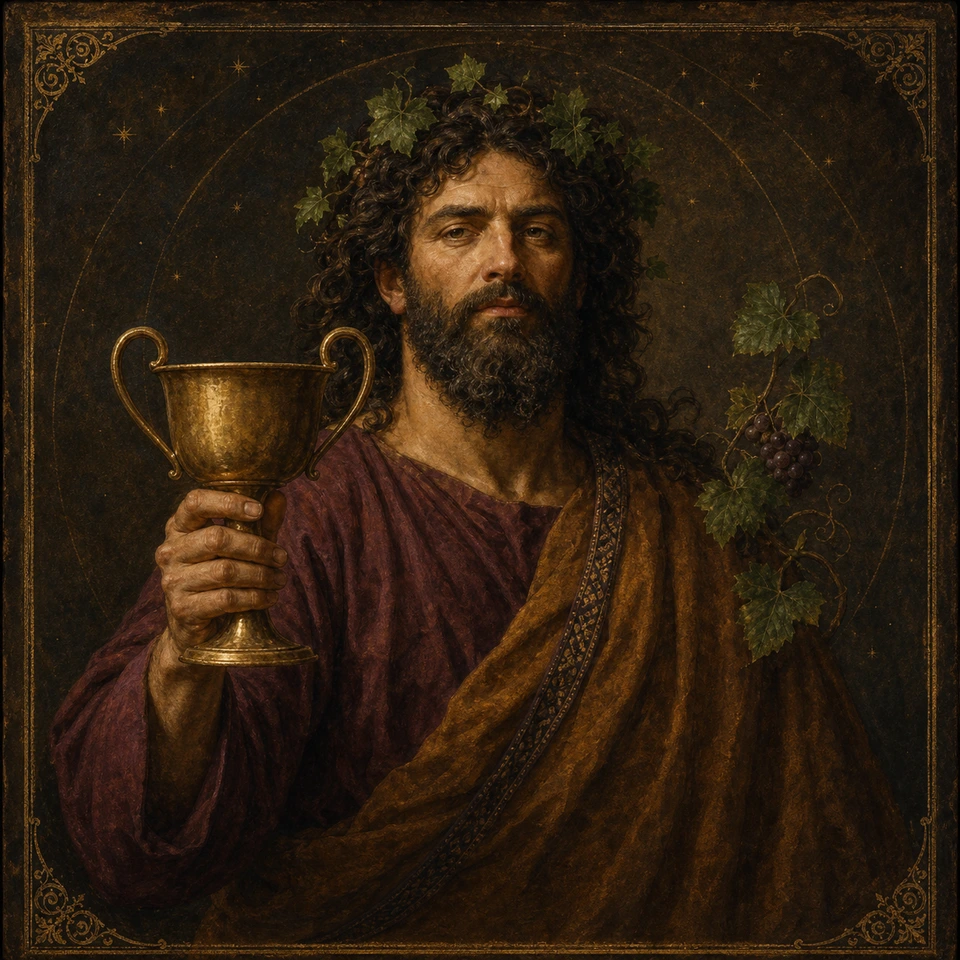
Igniting the powerful forces of festival and altered perception, Dionysus rules the realms of wine, theatre, and profound transformation. His capacity for dangerous recognition vibrates through ancient tragedy, surviving vibrantly in civic sanctuaries and firmly identified Greek art.
Overview
A ship lies under sudden vines. The mast and sail darken beneath their growth, wine runs across the deck, and a god who could not be bound becomes a lion before the men who tried to sell him. In Homeric Hymn 7, the sailors leap into the sea and become dolphins while the helmsman, the only man who recognized danger, is spared. Dionysus enters Greek poetry through transformation, terror, perfume, animal presence, and mercy arriving in the same breath.
His birth is already a crisis of divine and mortal bodies. Hesiod calls him the son of Zeus and Semele. Pseudo-Apollodorus tells how Hera's deception drives Semele to ask Zeus to appear in his full divinity. The sight kills her, Zeus takes the unborn child from the fire, and Dionysus finishes gestation sewn into his father's thigh. Hermes then carries the infant into concealment. The familiar title twice-born belongs to this ruptured sequence, not to a gentle allegory detached from death.
At Thebes, Euripides brings the grown god home in human disguise. Pentheus refuses his divinity, imprisons him, and imagines the women's rites as disorder to be mastered. Dionysus leads the king toward the mountain dressed as a Bacchant, places him where he can spy, and gives him to the hands of the women he wanted to control. Agave carries her son's head back in triumph until recognition returns. The play does not make ecstasy innocent. It joins divine presence, altered perception, civic refusal, gendered power, violence, and irreversible grief.
Older epic preserves another resistance. Lycurgus attacks Dionysus' nurses, drives the god into the sea, and receives punishment from the gods. Pseudo-Apollodorus expands the conflict with madness and family killing. Ariadne's story also refuses one ending. Hesiod makes her the immortal wife of Dionysus. The Odyssey says Artemis killed her on Dia at Dionysus' testimony while Theseus was carrying her away. Marriage and death remain separate ancient outcomes.
Athens met Dionysus through sanctuary, procession, sacrifice, theatre, and festival time. Pausanias saw the sanctuary beside the theatre with Dionysus Eleuthereus, another costly image, and paintings of Pentheus, Lycurgus, Ariadne, and Hephaestus' return. Thucydides places an older Dionysia at Dionysus in the Marshes during Anthesterion. The sanctuary on the Acropolis slope became the setting of the Greater or City Dionysia, where performance was itself public religious action.
Ancient objects keep the god from becoming a generic emblem of drunkenness. A named Attic amphora shows a mature bearded Dionysus with ivy, long clothing, kantharos, and grapevine. A Metropolitan Museum krater gives him cloak, ivy wreath, cup, and branch. Roman Liber and Bacchus, Etruscan Fufluns, and Greek Dionysus belong to historically connected but distinct religious worlds. Hellenion's December libation shows one present community still addressing Dionysus without claiming that ancient theatre or secret rites survived unchanged.
Canonical identity
Canonical Identity
Dionysus stands as an ancient Greek god rather than a mere poetic label for wine or a generic spirit of intoxication. While wine remains central to his domain, his divine portfolio heavily incorporates theatre, civic festival, procession, vegetation, masked presence, altered perception, profound transformation, and dangerous recognition. Important cultural cross-pollination occurred with the Roman Liber, the later Roman Bacchus, and the Etruscan Fufluns, but these figures possess their own rich histories of assimilation and do not serve as universal alternate names for the Greek cult.
Linguistic Identity
His Greek name is Διόνυσος, formally transliterated as Diónysos. A qualified fifth-century BC Attic reconstruction provides /di.ó.nyː.sos/ (approximately dee-OH-nü-soss), distinguished by a long front rounded vowel and a pitch accent impossible to replicate in English. Dionysus is the widely accepted conventional English spelling, whereas Dionysos offers a closer direct transliteration. The deeper linguistic origin of the name remains contested.
Sources and evidence
TEXTUAL · Supported
The Greek form Διόνυσος has a qualified fifth-century BC Attic reconstruction /di.ó.nyː.sos/.
- Source
- Wiktionary contributors, Διόνυσος
- Reviewed edition
- Wiktionary live revision reviewed 2026-08-30 · Wiktionary
- Exact locator
- Entry Διόνυσος · Section Ancient Greek pronunciation
- Scope
- Classical Greece · Attica
- Authority
- institutional or lexical reference
- Certainty
- Qualified
The claim remains limited to the named witness and locator.
Open exact reviewed source1 reviewed source for this section
- Wiktionary contributors, ΔιόνυσοςLive collaborative lexical entry reviewed 2026-08-30 · Wiktionary
Culture, tradition, period, and place
Dionysus appears from archaic epic and hymns through Classical tragedy, civic sanctuaries, painted pottery, and imperial-period descriptions of older Greek places. Homer remembers Lycurgus' attack. Hesiod gives birth and marriage. The hymns show pirates, dolphins, vines, nymphs, and mountain nurture. Fifth-century Athens makes Dionysus inseparable from public dramatic performance, while Thebes becomes the tragic landscape of refused recognition.
Each place changes the encounter. Athens held Dionysus Eleuthereus beside the theatre and celebrated older and civic Dionysia in distinct settings. Thebes anchored Semele, Pentheus, Cadmus, and the Bacchae. Naxos and sea-girt Dia belong to Ariadne traditions. The sea itself becomes a stage in the pirate hymn. One god crosses these settings, but no single rite or myth exhausts him.
Historical development
Archaic poetry does not present a simple late outsider waiting to enter Greek religion. Dionysus already belongs to divine genealogy in Hesiod and to epic memory in Homer. The Homeric Hymns make his powers visible through narrative: bonds fail, wine flows, vines climb, animals appear, and sailors become dolphins. These are early Greek witnesses, not later Roman decorations.
Classical Athens joins cult and performance at monumental scale. Tragedy and comedy unfolded in a sanctuary landscape under Dionysian festival authority. Euripides' Bacchae, composed at the end of the fifth century BC, turns the god's disputed arrival into a drama about recognition and civic catastrophe. Pausanias later saw temples, images, and paintings that kept several myths together beside the theatre. Continuity came through repeated remaking, not an identical ceremony frozen across centuries.
Attested roles and historical themes
Roles, powers, and limits
Wine reveals only part of Dionysus. In the pirate hymn it pours miraculously across a ship before vine, ivy, fragrance, lion, bear, and dolphin transformation follow. In Bacchae, the god changes how people see bodies, houses, mountains, gender, power, and kin. He can release women from ordinary labor and also steer a king toward dismemberment. Ecstasy and terror are neighbors in his surviving stories.
He also presides over theatrical and choral performance in civic religion, receives procession and sacrifice, and appears through masks, costumes, cups, vegetation, and altered states. These functions do not make every intoxication sacred or every loss of control divine. Ancient drama repeatedly shows limits: denial is dangerous, but frenzy can destroy families, and recognition may come only after the damage cannot be undone.
Epithets and titles
Cult Epithet
Eleuthereus
Ἐλευθερεύς · of Eleutherae
Athens and Eleutherae · Classical sanctuary, later described by PausaniasA place-linked Athenian cult title, not a universal abstract title of freedom.
1 reviewed source for this section
- Pausanias; Spiro Greek edition and Jones/Ormerod translation volumes, Description of Greece (1935)Perseus CTS edition corpus, 1903-1935 · Perseus Digital Library / Scaife ATLAS
Worship and cult
At Athens, worship gathered bodies into roads, sanctuary precincts, seats, choruses, sacrifice, and staged speech. The Sanctuary and Theatre of Dionysos on the south slope of the Acropolis joined a divine precinct to the place where tragedies and comedies became public religious events. Pausanias describes two temples and images beside the theatre, including Dionysus Eleuthereus.
Other Dionysian worship could be rural, nocturnal, mountain-based, or attached to different local associations. Bacchae makes ritual movement vivid but remains a tragedy, not a documentary script. Its thyrsoi, song, dance, dress, and cries belong to dramatic action shaped for an Athenian audience. No secret or ecstatic rite can be rebuilt safely by copying the play scene for scene.
Sources and evidence
ARCHAEOLOGICAL · Supported
The official site account identifies the sanctuary and theatre as the foremost Athenian sanctuary of Dionysus and the setting of the Greater or City Dionysia.
- Source
- Acropolis Museum, Sanctuary and Theatre of Dionysos
- Reviewed edition
- Official Acropolis Museum archaeological page reviewed 2026-08-30 · Acropolis Museum
- Exact locator
- Page Sanctuary and Theatre of Dionysos · Section Sanctuary, theatre, and Greater Dionysia
- Scope
- Classical Greece · Athens
- Authority
- institutional archaeological authority
- Certainty
- Qualified
The claim remains limited to the named witness and locator.
Open exact reviewed source1 reviewed source for this section
- Acropolis Museum, Sanctuary and Theatre of DionysosOfficial archaeological-site page reviewed 2026-08-30 · Acropolis Museum
Temples, sanctuaries, and sacred places
The Athenian sanctuary beside the theatre is the clearest built landscape here. Pausanias found Dionysus Eleuthereus, another image made by Alcamenes, and paintings of Hephaestus' return, Pentheus, Lycurgus, and Ariadne. Architecture and image gathered several divine powers into one precinct: festival, theatre, mythic punishment, marriage, and the god's ability to bring another god home.
Thucydides points to an older sanctuary of Dionysus in the Marshes and an older Dionysia in Anthesterion. Thebes carries the house of Semele and the mountain where Pentheus dies in Bacchae. Naxos or Dia belongs to Ariadne's divergent endings. Nysa, often named in nurture traditions, remains geographically unstable across ancient accounts and cannot be pinned to one certain modern location.
Sources and evidence
TEXTUAL · Supported
Pausanias places two temples and images of Dionysus beside the Athenian theatre and describes paintings of major Dionysian myths.
- Source
- Pausanias; Spiro Greek edition and Jones/Ormerod translation volumes, Description of Greece (1935)
- Reviewed edition
- Spiro Greek edition and Jones/Ormerod English volumes represented by the Perseus CTS corpus, 1903-1935 · translated by W. H. S. Jones and H. A. Ormerod, volume-dependent · edited by Friedrich Spiro for the Greek edition · Perseus Digital Library / Scaife ATLAS
- Exact locator
- Book 1 · Chapter 20 · Section 3
- Scope
- Greek religion under Roman imperial rule · Athens
- Authority
- primary textual witness
- Certainty
- High
The claim remains limited to the named witness and locator.
Open exact reviewed source1 reviewed source for this section
- Pausanias; Spiro Greek edition and Jones/Ormerod translation volumes, Description of Greece (1935)Perseus CTS edition corpus, 1903-1935 · Perseus Digital Library / Scaife ATLAS
Festivals and processions
Dionysian festival time in Athens was not one celebration. Thucydides identifies an older Dionysia at the sanctuary in the Marshes during Anthesterion, a custom shared in his account with Ionian communities. The Greater or City Dionysia belonged to the sanctuary and theatre on the Acropolis slope, where civic procession, sacrifice, choruses, tragedy, and comedy addressed both god and city.
The Lenaia, Rural Dionysia, and Anthesteria require their own local and chronological treatment. Names alone do not supply identical programs. Public performance is historically secure, but later stage conventions cannot be projected back into every early rite. Festival evidence is strongest when month, place, officials, and performance setting remain together.
Sources and evidence
TEXTUAL · Supported
In History 2.15.4, Thucydides anchors the older Dionysia at the sanctuary of Dionysus in the Marshes and names Anthesterion as its month.
- Source
- Thucydides; translated by Richard Crawley; revised by Richard Feetham, History of the Peloponnesian War (1910)
- Reviewed edition
- Richard Crawley translation, revised by Richard Feetham, 1910 Dent and Dutton edition · translated by Richard Crawley · edited by Richard Feetham · Perseus Digital Library
- Exact locator
- Book 2 · Section 15.4
- Scope
- Classical Greece · Athens
- Authority
- primary textual witness
- Certainty
- High
The claim remains limited to the named witness and locator.
Open exact reviewed source1 reviewed source for this section
- Thucydides; translated by Richard Crawley; revised by Richard Feetham, History of the Peloponnesian War (1910)1910 Dent and Dutton revision digitized by the Perseus Project · Perseus Digital Library
Offerings, votives, and ritual evidence
Wine belongs to Dionysus in poetry, vessel imagery, cups, and later public devotion, yet its meanings vary. On the pirate ship it appears as a divine sign rather than a human offering. The kantharos in Attic art marks the god through a distinctive drinking vessel. At modern Hellenion libations, poured liquid belongs to that organization's current shared practice.
Ancient Dionysian ritual also included sacrifice, procession, song, dance, dress, and theatrical competition. Bacchae gives incense smoke and torches a charged dramatic setting, but it does not preserve a universal recipe. The physical risks of alcohol, fire, crowd movement, and altered consciousness remain real; divine association never makes unsafe use harmless.
Iconography and material culture
A named Attic amphora of about 500 BC shows Dionysus as a mature bearded man with long hair, ivy wreath, long-sleeved chiton, mantle, kantharos, and grapevine. The written name prevents identification by resemblance alone. A Metropolitan Museum column-krater of about 470 to 460 BC gives him an ample cloak, large ivy wreath, kantharos, and ivy branch.
Ancient artists also made youthful Dionysian forms, masks, satyrs, maenads, animals, and scenes of arrival or procession. The mature bearded type is therefore securely ancient without being the only ancient body. Kantharos, ivy, grapevine, robe, and beard carry strong object-level support. A generic modern fantasy thyrsus or panther cannot replace accession-level evidence.
Sources and evidence
MATERIAL CULTURE · Supported
British Museum amphora E253 names Dionysus and shows him bearded, ivy-wreathed, long-robed, and carrying a kantharos beside grapevine.
- Source
- British Museum, British Museum Collection
- Reviewed edition
- Live record-level official museum collection · British Museum
- Exact locator
- MuseumObjectId 1843,1103.35 (E253) · Entry Attic red-figure amphora, circa 500 BC
- Scope
- Archaic Greece · Attica
- Authority
- institutional collection catalog
- Certainty
- Qualified
The claim remains limited to the named witness and locator.
Open exact reviewed sourceMATERIAL CULTURE · Supported
Metropolitan Museum column-krater 16.72 shows Dionysus with an ample cloak, ivy wreath, kantharos, and ivy branch.
- Source
- The Metropolitan Museum of Art, Open Access Collection and Collection API
- Reviewed edition
- Live collection records and API; eligible Open Access objects only · The Metropolitan Museum of Art
- Exact locator
- MuseumObjectId 16.72 · Entry Attic column-krater, circa 470-460 BC
- Scope
- Classical Greece · Attica
- Authority
- institutional collection catalog
- Certainty
- Qualified
The claim remains limited to the named witness and locator.
Open exact reviewed source2 reviewed sources for this section
- British Museum, British Museum CollectionLive official museum collection · British Museum
- The Metropolitan Museum of Art, Open Access Collection and Collection APILive collection data and eligible public-domain images · The Metropolitan Museum of Art
Animals, plants, and embodied forms
Grapevine and ivy cling close to Dionysus in named Attic art. They are living plants, cultivated and wild, that can crown, shade, climb, and produce wine. The pirate hymn makes vegetation erupt across worked timber and sail, turning a ship built for human profit into the stage of divine epiphany.
Animals appear with equal force in that hymn. Dionysus becomes a lion, a bear appears, and the terrified crew leap into the sea as dolphins. These are actions within one poem, not a universal sacred-animal table. Dolphins retain a particularly strong narrative bond to the failed abduction. Later panther imagery needs its own dated Greek objects before it can carry the same weight here.
Relationships and genealogy
Hesiod names Dionysus as the son of Zeus and Semele and says he later made mortal Ariadne his deathless wife. Pseudo-Apollodorus gives the birth its violent sequence: Hera deceives Semele, Zeus' unveiled divinity kills her, and the unborn child is sewn into Zeus' thigh before Hermes carries him into concealment. Semele remains his mortal mother even when the second gestation gives Zeus an extraordinary bodily role.
Ariadne's future divides. Hesiod gives marriage and immortality. The Odyssey says Artemis killed her on Dia at Dionysus' testimony while Theseus was carrying her from Crete. Theseus, Ariadne, Artemis, and Dionysus therefore occupy different relations in incompatible tellings. Roman family systems and Bacchic genealogies cannot be imported to make them agree.
Sources and evidence
TEXTUAL · Supported
Hesiod names Dionysus as the son of Zeus and Semele.
- Source
- Hesiod; edited and translated by Hugh G. Evelyn-White, Theogony (1914)
- Reviewed edition
- Hugh G. Evelyn-White edition and English translation in Hesiod, the Homeric Hymns and Homerica, 1914 · translated by Hugh G. Evelyn-White · edited by Hugh G. Evelyn-White · Perseus Digital Library / Scaife ATLAS
- Exact locator
- Entry Theogony · Line 940-942
- Scope
- Archaic Greece · Ancient Greece
- Authority
- primary textual witness
- Certainty
- High
The claim remains limited to the named witness and locator.
Open exact reviewed sourceTEXTUAL · Supported
Hesiod says Dionysus made Ariadne his wife and Zeus made her deathless and ageless.
- Source
- Hesiod; edited and translated by Hugh G. Evelyn-White, Theogony (1914)
- Reviewed edition
- Hugh G. Evelyn-White edition and English translation in Hesiod, the Homeric Hymns and Homerica, 1914 · translated by Hugh G. Evelyn-White · edited by Hugh G. Evelyn-White · Perseus Digital Library / Scaife ATLAS
- Exact locator
- Entry Theogony · Line 947-949
- Scope
- Archaic Greece · Ancient Greece
- Authority
- primary textual witness
- Certainty
- High
The claim remains limited to the named witness and locator.
Open exact reviewed sourceTEXTUAL · Supported
The Odyssey instead says Artemis killed Ariadne on Dia at Dionysus' testimony.
- Source
- Homer; translated by A. T. Murray, Odyssey (1919)
- Reviewed edition
- A. T. Murray English translation, London: William Heinemann; New York: G. P. Putnam's Sons, 1919 · translated by A. T. Murray · Perseus Digital Library / Scaife ATLAS
- Exact locator
- Book 11 · Line 321-325
- Scope
- Archaic Greece · Naxos
- Authority
- primary textual witness
- Certainty
- High
The claim remains limited to the named witness and locator.
Open exact reviewed source2 reviewed sources for this section
- Hesiod; edited and translated by Hugh G. Evelyn-White, Theogony (1914)Hesiod, the Homeric Hymns and Homerica, London and New York, 1914 · Perseus Digital Library / Scaife ATLAS
- Homer; translated by A. T. Murray, Odyssey (1919)A. T. Murray English translation, London: William Heinemann; New York: G. P. Putnam's Sons, 1919 · Perseus Digital Library / Scaife ATLAS
Actual myths and source variants
Five narratives anchor the mythology here. Semele's death and the thigh birth establish mortality, divine concealment, and double gestation. The pirate hymn shows failed bondage exploding into wine, vines, animal terror, mercy, and dolphin transformation. Bacchae turns Dionysus' arrival at Thebes into a test Pentheus cannot survive. Lycurgus attacks the god's nurses and learns that resistance can draw divine punishment. Ariadne receives either immortal marriage or death on Dia.
Their genres matter. Genealogy compresses. Hymn displays epiphany. Epic preserves a charged memory. Tragedy unfolds deception, performance, and recognition before an audience. Mythography gathers and rearranges inherited episodes. The contradictions are not clutter to be erased. They are evidence that Dionysus was repeatedly used to think about bodily limits, civic order, divine presence, gender, kinship, violence, and transformation.
At Tanagra, Pausanias preserves one local account in which women preparing for Dionysian rites are attacked by Triton. They call upon Dionysus, who kills the sea power. The rival Tanagran version uses wine and beheading but contains no Dionysus, so it cannot be made into a universal feud.
Sources and evidence
TEXTUAL · Supported
Pseudo-Apollodorus tells how Semele dies after seeing Zeus in divine splendor and how the unborn Dionysus completes gestation in Zeus' thigh.
- Source
- Pseudo-Apollodorus; edited and translated by James G. Frazer, Library (1921)
- Reviewed edition
- James G. Frazer edition and English translation, Harvard University Press and William Heinemann, 1921 · translated by James G. Frazer · edited by James G. Frazer · Perseus Digital Library / Scaife ATLAS
- Exact locator
- Entry Library · Section 3.4.3
- Scope
- Greek religion under Roman imperial rule · Thebes in Boeotia
- Authority
- primary textual witness
- Certainty
- High
The claim remains limited to the named witness and locator.
Open exact reviewed sourceTEXTUAL · Supported
Homeric Hymn 7 tells how attempted captors meet wine, vines, animal epiphany, and transformation into dolphins.
- Source
- Anonymous Homeric Hymns; edited and translated by Hugh G. Evelyn-White, Homeric Hymns (1914)
- Reviewed edition
- Hugh G. Evelyn-White edition and English translation in Hesiod, the Homeric Hymns and Homerica, 1914 · translated by Hugh G. Evelyn-White · edited by Hugh G. Evelyn-White · Perseus Digital Library / Scaife ATLAS
- Exact locator
- Hymn 7 · Line 1-59
- Scope
- Archaic Greece
- Authority
- primary textual witness
- Certainty
- High
The claim remains limited to the named witness and locator.
Open exact reviewed sourceTEXTUAL · Supported
Euripides makes Dionysus lead Pentheus toward the mountain where Agave and the Bacchants dismember him before recognition returns.
- Source
- Euripides; translated by Theodore Alois Buckley, The Bacchae (1850)
- Reviewed edition
- Theodore Alois Buckley English translation, The Tragedies of Euripides, 1850 · translated by Theodore Alois Buckley · Perseus Digital Library / Scaife ATLAS
- Exact locator
- Entry Bacchae · Line 1-1392
- Scope
- Classical Greece · Thebes in Boeotia
- Authority
- primary textual witness
- Certainty
- High
The claim remains limited to the named witness and locator.
Open exact reviewed sourceTEXTUAL · Supported
The Iliad remembers Lycurgus attacking Dionysus' nurses and driving the frightened god into the sea.
- Source
- Homer; Monro and Allen Greek edition with edition-specific translations, Iliad (1920)
- Reviewed edition
- Monro and Allen Greek edition represented by the Perseus CTS corpus, Oxford, 1908-1920 · edited by David Binning Monro and Thomas William Allen · Perseus Digital Library / Scaife ATLAS
- Exact locator
- Book 6 · Line 130-140
- Scope
- Archaic Greece
- Authority
- primary textual witness
- Certainty
- High
The claim remains limited to the named witness and locator.
Open exact reviewed sourceTEXTUAL · Supported
Pausanias preserves a Tanagran local account in which Dionysus kills Triton after women preparing for his rites call for help.
- Source
- Pausanias; Spiro Greek edition and Jones/Ormerod translation volumes, Description of Greece (1935)
- Reviewed edition
- W. H. S. Jones and H. A. Ormerod English translation volumes, 1918-1935 · translated by W. H. S. Jones and H. A. Ormerod, volume-dependent · Perseus Digital Library / Scaife ATLAS
- Exact locator
- Book 9 · Chapter 20 · Section 4
- Scope
- Greek religion under Roman imperial rule · Boeotia
- Authority
- Ancient primary text
- Certainty
- High
Exact source, edition, locator, culture, period, and place are retained; the claim is a close original paraphrase.
Open exact reviewed source5 reviewed sources for this section
- Pseudo-Apollodorus; edited and translated by James G. Frazer, Library (1921)Harvard University Press and William Heinemann edition, 1921 · Perseus Digital Library / Scaife ATLAS
- Anonymous Homeric Hymns; edited and translated by Hugh G. Evelyn-White, Homeric Hymns (1914)Hesiod, the Homeric Hymns and Homerica, London and New York, 1914 · Perseus Digital Library / Scaife ATLAS
- Euripides; translated by Theodore Alois Buckley, The Bacchae (1850)The Tragedies of Euripides, literally translated by Theodore Alois Buckley, 1850 · Perseus Digital Library / Scaife ATLAS
- Homer; Monro and Allen Greek edition with edition-specific translations, Iliad (1920)Perseus CTS edition corpus; Greek edition, Oxford, 1908-1920 · Perseus Digital Library / Scaife ATLAS
- Pausanias; Spiro Greek edition and Jones/Ormerod translation volumes, Description of Greece (1935)Perseus CTS edition corpus, 1903-1935 · Perseus Digital Library / Scaife ATLAS
Myth Library
Each myth gathers its attested participants into one source-grounded account, while distinct source traditions remain readable in their own variants.
Birth And Genealogy
The Birth of Dionysus
Semele dies after asking Zeus to reveal his divine splendor. Zeus rescues the unborn Dionysus and completes the pregnancy in his own thigh before Hermes carries the infant into concealment.
- Role in this profile
- unborn god rescued from Semele and brought to term in Zeus' thigh
- Place scope
- Ancient Greece
- Witnesses
- 2
- Variants
- 2
Epiphany And Transformation
Dionysus and the Tyrrhenian Pirates
Pirates seize Dionysus for ransom, but bonds fall away, wine runs, vines cover the ship, and animal epiphany drives the crew into the sea as dolphins while the helmsman is spared.
- Role in this profile
- captured god whose epiphany breaks bonds and transforms the crew
- Place scope
- Ancient Greece
- Witnesses
- 1
- Variants
- 1
Tragic Recognition And Punishment
Dionysus and Pentheus
Dionysus returns to Thebes in disguise, draws the resisting king Pentheus into spying on the Bacchants, and delivers him to dismemberment by his mother Agave and the women of the city.
- Role in this profile
- god in human disguise who leads Pentheus from denial into fatal exposure
- Place scope
- Thebes in Boeotia
- Witnesses
- 2
- Variants
- 2
Resistance Madness And Punishment
Dionysus and Lycurgus
Lycurgus attacks the nurses of Dionysus and drives the frightened god into the sea. Epic and mythography agree on resistance and punishment but differ sharply in the violence that follows.
- Role in this profile
- god driven into the sea who later punishes Lycurgus in mythography
- Place scope
- Ancient Greece
- Witnesses
- 2
- Variants
- 2
Marriage And Conflicting Fates
Dionysus and Ariadne
Hesiod makes Ariadne the immortal wife of Dionysus, while the Odyssey preserves a fatal outcome in which Artemis kills her on Dia at Dionysus' testimony.
- Role in this profile
- immortal husband in Hesiod and fatal testifier in the Odyssey
- Place scope
- Naxos
- Witnesses
- 2
- Variants
- 2
Mythographic Synthesis
Gaia and the Gigantes
Pseudo-Apollodorus makes Gaia bear the Gigantes in anger over the Titans and seek a protective drug before their war with the gods; the Pergamon Altar adds Phoibe’s long-torch combat beside Asteria.
- Role in this profile
- kills Eurytus with the thyrsus
- Place scope
- Ancient Greece · Pergamon
- Witnesses
- 2
- Variants
- 2
Divine Birth And Welcome
The Birth of Pan
Homeric Hymn 19 makes Hermes the father of Pan and the bearer who presents the goat-footed infant to the delighted Olympians.
- Role in this profile
- god said to delight in Pan above the other immortals
- Place scope
- Arcadia · Mount Olympus
- Witnesses
- 1
- Variants
- 1
Purification And Initiation
Rhea Purifies and Instructs Dionysus in Phrygia
After Hera drives Dionysus mad, Pseudo-Apollodorus says Rhea purifies him in Phrygia, teaches him initiation rites, and gives him ritual dress before he proceeds toward Thrace and India.
- Role in this profile
- god driven mad by Hera who receives purification, instruction, and ritual dress from Rhea
- Place scope
- Phrygia
- Witnesses
- 1
- Variants
- 1
Local Cult Aetiology With Rival Deaths
Triton of Tanagra
Tanagra preserves two deaths for Triton: Dionysus kills him after an attack on women, or local people intoxicate and behead him after raids.
- Role in this profile
- answers the women’s prayer and kills Triton in the first account
- Place scope
- Boeotia
- Witnesses
- 1
- Variants
- 2
Return And Reconciliation
Dionysus Returns Hephaestus to Olympus
Pausanias explains an Athenian painting through the story of Hera's golden chair and Dionysus' successful return of Hephaestus.
- Role in this profile
- trusted negotiator who intoxicates Hephaestus and brings him back to heaven
- Place scope
- Athens · Ancient Greece
- Witnesses
- 1
- Variants
- 1
Equivalences, syncretisms, and identity boundaries
Greek Dionysus, Roman Liber, Roman Bacchus, and Etruscan Fufluns became entangled through translation, conquest, art, and ritual exchange. That history matters precisely because the names began in different languages and institutions. An Etruscan mirror titled with Dionysos shows reception, not proof that every Fufluns cult was simply Greek Dionysus under another spelling.
The ancestral Roman Liber had relationships with Ceres and Libera that cannot be overwritten by later Bacchic assimilation. Bacchus became a powerful Roman and later European name, but it does not turn Greek sanctuary, festival, or myth into a Roman original. Similar cups, vines, processions, or ecstatic behavior establish comparison only when a historical witness makes the connection.
Correspondence index
Dionysus' strongest associations come from ancient action and objects: grapevine, ivy, wine, kantharos, theatrical sanctuary, festival procession, animal epiphany, and the smoke and torchlight of tragic Bacchic song. Each belongs to a dated poem, play, object, or place. The lion and dolphins of the pirate hymn remain narrative forms, while Athens supplies civic festival and theatre.
No witness used here assigns Dionysus a planet, zodiac sign, gemstone, metal, universal color, classical element, weekday, moon phase, compass direction, or single magical intention. Later occult systems may do so, but they need their own named authorities. Ancient ecstasy is not an automatic license for a modern correspondence chart.
Direct ancient correspondences
| Category | Direct correspondence | How and why | Evidence boundary |
|---|---|---|---|
| plant-tree | Grapevine and ivyDirect historical association | Named Attic art places grapevine and ivy with Dionysus, while Hymn 7 makes them erupt across the pirate ship. | Ancient Material Archaic and Classical Greek poetry and imagery 2 reviewed sources for this section
|
| animal-embodied-form | Lion and dolphinsDirect historical association | In Homeric Hymn 7 Dionysus appears as a lion and the fleeing pirates become dolphins. | Ancient Literary The pirate epiphany, not a universal animal table 1 reviewed source for this section
|
| direction-place | Sanctuary and Theatre of Dionysos, AthensDirect historical association | The Athenian precinct joins Dionysus Eleuthereus, theatre, festival, images, and public performance. | Ancient Cultic A cult place, not a compass direction 2 reviewed sources for this section
|
| festival-time | Older Dionysia and City DionysiaDirect historical association | Thucydides anchors the older Dionysia in Anthesterion, while the Acropolis sanctuary anchors the Greater or City Dionysia. | Ancient Cultic Distinct Athenian festivals, not one timeless celebration 2 reviewed sources for this section
|
| ritual-object-symbol-tool | KantharosDirect historical association | Two cataloged Attic vessels identify Dionysus with the high-handled kantharos. | Ancient Material Archaic and Classical Greek vase imagery 2 reviewed sources for this section
|
Contextual evidence, not a general correspondence
| Category | Direct correspondence | How and why | Evidence boundary |
|---|---|---|---|
| incense-perfume | Incense smoke in BacchaeContextual evidence only | The tragic chorus places incense smoke within Bacchic song and movement. | Ancient Literary Dramatic ritual language, not a named universal resin 1 reviewed source for this section
|
| offering-ritual-material | Wine and modern libationContextual evidence only | Wine is a divine sign and material attribute in ancient evidence, while Hellenion publicly schedules a present libation. | Modern Public Ancient narrative and one modern organization remain separate 2 reviewed sources for this section
|
9 expected categories currently not evidenced
celestial-body · Not evidenced
No celestial body attested
No witness here gives Dionysus rule over a planet, Sun, or Moon.
- Layer
- Research Boundary
- Scope
- Divine brightness and seasonal vegetation do not establish celestial rulership
zodiac · Not evidenced
No zodiac sign attested
No zodiac sign is assigned in this evidence.
- Layer
- Research Boundary
- Scope
- A later astrological claim needs its own named authority
gemstone-crystal-mineral · Not evidenced
No gemstone or mineral attested
No stone or mineral belongs to Dionysus in these witnesses.
- Layer
- Research Boundary
- Scope
- Color and wine imagery cannot supply a crystal by analogy
metal-material · Not evidenced
No metal attested
No metal assignment survives in the evidence used here.
- Layer
- Research Boundary
- Scope
- Vessel manufacture is not a divine metal correspondence
color · Not evidenced
No universal color attested
The clothing and painted surfaces of individual objects do not create one sacred color.
- Layer
- Research Boundary
- Scope
- Object pigments and poetic wine color remain contextual
classical-element · Not evidenced
No classical element attested
No four-element assignment appears in these witnesses.
- Layer
- Research Boundary
- Scope
- Wine, fire, water, and vegetation in stories do not establish rulership
weekday · Not evidenced
No weekday attested
No weekday is assigned to Dionysus here.
- Layer
- Research Boundary
- Scope
- No planetary chain is inferred
moon-phase · Not evidenced
No moon phase attested
No lunar phase structures the evidence here.
- Layer
- Research Boundary
- Scope
- Night ritual language does not establish a moon-phase rule
intention-magical-power · Not evidenced
No universal magical intention attested
Transformation, ecstasy, theatre, and liberation do not form one ancient spell-purpose list.
- Layer
- Research Boundary
- Scope
- Later intentions require accountable modern testimony
Later reception and living significance
Dionysus has continued through translations, opera, painting, theatre, psychology, philosophy, and modern Pagan religion. Later artists often emphasize youth, sensuality, madness, liberation, or gender crossing. Those themes may grow from ancient materials, but every modern work selects and reshapes them.
Hellenion offers one accountable living example. Its monthly schedule names a December libation to Dionysos for participating members. That establishes a present communal act by one Hellenic polytheist organization. It does not speak for all practitioners or claim an uninterrupted survival of Athenian festival, mystery, or maenadic practice.
Sources and evidence
RITUAL ATTESTED · Supported
Hellenion schedules a shared December libation to Dionysos.
- Source
- Hellenion, Monthly Libations
- Reviewed edition
- Live first-party community practice page reviewed 2026-08-29 · Hellenion
- Exact locator
- Page Monthly Libations · Entry December, Dionysos
- Scope
- Contemporary living religion · International online religious community
- Authority
- accountable living-tradition organization
- Certainty
- High
The claim remains limited to the named witness and locator.
Open exact reviewed source1 reviewed source for this section
- Hellenion, Monthly LibationsLive official community practice page · Hellenion
Evidence, conflicts, and research gaps
Hesiod controls genealogy and Ariadne's immortal marriage. Homer gives Lycurgus and Ariadne's death. Homeric Hymn 7 gives the pirate epiphany. Euripides gives the deepest continuous Pentheus narrative, while Pseudo-Apollodorus preserves later mythographic sequences. Thucydides and Pausanias anchor Athenian festivals and sanctuaries. Museum objects secure the bearded, ivy-wreathed, kantharos-bearing image.
Major gaps remain visible. Linear B material and the Mycenaean form of the name need a dedicated epigraphic edition. Orphic Zagreus and dismemberment traditions require careful source-by-source treatment rather than a single composite tale. The Lenaia, Rural Dionysia, Anthesteria, and regional mysteries need fuller local evidence. Ancient pronunciation varies by dialect and century, and hidden rites cannot be reconstructed as a complete ceremony.
Direct connections and evidence
Explicit Source
Hesiod names Zeus as Dionysus' father
Hesiod names Zeus and mortal Semele as the parents of Dionysus.
1 attestation · high confidence
- Hesiod; edited and translated by Hugh G. Evelyn-White, TheogonyHugh G. Evelyn-White edition and English translation in Hesiod, the Homeric Hymns and Homerica, 1914 · translated by Hugh G. Evelyn-White · edited by Hugh G. Evelyn-White · Perseus Digital Library / Scaife ATLAS · Archaic Greece · Ancient Greece · Entry Theogony · Line 940-942
Archive scope and classification
- Figure classification
- God or goddess · certain
- Pantheon or tradition shelf
- Greek
- Cultures
- Greek
- Traditions
- Ancient Greek religion
- Periods
- Archaic Greece, Classical Greece, Hellenistic Greek world, Greek religion under Roman imperial rule, Contemporary living religion
- Places
- Ancient Greece, Attica, Athens, Thebes in Boeotia, Naxos
The completed account preserves five major narratives, Athenian festival and theatre evidence, transformation and violence, ancient objects, modern public practice, and the distinct identities of Dionysus, Liber, Bacchus, and Fufluns.
Reviewed sources
- Hesiod; edited and translated by Hugh G. Evelyn-White, Theogony (1914)Hesiod, the Homeric Hymns and Homerica, London and New York, 1914 · Perseus Digital Library / Scaife ATLAS
- Anonymous Homeric Hymns; edited and translated by Hugh G. Evelyn-White, Homeric Hymns (1914)Hesiod, the Homeric Hymns and Homerica, London and New York, 1914 · Perseus Digital Library / Scaife ATLAS
- Homer; Monro and Allen Greek edition with edition-specific translations, Iliad (1920)Perseus CTS edition corpus; Greek edition, Oxford, 1908-1920 · Perseus Digital Library / Scaife ATLAS
- Homer; translated by A. T. Murray, Odyssey (1919)A. T. Murray English translation, London: William Heinemann; New York: G. P. Putnam's Sons, 1919 · Perseus Digital Library / Scaife ATLAS
- Pseudo-Apollodorus; edited and translated by James G. Frazer, Library (1921)Harvard University Press and William Heinemann edition, 1921 · Perseus Digital Library / Scaife ATLAS
- Pausanias; Spiro Greek edition and Jones/Ormerod translation volumes, Description of Greece (1935)Perseus CTS edition corpus, 1903-1935 · Perseus Digital Library / Scaife ATLAS
- The Metropolitan Museum of Art, Open Access Collection and Collection APILive collection data and eligible public-domain images · The Metropolitan Museum of Art
- British Museum, British Museum CollectionLive official museum collection · British Museum
- Hellenion, Monthly LibationsLive official community practice page · Hellenion
- Thucydides; translated by Richard Crawley; revised by Richard Feetham, History of the Peloponnesian War (1910)1910 Dent and Dutton revision digitized by the Perseus Project · Perseus Digital Library
- Euripides; translated by Theodore Alois Buckley, The Bacchae (1850)The Tragedies of Euripides, literally translated by Theodore Alois Buckley, 1850 · Perseus Digital Library / Scaife ATLAS
- Acropolis Museum, Sanctuary and Theatre of DionysosOfficial archaeological-site page reviewed 2026-08-30 · Acropolis Museum
- Wiktionary contributors, ΔιόνυσοςLive collaborative lexical entry reviewed 2026-08-30 · Wiktionary