
Greek · Divine group · Certain
Dioscuri
Διόσκουροι · Dioskouroi
Pronunciation: /di.ós.kuː.roi̯/ · dee-OSS-koo-roy
Research and editorial review by Cody Manes · Reviewed 2026-08-31
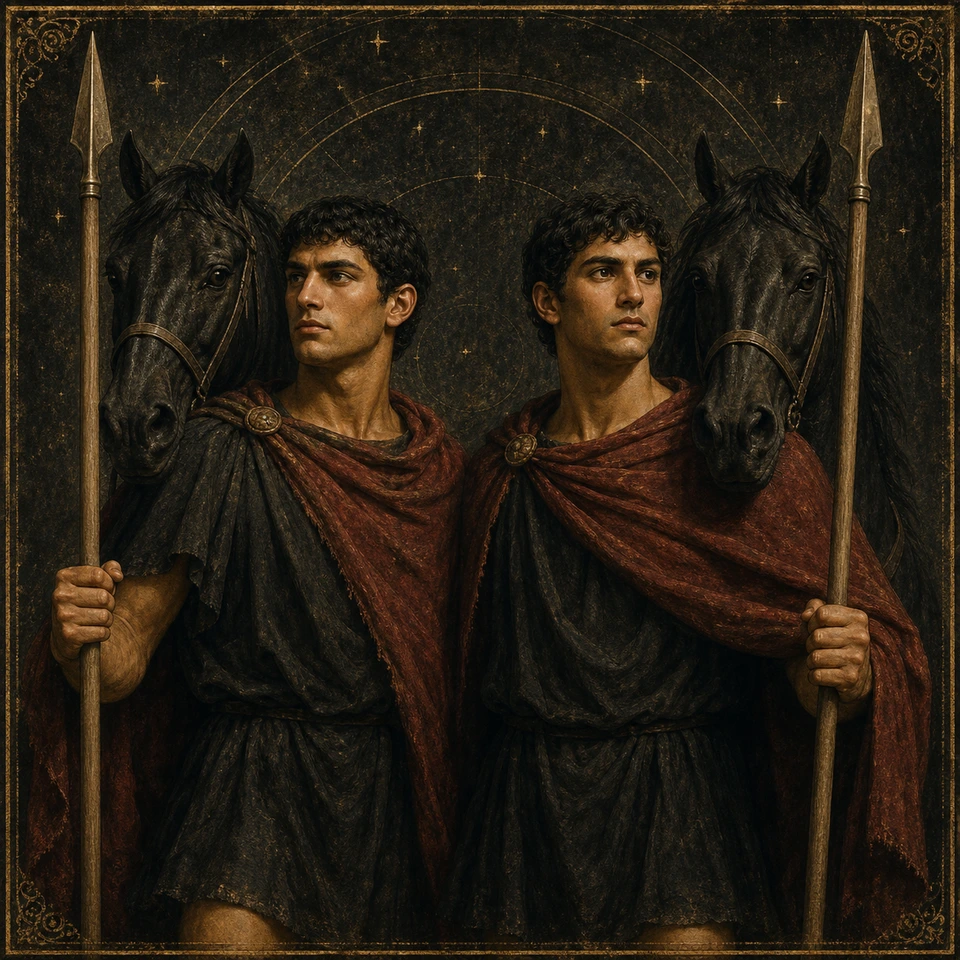
Bound by a shared and alternating fate, the Dioscuri stand as the divine twin collective of Castor and Polydeuces. They ride through ancient tradition as expert horsemen and the celebrated supernatural rescuers of imperiled sailors.
Overview
At sea, the Dioscuri arrive where human skill is failing. Homeric Hymn 33 hears a winter gale breaking over a ship as the sailors call on Castor and Polydeuces. The brothers sweep down through the air, quiet the wind, and level the waves. The scene catches the force of their ancient identity: two young horsemen whose nearness can mean rescue, safe passage, and the return of order in violent uncertainty.
Their Greek collective name is Διόσκουροι, Dioskouroi, Sons of Zeus. Greek poetry also calls them Tyndaridae, sons of Tyndareus. Hymn 33 names Zeus as father and Leda as mother. Odyssey 11 sets Leda in the house of Tyndareus, then gives the brothers an existence divided between life and death. The pair are inseparable, yet ancient authors repeatedly make their bond visible by placing mortality between them.
Pindar's Nemean 10 drives that division into a fatal fight. Lynceus sees Castor hidden in ambush. Idas strikes Castor down. Polydeuces kills Lynceus, Zeus destroys Idas, and the surviving brother faces the cost of being deathless alone. He chooses a shared lot, one day with the gods and one beneath the earth with Castor. Pseudo-Apollodorus tells the struggle differently, beginning with a disputed division of cattle and carrying the violence through an attack on Messene. The Odyssey omits the combat almost entirely. Each witness gives the brothers' alternating fate its own cause and emotional weight.
The Dioscuri also stride through other cycles. Pseudo-Apollodorus places them among the Argonauts and makes Polydeuces the boxer who confronts Amycus. He tells of the twins taking the daughters of Leucippus and of their assault on Athens to recover their abducted sister Helen. In Sparta, Pausanias records a stranger tale: two young men ask Phormion for the chamber once occupied by the brothers, he refuses, and by morning his daughter is gone while images of the Dioscuri, a table, and silphium stand in the room.
Their worship left more than poetry. Pausanias saw an old Athenian sanctuary with standing and mounted images, sanctuaries around the Spartan running course, a temple at the Phoebaeum near Therapne, and bronze figures at Croceae. An Attic black-figure vessel now in the British Museum shows them as beardless mounted youths in red cloaks arriving at a Theoxenia feast. The page image shows the pair together as source-controlled youthful horsemen, with two black horses and two spears; it does not assign a name to either visual position. Horses, spears, cloaks, athletic skill, hospitality, and maritime rescue belong to the evidence. Later planetary, zodiacal, crystal, and universal color assignments do not yet meet the same standard.
Canonical identity
Canonical Identity
The Dioscuri represent a specific ancient Greek divine collective. Castor and Polydeuces are the two distinct, named brothers who comprise this collective, rather than serving as interchangeable aliases for the group itself. Greek poetry successfully maintains two separate fatherhood traditions without forcing them into a singular narrative formula; Homeric Hymn 33 calls them Tyndaridae while explicitly naming Zeus as their father and Leda as their mother, whereas the Odyssey firmly places Leda within the household of Tyndareus.
Linguistic Identity
Dioscuri is the canonical English collective term derived from the Greek Διόσκουροι (Dioskouroi), which translates directly to "Sons of Zeus". The currently reviewed Classical reconstruction is /di.ós.kuː.roi̯/, presented in English guides as dee-OSS-koo-roy. This phonetic model remains partially sourced and awaits confirmation from a more robust academic phonology witness.
Sources and evidence
TEXTUAL · Supported
Homeric Hymn 33 names the Tyndaridae as sons of Zeus born by Leda, identifying Castor as horse-tamer and Polydeuces as faultless.
- Source
- Anonymous Homeric Hymns; edited and translated by Hugh G. Evelyn-White, Homeric Hymns (1914)
- Reviewed edition
- Hugh G. Evelyn-White edition and English translation in Hesiod, the Homeric Hymns and Homerica, 1914 · translated by Hugh G. Evelyn-White · edited by Hugh G. Evelyn-White · Perseus Digital Library / Scaife ATLAS
- Exact locator
- Entry Homeric Hymn 33 to the Dioscuri · Line 1-7
- Scope
- Archaic Greece · Ancient Greece
- Authority
- archaic Greek hymn
- Certainty
- Secure within this hymn
The collective and the named twins remain distinguishable in display and participation.
Open exact reviewed source2 reviewed sources for this section
- Wiktionary contributors, ΔιόσκουροιAncient Greek lexical entry, pronunciation section · Wiktionary
- Anonymous Homeric Hymns; edited and translated by Hugh G. Evelyn-White, Homeric Hymns (1914)Hesiod, the Homeric Hymns and Homerica, London and New York, 1914 · Perseus Digital Library / Scaife ATLAS
Culture, tradition, period, and place
The Dioscuri belong to ancient Greek religion, with a particularly dense Laconian and Spartan geography. Hymn 33 places their birth beneath Taygetus. Pausanias records sanctuaries, images, local memories, and a Pephnus birth claim across Laconia, while Attic vessels show that the pair also circulated beyond Sparta in named visual scenes. Archaic epic and hymn, Classical victory poetry, Attic pottery, and Pausanias's Imperial-period travel account do not speak from one moment. Each preserves a different layer of their religious life. Greek evidence controls the identity here. Roman Castor and Pollux belong to a later and separately bounded reception.
Sources and evidence
TEXTUAL · Supported
Pausanias reports a Pephnus claim that the Dioscuri were born there and describes small bronze images tied to regional traditions.
- Source
- Pausanias; Spiro Greek edition and Jones/Ormerod translation volumes, Description of Greece (1935)
- Reviewed edition
- Spiro Greek edition and Jones/Ormerod English volumes represented by the Perseus CTS corpus, 1903-1935 · translated by W. H. S. Jones and H. A. Ormerod, volume-dependent · edited by Friedrich Spiro for the Greek edition · Perseus Digital Library / Scaife ATLAS
- Exact locator
- Entry Description of Greece · Book 3 · Section 26.2-3
- Scope
- Greek religion under Roman imperial rule · Laconia
- Authority
- ancient Greek witness
- Certainty
- Secure within the cited passage
The Alcman link is indirect because the complete poem is not preserved in the reviewed route.
Open exact reviewed source5 reviewed sources for this section
- Anonymous Homeric Hymns; edited and translated by Hugh G. Evelyn-White, Homeric Hymns (1914)Hesiod, the Homeric Hymns and Homerica, London and New York, 1914 · Perseus Digital Library / Scaife ATLAS
- Homer; translated by A. T. Murray, Odyssey (1919)A. T. Murray English translation, London: William Heinemann; New York: G. P. Putnam's Sons, 1919 · Perseus Digital Library / Scaife ATLAS
- Pindar; translated by Diane Arnson Svarlien, Odes of Pindar (1990)1990 translation hosted by the Perseus Digital Library · Tufts University
- British Museum, British Museum CollectionLive official museum collection · British Museum
- Pausanias; Spiro Greek edition and Jones/Ormerod translation volumes, Description of Greece (1935)Perseus CTS edition corpus, 1903-1935 · Perseus Digital Library / Scaife ATLAS
Historical development
Archaic witnesses already contain the main tensions. The Iliad knows Castor and Polydeuces as Helen's absent brothers buried in Lacedaemon. The Odyssey grants them alternating life and death. Hymn 33 makes them mounted rescuers of sailors. Classical Pindar turns the divided fate into a choice made after Castor's death, and named Attic vessels give the pair youthful mounted bodies, short cloaks, and spears. Pseudo-Apollodorus later orders several heroic episodes into a mythographic biography, while Pausanias records sanctuaries and local traditions still visible in his own day. Development lies in these changing witnesses, not in a claim that one late account explains every earlier form.
4 reviewed sources for this section
- Anonymous Homeric Hymns; edited and translated by Hugh G. Evelyn-White, Homeric Hymns (1914)Hesiod, the Homeric Hymns and Homerica, London and New York, 1914 · Perseus Digital Library / Scaife ATLAS
- Homer; translated by A. T. Murray, Odyssey (1919)A. T. Murray English translation, London: William Heinemann; New York: G. P. Putnam's Sons, 1919 · Perseus Digital Library / Scaife ATLAS
- Pindar; translated by Diane Arnson Svarlien, Odes of Pindar (1990)1990 translation hosted by the Perseus Digital Library · Tufts University
- Classical Art Research Centre, University of Oxford, Beazley Archive Pottery DatabaseLive scholarly vase-painting catalogue · Classical Art Research Centre
Attested roles and historical themes
Roles, powers, and limits
Homeric Hymn 33 calls the brothers deliverers of people and ships. Castor is the horse-tamer, and Pseudo-Apollodorus assigns him warcraft while naming boxing as Polydeuces's skill. Their rescue at sea joins sudden arrival to the calming of wind and waves. Their alternating existence in the Odyssey and Pindar makes the boundary between mortality and divine honor part of their identity. None of this proves limitless protection, guaranteed rescue, or a universal twin symbolism. The brothers are powerful because the sources give them precise actions and limits: riding, fighting, boxing, arriving in danger, and sharing a fate that neither brother possesses alone.
Sources and evidence
TEXTUAL · Supported
Homeric Hymn 33 portrays the Dioscuri answering sailors in a winter storm and saving their ship after vows of white lambs.
- Source
- Anonymous Homeric Hymns; edited and translated by Hugh G. Evelyn-White, Homeric Hymns (1914)
- Reviewed edition
- Hugh G. Evelyn-White edition and English translation in Hesiod, the Homeric Hymns and Homerica, 1914 · translated by Hugh G. Evelyn-White · edited by Hugh G. Evelyn-White · Perseus Digital Library / Scaife ATLAS
- Exact locator
- Entry Homeric Hymn 33 to the Dioscuri · Line 6-19
- Scope
- Archaic Greece · Ancient Greece
- Authority
- archaic Greek hymn
- Certainty
- Secure within this hymn
The vow is historical narrative evidence, not a modern ritual instruction.
Open exact reviewed sourceTEXTUAL · Supported
Pseudo-Apollodorus assigns warcraft to Castor and boxing to Polydeuces before naming the pair Dioscuri.
- Source
- Pseudo-Apollodorus; edited and translated by James G. Frazer, Library (1921)
- Reviewed edition
- James G. Frazer edition and English translation, Harvard University Press and William Heinemann, 1921 · translated by James G. Frazer · edited by James G. Frazer · Perseus Digital Library / Scaife ATLAS
- Exact locator
- Entry Library · Book 3 · Section 11.2
- Scope
- Greek religion under Roman imperial rule · Ancient Greece
- Authority
- ancient Greek witness
- Certainty
- Secure within the cited passage
The passage distinguishes Castor's warcraft from Polydeuces's boxing.
Open exact reviewed source4 reviewed sources for this section
- Anonymous Homeric Hymns; edited and translated by Hugh G. Evelyn-White, Homeric Hymns (1914)Hesiod, the Homeric Hymns and Homerica, London and New York, 1914 · Perseus Digital Library / Scaife ATLAS
- Homer; translated by A. T. Murray, Odyssey (1919)A. T. Murray English translation, London: William Heinemann; New York: G. P. Putnam's Sons, 1919 · Perseus Digital Library / Scaife ATLAS
- Pindar; translated by Diane Arnson Svarlien, Odes of Pindar (1990)1990 translation hosted by the Perseus Digital Library · Tufts University
- Pseudo-Apollodorus; edited and translated by James G. Frazer, Library (1921)Harvard University Press and William Heinemann edition, 1921 · Perseus Digital Library / Scaife ATLAS
Epithets and titles
Theological Title
Dioskouroi
Διόσκουροι · Sons of Zeus
Greek poetic tradition · Archaic hymn witnessCollective divine title.
1 reviewed source for this section
- Anonymous Homeric Hymns; edited and translated by Hugh G. Evelyn-White, Homeric Hymns (1914)Hesiod, the Homeric Hymns and Homerica, London and New York, 1914 · Perseus Digital Library / Scaife ATLAS
Poetic Epithet
Tyndaridae
Τυνδαρίδαι · Sons of Tyndareus
Greek poetic tradition · Archaic epic and hymn receptionCollective title preserving the Tyndareus genealogy alongside Sons of Zeus.
2 reviewed sources for this section
- Anonymous Homeric Hymns; edited and translated by Hugh G. Evelyn-White, Homeric Hymns (1914)Hesiod, the Homeric Hymns and Homerica, London and New York, 1914 · Perseus Digital Library / Scaife ATLAS
- Homer; translated by A. T. Murray, Odyssey (1919)A. T. Murray English translation, London: William Heinemann; New York: G. P. Putnam's Sons, 1919 · Perseus Digital Library / Scaife ATLAS
Worship and cult
Pausanias saw an old Athenian sanctuary with standing and mounted images of the Dioscuri, paintings of the Leucippides and Argonauts, and several Laconian places marked by their worship or memory. Around the Spartan running course stood sanctuaries of the Dioscuri Starters and a trophy linked to Polydeuces and Lynceus. Near Therapne, the Phoebaeum held their temple. Attic Theoxenia imagery shows the pair arriving as divine guests where a couch and table wait. Together these notices establish cult, sacred space, athletic memory, images, and hospitality. They do not supply a complete priesthood, liturgy, household calendar, or one rite practiced identically in every city.
Sources and evidence
TEXTUAL · Supported
Pausanias describes an ancient Athenian sanctuary of the Dioscuri with standing and mounted images and paintings of the Leucippides and Argonauts.
- Source
- Pausanias; Spiro Greek edition and Jones/Ormerod translation volumes, Description of Greece (1935)
- Reviewed edition
- Spiro Greek edition and Jones/Ormerod English volumes represented by the Perseus CTS corpus, 1903-1935 · translated by W. H. S. Jones and H. A. Ormerod, volume-dependent · edited by Friedrich Spiro for the Greek edition · Perseus Digital Library / Scaife ATLAS
- Exact locator
- Entry Description of Greece · Book 1 · Section 18.1
- Scope
- Greek religion under Roman imperial rule · Athens
- Authority
- ancient Greek witness
- Certainty
- Secure within the cited passage
Pausanias distinguishes standing and mounted images and names both paintings.
Open exact reviewed source2 reviewed sources for this section
- Pausanias; Spiro Greek edition and Jones/Ormerod translation volumes, Description of Greece (1935)Perseus CTS edition corpus, 1903-1935 · Perseus Digital Library / Scaife ATLAS
- British Museum, British Museum CollectionLive official museum collection · British Museum
Temples, sanctuaries, and sacred places
Athens, Sparta, Therapne, Croceae, Taygetus, and Pephnus form the clearest reviewed sacred geography. The Athenian sanctuary joined free-standing and mounted images to paintings of stories in which the brothers participated. The Phoebaeum near Therapne housed their temple, but the nearby sacrifice made by Spartan youths was offered to Enyalius, not to the Dioscuri. Croceae held bronze figures beside its quarry. Pephnus claimed the brothers' birth and displayed small bronze images tied to that local tradition. Taygetus belongs to the hymn's birth landscape. These places should not be collapsed into a single central sanctuary or treated as evidence for a universal Greek cult plan.
Sources and evidence
TEXTUAL · Supported
Pausanias locates sanctuaries and memorial features of the Dioscuri around Sparta, a temple at the Phoebaeum near Therapne, and bronze figures at Croceae.
- Source
- Pausanias; Spiro Greek edition and Jones/Ormerod translation volumes, Description of Greece (1935)
- Reviewed edition
- Spiro Greek edition and Jones/Ormerod English volumes represented by the Perseus CTS corpus, 1903-1935 · translated by W. H. S. Jones and H. A. Ormerod, volume-dependent · edited by Friedrich Spiro for the Greek edition · Perseus Digital Library / Scaife ATLAS
- Exact locator
- Entry Description of Greece · Book 3 · Section 14.6-7; 20.2; 21.4
- Scope
- Greek religion under Roman imperial rule · Laconia
- Authority
- ancient Greek witness
- Certainty
- Secure for the named sites
The sacrifice by Spartan youths at the Phoebaeum is to Enyalius and is not assigned to the Dioscuri.
Open exact reviewed source1 reviewed source for this section
- Pausanias; Spiro Greek edition and Jones/Ormerod translation volumes, Description of Greece (1935)Perseus CTS edition corpus, 1903-1935 · Perseus Digital Library / Scaife ATLAS
Festivals and processions
Theoxenia, the reception of divine guests, is the clearest ritual setting associated with the pair in the reviewed material. British Museum 1867,0506.39 shows the mounted brothers arriving where a couch and feast have been prepared. Pausanias gives the expectation a darker local force at Sparta. Two young strangers ask Phormion for the chamber once occupied by the Dioscuri. He refuses, and by morning his daughter has vanished while images of the brothers, a table, and silphium stand inside. Arrival, hospitality, and the cost of refusal are secure. An annual date, fixed procession, and uniform festival program are not.
Sources and evidence
TEXTUAL · Supported
Pausanias tells how two young strangers asked Phormion for the chamber once used by the Dioscuri, after which Phormion's daughter vanished and images, a table, and silphium appeared.
- Source
- Pausanias; Spiro Greek edition and Jones/Ormerod translation volumes, Description of Greece (1935)
- Reviewed edition
- Spiro Greek edition and Jones/Ormerod English volumes represented by the Perseus CTS corpus, 1903-1935 · translated by W. H. S. Jones and H. A. Ormerod, volume-dependent · edited by Friedrich Spiro for the Greek edition · Perseus Digital Library / Scaife ATLAS
- Exact locator
- Entry Description of Greece · Book 3 · Section 16.2-3
- Scope
- Greek religion under Roman imperial rule · Sparta
- Authority
- ancient Greek witness
- Certainty
- Secure within the cited passage
Pausanias leaves the daughter's fate unresolved.
Open exact reviewed source2 reviewed sources for this section
- British Museum, British Museum CollectionLive official museum collection · British Museum
- Pausanias; Spiro Greek edition and Jones/Ormerod translation volumes, Description of Greece (1935)Perseus CTS edition corpus, 1903-1935 · Perseus Digital Library / Scaife ATLAS
Offerings, votives, and ritual evidence
Hymn 33 places one direct offering statement inside mortal danger. Sailors caught by a winter gale call on the Dioscuri and vow white lambs before the brothers descend, still the wind, and level the sea. The color and animal belong to that hymn's narrative vow. They are not permission to invent a timeless offering list or a modern guarantee of rescue. The Theoxenia scenes add prepared food, couch, and table as a grammar of receiving divine guests, but the objects belong to their named scenes. No reviewed witness supports crystals, incense, planetary hours, or an undated private rite for the pair.
1 reviewed source for this section
- Anonymous Homeric Hymns; edited and translated by Hugh G. Evelyn-White, Homeric Hymns (1914)Hesiod, the Homeric Hymns and Homerica, London and New York, 1914 · Perseus Digital Library / Scaife ATLAS
Iconography and material culture
The clearest named images show youthful horsemen rather than abstract twin signs. British Museum 1867,0506.39, an Attic black-figure lekythos dated about 500 BC, identifies the Dioscuri riding black horses in red cloaks as they arrive at a Theoxenia feast. Classical Art Research Centre entry 213387 identifies Castor and Polydeuces by inscription on an Attic red-figure stamnos and describes mounted youths carrying spears. Pausanias saw both standing and mounted images at Athens and bronze figures at Croceae. Horse, spear, short cloak, and paired arrival are therefore source-bounded attributes. They do not establish every anonymous horseman, star, cap, or modern twin emblem as the Dioscuri.
Sources and evidence
MATERIAL CULTURE · Supported
A British Museum Attic black-figure vessel dated about 500 BC identifies the Dioscuri as mounted youths in red cloaks within a Theoxenia scene.
- Source
- British Museum, British Museum Collection
- Reviewed edition
- Live record-level official museum collection · British Museum
- Exact locator
- MuseumObjectId British Museum 1867,0506.39 (B633) · Entry Dioscuri riding horses in Theoxenia scene
- Scope
- Archaic Greece · Attica
- Authority
- institutional museum catalog
- Certainty
- Secure catalog identification
The scene supports horseman imagery but does not make every anonymous horseman a Dioscurus.
Open exact reviewed sourceMATERIAL CULTURE · Supported
A Classical Art Research Centre catalog entry identifies Castor and Polydeuces by inscription as horsemen with spears on an Attic red-figure stamnos.
- Source
- Classical Art Research Centre, University of Oxford, Beazley Archive Pottery Database
- Reviewed edition
- Live record-level Beazley Archive Pottery Database · Classical Art Research Centre
- Exact locator
- Entry CARC/BAPD 213387 · MuseumObjectId Ashmolean 1916.68
- Scope
- Classical Greece · Attica
- Authority
- institutional archaeological catalog
- Certainty
- Secure catalog identification
The named inscriptions support the catalog identification.
Open exact reviewed source3 reviewed sources for this section
- British Museum, British Museum CollectionLive official museum collection · British Museum
- Classical Art Research Centre, University of Oxford, Beazley Archive Pottery DatabaseLive scholarly vase-painting catalogue · Classical Art Research Centre
- Pausanias; Spiro Greek edition and Jones/Ormerod translation volumes, Description of Greece (1935)Perseus CTS edition corpus, 1903-1935 · Perseus Digital Library / Scaife ATLAS
Animals, plants, and embodied forms
Horses belong to the strongest evidence. Castor is called horse-tamer, both brothers are addressed as riders, and securely identified Attic objects show them mounted. The connection joins poetic role to named material images, but it does not make every horse sacred to them or turn riding into a universal ritual instruction. The reviewed witnesses do not establish a sacred plant. Silphium appears in the Phormion story among the objects left after the strangers vanish, yet one miraculous sign in one Spartan narrative is not a general botanical correspondence. No plant, tree, flower, or herb should be added without a direct and separately reviewed ancient witness.
3 reviewed sources for this section
- Anonymous Homeric Hymns; edited and translated by Hugh G. Evelyn-White, Homeric Hymns (1914)Hesiod, the Homeric Hymns and Homerica, London and New York, 1914 · Perseus Digital Library / Scaife ATLAS
- British Museum, British Museum CollectionLive official museum collection · British Museum
- Classical Art Research Centre, University of Oxford, Beazley Archive Pottery DatabaseLive scholarly vase-painting catalogue · Classical Art Research Centre
Relationships and genealogy
The genealogy is intentionally double. Homeric Hymn 33 calls the brothers sons of Zeus born by Leda, yet it also uses the Tyndaridae title. Odyssey 11 places Leda within the house of Tyndareus and preserves the same collective under a mortal household frame. Castor and Polydeuces remain distinct persons inside the pair, especially when one dies and the other chooses a divided fate. Pseudo-Apollodorus says they carried off and married Hilaira and Phoebe, the daughters of Leucippus, and elsewhere sends them to recover their sister Helen from Attica. Abduction, marriage, sibling loyalty, and rival kinship are preserved without romantic softening or genealogical smoothing.
Sources and evidence
TEXTUAL · Supported
Pseudo-Apollodorus says the Dioscuri carried off and married Leucippus's daughters Hilaira and Phoebe.
- Source
- Pseudo-Apollodorus; edited and translated by James G. Frazer, Library (1921)
- Reviewed edition
- James G. Frazer edition and English translation, Harvard University Press and William Heinemann, 1921 · translated by James G. Frazer · edited by James G. Frazer · Perseus Digital Library / Scaife ATLAS
- Exact locator
- Entry Library · Book 3 · Section 10.3 and 11.2
- Scope
- Greek religion under Roman imperial rule · Ancient Greece
- Authority
- ancient Greek witness
- Certainty
- Secure within the cited passage
The abduction is stated without romantic softening.
Open exact reviewed source3 reviewed sources for this section
- Anonymous Homeric Hymns; edited and translated by Hugh G. Evelyn-White, Homeric Hymns (1914)Hesiod, the Homeric Hymns and Homerica, London and New York, 1914 · Perseus Digital Library / Scaife ATLAS
- Homer; translated by A. T. Murray, Odyssey (1919)A. T. Murray English translation, London: William Heinemann; New York: G. P. Putnam's Sons, 1919 · Perseus Digital Library / Scaife ATLAS
- Pseudo-Apollodorus; edited and translated by James G. Frazer, Library (1921)Harvard University Press and William Heinemann edition, 1921 · Perseus Digital Library / Scaife ATLAS
Actual myths and source variants
Seven canonical narratives carry the reviewed range. Hymn 33 combines birth beneath Taygetus with the brothers' descent to rescue sailors. The Odyssey, Pindar, and Pseudo-Apollodorus give incompatible mechanics for death and alternating immortality, so the cattle division, ambush, Castor's fall, Zeus's intervention, and Polydeuces's choice remain witness-specific. Pseudo-Apollodorus also records the abduction of the Leucippides, the attack on Attica to recover Helen, and Polydeuces's boxing victory over Amycus during the Argonautic voyage. Pausanias preserves the visitation to Phormion, where refused hospitality ends in disappearance and miraculous signs. The Iliad adds a severe boundary: Helen searches for brothers whom the narrator says already lie beneath Laconian earth.
Sources and evidence
TEXTUAL · Supported
Pindar's Nemean 10 tells the fatal conflict with Idas and Lynceus and Polydeuces's choice to share immortality with Castor.
- Source
- Pindar; translated by Diane Arnson Svarlien, Odes of Pindar (1990)
- Reviewed edition
- Diane Arnson Svarlien English translation, 1990 · translated by Diane Arnson Svarlien · Tufts University
- Exact locator
- Entry Nemean 10 · Line 55-90
- Scope
- Classical Greece · Ancient Greece
- Authority
- classical Greek victory ode
- Certainty
- Secure within Pindar's telling
Pindar's mechanism is kept separate from the Odyssey's alternating existence.
Open exact reviewed sourceTEXTUAL · Supported
Odyssey 11 says Castor and Polydeuces alternate life and death day by day beneath the earth and receive honor from Zeus.
- Source
- Homer; translated by A. T. Murray, Odyssey (1919)
- Reviewed edition
- A. T. Murray English translation, London: William Heinemann; New York: G. P. Putnam's Sons, 1919 · translated by A. T. Murray · Perseus Digital Library / Scaife ATLAS
- Exact locator
- Entry Odyssey · Book 11 · Line 298-304
- Scope
- Archaic Greece · Ancient Greece
- Authority
- archaic Greek epic
- Certainty
- Secure within this passage
The Odyssey names Tyndareus in the maternal context, preserving a genealogy boundary beside the hymn's Sons of Zeus title.
Open exact reviewed sourceTEXTUAL · Supported
Iliad 3 has Helen search the battlefield for Castor and Polydeuces while the narrator says both are already buried in Lacedaemon.
- Source
- Homer; Monro and Allen Greek edition with edition-specific translations, Iliad (1920)
- Reviewed edition
- Monro and Allen Greek edition represented by the Perseus CTS corpus, Oxford, 1908-1920 · edited by David Binning Monro and Thomas William Allen · Perseus Digital Library / Scaife ATLAS
- Exact locator
- Entry Iliad · Book 3 · Line 236-244
- Scope
- Archaic Greece · Laconia
- Authority
- archaic Greek epic
- Certainty
- Secure within the cited passage
The passage knows their death but does not give the alternating-existence mechanism.
Open exact reviewed sourceTEXTUAL · Supported
Pseudo-Apollodorus connects the fatal struggle with Idas and Lynceus to a cattle division, an ambush, Castor's death, and Polydeuces's refusal of immortality without his brother.
- Source
- Pseudo-Apollodorus; edited and translated by James G. Frazer, Library (1921)
- Reviewed edition
- James G. Frazer edition and English translation, Harvard University Press and William Heinemann, 1921 · translated by James G. Frazer · edited by James G. Frazer · Perseus Digital Library / Scaife ATLAS
- Exact locator
- Entry Library · Book 3 · Section 11.2
- Scope
- Greek religion under Roman imperial rule · Laconia
- Authority
- ancient Greek witness
- Certainty
- Secure within the cited passage
The cattle division and Messene ambush belong to this mythographic telling.
Open exact reviewed sourceTEXTUAL · Supported
Pseudo-Apollodorus says the Dioscuri took Athens, recovered Helen, and carried Aethra away captive.
- Source
- Pseudo-Apollodorus; edited and translated by James G. Frazer, Library (1921)
- Reviewed edition
- James G. Frazer edition and English translation, Harvard University Press and William Heinemann, 1921 · translated by James G. Frazer · edited by James G. Frazer · Perseus Digital Library / Scaife ATLAS
- Exact locator
- Entry Epitome · Section 1.23
- Scope
- Greek religion under Roman imperial rule · Attica
- Authority
- ancient Greek witness
- Certainty
- Secure within the cited passage
Helen's recovery is paired with Aethra's captivity.
Open exact reviewed sourceTEXTUAL · Supported
Pseudo-Apollodorus names Castor and Polydeuces among the Argonauts and makes Polydeuces the boxer who overcomes Amycus.
- Source
- Pseudo-Apollodorus; edited and translated by James G. Frazer, Library (1921)
- Reviewed edition
- James G. Frazer edition and English translation, Harvard University Press and William Heinemann, 1921 · translated by James G. Frazer · edited by James G. Frazer · Perseus Digital Library / Scaife ATLAS
- Exact locator
- Entry Library · Book 1 · Section 9.16 and 9.20
- Scope
- Greek religion under Roman imperial rule · Ancient Greece
- Authority
- ancient Greek witness
- Certainty
- Secure within the cited passage
The boxing victory belongs specifically to Polydeuces.
Open exact reviewed source6 reviewed sources for this section
- Anonymous Homeric Hymns; edited and translated by Hugh G. Evelyn-White, Homeric Hymns (1914)Hesiod, the Homeric Hymns and Homerica, London and New York, 1914 · Perseus Digital Library / Scaife ATLAS
- Homer; Monro and Allen Greek edition with edition-specific translations, Iliad (1920)Perseus CTS edition corpus; Greek edition, Oxford, 1908-1920 · Perseus Digital Library / Scaife ATLAS
- Homer; translated by A. T. Murray, Odyssey (1919)A. T. Murray English translation, London: William Heinemann; New York: G. P. Putnam's Sons, 1919 · Perseus Digital Library / Scaife ATLAS
- Pindar; translated by Diane Arnson Svarlien, Odes of Pindar (1990)1990 translation hosted by the Perseus Digital Library · Tufts University
- Pseudo-Apollodorus; edited and translated by James G. Frazer, Library (1921)Harvard University Press and William Heinemann edition, 1921 · Perseus Digital Library / Scaife ATLAS
- Pausanias; Spiro Greek edition and Jones/Ormerod translation volumes, Description of Greece (1935)Perseus CTS edition corpus, 1903-1935 · Perseus Digital Library / Scaife ATLAS
Myth Library
Each myth gathers its attested participants into one source-grounded account, while distinct source traditions remain readable in their own variants.
Genealogy
The Birth and Divided Parentage of the Dioscuri
Greek witnesses place the brothers within competing Zeus and Tyndareus genealogies and attach their birth to Taygetus or the local claim of Pephnus.
- Role in this profile
- divine pair whose parentage and birthplace differ among the witnesses
- Place scope
- Laconia · Mount Taygetus
- Witnesses
- 3
- Variants
- 3
Conflict
Idas, Lynceus, and the Shared Immortality of the Dioscuri
Pindar, Homer, and Pseudo-Apollodorus preserve different causes and mechanics for Castor's death and the brothers' alternating existence.
- Role in this profile
- brothers whose death and alternating life receive different explanations
- Place scope
- Laconia · Mount Taygetus
- Witnesses
- 5
- Variants
- 4
Rescue
The Dioscuri Save Sailors
Homeric Hymn 33 invokes the twin horsemen as deliverers of ships and shows them calming a winter storm.
- Role in this profile
- descend together and quiet the storm around the ship
- Place scope
- Ancient Greece
- Witnesses
- 1
- Variants
- 1
Abduction
The Dioscuri Abduct the Leucippides
Pseudo-Apollodorus says Castor and Polydeuces carried off Leucippus's daughters Hilaira and Phoebe and married them.
- Role in this profile
- brothers who carry off the daughters of Leucippus and marry them
- Place scope
- Laconia
- Witnesses
- 1
- Variants
- 1
Conflict
The Dioscuri Recover Helen from Attica
Pseudo-Apollodorus tells how the Dioscuri took Athens, recovered their sister Helen, and carried Aethra away captive.
- Role in this profile
- lead the attack on Athens and recover their sister Helen
- Place scope
- Attica · Athens · Sparta
- Witnesses
- 1
- Variants
- 1
Local
The Dioscuri Visit the House of Phormion
Pausanias preserves a Spartan visitation story in which refused hospitality is followed by a disappearance and the sudden presence of sacred images and a table.
- Role in this profile
- arrive as two young strangers and reveal their presence through morning signs
- Place scope
- Sparta
- Witnesses
- 1
- Variants
- 1
Quest Episode
Polydeuces Boxes Amycus
During the Argonautic expedition, Polydeuces answers the challenge of Amycus and defeats him in boxing.
- Role in this profile
- divine brothers sailing together among the Argonauts
- Place scope
- Ancient Greece
- Witnesses
- 1
- Variants
- 1
Equivalences, syncretisms, and identity boundaries
Greek Castor and Polydeuces are the Dioscuri within the evidence described here. Roman Castor and Pollux inherited and transformed the pair in different civic, literary, and religious settings, but Roman material must not be folded backward into Greek testimony. The same boundary applies to other divine twins, mounted pairs, stellar brothers, and comparative Indo-European models. Resemblance may support a dated comparison; it does not prove identity, direct descent, or shared worship. The English name Pollux can be useful when discussing Roman or later reception, but it must not silently replace Greek Polydeuces in an account governed by Greek sources.
1 reviewed source for this section
- Sergios Paschalis, The Dioscuri in Pindar's Nemean 10, Theocritus' Idyll 22 and Ovid's Fasti 5.693-720: Cattle, Brides, and Strife (2010)First Drafts at Classics · Center for Hellenic Studies, Harvard University
Correspondence index
Direct historical associations include horses and mounted youth, rescue of sailors in mortal danger, spears and short cloaks on identified Attic vessels, Laconian sacred geography, Theoxenia guest-reception, and the white-lamb vow inside Hymn 33. These belong to different literary, material, and cultic layers. They are not one occult table. A red cloak painted on one vessel is object-specific color, not a universal sacred hue. Bronze statues do not create a bronze correspondence. Alternating life and death does not establish a moon phase, zodiac sign, or planetary rulership. Crystals, weekdays, incense, and universal offerings remain unevidenced in the reviewed ancient material.
Direct ancient correspondences
| Category | Direct correspondence | How and why | Evidence boundary |
|---|---|---|---|
| animal-embodied-form | Horses and mounted youthDirect historical association | Castor is called horse-tamer, both brothers are addressed as riders, and named Attic objects show the pair mounted. | Ancient Material Greek hymn and identified Attic images. Anonymous riders require independent identification. 3 reviewed sources for this section
|
| direction-place | Sparta, Therapne, Taygetus, and PephnusDirect historical association | Poetry and Pausanias connect the pair with Laconian landscapes, sanctuaries, and local birth traditions. | Ancient Cultic Religious geography, not a compass direction or universal ritual quarter. 2 reviewed sources for this section
|
| ritual-object-symbol-tool | Spears, short cloaks, and mounted arrivalDirect historical association | Identified Attic vessels show the brothers as youthful horsemen with cloaks and spears. | Ancient Material Historical image attributes, not prescribed ritual equipment. 2 reviewed sources for this section
|
| intention-magical-power | Protection of sailors in mortal dangerDirect historical association | Hymn 33 invokes the pair as deliverers of people and ships and narrates their calming of a winter storm. | Ancient Literary An ancient hymn function, not a guaranteed modern outcome. 1 reviewed source for this section
|
Contextual evidence, not a general correspondence
| Category | Direct correspondence | How and why | Evidence boundary |
|---|---|---|---|
| color | Red cloaks on British Museum B633Contextual evidence only | The catalog describes the mounted brothers wearing red chlamydes on one Attic vessel. | Ancient Material Object-specific pigment and clothing, not a universal sacred color. 1 reviewed source for this section
|
| festival-time | Theoxenia and divine guest-receptionContextual evidence only | A named Attic image shows the brothers arriving at a prepared feast, and the Phormion story turns denied reception into a divine visitation. | Ancient Cultic The evidence supports hospitality and arrival, but not a fixed annual date. 2 reviewed sources for this section
|
| offering-ritual-material | White-lamb vow in Hymn 33Contextual evidence only | Storm-bound sailors vow white lambs immediately before the pair calms the sea. | Ancient Literary A narrative vow in one ancient hymn, not a present-day instruction. 1 reviewed source for this section
|
9 expected categories currently not evidenced
celestial-body · Not evidenced
No celestial body evidenced
No reviewed witness directly assigns the Greek Dioscuri to a planet, star, or constellation.
- Layer
- Research Boundary
- Scope
- Later stellar and Gemini traditions require their own dated evidence.
zodiac · Not evidenced
No zodiac sign evidenced
No reviewed witness directly assigns the pair to a zodiac sign.
- Layer
- Research Boundary
- Scope
- Twin identity alone does not establish Gemini.
gemstone-crystal-mineral · Not evidenced
No gemstone or mineral evidenced
No reviewed witness gives the Dioscuri a gemstone, crystal, or mineral.
- Layer
- Research Boundary
- Scope
- Later decorative stones cannot be backdated into Greek religion.
metal-material · Not evidenced
No metal correspondence evidenced
No reviewed witness establishes a metal belonging to the pair.
- Layer
- Research Boundary
- Scope
- Bronze statues are made objects, not automatic metal correspondences.
plant-tree · Not evidenced
No sacred plant evidenced
No reviewed witness names a plant or tree as sacred to the Dioscuri.
- Layer
- Research Boundary
- Scope
- Silphium appears in one Spartan visitation story as a sign, not a general plant bond.
classical-element · Not evidenced
No Classical element evidenced
No reviewed witness assigns the pair to earth, air, fire, or water.
- Layer
- Research Boundary
- Scope
- Storm rescue at sea does not by itself establish elemental rulership.
weekday · Not evidenced
No weekday evidenced
No reviewed witness assigns the Dioscuri to a weekday.
- Layer
- Research Boundary
- Scope
- No day is inferred from later planetary or astrological systems.
moon-phase · Not evidenced
No moon phase evidenced
No reviewed witness assigns the pair to a lunar phase.
- Layer
- Research Boundary
- Scope
- Alternating life and death is not a moon-phase calendar.
incense-perfume · Not evidenced
No incense or perfume evidenced
No reviewed witness names an incense, resin, perfume, or fumigation for the Dioscuri.
- Layer
- Research Boundary
- Scope
- No aromatic material is inferred from a feast or sanctuary.
3 reviewed sources for this section
- Anonymous Homeric Hymns; edited and translated by Hugh G. Evelyn-White, Homeric Hymns (1914)Hesiod, the Homeric Hymns and Homerica, London and New York, 1914 · Perseus Digital Library / Scaife ATLAS
- British Museum, British Museum CollectionLive official museum collection · British Museum
- Classical Art Research Centre, University of Oxford, Beazley Archive Pottery DatabaseLive scholarly vase-painting catalogue · Classical Art Research Centre
Later reception and living significance
The pair remain present in contemporary Hellenic polytheist devotion, but the available first-person institutional evidence is narrow. Hellenion's public Hymnodia program lists devotional material for the Dioskouri, identified there as Castor and Polydeuces or Pollux. That establishes practice within one named organization, not a rule for every practitioner, reconstructionist group, or Greek community. Later navigation lore, cavalry symbolism, astronomical naming, Gemini imagery, and modern art require their own dated witnesses before they can enter the historical account. Present devotion deserves recognition without being used to rewrite archaic poetry or to universalize one community's language.
Sources and evidence
LIVING TRADITION PUBLIC · Supported
Hellenion's public Hymnodia program lists devotional material for the Dioskouri, identified there as Castor and Polydeuces or Pollux.
- Source
- Hellenion, Hymnodia
- Reviewed edition
- Live first-party community program page reviewed 2026-08-30 · Hellenion
- Exact locator
- Entry Hymnodia · Section The Dioskouri (Castor and Polydeuces [Pollux])
- Scope
- Contemporary living religion · Ancient Greece
- Authority
- first-party Hellenic polytheist organization
- Certainty
- Secure for Hellenion's program only
Not generalized beyond Hellenion.
Open exact reviewed source1 reviewed source for this section
- Hellenion, HymnodiaLive official community program page · Hellenion
Evidence, conflicts, and research gaps
The strongest narrative witnesses are Homeric Hymn 33, Iliad 3, Odyssey 11, Pindar's Nemean 10, and the source-specific episodes preserved by Pseudo-Apollodorus and Pausanias. Named Attic objects in the British Museum and Classical Art Research Centre secure the mounted youthful image. Pausanias supplies much of the sanctuary geography, though his report is later than the Archaic and Classical material he describes. Sergios Paschalis's comparative study helps keep Pindaric, Theocritean, and Ovidian mechanics separate. Further work should add inscriptions, excavated evidence from Therapne and Sparta, stronger festival documentation, and fuller reception history. The pronunciation also remains qualified pending an academic historical-phonology source.
Sources and evidence
SCHOLARLY INTERPRETATION · Supported
Sergios Paschalis compares the Dioscuri traditions in Pindar, Theocritus, and Ovid, emphasizing that their narrative mechanics must be read within each work.
- Source
- Sergios Paschalis, The Dioscuri in Pindar's Nemean 10, Theocritus' Idyll 22 and Ovid's Fasti 5.693-720: Cattle, Brides, and Strife (2010)
- Reviewed edition
- First Drafts at Classics, 2010-02-18 · Center for Hellenic Studies, Harvard University
- Exact locator
- Page 1-5 · Entry Pindaric narrative and comparative framing
- Scope
- Classical Greece · Ancient Greece
- Authority
- Center for Hellenic Studies scholarship
- Certainty
- Secure for the author's comparative argument
Authorship is Sergios Paschalis; this study interprets rather than replaces the primary witnesses.
Open exact reviewed source5 reviewed sources for this section
- Homer; translated by A. T. Murray, Odyssey (1919)A. T. Murray English translation, London: William Heinemann; New York: G. P. Putnam's Sons, 1919 · Perseus Digital Library / Scaife ATLAS
- Pindar; translated by Diane Arnson Svarlien, Odes of Pindar (1990)1990 translation hosted by the Perseus Digital Library · Tufts University
- British Museum, British Museum CollectionLive official museum collection · British Museum
- Classical Art Research Centre, University of Oxford, Beazley Archive Pottery DatabaseLive scholarly vase-painting catalogue · Classical Art Research Centre
- Sergios Paschalis, The Dioscuri in Pindar's Nemean 10, Theocritus' Idyll 22 and Ovid's Fasti 5.693-720: Cattle, Brides, and Strife (2010)First Drafts at Classics · Center for Hellenic Studies, Harvard University
Direct connections and evidence
Explicit Source
Homeric Hymn 33 calls the Dioscuri sons of Zeus born by Leda
The Sons of Zeus title remains beside the Tyndaridae and Tyndareus genealogy rather than erasing it.
1 attestation · contextual confidence
- Anonymous Homeric Hymns; edited and translated by Hugh G. Evelyn-White, Homeric HymnsHugh G. Evelyn-White edition and English translation in Hesiod, the Homeric Hymns and Homerica, 1914 · translated by Hugh G. Evelyn-White · edited by Hugh G. Evelyn-White · Perseus Digital Library / Scaife ATLAS · Archaic Greece · Ancient Greece · Entry Homeric Hymn 33 to the Dioscuri · Line 1-7
Archive scope and classification
- Figure classification
- Divine group · certain
- Pantheon or tradition shelf
- Greek
- Cultures
- Greek
- Traditions
- Ancient Greek religion
- Periods
- Archaic Greece, Classical Greece
- Places
- Ancient Greece, Laconia, Sparta, Therapne, Mount Taygetus
Collective identity, myths, cult evidence, iconography, relationships, historical associations, and unresolved evidence gaps were reviewed on 2026-08-30.
Reviewed sources
- Anonymous Homeric Hymns; edited and translated by Hugh G. Evelyn-White, Homeric Hymns (1914)Hesiod, the Homeric Hymns and Homerica, London and New York, 1914 · Perseus Digital Library / Scaife ATLAS
- Homer; Monro and Allen Greek edition with edition-specific translations, Iliad (1920)Perseus CTS edition corpus; Greek edition, Oxford, 1908-1920 · Perseus Digital Library / Scaife ATLAS
- Homer; translated by A. T. Murray, Odyssey (1919)A. T. Murray English translation, London: William Heinemann; New York: G. P. Putnam's Sons, 1919 · Perseus Digital Library / Scaife ATLAS
- Pseudo-Apollodorus; edited and translated by James G. Frazer, Library (1921)Harvard University Press and William Heinemann edition, 1921 · Perseus Digital Library / Scaife ATLAS
- Pausanias; Spiro Greek edition and Jones/Ormerod translation volumes, Description of Greece (1935)Perseus CTS edition corpus, 1903-1935 · Perseus Digital Library / Scaife ATLAS
- British Museum, British Museum CollectionLive official museum collection · British Museum
- Classical Art Research Centre, University of Oxford, Beazley Archive Pottery DatabaseLive scholarly vase-painting catalogue · Classical Art Research Centre
- Pindar; translated by Diane Arnson Svarlien, Odes of Pindar (1990)1990 translation hosted by the Perseus Digital Library · Tufts University
- Sergios Paschalis, The Dioscuri in Pindar's Nemean 10, Theocritus' Idyll 22 and Ovid's Fasti 5.693-720: Cattle, Brides, and Strife (2010)First Drafts at Classics · Center for Hellenic Studies, Harvard University
- Wiktionary contributors, ΔιόσκουροιAncient Greek lexical entry, pronunciation section · Wiktionary
- Hellenion, HymnodiaLive official community program page · Hellenion