
Greek · Divine personification · Certain
Eros
Ἔρως · Érōs
Pronunciation: /é.rɔːs/ · EH-rawss
Research and editorial review by Cody Manes · Reviewed 2026-08-30
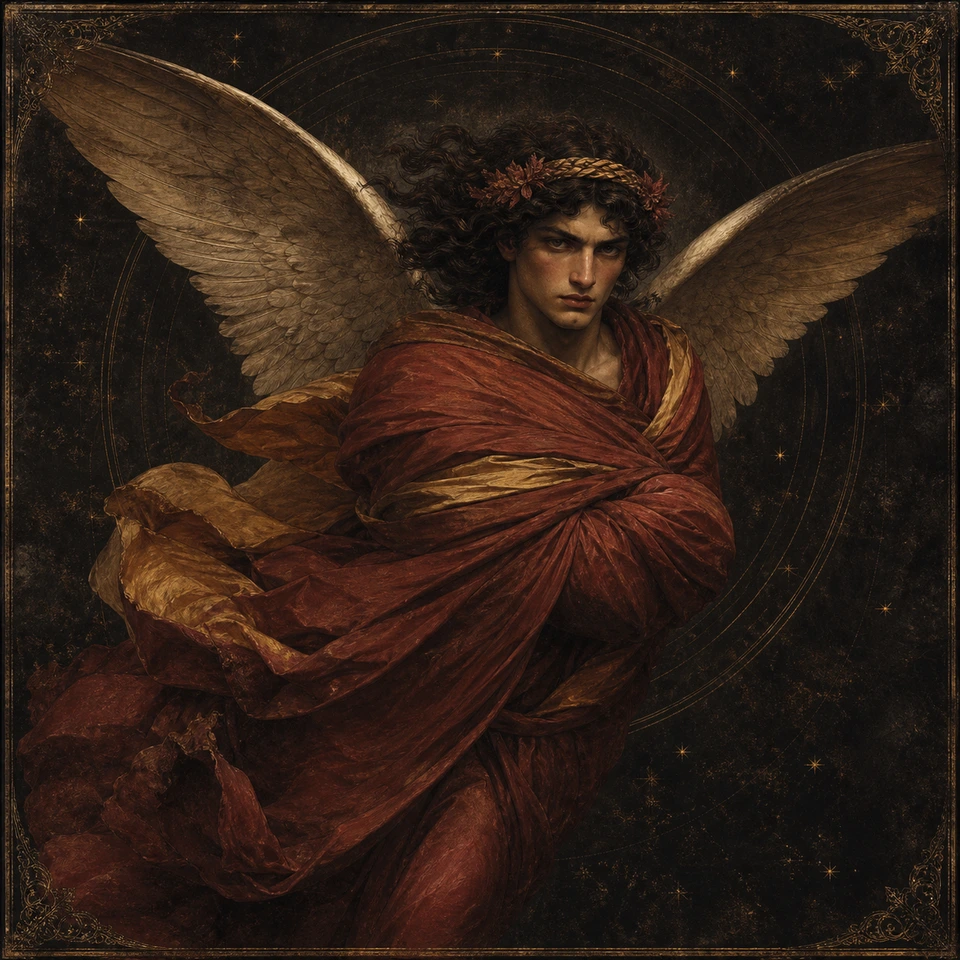
Striking with unpredictable precision, Eros manifests as the absolute personified power of desire. Ancient sources portray him simultaneously as a staggering primordial force, a locally worshipped deity, and a dangerously armed winged youth.
Overview
At Thespiae in Boeotia, Eros was not first encountered as a plump child with a heart-tipped arrow. Pausanias says the people honored him above other gods and kept an ancient unwrought stone as his image. In the same city, visitors later sought celebrated sculptures by Praxiteles and Lysippus. A rough sacred stone, a beautiful youth, and a dangerous winged archer all belong to Eros, but they belong to different places, objects, and centuries.
Hesiod places Eros close to the beginning of the cosmos. Chaos comes first, then Gaia and Tartarus, and then Eros, fairest among the deathless gods, whose force loosens limbs and masters thought in gods and mortals. No parents are named. Much later in the poem, Aphrodite rises from the sea and Eros accompanies her. Hesiod therefore cannot support the familiar claim that Eros is her child.
Other Greek voices give other beginnings. The chorus of Aristophanes' Birds sings a comic cosmogony in which black-winged Night lays an egg in Erebus and golden-winged Eros hatches after long ages. Plato's Symposium turns disagreement itself into philosophy. One speaker calls Eros the oldest god, another the youngest. Diotima makes him neither a beautiful Olympian nor a simple abstraction, but a daimon born from Poros and Penia on Aphrodite's birthday, forever moving between lack and resource.
By the Hellenistic period, Apollonius Rhodius can present Eros as Aphrodite's unruly son. Hera and Athena need Medea to desire Jason, so they ask Aphrodite for help. Eros is playing knucklebones with Ganymede and cheating him when his mother promises him a wondrous ball once made for the infant Zeus. He accepts the bargain, flies unseen into Aeetes' hall, and shoots Medea. Desire burns through her while Jason stands before her. The arrow helps the Argonauts, but the poem lets the reader feel its violence: Medea's future turns because a god wounds her for someone else's strategy.
Art makes that danger bodily. An Attic red-figure amphora in the British Museum shows a full-grown winged Eros driving forward through the air. A Hellenistic terracotta gives him outspread wings, curling hair, a wreath, and forearms wrapped inside a long himation. These bodies are far from the Roman and early modern putto. The grimoire image follows the winged-youth tradition without copying either museum object.
Cult also keeps the story local. Pausanias names Thespiae and Parium as places of particular reverence and records Thespian games for Eros with musical and athletic prizes. His brief notices do not supply one universal priesthood, sacrifice, offering list, procession, or calendar date. Later correspondences cannot be carried backward merely because Eros, Cupid, and Aphrodite imagery overlaps.
The Roman boundary matters most in the tale of Cupid and Psyche. The extended surviving narrative is in Apuleius' Latin Metamorphoses, where Cupid is Venus' son and Psyche becomes his wife. That imperial Latin witness belongs to Roman reception rather than to the Greek myths above. Greek Eros, Roman Cupid, the plural Erotes, Anteros, Himeros, and Pothos retain their names, dates, and distinct stories.
Canonical identity
Canonical Identity
Eros possesses a securely divine status within Greek poetry and worship, functioning simultaneously as desire itself and its divine personification. Because the noun and the name are identical, grammar alone cannot differentiate whether a text refers to a cosmic force, an emotion, or an active deity. His canonical form shifts dramatically across genres and periods: Hesiod casts him as a parentless primordial power, Classical comedy attributes to him golden wings and an egg-birth, and Hellenistic epic reimagines him as Aphrodite’s unruly archer son. These represent source-scoped historical variants, not pieces of a single, coherent mythological childhood.
Linguistic Identity
The Greek proper name is Ἔρως, transliterated as Érōs. A qualified fifth-century BC Attic reconstruction gives the pronunciation /é.rɔːs/, which can be approximated as EH-rawss.
Sources and evidence
TEXTUAL · Supported
The proper name Ἔρως is transliterated Érōs, with a qualified fifth-century BC Attic reconstruction /é.rɔːs/.
- Source
- Wiktionary contributors, Ἔρως
- Reviewed edition
- Permanent revision 88845851, timestamp 2025-12-26T11:07:49Z · Wiktionary
- Exact locator
- Entry Ἔρως · Section Ancient Greek pronunciation
- Scope
- Classical Greece · Attica
- Authority
- collaborative lexical reference
- Certainty
- Qualified
The guide EH-rawss approximates the sounds but cannot reproduce pitch accent.
Open exact reviewed sourceTEXTUAL · Supported
Hesiod places Eros among the first beings after Chaos, Gaia, and Tartarus, without naming parents.
- Source
- Hesiod; edited and translated by Hugh G. Evelyn-White, Theogony (1914)
- Reviewed edition
- Hugh G. Evelyn-White edition and English translation in Hesiod, the Homeric Hymns and Homerica, 1914 · translated by Hugh G. Evelyn-White · edited by Hugh G. Evelyn-White · Perseus Digital Library / Scaife ATLAS
- Exact locator
- Book Theogony · Line 116-122
- Scope
- Archaic Greece · Ancient Greece
- Authority
- primary literary witness
- Certainty
- High
The claim remains limited to the named witness and locator.
Open exact reviewed source4 reviewed sources for this section
- Wiktionary contributors, ἜρωςPermanent revision 88845851, Ancient Greek pronunciation section · Wiktionary
- Hesiod; edited and translated by Hugh G. Evelyn-White, Theogony (1914)Hesiod, the Homeric Hymns and Homerica, London and New York, 1914 · Perseus Digital Library / Scaife ATLAS
- Aristophanes; translated by Benjamin Bickley Rogers, The Birds of Aristophanes (1920)G. Bell and Sons separate edition, 1920 · Internet Archive
- Apollonius Rhodius; edited by George W. Mooney, Argonautica (1912)George W. Mooney Ancient Greek edition, 1912; Perseus grc2 component · Perseus Digital Library / Scaife ATLAS
Culture, tradition, period, and place
Eros belongs to ancient Greek religion and Greek-language poetry from the Archaic through the Hellenistic eras, with later testimony under Roman rule. Hesiod gives the earliest secure literary place in this study. Fifth-century Athenian drama and philosophy reshape his origins and nature. Apollonius carries the winged archer into Hellenistic epic at Colchis. Pausanias later describes enduring worship at Thespiae in Boeotia and Parium on the Hellespont.
No broad Greek label erases those settings. Thespian cult, Athenian argument, Hellenistic narrative, and Latin reception answer different questions. The god honored through an unwrought stone at Thespiae cannot be understood only through the youthful body painted on Attic pottery or the child called Cupid in Roman literature.
Sources and evidence
TEXTUAL · Supported
Hesiod places Eros among the first beings after Chaos, Gaia, and Tartarus, without naming parents.
- Source
- Hesiod; edited and translated by Hugh G. Evelyn-White, Theogony (1914)
- Reviewed edition
- Hugh G. Evelyn-White edition and English translation in Hesiod, the Homeric Hymns and Homerica, 1914 · translated by Hugh G. Evelyn-White · edited by Hugh G. Evelyn-White · Perseus Digital Library / Scaife ATLAS
- Exact locator
- Book Theogony · Line 116-122
- Scope
- Archaic Greece · Ancient Greece
- Authority
- primary literary witness
- Certainty
- High
The claim remains limited to the named witness and locator.
Open exact reviewed sourceTEXTUAL · Supported
The chorus of Aristophanes' Birds makes golden-winged Eros hatch from an egg laid by Night in Erebus and mingle the first elements of life.
- Source
- Aristophanes; translated by Benjamin Bickley Rogers, The Birds of Aristophanes (1920)
- Reviewed edition
- The Birds of Aristophanes, Benjamin Bickley Rogers English translation, G. Bell and Sons, 1920 · translated by Benjamin Bickley Rogers · edited by Benjamin Bickley Rogers · Internet Archive
- Exact locator
- Book Birds · Line 693-702
- Scope
- Classical Greece · Athens
- Authority
- Aristophanes, Birds, Rogers 1920 English translation
- Certainty
- High
The dramatic setting is comedy and must remain visible.
Open exact reviewed sourceTEXTUAL · Supported
Plato's Symposium deliberately presents incompatible accounts: Eros as oldest, Eros as youngest, and Diotima's Eros as a daimon born from Poros and Penia.
- Source
- Plato; translated by W. R. M. Lamb, Symposium (1925)
- Reviewed edition
- W. R. M. Lamb English translation in Plato in Twelve Volumes, Volume 3, 1925; Scaife ATLAS perseus-eng2 component · translated by W. R. M. Lamb · Perseus Digital Library / Scaife ATLAS
- Exact locator
- Book Symposium · Section 178a-c; 195a-197e; 202d-204c
- Scope
- Classical Greece · Athens
- Authority
- primary philosophical-literary witness
- Certainty
- High
These speeches are arguments inside a dialogue, not one cult genealogy.
Open exact reviewed sourceRITUAL ATTESTED · Supported
Pausanias says the Thespians honored Eros above other gods from early times and revered an ancient unwrought stone as his image.
- Source
- Pausanias; Spiro Greek edition and Jones/Ormerod translation volumes, Description of Greece (1935)
- Reviewed edition
- Spiro Greek edition and Jones/Ormerod English volumes represented by the Perseus CTS corpus, 1903-1935 · translated by W. H. S. Jones and H. A. Ormerod, volume-dependent · edited by Friedrich Spiro for the Greek edition · Perseus Digital Library / Scaife ATLAS
- Exact locator
- Book Description of Greece · Chapter 9.27 · Section 1
- Scope
- Greek religion under Roman imperial rule · Thespiae
- Authority
- ancient periegetic cult witness
- Certainty
- High
The claim remains limited to the named witness and locator.
Open exact reviewed sourceRITUAL ATTESTED · Supported
Pausanias reports that Eros received equal reverence at Parium on the Hellespont.
- Source
- Pausanias; Spiro Greek edition and Jones/Ormerod translation volumes, Description of Greece (1935)
- Reviewed edition
- Spiro Greek edition and Jones/Ormerod English volumes represented by the Perseus CTS corpus, 1903-1935 · translated by W. H. S. Jones and H. A. Ormerod, volume-dependent · edited by Friedrich Spiro for the Greek edition · Perseus Digital Library / Scaife ATLAS
- Exact locator
- Book Description of Greece · Chapter 9.27 · Section 1
- Scope
- Greek religion under Roman imperial rule · Parium on the Hellespont
- Authority
- ancient periegetic cult witness
- Certainty
- High
The claim remains limited to the named witness and locator.
Open exact reviewed source5 reviewed sources for this section
- Hesiod; edited and translated by Hugh G. Evelyn-White, Theogony (1914)Hesiod, the Homeric Hymns and Homerica, London and New York, 1914 · Perseus Digital Library / Scaife ATLAS
- Aristophanes; translated by Benjamin Bickley Rogers, The Birds of Aristophanes (1920)G. Bell and Sons separate edition, 1920 · Internet Archive
- Plato; translated by W. R. M. Lamb, Symposium (1925)Plato in Twelve Volumes, Volume 3, 1925; Scaife ATLAS English component perseus-eng2 · Perseus Digital Library / Scaife ATLAS
- Apollonius Rhodius; edited by George W. Mooney, Argonautica (1912)George W. Mooney Ancient Greek edition, 1912; Perseus grc2 component · Perseus Digital Library / Scaife ATLAS
- Pausanias; Spiro Greek edition and Jones/Ormerod translation volumes, Description of Greece (1935)Perseus CTS edition corpus, 1903-1935 · Perseus Digital Library / Scaife ATLAS
Historical development
Hesiod places Eros near the beginning of existence. He comes after Chaos, Gaia, and Tartarus, yet before the generations of Titans and Olympians. The poem gives no parents. When Aphrodite later rises from the sea, Eros and Himeros join her procession into divine society. That order matters because it prevents the later mother-and-son image from being projected backward into Hesiod.
Classical Athens multiplied the possibilities. The birds in Aristophanes' comedy sing that black-winged Night laid an egg in Erebus and that golden-winged Eros emerged when the ages had turned. Plato's Symposium then stages open disagreement. Phaedrus calls Eros ancient, Agathon calls him young, and Diotima describes a daimon born from Poros and Penia on Aphrodite's birthday.
By the Hellenistic period, Apollonius can write Eros as Aphrodite's difficult son, a winged archer who accepts a glittering toy as payment. Pausanias, centuries later, finds both an aniconic stone and famous sculptures at Thespiae. The history is not a march from crude to refined belief. Cosmic force, cult power, beautiful youth, dangerous archer, philosophical daimon, and Roman Cupid overlap without becoming identical.
Sources and evidence
TEXTUAL · Supported
Hesiod places Eros among the first beings after Chaos, Gaia, and Tartarus, without naming parents.
- Source
- Hesiod; edited and translated by Hugh G. Evelyn-White, Theogony (1914)
- Reviewed edition
- Hugh G. Evelyn-White edition and English translation in Hesiod, the Homeric Hymns and Homerica, 1914 · translated by Hugh G. Evelyn-White · edited by Hugh G. Evelyn-White · Perseus Digital Library / Scaife ATLAS
- Exact locator
- Book Theogony · Line 116-122
- Scope
- Archaic Greece · Ancient Greece
- Authority
- primary literary witness
- Certainty
- High
The claim remains limited to the named witness and locator.
Open exact reviewed sourceTEXTUAL · Supported
In Hesiod, Eros and Himeros accompany Aphrodite after her sea birth, so Eros precedes her rather than being born from her.
- Source
- Hesiod; edited and translated by Hugh G. Evelyn-White, Theogony (1914)
- Reviewed edition
- Hugh G. Evelyn-White edition and English translation in Hesiod, the Homeric Hymns and Homerica, 1914 · translated by Hugh G. Evelyn-White · edited by Hugh G. Evelyn-White · Perseus Digital Library / Scaife ATLAS
- Exact locator
- Book Theogony · Line 188-206
- Scope
- Archaic Greece · Cyprus
- Authority
- primary literary witness
- Certainty
- High
The claim remains limited to the named witness and locator.
Open exact reviewed sourceTEXTUAL · Supported
The chorus of Aristophanes' Birds makes golden-winged Eros hatch from an egg laid by Night in Erebus and mingle the first elements of life.
- Source
- Aristophanes; translated by Benjamin Bickley Rogers, The Birds of Aristophanes (1920)
- Reviewed edition
- The Birds of Aristophanes, Benjamin Bickley Rogers English translation, G. Bell and Sons, 1920 · translated by Benjamin Bickley Rogers · edited by Benjamin Bickley Rogers · Internet Archive
- Exact locator
- Book Birds · Line 693-702
- Scope
- Classical Greece · Athens
- Authority
- Aristophanes, Birds, Rogers 1920 English translation
- Certainty
- High
The dramatic setting is comedy and must remain visible.
Open exact reviewed sourceTEXTUAL · Supported
Plato's Symposium deliberately presents incompatible accounts: Eros as oldest, Eros as youngest, and Diotima's Eros as a daimon born from Poros and Penia.
- Source
- Plato; translated by W. R. M. Lamb, Symposium (1925)
- Reviewed edition
- W. R. M. Lamb English translation in Plato in Twelve Volumes, Volume 3, 1925; Scaife ATLAS perseus-eng2 component · translated by W. R. M. Lamb · Perseus Digital Library / Scaife ATLAS
- Exact locator
- Book Symposium · Section 178a-c; 195a-197e; 202d-204c
- Scope
- Classical Greece · Athens
- Authority
- primary philosophical-literary witness
- Certainty
- High
These speeches are arguments inside a dialogue, not one cult genealogy.
Open exact reviewed sourceTEXTUAL · Supported
Apollonius presents Eros as Aphrodite's unruly son, whom she persuades with the promise of Zeus's splendid ball.
- Source
- Apollonius Rhodius; edited by George W. Mooney, Argonautica (1912)
- Reviewed edition
- George W. Mooney edition of the Ancient Greek Argonautica, Longmans, Green, 1912 · edited by George W. Mooney · Perseus Digital Library / Scaife ATLAS
- Exact locator
- Book Argonautica · Chapter 3 · Line 36-166
- Scope
- Hellenistic Greek world · Ancient Greece
- Authority
- primary literary witness
- Certainty
- High
The claim remains limited to the named witness and locator.
Open exact reviewed sourceMATERIAL CULTURE · Supported
Pausanias describes the celebrated Thespian Eros by Praxiteles, its removal and return, a later copy by Menodorus, and a bronze Eros by Lysippus.
- Source
- Pausanias; Spiro Greek edition and Jones/Ormerod translation volumes, Description of Greece (1935)
- Reviewed edition
- Spiro Greek edition and Jones/Ormerod English volumes represented by the Perseus CTS corpus, 1903-1935 · translated by W. H. S. Jones and H. A. Ormerod, volume-dependent · edited by Friedrich Spiro for the Greek edition · Perseus Digital Library / Scaife ATLAS
- Exact locator
- Book Description of Greece · Chapter 9.27 · Section 2-4
- Scope
- Greek religion under Roman imperial rule · Thespiae
- Authority
- ancient periegetic material witness
- Certainty
- High
The claim remains limited to the named witness and locator.
Open exact reviewed source5 reviewed sources for this section
- Hesiod; edited and translated by Hugh G. Evelyn-White, Theogony (1914)Hesiod, the Homeric Hymns and Homerica, London and New York, 1914 · Perseus Digital Library / Scaife ATLAS
- Aristophanes; translated by Benjamin Bickley Rogers, The Birds of Aristophanes (1920)G. Bell and Sons separate edition, 1920 · Internet Archive
- Plato; translated by W. R. M. Lamb, Symposium (1925)Plato in Twelve Volumes, Volume 3, 1925; Scaife ATLAS English component perseus-eng2 · Perseus Digital Library / Scaife ATLAS
- Apollonius Rhodius; edited by George W. Mooney, Argonautica (1912)George W. Mooney Ancient Greek edition, 1912; Perseus grc2 component · Perseus Digital Library / Scaife ATLAS
- Pausanias; Spiro Greek edition and Jones/Ormerod translation volumes, Description of Greece (1935)Perseus CTS edition corpus, 1903-1935 · Perseus Digital Library / Scaife ATLAS
Attested roles and historical themes
Roles, powers, and limits
Eros acts where bodies, judgment, and intention lose their former balance. Hesiod says he loosens limbs and overcomes the minds and counsels of gods and mortals. The formula gives desire physical force and intellectual reach, but it does not make Eros ruler of every bond or emotion.
Apollonius turns that power into an arrow. Eros enters Aeetes' hall unseen, plants a shaft beneath Jason, and strikes Medea. Heat floods her, her thoughts fasten on the stranger, and her choices begin to bend toward helping him. The scene is not a gentle emblem of mutual affection. It shows desire imposed from outside for a divine strategy.
Plato's speakers stretch Eros into ethical, medical, cosmic, and philosophical argument, yet the dialogue refuses a single final portrait. Diotima's Eros is not a beautiful Olympian who possesses what he seeks. He is a mediator marked by want and resource, always pursuing the good he lacks. That philosophical role remains distinct from cult and epic action.
Sources and evidence
TEXTUAL · Supported
Hesiod calls Eros fairest among the deathless gods and gives him power to loosen limbs and master counsel in gods and mortals.
- Source
- Hesiod; edited and translated by Hugh G. Evelyn-White, Theogony (1914)
- Reviewed edition
- Hugh G. Evelyn-White edition and English translation in Hesiod, the Homeric Hymns and Homerica, 1914 · translated by Hugh G. Evelyn-White · edited by Hugh G. Evelyn-White · Perseus Digital Library / Scaife ATLAS
- Exact locator
- Book Theogony · Line 120-122
- Scope
- Archaic Greece · Ancient Greece
- Authority
- primary literary witness
- Certainty
- High
The claim remains limited to the named witness and locator.
Open exact reviewed sourceTEXTUAL · Supported
In Argonautica 3, Eros passes unseen into Aeetes' hall and shoots Medea, whose desire for Jason begins at once.
- Source
- Apollonius Rhodius; edited by George W. Mooney, Argonautica (1912)
- Reviewed edition
- George W. Mooney edition of the Ancient Greek Argonautica, Longmans, Green, 1912 · edited by George W. Mooney · Perseus Digital Library / Scaife ATLAS
- Exact locator
- Book Argonautica · Chapter 3 · Line 275-298
- Scope
- Hellenistic Greek world · Colchis
- Authority
- primary literary witness
- Certainty
- High
The claim remains limited to the named witness and locator.
Open exact reviewed sourceTEXTUAL · Supported
Plato's Symposium deliberately presents incompatible accounts: Eros as oldest, Eros as youngest, and Diotima's Eros as a daimon born from Poros and Penia.
- Source
- Plato; translated by W. R. M. Lamb, Symposium (1925)
- Reviewed edition
- W. R. M. Lamb English translation in Plato in Twelve Volumes, Volume 3, 1925; Scaife ATLAS perseus-eng2 component · translated by W. R. M. Lamb · Perseus Digital Library / Scaife ATLAS
- Exact locator
- Book Symposium · Section 178a-c; 195a-197e; 202d-204c
- Scope
- Classical Greece · Athens
- Authority
- primary philosophical-literary witness
- Certainty
- High
These speeches are arguments inside a dialogue, not one cult genealogy.
Open exact reviewed source3 reviewed sources for this section
- Hesiod; edited and translated by Hugh G. Evelyn-White, Theogony (1914)Hesiod, the Homeric Hymns and Homerica, London and New York, 1914 · Perseus Digital Library / Scaife ATLAS
- Apollonius Rhodius; edited by George W. Mooney, Argonautica (1912)George W. Mooney Ancient Greek edition, 1912; Perseus grc2 component · Perseus Digital Library / Scaife ATLAS
- Plato; translated by W. R. M. Lamb, Symposium (1925)Plato in Twelve Volumes, Volume 3, 1925; Scaife ATLAS English component perseus-eng2 · Perseus Digital Library / Scaife ATLAS
Epithets and titles
Poetic Epithet
Limb-loosening
λυσιμελής · Limb-loosening
Hesiodic Greek poetry · Archaic Greek witnessHesiod ties the epithet to Eros' power over bodies and counsel.
1 reviewed source for this section
- Hesiod; edited and translated by Hugh G. Evelyn-White, Theogony (1914)Hesiod, the Homeric Hymns and Homerica, London and New York, 1914 · Perseus Digital Library / Scaife ATLAS
Poetic Epithet
Golden-winged
Golden-winged
Athenian comedy · Classical Greek witnessThe phrase belongs to the chorus cosmogony in Birds and does not impose one color on all images or worship.
1 reviewed source for this section
- Aristophanes; translated by Benjamin Bickley Rogers, The Birds of Aristophanes (1920)G. Bell and Sons separate edition, 1920 · Internet Archive
Worship and cult
At Thespiae, Pausanias found Eros honored above other gods and represented by an ancient unwrought stone. The form is arresting because it resists the familiar winged youth. A community could approach Eros through a rough sacred object while poets and sculptors gave him a human body elsewhere.
Pausanias also reports equal reverence at Parium on the Hellespont. His second-century AD account looks back across traditions already old in his day, so it proves continuing local memory and worship without fixing their beginnings. The text does not provide a universal priesthood, household rite, or one Greek liturgy. Thespiae and Parium remain particular cult centers with their own histories.
Sources and evidence
RITUAL ATTESTED · Supported
Pausanias says the Thespians honored Eros above other gods from early times and revered an ancient unwrought stone as his image.
- Source
- Pausanias; Spiro Greek edition and Jones/Ormerod translation volumes, Description of Greece (1935)
- Reviewed edition
- Spiro Greek edition and Jones/Ormerod English volumes represented by the Perseus CTS corpus, 1903-1935 · translated by W. H. S. Jones and H. A. Ormerod, volume-dependent · edited by Friedrich Spiro for the Greek edition · Perseus Digital Library / Scaife ATLAS
- Exact locator
- Book Description of Greece · Chapter 9.27 · Section 1
- Scope
- Greek religion under Roman imperial rule · Thespiae
- Authority
- ancient periegetic cult witness
- Certainty
- High
The claim remains limited to the named witness and locator.
Open exact reviewed sourceRITUAL ATTESTED · Supported
Pausanias reports that Eros received equal reverence at Parium on the Hellespont.
- Source
- Pausanias; Spiro Greek edition and Jones/Ormerod translation volumes, Description of Greece (1935)
- Reviewed edition
- Spiro Greek edition and Jones/Ormerod English volumes represented by the Perseus CTS corpus, 1903-1935 · translated by W. H. S. Jones and H. A. Ormerod, volume-dependent · edited by Friedrich Spiro for the Greek edition · Perseus Digital Library / Scaife ATLAS
- Exact locator
- Book Description of Greece · Chapter 9.27 · Section 1
- Scope
- Greek religion under Roman imperial rule · Parium on the Hellespont
- Authority
- ancient periegetic cult witness
- Certainty
- High
The claim remains limited to the named witness and locator.
Open exact reviewed source1 reviewed source for this section
- Pausanias; Spiro Greek edition and Jones/Ormerod translation volumes, Description of Greece (1935)Perseus CTS edition corpus, 1903-1935 · Perseus Digital Library / Scaife ATLAS
Temples, sanctuaries, and sacred places
Thespiae at the foot of Mount Helicon is the strongest sacred landscape in the surviving account. The unwrought stone, the fame of Praxiteles' Eros, later sculptural replacements, and public games in the god's honor all belong to the city's memory. Visitors came not only for an abstract idea of love but for a god rooted in a Boeotian place and in physical images with contested histories.
Parium offers a second cult center across the Aegean on the Hellespont. Pausanias connects its people with colonists from Erythrae and says their reverence for Eros equaled that of Thespiae. Athens supplies another, more complex setting through philosophy, vase painting, and the separate altar of Anteros. None of these places stands for the whole Greek world.
Sources and evidence
RITUAL ATTESTED · Supported
Pausanias says the Thespians honored Eros above other gods from early times and revered an ancient unwrought stone as his image.
- Source
- Pausanias; Spiro Greek edition and Jones/Ormerod translation volumes, Description of Greece (1935)
- Reviewed edition
- Spiro Greek edition and Jones/Ormerod English volumes represented by the Perseus CTS corpus, 1903-1935 · translated by W. H. S. Jones and H. A. Ormerod, volume-dependent · edited by Friedrich Spiro for the Greek edition · Perseus Digital Library / Scaife ATLAS
- Exact locator
- Book Description of Greece · Chapter 9.27 · Section 1
- Scope
- Greek religion under Roman imperial rule · Thespiae
- Authority
- ancient periegetic cult witness
- Certainty
- High
The claim remains limited to the named witness and locator.
Open exact reviewed sourceRITUAL ATTESTED · Supported
Pausanias reports that Eros received equal reverence at Parium on the Hellespont.
- Source
- Pausanias; Spiro Greek edition and Jones/Ormerod translation volumes, Description of Greece (1935)
- Reviewed edition
- Spiro Greek edition and Jones/Ormerod English volumes represented by the Perseus CTS corpus, 1903-1935 · translated by W. H. S. Jones and H. A. Ormerod, volume-dependent · edited by Friedrich Spiro for the Greek edition · Perseus Digital Library / Scaife ATLAS
- Exact locator
- Book Description of Greece · Chapter 9.27 · Section 1
- Scope
- Greek religion under Roman imperial rule · Parium on the Hellespont
- Authority
- ancient periegetic cult witness
- Certainty
- High
The claim remains limited to the named witness and locator.
Open exact reviewed sourceTEXTUAL · Supported
Pausanias preserves an Athenian altar and a death narrative for Anteros, who remains distinct from Eros.
- Source
- Pausanias; Spiro Greek edition and Jones/Ormerod translation volumes, Description of Greece (1935)
- Reviewed edition
- Spiro Greek edition and Jones/Ormerod English volumes represented by the Perseus CTS corpus, 1903-1935 · translated by W. H. S. Jones and H. A. Ormerod, volume-dependent · edited by Friedrich Spiro for the Greek edition · Perseus Digital Library / Scaife ATLAS
- Exact locator
- Book Description of Greece · Chapter 1.30 · Section 1
- Scope
- Greek religion under Roman imperial rule · Athens
- Authority
- ancient periegetic cult witness
- Certainty
- High
Anteros is not reduced to an alias or automatic opposite of Eros.
Open exact reviewed source1 reviewed source for this section
- Pausanias; Spiro Greek edition and Jones/Ormerod translation volumes, Description of Greece (1935)Perseus CTS edition corpus, 1903-1935 · Perseus Digital Library / Scaife ATLAS
Festivals and processions
Near the grove of the Muses on Mount Helicon, Pausanias says the Thespians held a festival and the games called the Mouseia. He then names other games in honor of Eros, with prizes for music and athletic events. The passage secures public competition for the god but leaves its calendar date, procession, sacrifices, officials, and full program unknown.
Eros and the Muses therefore shared a Thespian landscape without sharing one undifferentiated festival. The named prize categories reveal performance and athletics, while the unwritten parts of the rite remain unwritten. Modern observance cannot be reconstructed from this notice alone.
Sources and evidence
RITUAL ATTESTED · Supported
Pausanias says the Thespians held games for Eros with prizes for music and athletic events.
- Source
- Pausanias; Spiro Greek edition and Jones/Ormerod translation volumes, Description of Greece (1935)
- Reviewed edition
- Spiro Greek edition and Jones/Ormerod English volumes represented by the Perseus CTS corpus, 1903-1935 · translated by W. H. S. Jones and H. A. Ormerod, volume-dependent · edited by Friedrich Spiro for the Greek edition · Perseus Digital Library / Scaife ATLAS
- Exact locator
- Book Description of Greece · Chapter 9.31 · Section 3
- Scope
- Greek religion under Roman imperial rule · Thespiae
- Authority
- ancient periegetic festival witness
- Certainty
- High
The brief notice does not supply a complete civic program or all rites.
Open exact reviewed source1 reviewed source for this section
- Pausanias; Spiro Greek edition and Jones/Ormerod translation volumes, Description of Greece (1935)Perseus CTS edition corpus, 1903-1935 · Perseus Digital Library / Scaife ATLAS
Offerings, votives, and ritual evidence
The unwrought stone at Thespiae is a cult image, not an offering recipe. The famous sculptures associated with Praxiteles, Menodorus, and Lysippus reveal dedication, display, removal, replacement, and civic prestige, but the surviving passage does not name a standard food, incense, libation, or household gift for Eros.
The sound historical boundary is therefore narrow. Eros received public honor and festival worship at named places. A universal list of roses, honey, wine, crystals, or perfumes does not follow from those facts. Any contemporary offering belongs to a named modern community or practitioner, not automatically to ancient Thespiae.
Sources and evidence
RITUAL ATTESTED · Supported
Pausanias says the Thespians honored Eros above other gods from early times and revered an ancient unwrought stone as his image.
- Source
- Pausanias; Spiro Greek edition and Jones/Ormerod translation volumes, Description of Greece (1935)
- Reviewed edition
- Spiro Greek edition and Jones/Ormerod English volumes represented by the Perseus CTS corpus, 1903-1935 · translated by W. H. S. Jones and H. A. Ormerod, volume-dependent · edited by Friedrich Spiro for the Greek edition · Perseus Digital Library / Scaife ATLAS
- Exact locator
- Book Description of Greece · Chapter 9.27 · Section 1
- Scope
- Greek religion under Roman imperial rule · Thespiae
- Authority
- ancient periegetic cult witness
- Certainty
- High
The claim remains limited to the named witness and locator.
Open exact reviewed sourceMATERIAL CULTURE · Supported
Pausanias describes the celebrated Thespian Eros by Praxiteles, its removal and return, a later copy by Menodorus, and a bronze Eros by Lysippus.
- Source
- Pausanias; Spiro Greek edition and Jones/Ormerod translation volumes, Description of Greece (1935)
- Reviewed edition
- Spiro Greek edition and Jones/Ormerod English volumes represented by the Perseus CTS corpus, 1903-1935 · translated by W. H. S. Jones and H. A. Ormerod, volume-dependent · edited by Friedrich Spiro for the Greek edition · Perseus Digital Library / Scaife ATLAS
- Exact locator
- Book Description of Greece · Chapter 9.27 · Section 2-4
- Scope
- Greek religion under Roman imperial rule · Thespiae
- Authority
- ancient periegetic material witness
- Certainty
- High
The claim remains limited to the named witness and locator.
Open exact reviewed sourceRITUAL ATTESTED · Supported
Pausanias says the Thespians held games for Eros with prizes for music and athletic events.
- Source
- Pausanias; Spiro Greek edition and Jones/Ormerod translation volumes, Description of Greece (1935)
- Reviewed edition
- Spiro Greek edition and Jones/Ormerod English volumes represented by the Perseus CTS corpus, 1903-1935 · translated by W. H. S. Jones and H. A. Ormerod, volume-dependent · edited by Friedrich Spiro for the Greek edition · Perseus Digital Library / Scaife ATLAS
- Exact locator
- Book Description of Greece · Chapter 9.31 · Section 3
- Scope
- Greek religion under Roman imperial rule · Thespiae
- Authority
- ancient periegetic festival witness
- Certainty
- High
The brief notice does not supply a complete civic program or all rites.
Open exact reviewed source1 reviewed source for this section
- Pausanias; Spiro Greek edition and Jones/Ormerod translation volumes, Description of Greece (1935)Perseus CTS edition corpus, 1903-1935 · Perseus Digital Library / Scaife ATLAS
Iconography and material culture
Greek material evidence refuses the image of Eros as only a baby. British Museum 1867,0508.1057 shows a full-grown winged youth in forceful horizontal flight on an Attic red-figure amphora around 470 BC. British Museum 1893,1101.3 preserves a Hellenistic flying figure with outspread wings, curling hair, a wreath, and both forearms muffled inside a long himation.
Apollonius supplies the bow, quiver, and arrow in narrative. The weapon is small enough to hide and powerful enough to redirect Medea's future. At Thespiae, however, the oldest sacred image in Pausanias is an unwrought stone, while celebrated anthropomorphic works by Praxiteles and Lysippus belong to later artistic histories. Wings, youthful beauty, wrapped clothing, arrows, and the rough stone are all attested, but never as one mandatory costume.
Sources and evidence
MATERIAL CULTURE · Supported
British Museum 1867,0508.1057 identifies a full-grown winged Eros in forceful horizontal flight on an Attic red-figure amphora of about 470 BC.
- Source
- British Museum, British Museum Collection
- Reviewed edition
- Live record-level official museum collection · British Museum
- Exact locator
- MuseumObjectId 1867,0508.1057 · RecordUrl https://www.britishmuseum.org/collection/object/G_1867-0508-1057
- Scope
- Classical Greece · Attica
- Authority
- official museum object catalogue
- Certainty
- High
The claim remains limited to the named witness and locator.
Open exact reviewed sourceMATERIAL CULTURE · Supported
British Museum 1893,1101.3 preserves a Hellenistic flying Eros with outspread wings, curling hair, wreath, and forearms wrapped in a long himation.
- Source
- British Museum, British Museum Collection
- Reviewed edition
- Live record-level official museum collection · British Museum
- Exact locator
- MuseumObjectId 1893,1101.3 · RecordUrl https://www.britishmuseum.org/collection/object/G_1893-1101-3
- Scope
- Hellenistic Greek world · Ancient Greece
- Authority
- official museum object catalogue
- Certainty
- High
The claim remains limited to the named witness and locator.
Open exact reviewed sourceTEXTUAL · Supported
In Argonautica 3, Eros passes unseen into Aeetes' hall and shoots Medea, whose desire for Jason begins at once.
- Source
- Apollonius Rhodius; edited by George W. Mooney, Argonautica (1912)
- Reviewed edition
- George W. Mooney edition of the Ancient Greek Argonautica, Longmans, Green, 1912 · edited by George W. Mooney · Perseus Digital Library / Scaife ATLAS
- Exact locator
- Book Argonautica · Chapter 3 · Line 275-298
- Scope
- Hellenistic Greek world · Colchis
- Authority
- primary literary witness
- Certainty
- High
The claim remains limited to the named witness and locator.
Open exact reviewed sourceMATERIAL CULTURE · Supported
Pausanias describes the celebrated Thespian Eros by Praxiteles, its removal and return, a later copy by Menodorus, and a bronze Eros by Lysippus.
- Source
- Pausanias; Spiro Greek edition and Jones/Ormerod translation volumes, Description of Greece (1935)
- Reviewed edition
- Spiro Greek edition and Jones/Ormerod English volumes represented by the Perseus CTS corpus, 1903-1935 · translated by W. H. S. Jones and H. A. Ormerod, volume-dependent · edited by Friedrich Spiro for the Greek edition · Perseus Digital Library / Scaife ATLAS
- Exact locator
- Book Description of Greece · Chapter 9.27 · Section 2-4
- Scope
- Greek religion under Roman imperial rule · Thespiae
- Authority
- ancient periegetic material witness
- Certainty
- High
The claim remains limited to the named witness and locator.
Open exact reviewed source3 reviewed sources for this section
- British Museum, British Museum CollectionLive official museum collection · British Museum
- Apollonius Rhodius; edited by George W. Mooney, Argonautica (1912)George W. Mooney Ancient Greek edition, 1912; Perseus grc2 component · Perseus Digital Library / Scaife ATLAS
- Pausanias; Spiro Greek edition and Jones/Ormerod translation volumes, Description of Greece (1935)Perseus CTS edition corpus, 1903-1935 · Perseus Digital Library / Scaife ATLAS
Animals, plants, and embodied forms
Wings are part of Eros' body in Classical comedy and ancient art, but no single bird becomes his sacred animal in these witnesses. Aristophanes makes golden wings central to a comic cosmogony, and Attic and Hellenistic artists use feathered flight to show speed, sudden arrival, and power without human limits.
No plant or tree is securely assigned to Eros here. The cited texts and objects establish no botanical cult bond, so no proposed flower, fruit, or tree moves beyond the research boundary without a precise source and period.
Sources and evidence
TEXTUAL · Supported
The chorus of Aristophanes' Birds makes golden-winged Eros hatch from an egg laid by Night in Erebus and mingle the first elements of life.
- Source
- Aristophanes; translated by Benjamin Bickley Rogers, The Birds of Aristophanes (1920)
- Reviewed edition
- The Birds of Aristophanes, Benjamin Bickley Rogers English translation, G. Bell and Sons, 1920 · translated by Benjamin Bickley Rogers · edited by Benjamin Bickley Rogers · Internet Archive
- Exact locator
- Book Birds · Line 693-702
- Scope
- Classical Greece · Athens
- Authority
- Aristophanes, Birds, Rogers 1920 English translation
- Certainty
- High
The dramatic setting is comedy and must remain visible.
Open exact reviewed sourceMATERIAL CULTURE · Supported
British Museum 1867,0508.1057 identifies a full-grown winged Eros in forceful horizontal flight on an Attic red-figure amphora of about 470 BC.
- Source
- British Museum, British Museum Collection
- Reviewed edition
- Live record-level official museum collection · British Museum
- Exact locator
- MuseumObjectId 1867,0508.1057 · RecordUrl https://www.britishmuseum.org/collection/object/G_1867-0508-1057
- Scope
- Classical Greece · Attica
- Authority
- official museum object catalogue
- Certainty
- High
The claim remains limited to the named witness and locator.
Open exact reviewed sourceMATERIAL CULTURE · Supported
British Museum 1893,1101.3 preserves a Hellenistic flying Eros with outspread wings, curling hair, wreath, and forearms wrapped in a long himation.
- Source
- British Museum, British Museum Collection
- Reviewed edition
- Live record-level official museum collection · British Museum
- Exact locator
- MuseumObjectId 1893,1101.3 · RecordUrl https://www.britishmuseum.org/collection/object/G_1893-1101-3
- Scope
- Hellenistic Greek world · Ancient Greece
- Authority
- official museum object catalogue
- Certainty
- High
The claim remains limited to the named witness and locator.
Open exact reviewed source2 reviewed sources for this section
- Aristophanes; translated by Benjamin Bickley Rogers, The Birds of Aristophanes (1920)G. Bell and Sons separate edition, 1920 · Internet Archive
- British Museum, British Museum CollectionLive official museum collection · British Museum
Relationships and genealogy
Eros has no single Greek genealogy. Hesiod gives him no parents and places him before Aphrodite, then brings Eros and Himeros beside her after her sea birth. Aristophanes' chorus makes Night's egg his origin. Plato lets speakers disagree over his age and parentage, while Diotima names Poros and Penia. Apollonius presents him as Aphrodite's son.
The direct family link to Aphrodite therefore belongs to the Hellenistic epic witness and later traditions, not to every earlier source. Anteros is also kept distinct. Pausanias' Athenian story gives Anteros his own altar and avenging context. Similar names and shared concerns with desire do not make one an alias of the other.
Sources and evidence
TEXTUAL · Supported
In Hesiod, Eros and Himeros accompany Aphrodite after her sea birth, so Eros precedes her rather than being born from her.
- Source
- Hesiod; edited and translated by Hugh G. Evelyn-White, Theogony (1914)
- Reviewed edition
- Hugh G. Evelyn-White edition and English translation in Hesiod, the Homeric Hymns and Homerica, 1914 · translated by Hugh G. Evelyn-White · edited by Hugh G. Evelyn-White · Perseus Digital Library / Scaife ATLAS
- Exact locator
- Book Theogony · Line 188-206
- Scope
- Archaic Greece · Cyprus
- Authority
- primary literary witness
- Certainty
- High
The claim remains limited to the named witness and locator.
Open exact reviewed sourceTEXTUAL · Supported
The chorus of Aristophanes' Birds makes golden-winged Eros hatch from an egg laid by Night in Erebus and mingle the first elements of life.
- Source
- Aristophanes; translated by Benjamin Bickley Rogers, The Birds of Aristophanes (1920)
- Reviewed edition
- The Birds of Aristophanes, Benjamin Bickley Rogers English translation, G. Bell and Sons, 1920 · translated by Benjamin Bickley Rogers · edited by Benjamin Bickley Rogers · Internet Archive
- Exact locator
- Book Birds · Line 693-702
- Scope
- Classical Greece · Athens
- Authority
- Aristophanes, Birds, Rogers 1920 English translation
- Certainty
- High
The dramatic setting is comedy and must remain visible.
Open exact reviewed sourceTEXTUAL · Supported
Plato's Symposium deliberately presents incompatible accounts: Eros as oldest, Eros as youngest, and Diotima's Eros as a daimon born from Poros and Penia.
- Source
- Plato; translated by W. R. M. Lamb, Symposium (1925)
- Reviewed edition
- W. R. M. Lamb English translation in Plato in Twelve Volumes, Volume 3, 1925; Scaife ATLAS perseus-eng2 component · translated by W. R. M. Lamb · Perseus Digital Library / Scaife ATLAS
- Exact locator
- Book Symposium · Section 178a-c; 195a-197e; 202d-204c
- Scope
- Classical Greece · Athens
- Authority
- primary philosophical-literary witness
- Certainty
- High
These speeches are arguments inside a dialogue, not one cult genealogy.
Open exact reviewed sourceTEXTUAL · Supported
Apollonius presents Eros as Aphrodite's unruly son, whom she persuades with the promise of Zeus's splendid ball.
- Source
- Apollonius Rhodius; edited by George W. Mooney, Argonautica (1912)
- Reviewed edition
- George W. Mooney edition of the Ancient Greek Argonautica, Longmans, Green, 1912 · edited by George W. Mooney · Perseus Digital Library / Scaife ATLAS
- Exact locator
- Book Argonautica · Chapter 3 · Line 36-166
- Scope
- Hellenistic Greek world · Ancient Greece
- Authority
- primary literary witness
- Certainty
- High
The claim remains limited to the named witness and locator.
Open exact reviewed sourceTEXTUAL · Supported
Pausanias preserves an Athenian altar and a death narrative for Anteros, who remains distinct from Eros.
- Source
- Pausanias; Spiro Greek edition and Jones/Ormerod translation volumes, Description of Greece (1935)
- Reviewed edition
- Spiro Greek edition and Jones/Ormerod English volumes represented by the Perseus CTS corpus, 1903-1935 · translated by W. H. S. Jones and H. A. Ormerod, volume-dependent · edited by Friedrich Spiro for the Greek edition · Perseus Digital Library / Scaife ATLAS
- Exact locator
- Book Description of Greece · Chapter 1.30 · Section 1
- Scope
- Greek religion under Roman imperial rule · Athens
- Authority
- ancient periegetic cult witness
- Certainty
- High
Anteros is not reduced to an alias or automatic opposite of Eros.
Open exact reviewed source5 reviewed sources for this section
- Hesiod; edited and translated by Hugh G. Evelyn-White, Theogony (1914)Hesiod, the Homeric Hymns and Homerica, London and New York, 1914 · Perseus Digital Library / Scaife ATLAS
- Aristophanes; translated by Benjamin Bickley Rogers, The Birds of Aristophanes (1920)G. Bell and Sons separate edition, 1920 · Internet Archive
- Plato; translated by W. R. M. Lamb, Symposium (1925)Plato in Twelve Volumes, Volume 3, 1925; Scaife ATLAS English component perseus-eng2 · Perseus Digital Library / Scaife ATLAS
- Apollonius Rhodius; edited by George W. Mooney, Argonautica (1912)George W. Mooney Ancient Greek edition, 1912; Perseus grc2 component · Perseus Digital Library / Scaife ATLAS
- Pausanias; Spiro Greek edition and Jones/Ormerod translation volumes, Description of Greece (1935)Perseus CTS edition corpus, 1903-1935 · Perseus Digital Library / Scaife ATLAS
Actual myths and source variants
Three linked narratives define the present mythic range. The shared birth traditions of Aphrodite preserve Hesiod's crucial sequence, where Eros already exists and accompanies the new goddess. The origins of Eros then set Hesiod's parentless primordial power beside the egg-born figure of Aristophanes and the contradictory speeches of Plato's Symposium. None cancels the others.
Apollonius gives Eros his sharpest sustained action. Aphrodite bargains with her son, promising him Zeus's wondrous ball. He reaches Colchis unseen, fits an arrow, and strikes Medea while Jason stands before her. The wound ignites desire that will help the Argonauts secure the fleece and draw Medea toward exile and violence. Roman tales of Cupid and Psyche or Cupid and Apollo belong to later Latin reception and are not silently inserted into this Greek sequence.
Sources and evidence
TEXTUAL · Supported
In Hesiod, Eros and Himeros accompany Aphrodite after her sea birth, so Eros precedes her rather than being born from her.
- Source
- Hesiod; edited and translated by Hugh G. Evelyn-White, Theogony (1914)
- Reviewed edition
- Hugh G. Evelyn-White edition and English translation in Hesiod, the Homeric Hymns and Homerica, 1914 · translated by Hugh G. Evelyn-White · edited by Hugh G. Evelyn-White · Perseus Digital Library / Scaife ATLAS
- Exact locator
- Book Theogony · Line 188-206
- Scope
- Archaic Greece · Cyprus
- Authority
- primary literary witness
- Certainty
- High
The claim remains limited to the named witness and locator.
Open exact reviewed sourceTEXTUAL · Supported
The chorus of Aristophanes' Birds makes golden-winged Eros hatch from an egg laid by Night in Erebus and mingle the first elements of life.
- Source
- Aristophanes; translated by Benjamin Bickley Rogers, The Birds of Aristophanes (1920)
- Reviewed edition
- The Birds of Aristophanes, Benjamin Bickley Rogers English translation, G. Bell and Sons, 1920 · translated by Benjamin Bickley Rogers · edited by Benjamin Bickley Rogers · Internet Archive
- Exact locator
- Book Birds · Line 693-702
- Scope
- Classical Greece · Athens
- Authority
- Aristophanes, Birds, Rogers 1920 English translation
- Certainty
- High
The dramatic setting is comedy and must remain visible.
Open exact reviewed sourceTEXTUAL · Supported
Plato's Symposium deliberately presents incompatible accounts: Eros as oldest, Eros as youngest, and Diotima's Eros as a daimon born from Poros and Penia.
- Source
- Plato; translated by W. R. M. Lamb, Symposium (1925)
- Reviewed edition
- W. R. M. Lamb English translation in Plato in Twelve Volumes, Volume 3, 1925; Scaife ATLAS perseus-eng2 component · translated by W. R. M. Lamb · Perseus Digital Library / Scaife ATLAS
- Exact locator
- Book Symposium · Section 178a-c; 195a-197e; 202d-204c
- Scope
- Classical Greece · Athens
- Authority
- primary philosophical-literary witness
- Certainty
- High
These speeches are arguments inside a dialogue, not one cult genealogy.
Open exact reviewed sourceTEXTUAL · Supported
Apollonius presents Eros as Aphrodite's unruly son, whom she persuades with the promise of Zeus's splendid ball.
- Source
- Apollonius Rhodius; edited by George W. Mooney, Argonautica (1912)
- Reviewed edition
- George W. Mooney edition of the Ancient Greek Argonautica, Longmans, Green, 1912 · edited by George W. Mooney · Perseus Digital Library / Scaife ATLAS
- Exact locator
- Book Argonautica · Chapter 3 · Line 36-166
- Scope
- Hellenistic Greek world · Ancient Greece
- Authority
- primary literary witness
- Certainty
- High
The claim remains limited to the named witness and locator.
Open exact reviewed sourceTEXTUAL · Supported
In Argonautica 3, Eros passes unseen into Aeetes' hall and shoots Medea, whose desire for Jason begins at once.
- Source
- Apollonius Rhodius; edited by George W. Mooney, Argonautica (1912)
- Reviewed edition
- George W. Mooney edition of the Ancient Greek Argonautica, Longmans, Green, 1912 · edited by George W. Mooney · Perseus Digital Library / Scaife ATLAS
- Exact locator
- Book Argonautica · Chapter 3 · Line 275-298
- Scope
- Hellenistic Greek world · Colchis
- Authority
- primary literary witness
- Certainty
- High
The claim remains limited to the named witness and locator.
Open exact reviewed sourceTEXTUAL · Supported
The extended surviving tale of Cupid and Psyche belongs to Apuleius' second-century AD Latin Metamorphoses, where the gods are Cupid and Venus.
- Source
- Apuleius; edited by Stephen Gaselee, Metamorphoses (1915)
- Reviewed edition
- Stephen Gaselee Latin edition, The Golden Ass, 1915 · edited by Stephen Gaselee · Perseus Digital Library
- Exact locator
- Book Metamorphoses · Chapter 4.28-6.24
- Scope
- Greek religion under Roman imperial rule · Rome
- Authority
- primary Latin literary witness
- Certainty
- High
Later reception often renames Cupid as Eros, but the source's Roman identity remains explicit.
Open exact reviewed source5 reviewed sources for this section
- Hesiod; edited and translated by Hugh G. Evelyn-White, Theogony (1914)Hesiod, the Homeric Hymns and Homerica, London and New York, 1914 · Perseus Digital Library / Scaife ATLAS
- Aristophanes; translated by Benjamin Bickley Rogers, The Birds of Aristophanes (1920)G. Bell and Sons separate edition, 1920 · Internet Archive
- Plato; translated by W. R. M. Lamb, Symposium (1925)Plato in Twelve Volumes, Volume 3, 1925; Scaife ATLAS English component perseus-eng2 · Perseus Digital Library / Scaife ATLAS
- Apollonius Rhodius; edited by George W. Mooney, Argonautica (1912)George W. Mooney Ancient Greek edition, 1912; Perseus grc2 component · Perseus Digital Library / Scaife ATLAS
- Apuleius; edited by Stephen Gaselee, Metamorphoses (1915)The Golden Ass, being the Metamorphoses of Lucius Apuleius, 1915 · Perseus Digital Library
Myth Library
Each myth gathers its attested participants into one source-grounded account, while distinct source traditions remain readable in their own variants.
Theogonic
Births and Parentages of Aphrodite
Hesiod brings Aphrodite from sea foam around the severed genitals of Uranus, while the Iliad calls her the daughter of Zeus and Dione. Hymn and painted pottery carry the sea arrival into new settings without resolving the two incompatible genealogies.
- Role in this profile
- primordial power who attends Aphrodite after her sea birth in Hesiod
- Place scope
- Cythera · Cyprus · Ancient Greece
- Witnesses
- 4
- Variants
- 4
Theogonic And Philosophical
Origins and Natures of Eros
Hesiod's parentless primordial Eros, Aristophanes' golden-winged child of Night's egg, and Plato's contradictory philosophical Erotes preserve irreconcilable origins.
- Role in this profile
- primordial power in Hesiod, golden-winged hatchling in Birds, and disputed god or daimon in Plato
- Place scope
- Ancient Greece · Athens
- Witnesses
- 3
- Variants
- 3
Divine Intervention And Compelled Desire
Eros Wounds Medea
Aphrodite bribes Eros to strike Medea with desire for Jason, turning a hidden arrow into the hinge of the Argonauts' success and Medea's ruinous future.
- Role in this profile
- winged archer who accepts Aphrodite's bargain, enters unseen, and shoots Medea
- Place scope
- Colchis
- Witnesses
- 1
- Variants
- 1
Equivalences, syncretisms, and identity boundaries
Greek Eros and Roman Cupid became closely identified in translation, art, and later storytelling, but the names do not erase language, period, or source. Apuleius' extended second-century AD tale names Cupid as Venus' son and Psyche's husband. It is a Latin novel embedded inside the Metamorphoses, not a lost chapter of Hesiod or Apollonius.
Plato's two Erotes are another boundary. Pausanias the speaker pairs different loves with Heavenly and Common Aphrodite as part of an argument about conduct. Anteros remains a distinct divine figure in Pausanias' Athenian account. Erotes in the plural, Cupid, Anteros, Himeros, and Pothos require their own source-scoped identities rather than becoming interchangeable labels.
Sources and evidence
TEXTUAL · Supported
Pausanias the speaker in Plato's Symposium distinguishes two forms of Eros alongside Heavenly and Common Aphrodite.
- Source
- Plato; translated by W. R. M. Lamb, Symposium (1925)
- Reviewed edition
- W. R. M. Lamb English translation in Plato in Twelve Volumes, Volume 3, 1925; Scaife ATLAS perseus-eng2 component · translated by W. R. M. Lamb · Perseus Digital Library / Scaife ATLAS
- Exact locator
- Book Symposium · Section 180d-181c
- Scope
- Classical Greece · Athens
- Authority
- primary philosophical-literary witness
- Certainty
- High
The rhetorical distinction is not treated as proof of two universally separate cult beings.
Open exact reviewed sourceTEXTUAL · Supported
Pausanias preserves an Athenian altar and a death narrative for Anteros, who remains distinct from Eros.
- Source
- Pausanias; Spiro Greek edition and Jones/Ormerod translation volumes, Description of Greece (1935)
- Reviewed edition
- Spiro Greek edition and Jones/Ormerod English volumes represented by the Perseus CTS corpus, 1903-1935 · translated by W. H. S. Jones and H. A. Ormerod, volume-dependent · edited by Friedrich Spiro for the Greek edition · Perseus Digital Library / Scaife ATLAS
- Exact locator
- Book Description of Greece · Chapter 1.30 · Section 1
- Scope
- Greek religion under Roman imperial rule · Athens
- Authority
- ancient periegetic cult witness
- Certainty
- High
Anteros is not reduced to an alias or automatic opposite of Eros.
Open exact reviewed sourceTEXTUAL · Supported
The extended surviving tale of Cupid and Psyche belongs to Apuleius' second-century AD Latin Metamorphoses, where the gods are Cupid and Venus.
- Source
- Apuleius; edited by Stephen Gaselee, Metamorphoses (1915)
- Reviewed edition
- Stephen Gaselee Latin edition, The Golden Ass, 1915 · edited by Stephen Gaselee · Perseus Digital Library
- Exact locator
- Book Metamorphoses · Chapter 4.28-6.24
- Scope
- Greek religion under Roman imperial rule · Rome
- Authority
- primary Latin literary witness
- Certainty
- High
Later reception often renames Cupid as Eros, but the source's Roman identity remains explicit.
Open exact reviewed source3 reviewed sources for this section
- Plato; translated by W. R. M. Lamb, Symposium (1925)Plato in Twelve Volumes, Volume 3, 1925; Scaife ATLAS English component perseus-eng2 · Perseus Digital Library / Scaife ATLAS
- Pausanias; Spiro Greek edition and Jones/Ormerod translation volumes, Description of Greece (1935)Perseus CTS edition corpus, 1903-1935 · Perseus Digital Library / Scaife ATLAS
- Apuleius; edited by Stephen Gaselee, Metamorphoses (1915)The Golden Ass, being the Metamorphoses of Lucius Apuleius, 1915 · Perseus Digital Library
Correspondence index
Ancient evidence directly supports desire as Eros' divine function, Thespiae and Parium as cult places, the Thespian games, the unwrought stone, wings, youthful form, and the bow and arrow in Hellenistic epic. Golden wings belong to one comic cosmogony, not to a universal color rule.
No planet, zodiac sign, gemstone, metal, classical element, weekday, moon phase, incense, or sacred plant is securely assigned by these witnesses. Resemblance to Aphrodite or Cupid is not enough to turn a later association into an ancient Greek fact.
Direct ancient correspondences
| Category | Direct correspondence | How and why | Evidence boundary |
|---|---|---|---|
| metal-material | Unwrought stone at ThespiaeDirect historical association | Pausanias describes an unwrought stone as the ancient Thespian image of Eros. | Ancient Cultic A sacred stone image does not create rulership over all stone or one mineral species 1 reviewed source for this section
|
| direction-place | Thespiae and PariumDirect historical association | Pausanias names Thespiae and Parium as places of particular reverence for Eros. | Ancient Cultic Cult geography is not a compass direction 1 reviewed source for this section
|
| festival-time | Thespian games for ErosDirect historical association | Pausanias states that Thespiae held games for Eros with prizes for music and athletic events. | Ancient Cultic The notice does not supply a complete date or rite 1 reviewed source for this section
|
| ritual-object-symbol-tool | Wings, bow, arrow, and Thespian stoneDirect historical association | Material and literary witnesses support wings, the archer's weapons, and the aniconic Thespian image. | Ancient Material Each attribute remains tied to its object, poem, place, and period 3 reviewed sources for this section
|
| intention-magical-power | Desire that overcomes body and counselDirect historical association | Hesiod gives Eros power over limbs, mind, and counsel, while Apollonius shows desire imposed through an arrow. | Ancient Literary This divine function does not prove a universal spell formula 2 reviewed sources for this section
|
Contextual evidence, not a general correspondence
| Category | Direct correspondence | How and why | Evidence boundary |
|---|---|---|---|
| animal-embodied-form | Feathered wings without one sacred birdContextual evidence only | Comedy and visual art give Eros wings, but no named bird becomes his sacred animal. | Ancient Material Divine anatomy and animal correspondence remain different claims 2 reviewed sources for this section
|
| color | Golden wings in BirdsContextual evidence only | Aristophanes calls the egg-born Eros golden-winged within a comic cosmogony. | Ancient Literary One poetic color does not establish a universal ritual palette 1 reviewed source for this section
|
9 expected categories currently not evidenced
celestial-body · Not evidenced
No celestial body attested
No ancient witness here assigns Eros to a planet, star, or constellation.
- Layer
- Research Boundary
- Scope
- Later Venus imagery cannot be inherited from Aphrodite without its own dated source
zodiac · Not evidenced
No zodiac sign attested
No zodiacal rulership or sign is named for Eros.
- Layer
- Research Boundary
- Scope
- Astrological similarity is not identity evidence
gemstone-crystal-mineral · Not evidenced
No gemstone or mineral attested
No crystal or mineral is assigned to Eros in the cited texts or objects.
- Layer
- Research Boundary
- Scope
- Rose quartz and similar modern choices require accountable modern sources
plant-tree · Not evidenced
No sacred plant attested
No plant or tree is established as sacred to Eros.
- Layer
- Research Boundary
- Scope
- Flowers in later art or romance do not create ancient botanical evidence
classical-element · Not evidenced
No classical element attested
Cosmogonic power and creative desire do not equal rulership over air, fire, water, or earth.
- Layer
- Research Boundary
- Scope
- Elemental assignments require an explicit ancient or dated later authority
weekday · Not evidenced
No weekday attested
No weekly day is assigned to Eros.
- Layer
- Research Boundary
- Scope
- Friday cannot be inherited automatically from later Venus associations
moon-phase · Not evidenced
No moon phase attested
No lunar phase is assigned to Eros.
- Layer
- Research Boundary
- Scope
- Night's egg in Birds is a creation scene, not moon-phase timing
incense-perfume · Not evidenced
No incense or perfume attested
No resin, smoke, or perfume offering to Eros is named.
- Layer
- Research Boundary
- Scope
- Contemporary fragrance choices remain community-specific
offering-ritual-material · Not evidenced
No standard offering list attested
Cult and festival are secure, but no food, drink, flower, or incense offering is specified.
- Layer
- Research Boundary
- Scope
- The unwrought stone is a cult image, not an offering recipe
Sources and evidence
TEXTUAL · Supported
Hesiod calls Eros fairest among the deathless gods and gives him power to loosen limbs and master counsel in gods and mortals.
- Source
- Hesiod; edited and translated by Hugh G. Evelyn-White, Theogony (1914)
- Reviewed edition
- Hugh G. Evelyn-White edition and English translation in Hesiod, the Homeric Hymns and Homerica, 1914 · translated by Hugh G. Evelyn-White · edited by Hugh G. Evelyn-White · Perseus Digital Library / Scaife ATLAS
- Exact locator
- Book Theogony · Line 120-122
- Scope
- Archaic Greece · Ancient Greece
- Authority
- primary literary witness
- Certainty
- High
The claim remains limited to the named witness and locator.
Open exact reviewed sourceRITUAL ATTESTED · Supported
Pausanias says the Thespians honored Eros above other gods from early times and revered an ancient unwrought stone as his image.
- Source
- Pausanias; Spiro Greek edition and Jones/Ormerod translation volumes, Description of Greece (1935)
- Reviewed edition
- Spiro Greek edition and Jones/Ormerod English volumes represented by the Perseus CTS corpus, 1903-1935 · translated by W. H. S. Jones and H. A. Ormerod, volume-dependent · edited by Friedrich Spiro for the Greek edition · Perseus Digital Library / Scaife ATLAS
- Exact locator
- Book Description of Greece · Chapter 9.27 · Section 1
- Scope
- Greek religion under Roman imperial rule · Thespiae
- Authority
- ancient periegetic cult witness
- Certainty
- High
The claim remains limited to the named witness and locator.
Open exact reviewed sourceRITUAL ATTESTED · Supported
Pausanias reports that Eros received equal reverence at Parium on the Hellespont.
- Source
- Pausanias; Spiro Greek edition and Jones/Ormerod translation volumes, Description of Greece (1935)
- Reviewed edition
- Spiro Greek edition and Jones/Ormerod English volumes represented by the Perseus CTS corpus, 1903-1935 · translated by W. H. S. Jones and H. A. Ormerod, volume-dependent · edited by Friedrich Spiro for the Greek edition · Perseus Digital Library / Scaife ATLAS
- Exact locator
- Book Description of Greece · Chapter 9.27 · Section 1
- Scope
- Greek religion under Roman imperial rule · Parium on the Hellespont
- Authority
- ancient periegetic cult witness
- Certainty
- High
The claim remains limited to the named witness and locator.
Open exact reviewed sourceRITUAL ATTESTED · Supported
Pausanias says the Thespians held games for Eros with prizes for music and athletic events.
- Source
- Pausanias; Spiro Greek edition and Jones/Ormerod translation volumes, Description of Greece (1935)
- Reviewed edition
- Spiro Greek edition and Jones/Ormerod English volumes represented by the Perseus CTS corpus, 1903-1935 · translated by W. H. S. Jones and H. A. Ormerod, volume-dependent · edited by Friedrich Spiro for the Greek edition · Perseus Digital Library / Scaife ATLAS
- Exact locator
- Book Description of Greece · Chapter 9.31 · Section 3
- Scope
- Greek religion under Roman imperial rule · Thespiae
- Authority
- ancient periegetic festival witness
- Certainty
- High
The brief notice does not supply a complete civic program or all rites.
Open exact reviewed sourceTEXTUAL · Supported
The chorus of Aristophanes' Birds makes golden-winged Eros hatch from an egg laid by Night in Erebus and mingle the first elements of life.
- Source
- Aristophanes; translated by Benjamin Bickley Rogers, The Birds of Aristophanes (1920)
- Reviewed edition
- The Birds of Aristophanes, Benjamin Bickley Rogers English translation, G. Bell and Sons, 1920 · translated by Benjamin Bickley Rogers · edited by Benjamin Bickley Rogers · Internet Archive
- Exact locator
- Book Birds · Line 693-702
- Scope
- Classical Greece · Athens
- Authority
- Aristophanes, Birds, Rogers 1920 English translation
- Certainty
- High
The dramatic setting is comedy and must remain visible.
Open exact reviewed sourceTEXTUAL · Supported
In Argonautica 3, Eros passes unseen into Aeetes' hall and shoots Medea, whose desire for Jason begins at once.
- Source
- Apollonius Rhodius; edited by George W. Mooney, Argonautica (1912)
- Reviewed edition
- George W. Mooney edition of the Ancient Greek Argonautica, Longmans, Green, 1912 · edited by George W. Mooney · Perseus Digital Library / Scaife ATLAS
- Exact locator
- Book Argonautica · Chapter 3 · Line 275-298
- Scope
- Hellenistic Greek world · Colchis
- Authority
- primary literary witness
- Certainty
- High
The claim remains limited to the named witness and locator.
Open exact reviewed sourceMATERIAL CULTURE · Supported
British Museum 1867,0508.1057 identifies a full-grown winged Eros in forceful horizontal flight on an Attic red-figure amphora of about 470 BC.
- Source
- British Museum, British Museum Collection
- Reviewed edition
- Live record-level official museum collection · British Museum
- Exact locator
- MuseumObjectId 1867,0508.1057 · RecordUrl https://www.britishmuseum.org/collection/object/G_1867-0508-1057
- Scope
- Classical Greece · Attica
- Authority
- official museum object catalogue
- Certainty
- High
The claim remains limited to the named witness and locator.
Open exact reviewed sourceMATERIAL CULTURE · Supported
British Museum 1893,1101.3 preserves a Hellenistic flying Eros with outspread wings, curling hair, wreath, and forearms wrapped in a long himation.
- Source
- British Museum, British Museum Collection
- Reviewed edition
- Live record-level official museum collection · British Museum
- Exact locator
- MuseumObjectId 1893,1101.3 · RecordUrl https://www.britishmuseum.org/collection/object/G_1893-1101-3
- Scope
- Hellenistic Greek world · Ancient Greece
- Authority
- official museum object catalogue
- Certainty
- High
The claim remains limited to the named witness and locator.
Open exact reviewed source5 reviewed sources for this section
- Hesiod; edited and translated by Hugh G. Evelyn-White, Theogony (1914)Hesiod, the Homeric Hymns and Homerica, London and New York, 1914 · Perseus Digital Library / Scaife ATLAS
- Pausanias; Spiro Greek edition and Jones/Ormerod translation volumes, Description of Greece (1935)Perseus CTS edition corpus, 1903-1935 · Perseus Digital Library / Scaife ATLAS
- Aristophanes; translated by Benjamin Bickley Rogers, The Birds of Aristophanes (1920)G. Bell and Sons separate edition, 1920 · Internet Archive
- Apollonius Rhodius; edited by George W. Mooney, Argonautica (1912)George W. Mooney Ancient Greek edition, 1912; Perseus grc2 component · Perseus Digital Library / Scaife ATLAS
- British Museum, British Museum CollectionLive official museum collection · British Museum
Later reception and living significance
Plato made Eros a vehicle for arguments about desire, goodness, generation, and philosophy. Apuleius later gives the extended Latin tale of Cupid and Psyche, naming Cupid as Venus' son within a second-century AD novel. Its Roman names, imperial date, and literary frame remain visible, so this witness cannot be carried backward into archaic or classical Greek evidence.
The surviving sources preserve several bodies and meanings without collapsing them: the adult winged youth of Classical art, the rough Thespian stone, the philosophical mediator, the Hellenistic archer, and Apuleius' Cupid. A contemporary devotional layer remains unfilled until an accountable public community source is reviewed.
Sources and evidence
TEXTUAL · Supported
Plato's Symposium deliberately presents incompatible accounts: Eros as oldest, Eros as youngest, and Diotima's Eros as a daimon born from Poros and Penia.
- Source
- Plato; translated by W. R. M. Lamb, Symposium (1925)
- Reviewed edition
- W. R. M. Lamb English translation in Plato in Twelve Volumes, Volume 3, 1925; Scaife ATLAS perseus-eng2 component · translated by W. R. M. Lamb · Perseus Digital Library / Scaife ATLAS
- Exact locator
- Book Symposium · Section 178a-c; 195a-197e; 202d-204c
- Scope
- Classical Greece · Athens
- Authority
- primary philosophical-literary witness
- Certainty
- High
These speeches are arguments inside a dialogue, not one cult genealogy.
Open exact reviewed sourceTEXTUAL · Supported
The extended surviving tale of Cupid and Psyche belongs to Apuleius' second-century AD Latin Metamorphoses, where the gods are Cupid and Venus.
- Source
- Apuleius; edited by Stephen Gaselee, Metamorphoses (1915)
- Reviewed edition
- Stephen Gaselee Latin edition, The Golden Ass, 1915 · edited by Stephen Gaselee · Perseus Digital Library
- Exact locator
- Book Metamorphoses · Chapter 4.28-6.24
- Scope
- Greek religion under Roman imperial rule · Rome
- Authority
- primary Latin literary witness
- Certainty
- High
Later reception often renames Cupid as Eros, but the source's Roman identity remains explicit.
Open exact reviewed sourceMATERIAL CULTURE · Supported
British Museum 1867,0508.1057 identifies a full-grown winged Eros in forceful horizontal flight on an Attic red-figure amphora of about 470 BC.
- Source
- British Museum, British Museum Collection
- Reviewed edition
- Live record-level official museum collection · British Museum
- Exact locator
- MuseumObjectId 1867,0508.1057 · RecordUrl https://www.britishmuseum.org/collection/object/G_1867-0508-1057
- Scope
- Classical Greece · Attica
- Authority
- official museum object catalogue
- Certainty
- High
The claim remains limited to the named witness and locator.
Open exact reviewed sourceRITUAL ATTESTED · Supported
Pausanias says the Thespians honored Eros above other gods from early times and revered an ancient unwrought stone as his image.
- Source
- Pausanias; Spiro Greek edition and Jones/Ormerod translation volumes, Description of Greece (1935)
- Reviewed edition
- Spiro Greek edition and Jones/Ormerod English volumes represented by the Perseus CTS corpus, 1903-1935 · translated by W. H. S. Jones and H. A. Ormerod, volume-dependent · edited by Friedrich Spiro for the Greek edition · Perseus Digital Library / Scaife ATLAS
- Exact locator
- Book Description of Greece · Chapter 9.27 · Section 1
- Scope
- Greek religion under Roman imperial rule · Thespiae
- Authority
- ancient periegetic cult witness
- Certainty
- High
The claim remains limited to the named witness and locator.
Open exact reviewed source4 reviewed sources for this section
- Plato; translated by W. R. M. Lamb, Symposium (1925)Plato in Twelve Volumes, Volume 3, 1925; Scaife ATLAS English component perseus-eng2 · Perseus Digital Library / Scaife ATLAS
- Apuleius; edited by Stephen Gaselee, Metamorphoses (1915)The Golden Ass, being the Metamorphoses of Lucius Apuleius, 1915 · Perseus Digital Library
- British Museum, British Museum CollectionLive official museum collection · British Museum
- Pausanias; Spiro Greek edition and Jones/Ormerod translation volumes, Description of Greece (1935)Perseus CTS edition corpus, 1903-1935 · Perseus Digital Library / Scaife ATLAS
Evidence, conflicts, and research gaps
The strongest witnesses here are Hesiod's Theogony, Aristophanes' Birds, Plato's Symposium, Apollonius' Argonautica, Pausanias' Description of Greece, and two accessioned British Museum objects. They establish divine identity, conflicting origins, cult at Thespiae and Parium, public Thespian games for Eros, changing bodies, and the Medea episode.
Important absences remain. Thespian and Parian inscriptions, excavation reports, priesthoods, sacrificial calendars, and the later history and naming of Eros' Thespian games need deeper study. Fragments attributed to Olen, Sappho, and other poets preserve additional genealogies through later quotation, but they require edition-level review. Roman Cupid, the Erotes as a group, Anteros, Himeros, Pothos, Psyche, and contemporary devotion deserve their own source chains. The qualified Attic pronunciation also awaits an academic historical-phonology check.
Sources and evidence
TEXTUAL · Supported
The proper name Ἔρως is transliterated Érōs, with a qualified fifth-century BC Attic reconstruction /é.rɔːs/.
- Source
- Wiktionary contributors, Ἔρως
- Reviewed edition
- Permanent revision 88845851, timestamp 2025-12-26T11:07:49Z · Wiktionary
- Exact locator
- Entry Ἔρως · Section Ancient Greek pronunciation
- Scope
- Classical Greece · Attica
- Authority
- collaborative lexical reference
- Certainty
- Qualified
The guide EH-rawss approximates the sounds but cannot reproduce pitch accent.
Open exact reviewed sourceTEXTUAL · Supported
Hesiod places Eros among the first beings after Chaos, Gaia, and Tartarus, without naming parents.
- Source
- Hesiod; edited and translated by Hugh G. Evelyn-White, Theogony (1914)
- Reviewed edition
- Hugh G. Evelyn-White edition and English translation in Hesiod, the Homeric Hymns and Homerica, 1914 · translated by Hugh G. Evelyn-White · edited by Hugh G. Evelyn-White · Perseus Digital Library / Scaife ATLAS
- Exact locator
- Book Theogony · Line 116-122
- Scope
- Archaic Greece · Ancient Greece
- Authority
- primary literary witness
- Certainty
- High
The claim remains limited to the named witness and locator.
Open exact reviewed sourceTEXTUAL · Supported
The chorus of Aristophanes' Birds makes golden-winged Eros hatch from an egg laid by Night in Erebus and mingle the first elements of life.
- Source
- Aristophanes; translated by Benjamin Bickley Rogers, The Birds of Aristophanes (1920)
- Reviewed edition
- The Birds of Aristophanes, Benjamin Bickley Rogers English translation, G. Bell and Sons, 1920 · translated by Benjamin Bickley Rogers · edited by Benjamin Bickley Rogers · Internet Archive
- Exact locator
- Book Birds · Line 693-702
- Scope
- Classical Greece · Athens
- Authority
- Aristophanes, Birds, Rogers 1920 English translation
- Certainty
- High
The dramatic setting is comedy and must remain visible.
Open exact reviewed sourceTEXTUAL · Supported
Plato's Symposium deliberately presents incompatible accounts: Eros as oldest, Eros as youngest, and Diotima's Eros as a daimon born from Poros and Penia.
- Source
- Plato; translated by W. R. M. Lamb, Symposium (1925)
- Reviewed edition
- W. R. M. Lamb English translation in Plato in Twelve Volumes, Volume 3, 1925; Scaife ATLAS perseus-eng2 component · translated by W. R. M. Lamb · Perseus Digital Library / Scaife ATLAS
- Exact locator
- Book Symposium · Section 178a-c; 195a-197e; 202d-204c
- Scope
- Classical Greece · Athens
- Authority
- primary philosophical-literary witness
- Certainty
- High
These speeches are arguments inside a dialogue, not one cult genealogy.
Open exact reviewed sourceTEXTUAL · Supported
In Argonautica 3, Eros passes unseen into Aeetes' hall and shoots Medea, whose desire for Jason begins at once.
- Source
- Apollonius Rhodius; edited by George W. Mooney, Argonautica (1912)
- Reviewed edition
- George W. Mooney edition of the Ancient Greek Argonautica, Longmans, Green, 1912 · edited by George W. Mooney · Perseus Digital Library / Scaife ATLAS
- Exact locator
- Book Argonautica · Chapter 3 · Line 275-298
- Scope
- Hellenistic Greek world · Colchis
- Authority
- primary literary witness
- Certainty
- High
The claim remains limited to the named witness and locator.
Open exact reviewed sourceRITUAL ATTESTED · Supported
Pausanias says the Thespians honored Eros above other gods from early times and revered an ancient unwrought stone as his image.
- Source
- Pausanias; Spiro Greek edition and Jones/Ormerod translation volumes, Description of Greece (1935)
- Reviewed edition
- Spiro Greek edition and Jones/Ormerod English volumes represented by the Perseus CTS corpus, 1903-1935 · translated by W. H. S. Jones and H. A. Ormerod, volume-dependent · edited by Friedrich Spiro for the Greek edition · Perseus Digital Library / Scaife ATLAS
- Exact locator
- Book Description of Greece · Chapter 9.27 · Section 1
- Scope
- Greek religion under Roman imperial rule · Thespiae
- Authority
- ancient periegetic cult witness
- Certainty
- High
The claim remains limited to the named witness and locator.
Open exact reviewed sourceRITUAL ATTESTED · Supported
Pausanias reports that Eros received equal reverence at Parium on the Hellespont.
- Source
- Pausanias; Spiro Greek edition and Jones/Ormerod translation volumes, Description of Greece (1935)
- Reviewed edition
- Spiro Greek edition and Jones/Ormerod English volumes represented by the Perseus CTS corpus, 1903-1935 · translated by W. H. S. Jones and H. A. Ormerod, volume-dependent · edited by Friedrich Spiro for the Greek edition · Perseus Digital Library / Scaife ATLAS
- Exact locator
- Book Description of Greece · Chapter 9.27 · Section 1
- Scope
- Greek religion under Roman imperial rule · Parium on the Hellespont
- Authority
- ancient periegetic cult witness
- Certainty
- High
The claim remains limited to the named witness and locator.
Open exact reviewed sourceRITUAL ATTESTED · Supported
Pausanias says the Thespians held games for Eros with prizes for music and athletic events.
- Source
- Pausanias; Spiro Greek edition and Jones/Ormerod translation volumes, Description of Greece (1935)
- Reviewed edition
- Spiro Greek edition and Jones/Ormerod English volumes represented by the Perseus CTS corpus, 1903-1935 · translated by W. H. S. Jones and H. A. Ormerod, volume-dependent · edited by Friedrich Spiro for the Greek edition · Perseus Digital Library / Scaife ATLAS
- Exact locator
- Book Description of Greece · Chapter 9.31 · Section 3
- Scope
- Greek religion under Roman imperial rule · Thespiae
- Authority
- ancient periegetic festival witness
- Certainty
- High
The brief notice does not supply a complete civic program or all rites.
Open exact reviewed sourceMATERIAL CULTURE · Supported
British Museum 1867,0508.1057 identifies a full-grown winged Eros in forceful horizontal flight on an Attic red-figure amphora of about 470 BC.
- Source
- British Museum, British Museum Collection
- Reviewed edition
- Live record-level official museum collection · British Museum
- Exact locator
- MuseumObjectId 1867,0508.1057 · RecordUrl https://www.britishmuseum.org/collection/object/G_1867-0508-1057
- Scope
- Classical Greece · Attica
- Authority
- official museum object catalogue
- Certainty
- High
The claim remains limited to the named witness and locator.
Open exact reviewed sourceMATERIAL CULTURE · Supported
British Museum 1893,1101.3 preserves a Hellenistic flying Eros with outspread wings, curling hair, wreath, and forearms wrapped in a long himation.
- Source
- British Museum, British Museum Collection
- Reviewed edition
- Live record-level official museum collection · British Museum
- Exact locator
- MuseumObjectId 1893,1101.3 · RecordUrl https://www.britishmuseum.org/collection/object/G_1893-1101-3
- Scope
- Hellenistic Greek world · Ancient Greece
- Authority
- official museum object catalogue
- Certainty
- High
The claim remains limited to the named witness and locator.
Open exact reviewed sourceTEXTUAL · Supported
The extended surviving tale of Cupid and Psyche belongs to Apuleius' second-century AD Latin Metamorphoses, where the gods are Cupid and Venus.
- Source
- Apuleius; edited by Stephen Gaselee, Metamorphoses (1915)
- Reviewed edition
- Stephen Gaselee Latin edition, The Golden Ass, 1915 · edited by Stephen Gaselee · Perseus Digital Library
- Exact locator
- Book Metamorphoses · Chapter 4.28-6.24
- Scope
- Greek religion under Roman imperial rule · Rome
- Authority
- primary Latin literary witness
- Certainty
- High
Later reception often renames Cupid as Eros, but the source's Roman identity remains explicit.
Open exact reviewed source8 reviewed sources for this section
- Hesiod; edited and translated by Hugh G. Evelyn-White, Theogony (1914)Hesiod, the Homeric Hymns and Homerica, London and New York, 1914 · Perseus Digital Library / Scaife ATLAS
- Aristophanes; translated by Benjamin Bickley Rogers, The Birds of Aristophanes (1920)G. Bell and Sons separate edition, 1920 · Internet Archive
- Plato; translated by W. R. M. Lamb, Symposium (1925)Plato in Twelve Volumes, Volume 3, 1925; Scaife ATLAS English component perseus-eng2 · Perseus Digital Library / Scaife ATLAS
- Apollonius Rhodius; edited by George W. Mooney, Argonautica (1912)George W. Mooney Ancient Greek edition, 1912; Perseus grc2 component · Perseus Digital Library / Scaife ATLAS
- Pausanias; Spiro Greek edition and Jones/Ormerod translation volumes, Description of Greece (1935)Perseus CTS edition corpus, 1903-1935 · Perseus Digital Library / Scaife ATLAS
- British Museum, British Museum CollectionLive official museum collection · British Museum
- Apuleius; edited by Stephen Gaselee, Metamorphoses (1915)The Golden Ass, being the Metamorphoses of Lucius Apuleius, 1915 · Perseus Digital Library
- Wiktionary contributors, ἜρωςPermanent revision 88845851, Ancient Greek pronunciation section · Wiktionary
Direct connections and evidence
Explicit Source
Apollonius presents Eros as Aphrodite's son
This genealogy governs the Argonautica scene. Hesiod's primordial Eros predates Aphrodite and is not forced into the same parentage.
1 attestation · high confidence
- Apollonius Rhodius; edited by George W. Mooney, ArgonauticaGeorge W. Mooney edition of the Ancient Greek Argonautica, Longmans, Green, 1912 · edited by George W. Mooney · Perseus Digital Library / Scaife ATLAS · Hellenistic Greek world · Ancient Greece · Book Argonautica · Chapter 3 · Line 36-166
Archive scope and classification
- Figure classification
- Divine personification, God or goddess · certain
- Pantheon or tradition shelf
- Greek
- Cultures
- Greek
- Traditions
- Ancient Greek religion
- Periods
- Archaic Greece, Classical Greece, Hellenistic Greek world, Greek religion under Roman imperial rule
- Places
- Ancient Greece, Boeotia, Thespiae, Parium on the Hellespont
Divine identity, conflicting origins, major mythic action, cult, material forms, relationships, reception, and evidence limits reviewed on 2026-08-30.
Reviewed sources
- Hesiod; edited and translated by Hugh G. Evelyn-White, Theogony (1914)Hesiod, the Homeric Hymns and Homerica, London and New York, 1914 · Perseus Digital Library / Scaife ATLAS
- Pausanias; Spiro Greek edition and Jones/Ormerod translation volumes, Description of Greece (1935)Perseus CTS edition corpus, 1903-1935 · Perseus Digital Library / Scaife ATLAS
- British Museum, British Museum CollectionLive official museum collection · British Museum
- Plato; translated by W. R. M. Lamb, Symposium (1925)Plato in Twelve Volumes, Volume 3, 1925; Scaife ATLAS English component perseus-eng2 · Perseus Digital Library / Scaife ATLAS
- Apollonius Rhodius; edited by George W. Mooney, Argonautica (1912)George W. Mooney Ancient Greek edition, 1912; Perseus grc2 component · Perseus Digital Library / Scaife ATLAS
- Apuleius; edited by Stephen Gaselee, Metamorphoses (1915)The Golden Ass, being the Metamorphoses of Lucius Apuleius, 1915 · Perseus Digital Library
- Wiktionary contributors, ἜρωςPermanent revision 88845851, Ancient Greek pronunciation section · Wiktionary
- Aristophanes; translated by Benjamin Bickley Rogers, The Birds of Aristophanes (1920)G. Bell and Sons separate edition, 1920 · Internet Archive