
Greek · God or goddess · Certain
Aphrodite
Ἀφροδίτη · Aphrodítē
Pronunciation: /a.pʰro.dǐː.tɛː/ · ah-PHROH-dee-teh
Research and editorial review by Cody Manes · Reviewed 2026-08-31
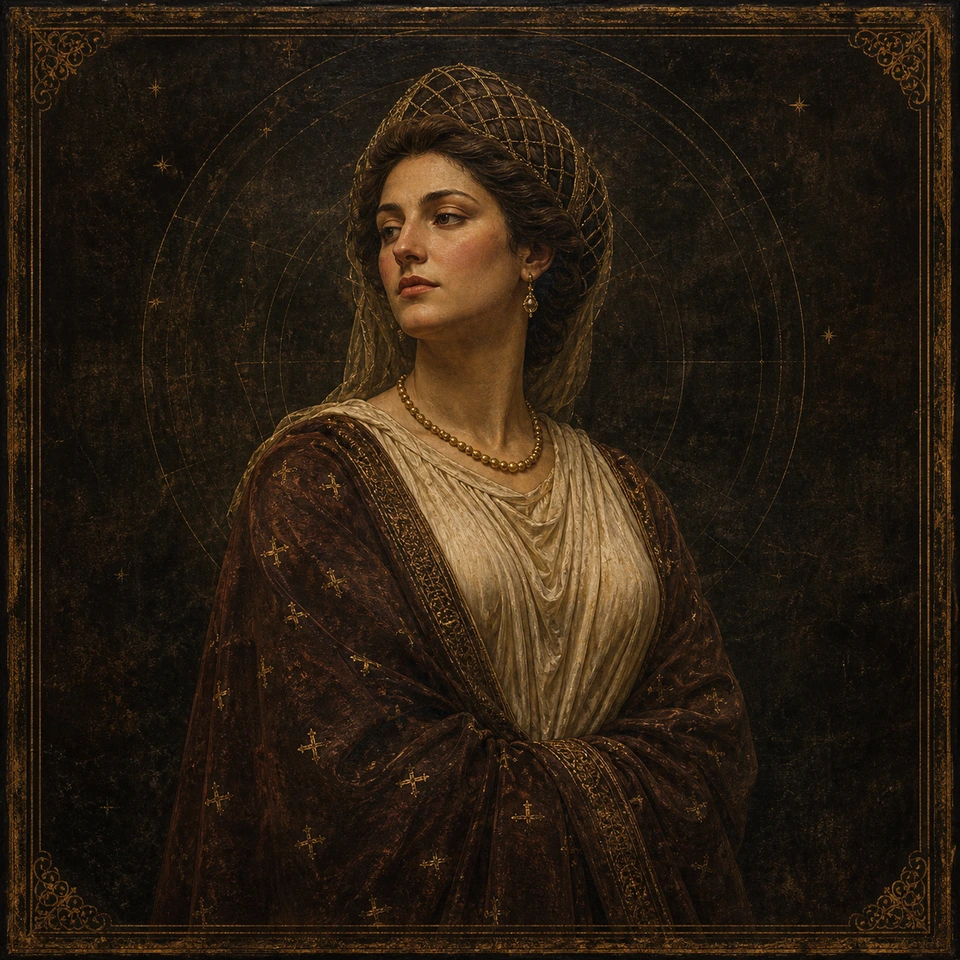
A formidable ancient force, Aphrodite governs desire, sexual union, and persuasion across vast literary and material traditions. Her worship reveals a complex figure offering maritime protection and civic integration, yet she also manifests in armed local forms capable of dangerous divine compulsion.
Overview
Before Aphrodite approaches Anchises on Mount Ida, Homeric Hymn 5 brings her to Paphos. The Graces bathe her, anoint her with fragrant oil, and dress her for the encounter. The scene joins beauty to action: adornment prepares a goddess whose power can move gods, mortals, birds, land animals, and creatures of the sea. Yet the same hymn names Athena, Artemis, and Hestia beyond her persuasion, while the Iliad lets Diomedes wound her hand. Aphrodite governs desire with immense force, but Greek poetry never makes her gentle by definition or invulnerable everywhere.
Her beginnings change with the poet. Hesiod draws her from white foam around the severed genitals of Uranus and carries her past Cythera to Cyprus. The Iliad instead places her inside the Olympian family as the daughter of Zeus and Dione. These accounts answer different theological questions. Hesiod makes desire arise from a violent cosmic succession; Homer gives Aphrodite parents who receive and admonish her after a battlefield injury. Plato later uses the two genealogies to distinguish Ourania and Pandemos in the Symposium, but Athenian worship did not simply follow that philosophical hierarchy.
Across the Greek world, people met Aphrodite under local names and in local institutions. Palaepaphos held a Cypriot sanctuary landscape whose life reached from the Late Bronze Age into late antiquity. Athens knew Ourania and Pandemos in different civic settings. Sparta kept armed and locally named forms such as Areia, Morpho, and Ambologera. Hermione joined Pontia and Limenia to the sea and harbor, and women sacrificed before marriage or remarriage. At Sicyon, a designated attendant and a virgin bath-bearer tended an image that held a poppy and apple. These practices show why the modern phrase goddess of love is too narrow: marriage, civic belonging, maritime passage, armed protection, aging, beauty, and dangerous desire all entered her historical life, but never in exactly the same combination at every sanctuary.
Her body also changed in art. An Attic vase names a richly dressed Aphrodite in long garments. Armed wooden images stood in local cult settings. Around the middle of the fourth century BC, Praxiteles made the lost nude cult image of Aphrodite Euploia at Knidos, and its fame altered the visual history of the goddess. The later Melian marble now called the Venus de Milo is partly draped and incomplete, not a surviving copy of one timeless divine appearance. Dress, nudity, weapons, mirrors, and bathing gestures belong to particular objects and periods.
The myths make desire consequential. Zeus turns Aphrodite's own power against her and she bears Aeneas to Anchises. Paris awards her the apple after she promises Helen, then the Iliad shows her rescuing him and threatening Helen when she resists. Hephaestus traps Aphrodite and Ares in invisible bonds before a laughing divine audience. Aphrodite and Persephone divide Adonis between them; he dies while hunting and is mourned in later festival poetry. In Euripides, her punishment of Hippolytus drives Phaedra, Theseus, and Hippolytus toward ruin. These stories bind attraction to dynasty, coercion, humiliation, grief, and death.
Corinth and Cyprus require particular care because popular retellings often turn Aphrodite's sanctuaries into temple brothels. Strabo reports dedicated hetairai at Corinth from a much later vantage point, while Athenaeus preserves fragments about courtesans praying and observing an Aphrodisia. Those passages attest sex workers' religious participation, but they do not describe a securely documented temple administration of commercial sex. Modern specialists reject a regular institutional system at Corinth and Cyprus, while leaving limited uncertainty around occasional Cypriot prenuptial or feast customs. The distinction keeps the worship of sex workers visible without forcing several different practices into one sensational institution.
Cyprus also anchors debate about contact with the eastern Mediterranean. Herodotus links Ascalon, Cyprus, and Cythera in an ancient transmission story, and archaeology reveals sustained exchange among Cypriot, Greek, and Phoenician communities. Aphrodite, Astarte, Ishtar, and earlier Cypriot goddesses took shape in interacting worlds, but interaction is not a single divine family tree. Their identities, cults, and histories remain distinct even where ancient people equated or compared them.
Later readers connected Aphrodite with the morning and evening star, the planet Venus, Roman Venus, and the zodiac signs assigned to that planet by Ptolemy. These associations belong to astronomy, astrology, translation, and reception after the earliest cult evidence. Contemporary Hellenic polytheists also continue to honor her. Hellenion, for example, publishes a February libation within its own monthly cycle. From Paphos to present practice, Aphrodite's history is held together not by one universal list of symbols, but by the repeated power of desire to unite, persuade, expose, protect, wound, and overturn human lives.
Canonical identity
Canonical Identity
Aphrodite is the ancient Greek goddess whose canonical presence unites beauty, gold, adornment, Cyprus, and marriage, as witnessed in Homeric Hymn 6. These diverse attributes gather around a single divine figure rather than fragmenting her into separate beings. Ancient poets frequently addressed her through regional titles like Kypris (the Cyprian) or Kythereia (the Cytherean), effectively drawing the geographies of Cyprus and Cythera directly into the core of her identity.
Linguistic Identity
The goddess known in English as Aphrodite derives from the Greek Ἀφροδίτη, transliterated as Aphrodítē. A qualified Classical Attic reconstruction establishes the sound as /a.pʰro.dǐː.tɛː/, articulated approximately as ah-PHROH-dee-teh. This historical form stands apart from the familiar modern English pronunciation, AF-ruh-DYE-tee.
Sources and evidence
SCHOLARLY INTERPRETATION · Supported
The Ancient Greek name is Ἀφροδίτη, transliterated Aphrodítē; the supplied reconstructed Attic pronunciation is qualified rather than treated as a single timeless Greek sound.
- Source
- Wiktionary contributors, Ἀφροδίτη
- Reviewed edition
- Live Ancient Greek lexical entry reviewed 2026-08-29 · Wiktionary
- Exact locator
- Entry Ἀφροδίτη · Section Ancient Greek, pronunciation and inflection
- Scope
- Modern classical scholarship · Ancient Greece
- Authority
- open lexical reference
- Certainty
- Qualified
Pronunciation remains pending an academic historical-phonology cross-check.
Open exact reviewed sourceTEXTUAL · Supported
Homeric Hymn 6 names golden Aphrodite, says she has as her domain the walled cities of sea-set Cyprus, and narrates her arrival from the sea at Cyprus.
- Source
- Anonymous Homeric Hymns; edited and translated by Hugh G. Evelyn-White, Homeric Hymns (1914)
- Reviewed edition
- Hugh G. Evelyn-White edition and English translation in Hesiod, the Homeric Hymns and Homerica, 1914 · translated by Hugh G. Evelyn-White · edited by Hugh G. Evelyn-White · Perseus Digital Library / Scaife ATLAS
- Exact locator
- Entry Homeric Hymn 6 to Aphrodite · Line 1-18
- Scope
- Archaic Greece · Cyprus
- Authority
- ancient literary witness
- Certainty
- Secure
Poetic witness for Cyprian identity, not a foundation inscription.
Open exact reviewed source3 reviewed sources for this section
- Wiktionary contributors, ἈφροδίτηLive Ancient Greek lexical entry · Wiktionary
- Anonymous Homeric Hymns; edited and translated by Hugh G. Evelyn-White, Homeric Hymns (1914)Hesiod, the Homeric Hymns and Homerica, London and New York, 1914 · Perseus Digital Library / Scaife ATLAS
- Hesiod; edited and translated by Hugh G. Evelyn-White, Theogony (1914)Hesiod, the Homeric Hymns and Homerica, London and New York, 1914 · Perseus Digital Library / Scaife ATLAS
Culture, tradition, period, and place
Aphrodite moved through many Greek-speaking religious landscapes. Archaic poets placed her at Cyprus and Cythera; Classical cities honored her in civic, maritime, bridal, and armed forms; Hellenistic courts and sculptors reshaped her festivals and image; Roman-imperial writers later walked through sanctuaries whose local histories were already centuries old. Palaepaphos supplies the deepest sanctuary sequence here, while Athens, Piraeus, Corinth, Sparta, Sicyon, Hermione, Elis, and Knidos each reveal a different public life for the goddess.
Herodotus traces Aphrodite Ourania from Ascalon to Cyprus and then Cythera. That ancient account matters because it shows Greeks themselves thinking about transmission across the eastern Mediterranean. Archaeology and comparative scholarship add evidence of prolonged contact among Cypriot, Greek, and Phoenician communities. Together they illuminate a world of exchange without turning Aphrodite, Astarte, Ishtar, and earlier Cypriot goddesses into one timeless figure.
Sources and evidence
TEXTUAL · Supported
Herodotus reports that the sanctuary of Aphrodite Ourania at Ascalon was the oldest he knew and that Cypriot sanctuaries derived from it while Phoenicians founded the sanctuary on Cythera.
- Source
- Herodotus; translated by A. D. Godley, The Histories (1925)
- Reviewed edition
- A. D. Godley English translation, Loeb Classical Library volumes I-IV, 1920-1925 · translated by A. D. Godley · edited by A. D. Godley · Perseus Digital Library / Scaife ATLAS
- Exact locator
- Entry Histories · Book 1 · Section 105
- Scope
- Classical Greece · Ascalon
- Authority
- ancient historiographic report
- Certainty
- Qualified
Reports a fifth-century BC Greek transmission account; it does not independently prove a single origin.
Open exact reviewed sourceARCHAEOLOGICAL · Supported
Archaeological synthesis places the sanctuary at Palaepaphos within a long-lived Cypriot religious landscape extending from the Late Bronze Age through later periods, with changing political and cultic contexts.
- Source
- Maria Iacovou, Palaepaphos: Unlocking the Landscape Context of the Sanctuary of the Cypriot Goddess (2019)
- Reviewed edition
- Open Archaeology 5, 2019, pages 204-234 · University of Cyprus
- Exact locator
- Page 212-229 · Section The Palaepaphos urban landscape and the sanctuary
- Scope
- Modern classical scholarship · Palaepaphos
- Authority
- peer-reviewed archaeological scholarship
- Certainty
- Secure
Supports continuity and development without projecting every later Greek name into the earliest material horizon.
Open exact reviewed sourceTEXTUAL · Supported
Pausanias records distinct Aphrodite sanctuaries, images, and local titles across Attica, Corinthia, Argolis, Laconia, Elis, and Cythera rather than a single uniform Greek cult form.
- Source
- Pausanias; Spiro Greek edition and Jones/Ormerod translation volumes, Description of Greece (1935)
- Reviewed edition
- Spiro Greek edition and Jones/Ormerod English volumes represented by the Perseus CTS corpus, 1903-1935 · translated by W. H. S. Jones and H. A. Ormerod, volume-dependent · edited by Friedrich Spiro for the Greek edition · Perseus Digital Library / Scaife ATLAS
- Exact locator
- Entry Description of Greece · Section 1.1.3; 1.14.7; 1.19.2; 1.22.3; 2.5.1; 2.10.4-5; 2.34.11; 3.15.10-11; 3.17.5; 3.18.1; 3.23.1; 5.13.7; 6.25.1
- Scope
- Greek religion under Roman imperial rule · Ancient Greece
- Authority
- ancient periegetic witness
- Certainty
- Secure
Roman-imperial observation and local tradition reports must retain their date and place limits.
Open exact reviewed sourceSCHOLARLY INTERPRETATION · Ambiguous
Modern scholarship treats Cyprus as a contact zone in which Greek Aphrodite and Phoenician Astarte could interact and sometimes be identified, while warning that contact and functional comparison do not erase distinct names, cults, places, or historical trajectories.
- Source
- Corinne Bonnet and Vinciane Pirenne-Delforge, Deux déesses en interaction : Aphrodite et Astarté dans le monde égéen (1999)
- Reviewed edition
- Les syncrétismes religieux dans le monde méditerranéen antique, 1999, pages 249-273 · ORBi, University of Liège
- Exact locator
- Page 249-273 · Section Aphrodite et Astarté: deux déesses en interaction
- Scope
- Modern classical scholarship · Cyprus
- Authority
- peer-reviewed comparative scholarship
- Certainty
- Qualified
Aphrodite, Astarte, and Mesopotamian Ishtar remain separately addressable figures; origin models are comparative hypotheses, not entity merges.
Open exact reviewed source6 reviewed sources for this section
- Hesiod; edited and translated by Hugh G. Evelyn-White, Theogony (1914)Hesiod, the Homeric Hymns and Homerica, London and New York, 1914 · Perseus Digital Library / Scaife ATLAS
- Herodotus; translated by A. D. Godley, The Histories (1925)A. D. Godley English translation, Loeb Classical Library volumes I-IV, 1920-1925; Perseus eng2 component · Perseus Digital Library / Scaife ATLAS
- Maria Iacovou, Palaepaphos: Unlocking the Landscape Context of the Sanctuary of the Cypriot Goddess (2019)Open Archaeology 5, pages 204-234 · University of Cyprus
- UNESCO World Heritage Centre, PaphosOfficial World Heritage property record 79 · UNESCO
- Pausanias; Spiro Greek edition and Jones/Ormerod translation volumes, Description of Greece (1935)Perseus CTS edition corpus, 1903-1935 · Perseus Digital Library / Scaife ATLAS
- Corinne Bonnet and Vinciane Pirenne-Delforge, Deux déesses en interaction : Aphrodite et Astarté dans le monde égéen (1999)Les syncrétismes religieux dans le monde méditerranéen antique, pages 249-273 · ORBi, University of Liège
Historical development
Aphrodite enters surviving Archaic poetry through disagreement. Hesiod makes her rise from the sea after Cronus attacks Uranus, while the Iliad calls her the daughter of Zeus and Dione. Sappho addresses a goddess who can descend swiftly to a worshipper in distress. The Homeric Hymns place Cyprus, desire, animal sexuality, adornment, marriage, and the birth of Aeneas around her. These poems already contain several ways of understanding the same power.
Classical cities and artists widened the range. Armed images stood at Corinth, Sparta, and Cythera; Athenians worshipped Pandemos and Ourania in distinct civic settings; tragedy made divine anger at rejected honor the engine of catastrophe. Around the middle of the fourth century BC, Praxiteles' lost Knidian cult image presented Aphrodite nude before the bath. Its fame made Knidos a destination and shifted how later artists imagined the goddess's body. Hellenistic Alexandria staged the Adonia through palace display, song, lament, and procession, while the partly draped Melian marble later called Venus de Milo carried another visual form into modern fame.
Pausanias and Pliny preserve much of this older landscape from Roman-imperial viewpoints. Their accounts are indispensable precisely because they look backward across centuries of change. Cyprus and Near Eastern comparanda add another historical question: contact and local identification are abundant, but no surviving native account supplies a single straight descent from Astarte or Ishtar to Aphrodite. Her development is a history of local cults, poetic reinvention, artistic change, and cross-cultural encounter.
Sources and evidence
TEXTUAL · Supported
Hesiod makes Aphrodite arise from the foam around the severed genitals of Uranus, pass by Cythera, and reach Cyprus, where Eros and Desire attend her.
- Source
- Hesiod; edited and translated by Hugh G. Evelyn-White, Theogony (1914)
- Reviewed edition
- Hugh G. Evelyn-White edition and English translation in Hesiod, the Homeric Hymns and Homerica, 1914 · translated by Hugh G. Evelyn-White · edited by Hugh G. Evelyn-White · Perseus Digital Library / Scaife ATLAS
- Exact locator
- Entry Theogony · Line 176-206
- Scope
- Archaic Greece · Cyprus
- Authority
- ancient poetic witness
- Certainty
- Secure
One source-scoped birth genealogy, kept separate from the Homeric parentage.
Open exact reviewed sourceTEXTUAL · Supported
In Iliad 5, Dione receives the wounded Aphrodite as her mother, while Zeus addresses Aphrodite as his daughter.
- Source
- Homer; Monro and Allen Greek edition with edition-specific translations, Iliad (1920)
- Reviewed edition
- Monro and Allen Greek edition represented by the Perseus CTS corpus, Oxford, 1908-1920 · edited by David Binning Monro and Thomas William Allen · Perseus Digital Library / Scaife ATLAS
- Exact locator
- Entry Iliad · Book 5 · Line 370-430
- Scope
- Archaic Greece · Ancient Greece
- Authority
- ancient epic witness
- Certainty
- Secure
A distinct Homeric genealogy; it does not overwrite Hesiod's birth account.
Open exact reviewed sourceTEXTUAL · Supported
Sappho's first fragment addresses Aphrodite in a formal lyric prayer and asks her to intervene in a particular crisis of desire and reciprocity.
- Source
- Sappho; translated by Gregory Nagy, Sappho 1, Prayer to Aphrodite
- Reviewed edition
- Gregory Nagy translation of Sappho 1 on the Center for Hellenic Studies site · translated by Gregory Nagy · Harvard University Center for Hellenic Studies
- Exact locator
- Entry Sappho fragment 1 · Line 1-28
- Scope
- Archaic Greece · Ancient Greece
- Authority
- ancient lyric witness
- Certainty
- Secure
A source-specific petition, not a guaranteed magical formula.
Open exact reviewed sourceTEXTUAL · Supported
In Euripides' Hippolytus, Aphrodite's prologue frames divine honor, erotic compulsion, and punitive power as the causes of the tragedy she announces.
- Source
- Euripides; translated by E. P. Coleridge, Hippolytus (1906)
- Reviewed edition
- E. P. Coleridge English translation in The Plays of Euripides, 1906 · translated by E. P. Coleridge · Perseus Digital Library / Scaife ATLAS
- Exact locator
- Entry Hippolytus · Line 1-57
- Scope
- Classical Greece · Troezen
- Authority
- ancient dramatic witness
- Certainty
- Secure
Literary characterization in tragedy, not a simple cult doctrine.
Open exact reviewed sourceTEXTUAL · Supported
Pliny's Roman-imperial account says Praxiteles made two statues of Venus, that Knidos selected the nude one, and that the Knidian statue became extraordinarily famous.
- Source
- Pliny the Elder; translated by D. E. Eichholz, Natural History, Book 36 (1962)
- Reviewed edition
- D. E. Eichholz translation, Natural History Books 36-37, Loeb Classical Library 419, 1962 · translated by D. E. Eichholz · Attalus
- Exact locator
- Entry Natural History · Book 36 · Section 20-21
- Scope
- Greek religion under Roman imperial rule · Knidos in Caria
- Authority
- ancient art-historical report
- Certainty
- Qualified
A first-century AD report about a fourth-century BC work, not a contemporary workshop record.
Open exact reviewed sourceMATERIAL CULTURE · Supported
The lost Aphrodite of Knidos, conventionally dated around 350 BC and known through Roman copies and Knidian coin types, marks a major transition in monumental nude representations of the goddess.
- Source
- Institute of Classical Archaeology, Friedrich Schiller University Jena, 006 - Aphrodite of Knidos
- Reviewed edition
- Live Friedrich Schiller University Jena cast-collection record, inventory 185 · Institute of Classical Archaeology
- Exact locator
- Entry Aphrodite of Knidos · Section Dating, reconstruction, and significance
- Scope
- Modern classical scholarship · Knidos in Caria
- Authority
- university cast-collection catalogue
- Certainty
- Qualified
The Greek original is lost; the reconstruction depends on later copies and coin imagery.
Open exact reviewed sourceRITUAL ATTESTED · Supported
Theocritus' fifteenth Idyll gives a Hellenistic Alexandrian literary witness to an Adonia celebration with women, songs, displayed fruits and cakes, temporary gardens, an image of Adonis, and a following-day lament and procession to the sea.
- Source
- Theocritus; edited by Roger James Cholmeley, The Idylls of Theocritus (1901)
- Reviewed edition
- Roger James Cholmeley Greek edition, The Idylls of Theocritus, 1901-1919 · edited by Roger James Cholmeley · Perseus Digital Library / Scaife ATLAS
- Exact locator
- Entry Idyll 15 · Line 94-149
- Scope
- Hellenistic Greek world · Alexandria in Egypt
- Authority
- ancient literary festival witness
- Certainty
- Qualified
A literary representation of a local Hellenistic observance, not a universal ritual calendar.
Open exact reviewed sourceMATERIAL CULTURE · Supported
The Louvre catalogues the Venus de Milo as a marble statue of Aphrodite from Melos, generally dated around 150-125 BC, whose modern Roman title does not change the Greek identity of the object.
- Source
- Musée du Louvre, Vénus de Milo, Aphrodite, inventory Ma 399
- Reviewed edition
- Live official collection record for inventory Ma 399 · Musée du Louvre, Department of Greek, Etruscan, and Roman Antiquities
- Exact locator
- MuseumObjectId Ma 399 · Entry Vénus de Milo, CL010277627
- Scope
- Hellenistic Greek world · Melos
- Authority
- museum object catalogue
- Certainty
- Secure
Armless survival limits reconstruction of the original gesture and attributes.
Open exact reviewed sourceSCHOLARLY INTERPRETATION · Ambiguous
Modern scholarship treats Cyprus as a contact zone in which Greek Aphrodite and Phoenician Astarte could interact and sometimes be identified, while warning that contact and functional comparison do not erase distinct names, cults, places, or historical trajectories.
- Source
- Corinne Bonnet and Vinciane Pirenne-Delforge, Deux déesses en interaction : Aphrodite et Astarté dans le monde égéen (1999)
- Reviewed edition
- Les syncrétismes religieux dans le monde méditerranéen antique, 1999, pages 249-273 · ORBi, University of Liège
- Exact locator
- Page 249-273 · Section Aphrodite et Astarté: deux déesses en interaction
- Scope
- Modern classical scholarship · Cyprus
- Authority
- peer-reviewed comparative scholarship
- Certainty
- Qualified
Aphrodite, Astarte, and Mesopotamian Ishtar remain separately addressable figures; origin models are comparative hypotheses, not entity merges.
Open exact reviewed source11 reviewed sources for this section
- Hesiod; edited and translated by Hugh G. Evelyn-White, Theogony (1914)Hesiod, the Homeric Hymns and Homerica, London and New York, 1914 · Perseus Digital Library / Scaife ATLAS
- Homer; Monro and Allen Greek edition with edition-specific translations, Iliad (1920)Perseus CTS edition corpus; Greek edition, Oxford, 1908-1920 · Perseus Digital Library / Scaife ATLAS
- Sappho; translated by Gregory Nagy, Sappho 1, Prayer to AphroditeCenter for Hellenic Studies primary-source selection · Harvard University Center for Hellenic Studies
- Anonymous Homeric Hymns; edited and translated by Hugh G. Evelyn-White, Homeric Hymns (1914)Hesiod, the Homeric Hymns and Homerica, London and New York, 1914 · Perseus Digital Library / Scaife ATLAS
- Euripides; translated by E. P. Coleridge, Hippolytus (1906)The Plays of Euripides, 1906 · Perseus Digital Library / Scaife ATLAS
- Theocritus; edited by Roger James Cholmeley, The Idylls of Theocritus (1901)Greek edition, 1901-1919 · Perseus Digital Library / Scaife ATLAS
- Pausanias; Spiro Greek edition and Jones/Ormerod translation volumes, Description of Greece (1935)Perseus CTS edition corpus, 1903-1935 · Perseus Digital Library / Scaife ATLAS
- Pliny the Elder; translated by D. E. Eichholz, Natural History, Book 36 (1962)Loeb Classical Library translation, 1962 · Attalus text mirror with section links to the Latin text
- Institute of Classical Archaeology, Friedrich Schiller University Jena, 006 - Aphrodite of KnidosLive academic cast-collection catalogue · Collection of Casts of Ancient Sculpture
- Musée du Louvre, Vénus de Milo, Aphrodite, inventory Ma 399Live official collection record · Musée du Louvre, Department of Greek, Etruscan, and Roman Antiquities
- Corinne Bonnet and Vinciane Pirenne-Delforge, Deux déesses en interaction : Aphrodite et Astarté dans le monde égéen (1999)Les syncrétismes religieux dans le monde méditerranéen antique, pages 249-273 · ORBi, University of Liège
Attested roles and historical themes
Roles, powers, and limits
Desire moves first in Aphrodite's stories. Homeric Hymn 5 sends it through gods, mortals, birds, beasts, and sea creatures, yet leaves Athena, Artemis, and Hestia untouched. Sappho asks the goddess to turn an unequal longing toward reciprocity. Euripides shows the darker edge: Hippolytus rejects Aphrodite's honor, so she directs Phaedra's desire into a chain of secrecy, accusation, curse, and death.
The Iliad gives her power a physical limit. She can lift Paris from a duel and wrap him in mist. She can shield Aeneas with her robe. She cannot stop Diomedes' spear from cutting her hand, and Apollo must take over the rescue. Local cult titles then carry her beyond the poem's erotic field. Pontia and Limenia place her at sea and harbor, Pandemos within civic life, Areia in an armed Spartan form, and Ambologera against the approach of old age. Aphrodite's power is therefore best understood through consequences: she draws together, persuades, protects, compels, exposes, and destroys, while each city and story sets its own limits.
Sources and evidence
TEXTUAL · Supported
Homeric Hymn 5 presents Aphrodite as able to bend gods and mortals to desire while naming Athena, Artemis, and Hestia as goddesses she cannot persuade.
- Source
- Anonymous Homeric Hymns; edited and translated by Hugh G. Evelyn-White, Homeric Hymns (1914)
- Reviewed edition
- Hugh G. Evelyn-White edition and English translation in Hesiod, the Homeric Hymns and Homerica, 1914 · translated by Hugh G. Evelyn-White · edited by Hugh G. Evelyn-White · Perseus Digital Library / Scaife ATLAS
- Exact locator
- Entry Homeric Hymn 5 to Aphrodite · Line 1-44
- Scope
- Archaic Greece · Ancient Greece
- Authority
- ancient hymnic witness
- Certainty
- Secure
The hymn defines both reach and explicit limits.
Open exact reviewed sourceTEXTUAL · Supported
Sappho's first fragment addresses Aphrodite in a formal lyric prayer and asks her to intervene in a particular crisis of desire and reciprocity.
- Source
- Sappho; translated by Gregory Nagy, Sappho 1, Prayer to Aphrodite
- Reviewed edition
- Gregory Nagy translation of Sappho 1 on the Center for Hellenic Studies site · translated by Gregory Nagy · Harvard University Center for Hellenic Studies
- Exact locator
- Entry Sappho fragment 1 · Line 1-28
- Scope
- Archaic Greece · Ancient Greece
- Authority
- ancient lyric witness
- Certainty
- Secure
A source-specific petition, not a guaranteed magical formula.
Open exact reviewed sourceTEXTUAL · Supported
In Iliad 3, Aphrodite breaks Paris' helmet strap, carries him from the duel in mist, and summons Helen to his chamber.
- Source
- Homer; Monro and Allen Greek edition with edition-specific translations, Iliad (1920)
- Reviewed edition
- Monro and Allen Greek edition represented by the Perseus CTS corpus, Oxford, 1908-1920 · edited by David Binning Monro and Thomas William Allen · Perseus Digital Library / Scaife ATLAS
- Exact locator
- Entry Iliad · Book 3 · Line 374-448
- Scope
- Archaic Greece · Mount Ida in the Troad
- Authority
- ancient epic witness
- Certainty
- Secure
Aphrodite's agency protects Paris but also coerces Helen.
Open exact reviewed sourceTEXTUAL · Supported
In Iliad 5, Aphrodite rescues Aeneas from Diomedes, is wounded in the hand, and withdraws while Apollo completes the protection.
- Source
- Homer; Monro and Allen Greek edition with edition-specific translations, Iliad (1920)
- Reviewed edition
- Monro and Allen Greek edition represented by the Perseus CTS corpus, Oxford, 1908-1920 · edited by David Binning Monro and Thomas William Allen · Perseus Digital Library / Scaife ATLAS
- Exact locator
- Entry Iliad · Book 5 · Line 311-430
- Scope
- Archaic Greece · Mount Ida in the Troad
- Authority
- ancient epic witness
- Certainty
- Secure
The episode dramatizes maternal protection and a limit in battle.
Open exact reviewed sourceTEXTUAL · Supported
In Euripides' Hippolytus, Aphrodite's prologue frames divine honor, erotic compulsion, and punitive power as the causes of the tragedy she announces.
- Source
- Euripides; translated by E. P. Coleridge, Hippolytus (1906)
- Reviewed edition
- E. P. Coleridge English translation in The Plays of Euripides, 1906 · translated by E. P. Coleridge · Perseus Digital Library / Scaife ATLAS
- Exact locator
- Entry Hippolytus · Line 1-57
- Scope
- Classical Greece · Troezen
- Authority
- ancient dramatic witness
- Certainty
- Secure
Literary characterization in tragedy, not a simple cult doctrine.
Open exact reviewed sourceTEXTUAL · Supported
At Hermione, Pausanias records temples of Aphrodite Pontia and Limenia, titles that place the goddess at sea and harbor within a specific Argolid setting.
- Source
- Pausanias; Spiro Greek edition and Jones/Ormerod translation volumes, Description of Greece (1935)
- Reviewed edition
- Spiro Greek edition and Jones/Ormerod English volumes represented by the Perseus CTS corpus, 1903-1935 · translated by W. H. S. Jones and H. A. Ormerod, volume-dependent · edited by Friedrich Spiro for the Greek edition · Perseus Digital Library / Scaife ATLAS
- Exact locator
- Entry Description of Greece · Book 2 · Section 34.11
- Scope
- Greek religion under Roman imperial rule · Hermione in the Argolid
- Authority
- ancient periegetic witness
- Certainty
- Secure
Local cult titles, not universal epithets for every sanctuary.
Open exact reviewed sourceTEXTUAL · Supported
Pausanias records at Sparta a fettered Aphrodite Morpho, a wooden armed image, Aphrodite Areia, and Aphrodite Ambologera in distinct local settings.
- Source
- Pausanias; Spiro Greek edition and Jones/Ormerod translation volumes, Description of Greece (1935)
- Reviewed edition
- Spiro Greek edition and Jones/Ormerod English volumes represented by the Perseus CTS corpus, 1903-1935 · translated by W. H. S. Jones and H. A. Ormerod, volume-dependent · edited by Friedrich Spiro for the Greek edition · Perseus Digital Library / Scaife ATLAS
- Exact locator
- Entry Description of Greece · Section 3.15.10-11; 3.17.5; 3.18.1
- Scope
- Greek religion under Roman imperial rule · Sparta
- Authority
- ancient periegetic witness
- Certainty
- Secure
The titles and images are local Spartan evidence.
Open exact reviewed source5 reviewed sources for this section
- Anonymous Homeric Hymns; edited and translated by Hugh G. Evelyn-White, Homeric Hymns (1914)Hesiod, the Homeric Hymns and Homerica, London and New York, 1914 · Perseus Digital Library / Scaife ATLAS
- Sappho; translated by Gregory Nagy, Sappho 1, Prayer to AphroditeCenter for Hellenic Studies primary-source selection · Harvard University Center for Hellenic Studies
- Homer; Monro and Allen Greek edition with edition-specific translations, Iliad (1920)Perseus CTS edition corpus; Greek edition, Oxford, 1908-1920 · Perseus Digital Library / Scaife ATLAS
- Euripides; translated by E. P. Coleridge, Hippolytus (1906)The Plays of Euripides, 1906 · Perseus Digital Library / Scaife ATLAS
- Pausanias; Spiro Greek edition and Jones/Ormerod translation volumes, Description of Greece (1935)Perseus CTS edition corpus, 1903-1935 · Perseus Digital Library / Scaife ATLAS
Epithets and titles
Geographic Epithet
Kypris
Κύπρις · Lady of Cyprus or Cyprian
Cyprus and Greek poetic traditions · Archaic literary witnessesA geographic-poetic title that keeps Cyprus central without treating every Cypriot phase as identical.
2 reviewed sources for this section
- Anonymous Homeric Hymns; edited and translated by Hugh G. Evelyn-White, Homeric Hymns (1914)Hesiod, the Homeric Hymns and Homerica, London and New York, 1914 · Perseus Digital Library / Scaife ATLAS
- Sappho; translated by Gregory Nagy, Sappho 1, Prayer to AphroditeCenter for Hellenic Studies primary-source selection · Harvard University Center for Hellenic Studies
Geographic Epithet
Kythereia
Κυθέρεια · Lady of Cythera or Cytherean
Cythera and Greek poetic traditions · Archaic literary witnessesA title tied to Cythera in the sea-birth route and poetic language.
2 reviewed sources for this section
- Hesiod; edited and translated by Hugh G. Evelyn-White, Theogony (1914)Hesiod, the Homeric Hymns and Homerica, London and New York, 1914 · Perseus Digital Library / Scaife ATLAS
- Anonymous Homeric Hymns; edited and translated by Hugh G. Evelyn-White, Homeric Hymns (1914)Hesiod, the Homeric Hymns and Homerica, London and New York, 1914 · Perseus Digital Library / Scaife ATLAS
Poetic Epithet
Philommeidēs
φιλομμειδής · Laughter-loving or smile-loving
Greek epic and hymn traditions · Archaic literary witnessesThe familiar translation is retained with caution because ancient wordplay may also evoke the genitals in the Hesiodic birth scene.
2 reviewed sources for this section
- Hesiod; edited and translated by Hugh G. Evelyn-White, Theogony (1914)Hesiod, the Homeric Hymns and Homerica, London and New York, 1914 · Perseus Digital Library / Scaife ATLAS
- Anonymous Homeric Hymns; edited and translated by Hugh G. Evelyn-White, Homeric Hymns (1914)Hesiod, the Homeric Hymns and Homerica, London and New York, 1914 · Perseus Digital Library / Scaife ATLAS
Cult Epithet
Ourania
Οὐρανία · Heavenly
Athens, Cythera, Elis, and other local cults · Classical cult settings through Pausanias's Roman-imperial accountA historically attested cult title with local meanings; Plato's philosophical use does not define every sanctuary.
3 reviewed sources for this section
- Pausanias; Spiro Greek edition and Jones/Ormerod translation volumes, Description of Greece (1935)Perseus CTS edition corpus, 1903-1935 · Perseus Digital Library / Scaife ATLAS
- Vinciane Pirenne-Delforge, Épithètes cultuelles et interprétation philosophique. À propos d'Aphrodite Ourania et Pandemos à Athènes (1988)L'Antiquité Classique 57, pages 142-157 · Persée
- Herodotus; translated by A. D. Godley, The Histories (1925)A. D. Godley English translation, Loeb Classical Library volumes I-IV, 1920-1925; Perseus eng2 component · Perseus Digital Library / Scaife ATLAS
Cult Epithet
Pandemos
Πάνδημος · Common to all the people
Athens and Elis · Classical civic tradition through Pausanias's Roman-imperial accountAn Athenian civic title linked by Pausanias to synoecism and Peitho; it should not be reduced to sexual vulgarity.
2 reviewed sources for this section
- Pausanias; Spiro Greek edition and Jones/Ormerod translation volumes, Description of Greece (1935)Perseus CTS edition corpus, 1903-1935 · Perseus Digital Library / Scaife ATLAS
- Vinciane Pirenne-Delforge, Épithètes cultuelles et interprétation philosophique. À propos d'Aphrodite Ourania et Pandemos à Athènes (1988)L'Antiquité Classique 57, pages 142-157 · Persée
Cult Epithet
Areia
Ἀρεία · Warlike
Sparta · Local cult described by PausaniasPausanias records a Spartan temple of Aphrodite Areia with old wooden images.
1 reviewed source for this section
- Pausanias; Spiro Greek edition and Jones/Ormerod translation volumes, Description of Greece (1935)Perseus CTS edition corpus, 1903-1935 · Perseus Digital Library / Scaife ATLAS
Cult Epithet
Morpho
Μορφώ · Of form or shapely form
Sparta · Local cult described by PausaniasA Spartan local title attached to a veiled and fettered wooden image in an upper chamber.
1 reviewed source for this section
- Pausanias; Spiro Greek edition and Jones/Ormerod translation volumes, Description of Greece (1935)Perseus CTS edition corpus, 1903-1935 · Perseus Digital Library / Scaife ATLAS
Cult Epithet
Ambologera
Ἀμβολογήρα · Postponer of old age
Sparta · Local cult described by PausaniasA local title attached to an image reportedly established in response to an oracle.
1 reviewed source for this section
- Pausanias; Spiro Greek edition and Jones/Ormerod translation volumes, Description of Greece (1935)Perseus CTS edition corpus, 1903-1935 · Perseus Digital Library / Scaife ATLAS
Cult Epithet
Pontia
Ποντία · Of the deep sea
Hermione in the Argolid · Local cult described by PausaniasA maritime cult title paired locally with Limenia.
1 reviewed source for this section
- Pausanias; Spiro Greek edition and Jones/Ormerod translation volumes, Description of Greece (1935)Perseus CTS edition corpus, 1903-1935 · Perseus Digital Library / Scaife ATLAS
Cult Epithet
Limenia
Λιμενία · Of the harbor
Hermione in the Argolid · Local cult described by PausaniasA harbor title attested at Hermione, not a universal claim about every port.
1 reviewed source for this section
- Pausanias; Spiro Greek edition and Jones/Ormerod translation volumes, Description of Greece (1935)Perseus CTS edition corpus, 1903-1935 · Perseus Digital Library / Scaife ATLAS
Geographic Epithet
Paphia
Παφία · Of Paphos or Paphian
Palaepaphos and wider Cypriot reception · Ancient dedication, undated in the cited recordAn undated sanctuary dedication explicitly names Aphrodite Paphia. The title is local and does not erase earlier Cypriot chronological layers.
1 reviewed source for this section
- Packard Humanities Institute, Dedication of a statue to Aphrodite Paphia (1888)JHS 9 (1888) 245, no. 77, PHI 311521 · Searchable Greek Inscriptions
Cult Epithet
Euploia
Εὔπλοια · Good Sailing
Knidos and maritime Greek cult · Knidian cult reported by PausaniasPausanias says Knidians themselves called the newest Aphrodite cult Euploia. The seafaring title is local evidence, not universal nautical rulership.
1 reviewed source for this section
- Pausanias; Spiro Greek edition and Jones/Ormerod translation volumes, Description of Greece (1935)Perseus CTS edition corpus, 1903-1935 · Perseus Digital Library / Scaife ATLAS
Geographic Epithet
Knidia
Κνιδία · Of Knidos or Knidian
Knidos in Caria and later reception · Classical cult image and Roman-imperial testimonyPausanias distinguishes the outsiders' name Knidia from the local Euploia; Pliny's account made the title famous through Praxiteles' image.
2 reviewed sources for this section
- Pausanias; Spiro Greek edition and Jones/Ormerod translation volumes, Description of Greece (1935)Perseus CTS edition corpus, 1903-1935 · Perseus Digital Library / Scaife ATLAS
- Pliny the Elder; translated by D. E. Eichholz, Natural History, Book 36 (1962)Loeb Classical Library translation, 1962 · Attalus text mirror with section links to the Latin text
Cult Epithet
Doritis
Δωρῖτις · Bountiful
Knidos in Caria · Oldest Knidian sanctuary in Pausanias's sequencePausanias presents Doritis as the oldest of three Knidian Aphrodite sanctuaries.
1 reviewed source for this section
- Pausanias; Spiro Greek edition and Jones/Ormerod translation volumes, Description of Greece (1935)Perseus CTS edition corpus, 1903-1935 · Perseus Digital Library / Scaife ATLAS
Geographic Epithet
Akraia
Ἀκραία · Of the Headland or Heights
Knidos in Caria · Middle sanctuary in Pausanias's Knidian sequencePausanias places Akraia between Doritis and the newer Euploia in the local sequence; the title is not generalized beyond that context.
1 reviewed source for this section
- Pausanias; Spiro Greek edition and Jones/Ormerod translation volumes, Description of Greece (1935)Perseus CTS edition corpus, 1903-1935 · Perseus Digital Library / Scaife ATLAS
Worship and cult
At Palaepaphos, worship gathered around a Cypriot sanctuary whose history stretched from the Late Bronze Age into late antiquity. In Athens, Ourania and Pandemos occupied different civic settings, and Pausanias tied Pandemos to Theseus, collective citizenship, and Peitho. At Sicyon, a female attendant and a virgin bath-bearer alone could approach the cult image. At Hermione, maidens and widows preparing to remarry sacrificed before marriage. Sparta kept armed and locally titled forms. Aphrodite's worship met people at thresholds where sexuality, civic status, danger, travel, age, and marriage touched public life.
Corinth and Cyprus have also attracted the claim that her sanctuaries maintained institutional brothels. Strabo, writing after the destruction of Greek Corinth, reports more than a thousand dedicated hetairai. Athenaeus preserves earlier fragments in which courtesans join prayers and celebrate an Aphrodisia distinct from a feast of free women. Sex workers clearly had a religious place in Aphrodite's world, but these texts do not give a contemporary administrative description of temple-run commercial sex. Focused studies reject a regular institution at Corinth and Cyprus, with limited uncertainty around occasional Cypriot prenuptial or feast customs. That distinction makes the surviving worship more precise, not less complex.
Sources and evidence
ARCHAEOLOGICAL · Supported
Archaeological synthesis places the sanctuary at Palaepaphos within a long-lived Cypriot religious landscape extending from the Late Bronze Age through later periods, with changing political and cultic contexts.
- Source
- Maria Iacovou, Palaepaphos: Unlocking the Landscape Context of the Sanctuary of the Cypriot Goddess (2019)
- Reviewed edition
- Open Archaeology 5, 2019, pages 204-234 · University of Cyprus
- Exact locator
- Page 212-229 · Section The Palaepaphos urban landscape and the sanctuary
- Scope
- Modern classical scholarship · Palaepaphos
- Authority
- peer-reviewed archaeological scholarship
- Certainty
- Secure
Supports continuity and development without projecting every later Greek name into the earliest material horizon.
Open exact reviewed sourceTEXTUAL · Supported
Pausanias distinguishes Athenian cult sites and traditions of Aphrodite Ourania and Aphrodite Pandemos, including a Pandemos sanctuary associated with Theseus and civic unification.
- Source
- Pausanias; Spiro Greek edition and Jones/Ormerod translation volumes, Description of Greece (1935)
- Reviewed edition
- Spiro Greek edition and Jones/Ormerod English volumes represented by the Perseus CTS corpus, 1903-1935 · translated by W. H. S. Jones and H. A. Ormerod, volume-dependent · edited by Friedrich Spiro for the Greek edition · Perseus Digital Library / Scaife ATLAS
- Exact locator
- Entry Description of Greece · Section 1.14.7; 1.19.2; 1.22.3
- Scope
- Greek religion under Roman imperial rule · Athens
- Authority
- ancient periegetic witness
- Certainty
- Qualified
Pausanias combines seen monuments with etiological reports; the two titles should not be reduced to Plato's binary.
Open exact reviewed sourceRITUAL ATTESTED · Supported
At Sicyon, Pausanias says the sanctuary was entered only by a female temple-keeper and a maiden serving for one year under the title Loutrophoros.
- Source
- Pausanias; Spiro Greek edition and Jones/Ormerod translation volumes, Description of Greece (1935)
- Reviewed edition
- Spiro Greek edition and Jones/Ormerod English volumes represented by the Perseus CTS corpus, 1903-1935 · translated by W. H. S. Jones and H. A. Ormerod, volume-dependent · edited by Friedrich Spiro for the Greek edition · Perseus Digital Library / Scaife ATLAS
- Exact locator
- Entry Description of Greece · Book 2 · Section 10.4
- Scope
- Greek religion under Roman imperial rule · Sicyon
- Authority
- ancient periegetic witness
- Certainty
- Secure
Local access pattern, not a general Aphrodite priesthood rule.
Open exact reviewed sourceRITUAL ATTESTED · Supported
Pausanias reports that at Hermione maidens and widows sacrificed to Aphrodite before marriage, tying one local cult to marital transition.
- Source
- Pausanias; Spiro Greek edition and Jones/Ormerod translation volumes, Description of Greece (1935)
- Reviewed edition
- Spiro Greek edition and Jones/Ormerod English volumes represented by the Perseus CTS corpus, 1903-1935 · translated by W. H. S. Jones and H. A. Ormerod, volume-dependent · edited by Friedrich Spiro for the Greek edition · Perseus Digital Library / Scaife ATLAS
- Exact locator
- Entry Description of Greece · Book 2 · Section 34.12
- Scope
- Greek religion under Roman imperial rule · Hermione in the Argolid
- Authority
- ancient periegetic witness
- Certainty
- Secure
A local rite and social context, not a universal bridal prescription.
Open exact reviewed sourceTEXTUAL · Supported
Pausanias records at Sparta a fettered Aphrodite Morpho, a wooden armed image, Aphrodite Areia, and Aphrodite Ambologera in distinct local settings.
- Source
- Pausanias; Spiro Greek edition and Jones/Ormerod translation volumes, Description of Greece (1935)
- Reviewed edition
- Spiro Greek edition and Jones/Ormerod English volumes represented by the Perseus CTS corpus, 1903-1935 · translated by W. H. S. Jones and H. A. Ormerod, volume-dependent · edited by Friedrich Spiro for the Greek edition · Perseus Digital Library / Scaife ATLAS
- Exact locator
- Entry Description of Greece · Section 3.15.10-11; 3.17.5; 3.18.1
- Scope
- Greek religion under Roman imperial rule · Sparta
- Authority
- ancient periegetic witness
- Certainty
- Secure
The titles and images are local Spartan evidence.
Open exact reviewed sourceTEXTUAL · Disputed
Strabo, writing under Roman rule after Greek Corinth's destruction, claims that the older sanctuary of Aphrodite possessed more than one thousand dedicated hetairai who drew visitors to the city.
- Source
- Strabo; translated by H. L. Jones, Geography, Book 8 (1924)
- Reviewed edition
- H. L. Jones edition and translation, Geography, Volume IV, 1924 · translated by H. L. Jones · edited by H. L. Jones · Perseus Digital Library / Scaife ATLAS
- Exact locator
- Entry Geography · Book 8 · Section 6.20 · Page C378
- Scope
- Greek religion under Roman imperial rule · Corinth
- Authority
- ancient geographic report
- Certainty
- Disputed
The late report is not contemporary administrative evidence for a standing institution.
Open exact reviewed sourceSCHOLARLY INTERPRETATION · Supported
Source-critical scholarship finds that the familiar model of an organized Corinthian institution of sacred prostitution rests on late, difficult, and repeatedly reinterpreted literary testimony rather than a secure contemporary institutional dossier.
- Source
- Mary Beard and John Henderson, With This Body I Thee Worship: Sacred Prostitution in Antiquity (1997)
- Reviewed edition
- Gender & History 9.3, 1997, pages 480-503 · Gender & History
- Exact locator
- Entry Gender & History 9.3 · Page 480-503
- Scope
- Modern classical scholarship · Corinth
- Authority
- peer-reviewed source criticism
- Certainty
- Qualified
Counters institutional certainty without claiming that every ancient sexual or dedicatory practice is recoverable.
Open exact reviewed sourceSCHOLARLY INTERPRETATION · Supported
A focused review of Cyprus rejects a regular institutional system of sacred prostitution at Paphos while leaving limited uncertainty around occasional or differently structured sexual customs reported for prenuptial and festival settings.
- Source
- Antoine Hermary, Les textes antiques ont-ils créé le mythe d'une prostitution sacrée à Chypre ? (2014)
- Reviewed edition
- Cahiers du Centre d'Études Chypriotes 44, 2014, pages 239-260 · Persée
- Exact locator
- Entry Cahiers du Centre d'Études Chypriotes 44 · Page 239-260
- Scope
- Modern classical scholarship · Palaepaphos
- Authority
- peer-reviewed archaeological and textual review
- Certainty
- Qualified
Institutional claims and isolated customs must remain distinct.
Open exact reviewed source8 reviewed sources for this section
- Maria Iacovou, Palaepaphos: Unlocking the Landscape Context of the Sanctuary of the Cypriot Goddess (2019)Open Archaeology 5, pages 204-234 · University of Cyprus
- Vinciane Pirenne-Delforge, Épithètes cultuelles et interprétation philosophique. À propos d'Aphrodite Ourania et Pandemos à Athènes (1988)L'Antiquité Classique 57, pages 142-157 · Persée
- Pausanias; Spiro Greek edition and Jones/Ormerod translation volumes, Description of Greece (1935)Perseus CTS edition corpus, 1903-1935 · Perseus Digital Library / Scaife ATLAS
- David S. Reese, Faunal Remains from the Altar of Aphrodite Ourania, Athens (1989)Hesperia 58, pages 63-70 · American School of Classical Studies at Athens
- Strabo; translated by H. L. Jones, Geography, Book 8 (1924)Loeb Classical Library, Volume IV, 1924 · Perseus Digital Library / Scaife ATLAS
- Athenaeus of Naucratis; translated by C. D. Yonge, The Deipnosophists, Book 13 (1854)The Deipnosophists, or Banquet of the Learned, 1854 · Attalus
- Mary Beard and John Henderson, With This Body I Thee Worship: Sacred Prostitution in Antiquity (1997)Gender & History 9.3, pages 480-503 · Gender & History
- Antoine Hermary, Les textes antiques ont-ils créé le mythe d'une prostitution sacrée à Chypre ? (2014)Cahiers du Centre d'Études Chypriotes 44, pages 239-260 · Persée
Temples, sanctuaries, and sacred places
A journey through Aphrodite's sacred places begins at Palaepaphos, where a long-lived Cypriot sanctuary shaped the surrounding landscape. Homeric Hymn 5 imagines her fragrant precinct at Paphos, and an undated dedication from Palaepaphos addresses her directly as Paphia. On Cythera, Pausanias found an old sanctuary of Ourania and an armed wooden image. Acrocorinth also held an armed Aphrodite, a reminder that the goddess of attraction could stand within fortified and martial settings.
Knidos made a different claim on memory. Pausanias distinguishes Doritis and Akraia from the newer cult called Knidia by outsiders and Euploia, Good Sailing, by the Knidians themselves. Praxiteles' nude cult image drew travelers there, and Pliny describes people sailing to Knidos for the sculpture alone. Athens and Piraeus held civic and maritime sanctuaries; Sparta preserved sharply local forms; Hermione joined the deep sea and harbor in Pontia and Limenia; Elis set Ourania and Pandemos into contrasting sculptures. Geography did more than locate worship. It gave Aphrodite different civic duties, bodies, titles, and relationships to the sea.
Sources and evidence
TEXTUAL · Supported
Homeric Hymn 5 sends Aphrodite to her fragrant precinct and altar at Paphos, where the Graces wash and anoint her before she returns to Mount Ida.
- Source
- Anonymous Homeric Hymns; edited and translated by Hugh G. Evelyn-White, Homeric Hymns (1914)
- Reviewed edition
- Hugh G. Evelyn-White edition and English translation in Hesiod, the Homeric Hymns and Homerica, 1914 · translated by Hugh G. Evelyn-White · edited by Hugh G. Evelyn-White · Perseus Digital Library / Scaife ATLAS
- Exact locator
- Entry Homeric Hymn 5 to Aphrodite · Line 58-74
- Scope
- Archaic Greece · Palaepaphos
- Authority
- ancient hymnic witness
- Certainty
- Secure
Literary sanctuary witness that complements, but does not replace, archaeology.
Open exact reviewed sourceARCHAEOLOGICAL · Supported
Archaeological synthesis places the sanctuary at Palaepaphos within a long-lived Cypriot religious landscape extending from the Late Bronze Age through later periods, with changing political and cultic contexts.
- Source
- Maria Iacovou, Palaepaphos: Unlocking the Landscape Context of the Sanctuary of the Cypriot Goddess (2019)
- Reviewed edition
- Open Archaeology 5, 2019, pages 204-234 · University of Cyprus
- Exact locator
- Page 212-229 · Section The Palaepaphos urban landscape and the sanctuary
- Scope
- Modern classical scholarship · Palaepaphos
- Authority
- peer-reviewed archaeological scholarship
- Certainty
- Secure
Supports continuity and development without projecting every later Greek name into the earliest material horizon.
Open exact reviewed sourceARCHAEOLOGICAL · Supported
UNESCO's World Heritage property record for Paphos includes the sanctuary of Aphrodite at Kouklia, ancient Palaepaphos, within the protected archaeological landscape.
- Source
- UNESCO World Heritage Centre, Paphos
- Reviewed edition
- Live official World Heritage property record 79 · UNESCO
- Exact locator
- Entry World Heritage List property 79, Paphos, Description and Outstanding Universal Value
- Scope
- Modern classical scholarship · Palaepaphos
- Authority
- official international heritage register
- Certainty
- Secure
Supports present archaeological scope and heritage status, not an ancient cult date.
Open exact reviewed sourceINSCRIPTIONAL · Supported
An undated Greek dedication from Palaepaphos preserves the local title Aphrodite Paphia in the surviving inscriptional text.
- Source
- Packard Humanities Institute, Dedication of a statue to Aphrodite Paphia (1888)
- Reviewed edition
- Searchable Greek Inscriptions PH311521; JHS 9 (1888) 245, no. 77 · Searchable Greek Inscriptions
- Exact locator
- Entry PHI Greek Inscriptions 311521 · InscriptionId JHS 9 (1888) 245, no. 77
- Scope
- Unspecified · Palaepaphos
- Authority
- epigraphic record
- Certainty
- Qualified
PHI marks the dedication undated; no historical period is asserted.
Open exact reviewed sourceTEXTUAL · Supported
Pausanias lists Knidian sanctuaries of Aphrodite Doritis, Akraia, and the newest Euploia, adding that outsiders called the Euploia image the Knidian Aphrodite.
- Source
- Pausanias; Spiro Greek edition and Jones/Ormerod translation volumes, Description of Greece (1935)
- Reviewed edition
- Spiro Greek edition and Jones/Ormerod English volumes represented by the Perseus CTS corpus, 1903-1935 · translated by W. H. S. Jones and H. A. Ormerod, volume-dependent · edited by Friedrich Spiro for the Greek edition · Perseus Digital Library / Scaife ATLAS
- Exact locator
- Entry Description of Greece · Book 1 · Section 1.3
- Scope
- Greek religion under Roman imperial rule · Knidos in Caria
- Authority
- ancient periegetic witness
- Certainty
- Secure
Euploia, Doritis, and Akraia are local cult titles; Knidia is an external geographic title for the famous image.
Open exact reviewed sourceTEXTUAL · Supported
Pliny's Roman-imperial account says Praxiteles made two statues of Venus, that Knidos selected the nude one, and that the Knidian statue became extraordinarily famous.
- Source
- Pliny the Elder; translated by D. E. Eichholz, Natural History, Book 36 (1962)
- Reviewed edition
- D. E. Eichholz translation, Natural History Books 36-37, Loeb Classical Library 419, 1962 · translated by D. E. Eichholz · Attalus
- Exact locator
- Entry Natural History · Book 36 · Section 20-21
- Scope
- Greek religion under Roman imperial rule · Knidos in Caria
- Authority
- ancient art-historical report
- Certainty
- Qualified
A first-century AD report about a fourth-century BC work, not a contemporary workshop record.
Open exact reviewed sourceMATERIAL CULTURE · Supported
At Cythera, Pausanias describes what he regarded as the oldest Greek sanctuary of Aphrodite Ourania and says the wooden image was armed.
- Source
- Pausanias; Spiro Greek edition and Jones/Ormerod translation volumes, Description of Greece (1935)
- Reviewed edition
- Spiro Greek edition and Jones/Ormerod English volumes represented by the Perseus CTS corpus, 1903-1935 · translated by W. H. S. Jones and H. A. Ormerod, volume-dependent · edited by Friedrich Spiro for the Greek edition · Perseus Digital Library / Scaife ATLAS
- Exact locator
- Entry Description of Greece · Book 3 · Section 23.1
- Scope
- Greek religion under Roman imperial rule · Cythera
- Authority
- ancient periegetic witness
- Certainty
- Qualified
The claimed antiquity is Pausanias' judgment; the armed image is a local form.
Open exact reviewed sourceMATERIAL CULTURE · Supported
Pausanias reports an armed image of Aphrodite on the summit of Acrocorinth.
- Source
- Pausanias; Spiro Greek edition and Jones/Ormerod translation volumes, Description of Greece (1935)
- Reviewed edition
- Spiro Greek edition and Jones/Ormerod English volumes represented by the Perseus CTS corpus, 1903-1935 · translated by W. H. S. Jones and H. A. Ormerod, volume-dependent · edited by Friedrich Spiro for the Greek edition · Perseus Digital Library / Scaife ATLAS
- Exact locator
- Entry Description of Greece · Book 2 · Section 5.1
- Scope
- Greek religion under Roman imperial rule · Corinth
- Authority
- ancient periegetic witness
- Certainty
- Secure
Local iconography; it prevents reducing Aphrodite to one nude visual type.
Open exact reviewed sourceTEXTUAL · Supported
Pausanias places an altar of Aphrodite Ourania near the Athenian Agora and reports a local tradition that Aegeus established her cult there.
- Source
- Pausanias; Spiro Greek edition and Jones/Ormerod translation volumes, Description of Greece (1935)
- Reviewed edition
- Spiro Greek edition and Jones/Ormerod English volumes represented by the Perseus CTS corpus, 1903-1935 · translated by W. H. S. Jones and H. A. Ormerod, volume-dependent · edited by Friedrich Spiro for the Greek edition · Perseus Digital Library / Scaife ATLAS
- Exact locator
- Entry Description of Greece · Book 1 · Section 14.7
- Scope
- Greek religion under Roman imperial rule · Athenian Agora
- Authority
- ancient periegetic witness
- Certainty
- Qualified
The foundation is an etiological report, not independently dated construction evidence.
Open exact reviewed sourceTEXTUAL · Supported
At Hermione, Pausanias records temples of Aphrodite Pontia and Limenia, titles that place the goddess at sea and harbor within a specific Argolid setting.
- Source
- Pausanias; Spiro Greek edition and Jones/Ormerod translation volumes, Description of Greece (1935)
- Reviewed edition
- Spiro Greek edition and Jones/Ormerod English volumes represented by the Perseus CTS corpus, 1903-1935 · translated by W. H. S. Jones and H. A. Ormerod, volume-dependent · edited by Friedrich Spiro for the Greek edition · Perseus Digital Library / Scaife ATLAS
- Exact locator
- Entry Description of Greece · Book 2 · Section 34.11
- Scope
- Greek religion under Roman imperial rule · Hermione in the Argolid
- Authority
- ancient periegetic witness
- Certainty
- Secure
Local cult titles, not universal epithets for every sanctuary.
Open exact reviewed sourceMATERIAL CULTURE · Supported
At Elis, Pausanias describes a chryselephantine Aphrodite Ourania by Phidias with one foot on a tortoise and a separate bronze Aphrodite Pandemos riding a goat.
- Source
- Pausanias; Spiro Greek edition and Jones/Ormerod translation volumes, Description of Greece (1935)
- Reviewed edition
- Spiro Greek edition and Jones/Ormerod English volumes represented by the Perseus CTS corpus, 1903-1935 · translated by W. H. S. Jones and H. A. Ormerod, volume-dependent · edited by Friedrich Spiro for the Greek edition · Perseus Digital Library / Scaife ATLAS
- Exact locator
- Entry Description of Greece · Book 6 · Section 25.1
- Scope
- Greek religion under Roman imperial rule · Elis
- Authority
- ancient periegetic witness
- Certainty
- Secure
Two local images with distinct titles and animal attributes.
Open exact reviewed source8 reviewed sources for this section
- Anonymous Homeric Hymns; edited and translated by Hugh G. Evelyn-White, Homeric Hymns (1914)Hesiod, the Homeric Hymns and Homerica, London and New York, 1914 · Perseus Digital Library / Scaife ATLAS
- Maria Iacovou, Palaepaphos: Unlocking the Landscape Context of the Sanctuary of the Cypriot Goddess (2019)Open Archaeology 5, pages 204-234 · University of Cyprus
- UNESCO World Heritage Centre, PaphosOfficial World Heritage property record 79 · UNESCO
- Packard Humanities Institute, Dedication of a statue to Aphrodite Paphia (1888)JHS 9 (1888) 245, no. 77, PHI 311521 · Searchable Greek Inscriptions
- Pausanias; Spiro Greek edition and Jones/Ormerod translation volumes, Description of Greece (1935)Perseus CTS edition corpus, 1903-1935 · Perseus Digital Library / Scaife ATLAS
- Pliny the Elder; translated by D. E. Eichholz, Natural History, Book 36 (1962)Loeb Classical Library translation, 1962 · Attalus text mirror with section links to the Latin text
- Institute of Classical Archaeology, Friedrich Schiller University Jena, 006 - Aphrodite of KnidosLive academic cast-collection catalogue · Collection of Casts of Ancient Sculpture
- David S. Reese, Faunal Remains from the Altar of Aphrodite Ourania, Athens (1989)Hesperia 58, pages 63-70 · American School of Classical Studies at Athens
Festivals and processions
In Athens in 283/2 BC, civic officials prepared for a procession of Aphrodite Pandemos by cleaning altars, pitching doors, washing cult images, providing purple cloth, and securing a dove for purification. The decree reveals a festival through work: wood, water, cloth, animal, images, and public responsibility all had to be made ready. It does not preserve the procession's universal date or call it Aphrodisia.
The name Aphrodisia appears in a different Corinthian setting. Athenaeus quotes comic material that distinguishes an observance of courtesans from one attended by free women. The fragments establish a named local celebration while leaving much of its civic calendar and ritual sequence unknown. In Ptolemaic Alexandria, Theocritus gives the Adonia a fuller dramatic shape. Crowds enter a palace display, a singer praises Adonis, women lament, and the image is carried toward the sea on the following day. Modern Hellenic practice adds another, clearly contemporary calendar: Hellenion publishes a February libation to Aphrodite within its own monthly cycle. These observances share a divine recipient, but their dates, communities, and actions belong to different cities and centuries.
Sources and evidence
TEXTUAL · Supported
Athenaeus preserves comic testimony that Corinth observed an Aphrodisia in which hetairai took part separately from free women, although his compilation and the quoted fragments are much later than the practices they describe.
- Source
- Athenaeus of Naucratis; translated by C. D. Yonge, The Deipnosophists, Book 13 (1854)
- Reviewed edition
- C. D. Yonge translation, The Deipnosophists, or Banquet of the Learned, Volume 3, 1854 · translated by C. D. Yonge · Attalus
- Exact locator
- Entry Deipnosophists · Book 13 · Section 573c-574c
- Scope
- Greek religion under Roman imperial rule · Corinth
- Authority
- late ancient compilation preserving earlier fragments
- Certainty
- Qualified
Supports a named Corinthian festival context, not a universal date or a secure temple-sex institution.
Open exact reviewed sourceINSCRIPTIONAL · Supported
An Athenian decree of 283/2 BC directs the priestess of Aphrodite Pandemos to purify the sanctuary and supply materials for a procession on the fourth day of Hekatombaion.
- Source
- Eleni Zavvou, Athenian decree relating to the sanctuary of Aphrodite Pandemos (2024)
- Reviewed edition
- Nautilos E54, based on E. Zavvou 2007, pages 53-55; concordances IG II2 659, IG II3 1, 879, AIO 355, CGRN 136 · edited by Eleni Zavvou · Nautilos
- Exact locator
- InscriptionId IG II³ 1, 879; CGRN 136 · Line 21-27 · Entry 283/2 BC
- Scope
- Hellenistic Greek world · Athens
- Authority
- peer-reviewed epigraphic edition
- Certainty
- Secure
The decree does not itself name the procession Aphrodisia; its date and cult title must stay local.
Open exact reviewed sourceRITUAL ATTESTED · Supported
Theocritus' fifteenth Idyll gives a Hellenistic Alexandrian literary witness to an Adonia celebration with women, songs, displayed fruits and cakes, temporary gardens, an image of Adonis, and a following-day lament and procession to the sea.
- Source
- Theocritus; edited by Roger James Cholmeley, The Idylls of Theocritus (1901)
- Reviewed edition
- Roger James Cholmeley Greek edition, The Idylls of Theocritus, 1901-1919 · edited by Roger James Cholmeley · Perseus Digital Library / Scaife ATLAS
- Exact locator
- Entry Idyll 15 · Line 94-149
- Scope
- Hellenistic Greek world · Alexandria in Egypt
- Authority
- ancient literary festival witness
- Certainty
- Qualified
A literary representation of a local Hellenistic observance, not a universal ritual calendar.
Open exact reviewed sourceLIVING TRADITION PUBLIC · Supported
Hellenion's public Monthly Libations page assigns February to Aphrodite and places the community's libation on the second Saturday of that month.
- Source
- Hellenion, Monthly Libations
- Reviewed edition
- Live first-party community practice page reviewed 2026-08-29 · Hellenion
- Exact locator
- Page Monthly Libations · Entry Aphrodite, February, second Saturday
- Scope
- Contemporary living religion · International online religious community
- Authority
- first-party religious community page
- Certainty
- Secure
One accountable modern community practice, with no fixed Gregorian date or claim of universal observance.
Open exact reviewed source4 reviewed sources for this section
- Athenaeus of Naucratis; translated by C. D. Yonge, The Deipnosophists, Book 13 (1854)The Deipnosophists, or Banquet of the Learned, 1854 · Attalus
- Eleni Zavvou, Athenian decree relating to the sanctuary of Aphrodite Pandemos (2024)Nautilos E54, based on IG II3 1, 879 and CGRN 136 · Department of History and Archaeology, National and Kapodistrian University of Athens
- Theocritus; edited by Roger James Cholmeley, The Idylls of Theocritus (1901)Greek edition, 1901-1919 · Perseus Digital Library / Scaife ATLAS
- Hellenion, Monthly LibationsLive official community practice page · Hellenion
Offerings, votives, and ritual evidence
Bones from the Athenian altar deposit identified with Aphrodite Ourania are dominated by pigs, sheep, and goats, with a smaller bird component. The deposit gives physical weight to sacrifice at one sanctuary. A separate decree for Pandemos orders a dove for purification and tells officials to wash images, clean altars, pitch doors, and supply purple material for a procession. At Sicyon, Pausanias says worshippers burned the thighs of victims other than pigs with juniper wood, while access to the image was closely restricted. At Hermione, maidens and widows sacrificed before marriage or remarriage.
These rites mattered because they placed Aphrodite inside household transition, civic maintenance, animal sacrifice, and the care of cult images. Sappho's prayer and Anchises' promise of an altar show petition and imagined reciprocity in poetry, not complete ritual instructions. Likewise, disputed reports about sexual service at Corinth or Paphos describe historical controversies, not acts for modern repetition. The clearest ritual picture is local and practical: particular people brought particular bodies, materials, and petitions to particular sanctuaries.
Sources and evidence
ARCHAEOLOGICAL · Supported
Faunal study of the Athenian Agora altar associated with Aphrodite Ourania identifies sacrificed sheep, goats, cattle, pigs, and birds across the excavated deposit while cautioning that chronology and altar identification matter.
- Source
- David S. Reese, Faunal Remains from the Altar of Aphrodite Ourania, Athens (1989)
- Reviewed edition
- Hesperia 58, 1989, pages 63-70 · American School of Classical Studies at Athens
- Exact locator
- Entry Hesperia 58.1 · Page 63-70 · Table 1-2
- Scope
- Modern classical scholarship · Athenian Agora
- Authority
- peer-reviewed zooarchaeological study
- Certainty
- Qualified
Material evidence for one Athenian deposit, not a universal offering list.
Open exact reviewed sourceINSCRIPTIONAL · Supported
An Athenian decree of 283/2 BC directs the priestess of Aphrodite Pandemos to purify the sanctuary and supply materials for a procession on the fourth day of Hekatombaion.
- Source
- Eleni Zavvou, Athenian decree relating to the sanctuary of Aphrodite Pandemos (2024)
- Reviewed edition
- Nautilos E54, based on E. Zavvou 2007, pages 53-55; concordances IG II2 659, IG II3 1, 879, AIO 355, CGRN 136 · edited by Eleni Zavvou · Nautilos
- Exact locator
- InscriptionId IG II³ 1, 879; CGRN 136 · Line 21-27 · Entry 283/2 BC
- Scope
- Hellenistic Greek world · Athens
- Authority
- peer-reviewed epigraphic edition
- Certainty
- Secure
The decree does not itself name the procession Aphrodisia; its date and cult title must stay local.
Open exact reviewed sourceRITUAL ATTESTED · Supported
Pausanias says the Sicyonians burned the thighs of sacrificial victims for Aphrodite, used juniper wood and other leaves in the burning, and excluded pigs from the permitted victims.
- Source
- Pausanias; Spiro Greek edition and Jones/Ormerod translation volumes, Description of Greece (1935)
- Reviewed edition
- Spiro Greek edition and Jones/Ormerod English volumes represented by the Perseus CTS corpus, 1903-1935 · translated by W. H. S. Jones and H. A. Ormerod, volume-dependent · edited by Friedrich Spiro for the Greek edition · Perseus Digital Library / Scaife ATLAS
- Exact locator
- Entry Description of Greece · Book 2 · Section 10.4-5
- Scope
- Greek religion under Roman imperial rule · Sicyon
- Authority
- ancient periegetic witness
- Certainty
- Secure
Local Sicyonian practice, not a generalized modern offering instruction.
Open exact reviewed sourceRITUAL ATTESTED · Supported
Pausanias reports that at Hermione maidens and widows sacrificed to Aphrodite before marriage, tying one local cult to marital transition.
- Source
- Pausanias; Spiro Greek edition and Jones/Ormerod translation volumes, Description of Greece (1935)
- Reviewed edition
- Spiro Greek edition and Jones/Ormerod English volumes represented by the Perseus CTS corpus, 1903-1935 · translated by W. H. S. Jones and H. A. Ormerod, volume-dependent · edited by Friedrich Spiro for the Greek edition · Perseus Digital Library / Scaife ATLAS
- Exact locator
- Entry Description of Greece · Book 2 · Section 34.12
- Scope
- Greek religion under Roman imperial rule · Hermione in the Argolid
- Authority
- ancient periegetic witness
- Certainty
- Secure
A local rite and social context, not a universal bridal prescription.
Open exact reviewed sourceTEXTUAL · Supported
Sappho's first fragment addresses Aphrodite in a formal lyric prayer and asks her to intervene in a particular crisis of desire and reciprocity.
- Source
- Sappho; translated by Gregory Nagy, Sappho 1, Prayer to Aphrodite
- Reviewed edition
- Gregory Nagy translation of Sappho 1 on the Center for Hellenic Studies site · translated by Gregory Nagy · Harvard University Center for Hellenic Studies
- Exact locator
- Entry Sappho fragment 1 · Line 1-28
- Scope
- Archaic Greece · Ancient Greece
- Authority
- ancient lyric witness
- Certainty
- Secure
A source-specific petition, not a guaranteed magical formula.
Open exact reviewed sourceTEXTUAL · Supported
In Homeric Hymn 5, Anchises promises an altar and rich yearly sacrifices when he mistakes the disguised Aphrodite for a mortal or nymph-like divine visitor.
- Source
- Anonymous Homeric Hymns; edited and translated by Hugh G. Evelyn-White, Homeric Hymns (1914)
- Reviewed edition
- Hugh G. Evelyn-White edition and English translation in Hesiod, the Homeric Hymns and Homerica, 1914 · translated by Hugh G. Evelyn-White · edited by Hugh G. Evelyn-White · Perseus Digital Library / Scaife ATLAS
- Exact locator
- Entry Homeric Hymn 5 to Aphrodite · Line 92-106
- Scope
- Archaic Greece · Mount Ida in the Troad
- Authority
- ancient hymnic narrative
- Certainty
- Secure
A narrative promise within the hymn, not evidence for an identified historical sanctuary.
Open exact reviewed sourceSCHOLARLY INTERPRETATION · Supported
Source-critical scholarship finds that the familiar model of an organized Corinthian institution of sacred prostitution rests on late, difficult, and repeatedly reinterpreted literary testimony rather than a secure contemporary institutional dossier.
- Source
- Mary Beard and John Henderson, With This Body I Thee Worship: Sacred Prostitution in Antiquity (1997)
- Reviewed edition
- Gender & History 9.3, 1997, pages 480-503 · Gender & History
- Exact locator
- Entry Gender & History 9.3 · Page 480-503
- Scope
- Modern classical scholarship · Corinth
- Authority
- peer-reviewed source criticism
- Certainty
- Qualified
Counters institutional certainty without claiming that every ancient sexual or dedicatory practice is recoverable.
Open exact reviewed sourceSCHOLARLY INTERPRETATION · Supported
A focused review of Cyprus rejects a regular institutional system of sacred prostitution at Paphos while leaving limited uncertainty around occasional or differently structured sexual customs reported for prenuptial and festival settings.
- Source
- Antoine Hermary, Les textes antiques ont-ils créé le mythe d'une prostitution sacrée à Chypre ? (2014)
- Reviewed edition
- Cahiers du Centre d'Études Chypriotes 44, 2014, pages 239-260 · Persée
- Exact locator
- Entry Cahiers du Centre d'Études Chypriotes 44 · Page 239-260
- Scope
- Modern classical scholarship · Palaepaphos
- Authority
- peer-reviewed archaeological and textual review
- Certainty
- Qualified
Institutional claims and isolated customs must remain distinct.
Open exact reviewed source7 reviewed sources for this section
- David S. Reese, Faunal Remains from the Altar of Aphrodite Ourania, Athens (1989)Hesperia 58, pages 63-70 · American School of Classical Studies at Athens
- Eleni Zavvou, Athenian decree relating to the sanctuary of Aphrodite Pandemos (2024)Nautilos E54, based on IG II3 1, 879 and CGRN 136 · Department of History and Archaeology, National and Kapodistrian University of Athens
- Pausanias; Spiro Greek edition and Jones/Ormerod translation volumes, Description of Greece (1935)Perseus CTS edition corpus, 1903-1935 · Perseus Digital Library / Scaife ATLAS
- Sappho; translated by Gregory Nagy, Sappho 1, Prayer to AphroditeCenter for Hellenic Studies primary-source selection · Harvard University Center for Hellenic Studies
- Anonymous Homeric Hymns; edited and translated by Hugh G. Evelyn-White, Homeric Hymns (1914)Hesiod, the Homeric Hymns and Homerica, London and New York, 1914 · Perseus Digital Library / Scaife ATLAS
- Mary Beard and John Henderson, With This Body I Thee Worship: Sacred Prostitution in Antiquity (1997)Gender & History 9.3, pages 480-503 · Gender & History
- Antoine Hermary, Les textes antiques ont-ils créé le mythe d'une prostitution sacrée à Chypre ? (2014)Cahiers du Centre d'Études Chypriotes 44, pages 239-260 · Persée
Iconography and material culture
A richly dressed Aphrodite stands on British Museum vase 1856,0512.15 in a long chiton and embroidered mantle, surrounded by Eros, Peitho, and personified companions. A mid-fifth-century BC pyxis lid in the Metropolitan Museum turns her birth or arrival into a circular painted scene. An Apulian mirror frames the Judgment of Paris with Aphrodite seated and holding a mirror. These objects show a recognizable goddess long before later art made nudity her dominant modern image.
Cult statues widened the visual field. Pausanias saw armed Aphrodites at Corinth, Sparta, and Cythera, as well as different sculptures for Ourania and Pandemos at Elis. Around the middle of the fourth century BC, Praxiteles carved the lost nude Aphrodite Euploia for Knidos as if preparing for a bath. Pliny's account, Knidian coins, and later marble copies preserve the work's extraordinary reception, though not its original surface. The Hellenistic marble from Melos later called Venus de Milo is partly draped, incomplete, and fitted in antiquity with added elements. Aphrodite could be clothed, armed, bathing, enthroned, or partly draped because artists and sanctuaries made her body answer different historical needs.
Sources and evidence
MATERIAL CULTURE · Supported
A British Museum Attic vase names Aphrodite and presents her clothed within a mythic scene, demonstrating that archaic and classical visual identity cannot be reduced to later nude statuary.
- Source
- British Museum, British Museum Collection
- Reviewed edition
- Live record-level official museum collection · British Museum
- Exact locator
- MuseumObjectId 1856,0512.15 · Entry British Museum
- Scope
- Classical Greece · Attica
- Authority
- museum object catalogue
- Certainty
- Qualified
Object date, attributed scene, and surviving labels control identification.
Open exact reviewed sourceMATERIAL CULTURE · Supported
The Metropolitan Museum's Attic red-figure pyxis lid depicts the birth of Aphrodite in a named mythic scene and dates to the later fifth century BC.
- Source
- The Metropolitan Museum of Art, Open Access Collection and Collection API
- Reviewed edition
- Live collection records and API; eligible Open Access objects only · The Metropolitan Museum of Art
- Exact locator
- MuseumObjectId 1972.118.148 · Entry 253580
- Scope
- Classical Greece · Attica
- Authority
- museum object catalogue
- Certainty
- Secure
Material reception of the birth narrative, not an independent genealogy.
Open exact reviewed sourceMATERIAL CULTURE · Supported
A British Museum engraved bronze mirror represents the Judgment of Paris and anchors that narrative in surviving portable material culture.
- Source
- British Museum, British Museum Collection
- Reviewed edition
- Live record-level official museum collection · British Museum
- Exact locator
- MuseumObjectId 1856,1226.44 · Entry British Museum
- Scope
- Classical Greece · Ancient Greece
- Authority
- museum object catalogue
- Certainty
- Qualified
Museum identification should be read with the object's date, preservation, and catalogue description.
Open exact reviewed sourceMATERIAL CULTURE · Supported
Pausanias' descriptions of armed Aphrodite images at Corinth, Sparta, and Cythera show that martial or armed iconography was locally attested and cannot be dismissed as a modern invention.
- Source
- Pausanias; Spiro Greek edition and Jones/Ormerod translation volumes, Description of Greece (1935)
- Reviewed edition
- Spiro Greek edition and Jones/Ormerod English volumes represented by the Perseus CTS corpus, 1903-1935 · translated by W. H. S. Jones and H. A. Ormerod, volume-dependent · edited by Friedrich Spiro for the Greek edition · Perseus Digital Library / Scaife ATLAS
- Exact locator
- Entry Description of Greece · Section 2.5.1; 3.15.10; 3.23.1
- Scope
- Greek religion under Roman imperial rule · Ancient Greece
- Authority
- ancient periegetic witness
- Certainty
- Secure
Local images and titles do not prove one pan-Greek martial theology.
Open exact reviewed sourceMATERIAL CULTURE · Supported
At Elis, Pausanias describes a chryselephantine Aphrodite Ourania by Phidias with one foot on a tortoise and a separate bronze Aphrodite Pandemos riding a goat.
- Source
- Pausanias; Spiro Greek edition and Jones/Ormerod translation volumes, Description of Greece (1935)
- Reviewed edition
- Spiro Greek edition and Jones/Ormerod English volumes represented by the Perseus CTS corpus, 1903-1935 · translated by W. H. S. Jones and H. A. Ormerod, volume-dependent · edited by Friedrich Spiro for the Greek edition · Perseus Digital Library / Scaife ATLAS
- Exact locator
- Entry Description of Greece · Book 6 · Section 25.1
- Scope
- Greek religion under Roman imperial rule · Elis
- Authority
- ancient periegetic witness
- Certainty
- Secure
Two local images with distinct titles and animal attributes.
Open exact reviewed sourceTEXTUAL · Supported
Pliny's Roman-imperial account says Praxiteles made two statues of Venus, that Knidos selected the nude one, and that the Knidian statue became extraordinarily famous.
- Source
- Pliny the Elder; translated by D. E. Eichholz, Natural History, Book 36 (1962)
- Reviewed edition
- D. E. Eichholz translation, Natural History Books 36-37, Loeb Classical Library 419, 1962 · translated by D. E. Eichholz · Attalus
- Exact locator
- Entry Natural History · Book 36 · Section 20-21
- Scope
- Greek religion under Roman imperial rule · Knidos in Caria
- Authority
- ancient art-historical report
- Certainty
- Qualified
A first-century AD report about a fourth-century BC work, not a contemporary workshop record.
Open exact reviewed sourceMATERIAL CULTURE · Supported
The lost Aphrodite of Knidos, conventionally dated around 350 BC and known through Roman copies and Knidian coin types, marks a major transition in monumental nude representations of the goddess.
- Source
- Institute of Classical Archaeology, Friedrich Schiller University Jena, 006 - Aphrodite of Knidos
- Reviewed edition
- Live Friedrich Schiller University Jena cast-collection record, inventory 185 · Institute of Classical Archaeology
- Exact locator
- Entry Aphrodite of Knidos · Section Dating, reconstruction, and significance
- Scope
- Modern classical scholarship · Knidos in Caria
- Authority
- university cast-collection catalogue
- Certainty
- Qualified
The Greek original is lost; the reconstruction depends on later copies and coin imagery.
Open exact reviewed sourceMATERIAL CULTURE · Supported
The Louvre catalogues the Venus de Milo as a marble statue of Aphrodite from Melos, generally dated around 150-125 BC, whose modern Roman title does not change the Greek identity of the object.
- Source
- Musée du Louvre, Vénus de Milo, Aphrodite, inventory Ma 399
- Reviewed edition
- Live official collection record for inventory Ma 399 · Musée du Louvre, Department of Greek, Etruscan, and Roman Antiquities
- Exact locator
- MuseumObjectId Ma 399 · Entry Vénus de Milo, CL010277627
- Scope
- Hellenistic Greek world · Melos
- Authority
- museum object catalogue
- Certainty
- Secure
Armless survival limits reconstruction of the original gesture and attributes.
Open exact reviewed sourceTEXTUAL · Supported
In Iliad 14, Aphrodite lends Hera an embroidered band containing love, desire, and persuasive allure.
- Source
- Homer; Monro and Allen Greek edition with edition-specific translations, Iliad (1920)
- Reviewed edition
- Monro and Allen Greek edition represented by the Perseus CTS corpus, Oxford, 1908-1920 · edited by David Binning Monro and Thomas William Allen · Perseus Digital Library / Scaife ATLAS
- Exact locator
- Entry Iliad · Book 14 · Line 188-223
- Scope
- Archaic Greece · Ancient Greece
- Authority
- ancient epic witness
- Certainty
- Secure
A literary object; later girdle imagery should not be projected onto every cult image.
Open exact reviewed source7 reviewed sources for this section
- British Museum, British Museum CollectionLive official museum collection · British Museum
- The Metropolitan Museum of Art, Open Access Collection and Collection APILive collection data and eligible public-domain images · The Metropolitan Museum of Art
- Pausanias; Spiro Greek edition and Jones/Ormerod translation volumes, Description of Greece (1935)Perseus CTS edition corpus, 1903-1935 · Perseus Digital Library / Scaife ATLAS
- Pliny the Elder; translated by D. E. Eichholz, Natural History, Book 36 (1962)Loeb Classical Library translation, 1962 · Attalus text mirror with section links to the Latin text
- Institute of Classical Archaeology, Friedrich Schiller University Jena, 006 - Aphrodite of KnidosLive academic cast-collection catalogue · Collection of Casts of Ancient Sculpture
- Musée du Louvre, Vénus de Milo, Aphrodite, inventory Ma 399Live official collection record · Musée du Louvre, Department of Greek, Etruscan, and Roman Antiquities
- Homer; Monro and Allen Greek edition with edition-specific translations, Iliad (1920)Perseus CTS edition corpus; Greek edition, Oxford, 1908-1920 · Perseus Digital Library / Scaife ATLAS
Animals, plants, and embodied forms
Sparrows pull Aphrodite's chariot through Sappho's first poem, carrying the goddess from Zeus's house to a speaker in distress. Homeric Hymn 5 places her among a wider surge of animal desire as wolves, lions, bears, and panthers follow her across Mount Ida and pair after she passes. The hymn makes the whole scene demonstrate erotic power; it does not name every creature as sacred.
Cult images give plants and animals more local meanings. At Elis, Ourania rests a foot on a tortoise while Pandemos sits on a he-goat, and Pausanias deliberately leaves their interpretation unexplained. At Temnus, the image itself was fashioned from a living myrtle. At Sicyon, Aphrodite held a poppy and an apple. Each detail belongs to a particular poem, sculpture, or sanctuary. Together they reveal how artists and worshippers embodied the goddess through movement, fruit, wood, and animal form without producing one universal list of familiars.
Sources and evidence
TEXTUAL · Supported
Sappho's first fragment imagines Aphrodite descending in a chariot drawn by swift sparrows.
- Source
- Sappho; translated by Gregory Nagy, Sappho 1, Prayer to Aphrodite
- Reviewed edition
- Gregory Nagy translation of Sappho 1 on the Center for Hellenic Studies site · translated by Gregory Nagy · Harvard University Center for Hellenic Studies
- Exact locator
- Entry Sappho fragment 1 · Line 7-12
- Scope
- Archaic Greece · Ancient Greece
- Authority
- ancient lyric witness
- Certainty
- Secure
Poetic vehicle imagery, not a sacrificial rule.
Open exact reviewed sourceTEXTUAL · Supported
Homeric Hymn 5 has wolves, lions, bears, and panthers follow Aphrodite on Mount Ida before she stirs them to mate.
- Source
- Anonymous Homeric Hymns; edited and translated by Hugh G. Evelyn-White, Homeric Hymns (1914)
- Reviewed edition
- Hugh G. Evelyn-White edition and English translation in Hesiod, the Homeric Hymns and Homerica, 1914 · translated by Hugh G. Evelyn-White · edited by Hugh G. Evelyn-White · Perseus Digital Library / Scaife ATLAS
- Exact locator
- Entry Homeric Hymn 5 to Aphrodite · Line 68-74
- Scope
- Archaic Greece · Mount Ida in the Troad
- Authority
- ancient hymnic witness
- Certainty
- Secure
Narrative demonstration of sexual power in wild nature, not a fixed sacred-animal list.
Open exact reviewed sourceMATERIAL CULTURE · Supported
Pausanias' Elean images associate Aphrodite Ourania with a tortoise and Aphrodite Pandemos with a goat in one local sculptural program.
- Source
- Pausanias; Spiro Greek edition and Jones/Ormerod translation volumes, Description of Greece (1935)
- Reviewed edition
- Spiro Greek edition and Jones/Ormerod English volumes represented by the Perseus CTS corpus, 1903-1935 · translated by W. H. S. Jones and H. A. Ormerod, volume-dependent · edited by Friedrich Spiro for the Greek edition · Perseus Digital Library / Scaife ATLAS
- Exact locator
- Entry Description of Greece · Book 6 · Section 25.1
- Scope
- Greek religion under Roman imperial rule · Elis
- Authority
- ancient periegetic witness
- Certainty
- Secure
Local sculptural attributes, not universal animal correspondences.
Open exact reviewed sourceMATERIAL CULTURE · Supported
Pausanias reports a living myrtle tree associated with Aphrodite at the sanctuary called Temnus at Olympia.
- Source
- Pausanias; Spiro Greek edition and Jones/Ormerod translation volumes, Description of Greece (1935)
- Reviewed edition
- Spiro Greek edition and Jones/Ormerod English volumes represented by the Perseus CTS corpus, 1903-1935 · translated by W. H. S. Jones and H. A. Ormerod, volume-dependent · edited by Friedrich Spiro for the Greek edition · Perseus Digital Library / Scaife ATLAS
- Exact locator
- Entry Description of Greece · Book 5 · Section 13.7
- Scope
- Greek religion under Roman imperial rule · Elis
- Authority
- ancient periegetic witness
- Certainty
- Secure
Specific living cult feature; it supports myrtle with a place boundary.
Open exact reviewed sourceMATERIAL CULTURE · Supported
Pausanias describes the Sicyonian image of Aphrodite holding a poppy in one hand and an apple in the other.
- Source
- Pausanias; Spiro Greek edition and Jones/Ormerod translation volumes, Description of Greece (1935)
- Reviewed edition
- Spiro Greek edition and Jones/Ormerod English volumes represented by the Perseus CTS corpus, 1903-1935 · translated by W. H. S. Jones and H. A. Ormerod, volume-dependent · edited by Friedrich Spiro for the Greek edition · Perseus Digital Library / Scaife ATLAS
- Exact locator
- Entry Description of Greece · Book 2 · Section 10.5
- Scope
- Greek religion under Roman imperial rule · Sicyon
- Authority
- ancient periegetic witness
- Certainty
- Secure
Local cult-image attributes, not universal offerings.
Open exact reviewed source3 reviewed sources for this section
- Sappho; translated by Gregory Nagy, Sappho 1, Prayer to AphroditeCenter for Hellenic Studies primary-source selection · Harvard University Center for Hellenic Studies
- Anonymous Homeric Hymns; edited and translated by Hugh G. Evelyn-White, Homeric Hymns (1914)Hesiod, the Homeric Hymns and Homerica, London and New York, 1914 · Perseus Digital Library / Scaife ATLAS
- Pausanias; Spiro Greek edition and Jones/Ormerod translation volumes, Description of Greece (1935)Perseus CTS edition corpus, 1903-1935 · Perseus Digital Library / Scaife ATLAS
Relationships and genealogy
Hesiod gives Aphrodite no ordinary mother or father. She forms in the sea around the severed genitals of Uranus. In the Iliad, by contrast, Dione comforts her wounded daughter and Zeus speaks to her as his child. Both genealogies shaped later thought, but they cannot occupy the same family tree without losing what each poem is doing.
Other relationships gather around particular stories. Demodocus calls Aphrodite the wife of Hephaestus and lover of Ares when he sings of the invisible net. Homeric Hymn 5 makes Anchises her mortal partner and Aeneas their son. Hesiod names Phobos, Deimos, and Harmonia as children of Ares and Cytherea. Aphrodite loves Adonis, and Persephone also claims him. Eros is more difficult: he exists before Aphrodite in Hesiod and attends her arrival, while later art and cult place them closely together. Aphrodite's family is therefore not a settled domestic household. It is a set of poetic genealogies, unions, rival claims, and divine alliances that change with the story being told.
Sources and evidence
TEXTUAL · Supported
Hesiod makes Aphrodite arise from the foam around the severed genitals of Uranus, pass by Cythera, and reach Cyprus, where Eros and Desire attend her.
- Source
- Hesiod; edited and translated by Hugh G. Evelyn-White, Theogony (1914)
- Reviewed edition
- Hugh G. Evelyn-White edition and English translation in Hesiod, the Homeric Hymns and Homerica, 1914 · translated by Hugh G. Evelyn-White · edited by Hugh G. Evelyn-White · Perseus Digital Library / Scaife ATLAS
- Exact locator
- Entry Theogony · Line 176-206
- Scope
- Archaic Greece · Cyprus
- Authority
- ancient poetic witness
- Certainty
- Secure
One source-scoped birth genealogy, kept separate from the Homeric parentage.
Open exact reviewed sourceTEXTUAL · Supported
In Iliad 5, Dione receives the wounded Aphrodite as her mother, while Zeus addresses Aphrodite as his daughter.
- Source
- Homer; Monro and Allen Greek edition with edition-specific translations, Iliad (1920)
- Reviewed edition
- Monro and Allen Greek edition represented by the Perseus CTS corpus, Oxford, 1908-1920 · edited by David Binning Monro and Thomas William Allen · Perseus Digital Library / Scaife ATLAS
- Exact locator
- Entry Iliad · Book 5 · Line 370-430
- Scope
- Archaic Greece · Ancient Greece
- Authority
- ancient epic witness
- Certainty
- Secure
A distinct Homeric genealogy; it does not overwrite Hesiod's birth account.
Open exact reviewed sourceTEXTUAL · Supported
Demodocus' song in Odyssey 8 calls Aphrodite the wife of Hephaestus and narrates her affair with Ares and their capture in Hephaestus' net.
- Source
- Homer; translated by A. T. Murray, Odyssey (1919)
- Reviewed edition
- A. T. Murray English translation, London: William Heinemann; New York: G. P. Putnam's Sons, 1919 · translated by A. T. Murray · Perseus Digital Library / Scaife ATLAS
- Exact locator
- Entry Odyssey · Book 8 · Line 266-366
- Scope
- Archaic Greece · Ancient Greece
- Authority
- ancient epic song within narrative
- Certainty
- Secure
One epic relationship configuration, not a harmonized universal marriage.
Open exact reviewed sourceTEXTUAL · Supported
Homeric Hymn 5 makes Anchises the mortal father and Aphrodite the mother of Aeneas, whom nymphs will raise before he is brought to his father.
- Source
- Anonymous Homeric Hymns; edited and translated by Hugh G. Evelyn-White, Homeric Hymns (1914)
- Reviewed edition
- Hugh G. Evelyn-White edition and English translation in Hesiod, the Homeric Hymns and Homerica, 1914 · translated by Hugh G. Evelyn-White · edited by Hugh G. Evelyn-White · Perseus Digital Library / Scaife ATLAS
- Exact locator
- Entry Homeric Hymn 5 to Aphrodite · Line 252-290
- Scope
- Archaic Greece · Mount Ida in the Troad
- Authority
- ancient hymnic witness
- Certainty
- Secure
Participant labels are unlinked because Anchises and Aeneas do not yet have canonical entity records.
Open exact reviewed sourceTEXTUAL · Supported
Hesiod names Fear, Terror, and Harmonia as children of Ares and Aphrodite.
- Source
- Hesiod; edited and translated by Hugh G. Evelyn-White, Theogony (1914)
- Reviewed edition
- Hugh G. Evelyn-White edition and English translation in Hesiod, the Homeric Hymns and Homerica, 1914 · translated by Hugh G. Evelyn-White · edited by Hugh G. Evelyn-White · Perseus Digital Library / Scaife ATLAS
- Exact locator
- Entry Theogony · Line 933-937
- Scope
- Archaic Greece · Ancient Greece
- Authority
- ancient poetic genealogy
- Certainty
- Secure
Children remain unlinked labels until canonical entity records exist.
Open exact reviewed sourceTEXTUAL · Supported
Pseudo-Apollodorus makes Aphrodite hide the infant Adonis in a chest entrusted to Persephone; when Persephone refuses to return him, Zeus divides his year between the goddesses and himself.
- Source
- Pseudo-Apollodorus; edited and translated by James G. Frazer, Library (1921)
- Reviewed edition
- James G. Frazer edition and English translation, Harvard University Press and William Heinemann, 1921 · translated by James G. Frazer · edited by James G. Frazer · Perseus Digital Library / Scaife ATLAS
- Exact locator
- Entry Library · Book 3 · Section 14.4
- Scope
- Greek religion under Roman imperial rule · Ancient Greece
- Authority
- ancient mythographic witness
- Certainty
- Secure
This custody and seasonal division is one mythographic version.
Open exact reviewed sourceTEXTUAL · Supported
Hesiod places Eros among the earliest beings before Aphrodite's birth, then has Eros accompany the newly born goddess; this witness does not make Eros her child.
- Source
- Hesiod; edited and translated by Hugh G. Evelyn-White, Theogony (1914)
- Reviewed edition
- Hugh G. Evelyn-White edition and English translation in Hesiod, the Homeric Hymns and Homerica, 1914 · translated by Hugh G. Evelyn-White · edited by Hugh G. Evelyn-White · Perseus Digital Library / Scaife ATLAS
- Exact locator
- Entry Theogony · Line 120-122; 201-206
- Scope
- Archaic Greece · Ancient Greece
- Authority
- ancient poetic witness
- Certainty
- Secure
Prevents an unsupported universal mother-child edge for Eros.
Open exact reviewed source6 reviewed sources for this section
- Hesiod; edited and translated by Hugh G. Evelyn-White, Theogony (1914)Hesiod, the Homeric Hymns and Homerica, London and New York, 1914 · Perseus Digital Library / Scaife ATLAS
- Homer; Monro and Allen Greek edition with edition-specific translations, Iliad (1920)Perseus CTS edition corpus; Greek edition, Oxford, 1908-1920 · Perseus Digital Library / Scaife ATLAS
- Homer; translated by A. T. Murray, Odyssey (1919)A. T. Murray English translation, London: William Heinemann; New York: G. P. Putnam's Sons, 1919 · Perseus Digital Library / Scaife ATLAS
- Anonymous Homeric Hymns; edited and translated by Hugh G. Evelyn-White, Homeric Hymns (1914)Hesiod, the Homeric Hymns and Homerica, London and New York, 1914 · Perseus Digital Library / Scaife ATLAS
- Pseudo-Apollodorus; edited and translated by James G. Frazer, Library (1921)Harvard University Press and William Heinemann edition, 1921 · Perseus Digital Library / Scaife ATLAS
- The Metropolitan Museum of Art, Open Access Collection and Collection APILive collection data and eligible public-domain images · The Metropolitan Museum of Art
Actual myths and source variants
Aphrodite's myths begin with incompatible births and move outward into the consequences of desire. Hesiod brings her from Uranus and the sea, while Homer places her among the children of Zeus. Homeric Hymn 5 then turns her power against her: she approaches Anchises in disguise, reveals herself after their union, and foretells Aeneas. The Trojan cycle carries that divine promise into war. Paris chooses Aphrodite after she offers Helen, and the Iliad later shows the goddess rescuing both Paris and Aeneas while threatening Helen and suffering a wound of her own.
Other stories expose desire to public judgment, death, and grief. Hephaestus traps Aphrodite and Ares in a net and displays them before the gods. Aphrodite and Persephone contend over Adonis before his death and later festival mourning. Phaedra and Hippolytus die inside the punishment Aphrodite announces at the start of Euripides' tragedy. Hippomenes wins Atalanta's lethal race with the goddess's golden apples. On Lemnos, neglected honor becomes foul odor, rejection, and mass killing. The stories do not repeat one moral. Together they show a divine power acting through bodies, promises, families, cities, and the irreversible choices of gods and mortals.
Sources and evidence
TEXTUAL · Supported
Hesiod makes Aphrodite arise from the foam around the severed genitals of Uranus, pass by Cythera, and reach Cyprus, where Eros and Desire attend her.
- Source
- Hesiod; edited and translated by Hugh G. Evelyn-White, Theogony (1914)
- Reviewed edition
- Hugh G. Evelyn-White edition and English translation in Hesiod, the Homeric Hymns and Homerica, 1914 · translated by Hugh G. Evelyn-White · edited by Hugh G. Evelyn-White · Perseus Digital Library / Scaife ATLAS
- Exact locator
- Entry Theogony · Line 176-206
- Scope
- Archaic Greece · Cyprus
- Authority
- ancient poetic witness
- Certainty
- Secure
One source-scoped birth genealogy, kept separate from the Homeric parentage.
Open exact reviewed sourceTEXTUAL · Supported
Homeric Hymn 5 narrates Aphrodite's disguise, union with Anchises, revelation, warning against boasting, and announcement of Aeneas' birth.
- Source
- Anonymous Homeric Hymns; edited and translated by Hugh G. Evelyn-White, Homeric Hymns (1914)
- Reviewed edition
- Hugh G. Evelyn-White edition and English translation in Hesiod, the Homeric Hymns and Homerica, 1914 · translated by Hugh G. Evelyn-White · edited by Hugh G. Evelyn-White · Perseus Digital Library / Scaife ATLAS
- Exact locator
- Entry Homeric Hymn 5 to Aphrodite · Line 45-291
- Scope
- Archaic Greece · Mount Ida in the Troad
- Authority
- ancient hymnic narrative
- Certainty
- Secure
Controlling witness for the canonical shared myth record.
Open exact reviewed sourceTEXTUAL · Supported
Pseudo-Apollodorus' epitome has Paris judge Hera, Athena, and Aphrodite, awards the apple to Aphrodite after her promise of Helen, and links the decision to the Trojan War sequence.
- Source
- Pseudo-Apollodorus; edited and translated by James G. Frazer, Library (1921)
- Reviewed edition
- James G. Frazer edition and English translation, Harvard University Press and William Heinemann, 1921 · translated by James G. Frazer · edited by James G. Frazer · Perseus Digital Library / Scaife ATLAS
- Exact locator
- Entry Epitome · Section 3.1-3.5
- Scope
- Greek religion under Roman imperial rule · Mount Ida in the Troad
- Authority
- ancient mythographic witness
- Certainty
- Secure
Late mythographic synthesis kept separate from the Iliad's later Paris episodes.
Open exact reviewed sourceTEXTUAL · Supported
Odyssey 8 preserves the Ares and Aphrodite net story as a song performed by Demodocus before the Phaeacian court.
- Source
- Homer; translated by A. T. Murray, Odyssey (1919)
- Reviewed edition
- A. T. Murray English translation, London: William Heinemann; New York: G. P. Putnam's Sons, 1919 · translated by A. T. Murray · Perseus Digital Library / Scaife ATLAS
- Exact locator
- Entry Odyssey · Book 8 · Line 266-366
- Scope
- Archaic Greece · Ancient Greece
- Authority
- ancient epic performance scene
- Certainty
- Secure
The frame as an embedded song is part of the witness.
Open exact reviewed sourceTEXTUAL · Supported
Pseudo-Apollodorus makes Aphrodite hide the infant Adonis in a chest entrusted to Persephone; when Persephone refuses to return him, Zeus divides his year between the goddesses and himself.
- Source
- Pseudo-Apollodorus; edited and translated by James G. Frazer, Library (1921)
- Reviewed edition
- James G. Frazer edition and English translation, Harvard University Press and William Heinemann, 1921 · translated by James G. Frazer · edited by James G. Frazer · Perseus Digital Library / Scaife ATLAS
- Exact locator
- Entry Library · Book 3 · Section 14.4
- Scope
- Greek religion under Roman imperial rule · Ancient Greece
- Authority
- ancient mythographic witness
- Certainty
- Secure
This custody and seasonal division is one mythographic version.
Open exact reviewed sourceTEXTUAL · Supported
In Euripides' Hippolytus, Aphrodite's prologue frames divine honor, erotic compulsion, and punitive power as the causes of the tragedy she announces.
- Source
- Euripides; translated by E. P. Coleridge, Hippolytus (1906)
- Reviewed edition
- E. P. Coleridge English translation in The Plays of Euripides, 1906 · translated by E. P. Coleridge · Perseus Digital Library / Scaife ATLAS
- Exact locator
- Entry Hippolytus · Line 1-57
- Scope
- Classical Greece · Troezen
- Authority
- ancient dramatic witness
- Certainty
- Secure
Literary characterization in tragedy, not a simple cult doctrine.
Open exact reviewed sourceTEXTUAL · Supported
Pseudo-Apollodorus says Hippomenes prayed to Aphrodite and received golden apples that distracted Atalanta during their race.
- Source
- Pseudo-Apollodorus; edited and translated by James G. Frazer, Library (1921)
- Reviewed edition
- James G. Frazer edition and English translation, Harvard University Press and William Heinemann, 1921 · translated by James G. Frazer · edited by James G. Frazer · Perseus Digital Library / Scaife ATLAS
- Exact locator
- Entry Library · Book 3 · Section 9.2
- Scope
- Greek religion under Roman imperial rule · Ancient Greece
- Authority
- ancient mythographic witness
- Certainty
- Secure
This version emphasizes divine aid and the race device.
Open exact reviewed sourceTEXTUAL · Supported
Pseudo-Apollodorus says the women of Lemnos neglected Aphrodite's rites, were afflicted with a foul odor, and killed their male kin, with Hypsipyle sparing Thoas.
- Source
- Pseudo-Apollodorus; edited and translated by James G. Frazer, Library (1921)
- Reviewed edition
- James G. Frazer edition and English translation, Harvard University Press and William Heinemann, 1921 · translated by James G. Frazer · edited by James G. Frazer · Perseus Digital Library / Scaife ATLAS
- Exact locator
- Entry Library · Book 1 · Section 9.17
- Scope
- Greek religion under Roman imperial rule · Lemnos
- Authority
- ancient mythographic witness
- Certainty
- Secure
Violent mythic narrative, not evidence for a historical Lemnian event.
Open exact reviewed source8 reviewed sources for this section
- Hesiod; edited and translated by Hugh G. Evelyn-White, Theogony (1914)Hesiod, the Homeric Hymns and Homerica, London and New York, 1914 · Perseus Digital Library / Scaife ATLAS
- Homer; Monro and Allen Greek edition with edition-specific translations, Iliad (1920)Perseus CTS edition corpus; Greek edition, Oxford, 1908-1920 · Perseus Digital Library / Scaife ATLAS
- Homer; translated by A. T. Murray, Odyssey (1919)A. T. Murray English translation, London: William Heinemann; New York: G. P. Putnam's Sons, 1919 · Perseus Digital Library / Scaife ATLAS
- Anonymous Homeric Hymns; edited and translated by Hugh G. Evelyn-White, Homeric Hymns (1914)Hesiod, the Homeric Hymns and Homerica, London and New York, 1914 · Perseus Digital Library / Scaife ATLAS
- Pseudo-Apollodorus; edited and translated by James G. Frazer, Library (1921)Harvard University Press and William Heinemann edition, 1921 · Perseus Digital Library / Scaife ATLAS
- Euripides; translated by E. P. Coleridge, Hippolytus (1906)The Plays of Euripides, 1906 · Perseus Digital Library / Scaife ATLAS
- Theocritus; edited by Roger James Cholmeley, The Idylls of Theocritus (1901)Greek edition, 1901-1919 · Perseus Digital Library / Scaife ATLAS
- British Museum, British Museum CollectionLive official museum collection · British Museum
Myth Library
Each myth gathers its attested participants into one source-grounded account, while distinct source traditions remain readable in their own variants.
Theogonic
Births and Parentages of Aphrodite
Hesiod brings Aphrodite from sea foam around the severed genitals of Uranus, while the Iliad calls her the daughter of Zeus and Dione. Hymn and painted pottery carry the sea arrival into new settings without resolving the two incompatible genealogies.
- Role in this profile
- goddess whose birth and parentage differ across the witnesses
- Place scope
- Cythera · Cyprus · Ancient Greece
- Witnesses
- 4
- Variants
- 4
Divine Mortal Union
Aphrodite and Anchises
Zeus makes Aphrodite desire the Trojan herdsman Anchises, so she crosses from Paphos to Mount Ida in mortal disguise. After they have sex she reveals her divinity, foretells Aeneas, and warns Anchises that boasting of their union will bring punishment.
- Role in this profile
- goddess compelled to desire Anchises, mother of Aeneas, and wounded protector in the epic continuation
- Place scope
- Mount Ida in the Troad
- Witnesses
- 2
- Variants
- 2
Contest And War Prelude
The Judgment of Paris
Eris sets Hera, Athena, and Aphrodite against one another with an apple for the fairest, and Paris gives it to Aphrodite after she promises him Helen. The Iliad takes up the cost of that choice when Aphrodite rescues Paris from Menelaus and threatens Helen into returning to him.
- Role in this profile
- contestant who promises Helen, wins Paris' judgment, and later protects and commands him
- Place scope
- Mount Ida in the Troad · Ancient Greece
- Witnesses
- 3
- Variants
- 3
Comic Divine Conflict
Ares, Hephaestus, and the Net
Helios sees Ares and Aphrodite having sex in Hephaestus' house and tells the wronged husband. Hephaestus traps the pair in invisible bonds, exposes them to the gods, and releases them only after Poseidon guarantees that Ares will pay.
- Role in this profile
- wife of Hephaestus and lover of Ares who is trapped and publicly exposed
- Place scope
- Ancient Greece
- Witnesses
- 1
- Variants
- 1
Custody Death And Ritual Reception
Adonis Between Aphrodite and Persephone
Pseudo-Apollodorus preserves competing parentages, then follows Panyasis: Aphrodite's anger drives Smyrna toward her father Thias, a nurse conceals their incest for twelve nights, and Smyrna becomes the myrrh tree from which Adonis is born. Aphrodite hides the infant with Persephone, Zeus divides his year when Persephone refuses to return him, and Artemis's anger brings his boar death. Theocritus and Ovid reshape the later mourning in Alexandrian and Roman settings.
- Role in this profile
- goddess whose anger begins Smyrna's Greek mythographic story, who later hides and claims Adonis, and who receives or mourns him in festival and Roman tellings
- Place scope
- Ancient Greece · Alexandria in Egypt
- Witnesses
- 3
- Variants
- 3
Tragic Divine Retribution
Hippolytus and Phaedra
Aphrodite punishes Hippolytus for rejecting her honors by making his stepmother Phaedra desire him. Secrecy, the nurse's disclosure, Phaedra's suicide and accusation, Theseus' curse, and a fatal chariot wreck complete the destruction Aphrodite announces at the play's opening.
- Role in this profile
- divine speaker who causes Phaedra's desire and announces punishment for Hippolytus' rejection of her honors
- Place scope
- Troezen
- Witnesses
- 1
- Variants
- 1
Contest And Divine Aid
Atalanta and the Golden Apples
Hippomenes cannot outrun Atalanta, so he asks Aphrodite for help in a marriage race where defeated suitors die. The goddess gives him three golden apples, and he wins by throwing them aside one by one so Atalanta loses ground while gathering them.
- Role in this profile
- goddess who gives Hippomenes three golden apples to use in the race
- Place scope
- Ancient Greece
- Witnesses
- 1
- Variants
- 1
Divine Punishment And Mass Violence
The Lemnian Women and Aphrodite
When the women of Lemnos neglect Aphrodite's rites, the goddess gives them a foul odor and their husbands take Thracian captives into their beds. The women kill their husbands and male kin, while Queen Hypsipyle secretly saves her father Thoas before the Argonauts reach the island.
- Role in this profile
- goddess whose neglected rites bring the punitive odor upon the Lemnian women
- Place scope
- Lemnos
- Witnesses
- 1
- Variants
- 1
Divine Performance
The Charites in Apollo's Divine Dance
Apollo’s arrival on Olympus gathers the Charites into a linked divine dance with the Horai, Harmonia, Hebe, Aphrodite, Artemis, Ares, and Hermes.
- Role in this profile
- dancer within the linked divine company
- Place scope
- Ancient Greece
- Witnesses
- 1
- Variants
- 1
Epic
Hera Beguiles Zeus on Ida
Hera borrows Aphrodite’s embroidered zone, bargains with Sleep, and draws Zeus into love and sleep on Mount Ida so Poseidon can aid the Achaeans.
- Role in this profile
- Lends the embroidered zone
- Place scope
- Mount Ida in the Troad
- Witnesses
- 1
- Variants
- 1
Theogonic And Philosophical
Origins and Natures of Eros
Hesiod's parentless primordial Eros, Aristophanes' golden-winged child of Night's egg, and Plato's contradictory philosophical Erotes preserve irreconcilable origins.
- Role in this profile
- goddess whose birthday feast provides the setting for Diotima's conception of Eros
- Place scope
- Ancient Greece · Athens
- Witnesses
- 3
- Variants
- 3
Local Land Dispute
Poseidon and Helios Divide Corinth
Briareus awards the Corinthian Isthmus to Poseidon and the height above the city to Helios, who later gives Acrocorinth to Aphrodite.
- Role in this profile
- receives Acrocorinth from Helios in the continuation of the local tradition
- Place scope
- Corinth
- Witnesses
- 1
- Variants
- 1
Divine Oath And Honor
Hestia's Oath and Honors
Hestia refuses Apollo and Poseidon, swears before Zeus to remain unmarried, and receives central household and temple honors.
- Role in this profile
- divine power whose influence the hymn says cannot bend Hestia
- Place scope
- Ancient Greece
- Witnesses
- 1
- Variants
- 1
Divine Retribution And Human Condition
Epimetheus and Pandora
Zeus answers Prometheus’s challenge by fashioning a dangerous gift. Epimetheus accepts her despite warning, and the Hesiodic witnesses diverge over her name, the jar, and the human consequences before later mythography makes Pandora his wife and Pyrrha their daughter.
- Role in this profile
- goddess ordered to surround Pandora with grace, painful desire, and limb-wearying care
- Place scope
- Ancient Greece
- Witnesses
- 3
- Variants
- 3
Theogonic Punishment And Creation
Hephaestus Makes Pandora
Under Zeus' command, Hephaestus shapes the woman later named Pandora, while two Hesiodic poems preserve materially different versions.
- Role in this profile
- goddess ordered to pour beauty, painful longing, and care around the made woman
- Place scope
- Ancient Greece
- Witnesses
- 2
- Variants
- 2
Monster Birth And Divine Combat
Gaia Bears Typhoeus
Gaia and Tartarus produce Typhoeus after the Titans’ defeat, and Zeus answers his challenge with thunder and fire.
- Role in this profile
- mediates the union of Gaia and Tartarus through which Typhoeus is conceived in Hesiod’s account
- Place scope
- Ancient Greece
- Witnesses
- 1
- Variants
- 1
Epic Cycle
Apollo's Interventions in the Trojan War
The Iliad gives Apollo several distinct Trojan interventions: he rescues Aeneas from Diomedes, strikes and disarms Patroclus before his death, and preserves Hector's corpse from damage.
- Role in this profile
- Aeneas's mother and first rescuer, wounded by Diomedes before Apollo intervenes
- Place scope
- Troy and the Achaean war camp
- Witnesses
- 3
- Variants
- 0
Foundation And Genealogy
Apollo and Cyrene
Pindar's ninth Pythian ode makes Apollo see the Thessalian huntress Cyrene wrestling a lion, consult Chiron, carry her to Libya, and enter a marriage welcomed by Aphrodite, leading toward Aristaeus's birth and the future city of Cyrene.
- Role in this profile
- silver-footed goddess who welcomes Apollo from the chariot and joins Apollo and Cyrene in marriage
- Place scope
- Cyrene · Cyrenaica
- Witnesses
- 1
- Variants
- 1
Divine Preparation
The Charites Prepare Aphrodite at Paphos
Inside Aphrodite’s Paphian sanctuary, the Charites bathe, anoint, clothe, and adorn the goddess before she travels to Ida to meet Anchises.
- Role in this profile
- goddess prepared inside her Paphian sanctuary before going to Anchises
- Place scope
- Ancient Greece
- Witnesses
- 1
- Variants
- 1
Divine Intervention And Compelled Desire
Eros Wounds Medea
Aphrodite bribes Eros to strike Medea with desire for Jason, turning a hidden arrow into the hinge of the Argonauts' success and Medea's ruinous future.
- Role in this profile
- mother who negotiates with Eros and promises him Zeus's ball for striking Medea
- Place scope
- Colchis
- Witnesses
- 1
- Variants
- 1
Equivalences, syncretisms, and identity boundaries
A Ptolemaic foundation plaque from Cusae names a temple of Hathor or Aphrodite. The bilingual equation gives a concrete Egyptian setting in which two divine names could be aligned, while Hathor and Aphrodite continued to have distinct cult histories. Herodotus offers another ancient map of contact when he traces Ourania from Ascalon through Cyprus to Cythera. Archaeology confirms sustained exchange around Cyprus and the eastern Mediterranean, and modern scholarship follows the changing comparisons among Aphrodite, Astarte, Ishtar, and earlier Cypriot goddesses. The comparisons reveal translation and interaction, not a single being moving unchanged through every language.
Roman reception created a different closeness. Latin poets told Greek-derived stories under the name Venus, and the title Venus de Milo became globally familiar for a Greek statue of Aphrodite. Historical identification connects the goddesses without erasing the cultures that shaped them. Plato's Symposium also recasts Aphrodite from within Greek philosophy, dividing Ourania and Pandemos into a hierarchy built from the two birth traditions. Athenian sanctuaries used those titles in civic and cult settings more varied than Plato's argument. Each identification tells us what a particular community or author was doing with Aphrodite, which is more revealing than treating every resemblance as identity.
Sources and evidence
INSCRIPTIONAL · Supported
A bilingual Ptolemaic foundation plaque from Cusae identifies Hathor and Aphrodite within one local dedicatory context while leaving the Egyptian and Greek goddesses as distinct canonical figures.
- Source
- The Metropolitan Museum of Art, Foundation plaque for a temple dedicated to Hathor / Aphrodite at Cusae
- Reviewed edition
- Live institutional object catalogue, accession 48.45 · The Metropolitan Museum of Art
- Exact locator
- MuseumObjectId Met accession 48.45 · RecordUrl https://www.metmuseum.org/art/collection/search/545999
- Scope
- Ptolemaic Egypt · Cusae (Qis)
- Authority
- museum object and bilingual inscription
- Certainty
- Secure
Reuses the existing reciprocal Hathor relationship rather than duplicating it.
Open exact reviewed sourceTEXTUAL · Supported
Ovid's Metamorphoses retells the Adonis story under the Roman name Venus, a major literary reception that belongs to the separate Venus record and a historical identification layer rather than an identity merge.
- Source
- Ovid; Hugo Magnus Latin edition and Brookes More translation, Metamorphoses (1922)
- Reviewed edition
- Perseus/Scaife corpus with Hugo Magnus Latin and Brookes More English components, 1892-1922 · translated by Brookes More for the registered English component · edited by Hugo Magnus for the registered Latin component · Perseus Digital Library / Scaife ATLAS
- Exact locator
- Entry Metamorphoses · Book 10 · Line 503-739
- Scope
- Greek religion under Roman imperial rule
- Authority
- Roman literary reception
- Certainty
- Secure
Supports reception and identification, not the collapse of Greek Aphrodite into Roman Venus; no composition place is asserted.
Open exact reviewed sourceMATERIAL CULTURE · Supported
The conventional title Venus de Milo is a modern Roman-name label for a Hellenistic Greek statue catalogued as Aphrodite, illustrating reception without changing the object's cultural identity.
- Source
- Musée du Louvre, Vénus de Milo, Aphrodite, inventory Ma 399
- Reviewed edition
- Live official collection record for inventory Ma 399 · Musée du Louvre, Department of Greek, Etruscan, and Roman Antiquities
- Exact locator
- MuseumObjectId Ma 399 · Entry Vénus de Milo, CL010277627
- Scope
- Modern classical scholarship · Melos
- Authority
- museum catalogue nomenclature
- Certainty
- Secure
A naming and reception boundary, not a true-name collision notice.
Open exact reviewed sourceTEXTUAL · Supported
Herodotus reports that the sanctuary of Aphrodite Ourania at Ascalon was the oldest he knew and that Cypriot sanctuaries derived from it while Phoenicians founded the sanctuary on Cythera.
- Source
- Herodotus; translated by A. D. Godley, The Histories (1925)
- Reviewed edition
- A. D. Godley English translation, Loeb Classical Library volumes I-IV, 1920-1925 · translated by A. D. Godley · edited by A. D. Godley · Perseus Digital Library / Scaife ATLAS
- Exact locator
- Entry Histories · Book 1 · Section 105
- Scope
- Classical Greece · Ascalon
- Authority
- ancient historiographic report
- Certainty
- Qualified
Reports a fifth-century BC Greek transmission account; it does not independently prove a single origin.
Open exact reviewed sourceSCHOLARLY INTERPRETATION · Ambiguous
Modern scholarship treats Cyprus as a contact zone in which Greek Aphrodite and Phoenician Astarte could interact and sometimes be identified, while warning that contact and functional comparison do not erase distinct names, cults, places, or historical trajectories.
- Source
- Corinne Bonnet and Vinciane Pirenne-Delforge, Deux déesses en interaction : Aphrodite et Astarté dans le monde égéen (1999)
- Reviewed edition
- Les syncrétismes religieux dans le monde méditerranéen antique, 1999, pages 249-273 · ORBi, University of Liège
- Exact locator
- Page 249-273 · Section Aphrodite et Astarté: deux déesses en interaction
- Scope
- Modern classical scholarship · Cyprus
- Authority
- peer-reviewed comparative scholarship
- Certainty
- Qualified
Aphrodite, Astarte, and Mesopotamian Ishtar remain separately addressable figures; origin models are comparative hypotheses, not entity merges.
Open exact reviewed sourceTEXTUAL · Supported
In Plato's Symposium, Pausanias the speaker distinguishes an older motherless Heavenly Aphrodite from a younger Common Aphrodite born of Zeus and Dione to construct a philosophical theory of two kinds of love.
- Source
- Plato; translated by W. R. M. Lamb, Symposium (1925)
- Reviewed edition
- W. R. M. Lamb English translation in Plato in Twelve Volumes, Volume 3, 1925; Scaife ATLAS perseus-eng2 component · translated by W. R. M. Lamb · Perseus Digital Library / Scaife ATLAS
- Exact locator
- Entry Symposium · Section 180d-185c
- Scope
- Classical Greece · Athens
- Authority
- ancient philosophical dialogue
- Certainty
- Secure
A philosophical reception layer, not a complete map of cult identities.
Open exact reviewed sourceSCHOLARLY INTERPRETATION · Supported
Scholarship on Ourania and Pandemos shows that Plato's rhetorical pairing cannot simply be projected onto the varied civic cults and local meanings carried by those epithets.
- Source
- Vinciane Pirenne-Delforge, Épithètes cultuelles et interprétation philosophique. À propos d'Aphrodite Ourania et Pandemos à Athènes (1988)
- Reviewed edition
- L'Antiquité Classique 57, 1988, pages 142-157 · Persée
- Exact locator
- Entry Kernos 1 · Page 142-157
- Scope
- Modern classical scholarship · Athens
- Authority
- peer-reviewed history-of-religion scholarship
- Certainty
- Secure
Keeps philosophical typology separate from local cult evidence.
Open exact reviewed source8 reviewed sources for this section
- The Metropolitan Museum of Art, Foundation plaque for a temple dedicated to Hathor / Aphrodite at CusaeLive institutional object catalogue, accession 48.45 · The Metropolitan Museum of Art
- Ovid; Hugo Magnus Latin edition and Brookes More translation, Metamorphoses (1922)Perseus / Scaife edition corpus, 1892-1922 components · Perseus Digital Library / Scaife ATLAS
- Musée du Louvre, Vénus de Milo, Aphrodite, inventory Ma 399Live official collection record · Musée du Louvre, Department of Greek, Etruscan, and Roman Antiquities
- Herodotus; translated by A. D. Godley, The Histories (1925)A. D. Godley English translation, Loeb Classical Library volumes I-IV, 1920-1925; Perseus eng2 component · Perseus Digital Library / Scaife ATLAS
- Maria Iacovou, Palaepaphos: Unlocking the Landscape Context of the Sanctuary of the Cypriot Goddess (2019)Open Archaeology 5, pages 204-234 · University of Cyprus
- Corinne Bonnet and Vinciane Pirenne-Delforge, Deux déesses en interaction : Aphrodite et Astarté dans le monde égéen (1999)Les syncrétismes religieux dans le monde méditerranéen antique, pages 249-273 · ORBi, University of Liège
- Plato; translated by W. R. M. Lamb, Symposium (1925)Plato in Twelve Volumes, Volume 3, 1925; Scaife ATLAS English component perseus-eng2 · Perseus Digital Library / Scaife ATLAS
- Vinciane Pirenne-Delforge, Épithètes cultuelles et interprétation philosophique. À propos d'Aphrodite Ourania et Pandemos à Athènes (1988)L'Antiquité Classique 57, pages 142-157 · Persée
Correspondence index
The oldest strong associations here arise from acts and objects. Sappho gives Aphrodite a sparrow-drawn chariot. The image at Temnus is made from living myrtle, and the Sicyonian image holds poppy and apple. Elis places a tortoise beneath Ourania's foot and a he-goat beneath Pandemos. Hermione brings sacrifice into marriage, Athens preserves animal remains and procession work, and Iliad 14 gives the goddess an embroidered strap filled with desire and persuasive speech. The Adonia at Alexandria joins her to display, song, lament, and movement toward the sea. Each connection can be explained because a poem, object, or sanctuary shows how it functioned.
Astronomy and astrology add later layers. Epinomis calls the morning and evening star Aphrodite's star. Ptolemy assigns the planet Venus to Taurus and Libra, so the zodiac connection runs through the planet rather than directly from Aphrodite's cult. Stone, metal, color, classical element, weekday, moon phase, direction, and incense remain without a secure general assignment in this corpus. That absence keeps the historically attested associations visible instead of burying them beneath a modern decorative list.
Direct ancient correspondences
| Category | Direct correspondence | How and why | Evidence boundary |
|---|---|---|---|
| plant-tree | MyrtleDirect historical association | At Temnus, Pausanias saw an image of Aphrodite fashioned from a living myrtle, making tree and goddess physically meet in one cult object. | Ancient Cultic The association belongs to the Temnian image and its local cult setting. It does not describe every myrtle in the Greek world. 1 reviewed source for this section
|
| animal-bird | SparrowsDirect historical association | Swift sparrows draw Aphrodite's chariot in Sappho's first poem, carrying her from Zeus's house to a speaker who has called for help. | Ancient Literary The image belongs to one Archaic lyric invocation. It supports a strong poetic association, not a rule about sacrifice or every sanctuary. 1 reviewed source for this section
|
| festival-time | Adonia at Hellenistic AlexandriaDirect historical association | Theocritus leads the reader through an Alexandrian Adonia of palace display, song, lament, and a next-day movement toward the sea. | Ancient Literary The festival scene belongs to Ptolemaic Alexandria in Idyll 15. It supplies neither one Greek-wide season nor a fixed universal date. 1 reviewed source for this section
|
| offering-animal-remains | Pigs, sheep, goats, and a small bird componentDirect historical association | Animal bones from the Athenian altar deposit identified with Ourania are mostly pig, sheep, and goat, with a smaller bird component. | Ancient Cultic The proportions describe one excavated deposit in Athens. They illuminate that sanctuary without prescribing offerings elsewhere or today. 1 reviewed source for this section
|
| offering-sacrifice | Localized Sicyonian sacrifice with juniper woodDirect historical association | At Sicyon, worshippers burned the thighs of sacrificial victims other than pigs on juniper wood, according to Pausanias. | Ancient Cultic This was a local historical rite with its own restrictions. Its value here is descriptive, not instructional. 1 reviewed source for this section
|
| place-cult-center | PalaepaphosDirect historical association | At Palaepaphos, sanctuary buildings, inscriptions, and a long archaeological sequence place a Cypriot goddess at the center of durable worship later named for Aphrodite. | Ancient Cultic The cult center endured through changing periods and names. Its history matters because those phases cannot be treated as one unchanged institution. 2 reviewed sources for this section
|
Later historical correspondence systems
| Category | Direct correspondence | How and why | Evidence boundary |
|---|---|---|---|
| celestial-body | Morning and evening star, later planet VenusDirect historical association | Epinomis calls the morning and evening star Aphrodite's star, joining the goddess to the bright body later understood as the planet Venus. | Later Historical The naming belongs to later Platonic astronomy and disputed authorship. It illuminates reception, not Aphrodite's earliest cult. 1 reviewed source for this section
|
Contextual evidence, not a general correspondence
| Category | Direct correspondence | How and why | Evidence boundary |
|---|---|---|---|
| zodiac | Taurus and Libra through the planet VenusContextual evidence only | Ptolemy gives Taurus and Libra to the planet Venus; Epinomis supplies the earlier step by calling that star Aphrodite's. | Later Historical The path runs from goddess to star and then from planet to zodiac signs. It is an astronomical and astrological reception history, not a direct cult rulership. 2 reviewed sources for this section
|
| plant-fruit-flower | Poppy and appleContextual evidence only | The Sicyonian cult image held a poppy in one hand and an apple in the other, placing both plants within its visible theology. | Ancient Material Pausanias describes image attributes at Sicyon. He does not turn either plant into a general offering or ritual instruction. 1 reviewed source for this section
|
| animal-iconographic | Tortoise and he-goatContextual evidence only | At Elis, Ourania rests a foot on a tortoise while Pandemos sits on a he-goat, giving the two cult forms sharply different animal supports. | Ancient Material Pausanias declines to explain what the animals mean. Their secure setting is local sculpture, not a universal sacred-animal system. 1 reviewed source for this section
|
| ritual-object-symbol-tool | Kestos himas, the embroidered strap or girdleContextual evidence only | In Iliad 14, Aphrodite lends Hera the embroidered kestos, which holds desire, longing, and speech able to persuade. | Ancient Literary The kestos acts inside an epic deception scene. It is a divine narrative object, not a surviving ritual tool or a recipe for a talisman. 1 reviewed source for this section
|
| intention-magical-power | Petition concerning reciprocal desireContextual evidence only | Sappho asks Aphrodite to enter a painful crisis of desire and make affection reciprocal, placing petition at the center of the poem. | Ancient Literary One lyric speaker addresses one divine ally in one crisis. The prayer shows religious intimacy without promising a repeatable result. 1 reviewed source for this section
|
8 expected categories currently not evidenced
gemstone-crystal-mineral · Not evidenced
No universal stone or mineral evidenced
No surviving Greek witness assigns Aphrodite a general gemstone, crystal, or mineral.
- Layer
- Research Boundary
- Scope
- Marble, ivory, gold, and terracotta tell us how particular objects were made. Their materials do not turn them into gemstones sacred to the goddess.
metal-material · Not evidenced
No universal metal evidenced
No single metal emerges as Aphrodite's general correspondence in the ancient, later historical, or accountable modern sources assembled here.
- Layer
- Research Boundary
- Scope
- Bronze mirrors, gold adornment, and iron weapons belong to specific images and stories. Their substance alone carries no wider symbolic assignment.
color · Not evidenced
No universal color evidenced
The surviving sources provide many garment, pigment, flower, and metal colors, but none assigns one color to Aphrodite across traditions.
- Layer
- Research Boundary
- Scope
- Color remains attached to the individual vase, statue, textile, or narrative object in which it appears.
classical-element · Not evidenced
No universal classical element evidenced
Aphrodite receives no general rulership over a Classical element in the sources represented here.
- Layer
- Research Boundary
- Scope
- Her sea birth and maritime titles describe genealogy and local cult. They do not by themselves make water an elemental correspondence.
weekday · Not evidenced
No direct weekday evidenced
A direct weekday assignment for Aphrodite has not yet been established from the historical or accountable modern material used here.
- Layer
- Research Boundary
- Scope
- The familiar Venus-Friday connection needs its own documented linguistic and planetary history before it can be attached to the Greek goddess.
moon-phase · Not evidenced
No moon phase evidenced
No surviving Greek witness assigns Aphrodite to a phase of the moon.
- Layer
- Research Boundary
- Scope
- A contemporary community calendar and later lunar symbolism answer different questions from an ancient moon-phase practice.
direction-place · Not evidenced
No universal direction evidenced
No ancient or accountable modern witness used here assigns Aphrodite a ritual compass direction.
- Layer
- Research Boundary
- Scope
- Cyprus, Cythera, Paphos, Knidos, harbors, and the open sea are meaningful places. Geography is not the same as compass rulership.
incense-perfume · Not evidenced
No universal incense or resin evidenced
No surviving Greek witness assigns Aphrodite a single incense or resin.
- Layer
- Research Boundary
- Scope
- A fragrant precinct in poetry and juniper burned during one Sicyonian sacrifice carry local meanings, not a general incense list.
Sources and evidence
TEXTUAL · Supported
The Epinomis identifies the morning and evening star as the star of Aphrodite, providing a later Greek astronomical association with the planet now called Venus.
- Source
- Pseudo-Plato; translated by W. R. M. Lamb, Epinomis (1927)
- Reviewed edition
- W. R. M. Lamb translation in Plato in Twelve Volumes, Volume 9, 1927 · translated by W. R. M. Lamb · Perseus Digital Library / Scaife ATLAS
- Exact locator
- Entry Epinomis · Section 987b-c
- Scope
- Classical Greece · Athens
- Authority
- ancient philosophical-astronomical text
- Certainty
- Qualified
Later astronomical naming; not automatically an early cult correspondence.
Open exact reviewed sourceTEXTUAL · Supported
Ptolemy assigns the planet Venus the zodiacal houses Taurus and Libra, a Greco-Roman astrological layer that postdates archaic Aphrodite cults.
- Source
- Claudius Ptolemy; J. M. Ashmand, translator, Tetrabiblos; or, Quadripartite (1900)
- Reviewed edition
- W. Foulsham 1900 printing of Ashmand’s 1822 English version · Project Gutenberg
- Exact locator
- Entry Tetrabiblos · Book 1 · Chapter 17, Of the Houses of the Several Planets
- Scope
- Greek religion under Roman imperial rule
- Authority
- ancient astrological treatise
- Certainty
- Secure
Planetary rulership is stored as later astrology, not backdated cult; no composition place is asserted.
Open exact reviewed sourceTEXTUAL · Supported
Sappho's first fragment imagines Aphrodite descending in a chariot drawn by swift sparrows.
- Source
- Sappho; translated by Gregory Nagy, Sappho 1, Prayer to Aphrodite
- Reviewed edition
- Gregory Nagy translation of Sappho 1 on the Center for Hellenic Studies site · translated by Gregory Nagy · Harvard University Center for Hellenic Studies
- Exact locator
- Entry Sappho fragment 1 · Line 7-12
- Scope
- Archaic Greece · Ancient Greece
- Authority
- ancient lyric witness
- Certainty
- Secure
Poetic vehicle imagery, not a sacrificial rule.
Open exact reviewed sourceMATERIAL CULTURE · Supported
Pausanias reports a living myrtle tree associated with Aphrodite at the sanctuary called Temnus at Olympia.
- Source
- Pausanias; Spiro Greek edition and Jones/Ormerod translation volumes, Description of Greece (1935)
- Reviewed edition
- Spiro Greek edition and Jones/Ormerod English volumes represented by the Perseus CTS corpus, 1903-1935 · translated by W. H. S. Jones and H. A. Ormerod, volume-dependent · edited by Friedrich Spiro for the Greek edition · Perseus Digital Library / Scaife ATLAS
- Exact locator
- Entry Description of Greece · Book 5 · Section 13.7
- Scope
- Greek religion under Roman imperial rule · Elis
- Authority
- ancient periegetic witness
- Certainty
- Secure
Specific living cult feature; it supports myrtle with a place boundary.
Open exact reviewed sourceMATERIAL CULTURE · Supported
Pausanias describes the Sicyonian image of Aphrodite holding a poppy in one hand and an apple in the other.
- Source
- Pausanias; Spiro Greek edition and Jones/Ormerod translation volumes, Description of Greece (1935)
- Reviewed edition
- Spiro Greek edition and Jones/Ormerod English volumes represented by the Perseus CTS corpus, 1903-1935 · translated by W. H. S. Jones and H. A. Ormerod, volume-dependent · edited by Friedrich Spiro for the Greek edition · Perseus Digital Library / Scaife ATLAS
- Exact locator
- Entry Description of Greece · Book 2 · Section 10.5
- Scope
- Greek religion under Roman imperial rule · Sicyon
- Authority
- ancient periegetic witness
- Certainty
- Secure
Local cult-image attributes, not universal offerings.
Open exact reviewed sourceMATERIAL CULTURE · Supported
Pausanias' Elean images associate Aphrodite Ourania with a tortoise and Aphrodite Pandemos with a goat in one local sculptural program.
- Source
- Pausanias; Spiro Greek edition and Jones/Ormerod translation volumes, Description of Greece (1935)
- Reviewed edition
- Spiro Greek edition and Jones/Ormerod English volumes represented by the Perseus CTS corpus, 1903-1935 · translated by W. H. S. Jones and H. A. Ormerod, volume-dependent · edited by Friedrich Spiro for the Greek edition · Perseus Digital Library / Scaife ATLAS
- Exact locator
- Entry Description of Greece · Book 6 · Section 25.1
- Scope
- Greek religion under Roman imperial rule · Elis
- Authority
- ancient periegetic witness
- Certainty
- Secure
Local sculptural attributes, not universal animal correspondences.
Open exact reviewed sourceARCHAEOLOGICAL · Supported
Faunal study of the Athenian Agora altar associated with Aphrodite Ourania identifies sacrificed sheep, goats, cattle, pigs, and birds across the excavated deposit while cautioning that chronology and altar identification matter.
- Source
- David S. Reese, Faunal Remains from the Altar of Aphrodite Ourania, Athens (1989)
- Reviewed edition
- Hesperia 58, 1989, pages 63-70 · American School of Classical Studies at Athens
- Exact locator
- Entry Hesperia 58.1 · Page 63-70 · Table 1-2
- Scope
- Modern classical scholarship · Athenian Agora
- Authority
- peer-reviewed zooarchaeological study
- Certainty
- Qualified
Material evidence for one Athenian deposit, not a universal offering list.
Open exact reviewed sourceTEXTUAL · Supported
In Iliad 14, Aphrodite lends Hera an embroidered band containing love, desire, and persuasive allure.
- Source
- Homer; Monro and Allen Greek edition with edition-specific translations, Iliad (1920)
- Reviewed edition
- Monro and Allen Greek edition represented by the Perseus CTS corpus, Oxford, 1908-1920 · edited by David Binning Monro and Thomas William Allen · Perseus Digital Library / Scaife ATLAS
- Exact locator
- Entry Iliad · Book 14 · Line 188-223
- Scope
- Archaic Greece · Ancient Greece
- Authority
- ancient epic witness
- Certainty
- Secure
A literary object; later girdle imagery should not be projected onto every cult image.
Open exact reviewed sourceRITUAL ATTESTED · Supported
Theocritus' fifteenth Idyll gives a Hellenistic Alexandrian literary witness to an Adonia celebration with women, songs, displayed fruits and cakes, temporary gardens, an image of Adonis, and a following-day lament and procession to the sea.
- Source
- Theocritus; edited by Roger James Cholmeley, The Idylls of Theocritus (1901)
- Reviewed edition
- Roger James Cholmeley Greek edition, The Idylls of Theocritus, 1901-1919 · edited by Roger James Cholmeley · Perseus Digital Library / Scaife ATLAS
- Exact locator
- Entry Idyll 15 · Line 94-149
- Scope
- Hellenistic Greek world · Alexandria in Egypt
- Authority
- ancient literary festival witness
- Certainty
- Qualified
A literary representation of a local Hellenistic observance, not a universal ritual calendar.
Open exact reviewed source7 reviewed sources for this section
- Sappho; translated by Gregory Nagy, Sappho 1, Prayer to AphroditeCenter for Hellenic Studies primary-source selection · Harvard University Center for Hellenic Studies
- Pausanias; Spiro Greek edition and Jones/Ormerod translation volumes, Description of Greece (1935)Perseus CTS edition corpus, 1903-1935 · Perseus Digital Library / Scaife ATLAS
- David S. Reese, Faunal Remains from the Altar of Aphrodite Ourania, Athens (1989)Hesperia 58, pages 63-70 · American School of Classical Studies at Athens
- Homer; Monro and Allen Greek edition with edition-specific translations, Iliad (1920)Perseus CTS edition corpus; Greek edition, Oxford, 1908-1920 · Perseus Digital Library / Scaife ATLAS
- Theocritus; edited by Roger James Cholmeley, The Idylls of Theocritus (1901)Greek edition, 1901-1919 · Perseus Digital Library / Scaife ATLAS
- Pseudo-Plato; translated by W. R. M. Lamb, Epinomis (1927)Plato in Twelve Volumes, Volume 9, 1927 · Perseus Digital Library / Scaife ATLAS
- Claudius Ptolemy; J. M. Ashmand, translator, Tetrabiblos; or, Quadripartite (1900)W. Foulsham 1900 printing of Ashmand’s 1822 English version · Project Gutenberg
Later reception and living significance
The Venus de Milo stands at the center of Aphrodite's modern visual fame. Found on Melos and now displayed in the Louvre, the Hellenistic marble is incomplete, partly draped, and known worldwide under a Romanized title. Its celebrity helped compress the goddess into an ideal of nude beauty even though ancient artists also clothed, armed, enthroned, and localized her. Ovid performed a similar transformation in literature by carrying stories of Adonis and other Greek figures into Latin poetry under the name Venus.
Plato's philosophical contrast between Ourania and Pandemos continues to influence spiritual and moral readings, often more strongly than the varied civic cults that used those titles. Contemporary Hellenic polytheism offers another form of reception grounded in living religion. Hellenion publishes a February libation to Aphrodite within its own communal calendar. That practice speaks for a named modern community, not for every devotee. Aphrodite's living significance now moves through museums, poetry, philosophy, reconstructionist worship, art, and popular culture, while her ancient local forms continue to resist reduction to romance alone.
Sources and evidence
MATERIAL CULTURE · Supported
The Louvre catalogues the Venus de Milo as a marble statue of Aphrodite from Melos, generally dated around 150-125 BC, whose modern Roman title does not change the Greek identity of the object.
- Source
- Musée du Louvre, Vénus de Milo, Aphrodite, inventory Ma 399
- Reviewed edition
- Live official collection record for inventory Ma 399 · Musée du Louvre, Department of Greek, Etruscan, and Roman Antiquities
- Exact locator
- MuseumObjectId Ma 399 · Entry Vénus de Milo, CL010277627
- Scope
- Hellenistic Greek world · Melos
- Authority
- museum object catalogue
- Certainty
- Secure
Armless survival limits reconstruction of the original gesture and attributes.
Open exact reviewed sourceMATERIAL CULTURE · Supported
The conventional title Venus de Milo is a modern Roman-name label for a Hellenistic Greek statue catalogued as Aphrodite, illustrating reception without changing the object's cultural identity.
- Source
- Musée du Louvre, Vénus de Milo, Aphrodite, inventory Ma 399
- Reviewed edition
- Live official collection record for inventory Ma 399 · Musée du Louvre, Department of Greek, Etruscan, and Roman Antiquities
- Exact locator
- MuseumObjectId Ma 399 · Entry Vénus de Milo, CL010277627
- Scope
- Modern classical scholarship · Melos
- Authority
- museum catalogue nomenclature
- Certainty
- Secure
A naming and reception boundary, not a true-name collision notice.
Open exact reviewed sourceTEXTUAL · Supported
Ovid's Metamorphoses retells the Adonis story under the Roman name Venus, a major literary reception that belongs to the separate Venus record and a historical identification layer rather than an identity merge.
- Source
- Ovid; Hugo Magnus Latin edition and Brookes More translation, Metamorphoses (1922)
- Reviewed edition
- Perseus/Scaife corpus with Hugo Magnus Latin and Brookes More English components, 1892-1922 · translated by Brookes More for the registered English component · edited by Hugo Magnus for the registered Latin component · Perseus Digital Library / Scaife ATLAS
- Exact locator
- Entry Metamorphoses · Book 10 · Line 503-739
- Scope
- Greek religion under Roman imperial rule
- Authority
- Roman literary reception
- Certainty
- Secure
Supports reception and identification, not the collapse of Greek Aphrodite into Roman Venus; no composition place is asserted.
Open exact reviewed sourceLIVING TRADITION PUBLIC · Supported
Hellenion's public Monthly Libations page assigns February to Aphrodite and places the community's libation on the second Saturday of that month.
- Source
- Hellenion, Monthly Libations
- Reviewed edition
- Live first-party community practice page reviewed 2026-08-29 · Hellenion
- Exact locator
- Page Monthly Libations · Entry Aphrodite, February, second Saturday
- Scope
- Contemporary living religion · International online religious community
- Authority
- first-party religious community page
- Certainty
- Secure
One accountable modern community practice, with no fixed Gregorian date or claim of universal observance.
Open exact reviewed source3 reviewed sources for this section
- Musée du Louvre, Vénus de Milo, Aphrodite, inventory Ma 399Live official collection record · Musée du Louvre, Department of Greek, Etruscan, and Roman Antiquities
- Ovid; Hugo Magnus Latin edition and Brookes More translation, Metamorphoses (1922)Perseus / Scaife edition corpus, 1892-1922 components · Perseus Digital Library / Scaife ATLAS
- Hellenion, Monthly LibationsLive official community practice page · Hellenion
Evidence, conflicts, and research gaps
Aphrodite survives through several kinds of evidence that answer different questions. Hesiod, Homer, Sappho, the Homeric Hymns, Euripides, and later poets show how performers made her act in theogony, epic, lyric prayer, hymn, and tragedy. Inscriptions and sanctuary archaeology place her in civic and ritual life. Animal remains from Athens reveal sacrifice at one altar. Museum objects preserve clothing, posture, companions, weapons, and changing bodies. Pausanias records local sanctuaries and images that had already accumulated long histories by his lifetime. Reading these materials together makes variation visible instead of forcing them into one biography.
Important questions remain open. Cyprus clearly connected Greek and Phoenician worlds, but no simple line from Ishtar or Astarte explains every stage of Aphrodite's formation. The Palaepaphos dedication to Paphia is undated. Strabo and Athenaeus leave the sexual economy of Corinth difficult to reconstruct, and specialist debate continues around limited Cypriot prenuptial customs. Pausanias is often the only surviving guide to a local title or image, so his Roman-imperial distance must stay in view. The original surface of the Knidian statue is lost, and Plato's Ourania-Pandemos hierarchy cannot stand in for local worship. These uncertainties sharpen the portrait: Aphrodite is best known through the tension between widely shared divine power and stubbornly local histories.
Sources and evidence
SCHOLARLY INTERPRETATION · Supported
The Ancient Greek name is Ἀφροδίτη, transliterated Aphrodítē; the supplied reconstructed Attic pronunciation is qualified rather than treated as a single timeless Greek sound.
- Source
- Wiktionary contributors, Ἀφροδίτη
- Reviewed edition
- Live Ancient Greek lexical entry reviewed 2026-08-29 · Wiktionary
- Exact locator
- Entry Ἀφροδίτη · Section Ancient Greek, pronunciation and inflection
- Scope
- Modern classical scholarship · Ancient Greece
- Authority
- open lexical reference
- Certainty
- Qualified
Pronunciation remains pending an academic historical-phonology cross-check.
Open exact reviewed sourceARCHAEOLOGICAL · Supported
Archaeological synthesis places the sanctuary at Palaepaphos within a long-lived Cypriot religious landscape extending from the Late Bronze Age through later periods, with changing political and cultic contexts.
- Source
- Maria Iacovou, Palaepaphos: Unlocking the Landscape Context of the Sanctuary of the Cypriot Goddess (2019)
- Reviewed edition
- Open Archaeology 5, 2019, pages 204-234 · University of Cyprus
- Exact locator
- Page 212-229 · Section The Palaepaphos urban landscape and the sanctuary
- Scope
- Modern classical scholarship · Palaepaphos
- Authority
- peer-reviewed archaeological scholarship
- Certainty
- Secure
Supports continuity and development without projecting every later Greek name into the earliest material horizon.
Open exact reviewed sourceTEXTUAL · Supported
Herodotus reports that the sanctuary of Aphrodite Ourania at Ascalon was the oldest he knew and that Cypriot sanctuaries derived from it while Phoenicians founded the sanctuary on Cythera.
- Source
- Herodotus; translated by A. D. Godley, The Histories (1925)
- Reviewed edition
- A. D. Godley English translation, Loeb Classical Library volumes I-IV, 1920-1925 · translated by A. D. Godley · edited by A. D. Godley · Perseus Digital Library / Scaife ATLAS
- Exact locator
- Entry Histories · Book 1 · Section 105
- Scope
- Classical Greece · Ascalon
- Authority
- ancient historiographic report
- Certainty
- Qualified
Reports a fifth-century BC Greek transmission account; it does not independently prove a single origin.
Open exact reviewed sourceSCHOLARLY INTERPRETATION · Ambiguous
Modern scholarship treats Cyprus as a contact zone in which Greek Aphrodite and Phoenician Astarte could interact and sometimes be identified, while warning that contact and functional comparison do not erase distinct names, cults, places, or historical trajectories.
- Source
- Corinne Bonnet and Vinciane Pirenne-Delforge, Deux déesses en interaction : Aphrodite et Astarté dans le monde égéen (1999)
- Reviewed edition
- Les syncrétismes religieux dans le monde méditerranéen antique, 1999, pages 249-273 · ORBi, University of Liège
- Exact locator
- Page 249-273 · Section Aphrodite et Astarté: deux déesses en interaction
- Scope
- Modern classical scholarship · Cyprus
- Authority
- peer-reviewed comparative scholarship
- Certainty
- Qualified
Aphrodite, Astarte, and Mesopotamian Ishtar remain separately addressable figures; origin models are comparative hypotheses, not entity merges.
Open exact reviewed sourceTEXTUAL · Supported
Pausanias is indispensable for local sanctuaries and images, but his second-century AD descriptions combine observation, attribution, and inherited foundation stories whose dates and evidentiary force must be evaluated separately.
- Source
- Pausanias; Spiro Greek edition and Jones/Ormerod translation volumes, Description of Greece (1935)
- Reviewed edition
- Spiro Greek edition and Jones/Ormerod English volumes represented by the Perseus CTS corpus, 1903-1935 · translated by W. H. S. Jones and H. A. Ormerod, volume-dependent · edited by Friedrich Spiro for the Greek edition · Perseus Digital Library / Scaife ATLAS
- Exact locator
- Entry Description of Greece · Section 1.1.3; 1.14.7; 1.19.2; 1.22.3; 2.5.1; 2.10.4-5; 2.34.11; 3.15.10-11; 3.17.5; 3.18.1; 3.23.1; 5.13.7; 6.25.1
- Scope
- Greek religion under Roman imperial rule · Ancient Greece
- Authority
- source-critical assessment of ancient periegesis
- Certainty
- Secure
Explicit methodological boundary attached to the evidence, not a reason to suppress local testimony.
Open exact reviewed sourceTEXTUAL · Supported
Pliny's Roman-imperial account says Praxiteles made two statues of Venus, that Knidos selected the nude one, and that the Knidian statue became extraordinarily famous.
- Source
- Pliny the Elder; translated by D. E. Eichholz, Natural History, Book 36 (1962)
- Reviewed edition
- D. E. Eichholz translation, Natural History Books 36-37, Loeb Classical Library 419, 1962 · translated by D. E. Eichholz · Attalus
- Exact locator
- Entry Natural History · Book 36 · Section 20-21
- Scope
- Greek religion under Roman imperial rule · Knidos in Caria
- Authority
- ancient art-historical report
- Certainty
- Qualified
A first-century AD report about a fourth-century BC work, not a contemporary workshop record.
Open exact reviewed sourceSCHOLARLY INTERPRETATION · Supported
Source-critical scholarship finds that the familiar model of an organized Corinthian institution of sacred prostitution rests on late, difficult, and repeatedly reinterpreted literary testimony rather than a secure contemporary institutional dossier.
- Source
- Mary Beard and John Henderson, With This Body I Thee Worship: Sacred Prostitution in Antiquity (1997)
- Reviewed edition
- Gender & History 9.3, 1997, pages 480-503 · Gender & History
- Exact locator
- Entry Gender & History 9.3 · Page 480-503
- Scope
- Modern classical scholarship · Corinth
- Authority
- peer-reviewed source criticism
- Certainty
- Qualified
Counters institutional certainty without claiming that every ancient sexual or dedicatory practice is recoverable.
Open exact reviewed sourceSCHOLARLY INTERPRETATION · Supported
A focused review of Cyprus rejects a regular institutional system of sacred prostitution at Paphos while leaving limited uncertainty around occasional or differently structured sexual customs reported for prenuptial and festival settings.
- Source
- Antoine Hermary, Les textes antiques ont-ils créé le mythe d'une prostitution sacrée à Chypre ? (2014)
- Reviewed edition
- Cahiers du Centre d'Études Chypriotes 44, 2014, pages 239-260 · Persée
- Exact locator
- Entry Cahiers du Centre d'Études Chypriotes 44 · Page 239-260
- Scope
- Modern classical scholarship · Palaepaphos
- Authority
- peer-reviewed archaeological and textual review
- Certainty
- Qualified
Institutional claims and isolated customs must remain distinct.
Open exact reviewed sourceSCHOLARLY INTERPRETATION · Supported
Scholarship on Ourania and Pandemos shows that Plato's rhetorical pairing cannot simply be projected onto the varied civic cults and local meanings carried by those epithets.
- Source
- Vinciane Pirenne-Delforge, Épithètes cultuelles et interprétation philosophique. À propos d'Aphrodite Ourania et Pandemos à Athènes (1988)
- Reviewed edition
- L'Antiquité Classique 57, 1988, pages 142-157 · Persée
- Exact locator
- Entry Kernos 1 · Page 142-157
- Scope
- Modern classical scholarship · Athens
- Authority
- peer-reviewed history-of-religion scholarship
- Certainty
- Secure
Keeps philosophical typology separate from local cult evidence.
Open exact reviewed source9 reviewed sources for this section
- Wiktionary contributors, ἈφροδίτηLive Ancient Greek lexical entry · Wiktionary
- Maria Iacovou, Palaepaphos: Unlocking the Landscape Context of the Sanctuary of the Cypriot Goddess (2019)Open Archaeology 5, pages 204-234 · University of Cyprus
- Herodotus; translated by A. D. Godley, The Histories (1925)A. D. Godley English translation, Loeb Classical Library volumes I-IV, 1920-1925; Perseus eng2 component · Perseus Digital Library / Scaife ATLAS
- Pausanias; Spiro Greek edition and Jones/Ormerod translation volumes, Description of Greece (1935)Perseus CTS edition corpus, 1903-1935 · Perseus Digital Library / Scaife ATLAS
- Pliny the Elder; translated by D. E. Eichholz, Natural History, Book 36 (1962)Loeb Classical Library translation, 1962 · Attalus text mirror with section links to the Latin text
- Corinne Bonnet and Vinciane Pirenne-Delforge, Deux déesses en interaction : Aphrodite et Astarté dans le monde égéen (1999)Les syncrétismes religieux dans le monde méditerranéen antique, pages 249-273 · ORBi, University of Liège
- Mary Beard and John Henderson, With This Body I Thee Worship: Sacred Prostitution in Antiquity (1997)Gender & History 9.3, pages 480-503 · Gender & History
- Antoine Hermary, Les textes antiques ont-ils créé le mythe d'une prostitution sacrée à Chypre ? (2014)Cahiers du Centre d'Études Chypriotes 44, pages 239-260 · Persée
- Vinciane Pirenne-Delforge, Épithètes cultuelles et interprétation philosophique. À propos d'Aphrodite Ourania et Pandemos à Athènes (1988)L'Antiquité Classique 57, pages 142-157 · Persée
Direct connections and evidence
Explicit Source
Hathor and Aphrodite were historically identified in a Ptolemaic Cusae dedication
Local interpretatio; the two canonical entities remain separate.
1 attestation · high confidence
- The Metropolitan Museum of Art, Foundation plaque for a temple dedicated to Hathor / Aphrodite at CusaeLive institutional object catalogue, accession 48.45 · The Metropolitan Museum of Art · Ptolemaic Egypt · Cusae (Qis) · MuseumObjectId Met accession 48.45 · RecordUrl https://www.metmuseum.org/art/collection/search/545999
Explicit Source
Hesiod makes Aphrodite arise from the severed generative body of Uranus
Source-scoped birth genealogy; it conflicts with the Homeric Zeus and Dione parentage and is not selected as a universal default.
1 attestation · high confidence
- Hesiod; edited and translated by Hugh G. Evelyn-White, TheogonyHugh G. Evelyn-White edition and English translation in Hesiod, the Homeric Hymns and Homerica, 1914 · translated by Hugh G. Evelyn-White · edited by Hugh G. Evelyn-White · Perseus Digital Library / Scaife ATLAS · Archaic Greece · Cyprus · Entry Theogony · Line 176-206
Explicit Source
The Iliad addresses Aphrodite as Zeus' daughter while Dione receives her as mother
The Iliad names Dione as Aphrodite's mother in this episode; that maternal genealogy remains visible beside the relationship with Zeus.
1 attestation · high confidence
- Homer; Monro and Allen Greek edition with edition-specific translations, IliadMonro and Allen Greek edition represented by the Perseus CTS corpus, Oxford, 1908-1920 · edited by David Binning Monro and Thomas William Allen · Perseus Digital Library / Scaife ATLAS · Archaic Greece · Ancient Greece · Entry Iliad · Book 5 · Line 370-430
Explicit Source
Demodocus' song calls Aphrodite the wife of Hephaestus
One source-scoped marriage configuration; other genealogical traditions are not silently harmonized into it.
1 attestation · high confidence
- Homer; translated by A. T. Murray, OdysseyA. T. Murray English translation, London: William Heinemann; New York: G. P. Putnam's Sons, 1919 · translated by A. T. Murray · Perseus Digital Library / Scaife ATLAS · Archaic Greece · Ancient Greece · Entry Odyssey · Book 8 · Line 266-366
Explicit Source
Odyssey 8 narrates the sexual partnership of Aphrodite and Ares
The explicit epic liaison is separate from Hesiod's independent genealogy of their children.
1 attestation · high confidence
- Homer; translated by A. T. Murray, OdysseyA. T. Murray English translation, London: William Heinemann; New York: G. P. Putnam's Sons, 1919 · translated by A. T. Murray · Perseus Digital Library / Scaife ATLAS · Archaic Greece · Ancient Greece · Entry Odyssey · Book 8 · Line 266-366
Explicit Source
The Epinomis calls the morning and evening star the star of Aphrodite
A later celestial association, not automatic evidence for the earliest cult.
1 attestation · contextual confidence
- Pseudo-Plato; translated by W. R. M. Lamb, EpinomisW. R. M. Lamb translation in Plato in Twelve Volumes, Volume 9, 1927 · translated by W. R. M. Lamb · Perseus Digital Library / Scaife ATLAS · Classical Greece · Athens · Entry Epinomis · Section 987b-c
Cross Source
Roman and later reception renders Aphrodite traditions through the separately addressable Venus
Historical identification and reception only; Aphrodite and Venus remain separate entities with distinct cultural histories.
2 attestations · contextual confidence
- Ovid; Hugo Magnus Latin edition and Brookes More translation, MetamorphosesPerseus/Scaife corpus with Hugo Magnus Latin and Brookes More English components, 1892-1922 · translated by Brookes More for the registered English component · edited by Hugo Magnus for the registered Latin component · Perseus Digital Library / Scaife ATLAS · Greek religion under Roman imperial rule · Entry Metamorphoses · Book 10 · Line 503-739
- Musée du Louvre, Vénus de Milo, Aphrodite, inventory Ma 399Live official collection record for inventory Ma 399 · Musée du Louvre, Department of Greek, Etruscan, and Roman Antiquities · Modern classical scholarship · Melos · MuseumObjectId Louvre Ma 399, CL010277627
Explicit Source
Sappho petitions Aphrodite in a crisis of love and desired reciprocity
A source-specific prayer, not an automatic recommendation or promise of outcome.
1 attestation · contextual confidence
- Sappho; translated by Gregory Nagy, Sappho 1, Prayer to AphroditeGregory Nagy translation of Sappho 1 on the Center for Hellenic Studies site · translated by Gregory Nagy · Harvard University Center for Hellenic Studies · Archaic Greece · Ancient Greece · Entry Sappho fragment 1 · Line 1-28
Explicit Source
Homeric Hymn 5 makes Aphrodite a power who stirs gods, mortals, and animals toward sexual union
Ancient literary function with named limits, not a universal magical prescription.
1 attestation · contextual confidence
- Anonymous Homeric Hymns; edited and translated by Hugh G. Evelyn-White, Homeric HymnsHugh G. Evelyn-White edition and English translation in Hesiod, the Homeric Hymns and Homerica, 1914 · translated by Hugh G. Evelyn-White · edited by Hugh G. Evelyn-White · Perseus Digital Library / Scaife ATLAS · Archaic Greece · Ancient Greece · Entry Homeric Hymn 5 to Aphrodite · Line 1-44; 68-74
Explicit Source
Apollonius presents Eros as Aphrodite's son
This genealogy governs the Argonautica scene. Hesiod's primordial Eros predates Aphrodite and is not forced into the same parentage.
1 attestation · high confidence
- Apollonius Rhodius; edited by George W. Mooney, ArgonauticaGeorge W. Mooney edition of the Ancient Greek Argonautica, Longmans, Green, 1912 · edited by George W. Mooney · Perseus Digital Library / Scaife ATLAS · Hellenistic Greek world · Ancient Greece · Book Argonautica · Chapter 3 · Line 36-166
Archive scope and classification
- Figure classification
- God or goddess · certain
- Pantheon or tradition shelf
- Greek
- Cultures
- Greek
- Traditions
- Ancient Greek religion
- Periods
- Archaic Greece, Classical Greece, Hellenistic Greek world, Greek religion under Roman imperial rule, Contemporary living religion
- Places
- Ancient Greece, Athens, Sparta, Cythera, Cyprus, Palaepaphos, Sicyon, Hermione in the Argolid, Elis
The completed dossier keeps local cult titles, conflicting genealogies, literary characterization, material evidence, later astrology, historical interpretatio, and contemporary public devotion in separate source-scoped layers.
Reviewed sources
- Claudius Ptolemy; J. M. Ashmand, translator, Tetrabiblos; or, Quadripartite (1900)W. Foulsham 1900 printing of Ashmand’s 1822 English version · Project Gutenberg
- Hesiod; edited and translated by Hugh G. Evelyn-White, Theogony (1914)Hesiod, the Homeric Hymns and Homerica, London and New York, 1914 · Perseus Digital Library / Scaife ATLAS
- Anonymous Homeric Hymns; edited and translated by Hugh G. Evelyn-White, Homeric Hymns (1914)Hesiod, the Homeric Hymns and Homerica, London and New York, 1914 · Perseus Digital Library / Scaife ATLAS
- Homer; Monro and Allen Greek edition with edition-specific translations, Iliad (1920)Perseus CTS edition corpus; Greek edition, Oxford, 1908-1920 · Perseus Digital Library / Scaife ATLAS
- Homer; translated by A. T. Murray, Odyssey (1919)A. T. Murray English translation, London: William Heinemann; New York: G. P. Putnam's Sons, 1919 · Perseus Digital Library / Scaife ATLAS
- Pseudo-Apollodorus; edited and translated by James G. Frazer, Library (1921)Harvard University Press and William Heinemann edition, 1921 · Perseus Digital Library / Scaife ATLAS
- Pausanias; Spiro Greek edition and Jones/Ormerod translation volumes, Description of Greece (1935)Perseus CTS edition corpus, 1903-1935 · Perseus Digital Library / Scaife ATLAS
- The Metropolitan Museum of Art, Open Access Collection and Collection APILive collection data and eligible public-domain images · The Metropolitan Museum of Art
- British Museum, British Museum CollectionLive official museum collection · British Museum
- Ovid; Hugo Magnus Latin edition and Brookes More translation, Metamorphoses (1922)Perseus / Scaife edition corpus, 1892-1922 components · Perseus Digital Library / Scaife ATLAS
- The Metropolitan Museum of Art, Foundation plaque for a temple dedicated to Hathor / Aphrodite at CusaeLive institutional object catalogue, accession 48.45 · The Metropolitan Museum of Art
- Euripides; translated by E. P. Coleridge, Hippolytus (1906)The Plays of Euripides, 1906 · Perseus Digital Library / Scaife ATLAS
- Herodotus; translated by A. D. Godley, The Histories (1925)A. D. Godley English translation, Loeb Classical Library volumes I-IV, 1920-1925; Perseus eng2 component · Perseus Digital Library / Scaife ATLAS
- Sappho; translated by Gregory Nagy, Sappho 1, Prayer to AphroditeCenter for Hellenic Studies primary-source selection · Harvard University Center for Hellenic Studies
- Pseudo-Plato; translated by W. R. M. Lamb, Epinomis (1927)Plato in Twelve Volumes, Volume 9, 1927 · Perseus Digital Library / Scaife ATLAS
- Vinciane Pirenne-Delforge, Épithètes cultuelles et interprétation philosophique. À propos d'Aphrodite Ourania et Pandemos à Athènes (1988)L'Antiquité Classique 57, pages 142-157 · Persée
- Maria Iacovou, Palaepaphos: Unlocking the Landscape Context of the Sanctuary of the Cypriot Goddess (2019)Open Archaeology 5, pages 204-234 · University of Cyprus
- David S. Reese, Faunal Remains from the Altar of Aphrodite Ourania, Athens (1989)Hesperia 58, pages 63-70 · American School of Classical Studies at Athens
- Theocritus; edited by Roger James Cholmeley, The Idylls of Theocritus (1901)Greek edition, 1901-1919 · Perseus Digital Library / Scaife ATLAS
- Musée du Louvre, Vénus de Milo, Aphrodite, inventory Ma 399Live official collection record · Musée du Louvre, Department of Greek, Etruscan, and Roman Antiquities
- Hellenion, Monthly LibationsLive official community practice page · Hellenion
- UNESCO World Heritage Centre, PaphosOfficial World Heritage property record 79 · UNESCO
- Plato; translated by W. R. M. Lamb, Symposium (1925)Plato in Twelve Volumes, Volume 3, 1925; Scaife ATLAS English component perseus-eng2 · Perseus Digital Library / Scaife ATLAS
- Wiktionary contributors, ἈφροδίτηLive Ancient Greek lexical entry · Wiktionary
- Eleni Zavvou, Athenian decree relating to the sanctuary of Aphrodite Pandemos (2024)Nautilos E54, based on IG II3 1, 879 and CGRN 136 · Department of History and Archaeology, National and Kapodistrian University of Athens
- Pliny the Elder; translated by D. E. Eichholz, Natural History, Book 36 (1962)Loeb Classical Library translation, 1962 · Attalus text mirror with section links to the Latin text
- Institute of Classical Archaeology, Friedrich Schiller University Jena, 006 - Aphrodite of KnidosLive academic cast-collection catalogue · Collection of Casts of Ancient Sculpture
- Antoine Hermary, Les textes antiques ont-ils créé le mythe d'une prostitution sacrée à Chypre ? (2014)Cahiers du Centre d'Études Chypriotes 44, pages 239-260 · Persée
- Mary Beard and John Henderson, With This Body I Thee Worship: Sacred Prostitution in Antiquity (1997)Gender & History 9.3, pages 480-503 · Gender & History
- Corinne Bonnet and Vinciane Pirenne-Delforge, Deux déesses en interaction : Aphrodite et Astarté dans le monde égéen (1999)Les syncrétismes religieux dans le monde méditerranéen antique, pages 249-273 · ORBi, University of Liège
- Athenaeus of Naucratis; translated by C. D. Yonge, The Deipnosophists, Book 13 (1854)The Deipnosophists, or Banquet of the Learned, 1854 · Attalus
- Strabo; translated by H. L. Jones, Geography, Book 8 (1924)Loeb Classical Library, Volume IV, 1924 · Perseus Digital Library / Scaife ATLAS
- Packard Humanities Institute, Dedication of a statue to Aphrodite Paphia (1888)JHS 9 (1888) 245, no. 77, PHI 311521 · Searchable Greek Inscriptions
- Apollonius Rhodius; edited by George W. Mooney, Argonautica (1912)George W. Mooney Ancient Greek edition, 1912; Perseus grc2 component · Perseus Digital Library / Scaife ATLAS