
Greek · Divine personification · Certain
Nike
Νῑ́κη · Nī́kē
Pronunciation: /nǐː.kɛː/ · NEE-keh
Research and editorial review by Cody Manes · Reviewed 2026-08-30
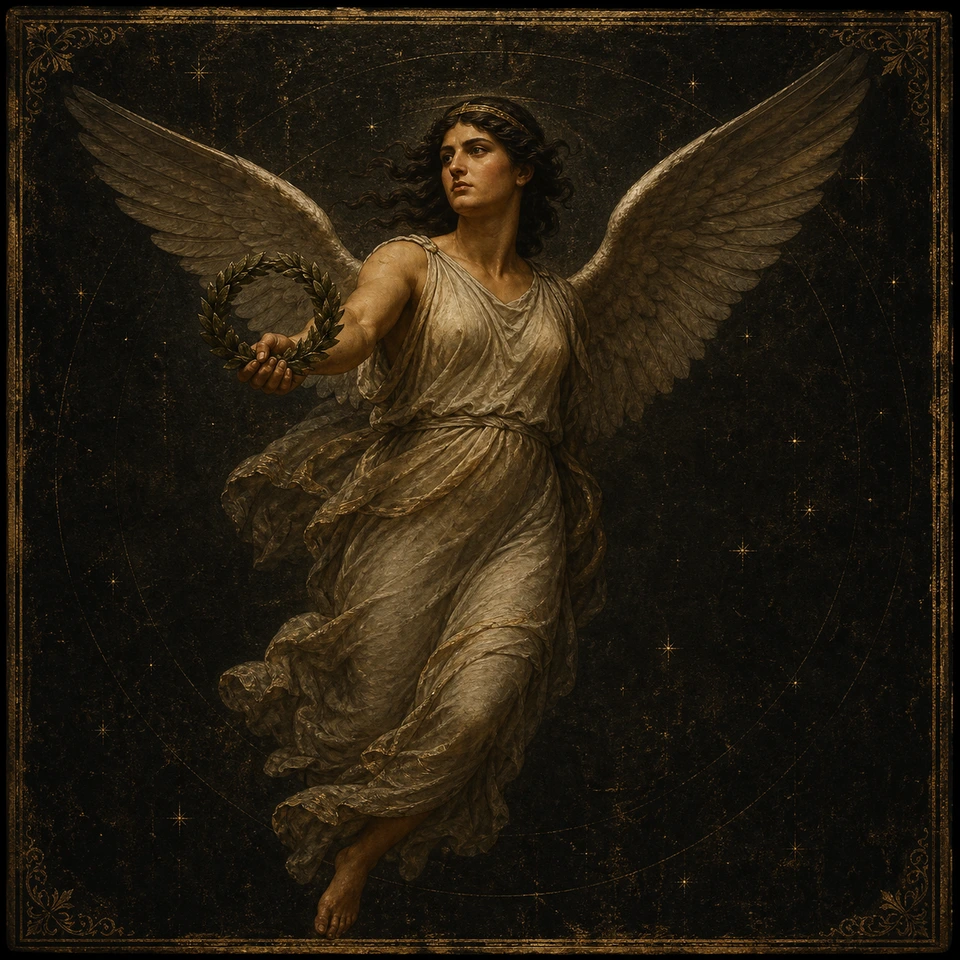
Breathing visible sacred power into military and civic triumphs, Nike embodies the absolute personification of victory. Her iconic winged forms historically attend major deities like Zeus and Athena while proudly crowning the champions of ancient athletic contests.
Overview
Nike arrives in Greek poetry before victory is secure. Hesiod places her inside a household of powers born to Styx and Pallas: Zelus, Nike, Kratos, and Bia. Rivalry, victory, authority, and force are siblings, close enough to act together but not interchangeable. When Zeus calls the immortals to choose sides before the war against the Titans, Styx comes first and brings the children. Their reward is a permanent place beside him. Nike’s nearness to sovereignty begins as memory of first allegiance, not as a decorative flourish after battle is over.
That early story is spare. Nike does not duel an enemy or deliver a speech. Her force grows through the places where Greeks made victory visible. At Olympia, Pausanias sees an altar of Nike, a towering Messenian and Naupactian dedication, a gilt Victory above the temple pediment, dancing victories, and an ivory-and-gold Nike held in the right hand of Zeus. The sanctuary joins sacred competition to hard political memory. A victory monument can praise success while keeping alive the rival city, defeated army, or disputed event that made the dedication possible.
Classical Greek art gives her motion. On a Western Greek krater, Nike faces a victorious athlete and extends a wreath. On an Athenian relief dedicated to Athena, a small winged Nike crowns a charioteer, probably a Panathenaic victor. Around the Temple of Athena Nike, carved Nikai lead a bull, handle weapons, and adorn trophies while Athena sits among them. Victory is not confined to one body. It repeats around the city’s goddess as a host of swift female figures, each caught in an exact task.
The Athenian evidence also demands a boundary. Pausanias calls the bastion shrine a temple of Wingless Victory and explains that the Athenians kept her without wings so she could never leave. The fifth-century decree, however, concerns the priestess and temple of Athena Nike. The Acropolis sculptures distinguish seated Athena from the winged Nikai who serve the victory program around her. Athena in her victorious aspect and Nike as personification share sacred space, but they are not simply two names for one goddess.
Wings remain Nike’s most durable form elsewhere. A late fifth-century BC terracotta at the Metropolitan Museum catches her in flight or at the instant of landing. The great Hellenistic monument from Samothrace sets a winged Nike above a ship-shaped base amid clinging and billowing drapery. The Louvre dates the figure to about 200-175 BC, records Parian marble for the goddess and Lartos marble for the ship, and marks Rhodes only as an uncertain place of creation. Its visitor trail places the monument in the Sanctuary of the Great Gods; neither Louvre page names a secure patron or commemorated victory.
Nike moves between war and games without making every success sacred or just. A wreath may honor an athlete. A trophy may proclaim a city’s triumph. A figure in Zeus’s hand may show that victory attends rule. None of this gives her every power named in her siblings, and none guarantees the outcome of a modern undertaking. Her ancient field is narrower and more severe: the arrival of victory, the public act of crowning, and the transformation of contested success into a memory that can stand in stone.
The British Museum’s authority entry catalogs Greek Nike and Roman Victoria together while retaining both cultural names. Modern English adds further name collisions through an asteroid and a commercial name. Those reuses explain why the name is familiar, not who the goddess was. The Greek goddess remains winged or locally wingless, close to Zeus, visible beside Athena, and always bound to the dangerous question of who gets to call an outcome victory.
Canonical identity
Canonical Identity
Nike exists historically as a worshipped goddess and a literal divine personification. Victory serves as both the literal translation of her name and the exact force she embodies across ancient cults, images, and poetry. She must not be conflated with the asteroid 307 Nike, the modern athletic brand, or an anonymous winged angel, as those later visual resemblances and homonyms belong strictly to reception rather than her ancient canonical identity.
Linguistic Identity
Nike originates from the Ancient Greek Νῑ́κη, transliterated as Nī́kē, a name identical to the ordinary Greek word for victory. The fifth-century BC Attic reconstruction /nǐː.kɛː/ approximates to NEE-keh. While modern English speakers frequently say NY-kee, this later habit fails to recover the ancient pitch or vowel length.
Sources and evidence
TEXTUAL · Supported
Ancient Greek Νῑ́κη is transliterated Nī́kē and has the qualified fifth-century BC Attic reconstruction /nǐː.kɛː/.
- Source
- Wiktionary contributors, Νίκη
- Reviewed edition
- Permanent revision 92068313, last edited 2026-08-19 · Wiktionary
- Exact locator
- Entry Νίκη · Section Ancient Greek pronunciation and proper noun · RecordUrl https://en.wiktionary.org/w/index.php?title=%CE%9D%CE%AF%CE%BA%CE%B7&oldid=92068313
- Scope
- Classical Greece · Attica
- Authority
- collaborative lexical reference
- Certainty
- Qualified
The readable guide NEE-keh is approximate; tonal contour and vowel length cannot be fully carried into English.
Open exact reviewed sourceTEXTUAL · Supported
The proper name Νίκη derives from the Ancient Greek noun for victory and names a divine personification rather than an abstract quality alone.
- Source
- Wiktionary contributors, Νίκη
- Reviewed edition
- Permanent revision 92068313, last edited 2026-08-19 · Wiktionary
- Exact locator
- Entry Νίκη · Section Ancient Greek etymology and proper noun
- Scope
- Ancient Greek diachrony · Ancient Greece
- Authority
- collaborative lexical reference
- Certainty
- Qualified
The lexical identity supports the personification classification but does not replace cult or material evidence.
Open exact reviewed sourceTEXTUAL · Supported
Modern English uses Nike for the Greek goddess, an asteroid, and a commercial name, while the goddess is commonly pronounced /ˈnaɪkiː/.
- Source
- Wiktionary contributors, Nike (English)
- Reviewed edition
- Permanent revision 90919480, last edited 2026-05-23 · Wiktionary
- Exact locator
- Entry Nike · Section English pronunciation and proper noun · RecordUrl https://en.wiktionary.org/w/index.php?title=Nike&oldid=90919480
- Scope
- Modern classical scholarship
- Authority
- collaborative lexical reference
- Certainty
- Qualified
The later names do not become divine aliases, relationships, or evidence for ancient practice.
Open exact reviewed source2 reviewed sources for this section
- Wiktionary contributors, ΝίκηPermanent revision 92068313, Ancient Greek pronunciation section · Wiktionary
- Wiktionary contributors, Nike (English)Permanent revision 90919480, English proper-noun section · Wiktionary
Culture, tradition, period, and place
Nike belongs to Greek-language religion from Archaic poetry through Classical civic art, Hellenistic monuments, and Roman-imperial descriptions of Greek sanctuaries. Hesiod gives her earliest secure surviving genealogy and political placement. Classical Athens surrounds Athena’s victory cult with multiple winged Nikai. Olympia preserves an altar, major dedications, and images in the sanctuary of Zeus.
Her geography cannot be collapsed into one cult center. Athens joins her imagery to Athena and civic victory. Olympia joins altar, games, war dedications, and Zeus. Samothrace holds the Hellenistic ship monument found in the Sanctuary of the Great Gods. Each setting gives victory a different body, from wreath-bearing athletic messenger to vast figure descending upon a warship.
Sources and evidence
TEXTUAL · Supported
Hesiod makes Nike a daughter of Styx and Pallas, sister of Zelus, Kratos, and Bia, and part of the first household to answer Zeus before the Titan conflict.
- Source
- Hesiod; edited and translated by Hugh G. Evelyn-White, Theogony (1914)
- Reviewed edition
- Hugh G. Evelyn-White edition and English translation in Hesiod, the Homeric Hymns and Homerica, 1914 · translated by Hugh G. Evelyn-White · edited by Hugh G. Evelyn-White · Perseus Digital Library / Scaife ATLAS
- Exact locator
- Entry Theogony · Line 383-403
- Scope
- Archaic Greece · Ancient Greece
- Authority
- primary poetic source
- Certainty
- Certain
The poem joins genealogy to political allegiance and says the children dwell with Zeus.
Open exact reviewed sourceTEXTUAL · Supported
Pausanias describes a temple of Wingless Victory beside the Athenian Acropolis gateway and explains the local idea that wingless victory could not leave the city.
- Source
- Pausanias; Spiro Greek edition and Jones/Ormerod translation volumes, Description of Greece (1935)
- Reviewed edition
- W. H. S. Jones and H. A. Ormerod English translation volumes, 1918-1935 · translated by W. H. S. Jones and H. A. Ormerod, volume-dependent · Perseus Digital Library / Scaife ATLAS
- Exact locator
- Book 1 and 3 · Chapter 22 and 15 · Section 1.22.4; 3.15.7
- Scope
- Greek religion under Roman imperial rule · Athens
- Authority
- ancient travel and cult description
- Certainty
- Certain
Pausanias 1.22.4 names the temple of Wingless Victory at the Acropolis gateway; 3.15.7 separately gives the Athenian explanation that wingless Victory stays where she is.
Open exact reviewed sourceTEXTUAL · Supported
Pausanias lists an altar of Nike among the altars at Olympia.
- Source
- Pausanias; Spiro Greek edition and Jones/Ormerod translation volumes, Description of Greece (1935)
- Reviewed edition
- W. H. S. Jones and H. A. Ormerod English translation volumes, 1918-1935 · translated by W. H. S. Jones and H. A. Ormerod, volume-dependent · Perseus Digital Library / Scaife ATLAS
- Exact locator
- Book 5 · Chapter 14 · Section 8
- Scope
- Greek religion under Roman imperial rule · Olympia
- Authority
- ancient sanctuary description
- Certainty
- Certain
This is direct cult-place evidence, but it does not identify a Nike-specific festival or exclusive offering.
Open exact reviewed sourceARCHAEOLOGICAL · Supported
The Acropolis Museum identifies the classical building as the Temple of Athena Nike and distinguishes seated Athena from winged Nikai who lead bulls, hold weapons, and adorn trophies.
- Source
- Acropolis Museum, Acropolis Museum Collections
- Reviewed edition
- Acropolis Museum page, The Temple of Athena Nike · Acropolis Museum
- Exact locator
- Entry The Temple of Athena Nike · Section Temple history and parapet iconography · RecordUrl https://www.theacropolismuseum.gr/en/other-monuments-periklean-building-programme/temple-athena-nike
- Scope
- Classical Greece · Athens
- Authority
- official museum synthesis
- Certainty
- Certain
Athena in a victory aspect and the personified Nikai share a cult setting without becoming one figure.
Open exact reviewed sourceMATERIAL CULTURE · Supported
A Western Greek bell-krater of about 400-380 BC shows Nike holding out a wreath to crown a victorious athlete.
- Source
- British Museum, British Museum Collection
- Reviewed edition
- British Museum object record 1772,0320.526 (F170), Western Greek red-figured bell krater · British Museum
- Exact locator
- MuseumObjectId 1772,0320.526 · Entry Victorious athlete crowned by Nike · RecordUrl https://www.britishmuseum.org/collection/object/G_1772-0320-526
- Scope
- Classical Greece · Italy
- Authority
- official museum object catalog
- Certainty
- Certain
The object supports athletic victory and the wreath, not a universal sacred plant or modern sports ritual.
Open exact reviewed sourceMATERIAL CULTURE · Supported
The Louvre dates the Winged Victory of Samothrace to about 200-175 BC and identifies a winged Nike in Parian marble set upon a ship-shaped base of Lartos marble.
- Source
- Musée du Louvre, Victoire de Samothrace
- Reviewed edition
- Live official collection entry, inventory Ma 2369 · Musée du Louvre
- Exact locator
- MuseumObjectId Ma 2369 · Entry Victoire de Samothrace · RecordUrl https://collections.louvre.fr/ark:/53355/cl010252531
- Scope
- Hellenistic Greek world · Samothrace
- Authority
- official museum object catalog
- Certainty
- Certain
The exact battle and patron remain debated, so the monument is not assigned to a named historical victory.
Open exact reviewed sourceMATERIAL CULTURE · Supported
The Louvre visitor trail identifies the Winged Victory as Nike above a warship in the Sanctuary of the Great Gods on Samothrace.
- Source
- Musée du Louvre, Victoire de Samothrace
- Reviewed edition
- Musée du Louvre official English visitor trail, An uplifting sight, The Winged Victory of Samothrace · Musée du Louvre
- Exact locator
- MuseumObjectId Ma 2369 · Entry An uplifting sight, The Winged Victory of Samothrace · Section The Winged Victory of Samothrace · RecordUrl https://www.louvre.fr/en/explore/visitor-trails/the-louvre-s-masterpieces/an-uplifting-sight
- Scope
- Hellenistic Greek world · Samothrace
- Authority
- official museum interpretation
- Certainty
- Certain
This page controls sanctuary, warship, drapery, and Nike identification only; Ma 2369 controls object date, materials, accession, and the uncertain Rhodes production place.
Open exact reviewed source5 reviewed sources for this section
- Hesiod; edited and translated by Hugh G. Evelyn-White, Theogony (1914)Hesiod, the Homeric Hymns and Homerica, London and New York, 1914 · Perseus Digital Library / Scaife ATLAS
- Pausanias; Spiro Greek edition and Jones/Ormerod translation volumes, Description of Greece (1935)Perseus CTS edition corpus, 1903-1935 · Perseus Digital Library / Scaife ATLAS
- Acropolis Museum, Acropolis Museum CollectionsLive official museum collection · Acropolis Museum
- British Museum, British Museum CollectionLive official museum collection · British Museum
- Musée du Louvre, Victoire de SamothraceLive official collection entry, Ma 2369 · Musée du Louvre
Historical development
Hesiod’s Nike begins inside a divine family and a struggle for succession. She is daughter of Styx and Pallas, sister of Zelus, Kratos, and Bia, and one of the powers that come first to Zeus. Pseudo-Apollodorus later compresses this into genealogy, preserving the family but not the dramatic council.
By the fifth century BC, artists made victory mobile. Winged Nikai descend, crown athletes, lead sacrifice, and decorate trophies. Athenian monuments make them numerous around Athena rather than treating every image as one biographical scene. At Olympia, victory could stand on a high pillar as a public war dedication, rest in Zeus’s hand, dance around his throne, or receive an altar.
The Hellenistic monument from Samothrace magnifies movement itself. Clinging and billowing drapery rises above a ship-shaped base in the Sanctuary of the Great Gods. A British Museum authority entry catalogs the Greek name Nike and the Roman name Victoria together, while the two identities remain separately addressed.
Sources and evidence
TEXTUAL · Supported
Hesiod makes Nike a daughter of Styx and Pallas, sister of Zelus, Kratos, and Bia, and part of the first household to answer Zeus before the Titan conflict.
- Source
- Hesiod; edited and translated by Hugh G. Evelyn-White, Theogony (1914)
- Reviewed edition
- Hugh G. Evelyn-White edition and English translation in Hesiod, the Homeric Hymns and Homerica, 1914 · translated by Hugh G. Evelyn-White · edited by Hugh G. Evelyn-White · Perseus Digital Library / Scaife ATLAS
- Exact locator
- Entry Theogony · Line 383-403
- Scope
- Archaic Greece · Ancient Greece
- Authority
- primary poetic source
- Certainty
- Certain
The poem joins genealogy to political allegiance and says the children dwell with Zeus.
Open exact reviewed sourceTEXTUAL · Supported
Pseudo-Apollodorus repeats Pallas and Styx as parents of Nike, Kratos, Zelus, and Bia but omits Hesiod’s extended council-and-reward sequence.
- Source
- Pseudo-Apollodorus; edited and translated by James G. Frazer, Library (1921)
- Reviewed edition
- James G. Frazer edition and English translation, Harvard University Press and William Heinemann, 1921 · translated by James G. Frazer · edited by James G. Frazer · Perseus Digital Library / Scaife ATLAS
- Exact locator
- Book 1 · Chapter 2 · Section 4
- Scope
- Greek religion under Roman imperial rule · Ancient Greece
- Authority
- primary mythographic source
- Certainty
- Certain
The compact list confirms the family while preserving the difference in narrative scope.
Open exact reviewed sourceTEXTUAL · Supported
Pausanias describes the Messenian and Naupactian dedication of a Nike on a pillar at Olympia and preserves competing explanations for the victory it commemorated.
- Source
- Pausanias; Spiro Greek edition and Jones/Ormerod translation volumes, Description of Greece (1935)
- Reviewed edition
- W. H. S. Jones and H. A. Ormerod English translation volumes, 1918-1935 · translated by W. H. S. Jones and H. A. Ormerod, volume-dependent · Perseus Digital Library / Scaife ATLAS
- Exact locator
- Book 5 · Chapter 26 · Section 1
- Scope
- Greek religion under Roman imperial rule · Olympia
- Authority
- ancient monument and inscription description
- Certainty
- Certain
The monument ties Nike to contested civic memory rather than to timeless triumph without human stakes.
Open exact reviewed sourceMATERIAL CULTURE · Supported
The Athena Nike parapet shows multiple winged Nikai leading a sacrificial bull, holding weapons, and adorning trophies while Athena sits among them.
- Source
- Acropolis Museum, Acropolis Museum Collections
- Reviewed edition
- Acropolis Museum object record Akr. 972, north slab IV of the Temple of Athena Nike parapet · Acropolis Museum
- Exact locator
- MuseumObjectId Akr. 972 · Entry Athena Nike Temple parapet, north slab IV · RecordUrl https://www.theacropolismuseum.gr/en/node/22157
- Scope
- Classical Greece · Athens
- Authority
- official museum object entry
- Certainty
- Certain
The bull belongs to sacrifice for Athena in this scene and is not made Nike’s sacred animal.
Open exact reviewed sourceMATERIAL CULTURE · Supported
A Western Greek bell-krater of about 400-380 BC shows Nike holding out a wreath to crown a victorious athlete.
- Source
- British Museum, British Museum Collection
- Reviewed edition
- British Museum object record 1772,0320.526 (F170), Western Greek red-figured bell krater · British Museum
- Exact locator
- MuseumObjectId 1772,0320.526 · Entry Victorious athlete crowned by Nike · RecordUrl https://www.britishmuseum.org/collection/object/G_1772-0320-526
- Scope
- Classical Greece · Italy
- Authority
- official museum object catalog
- Certainty
- Certain
The object supports athletic victory and the wreath, not a universal sacred plant or modern sports ritual.
Open exact reviewed sourceMATERIAL CULTURE · Supported
A Classical Athenian votive relief dedicated to Athena shows a small winged Nike descending to crown a charioteer, probably a Panathenaic victor.
- Source
- British Museum, British Museum Collection
- Reviewed edition
- British Museum object record 1816,0610.197, Classical Greek marble votive relief dedicated to Athena · British Museum
- Exact locator
- MuseumObjectId 1816,0610.197 · Entry Votive relief dedicated to Athena · RecordUrl https://www.britishmuseum.org/collection/object/G_1816-0610-197
- Scope
- Classical Greece · Athens
- Authority
- official museum object catalog
- Certainty
- Certain
The scene supports Nike’s material association with Athena and athletic victory without merging their identities.
Open exact reviewed sourceTEXTUAL · Supported
The Olympian statue of Zeus held an ivory-and-gold Nike wearing a ribbon and garland, while additional Nikai danced around the throne.
- Source
- Pausanias; Spiro Greek edition and Jones/Ormerod translation volumes, Description of Greece (1935)
- Reviewed edition
- W. H. S. Jones and H. A. Ormerod English translation volumes, 1918-1935 · translated by W. H. S. Jones and H. A. Ormerod, volume-dependent · Perseus Digital Library / Scaife ATLAS
- Exact locator
- Book 5 · Chapter 11 · Section 1-2
- Scope
- Greek religion under Roman imperial rule · Olympia
- Authority
- ancient monumental description
- Certainty
- Certain
Pausanias 5.11.1 describes the ivory-and-gold Nike held by Zeus; 5.11.2 separately describes four dancing Victories at the throne feet and two more at each foot base.
Open exact reviewed sourceMATERIAL CULTURE · Supported
The Louvre dates the Winged Victory of Samothrace to about 200-175 BC and identifies a winged Nike in Parian marble set upon a ship-shaped base of Lartos marble.
- Source
- Musée du Louvre, Victoire de Samothrace
- Reviewed edition
- Live official collection entry, inventory Ma 2369 · Musée du Louvre
- Exact locator
- MuseumObjectId Ma 2369 · Entry Victoire de Samothrace · RecordUrl https://collections.louvre.fr/ark:/53355/cl010252531
- Scope
- Hellenistic Greek world · Samothrace
- Authority
- official museum object catalog
- Certainty
- Certain
The exact battle and patron remain debated, so the monument is not assigned to a named historical victory.
Open exact reviewed sourceSCHOLARLY INTERPRETATION · Supported
The British Museum’s authority entry groups the victory figure under Greek Nike and Roman Victoria while identifying both cultural scopes.
- Source
- British Museum, British Museum Collection
- Reviewed edition
- British Museum authority record BIOG60915, Nike/Victoria/Victory · British Museum
- Exact locator
- Entry Nike/Victoria/Victory · RecordUrl https://www.britishmuseum.org/collection/term/BIOG60915
- Scope
- Unspecified
- Authority
- institutional authority vocabulary
- Certainty
- Qualified
The official-indexed authority metadata supports a Greek and Roman counterpart boundary, not an ancient dated or located witness and not a merger of identities.
Open exact reviewed sourceMATERIAL CULTURE · Supported
The Louvre visitor trail identifies the Winged Victory as Nike above a warship in the Sanctuary of the Great Gods on Samothrace.
- Source
- Musée du Louvre, Victoire de Samothrace
- Reviewed edition
- Musée du Louvre official English visitor trail, An uplifting sight, The Winged Victory of Samothrace · Musée du Louvre
- Exact locator
- MuseumObjectId Ma 2369 · Entry An uplifting sight, The Winged Victory of Samothrace · Section The Winged Victory of Samothrace · RecordUrl https://www.louvre.fr/en/explore/visitor-trails/the-louvre-s-masterpieces/an-uplifting-sight
- Scope
- Hellenistic Greek world · Samothrace
- Authority
- official museum interpretation
- Certainty
- Certain
This page controls sanctuary, warship, drapery, and Nike identification only; Ma 2369 controls object date, materials, accession, and the uncertain Rhodes production place.
Open exact reviewed source6 reviewed sources for this section
- Hesiod; edited and translated by Hugh G. Evelyn-White, Theogony (1914)Hesiod, the Homeric Hymns and Homerica, London and New York, 1914 · Perseus Digital Library / Scaife ATLAS
- Pseudo-Apollodorus; edited and translated by James G. Frazer, Library (1921)Harvard University Press and William Heinemann edition, 1921 · Perseus Digital Library / Scaife ATLAS
- Pausanias; Spiro Greek edition and Jones/Ormerod translation volumes, Description of Greece (1935)Perseus CTS edition corpus, 1903-1935 · Perseus Digital Library / Scaife ATLAS
- Acropolis Museum, Acropolis Museum CollectionsLive official museum collection · Acropolis Museum
- British Museum, British Museum CollectionLive official museum collection · British Museum
- Musée du Louvre, Victoire de SamothraceLive official collection entry, Ma 2369 · Musée du Louvre
Attested roles and historical themes
Roles, powers, and limits
Nike gives victory a visible divine presence. In Hesiod she belongs beside Zeus after her family’s first allegiance. In Classical images she approaches a victor, carries or extends a wreath, moves through the air, and helps turn a successful contest into an honored event. At Olympia and Athens, victory can serve a ruler, a city, an athlete, or a dedicatory message.
These roles have limits. Nike is not every act of strength, force, rivalry, or political authority. Hesiod assigns those neighboring powers to her siblings Kratos, Bia, and Zelus. She does not decide every battle in surviving narrative, and a Nike figure on a monument does not prove which historical victory the patron intended unless the inscription or context says so. Triumph may be celebrated through her, but the human cost and contested memory of war remain visible.
Sources and evidence
TEXTUAL · Supported
Hesiod makes Nike a daughter of Styx and Pallas, sister of Zelus, Kratos, and Bia, and part of the first household to answer Zeus before the Titan conflict.
- Source
- Hesiod; edited and translated by Hugh G. Evelyn-White, Theogony (1914)
- Reviewed edition
- Hugh G. Evelyn-White edition and English translation in Hesiod, the Homeric Hymns and Homerica, 1914 · translated by Hugh G. Evelyn-White · edited by Hugh G. Evelyn-White · Perseus Digital Library / Scaife ATLAS
- Exact locator
- Entry Theogony · Line 383-403
- Scope
- Archaic Greece · Ancient Greece
- Authority
- primary poetic source
- Certainty
- Certain
The poem joins genealogy to political allegiance and says the children dwell with Zeus.
Open exact reviewed sourceTEXTUAL · Supported
Pausanias describes the Messenian and Naupactian dedication of a Nike on a pillar at Olympia and preserves competing explanations for the victory it commemorated.
- Source
- Pausanias; Spiro Greek edition and Jones/Ormerod translation volumes, Description of Greece (1935)
- Reviewed edition
- W. H. S. Jones and H. A. Ormerod English translation volumes, 1918-1935 · translated by W. H. S. Jones and H. A. Ormerod, volume-dependent · Perseus Digital Library / Scaife ATLAS
- Exact locator
- Book 5 · Chapter 26 · Section 1
- Scope
- Greek religion under Roman imperial rule · Olympia
- Authority
- ancient monument and inscription description
- Certainty
- Certain
The monument ties Nike to contested civic memory rather than to timeless triumph without human stakes.
Open exact reviewed sourceMATERIAL CULTURE · Supported
A Western Greek bell-krater of about 400-380 BC shows Nike holding out a wreath to crown a victorious athlete.
- Source
- British Museum, British Museum Collection
- Reviewed edition
- British Museum object record 1772,0320.526 (F170), Western Greek red-figured bell krater · British Museum
- Exact locator
- MuseumObjectId 1772,0320.526 · Entry Victorious athlete crowned by Nike · RecordUrl https://www.britishmuseum.org/collection/object/G_1772-0320-526
- Scope
- Classical Greece · Italy
- Authority
- official museum object catalog
- Certainty
- Certain
The object supports athletic victory and the wreath, not a universal sacred plant or modern sports ritual.
Open exact reviewed sourceMATERIAL CULTURE · Supported
The Louvre dates the Winged Victory of Samothrace to about 200-175 BC and identifies a winged Nike in Parian marble set upon a ship-shaped base of Lartos marble.
- Source
- Musée du Louvre, Victoire de Samothrace
- Reviewed edition
- Live official collection entry, inventory Ma 2369 · Musée du Louvre
- Exact locator
- MuseumObjectId Ma 2369 · Entry Victoire de Samothrace · RecordUrl https://collections.louvre.fr/ark:/53355/cl010252531
- Scope
- Hellenistic Greek world · Samothrace
- Authority
- official museum object catalog
- Certainty
- Certain
The exact battle and patron remain debated, so the monument is not assigned to a named historical victory.
Open exact reviewed source4 reviewed sources for this section
- Hesiod; edited and translated by Hugh G. Evelyn-White, Theogony (1914)Hesiod, the Homeric Hymns and Homerica, London and New York, 1914 · Perseus Digital Library / Scaife ATLAS
- Pausanias; Spiro Greek edition and Jones/Ormerod translation volumes, Description of Greece (1935)Perseus CTS edition corpus, 1903-1935 · Perseus Digital Library / Scaife ATLAS
- British Museum, British Museum CollectionLive official museum collection · British Museum
- Musée du Louvre, Victoire de SamothraceLive official collection entry, Ma 2369 · Musée du Louvre
Epithets and titles
Cult Epithet
Wingless Victory
Νίκη Ἄπτερος · Wingless Victory
Athenian Acropolis · Local image and temple description reported in the second century ADPausanias reports the wingless local form, while inscriptional and museum evidence keeps the Athena Nike cult title distinct from the surrounding personified Nikai.
2 reviewed sources for this section
- Pausanias; Spiro Greek edition and Jones/Ormerod translation volumes, Description of Greece (1935)Perseus CTS edition corpus, 1903-1935 · Perseus Digital Library / Scaife ATLAS
- Acropolis Museum, Acropolis Museum CollectionsLive official museum collection · Acropolis Museum
Worship and cult
Olympia supplies the clearest direct cult evidence. Pausanias lists an altar of Nike among the sanctuary’s altars and describes victory figures throughout the sacred precinct. One could meet Nike there as recipient, dedication, attendant figure, and visual declaration of athletic or military success.
Athens requires finer handling. Pausanias calls the bastion shrine a temple of Wingless Victory, yet the fifth-century decree concerns the priestess, temple, and altar of Athena Nike. The Acropolis Museum also distinguishes seated Athena from the winged Nikai on the parapet. The evidence therefore supports a powerful Athenian victory cult and abundant personified victories, but it does not permit every Athena Nike rite to be reassigned to an independent Nike.
Sources and evidence
TEXTUAL · Supported
Pausanias lists an altar of Nike among the altars at Olympia.
- Source
- Pausanias; Spiro Greek edition and Jones/Ormerod translation volumes, Description of Greece (1935)
- Reviewed edition
- W. H. S. Jones and H. A. Ormerod English translation volumes, 1918-1935 · translated by W. H. S. Jones and H. A. Ormerod, volume-dependent · Perseus Digital Library / Scaife ATLAS
- Exact locator
- Book 5 · Chapter 14 · Section 8
- Scope
- Greek religion under Roman imperial rule · Olympia
- Authority
- ancient sanctuary description
- Certainty
- Certain
This is direct cult-place evidence, but it does not identify a Nike-specific festival or exclusive offering.
Open exact reviewed sourceTEXTUAL · Supported
Pausanias describes a temple of Wingless Victory beside the Athenian Acropolis gateway and explains the local idea that wingless victory could not leave the city.
- Source
- Pausanias; Spiro Greek edition and Jones/Ormerod translation volumes, Description of Greece (1935)
- Reviewed edition
- W. H. S. Jones and H. A. Ormerod English translation volumes, 1918-1935 · translated by W. H. S. Jones and H. A. Ormerod, volume-dependent · Perseus Digital Library / Scaife ATLAS
- Exact locator
- Book 1 and 3 · Chapter 22 and 15 · Section 1.22.4; 3.15.7
- Scope
- Greek religion under Roman imperial rule · Athens
- Authority
- ancient travel and cult description
- Certainty
- Certain
Pausanias 1.22.4 names the temple of Wingless Victory at the Acropolis gateway; 3.15.7 separately gives the Athenian explanation that wingless Victory stays where she is.
Open exact reviewed sourceINSCRIPTIONAL · Supported
A fifth-century BC decree from the Acropolis concerns selection and pay for the priestess of Athena Nike and construction of the temple and altar.
- Source
- Acropolis Museum, Acropolis Museum Collections
- Reviewed edition
- Acropolis Museum inscription record EM 8116, decree concerning Athena Nike · Acropolis Museum
- Exact locator
- MuseumObjectId EM 8116 · Entry Stele with decrees for the Temple of Athena Nike · RecordUrl https://www.theacropolismuseum.gr/en/stele-decrees-temple-athena-nike
- Scope
- Classical Greece · Athens
- Authority
- official museum inscription entry
- Certainty
- Certain
The inscription secures Athena Nike’s civic cult and prevents automatic reassignment of her priesthood to a separate Nike.
Open exact reviewed sourceARCHAEOLOGICAL · Supported
The Acropolis Museum identifies the classical building as the Temple of Athena Nike and distinguishes seated Athena from winged Nikai who lead bulls, hold weapons, and adorn trophies.
- Source
- Acropolis Museum, Acropolis Museum Collections
- Reviewed edition
- Acropolis Museum page, The Temple of Athena Nike · Acropolis Museum
- Exact locator
- Entry The Temple of Athena Nike · Section Temple history and parapet iconography · RecordUrl https://www.theacropolismuseum.gr/en/other-monuments-periklean-building-programme/temple-athena-nike
- Scope
- Classical Greece · Athens
- Authority
- official museum synthesis
- Certainty
- Certain
Athena in a victory aspect and the personified Nikai share a cult setting without becoming one figure.
Open exact reviewed source2 reviewed sources for this section
- Pausanias; Spiro Greek edition and Jones/Ormerod translation volumes, Description of Greece (1935)Perseus CTS edition corpus, 1903-1935 · Perseus Digital Library / Scaife ATLAS
- Acropolis Museum, Acropolis Museum CollectionsLive official museum collection · Acropolis Museum
Temples, sanctuaries, and sacred places
At Olympia, Nike had an altar and appeared across the sanctuary in some of its most charged monuments. The Messenian and Naupactian Nike stood high on a pillar; the colossal Zeus held a smaller Nike; other Nikai danced around his throne, while a separate gilt Victory stood above the temple pediment. These placements joined victory to Panhellenic games, interstate rivalry, and the authority of Zeus.
The Athenian Acropolis bastion held the temple and altar of Athena Nike. Its parapet surrounded the dangerous edge with winged Nikai moving through sacrifice and trophy scenes. The place belongs to Athena’s civic cult even while personified victories fill its art.
Samothrace preserves a different sacred setting. The great Hellenistic Nike stood upon a ship-shaped base in the Sanctuary of the Great Gods, turning a monumental warship setting into the vision of a goddess landing in wind.
Sources and evidence
TEXTUAL · Supported
Pausanias lists an altar of Nike among the altars at Olympia.
- Source
- Pausanias; Spiro Greek edition and Jones/Ormerod translation volumes, Description of Greece (1935)
- Reviewed edition
- W. H. S. Jones and H. A. Ormerod English translation volumes, 1918-1935 · translated by W. H. S. Jones and H. A. Ormerod, volume-dependent · Perseus Digital Library / Scaife ATLAS
- Exact locator
- Book 5 · Chapter 14 · Section 8
- Scope
- Greek religion under Roman imperial rule · Olympia
- Authority
- ancient sanctuary description
- Certainty
- Certain
This is direct cult-place evidence, but it does not identify a Nike-specific festival or exclusive offering.
Open exact reviewed sourceTEXTUAL · Supported
Pausanias describes the Messenian and Naupactian dedication of a Nike on a pillar at Olympia and preserves competing explanations for the victory it commemorated.
- Source
- Pausanias; Spiro Greek edition and Jones/Ormerod translation volumes, Description of Greece (1935)
- Reviewed edition
- W. H. S. Jones and H. A. Ormerod English translation volumes, 1918-1935 · translated by W. H. S. Jones and H. A. Ormerod, volume-dependent · Perseus Digital Library / Scaife ATLAS
- Exact locator
- Book 5 · Chapter 26 · Section 1
- Scope
- Greek religion under Roman imperial rule · Olympia
- Authority
- ancient monument and inscription description
- Certainty
- Certain
The monument ties Nike to contested civic memory rather than to timeless triumph without human stakes.
Open exact reviewed sourceTEXTUAL · Supported
The Olympian statue of Zeus held an ivory-and-gold Nike wearing a ribbon and garland, while additional Nikai danced around the throne.
- Source
- Pausanias; Spiro Greek edition and Jones/Ormerod translation volumes, Description of Greece (1935)
- Reviewed edition
- W. H. S. Jones and H. A. Ormerod English translation volumes, 1918-1935 · translated by W. H. S. Jones and H. A. Ormerod, volume-dependent · Perseus Digital Library / Scaife ATLAS
- Exact locator
- Book 5 · Chapter 11 · Section 1-2
- Scope
- Greek religion under Roman imperial rule · Olympia
- Authority
- ancient monumental description
- Certainty
- Certain
Pausanias 5.11.1 describes the ivory-and-gold Nike held by Zeus; 5.11.2 separately describes four dancing Victories at the throne feet and two more at each foot base.
Open exact reviewed sourceARCHAEOLOGICAL · Supported
The Acropolis Museum identifies the classical building as the Temple of Athena Nike and distinguishes seated Athena from winged Nikai who lead bulls, hold weapons, and adorn trophies.
- Source
- Acropolis Museum, Acropolis Museum Collections
- Reviewed edition
- Acropolis Museum page, The Temple of Athena Nike · Acropolis Museum
- Exact locator
- Entry The Temple of Athena Nike · Section Temple history and parapet iconography · RecordUrl https://www.theacropolismuseum.gr/en/other-monuments-periklean-building-programme/temple-athena-nike
- Scope
- Classical Greece · Athens
- Authority
- official museum synthesis
- Certainty
- Certain
Athena in a victory aspect and the personified Nikai share a cult setting without becoming one figure.
Open exact reviewed sourceINSCRIPTIONAL · Supported
A fifth-century BC decree from the Acropolis concerns selection and pay for the priestess of Athena Nike and construction of the temple and altar.
- Source
- Acropolis Museum, Acropolis Museum Collections
- Reviewed edition
- Acropolis Museum inscription record EM 8116, decree concerning Athena Nike · Acropolis Museum
- Exact locator
- MuseumObjectId EM 8116 · Entry Stele with decrees for the Temple of Athena Nike · RecordUrl https://www.theacropolismuseum.gr/en/stele-decrees-temple-athena-nike
- Scope
- Classical Greece · Athens
- Authority
- official museum inscription entry
- Certainty
- Certain
The inscription secures Athena Nike’s civic cult and prevents automatic reassignment of her priesthood to a separate Nike.
Open exact reviewed sourceMATERIAL CULTURE · Supported
The Athena Nike parapet shows multiple winged Nikai leading a sacrificial bull, holding weapons, and adorning trophies while Athena sits among them.
- Source
- Acropolis Museum, Acropolis Museum Collections
- Reviewed edition
- Acropolis Museum object record Akr. 972, north slab IV of the Temple of Athena Nike parapet · Acropolis Museum
- Exact locator
- MuseumObjectId Akr. 972 · Entry Athena Nike Temple parapet, north slab IV · RecordUrl https://www.theacropolismuseum.gr/en/node/22157
- Scope
- Classical Greece · Athens
- Authority
- official museum object entry
- Certainty
- Certain
The bull belongs to sacrifice for Athena in this scene and is not made Nike’s sacred animal.
Open exact reviewed sourceMATERIAL CULTURE · Supported
The Louvre dates the Winged Victory of Samothrace to about 200-175 BC and identifies a winged Nike in Parian marble set upon a ship-shaped base of Lartos marble.
- Source
- Musée du Louvre, Victoire de Samothrace
- Reviewed edition
- Live official collection entry, inventory Ma 2369 · Musée du Louvre
- Exact locator
- MuseumObjectId Ma 2369 · Entry Victoire de Samothrace · RecordUrl https://collections.louvre.fr/ark:/53355/cl010252531
- Scope
- Hellenistic Greek world · Samothrace
- Authority
- official museum object catalog
- Certainty
- Certain
The exact battle and patron remain debated, so the monument is not assigned to a named historical victory.
Open exact reviewed sourceMATERIAL CULTURE · Supported
The Louvre visitor trail identifies the Winged Victory as Nike above a warship in the Sanctuary of the Great Gods on Samothrace.
- Source
- Musée du Louvre, Victoire de Samothrace
- Reviewed edition
- Musée du Louvre official English visitor trail, An uplifting sight, The Winged Victory of Samothrace · Musée du Louvre
- Exact locator
- MuseumObjectId Ma 2369 · Entry An uplifting sight, The Winged Victory of Samothrace · Section The Winged Victory of Samothrace · RecordUrl https://www.louvre.fr/en/explore/visitor-trails/the-louvre-s-masterpieces/an-uplifting-sight
- Scope
- Hellenistic Greek world · Samothrace
- Authority
- official museum interpretation
- Certainty
- Certain
This page controls sanctuary, warship, drapery, and Nike identification only; Ma 2369 controls object date, materials, accession, and the uncertain Rhodes production place.
Open exact reviewed sourceTEXTUAL · Supported
Pausanias describes a gilt Victory set above the middle of the pediment of the Temple of Zeus at Olympia.
- Source
- Pausanias; Spiro Greek edition and Jones/Ormerod translation volumes, Description of Greece (1935)
- Reviewed edition
- W. H. S. Jones and H. A. Ormerod English translation volumes, 1918-1935 · translated by W. H. S. Jones and H. A. Ormerod, volume-dependent · Perseus Digital Library / Scaife ATLAS
- Exact locator
- Book 5 · Chapter 10 · Section 4
- Scope
- Greek religion under Roman imperial rule · Olympia
- Authority
- ancient sanctuary description
- Certainty
- Certain
Exact Jones translation checked in the official PerseusDL canonical eng2 XML; the gilt Victory is distinct from the sculpted narrative figures inside the pediment.
Open exact reviewed source3 reviewed sources for this section
- Pausanias; Spiro Greek edition and Jones/Ormerod translation volumes, Description of Greece (1935)Perseus CTS edition corpus, 1903-1935 · Perseus Digital Library / Scaife ATLAS
- Acropolis Museum, Acropolis Museum CollectionsLive official museum collection · Acropolis Museum
- Musée du Louvre, Victoire de SamothraceLive official collection entry, Ma 2369 · Musée du Louvre
Festivals and processions
Nike belongs to athletic and military celebration, but the surviving sources do not name a festival devoted solely to her. The British Museum krater places her before a victorious athlete with a wreath. A second Athenian relief probably connects her crowning act to a Panathenaic chariot victor, though the dedication itself is to Athena. Olympia adds the setting of the games, yet Pausanias’s Nike altar and monuments do not name a separate Nike feast.
The proper conclusion is narrower than a modern calendar assignment. Nike could crown, honor, and monumentalize victory within established civic and sanctuary occasions. No weekday, month day, lunar phase, or universal annual observance emerges from these materials.
Sources and evidence
MATERIAL CULTURE · Supported
A Western Greek bell-krater of about 400-380 BC shows Nike holding out a wreath to crown a victorious athlete.
- Source
- British Museum, British Museum Collection
- Reviewed edition
- British Museum object record 1772,0320.526 (F170), Western Greek red-figured bell krater · British Museum
- Exact locator
- MuseumObjectId 1772,0320.526 · Entry Victorious athlete crowned by Nike · RecordUrl https://www.britishmuseum.org/collection/object/G_1772-0320-526
- Scope
- Classical Greece · Italy
- Authority
- official museum object catalog
- Certainty
- Certain
The object supports athletic victory and the wreath, not a universal sacred plant or modern sports ritual.
Open exact reviewed sourceMATERIAL CULTURE · Supported
A Classical Athenian votive relief dedicated to Athena shows a small winged Nike descending to crown a charioteer, probably a Panathenaic victor.
- Source
- British Museum, British Museum Collection
- Reviewed edition
- British Museum object record 1816,0610.197, Classical Greek marble votive relief dedicated to Athena · British Museum
- Exact locator
- MuseumObjectId 1816,0610.197 · Entry Votive relief dedicated to Athena · RecordUrl https://www.britishmuseum.org/collection/object/G_1816-0610-197
- Scope
- Classical Greece · Athens
- Authority
- official museum object catalog
- Certainty
- Certain
The scene supports Nike’s material association with Athena and athletic victory without merging their identities.
Open exact reviewed sourceTEXTUAL · Supported
Pausanias lists an altar of Nike among the altars at Olympia.
- Source
- Pausanias; Spiro Greek edition and Jones/Ormerod translation volumes, Description of Greece (1935)
- Reviewed edition
- W. H. S. Jones and H. A. Ormerod English translation volumes, 1918-1935 · translated by W. H. S. Jones and H. A. Ormerod, volume-dependent · Perseus Digital Library / Scaife ATLAS
- Exact locator
- Book 5 · Chapter 14 · Section 8
- Scope
- Greek religion under Roman imperial rule · Olympia
- Authority
- ancient sanctuary description
- Certainty
- Certain
This is direct cult-place evidence, but it does not identify a Nike-specific festival or exclusive offering.
Open exact reviewed source2 reviewed sources for this section
- British Museum, British Museum CollectionLive official museum collection · British Museum
- Pausanias; Spiro Greek edition and Jones/Ormerod translation volumes, Description of Greece (1935)Perseus CTS edition corpus, 1903-1935 · Perseus Digital Library / Scaife ATLAS
Offerings, votives, and ritual evidence
Nike’s surviving ritual world is strongest in altar and dedication. Olympia preserves her altar and monumental victory offerings. The Nike of Paeonius carried a dedicatory history contested even in Pausanias’s account, showing how a city could use the goddess to make success stand over communal space. At Samothrace, the vast ship-base monument stood within the Sanctuary of the Great Gods.
The Athenian parapet shows Nikai leading bulls toward sacrifice, but Athena sits as the honored goddess. That scene cannot be converted into a rule that bulls were Nike’s animal or proper offering. Likewise, the wreath extended to an athlete is an honor for the victor, not evidence that worshippers universally offered laurel to Nike. No exclusive food, incense, libation, or household rite has been established.
Sources and evidence
TEXTUAL · Supported
Pausanias lists an altar of Nike among the altars at Olympia.
- Source
- Pausanias; Spiro Greek edition and Jones/Ormerod translation volumes, Description of Greece (1935)
- Reviewed edition
- W. H. S. Jones and H. A. Ormerod English translation volumes, 1918-1935 · translated by W. H. S. Jones and H. A. Ormerod, volume-dependent · Perseus Digital Library / Scaife ATLAS
- Exact locator
- Book 5 · Chapter 14 · Section 8
- Scope
- Greek religion under Roman imperial rule · Olympia
- Authority
- ancient sanctuary description
- Certainty
- Certain
This is direct cult-place evidence, but it does not identify a Nike-specific festival or exclusive offering.
Open exact reviewed sourceTEXTUAL · Supported
Pausanias describes the Messenian and Naupactian dedication of a Nike on a pillar at Olympia and preserves competing explanations for the victory it commemorated.
- Source
- Pausanias; Spiro Greek edition and Jones/Ormerod translation volumes, Description of Greece (1935)
- Reviewed edition
- W. H. S. Jones and H. A. Ormerod English translation volumes, 1918-1935 · translated by W. H. S. Jones and H. A. Ormerod, volume-dependent · Perseus Digital Library / Scaife ATLAS
- Exact locator
- Book 5 · Chapter 26 · Section 1
- Scope
- Greek religion under Roman imperial rule · Olympia
- Authority
- ancient monument and inscription description
- Certainty
- Certain
The monument ties Nike to contested civic memory rather than to timeless triumph without human stakes.
Open exact reviewed sourceMATERIAL CULTURE · Supported
The Louvre dates the Winged Victory of Samothrace to about 200-175 BC and identifies a winged Nike in Parian marble set upon a ship-shaped base of Lartos marble.
- Source
- Musée du Louvre, Victoire de Samothrace
- Reviewed edition
- Live official collection entry, inventory Ma 2369 · Musée du Louvre
- Exact locator
- MuseumObjectId Ma 2369 · Entry Victoire de Samothrace · RecordUrl https://collections.louvre.fr/ark:/53355/cl010252531
- Scope
- Hellenistic Greek world · Samothrace
- Authority
- official museum object catalog
- Certainty
- Certain
The exact battle and patron remain debated, so the monument is not assigned to a named historical victory.
Open exact reviewed sourceMATERIAL CULTURE · Supported
The Athena Nike parapet shows multiple winged Nikai leading a sacrificial bull, holding weapons, and adorning trophies while Athena sits among them.
- Source
- Acropolis Museum, Acropolis Museum Collections
- Reviewed edition
- Acropolis Museum object record Akr. 972, north slab IV of the Temple of Athena Nike parapet · Acropolis Museum
- Exact locator
- MuseumObjectId Akr. 972 · Entry Athena Nike Temple parapet, north slab IV · RecordUrl https://www.theacropolismuseum.gr/en/node/22157
- Scope
- Classical Greece · Athens
- Authority
- official museum object entry
- Certainty
- Certain
The bull belongs to sacrifice for Athena in this scene and is not made Nike’s sacred animal.
Open exact reviewed sourceMATERIAL CULTURE · Supported
A Western Greek bell-krater of about 400-380 BC shows Nike holding out a wreath to crown a victorious athlete.
- Source
- British Museum, British Museum Collection
- Reviewed edition
- British Museum object record 1772,0320.526 (F170), Western Greek red-figured bell krater · British Museum
- Exact locator
- MuseumObjectId 1772,0320.526 · Entry Victorious athlete crowned by Nike · RecordUrl https://www.britishmuseum.org/collection/object/G_1772-0320-526
- Scope
- Classical Greece · Italy
- Authority
- official museum object catalog
- Certainty
- Certain
The object supports athletic victory and the wreath, not a universal sacred plant or modern sports ritual.
Open exact reviewed sourceMATERIAL CULTURE · Supported
The Louvre visitor trail identifies the Winged Victory as Nike above a warship in the Sanctuary of the Great Gods on Samothrace.
- Source
- Musée du Louvre, Victoire de Samothrace
- Reviewed edition
- Musée du Louvre official English visitor trail, An uplifting sight, The Winged Victory of Samothrace · Musée du Louvre
- Exact locator
- MuseumObjectId Ma 2369 · Entry An uplifting sight, The Winged Victory of Samothrace · Section The Winged Victory of Samothrace · RecordUrl https://www.louvre.fr/en/explore/visitor-trails/the-louvre-s-masterpieces/an-uplifting-sight
- Scope
- Hellenistic Greek world · Samothrace
- Authority
- official museum interpretation
- Certainty
- Certain
This page controls sanctuary, warship, drapery, and Nike identification only; Ma 2369 controls object date, materials, accession, and the uncertain Rhodes production place.
Open exact reviewed source4 reviewed sources for this section
- Pausanias; Spiro Greek edition and Jones/Ormerod translation volumes, Description of Greece (1935)Perseus CTS edition corpus, 1903-1935 · Perseus Digital Library / Scaife ATLAS
- Musée du Louvre, Victoire de SamothraceLive official collection entry, Ma 2369 · Musée du Louvre
- Acropolis Museum, Acropolis Museum CollectionsLive official museum collection · Acropolis Museum
- British Museum, British Museum CollectionLive official museum collection · British Museum
Iconography and material culture
Wings are Nike’s most persistent identifying feature, but ancient art gives them different rhythms. The Met terracotta evokes flight or alighting. The Samothrace monument expands that movement into wind-struck marble above a ship. A krater brings her close to the athlete she crowns. A votive relief makes her a small descending presence beside Athena.
Wreath, ribbon, garland, trophy, and weapon appear in exact scenes. At Olympia, the Nike in Zeus’s hand wears ribbon and garland. On the Athena Nike parapet, Nikai tend trophies and move toward sacrifice. These objects speak through context rather than forming one timeless kit. Gold, ivory, terracotta, ceramic paint, Pentelic marble, Parian marble, and Lartos marble are materials of particular works, not universal substances ruled by Nike.
Sources and evidence
MATERIAL CULTURE · Supported
A late fifth-century BC Greek terracotta at the Metropolitan Museum identifies Nike as a winged personification shown in flight or at the moment of alighting.
- Source
- The Metropolitan Museum of Art, Open Access Collection and Collection API
- Reviewed edition
- Metropolitan Museum of Art object record 07.286.23, Terracotta statuette of Nike · The Metropolitan Museum of Art
- Exact locator
- MuseumObjectId 07.286.23 · Entry Terracotta statuette of Nike · RecordUrl https://www.metmuseum.org/art/collection/search/247903
- Scope
- Classical Greece
- Authority
- official museum object catalog
- Certainty
- Certain
The object is public domain and supplies exact wing and movement evidence.
Open exact reviewed sourceMATERIAL CULTURE · Supported
The Louvre dates the Winged Victory of Samothrace to about 200-175 BC and identifies a winged Nike in Parian marble set upon a ship-shaped base of Lartos marble.
- Source
- Musée du Louvre, Victoire de Samothrace
- Reviewed edition
- Live official collection entry, inventory Ma 2369 · Musée du Louvre
- Exact locator
- MuseumObjectId Ma 2369 · Entry Victoire de Samothrace · RecordUrl https://collections.louvre.fr/ark:/53355/cl010252531
- Scope
- Hellenistic Greek world · Samothrace
- Authority
- official museum object catalog
- Certainty
- Certain
The exact battle and patron remain debated, so the monument is not assigned to a named historical victory.
Open exact reviewed sourceMATERIAL CULTURE · Supported
A Western Greek bell-krater of about 400-380 BC shows Nike holding out a wreath to crown a victorious athlete.
- Source
- British Museum, British Museum Collection
- Reviewed edition
- British Museum object record 1772,0320.526 (F170), Western Greek red-figured bell krater · British Museum
- Exact locator
- MuseumObjectId 1772,0320.526 · Entry Victorious athlete crowned by Nike · RecordUrl https://www.britishmuseum.org/collection/object/G_1772-0320-526
- Scope
- Classical Greece · Italy
- Authority
- official museum object catalog
- Certainty
- Certain
The object supports athletic victory and the wreath, not a universal sacred plant or modern sports ritual.
Open exact reviewed sourceMATERIAL CULTURE · Supported
A Classical Athenian votive relief dedicated to Athena shows a small winged Nike descending to crown a charioteer, probably a Panathenaic victor.
- Source
- British Museum, British Museum Collection
- Reviewed edition
- British Museum object record 1816,0610.197, Classical Greek marble votive relief dedicated to Athena · British Museum
- Exact locator
- MuseumObjectId 1816,0610.197 · Entry Votive relief dedicated to Athena · RecordUrl https://www.britishmuseum.org/collection/object/G_1816-0610-197
- Scope
- Classical Greece · Athens
- Authority
- official museum object catalog
- Certainty
- Certain
The scene supports Nike’s material association with Athena and athletic victory without merging their identities.
Open exact reviewed sourceTEXTUAL · Supported
The Olympian statue of Zeus held an ivory-and-gold Nike wearing a ribbon and garland, while additional Nikai danced around the throne.
- Source
- Pausanias; Spiro Greek edition and Jones/Ormerod translation volumes, Description of Greece (1935)
- Reviewed edition
- W. H. S. Jones and H. A. Ormerod English translation volumes, 1918-1935 · translated by W. H. S. Jones and H. A. Ormerod, volume-dependent · Perseus Digital Library / Scaife ATLAS
- Exact locator
- Book 5 · Chapter 11 · Section 1-2
- Scope
- Greek religion under Roman imperial rule · Olympia
- Authority
- ancient monumental description
- Certainty
- Certain
Pausanias 5.11.1 describes the ivory-and-gold Nike held by Zeus; 5.11.2 separately describes four dancing Victories at the throne feet and two more at each foot base.
Open exact reviewed sourceMATERIAL CULTURE · Supported
The Athena Nike parapet shows multiple winged Nikai leading a sacrificial bull, holding weapons, and adorning trophies while Athena sits among them.
- Source
- Acropolis Museum, Acropolis Museum Collections
- Reviewed edition
- Acropolis Museum object record Akr. 972, north slab IV of the Temple of Athena Nike parapet · Acropolis Museum
- Exact locator
- MuseumObjectId Akr. 972 · Entry Athena Nike Temple parapet, north slab IV · RecordUrl https://www.theacropolismuseum.gr/en/node/22157
- Scope
- Classical Greece · Athens
- Authority
- official museum object entry
- Certainty
- Certain
The bull belongs to sacrifice for Athena in this scene and is not made Nike’s sacred animal.
Open exact reviewed sourceMATERIAL CULTURE · Supported
The Louvre visitor trail identifies the Winged Victory as Nike above a warship in the Sanctuary of the Great Gods on Samothrace.
- Source
- Musée du Louvre, Victoire de Samothrace
- Reviewed edition
- Musée du Louvre official English visitor trail, An uplifting sight, The Winged Victory of Samothrace · Musée du Louvre
- Exact locator
- MuseumObjectId Ma 2369 · Entry An uplifting sight, The Winged Victory of Samothrace · Section The Winged Victory of Samothrace · RecordUrl https://www.louvre.fr/en/explore/visitor-trails/the-louvre-s-masterpieces/an-uplifting-sight
- Scope
- Hellenistic Greek world · Samothrace
- Authority
- official museum interpretation
- Certainty
- Certain
This page controls sanctuary, warship, drapery, and Nike identification only; Ma 2369 controls object date, materials, accession, and the uncertain Rhodes production place.
Open exact reviewed source5 reviewed sources for this section
- The Metropolitan Museum of Art, Open Access Collection and Collection APILive collection data and eligible public-domain images · The Metropolitan Museum of Art
- Musée du Louvre, Victoire de SamothraceLive official collection entry, Ma 2369 · Musée du Louvre
- British Museum, British Museum CollectionLive official museum collection · British Museum
- Pausanias; Spiro Greek edition and Jones/Ormerod translation volumes, Description of Greece (1935)Perseus CTS edition corpus, 1903-1935 · Perseus Digital Library / Scaife ATLAS
- Acropolis Museum, Acropolis Museum CollectionsLive official museum collection · Acropolis Museum
Animals, plants, and embodied forms
Nike’s securely attested body is a youthful winged woman in Greek dress, often moving through the air or just reaching the ground. Her wings distinguish the personified victory figures on the Athenian parapet and the terracotta at the Met. The wingless Athenian form reported by Pausanias is a deliberate local exception, not a reason to erase wings from the wider tradition.
No sacred animal is established. Bulls appear because Nikai lead sacrificial victims in Athena’s precinct. No sacred plant is established either. A wreath can be held out to an athlete, and a garland crowns an Olympian image, but those scenes do not make a named plant species Nike’s possession. Her material forms are human and divine, not bird-bodied and not angelic.
Sources and evidence
MATERIAL CULTURE · Supported
A late fifth-century BC Greek terracotta at the Metropolitan Museum identifies Nike as a winged personification shown in flight or at the moment of alighting.
- Source
- The Metropolitan Museum of Art, Open Access Collection and Collection API
- Reviewed edition
- Metropolitan Museum of Art object record 07.286.23, Terracotta statuette of Nike · The Metropolitan Museum of Art
- Exact locator
- MuseumObjectId 07.286.23 · Entry Terracotta statuette of Nike · RecordUrl https://www.metmuseum.org/art/collection/search/247903
- Scope
- Classical Greece
- Authority
- official museum object catalog
- Certainty
- Certain
The object is public domain and supplies exact wing and movement evidence.
Open exact reviewed sourceMATERIAL CULTURE · Supported
The Athena Nike parapet shows multiple winged Nikai leading a sacrificial bull, holding weapons, and adorning trophies while Athena sits among them.
- Source
- Acropolis Museum, Acropolis Museum Collections
- Reviewed edition
- Acropolis Museum object record Akr. 972, north slab IV of the Temple of Athena Nike parapet · Acropolis Museum
- Exact locator
- MuseumObjectId Akr. 972 · Entry Athena Nike Temple parapet, north slab IV · RecordUrl https://www.theacropolismuseum.gr/en/node/22157
- Scope
- Classical Greece · Athens
- Authority
- official museum object entry
- Certainty
- Certain
The bull belongs to sacrifice for Athena in this scene and is not made Nike’s sacred animal.
Open exact reviewed sourceTEXTUAL · Supported
Pausanias describes a temple of Wingless Victory beside the Athenian Acropolis gateway and explains the local idea that wingless victory could not leave the city.
- Source
- Pausanias; Spiro Greek edition and Jones/Ormerod translation volumes, Description of Greece (1935)
- Reviewed edition
- W. H. S. Jones and H. A. Ormerod English translation volumes, 1918-1935 · translated by W. H. S. Jones and H. A. Ormerod, volume-dependent · Perseus Digital Library / Scaife ATLAS
- Exact locator
- Book 1 and 3 · Chapter 22 and 15 · Section 1.22.4; 3.15.7
- Scope
- Greek religion under Roman imperial rule · Athens
- Authority
- ancient travel and cult description
- Certainty
- Certain
Pausanias 1.22.4 names the temple of Wingless Victory at the Acropolis gateway; 3.15.7 separately gives the Athenian explanation that wingless Victory stays where she is.
Open exact reviewed sourceMATERIAL CULTURE · Supported
A Western Greek bell-krater of about 400-380 BC shows Nike holding out a wreath to crown a victorious athlete.
- Source
- British Museum, British Museum Collection
- Reviewed edition
- British Museum object record 1772,0320.526 (F170), Western Greek red-figured bell krater · British Museum
- Exact locator
- MuseumObjectId 1772,0320.526 · Entry Victorious athlete crowned by Nike · RecordUrl https://www.britishmuseum.org/collection/object/G_1772-0320-526
- Scope
- Classical Greece · Italy
- Authority
- official museum object catalog
- Certainty
- Certain
The object supports athletic victory and the wreath, not a universal sacred plant or modern sports ritual.
Open exact reviewed sourceTEXTUAL · Supported
The Olympian statue of Zeus held an ivory-and-gold Nike wearing a ribbon and garland, while additional Nikai danced around the throne.
- Source
- Pausanias; Spiro Greek edition and Jones/Ormerod translation volumes, Description of Greece (1935)
- Reviewed edition
- W. H. S. Jones and H. A. Ormerod English translation volumes, 1918-1935 · translated by W. H. S. Jones and H. A. Ormerod, volume-dependent · Perseus Digital Library / Scaife ATLAS
- Exact locator
- Book 5 · Chapter 11 · Section 1-2
- Scope
- Greek religion under Roman imperial rule · Olympia
- Authority
- ancient monumental description
- Certainty
- Certain
Pausanias 5.11.1 describes the ivory-and-gold Nike held by Zeus; 5.11.2 separately describes four dancing Victories at the throne feet and two more at each foot base.
Open exact reviewed source4 reviewed sources for this section
- The Metropolitan Museum of Art, Open Access Collection and Collection APILive collection data and eligible public-domain images · The Metropolitan Museum of Art
- Acropolis Museum, Acropolis Museum CollectionsLive official museum collection · Acropolis Museum
- Pausanias; Spiro Greek edition and Jones/Ormerod translation volumes, Description of Greece (1935)Perseus CTS edition corpus, 1903-1935 · Perseus Digital Library / Scaife ATLAS
- British Museum, British Museum CollectionLive official museum collection · British Museum
Relationships and genealogy
Hesiod and Pseudo-Apollodorus agree on the immediate family: Pallas and Styx are parents of Nike, and Zelus, Kratos, and Bia are her siblings. Hesiod alone gives the family a political moment. Styx answers Zeus first and brings the children, who then dwell with him. The genealogy keeps victory beside rivalry, authority, and force without making those powers interchangeable.
Pallas, Styx, Zelus, Kratos, and Bia remain fully named within the genealogy. These passages do not give each of them an independent narrative arc. Zeus is connected through both poetry and monumental art. Athena is connected through Classical material context, not blood or identity. The British Museum authority record catalogs Roman Victoria alongside Greek Nike, but Victoria is not an alternate Greek name.
Sources and evidence
TEXTUAL · Supported
Hesiod makes Nike a daughter of Styx and Pallas, sister of Zelus, Kratos, and Bia, and part of the first household to answer Zeus before the Titan conflict.
- Source
- Hesiod; edited and translated by Hugh G. Evelyn-White, Theogony (1914)
- Reviewed edition
- Hugh G. Evelyn-White edition and English translation in Hesiod, the Homeric Hymns and Homerica, 1914 · translated by Hugh G. Evelyn-White · edited by Hugh G. Evelyn-White · Perseus Digital Library / Scaife ATLAS
- Exact locator
- Entry Theogony · Line 383-403
- Scope
- Archaic Greece · Ancient Greece
- Authority
- primary poetic source
- Certainty
- Certain
The poem joins genealogy to political allegiance and says the children dwell with Zeus.
Open exact reviewed sourceTEXTUAL · Supported
Pseudo-Apollodorus repeats Pallas and Styx as parents of Nike, Kratos, Zelus, and Bia but omits Hesiod’s extended council-and-reward sequence.
- Source
- Pseudo-Apollodorus; edited and translated by James G. Frazer, Library (1921)
- Reviewed edition
- James G. Frazer edition and English translation, Harvard University Press and William Heinemann, 1921 · translated by James G. Frazer · edited by James G. Frazer · Perseus Digital Library / Scaife ATLAS
- Exact locator
- Book 1 · Chapter 2 · Section 4
- Scope
- Greek religion under Roman imperial rule · Ancient Greece
- Authority
- primary mythographic source
- Certainty
- Certain
The compact list confirms the family while preserving the difference in narrative scope.
Open exact reviewed sourceTEXTUAL · Supported
The Olympian statue of Zeus held an ivory-and-gold Nike wearing a ribbon and garland, while additional Nikai danced around the throne.
- Source
- Pausanias; Spiro Greek edition and Jones/Ormerod translation volumes, Description of Greece (1935)
- Reviewed edition
- W. H. S. Jones and H. A. Ormerod English translation volumes, 1918-1935 · translated by W. H. S. Jones and H. A. Ormerod, volume-dependent · Perseus Digital Library / Scaife ATLAS
- Exact locator
- Book 5 · Chapter 11 · Section 1-2
- Scope
- Greek religion under Roman imperial rule · Olympia
- Authority
- ancient monumental description
- Certainty
- Certain
Pausanias 5.11.1 describes the ivory-and-gold Nike held by Zeus; 5.11.2 separately describes four dancing Victories at the throne feet and two more at each foot base.
Open exact reviewed sourceARCHAEOLOGICAL · Supported
The Acropolis Museum identifies the classical building as the Temple of Athena Nike and distinguishes seated Athena from winged Nikai who lead bulls, hold weapons, and adorn trophies.
- Source
- Acropolis Museum, Acropolis Museum Collections
- Reviewed edition
- Acropolis Museum page, The Temple of Athena Nike · Acropolis Museum
- Exact locator
- Entry The Temple of Athena Nike · Section Temple history and parapet iconography · RecordUrl https://www.theacropolismuseum.gr/en/other-monuments-periklean-building-programme/temple-athena-nike
- Scope
- Classical Greece · Athens
- Authority
- official museum synthesis
- Certainty
- Certain
Athena in a victory aspect and the personified Nikai share a cult setting without becoming one figure.
Open exact reviewed sourceSCHOLARLY INTERPRETATION · Supported
The British Museum’s authority entry groups the victory figure under Greek Nike and Roman Victoria while identifying both cultural scopes.
- Source
- British Museum, British Museum Collection
- Reviewed edition
- British Museum authority record BIOG60915, Nike/Victoria/Victory · British Museum
- Exact locator
- Entry Nike/Victoria/Victory · RecordUrl https://www.britishmuseum.org/collection/term/BIOG60915
- Scope
- Unspecified
- Authority
- institutional authority vocabulary
- Certainty
- Qualified
The official-indexed authority metadata supports a Greek and Roman counterpart boundary, not an ancient dated or located witness and not a merger of identities.
Open exact reviewed source5 reviewed sources for this section
- Hesiod; edited and translated by Hugh G. Evelyn-White, Theogony (1914)Hesiod, the Homeric Hymns and Homerica, London and New York, 1914 · Perseus Digital Library / Scaife ATLAS
- Pseudo-Apollodorus; edited and translated by James G. Frazer, Library (1921)Harvard University Press and William Heinemann edition, 1921 · Perseus Digital Library / Scaife ATLAS
- Pausanias; Spiro Greek edition and Jones/Ormerod translation volumes, Description of Greece (1935)Perseus CTS edition corpus, 1903-1935 · Perseus Digital Library / Scaife ATLAS
- Acropolis Museum, Acropolis Museum CollectionsLive official museum collection · Acropolis Museum
- British Museum, British Museum CollectionLive official museum collection · British Museum
Actual myths and source variants
Nike’s principal surviving narrative is brief and shared with her family. In Hesiod, Styx bears Nike and three siblings to Pallas. When Zeus calls for allies, Styx comes first with the children. Their reward is enduring proximity: they dwell beside Zeus, while Styx becomes the gods’ great oath. Victory enters the new order through loyalty at the moment when succession is still uncertain.
Pseudo-Apollodorus preserves the family but not the scene. His list confirms Nike, Kratos, Zelus, and Bia as children of Pallas and Styx. It does not describe Zeus’s council, Styx’s first arrival, or the reward. The two witnesses therefore belong to one shared genealogy with separate tellings.
The many ancient images are not silent episodes from a lost biography. Nike crowning an athlete, standing in Zeus’s hand, descending beside Athena, or landing on a ship is an embodied function within a specific monument. Those scenes should remain material evidence unless a narrative witness supplies causation and sequence.
Sources and evidence
TEXTUAL · Supported
Hesiod makes Nike a daughter of Styx and Pallas, sister of Zelus, Kratos, and Bia, and part of the first household to answer Zeus before the Titan conflict.
- Source
- Hesiod; edited and translated by Hugh G. Evelyn-White, Theogony (1914)
- Reviewed edition
- Hugh G. Evelyn-White edition and English translation in Hesiod, the Homeric Hymns and Homerica, 1914 · translated by Hugh G. Evelyn-White · edited by Hugh G. Evelyn-White · Perseus Digital Library / Scaife ATLAS
- Exact locator
- Entry Theogony · Line 383-403
- Scope
- Archaic Greece · Ancient Greece
- Authority
- primary poetic source
- Certainty
- Certain
The poem joins genealogy to political allegiance and says the children dwell with Zeus.
Open exact reviewed sourceTEXTUAL · Supported
Pseudo-Apollodorus repeats Pallas and Styx as parents of Nike, Kratos, Zelus, and Bia but omits Hesiod’s extended council-and-reward sequence.
- Source
- Pseudo-Apollodorus; edited and translated by James G. Frazer, Library (1921)
- Reviewed edition
- James G. Frazer edition and English translation, Harvard University Press and William Heinemann, 1921 · translated by James G. Frazer · edited by James G. Frazer · Perseus Digital Library / Scaife ATLAS
- Exact locator
- Book 1 · Chapter 2 · Section 4
- Scope
- Greek religion under Roman imperial rule · Ancient Greece
- Authority
- primary mythographic source
- Certainty
- Certain
The compact list confirms the family while preserving the difference in narrative scope.
Open exact reviewed sourceMATERIAL CULTURE · Supported
A Western Greek bell-krater of about 400-380 BC shows Nike holding out a wreath to crown a victorious athlete.
- Source
- British Museum, British Museum Collection
- Reviewed edition
- British Museum object record 1772,0320.526 (F170), Western Greek red-figured bell krater · British Museum
- Exact locator
- MuseumObjectId 1772,0320.526 · Entry Victorious athlete crowned by Nike · RecordUrl https://www.britishmuseum.org/collection/object/G_1772-0320-526
- Scope
- Classical Greece · Italy
- Authority
- official museum object catalog
- Certainty
- Certain
The object supports athletic victory and the wreath, not a universal sacred plant or modern sports ritual.
Open exact reviewed sourceTEXTUAL · Supported
The Olympian statue of Zeus held an ivory-and-gold Nike wearing a ribbon and garland, while additional Nikai danced around the throne.
- Source
- Pausanias; Spiro Greek edition and Jones/Ormerod translation volumes, Description of Greece (1935)
- Reviewed edition
- W. H. S. Jones and H. A. Ormerod English translation volumes, 1918-1935 · translated by W. H. S. Jones and H. A. Ormerod, volume-dependent · Perseus Digital Library / Scaife ATLAS
- Exact locator
- Book 5 · Chapter 11 · Section 1-2
- Scope
- Greek religion under Roman imperial rule · Olympia
- Authority
- ancient monumental description
- Certainty
- Certain
Pausanias 5.11.1 describes the ivory-and-gold Nike held by Zeus; 5.11.2 separately describes four dancing Victories at the throne feet and two more at each foot base.
Open exact reviewed sourceMATERIAL CULTURE · Supported
A Classical Athenian votive relief dedicated to Athena shows a small winged Nike descending to crown a charioteer, probably a Panathenaic victor.
- Source
- British Museum, British Museum Collection
- Reviewed edition
- British Museum object record 1816,0610.197, Classical Greek marble votive relief dedicated to Athena · British Museum
- Exact locator
- MuseumObjectId 1816,0610.197 · Entry Votive relief dedicated to Athena · RecordUrl https://www.britishmuseum.org/collection/object/G_1816-0610-197
- Scope
- Classical Greece · Athens
- Authority
- official museum object catalog
- Certainty
- Certain
The scene supports Nike’s material association with Athena and athletic victory without merging their identities.
Open exact reviewed sourceMATERIAL CULTURE · Supported
The Louvre dates the Winged Victory of Samothrace to about 200-175 BC and identifies a winged Nike in Parian marble set upon a ship-shaped base of Lartos marble.
- Source
- Musée du Louvre, Victoire de Samothrace
- Reviewed edition
- Live official collection entry, inventory Ma 2369 · Musée du Louvre
- Exact locator
- MuseumObjectId Ma 2369 · Entry Victoire de Samothrace · RecordUrl https://collections.louvre.fr/ark:/53355/cl010252531
- Scope
- Hellenistic Greek world · Samothrace
- Authority
- official museum object catalog
- Certainty
- Certain
The exact battle and patron remain debated, so the monument is not assigned to a named historical victory.
Open exact reviewed source5 reviewed sources for this section
- Hesiod; edited and translated by Hugh G. Evelyn-White, Theogony (1914)Hesiod, the Homeric Hymns and Homerica, London and New York, 1914 · Perseus Digital Library / Scaife ATLAS
- Pseudo-Apollodorus; edited and translated by James G. Frazer, Library (1921)Harvard University Press and William Heinemann edition, 1921 · Perseus Digital Library / Scaife ATLAS
- British Museum, British Museum CollectionLive official museum collection · British Museum
- Pausanias; Spiro Greek edition and Jones/Ormerod translation volumes, Description of Greece (1935)Perseus CTS edition corpus, 1903-1935 · Perseus Digital Library / Scaife ATLAS
- Musée du Louvre, Victoire de SamothraceLive official collection entry, Ma 2369 · Musée du Louvre
Myth Library
Each myth gathers its attested participants into one source-grounded account, while distinct source traditions remain readable in their own variants.
Divine Genealogy And Succession
Styx Brings Her Children to Zeus
Styx brings Nike and her siblings to Zeus at the beginning of his struggle for rule, and their first allegiance wins them a permanent place beside him.
- Role in this profile
- daughter of Styx and Pallas who comes with her mother and siblings to dwell beside Zeus
- Place scope
- Ancient Greece
- Witnesses
- 2
- Variants
- 2
Equivalences, syncretisms, and identity boundaries
The British Museum’s authority entry catalogs the victory figure under Greek Nike and Roman Victoria while retaining both cultural names. That institutional grouping supports an explicit catalog association between the figures, but it does not establish a dated ancient identification or erase the separate Greek and Roman identities.
Athena Nike presents a different boundary. It is a victory title and cult form of Athena, supported by the priestess decree and temple context. The winged Nikai around seated Athena are personified victories serving that setting. Athena Nike is not simply another spelling for Nike, and Nike is not a detachable name for every victorious Athena.
The modern company and asteroid repeat the name but are neither divine equivalents nor ancient cult developments.
Sources and evidence
SCHOLARLY INTERPRETATION · Supported
The British Museum’s authority entry groups the victory figure under Greek Nike and Roman Victoria while identifying both cultural scopes.
- Source
- British Museum, British Museum Collection
- Reviewed edition
- British Museum authority record BIOG60915, Nike/Victoria/Victory · British Museum
- Exact locator
- Entry Nike/Victoria/Victory · RecordUrl https://www.britishmuseum.org/collection/term/BIOG60915
- Scope
- Unspecified
- Authority
- institutional authority vocabulary
- Certainty
- Qualified
The official-indexed authority metadata supports a Greek and Roman counterpart boundary, not an ancient dated or located witness and not a merger of identities.
Open exact reviewed sourceINSCRIPTIONAL · Supported
A fifth-century BC decree from the Acropolis concerns selection and pay for the priestess of Athena Nike and construction of the temple and altar.
- Source
- Acropolis Museum, Acropolis Museum Collections
- Reviewed edition
- Acropolis Museum inscription record EM 8116, decree concerning Athena Nike · Acropolis Museum
- Exact locator
- MuseumObjectId EM 8116 · Entry Stele with decrees for the Temple of Athena Nike · RecordUrl https://www.theacropolismuseum.gr/en/stele-decrees-temple-athena-nike
- Scope
- Classical Greece · Athens
- Authority
- official museum inscription entry
- Certainty
- Certain
The inscription secures Athena Nike’s civic cult and prevents automatic reassignment of her priesthood to a separate Nike.
Open exact reviewed sourceARCHAEOLOGICAL · Supported
The Acropolis Museum identifies the classical building as the Temple of Athena Nike and distinguishes seated Athena from winged Nikai who lead bulls, hold weapons, and adorn trophies.
- Source
- Acropolis Museum, Acropolis Museum Collections
- Reviewed edition
- Acropolis Museum page, The Temple of Athena Nike · Acropolis Museum
- Exact locator
- Entry The Temple of Athena Nike · Section Temple history and parapet iconography · RecordUrl https://www.theacropolismuseum.gr/en/other-monuments-periklean-building-programme/temple-athena-nike
- Scope
- Classical Greece · Athens
- Authority
- official museum synthesis
- Certainty
- Certain
Athena in a victory aspect and the personified Nikai share a cult setting without becoming one figure.
Open exact reviewed sourceTEXTUAL · Supported
Modern English uses Nike for the Greek goddess, an asteroid, and a commercial name, while the goddess is commonly pronounced /ˈnaɪkiː/.
- Source
- Wiktionary contributors, Nike (English)
- Reviewed edition
- Permanent revision 90919480, last edited 2026-05-23 · Wiktionary
- Exact locator
- Entry Nike · Section English pronunciation and proper noun · RecordUrl https://en.wiktionary.org/w/index.php?title=Nike&oldid=90919480
- Scope
- Modern classical scholarship
- Authority
- collaborative lexical reference
- Certainty
- Qualified
The later names do not become divine aliases, relationships, or evidence for ancient practice.
Open exact reviewed source3 reviewed sources for this section
- British Museum, British Museum CollectionLive official museum collection · British Museum
- Acropolis Museum, Acropolis Museum CollectionsLive official museum collection · Acropolis Museum
- Wiktionary contributors, Nike (English)Permanent revision 90919480, English proper-noun section · Wiktionary
Correspondence index
Nike’s direct historical field is victory itself, especially the public recognition of military and athletic success. Wreath, wings, trophy, altar, monumental dedication, and alighting movement belong to exact ancient scenes. Athens, Olympia, and Samothrace are documented places, while Zeus, Athena, and Victoria each have a different supported relationship to her.
No planet, zodiac sign, gemstone, sacred metal, ritual color, classical element, weekday, moon phase, compass direction, incense, exclusive offering, or sacred animal is established. Gold and ivory belong to one Olympian image. Marble and terracotta belong to specific monuments. The bull belongs to Athena’s sacrificial setting. A historical emblem does not become a universal magical ingredient.
Direct ancient correspondences
| Category | Direct correspondence | How and why | Evidence boundary |
|---|---|---|---|
| intention-magical-power | Victory in battle and athletic contestDirect historical association | Nike is the named personification of victory and appears crowning victors in military and athletic contexts. | Ancient Literary Historical function does not guarantee a modern spell result or moral approval of every victory. 3 reviewed sources for this section
|
Contextual evidence, not a general correspondence
| Category | Direct correspondence | How and why | Evidence boundary |
|---|---|---|---|
| celestial-body | Asteroid 307 Nike as a namesake onlyContextual evidence only | The asteroid 307 Nike is a modern namesake; it does not establish an ancient celestial correspondence. | Modern Public No planet, star, or constellation is assigned to the goddess. 1 reviewed source for this section
|
| metal-material | Gold and ivory in the Olympian Zeus imageContextual evidence only | Pausanias describes the Nike in Zeus’s hand as ivory and gold. | Ancient Material The materials belong to one chryselephantine composition and are not universal sacred substances. 1 reviewed source for this section
|
| plant-tree | Wreath and garland in exact ancient scenesContextual evidence only | Wreath and garland appear in exact ancient scenes, but the named materials do not establish a universal sacred plant. | Ancient Material No plant species is assigned beyond the athlete-crowning and Olympian image contexts. 2 reviewed sources for this section
|
| animal-embodied-form | Winged female divine formContextual evidence only | Greek objects repeatedly present Nike as a winged woman in flight or alighting. | Ancient Material Bulls in the Athena Nike parapet are sacrificial victims for Athena, not Nike’s sacred animals. 3 reviewed sources for this section
|
| direction-place | Athens, Olympia, and SamothraceContextual evidence only | These places preserve cult, dedication, and material evidence. | Ancient Cultic Geography is retained without inventing a compass direction. 3 reviewed sources for this section
|
| festival-time | Athletic and military victory occasionsContextual evidence only | Nike crowns an athlete and appears within Olympia and Athenian civic victory settings. | Ancient Cultic No independent Nike festival, calendar day, or annual observance is established. 2 reviewed sources for this section
|
| offering-ritual-material | Altars and victory dedicationsContextual evidence only | Olympia preserves an altar and monumental dedications, while Samothrace preserves a ship-base sanctuary monument. | Ancient Cultic The evidence does not name one exclusive offering substance. 2 reviewed sources for this section
|
| ritual-object-symbol-tool | Wreath, wings, trophy, and monumental imageContextual evidence only | These attributes appear in exact Greek objects and sanctuary descriptions. | Ancient Material They remain scene-bound attributes rather than a universal ritual kit. 4 reviewed sources for this section
|
7 expected categories currently not evidenced
zodiac · Not evidenced
No zodiac sign attested
No ancient source named above assigns Nike a zodiac sign.
- Layer
- Research Boundary
- Scope
- Victory cannot be mapped to a sign without a dated source.
gemstone-crystal-mineral · Not evidenced
No gemstone or mineral attested
No ancient source named above assigns Nike a gemstone, crystal, or mineral.
- Layer
- Research Boundary
- Scope
- Monumental stone is material evidence, not mineral rulership.
color · Not evidenced
No ritual color attested
No ancient source named above assigns Nike a ritual color.
- Layer
- Research Boundary
- Scope
- Variations in surviving media do not establish a cult color.
classical-element · Not evidenced
No classical element attested
No ancient source named above places Nike under a formal elemental system.
- Layer
- Research Boundary
- Scope
- Flight and wind-blown drapery do not establish air rulership.
weekday · Not evidenced
No weekday attested
No ancient source named above assigns Nike a weekday.
- Layer
- Research Boundary
- Scope
- No day is borrowed from an unrelated planetary scheme.
moon-phase · Not evidenced
No moon phase attested
No ancient source named above assigns Nike a moon phase.
- Layer
- Research Boundary
- Scope
- Victory is not converted into a lunar cycle.
incense-perfume · Not evidenced
No incense or perfume attested
No ancient source named above gives Nike an incense, resin, or perfume.
- Layer
- Research Boundary
- Scope
- No fragrance is inferred from general Greek ritual.
Sources and evidence
TEXTUAL · Supported
The proper name Νίκη derives from the Ancient Greek noun for victory and names a divine personification rather than an abstract quality alone.
- Source
- Wiktionary contributors, Νίκη
- Reviewed edition
- Permanent revision 92068313, last edited 2026-08-19 · Wiktionary
- Exact locator
- Entry Νίκη · Section Ancient Greek etymology and proper noun
- Scope
- Ancient Greek diachrony · Ancient Greece
- Authority
- collaborative lexical reference
- Certainty
- Qualified
The lexical identity supports the personification classification but does not replace cult or material evidence.
Open exact reviewed sourceTEXTUAL · Supported
Pausanias lists an altar of Nike among the altars at Olympia.
- Source
- Pausanias; Spiro Greek edition and Jones/Ormerod translation volumes, Description of Greece (1935)
- Reviewed edition
- W. H. S. Jones and H. A. Ormerod English translation volumes, 1918-1935 · translated by W. H. S. Jones and H. A. Ormerod, volume-dependent · Perseus Digital Library / Scaife ATLAS
- Exact locator
- Book 5 · Chapter 14 · Section 8
- Scope
- Greek religion under Roman imperial rule · Olympia
- Authority
- ancient sanctuary description
- Certainty
- Certain
This is direct cult-place evidence, but it does not identify a Nike-specific festival or exclusive offering.
Open exact reviewed sourceTEXTUAL · Supported
The Olympian statue of Zeus held an ivory-and-gold Nike wearing a ribbon and garland, while additional Nikai danced around the throne.
- Source
- Pausanias; Spiro Greek edition and Jones/Ormerod translation volumes, Description of Greece (1935)
- Reviewed edition
- W. H. S. Jones and H. A. Ormerod English translation volumes, 1918-1935 · translated by W. H. S. Jones and H. A. Ormerod, volume-dependent · Perseus Digital Library / Scaife ATLAS
- Exact locator
- Book 5 · Chapter 11 · Section 1-2
- Scope
- Greek religion under Roman imperial rule · Olympia
- Authority
- ancient monumental description
- Certainty
- Certain
Pausanias 5.11.1 describes the ivory-and-gold Nike held by Zeus; 5.11.2 separately describes four dancing Victories at the throne feet and two more at each foot base.
Open exact reviewed sourceMATERIAL CULTURE · Supported
The Athena Nike parapet shows multiple winged Nikai leading a sacrificial bull, holding weapons, and adorning trophies while Athena sits among them.
- Source
- Acropolis Museum, Acropolis Museum Collections
- Reviewed edition
- Acropolis Museum object record Akr. 972, north slab IV of the Temple of Athena Nike parapet · Acropolis Museum
- Exact locator
- MuseumObjectId Akr. 972 · Entry Athena Nike Temple parapet, north slab IV · RecordUrl https://www.theacropolismuseum.gr/en/node/22157
- Scope
- Classical Greece · Athens
- Authority
- official museum object entry
- Certainty
- Certain
The bull belongs to sacrifice for Athena in this scene and is not made Nike’s sacred animal.
Open exact reviewed sourceMATERIAL CULTURE · Supported
A Western Greek bell-krater of about 400-380 BC shows Nike holding out a wreath to crown a victorious athlete.
- Source
- British Museum, British Museum Collection
- Reviewed edition
- British Museum object record 1772,0320.526 (F170), Western Greek red-figured bell krater · British Museum
- Exact locator
- MuseumObjectId 1772,0320.526 · Entry Victorious athlete crowned by Nike · RecordUrl https://www.britishmuseum.org/collection/object/G_1772-0320-526
- Scope
- Classical Greece · Italy
- Authority
- official museum object catalog
- Certainty
- Certain
The object supports athletic victory and the wreath, not a universal sacred plant or modern sports ritual.
Open exact reviewed sourceMATERIAL CULTURE · Supported
The Louvre dates the Winged Victory of Samothrace to about 200-175 BC and identifies a winged Nike in Parian marble set upon a ship-shaped base of Lartos marble.
- Source
- Musée du Louvre, Victoire de Samothrace
- Reviewed edition
- Live official collection entry, inventory Ma 2369 · Musée du Louvre
- Exact locator
- MuseumObjectId Ma 2369 · Entry Victoire de Samothrace · RecordUrl https://collections.louvre.fr/ark:/53355/cl010252531
- Scope
- Hellenistic Greek world · Samothrace
- Authority
- official museum object catalog
- Certainty
- Certain
The exact battle and patron remain debated, so the monument is not assigned to a named historical victory.
Open exact reviewed source5 reviewed sources for this section
- Wiktionary contributors, ΝίκηPermanent revision 92068313, Ancient Greek pronunciation section · Wiktionary
- Pausanias; Spiro Greek edition and Jones/Ormerod translation volumes, Description of Greece (1935)Perseus CTS edition corpus, 1903-1935 · Perseus Digital Library / Scaife ATLAS
- Acropolis Museum, Acropolis Museum CollectionsLive official museum collection · Acropolis Museum
- British Museum, British Museum CollectionLive official museum collection · British Museum
- Musée du Louvre, Victoire de SamothraceLive official collection entry, Ma 2369 · Musée du Louvre
Later reception and living significance
The Winged Victory of Samothrace gave Nike one of the most recognizable bodies in later museum culture: headless, wind-driven, and poised over a ship. Its modern fame should not erase the sanctuary setting, uncertain patron, or Hellenistic date of the ancient monument. The isolated silhouette is only the latest life of an object once fixed within sacred architecture.
The British Museum’s authority entry places Greek Nike and Roman Victoria within one catalog history while retaining both names. A current English lexical entry also lists the asteroid and commercial namesakes. Those uses make the ancient name familiar while creating pronunciation and identity collisions. A shared contemporary rite specific to Nike remains undocumented, so no modern offering or promise of success is presented as a living consensus.
Sources and evidence
MATERIAL CULTURE · Supported
The Louvre dates the Winged Victory of Samothrace to about 200-175 BC and identifies a winged Nike in Parian marble set upon a ship-shaped base of Lartos marble.
- Source
- Musée du Louvre, Victoire de Samothrace
- Reviewed edition
- Live official collection entry, inventory Ma 2369 · Musée du Louvre
- Exact locator
- MuseumObjectId Ma 2369 · Entry Victoire de Samothrace · RecordUrl https://collections.louvre.fr/ark:/53355/cl010252531
- Scope
- Hellenistic Greek world · Samothrace
- Authority
- official museum object catalog
- Certainty
- Certain
The exact battle and patron remain debated, so the monument is not assigned to a named historical victory.
Open exact reviewed sourceSCHOLARLY INTERPRETATION · Supported
The British Museum’s authority entry groups the victory figure under Greek Nike and Roman Victoria while identifying both cultural scopes.
- Source
- British Museum, British Museum Collection
- Reviewed edition
- British Museum authority record BIOG60915, Nike/Victoria/Victory · British Museum
- Exact locator
- Entry Nike/Victoria/Victory · RecordUrl https://www.britishmuseum.org/collection/term/BIOG60915
- Scope
- Unspecified
- Authority
- institutional authority vocabulary
- Certainty
- Qualified
The official-indexed authority metadata supports a Greek and Roman counterpart boundary, not an ancient dated or located witness and not a merger of identities.
Open exact reviewed sourceTEXTUAL · Supported
Modern English uses Nike for the Greek goddess, an asteroid, and a commercial name, while the goddess is commonly pronounced /ˈnaɪkiː/.
- Source
- Wiktionary contributors, Nike (English)
- Reviewed edition
- Permanent revision 90919480, last edited 2026-05-23 · Wiktionary
- Exact locator
- Entry Nike · Section English pronunciation and proper noun · RecordUrl https://en.wiktionary.org/w/index.php?title=Nike&oldid=90919480
- Scope
- Modern classical scholarship
- Authority
- collaborative lexical reference
- Certainty
- Qualified
The later names do not become divine aliases, relationships, or evidence for ancient practice.
Open exact reviewed sourceMATERIAL CULTURE · Supported
The Louvre visitor trail identifies the Winged Victory as Nike above a warship in the Sanctuary of the Great Gods on Samothrace.
- Source
- Musée du Louvre, Victoire de Samothrace
- Reviewed edition
- Musée du Louvre official English visitor trail, An uplifting sight, The Winged Victory of Samothrace · Musée du Louvre
- Exact locator
- MuseumObjectId Ma 2369 · Entry An uplifting sight, The Winged Victory of Samothrace · Section The Winged Victory of Samothrace · RecordUrl https://www.louvre.fr/en/explore/visitor-trails/the-louvre-s-masterpieces/an-uplifting-sight
- Scope
- Hellenistic Greek world · Samothrace
- Authority
- official museum interpretation
- Certainty
- Certain
This page controls sanctuary, warship, drapery, and Nike identification only; Ma 2369 controls object date, materials, accession, and the uncertain Rhodes production place.
Open exact reviewed source3 reviewed sources for this section
- Musée du Louvre, Victoire de SamothraceLive official collection entry, Ma 2369 · Musée du Louvre
- British Museum, British Museum CollectionLive official museum collection · British Museum
- Wiktionary contributors, Nike (English)Permanent revision 90919480, English proper-noun section · Wiktionary
Evidence, conflicts, and research gaps
The evidence is strongest where independent forms meet: Hesiod and Pseudo-Apollodorus agree on the family; Pausanias supplies altar, temple, and monumental descriptions; official museum entries anchor exact objects from Athens, Olympia’s wider tradition, Samothrace, and the Greek Mediterranean. The witnesses do not say the same thing. Hesiod alone narrates the alliance. Pseudo-Apollodorus alone reduces it to a list. The Acropolis inscription belongs to Athena Nike, while the parapet multiplies winged Nikai around Athena.
Important gaps remain. No secure Mycenaean attestation was established. The exact date, patron, and commemorated event of the Samothrace monument remain debated beyond its museum date and provenance. No Nike-specific festival, priesthood independent of Athena Nike, exclusive offering, sacred animal, sacred plant, or accountable public modern practice source was found. The Attic pronunciation is a qualified collaborative reconstruction.
Sources and evidence
TEXTUAL · Supported
Ancient Greek Νῑ́κη is transliterated Nī́kē and has the qualified fifth-century BC Attic reconstruction /nǐː.kɛː/.
- Source
- Wiktionary contributors, Νίκη
- Reviewed edition
- Permanent revision 92068313, last edited 2026-08-19 · Wiktionary
- Exact locator
- Entry Νίκη · Section Ancient Greek pronunciation and proper noun · RecordUrl https://en.wiktionary.org/w/index.php?title=%CE%9D%CE%AF%CE%BA%CE%B7&oldid=92068313
- Scope
- Classical Greece · Attica
- Authority
- collaborative lexical reference
- Certainty
- Qualified
The readable guide NEE-keh is approximate; tonal contour and vowel length cannot be fully carried into English.
Open exact reviewed sourceTEXTUAL · Supported
The proper name Νίκη derives from the Ancient Greek noun for victory and names a divine personification rather than an abstract quality alone.
- Source
- Wiktionary contributors, Νίκη
- Reviewed edition
- Permanent revision 92068313, last edited 2026-08-19 · Wiktionary
- Exact locator
- Entry Νίκη · Section Ancient Greek etymology and proper noun
- Scope
- Ancient Greek diachrony · Ancient Greece
- Authority
- collaborative lexical reference
- Certainty
- Qualified
The lexical identity supports the personification classification but does not replace cult or material evidence.
Open exact reviewed sourceTEXTUAL · Supported
Hesiod makes Nike a daughter of Styx and Pallas, sister of Zelus, Kratos, and Bia, and part of the first household to answer Zeus before the Titan conflict.
- Source
- Hesiod; edited and translated by Hugh G. Evelyn-White, Theogony (1914)
- Reviewed edition
- Hugh G. Evelyn-White edition and English translation in Hesiod, the Homeric Hymns and Homerica, 1914 · translated by Hugh G. Evelyn-White · edited by Hugh G. Evelyn-White · Perseus Digital Library / Scaife ATLAS
- Exact locator
- Entry Theogony · Line 383-403
- Scope
- Archaic Greece · Ancient Greece
- Authority
- primary poetic source
- Certainty
- Certain
The poem joins genealogy to political allegiance and says the children dwell with Zeus.
Open exact reviewed sourceTEXTUAL · Supported
Pseudo-Apollodorus repeats Pallas and Styx as parents of Nike, Kratos, Zelus, and Bia but omits Hesiod’s extended council-and-reward sequence.
- Source
- Pseudo-Apollodorus; edited and translated by James G. Frazer, Library (1921)
- Reviewed edition
- James G. Frazer edition and English translation, Harvard University Press and William Heinemann, 1921 · translated by James G. Frazer · edited by James G. Frazer · Perseus Digital Library / Scaife ATLAS
- Exact locator
- Book 1 · Chapter 2 · Section 4
- Scope
- Greek religion under Roman imperial rule · Ancient Greece
- Authority
- primary mythographic source
- Certainty
- Certain
The compact list confirms the family while preserving the difference in narrative scope.
Open exact reviewed sourceTEXTUAL · Supported
Pausanias describes a temple of Wingless Victory beside the Athenian Acropolis gateway and explains the local idea that wingless victory could not leave the city.
- Source
- Pausanias; Spiro Greek edition and Jones/Ormerod translation volumes, Description of Greece (1935)
- Reviewed edition
- W. H. S. Jones and H. A. Ormerod English translation volumes, 1918-1935 · translated by W. H. S. Jones and H. A. Ormerod, volume-dependent · Perseus Digital Library / Scaife ATLAS
- Exact locator
- Book 1 and 3 · Chapter 22 and 15 · Section 1.22.4; 3.15.7
- Scope
- Greek religion under Roman imperial rule · Athens
- Authority
- ancient travel and cult description
- Certainty
- Certain
Pausanias 1.22.4 names the temple of Wingless Victory at the Acropolis gateway; 3.15.7 separately gives the Athenian explanation that wingless Victory stays where she is.
Open exact reviewed sourceTEXTUAL · Supported
Pausanias lists an altar of Nike among the altars at Olympia.
- Source
- Pausanias; Spiro Greek edition and Jones/Ormerod translation volumes, Description of Greece (1935)
- Reviewed edition
- W. H. S. Jones and H. A. Ormerod English translation volumes, 1918-1935 · translated by W. H. S. Jones and H. A. Ormerod, volume-dependent · Perseus Digital Library / Scaife ATLAS
- Exact locator
- Book 5 · Chapter 14 · Section 8
- Scope
- Greek religion under Roman imperial rule · Olympia
- Authority
- ancient sanctuary description
- Certainty
- Certain
This is direct cult-place evidence, but it does not identify a Nike-specific festival or exclusive offering.
Open exact reviewed sourceTEXTUAL · Supported
The Olympian statue of Zeus held an ivory-and-gold Nike wearing a ribbon and garland, while additional Nikai danced around the throne.
- Source
- Pausanias; Spiro Greek edition and Jones/Ormerod translation volumes, Description of Greece (1935)
- Reviewed edition
- W. H. S. Jones and H. A. Ormerod English translation volumes, 1918-1935 · translated by W. H. S. Jones and H. A. Ormerod, volume-dependent · Perseus Digital Library / Scaife ATLAS
- Exact locator
- Book 5 · Chapter 11 · Section 1-2
- Scope
- Greek religion under Roman imperial rule · Olympia
- Authority
- ancient monumental description
- Certainty
- Certain
Pausanias 5.11.1 describes the ivory-and-gold Nike held by Zeus; 5.11.2 separately describes four dancing Victories at the throne feet and two more at each foot base.
Open exact reviewed sourceTEXTUAL · Supported
Pausanias describes the Messenian and Naupactian dedication of a Nike on a pillar at Olympia and preserves competing explanations for the victory it commemorated.
- Source
- Pausanias; Spiro Greek edition and Jones/Ormerod translation volumes, Description of Greece (1935)
- Reviewed edition
- W. H. S. Jones and H. A. Ormerod English translation volumes, 1918-1935 · translated by W. H. S. Jones and H. A. Ormerod, volume-dependent · Perseus Digital Library / Scaife ATLAS
- Exact locator
- Book 5 · Chapter 26 · Section 1
- Scope
- Greek religion under Roman imperial rule · Olympia
- Authority
- ancient monument and inscription description
- Certainty
- Certain
The monument ties Nike to contested civic memory rather than to timeless triumph without human stakes.
Open exact reviewed sourceARCHAEOLOGICAL · Supported
The Acropolis Museum identifies the classical building as the Temple of Athena Nike and distinguishes seated Athena from winged Nikai who lead bulls, hold weapons, and adorn trophies.
- Source
- Acropolis Museum, Acropolis Museum Collections
- Reviewed edition
- Acropolis Museum page, The Temple of Athena Nike · Acropolis Museum
- Exact locator
- Entry The Temple of Athena Nike · Section Temple history and parapet iconography · RecordUrl https://www.theacropolismuseum.gr/en/other-monuments-periklean-building-programme/temple-athena-nike
- Scope
- Classical Greece · Athens
- Authority
- official museum synthesis
- Certainty
- Certain
Athena in a victory aspect and the personified Nikai share a cult setting without becoming one figure.
Open exact reviewed sourceINSCRIPTIONAL · Supported
A fifth-century BC decree from the Acropolis concerns selection and pay for the priestess of Athena Nike and construction of the temple and altar.
- Source
- Acropolis Museum, Acropolis Museum Collections
- Reviewed edition
- Acropolis Museum inscription record EM 8116, decree concerning Athena Nike · Acropolis Museum
- Exact locator
- MuseumObjectId EM 8116 · Entry Stele with decrees for the Temple of Athena Nike · RecordUrl https://www.theacropolismuseum.gr/en/stele-decrees-temple-athena-nike
- Scope
- Classical Greece · Athens
- Authority
- official museum inscription entry
- Certainty
- Certain
The inscription secures Athena Nike’s civic cult and prevents automatic reassignment of her priesthood to a separate Nike.
Open exact reviewed sourceMATERIAL CULTURE · Supported
The Athena Nike parapet shows multiple winged Nikai leading a sacrificial bull, holding weapons, and adorning trophies while Athena sits among them.
- Source
- Acropolis Museum, Acropolis Museum Collections
- Reviewed edition
- Acropolis Museum object record Akr. 972, north slab IV of the Temple of Athena Nike parapet · Acropolis Museum
- Exact locator
- MuseumObjectId Akr. 972 · Entry Athena Nike Temple parapet, north slab IV · RecordUrl https://www.theacropolismuseum.gr/en/node/22157
- Scope
- Classical Greece · Athens
- Authority
- official museum object entry
- Certainty
- Certain
The bull belongs to sacrifice for Athena in this scene and is not made Nike’s sacred animal.
Open exact reviewed sourceMATERIAL CULTURE · Supported
A Western Greek bell-krater of about 400-380 BC shows Nike holding out a wreath to crown a victorious athlete.
- Source
- British Museum, British Museum Collection
- Reviewed edition
- British Museum object record 1772,0320.526 (F170), Western Greek red-figured bell krater · British Museum
- Exact locator
- MuseumObjectId 1772,0320.526 · Entry Victorious athlete crowned by Nike · RecordUrl https://www.britishmuseum.org/collection/object/G_1772-0320-526
- Scope
- Classical Greece · Italy
- Authority
- official museum object catalog
- Certainty
- Certain
The object supports athletic victory and the wreath, not a universal sacred plant or modern sports ritual.
Open exact reviewed sourceMATERIAL CULTURE · Supported
A Classical Athenian votive relief dedicated to Athena shows a small winged Nike descending to crown a charioteer, probably a Panathenaic victor.
- Source
- British Museum, British Museum Collection
- Reviewed edition
- British Museum object record 1816,0610.197, Classical Greek marble votive relief dedicated to Athena · British Museum
- Exact locator
- MuseumObjectId 1816,0610.197 · Entry Votive relief dedicated to Athena · RecordUrl https://www.britishmuseum.org/collection/object/G_1816-0610-197
- Scope
- Classical Greece · Athens
- Authority
- official museum object catalog
- Certainty
- Certain
The scene supports Nike’s material association with Athena and athletic victory without merging their identities.
Open exact reviewed sourceSCHOLARLY INTERPRETATION · Supported
The British Museum’s authority entry groups the victory figure under Greek Nike and Roman Victoria while identifying both cultural scopes.
- Source
- British Museum, British Museum Collection
- Reviewed edition
- British Museum authority record BIOG60915, Nike/Victoria/Victory · British Museum
- Exact locator
- Entry Nike/Victoria/Victory · RecordUrl https://www.britishmuseum.org/collection/term/BIOG60915
- Scope
- Unspecified
- Authority
- institutional authority vocabulary
- Certainty
- Qualified
The official-indexed authority metadata supports a Greek and Roman counterpart boundary, not an ancient dated or located witness and not a merger of identities.
Open exact reviewed sourceMATERIAL CULTURE · Supported
A late fifth-century BC Greek terracotta at the Metropolitan Museum identifies Nike as a winged personification shown in flight or at the moment of alighting.
- Source
- The Metropolitan Museum of Art, Open Access Collection and Collection API
- Reviewed edition
- Metropolitan Museum of Art object record 07.286.23, Terracotta statuette of Nike · The Metropolitan Museum of Art
- Exact locator
- MuseumObjectId 07.286.23 · Entry Terracotta statuette of Nike · RecordUrl https://www.metmuseum.org/art/collection/search/247903
- Scope
- Classical Greece
- Authority
- official museum object catalog
- Certainty
- Certain
The object is public domain and supplies exact wing and movement evidence.
Open exact reviewed sourceMATERIAL CULTURE · Supported
The Louvre dates the Winged Victory of Samothrace to about 200-175 BC and identifies a winged Nike in Parian marble set upon a ship-shaped base of Lartos marble.
- Source
- Musée du Louvre, Victoire de Samothrace
- Reviewed edition
- Live official collection entry, inventory Ma 2369 · Musée du Louvre
- Exact locator
- MuseumObjectId Ma 2369 · Entry Victoire de Samothrace · RecordUrl https://collections.louvre.fr/ark:/53355/cl010252531
- Scope
- Hellenistic Greek world · Samothrace
- Authority
- official museum object catalog
- Certainty
- Certain
The exact battle and patron remain debated, so the monument is not assigned to a named historical victory.
Open exact reviewed sourceTEXTUAL · Supported
Modern English uses Nike for the Greek goddess, an asteroid, and a commercial name, while the goddess is commonly pronounced /ˈnaɪkiː/.
- Source
- Wiktionary contributors, Nike (English)
- Reviewed edition
- Permanent revision 90919480, last edited 2026-05-23 · Wiktionary
- Exact locator
- Entry Nike · Section English pronunciation and proper noun · RecordUrl https://en.wiktionary.org/w/index.php?title=Nike&oldid=90919480
- Scope
- Modern classical scholarship
- Authority
- collaborative lexical reference
- Certainty
- Qualified
The later names do not become divine aliases, relationships, or evidence for ancient practice.
Open exact reviewed source9 reviewed sources for this section
- Wiktionary contributors, ΝίκηPermanent revision 92068313, Ancient Greek pronunciation section · Wiktionary
- Hesiod; edited and translated by Hugh G. Evelyn-White, Theogony (1914)Hesiod, the Homeric Hymns and Homerica, London and New York, 1914 · Perseus Digital Library / Scaife ATLAS
- Pseudo-Apollodorus; edited and translated by James G. Frazer, Library (1921)Harvard University Press and William Heinemann edition, 1921 · Perseus Digital Library / Scaife ATLAS
- Pausanias; Spiro Greek edition and Jones/Ormerod translation volumes, Description of Greece (1935)Perseus CTS edition corpus, 1903-1935 · Perseus Digital Library / Scaife ATLAS
- Acropolis Museum, Acropolis Museum CollectionsLive official museum collection · Acropolis Museum
- British Museum, British Museum CollectionLive official museum collection · British Museum
- The Metropolitan Museum of Art, Open Access Collection and Collection APILive collection data and eligible public-domain images · The Metropolitan Museum of Art
- Musée du Louvre, Victoire de SamothraceLive official collection entry, Ma 2369 · Musée du Louvre
- Wiktionary contributors, Nike (English)Permanent revision 90919480, English proper-noun section · Wiktionary
Direct connections and evidence
Cross Source
Classical Athenian art presents winged Nikai within Athena’s victory cult setting
The shared setting is material and cultic context. Athena Nike remains an Athena title, while the winged Nikai remain personified victories.
2 attestations · high confidence
- Acropolis Museum, Acropolis Museum CollectionsAcropolis Museum object record Akr. 972, north slab IV of the Temple of Athena Nike parapet · Acropolis Museum · Classical Greece · Athens · MuseumObjectId Akr. 972 · Entry Athena Nike Temple parapet, north slab IV · RecordUrl https://www.theacropolismuseum.gr/en/node/22157
- British Museum, British Museum CollectionBritish Museum object record 1816,0610.197, Classical Greek marble votive relief dedicated to Athena · British Museum · Classical Greece · Athens · MuseumObjectId 1816,0610.197 · Entry Votive relief dedicated to Athena · RecordUrl https://www.britishmuseum.org/collection/object/G_1816-0610-197
Cross Source
Hesiod places Nike beside Zeus, and the Olympian cult image put her in his hand
The relationship joins explicit divine proximity with monumental display; it does not make Nike a mere attribute without personhood.
2 attestations · high confidence
- Hesiod; edited and translated by Hugh G. Evelyn-White, TheogonyHugh G. Evelyn-White edition and English translation in Hesiod, the Homeric Hymns and Homerica, 1914 · translated by Hugh G. Evelyn-White · edited by Hugh G. Evelyn-White · Perseus Digital Library / Scaife ATLAS · Archaic Greece · Ancient Greece · Entry Theogony · Line 383-403
- Pausanias; Spiro Greek edition and Jones/Ormerod translation volumes, Description of GreeceW. H. S. Jones and H. A. Ormerod English translation volumes, 1918-1935 · translated by W. H. S. Jones and H. A. Ormerod, volume-dependent · Perseus Digital Library / Scaife ATLAS · Greek religion under Roman imperial rule · Olympia · Book 5 · Chapter 11 · Section 1
Explicit Source
The British Museum authority record catalogs Greek Nike and Roman Victoria together while retaining both cultural names
This edge records the official institutional catalog association only. It does not claim a dated ancient identification, merge the figures, or treat Victoria as an alternate Greek name.
1 attestation · contextual confidence
- British Museum, British Museum CollectionBritish Museum authority record BIOG60915, Nike/Victoria/Victory · British Museum · Unspecified · Entry Nike/Victoria/Victory · RecordUrl https://www.britishmuseum.org/collection/term/BIOG60915
Archive scope and classification
- Figure classification
- Divine personification, God or goddess · certain
- Pantheon or tradition shelf
- Greek
- Cultures
- Greek
- Traditions
- Ancient Greek religion
- Periods
- Archaic Greece, Classical Greece, Hellenistic Greek world, Greek religion under Roman imperial rule
- Places
- Ancient Greece, Athens, Olympia, Samothrace, Italy
Nike is securely a Greek divine personification and goddess. Athena Nike, Roman Victoria, the asteroid, and the commercial name remain distinct despite shared language or reception.
Reviewed sources
- Hesiod; edited and translated by Hugh G. Evelyn-White, Theogony (1914)Hesiod, the Homeric Hymns and Homerica, London and New York, 1914 · Perseus Digital Library / Scaife ATLAS
- Pseudo-Apollodorus; edited and translated by James G. Frazer, Library (1921)Harvard University Press and William Heinemann edition, 1921 · Perseus Digital Library / Scaife ATLAS
- Pausanias; Spiro Greek edition and Jones/Ormerod translation volumes, Description of Greece (1935)Perseus CTS edition corpus, 1903-1935 · Perseus Digital Library / Scaife ATLAS
- Acropolis Museum, Acropolis Museum CollectionsLive official museum collection · Acropolis Museum
- The Metropolitan Museum of Art, Open Access Collection and Collection APILive collection data and eligible public-domain images · The Metropolitan Museum of Art
- British Museum, British Museum CollectionLive official museum collection · British Museum
- Wiktionary contributors, ΝίκηPermanent revision 92068313, Ancient Greek pronunciation section · Wiktionary
- Wiktionary contributors, Nike (English)Permanent revision 90919480, English proper-noun section · Wiktionary
- Musée du Louvre, Victoire de SamothraceLive official collection entry, Ma 2369 · Musée du Louvre