Planet · Certain
Mars
Research and editorial review by Cody Manes · Reviewed
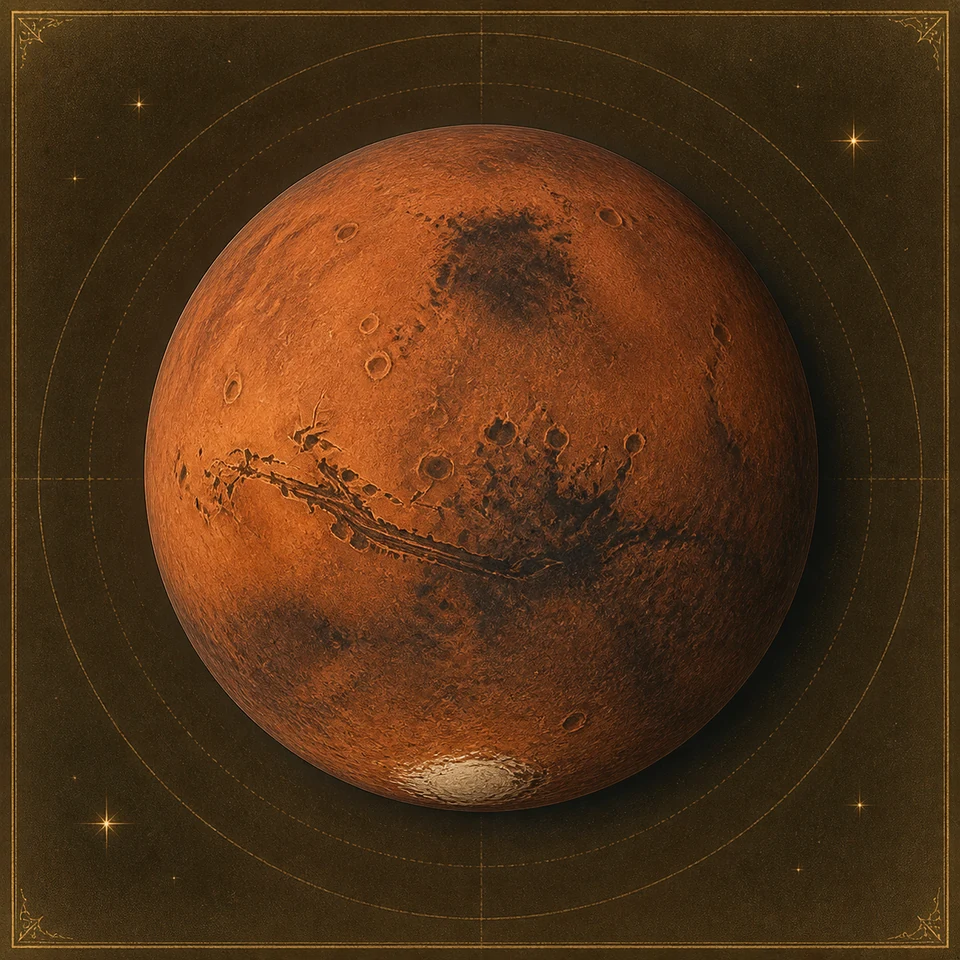
The classical planet Mars in historical correspondence systems.
Overview
Mars is the red classical planet of force, contest, severing, heat, and decisive motion. Ptolemy describes it as strongly hot and dry, classifies it as malefic, and assigns it Aries and Scorpio. Renaissance and Solomonic sources connect it with martial plants and stones, Tuesday, iron, and red.
Historical and Astrological Context
Historical astrology reads Mars through its visible redness and forceful symbolism. Ptolemy’s planetary doctrine, Agrippa’s natural correspondences, Culpeper’s herb attributions, and Solomonic tables are separate witnesses within that broader martial tradition.
Traditional and Modern Rulerships
Ptolemy assigns Aries and Scorpio to Mars in Book I, Chapter XX. Modern Western astrology may add Pluto as a co-ruler of Scorpio, but that twentieth-century convention does not remove the older Mars relationship.
Traditional Qualities
Ptolemy gives Mars drying power and strong heat, and places it among the malefics. “Malefic” is retained as a technical historical term for difficult influence, not as a claim that the planet is morally evil.
Plants, Stones, Metals, and Ritual Materials
Agrippa associates Mars with fire, garlic, bay, dogwood, gum ammoniac, diamond, magnetite, bloodstone, and amethyst. Nettle has cross-source martial support. The Key of Solomon connects Mars with Tuesday, iron, and red.
Modern Practice
Martial work may emphasize courage, boundaries, defense, competition, cutting away, and disciplined action. Physical materials remain governed by their own safety records; a symbolic martial connection never authorizes ingestion or unsafe burning.
Identity Boundary
Mars the planet and Mars the Roman deity are separate records despite their shared name. The collision note protects identity without manufacturing a deity recommendation.
Safety and Physical Boundaries
Planetary records describe symbolic and historical relationships. They do not authorize ingestion, burning, topical use, or handling of connected materials. Each physical entity carries its own safety review, and hazardous records are excluded from default ritual candidates.
Sources
Claudius Ptolemy, Tetrabiblos; Heinrich Cornelius Agrippa, Three Books of Occult Philosophy; Nicholas Culpeper, The Complete Herbal; S. L. MacGregor Mathers, The Key of Solomon.
Direct connections and evidence
Explicit Source
element under Mars
1 attestation · high confidence
- Heinrich Cornelius Agrippa, Three Books of Occult Philosophy, Book OneBook One, English edition based on the 1651 J. F. translation · Library of Congress · Renaissance Europe, c. 1533 · Renaissance Europe · Book Book One · Chapter XXVII · Section Of those things which are under the power of Mars · Page 101-102
Explicit Source
plant or tree under Mars
1 attestation · high confidence
- Heinrich Cornelius Agrippa, Three Books of Occult Philosophy, Book OneBook One, English edition based on the 1651 J. F. translation · Library of Congress · Renaissance Europe, c. 1533 · Renaissance Europe · Book Book One · Chapter XXVII · Section Of those things which are under the power of Mars · Page 101-102
Explicit Source
plant or tree under Mars
1 attestation · high confidence
- Heinrich Cornelius Agrippa, Three Books of Occult Philosophy, Book OneBook One, English edition based on the 1651 J. F. translation · Library of Congress · Renaissance Europe, c. 1533 · Renaissance Europe · Book Book One · Chapter XXVII · Section Of those things which are under the power of Mars · Page 101-102
Explicit Source
plant or tree under Mars
1 attestation · high confidence
- Heinrich Cornelius Agrippa, Three Books of Occult Philosophy, Book OneBook One, English edition based on the 1651 J. F. translation · Library of Congress · Renaissance Europe, c. 1533 · Renaissance Europe · Book Book One · Chapter XXVII · Section Of those things which are under the power of Mars · Page 101-102
Explicit Source
aromatic material under Mars
1 attestation · high confidence
- Heinrich Cornelius Agrippa, Three Books of Occult Philosophy, Book OneBook One, English edition based on the 1651 J. F. translation · Library of Congress · Renaissance Europe, c. 1533 · Renaissance Europe · Book Book One · Chapter XXVII · Section Of those things which are under the power of Mars · Page 101-102
Explicit Source
stone under Mars
1 attestation · high confidence
- Heinrich Cornelius Agrippa, Three Books of Occult Philosophy, Book OneBook One, English edition based on the 1651 J. F. translation · Library of Congress · Renaissance Europe, c. 1533 · Renaissance Europe · Book Book One · Chapter XXVII · Section Of those things which are under the power of Mars · Page 101-102
Explicit Source
stone under Mars
1 attestation · high confidence
- Heinrich Cornelius Agrippa, Three Books of Occult Philosophy, Book OneBook One, English edition based on the 1651 J. F. translation · Library of Congress · Renaissance Europe, c. 1533 · Renaissance Europe · Book Book One · Chapter XXVII · Section Of those things which are under the power of Mars · Page 101-102
Explicit Source
stone under Mars
1 attestation · high confidence
- Heinrich Cornelius Agrippa, Three Books of Occult Philosophy, Book OneBook One, English edition based on the 1651 J. F. translation · Library of Congress · Renaissance Europe, c. 1533 · Renaissance Europe · Book Book One · Chapter XXVII · Section Of those things which are under the power of Mars · Page 101-102
Explicit Source
stone under Mars
1 attestation · high confidence
- Heinrich Cornelius Agrippa, Three Books of Occult Philosophy, Book OneBook One, English edition based on the 1651 J. F. translation · Library of Congress · Renaissance Europe, c. 1533 · Renaissance Europe · Book Book One · Chapter XXVII · Section Of those things which are under the power of Mars · Page 101-102
Cross Source
plant associated with Mars
2 attestations · high confidence
- Heinrich Cornelius Agrippa, Three Books of Occult Philosophy, Book OneBook One, English edition based on the 1651 J. F. translation · Library of Congress · Renaissance Europe, c. 1533 · Renaissance Europe · Book Book One · Chapter XXVII · Section Of those things which are under the power of Mars · Page 101-102
- Nicholas Culpeper, The Complete HerbalNew edition with additions by Thomas Kelly · Project Gutenberg · Seventeenth-century England · England · Entry Nettles · Section Government and virtues · Page 127-128
Explicit Source
weekday of Mars
1 attestation · high confidence
- S. L. MacGregor Mathers, translator and editor, The Key of Solomon the King (Clavicula Salomonis)First edition · Wellcome Collection · British occult revival, 1889 edition · Britain · Section Table of the Archangels, Angels, Metals, Days of the Week, and Colours attributed to each Planet · Page 8 · Table Days and planets
Explicit Source
metal ruled by Mars
1 attestation · high confidence
- S. L. MacGregor Mathers, translator and editor, The Key of Solomon the King (Clavicula Salomonis)First edition · Wellcome Collection · British occult revival, 1889 edition · Britain · Book Book I · Chapter XVIII · Section Concerning the Holy Pentacles or Medals · Page 56
Explicit Source
color ruled by Mars
1 attestation · high confidence
- S. L. MacGregor Mathers, translator and editor, The Key of Solomon the King (Clavicula Salomonis)First edition · Wellcome Collection · British occult revival, 1889 edition · Britain · Book Book I · Chapter XVIII · Section Concerning the Holy Pentacles or Medals · Page 56-57
Explicit Source
traditional ruler of Aries
Classical domicile rulership recorded directly from Ptolemy; later and modern co-rulership layers remain separate.
1 attestation · high confidence
- Claudius Ptolemy; J. M. Ashmand, translator, Tetrabiblos; or, QuadripartiteW. Foulsham 1900 printing of Ashmand’s 1822 English version · Project Gutenberg · Second century CE · Roman Egypt · Book Book I · Chapter Chapter XX — The Houses of the Planets · Section The Houses of the Planets · Page 28–29
Explicit Source
traditional ruler of Scorpio
Classical domicile rulership recorded directly from Ptolemy; later and modern co-rulership layers remain separate.
1 attestation · high confidence
- Claudius Ptolemy; J. M. Ashmand, translator, Tetrabiblos; or, QuadripartiteW. Foulsham 1900 printing of Ashmand’s 1822 English version · Project Gutenberg · Second century CE · Roman Egypt · Book Book I · Chapter Chapter XX — The Houses of the Planets · Section The Houses of the Planets · Page 28–29
Explicit Source
A late Greek hymn places the fiery sphere of Ares among the wandering stars
The likely fifth-century AD hymn cannot establish an Archaic or Classical planetary cult correspondence.
1 attestation · high confidence
- Anonymous Homeric Hymns; edited and translated by Hugh G. Evelyn-White, Homeric HymnsHugh G. Evelyn-White edition and English translation in Hesiod, the Homeric Hymns and Homerica, 1914 · translated by Hugh G. Evelyn-White · edited by Hugh G. Evelyn-White · Perseus Digital Library / Scaife ATLAS · Late Antique Greek world · Ancient Greece · Hymn 8 · Line 1-17
Reviewed sources
- Heinrich Cornelius Agrippa, Three Books of Occult Philosophy, Book One (1898)Book One, English edition based on the 1651 J. F. translation · Library of Congress
- Nicholas Culpeper, The Complete Herbal (1850)New edition with additions by Thomas Kelly · Project Gutenberg
- S. L. MacGregor Mathers, translator and editor, The Key of Solomon the King (Clavicula Salomonis) (1889)First edition · Wellcome Collection
- Claudius Ptolemy; J. M. Ashmand, translator, Tetrabiblos; or, Quadripartite (1900)W. Foulsham 1900 printing of Ashmand’s 1822 English version · Project Gutenberg
- Anonymous Homeric Hymns; edited and translated by Hugh G. Evelyn-White, Homeric Hymns (1914)Hesiod, the Homeric Hymns and Homerica, London and New York, 1914 · Perseus Digital Library / Scaife ATLAS