
Greek · God or goddess · Certain
Ares
Ἄρης · Árēs
Pronunciation: /á.rɛːs/ · AH-rehss
Research and editorial review by Cody Manes · Reviewed 2026-08-29
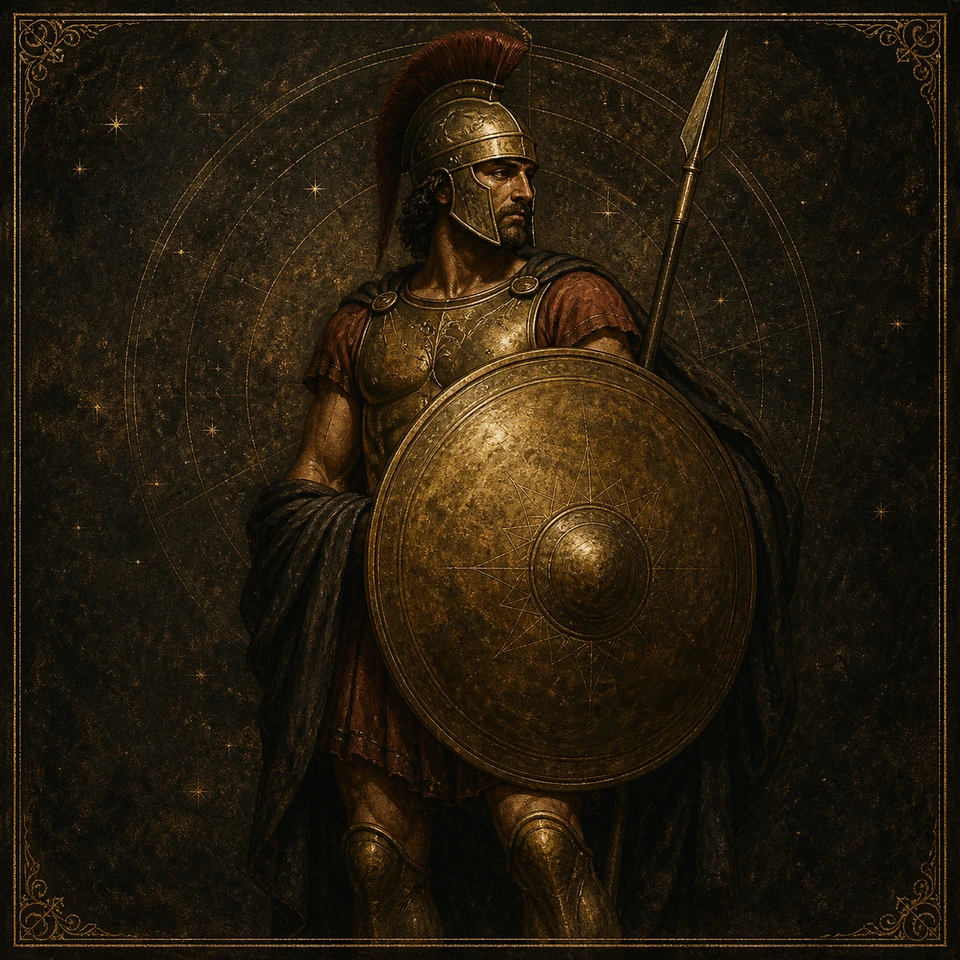
Embodying the chaotic din and staggering bodily cost of ancient warfare, Ares channels courage and grief in equal measure. Though epic poetry portrays him as a combatant capable of suffering wounds, diverse local cults honored him through deeply rooted defensive and civic rites that defy simple categorization.
Overview
Ares is not war seen from a clean map. He is the moment the line breaks, the bronze edge close enough to smell, the courage that keeps a body standing, and the fury that can drag courage past its limit. Greek poetry lets him roar with the force of armies, yet it also wounds him, traps him, mocks him, and forces him to face the cost of violence. That tension makes him far more than the blunt villain of modern retellings.
His oldest secure trace is almost painfully small. On a Linear B tablet from Knossos, the form a-re appears in the dative among divine recipients of oil in a record connected with Amnisos. A single administrative line cannot tell us what stories were told, what image stood in a sanctuary, or whether the god already carried every later war function. It does show that a divine recipient bearing the name was honored in Mycenaean Crete. Another tablet may preserve the name, or merely a person's name, and remains unresolved.
By the time of the Iliad, Ares is unmistakable. He enters battle on the Trojan side and discovers that divine flesh is not beyond pain. Athena guides Diomedes' spear into him; Ares screams and retreats to Olympus. Later, news of his son Ascalaphus' death drives him toward reckless vengeance until Athena halts him. When gods fight beside the Scamander, Athena knocks him down again. These scenes are not an argument that Ares is weak. They make war itself answerable to limits, strategy, kinship, grief, and the wills of other gods.
The myths keep returning to containment. Otus and Ephialtes shut Ares in a bronze jar for thirteen months until Hermes rescues him. Hephaestus catches Ares and Aphrodite in an invisible net and displays them before the gods. Heracles kills Cycnus and wounds the father who rushes into the fight. Ares can embody violence without controlling every outcome of violence.
Cult tells a different, quieter story. Ares had sanctuaries, images, local titles, and civic meanings. Pausanias saw his temple in the Athenian Agora. At Geronthrae, an annual festival in his grove excluded men. Tegea remembered him through victory and local epithets. Thebes placed his dragon at the spring where Cadmus came for water, turning a place of foundation into a place of killing, service, and eventual marriage to Harmonia. These cults were local, not interchangeable pieces of one ritual system.
Ancient art resists one fixed appearance. Attic vases arm Ares with helmet, shield, and spear in the struggle around Cycnus. On the Parthenon East Frieze, he sits among the gods with one knee drawn up and a foot against his spear shaft. The weapon remains, but the body is held in ceremonial stillness. Ares can be battle in motion and force contained.
The later Hymn to Ares offers a final turn. Probably composed in the fifth century AD, it addresses a fiery planetary power and asks for boldness, calm strength, peace, and restraint. This is late reception, not Archaic religion, yet it understands the older god's deepest problem: the force needed to meet danger is also the force that must be governed. Ares stands where courage, rage, loyalty, grief, and bodily peril become impossible to separate.
Canonical identity
Canonical Identity
Ares defies a compact definition despite the hard, abrupt sound of his name. The earliest secure trace of his existence may date to Mycenaean Crete, where Knossos tablet Fp 14 records oil allocated to "a-re" among divine recipients in an Amnisos setting. While this confirms his status as a divine recipient of cult allocation, it does not mean he already possessed the full array of roles, epithets, or stories found in later Greek sources. He is securely a Greek god, and while he occasionally shares battle language with Enyalios, treating the two names as permanent synonyms would erase the distinct local and historical differences preserved in the evidence.
Linguistic Identity
The ancient Greek form is Ἄρης, which transliterates as Árēs. A careful fifth-century Attic reconstruction yields /á.rɛːs/ (approximately AH-rehss), characterized by a long open second vowel. This ancient articulation differs significantly from modern Greek pronunciation, while current English usage follows its own separate historical development. Another Mycenaean tablet, KN Mc 4462, remains unresolved regarding whether it contains the divine name or merely a personal one.
Sources and evidence
SCHOLARLY INTERPRETATION · Supported
The ancient Greek name is Ἄρης, transliterated Árēs.
- Source
- Berlin-Brandenburg Academy of Sciences and Humanities, Ἄρης
- Reviewed edition
- Live academic digital lemma reviewed 2026-08-29 · Corpus Lexicographorum Graecorum Digital
- Exact locator
- Entry lemma Ἄρης
- Scope
- Classical Greece · Ancient Greece
- Authority
- academic digital lexicon
- Certainty
- Secure within the cited witness
Supports the written name and transliteration; it does not by itself establish pronunciation, function, or cult history.
Open exact reviewed sourceSCHOLARLY INTERPRETATION · Supported
A reconstructed fifth-century Attic pronunciation is /á.rɛːs/, rendered approximately AH-rehss with a long open second vowel and pitch accent on the first syllable.
- Source
- Wiktionary contributors, Ἄρης
- Reviewed edition
- Live Ancient Greek lexical entry reviewed 2026-08-29, revision 92159545 · Wiktionary
- Exact locator
- Entry Ancient Greek pronunciation sequence
- Scope
- Classical Greece · Athens
- Authority
- lexical pronunciation reference cross-checked against academic phonology
- Certainty
- Qualified reconstruction
A period-specific reconstruction for fifth-century BC Attic, not a universal ancient, modern Greek, or English pronunciation.
Open exact reviewed sourceINSCRIPTIONAL · Supported
The Linear B form a-re appears as a divine recipient of oil on Knossos tablet Fp 14, but the tablet does not establish the full later personality or war functions of Ares.
- Source
- Joann Gulizio, A-re in the Linear B Tablets and the Continuity of the Cult of Ares in the Historical Period (2001)
- Reviewed edition
- Journal of Prehistoric Religion 15, 2001, printed pages 32-38 · Program in Aegean Scripts and Prehistory, The University of Texas at Austin
- Exact locator
- Tablet KN Fp 14 · Page 33-34
- Scope
- Mycenaean Greece · Knossos
- Authority
- peer-reviewed epigraphic scholarship
- Certainty
- Secure recipient identification, later continuity qualified
The tablet secures a divine recipient and an oil allotment, not uninterrupted continuity with every later myth and function.
Open exact reviewed sourceSCHOLARLY INTERPRETATION · Supported
Ares and Enyalios overlap in some Greek literary and cult settings, yet the surviving evidence also gives Enyalios a distinct cultic identity, so the names cannot be treated as universal aliases.
- Source
- Alexander T. Millington, War and the Warrior: Functions of Ares in Literature and Cult (2014)
- Reviewed edition
- Corrected doctoral thesis PDF, submitted for the UCL PhD in History in 2013 and catalogued by UCL Discovery in 2014 · UCL Discovery
- Exact locator
- Page 120; 214-230
- Scope
- Classical Greece · Ancient Greece
- Authority
- doctoral specialist scholarship
- Certainty
- Context-dependent distinction
Overlap with Enyalios varies by witness; distinct cult evidence prevents a permanent identity merge.
Open exact reviewed source4 reviewed sources for this section
- Berlin-Brandenburg Academy of Sciences and Humanities, ἌρηςCorpus Lexicographorum Graecorum Digital, live lemma · Corpus Lexicographorum Graecorum Digital
- Wiktionary contributors, ἌρηςLive Ancient Greek lexical entry · Wiktionary
- Joann Gulizio, A-re in the Linear B Tablets and the Continuity of the Cult of Ares in the Historical Period (2001)Journal of Prehistoric Religion 15, pages 32-38 · Program in Aegean Scripts and Prehistory, The University of Texas at Austin
- Alexander T. Millington, War and the Warrior: Functions of Ares in Literature and Cult (2014)Doctoral thesis, corrected open-access PDF; submitted 2013 and catalogued 2014 · UCL Discovery
Culture, tradition, period, and place
Ares belongs to ancient Greek religion across a long and uneven history, from a Mycenaean tablet to epic poetry, Classical monuments, local sanctuaries, Roman-imperial travel accounts, and a late antique hymn. Those layers do not speak with one voice.
The Mycenaean record points to Knossos and Amnisos. Archaic poetry gives the god a vast narrative body, loud enough to shake the field yet vulnerable to wounds, traps, and rebuke. Classical Athens seats him among the gods on the Parthenon and develops civic associations around the Areopagus. Pausanias, writing in the second century AD, finds different Ares traditions in Athens, Laconia, Arcadia, and Boeotia. A late lexicon remembers Biennos in Crete, but from centuries after the Classical age.
Ares was never only an idea called war. He was encountered through particular cities, landscapes, poems, images, and community memories. The differences between those places are part of his history.
Sources and evidence
INSCRIPTIONAL · Supported
Knossos tablet Fp 14 places the oil allotment to a-re within a record connected with Amnisos, anchoring the earliest secure cult context in Mycenaean Crete.
- Source
- Joann Gulizio, A-re in the Linear B Tablets and the Continuity of the Cult of Ares in the Historical Period (2001)
- Reviewed edition
- Journal of Prehistoric Religion 15, 2001, printed pages 32-38 · Program in Aegean Scripts and Prehistory, The University of Texas at Austin
- Exact locator
- Tablet KN Fp 14 · Page 33
- Scope
- Mycenaean Greece · Amnisos
- Authority
- peer-reviewed epigraphic scholarship
- Certainty
- Secure within the cited witness
The administrative context anchors the allotment geographically but does not reveal a sanctuary plan or full ritual sequence.
Open exact reviewed sourceTEXTUAL · Supported
Ares was honored in locally distinct Greek settings, including Athens, Laconia, Arcadia, and Boeotia, rather than through one uniform cult shared everywhere.
- Source
- Pausanias; Spiro Greek edition and Jones/Ormerod translation volumes, Description of Greece (1935)
- Reviewed edition
- Spiro Greek edition and Jones/Ormerod English volumes represented by the Perseus CTS corpus, 1903-1935 · translated by W. H. S. Jones and H. A. Ormerod, volume-dependent · edited by Friedrich Spiro for the Greek edition · Perseus Digital Library / Scaife ATLAS
- Exact locator
- Section 1.8.4; 1.28.5; 3.22.6-7; 8.48.4-5; 9.10.5
- Scope
- Greek religion under Roman imperial rule · Ancient Greece
- Authority
- primary travel and cult description
- Certainty
- Secure within the cited witness
Athens, Laconia, Arcadia, and Boeotia preserve different local evidence that must not be collapsed into one cult system.
Open exact reviewed source2 reviewed sources for this section
- Joann Gulizio, A-re in the Linear B Tablets and the Continuity of the Cult of Ares in the Historical Period (2001)Journal of Prehistoric Religion 15, pages 32-38 · Program in Aegean Scripts and Prehistory, The University of Texas at Austin
- Pausanias; Spiro Greek edition and Jones/Ormerod translation volumes, Description of Greece (1935)Perseus CTS edition corpus, 1903-1935 · Perseus Digital Library / Scaife ATLAS
Historical development
The first secure cult trace is spare: a name in Linear B and an oil allotment. Centuries later, the Homeric and Hesiodic poems reveal a fully articulated divine figure. Hesiod places Ares among the children of Zeus and Hera. The Iliad gives him battle force, wounded flesh, furious grief, and the humiliating knowledge that even a god of war can be restrained.
Material and civic visibility changes by place and period. In Athens, Ares becomes more prominent from the fourth century BC onward, while the Parthenon frieze had already shown him seated among the Olympians in the fifth. Local cults preserve other faces: an annual women-only observance at Geronthrae, victory memory at Tegea, a dragon and spring at Thebes, and a judicial foundation story at the Areopagus.
Later Greek and Roman authors connect Ares to Mars. That comparison became culturally powerful, but it did not erase the Roman god's separate civic and ancestral life. The historical story is therefore expansion and translation, not a straight line from one timeless war god.
Sources and evidence
TEXTUAL · Supported
Hesiod names Ares as a child of Zeus and Hera in the divine genealogy.
- Source
- Hesiod; edited and translated by Hugh G. Evelyn-White, Theogony (1914)
- Reviewed edition
- Hugh G. Evelyn-White edition and English translation in Hesiod, the Homeric Hymns and Homerica, 1914 · translated by Hugh G. Evelyn-White · edited by Hugh G. Evelyn-White · Perseus Digital Library / Scaife ATLAS
- Exact locator
- Entry Theogony · Line 921-923
- Scope
- Archaic Greece · Ancient Greece
- Authority
- primary text
- Certainty
- Secure within the cited witness
This is Hesiodic poetic genealogy and does not show that every local cult foregrounded the same family relationship.
Open exact reviewed sourceSCHOLARLY INTERPRETATION · Supported
Ares becomes more visible in Athenian civic and monumental contexts from the fourth century BC onward, while earlier evidence remains thinner and more contested.
- Source
- Alexander T. Millington, War and the Warrior: Functions of Ares in Literature and Cult (2014)
- Reviewed edition
- Corrected doctoral thesis PDF, submitted for the UCL PhD in History in 2013 and catalogued by UCL Discovery in 2014 · UCL Discovery
- Exact locator
- Page 169-177
- Scope
- Classical Greece · Athens
- Authority
- doctoral specialist scholarship
- Certainty
- Qualified historical synthesis
The statement describes visibility in surviving Athenian evidence, not proof that earlier worship was absent.
Open exact reviewed sourceSCHOLARLY INTERPRETATION · Supported
Roman writers and artists assimilated Ares to Mars, but Mars retained a separate Roman cult history and civic range, so the Greek and Roman figures remain separate records.
- Source
- Nancy L. Thompson, Roman Art: A Resource for Educators (2007)
- Reviewed edition
- Nancy L. Thompson, Roman Art: A Resource for Educators, The Metropolitan Museum of Art, 2007 · The Metropolitan Museum of Art
- Exact locator
- Page 89-90
- Scope
- Greek religion under Roman imperial rule · Ancient Greece
- Authority
- museum scholarly publication
- Certainty
- Secure within the cited witness
Historical assimilation supports comparison while requiring Greek Ares and Roman Mars to remain separately addressable.
Open exact reviewed source3 reviewed sources for this section
- Hesiod; edited and translated by Hugh G. Evelyn-White, Theogony (1914)Hesiod, the Homeric Hymns and Homerica, London and New York, 1914 · Perseus Digital Library / Scaife ATLAS
- Alexander T. Millington, War and the Warrior: Functions of Ares in Literature and Cult (2014)Doctoral thesis, corrected open-access PDF; submitted 2013 and catalogued 2014 · UCL Discovery
- Nancy L. Thompson, Roman Art: A Resource for Educators (2007)The Metropolitan Museum of Art, 2007 · The Metropolitan Museum of Art
Attested roles and historical themes
Roles, powers, and limits
Ares is the nearness of battle: bronze at arm's length, dust in the mouth, courage tipping toward rage, and grief demanding immediate blood. Epic does not make him an abstract commander watching safely from above. He enters the field. Diomedes wounds him with Athena's help, and his cry fills the poem like the roar of armies. When Ascalaphus dies, Ares strikes his thighs and rushes toward revenge until Athena forces him to stop.
That volatility is not the whole god. The late Hymn to Ares asks him for boldness, calm strength, peace, and the ability to restrain destructive impulse. The prayer understands that martial power without measure consumes its bearer. Local cult likewise places Ares within cities, victory memories, sacred precincts, and regulated festivals.
His limits are as revealing as his force. He can be trapped, wounded, carried from battle, mocked, and overruled. Greek myth makes war dreadful partly by refusing to make its god invincible.
Sources and evidence
TEXTUAL · Supported
In Iliad 5, Ares enters the fighting on the Trojan side and is wounded by Diomedes with Athena's aid, showing divine ferocity and divine vulnerability in the same scene.
- Source
- Homer; Monro and Allen Greek edition with edition-specific translations, Iliad (1920)
- Reviewed edition
- Monro and Allen Greek edition represented by the Perseus CTS corpus, Oxford, 1908-1920 · edited by David Binning Monro and Thomas William Allen · Perseus Digital Library / Scaife ATLAS
- Exact locator
- Book 5 · Line 826-909
- Scope
- Archaic Greece · Ancient Greece
- Authority
- primary text
- Certainty
- Secure within the cited witness
An epic scene of divine vulnerability, not a cult statement or a simple verdict that Ares is weak.
Open exact reviewed sourceTEXTUAL · Supported
When Ascalaphus is killed, Iliad 15 lets Ares hear the news, strike his thighs, and rush toward vengeance until Athena stops him.
- Source
- Homer; Monro and Allen Greek edition with edition-specific translations, Iliad (1920)
- Reviewed edition
- Monro and Allen Greek edition represented by the Perseus CTS corpus, Oxford, 1908-1920 · edited by David Binning Monro and Thomas William Allen · Perseus Digital Library / Scaife ATLAS
- Exact locator
- Book 15 · Line 104-142
- Scope
- Archaic Greece · Ancient Greece
- Authority
- primary text
- Certainty
- Secure within the cited witness
The passage gives Ares a father's grief in one episode without making bereavement his universal function.
Open exact reviewed sourceTEXTUAL · Supported
The late Homeric Hymn to Ares asks for courage, calm strength, and the power to restrain destructive fury, presenting warfare's god as one whose force must be governed.
- Source
- Anonymous Homeric Hymns; edited and translated by Hugh G. Evelyn-White, Homeric Hymns (1914)
- Reviewed edition
- Hugh G. Evelyn-White edition and English translation in Hesiod, the Homeric Hymns and Homerica, 1914 · translated by Hugh G. Evelyn-White · edited by Hugh G. Evelyn-White · Perseus Digital Library / Scaife ATLAS
- Exact locator
- Hymn 8 · Line 1-17
- Scope
- Late Antique Greek world · Ancient Greece
- Authority
- primary text
- Certainty
- Secure hymn text, late chronology emphasized
The prayer belongs to late antiquity and must not be projected backward into Mycenaean, Archaic, or Classical cult.
Open exact reviewed source2 reviewed sources for this section
- Homer; Monro and Allen Greek edition with edition-specific translations, Iliad (1920)Perseus CTS edition corpus; Greek edition, Oxford, 1908-1920 · Perseus Digital Library / Scaife ATLAS
- Anonymous Homeric Hymns; edited and translated by Hugh G. Evelyn-White, Homeric Hymns (1914)Hesiod, the Homeric Hymns and Homerica, London and New York, 1914 · Perseus Digital Library / Scaife ATLAS
Epithets and titles
Cult Epithet
Gynaikothoinas
Γυναικοθοίνας · Feasted by women
Tegea in Arcadia · Local tradition recorded by PausaniasAttached to a Tegean victory tradition and kept separate from modern speculation about ritual reconstruction.
2 reviewed sources for this section
- Pausanias; Spiro Greek edition and Jones/Ormerod translation volumes, Description of Greece (1935)Perseus CTS edition corpus, 1903-1935 · Perseus Digital Library / Scaife ATLAS
- Alexander T. Millington, War and the Warrior: Functions of Ares in Literature and Cult (2014)Doctoral thesis, corrected open-access PDF; submitted 2013 and catalogued 2014 · UCL Discovery
Cult Epithet
Aphneios
Ἀφνειός · Abundant or wealthy
Tegea in Arcadia · Local tradition recorded by PausaniasLocal Tegean title tied to the story Pausanias reports; its meaning is not generalized across Greek cult.
2 reviewed sources for this section
- Pausanias; Spiro Greek edition and Jones/Ormerod translation volumes, Description of Greece (1935)Perseus CTS edition corpus, 1903-1935 · Perseus Digital Library / Scaife ATLAS
- Alexander T. Millington, War and the Warrior: Functions of Ares in Literature and Cult (2014)Doctoral thesis, corrected open-access PDF; submitted 2013 and catalogued 2014 · UCL Discovery
Worship and cult
Cultic Ares is quieter and more local than the thunder of epic. Pausanias saw a temple in the Athenian Agora with Ares set among a sculptural company that included Aphrodite, Athena, and Enyo. At Geronthrae in Laconia, a sanctuary and grove held an annual festival that excluded men. At Tegea, local stories attached Ares to victory and to the titles Gynaikothoinas and Aphneios.
These sites do not assemble into a single pan-Hellenic ritual manual. A title shaped by one city's memory cannot simply be carried to every other sanctuary. The Geronthrae restriction tells us something precise about one annual observance, not a universal rule about gender and Ares. Pausanias also writes many centuries after the earliest epics, preserving places and explanations that had already lived through long histories.
The durable lesson is that Ares received real worship, even when large temples and famous festivals were fewer than the surviving monuments of other Olympians. The evidence is dispersed, but it is not empty.
Sources and evidence
TEXTUAL · Supported
Pausanias saw a temple of Ares in the Athenian Agora and described cult images of Ares, Aphrodite, Athena, and Enyo within its sculptural setting.
- Source
- Pausanias; Spiro Greek edition and Jones/Ormerod translation volumes, Description of Greece (1935)
- Reviewed edition
- Spiro Greek edition and Jones/Ormerod English volumes represented by the Perseus CTS corpus, 1903-1935 · translated by W. H. S. Jones and H. A. Ormerod, volume-dependent · edited by Friedrich Spiro for the Greek edition · Perseus Digital Library / Scaife ATLAS
- Exact locator
- Book 1 · Section 8.4
- Scope
- Greek religion under Roman imperial rule · Athens
- Authority
- primary text
- Certainty
- Secure within the cited witness
Pausanias records the arrangement visible in his own Roman-imperial period; the notice does not settle every earlier building phase.
Open exact reviewed sourceTEXTUAL · Supported
At Geronthrae, Pausanias reports a sanctuary and grove of Ares with an annual festival from which men were excluded.
- Source
- Pausanias; Spiro Greek edition and Jones/Ormerod translation volumes, Description of Greece (1935)
- Reviewed edition
- Spiro Greek edition and Jones/Ormerod English volumes represented by the Perseus CTS corpus, 1903-1935 · translated by W. H. S. Jones and H. A. Ormerod, volume-dependent · edited by Friedrich Spiro for the Greek edition · Perseus Digital Library / Scaife ATLAS
- Exact locator
- Book 3 · Section 22.6-7
- Scope
- Greek religion under Roman imperial rule · Geronthrae
- Authority
- primary text
- Certainty
- Secure within the cited witness
The exclusion of men belongs to one annual Geronthraean observance and is not a universal rule for worship of Ares.
Open exact reviewed sourceTEXTUAL · Supported
Tegea preserved local cult titles and victory traditions for Ares, including Gynaikothoinas and Aphneios, whose meanings must remain tied to the local stories Pausanias records.
- Source
- Pausanias; Spiro Greek edition and Jones/Ormerod translation volumes, Description of Greece (1935)
- Reviewed edition
- Spiro Greek edition and Jones/Ormerod English volumes represented by the Perseus CTS corpus, 1903-1935 · translated by W. H. S. Jones and H. A. Ormerod, volume-dependent · edited by Friedrich Spiro for the Greek edition · Perseus Digital Library / Scaife ATLAS
- Exact locator
- Book 8 · Section 44.7-8; 48.4-5
- Scope
- Greek religion under Roman imperial rule · Tegea
- Authority
- primary text
- Certainty
- Secure within the cited witness
Both titles remain attached to Tegean memory rather than becoming general names or ritual instructions.
Open exact reviewed source1 reviewed source for this section
- Pausanias; Spiro Greek edition and Jones/Ormerod translation volumes, Description of Greece (1935)Perseus CTS edition corpus, 1903-1935 · Perseus Digital Library / Scaife ATLAS
Temples, sanctuaries, and sacred places
The Athenian Agora gave Ares a civic temple; the Areopagus tied his name to a hill of homicide trial and remembered judgment. At Thebes, Cadmus approaches a spring guarded by the dragon of Ares. The water source becomes the tense beginning of foundation, killing, service, and marriage.
Other landscapes belong more clearly to story than excavated cult. In Colchis, Pseudo-Apollodorus places the Golden Fleece in a grove sacred to Ares beneath a sleepless dragon. The scene smells of leaf mold, metal, and danger, but it is a mythographic setting. It does not prove that Greek worshippers reproduced such a grove as a standard sanctuary.
Geronthrae adds a sanctuary and grove with annual observance; Tegea adds local cult memory; Knossos and Amnisos preserve the oldest administrative trace. Together they show how Ares could inhabit a palace ledger, a city square, a spring, a wooded precinct, and a far eastern mythic frontier without any one place exhausting his meaning.
Sources and evidence
TEXTUAL · Supported
At Thebes in Boeotia, Pausanias places the dragon of Ares at the spring where Cadmus sought water before founding the city.
- Source
- Pausanias; Spiro Greek edition and Jones/Ormerod translation volumes, Description of Greece (1935)
- Reviewed edition
- Spiro Greek edition and Jones/Ormerod English volumes represented by the Perseus CTS corpus, 1903-1935 · translated by W. H. S. Jones and H. A. Ormerod, volume-dependent · edited by Friedrich Spiro for the Greek edition · Perseus Digital Library / Scaife ATLAS
- Exact locator
- Book 9 · Section 10.5
- Scope
- Greek religion under Roman imperial rule · Thebes in Boeotia
- Authority
- primary text
- Certainty
- Secure within the cited witness
Pausanias anchors the dragon story in Theban landscape; the notice alone does not reconstruct worship at the spring.
Open exact reviewed sourceTEXTUAL · Supported
Pseudo-Apollodorus places the Golden Fleece in a grove sacred to Ares in Colchis, guarded by a sleepless dragon; this is a mythic landscape, not a documented Greek sanctuary plan.
- Source
- Pseudo-Apollodorus; edited and translated by James G. Frazer, Library (1921)
- Reviewed edition
- James G. Frazer edition and English translation, Harvard University Press and William Heinemann, 1921 · translated by James G. Frazer · edited by James G. Frazer · Perseus Digital Library / Scaife ATLAS
- Exact locator
- Entry Library · Section 1.9.16
- Scope
- Greek religion under Roman imperial rule · Colchis
- Authority
- primary text
- Certainty
- Secure literary setting; cult status not established
A mythographic grove is narrative geography, not evidence for a standard historical sanctuary copied across Greece.
Open exact reviewed sourceTEXTUAL · Supported
Pausanias saw a temple of Ares in the Athenian Agora and described cult images of Ares, Aphrodite, Athena, and Enyo within its sculptural setting.
- Source
- Pausanias; Spiro Greek edition and Jones/Ormerod translation volumes, Description of Greece (1935)
- Reviewed edition
- Spiro Greek edition and Jones/Ormerod English volumes represented by the Perseus CTS corpus, 1903-1935 · translated by W. H. S. Jones and H. A. Ormerod, volume-dependent · edited by Friedrich Spiro for the Greek edition · Perseus Digital Library / Scaife ATLAS
- Exact locator
- Book 1 · Section 8.4
- Scope
- Greek religion under Roman imperial rule · Athens
- Authority
- primary text
- Certainty
- Secure within the cited witness
Pausanias records the arrangement visible in his own Roman-imperial period; the notice does not settle every earlier building phase.
Open exact reviewed sourceTEXTUAL · Supported
At Geronthrae, Pausanias reports a sanctuary and grove of Ares with an annual festival from which men were excluded.
- Source
- Pausanias; Spiro Greek edition and Jones/Ormerod translation volumes, Description of Greece (1935)
- Reviewed edition
- Spiro Greek edition and Jones/Ormerod English volumes represented by the Perseus CTS corpus, 1903-1935 · translated by W. H. S. Jones and H. A. Ormerod, volume-dependent · edited by Friedrich Spiro for the Greek edition · Perseus Digital Library / Scaife ATLAS
- Exact locator
- Book 3 · Section 22.6-7
- Scope
- Greek religion under Roman imperial rule · Geronthrae
- Authority
- primary text
- Certainty
- Secure within the cited witness
The exclusion of men belongs to one annual Geronthraean observance and is not a universal rule for worship of Ares.
Open exact reviewed source2 reviewed sources for this section
- Pausanias; Spiro Greek edition and Jones/Ormerod translation volumes, Description of Greece (1935)Perseus CTS edition corpus, 1903-1935 · Perseus Digital Library / Scaife ATLAS
- Pseudo-Apollodorus; edited and translated by James G. Frazer, Library (1921)Harvard University Press and William Heinemann edition, 1921 · Perseus Digital Library / Scaife ATLAS
Festivals and processions
Geronthrae supplies the clearest annual rhythm. Pausanias reports that men were forbidden to enter the grove during the festival, leaving a striking but incomplete glimpse of a women-centered observance. He does not give the calendar date, full sequence, priestly offices, or complete offering list.
A second notice comes from much later. Stephanus of Byzantium preserves a Hekatomphonia at Biennos, associated with a man who had killed one hundred enemies. The witness survives through a sixth-century AD lexicon and epitome. It cannot be treated as a Classical festival calendar, and its compact wording does not authorize reconstruction of a rite.
The absence of a famous pan-Hellenic festival is itself historically useful. Ares could be widely honored through local forms without possessing one great public celebration shared across the Greek world.
Sources and evidence
TEXTUAL · Supported
The Geronthrae observance is explicitly annual and gender-restricted in Pausanias, but he does not preserve a complete calendar date or ritual order.
- Source
- Pausanias; Spiro Greek edition and Jones/Ormerod translation volumes, Description of Greece (1935)
- Reviewed edition
- Spiro Greek edition and Jones/Ormerod English volumes represented by the Perseus CTS corpus, 1903-1935 · translated by W. H. S. Jones and H. A. Ormerod, volume-dependent · edited by Friedrich Spiro for the Greek edition · Perseus Digital Library / Scaife ATLAS
- Exact locator
- Book 3 · Section 22.6-7
- Scope
- Greek religion under Roman imperial rule · Geronthrae
- Authority
- primary text
- Certainty
- Festival attested, protocol incomplete
Annual recurrence and gender restriction are secure, while date, offices, offerings, and ritual order remain unknown.
Open exact reviewed sourceTEXTUAL · Supported
Stephanus of Byzantium preserves a late notice of a Hekatomphonia at Biennos for a man who killed one hundred enemies, but the epitomized lexicon does not establish a Classical calendar festival or a complete rite.
- Source
- Stephanus of Byzantium; edited by Margarethe Billerbeck and collaborators, Stephani Byzantii Ethnica, Volume I: Alpha-Gamma (2006)
- Reviewed edition
- Margarethe Billerbeck et al., Stephani Byzantii Ethnica, Volume I: Alpha-Gamma, De Gruyter, 2006 · De Gruyter
- Exact locator
- Entry Ethnica s.v. Βίεννος
- Scope
- Late Antique Greek world · Biennos in Crete
- Authority
- late primary lexicon in critical edition
- Certainty
- Late and epitomized witness
The late lexicon preserves a name and compressed explanation, not a complete Classical festival or usable rite.
Open exact reviewed sourceSCHOLARLY INTERPRETATION · Supported
No major pan-Hellenic public festival for Ares is securely documented before the Roman imperial evidence, despite geographically widespread traces of cult.
- Source
- Alexander T. Millington, War and the Warrior: Functions of Ares in Literature and Cult (2014)
- Reviewed edition
- Corrected doctoral thesis PDF, submitted for the UCL PhD in History in 2013 and catalogued by UCL Discovery in 2014 · UCL Discovery
- Exact locator
- Page 255-259
- Scope
- Greek religion under Roman imperial rule · Ancient Greece
- Authority
- doctoral specialist scholarship
- Certainty
- Qualified synthesis from surviving evidence
This is a reviewed documentary gap, not proof that no unrecorded local observance ever existed.
Open exact reviewed source3 reviewed sources for this section
- Pausanias; Spiro Greek edition and Jones/Ormerod translation volumes, Description of Greece (1935)Perseus CTS edition corpus, 1903-1935 · Perseus Digital Library / Scaife ATLAS
- Stephanus of Byzantium; edited by Margarethe Billerbeck and collaborators, Stephani Byzantii Ethnica, Volume I: Alpha-Gamma (2006)Critical edition, De Gruyter, 2006 · De Gruyter
- Alexander T. Millington, War and the Warrior: Functions of Ares in Literature and Cult (2014)Doctoral thesis, corrected open-access PDF; submitted 2013 and catalogued 2014 · UCL Discovery
Offerings, votives, and ritual evidence
The oldest secure offering is oil. Knossos tablet Fp 14 allots it to a-re in a list of divine recipients connected with Amnisos. The line is brief, administrative, and precious precisely because it records an actual transfer rather than a later guess about what a war god ought to receive.
Later accounts preserve sacrifice, sanctuary rules, cult images, and festival memory, but their details are local. Geronthrae's annual exclusion of men cannot be expanded into a complete ceremony. The Biennos notice cannot supply a missing ritual order. Herodotus' report of Scythian sacrifice under the Greek name Ares belongs to a Scythian religious world and must never become instruction for Greek or modern practice.
No verified ancient source supports the familiar impulse to assemble red candles, iron, blood, sharp weapons, and aggressive petitions into a supposedly timeless Ares rite. Where the record is silent, silence is more faithful than theatrical invention.
Sources and evidence
INSCRIPTIONAL · Supported
Knossos tablet Fp 14 records oil allotted to a-re among divine recipients, the clearest material offering attached to the Mycenaean name.
- Source
- Joann Gulizio, A-re in the Linear B Tablets and the Continuity of the Cult of Ares in the Historical Period (2001)
- Reviewed edition
- Journal of Prehistoric Religion 15, 2001, printed pages 32-38 · Program in Aegean Scripts and Prehistory, The University of Texas at Austin
- Exact locator
- Tablet KN Fp 14 · Page 33
- Scope
- Mycenaean Greece · Amnisos
- Authority
- peer-reviewed epigraphic scholarship
- Certainty
- Secure within the cited witness
The oil allotment is the earliest direct offering trace but does not define later Greek practice.
Open exact reviewed sourceSCHOLARLY INTERPRETATION · Supported
The ancient witnesses reviewed here do not support turning the Geronthrae festival, the Biennos notice, or Scythian sacrifice into a general modern offering formula for Ares.
- Source
- Alexander T. Millington, War and the Warrior: Functions of Ares in Literature and Cult (2014)
- Reviewed edition
- Corrected doctoral thesis PDF, submitted for the UCL PhD in History in 2013 and catalogued by UCL Discovery in 2014 · UCL Discovery
- Exact locator
- Page 214-230; 255-259
- Scope
- Modern classical scholarship · Ancient Greece
- Authority
- doctoral specialist scholarship
- Certainty
- Conservative boundary
The cited acts remain historical evidence and must not be converted into modern ritual instruction.
Open exact reviewed sourceTEXTUAL · Supported
Herodotus describes a Scythian cult through the Greek name Ares, but its sword, stick-pile sanctuary, and sacrifices belong to a Scythian religious setting and cannot be imported into Greek worship.
- Source
- Herodotus; translated by A. D. Godley, The Histories (1925)
- Reviewed edition
- A. D. Godley English translation, Loeb Classical Library volumes I-IV, 1920-1925 · translated by A. D. Godley · edited by A. D. Godley · Perseus Digital Library / Scaife ATLAS
- Exact locator
- Book 4 · Section 59; 62
- Scope
- Classical Greece · Ancient Greece
- Authority
- primary text
- Certainty
- Greek interpretatio with strict cultural boundary
Herodotus uses Greek interpretatio; the described rites remain Scythian and are not Greek or modern instructions.
Open exact reviewed source3 reviewed sources for this section
- Joann Gulizio, A-re in the Linear B Tablets and the Continuity of the Cult of Ares in the Historical Period (2001)Journal of Prehistoric Religion 15, pages 32-38 · Program in Aegean Scripts and Prehistory, The University of Texas at Austin
- Alexander T. Millington, War and the Warrior: Functions of Ares in Literature and Cult (2014)Doctoral thesis, corrected open-access PDF; submitted 2013 and catalogued 2014 · UCL Discovery
- Herodotus; translated by A. D. Godley, The Histories (1925)A. D. Godley English translation, Loeb Classical Library volumes I-IV, 1920-1925; Perseus eng2 component · Perseus Digital Library / Scaife ATLAS
Iconography and material culture
Ares is often armed, but ancient artists do not imprison him in one costume. On two Attic vases in the British Museum, he appears in the Heracles and Cycnus story with the equipment of a warrior: helmet, shield, and spear. These are narrative images made around 510 BC, not a universal portrait valid for every city and century.
The Parthenon offers a different charge. Ares sits among the gods on East Frieze Block IV. One knee is drawn up and held; a foot rests against the shaft of his spear. The weapon is present, yet the body is momentarily contained. This is readiness held inside civic ceremony, not a berserker rushing through smoke.
Acropolis Museum inventory ΜΑ ΑΝΤ. 021 helps identify the scene but must be named accurately: it is a nineteenth-century plaster replica of the ancient block. Modern fantasy often swells Ares into black armor, flames, skulls, or monstrous bulk. Those choices may be dramatic, but they are not substitutes for the surviving material record.
Sources and evidence
MATERIAL CULTURE · Supported
On the Parthenon East Frieze, Ares sits with one knee clasped while a foot rests against the shaft of his spear, a moment of contained readiness rather than battle frenzy.
- Source
- Hellenic Ministry of Culture and Acropolis Museum, Parthenon Frieze, East Frieze, Block IV
- Reviewed edition
- Official current digital record of the fifth-century BC monument · Hellenic Ministry of Culture and Acropolis Museum
- Exact locator
- Entry East Frieze IV · Section 20-27
- Scope
- Classical Greece · Athens
- Authority
- official monument record
- Certainty
- Secure within the cited witness
The seated pose belongs to this civic monument and should not be universalized as Ares' fixed appearance.
Open exact reviewed sourceMATERIAL CULTURE · Supported
British Museum amphora B202 shows an armed Ares in the Heracles and Cycnus scene, preserving helmet, shield, and spear as scene-specific iconography.
- Source
- British Museum, British Museum Collection
- Reviewed edition
- Live record-level official museum collection · British Museum
- Exact locator
- MuseumObjectId 1843,1103.3 · Entry B202
- Scope
- Archaic Greece · Ancient Greece
- Authority
- museum object record
- Certainty
- Secure within the cited witness
This accession-level object supports scene-specific arms and costume, not a timeless portrait.
Open exact reviewed sourceMATERIAL CULTURE · Supported
British Museum kylix E8 gives another Attic image of armed Ares in the Heracles and Cycnus story, dated about 510 BC.
- Source
- British Museum, British Museum Collection
- Reviewed edition
- Live record-level official museum collection · British Museum
- Exact locator
- MuseumObjectId 1978,0411.10 · Entry E8
- Scope
- Archaic Greece · Ancient Greece
- Authority
- museum object record
- Certainty
- Secure within the cited witness
A second accession-level Cycnus scene confirms armed iconography while retaining its own object context.
Open exact reviewed sourceMATERIAL CULTURE · Supported
Acropolis Museum inventory ΜΑ ΑΝΤ. 021 is a nineteenth-century plaster replica of Parthenon East Frieze Block IV, not an ancient Ares sculpture.
- Source
- Acropolis Museum, Acropolis Museum Collections
- Reviewed edition
- Live record-level official museum collection · Acropolis Museum
- Exact locator
- Entry {"inventoryNumber":"ΜΑ ΑΝΤ. 021"}
- Scope
- Modern classical scholarship · Athens
- Authority
- museum object record
- Certainty
- Replica identification secure
The plaster cast documents modern preservation and display; ancient material evidence belongs to the original frieze block.
Open exact reviewed source3 reviewed sources for this section
- Hellenic Ministry of Culture and Acropolis Museum, Parthenon Frieze, East Frieze, Block IVOfficial digital monument record · Hellenic Ministry of Culture and Acropolis Museum
- British Museum, British Museum CollectionLive official museum collection · British Museum
- Acropolis Museum, Acropolis Museum CollectionsLive official museum collection · Acropolis Museum
Animals, plants, and embodied forms
No reviewed Greek source establishes one universal sacred animal, plant, color, gemstone, or metal for Ares. That matters because modern lists often fill these categories by association: red because of blood, iron because of weapons, wolves because of ferocity, or thorned plants because they look dangerous. Such links may feel intuitive, but intuition is not historical attestation.
Bronze weapons and armor do appear around Ares in epic and art. Their presence describes material culture and specific scenes. It does not automatically create a timeless bronze correspondence. The same rule protects animals and plants from being drafted into the god's identity merely because a modern interpreter finds them martial.
The strongest physical associations remain the spear, shield, helmet, and the disciplined or violent human body shown in particular texts and objects. Everything else stays open until a named witness closes the gap.
Sources and evidence
SCHOLARLY INTERPRETATION · Supported
The reviewed Greek textual and cult evidence does not establish one universal sacred animal or sacred plant for Ares.
- Source
- Alexander T. Millington, War and the Warrior: Functions of Ares in Literature and Cult (2014)
- Reviewed edition
- Corrected doctoral thesis PDF, submitted for the UCL PhD in History in 2013 and catalogued by UCL Discovery in 2014 · UCL Discovery
- Exact locator
- Page 8-9; 255-259
- Scope
- Modern classical scholarship · Ancient Greece
- Authority
- doctoral specialist scholarship
- Certainty
- No secure universal association found
No surviving Greek witness establishes a universal animal or plant for Ares; the absence remains an evidence gap rather than a claim of impossibility.
Open exact reviewed sourceMATERIAL CULTURE · Supported
Spear, shield, and helmet are securely attested in specific literary and material scenes, but no source makes them a universal magical tool set.
- Source
- British Museum, British Museum Collection
- Reviewed edition
- Live record-level official museum collection · British Museum
- Exact locator
- MuseumObjectId 1843,1103.3; 1978,0411.10
- Scope
- Archaic Greece · Ancient Greece
- Authority
- museum object records
- Certainty
- Secure within the cited witness
Weapons are attested attributes in particular scenes, not interchangeable magical implements.
Open exact reviewed source2 reviewed sources for this section
- Alexander T. Millington, War and the Warrior: Functions of Ares in Literature and Cult (2014)Doctoral thesis, corrected open-access PDF; submitted 2013 and catalogued 2014 · UCL Discovery
- British Museum, British Museum CollectionLive official museum collection · British Museum
Relationships and genealogy
Hesiod makes Ares a son of Zeus and Hera. That genealogy places martial force inside the Olympian household, not outside it. With Aphrodite he fathers Harmonia, Phobos, and Deimos in the Theogony. Harmony, Fear, and Dread emerge from the union of love and battle, a family arrangement more unsettling and more intelligent than a simple tale of opposites.
The Odyssey preserves another strand: Ares and Aphrodite as lovers trapped in Hephaestus' hidden net. The shared myth is comic, sexual, humiliating, and public. It is not the same witness as Hesiod's genealogy, even though the traditions touch.
The Iliad names Ascalaphus and Ialmenus as sons of Ares. Later mythography names Alcippe, Penthesilea, Cycnus, and others in separate stories. Those children do not form one tidy household. Their genealogies belong to different poems, cities, and narrative needs, and contradictions should remain visible rather than being forced into one family tree.
Sources and evidence
TEXTUAL · Supported
Hesiod makes Zeus and Hera the parents of Ares.
- Source
- Hesiod; edited and translated by Hugh G. Evelyn-White, Theogony (1914)
- Reviewed edition
- Hugh G. Evelyn-White edition and English translation in Hesiod, the Homeric Hymns and Homerica, 1914 · translated by Hugh G. Evelyn-White · edited by Hugh G. Evelyn-White · Perseus Digital Library / Scaife ATLAS
- Exact locator
- Entry Theogony · Line 921-923
- Scope
- Archaic Greece · Ancient Greece
- Authority
- primary text
- Certainty
- Secure within the cited witness
Hesiod supplies this genealogy; family connection does not by itself prove shared worship or a magical association.
Open exact reviewed sourceTEXTUAL · Supported
Hesiod names Harmonia, Phobos, and Deimos as children born from Ares and Aphrodite, while the Odyssey separately narrates the lovers caught by Hephaestus.
- Source
- Hesiod; edited and translated by Hugh G. Evelyn-White, Theogony (1914)
- Reviewed edition
- Hugh G. Evelyn-White edition and English translation in Hesiod, the Homeric Hymns and Homerica, 1914 · translated by Hugh G. Evelyn-White · edited by Hugh G. Evelyn-White · Perseus Digital Library / Scaife ATLAS
- Exact locator
- Entry Theogony · Line 933-937
- Scope
- Archaic Greece · Ancient Greece
- Authority
- primary text
- Certainty
- Secure within the cited witness
Hesiodic genealogy and the Odyssey's affair narrative are related witnesses, not one harmonized family account.
Open exact reviewed sourceTEXTUAL · Supported
The Iliad names Ascalaphus and Ialmenus as sons of Ares who lead the Minyan contingent to Troy.
- Source
- Homer; Monro and Allen Greek edition with edition-specific translations, Iliad (1920)
- Reviewed edition
- Monro and Allen Greek edition represented by the Perseus CTS corpus, Oxford, 1908-1920 · edited by David Binning Monro and Thomas William Allen · Perseus Digital Library / Scaife ATLAS
- Exact locator
- Book 2 · Line 511-516
- Scope
- Archaic Greece · Ancient Greece
- Authority
- primary text
- Certainty
- Secure within the cited witness
Epic genealogy supports parentage within the Trojan narrative without implying a separate cult relationship.
Open exact reviewed source2 reviewed sources for this section
- Hesiod; edited and translated by Hugh G. Evelyn-White, Theogony (1914)Hesiod, the Homeric Hymns and Homerica, London and New York, 1914 · Perseus Digital Library / Scaife ATLAS
- Homer; Monro and Allen Greek edition with edition-specific translations, Iliad (1920)Perseus CTS edition corpus; Greek edition, Oxford, 1908-1920 · Perseus Digital Library / Scaife ATLAS
Actual myths and source variants
Ares' myths repeatedly test what happens when force meets limit. The Aloadae shut him in a bronze jar for thirteen months until Hermes finds him nearly spent. Diomedes wounds him under Athena's guidance. Athena hurls him down again in the divine battle beside Troy. Heracles kills Cycnus and wounds the father who rushes to defend him. The god of war survives, but the stories never let him confuse violence with mastery.
Other myths bind Ares to civic order. Cadmus kills his dragon, serves him for eight years, and marries Harmonia. Alcippe's assault leads Ares to kill Halirrhothius and stand trial on the Areopagus. Penthesilea carries his lineage into the Amazon intervention at Troy. The death of Ascalaphus tears open the god's grief beneath his armor.
The net of Hephaestus adds shame and laughter. The myths do not present a single moral. They give Ares a dangerous range: lover, father, prisoner, avenger, wounded combatant, civic defendant, and source of descendants whose stories outgrow him.
Sources and evidence
TEXTUAL · Supported
Otus and Ephialtes imprison Ares in a bronze jar for thirteen months until Hermes rescues him, a story told briefly in the Iliad and retold by Pseudo-Apollodorus.
- Source
- Homer; Monro and Allen Greek edition with edition-specific translations, Iliad (1920)
- Reviewed edition
- Monro and Allen Greek edition represented by the Perseus CTS corpus, Oxford, 1908-1920 · edited by David Binning Monro and Thomas William Allen · Perseus Digital Library / Scaife ATLAS
- Exact locator
- Book 5 · Line 385-391
- Scope
- Archaic Greece · Ancient Greece
- Authority
- primary text
- Certainty
- Secure within the cited witness
The Iliad and Pseudo-Apollodorus share captivity and rescue but preserve different narrative scope.
Open exact reviewed sourceTEXTUAL · Supported
In Iliad 5, Ares enters the fighting on the Trojan side and is wounded by Diomedes with Athena's aid, showing divine ferocity and divine vulnerability in the same scene.
- Source
- Homer; Monro and Allen Greek edition with edition-specific translations, Iliad (1920)
- Reviewed edition
- Monro and Allen Greek edition represented by the Perseus CTS corpus, Oxford, 1908-1920 · edited by David Binning Monro and Thomas William Allen · Perseus Digital Library / Scaife ATLAS
- Exact locator
- Book 5 · Line 826-909
- Scope
- Archaic Greece · Ancient Greece
- Authority
- primary text
- Certainty
- Secure within the cited witness
An epic scene of divine vulnerability, not a cult statement or a simple verdict that Ares is weak.
Open exact reviewed sourceTEXTUAL · Supported
In the Shield of Heracles, Heracles kills Cycnus and wounds Ares when the god charges into the fight, after which Panic and Dread carry Ares away.
- Source
- Hesiod; edited and translated by Hugh G. Evelyn-White, Shield of Heracles (1914)
- Reviewed edition
- Hugh G. Evelyn-White edition and English translation in Hesiod, the Homeric Hymns and Homerica, 1914 · translated by Hugh G. Evelyn-White · edited by Hugh G. Evelyn-White · Perseus Digital Library / Scaife ATLAS
- Exact locator
- Line 57-114; 327-337; 349-480
- Scope
- Archaic Greece · Ancient Greece
- Authority
- primary text
- Certainty
- Secure within the cited witness
The Shield episode remains distinct from two compact later notices that may concern different sons named Cycnus.
Open exact reviewed sourceTEXTUAL · Supported
Pseudo-Apollodorus has Cadmus kill the dragon of Ares, serve Ares for eight years, and then marry Harmonia, linking violence, penance, and civic foundation.
- Source
- Pseudo-Apollodorus; edited and translated by James G. Frazer, Library (1921)
- Reviewed edition
- James G. Frazer edition and English translation, Harvard University Press and William Heinemann, 1921 · translated by James G. Frazer · edited by James G. Frazer · Perseus Digital Library / Scaife ATLAS
- Exact locator
- Entry Library · Section 3.4.1-2
- Scope
- Greek religion under Roman imperial rule · Thebes in Boeotia
- Authority
- primary text
- Certainty
- Secure within the cited witness
The full cycle is assembled transparently from mythographic, local-landscape, and genealogical witnesses.
Open exact reviewed sourceTEXTUAL · Supported
Ares kills Halirrhothius after the assault on Alcippe and is tried on the hill later called the Areopagus, according to Pseudo-Apollodorus and Pausanias.
- Source
- Pseudo-Apollodorus; edited and translated by James G. Frazer, Library (1921)
- Reviewed edition
- James G. Frazer edition and English translation, Harvard University Press and William Heinemann, 1921 · translated by James G. Frazer · edited by James G. Frazer · Perseus Digital Library / Scaife ATLAS
- Exact locator
- Entry Library · Section 3.14.2
- Scope
- Greek religion under Roman imperial rule · Athens
- Authority
- primary text
- Certainty
- Secure within the cited witness
Alcippe's assault remains the cause of the killing and must not disappear behind the courtroom aetiology.
Open exact reviewed sourceTEXTUAL · Supported
Pseudo-Apollodorus names Penthesilea, daughter of Ares, as the Amazon leader who comes to Troy and is killed by Achilles.
- Source
- Pseudo-Apollodorus; edited and translated by James G. Frazer, Library (1921)
- Reviewed edition
- James G. Frazer edition and English translation, Harvard University Press and William Heinemann, 1921 · translated by James G. Frazer · edited by James G. Frazer · Perseus Digital Library / Scaife ATLAS
- Exact locator
- Entry Epitome · Section 5.1-2
- Scope
- Greek religion under Roman imperial rule · Ancient Greece
- Authority
- primary text
- Certainty
- Secure within the cited witness
The Epitome is compact; richer later death and desire motifs require their own witnesses and are not imported here.
Open exact reviewed source3 reviewed sources for this section
- Homer; Monro and Allen Greek edition with edition-specific translations, Iliad (1920)Perseus CTS edition corpus; Greek edition, Oxford, 1908-1920 · Perseus Digital Library / Scaife ATLAS
- Hesiod; edited and translated by Hugh G. Evelyn-White, Shield of Heracles (1914)Hesiod, the Homeric Hymns and Homerica, London and New York, 1914 · Perseus Digital Library / Scaife ATLAS
- Pseudo-Apollodorus; edited and translated by James G. Frazer, Library (1921)Harvard University Press and William Heinemann edition, 1921 · Perseus Digital Library / Scaife ATLAS
Myth Library
Each myth gathers its attested participants into one source-grounded account, while distinct source traditions remain readable in their own variants.
Divine Conflict
Ares Imprisoned by the Aloadae
Otus and Ephialtes, sons of Poseidon and Iphimedeia in Pseudo-Apollodorus, imprison Ares in a bronze jar until Hermes releases him. Their wider revolt ends through Artemis ruse.
- Role in this profile
- captive god shut in the bronze jar and rescued after thirteen months
- Place scope
- Ancient Greece · Naxos
- Witnesses
- 2
- Variants
- 2
Epic Cycle
Ares in the Trojan War
Across the Iliad, Ares fights for Troy, is wounded through Athena and Diomedes, grieves for his fallen son Ascalaphus, and is cast down again when the gods enter battle.
- Role in this profile
- divine combatant aligned with Troy, wounded, bereaved, and checked
- Place scope
- Ancient Greece
- Witnesses
- 4
- Variants
- 4
Heroic Conflict
Heracles and the Sons Named Cycnus
The Shield of Heracles and later mythography preserve related but nonidentical conflicts in which Heracles kills a son of Ares named Cycnus; the Shield continues with Ares' failed intervention and wound.
- Role in this profile
- father who intervenes after Cycnus is killed and is wounded by Heracles
- Place scope
- Ancient Greece
- Witnesses
- 3
- Variants
- 3
Foundation
Cadmus and the Dragon of Ares
Cadmus kills the dragon of Ares at a Theban spring, serves the god in consequence, and marries Harmonia, bringing violence, penance, genealogy, and city foundation into one cycle.
- Role in this profile
- owner or father of the dragon and god served by Cadmus before the marriage to Harmonia
- Place scope
- Thebes in Boeotia
- Witnesses
- 3
- Variants
- 2
Aetiology
Ares, Alcippe, and the Areopagus
After Halirrhothius assaults Alcippe, Ares kills him and stands trial before the gods, a myth attached to the Athenian Areopagus and the judgment of homicide.
- Role in this profile
- father who kills Halirrhothius after the assault on Alcippe and stands trial
- Place scope
- Athens
- Witnesses
- 2
- Variants
- 2
Epic Cycle
Penthesilea at Troy
Penthesilea, Amazon daughter of Ares, comes to aid Troy after Hector's death and is killed by Achilles, carrying Ares' lineage into the final phase of the Trojan cycle.
- Role in this profile
- father of Penthesilea in the mythographic genealogy
- Place scope
- Ancient Greece
- Witnesses
- 1
- Variants
- 1
Comic Divine Conflict
Ares, Hephaestus, and the Net
Helios sees Ares and Aphrodite having sex in Hephaestus' house and tells the wronged husband. Hephaestus traps the pair in invisible bonds, exposes them to the gods, and releases them only after Poseidon guarantees that Ares will pay.
- Role in this profile
- lover trapped beside Aphrodite and released under a promised penalty
- Place scope
- Ancient Greece
- Witnesses
- 1
- Variants
- 1
Divine Performance
The Charites in Apollo's Divine Dance
Apollo’s arrival on Olympus gathers the Charites into a linked divine dance with the Horai, Harmonia, Hebe, Aphrodite, Artemis, Ares, and Hermes.
- Role in this profile
- god who joins the divine play
- Place scope
- Ancient Greece
- Witnesses
- 1
- Variants
- 1
Capture Of Death And Mortal Escape
Sisyphus Binds Thanatos
Sisyphus binds Thanatos and halts human death until the captive power is freed, with Hades and Ares preserved as conflicting release agents.
- Role in this profile
- hands Sisyphus to Death and frees Thanatos in Sommerstein’s translation
- Place scope
- Corinth
- Witnesses
- 2
- Variants
- 2
Equivalences, syncretisms, and identity boundaries
Ares and Mars became strongly identified, especially in Greek and Roman translation and art. Historical identification is real, but identity is not sameness. Mars carried Roman civic, agricultural, military, and ancestral meanings that cannot be poured backward into every Greek Ares cult. The two figures remain separately addressable.
Enyalios presents a different problem. Some sources place the name close to Ares, while cult evidence also preserves Enyalios as distinct. Each occurrence therefore has to be read in context rather than settled by a permanent alias.
Herodotus offers an even sharper boundary. He calls a Scythian god Ares while describing a stick-pile sanctuary, an iron sword, and sacrifices. His Greek naming is interpretatio, a translation across religions. It does not make Scythian practice a hidden chapter of Greek worship, nor does it authorize importing those acts into modern ritual.
Sources and evidence
SCHOLARLY INTERPRETATION · Supported
Historical assimilation linked Ares with Mars, yet the Roman god's civic, agricultural, and ancestral functions prevent a simple identity merge.
- Source
- Nancy L. Thompson, Roman Art: A Resource for Educators (2007)
- Reviewed edition
- Nancy L. Thompson, Roman Art: A Resource for Educators, The Metropolitan Museum of Art, 2007 · The Metropolitan Museum of Art
- Exact locator
- Page 89-90
- Scope
- Greek religion under Roman imperial rule · Ancient Greece
- Authority
- museum scholarly publication
- Certainty
- Secure within the cited witness
Ancient comparison and assimilation do not erase Mars' separate Roman civic, ancestral, and cult history.
Open exact reviewed sourceSCHOLARLY INTERPRETATION · Supported
Ares and Enyalios overlap in some Greek literary and cult settings, yet the surviving evidence also gives Enyalios a distinct cultic identity, so the names cannot be treated as universal aliases.
- Source
- Alexander T. Millington, War and the Warrior: Functions of Ares in Literature and Cult (2014)
- Reviewed edition
- Corrected doctoral thesis PDF, submitted for the UCL PhD in History in 2013 and catalogued by UCL Discovery in 2014 · UCL Discovery
- Exact locator
- Page 120; 214-230
- Scope
- Classical Greece · Ancient Greece
- Authority
- doctoral specialist scholarship
- Certainty
- Context-dependent distinction
Overlap with Enyalios varies by witness; distinct cult evidence prevents a permanent identity merge.
Open exact reviewed sourceTEXTUAL · Supported
Herodotus describes a Scythian cult through the Greek name Ares, but its sword, stick-pile sanctuary, and sacrifices belong to a Scythian religious setting and cannot be imported into Greek worship.
- Source
- Herodotus; translated by A. D. Godley, The Histories (1925)
- Reviewed edition
- A. D. Godley English translation, Loeb Classical Library volumes I-IV, 1920-1925 · translated by A. D. Godley · edited by A. D. Godley · Perseus Digital Library / Scaife ATLAS
- Exact locator
- Book 4 · Section 59; 62
- Scope
- Classical Greece · Ancient Greece
- Authority
- primary text
- Certainty
- Greek interpretatio with strict cultural boundary
Herodotus uses Greek interpretatio; the described rites remain Scythian and are not Greek or modern instructions.
Open exact reviewed source3 reviewed sources for this section
- Nancy L. Thompson, Roman Art: A Resource for Educators (2007)The Metropolitan Museum of Art, 2007 · The Metropolitan Museum of Art
- Alexander T. Millington, War and the Warrior: Functions of Ares in Literature and Cult (2014)Doctoral thesis, corrected open-access PDF; submitted 2013 and catalogued 2014 · UCL Discovery
- Herodotus; translated by A. D. Godley, The Histories (1925)A. D. Godley English translation, Loeb Classical Library volumes I-IV, 1920-1925; Perseus eng2 component · Perseus Digital Library / Scaife ATLAS
Correspondence index
Ares has fewer secure universal correspondences than modern charts suggest. The clearest associations are contextual. Mycenaean a-re receives oil. Geronthrae supplies an annual festival. The Parthenon and Attic vases supply spear, shield, helmet, and armed or seated postures. A late hymn places Ares' fiery sphere among the planets and prays for courage governed by restraint.
Chronology changes the meaning. Planetary language in the fifth-century AD hymn cannot be pushed back into Homeric religion. Bronze armor in a vase scene is not the same claim as a magical metal rulership. A grove in Colchis belongs to mythic landscape; it does not create a universal direction or place correspondence.
For zodiac, gemstone, plant, animal, color, classical element, weekday, moon phase, direction, incense, and universal metal links, no secure historical attestation was established. Those empty spaces are not failures. They keep later imagination from masquerading as ancient custom.
Direct ancient correspondences
| Category | Direct correspondence | How and why | Evidence boundary |
|---|---|---|---|
| festival-time | Annual festival at GeronthraeDirect historical association | Pausanias records an annual festival in the grove of Ares at Geronthrae from which men were excluded. | Ancient Cultic Geronthrae in Laconia under Pausanias' testimony 1 reviewed source for this section
|
| offering-ritual-material | OilDirect historical association | Knossos tablet Fp 14 records oil allotted to a-re among divine recipients in an Amnisos context. | Ancient Cultic Mycenaean Crete only 1 reviewed source for this section
|
Contextual evidence, not a general correspondence
| Category | Direct correspondence | How and why | Evidence boundary |
|---|---|---|---|
| celestial-body | MarsContextual evidence only | Homeric Hymn 8 places Ares' fiery sphere among the seven wandering stars. This is a late antique poetic association, not early cult evidence. | Later Historical Fifth-century AD hymn only 2 reviewed sources for this section
|
| ritual-object-symbol-tool | Spear, shield, and helmetContextual evidence only | Ancient poems and Attic images place these arms with Ares in specific scenes. They are iconographic attributes, not a universal magical kit. | Ancient Material Scene-specific Greek literary and material witnesses 2 reviewed sources for this section
|
| intention-magical-power | Courage governed by restraintContextual evidence only | Homeric Hymn 8 asks Ares for boldness, calm strength, peace, and restraint of destructive fury. | Later Historical Late antique hymn prayer, not a universal ritual promise 2 reviewed sources for this section
|
11 expected categories currently not evidenced
zodiac · Not evidenced
No secure historical zodiac link established
No known ancient Greek witness securely assigns Ares a zodiac sign.
- Layer
- Research Boundary
- Scope
- No zodiac assignment in the cited Greek evidence
gemstone-crystal-mineral · Not evidenced
No secure historical gemstone link established
No known ancient Greek witness establishes a gemstone, crystal, or mineral rulership for Ares.
- Layer
- Research Boundary
- Scope
- No gemstone or mineral rulership in the cited Greek evidence
metal-material · Not evidenced
No universal metal rulership established
Bronze weapons appear in specific texts and objects, but material presence is not a universal magical correspondence.
- Layer
- Research Boundary
- Scope
- Scene-specific material evidence only
plant-tree · Not evidenced
No secure historical sacred plant established
No known ancient Greek witness establishes one universal sacred plant for Ares.
- Layer
- Research Boundary
- Scope
- No universal plant emblem in the cited Greek evidence
animal · Not evidenced
No secure historical sacred animal established
No known ancient Greek witness establishes one universal sacred animal for Ares.
- Layer
- Research Boundary
- Scope
- No universal animal attribute in the cited Greek evidence
color · Not evidenced
No secure historical color established
Blood imagery and modern red associations do not by themselves establish an ancient color correspondence.
- Layer
- Research Boundary
- Scope
- No direct historical attestation established
classical-element · Not evidenced
No secure classical-element rulership established
Known ancient Greek evidence does not assign Ares one of the classical elements.
- Layer
- Research Boundary
- Scope
- No formal four-element rulership in the cited Greek evidence
weekday · Not evidenced
No secure historical weekday established
Later planetary weekday systems are not silently imported into ancient Greek Ares cult.
- Layer
- Research Boundary
- Scope
- Greek cult boundary
moon-phase · Not evidenced
No secure moon-phase link established
No reviewed witness links Ares to a lunar phase.
- Layer
- Research Boundary
- Scope
- No lunar timing in the cited Greek evidence
direction-place · Not evidenced
No universal direction established
Local sanctuaries and mythic landscapes do not create a universal compass direction.
- Layer
- Research Boundary
- Scope
- Place evidence remains local
incense-perfume · Not evidenced
No secure historical incense established
No known ancient Greek source establishes an incense or perfume specifically for Ares.
- Layer
- Research Boundary
- Scope
- No named incense or perfume in the cited Greek evidence
Sources and evidence
INSCRIPTIONAL · Supported
Knossos tablet Fp 14 records oil allotted to a-re among divine recipients, the clearest material offering attached to the Mycenaean name.
- Source
- Joann Gulizio, A-re in the Linear B Tablets and the Continuity of the Cult of Ares in the Historical Period (2001)
- Reviewed edition
- Journal of Prehistoric Religion 15, 2001, printed pages 32-38 · Program in Aegean Scripts and Prehistory, The University of Texas at Austin
- Exact locator
- Tablet KN Fp 14 · Page 33
- Scope
- Mycenaean Greece · Amnisos
- Authority
- peer-reviewed epigraphic scholarship
- Certainty
- Secure within the cited witness
The oil allotment is the earliest direct offering trace but does not define later Greek practice.
Open exact reviewed sourceTEXTUAL · Supported
The late Homeric Hymn to Ares places the god's fiery sphere among the seven wandering stars, a late antique literary association rather than an Archaic cult correspondence.
- Source
- Anonymous Homeric Hymns; edited and translated by Hugh G. Evelyn-White, Homeric Hymns (1914)
- Reviewed edition
- Hugh G. Evelyn-White edition and English translation in Hesiod, the Homeric Hymns and Homerica, 1914 · translated by Hugh G. Evelyn-White · edited by Hugh G. Evelyn-White · Perseus Digital Library / Scaife ATLAS
- Exact locator
- Hymn 8 · Line 1-17
- Scope
- Late Antique Greek world · Ancient Greece
- Authority
- primary text
- Certainty
- Secure late literary layer
The planet association is securely late and literary, not evidence for an early universal cult correspondence.
Open exact reviewed sourceTEXTUAL · Supported
Geronthrae provides a direct annual festival association and Biennos a separate late Hekatomphonia notice; neither can be generalized into a universal Ares calendar.
- Source
- Pausanias; Spiro Greek edition and Jones/Ormerod translation volumes, Description of Greece (1935)
- Reviewed edition
- Spiro Greek edition and Jones/Ormerod English volumes represented by the Perseus CTS corpus, 1903-1935 · translated by W. H. S. Jones and H. A. Ormerod, volume-dependent · edited by Friedrich Spiro for the Greek edition · Perseus Digital Library / Scaife ATLAS
- Exact locator
- Book 3 · Section 22.6-7
- Scope
- Greek religion under Roman imperial rule · Geronthrae
- Authority
- primary text
- Certainty
- Secure within the cited witness
Geronthrae and Biennos remain separate local and chronological layers rather than one universal calendar.
Open exact reviewed sourceMATERIAL CULTURE · Supported
Spear, shield, and helmet are securely attested in specific literary and material scenes, but no source makes them a universal magical tool set.
- Source
- British Museum, British Museum Collection
- Reviewed edition
- Live record-level official museum collection · British Museum
- Exact locator
- MuseumObjectId 1843,1103.3; 1978,0411.10
- Scope
- Archaic Greece · Ancient Greece
- Authority
- museum object records
- Certainty
- Secure within the cited witness
Weapons are attested attributes in particular scenes, not interchangeable magical implements.
Open exact reviewed sourceSCHOLARLY INTERPRETATION · Supported
The reviewed Greek textual and cult evidence does not establish one universal sacred animal or sacred plant for Ares.
- Source
- Alexander T. Millington, War and the Warrior: Functions of Ares in Literature and Cult (2014)
- Reviewed edition
- Corrected doctoral thesis PDF, submitted for the UCL PhD in History in 2013 and catalogued by UCL Discovery in 2014 · UCL Discovery
- Exact locator
- Page 8-9; 255-259
- Scope
- Modern classical scholarship · Ancient Greece
- Authority
- doctoral specialist scholarship
- Certainty
- No secure universal association found
No surviving Greek witness establishes a universal animal or plant for Ares; the absence remains an evidence gap rather than a claim of impossibility.
Open exact reviewed source5 reviewed sources for this section
- Joann Gulizio, A-re in the Linear B Tablets and the Continuity of the Cult of Ares in the Historical Period (2001)Journal of Prehistoric Religion 15, pages 32-38 · Program in Aegean Scripts and Prehistory, The University of Texas at Austin
- Anonymous Homeric Hymns; edited and translated by Hugh G. Evelyn-White, Homeric Hymns (1914)Hesiod, the Homeric Hymns and Homerica, London and New York, 1914 · Perseus Digital Library / Scaife ATLAS
- Pausanias; Spiro Greek edition and Jones/Ormerod translation volumes, Description of Greece (1935)Perseus CTS edition corpus, 1903-1935 · Perseus Digital Library / Scaife ATLAS
- British Museum, British Museum CollectionLive official museum collection · British Museum
- Alexander T. Millington, War and the Warrior: Functions of Ares in Literature and Cult (2014)Doctoral thesis, corrected open-access PDF; submitted 2013 and catalogued 2014 · UCL Discovery
Later reception and living significance
The strongest ancient afterlife of Ares runs through his assimilation to Mars. Roman translation amplified the pair in literature and art, while the differences in cult and civic meaning remained. In late antiquity, the Hymn to Ares recast martial power in cosmic and ethical language. Its speaker does not beg for unchecked fury. He asks for courage, peace, and command over the impulses that drive a person toward violence.
Modern novels, games, films, and art often choose a simpler figure: a brutal villain in black armor, the embodiment of bloodlust, or a loud foil to Athena's strategy. Greek sources are harsher and stranger. Ares can be terrifying, but he can also grieve, love, suffer humiliation, protect local communities, and embody the need to restrain the very force he brings.
No accountable contemporary community source was established for a living devotional rite specific to Ares. Modern spiritual claims therefore remain unasserted here rather than being dressed as ancient inheritance.
Sources and evidence
SCHOLARLY INTERPRETATION · Supported
Roman writers and artists assimilated Ares to Mars, but Mars retained a separate Roman cult history and civic range, so the Greek and Roman figures remain separate records.
- Source
- Nancy L. Thompson, Roman Art: A Resource for Educators (2007)
- Reviewed edition
- Nancy L. Thompson, Roman Art: A Resource for Educators, The Metropolitan Museum of Art, 2007 · The Metropolitan Museum of Art
- Exact locator
- Page 89-90
- Scope
- Greek religion under Roman imperial rule · Ancient Greece
- Authority
- museum scholarly publication
- Certainty
- Secure within the cited witness
Historical assimilation supports comparison while requiring Greek Ares and Roman Mars to remain separately addressable.
Open exact reviewed sourceSCHOLARLY INTERPRETATION · Supported
The Hymn to Ares is probably a fifth-century AD composition, so its planet language and prayer for self-command belong to late reception rather than the earliest Greek cult.
- Source
- Alexander T. Millington, War and the Warrior: Functions of Ares in Literature and Cult (2014)
- Reviewed edition
- Corrected doctoral thesis PDF, submitted for the UCL PhD in History in 2013 and catalogued by UCL Discovery in 2014 · UCL Discovery
- Exact locator
- Page 75
- Scope
- Late Antique Greek world · Ancient Greece
- Authority
- doctoral specialist scholarship
- Certainty
- Qualified scholarly dating
The probable fifth-century AD dating places the hymn within late reception and keeps its cosmic language out of earlier cult.
Open exact reviewed sourceSCHOLARLY INTERPRETATION · Supported
No accountable contemporary community source was established for a modern Ares devotional rite, so no present-day offering formula or closed practice is represented as inherited ancient custom.
- Source
- Alexander T. Millington, War and the Warrior: Functions of Ares in Literature and Cult (2014)
- Reviewed edition
- Corrected doctoral thesis PDF, submitted for the UCL PhD in History in 2013 and catalogued by UCL Discovery in 2014 · UCL Discovery
- Exact locator
- Page 255-259
- Scope
- Modern classical scholarship · Ancient Greece
- Authority
- scope boundary from reviewed evidence
- Certainty
- No accountable living-practice source established
No accountable public community source was found; this does not deny private devotion or authorize invented collective practice.
Open exact reviewed source2 reviewed sources for this section
- Nancy L. Thompson, Roman Art: A Resource for Educators (2007)The Metropolitan Museum of Art, 2007 · The Metropolitan Museum of Art
- Alexander T. Millington, War and the Warrior: Functions of Ares in Literature and Cult (2014)Doctoral thesis, corrected open-access PDF; submitted 2013 and catalogued 2014 · UCL Discovery
Evidence, conflicts, and research gaps
The greatest uncertainty stands at the beginning. Linear B gives a-re divine-recipient status, but not a complete Mycenaean personality. The route from that palace record to later epic and local cult is plausible in some respects and unproven in others. KN Mc 4462 remains ambiguous, and theophoric personal names show circulation of the name without proving identical worship.
Cult detail is also uneven. Pausanias preserves precious local notices, yet he writes under Roman rule and often gives only a sanctuary, image, title, or compressed story. Geronthrae lacks a complete calendar and ritual sequence. Biennos reaches us through a late lexicon. Ares and Enyalios require case-by-case judgment. The origin and date of several poetic witnesses remain debated.
Material images survive more clearly than many ritual actions, but even images have limits. Ares armed in a Cycnus scene does not fix one universal appearance, and a modern plaster cast is not an ancient object. The remaining gaps should stay visible until another inscription, object, text, or accountable living voice supplies firmer ground.
Sources and evidence
INSCRIPTIONAL · Supported
The Linear B evidence secures a divine recipient named a-re but leaves his Mycenaean functions, iconography, and relation to later local cults unresolved.
- Source
- Joann Gulizio, A-re in the Linear B Tablets and the Continuity of the Cult of Ares in the Historical Period (2001)
- Reviewed edition
- Journal of Prehistoric Religion 15, 2001, printed pages 32-38 · Program in Aegean Scripts and Prehistory, The University of Texas at Austin
- Exact locator
- Page 32-38
- Scope
- Mycenaean Greece · Knossos
- Authority
- peer-reviewed epigraphic scholarship
- Certainty
- Identity stronger than functional continuity
The Mycenaean name is secure enough to record, while function, image, and later continuity remain unresolved.
Open exact reviewed sourceSCHOLARLY INTERPRETATION · Supported
Surviving descriptions preserve sanctuaries, titles, images, a few festivals, and local stories, but rarely the full sequence of priestly offices, offerings, calendar dates, and participant actions.
- Source
- Alexander T. Millington, War and the Warrior: Functions of Ares in Literature and Cult (2014)
- Reviewed edition
- Corrected doctoral thesis PDF, submitted for the UCL PhD in History in 2013 and catalogued by UCL Discovery in 2014 · UCL Discovery
- Exact locator
- Page 214-230; 255-259
- Scope
- Modern classical scholarship · Ancient Greece
- Authority
- doctoral specialist scholarship
- Certainty
- Documentary gap
Fragmentary survival explains the missing ritual detail and does not license reconstruction from modern expectations.
Open exact reviewed sourceSCHOLARLY INTERPRETATION · Supported
Ares and Enyalios overlap in some Greek literary and cult settings, yet the surviving evidence also gives Enyalios a distinct cultic identity, so the names cannot be treated as universal aliases.
- Source
- Alexander T. Millington, War and the Warrior: Functions of Ares in Literature and Cult (2014)
- Reviewed edition
- Corrected doctoral thesis PDF, submitted for the UCL PhD in History in 2013 and catalogued by UCL Discovery in 2014 · UCL Discovery
- Exact locator
- Page 120; 214-230
- Scope
- Classical Greece · Ancient Greece
- Authority
- doctoral specialist scholarship
- Certainty
- Context-dependent distinction
Overlap with Enyalios varies by witness; distinct cult evidence prevents a permanent identity merge.
Open exact reviewed sourceMATERIAL CULTURE · Supported
Acropolis Museum inventory ΜΑ ΑΝΤ. 021 is a nineteenth-century plaster replica of Parthenon East Frieze Block IV, not an ancient Ares sculpture.
- Source
- Acropolis Museum, Acropolis Museum Collections
- Reviewed edition
- Live record-level official museum collection · Acropolis Museum
- Exact locator
- Entry {"inventoryNumber":"ΜΑ ΑΝΤ. 021"}
- Scope
- Modern classical scholarship · Athens
- Authority
- museum object record
- Certainty
- Replica identification secure
The plaster cast documents modern preservation and display; ancient material evidence belongs to the original frieze block.
Open exact reviewed source3 reviewed sources for this section
- Joann Gulizio, A-re in the Linear B Tablets and the Continuity of the Cult of Ares in the Historical Period (2001)Journal of Prehistoric Religion 15, pages 32-38 · Program in Aegean Scripts and Prehistory, The University of Texas at Austin
- Alexander T. Millington, War and the Warrior: Functions of Ares in Literature and Cult (2014)Doctoral thesis, corrected open-access PDF; submitted 2013 and catalogued 2014 · UCL Discovery
- Acropolis Museum, Acropolis Museum CollectionsLive official museum collection · Acropolis Museum
Direct connections and evidence
Explicit Source
Odyssey 8 narrates the sexual partnership of Aphrodite and Ares
The explicit epic liaison is separate from Hesiod's independent genealogy of their children.
1 attestation · high confidence
- Homer; translated by A. T. Murray, OdysseyA. T. Murray English translation, London: William Heinemann; New York: G. P. Putnam's Sons, 1919 · translated by A. T. Murray · Perseus Digital Library / Scaife ATLAS · Archaic Greece · Ancient Greece · Entry Odyssey · Book 8 · Line 266-366
Explicit Source
Hesiod names Ares as a son of Zeus
Genealogy in the Theogony; no cult relationship is implied.
1 attestation · high confidence
- Hesiod; edited and translated by Hugh G. Evelyn-White, TheogonyHugh G. Evelyn-White edition and English translation in Hesiod, the Homeric Hymns and Homerica, 1914 · translated by Hugh G. Evelyn-White · edited by Hugh G. Evelyn-White · Perseus Digital Library / Scaife ATLAS · Archaic Greece · Ancient Greece · Entry Theogony · Line 921-923
Explicit Source
Hesiod names Ares as a son of Hera
Genealogy in the Theogony; no cult relationship is implied.
1 attestation · high confidence
- Hesiod; edited and translated by Hugh G. Evelyn-White, TheogonyHugh G. Evelyn-White edition and English translation in Hesiod, the Homeric Hymns and Homerica, 1914 · translated by Hugh G. Evelyn-White · edited by Hugh G. Evelyn-White · Perseus Digital Library / Scaife ATLAS · Archaic Greece · Ancient Greece · Entry Theogony · Line 921-923
Explicit Source
Greek Ares was historically identified with Roman Mars while their cult histories remained distinct
Historical assimilation does not merge the two entities or import Mars' civic and ancestral functions into Greek cult.
1 attestation · high confidence
- Nancy L. Thompson, Roman Art: A Resource for EducatorsNancy L. Thompson, Roman Art: A Resource for Educators, The Metropolitan Museum of Art, 2007 · The Metropolitan Museum of Art · Greek religion under Roman imperial rule · Ancient Greece · Page 89-90
Explicit Source
A late Greek hymn places the fiery sphere of Ares among the wandering stars
The likely fifth-century AD hymn cannot establish an Archaic or Classical planetary cult correspondence.
1 attestation · high confidence
- Anonymous Homeric Hymns; edited and translated by Hugh G. Evelyn-White, Homeric HymnsHugh G. Evelyn-White edition and English translation in Hesiod, the Homeric Hymns and Homerica, 1914 · translated by Hugh G. Evelyn-White · edited by Hugh G. Evelyn-White · Perseus Digital Library / Scaife ATLAS · Late Antique Greek world · Ancient Greece · Hymn 8 · Line 1-17
Explicit Source
The late Hymn to Ares asks the god for protection, courage, peace, and restraint
A source-scoped hymn prayer, not a universal magical promise or cult prescription.
1 attestation · medium confidence
- Anonymous Homeric Hymns; edited and translated by Hugh G. Evelyn-White, Homeric HymnsHugh G. Evelyn-White edition and English translation in Hesiod, the Homeric Hymns and Homerica, 1914 · translated by Hugh G. Evelyn-White · edited by Hugh G. Evelyn-White · Perseus Digital Library / Scaife ATLAS · Late Antique Greek world · Ancient Greece · Hymn 8 · Line 1-17
Explicit Source
Hesiod names Ares beside Eileithyia in one sibling group
The shared parentage is explicit in Hesiod's compact genealogy.
1 attestation · high confidence
- Hesiod; edited and translated by Hugh G. Evelyn-White, TheogonyHugh G. Evelyn-White edition and English translation in Hesiod, the Homeric Hymns and Homerica, 1914 · translated by Hugh G. Evelyn-White · edited by Hugh G. Evelyn-White · Perseus Digital Library / Scaife ATLAS · Archaic Greece · Ancient Greece · Entry Theogony · Line 921-923
Explicit Source
The Iliad calls Eris sister and comrade of Ares
The Homeric relationship remains distinct from Hesiod’s Nyx genealogy.
1 attestation · high confidence
- Homer; Monro and Allen Greek edition with edition-specific translations, IliadMonro and Allen Greek edition represented by the Perseus CTS corpus, Oxford, 1908-1920 · edited by David Binning Monro and Thomas William Allen · Perseus Digital Library / Scaife ATLAS · Archaic Greece · Ancient Greece · Book 4 · Line 440-445
Explicit Source
Hesiod names Ares beside Hebe among the children of Zeus and Hera
Their shared parentage is explicit in one genealogical sequence.
1 attestation · high confidence
- Hesiod; edited and translated by Hugh G. Evelyn-White, TheogonyHugh G. Evelyn-White edition and English translation in Hesiod, the Homeric Hymns and Homerica, 1914 · translated by Hugh G. Evelyn-White · edited by Hugh G. Evelyn-White · Perseus Digital Library / Scaife ATLAS · Archaic Greece · Ancient Greece · Entry Theogony · Line 921-923
Archive scope and classification
- Figure classification
- God or goddess · certain
- Pantheon or tradition shelf
- Greek
- Cultures
- Greek
- Traditions
- Ancient Greek religion
- Periods
- Mycenaean Greece, Archaic Greece, Classical Greece, Hellenistic Greek world, Greek religion under Roman imperial rule, Late Antique Greek world
- Places
- Knossos, Amnisos, Ancient Greece, Athens, Sparta, Thebes in Boeotia, Tegea, Geronthrae, Biennos in Crete
Identity, chronology, local cult, myths, material witnesses, relationships, and evidence limits are reviewed. Ares remains distinct from Roman Mars, and context-dependent Enyalios evidence is not silently merged.
Reviewed sources
- Hesiod; edited and translated by Hugh G. Evelyn-White, Theogony (1914)Hesiod, the Homeric Hymns and Homerica, London and New York, 1914 · Perseus Digital Library / Scaife ATLAS
- Anonymous Homeric Hymns; edited and translated by Hugh G. Evelyn-White, Homeric Hymns (1914)Hesiod, the Homeric Hymns and Homerica, London and New York, 1914 · Perseus Digital Library / Scaife ATLAS
- Homer; Monro and Allen Greek edition with edition-specific translations, Iliad (1920)Perseus CTS edition corpus; Greek edition, Oxford, 1908-1920 · Perseus Digital Library / Scaife ATLAS
- Homer; translated by A. T. Murray, Odyssey (1919)A. T. Murray English translation, London: William Heinemann; New York: G. P. Putnam's Sons, 1919 · Perseus Digital Library / Scaife ATLAS
- Pseudo-Apollodorus; edited and translated by James G. Frazer, Library (1921)Harvard University Press and William Heinemann edition, 1921 · Perseus Digital Library / Scaife ATLAS
- Pausanias; Spiro Greek edition and Jones/Ormerod translation volumes, Description of Greece (1935)Perseus CTS edition corpus, 1903-1935 · Perseus Digital Library / Scaife ATLAS
- Acropolis Museum, Acropolis Museum CollectionsLive official museum collection · Acropolis Museum
- British Museum, British Museum CollectionLive official museum collection · British Museum
- Herodotus; translated by A. D. Godley, The Histories (1925)A. D. Godley English translation, Loeb Classical Library volumes I-IV, 1920-1925; Perseus eng2 component · Perseus Digital Library / Scaife ATLAS
- Joann Gulizio, A-re in the Linear B Tablets and the Continuity of the Cult of Ares in the Historical Period (2001)Journal of Prehistoric Religion 15, pages 32-38 · Program in Aegean Scripts and Prehistory, The University of Texas at Austin
- Alexander T. Millington, War and the Warrior: Functions of Ares in Literature and Cult (2014)Doctoral thesis, corrected open-access PDF; submitted 2013 and catalogued 2014 · UCL Discovery
- Hesiod; edited and translated by Hugh G. Evelyn-White, Shield of Heracles (1914)Hesiod, the Homeric Hymns and Homerica, London and New York, 1914 · Perseus Digital Library / Scaife ATLAS
- Wiktionary contributors, ἌρηςLive Ancient Greek lexical entry · Wiktionary
- Nancy L. Thompson, Roman Art: A Resource for Educators (2007)The Metropolitan Museum of Art, 2007 · The Metropolitan Museum of Art
- Berlin-Brandenburg Academy of Sciences and Humanities, ἌρηςCorpus Lexicographorum Graecorum Digital, live lemma · Corpus Lexicographorum Graecorum Digital
- Stephanus of Byzantium; edited by Margarethe Billerbeck and collaborators, Stephani Byzantii Ethnica, Volume I: Alpha-Gamma (2006)Critical edition, De Gruyter, 2006 · De Gruyter
- Hellenic Ministry of Culture and Acropolis Museum, Parthenon Frieze, East Frieze, Block IVOfficial digital monument record · Hellenic Ministry of Culture and Acropolis Museum