Verbena officinalis · Probable
Vervain
Verbena officinalis
Research and editorial review by Cody Manes · Reviewed
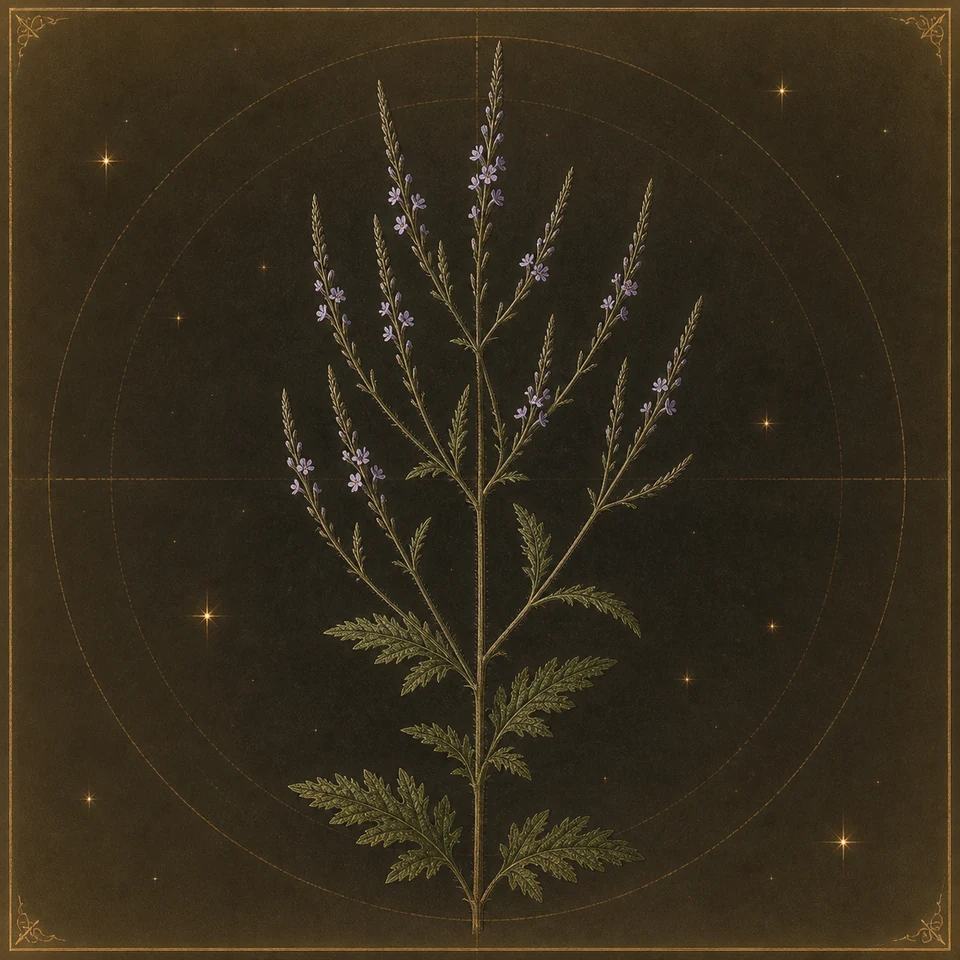
Common vervain as the probable identity of the unqualified vervain named in early modern and nineteenth-century sources.
Overview
Vervain is a slender perennial herb native across much of Europe and western Asia, recognizable by its narrow leaves and small lilac-to-pale-purple flowers carried along branching spikes. Although visually modest, vervain accumulated an unusually rich body of religious, magical, and folkloric associations. Its reputation was built less on spectacular appearance than on centuries of ritual use.
In European magical tradition, vervain appears in contexts involving purification, protection, sacred preparation, divination, and enchantment. Renaissance occult philosophy also places vervain within the planetary sphere of Venus, connecting it to the broader network of Venusian plants and materials. This planetary correspondence belongs specifically to that historical occult framework rather than to botany.
Vervain continued to appear in later European folklore and magical practice, where it was gathered, carried, prepared, or incorporated into charms for different purposes depending on region and period. Modern Pagan and witchcraft traditions have inherited parts of this older reputation while developing additional uses of their own.
Because several traditions overlap around vervain without being identical, Mystic preserves each attested relationship separately rather than combining them into a single supposedly universal system.
Historical and Folkloric Context
Vervain has a long European history as a ritually significant plant. Classical and later European writers recorded reverence for vervain and plants identified with that name, although historical terminology must be handled carefully because older botanical names do not always map perfectly onto modern species.
By the Renaissance, vervain had entered formal occult correspondence systems. Heinrich Cornelius Agrippa associates vervain with Venus in Three Books of Occult Philosophy, placing it within a larger planetary system in which plants, stones, metals, colors, animals, and other natural objects participate in celestial correspondences.
Later folklore collections record vervain in charms and magical customs involving protection and other ritual purposes. These folk traditions remain distinct from Agrippa's learned Renaissance occult philosophy even when they produce similar practical associations.
Modern Practice
In modern Pagan and witchcraft practice, vervain remains a ritual herb associated especially with purification, protection, and magical preparation. Some practitioners also use it within love, attraction, divinatory, or Venus-oriented work.
A modern relationship enters the graph only when repeated use can be demonstrated across independent contemporary sources. A modern convention is not retroactively attributed to Agrippa, ancient religion, or European folklore simply because the same plant appears in all three.
Venus
Relationship: Vervain → associated with → Venus Tradition: Renaissance occult philosophy and astrological herbalism Evidence: Two historical attestations Status: Direct correspondence
Agrippa includes vervain within the natural substances associated with the planetary sphere of Venus, while Culpeper supplies a separate astrological-herbal attribution. This is a direct historical correspondence rather than one inferred from another Venusian property.
Protection
Relationship: Vervain → used for → Protection Tradition: English plant folklore and folk magic Evidence: Explicit historical attestation Status: Direct relationship
Thiselton-Dyer records vervain in an English counter-charm tradition. The claim remains limited to that cited regional and historical context; it is not treated as proof of a universal protective meaning.
Connected Correspondences
These are graph paths, not additional direct claims.
Vervain → Venus → Friday Friday is directly associated with Venus in a Solomonic source. Because vervain has its own direct Venus correspondence, Friday can appear as a connected record. Mystic does not create a direct Vervain → Friday edge unless a source independently supports it.
Vervain → Venus → Copper Copper belongs to a directly attested Venusian correspondence complex. This path explains why vervain and copper may appear together in a Venus-oriented ritual system without claiming that a historical source establishes a direct vervain-to-copper relationship.
Botanical Identification
Accepted identity: Verbena officinalis L. Plant type: Herbaceous perennial Family: Verbenaceae
Historical references to ‘vervain’ or ‘verbena’ must be checked individually before being mapped to Verbena officinalis. A historical plant name is not silently normalized when the source's botanical identity is uncertain.
Safety
Vervain's presence in the correspondence database documents ritual, folkloric, and historical associations. This record does not generate ingestion or medicinal recommendations. Its physical-use review is not yet complete, so the ritual engine excludes it from default material suggestions. Any specific hazard discovered during botanical review is recorded separately rather than attaching a generic warning to every practice.
Evidence Summary
Historical correspondence evidence: Present Folkloric evidence: Present Modern-practice evidence: Evaluated separately Conflicting traditions: Preserved where found Inferred graph relationships: Displayed separately from direct correspondences
Sources
Heinrich Cornelius Agrippa, Three Books of Occult Philosophy: Venus correspondence.
Nicholas Culpeper, The Complete Herbal: astrological-herbal Venus attribution.
Richard Folkard, Plant Lore, Legends, and Lyrics: historical plant folklore and magical customs.
T. F. Thiselton-Dyer, The Folk-Lore of Plants: European plant folklore, charms, protective practices, and folk belief.
Additional evidence belongs to individual attestations rather than serving as generic support for every statement in the profile.
Direct connections and evidence
Cross Source
plant associated with Venus
2 attestations · high confidence
- Heinrich Cornelius Agrippa, Three Books of Occult Philosophy, Book OneBook One, English edition based on the 1651 J. F. translation · Library of Congress · Renaissance Europe, c. 1533 · Renaissance Europe · Book Book One · Chapter XXVIII · Section Of those things which are under the power of Venus · Page 102-103
- Nicholas Culpeper, The Complete HerbalNew edition with additions by Thomas Kelly · Project Gutenberg · Seventeenth-century England · England · Entry Vervain · Section Government and virtues · Page 187-188
Explicit Source
counter-charm against witchcraft
The edge is limited to the cited English counter-charm tradition.
1 attestation · high confidence
- T. F. Thiselton-Dyer, The Folk-Lore of PlantsFirst edition · Wellcome Collection · Seventeenth-century English references summarized in 1889 · England · Book The Folk-Lore of Plants · Chapter V · Section Plants in Witchcraft · Page 56
Reviewed sources
- Heinrich Cornelius Agrippa, Three Books of Occult Philosophy, Book One (1898)Book One, English edition based on the 1651 J. F. translation · Library of Congress
- Nicholas Culpeper, The Complete Herbal (1850)New edition with additions by Thomas Kelly · Project Gutenberg
- T. F. Thiselton-Dyer, The Folk-Lore of Plants (1889)First edition · Wellcome Collection
- Richard Folkard, Plant Lore, Legends, and Lyrics (1884)First edition · Wellcome Collection