
Planet · Certain
Venus
Research and editorial review by Cody Manes · Reviewed
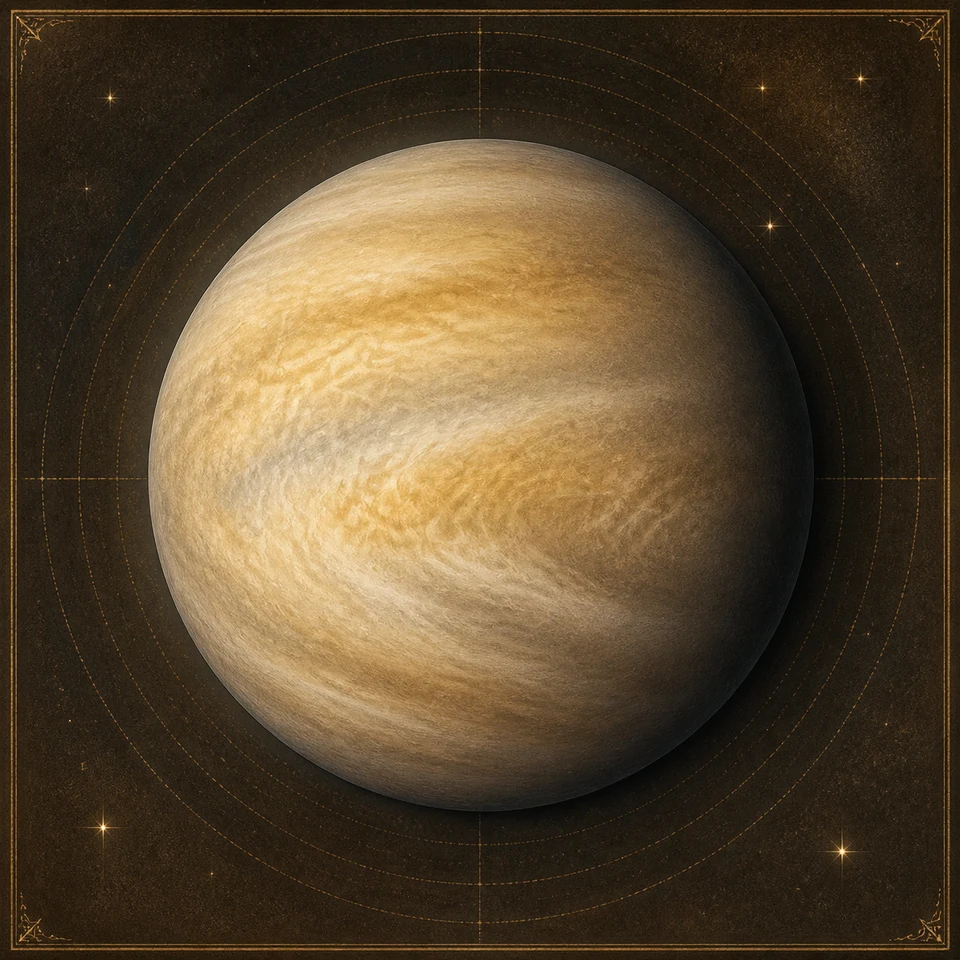
The classical planet Venus in historical correspondence systems.
Overview
Venus is the bright classical planet of attraction, joining, beauty, pleasure, and cultivated harmony. Ptolemy describes it as temperate, warm, and chiefly moist, classifies it as benefic, and assigns it Taurus and Libra. Later sources gather around it Venusian plants, perfumes, stones, Friday, copper, and green.
Historical and Astrological Context
Venus appears across learned astrology, Renaissance occult philosophy, astrological herbalism, and later magical practice. Similar themes recur, but the database does not treat repetition across eras as proof of one timeless system. Vervain, for example, carries separate Agrippan, Culpeperian, folkloric, and modern histories.
Traditional and Modern Rulerships
Ptolemy assigns Taurus and Libra to Venus in Book I, Chapter XX. These are classical domicile relationships and remain separate from the planet’s name collision with the Roman deity Venus.
Traditional Qualities
Ptolemy places Venus in a temperate balance of warmth and moisture, with moisture predominant, and numbers it among the benefics. These classifications are preserved as classical vocabulary rather than universal moral judgments.
Plants, Stones, Metals, and Ritual Materials
Agrippa’s Venusian layer includes air and water, violet, thyme, coriander, myrtle, labdanum, red sandalwood, emerald, carnelian, and brass. The Key of Solomon connects Venus with Friday, copper, and green. Vervain has independent source support in Agrippa and Culpeper.
Modern Practice
Modern Venus-oriented practice often turns toward affection, pleasure, attraction, friendship, reconciliation, and artistic refinement. Any practical selection should follow the direct, sourced edges and the separate safety record of the material involved.
Identity Boundary
The planet Venus and the Roman deity Venus have the same name but are separate records. The deity is not stored as an alias or as automatic evidence for a planetary correspondence.
Safety and Physical Boundaries
Planetary records describe symbolic and historical relationships. They do not authorize ingestion, burning, topical use, or handling of connected materials. Each physical entity carries its own safety review, and hazardous records are excluded from default ritual candidates.
Sources
Claudius Ptolemy, Tetrabiblos; Heinrich Cornelius Agrippa, Three Books of Occult Philosophy; Nicholas Culpeper, The Complete Herbal; S. L. MacGregor Mathers, The Key of Solomon.
Direct connections and evidence
Explicit Source
element under Venus
1 attestation · high confidence
- Heinrich Cornelius Agrippa, Three Books of Occult Philosophy, Book OneBook One, English edition based on the 1651 J. F. translation · Library of Congress · Renaissance Europe, c. 1533 · Renaissance Europe · Book Book One · Chapter XXVIII · Section Of those things which are under the power of Venus · Page 102-103
Explicit Source
element under Venus
1 attestation · high confidence
- Heinrich Cornelius Agrippa, Three Books of Occult Philosophy, Book OneBook One, English edition based on the 1651 J. F. translation · Library of Congress · Renaissance Europe, c. 1533 · Renaissance Europe · Book Book One · Chapter XXVIII · Section Of those things which are under the power of Venus · Page 102-103
Explicit Source
plant or tree under Venus
1 attestation · high confidence
- Heinrich Cornelius Agrippa, Three Books of Occult Philosophy, Book OneBook One, English edition based on the 1651 J. F. translation · Library of Congress · Renaissance Europe, c. 1533 · Renaissance Europe · Book Book One · Chapter XXVIII · Section Of those things which are under the power of Venus · Page 102-103
Explicit Source
plant or tree under Venus
1 attestation · high confidence
- Heinrich Cornelius Agrippa, Three Books of Occult Philosophy, Book OneBook One, English edition based on the 1651 J. F. translation · Library of Congress · Renaissance Europe, c. 1533 · Renaissance Europe · Book Book One · Chapter XXVIII · Section Of those things which are under the power of Venus · Page 102-103
Explicit Source
plant or tree under Venus
1 attestation · high confidence
- Heinrich Cornelius Agrippa, Three Books of Occult Philosophy, Book OneBook One, English edition based on the 1651 J. F. translation · Library of Congress · Renaissance Europe, c. 1533 · Renaissance Europe · Book Book One · Chapter XXVIII · Section Of those things which are under the power of Venus · Page 102-103
Explicit Source
plant or tree under Venus
1 attestation · high confidence
- Heinrich Cornelius Agrippa, Three Books of Occult Philosophy, Book OneBook One, English edition based on the 1651 J. F. translation · Library of Congress · Renaissance Europe, c. 1533 · Renaissance Europe · Book Book One · Chapter XXVIII · Section Of those things which are under the power of Venus · Page 102-103
Explicit Source
aromatic material under Venus
1 attestation · high confidence
- Heinrich Cornelius Agrippa, Three Books of Occult Philosophy, Book OneBook One, English edition based on the 1651 J. F. translation · Library of Congress · Renaissance Europe, c. 1533 · Renaissance Europe · Book Book One · Chapter XXVIII · Section Of those things which are under the power of Venus · Page 102-103
Explicit Source
aromatic material under Venus
1 attestation · high confidence
- Heinrich Cornelius Agrippa, Three Books of Occult Philosophy, Book OneBook One, English edition based on the 1651 J. F. translation · Library of Congress · Renaissance Europe, c. 1533 · Renaissance Europe · Book Book One · Chapter XXVIII · Section Of those things which are under the power of Venus · Page 102-103
Explicit Source
stone under Venus
1 attestation · high confidence
- Heinrich Cornelius Agrippa, Three Books of Occult Philosophy, Book OneBook One, English edition based on the 1651 J. F. translation · Library of Congress · Renaissance Europe, c. 1533 · Renaissance Europe · Book Book One · Chapter XXVIII · Section Of those things which are under the power of Venus · Page 102-103
Explicit Source
stone under Venus
1 attestation · high confidence
- Heinrich Cornelius Agrippa, Three Books of Occult Philosophy, Book OneBook One, English edition based on the 1651 J. F. translation · Library of Congress · Renaissance Europe, c. 1533 · Renaissance Europe · Book Book One · Chapter XXVIII · Section Of those things which are under the power of Venus · Page 102-103
Explicit Source
metal under Venus
1 attestation · high confidence
- Heinrich Cornelius Agrippa, Three Books of Occult Philosophy, Book OneBook One, English edition based on the 1651 J. F. translation · Library of Congress · Renaissance Europe, c. 1533 · Renaissance Europe · Book Book One · Chapter XXVIII · Section Of those things which are under the power of Venus · Page 102-103
Cross Source
plant associated with Venus
2 attestations · high confidence
- Heinrich Cornelius Agrippa, Three Books of Occult Philosophy, Book OneBook One, English edition based on the 1651 J. F. translation · Library of Congress · Renaissance Europe, c. 1533 · Renaissance Europe · Book Book One · Chapter XXVIII · Section Of those things which are under the power of Venus · Page 102-103
- Nicholas Culpeper, The Complete HerbalNew edition with additions by Thomas Kelly · Project Gutenberg · Seventeenth-century England · England · Entry Vervain · Section Government and virtues · Page 187-188
Explicit Source
herb of Venus
Culpeper's Venusian attribution is preserved alongside Agrippa's solar and Jovial attributions; the database does not reconcile the alternatives.
1 attestation · high confidence
- Nicholas Culpeper, The Complete HerbalNew edition with additions by Thomas Kelly · Project Gutenberg · Nineteenth-century edition of Culpeper's seventeenth-century astrological herbalism · England · Entry Mint · Section Government and virtues · Page 117
Explicit Source
weekday of Venus
1 attestation · high confidence
- S. L. MacGregor Mathers, translator and editor, The Key of Solomon the King (Clavicula Salomonis)First edition · Wellcome Collection · British occult revival, 1889 edition · Britain · Section Table of the Archangels, Angels, Metals, Days of the Week, and Colours attributed to each Planet · Page 8 · Table Days and planets
Explicit Source
metal ruled by Venus
1 attestation · high confidence
- S. L. MacGregor Mathers, translator and editor, The Key of Solomon the King (Clavicula Salomonis)First edition · Wellcome Collection · British occult revival, 1889 edition · Britain · Book Book I · Chapter XVIII · Section Concerning the Holy Pentacles or Medals · Page 56
Explicit Source
color ruled by Venus
1 attestation · high confidence
- S. L. MacGregor Mathers, translator and editor, The Key of Solomon the King (Clavicula Salomonis)First edition · Wellcome Collection · British occult revival, 1889 edition · Britain · Book Book I · Chapter XVIII · Section Concerning the Holy Pentacles or Medals · Page 56-57
Explicit Source
traditional ruler of Taurus
Classical domicile rulership recorded directly from Ptolemy; later and modern co-rulership layers remain separate.
1 attestation · high confidence
- Claudius Ptolemy; J. M. Ashmand, translator, Tetrabiblos; or, QuadripartiteW. Foulsham 1900 printing of Ashmand’s 1822 English version · Project Gutenberg · Second century CE · Roman Egypt · Book Book I · Chapter Chapter XX — The Houses of the Planets · Section The Houses of the Planets · Page 28–29
Explicit Source
traditional ruler of Libra
Classical domicile rulership recorded directly from Ptolemy; later and modern co-rulership layers remain separate.
1 attestation · high confidence
- Claudius Ptolemy; J. M. Ashmand, translator, Tetrabiblos; or, QuadripartiteW. Foulsham 1900 printing of Ashmand’s 1822 English version · Project Gutenberg · Second century CE · Roman Egypt · Book Book I · Chapter Chapter XX — The Houses of the Planets · Section The Houses of the Planets · Page 28–29
Explicit Source
Crowley’s 1909 tables place Hathoor at two Venus-coded key-scale rows
Later occult reception only; never inferred through Aphrodite or backdated into ancient Egypt.
1 attestation · high confidence
- Aleister Crowley, 777First edition scan, Casa Fernando Pessoa copy 0038575 · Casa Fernando Pessoa · British occult publication, 1909 · London publication context · Page printed pp. 2 and 6 / PDF pp. 20 and 24 · Table Table I, column VII and columns XIX-XX, rows 7 and 14
Explicit Source
The Epinomis calls the morning and evening star the star of Aphrodite
A later celestial association, not automatic evidence for the earliest cult.
1 attestation · contextual confidence
- Pseudo-Plato; translated by W. R. M. Lamb, EpinomisW. R. M. Lamb translation in Plato in Twelve Volumes, Volume 9, 1927 · translated by W. R. M. Lamb · Perseus Digital Library / Scaife ATLAS · Classical Greece · Athens · Entry Epinomis · Section 987b-c
Reviewed sources
- Heinrich Cornelius Agrippa, Three Books of Occult Philosophy, Book One (1898)Book One, English edition based on the 1651 J. F. translation · Library of Congress
- Nicholas Culpeper, The Complete Herbal (1850)New edition with additions by Thomas Kelly · Project Gutenberg
- S. L. MacGregor Mathers, translator and editor, The Key of Solomon the King (Clavicula Salomonis) (1889)First edition · Wellcome Collection
- Claudius Ptolemy; J. M. Ashmand, translator, Tetrabiblos; or, Quadripartite (1900)W. Foulsham 1900 printing of Ashmand’s 1822 English version · Project Gutenberg
- Aleister Crowley, 777 (1909)First edition, London, 1909 · University of Michigan / Google Books
- Pseudo-Plato; translated by W. R. M. Lamb, Epinomis (1927)Plato in Twelve Volumes, Volume 9, 1927 · Perseus Digital Library / Scaife ATLAS