
Greek · Divine personification · Certain
Eris
Ἔρις · Éris
Pronunciation: /é.ris/ · EH-riss
Research and editorial review by Cody Manes · Reviewed 2026-08-30
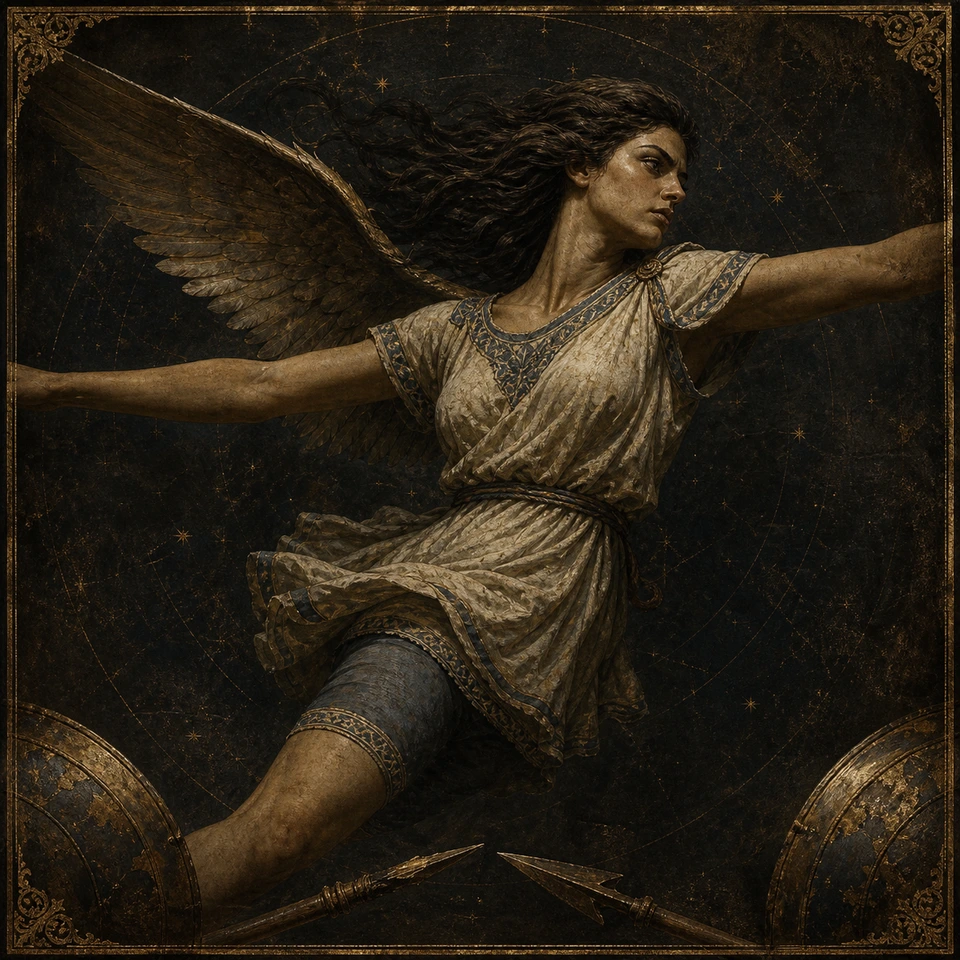
Driving both productive rivalry and catastrophic social fracture, Eris operates as the pure personification of strife. Her pervasive influence fuels battlefield escalation and famously ignited the mythological conflict at the Judgment of Paris.
Overview
Eris begins near the ground. In Iliad 4, Strife enters the battle small, then grows until her feet remain on earth and her head strikes heaven. The image turns escalation into a body. A quarrel does not stay where it began. It rises over the people who feed it.
Hesiod refuses to make that force simple. The Theogony places Eris among the children of Nyx and gives her children of her own: Toil, Forgetfulness, Famine, Sorrows, Battles, Murders, Quarrels, Lies, Disputes, Lawlessness, Ruin, and Oath. This is not a list of decorative attributes. It is a genealogy of what strife produces when it enters households, speech, law, hunger, and war.
Works and Days then interrupts the darker genealogy. There are two Strifes, the poet says. One breeds cruel war and deserves blame. The elder is kinder. Zeus set her at the roots of the earth, where she makes an idle person look at a prosperous neighbor and begin to plough, plant, and order a household. Potter competes with potter, singer with singer. Rivalry can corrode, but it can also make work move.
The Iliad returns to the cruel form. Eris accompanies war, grows with it, and cries across the Achaean ships until exhausted fighters want battle more than home. She is not a strategist like Athena or a warrior measured by wounds like Ares. She is the spread of conflict itself, the pressure that makes a host recommit to violence.
The best-known apple comes from a later connected telling. At the wedding of Peleus and Thetis, Eris throws an apple that Hera, Athena, and Aphrodite each claim. Paris judges, Aphrodite wins by promising Helen, and the choice leads into the Trojan War tradition. The apple matters, but it is one episode, not the key to every appearance of Eris.
Archaic pottery remembers a more physical figure. A British Museum hydria shows a winged woman in rapid airborne motion, looking back over her shoulder, her short embroidered chiton and streaming hair caught in the race. The ancient image restores speed to a goddess often reduced to a single fruit.
No sanctuary or festival emerges from these same witnesses. That absence matters because vivid poetry can tempt later readers to invent a complete cult around it. Eris survives here through genealogy, epic action, moral argument, mythography, and painted movement. Each form carries real historical weight, but none can supply rites that it never names.
Canonical identity
Canonical Identity
Eris operates as the ancient Greek goddess and direct divine personification of strife, quarrel, and contest. She is not simply a flat deity of random chaos; Greek poetry attributes distinct moral directions and scales to her power, spanning from neighborly disputes and productive workplace rivalry, to escalating battlefield violence and the catastrophic divine contest that sparked the Trojan War. The ordinary noun for strife and the goddess herself share the exact same word, demanding that each ancient passage be evaluated to determine whether a literal quarrel or the divine figure is present. No cross-cultural equivalences are asserted without explicit textual backing.
Linguistic Identity
Her name is Ἔρις, transliterated as Éris. A qualified fifth-century BC Attic reconstruction yields /é.ris/ (roughly EH-riss), marked by an ancient pitch accent that standard English orthography cannot replicate.
Sources and evidence
TEXTUAL · Supported
The proper name Ἔρις has a qualified fifth-century BC Attic reconstruction /é.ris/.
- Source
- Wiktionary contributors, Ἔρις
- Reviewed edition
- Wiktionary live revision reviewed 2026-08-30 · Wiktionary
- Exact locator
- Entry Ἔρις · Section Ancient Greek pronunciation
- Scope
- Classical Greece · Attica
- Authority
- collaborative lexical reference
- Certainty
- Qualified
The readable guide approximates the reconstructed sounds but cannot reproduce ancient pitch accent.
Open exact reviewed sourceTEXTUAL · Supported
Hesiod treats Eris as a named daughter of Night and the mother of a destructive personified lineage.
- Source
- Hesiod; edited and translated by Hugh G. Evelyn-White, Theogony (1914)
- Reviewed edition
- Hugh G. Evelyn-White edition and English translation in Hesiod, the Homeric Hymns and Homerica, 1914 · translated by Hugh G. Evelyn-White · edited by Hugh G. Evelyn-White · Perseus Digital Library / Scaife ATLAS
- Exact locator
- Entry Theogony · Line 211-232
- Scope
- Archaic Greece · Ancient Greece
- Authority
- ancient literary witness
- Certainty
- High
This identity claim is limited to the Theogony genealogy and does not supply cult practice.
Open exact reviewed source2 reviewed sources for this section
- Wiktionary contributors, ἜριςLive collaborative lexical entry reviewed 2026-08-30 · Wiktionary
- Hesiod; edited and translated by Hugh G. Evelyn-White, Theogony (1914)Hesiod, the Homeric Hymns and Homerica, London and New York, 1914 · Perseus Digital Library / Scaife ATLAS
Culture, tradition, period, and place
Archaic Greek hexameter poetry supplies the central evidence. Hesiod places Eris in the genealogy of Night and turns her name into a family of destructive social forces. Works and Days then opens a harder question by speaking of two Strifes, one cruel and one beneficial. Homer gives her a body on the battlefield, small at first and then immense.
Attic pottery makes that moving body visible. A British Museum hydria dated about 520 to 500 BC shows a winged woman racing through the air and looking back. The Judgment of Paris belongs to a later connected mythographic telling located at the wedding of Peleus and Thetis and on Mount Ida. Poetic landscape, Trojan story, and Attic object are different kinds of place evidence.
Sources and evidence
TEXTUAL · Supported
The Theogony locates Eris within an Archaic Greek poetic genealogy of Night and social afflictions.
- Source
- Hesiod; edited and translated by Hugh G. Evelyn-White, Theogony (1914)
- Reviewed edition
- Hugh G. Evelyn-White edition and English translation in Hesiod, the Homeric Hymns and Homerica, 1914 · translated by Hugh G. Evelyn-White · edited by Hugh G. Evelyn-White · Perseus Digital Library / Scaife ATLAS
- Exact locator
- Entry Theogony · Line 211-232
- Scope
- Archaic Greece · Ancient Greece
- Authority
- ancient literary witness
- Certainty
- High
The poem is a literary witness from the Greek hexameter tradition.
Open exact reviewed sourceTEXTUAL · Supported
Works and Days gives the central didactic distinction between a blameworthy Strife and a kinder elder Strife.
- Source
- Hesiod; edited and translated by Hugh G. Evelyn-White, Works and Days (1914)
- Reviewed edition
- Hugh G. Evelyn-White edition and English translation in Hesiod, the Homeric Hymns and Homerica, 1914 · translated by Hugh G. Evelyn-White · edited by Hugh G. Evelyn-White · Perseus Digital Library / Scaife ATLAS
- Exact locator
- Entry Works and Days · Line 11-26
- Scope
- Archaic Greece · Ancient Greece
- Authority
- ancient literary witness
- Certainty
- High
The distinction belongs to this poem and should not be projected into every Greek witness.
Open exact reviewed sourceTEXTUAL · Supported
The Iliad embodies Eris on the battlefield as a force that grows among the assembled fighters.
- Source
- Homer; Monro and Allen Greek edition with edition-specific translations, Iliad (1920)
- Reviewed edition
- Monro and Allen Greek edition represented by the Perseus CTS corpus, Oxford, 1908-1920 · edited by David Binning Monro and Thomas William Allen · Perseus Digital Library / Scaife ATLAS
- Exact locator
- Book 4 · Line 440-445
- Scope
- Archaic Greece · Ancient Greece
- Authority
- ancient literary witness
- Certainty
- High
The epic passage establishes literary action, not a sanctuary or rite.
Open exact reviewed sourceMATERIAL CULTURE · Supported
British Museum hydria 1837,0609.53 is an Attic black-figure object dated about 520 to 500 BC that identifies Eris in airborne motion.
- Source
- British Museum, British Museum Collection
- Reviewed edition
- Live record-level official museum collection · British Museum
- Exact locator
- MuseumObjectId 1837,0609.53 · Entry Object description and date
- Scope
- Archaic Greece · Attica
- Authority
- museum accession record
- Certainty
- High
The accession and date secure an Attic material witness without implying a local pilgrimage place.
Open exact reviewed sourceTEXTUAL · Supported
Pseudo-Apollodorus locates the divine contest after the wedding of Peleus and Thetis and sends the goddesses to Paris on Mount Ida.
- Source
- Pseudo-Apollodorus; edited and translated by James G. Frazer, Library (1921)
- Reviewed edition
- James G. Frazer edition and English translation, Harvard University Press and William Heinemann, 1921 · translated by James G. Frazer · edited by James G. Frazer · Perseus Digital Library / Scaife ATLAS
- Exact locator
- Book Epitome · Section 3.1-3.5
- Scope
- Greek religion under Roman imperial rule · Mount Ida in the Troad
- Authority
- ancient literary witness
- Certainty
- High
This later mythographic setting remains distinct from Archaic genealogy and epic battle scenes.
Open exact reviewed source5 reviewed sources for this section
- Hesiod; edited and translated by Hugh G. Evelyn-White, Theogony (1914)Hesiod, the Homeric Hymns and Homerica, London and New York, 1914 · Perseus Digital Library / Scaife ATLAS
- Hesiod; edited and translated by Hugh G. Evelyn-White, Works and Days (1914)Hesiod, the Homeric Hymns and Homerica, London and New York, 1914 · Perseus Digital Library / Scaife ATLAS
- Homer; Monro and Allen Greek edition with edition-specific translations, Iliad (1920)Perseus CTS edition corpus; Greek edition, Oxford, 1908-1920 · Perseus Digital Library / Scaife ATLAS
- British Museum, British Museum CollectionLive official museum collection · British Museum
- Pseudo-Apollodorus; edited and translated by James G. Frazer, Library (1921)Harvard University Press and William Heinemann edition, 1921 · Perseus Digital Library / Scaife ATLAS
Historical development
The Theogony presents one relentless Eris, born from Nyx and giving birth to a grim company of abstractions. Works and Days immediately refuses that simplicity. Its speaker says there are two Strifes across the earth. One nourishes evil war; the elder, placed at the roots of the earth by Zeus, makes an idle person work when a prosperous neighbor becomes a rival.
The Iliad develops a different scale. Eris grows as conflict spreads and can stand among ships crying until weariness gives way to renewed appetite for battle. Later mythography moves her from battlefield to banquet: her apple begins the contest judged by Paris. The sequence is development across genres, not one seamless biography.
Sources and evidence
TEXTUAL · Supported
The Theogony presents one Eris, born from Nyx and generating a family of destructive social forces.
- Source
- Hesiod; edited and translated by Hugh G. Evelyn-White, Theogony (1914)
- Reviewed edition
- Hugh G. Evelyn-White edition and English translation in Hesiod, the Homeric Hymns and Homerica, 1914 · translated by Hugh G. Evelyn-White · edited by Hugh G. Evelyn-White · Perseus Digital Library / Scaife ATLAS
- Exact locator
- Entry Theogony · Line 211-232
- Scope
- Archaic Greece · Ancient Greece
- Authority
- ancient literary witness
- Certainty
- High
The genealogy supplies the earliest layer used in this historical sequence.
Open exact reviewed sourceTEXTUAL · Supported
Works and Days distinguishes a cruel Strife of war from an elder Strife who drives people into productive rivalry.
- Source
- Hesiod; edited and translated by Hugh G. Evelyn-White, Works and Days (1914)
- Reviewed edition
- Hugh G. Evelyn-White edition and English translation in Hesiod, the Homeric Hymns and Homerica, 1914 · translated by Hugh G. Evelyn-White · edited by Hugh G. Evelyn-White · Perseus Digital Library / Scaife ATLAS
- Exact locator
- Entry Works and Days · Line 11-26
- Scope
- Archaic Greece · Ancient Greece
- Authority
- ancient literary witness
- Certainty
- High
The poem overturns a simple one-form account by making the two natures morally opposed.
Open exact reviewed sourceTEXTUAL · Supported
The Iliad develops Eris through two battlefield actions, bodily growth among the armies and a cry across the ships.
- Source
- Homer; Monro and Allen Greek edition with edition-specific translations, Iliad (1920)
- Reviewed edition
- Monro and Allen Greek edition represented by the Perseus CTS corpus, Oxford, 1908-1920 · edited by David Binning Monro and Thomas William Allen · Perseus Digital Library / Scaife ATLAS
- Exact locator
- Book 4; 11 · Line 4.440-445; 11.3-14
- Scope
- Archaic Greece · Ancient Greece
- Authority
- ancient literary witness
- Certainty
- High
The two scenes remain separate epic episodes with different actions.
Open exact reviewed sourceTEXTUAL · Supported
Pseudo-Apollodorus later gives Eris an apple that begins the contest judged by Paris.
- Source
- Pseudo-Apollodorus; edited and translated by James G. Frazer, Library (1921)
- Reviewed edition
- James G. Frazer edition and English translation, Harvard University Press and William Heinemann, 1921 · translated by James G. Frazer · edited by James G. Frazer · Perseus Digital Library / Scaife ATLAS
- Exact locator
- Book Epitome · Section 3.1-3.5
- Scope
- Greek religion under Roman imperial rule · Mount Ida in the Troad
- Authority
- ancient literary witness
- Certainty
- High
The apple episode is a later mythographic development, not a key to every earlier appearance.
Open exact reviewed source4 reviewed sources for this section
- Hesiod; edited and translated by Hugh G. Evelyn-White, Theogony (1914)Hesiod, the Homeric Hymns and Homerica, London and New York, 1914 · Perseus Digital Library / Scaife ATLAS
- Hesiod; edited and translated by Hugh G. Evelyn-White, Works and Days (1914)Hesiod, the Homeric Hymns and Homerica, London and New York, 1914 · Perseus Digital Library / Scaife ATLAS
- Homer; Monro and Allen Greek edition with edition-specific translations, Iliad (1920)Perseus CTS edition corpus; Greek edition, Oxford, 1908-1920 · Perseus Digital Library / Scaife ATLAS
- Pseudo-Apollodorus; edited and translated by James G. Frazer, Library (1921)Harvard University Press and William Heinemann edition, 1921 · Perseus Digital Library / Scaife ATLAS
Attested roles and historical themes
Roles, powers, and limits
Eris makes conflict grow. Iliad 4 captures the mechanism in physical terms: she starts low and ends with her head against heaven, planting strife among people as her scale expands. Iliad 11 gives her a voice that reaches the whole Achaean host and turns exhaustion toward renewed combat. She incites rather than commanding a stable realm.
Hesiod widens that function. The cruel Strife brings war and battle, while the elder Strife awakens effort through rivalry. The Theogony traces destructive consequences through her children, from famine and sorrow to lies, disputes, lawlessness, ruin, and oath. These are poetic genealogies of social fracture, not automatic ritual powers.
Sources and evidence
TEXTUAL · Supported
Hesiod makes Eris mother of Toil, Forgetfulness, Famine, Sorrows, Battles, Murders, Quarrels, Lies, Disputes, Lawlessness, Ruin, and Oath.
- Source
- Hesiod; edited and translated by Hugh G. Evelyn-White, Theogony (1914)
- Reviewed edition
- Hugh G. Evelyn-White edition and English translation in Hesiod, the Homeric Hymns and Homerica, 1914 · translated by Hugh G. Evelyn-White · edited by Hugh G. Evelyn-White · Perseus Digital Library / Scaife ATLAS
- Exact locator
- Entry Theogony · Line 226-232
- Scope
- Archaic Greece · Ancient Greece
- Authority
- ancient literary witness
- Certainty
- High
The list is a poetic genealogy of consequences rather than a ritual inventory.
Open exact reviewed sourceTEXTUAL · Supported
The Iliad pictures Eris growing from a small beginning until her head reaches heaven while her feet remain on earth.
- Source
- Homer; Monro and Allen Greek edition with edition-specific translations, Iliad (1920)
- Reviewed edition
- Monro and Allen Greek edition represented by the Perseus CTS corpus, Oxford, 1908-1920 · edited by David Binning Monro and Thomas William Allen · Perseus Digital Library / Scaife ATLAS
- Exact locator
- Book 4 · Line 440-445
- Scope
- Archaic Greece · Ancient Greece
- Authority
- ancient literary witness
- Certainty
- High
The passage makes escalation visible through bodily scale.
Open exact reviewed sourceTEXTUAL · Supported
The Iliad sends Eris among the Achaean ships with Zeus’ sign of war and gives her a cry that renews the fighters’ appetite for battle.
- Source
- Homer; Monro and Allen Greek edition with edition-specific translations, Iliad (1920)
- Reviewed edition
- Monro and Allen Greek edition represented by the Perseus CTS corpus, Oxford, 1908-1920 · edited by David Binning Monro and Thomas William Allen · Perseus Digital Library / Scaife ATLAS
- Exact locator
- Book 11 · Line 3-14
- Scope
- Archaic Greece · Ancient Greece
- Authority
- ancient literary witness
- Certainty
- High
Her action changes collective resolve rather than describing a duel or fixed weapon.
Open exact reviewed sourceTEXTUAL · Supported
The elder Strife in Works and Days stirs idle people toward ploughing, planting, household order, craft, and song through rivalry.
- Source
- Hesiod; edited and translated by Hugh G. Evelyn-White, Works and Days (1914)
- Reviewed edition
- Hugh G. Evelyn-White edition and English translation in Hesiod, the Homeric Hymns and Homerica, 1914 · translated by Hugh G. Evelyn-White · edited by Hugh G. Evelyn-White · Perseus Digital Library / Scaife ATLAS
- Exact locator
- Entry Works and Days · Line 11-26
- Scope
- Archaic Greece · Ancient Greece
- Authority
- ancient literary witness
- Certainty
- High
The didactic passage distinguishes productive competition from cruel war and courtroom quarrel.
Open exact reviewed source3 reviewed sources for this section
- Hesiod; edited and translated by Hugh G. Evelyn-White, Theogony (1914)Hesiod, the Homeric Hymns and Homerica, London and New York, 1914 · Perseus Digital Library / Scaife ATLAS
- Homer; Monro and Allen Greek edition with edition-specific translations, Iliad (1920)Perseus CTS edition corpus; Greek edition, Oxford, 1908-1920 · Perseus Digital Library / Scaife ATLAS
- Hesiod; edited and translated by Hugh G. Evelyn-White, Works and Days (1914)Hesiod, the Homeric Hymns and Homerica, London and New York, 1914 · Perseus Digital Library / Scaife ATLAS
Epithets and titles
No securely localized epithet with an exact ancient or institutional locator is included; poetic descriptions of strife are not converted into formal titles.
2 reviewed sources for this section
- Hesiod; edited and translated by Hugh G. Evelyn-White, Theogony (1914)Hesiod, the Homeric Hymns and Homerica, London and New York, 1914 · Perseus Digital Library / Scaife ATLAS
- Homer; Monro and Allen Greek edition with edition-specific translations, Iliad (1920)Perseus CTS edition corpus; Greek edition, Oxford, 1908-1920 · Perseus Digital Library / Scaife ATLAS
Worship and cult
No sanctuary, priesthood, civic sacrifice, household rite, or independent cult title for Eris survives in Hesiod, Homer, Pseudo-Apollodorus, or the Attic objects discussed here. The reviewed literary and visual evidence documents a figure active in poetry and image, but it does not establish an institution of worship.
The harsh Strife of Works and Days receives an honor imposed by divine necessity, but the poem does not describe an altar or offering. That line should remain a statement about the world's compulsory encounter with conflict. A cult history would need an inscription, calendar, altar, or archaeological context naming Eris directly.
5 reviewed sources for this section
- Hesiod; edited and translated by Hugh G. Evelyn-White, Theogony (1914)Hesiod, the Homeric Hymns and Homerica, London and New York, 1914 · Perseus Digital Library / Scaife ATLAS
- Hesiod; edited and translated by Hugh G. Evelyn-White, Works and Days (1914)Hesiod, the Homeric Hymns and Homerica, London and New York, 1914 · Perseus Digital Library / Scaife ATLAS
- Homer; Monro and Allen Greek edition with edition-specific translations, Iliad (1920)Perseus CTS edition corpus; Greek edition, Oxford, 1908-1920 · Perseus Digital Library / Scaife ATLAS
- Pseudo-Apollodorus; edited and translated by James G. Frazer, Library (1921)Harvard University Press and William Heinemann edition, 1921 · Perseus Digital Library / Scaife ATLAS
- British Museum, British Museum CollectionLive official museum collection · British Museum
Temples, sanctuaries, and sacred places
Mount Ida is the judgment place in Pseudo-Apollodorus, while the wedding feast of Peleus and Thetis supplies the social breach that begins the contest. The Achaean ships in Iliad 11 are a theater of war where Eris raises her cry. Neither setting becomes her sanctuary merely because she acts there.
Attica is secure for surviving visual evidence: the British Museum hydria is an Attic black-figure vessel. The vessel's archaeological and collecting history belongs to the object, not to an Eris pilgrimage center. No temple, spring, grove, or civic precinct can yet be named as hers.
Sources and evidence
TEXTUAL · Supported
Pseudo-Apollodorus places Paris on Mount Ida when Hermes brings the three goddesses for judgment.
- Source
- Pseudo-Apollodorus; edited and translated by James G. Frazer, Library (1921)
- Reviewed edition
- James G. Frazer edition and English translation, Harvard University Press and William Heinemann, 1921 · translated by James G. Frazer · edited by James G. Frazer · Perseus Digital Library / Scaife ATLAS
- Exact locator
- Book Epitome · Section 3.1-3.5
- Scope
- Greek religion under Roman imperial rule · Mount Ida in the Troad
- Authority
- ancient literary witness
- Certainty
- High
Mount Ida is a narrative setting in this episode, not evidence for an Eris sanctuary.
Open exact reviewed sourceTEXTUAL · Supported
The Iliad places Eris where her cry reaches the Achaean ships and the entire fighting host.
- Source
- Homer; Monro and Allen Greek edition with edition-specific translations, Iliad (1920)
- Reviewed edition
- Monro and Allen Greek edition represented by the Perseus CTS corpus, Oxford, 1908-1920 · edited by David Binning Monro and Thomas William Allen · Perseus Digital Library / Scaife ATLAS
- Exact locator
- Book 11 · Line 3-14
- Scope
- Archaic Greece · Ancient Greece
- Authority
- ancient literary witness
- Certainty
- High
The ships are a theater of epic action rather than a sacred precinct.
Open exact reviewed sourceMATERIAL CULTURE · Supported
The British Museum hydria is Attic material evidence for Eris’ image.
- Source
- British Museum, British Museum Collection
- Reviewed edition
- Live record-level official museum collection · British Museum
- Exact locator
- MuseumObjectId 1837,0609.53 · Entry Object description and date
- Scope
- Archaic Greece · Attica
- Authority
- museum accession record
- Certainty
- High
The object’s production context does not establish an Eris pilgrimage center in Attica.
Open exact reviewed source3 reviewed sources for this section
- Pseudo-Apollodorus; edited and translated by James G. Frazer, Library (1921)Harvard University Press and William Heinemann edition, 1921 · Perseus Digital Library / Scaife ATLAS
- Homer; Monro and Allen Greek edition with edition-specific translations, Iliad (1920)Perseus CTS edition corpus; Greek edition, Oxford, 1908-1920 · Perseus Digital Library / Scaife ATLAS
- British Museum, British Museum CollectionLive official museum collection · British Museum
Festivals and processions
No named festival, procession, contest day, or sacrificial calendar for Eris survives in the evidence assembled here. The wedding of Peleus and Thetis is a mythic feast, not an Eris festival. The competitive labor praised in Works and Days is a social observation, not a dated holy day.
Modern observance cannot be backdated from the recurrence of arguments, athletic rivalry, political conflict, or war. A historical festival claim requires a calendar, inscription, civic decree, or explicit literary testimony.
Sources and evidence
TEXTUAL · Supported
Pseudo-Apollodorus describes the wedding of Peleus and Thetis as the feast from which Eris is excluded.
- Source
- Pseudo-Apollodorus; edited and translated by James G. Frazer, Library (1921)
- Reviewed edition
- James G. Frazer edition and English translation, Harvard University Press and William Heinemann, 1921 · translated by James G. Frazer · edited by James G. Frazer · Perseus Digital Library / Scaife ATLAS
- Exact locator
- Book Epitome · Section 3.1-3.5
- Scope
- Greek religion under Roman imperial rule · Mount Ida in the Troad
- Authority
- ancient literary witness
- Certainty
- High
A feast inside a myth is not a calendrical festival for Eris.
Open exact reviewed sourceTEXTUAL · Supported
Works and Days describes rivalry among neighbors, craftspeople, beggars, and singers without naming a festival day.
- Source
- Hesiod; edited and translated by Hugh G. Evelyn-White, Works and Days (1914)
- Reviewed edition
- Hugh G. Evelyn-White edition and English translation in Hesiod, the Homeric Hymns and Homerica, 1914 · translated by Hugh G. Evelyn-White · edited by Hugh G. Evelyn-White · Perseus Digital Library / Scaife ATLAS
- Exact locator
- Entry Works and Days · Line 11-26
- Scope
- Archaic Greece · Ancient Greece
- Authority
- ancient literary witness
- Certainty
- High
The poem presents social and economic competition, not a ritual calendar.
Open exact reviewed source2 reviewed sources for this section
- Pseudo-Apollodorus; edited and translated by James G. Frazer, Library (1921)Harvard University Press and William Heinemann edition, 1921 · Perseus Digital Library / Scaife ATLAS
- Hesiod; edited and translated by Hugh G. Evelyn-White, Works and Days (1914)Hesiod, the Homeric Hymns and Homerica, London and New York, 1914 · Perseus Digital Library / Scaife ATLAS
Offerings, votives, and ritual evidence
No ancient offering, votive formula, prayer, libation, incense, food, or ritual gesture addressed to Eris is securely attested here. The apple in the Judgment of Paris is an instrument of provocation inside one mythographic episode. It is not presented as a gift from a worshipper to the goddess.
Broken weapons and opposed shields can evoke her battlefield character in modern art, but the ancient texts do not turn those objects into offerings. Any present-day devotional practice needs an accountable contemporary witness and should speak for its own community rather than claiming universal Greek inheritance.
Sources and evidence
TEXTUAL · Supported
In Pseudo-Apollodorus, Eris throws the apple to provoke a contest among goddesses.
- Source
- Pseudo-Apollodorus; edited and translated by James G. Frazer, Library (1921)
- Reviewed edition
- James G. Frazer edition and English translation, Harvard University Press and William Heinemann, 1921 · translated by James G. Frazer · edited by James G. Frazer · Perseus Digital Library / Scaife ATLAS
- Exact locator
- Book Epitome · Section 3.1-3.5
- Scope
- Greek religion under Roman imperial rule · Mount Ida in the Troad
- Authority
- ancient literary witness
- Certainty
- High
The apple moves from Eris into the quarrel and is not described as a worshipper’s gift to her.
Open exact reviewed source1 reviewed source for this section
- Pseudo-Apollodorus; edited and translated by James G. Frazer, Library (1921)Harvard University Press and William Heinemann edition, 1921 · Perseus Digital Library / Scaife ATLAS
Iconography and material culture
Wings and urgent running belong to Eris' strongest ancient visual type. British Museum hydria 1837,0609.53 shows her airborne, looking backward, with long hair, a short embroidered chiton, and winged motion. The body carries conflict forward before any later emblem is added.
The apple belongs specifically to the Judgment of Paris tradition. It became famous because it makes competition tangible, but it should not erase the earlier winged battle figure or become proof of a cult symbol. Spears and shields belong to the field of war around her; they are not personal possessions consistently assigned to her.
Sources and evidence
MATERIAL CULTURE · Supported
British Museum hydria 1837,0609.53 shows Eris winged, looking backward in airborne running motion, with long hair and a short embroidered chiton.
- Source
- British Museum, British Museum Collection
- Reviewed edition
- Live record-level official museum collection · British Museum
- Exact locator
- MuseumObjectId 1837,0609.53 · Entry Object description and date
- Scope
- Archaic Greece · Attica
- Authority
- museum accession record
- Certainty
- High
The accession supports the winged running type and specific dress details.
Open exact reviewed sourceTEXTUAL · Supported
Pseudo-Apollodorus makes the apple the object through which Eris sets the divine contest in motion.
- Source
- Pseudo-Apollodorus; edited and translated by James G. Frazer, Library (1921)
- Reviewed edition
- James G. Frazer edition and English translation, Harvard University Press and William Heinemann, 1921 · translated by James G. Frazer · edited by James G. Frazer · Perseus Digital Library / Scaife ATLAS
- Exact locator
- Book Epitome · Section 3.1-3.5
- Scope
- Greek religion under Roman imperial rule · Mount Ida in the Troad
- Authority
- ancient literary witness
- Certainty
- High
The apple is episode-specific and should not erase the earlier winged material image.
Open exact reviewed source2 reviewed sources for this section
- British Museum, British Museum CollectionLive official museum collection · British Museum
- Pseudo-Apollodorus; edited and translated by James G. Frazer, Library (1921)Harvard University Press and William Heinemann edition, 1921 · Perseus Digital Library / Scaife ATLAS
Animals, plants, and embodied forms
No animal, plant, tree, or transformed body is directly assigned to Eris by these witnesses. Wings do not establish a sacred bird, and the apple of the judgment is a narrative object rather than evidence for an apple-tree cult or botanical correspondence.
Later decorative choices may pair her with scavengers, thorns, or poisonous plants, but those associations need their own histories. None should be projected onto Archaic poetry or Attic pottery.
Sources and evidence
MATERIAL CULTURE · Supported
The Attic hydria depicts Eris as a winged woman rather than assigning her a sacred bird.
- Source
- British Museum, British Museum Collection
- Reviewed edition
- Live record-level official museum collection · British Museum
- Exact locator
- MuseumObjectId 1837,0609.53 · Entry Object description and date
- Scope
- Archaic Greece · Attica
- Authority
- museum accession record
- Certainty
- High
Human wings in this image do not establish an animal correspondence.
Open exact reviewed sourceTEXTUAL · Supported
The apple in the Judgment of Paris functions as a narrative object rather than evidence for a sacred plant.
- Source
- Pseudo-Apollodorus; edited and translated by James G. Frazer, Library (1921)
- Reviewed edition
- James G. Frazer edition and English translation, Harvard University Press and William Heinemann, 1921 · translated by James G. Frazer · edited by James G. Frazer · Perseus Digital Library / Scaife ATLAS
- Exact locator
- Book Epitome · Section 3.1-3.5
- Scope
- Greek religion under Roman imperial rule · Mount Ida in the Troad
- Authority
- ancient literary witness
- Certainty
- High
The episode does not name an apple tree, grove, or botanical rite for Eris.
Open exact reviewed source2 reviewed sources for this section
- British Museum, British Museum CollectionLive official museum collection · British Museum
- Pseudo-Apollodorus; edited and translated by James G. Frazer, Library (1921)Harvard University Press and William Heinemann edition, 1921 · Perseus Digital Library / Scaife ATLAS
Relationships and genealogy
Hesiod's Theogony makes Nyx the sole parent of Eris. It then makes Eris mother of a dense lineage of personified afflictions and conflicts, including Toil, Famine, Battles, Murders, Lies, Disputes, Lawlessness, Ruin, and Oath. The genealogy turns social damage into a family that multiplies from strife.
The Iliad calls Eris sister and comrade of murderous Ares. That poetic relationship does not fit neatly with the Hesiodic genealogy of Ares as a child of Zeus and Hera. The witnesses remain side by side instead of being forced into one family tree.
Sources and evidence
TEXTUAL · Supported
Hesiod names Eris among the children borne by Nyx without a partner.
- Source
- Hesiod; edited and translated by Hugh G. Evelyn-White, Theogony (1914)
- Reviewed edition
- Hugh G. Evelyn-White edition and English translation in Hesiod, the Homeric Hymns and Homerica, 1914 · translated by Hugh G. Evelyn-White · edited by Hugh G. Evelyn-White · Perseus Digital Library / Scaife ATLAS
- Exact locator
- Entry Theogony · Line 211-225
- Scope
- Archaic Greece · Ancient Greece
- Authority
- ancient literary witness
- Certainty
- High
The parentage is explicit in the Theogony and remains separate from Homeric sibling language.
Open exact reviewed sourceTEXTUAL · Supported
The Theogony makes Eris the mother of a long personified lineage that includes Battles, Murders, Lies, Disputes, Lawlessness, Ruin, and Oath.
- Source
- Hesiod; edited and translated by Hugh G. Evelyn-White, Theogony (1914)
- Reviewed edition
- Hugh G. Evelyn-White edition and English translation in Hesiod, the Homeric Hymns and Homerica, 1914 · translated by Hugh G. Evelyn-White · edited by Hugh G. Evelyn-White · Perseus Digital Library / Scaife ATLAS
- Exact locator
- Entry Theogony · Line 226-232
- Scope
- Archaic Greece · Ancient Greece
- Authority
- ancient literary witness
- Certainty
- High
The family list shows how strife multiplies into social damage within Hesiod’s genealogy.
Open exact reviewed sourceTEXTUAL · Supported
The Iliad calls Eris the sister and comrade of murderous Ares.
- Source
- Homer; Monro and Allen Greek edition with edition-specific translations, Iliad (1920)
- Reviewed edition
- Monro and Allen Greek edition represented by the Perseus CTS corpus, Oxford, 1908-1920 · edited by David Binning Monro and Thomas William Allen · Perseus Digital Library / Scaife ATLAS
- Exact locator
- Book 4 · Line 440-445
- Scope
- Archaic Greece · Ancient Greece
- Authority
- ancient literary witness
- Certainty
- High
The Homeric sibling language conflicts with a simple synthesis of Hesiod’s different genealogy.
Open exact reviewed source2 reviewed sources for this section
- Hesiod; edited and translated by Hugh G. Evelyn-White, Theogony (1914)Hesiod, the Homeric Hymns and Homerica, London and New York, 1914 · Perseus Digital Library / Scaife ATLAS
- Homer; Monro and Allen Greek edition with edition-specific translations, Iliad (1920)Perseus CTS edition corpus; Greek edition, Oxford, 1908-1920 · Perseus Digital Library / Scaife ATLAS
Actual myths and source variants
Three narratives show Eris working at different scales. Works and Days divides strife itself in two, placing destructive war beside rivalry that can make a household labor. The Iliad lets conflict grow until a goddess spans earth and heaven, then gives her a cry that reaches exhausted fighters along the ships.
The Judgment of Paris turns provocation into plot. Excluded from the wedding feast, Eris throws the apple that makes Hera, Athena, and Aphrodite compete. Paris' decision for Aphrodite draws Helen and Troy into the consequences. The late connected telling should not be mistaken for the whole of Eris' earlier identity.
Sources and evidence
TEXTUAL · Supported
Works and Days divides Strife into cruel war and a kinder rivalry that awakens labor.
- Source
- Hesiod; edited and translated by Hugh G. Evelyn-White, Works and Days (1914)
- Reviewed edition
- Hugh G. Evelyn-White edition and English translation in Hesiod, the Homeric Hymns and Homerica, 1914 · translated by Hugh G. Evelyn-White · edited by Hugh G. Evelyn-White · Perseus Digital Library / Scaife ATLAS
- Exact locator
- Entry Works and Days · Line 11-26
- Scope
- Archaic Greece · Ancient Greece
- Authority
- ancient literary witness
- Certainty
- High
This source controls the two-form narrative and its address to Perses.
Open exact reviewed sourceTEXTUAL · Supported
In Iliad 4, Eris grows until she spans earth and heaven while casting conflict among the fighters.
- Source
- Homer; Monro and Allen Greek edition with edition-specific translations, Iliad (1920)
- Reviewed edition
- Monro and Allen Greek edition represented by the Perseus CTS corpus, Oxford, 1908-1920 · edited by David Binning Monro and Thomas William Allen · Perseus Digital Library / Scaife ATLAS
- Exact locator
- Book 4 · Line 440-445
- Scope
- Archaic Greece · Ancient Greece
- Authority
- ancient literary witness
- Certainty
- High
The scene centers on supernatural scale and the spread of battle.
Open exact reviewed sourceTEXTUAL · Supported
In Iliad 11, Eris cries across the Achaean ships until exhausted fighters desire battle more than return.
- Source
- Homer; Monro and Allen Greek edition with edition-specific translations, Iliad (1920)
- Reviewed edition
- Monro and Allen Greek edition represented by the Perseus CTS corpus, Oxford, 1908-1920 · edited by David Binning Monro and Thomas William Allen · Perseus Digital Library / Scaife ATLAS
- Exact locator
- Book 11 · Line 3-14
- Scope
- Archaic Greece · Ancient Greece
- Authority
- ancient literary witness
- Certainty
- High
This later battlefield scene centers on voice, placement, and altered resolve.
Open exact reviewed sourceTEXTUAL · Supported
Pseudo-Apollodorus makes Eris throw the apple that brings Hera, Athena, and Aphrodite before Paris.
- Source
- Pseudo-Apollodorus; edited and translated by James G. Frazer, Library (1921)
- Reviewed edition
- James G. Frazer edition and English translation, Harvard University Press and William Heinemann, 1921 · translated by James G. Frazer · edited by James G. Frazer · Perseus Digital Library / Scaife ATLAS
- Exact locator
- Book Epitome · Section 3.1-3.5
- Scope
- Greek religion under Roman imperial rule · Mount Ida in the Troad
- Authority
- ancient literary witness
- Certainty
- High
The mythographer controls the apple, the three offers, and Paris’ decision in this linked narrative.
Open exact reviewed source3 reviewed sources for this section
- Hesiod; edited and translated by Hugh G. Evelyn-White, Works and Days (1914)Hesiod, the Homeric Hymns and Homerica, London and New York, 1914 · Perseus Digital Library / Scaife ATLAS
- Homer; Monro and Allen Greek edition with edition-specific translations, Iliad (1920)Perseus CTS edition corpus; Greek edition, Oxford, 1908-1920 · Perseus Digital Library / Scaife ATLAS
- Pseudo-Apollodorus; edited and translated by James G. Frazer, Library (1921)Harvard University Press and William Heinemann edition, 1921 · Perseus Digital Library / Scaife ATLAS
Myth Library
Each myth gathers its attested participants into one source-grounded account, while distinct source traditions remain readable in their own variants.
Contest And War Prelude
The Judgment of Paris
Eris sets Hera, Athena, and Aphrodite against one another with an apple for the fairest, and Paris gives it to Aphrodite after she promises him Helen. The Iliad takes up the cost of that choice when Aphrodite rescues Paris from Menelaus and threatens Helen into returning to him.
- Role in this profile
- goddess who casts the apple that provokes the contest
- Place scope
- Mount Ida in the Troad · Ancient Greece
- Witnesses
- 3
- Variants
- 3
Didactic Personification
The Two Strifes
Hesiod distinguishes a cruel Strife of war from an elder Strife who drives people to work through rivalry.
- Role in this profile
- appears as two opposed forms, one driving cruel war and the elder stirring productive rivalry
- Place scope
- Ancient Greece
- Witnesses
- 2
- Variants
- 2
Epic Battle Personification
Eris on the Battlefield
The Iliad gives Strife a growing body and a cry that renews the Achaeans’ will to fight.
- Role in this profile
- grows from a small beginning to span earth and heaven, then cries across the ships to renew battle
- Place scope
- Ancient Greece
- Witnesses
- 2
- Variants
- 2
Divine Genealogy And Cosmic Dwelling
Night Bears Sleep, Death, and Dreams
Night emerges from Chaos, becomes mother to bright Day and a severe brood of personified powers, and crosses the bronze threshold where Sleep and Death reveal sharply different natures.
- Role in this profile
- Strife, daughter of Night and mother of a younger generation of destructive powers
- Place scope
- Ancient Greece
- Witnesses
- 3
- Variants
- 3
Equivalences, syncretisms, and identity boundaries
Hesiod, Homer, and Pseudo-Apollodorus present Eris within Greek genealogy, epic conflict, and the Judgment of Paris. None of the passages cited here establishes an equivalence with another named figure. Similar function, translation, or shared spelling cannot supply one.
The identity boundary is therefore narrow: Eris remains the Greek goddess and personification attested by these Greek witnesses. Any proposed equivalence or later namesake needs its own dated source before it can enter her history.
3 reviewed sources for this section
- Hesiod; edited and translated by Hugh G. Evelyn-White, Works and Days (1914)Hesiod, the Homeric Hymns and Homerica, London and New York, 1914 · Perseus Digital Library / Scaife ATLAS
- Homer; Monro and Allen Greek edition with edition-specific translations, Iliad (1920)Perseus CTS edition corpus; Greek edition, Oxford, 1908-1920 · Perseus Digital Library / Scaife ATLAS
- Pseudo-Apollodorus; edited and translated by James G. Frazer, Library (1921)Harvard University Press and William Heinemann edition, 1921 · Perseus Digital Library / Scaife ATLAS
Correspondence index
The surviving evidence yields a narrow pattern: strife, rivalry, battlefield escalation, winged motion, and the episode-specific apple. It does not yield a planet, zodiac sign, gemstone, metal, plant, animal, color, element, weekday, moon phase, direction, festival, incense, or offering.
This restraint leaves Eris more vivid, not less. Homer shows conflict acquiring scale and voice. Hesiod separates corrosive violence from productive competition. The judgment makes one provocation travel outward through choice and consequence. Those ancient forms should stand before later occult associations are considered.
Direct ancient correspondences
| Category | Direct correspondence | How and why | Evidence boundary |
|---|---|---|---|
| animal-embodied-form | Winged womanDirect historical association | Archaic pottery depicts Eris as a winged woman in rapid movement. | Ancient Material Wings do not identify a sacred bird 1 reviewed source for this section
|
Contextual evidence, not a general correspondence
| Category | Direct correspondence | How and why | Evidence boundary |
|---|---|---|---|
| metal-material | Painted pottery as evidenceContextual evidence only | Attic ceramic vessels preserve Eris in winged motion. | Ancient Material The vessel medium documents an image, not a ritual metal or material correspondence 1 reviewed source for this section
|
| direction-place | Battlefield and Mount IdaContextual evidence only | The Iliad places Eris among fighters, while the judgment unfolds on Mount Ida. | Ancient Literary Narrative settings are not directional rulerships 2 reviewed sources for this section
|
| ritual-object-symbol-tool | Apple of the judgmentContextual evidence only | Eris throws the apple that begins the divine contest. | Ancient Literary The object belongs to the Judgment of Paris and is not universal 1 reviewed source for this section
|
| intention-magical-power | Strife and rivalryContextual evidence only | Hesiod distinguishes ruinous conflict from rivalry that spurs work. | Ancient Literary A poetic account of social force is not a ritual instruction 1 reviewed source for this section
|
11 expected categories currently not evidenced
celestial-body · Not evidenced
No ancient celestial body attested
No ancient witness here assigns Eris a planet or star.
- Layer
- Research Boundary
- Scope
- No celestial assignment is made beyond the cited ancient evidence
zodiac · Not evidenced
No zodiac sign attested
No Greek or later astrological witness cited here assigns Eris a zodiac sign.
- Layer
- Research Boundary
- Scope
- No zodiacal rulership is established
gemstone-crystal-mineral · Not evidenced
No gemstone attested
No ancient stone or mineral is assigned to Eris.
- Layer
- Research Boundary
- Scope
- Later crystal pairings need their own dated source
plant-tree · Not evidenced
No plant attested
The apple belongs to one mythic contest, not a plant cult.
- Layer
- Research Boundary
- Scope
- No sacred tree or herb is established
color · Not evidenced
No canonical color attested
No stable color correspondence survives in these witnesses.
- Layer
- Research Boundary
- Scope
- Vase colors belong to technique and preservation
classical-element · Not evidenced
No classical element attested
No ancient element is assigned to Eris.
- Layer
- Research Boundary
- Scope
- Conflict does not automatically equal fire
weekday · Not evidenced
No weekday attested
No weekday rulership is evidenced.
- Layer
- Research Boundary
- Scope
- Later calendars require dated testimony
moon-phase · Not evidenced
No moon phase attested
No lunar phase is assigned to Eris.
- Layer
- Research Boundary
- Scope
- No relation is inferred from darkness or disorder
festival-time · Not evidenced
No festival attested
No festival or procession for Eris is secured.
- Layer
- Research Boundary
- Scope
- A mythic wedding is not her holy day
incense-perfume · Not evidenced
No incense attested
No incense or perfume is named for Eris.
- Layer
- Research Boundary
- Scope
- Modern scent lists cannot be backdated
offering-ritual-material · Not evidenced
No offering attested
No offering or votive is addressed to Eris in these witnesses.
- Layer
- Research Boundary
- Scope
- The apple is a provocation, not a worshipper offering
Sources and evidence
TEXTUAL · Supported
Works and Days directly supports strife and rivalry as literary themes, with destructive and productive forms kept distinct.
- Source
- Hesiod; edited and translated by Hugh G. Evelyn-White, Works and Days (1914)
- Reviewed edition
- Hugh G. Evelyn-White edition and English translation in Hesiod, the Homeric Hymns and Homerica, 1914 · translated by Hugh G. Evelyn-White · edited by Hugh G. Evelyn-White · Perseus Digital Library / Scaife ATLAS
- Exact locator
- Entry Works and Days · Line 11-26
- Scope
- Archaic Greece · Ancient Greece
- Authority
- ancient literary witness
- Certainty
- High
The passage supports a historical theme but does not prescribe modern ritual work.
Open exact reviewed sourceTEXTUAL · Supported
The Iliad directly supports battlefield escalation and a far-reaching war cry as Eris’ epic actions.
- Source
- Homer; Monro and Allen Greek edition with edition-specific translations, Iliad (1920)
- Reviewed edition
- Monro and Allen Greek edition represented by the Perseus CTS corpus, Oxford, 1908-1920 · edited by David Binning Monro and Thomas William Allen · Perseus Digital Library / Scaife ATLAS
- Exact locator
- Book 4; 11 · Line 4.440-445; 11.3-14
- Scope
- Archaic Greece · Ancient Greece
- Authority
- ancient literary witness
- Certainty
- High
Epic action does not establish a planet, element, weekday, or magical rulership.
Open exact reviewed sourceMATERIAL CULTURE · Supported
The Attic hydria directly supports winged motion as a historical visual form for Eris.
- Source
- British Museum, British Museum Collection
- Reviewed edition
- Live record-level official museum collection · British Museum
- Exact locator
- MuseumObjectId 1837,0609.53 · Entry Object description and date
- Scope
- Archaic Greece · Attica
- Authority
- museum accession record
- Certainty
- High
The figure’s wings do not create a sacred animal or directional correspondence.
Open exact reviewed sourceTEXTUAL · Supported
Pseudo-Apollodorus supports the apple only within the Judgment of Paris sequence.
- Source
- Pseudo-Apollodorus; edited and translated by James G. Frazer, Library (1921)
- Reviewed edition
- James G. Frazer edition and English translation, Harvard University Press and William Heinemann, 1921 · translated by James G. Frazer · edited by James G. Frazer · Perseus Digital Library / Scaife ATLAS
- Exact locator
- Book Epitome · Section 3.1-3.5
- Scope
- Greek religion under Roman imperial rule · Mount Ida in the Troad
- Authority
- ancient literary witness
- Certainty
- High
The episode does not establish the apple as an offering, plant cult, or universal ritual implement.
Open exact reviewed source4 reviewed sources for this section
- Hesiod; edited and translated by Hugh G. Evelyn-White, Works and Days (1914)Hesiod, the Homeric Hymns and Homerica, London and New York, 1914 · Perseus Digital Library / Scaife ATLAS
- Homer; Monro and Allen Greek edition with edition-specific translations, Iliad (1920)Perseus CTS edition corpus; Greek edition, Oxford, 1908-1920 · Perseus Digital Library / Scaife ATLAS
- British Museum, British Museum CollectionLive official museum collection · British Museum
- Pseudo-Apollodorus; edited and translated by James G. Frazer, Library (1921)Harvard University Press and William Heinemann edition, 1921 · Perseus Digital Library / Scaife ATLAS
Later reception and living significance
The cited Greek poetry and pottery establish ancient strife, rivalry, battlefield escalation, the Judgment’s apple, and a winged runner in rapid movement. They do not establish a later rite, modern theology, astronomical correspondence, or living devotional custom.
No modern equivalence or practice is asserted here. A later claim belongs only after a dated literary, institutional, or accountable community source identifies its own setting and meaning.
Sources and evidence
TEXTUAL · Supported
The apple’s ancient narrative basis comes from the Judgment of Paris sequence in Pseudo-Apollodorus.
- Source
- Pseudo-Apollodorus; edited and translated by James G. Frazer, Library (1921)
- Reviewed edition
- James G. Frazer edition and English translation, Harvard University Press and William Heinemann, 1921 · translated by James G. Frazer · edited by James G. Frazer · Perseus Digital Library / Scaife ATLAS
- Exact locator
- Book Epitome · Section 3.1-3.5
- Scope
- Greek religion under Roman imperial rule · Mount Ida in the Troad
- Authority
- ancient literary witness
- Certainty
- High
Later artistic prominence should remain anchored to this particular story.
Open exact reviewed sourceMATERIAL CULTURE · Supported
The British Museum hydria preserves an alternative ancient image of Eris as a winged runner looking backward.
- Source
- British Museum, British Museum Collection
- Reviewed edition
- Live record-level official museum collection · British Museum
- Exact locator
- MuseumObjectId 1837,0609.53 · Entry Object description and date
- Scope
- Archaic Greece · Attica
- Authority
- museum accession record
- Certainty
- High
The surviving vase image broadens reception beyond the famous apple scene.
Open exact reviewed source2 reviewed sources for this section
- Pseudo-Apollodorus; edited and translated by James G. Frazer, Library (1921)Harvard University Press and William Heinemann edition, 1921 · Perseus Digital Library / Scaife ATLAS
- British Museum, British Museum CollectionLive official museum collection · British Museum
Evidence, conflicts, and research gaps
Hesiod controls genealogy and the two-Strifes problem. Homer controls Eris' expanding battlefield body and war cry. Pseudo-Apollodorus controls the connected apple-and-judgment sequence. The British Museum object secures one Archaic visual type, while a qualified lexical entry supplies pronunciation only.
The largest gaps concern cult, local epithets, inscriptions, festivals, offerings, and Roman reception. Living practice varies by community and requires direct public testimony from the people who maintain it. The image research identifies an inscribed Berlin cup, but no direct institutional description is yet available to establish its details beside the British Museum hydria.
6 reviewed sources for this section
- Hesiod; edited and translated by Hugh G. Evelyn-White, Theogony (1914)Hesiod, the Homeric Hymns and Homerica, London and New York, 1914 · Perseus Digital Library / Scaife ATLAS
- Hesiod; edited and translated by Hugh G. Evelyn-White, Works and Days (1914)Hesiod, the Homeric Hymns and Homerica, London and New York, 1914 · Perseus Digital Library / Scaife ATLAS
- Homer; Monro and Allen Greek edition with edition-specific translations, Iliad (1920)Perseus CTS edition corpus; Greek edition, Oxford, 1908-1920 · Perseus Digital Library / Scaife ATLAS
- Pseudo-Apollodorus; edited and translated by James G. Frazer, Library (1921)Harvard University Press and William Heinemann edition, 1921 · Perseus Digital Library / Scaife ATLAS
- British Museum, British Museum CollectionLive official museum collection · British Museum
- Wiktionary contributors, ἜριςLive collaborative lexical entry reviewed 2026-08-30 · Wiktionary
Direct connections and evidence
Explicit Source
Hesiod names Eris a daughter of Nyx
The Theogony describes Nyx bearing Eris without a partner.
1 attestation · high confidence
- Hesiod; edited and translated by Hugh G. Evelyn-White, TheogonyHugh G. Evelyn-White edition and English translation in Hesiod, the Homeric Hymns and Homerica, 1914 · translated by Hugh G. Evelyn-White · edited by Hugh G. Evelyn-White · Perseus Digital Library / Scaife ATLAS · Archaic Greece · Ancient Greece · Entry Theogony · Line 211-225
Explicit Source
The Iliad calls Eris sister and comrade of Ares
The Homeric relationship remains distinct from Hesiod’s Nyx genealogy.
1 attestation · high confidence
- Homer; Monro and Allen Greek edition with edition-specific translations, IliadMonro and Allen Greek edition represented by the Perseus CTS corpus, Oxford, 1908-1920 · edited by David Binning Monro and Thomas William Allen · Perseus Digital Library / Scaife ATLAS · Archaic Greece · Ancient Greece · Book 4 · Line 440-445
Archive scope and classification
- Figure classification
- Divine personification · certain
- Pantheon or tradition shelf
- Greek
- Cultures
- Greek
- Traditions
- Ancient Greek religion
- Periods
- Archaic Greece, Classical Greece, Greek religion under Roman imperial rule
- Places
- Ancient Greece, Attica, Mount Ida in the Troad
Poetic identity, conflicting genealogies, three linked shared myths, Archaic iconography, and evidence gaps are reviewed.
Reviewed sources
- Hesiod; edited and translated by Hugh G. Evelyn-White, Theogony (1914)Hesiod, the Homeric Hymns and Homerica, London and New York, 1914 · Perseus Digital Library / Scaife ATLAS
- Homer; Monro and Allen Greek edition with edition-specific translations, Iliad (1920)Perseus CTS edition corpus; Greek edition, Oxford, 1908-1920 · Perseus Digital Library / Scaife ATLAS
- Pseudo-Apollodorus; edited and translated by James G. Frazer, Library (1921)Harvard University Press and William Heinemann edition, 1921 · Perseus Digital Library / Scaife ATLAS
- British Museum, British Museum CollectionLive official museum collection · British Museum
- Hesiod; edited and translated by Hugh G. Evelyn-White, Works and Days (1914)Hesiod, the Homeric Hymns and Homerica, London and New York, 1914 · Perseus Digital Library / Scaife ATLAS
- Wiktionary contributors, ἜριςLive collaborative lexical entry reviewed 2026-08-30 · Wiktionary