Greek · Divine personification · Certain
Nyx
Νύξ · Nýx
Pronunciation: /nýks/ · NÜKS
Research and editorial review by Cody Manes · Reviewed 2026-08-30
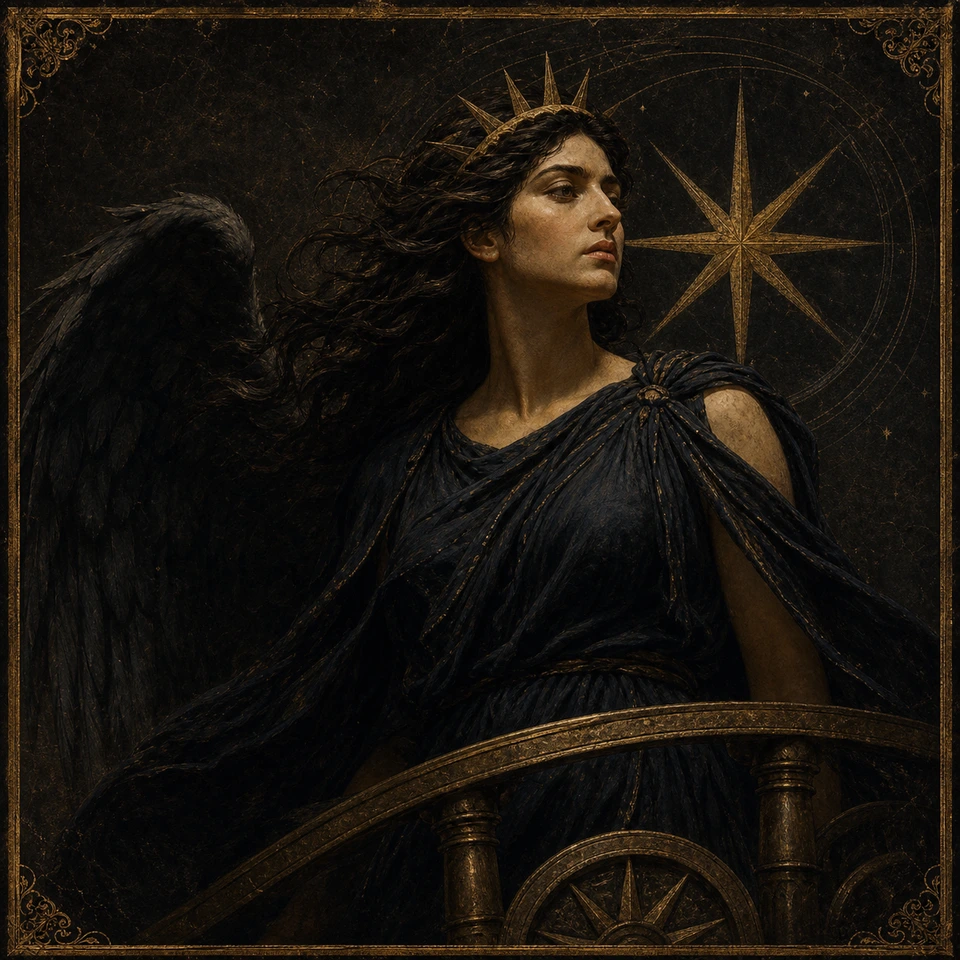
Emerging directly from primordial Chaos in Hesiodic tradition, Nyx surrounds the world as the absolute personification of Night. She brought forth Sleep, Death, and Strife, offering such formidable power that she successfully sheltered Hypnos from the wrath of Zeus in surviving ancient myth.
Overview
Nyx enters Greek poetry before a sun has risen. Hesiod does not introduce her as a queen waiting in a finished cosmos. He brings black Night and Erebus out of Chaos, then makes Night and Erebus the parents of Aether and Day. Darkness produces brightness without surrendering its own place. The genealogy gives Nyx a body, desire, offspring, and movement while keeping her inseparable from the daily reality named by her Greek name.
Her next children are not stars or decorative shadows. Night bears Doom, Fate, Death, Sleep, Dreams, Blame, Woe, the Hesperides, the Fates and death spirits, Nemesis, Deceit, Friendship, Age, and Strife. Strife then bears a younger generation of toil, famine, battles, lies, lawlessness, and ruin. The poem’s sequence is severe. Sleep and Dreams can ease mortal life, while Death, deception, age, and conflict close around it. Nyx stands at the beginning of that family, but the children remain distinct powers rather than masks she can wear at will.
Hesiod also gives her a house near the roots of earth and sea. Night and Day approach one bronze threshold, greet each other, and pass in opposite directions. One crosses the world while the other waits within. Sleep goes with Night; Death remains pitiless. The image is mechanical and intimate at once, a cosmic exchange conducted like two members of one household meeting at a door. It makes night neither evil nor accidental. Night is half of an ordered alternation.
The Iliad shows why even Zeus must reckon with her. Hypnos remembers an earlier time when Hera persuaded him to put Zeus to sleep and then drove Heracles off course in a storm. Zeus woke in fury and pursued Sleep through the halls of the gods. Hypnos escaped to Nyx. Zeus stopped because he feared to do anything displeasing to swift Night. The poem does not say that Nyx overthrows him. Her force lies in the boundary he refuses to cross.
Greek material evidence gives that alternation visible motion without making every painted detail a universal attribute. On an Attic lekythos of about 500 BC at the Metropolitan Museum of Art, Nyx drives away as Helios rises and Eos moves in the opposite direction. Night, Sun, and Dawn occupy one cycle but remain separate powers. The British Museum catalogues a later Attic red-figure pyxis and lid dated 430-410 BC, associates it with Nyx and Selene or Nox, and records an earlier Eos identification. Its indexed description presents Nyx as winged, driving four horses with reins in both hands, her tied chiton and streaming hair beneath a radiated fillet, with an eight-rayed star beside her head. A myrtle wreath decorates the vessel body. These are features of one catalogued object, not a universal list of Nyx's cult attributes.
A Classical comedy adds a source-specific turn that Hesiod does not know. In Aristophanes' Birds, a chorus claiming cosmic seniority makes black-winged Night lay an egg in Erebus; golden-winged Eros hatches from it and mingles with winged Chaos. The comic song gives Nyx a new act of motherhood without cancelling Hesiod's different genealogies.
Cult evidence is far thinner than the poetry. Pausanias reports an oracle called that of Night on the citadel of Megara, yet he does not tell us who spoke there or how questions were asked. A late ancient Orphic hymn invokes Nyx as a parent goddess of repose, dreams, and shadow and carries a rubric for fumigation with torches. The oracle and hymn prove more than modern guesswork, but less than a complete universal system of worship.
Nyx is therefore not a blank screen for every black stone, nocturnal animal, moon phase, or protective spell. She is a Greek divine personification with an archaic genealogy, an epic act of shelter, a local oracle, a late hymn, and securely identified Classical images. Roman Nox is a historical counterpart, not a reason to merge languages and cults. Selene is the Moon, Eos is Dawn, and neither becomes Nyx merely by crossing the same painted sky.
Canonical identity
Canonical Identity
Nyx is an active female divine figure and the absolute personification of night in Greek art and poetry. In Hesiod's account, she emerges directly from Chaos, gives birth to numerous children, and divides the world's daily passage alongside Day. As a named goddess among Greek divine personifications, she maintains strict boundaries separating her from her own offspring and the daylight power she meets at the threshold.
Linguistic Identity
Nyx is the exact transliteration of the Greek Νύξ (Nýx), a name identical to the ordinary Greek word for night. A qualified fifth-century BC Attic reconstruction gives /nýks/ (approximately NÜKS), featuring a rounded vowel distinct from standard English and an unreplicable pitch accent. Current English usage generally favors NIKS.
Sources and evidence
TEXTUAL · Supported
LSJ records the Ancient Greek headword νύξ, genitive νυκτός, as a feminine noun meaning night.
- Source
- Henry George Liddell and Robert Scott; Scaife ATLAS, νύξ, LSJ entry
- Reviewed edition
- LSJ digital entry νύξ, Scaife ATLAS URN lsj-n71314 · Tufts University
- Exact locator
- Entry νύξ, νυκτός, ἡ · Section LSJ headword and short definition · RecordUrl https://atlas.perseus.tufts.edu/dictionaries/entry/urn%3Acite2%3Ascaife-viewer%3Adictionaries.v1%3Alsj-n71314/
- Scope
- Unspecified · Ancient Greece
- Authority
- Liddell and Scott, LSJ, Scaife ATLAS headword νύξ
- Certainty
- Certain
The lexicon anchors the word and written accent; historical sound values are derived separately from Smyth.
Open exact reviewed sourceTEXTUAL · Supported
Applying Smyth's fifth-century Attic letter, vowel, and pitch-accent rules to the independently registered LSJ headword supports the qualified reconstruction /nýks/.
- Source
- Herbert Weir Smyth, A Greek Grammar for Colleges (1920)
- Reviewed edition
- Herbert Weir Smyth, A Greek Grammar for Colleges, American Book Company, 1920; Perseus text 1999.04.0007 · Perseus Digital Library
- Exact locator
- Entry A Greek Grammar for Colleges · Section §1 letter values; §24 fifth-century Attic υ; §150 raised-tone acute · RecordUrl https://www.perseus.tufts.edu/hopper/text?doc=Perseus:text:1999.04.0007
- Scope
- Classical Greece · Attica
- Authority
- Herbert Weir Smyth, A Greek Grammar for Colleges, 1920
- Certainty
- Qualified
LSJ separately anchors νύξ, νυκτός, ἡ. NÜKS approximates the front rounded vowel and cannot reproduce the ancient pitch accent.
Open exact reviewed sourceTEXTUAL · Supported
Modern English commonly pronounces Nyx /nɪks/, NIKS.
- Source
- Carnegie Mellon University Speech Group, CMU Pronouncing Dictionary
- Reviewed edition
- cmudict data file at commit 74790861f652b15e4ac49015a90074ad62a27690 · Carnegie Mellon University
- Exact locator
- Entry nyx · Section ARPABET N IH1 K S, line 85843 · RecordUrl https://raw.githubusercontent.com/cmusphinx/cmudict/74790861f652b15e4ac49015a90074ad62a27690/cmudict.dict
- Scope
- Modern classical scholarship
- Authority
- CMU Pronouncing Dictionary, pinned commit 74790861f652b15e4ac49015a90074ad62a27690
- Certainty
- Qualified
This is current English pronunciation, not ancient Greek sound.
Open exact reviewed source4 reviewed sources for this section
- Henry George Liddell and Robert Scott; Scaife ATLAS, νύξ, LSJ entryLSJ digital entry with exact headword and inflection · Tufts University
- Herbert Weir Smyth, A Greek Grammar for Colleges (1920)American Book Company, 1920; Perseus text 1999.04.0007 · Perseus Digital Library
- Carnegie Mellon University Speech Group, CMU Pronouncing DictionaryPinned repository commit 74790861f652b15e4ac49015a90074ad62a27690 · Carnegie Mellon University
- Hesiod; edited and translated by Hugh G. Evelyn-White, Theogony (1914)Hesiod, the Homeric Hymns and Homerica, London and New York, 1914 · Perseus Digital Library / Scaife ATLAS
Culture, tradition, period, and place
Nyx belongs to ancient Greek religious and poetic traditions from archaic hexameter through Classical Athenian art and Roman-imperial descriptions of older Greek sites. Hesiod gives her cosmogony and genealogy. Homer places her authority inside the remembered history of the Trojan War. Fifth-century BC vessels make her visible, and Pausanias finds a local oracle of Night at Megara centuries later.
These witnesses do not describe one uniform practice. The house beyond earth, an Attic vase, the Megarian citadel, and a late ritual hymn belong to different genres and communities. Their agreement on divine Night does not erase their differences in place, date, or purpose.
6 reviewed sources for this section
- Hesiod; edited and translated by Hugh G. Evelyn-White, Theogony (1914)Hesiod, the Homeric Hymns and Homerica, London and New York, 1914 · Perseus Digital Library / Scaife ATLAS
- Homer; Monro and Allen Greek edition with edition-specific translations, Iliad (1920)Perseus CTS edition corpus; Greek edition, Oxford, 1908-1920 · Perseus Digital Library / Scaife ATLAS
- Pausanias; Spiro Greek edition and Jones/Ormerod translation volumes, Description of Greece (1935)Perseus CTS edition corpus, 1903-1935 · Perseus Digital Library / Scaife ATLAS
- British Museum, British Museum CollectionLive official museum collection · British Museum
- The Metropolitan Museum of Art, Open Access Collection and Collection APILive collection data and eligible public-domain images · The Metropolitan Museum of Art
- Anonymous Orphic hymn poet; translated by Thomas Taylor, The Hymns of Orpheus (1792)Thomas Taylor English translation, 1792 · Internet Archive
Historical development
Archaic poetry already gives Nyx several durable forms. She is born from Chaos, becomes a parent with Erebus, bears another generation alone, and occupies a threshold opposite Day. Homer remembers her as the refuge Zeus will not violate. These are not stages in a simple rise from abstraction to goddesshood. Personification, genealogy, cosmic movement, and authority coexist from the surviving early texts.
Classical artists then show Night in chariot motion, distinguished from Selene, Helios, and Eos. Pausanias preserves the local Megarian oracle in the second century AD. The Orphic hymn collection addresses her in a later ritual voice. Each witness adds a setting without turning its local or literary form into the universal origin of all the others.
Sources and evidence
TEXTUAL · Supported
Hesiod brings Night and Erebus forth from Chaos, then makes Aether and Day the children of Night and Erebus.
- Source
- Hesiod; edited and translated by Hugh G. Evelyn-White, Theogony (1914)
- Reviewed edition
- Hugh G. Evelyn-White English translation in Hesiod, the Homeric Hymns and Homerica, Loeb Classical Library, 1914, Perseus eng1 component · translated by Hugh G. Evelyn-White · edited by Hugh G. Evelyn-White · Perseus Digital Library
- Exact locator
- Entry Theogony · Line 116-125
- Scope
- Archaic Greece · Ancient Greece
- Authority
- Hesiod, Theogony, Evelyn-White translation
- Certainty
- Certain
The poem makes Nyx both a cosmic condition and a female divine parent.
Open exact reviewed source6 reviewed sources for this section
- Hesiod; edited and translated by Hugh G. Evelyn-White, Theogony (1914)Hesiod, the Homeric Hymns and Homerica, London and New York, 1914 · Perseus Digital Library / Scaife ATLAS
- Homer; Monro and Allen Greek edition with edition-specific translations, Iliad (1920)Perseus CTS edition corpus; Greek edition, Oxford, 1908-1920 · Perseus Digital Library / Scaife ATLAS
- British Museum, British Museum CollectionLive official museum collection · British Museum
- The Metropolitan Museum of Art, Open Access Collection and Collection APILive collection data and eligible public-domain images · The Metropolitan Museum of Art
- Pausanias; Spiro Greek edition and Jones/Ormerod translation volumes, Description of Greece (1935)Perseus CTS edition corpus, 1903-1935 · Perseus Digital Library / Scaife ATLAS
- Anonymous Orphic hymn poet; translated by Thomas Taylor, The Hymns of Orpheus (1792)Thomas Taylor English translation, 1792 · Internet Archive
Attested roles and historical themes
Roles, powers, and limits
Nyx is the arrival and presence of night, not merely a ruler assigned to it. Hesiod gives her a route opposite Day and makes Sleep and Dreams part of her family. Homer shows a different force when Zeus abandons pursuit of Hypnos rather than offend her. The scene grants dignity and protective reach, but it does not make Night stronger than every Olympian in every circumstance.
Her children widen the emotional and mortal field around darkness: sleep, death, dreams, grief, blame, deception, age, strife, and fate. Their powers remain their own. Nyx does not automatically control every death, dream, quarrel, or destiny merely because a genealogy places them after her.
Sources and evidence
TEXTUAL · Supported
Hesiod places the houses of Night and Day near the roots of earth and sea, where the two cross a bronze threshold and never occupy the house together.
- Source
- Hesiod; edited and translated by Hugh G. Evelyn-White, Theogony (1914)
- Reviewed edition
- Hugh G. Evelyn-White English translation in Hesiod, the Homeric Hymns and Homerica, Loeb Classical Library, 1914, Perseus eng1 component · translated by Hugh G. Evelyn-White · edited by Hugh G. Evelyn-White · Perseus Digital Library
- Exact locator
- Entry Theogony · Line 744-757
- Scope
- Archaic Greece · Ancient Greece
- Authority
- Hesiod, Theogony, Evelyn-White translation
- Certainty
- Certain
This poetic cosmic geography is not a mapped earthly sanctuary.
Open exact reviewed source2 reviewed sources for this section
- Hesiod; edited and translated by Hugh G. Evelyn-White, Theogony (1914)Hesiod, the Homeric Hymns and Homerica, London and New York, 1914 · Perseus Digital Library / Scaife ATLAS
- Homer; Monro and Allen Greek edition with edition-specific translations, Iliad (1920)Perseus CTS edition corpus; Greek edition, Oxford, 1908-1920 · Perseus Digital Library / Scaife ATLAS
Epithets and titles
Theological Title
Parent goddess
Parent goddess
Late ancient Greek hymn tradition · Broadly late Hellenistic or Roman imperialOrphic Hymn 2 opens by addressing Night as a parent goddess; the title is retained within that hymn tradition.
1 reviewed source for this section
- Anonymous Orphic hymn poet; translated by Thomas Taylor, The Hymns of Orpheus (1792)Thomas Taylor English translation, 1792 · Internet Archive
Worship and cult
The clearest named cult location is small and exact. On the Carian citadel of Megara, Pausanias saw an oracle called that of Night among other sanctuaries. He gives its name and setting but not its operators, questions, offerings, or method. The gap must remain a gap.
Orphic Hymn 2 provides a different kind of evidence. It invokes Night as a parent goddess of rest, dreams, shadow, and chariot movement, under a rubric of fumigation with torches. The collection is late and difficult to date closely. Its words show a ritual hymn tradition, not an archaic nationwide ceremony and not a complete private practice for modern reconstruction.
Sources and evidence
TEXTUAL · Supported
Pausanias reports an oracle called that of Night on the Carian citadel of Megara.
- Source
- Pausanias; Spiro Greek edition and Jones/Ormerod translation volumes, Description of Greece (1935)
- Reviewed edition
- W. H. S. Jones and H. A. Ormerod English translation volumes, 1918-1935 · translated by W. H. S. Jones and H. A. Ormerod, volume-dependent · Perseus Digital Library / Scaife ATLAS
- Exact locator
- Book 1 · Chapter 40 · Section 6
- Scope
- Greek religion under Roman imperial rule · Megara
- Authority
- Pausanias, Description of Greece 1.40.6
- Certainty
- Certain
The report establishes a named local oracle but gives no ritual manual or universal priesthood.
Open exact reviewed sourceTEXTUAL · Supported
Orphic Hymn 2 addresses Night as a parent goddess, associates her with sleep, dreams, and a chariot, and carries the rubric of fumigation with torches.
- Source
- Anonymous Orphic hymn poet; translated by Thomas Taylor, The Hymns of Orpheus (1792)
- Reviewed edition
- The Hymns of Orpheus, Thomas Taylor English translation, 1792 · translated by Thomas Taylor · Internet Archive
- Exact locator
- Entry Hymn II, To Night · Page 115-116
- Scope
- Unspecified · Ancient Greece
- Authority
- The Hymns of Orpheus, Thomas Taylor 1792 English translation
- Certainty
- Qualified
The exact Taylor 1792 English passage was read at printed pages 115-116; the ancient hymn collection date remains broad.
Open exact reviewed source2 reviewed sources for this section
- Pausanias; Spiro Greek edition and Jones/Ormerod translation volumes, Description of Greece (1935)Perseus CTS edition corpus, 1903-1935 · Perseus Digital Library / Scaife ATLAS
- Anonymous Orphic hymn poet; translated by Thomas Taylor, The Hymns of Orpheus (1792)Thomas Taylor English translation, 1792 · Internet Archive
Temples, sanctuaries, and sacred places
Megara supplies a securely named earthly site: an oracle of Night on the citadel called Caria. Pausanias places it near sanctuaries of Dionysus Nyctelius and Aphrodite Epistrophia, yet proximity does not create identity or shared office among the deities.
Hesiod’s house of Night and Day is sacred cosmic geography of another order. It stands near the roots of earth and sea, beyond Atlas, where the two powers exchange the world at a bronze threshold. The poem’s location gives night a structure and rhythm. It cannot be plotted as a lost temple or claimed as archaeological evidence.
2 reviewed sources for this section
- Pausanias; Spiro Greek edition and Jones/Ormerod translation volumes, Description of Greece (1935)Perseus CTS edition corpus, 1903-1935 · Perseus Digital Library / Scaife ATLAS
- Hesiod; edited and translated by Hugh G. Evelyn-White, Theogony (1914)Hesiod, the Homeric Hymns and Homerica, London and New York, 1914 · Perseus Digital Library / Scaife ATLAS
Festivals and processions
No independent annual festival of Nyx is named by these witnesses. Pausanias names an oracle without a calendar, and the late hymn names an offering rubric without a procession date. Silence on a festival is not proof that none ever existed, but it prevents a modern schedule from being presented as ancient fact.
Night itself is a recurring sacred time rather than a festival. Hesiod imagines its daily passage in alternation with Day. That cosmic rhythm may explain why later prayer addresses Nyx at all, yet the poem does not prescribe a feast, vigil, or monthly observance.
3 reviewed sources for this section
- Pausanias; Spiro Greek edition and Jones/Ormerod translation volumes, Description of Greece (1935)Perseus CTS edition corpus, 1903-1935 · Perseus Digital Library / Scaife ATLAS
- Anonymous Orphic hymn poet; translated by Thomas Taylor, The Hymns of Orpheus (1792)Thomas Taylor English translation, 1792 · Internet Archive
- Hesiod; edited and translated by Hugh G. Evelyn-White, Theogony (1914)Hesiod, the Homeric Hymns and Homerica, London and New York, 1914 · Perseus Digital Library / Scaife ATLAS
Offerings, votives, and ritual evidence
The Orphic hymn’s heading specifies fumigation with torches. That strange, vivid rubric is the strongest offering detail here, and it must stay attached to Hymn 2 and the late collection that preserves it. No resin, perfume, food, libation, animal victim, or priestly sequence accompanies the rubric in the surviving translation.
The Megarian oracle proves a named sacred installation but adds no material procedure. Painted vessels depicting Nyx are material witnesses to her image, not automatically votive gifts to her. An object can preserve iconography without revealing how or whether it was offered.
4 reviewed sources for this section
- Anonymous Orphic hymn poet; translated by Thomas Taylor, The Hymns of Orpheus (1792)Thomas Taylor English translation, 1792 · Internet Archive
- Pausanias; Spiro Greek edition and Jones/Ormerod translation volumes, Description of Greece (1935)Perseus CTS edition corpus, 1903-1935 · Perseus Digital Library / Scaife ATLAS
- British Museum, British Museum CollectionLive official museum collection · British Museum
- The Metropolitan Museum of Art, Open Access Collection and Collection APILive collection data and eligible public-domain images · The Metropolitan Museum of Art
Iconography and material culture
The Metropolitan Museum of Art's Attic lekythos of about 500 BC places Nyx in motion: she drives away as Helios rises and Eos moves in the opposite direction. The scene makes a cosmic alternation visible while keeping Night, Sun, and Dawn distinct. Its chariot movement is strong evidence for this object, not a license to assign every later nocturnal emblem to Nyx.
The British Museum catalogues 1873,0915.14 as an Attic red-figure pyxis and lid dated 430-410 BC. Its indexed description presents Nyx as a winged figure in a tied chiton, leaning forward over four chariot horses with reins in both hands, streaming hair beneath a radiated fillet, and an eight-rayed star beside her head. The vessel body carries a myrtle wreath. Associated names and an earlier identification preserve a Nyx, Selene or Nox, and Eos naming history. Every pose, garment, animal, star, and plant detail remains attached to this pyxis rather than becoming a universal cult attribute.
Sources and evidence
MATERIAL CULTURE · Supported
The British Museum catalogues 1873,0915.14 as an Attic red-figure pyxis and lid dated 430-410 BC. Its indexed description presents Nyx as a winged figure in a tied chiton, leaning forward over four chariot horses with reins in both hands, streaming hair beneath a radiated fillet, and an eight-rayed star beside her head; the vessel body carries a myrtle wreath. The catalogue associates the scene with Nyx and Selene or Nox and records an earlier Eos identification.
- Source
- British Museum, British Museum Collection
- Reviewed edition
- Live accession-specific British Museum collection record 1873,0915.14 · British Museum
- Exact locator
- MuseumObjectId 1873,0915.14 · Entry Attic red-figure pyxis and lid with Nyx · RecordUrl https://www.britishmuseum.org/collection/object/G_1873-0915-14
- Scope
- Classical Greece · Athens
- Authority
- British Museum indexed object metadata
- Certainty
- Qualified
Every listed detail comes from the official indexed catalogue description rather than direct image inspection. The pose, dress, wings, horses, star, and vessel decoration remain object-bound and do not become universal cult attributes.
Open exact reviewed sourceMATERIAL CULTURE · Supported
An Attic lekythos of about 500 BC places Nyx driving away as Helios rises and Eos moves in the opposite direction.
- Source
- The Metropolitan Museum of Art, Open Access Collection and Collection API
- Reviewed edition
- Live accession-specific Metropolitan Museum of Art record and Open Access API object 254196 / 41.162.29 · The Metropolitan Museum of Art
- Exact locator
- MuseumObjectId 41.162.29 · Entry Attic lekythos with Nyx, Helios, and Eos · RecordUrl https://www.metmuseum.org/art/collection/search/254196
- Scope
- Archaic Greece · Athens
- Authority
- Metropolitan Museum of Art object catalogue
- Certainty
- Certain
The scene distinguishes Nyx from Eos, Helios, and Selene and gives no crescent-moon identity.
Open exact reviewed source2 reviewed sources for this section
- British Museum, British Museum CollectionLive official museum collection · British Museum
- The Metropolitan Museum of Art, Open Access Collection and Collection APILive collection data and eligible public-domain images · The Metropolitan Museum of Art
Animals, plants, and embodied forms
No sacred animal is established for Nyx by these witnesses. The Met lekythos and British Museum catalogue place horses with Nyx's chariot, and the British Museum describes her as winged, but neither establishes a horse, bird, or another animal as sacred to or embodied by Nyx. Bats, owls, ravens, and black animals require their own dated sources.
The British Museum catalogue records a myrtle wreath on the body of the pyxis, not a plant held or worn by Nyx and not a statement of sacred status. No sacred plant is established. Later night-blooming or poisonous plants cannot be carried backward into Greek cult without a specific witness.
3 reviewed sources for this section
- British Museum, British Museum CollectionLive official museum collection · British Museum
- The Metropolitan Museum of Art, Open Access Collection and Collection APILive collection data and eligible public-domain images · The Metropolitan Museum of Art
- Anonymous Orphic hymn poet; translated by Thomas Taylor, The Hymns of Orpheus (1792)Thomas Taylor English translation, 1792 · Internet Archive
Relationships and genealogy
Hesiod makes Nyx a child of Chaos and partner of Erebus. Their children Aether and Day remain equally important to the genealogy. Nyx then bears another generation alone, including Hypnos, Thanatos, Nemesis, and Eris; each remains a distinct divine figure with its own actions and relationships.
The Moirai carry a deliberate conflict. One passage makes the Fates daughters of Night; another makes them daughters of Zeus and Themis. The parentage is therefore source-backed but qualified. Nyx is not turned into the direct parent of every child later born to Eris, and family descent creates no automatic magical association.
Sources and evidence
TEXTUAL · Supported
Hesiod says Night bears Doom, Fate, Death, Sleep, and Dreams without union with another deity.
- Source
- Hesiod; edited and translated by Hugh G. Evelyn-White, Theogony (1914)
- Reviewed edition
- Hugh G. Evelyn-White English translation in Hesiod, the Homeric Hymns and Homerica, Loeb Classical Library, 1914, Perseus eng1 component · translated by Hugh G. Evelyn-White · edited by Hugh G. Evelyn-White · Perseus Digital Library
- Exact locator
- Entry Theogony · Line 211-213
- Scope
- Archaic Greece · Ancient Greece
- Authority
- Hesiod, Theogony, Evelyn-White translation
- Certainty
- Certain
The English names translate personified powers and must not be collapsed into one child.
Open exact reviewed sourceTEXTUAL · Supported
Hesiod continues Night’s children with Blame, Woe, the Hesperides, the Fates and Keres, Nemesis, Deceit, Friendship, Age, and Strife.
- Source
- Hesiod; edited and translated by Hugh G. Evelyn-White, Theogony (1914)
- Reviewed edition
- Hugh G. Evelyn-White English translation in Hesiod, the Homeric Hymns and Homerica, Loeb Classical Library, 1914, Perseus eng1 component · translated by Hugh G. Evelyn-White · edited by Hugh G. Evelyn-White · Perseus Digital Library
- Exact locator
- Entry Theogony · Line 214-225
- Scope
- Archaic Greece · Ancient Greece
- Authority
- Hesiod, Theogony, Evelyn-White translation
- Certainty
- Certain
Translations vary for several personified names; exact genealogy is source-specific.
Open exact reviewed sourceTEXTUAL · Supported
Hesiod makes Strife a daughter of Night and then gives Strife her own brood of toil, violence, lies, conflict, and ruin.
- Source
- Hesiod; edited and translated by Hugh G. Evelyn-White, Theogony (1914)
- Reviewed edition
- Hugh G. Evelyn-White English translation in Hesiod, the Homeric Hymns and Homerica, Loeb Classical Library, 1914, Perseus eng1 component · translated by Hugh G. Evelyn-White · edited by Hugh G. Evelyn-White · Perseus Digital Library
- Exact locator
- Entry Theogony · Line 225-232
- Scope
- Archaic Greece · Ancient Greece
- Authority
- Hesiod, Theogony, Evelyn-White translation
- Certainty
- Certain
Nyx is not made the direct parent of every descendant in Strife’s later generation.
Open exact reviewed source1 reviewed source for this section
- Hesiod; edited and translated by Hugh G. Evelyn-White, Theogony (1914)Hesiod, the Homeric Hymns and Homerica, London and New York, 1914 · Perseus Digital Library / Scaife ATLAS
Actual myths and source variants
Three narratives carry Nyx beyond a list of names. Hesiod's cosmogony moves from her birth out of Chaos to her children and then to the house where Night and Day exchange the world. The same poem contradicts itself over the parentage of the Fates, and the linked retelling preserves that tension.
In the Iliad, Hypnos remembers a previous deception of Zeus. Zeus hunts him through the divine halls, but Sleep reaches Nyx and the pursuit ends because Zeus fears to offend her. The memory explains why Hypnos resists Hera's next request. Nyx is a refuge in the embedded earlier episode, not the planner of the new deception.
Aristophanes gives the goddess a sharply different act in Birds 693-702. The chorus sings that black-winged Night laid an egg in Erebus, and golden-winged Eros hatched from it before mingling with Chaos. This is a comic choral cosmogony, not a missing chapter of Hesiod, so the egg and its maternity remain attached to the play that supplies them.
Sources and evidence
TEXTUAL · Supported
In Iliad 14, Hypnos recalls fleeing from Zeus and reaching Night, whom Zeus feared to offend.
- Source
- Homer; Monro and Allen Greek edition with edition-specific translations, Iliad (1920)
- Reviewed edition
- A. T. Murray English translation, volumes I-II, 1924-1925 · translated by A. T. Murray · Perseus Digital Library / Scaife ATLAS
- Exact locator
- Entry Iliad · Book 14 · Line 231-261
- Scope
- Archaic Greece · Ancient Greece
- Authority
- Homer, Iliad Book 14
- Certainty
- Certain
The scene demonstrates protective authority through one epic recollection, not omnipotence over Zeus.
Open exact reviewed sourceTEXTUAL · Supported
Hera wins Hypnos’s help by promising Pasithea, and the renewed deception lets Poseidon aid the Greeks while Zeus sleeps.
- Source
- Homer; Monro and Allen Greek edition with edition-specific translations, Iliad (1920)
- Reviewed edition
- A. T. Murray English translation, volumes I-II, 1924-1925 · translated by A. T. Murray · Perseus Digital Library / Scaife ATLAS
- Exact locator
- Entry Iliad · Book 14 · Line 262-291; 346-369
- Scope
- Archaic Greece · Ancient Greece
- Authority
- Homer, Iliad Book 14
- Certainty
- Certain
Nyx belongs to the embedded earlier crisis as Hypnos’s shelter.
Open exact reviewed sourceTEXTUAL · Supported
Aristophanes' Birds makes black-winged Night lay an egg in Erebus, from which golden-winged Eros hatches.
- Source
- Aristophanes; translated by Benjamin Bickley Rogers, The Birds of Aristophanes (1920)
- Reviewed edition
- The Birds of Aristophanes, Benjamin Bickley Rogers English translation, G. Bell and Sons, 1920 · translated by Benjamin Bickley Rogers · edited by Benjamin Bickley Rogers · Internet Archive
- Exact locator
- Entry Birds · Line 693-702
- Scope
- Classical Greece · Athens
- Authority
- Aristophanes, Birds, Rogers 1920 English translation
- Certainty
- Certain
The maternity belongs to the comic chorus' cosmogony and does not replace Hesiod's different account.
Open exact reviewed source3 reviewed sources for this section
- Hesiod; edited and translated by Hugh G. Evelyn-White, Theogony (1914)Hesiod, the Homeric Hymns and Homerica, London and New York, 1914 · Perseus Digital Library / Scaife ATLAS
- Homer; Monro and Allen Greek edition with edition-specific translations, Iliad (1920)Perseus CTS edition corpus; Greek edition, Oxford, 1908-1920 · Perseus Digital Library / Scaife ATLAS
- Aristophanes; translated by Benjamin Bickley Rogers, The Birds of Aristophanes (1920)G. Bell and Sons separate edition, 1920 · Internet Archive
Myth Library
Each myth gathers its attested participants into one source-grounded account, while distinct source traditions remain readable in their own variants.
Divine Genealogy And Cosmic Dwelling
Night Bears Sleep, Death, and Dreams
Night emerges from Chaos, becomes mother to bright Day and a severe brood of personified powers, and crosses the bronze threshold where Sleep and Death reveal sharply different natures.
- Role in this profile
- Night who emerges from Chaos, becomes a divine parent, and shelters the house shared in alternation with Day
- Place scope
- Ancient Greece
- Witnesses
- 3
- Variants
- 3
Epic
Hera Beguiles Zeus on Ida
Hera borrows Aphrodite’s embroidered zone, bargains with Sleep, and draws Zeus into love and sleep on Mount Ida so Poseidon can aid the Achaeans.
- Role in this profile
- protective Night whose standing stops Zeus from punishing Hypnos after the earlier deception
- Place scope
- Mount Ida in the Troad
- Witnesses
- 1
- Variants
- 1
Theogonic And Philosophical
Origins and Natures of Eros
Hesiod's parentless primordial Eros, Aristophanes' golden-winged child of Night's egg, and Plato's contradictory philosophical Erotes preserve irreconcilable origins.
- Role in this profile
- black-winged mother who lays the cosmic egg in Aristophanes' choral song
- Place scope
- Ancient Greece · Athens
- Witnesses
- 3
- Variants
- 3
Theogony
The Two Genealogies of the Moirai
Hesiod gives the Moirai two different parentages, first as daughters of Night and later as daughters of Zeus and Themis.
- Role in this profile
- bears the three named sisters without a partner in the first genealogy
- Place scope
- Ancient Greece
- Witnesses
- 2
- Variants
- 2
Equivalences, syncretisms, and identity boundaries
The British Museum catalogue uses Nox in association with a Greek Nyx or Selene scene and records an earlier Eos identification. That naming history does not merge Greek Nyx with Roman Nox, and the catalogue's detailed object description does not establish a shared cult or one interchangeable identity.
The Met lekythos keeps Nyx, Eos, and Helios separate even as their movements share one sky. Selene is the Moon, Eos is Dawn, Helios is the Sun, and Nyx is Night. Similar darkness in another culture proves neither cognate origin nor equivalence.
Sources and evidence
MATERIAL CULTURE · Supported
The British Museum catalogue uses the Roman comparative name Nox while identifying a Greek Nyx or Selene scene and recording an earlier Eos identification; that naming history does not merge Greek Nyx with Roman Nox.
- Source
- British Museum, British Museum Collection
- Reviewed edition
- Live accession-specific British Museum collection record 1873,0915.14 · British Museum
- Exact locator
- MuseumObjectId 1873,0915.14 · Entry Associated names and catalogue identification · RecordUrl https://www.britishmuseum.org/collection/object/G_1873-0915-14
- Scope
- Classical Greece · Athens
- Authority
- British Museum indexed object metadata
- Certainty
- Qualified
The boundary rests on the catalogue's naming history. The indexed object description does not establish cultic equivalence between Greek Nyx and Roman Nox.
Open exact reviewed source2 reviewed sources for this section
- British Museum, British Museum CollectionLive official museum collection · British Museum
- The Metropolitan Museum of Art, Open Access Collection and Collection APILive collection data and eligible public-domain images · The Metropolitan Museum of Art
Correspondence index
Night itself, the movement opposite Day, the house beyond the roots of earth and sea, and the sheltering of Hypnos are direct ancient evidence. The Met lekythos supplies an object-bound chariot scene and distinguishes Nyx from Helios and Eos. The British Museum catalogue supplies a second chariot, wing, horse, star, and vessel-decoration record. Megara is a cult place because Pausanias names an oracle there.
No ancient witness named above assigns Nyx a planet, zodiac sign, moon phase, gemstone, weekday, classical element, sacred plant, sacred animal, universal color, incense, or annual festival. The pyxis and Aristophanes' winged Night establish source-specific wings, and the pyxis establishes one eight-rayed star, but neither becomes a universal cult correspondence. Later associations require their own named traditions and dates.
Direct ancient correspondences
| Category | Direct correspondence | How and why | Evidence boundary |
|---|---|---|---|
| festival-time | Night as a divine timeDirect historical association | Nyx is the personified night that alternates with Day. | Ancient Literary No independent annual festival or calendar date is established. 1 reviewed source for this section
|
| offering-ritual-material | Torch fumigation rubricDirect historical association | Orphic Hymn 2 carries a source-specific rubric for fumigation with torches. | Ancient Cultic The rubric belongs to that hymn collection and is not expanded into a modern rite. 1 reviewed source for this section
|
Contextual evidence, not a general correspondence
| Category | Direct correspondence | How and why | Evidence boundary |
|---|---|---|---|
| celestial-body | Eight-rayed star on the British Museum pyxisContextual evidence only | The official indexed catalogue places one large eight-rayed star beside Nyx's head on this object. | Ancient Material The object-bound star does not assign Nyx a planet, constellation, or universal celestial rulership. 1 reviewed source for this section
|
| metal-material | Attic painted potteryContextual evidence only | Two securely identified Attic vessels preserve Nyx in motion. | Ancient Material Terracotta is the support of these images, not a universal sacred substance. 2 reviewed sources for this section
|
| plant-tree | Myrtle wreath on the British Museum pyxisContextual evidence only | The British Museum catalogue records a myrtle wreath on the vessel body, not as a plant held, worn, or named sacred to Nyx. | Ancient Material Object decoration does not establish a universal sacred plant. 1 reviewed source for this section
|
| color | Black and darkness languageContextual evidence only | Hesiod calls Night black, and the late hymn describes ebon night. | Ancient Literary Literary darkness does not establish a universal ritual color. 2 reviewed sources for this section
|
| direction-place | Megara and the cosmic thresholdContextual evidence only | Megara preserves an oracle of Night, while Hesiod gives Night a poetic house beyond ordinary geography. | Ancient Cultic No compass direction is attested. 2 reviewed sources for this section
|
| ritual-object-symbol-tool | Chariot movement and an eight-rayed starContextual evidence only | The Met places Nyx driving away as Helios rises, while the British Museum catalogue describes winged Nyx driving four horses with an eight-rayed star beside her head. | Ancient Material These pictorial features remain object-bound iconography, not universal ritual tools or star correspondences. 2 reviewed sources for this section
|
| intention-magical-power | Night, sleep, dreams, and refugeContextual evidence only | Hesiod, Homer, and the late hymn connect Nyx with night, her children Sleep and Dreams, and the protection of Hypnos. | Ancient Literary The evidence does not guarantee concealment, sleep, or protection in a modern working. 3 reviewed sources for this section
|
7 expected categories currently not evidenced
zodiac · Not evidenced
No zodiac sign attested
The cited Greek witnesses never place the goddess in a zodiacal scheme.
- Layer
- Research Boundary
- Scope
- Night is not mapped to a sign without a dated source.
6 reviewed sources for this section
- Hesiod; edited and translated by Hugh G. Evelyn-White, Theogony (1914)Hesiod, the Homeric Hymns and Homerica, London and New York, 1914 · Perseus Digital Library / Scaife ATLAS
- Homer; Monro and Allen Greek edition with edition-specific translations, Iliad (1920)Perseus CTS edition corpus; Greek edition, Oxford, 1908-1920 · Perseus Digital Library / Scaife ATLAS
- Pausanias; Spiro Greek edition and Jones/Ormerod translation volumes, Description of Greece (1935)Perseus CTS edition corpus, 1903-1935 · Perseus Digital Library / Scaife ATLAS
- British Museum, British Museum CollectionLive official museum collection · British Museum
- The Metropolitan Museum of Art, Open Access Collection and Collection APILive collection data and eligible public-domain images · The Metropolitan Museum of Art
- Anonymous Orphic hymn poet; translated by Thomas Taylor, The Hymns of Orpheus (1792)Thomas Taylor English translation, 1792 · Internet Archive
gemstone-crystal-mineral · Not evidenced
No gemstone or mineral attested
The literary, cultic, and object evidence names no gemstone, crystal, or mineral for Nyx.
- Layer
- Research Boundary
- Scope
- Dark appearance does not establish onyx, obsidian, or another stone.
6 reviewed sources for this section
- Hesiod; edited and translated by Hugh G. Evelyn-White, Theogony (1914)Hesiod, the Homeric Hymns and Homerica, London and New York, 1914 · Perseus Digital Library / Scaife ATLAS
- Homer; Monro and Allen Greek edition with edition-specific translations, Iliad (1920)Perseus CTS edition corpus; Greek edition, Oxford, 1908-1920 · Perseus Digital Library / Scaife ATLAS
- Pausanias; Spiro Greek edition and Jones/Ormerod translation volumes, Description of Greece (1935)Perseus CTS edition corpus, 1903-1935 · Perseus Digital Library / Scaife ATLAS
- British Museum, British Museum CollectionLive official museum collection · British Museum
- The Metropolitan Museum of Art, Open Access Collection and Collection APILive collection data and eligible public-domain images · The Metropolitan Museum of Art
- Anonymous Orphic hymn poet; translated by Thomas Taylor, The Hymns of Orpheus (1792)Thomas Taylor English translation, 1792 · Internet Archive
animal-embodied-form · Not evidenced
No sacred animal attested
The catalogued scenes show horses drawing Nyx's chariot, and the British Museum record describes her as winged; neither makes a horse, bird, or another animal her sacred animal or embodied form.
- Layer
- Research Boundary
- Scope
- The horse and wing evidence remains object-bound iconography, not a universal sacred-animal or embodied-form claim.
2 reviewed sources for this section
- The Metropolitan Museum of Art, Open Access Collection and Collection APILive collection data and eligible public-domain images · The Metropolitan Museum of Art
- British Museum, British Museum CollectionLive official museum collection · British Museum
classical-element · Not evidenced
No classical element attested
Her genealogy includes bright upper air, but no passage assigns her to a formal elemental system.
- Layer
- Research Boundary
- Scope
- Darkness and upper air genealogy do not establish elemental rulership.
2 reviewed sources for this section
- Hesiod; edited and translated by Hugh G. Evelyn-White, Theogony (1914)Hesiod, the Homeric Hymns and Homerica, London and New York, 1914 · Perseus Digital Library / Scaife ATLAS
- Anonymous Orphic hymn poet; translated by Thomas Taylor, The Hymns of Orpheus (1792)Thomas Taylor English translation, 1792 · Internet Archive
weekday · Not evidenced
No weekday attested
Neither the Megarian oracle nor the hymn assigns Nyx a weekday.
- Layer
- Research Boundary
- Scope
- No day is borrowed from planetary convention.
2 reviewed sources for this section
- Pausanias; Spiro Greek edition and Jones/Ormerod translation volumes, Description of Greece (1935)Perseus CTS edition corpus, 1903-1935 · Perseus Digital Library / Scaife ATLAS
- Anonymous Orphic hymn poet; translated by Thomas Taylor, The Hymns of Orpheus (1792)Thomas Taylor English translation, 1792 · Internet Archive
moon-phase · Not evidenced
No moon phase attested
The Met scene distinguishes Night from Helios and Eos and assigns no lunar phase to Nyx.
- Layer
- Research Boundary
- Scope
- Night is not silently converted into the Moon or one lunar phase.
1 reviewed source for this section
- The Metropolitan Museum of Art, Open Access Collection and Collection APILive collection data and eligible public-domain images · The Metropolitan Museum of Art
incense-perfume · Not evidenced
No incense or perfume named
The Orphic hymn's torch rubric names no incense, resin, or perfume.
- Layer
- Research Boundary
- Scope
- No fragrance is supplied by analogy.
1 reviewed source for this section
- Anonymous Orphic hymn poet; translated by Thomas Taylor, The Hymns of Orpheus (1792)Thomas Taylor English translation, 1792 · Internet Archive
6 reviewed sources for this section
- Hesiod; edited and translated by Hugh G. Evelyn-White, Theogony (1914)Hesiod, the Homeric Hymns and Homerica, London and New York, 1914 · Perseus Digital Library / Scaife ATLAS
- Homer; Monro and Allen Greek edition with edition-specific translations, Iliad (1920)Perseus CTS edition corpus; Greek edition, Oxford, 1908-1920 · Perseus Digital Library / Scaife ATLAS
- Pausanias; Spiro Greek edition and Jones/Ormerod translation volumes, Description of Greece (1935)Perseus CTS edition corpus, 1903-1935 · Perseus Digital Library / Scaife ATLAS
- British Museum, British Museum CollectionLive official museum collection · British Museum
- The Metropolitan Museum of Art, Open Access Collection and Collection APILive collection data and eligible public-domain images · The Metropolitan Museum of Art
- Anonymous Orphic hymn poet; translated by Thomas Taylor, The Hymns of Orpheus (1792)Thomas Taylor English translation, 1792 · Internet Archive
Later reception and living significance
The late Orphic hymn addresses Night in ancient ritual poetry. Modern devotional, artistic, ecological, and occult uses belong to later histories; the hymn cannot be made to speak for those communities or projected backward into ancient cult.
1 reviewed source for this section
- Anonymous Orphic hymn poet; translated by Thomas Taylor, The Hymns of Orpheus (1792)Thomas Taylor English translation, 1792 · Internet Archive
Evidence, conflicts, and research gaps
Hesiod preserves Nyx's early genealogy, her severe children, and the Night and Day threshold. Homer preserves the refuge of Hypnos. Aristophanes preserves the comic egg cosmogony. Pausanias names the Megarian oracle. The Met lekythos preserves chariot movement and the distinction among Nyx, Helios, and Eos. The British Museum catalogue preserves a pyxis identity, a detailed winged chariot scene with an eight-rayed star, myrtle decoration on the vessel body, and a history of Nyx, Selene or Nox, and earlier Eos naming. Thomas Taylor's 1792 English edition of The Hymns of Orpheus preserves Hymn II to Night and its torch rubric at printed pages 115-116.
Several gaps remain. No secure Mycenaean form has been established. Chaos, Erebus, Aether, and Day still need their own identity histories. The Fates have incompatible parents in the canonical Moirai genealogy myth, rather than a duplicated Night-brood episode. The oracle's personnel and rites are unknown. The hymn collection's ancient date is broad. Roman Nox requires separate Roman evidence, and no dated history of a present-day Nyx-specific devotional community is established.
Sources and evidence
TEXTUAL · Supported
Theogony first makes the Fates children of Night, but later makes them daughters of Zeus and Themis.
- Source
- Hesiod; edited and translated by Hugh G. Evelyn-White, Theogony (1914)
- Reviewed edition
- Hugh G. Evelyn-White English translation in Hesiod, the Homeric Hymns and Homerica, Loeb Classical Library, 1914, Perseus eng1 component · translated by Hugh G. Evelyn-White · edited by Hugh G. Evelyn-White · Perseus Digital Library
- Exact locator
- Entry Theogony · Line 217-222; 901-906
- Scope
- Archaic Greece · Ancient Greece
- Authority
- Hesiod, Theogony, Evelyn-White translation
- Certainty
- Certain
Both genealogies remain visible; one is not silently discarded.
Open exact reviewed source10 reviewed sources for this section
- Hesiod; edited and translated by Hugh G. Evelyn-White, Theogony (1914)Hesiod, the Homeric Hymns and Homerica, London and New York, 1914 · Perseus Digital Library / Scaife ATLAS
- Homer; Monro and Allen Greek edition with edition-specific translations, Iliad (1920)Perseus CTS edition corpus; Greek edition, Oxford, 1908-1920 · Perseus Digital Library / Scaife ATLAS
- Pausanias; Spiro Greek edition and Jones/Ormerod translation volumes, Description of Greece (1935)Perseus CTS edition corpus, 1903-1935 · Perseus Digital Library / Scaife ATLAS
- British Museum, British Museum CollectionLive official museum collection · British Museum
- The Metropolitan Museum of Art, Open Access Collection and Collection APILive collection data and eligible public-domain images · The Metropolitan Museum of Art
- Henry George Liddell and Robert Scott; Scaife ATLAS, νύξ, LSJ entryLSJ digital entry with exact headword and inflection · Tufts University
- Herbert Weir Smyth, A Greek Grammar for Colleges (1920)American Book Company, 1920; Perseus text 1999.04.0007 · Perseus Digital Library
- Carnegie Mellon University Speech Group, CMU Pronouncing DictionaryPinned repository commit 74790861f652b15e4ac49015a90074ad62a27690 · Carnegie Mellon University
- Anonymous Orphic hymn poet; translated by Thomas Taylor, The Hymns of Orpheus (1792)Thomas Taylor English translation, 1792 · Internet Archive
- Aristophanes; translated by Benjamin Bickley Rogers, The Birds of Aristophanes (1920)G. Bell and Sons separate edition, 1920 · Internet Archive
Direct connections and evidence
Explicit Source
Hesiod names Eris a daughter of Nyx
The Theogony describes Nyx bearing Eris without a partner.
1 attestation · high confidence
- Hesiod; edited and translated by Hugh G. Evelyn-White, TheogonyHugh G. Evelyn-White edition and English translation in Hesiod, the Homeric Hymns and Homerica, 1914 · translated by Hugh G. Evelyn-White · edited by Hugh G. Evelyn-White · Perseus Digital Library / Scaife ATLAS · Archaic Greece · Ancient Greece · Entry Theogony · Line 211-225
Explicit Source
Hesiod names Hypnos among the children of Nyx
Night’s motherhood is explicit, and Homer also shows her protecting Hypnos.
1 attestation · high confidence
- Hesiod; edited and translated by Hugh G. Evelyn-White, TheogonyHugh G. Evelyn-White edition and English translation in Hesiod, the Homeric Hymns and Homerica, 1914 · translated by Hugh G. Evelyn-White · edited by Hugh G. Evelyn-White · Perseus Digital Library / Scaife ATLAS · Archaic Greece · Ancient Greece · Entry Theogony · Line 211-232
Explicit Source
Hesiod first makes the Moirai daughters of Nyx
This parentage is not merged with the later Zeus and Themis genealogy.
1 attestation · high confidence
- Hesiod; edited and translated by Hugh G. Evelyn-White, TheogonyHugh G. Evelyn-White English translation in Hesiod, the Homeric Hymns and Homerica, Loeb Classical Library, 1914, Perseus eng1 component · translated by Hugh G. Evelyn-White · edited by Hugh G. Evelyn-White · Perseus Digital Library · Archaic Greece · Ancient Greece · Entry Theogony · Line 211-225
Explicit Source
Hesiod names Nemesis as a daughter of Night
Hesiodic genealogy only; it does not create a nighttime or lunar correspondence.
1 attestation · high confidence
- Hesiod; edited and translated by Hugh G. Evelyn-White, TheogonyHugh G. Evelyn-White edition and English translation in Hesiod, the Homeric Hymns and Homerica, 1914 · translated by Hugh G. Evelyn-White · edited by Hugh G. Evelyn-White · Perseus Digital Library / Scaife ATLAS · Archaic Greece · Ancient Greece · Entry Theogony · Line 223-225
Explicit Source
Hesiod names Thanatos, Death, as a child of Nyx
Death remains a separate divine personification.
1 attestation · high confidence
- Hesiod; edited and translated by Hugh G. Evelyn-White, TheogonyHugh G. Evelyn-White English translation in Hesiod, the Homeric Hymns and Homerica, Loeb Classical Library, 1914, Perseus eng1 component · translated by Hugh G. Evelyn-White · edited by Hugh G. Evelyn-White · Perseus Digital Library · Archaic Greece · Ancient Greece · Entry Theogony · Line 211-213
Archive scope and classification
- Figure classification
- Divine personification, God or goddess · certain
- Pantheon or tradition shelf
- Greek
- Cultures
- Greek
- Traditions
- Ancient Greek religion
- Periods
- Archaic Greece, Classical Greece, Greek religion under Roman imperial rule
- Places
- Ancient Greece, Attica, Athens, Megara
Greek poetry, Classical material evidence, the Megarian oracle, the late Orphic hymn, source-scoped myths, genealogy, identity boundaries, and correspondence limits are complete for the reviewed public evidence.
Reviewed sources
- Hesiod; edited and translated by Hugh G. Evelyn-White, Theogony (1914)Hesiod, the Homeric Hymns and Homerica, London and New York, 1914 · Perseus Digital Library / Scaife ATLAS
- Homer; Monro and Allen Greek edition with edition-specific translations, Iliad (1920)Perseus CTS edition corpus; Greek edition, Oxford, 1908-1920 · Perseus Digital Library / Scaife ATLAS
- Pausanias; Spiro Greek edition and Jones/Ormerod translation volumes, Description of Greece (1935)Perseus CTS edition corpus, 1903-1935 · Perseus Digital Library / Scaife ATLAS
- The Metropolitan Museum of Art, Open Access Collection and Collection APILive collection data and eligible public-domain images · The Metropolitan Museum of Art
- British Museum, British Museum CollectionLive official museum collection · British Museum
- Carnegie Mellon University Speech Group, CMU Pronouncing DictionaryPinned repository commit 74790861f652b15e4ac49015a90074ad62a27690 · Carnegie Mellon University
- Aristophanes; translated by Benjamin Bickley Rogers, The Birds of Aristophanes (1920)G. Bell and Sons separate edition, 1920 · Internet Archive
- Anonymous Orphic hymn poet; translated by Thomas Taylor, The Hymns of Orpheus (1792)Thomas Taylor English translation, 1792 · Internet Archive
- Henry George Liddell and Robert Scott; Scaife ATLAS, νύξ, LSJ entryLSJ digital entry with exact headword and inflection · Tufts University
- Herbert Weir Smyth, A Greek Grammar for Colleges (1920)American Book Company, 1920; Perseus text 1999.04.0007 · Perseus Digital Library