
Greek · God or goddess · Certain
Hephaestus
Ἥφαιστος · Hḗphaistos
Pronunciation: /hɛ̌ː.pʰai̯s.tos/ · hay-FAI-stoss
Research and editorial review by Cody Manes · Reviewed 2026-08-30
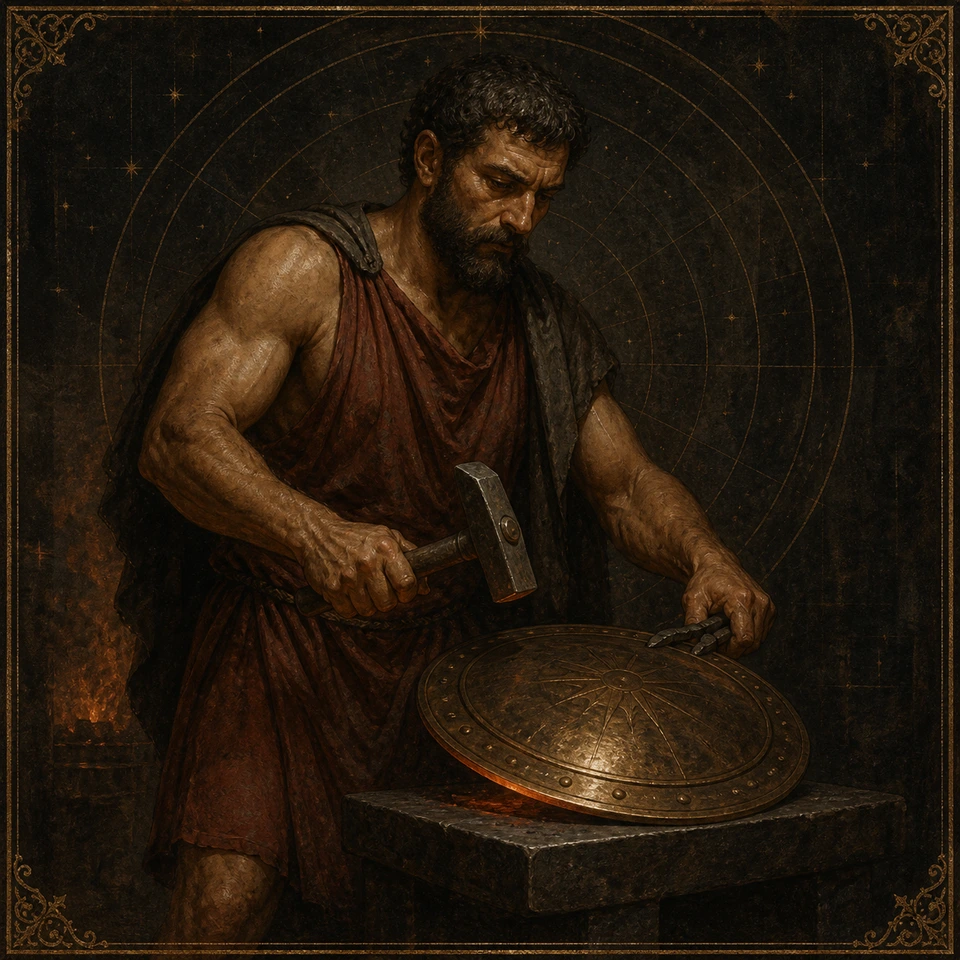
Forging marvelous devices and monumental architecture, Hephaestus commands the transformative forces of fire and intricate metalwork. His complex mythology intertwines themes of physical disability and difficult kinship with profound elements of protection, divine punishment, and civic worship.
Overview
Thetis enters a bronze house on Olympus and finds Hephaestus sweating over twenty wheeled tripods. Golden wheels wait beneath their feet so that the vessels may travel to the gods' assembly and return by themselves. Bellows breathe at his command. Golden attendants move beside him with intelligence and speech. This is not a smith reduced to one hammer or one flame. In Iliad 18, Hephaestus commands metal, motion, architecture, imagery, and the dangerous intimacy between a maker and what he makes.
He welcomes Thetis because she once saved him. The same epic preserves two incompatible falls. In Iliad 18, Hephaestus says Hera cast him away because she wished to hide his lameness, and Thetis and Eurynome sheltered him for nine years in a sea cave. In Iliad 1, he recalls Zeus hurling him from the divine threshold after he tried to help Hera. He falls all day, lands on Lemnos, and is tended by the Sintians. Neither account cancels the other. Each places injury, kinship, and rescue differently.
His body is never a license for caricature. The poems speak openly of lameness and uneven movement, but they also show speed of mind, mastery, rage, tenderness, and social vulnerability. When Thetis asks for arms for Achilles, Hephaestus remembers her care and works through the night. The shield he raises from the fire bears cities, fields, dancers, stars, war, judgment, harvest, and Ocean. Craft is memory made material.
Other works are less protective. Zeus commands him to shape Pandora from earth and water as a punishment aimed at mortals. Power and Force compel him to fasten Prometheus to the rock in Prometheus Bound. He pities the captive and hates the task, yet his rivets still bite. In Odyssey 8, he forges invisible restraints after Helios reveals Ares and Aphrodite in his bed. The bonds expose the lovers before laughing gods. Hephaestus can defend, constrain, punish, reveal, and humiliate through the same mastery.
Fire also exceeds the workshop. In Iliad 21, Hera calls her son against the river Xanthus. He burns the plain, vegetation, fish, and the dead until the river boils and begs for relief. The scene gives Hephaestus a terrible field of action without turning him into a timeless philosophical ruler of the element.
Athens held him in civic space. Pausanias saw his temple above the Kerameikos with Athena beside him. A classical decree probably belongs to the Hephaistia and describes procession, sacrifice, metic meat portions, bull-lifting, torch racing, contests, and prizes. The attribution is likely rather than conclusive, so the festival cannot be narrated as if every detail were beyond dispute.
Ancient Greek poems and civic evidence preserve a god of difficult kinship and exacting craft, honored in particular places and remembered through works that protect, punish, move, restrain, and blaze.
Canonical identity
Canonical Identity
Hephaestus operates securely as a Greek god rather than a marginalized heroic figure. His canonical identity complexly weaves together the mastery of craft, architecture, forged objects, fire, and the implementation of powerful restraints. The surviving historical evidence does not permit reducing his vast portfolio to that of a generic volcano god.
Linguistic Identity
The Greek name is Ἥφαιστος, which transliterates strictly as Hḗphaistos. A qualified reconstruction of the fifth-century BC Attic dialect yields /hɛ̌ː.pʰai̯s.tos/, approximated for modern readers as hay-FAI-stoss. This phonetic guide is constrained and cannot flawlessly reproduce the exact ancient nuances of pitch, aspiration, or vowel length. Dialectal spelling variations survive in the record, and the name's absolute etymological origin remains unresolved.
Sources and evidence
TEXTUAL · Supported
The name Ἥφαιστος is transliterated Hḗphaistos, with a qualified fifth-century BC Attic reconstruction /hɛ̌ː.pʰai̯s.tos/.
- Source
- Wiktionary contributors, Ἥφαιστος
- Reviewed edition
- Permanent revision 92064177, timestamp 2026-08-19T00:43:12Z · Wiktionary
- Exact locator
- Entry Ἥφαιστος · Section Ancient Greek pronunciation
- Scope
- Classical Greece · Attica
- Authority
- collaborative lexical reference
- Certainty
- Qualified
The readable guide hay-FAI-stoss is approximate and cannot reproduce pitch accent.
Open exact reviewed source3 reviewed sources for this section
- Wiktionary contributors, ἭφαιστοςPermanent revision 92064177, Ancient Greek pronunciation section · Wiktionary
- Hesiod; edited and translated by Hugh G. Evelyn-White, Theogony (1914)Hesiod, the Homeric Hymns and Homerica, London and New York, 1914 · Perseus Digital Library / Scaife ATLAS
- Homer; Monro and Allen Greek edition with edition-specific translations, Iliad (1920)Perseus CTS edition corpus; Greek edition, Oxford, 1908-1920 · Perseus Digital Library / Scaife ATLAS
Culture, tradition, period, and place
Hephaestus belongs to ancient Greek religion and Greek-language poetry from the Archaic period onward. Homeric epic places his workshop among the gods, his rescue beneath the sea, his fall on Lemnos, and his intervention on the Trojan plain. Hesiod preserves his birth from Hera alone and his marriage to Aglaia. Classical Athens gives him civic presence near the Kerameikos, with Athena beside him and a probably associated festival decree.
These settings must remain distinct. Lemnos in epic, the Athenian Agora, the Attic festival context, and the divine house of poetry answer different historical and narrative questions. The Greek name, cult places, and source-specific family traditions stand on their own terms; no Roman identification is asserted without a dated witness.
4 reviewed sources for this section
- Homer; Monro and Allen Greek edition with edition-specific translations, Iliad (1920)Perseus CTS edition corpus; Greek edition, Oxford, 1908-1920 · Perseus Digital Library / Scaife ATLAS
- Hesiod; edited and translated by Hugh G. Evelyn-White, Theogony (1914)Hesiod, the Homeric Hymns and Homerica, London and New York, 1914 · Perseus Digital Library / Scaife ATLAS
- Pausanias; Spiro Greek edition and Jones/Ormerod translation volumes, Description of Greece (1935)Perseus CTS edition corpus, 1903-1935 · Perseus Digital Library / Scaife ATLAS
- Attic Inscriptions Online editorial committee, Attic Inscriptions OnlineContinuously updated scholarly digital corpus · British School at Athens
Historical development
The earliest literary witnesses already disagree. Hesiod says Hera bears Hephaestus without union, in anger and strife with Zeus. Homeric epic offers not one stable childhood but two remembered expulsions. Zeus throws him for helping Hera in Iliad 1. Hera throws him because she wishes to hide his lameness in Iliad 18. The god reaches Lemnos in one account and the shelter of Thetis and Eurynome in the other.
Pausanias preserves another path back to Olympus. After Hera casts the newborn away, Hephaestus traps her in a golden chair. Other gods fail to persuade him, but Dionysus earns his trust, intoxicates him, and brings him back. The traveler encounters this episode as a painted scene in Athens. It is therefore both a myth of return and testimony to later visual remembrance.
By Pausanias' day, an Athenian temple and paired image with Athena remained visible above the Kerameikos. A classical inscription probably tied to the Hephaistia preserves civic organization, but its identification is not conclusive. Literary change, cult practice, and material display overlap without becoming a single straight development.
Sources and evidence
TEXTUAL · Supported
Pausanias describes a painting in which Dionysus brings Hephaestus back to heaven after the smith traps Hera in a golden chair and refuses other gods.
- Source
- Pausanias; Spiro Greek edition and Jones/Ormerod translation volumes, Description of Greece (1935)
- Reviewed edition
- W. H. S. Jones and H. A. Ormerod English translation volumes, 1918-1935 · translated by W. H. S. Jones and H. A. Ormerod, volume-dependent · Perseus Digital Library / Scaife ATLAS
- Exact locator
- Book 1 · Chapter 20 · Section 3
- Scope
- Greek religion under Roman imperial rule · Athens
- Authority
- ancient literary witness
- Certainty
- High
Pausanias explains that Dionysus wins Hephaestus' trust, intoxicates him, and leads him back.
Open exact reviewed source4 reviewed sources for this section
- Hesiod; edited and translated by Hugh G. Evelyn-White, Theogony (1914)Hesiod, the Homeric Hymns and Homerica, London and New York, 1914 · Perseus Digital Library / Scaife ATLAS
- Homer; Monro and Allen Greek edition with edition-specific translations, Iliad (1920)Perseus CTS edition corpus; Greek edition, Oxford, 1908-1920 · Perseus Digital Library / Scaife ATLAS
- Pausanias; Spiro Greek edition and Jones/Ormerod translation volumes, Description of Greece (1935)Perseus CTS edition corpus, 1903-1935 · Perseus Digital Library / Scaife ATLAS
- Attic Inscriptions Online editorial committee, Attic Inscriptions OnlineContinuously updated scholarly digital corpus · British School at Athens
Attested roles and historical themes
Roles, powers, and limits
Hephaestus makes things that move, protect, deceive, reveal, and wound. Iliad 18 surrounds him with self-moving tripods, responsive bellows, golden attendants, palaces, tools, and metals. For Achilles he forges arms whose shield holds an ordered world of cities, fields, stars, conflict, judgment, harvest, dance, and encircling Ocean. His mastery includes design and animation as well as smithing.
The same skill creates invisible bonds in Odyssey 8. Force cannot break them, but their purpose is exposure and repayment. In Prometheus Bound, exact metalwork becomes an instrument of punishment even while Hephaestus voices pity. In Works and Days, his power to shape a body serves Zeus' hostile plan for humanity.
Fire is an enacted power, but not an unlimited abstraction. Against Xanthus, Hephaestus burns the plain until the river boils and surrenders. Hera then orders him to stop. The scene gives him terrible reach and a clear limit: he acts within conflict among other divine powers.
Sources and evidence
TEXTUAL · Supported
Hephaestus receives Thetis in his bronze house and forges Achilles a shield, cuirass, helmet, and greaves.
- Source
- Homer; Monro and Allen Greek edition with edition-specific translations, Iliad (1920)
- Reviewed edition
- A. T. Murray English translation, volumes I-II, 1924-1925 · translated by A. T. Murray · Perseus Digital Library / Scaife ATLAS
- Exact locator
- Book Iliad · Chapter 18 · Line 368-617
- Scope
- Archaic Greece · Mount Olympus
- Authority
- ancient literary witness
- Certainty
- High
The passage also describes self-moving tripods, golden attendants, bellows, metals, and the shield's ordered scenes.
Open exact reviewed sourceTEXTUAL · Supported
At Hera's summons in Iliad 21, Hephaestus drives fire against Xanthus or Scamander until the river boils and yields.
- Source
- Homer; Monro and Allen Greek edition with edition-specific translations, Iliad (1920)
- Reviewed edition
- A. T. Murray English translation, volumes I-II, 1924-1925 · translated by A. T. Murray · Perseus Digital Library / Scaife ATLAS
- Exact locator
- Book Iliad · Chapter 21 · Line 324-382
- Scope
- Archaic Greece · Xanthus or Scamander on the Trojan plain
- Authority
- ancient literary witness
- Certainty
- High
This violent divine action supports fire as an enacted power, not formal philosophical elemental rulership.
Open exact reviewed source4 reviewed sources for this section
- Homer; Monro and Allen Greek edition with edition-specific translations, Iliad (1920)Perseus CTS edition corpus; Greek edition, Oxford, 1908-1920 · Perseus Digital Library / Scaife ATLAS
- Homer; translated by A. T. Murray, Odyssey (1919)A. T. Murray English translation, London: William Heinemann; New York: G. P. Putnam's Sons, 1919 · Perseus Digital Library / Scaife ATLAS
- Traditionally attributed to Aeschylus; translated by Herbert Weir Smyth, Prometheus Bound (1922)Herbert Weir Smyth English translation, 1922, modernized by Perseus · Perseus Digital Library / Scaife ATLAS
- Hesiod; edited and translated by Hugh G. Evelyn-White, Works and Days (1914)Hesiod, the Homeric Hymns and Homerica, London and New York, 1914 · Perseus Digital Library / Scaife ATLAS
Epithets and titles
Poetic Epithet
Famed for craft
κλυτοτέχνης · Famed for craft
Homeric Greek epic · Archaic Greek witnessIliad 1 addresses Hephaestus through his renowned workmanship; the poetic title does not create a separate cult form.
1 reviewed source for this section
- Homer; Monro and Allen Greek edition with edition-specific translations, Iliad (1920)Perseus CTS edition corpus; Greek edition, Oxford, 1908-1920 · Perseus Digital Library / Scaife ATLAS
Worship and cult
Pausanias places a temple of Hephaestus above the Kerameikos at Athens and sees an image of Athena standing beside him. The setting binds worship to a city of workshops, citizens, metics, festivals, and civic memory. The paired image supports association in Athenian cult space, but it does not make every myth involving the two deities harmonious.
The surviving evidence here does not justify one universal Greek priesthood, one household rite, or a fixed offering list. The probable Hephaistia decree is unusually rich, yet its attribution remains debated. Modern ritual directions are therefore not projected backward into ancient worship.
Sources and evidence
TEXTUAL · Supported
Pausanias locates a temple of Hephaestus above the Kerameikos at Athens and notes an image of Athena standing beside him.
- Source
- Pausanias; Spiro Greek edition and Jones/Ormerod translation volumes, Description of Greece (1935)
- Reviewed edition
- W. H. S. Jones and H. A. Ormerod English translation volumes, 1918-1935 · translated by W. H. S. Jones and H. A. Ormerod, volume-dependent · Perseus Digital Library / Scaife ATLAS
- Exact locator
- Book 1 · Chapter 14 · Section 6
- Scope
- Greek religion under Roman imperial rule · Athenian Agora
- Authority
- ancient literary witness
- Certainty
- High
The paired images support an Athenian civic and craft setting without making every shared appearance a family bond.
Open exact reviewed source2 reviewed sources for this section
- Pausanias; Spiro Greek edition and Jones/Ormerod translation volumes, Description of Greece (1935)Perseus CTS edition corpus, 1903-1935 · Perseus Digital Library / Scaife ATLAS
- Attic Inscriptions Online editorial committee, Attic Inscriptions OnlineContinuously updated scholarly digital corpus · British School at Athens
Temples, sanctuaries, and sacred places
Athens provides the strongest architectural location. Pausanias places the temple above the Kerameikos, near the Agora, with Athena standing beside Hephaestus in the sanctuary.
Lemnos belongs to a different register. In Iliad 1, Hephaestus recalls falling there after Zeus cast him from heaven and being tended by the Sintians. Olympus and the sea cave of Thetis and Eurynome are mythic settings in the poems, not excavated cult sites. None of these places can be exchanged for another or made to prove a universal volcanic identity.
2 reviewed sources for this section
- Pausanias; Spiro Greek edition and Jones/Ormerod translation volumes, Description of Greece (1935)Perseus CTS edition corpus, 1903-1935 · Perseus Digital Library / Scaife ATLAS
- Homer; Monro and Allen Greek edition with edition-specific translations, Iliad (1920)Perseus CTS edition corpus; Greek edition, Oxford, 1908-1920 · Perseus Digital Library / Scaife ATLAS
Festivals and processions
A classical Athenian decree likely concerns the Hephaistia. Its arrangements include a procession, sacrifices, distribution of meat to metics, bull-lifting, a torch race, contests, and prizes. Those details show organized civic labor and participation if the attribution is correct.
The qualification matters. The editors judge the Hephaistia identification likely, not certain. No festival detail should be detached from that uncertainty or expanded into an annual universal observance. The decree offers a probable Athenian festival picture, not a complete calendar for all Greek communities.
Sources and evidence
INSCRIPTIONAL · Supported
A decree of 421/0 BC orders meat portions for metics, a procession, sacrifices, bull-lifting, a torch race, contests, and prizes.
- Source
- Attic Inscriptions Online editorial committee, Attic Inscriptions Online
- Reviewed edition
- AIO 1304 / CGRN 43, decree of 421/0 BC concerning festival administration; English translation and commentary by Stephen Lambert and Feyo Schuddeboom · translated by Stephen Lambert and Feyo Schuddeboom · Attic Inscriptions Online
- Exact locator
- Entry AIO 1304 / CGRN 43 · Line 15, 23-24, 29-41 · RecordUrl https://www.atticinscriptions.com/inscription/CGRN/43
- Scope
- Classical Greece · Athens
- Authority
- ancient civic decree in a scholarly edition
- Certainty
- High
The decree provisions are secure even though the festival identification remains qualified.
Open exact reviewed sourceSCHOLARLY INTERPRETATION · Supported
The AIO editors identify the decree as probably belonging to the Hephaistia while preserving the Theseia as an alternative.
- Source
- Attic Inscriptions Online editorial committee, Attic Inscriptions Online
- Reviewed edition
- AIO 1304 / CGRN 43, decree of 421/0 BC concerning festival administration; English translation and commentary by Stephen Lambert and Feyo Schuddeboom · translated by Stephen Lambert and Feyo Schuddeboom · Attic Inscriptions Online
- Exact locator
- Entry AIO 1304 / CGRN 43 · Section commentary notes 1 and 4 · RecordUrl https://www.atticinscriptions.com/inscription/CGRN/43
- Scope
- Classical Greece · Athens
- Authority
- scholarly inscription commentary
- Certainty
- Qualified
The probable attribution never converts the listed provisions into an unqualified Hephaistia program.
Open exact reviewed source1 reviewed source for this section
- Attic Inscriptions Online editorial committee, Attic Inscriptions OnlineContinuously updated scholarly digital corpus · British School at Athens
Offerings, votives, and ritual evidence
The decree of 421/0 BC orders sacrifices and meat distribution, including portions for metics, alongside procession, bull-lifting, torch racing, contests, and prizes. These are public civic acts. The editors probably connect the text with the Hephaistia, while preserving the Theseia as another possibility.
No ancient witness used here establishes a universal offering list of gemstones, incense, plants, coins, alcohol, or crafted miniatures. The Athenian decree records one civic program under an explicit uncertainty; it is not a private ritual manual.
1 reviewed source for this section
- Attic Inscriptions Online editorial committee, Attic Inscriptions OnlineContinuously updated scholarly digital corpus · British School at Athens
Iconography and material culture
Iliad 18 gives Hephaestus a workshop dense with action: hammer, tongs, anvil, bellows, bronze, tin, gold, silver, wheeled tripods, golden attendants, palaces, and Achilles' arms. These objects do not sit beside him as decorative emblems. They move, answer commands, carry hospitality and debt, protect a warrior, and place an ordered world upon a shield.
The literary forge firmly supports the hammer, tongs, anvil, bellows, armor, and crafted restraints. Pausanias' brief descriptions do not establish a full visual type, so later pictures and modern fantasy conventions cannot fill the gap.
1 reviewed source for this section
- Homer; Monro and Allen Greek edition with edition-specific translations, Iliad (1920)Perseus CTS edition corpus; Greek edition, Oxford, 1908-1920 · Perseus Digital Library / Scaife ATLAS
Animals, plants, and embodied forms
Iliad 21 names the living things caught in Hephaestus' assault on Xanthus: elms, willows, tamarisks, lotus, rushes, and galingale burn along the banks, while fish and eels writhe in the heated water. None of them becomes his emblem merely by suffering in the scene. No ancient witness used here establishes a sacred animal or sacred plant for Hephaestus.
His embodied form receives firmer literary attention. Epic speaks openly of lameness and distinctive movement while also showing intelligence, technical mastery, rage, tenderness, and social vulnerability. Disability and skilled labor make him neither monstrous nor less divine.
1 reviewed source for this section
- Homer; Monro and Allen Greek edition with edition-specific translations, Iliad (1920)Perseus CTS edition corpus; Greek edition, Oxford, 1908-1920 · Perseus Digital Library / Scaife ATLAS
Relationships and genealogy
Hesiod makes Hera the sole parent of Hephaestus, born without union during her conflict with Zeus. Homeric memories complicate the household: one fall follows his defense of Hera against Zeus, while another follows Hera's rejection of her son's lameness. These are related scenes of divine family violence, not one recoverable biography.
His marriages also diverge. Hesiod names Aglaia, youngest of the Charites, as his wife. Demodocus' song in Odyssey 8 calls Aphrodite his wife and stages her affair with Ares. Aglaia is not silently replaced by Aphrodite, and singular Aglaia is not converted into a marriage with the Charites as a collective.
Thetis and Eurynome are rescuers and fosterers in Iliad 18. Dionysus becomes the trusted god who returns him to Olympus in Pausanias' account. Athena shares Athenian cult space with him but resists his assault in the Erichthonius story. Each connection has its own kind and witness.
Sources and evidence
TEXTUAL · Supported
Hesiod says Hera bore Hephaestus without union in anger and strife with Zeus, and calls him skilled in crafts beyond the sons of Heaven.
- Source
- Hesiod; edited and translated by Hugh G. Evelyn-White, Theogony (1914)
- Reviewed edition
- Hugh G. Evelyn-White edition and English translation in Hesiod, the Homeric Hymns and Homerica, 1914 · translated by Hugh G. Evelyn-White · edited by Hugh G. Evelyn-White · Perseus Digital Library / Scaife ATLAS
- Exact locator
- Entry Theogony · Line 924-929
- Scope
- Archaic Greece · Ancient Greece
- Authority
- ancient literary witness
- Certainty
- High
The passage supports Hera as sole parent in Hesiod but not every other genealogy.
Open exact reviewed sourceTEXTUAL · Supported
Hesiod names Aglaia, youngest of the Charites, as the wife of Hephaestus.
- Source
- Hesiod; edited and translated by Hugh G. Evelyn-White, Theogony (1914)
- Reviewed edition
- Hugh G. Evelyn-White edition and English translation in Hesiod, the Homeric Hymns and Homerica, 1914 · translated by Hugh G. Evelyn-White · edited by Hugh G. Evelyn-White · Perseus Digital Library / Scaife ATLAS
- Exact locator
- Entry Theogony · Line 945-946
- Scope
- Archaic Greece · Ancient Greece
- Authority
- ancient literary witness
- Certainty
- High
Aglaia is a named individual; the claim is not converted into marriage with the Charites as a collective.
Open exact reviewed sourceTEXTUAL · Supported
Iliad 18 names the singular Charis as Hephaestus' wife when she welcomes Thetis to the smith's house.
- Source
- Homer; Monro and Allen Greek edition with edition-specific translations, Iliad (1920)
- Reviewed edition
- A. T. Murray English translation, volumes I-II, 1924-1925 · translated by A. T. Murray · Perseus Digital Library / Scaife ATLAS
- Exact locator
- Book Iliad · Chapter 18 · Line 382-392
- Scope
- Archaic Greece · Mount Olympus
- Authority
- ancient literary witness
- Certainty
- High
The singular Charis remains a source-specific wife and is not converted into a spouse edge to the collective Charites.
Open exact reviewed sourceTEXTUAL · Supported
Within Demodocus' song in Odyssey 8, Aphrodite is Hephaestus' wife and Ares is her secret lover.
- Source
- Homer; translated by A. T. Murray, Odyssey (1919)
- Reviewed edition
- A. T. Murray English translation, London: William Heinemann; New York: G. P. Putnam's Sons, 1919 · translated by A. T. Murray · Perseus Digital Library / Scaife ATLAS
- Exact locator
- Book Odyssey · Chapter 8 · Line 266-366
- Scope
- Archaic Greece · Ancient Greece
- Authority
- ancient literary witness
- Certainty
- High
The marriage is source-scoped; Hesiod names Aglaia as Hephaestus' wife.
Open exact reviewed source5 reviewed sources for this section
- Hesiod; edited and translated by Hugh G. Evelyn-White, Theogony (1914)Hesiod, the Homeric Hymns and Homerica, London and New York, 1914 · Perseus Digital Library / Scaife ATLAS
- Homer; Monro and Allen Greek edition with edition-specific translations, Iliad (1920)Perseus CTS edition corpus; Greek edition, Oxford, 1908-1920 · Perseus Digital Library / Scaife ATLAS
- Homer; translated by A. T. Murray, Odyssey (1919)A. T. Murray English translation, London: William Heinemann; New York: G. P. Putnam's Sons, 1919 · Perseus Digital Library / Scaife ATLAS
- Pausanias; Spiro Greek edition and Jones/Ormerod translation volumes, Description of Greece (1935)Perseus CTS edition corpus, 1903-1935 · Perseus Digital Library / Scaife ATLAS
- Pseudo-Apollodorus; edited and translated by James G. Frazer, Library (1921)Harvard University Press and William Heinemann edition, 1921 · Perseus Digital Library / Scaife ATLAS
Actual myths and source variants
Hesiodic Pandora traditions place Hephaestus' making inside Epimetheus' fate, while Plato's Protagoras places fiery craft in an Athena-Hephaestus workshop before Prometheus steals it for mortals. Odyssey 8 gives the invisible bonds around Ares and Aphrodite. Pseudo-Apollodorus gives the attempted assault on Athena and the earth-birth of Erichthonius. Homer and Hesiod preserve incompatible births and falls. Iliad 18 shows Hephaestus repaying Thetis by forging Achilles' arms, while Works and Days makes him shape Pandora under Zeus' command.
Prometheus Bound turns him into a reluctant agent of punishment before Power and Force. Pseudo-Apollodorus gives a shorter Caucasus version without that exchange and sends red-hot metal from Hephaestus against the Giant Mimas in the war of the Gigantes. Pausanias tells how Dionysus brings the intoxicated smith back after Hera is trapped in a golden chair. Iliad 21 sends his fire against Xanthus until Hera calls it off.
These accounts refuse a smooth moral portrait. Hephaestus protects, repays, invents, assaults, exposes, obeys, pities, and devastates. Each action remains attached to its poem, play, or travel account rather than being blended into a single personality test.
Sources and evidence
TEXTUAL · Supported
In Iliad 1, Hephaestus recalls Zeus hurling him from the divine threshold when he tried to help Hera; he falls all day and the Sintians tend him on Lemnos.
- Source
- Homer; Monro and Allen Greek edition with edition-specific translations, Iliad (1920)
- Reviewed edition
- A. T. Murray English translation, volumes I-II, 1924-1925 · translated by A. T. Murray · Perseus Digital Library / Scaife ATLAS
- Exact locator
- Book Iliad · Chapter 1 · Line 568-594
- Scope
- Archaic Greece · Lemnos
- Authority
- ancient literary witness
- Certainty
- High
This fall is distinct from the maternal casting-out narrated in Iliad 18.
Open exact reviewed sourceTEXTUAL · Supported
In Iliad 18, Hephaestus says Hera threw him away because she wished to hide his lameness; Thetis and Eurynome sheltered him for nine years.
- Source
- Homer; Monro and Allen Greek edition with edition-specific translations, Iliad (1920)
- Reviewed edition
- A. T. Murray English translation, volumes I-II, 1924-1925 · translated by A. T. Murray · Perseus Digital Library / Scaife ATLAS
- Exact locator
- Book Iliad · Chapter 18 · Line 394-405
- Scope
- Archaic Greece
- Authority
- ancient literary witness
- Certainty
- High
This is a conflicting first-person account and is not harmonized with Iliad 1.
Open exact reviewed sourceTEXTUAL · Supported
In Works and Days, Zeus orders Hephaestus to mix earth with water and shape a woman later named Pandora, whom the gods adorn.
- Source
- Hesiod; edited and translated by Hugh G. Evelyn-White, Works and Days (1914)
- Reviewed edition
- Hugh G. Evelyn-White edition and English translation in Hesiod, the Homeric Hymns and Homerica, 1914 · translated by Hugh G. Evelyn-White · edited by Hugh G. Evelyn-White · Perseus Digital Library / Scaife ATLAS
- Exact locator
- Entry Works and Days · Line 47-105, especially 59-82
- Scope
- Archaic Greece · Ancient Greece
- Authority
- ancient literary witness
- Certainty
- High
The poem's gendered blame and punitive design remain explicit rather than softened.
Open exact reviewed sourceTEXTUAL · Supported
Prometheus Bound opens with Hephaestus compelled by Power and Force to fasten Prometheus to rock; he pities the captive yet completes the punishment.
- Source
- Traditionally attributed to Aeschylus; translated by Herbert Weir Smyth, Prometheus Bound (1922)
- Reviewed edition
- Herbert Weir Smyth English translation in Aeschylus, volume I, 1922; Perseus modernization · translated by Herbert Weir Smyth · Perseus Digital Library / Scaife ATLAS
- Exact locator
- Entry Prometheus Bound · Line 1-65
- Scope
- Classical Greece · Scythian wilderness in Prometheus Bound
- Authority
- ancient literary witness
- Certainty
- High
The dramatic work is traditionally attributed to Aeschylus, but authorship is disputed; the witness is kept distinct from mythographic summary.
Open exact reviewed sourceTEXTUAL · Supported
Pseudo-Apollodorus says Zeus ordered Hephaestus to nail Prometheus to a mountain in the Caucasus.
- Source
- Pseudo-Apollodorus; edited and translated by James G. Frazer, Library (1921)
- Reviewed edition
- James G. Frazer edition and English translation, Harvard University Press and William Heinemann, 1921 · translated by James G. Frazer · edited by James G. Frazer · Perseus Digital Library / Scaife ATLAS
- Exact locator
- Entry Library · Section 1.7.1
- Scope
- Greek religion under Roman imperial rule · Mount Caucasus in Scythia
- Authority
- ancient literary witness
- Certainty
- High
The concise mythographic version lacks the tragic scene's reluctance, Power, and Force.
Open exact reviewed sourceTEXTUAL · Supported
Pseudo-Apollodorus makes Hephaestus the assailant in the violent origin of earth-born Erichthonius after Athena resists him.
- Source
- Pseudo-Apollodorus; edited and translated by James G. Frazer, Library (1921)
- Reviewed edition
- James G. Frazer edition and English translation, Harvard University Press and William Heinemann, 1921 · translated by James G. Frazer · edited by James G. Frazer · Perseus Digital Library / Scaife ATLAS
- Exact locator
- Entry Library · Section 3.14.6
- Scope
- Greek religion under Roman imperial rule · Attica
- Authority
- ancient literary witness
- Certainty
- High
The attempted assault and its consequences require an explicit content note.
Open exact reviewed source8 reviewed sources for this section
- Homer; translated by A. T. Murray, Odyssey (1919)A. T. Murray English translation, London: William Heinemann; New York: G. P. Putnam's Sons, 1919 · Perseus Digital Library / Scaife ATLAS
- Pseudo-Apollodorus; edited and translated by James G. Frazer, Library (1921)Harvard University Press and William Heinemann edition, 1921 · Perseus Digital Library / Scaife ATLAS
- Homer; Monro and Allen Greek edition with edition-specific translations, Iliad (1920)Perseus CTS edition corpus; Greek edition, Oxford, 1908-1920 · Perseus Digital Library / Scaife ATLAS
- Hesiod; edited and translated by Hugh G. Evelyn-White, Theogony (1914)Hesiod, the Homeric Hymns and Homerica, London and New York, 1914 · Perseus Digital Library / Scaife ATLAS
- Hesiod; edited and translated by Hugh G. Evelyn-White, Works and Days (1914)Hesiod, the Homeric Hymns and Homerica, London and New York, 1914 · Perseus Digital Library / Scaife ATLAS
- Traditionally attributed to Aeschylus; translated by Herbert Weir Smyth, Prometheus Bound (1922)Herbert Weir Smyth English translation, 1922, modernized by Perseus · Perseus Digital Library / Scaife ATLAS
- Pausanias; Spiro Greek edition and Jones/Ormerod translation volumes, Description of Greece (1935)Perseus CTS edition corpus, 1903-1935 · Perseus Digital Library / Scaife ATLAS
- Plato; translated by W. R. M. Lamb, Protagoras (1967)Plato in Twelve Volumes, Volume 3, 1967 reprint · Perseus Digital Library
Myth Library
Each myth gathers its attested participants into one source-grounded account, while distinct source traditions remain readable in their own variants.
Comic Divine Conflict
Ares, Hephaestus, and the Net
Helios sees Ares and Aphrodite having sex in Hephaestus' house and tells the wronged husband. Hephaestus traps the pair in invisible bonds, exposes them to the gods, and releases them only after Poseidon guarantees that Ares will pay.
- Role in this profile
- husband and craftsman who forges the invisible net and demands restitution
- Place scope
- Ancient Greece
- Witnesses
- 1
- Variants
- 1
Local
Athena and Erichthonius
Athena fosters earth-born Erichthonius after Hephaestus assaults her.
- Role in this profile
- pursuer and assailant whose seed reaches the earth after Athena resists him
- Place scope
- Attica
- Witnesses
- 1
- Variants
- 1
Conflicting Theogonic And Epic
Births and Falls of Hephaestus
Hesiod and two Homeric memories give incompatible births, expulsions, rescuers, and landing places for Hephaestus.
- Role in this profile
- child and divine craftsman who remembers two incompatible expulsions
- Place scope
- Ancient Greece · Lemnos
- Witnesses
- 3
- Variants
- 3
Epic Craft And War
Hephaestus Forges Achilles' Armor
Thetis calls upon the god she once rescued, and Hephaestus forges Achilles' new armor around a shield filled with an ordered world.
- Role in this profile
- host and master maker who repays Thetis by forging Achilles' armor
- Place scope
- Mount Olympus
- Witnesses
- 1
- Variants
- 1
Theogonic Punishment And Creation
Hephaestus Makes Pandora
Under Zeus' command, Hephaestus shapes the woman later named Pandora, while two Hesiodic poems preserve materially different versions.
- Role in this profile
- maker ordered by Zeus to shape a woman from earth and water
- Place scope
- Ancient Greece
- Witnesses
- 2
- Variants
- 2
Tragic Punishment And Mythographic Variant
Hephaestus Binds Prometheus
Hephaestus reluctantly binds Prometheus under violent command in tragedy, while Pseudo-Apollodorus gives a shorter Caucasus version.
- Role in this profile
- reluctant divine worker who rivets Prometheus to the rock
- Place scope
- Scythian wilderness in Prometheus Bound · Mount Caucasus in Scythia
- Witnesses
- 2
- Variants
- 2
Return And Reconciliation
Dionysus Returns Hephaestus to Olympus
Pausanias explains an Athenian painting through the story of Hera's golden chair and Dionysus' successful return of Hephaestus.
- Role in this profile
- rejected son who traps Hera and is persuaded to return only through Dionysus
- Place scope
- Athens · Ancient Greece
- Witnesses
- 1
- Variants
- 1
Epic Divine Battle
Hephaestus Fights Xanthus
Hera summons Hephaestus against the river Xanthus, and divine fire boils the water until the river yields.
- Role in this profile
- fire-wielding defender summoned by Hera against the river
- Place scope
- Xanthus or Scamander on the Trojan plain
- Witnesses
- 1
- Variants
- 1
Divine Retribution And Human Condition
Epimetheus and Pandora
Zeus answers Prometheus’s challenge by fashioning a dangerous gift. Epimetheus accepts her despite warning, and the Hesiodic witnesses diverge over her name, the jar, and the human consequences before later mythography makes Pandora his wife and Pyrrha their daughter.
- Role in this profile
- divine craftsman ordered to shape the woman from earth or earth and water
- Place scope
- Ancient Greece
- Witnesses
- 3
- Variants
- 3
Philosophical Anthropogony
Epimetheus Distributes Mortal Powers
In the mythic speech of Plato’s Protagoras, Epimetheus distributes protections among mortal species, exhausts the available powers before reaching humankind, and leaves Prometheus to steal fire and technical skill before Zeus gives civic bonds.
- Role in this profile
- divine holder of fiery craft taken for humanity
- Place scope
- Ancient Greece
- Witnesses
- 1
- Variants
- 1
Mythographic Synthesis
Gaia and the Gigantes
Pseudo-Apollodorus makes Gaia bear the Gigantes in anger over the Titans and seek a protective drug before their war with the gods; the Pergamon Altar adds Phoibe’s long-torch combat beside Asteria.
- Role in this profile
- kills Mimas with masses of red-hot metal
- Place scope
- Ancient Greece · Pergamon
- Witnesses
- 2
- Variants
- 2
Tragic Bondage And Prophecy
Prometheus Bound and the Secret of Zeus
Prometheus Bound stages the divine culture hero chained at a remote crag, defending his gifts to mortals, prophesying Io's road, and withholding the secret of a marriage that could threaten Zeus.
- Role in this profile
- reluctant smith compelled to fasten Prometheus to the crag
- Place scope
- Ancient Greece
- Witnesses
- 1
- Variants
- 3
Anthropogony Fire Theft And Punishment
Prometheus Moulds Humans and Gives Them Fire
Pseudo-Apollodorus makes Prometheus mould humans from water and earth, give them hidden fennel fire, suffer the eagle, and receive release through Heracles.
- Role in this profile
- fastens Prometheus to the Caucasian mountain at Zeus's command
- Place scope
- Ancient Greece
- Witnesses
- 1
- Variants
- 1
Equivalences, syncretisms, and identity boundaries
The Greek poems and civic evidence establish Hephaestus within their own language, places, and periods. They do not supply a dated cross-cultural identification. Similar work at a forge or with fire is not enough to establish identity, borrowing, translation, or kinship between divine figures.
No comparative equivalence is asserted here. Such a connection requires its own historical witness and exact locator.
Correspondence index
Iliad 18 gives bronze, tin, gold, and silver a firm place in Hephaestus' forge. The metals belong to the making of Achilles' armor; they do not become a timeless rulership chart. Fire is equally concrete in the workshop and against Xanthus, yet no ancient text used here assigns Hephaestus a formal philosophical element.
Athens, the Agora, and Lemnos are civic or narrative places, not compass directions. A decree probably connected with the Hephaistia records sacrifice, meat distribution, procession, bull-lifting, torch racing, contests, and prizes, while also preserving the Theseia as another possible setting. Hammer, tongs, anvil, bellows, shields, armor, invisible bonds, and marvelous devices are tools and works within particular stories.
Craft, making, containment, protection, punishment, and fire emerge from what Hephaestus does. No ancient source used here assigns him a planet, zodiac sign, gemstone, weekday, moon phase, ritual color, perfume, sacred plant, or canonical animal. Later occult systems require their own dated witnesses.
Direct ancient correspondences
| Category | Direct correspondence | How and why | Evidence boundary |
|---|---|---|---|
| metal-material | Bronze, tin, gold, and silver in the Iliad 18 forgeDirect historical association | Iliad 18 names bronze, tin, gold, and silver in Hephaestus' work; the metals belong to this making scene, not a universal rulership table. | Ancient Literary Named workshop materials do not establish exclusive metal rulership 1 reviewed source for this section
|
| ritual-object-symbol-tool | Hammer, tongs, anvil, bellows, armor, and bondsDirect historical association | Hammer, tongs, anvil, bellows, shield, armor, and crafted restraints are attested tools and works. | Ancient Literary Each tool or work remains tied to its poem or ancient object 2 reviewed sources for this section
|
Contextual evidence, not a general correspondence
| Category | Direct correspondence | How and why | Evidence boundary |
|---|---|---|---|
| animal-embodied-form | Literary lameness and distinctive movement; no sacred animal attestedContextual evidence only | Epic describes Hephaestus' embodied movement; fish and eels in Iliad 21 are victims of the river battle, not sacred animals. | Ancient Literary Embodied form and narrative victims do not create a sacred-animal assignment 1 reviewed source for this section
|
| classical-element | Forge fire and fire against XanthusContextual evidence only | Forge fire and the assault on Xanthus are explicit actions, but formal philosophical elemental rulership is not established. | Ancient Literary Literary action does not establish formal philosophical elemental rulership 1 reviewed source for this section
|
| direction-place | Athens, the Athenian Agora, and LemnosContextual evidence only | Athens, the Athenian Agora, and Lemnos are secure settings; none supplies a compass direction. | Ancient Cultic Cult and narrative geography is not a compass direction 2 reviewed sources for this section
|
| festival-time | Probable Athenian HephaistiaContextual evidence only | AIO 1304 likely concerns the Hephaistia, but the attribution is not conclusive. | Ancient Cultic Every detail remains within the decree's likely but inconclusive festival attribution 1 reviewed source for this section
|
| offering-ritual-material | Probable Hephaistia sacrifice and meat distributionContextual evidence only | Sacrifice, meat distribution, and bull-lifting belong to a decree probably concerning the Hephaistia; no universal offering list follows. | Ancient Cultic These civic acts are not a universal offering recipe 1 reviewed source for this section
|
| intention-magical-power | Craft, making, containment, protection, punishment, and fireContextual evidence only | Craft, making, containment, protection, punishment, and fire describe attested actions; they are not presented as universal spell instructions. | Ancient Literary Attested divine actions do not promise a modern spell outcome 4 reviewed sources for this section
|
8 expected categories currently not evidenced
celestial-body · Not evidenced
No celestial body attested
No ancient or dated later source used here supports a planet or star assignment.
- Layer
- Research Boundary
- Scope
- Planet and star associations require their own dated witness
zodiac · Not evidenced
No zodiac sign attested
No ancient or dated later source used here supports a zodiac sign assignment.
- Layer
- Research Boundary
- Scope
- No sign can be inferred from fire or craft
gemstone-crystal-mineral · Not evidenced
No gemstone or mineral attested
No ancient or dated later source used here supports a gemstone, crystal, or mineral correspondence.
- Layer
- Research Boundary
- Scope
- Modern crystal lists require accountable modern evidence
plant-tree · Not evidenced
No sacred plant or tree attested
No ancient or dated later source used here establishes a sacred plant or tree.
- Layer
- Research Boundary
- Scope
- Plants burned beside Xanthus are victims, not attributes
color · Not evidenced
No ritual color attested
Material colors in poetry and pottery do not establish a ritual color correspondence.
- Layer
- Research Boundary
- Scope
- Colors of objects and garments do not create a universal palette
weekday · Not evidenced
No weekday attested
No ancient or dated later source used here supports a weekday assignment.
- Layer
- Research Boundary
- Scope
- A weekday cannot be borrowed from later planetary schemes
moon-phase · Not evidenced
No moon phase attested
No ancient or dated later source used here supports a moon-phase assignment.
- Layer
- Research Boundary
- Scope
- No lunar phase is assigned in the sources used here
incense-perfume · Not evidenced
No incense or perfume attested
No ancient or dated later source used here supports an incense or perfume correspondence.
- Layer
- Research Boundary
- Scope
- No resin, smoke blend, or fragrance is established
3 reviewed sources for this section
- Homer; Monro and Allen Greek edition with edition-specific translations, Iliad (1920)Perseus CTS edition corpus; Greek edition, Oxford, 1908-1920 · Perseus Digital Library / Scaife ATLAS
- Homer; translated by A. T. Murray, Odyssey (1919)A. T. Murray English translation, London: William Heinemann; New York: G. P. Putnam's Sons, 1919 · Perseus Digital Library / Scaife ATLAS
- Attic Inscriptions Online editorial committee, Attic Inscriptions OnlineContinuously updated scholarly digital corpus · British School at Athens
Later reception and living significance
No later artwork or present-day devotional community is named by the sources used here. The ancient record can therefore speak with its own force without being turned into a modern offering schedule, planetary system, ritual calendar, or healing claim.
Hephaestus' lameness does not make him a grotesque joke, and admiration for his craft does not erase the violence in the stories of Athena, Pandora, Prometheus, or the trapped lovers. Those tensions belong to the sources; modern practice remains an open field rather than an invented conclusion.
Evidence, conflicts, and research gaps
Homer, Hesiod, Prometheus Bound, Pseudo-Apollodorus, Pausanias, and an Athenian decree hold the central record. They preserve incompatible falls and marriages, a probable rather than certain festival identification, protective and punitive works, and a god whose craft can answer care or enforce violence.
Important gaps remain. The pronunciation is a qualified collaborative reconstruction. Pausanias describes painted and paired cult images, but no directly catalogued ancient object anchors a fuller visual type. Later reception and contemporary devotion still lack accountable witnesses. No ancient authority used here assigns a planet, zodiac sign, gemstone, weekday, moon phase, compass direction, ritual color, perfume, sacred plant, or canonical animal.
9 reviewed sources for this section
- Wiktionary contributors, ἭφαιστοςPermanent revision 92064177, Ancient Greek pronunciation section · Wiktionary
- Hesiod; edited and translated by Hugh G. Evelyn-White, Theogony (1914)Hesiod, the Homeric Hymns and Homerica, London and New York, 1914 · Perseus Digital Library / Scaife ATLAS
- Homer; Monro and Allen Greek edition with edition-specific translations, Iliad (1920)Perseus CTS edition corpus; Greek edition, Oxford, 1908-1920 · Perseus Digital Library / Scaife ATLAS
- Homer; translated by A. T. Murray, Odyssey (1919)A. T. Murray English translation, London: William Heinemann; New York: G. P. Putnam's Sons, 1919 · Perseus Digital Library / Scaife ATLAS
- Hesiod; edited and translated by Hugh G. Evelyn-White, Works and Days (1914)Hesiod, the Homeric Hymns and Homerica, London and New York, 1914 · Perseus Digital Library / Scaife ATLAS
- Traditionally attributed to Aeschylus; translated by Herbert Weir Smyth, Prometheus Bound (1922)Herbert Weir Smyth English translation, 1922, modernized by Perseus · Perseus Digital Library / Scaife ATLAS
- Pseudo-Apollodorus; edited and translated by James G. Frazer, Library (1921)Harvard University Press and William Heinemann edition, 1921 · Perseus Digital Library / Scaife ATLAS
- Pausanias; Spiro Greek edition and Jones/Ormerod translation volumes, Description of Greece (1935)Perseus CTS edition corpus, 1903-1935 · Perseus Digital Library / Scaife ATLAS
- Attic Inscriptions Online editorial committee, Attic Inscriptions OnlineContinuously updated scholarly digital corpus · British School at Athens
Direct connections and evidence
Explicit Source
Demodocus' song calls Aphrodite the wife of Hephaestus
One source-scoped marriage configuration; other genealogical traditions are not silently harmonized into it.
1 attestation · high confidence
- Homer; translated by A. T. Murray, OdysseyA. T. Murray English translation, London: William Heinemann; New York: G. P. Putnam's Sons, 1919 · translated by A. T. Murray · Perseus Digital Library / Scaife ATLAS · Archaic Greece · Ancient Greece · Entry Odyssey · Book 8 · Line 266-366
Explicit Source
Hesiod presents Hephaestus as Hera's son born without union
Hesiod makes Hera the sole parent. Other sources preserve different family settings and expulsions without erasing this genealogy.
1 attestation · high confidence
- Hesiod; edited and translated by Hugh G. Evelyn-White, TheogonyHugh G. Evelyn-White edition and English translation in Hesiod, the Homeric Hymns and Homerica, 1914 · translated by Hugh G. Evelyn-White · edited by Hugh G. Evelyn-White · Perseus Digital Library / Scaife ATLAS · Archaic Greece · Ancient Greece · Entry Theogony · Line 924-929
Archive scope and classification
- Figure classification
- God or goddess · certain
- Pantheon or tradition shelf
- Greek
- Cultures
- Greek
- Traditions
- Ancient Greek religion
- Periods
- Archaic Greece, Classical Greece, Greek religion under Roman imperial rule
- Places
- Ancient Greece, Lemnos, Athens, Athenian Agora, Attica, Mount Olympus, Xanthus or Scamander on the Trojan plain, Mount Caucasus in Scythia, Scythian wilderness in Prometheus Bound
Divine identity, conflicting births and falls, craft and fire roles, Athenian cult, major myths, relationships, pronunciation, and correspondence limits reviewed on 2026-08-30. Ancient visual iconography, later reception, and contemporary practice remain explicit open fields.
Reviewed sources
- Hesiod; edited and translated by Hugh G. Evelyn-White, Theogony (1914)Hesiod, the Homeric Hymns and Homerica, London and New York, 1914 · Perseus Digital Library / Scaife ATLAS
- Homer; Monro and Allen Greek edition with edition-specific translations, Iliad (1920)Perseus CTS edition corpus; Greek edition, Oxford, 1908-1920 · Perseus Digital Library / Scaife ATLAS
- Homer; translated by A. T. Murray, Odyssey (1919)A. T. Murray English translation, London: William Heinemann; New York: G. P. Putnam's Sons, 1919 · Perseus Digital Library / Scaife ATLAS
- Pseudo-Apollodorus; edited and translated by James G. Frazer, Library (1921)Harvard University Press and William Heinemann edition, 1921 · Perseus Digital Library / Scaife ATLAS
- Pausanias; Spiro Greek edition and Jones/Ormerod translation volumes, Description of Greece (1935)Perseus CTS edition corpus, 1903-1935 · Perseus Digital Library / Scaife ATLAS
- Attic Inscriptions Online editorial committee, Attic Inscriptions OnlineContinuously updated scholarly digital corpus · British School at Athens
- Hesiod; edited and translated by Hugh G. Evelyn-White, Works and Days (1914)Hesiod, the Homeric Hymns and Homerica, London and New York, 1914 · Perseus Digital Library / Scaife ATLAS
- Plato; translated by W. R. M. Lamb, Protagoras (1967)Plato in Twelve Volumes, Volume 3, 1967 reprint · Perseus Digital Library
- Wiktionary contributors, ἭφαιστοςPermanent revision 92064177, Ancient Greek pronunciation section · Wiktionary
- Traditionally attributed to Aeschylus; translated by Herbert Weir Smyth, Prometheus Bound (1922)Herbert Weir Smyth English translation, 1922, modernized by Perseus · Perseus Digital Library / Scaife ATLAS