
Greek · God or goddess · Certain
Hera
Ἥρᾱ · Hḗrā
Pronunciation: /hɛ̌ː.raː/ · HEH-rah
Research and editorial review by Cody Manes · Reviewed 2026-08-31
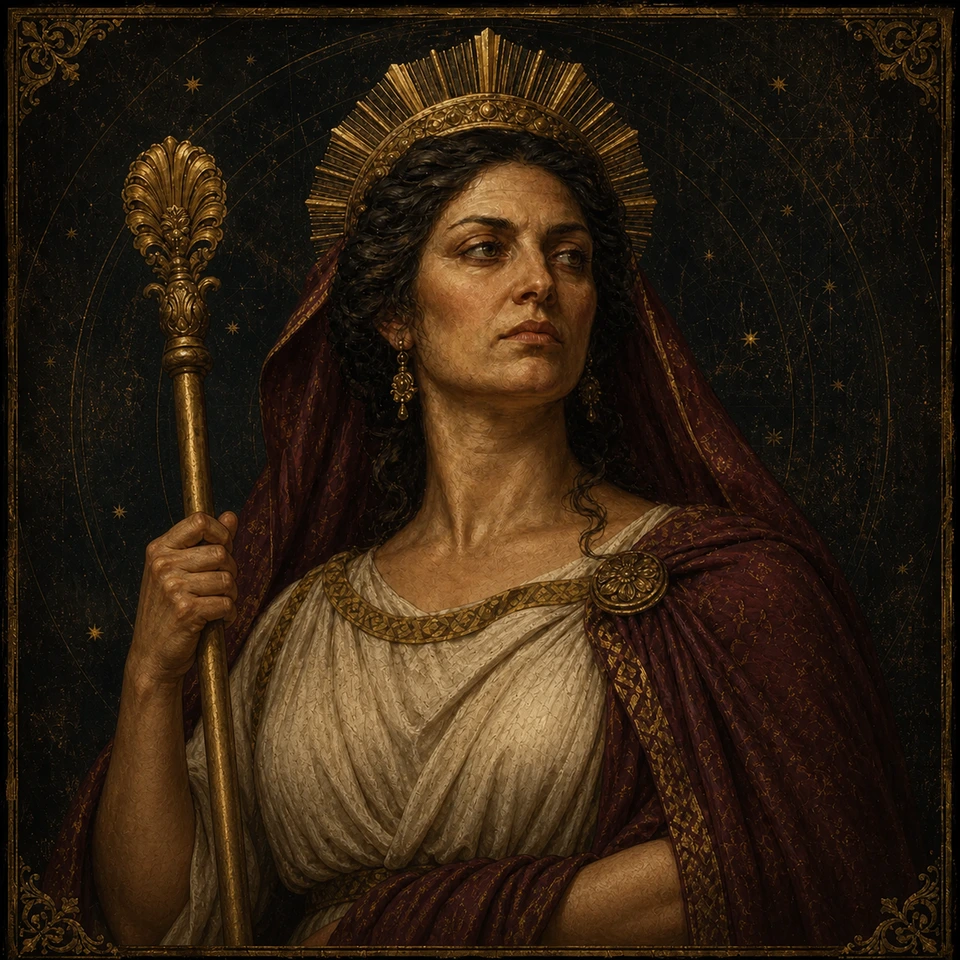
Occupying the absolute apex of Olympian queenship, Hera projects intense literary agency and sacred authority. Her influence defined ancient civic life through major sanctuaries and source-specific marriage cults, claiming particularly deep historical roots at Argos and Samos.
Overview
Hera enters Greek literature already crowned. Hesiod places her among the children of Rhea and Cronus, sister to the generation that divides the cosmos after the Titans, then names her as wife of Zeus and mother of Ares, Hebe, and Eileithyia. The Iliad calls her queenly, golden-throned, white-armed, and ox-eyed. Yet none of those titles makes her passive. She argues policy, recruits allies, drives divine chariots, defies Zeus, and bends the course of war.
Marriage is central to her history, but the surviving evidence refuses the smooth portrait of a household ideal. Zeus's infidelities, Hera's pursuit of women and children caught in them, and the couple's tactical battles expose marriage as a field of rank, oath, injury, and reconciliation. On Mount Ida Hera borrows Aphrodite's zone, bargains with Sleep, and uses intimacy to distract Zeus while Poseidon aids the Achaeans. In another Iliadic memory she turns Zeus's boast about a coming ruler into an oath, advances Eurystheus's birth, and delays Alcmene's labor. Pseudo-Apollodorus also places her disguised counsel before Semele's fatal request and Dionysus's double birth. Her intelligence often works through the precise terms of promises made by more powerful figures.
Cult gives a broader Hera than epic anger. At the Argive Heraion, below Mount Euboea, Polycleitus's seated gold-and-ivory goddess wore a crown bearing the Graces and Seasons, held a pomegranate, and carried a sceptre topped by a cuckoo. Herodotus tells how Cleobis and Biton pulled the wagon of their mother, Hera's priestess, to an Argive festival. Their strength, the public sacrifice, the mother's prayer, and the brothers' death make the story as much about mortal honor before the goddess as about miraculous transport.
Samos claimed Hera's birth beside the Imbrasos and a lygos tree. Its Heraion became one of the ancient Mediterranean's great sanctuaries. The enormous sixth-century BC temple and the sanctuary's far-traveled votives show how an island goddess could command international attention without losing her local river and tree. Herodotus called the temple the largest he knew. UNESCO's archaeological description anchors that monument in its surviving landscape.
At Olympia, the Sixteen Women wove Hera a robe and administered the Heraea foot races for maidens. Three age classes ran, and victors received olive crowns and a portion of the sacrificed cow. At Stymphalus, Hera's titles traced a local sacred life as Pais, Teleia, and Chera: Girl, Fulfilled or Married Woman, and Widow. At Plataea the Daedala joined Hera and Zeus through a story of quarrel, a false wooden bride, laughter, and reconciliation, then carried dressed images and animal offerings into a fire on Cithaeron.
Objects keep her visible. A name-inscribed Attic vase in the British Museum gives Hera Doric dress, a veil-like himation, radiated stephane, and a palmette-topped sceptre. A South Italian terracotta volute-krater at the Metropolitan Museum seats her in the Judgment of Paris with a sceptre. The pomegranate and cuckoo belong securely to the Argive cult image described by Pausanias. Peacock, planet, zodiac, gemstone, ritual color, weekday, and lunar phase remain unevidenced in the named ancient witnesses.
Hera remains present in public modern worship. YSEE's report documents a Heraia held on 19 August 2020 in its Athens temple, honoring her under the Greek titles Basilis and Ourania. That dated ceremony speaks for one modern Hellenic community, not for every devotee or Pagan tradition. The ancient evidence and the YSEE report together preserve queenship, marriage, city, oath, conflict, and return without turning Hera into either a sanitized queen or a jealous caricature.
Canonical identity
Canonical Identity
Hera exists as a powerful ancient Greek goddess, firmly established as one of the offspring of Cronus and Rhea. While her status as the wife of Zeus is central to her mythology, it does not exhaust her divine portfolio. She operates with massive agency as an Olympian ruler, a formidable partisan in epic poetry, and a guardian of both local communities and specific marriage cults. She is emphatically not the Roman Juno, an abstract symbol of jealousy, or a universal mother goddess, requiring any such identifications to provide their own dated textual witnesses.
Linguistic Identity
Hera is the standard English form derived from the Greek Ἥρα (Hēra). A qualified fifth-century BC Attic reconstruction provides /hɛ̌ː.raː/, roughly HEH-rah, although this approximation misses the ancient pitch accent and exact vowel lengths. The conventional English pronunciation HEER-uh remains in common use. Greek poetry frequently applies titles like queenly, white-armed, ox-eyed, and golden-throned; these serve strictly as poetic and cultic descriptors, not as distinct alternative personas.
Sources and evidence
TEXTUAL · Supported
The Greek headword is Ἥρα, transliterated Hēra, with a qualified fifth-century BC Attic reconstruction /hɛ̌ː.raː/.
- Source
- Wiktionary contributors, Ἥρα
- Reviewed edition
- Permanent revision 92197285 of the Ancient Greek entry Ἥρα · Wiktionary
- Exact locator
- Entry Ἥρα · Section Ancient Greek pronunciation
- Scope
- Classical Greece · Attica
- Authority
- collaborative historical lexicon
- Certainty
- Qualified historical reconstruction
The readable guide approximates the vowels and stress but cannot reproduce ancient pitch accent.
Open exact reviewed source4 reviewed sources for this section
- Wiktionary contributors, ἭραLive Ancient Greek lexical entry · Wiktionary
- Hesiod; edited and translated by Hugh G. Evelyn-White, Theogony (1914)Hesiod, the Homeric Hymns and Homerica, London and New York, 1914 · Perseus Digital Library / Scaife ATLAS
- Homer; Monro and Allen Greek edition with edition-specific translations, Iliad (1920)Perseus CTS edition corpus; Greek edition, Oxford, 1908-1920 · Perseus Digital Library / Scaife ATLAS
- Pausanias; Spiro Greek edition and Jones/Ormerod translation volumes, Description of Greece (1935)Perseus CTS edition corpus, 1903-1935 · Perseus Digital Library / Scaife ATLAS
Culture, tradition, period, and place
Hera’s evidence stretches from Archaic epic and genealogy through Classical objects and Roman-period descriptions of older sanctuaries. Argos, Samos, Olympia, Plataea, Stymphalus, and the Homeric battlefield do not offer one uniform theology. The Argive sanctuary holds a royal cult image. Samos claims her birth and builds a temple visible across the Greek world. Olympia’s women weave and race. Plataea burns wooden bridal images in a civic reconciliation festival.
The language is Greek, but regional distinction matters. Herodotus writes history, Homer composes epic, Hesiod orders divine genealogy, and Pausanias reports local places centuries later. Material objects correct literary overreach by showing how dress, crown, throne, veil, and sceptre actually marked her body.
6 reviewed sources for this section
- Hesiod; edited and translated by Hugh G. Evelyn-White, Theogony (1914)Hesiod, the Homeric Hymns and Homerica, London and New York, 1914 · Perseus Digital Library / Scaife ATLAS
- Homer; Monro and Allen Greek edition with edition-specific translations, Iliad (1920)Perseus CTS edition corpus; Greek edition, Oxford, 1908-1920 · Perseus Digital Library / Scaife ATLAS
- Herodotus; translated by A. D. Godley, The Histories (1925)A. D. Godley English translation, Loeb Classical Library volumes I-IV, 1920-1925; Perseus eng2 component · Perseus Digital Library / Scaife ATLAS
- Pausanias; Spiro Greek edition and Jones/Ormerod translation volumes, Description of Greece (1935)Perseus CTS edition corpus, 1903-1935 · Perseus Digital Library / Scaife ATLAS
- British Museum, British Museum CollectionLive official museum collection · British Museum
- UNESCO World Heritage Centre, Pythagoreion and Heraion of Samos (1992)World Heritage List entry 595 · UNESCO World Heritage Centre
Historical development
Hesiod places Hera within the generation born to Rhea and Cronus, then gives her marriage to Zeus and three children. The Iliad already assumes a mature Olympian queen whose plans can move battle and unsettle Zeus. Local cults preserve different beginnings: Samian tradition makes the Imbrasos landscape her birthplace, while Stymphalus divides her sacred life into Girl, Fulfilled or Married Woman, and Widow.
The monumental Heraia of Argos and Samos developed through long architectural histories rather than appearing complete in a single year. UNESCO’s Samian evidence emphasizes sixth-century BC scale and votives arriving from many regions. Pausanias’s later travel account preserves statues, rites, and place legends, but his date must not be mistaken for the date when each custom began.
Sources and evidence
TEXTUAL · Supported
Pausanias reports the Samian claim that Hera was born on their island beside the Imbrasos and a lygos tree.
- Source
- Pausanias; Spiro Greek edition and Jones/Ormerod translation volumes, Description of Greece (1935)
- Reviewed edition
- W. H. S. Jones and H. A. Ormerod English translation volumes, 1918-1935 · translated by W. H. S. Jones and H. A. Ormerod, volume-dependent · Perseus Digital Library / Scaife ATLAS
- Exact locator
- Book 7 · Chapter 4 · Section 4
- Scope
- Greek religion under Roman imperial rule · Samos
- Authority
- ancient literary witness
- Certainty
- Supported
The Samian birthplace claim coexists with other local traditions and is not universalized.
Open exact reviewed sourceTEXTUAL · Supported
At Stymphalus Hera was worshipped in a local life-course sequence as Pais, Teleia, and Chera.
- Source
- Pausanias; Spiro Greek edition and Jones/Ormerod translation volumes, Description of Greece (1935)
- Reviewed edition
- W. H. S. Jones and H. A. Ormerod English translation volumes, 1918-1935 · translated by W. H. S. Jones and H. A. Ormerod, volume-dependent · Perseus Digital Library / Scaife ATLAS
- Exact locator
- Book 8 · Chapter 22 · Section 2
- Scope
- Greek religion under Roman imperial rule · Stymphalus
- Authority
- ancient literary witness
- Certainty
- Supported
Pais, Teleia, and Chera form a local Stymphalian sequence rather than a universal threefold theology.
Open exact reviewed source4 reviewed sources for this section
- Pausanias; Spiro Greek edition and Jones/Ormerod translation volumes, Description of Greece (1935)Perseus CTS edition corpus, 1903-1935 · Perseus Digital Library / Scaife ATLAS
- Hesiod; edited and translated by Hugh G. Evelyn-White, Theogony (1914)Hesiod, the Homeric Hymns and Homerica, London and New York, 1914 · Perseus Digital Library / Scaife ATLAS
- Homer; Monro and Allen Greek edition with edition-specific translations, Iliad (1920)Perseus CTS edition corpus; Greek edition, Oxford, 1908-1920 · Perseus Digital Library / Scaife ATLAS
- UNESCO World Heritage Centre, Pythagoreion and Heraion of Samos (1992)World Heritage List entry 595 · UNESCO World Heritage Centre
Attested roles and historical themes
Roles, powers, and limits
Hera’s Iliadic sovereignty works through speech, alliance, deception, command, and refusal. She recruits Athena, bargains with Aphrodite and Sleep, confronts Zeus, and supports the Achaeans. Her power is political and relational, not merely emotional. The same epic also shows its limits: she cannot simply overrule Zeus and must create openings through oath, persuasion, or stratagem.
Cult narrows these powers into local forms. Teleia speaks to completed marriage at Stymphalus. Basilis and the royal posture of the Argive image express queenship. Eileithyia is a separate childbirth goddess and Hera’s daughter in Hesiod, even when Hera controls the timing of birth in Iliad 19. A story about obstructed labor does not make harmful childbirth intervention a devotional model.
Sources and evidence
TEXTUAL · Supported
The Iliad repeatedly presents Hera as queenly wife of Zeus and an active Olympian strategist in the Trojan conflict.
- Source
- Homer; Monro and Allen Greek edition with edition-specific translations, Iliad (1920)
- Reviewed edition
- A. T. Murray English translation, volumes I-II, 1924-1925 · translated by A. T. Murray · Perseus Digital Library / Scaife ATLAS
- Exact locator
- Book 14 · Line 153-353
- Scope
- Archaic Greece · Mount Ida in the Troad
- Authority
- ancient literary witness
- Certainty
- Supported
Epic strategy describes literary action, not a complete statement of cultic powers.
Open exact reviewed source3 reviewed sources for this section
- Homer; Monro and Allen Greek edition with edition-specific translations, Iliad (1920)Perseus CTS edition corpus; Greek edition, Oxford, 1908-1920 · Perseus Digital Library / Scaife ATLAS
- Hesiod; edited and translated by Hugh G. Evelyn-White, Theogony (1914)Hesiod, the Homeric Hymns and Homerica, London and New York, 1914 · Perseus Digital Library / Scaife ATLAS
- Pausanias; Spiro Greek edition and Jones/Ormerod translation volumes, Description of Greece (1935)Perseus CTS edition corpus, 1903-1935 · Perseus Digital Library / Scaife ATLAS
Epithets and titles
Royal Title
Basilis
Βασιλίδος · Queen
YSEE temple in Athens · Public community report dated 19 August 2020The YSEE page uses the inflected Greek form Βασιλίδος in its modern rite; this source-scoped title does not establish a universal ancient cult epithet.
1 reviewed source for this section
- Supreme Council of Ethnic Hellenes (YSEE), Η ΕΛΛΗΝΙΚΗ ΕΘΝΙΚΗ ΘΡΗΣΚΕΙΑ ΤΕΛΕΣΕ ΙΕΡΟΠΡΑΞΙΑ ΓΙΑ ΤΑ ΗΡΑΙΑ & ΤΗΝ ΝΟΥΜΗΝΙΑ (2020)Public first-party community report for Heraia 2020 · Supreme Council of Ethnic Hellenes
Theological Title
Ourania
Ουρανίας · Heavenly
YSEE temple in Athens · Public community report dated 19 August 2020The YSEE page uses the inflected Greek form Ουρανίας in its modern rite; it speaks for that community and date only.
1 reviewed source for this section
- Supreme Council of Ethnic Hellenes (YSEE), Η ΕΛΛΗΝΙΚΗ ΕΘΝΙΚΗ ΘΡΗΣΚΕΙΑ ΤΕΛΕΣΕ ΙΕΡΟΠΡΑΞΙΑ ΓΙΑ ΤΑ ΗΡΑΙΑ & ΤΗΝ ΝΟΥΜΗΝΙΑ (2020)Public first-party community report for Heraia 2020 · Supreme Council of Ethnic Hellenes
Cult Epithet
Teleia
Τελεία · Fulfilled or Married
Stymphalus in Arcadia · Local cult described by PausaniasOne title in the local Pais, Teleia, and Chera sequence.
1 reviewed source for this section
- Pausanias; Spiro Greek edition and Jones/Ormerod translation volumes, Description of Greece (1935)Perseus CTS edition corpus, 1903-1935 · Perseus Digital Library / Scaife ATLAS
Cult Epithet
Pais
Παῖς · Girl
Stymphalus in Arcadia · Local cult described by PausaniasOne title in the local Stymphalian sequence.
1 reviewed source for this section
- Pausanias; Spiro Greek edition and Jones/Ormerod translation volumes, Description of Greece (1935)Perseus CTS edition corpus, 1903-1935 · Perseus Digital Library / Scaife ATLAS
Cult Epithet
Chera
Χήρα · Widow
Stymphalus in Arcadia · Local cult described by PausaniasLocal title tied to Hera’s separation from Zeus.
1 reviewed source for this section
- Pausanias; Spiro Greek edition and Jones/Ormerod translation volumes, Description of Greece (1935)Perseus CTS edition corpus, 1903-1935 · Perseus Digital Library / Scaife ATLAS
Worship and cult
The Argive Heraion stood at the center of a powerful regional cult. Herodotus’s Cleobis and Biton story depends upon a priestess, a public festival, a wagon procession, sacrifice, and the long road to Hera’s sanctuary. At Samos the temple’s architecture and far-traveled votives show a sanctuary drawing attention beyond the island.
Other communities honored different forms. Olympia’s Sixteen Women prepared Hera’s robe and administered races for maidens. Stymphalus maintained three age-marked titles. Plataea joined Hera and Zeus in a great sacrificial fire. These are civic and local institutions. They should not be reduced to private marriage spells or copied as modern ritual instructions.
Sources and evidence
TEXTUAL · Supported
Pausanias places Hera’s celebrated Argive sanctuary below Mount Euboea and preserves local traditions about the daughters of Asterion as her nurses.
- Source
- Pausanias; Spiro Greek edition and Jones/Ormerod translation volumes, Description of Greece (1935)
- Reviewed edition
- W. H. S. Jones and H. A. Ormerod English translation volumes, 1918-1935 · translated by W. H. S. Jones and H. A. Ormerod, volume-dependent · Perseus Digital Library / Scaife ATLAS
- Exact locator
- Book 2 · Chapter 17 · Section 1
- Scope
- Greek religion under Roman imperial rule · Heraion of Argos
- Authority
- ancient literary witness
- Certainty
- Supported
The nurses of Hera belong to Argive place tradition reported by Pausanias.
Open exact reviewed source3 reviewed sources for this section
- Pausanias; Spiro Greek edition and Jones/Ormerod translation volumes, Description of Greece (1935)Perseus CTS edition corpus, 1903-1935 · Perseus Digital Library / Scaife ATLAS
- Herodotus; translated by A. D. Godley, The Histories (1925)A. D. Godley English translation, Loeb Classical Library volumes I-IV, 1920-1925; Perseus eng2 component · Perseus Digital Library / Scaife ATLAS
- UNESCO World Heritage Centre, Pythagoreion and Heraion of Samos (1992)World Heritage List entry 595 · UNESCO World Heritage Centre
Temples, sanctuaries, and sacred places
The Heraion below Mount Euboea joined the landscapes of Argos and Mycenae. Pausanias found there an image by Polycleitus and local memories of the river Asterion and his daughters. On Samos the Heraion stood near the Imbrasos, and the island’s tradition located Hera’s birth beside the river and lygos. UNESCO preserves the archaeological scale of the sanctuary and its great sixth-century temple.
Olympia gives Hera an older temple setting and the Heraea. Plataea and Mount Cithaeron hold the Daedala’s wooden images, procession, altar, and blaze. Mount Ida in the Troad is different again: it is the epic landscape where Hera distracts Zeus during battle, not proof of a sanctuary matching the scene.
Sources and evidence
TEXTUAL · Supported
UNESCO identifies the Heraion of Samos as a monumental sanctuary whose sixth-century BC temple and far-traveled votives testify to wide importance.
- Source
- UNESCO World Heritage Centre, Pythagoreion and Heraion of Samos (1992)
- Reviewed edition
- UNESCO World Heritage List entry 595 · UNESCO World Heritage Centre
- Exact locator
- Entry World Heritage List 595 · Section Description and Outstanding Universal Value
- Scope
- Ancient Greek diachrony · Samos
- Authority
- institutional archaeological heritage authority
- Certainty
- Supported institutional synthesis
UNESCO supports the material sanctuary and its importance, not every later devotional interpretation.
Open exact reviewed sourceTEXTUAL · Supported
Herodotus names the Samian Hera temple as the largest temple known to him.
- Source
- Herodotus; translated by A. D. Godley, The Histories (1925)
- Reviewed edition
- A. D. Godley English translation, Loeb Classical Library volumes I-IV, 1920-1925 · translated by A. D. Godley · edited by A. D. Godley · Perseus Digital Library / Scaife ATLAS
- Exact locator
- Book 3 · Section 60.4
- Scope
- Classical Greece · Samos
- Authority
- ancient literary witness
- Certainty
- Supported
Herodotus’s comparison reports what he knew in his own historical horizon.
Open exact reviewed source4 reviewed sources for this section
- UNESCO World Heritage Centre, Pythagoreion and Heraion of Samos (1992)World Heritage List entry 595 · UNESCO World Heritage Centre
- Herodotus; translated by A. D. Godley, The Histories (1925)A. D. Godley English translation, Loeb Classical Library volumes I-IV, 1920-1925; Perseus eng2 component · Perseus Digital Library / Scaife ATLAS
- Pausanias; Spiro Greek edition and Jones/Ormerod translation volumes, Description of Greece (1935)Perseus CTS edition corpus, 1903-1935 · Perseus Digital Library / Scaife ATLAS
- Homer; Monro and Allen Greek edition with edition-specific translations, Iliad (1920)Perseus CTS edition corpus; Greek edition, Oxford, 1908-1920 · Perseus Digital Library / Scaife ATLAS
Festivals and processions
At Olympia, every fourth year, the Sixteen Women wove a robe and held foot races called Heraea. Maidens ran in three age divisions, and victors received olive crowns and portions of the sacrificed cow. The rite gives women athletic office and public honor within the sanctuary’s calendar.
The Argive festival appears through Cleobis and Biton, whose journey bears their mother, Hera’s priestess, to the sanctuary. The Great Daedala at Plataea joins cities in selecting wooden images, processing them to Cithaeron, sacrificing a cow to Hera and a bull to Zeus, and burning the daedala with the offerings. One is not a variant of the other.
Sources and evidence
TEXTUAL · Supported
Herodotus tells how Cleobis and Biton drew their priestess mother’s wagon to Hera’s Argive festival and received death after her prayer for the best human gift.
- Source
- Herodotus; translated by A. D. Godley, The Histories (1925)
- Reviewed edition
- A. D. Godley English translation, Loeb Classical Library volumes I-IV, 1920-1925 · translated by A. D. Godley · edited by A. D. Godley · Perseus Digital Library / Scaife ATLAS
- Exact locator
- Book 1 · Section 31.1-5
- Scope
- Classical Greece · Argos
- Authority
- ancient literary witness
- Certainty
- Supported
The brothers’ death is integral to the Herodotean account and should not be omitted.
Open exact reviewed sourceTEXTUAL · Supported
Every fourth year the Sixteen Women wove a robe for Hera at Olympia and held Heraea foot races for three age classes of maidens.
- Source
- Pausanias; Spiro Greek edition and Jones/Ormerod translation volumes, Description of Greece (1935)
- Reviewed edition
- W. H. S. Jones and H. A. Ormerod English translation volumes, 1918-1935 · translated by W. H. S. Jones and H. A. Ormerod, volume-dependent · Perseus Digital Library / Scaife ATLAS
- Exact locator
- Book 5 · Chapter 16 · Section 2-4
- Scope
- Greek religion under Roman imperial rule · Olympia
- Authority
- ancient literary witness
- Certainty
- Supported
The robe and races belong to Olympia and the office of the Sixteen Women.
Open exact reviewed sourceTEXTUAL · Supported
Pausanias describes the Great Daedala as a Boeotian rite in which cities brought wooden images, sacrificed a cow to Hera and a bull to Zeus, and burned the images with the victims and aromatics.
- Source
- Pausanias; Spiro Greek edition and Jones/Ormerod translation volumes, Description of Greece (1935)
- Reviewed edition
- W. H. S. Jones and H. A. Ormerod English translation volumes, 1918-1935 · translated by W. H. S. Jones and H. A. Ormerod, volume-dependent · Perseus Digital Library / Scaife ATLAS
- Exact locator
- Book 9 · Chapter 3 · Section 1-8
- Scope
- Greek religion under Roman imperial rule · Plataea
- Authority
- ancient literary witness
- Certainty
- Supported
The high ritual fire belongs to the Great Daedala and is described historically, not prescribed.
Open exact reviewed source2 reviewed sources for this section
- Herodotus; translated by A. D. Godley, The Histories (1925)A. D. Godley English translation, Loeb Classical Library volumes I-IV, 1920-1925; Perseus eng2 component · Perseus Digital Library / Scaife ATLAS
- Pausanias; Spiro Greek edition and Jones/Ormerod translation volumes, Description of Greece (1935)Perseus CTS edition corpus, 1903-1935 · Perseus Digital Library / Scaife ATLAS
Offerings, votives, and ritual evidence
Hera’s evidence includes garments, animal sacrifice, votive images, and festival labor. Olympia’s robe was made by named ritual officials, and the cow’s meat entered the prize economy of the Heraea. At Plataea, wine and incense accompanied the animals and wooden images into a great communal fire. The Samian sanctuary accumulated gifts from many parts of the ancient world.
Objects offered to a sanctuary do not automatically become timeless magical tools. The Argive pomegranate belongs to one cult image, and Pausanias explicitly withholds its explanation. The cuckoo crowns a sceptre within a local tale about Zeus. These details can shape historically grounded devotion, but they do not supply a universal recipe.
Sources and evidence
TEXTUAL · Supported
Victors in the Heraea received olive crowns and a share of the cow sacrificed to Hera, and could dedicate painted portraits.
- Source
- Pausanias; Spiro Greek edition and Jones/Ormerod translation volumes, Description of Greece (1935)
- Reviewed edition
- W. H. S. Jones and H. A. Ormerod English translation volumes, 1918-1935 · translated by W. H. S. Jones and H. A. Ormerod, volume-dependent · Perseus Digital Library / Scaife ATLAS
- Exact locator
- Book 5 · Chapter 16 · Section 3
- Scope
- Greek religion under Roman imperial rule · Olympia
- Authority
- ancient literary witness
- Certainty
- Supported
The sacrificed cow enters this specific festival and athletic prize context.
Open exact reviewed source2 reviewed sources for this section
- Pausanias; Spiro Greek edition and Jones/Ormerod translation volumes, Description of Greece (1935)Perseus CTS edition corpus, 1903-1935 · Perseus Digital Library / Scaife ATLAS
- UNESCO World Heritage Centre, Pythagoreion and Heraion of Samos (1992)World Heritage List entry 595 · UNESCO World Heritage Centre
Iconography and material culture
Hera’s most secure ancient visual language is regal. British Museum vase 1847,0909.6 names her beside a woman in Doric chiton, himation drawn over the head, radiated stephane, and a tall palmette-topped sceptre. Metropolitan Museum volute-krater 69.11.7 places her seated in the upper right of the Judgment of Paris, holding a sceptre. Pausanias’s Argive cult image adds throne, gold and ivory, a crown with Graces and Seasons, a pomegranate, and a cuckoo-topped sceptre.
The veil, crown, throne, and sceptre signal rank, but their exact forms vary. No peacock is established by the selected ancient material. Later European and Roman images need their own dated witnesses before any attribute can be carried backward into an Attic vase or Argive sanctuary.
Sources and evidence
TEXTUAL · Supported
Pausanias describes Polycleitus’s seated gold-and-ivory Hera with a crown bearing Graces and Seasons, a pomegranate, and a sceptre topped by a cuckoo.
- Source
- Pausanias; Spiro Greek edition and Jones/Ormerod translation volumes, Description of Greece (1935)
- Reviewed edition
- W. H. S. Jones and H. A. Ormerod English translation volumes, 1918-1935 · translated by W. H. S. Jones and H. A. Ormerod, volume-dependent · Perseus Digital Library / Scaife ATLAS
- Exact locator
- Book 2 · Chapter 17 · Section 4
- Scope
- Greek religion under Roman imperial rule · Heraion of Argos
- Authority
- ancient literary witness
- Certainty
- Supported
Pausanias declines to explain the pomegranate’s sacred meaning.
Open exact reviewed sourceMATERIAL CULTURE · Supported
A name-inscribed Attic red-figure vase shows Hera with a palmette-topped sceptre, Doric dress, veil-like himation, and radiated stephane.
- Source
- British Museum, British Museum Collection
- Reviewed edition
- British Museum object record 1847,0909.6 (E82), Attic red-figure kylix · British Museum
- Exact locator
- MuseumObjectId 1847,0909.6 (E82) · Entry Object description and production date
- Scope
- Classical Greece · Attica
- Authority
- institutional museum object record
- Certainty
- Supported
The inscription secures Hera’s identity on this object; the sceptre’s form is object-specific.
Open exact reviewed sourceMATERIAL CULTURE · Supported
Metropolitan Museum volute-krater 69.11.7 places Hera seated in the upper right of the Judgment of Paris, holding her sceptre.
- Source
- The Metropolitan Museum of Art, Open Access Collection and Collection API
- Reviewed edition
- Metropolitan Museum of Art object record 255282, accession 69.11.7, terracotta volute-krater · The Metropolitan Museum of Art
- Exact locator
- MuseumObjectId 69.11.7 · Entry Terracotta volute-krater, Judgment of Paris, object description and date
- Scope
- Classical Greece · Apulia (South Italy)
- Authority
- institutional museum object record
- Certainty
- Supported
The object is a monumental Apulian red-figure mixing bowl dated about 330-310 BC, not a statuette.
Open exact reviewed source3 reviewed sources for this section
- Pausanias; Spiro Greek edition and Jones/Ormerod translation volumes, Description of Greece (1935)Perseus CTS edition corpus, 1903-1935 · Perseus Digital Library / Scaife ATLAS
- British Museum, British Museum CollectionLive official museum collection · British Museum
- The Metropolitan Museum of Art, Open Access Collection and Collection APILive collection data and eligible public-domain images · The Metropolitan Museum of Art
Animals, plants, and embodied forms
The cuckoo has a precise Argive setting. Pausanias says it sat atop Hera’s sceptre and connects it to a local story in which Zeus approached her in that form. The bird is therefore historically relevant without becoming a universal embodiment. The pomegranate rests in the image’s other hand, but Pausanias refuses to reveal its sacred meaning.
Samos supplies a different plant boundary. Its local birth tradition places Hera beside a lygos tree near the Imbrasos. A tree in a place legend is not automatically an offering for every worshipper. Peacock, cow, crow, lily, lotus, and other familiar later associations require their own dated evidence before admission to an ancient layer.
Sources and evidence
TEXTUAL · Supported
The pomegranate and cuckoo occur together on the Argive cult image described by Pausanias, who declines to disclose the pomegranate’s meaning.
- Source
- Pausanias; Spiro Greek edition and Jones/Ormerod translation volumes, Description of Greece (1935)
- Reviewed edition
- W. H. S. Jones and H. A. Ormerod English translation volumes, 1918-1935 · translated by W. H. S. Jones and H. A. Ormerod, volume-dependent · Perseus Digital Library / Scaife ATLAS
- Exact locator
- Book 2 · Chapter 17 · Section 4
- Scope
- Greek religion under Roman imperial rule · Heraion of Argos
- Authority
- ancient literary witness
- Certainty
- Supported
Both attributes remain attached to the Argive image and its local explanation.
Open exact reviewed source1 reviewed source for this section
- Pausanias; Spiro Greek edition and Jones/Ormerod translation volumes, Description of Greece (1935)Perseus CTS edition corpus, 1903-1935 · Perseus Digital Library / Scaife ATLAS
Relationships and genealogy
Hesiod makes Hera a daughter of Cronus and Rhea and names Hestia, Demeter, Hades, Poseidon, and Zeus among the same sibling generation. He then calls Hera the last wife of Zeus and names Ares, Hebe, and Eileithyia as their children. The Iliad can call Hephaestus her son, while other traditions complicate his paternity. These genealogies belong to particular works, not one modern family chart.
Hera’s conflicts also resist simplification. Leto, Io, Alcmene, Heracles, Paris, Aphrodite, Athena, Artemis, Sleep, and Poseidon meet her in different scenes. A rival in one poem is not an eternal enemy in cult. Her marriage with Zeus contains alliance, struggle, secrecy, and public reconciliation, not a single moral allegory.
Sources and evidence
TEXTUAL · Supported
Hesiod names Hera among the children born to Rhea and Cronus.
- Source
- Hesiod; edited and translated by Hugh G. Evelyn-White, Theogony (1914)
- Reviewed edition
- Hugh G. Evelyn-White edition and English translation in Hesiod, the Homeric Hymns and Homerica, 1914 · translated by Hugh G. Evelyn-White · edited by Hugh G. Evelyn-White · Perseus Digital Library / Scaife ATLAS
- Exact locator
- Line 453-458
- Scope
- Archaic Greece · Ancient Greece
- Authority
- ancient literary witness
- Certainty
- Supported
This is Hesiod’s genealogy; later local accounts of Hera’s upbringing remain separate.
Open exact reviewed sourceTEXTUAL · Supported
Hesiod names Hera as Zeus’s wife and Ares, Hebe, and Eileithyia as their children.
- Source
- Hesiod; edited and translated by Hugh G. Evelyn-White, Theogony (1914)
- Reviewed edition
- Hugh G. Evelyn-White edition and English translation in Hesiod, the Homeric Hymns and Homerica, 1914 · translated by Hugh G. Evelyn-White · edited by Hugh G. Evelyn-White · Perseus Digital Library / Scaife ATLAS
- Exact locator
- Line 921-923
- Scope
- Archaic Greece · Ancient Greece
- Authority
- ancient literary witness
- Certainty
- Supported
Hephaestus requires his own source variants and is not silently added to Hesiod’s line list.
Open exact reviewed source2 reviewed sources for this section
- Hesiod; edited and translated by Hugh G. Evelyn-White, Theogony (1914)Hesiod, the Homeric Hymns and Homerica, London and New York, 1914 · Perseus Digital Library / Scaife ATLAS
- Homer; Monro and Allen Greek edition with edition-specific translations, Iliad (1920)Perseus CTS edition corpus; Greek edition, Oxford, 1908-1920 · Perseus Digital Library / Scaife ATLAS
Actual myths and source variants
Hera's narratives move among epic, hymn, mythography, and local festival tradition. In the Judgment of Paris she offers sovereignty and joins Athena in opposition to Troy. In Apollo's Delian birth, the Homeric Hymn and Callimachus preserve different forms of her resistance to Leto. In the Iliad's Ares cycle she reports Ascalaphus's death, while another Iliadic scene has Hebe prepare Hera's chariot before Hera rides toward battle. Pseudo-Apollodorus places Hera's disguised counsel before Semele's fatal request and makes her assault by Porphyrion part of the war with the Gigantes.
Other tellings expose strategy and consequence. Iliad 19 makes Hera's control of birth timing the reason Eurystheus rules before Heracles. Iliad 14 makes marital intimacy a battlefield stratagem. Pseudo-Apollodorus traces Io through disguise, Argus, Hermes, and the gadfly. Apollonius makes Hera the protector of Jason who plans Medea's wounding by Eros. The marriage of Heracles and Hebe carries a later reconciliation with Hera, while Pausanias makes Zeus and Hera's quarrel the sacred history of the Daedala. Each witness keeps its own motive, sequence, and moral pressure.
Hera also belongs explicitly to the succession story in which Cronus swallows and later releases the children of Rhea, and to Pseudo-Apollodorus's Callisto witness, where the agent who transforms or kills Callisto changes between alternatives. Hephaestus's live myth records preserve Hera as sole mother in Hesiod, rejecting mother in Iliad 18, the Olympian power reconciled by Dionysus's return of the smith, and the commander who calls her son against Xanthus. These incompatible roles remain beside one another instead of being pressed into a single biography.
Sources and evidence
TEXTUAL · Supported
Pseudo-Apollodorus makes Hera the guard and pursuer of Io through Argus and the gadfly.
- Source
- Pseudo-Apollodorus; edited and translated by James G. Frazer, Library (1921)
- Reviewed edition
- James G. Frazer edition and English translation, Harvard University Press and William Heinemann, 1921 · translated by James G. Frazer · edited by James G. Frazer · Perseus Digital Library / Scaife ATLAS
- Exact locator
- Book 2 · Chapter 1 · Section 3
- Scope
- Greek religion under Roman imperial rule · Ancient Greece
- Authority
- ancient literary witness
- Certainty
- Supported
Pseudo-Apollodorus says Zeus seduced Io, then preserves Hera’s transformation, confinement through Argus, and gadfly pursuit; this witness alone does not settle the encounter’s consent framing.
Open exact reviewed sourceTEXTUAL · Supported
The Iliad has Hera exploit Zeus’s oath, accelerate Eurystheus’s birth, and hold back Alcmene’s labor and the Eileithyiae.
- Source
- Homer; Monro and Allen Greek edition with edition-specific translations, Iliad (1920)
- Reviewed edition
- A. T. Murray English translation, volumes I-II, 1924-1925 · translated by A. T. Murray · Perseus Digital Library / Scaife ATLAS
- Exact locator
- Book 19 · Line 95-133
- Scope
- Archaic Greece · Ancient Greece
- Authority
- ancient literary witness
- Certainty
- Supported
The scene involves obstructed childbirth and should not be treated as a devotional model.
Open exact reviewed sourceTEXTUAL · Supported
In Iliad 14 Hera uses Aphrodite’s embroidered zone and Sleep’s aid to distract Zeus on Ida while Poseidon helps the Achaeans.
- Source
- Homer; Monro and Allen Greek edition with edition-specific translations, Iliad (1920)
- Reviewed edition
- A. T. Murray English translation, volumes I-II, 1924-1925 · translated by A. T. Murray · Perseus Digital Library / Scaife ATLAS
- Exact locator
- Book 14 · Line 153-353
- Scope
- Archaic Greece · Mount Ida in the Troad
- Authority
- ancient literary witness
- Certainty
- Supported
The episode binds divine intimacy to the immediate military crisis in Iliad 14.
Open exact reviewed source10 reviewed sources for this section
- Pseudo-Apollodorus; edited and translated by James G. Frazer, Library (1921)Harvard University Press and William Heinemann edition, 1921 · Perseus Digital Library / Scaife ATLAS
- British Museum, British Museum CollectionLive official museum collection · British Museum
- Homer; Monro and Allen Greek edition with edition-specific translations, Iliad (1920)Perseus CTS edition corpus; Greek edition, Oxford, 1908-1920 · Perseus Digital Library / Scaife ATLAS
- Homeric Hymn to Apollo; translated by Rodney Merrill, The Homeric Hymn to ApolloCenter for Hellenic Studies online translation · Harvard University Center for Hellenic Studies
- Callimachus; translated by A. W. Mair, Hymns (1921)1921 Loeb edition hosted by the Perseus Digital Library · Perseus Digital Library
- Hesiod; edited and translated by Hugh G. Evelyn-White, Theogony (1914)Hesiod, the Homeric Hymns and Homerica, London and New York, 1914 · Perseus Digital Library / Scaife ATLAS
- Apollonius Rhodius; edited by George W. Mooney, Argonautica (1912)George W. Mooney Ancient Greek edition, 1912; Perseus grc2 component · Perseus Digital Library / Scaife ATLAS
- Homer; translated by A. T. Murray, Odyssey (1919)A. T. Murray English translation, London: William Heinemann; New York: G. P. Putnam's Sons, 1919 · Perseus Digital Library / Scaife ATLAS
- Anonymous Homeric Hymns; edited and translated by Hugh G. Evelyn-White, Homeric Hymns (1914)Hesiod, the Homeric Hymns and Homerica, London and New York, 1914 · Perseus Digital Library / Scaife ATLAS
- Pausanias; Spiro Greek edition and Jones/Ormerod translation volumes, Description of Greece (1935)Perseus CTS edition corpus, 1903-1935 · Perseus Digital Library / Scaife ATLAS
Myth Library
Each myth gathers its attested participants into one source-grounded account, while distinct source traditions remain readable in their own variants.
Contest And War Prelude
The Judgment of Paris
Eris sets Hera, Athena, and Aphrodite against one another with an apple for the fairest, and Paris gives it to Aphrodite after she promises him Helen. The Iliad takes up the cost of that choice when Aphrodite rescues Paris from Menelaus and threatens Helen into returning to him.
- Role in this profile
- contestant who offers Paris sovereignty in the mythographic witness
- Place scope
- Mount Ida in the Troad · Ancient Greece
- Witnesses
- 3
- Variants
- 3
Divine Birth
The Birth of Apollo at Delos
Leto finds refuge on Delos and gives birth to Apollo after the island receives a sworn promise of honor; Callimachus later reshapes the birth through Delos's wanderings, Hera's resistance, and the island's fixing in place.
- Role in this profile
- divine opponent who obstructs Leto's delivery
- Place scope
- Delos
- Witnesses
- 2
- Variants
- 2
Epic Cycle
Ares in the Trojan War
Across the Iliad, Ares fights for Troy, is wounded through Athena and Diomedes, grieves for his fallen son Ascalaphus, and is cast down again when the gods enter battle.
- Role in this profile
- Olympian who reports Ascalaphus' death to Ares
- Place scope
- Ancient Greece
- Witnesses
- 4
- Variants
- 4
Birth And Genealogy
The Birth of Dionysus
Semele dies after asking Zeus to reveal his divine splendor. Zeus rescues the unborn Dionysus and completes the pregnancy in his own thigh before Hermes carries the infant into concealment.
- Role in this profile
- deceiver who plants the fatal request in Semele
- Place scope
- Ancient Greece
- Witnesses
- 2
- Variants
- 2
Birth And Divine Rivalry
Hera Delays the Birth of Heracles
Hera turns Zeus' oath against the unborn Heracles by advancing Eurystheus' birth and holding the Eileithyiae away from Alcmene.
- Role in this profile
- strategist who secures Zeus' oath, hastens Eurystheus, and holds childbirth powers away from Alcmene
- Place scope
- Ancient Greece
- Witnesses
- 1
- Variants
- 1
Divine Intervention And Compelled Desire
Eros Wounds Medea
Aphrodite bribes Eros to strike Medea with desire for Jason, turning a hidden arrow into the hinge of the Argonauts' success and Medea's ruinous future.
- Role in this profile
- protector of Jason who devises the appeal to Aphrodite so Medea will help him
- Place scope
- Colchis
- Witnesses
- 1
- Variants
- 1
Mythographic Synthesis
Gaia and the Gigantes
Pseudo-Apollodorus makes Gaia bear the Gigantes in anger over the Titans and seek a protective drug before their war with the gods; the Pergamon Altar adds Phoibe’s long-torch combat beside Asteria.
- Role in this profile
- is assaulted by Porphyrion during the battle
- Place scope
- Ancient Greece · Pergamon
- Witnesses
- 2
- Variants
- 2
Divine Household
Hebe Serves on Olympus
Hebe pours nectar as the gods watch Troy, then readies Hera’s chariot when divine argument becomes battlefield intervention.
- Role in this profile
- receives Hebe’s chariot preparation before riding with Athena toward the battlefield
- Place scope
- Ancient Greece
- Witnesses
- 2
- Variants
- 2
Divine Marriage
Heracles Weds Hebe on Olympus
After his mortal labors, Heracles enters immortal life with Hebe, while different witnesses emphasize agelessness, a divided underworld presence, praise, or reconciliation with Hera.
- Role in this profile
- is named as Hebe’s mother and, in the mythographic telling, becomes reconciled with Heracles before the marriage
- Place scope
- Ancient Greece
- Witnesses
- 4
- Variants
- 4
Epic
Hera Beguiles Zeus on Ida
Hera borrows Aphrodite’s embroidered zone, bargains with Sleep, and draws Zeus into love and sleep on Mount Ida so Poseidon can aid the Achaeans.
- Role in this profile
- Strategist who organizes Zeus’s distraction
- Place scope
- Mount Ida in the Troad
- Witnesses
- 1
- Variants
- 1
Transformation
Io, Argus, and the Gadfly
Pseudo-Apollodorus tells how Io becomes a cow, Hera sets Argus to guard her, Hermes kills the watchman, and Hera’s gadfly drives Io across distant lands.
- Role in this profile
- Takes custody of Io, appoints Argus, and sends the gadfly
- Place scope
- Argos · Mycenae · Ancient Egypt · Ancient Greece
- Witnesses
- 1
- Variants
- 1
Cult Aetiology
Zeus, Hera, and the Daedala
A Plataean sacred story tells how Hera separates from Zeus, returns after discovering his wooden bride is a ruse, and becomes the center of the Daedala festival of reconciliation and sacrifice.
- Role in this profile
- Separated spouse who exposes the false bride and reconciles
- Place scope
- Plataea · Boeotia · Mount Cithaeron
- Witnesses
- 1
- Variants
- 1
Conflicting Theogonic And Epic
Births and Falls of Hephaestus
Hesiod and two Homeric memories give incompatible births, expulsions, rescuers, and landing places for Hephaestus.
- Role in this profile
- sole parent in Hesiod and rejecting mother in the Iliad 18 account
- Place scope
- Ancient Greece · Lemnos
- Witnesses
- 3
- Variants
- 3
Return And Reconciliation
Dionysus Returns Hephaestus to Olympus
Pausanias explains an Athenian painting through the story of Hera's golden chair and Dionysus' successful return of Hephaestus.
- Role in this profile
- mother bound in the golden chair after throwing Hephaestus away
- Place scope
- Athens · Ancient Greece
- Witnesses
- 1
- Variants
- 1
Epic Divine Battle
Hephaestus Fights Xanthus
Hera summons Hephaestus against the river Xanthus, and divine fire boils the water until the river yields.
- Role in this profile
- mother who summons Hephaestus and later orders him to stop
- Place scope
- Xanthus or Scamander on the Trojan plain
- Witnesses
- 1
- Variants
- 1
Theogony
Cronus and the Swallowed Children
Cronus swallows five children born by Rhea, but she hides Zeus and gives Cronus a wrapped stone; Zeus survives, the children return, and the feared succession begins.
- Role in this profile
- swallowed daughter of Cronus and Rhea who returns with her divine siblings
- Place scope
- Ancient Greece · Crete · Olympia · Arcadia
- Witnesses
- 4
- Variants
- 4
Coercion Transformation And Catasterism
Artemis and Callisto
Zeus approaches Callisto in divine disguise, after which Pseudo-Apollodorus preserves conflicting agents for her transformation and death before Arcas is rescued and Callisto is set among the stars.
- Role in this profile
- alternative transformer of Callisto and, in another alternative, instigator of Artemis’s fatal shot
- Place scope
- Arcadia
- Witnesses
- 1
- Variants
- 1
Epic
Iris in the Trojan War
Across the Iliad, Iris carries commands, warnings, summons, and prayers between Olympus, Troy, the ships, and the winds.
- Role in this profile
- is restrained by Iris and later sends her secretly to Achilles
- Place scope
- Ancient Greece · Mount Ida in the Troad
- Witnesses
- 7
- Variants
- 7
Local Land Dispute
Hera and Poseidon Contest Argos
Pausanias says the river gods Inachus, Cephisus, and Asterion judge Argos to belong to Hera. Poseidon punishes the judgment by taking away their water, while another local passage remembers his flood at Argos.
- Role in this profile
- goddess awarded Argos by the river judges
- Place scope
- Argos
- Witnesses
- 1
- Variants
- 1
Divine Conflict
Hera, Poseidon, and Athena Attempt to Bind Zeus
The Iliad recalls Hera, Poseidon, and Athena attempting to bind Zeus. Thetis summons Briareus, whose presence frightens the conspirators away from the king.
- Role in this profile
- one of the three Olympians who attempt to bind Zeus
- Place scope
- Ancient Greece
- Witnesses
- 1
- Variants
- 1
Rescue
Poseidon Rescues Aeneas from Achilles
Although he stands against Troy, Poseidon removes Aeneas from Achilles because fate requires the Dardanian line to survive and because the mortal has honored the gods with sacrifice.
- Role in this profile
- goddess who leaves the decision about rescue to Poseidon
- Place scope
- Ancient Greece
- Witnesses
- 1
- Variants
- 1
Reported Divine Fosterage And Estrangement
Oceanus and Tethys Foster Hera
Hera says Oceanus and Tethys raised her, then uses their estrangement as a false explanation for leaving Olympus.
- Role in this profile
- claims Oceanus and Tethys raised her and uses their estrangement as a false reason for her journey
- Place scope
- Ancient Greece
- Witnesses
- 1
- Variants
- 1
Tragic
The Madness and Service of Heracles
Pseudo-Apollodorus places the madness before purification and service, while Euripides places it after the last labor and gives Iris, Lyssa, Athena, Amphitryon, and Theseus decisive roles. The incompatible chronologies remain separate.
- Role in this profile
- sends the madness directly in Pseudo-Apollodorus and commands it through Iris and Lyssa in Euripides
- Place scope
- Ancient Greece
- Witnesses
- 2
- Variants
- 2
Death Pyre And Divinization
The Death and Apotheosis of Heracles
Sophocles stages Deianeira's fatal gift and Heracles' command for the Oeta pyre but ends before death or ascent. Pseudo-Apollodorus continues through the lit pyre, cloud-borne apotheosis, reconciliation with Hera, and marriage to Hebe; Hesiod and the Odyssey preserve other endings.
- Role in this profile
- reconciles with Heracles after his ascent
- Place scope
- Ancient Greece
- Witnesses
- 4
- Variants
- 4
Heroic Labor Cycle
The Twelve Labors of Heracles
Pseudo-Apollodorus orders ten commands into twelve credited labors after Eurystheus rejects the Hydra and Augean tasks. The cycle depends on companions, divine conditions, bargaining, travel, strategy, and violence as much as bodily strength.
- Role in this profile
- intervenes against Heracles in the Hydra, Amazon, and cattle sequences
- Place scope
- Ancient Greece
- Witnesses
- 1
- Variants
- 1
Equivalences, syncretisms, and identity boundaries
Greek poems, sanctuaries, titles, and objects establish Hera within Greek religious history. Pausanias's account of Argos, Samos, Olympia, Stymphalus, and Plataea does not supply the separate Roman cult history of Juno. No Greek-Roman equivalence is asserted without a direct witness for that historical relation.
Argive Hera, Samian Hera, Hera Teleia, Hera Pais, and Hera Chera remain local or functional forms within the Greek evidence. Their distinct rites and landscapes do not require separate divine identities, and their shared name does not erase regional difference.
Sources and evidence
TEXTUAL · Supported
Pausanias’s account of Hera’s Greek sanctuaries and local images does not supply the separate Roman cult history of Juno.
- Source
- Pausanias; Spiro Greek edition and Jones/Ormerod translation volumes, Description of Greece (1935)
- Reviewed edition
- W. H. S. Jones and H. A. Ormerod English translation volumes, 1918-1935 · translated by W. H. S. Jones and H. A. Ormerod, volume-dependent · Perseus Digital Library / Scaife ATLAS
- Exact locator
- Book 2 · Chapter 17 · Section 1-4
- Scope
- Greek religion under Roman imperial rule · Ancient Greece
- Authority
- ancient Greek travel and cult witness
- Certainty
- Qualified source boundary
Greek cult evidence cannot substitute for an independent account of Roman Juno.
Open exact reviewed source1 reviewed source for this section
- Pausanias; Spiro Greek edition and Jones/Ormerod translation volumes, Description of Greece (1935)Perseus CTS edition corpus, 1903-1935 · Perseus Digital Library / Scaife ATLAS
Correspondence index
Hera's strongest associations come from named cults and objects: Argos and Samos, the Heraea and Daedala, the robe, sceptre, throne, crown, pomegranate, cuckoo, lygos, cow sacrifice, and the local title Teleia. Marriage and queenship are historically grounded when kept within their sources. Royal posture does not by itself create a gold, planetary, or solar correspondence.
The ancient witnesses named here do not fix a planet, zodiac sign, gemstone, ritual color, Classical element, weekday, moon phase, compass direction, or universal incense. A modern lexical entry lists Pythagorean senses of Hera for nine and Venus, but a primary ancient locator is still required before either can support a relationship to the goddess. YSEE's 2020 report documents one community ceremony, not a universal modern correspondence list.
Direct ancient correspondences
| Category | Direct correspondence | How and why | Evidence boundary |
|---|---|---|---|
| direction-place | Argos, Samos, Olympia, and PlataeaDirect historical association | Major sanctuaries and festivals tie Hera to named Greek places. | Ancient Cultic These are local sacred geographies, not a compass direction. 3 reviewed sources for this section
|
| festival-time | Heraea, Argive procession, and DaedalaDirect historical association | Named calendars preserve robe weaving, races, procession, sacrifice, and reconciliation. | Ancient Cultic The observances remain distinct by city and period. 2 reviewed sources for this section
|
| offering-ritual-material | Robe, cow sacrifice, and votive giftsDirect historical association | Olympia provides a woven robe and cow sacrifice, while Samos preserves far-traveled votives. | Ancient Cultic Offerings remain tied to specific sanctuaries and civic rites. 2 reviewed sources for this section
|
| ritual-object-symbol-tool | Sceptre, crown, throne, robe, and pomegranateDirect historical association | Cult images and festival practice preserve regalia, garment, and fruit as local material signs. | Ancient Material The objects are not interchangeable magical tools. 3 reviewed sources for this section
|
| intention-magical-power | Marriage and queenly sovereigntyDirect historical association | Hera Teleia and her marriage with Zeus support a historically bounded marriage role, while royal imagery supports sovereignty. | Ancient Cultic This does not promise romantic control, fidelity, pregnancy, or victory in every context. 2 reviewed sources for this section
|
Contextual evidence, not a general correspondence
| Category | Direct correspondence | How and why | Evidence boundary |
|---|---|---|---|
| metal-material | Gold and ivory in the Argive cult imageContextual evidence only | Polycleitus’s Hera was made of gold and ivory. | Ancient Material The materials describe one statue and do not establish a universal sacred metal. 1 reviewed source for this section
|
| plant-tree | Argive pomegranate and Samian lygosContextual evidence only | A pomegranate belongs to the Argive cult image, while lygos belongs to the Samian birth landscape. | Ancient Material Neither item becomes a universal offering or magical herb. 1 reviewed source for this section
|
| animal-embodied-form | Cuckoo on the Argive sceptreContextual evidence only | Pausanias places a cuckoo atop the Argive cult image’s sceptre and links it to a local story. | Ancient Material No peacock or universal sacred-animal claim is admitted without its own witness. 1 reviewed source for this section
|
| incense-perfume | Incense at the Great DaedalaContextual evidence only | Pausanias includes incense in the material burned with the festival sacrifice. | Ancient Cultic One rite does not establish a universal fragrance or private incense prescription. 1 reviewed source for this section
|
7 expected categories currently not evidenced
celestial-body · Not evidenced
No cultic celestial-body correspondence established
A lexical entry lists Pythagorean uses of Hera for nine and Venus, but no primary cultic or mythic locator has yet established a planetary relationship to the goddess.
- Layer
- Research Boundary
- Scope
- Lexical names for a number or planet remain distinct from the divine identity until primary evidence is reviewed
1 reviewed source for this section
- Wiktionary contributors, ἭραLive Ancient Greek lexical entry · Wiktionary
zodiac · Not evidenced
No zodiac sign evidenced
No zodiac sign is securely assigned to Hera.
- Layer
- Research Boundary
- Scope
- Marriage and sovereignty do not imply Libra, Cancer, or any other sign.
gemstone-crystal-mineral · Not evidenced
No gemstone, crystal, or mineral evidenced
No stone or mineral is dedicated to Hera in the reviewed witnesses.
- Layer
- Research Boundary
- Scope
- Pearl, diamond, garnet, and moonstone require dated modern testimony.
color · Not evidenced
No ritual color evidenced
No ancient rite or object fixes one ritual color for Hera.
- Layer
- Research Boundary
- Scope
- White dress, gold material, and royal imagery do not establish a universal palette.
classical-element · Not evidenced
No Classical element evidenced
No source here assigns Hera a formal element.
- Layer
- Research Boundary
- Scope
- Sky, marriage, or incense smoke cannot be converted into air or fire by analogy.
weekday · Not evidenced
No weekday evidenced
No weekday is securely assigned to Hera.
- Layer
- Research Boundary
- Scope
- A modern planetary week cannot be inferred from Zeus or Juno.
moon-phase · Not evidenced
No moon phase evidenced
No lunar phase is securely assigned to Hera.
- Layer
- Research Boundary
- Scope
- A modern new-moon celebration by one community does not create an ancient lunar rulership.
Sources and evidence
TEXTUAL · Supported
Hera’s marriage association is supported by her union with Zeus and the local cult title Teleia, but it does not turn every love practice into her ancient rite.
- Source
- Pausanias; Spiro Greek edition and Jones/Ormerod translation volumes, Description of Greece (1935)
- Reviewed edition
- W. H. S. Jones and H. A. Ormerod English translation volumes, 1918-1935 · translated by W. H. S. Jones and H. A. Ormerod, volume-dependent · Perseus Digital Library / Scaife ATLAS
- Exact locator
- Book 8 · Chapter 22 · Section 2
- Scope
- Greek religion under Roman imperial rule · Stymphalus
- Authority
- ancient literary witness
- Certainty
- Supported
Teleia supports marriage within a local cult sequence, not a universal love correspondence.
Open exact reviewed source4 reviewed sources for this section
- Pausanias; Spiro Greek edition and Jones/Ormerod translation volumes, Description of Greece (1935)Perseus CTS edition corpus, 1903-1935 · Perseus Digital Library / Scaife ATLAS
- Herodotus; translated by A. D. Godley, The Histories (1925)A. D. Godley English translation, Loeb Classical Library volumes I-IV, 1920-1925; Perseus eng2 component · Perseus Digital Library / Scaife ATLAS
- Wiktionary contributors, ἭραLive Ancient Greek lexical entry · Wiktionary
- Supreme Council of Ethnic Hellenes (YSEE), Η ΕΛΛΗΝΙΚΗ ΕΘΝΙΚΗ ΘΡΗΣΚΕΙΑ ΤΕΛΕΣΕ ΙΕΡΟΠΡΑΞΙΑ ΓΙΑ ΤΑ ΗΡΑΙΑ & ΤΗΝ ΝΟΥΜΗΝΙΑ (2020)Public first-party community report for Heraia 2020 · Supreme Council of Ethnic Hellenes
Later reception and living significance
YSEE's dated public report documents a Heraia celebrated on 19 August 2020 in its Athens temple, honoring Hera as Basilis and Ourania. The report also notes parallel celebrations by YSEE branches. This is first-party evidence for one living religious community, not a claim to speak for every Hellenic polytheist, Pagan, witch, reconstructionist, or devotee.
The report establishes its own ceremony and titles. It does not establish private rites, universal devotional rules, artistic reception, media history, or practices chosen by other communities. Those later claims require public testimony from the people, works, and periods concerned.
Sources and evidence
LIVING TRADITION PUBLIC · Supported
YSEE’s public report documents a Heraia held on 19 August 2020 in its Athens temple, honoring Hera as Basilis and Ourania.
- Source
- Supreme Council of Ethnic Hellenes (YSEE), Η ΕΛΛΗΝΙΚΗ ΕΘΝΙΚΗ ΘΡΗΣΚΕΙΑ ΤΕΛΕΣΕ ΙΕΡΟΠΡΑΞΙΑ ΓΙΑ ΤΑ ΗΡΑΙΑ & ΤΗΝ ΝΟΥΜΗΝΙΑ (2020)
- Reviewed edition
- Public YSEE Heraia 2020 report reviewed 2026-08-30 · Supreme Council of Ethnic Hellenes
- Exact locator
- Entry Heraia 2020 report, opening notice dated 19 August 2020
- Scope
- Contemporary living religion · Attica
- Authority
- first-party public religious community
- Certainty
- Supported for this community only
First-party public testimony for one named community and dated observance only.
Open exact reviewed source1 reviewed source for this section
- Supreme Council of Ethnic Hellenes (YSEE), Η ΕΛΛΗΝΙΚΗ ΕΘΝΙΚΗ ΘΡΗΣΚΕΙΑ ΤΕΛΕΣΕ ΙΕΡΟΠΡΑΞΙΑ ΓΙΑ ΤΑ ΗΡΑΙΑ & ΤΗΝ ΝΟΥΜΗΝΙΑ (2020)Public first-party community report for Heraia 2020 · Supreme Council of Ethnic Hellenes
Evidence, conflicts, and research gaps
Hesiod controls genealogy, the Iliad controls Hera's battlefield strategies and Heracles-birth oath, Pseudo-Apollodorus controls the Io and Dionysus-birth episodes, and the Homeric Hymn to Apollo and Callimachus preserve distinct Delian birth scenes. Herodotus preserves Argive and Samian notices, Pausanias maps local cults and images, and museum catalogues secure named visual details. UNESCO supplies licensed archaeological synthesis for Samos, while YSEE's dated 2020 page speaks only for its own contemporary observance.
Important gaps remain. The early chronology of Hera's major sanctuaries deserves deeper excavation reports. Pausanias intentionally withholds the meaning of the Argive pomegranate. Peacock iconography, astral correspondences, and universal magical materials are not established. The lexical Pythagorean senses of Hera for nine and Venus require a primary-text locator. Juno's Roman history requires direct Roman witnesses. The pronunciation remains a qualified reconstruction rather than a surviving ancient audio tradition.
15 reviewed sources for this section
- Wiktionary contributors, ἭραLive Ancient Greek lexical entry · Wiktionary
- Hesiod; edited and translated by Hugh G. Evelyn-White, Theogony (1914)Hesiod, the Homeric Hymns and Homerica, London and New York, 1914 · Perseus Digital Library / Scaife ATLAS
- Homer; Monro and Allen Greek edition with edition-specific translations, Iliad (1920)Perseus CTS edition corpus; Greek edition, Oxford, 1908-1920 · Perseus Digital Library / Scaife ATLAS
- Pausanias; Spiro Greek edition and Jones/Ormerod translation volumes, Description of Greece (1935)Perseus CTS edition corpus, 1903-1935 · Perseus Digital Library / Scaife ATLAS
- Herodotus; translated by A. D. Godley, The Histories (1925)A. D. Godley English translation, Loeb Classical Library volumes I-IV, 1920-1925; Perseus eng2 component · Perseus Digital Library / Scaife ATLAS
- British Museum, British Museum CollectionLive official museum collection · British Museum
- UNESCO World Heritage Centre, Pythagoreion and Heraion of Samos (1992)World Heritage List entry 595 · UNESCO World Heritage Centre
- The Metropolitan Museum of Art, Open Access Collection and Collection APILive collection data and eligible public-domain images · The Metropolitan Museum of Art
- Pseudo-Apollodorus; edited and translated by James G. Frazer, Library (1921)Harvard University Press and William Heinemann edition, 1921 · Perseus Digital Library / Scaife ATLAS
- Homeric Hymn to Apollo; translated by Rodney Merrill, The Homeric Hymn to ApolloCenter for Hellenic Studies online translation · Harvard University Center for Hellenic Studies
- Callimachus; translated by A. W. Mair, Hymns (1921)1921 Loeb edition hosted by the Perseus Digital Library · Perseus Digital Library
- Apollonius Rhodius; edited by George W. Mooney, Argonautica (1912)George W. Mooney Ancient Greek edition, 1912; Perseus grc2 component · Perseus Digital Library / Scaife ATLAS
- Homer; translated by A. T. Murray, Odyssey (1919)A. T. Murray English translation, London: William Heinemann; New York: G. P. Putnam's Sons, 1919 · Perseus Digital Library / Scaife ATLAS
- Anonymous Homeric Hymns; edited and translated by Hugh G. Evelyn-White, Homeric Hymns (1914)Hesiod, the Homeric Hymns and Homerica, London and New York, 1914 · Perseus Digital Library / Scaife ATLAS
- Supreme Council of Ethnic Hellenes (YSEE), Η ΕΛΛΗΝΙΚΗ ΕΘΝΙΚΗ ΘΡΗΣΚΕΙΑ ΤΕΛΕΣΕ ΙΕΡΟΠΡΑΞΙΑ ΓΙΑ ΤΑ ΗΡΑΙΑ & ΤΗΝ ΝΟΥΜΗΝΙΑ (2020)Public first-party community report for Heraia 2020 · Supreme Council of Ethnic Hellenes
Direct connections and evidence
Explicit Source
Hesiod names Ares as a son of Hera
Genealogy in the Theogony; no cult relationship is implied.
1 attestation · high confidence
- Hesiod; edited and translated by Hugh G. Evelyn-White, TheogonyHugh G. Evelyn-White edition and English translation in Hesiod, the Homeric Hymns and Homerica, 1914 · translated by Hugh G. Evelyn-White · edited by Hugh G. Evelyn-White · Perseus Digital Library / Scaife ATLAS · Archaic Greece · Ancient Greece · Entry Theogony · Line 921-923
Explicit Source
Cronus and Rhea are parents of Hera
Direct parent-child relationship only.
1 attestation · high confidence
- Hesiod; edited and translated by Hugh G. Evelyn-White, TheogonyHugh G. Evelyn-White edition and English translation in Hesiod, the Homeric Hymns and Homerica, 1914 · translated by Hugh G. Evelyn-White · edited by Hugh G. Evelyn-White · Perseus Digital Library / Scaife ATLAS · Archaic Greece · Ancient Greece · Entry Theogony · Line 453-458
Explicit Source
Hesiod names Hera as Eileithyia's mother
Hera holds the maternal place and is also linked to childbirth powers elsewhere in Homer.
1 attestation · high confidence
- Hesiod; edited and translated by Hugh G. Evelyn-White, TheogonyHugh G. Evelyn-White edition and English translation in Hesiod, the Homeric Hymns and Homerica, 1914 · translated by Hugh G. Evelyn-White · edited by Hugh G. Evelyn-White · Perseus Digital Library / Scaife ATLAS · Archaic Greece · Ancient Greece · Entry Theogony · Line 921-923
Explicit Source
Hesiod names Hebe as a daughter of Hera
The same line also names Ares and Eileithyia.
1 attestation · high confidence
- Hesiod; edited and translated by Hugh G. Evelyn-White, TheogonyHugh G. Evelyn-White edition and English translation in Hesiod, the Homeric Hymns and Homerica, 1914 · translated by Hugh G. Evelyn-White · edited by Hugh G. Evelyn-White · Perseus Digital Library / Scaife ATLAS · Archaic Greece · Ancient Greece · Entry Theogony · Line 921-923
Explicit Source
Hesiod presents Hephaestus as Hera's son born without union
Hesiod makes Hera the sole parent. Other sources preserve different family settings and expulsions without erasing this genealogy.
1 attestation · high confidence
- Hesiod; edited and translated by Hugh G. Evelyn-White, TheogonyHugh G. Evelyn-White edition and English translation in Hesiod, the Homeric Hymns and Homerica, 1914 · translated by Hugh G. Evelyn-White · edited by Hugh G. Evelyn-White · Perseus Digital Library / Scaife ATLAS · Archaic Greece · Ancient Greece · Entry Theogony · Line 924-929
Explicit Source
Daughter of Rhea
Hesiodic descent from Rhea only; local upbringing traditions remain separately narrated.
1 attestation · high confidence
- Hesiod; edited and translated by Hugh G. Evelyn-White, TheogonyHugh G. Evelyn-White edition and English translation in Hesiod, the Homeric Hymns and Homerica, 1914 · translated by Hugh G. Evelyn-White · edited by Hugh G. Evelyn-White · Perseus Digital Library / Scaife ATLAS · Archaic Greece · Ancient Greece · Entry Theogony · Line 453-458
Explicit Source
Wife of Zeus
Hesiod names the marriage, while Homeric scenes preserve conflict and alliance without creating a modern ideal.
1 attestation · high confidence
- Hesiod; edited and translated by Hugh G. Evelyn-White, TheogonyHugh G. Evelyn-White edition and English translation in Hesiod, the Homeric Hymns and Homerica, 1914 · translated by Hugh G. Evelyn-White · edited by Hugh G. Evelyn-White · Perseus Digital Library / Scaife ATLAS · Archaic Greece · Ancient Greece · Entry Theogony · Line 921-923
Explicit Source
Hesiod names Hera and Hestia in the same sibling generation of Cronus and Rhea
Theogony 453-458 gives Hera and Hestia the same parents; the relationship does not imply shared cult or correspondence.
1 attestation · high confidence
- Hesiod; edited and translated by Hugh G. Evelyn-White, TheogonyHugh G. Evelyn-White edition and English translation in Hesiod, the Homeric Hymns and Homerica, 1914 · translated by Hugh G. Evelyn-White · edited by Hugh G. Evelyn-White · Perseus Digital Library / Scaife ATLAS · Archaic Greece · Ancient Greece · Entry Theogony · Line 453-458
Explicit Source
Hesiod names Hera and Demeter in the same sibling generation of Cronus and Rhea
Theogony 453-458 gives Hera and Demeter the same parents; the relationship does not imply shared cult or correspondence.
1 attestation · high confidence
- Hesiod; edited and translated by Hugh G. Evelyn-White, TheogonyHugh G. Evelyn-White edition and English translation in Hesiod, the Homeric Hymns and Homerica, 1914 · translated by Hugh G. Evelyn-White · edited by Hugh G. Evelyn-White · Perseus Digital Library / Scaife ATLAS · Archaic Greece · Ancient Greece · Entry Theogony · Line 453-458
Explicit Source
Hesiod names Hera and Hades in the same sibling generation of Cronus and Rhea
Theogony 453-458 gives Hera and Hades the same parents; the relationship does not imply shared cult or correspondence.
1 attestation · high confidence
- Hesiod; edited and translated by Hugh G. Evelyn-White, TheogonyHugh G. Evelyn-White edition and English translation in Hesiod, the Homeric Hymns and Homerica, 1914 · translated by Hugh G. Evelyn-White · edited by Hugh G. Evelyn-White · Perseus Digital Library / Scaife ATLAS · Archaic Greece · Ancient Greece · Entry Theogony · Line 453-458
Explicit Source
Hesiod names Hera and Poseidon in the same sibling generation of Cronus and Rhea
Theogony 453-458 gives Hera and Poseidon the same parents; the relationship does not imply shared cult or correspondence.
1 attestation · high confidence
- Hesiod; edited and translated by Hugh G. Evelyn-White, TheogonyHugh G. Evelyn-White edition and English translation in Hesiod, the Homeric Hymns and Homerica, 1914 · translated by Hugh G. Evelyn-White · edited by Hugh G. Evelyn-White · Perseus Digital Library / Scaife ATLAS · Archaic Greece · Ancient Greece · Entry Theogony · Line 453-458
Explicit Source
Hesiod names Hera and Zeus in the same sibling generation of Cronus and Rhea
Theogony 453-458 gives Hera and Zeus the same parents; the relationship does not imply shared cult or correspondence.
1 attestation · high confidence
- Hesiod; edited and translated by Hugh G. Evelyn-White, TheogonyHugh G. Evelyn-White edition and English translation in Hesiod, the Homeric Hymns and Homerica, 1914 · translated by Hugh G. Evelyn-White · edited by Hugh G. Evelyn-White · Perseus Digital Library / Scaife ATLAS · Archaic Greece · Ancient Greece · Entry Theogony · Line 453-458
Explicit Source
Hera sends the madness that destroys Heracles' household before service in Pseudo-Apollodorus
Source-scoped opposition. It does not erase Pseudo-Apollodorus' later reconciliation at the apotheosis or create a universal cult rivalry.
1 attestation · high confidence
- Pseudo-Apollodorus; edited and translated by James G. Frazer, LibraryJames G. Frazer edition and English translation, Harvard University Press and William Heinemann, 1921 · translated by James G. Frazer · edited by James G. Frazer · Perseus Digital Library / Scaife ATLAS · Greek religion under Roman imperial rule · Ancient Greece · Book 2 · Chapter 4 · Section 12
Explicit Source
Hera secretly sends Iris to Achilles after Patroclus falls
Iris names Hera as sender and expressly says Zeus did not commission the errand.
1 attestation · high confidence
- Homer; Monro and Allen Greek edition with edition-specific translations, IliadA. T. Murray English translation, volumes I-II, 1924-1925 · translated by A. T. Murray · Perseus Digital Library / Scaife ATLAS · Archaic Greece · Ancient Greece · Book 18 · Line 165-202
Archive scope and classification
- Figure classification
- God or goddess · certain
- Pantheon or tradition shelf
- Greek
- Cultures
- Greek
- Traditions
- Ancient Greek religion
- Periods
- Archaic Greece, Classical Greece, Greek religion under Roman imperial rule
- Places
- Ancient Greece, Argos, Samos, Olympia, Plataea
Greek identity, pronunciation, cult, source-scoped narratives, material evidence, genealogy, correspondence limits, and one public YSEE observance are established with explicit scope.
Reviewed sources
- Hesiod; edited and translated by Hugh G. Evelyn-White, Theogony (1914)Hesiod, the Homeric Hymns and Homerica, London and New York, 1914 · Perseus Digital Library / Scaife ATLAS
- Anonymous Homeric Hymns; edited and translated by Hugh G. Evelyn-White, Homeric Hymns (1914)Hesiod, the Homeric Hymns and Homerica, London and New York, 1914 · Perseus Digital Library / Scaife ATLAS
- Homer; Monro and Allen Greek edition with edition-specific translations, Iliad (1920)Perseus CTS edition corpus; Greek edition, Oxford, 1908-1920 · Perseus Digital Library / Scaife ATLAS
- Homer; translated by A. T. Murray, Odyssey (1919)A. T. Murray English translation, London: William Heinemann; New York: G. P. Putnam's Sons, 1919 · Perseus Digital Library / Scaife ATLAS
- Pseudo-Apollodorus; edited and translated by James G. Frazer, Library (1921)Harvard University Press and William Heinemann edition, 1921 · Perseus Digital Library / Scaife ATLAS
- Pausanias; Spiro Greek edition and Jones/Ormerod translation volumes, Description of Greece (1935)Perseus CTS edition corpus, 1903-1935 · Perseus Digital Library / Scaife ATLAS
- The Metropolitan Museum of Art, Open Access Collection and Collection APILive collection data and eligible public-domain images · The Metropolitan Museum of Art
- British Museum, British Museum CollectionLive official museum collection · British Museum
- Herodotus; translated by A. D. Godley, The Histories (1925)A. D. Godley English translation, Loeb Classical Library volumes I-IV, 1920-1925; Perseus eng2 component · Perseus Digital Library / Scaife ATLAS
- Callimachus; translated by A. W. Mair, Hymns (1921)1921 Loeb edition hosted by the Perseus Digital Library · Perseus Digital Library
- Homeric Hymn to Apollo; translated by Rodney Merrill, The Homeric Hymn to ApolloCenter for Hellenic Studies online translation · Harvard University Center for Hellenic Studies
- Apollonius Rhodius; edited by George W. Mooney, Argonautica (1912)George W. Mooney Ancient Greek edition, 1912; Perseus grc2 component · Perseus Digital Library / Scaife ATLAS
- Wiktionary contributors, ἭραLive Ancient Greek lexical entry · Wiktionary
- UNESCO World Heritage Centre, Pythagoreion and Heraion of Samos (1992)World Heritage List entry 595 · UNESCO World Heritage Centre
- Supreme Council of Ethnic Hellenes (YSEE), Η ΕΛΛΗΝΙΚΗ ΕΘΝΙΚΗ ΘΡΗΣΚΕΙΑ ΤΕΛΕΣΕ ΙΕΡΟΠΡΑΞΙΑ ΓΙΑ ΤΑ ΗΡΑΙΑ & ΤΗΝ ΝΟΥΜΗΝΙΑ (2020)Public first-party community report for Heraia 2020 · Supreme Council of Ethnic Hellenes