
Greek · God or goddess · Certain
Iris
Ἶρις · Iris
Pronunciation: /ˈaɪɹəs/ · EYE-riss
Research and editorial review by Cody Manes · Reviewed 2026-08-30
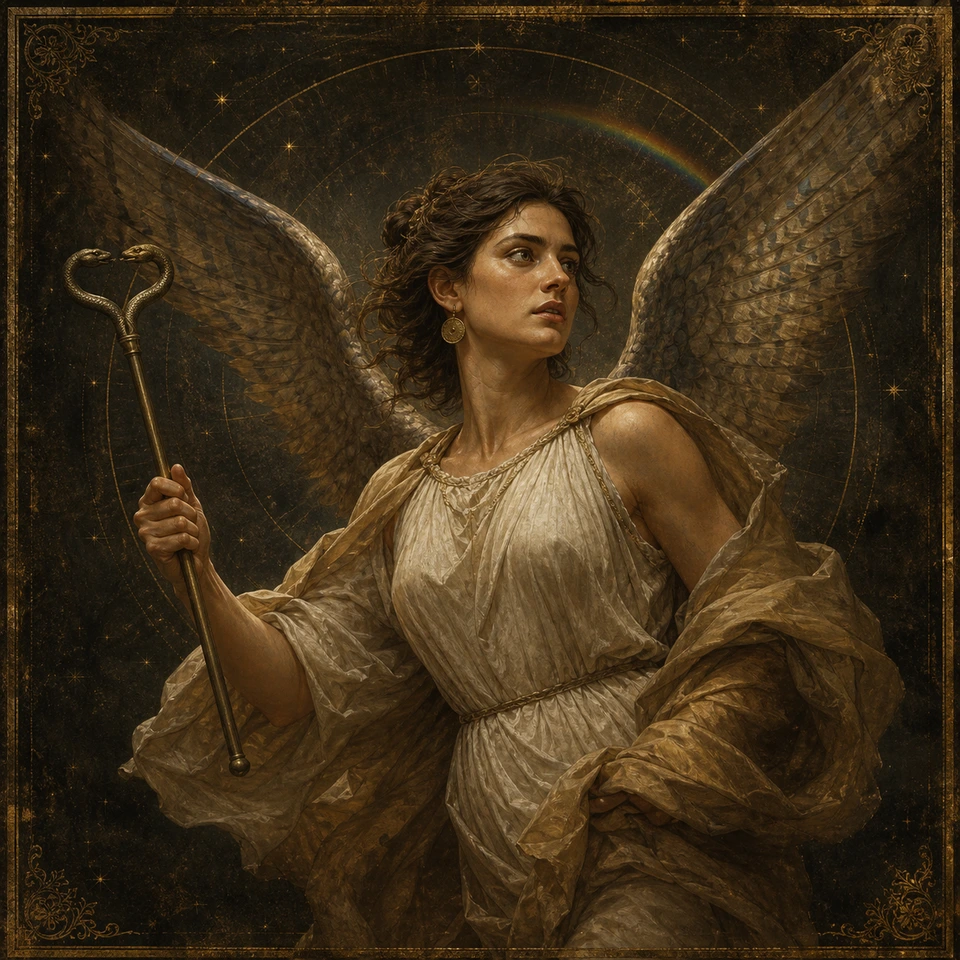
Flashing across the sky as the vivid embodiment of the rainbow, Iris operates as a high-speed divine messenger. She reliably transports critical oath water, secret summons, urgent prayers, and the absolute commands of the gods.
Overview
A goddess strikes the air above a battlefield, but she is not racing without purpose. Iris carries a sentence that must reach its hearer before armies collide, a command that must survive anger, or a summons that must enter grief without breaking it. Homer calls her swift as wind and gives her more than speed. She chooses a familiar face, stands before dangerous gods, asks whether a defiant answer should truly be repeated, and names the sender when secrecy matters.
At Troy she arrives first in the likeness of Polites to warn Hector that the Achaeans are moving. Then she takes Laodice’s form and draws Helen toward the wall, where the sight of the duel opens old longing. When Hera and Athena arm against Zeus’s will, Iris stops them with his threat. When Poseidon resists an order to withdraw, she does not merely recite it again. She asks him to consider what reply she must carry back. The sea god yields.
Her allegiance cannot be flattened into permanent service to Zeus. Hera sends her secretly to Achilles after Patroclus falls, and Iris tells him plainly that Zeus and the other gods did not commission her. At Patroclus’s pyre she hears Achilles pray for the winds, crosses to their feast, refuses a seat, and brings Boreas and Zephyrus to the flame. In the final book Zeus sends her beneath the sea for Thetis and then into Priam’s terror, preparing the ransom that returns Hector’s body.
The Homeric Hymn to Apollo shows the same intelligence outside war. Leto has labored nine days on Delos while Hera keeps Eileithyia away. The goddesses entrust Iris with a golden-threaded necklace and a secret approach. She calls Eileithyia outside, speaks where Hera cannot stop them, and the two travel like shy doves. When Eileithyia reaches Delos, birth begins. Iris neither rules childbirth nor steals its honor. She makes the necessary meeting possible.
Hesiod carries her farther. Thaumas and Electra are her parents; the Harpies are her sisters. When divine quarrel makes an oath necessary, Zeus sends Iris across the sea to the rock-vaulted house of Styx. She fills a golden jug with the cold water that punishes divine perjury. Messenger work becomes a pillar of cosmic truth.
Ancient artists made her office visible. An inscribed Attic kylix gives her patterned wings, Greek dress, and the kerykeion while satyrs seize at her in a violent scene. A lekythos places her with Hermes beside Thetis’s flying chariot. The shared staff does not merge the two messengers. The rainbow likewise needs care. Iris is the Greek name of the goddess and the colored arc, and Homer can speak of Zeus stretching an iris as a portent. Yet the oldest profile is not a modern spectrum mascot. She is the difficult passage between powers: swift, articulate, watchful, and accountable for getting the words through.
Canonical identity
Canonical Identity
Iris is a highly active goddess whose name simultaneously denotes the physical rainbow. In epic poetry, she is far more than a mute band of color; she disguises herself, flies, runs, aggressively interrupts divine councils, and delivers binding commands backed by the authority of the sender. She prioritizes urgent errands over hospitality, and her speech clearly delineates the boundaries of her authority, such as when she explicitly informs Achilles that she was sent secretly by Hera, completely without Zeus's knowledge. She remains strictly separated from her Hesiodic sisters, the Harpies, and from Hermes, alongside whom she appears as a distinctly named fellow messenger on the Met lekythos. A physical rainbow can invoke her name without demanding that every colorful arc be treated as a separately narrated divine intervention.
Linguistic Identity
Iris is the Greek Ἶρις. While current American English pronounces the name EYE-riss, the authentic ancient sound remains unresolved.
Sources and evidence
TEXTUAL · Supported
Current General American English pronounces Iris /ˈaɪɹəs/, EYE-riss.
- Source
- Carnegie Mellon University Speech Group, CMU Pronouncing Dictionary
- Reviewed edition
- cmudict data file at commit 74790861f652b15e4ac49015a90074ad62a27690 · Carnegie Mellon University
- Exact locator
- Entry iris · Section ARPABET AY1 R AH0 S; commit 74790861f652b15e4ac49015a90074ad62a27690
- Scope
- Modern classical scholarship
- Authority
- Carnegie Mellon University Pronouncing Dictionary
- Certainty
- Qualified
This is an English pronunciation only; no ancient dialect is reconstructed.
Open exact reviewed source4 reviewed sources for this section
- Carnegie Mellon University Speech Group, CMU Pronouncing DictionaryPinned repository commit 74790861f652b15e4ac49015a90074ad62a27690 · Carnegie Mellon University
- Hesiod; edited and translated by Hugh G. Evelyn-White, Theogony (1914)Hesiod, the Homeric Hymns and Homerica, London and New York, 1914 · Perseus Digital Library / Scaife ATLAS
- Homer; Monro and Allen Greek edition with edition-specific translations, Iliad (1920)Perseus CTS edition corpus; Greek edition, Oxford, 1908-1920 · Perseus Digital Library / Scaife ATLAS
- The Metropolitan Museum of Art, Open Access Collection and Collection APILive collection data and eligible public-domain images · The Metropolitan Museum of Art
Culture, tradition, period, and place
Iris moves through Archaic Greek hexameter and classical Attic pottery. Hesiod sends her over the sea toward Styx’s remote house. Homer carries her between Olympus, Troy, the Achaean ships, Ocean, and the land of the Ethiopians. The Delian hymn brings her from Delos to Olympus and back with Eileithyia.
Material witnesses place her in Attic workshops around 500 to 480 BC. One lekythos joins her to Hermes and Thetis in flight; one inscribed kylix catches her amid a disturbing satyr pursuit. These are made objects with narrative settings, not maps of a uniform cult. The full geography belongs to travel and mediation: no single secure sanctuary center controls the dossier.
5 reviewed sources for this section
- Hesiod; edited and translated by Hugh G. Evelyn-White, Theogony (1914)Hesiod, the Homeric Hymns and Homerica, London and New York, 1914 · Perseus Digital Library / Scaife ATLAS
- Homer; Monro and Allen Greek edition with edition-specific translations, Iliad (1920)Perseus CTS edition corpus; Greek edition, Oxford, 1908-1920 · Perseus Digital Library / Scaife ATLAS
- Homeric Hymn to Apollo; translated by Rodney Merrill, The Homeric Hymn to ApolloCenter for Hellenic Studies online translation · Harvard University Center for Hellenic Studies
- British Museum, British Museum CollectionLive official museum collection · British Museum
- The Metropolitan Museum of Art, Open Access Collection and Collection APILive collection data and eligible public-domain images · The Metropolitan Museum of Art
Historical development
Hesiod anchors Iris in genealogy and cosmic procedure. She is daughter of Thaumas and Electra, sister to the Harpies, and the rare traveler who brings Styx water when the gods must swear. Homeric epic expands that office into a crowded field of war, grief, diplomacy, disguise, and divine disagreement.
Archaic and early classical artists made speed visible through wings, striding posture, dress, and kerykeion. The rainbow connection remains present in the word and in Homeric comparison, yet messenger action dominates the surviving narratives used here. The older figure carries messages that can delay battle, expose danger, summon birth, or open the road to ransom.
5 reviewed sources for this section
- Hesiod; edited and translated by Hugh G. Evelyn-White, Theogony (1914)Hesiod, the Homeric Hymns and Homerica, London and New York, 1914 · Perseus Digital Library / Scaife ATLAS
- Homer; Monro and Allen Greek edition with edition-specific translations, Iliad (1920)Perseus CTS edition corpus; Greek edition, Oxford, 1908-1920 · Perseus Digital Library / Scaife ATLAS
- Homeric Hymn to Apollo; translated by Rodney Merrill, The Homeric Hymn to ApolloCenter for Hellenic Studies online translation · Harvard University Center for Hellenic Studies
- British Museum, British Museum CollectionLive official museum collection · British Museum
- The Metropolitan Museum of Art, Open Access Collection and Collection APILive collection data and eligible public-domain images · The Metropolitan Museum of Art
Attested roles and historical themes
Roles, powers, and limits
Iris carries divine speech across boundaries. Zeus uses her to warn Troy, halt Hera and Athena, order Poseidon from battle, summon Thetis, and instruct Priam. Hera sends her covertly to Achilles. The gathered goddesses send her to Eileithyia. Achilles does not formally commission her at Patroclus’s pyre; she hears the prayer and takes it to the winds.
She is therefore more than one god’s servant. Her office depends on swift passage, exact speech, social intelligence, and the ability to stand inside dangerous conversations. She may disguise herself, urge reconsideration, or make a message bearable without changing its source. Her limits are clear: she does not originate Zeus’s law, rule Styx, govern childbirth, command the winds by ownership, or decide the war.
Sources and evidence
TEXTUAL · Supported
When divine conflict and falsehood arise, Zeus sends swift-footed Iris to fetch the cold oath water of Styx in a golden jug.
- Source
- Hesiod; edited and translated by Hugh G. Evelyn-White, Theogony (1914)
- Reviewed edition
- Hugh G. Evelyn-White edition and English translation in Hesiod, the Homeric Hymns and Homerica, 1914 · translated by Hugh G. Evelyn-White · edited by Hugh G. Evelyn-White · Perseus Digital Library / Scaife ATLAS
- Exact locator
- Entry Theogony · Line 775-806
- Scope
- Archaic Greece · Ancient Greece
- Authority
- Hesiod, Theogony
- Certainty
- High
Her journey serves the binding oath and carries serious consequences for divine perjury.
Open exact reviewed sourceTEXTUAL · Supported
Iris takes the likeness of Laodice and calls Helen to the Trojan wall to witness the duel.
- Source
- Homer; Monro and Allen Greek edition with edition-specific translations, Iliad (1920)
- Reviewed edition
- A. T. Murray English translation, volumes I-II, 1924-1925 · translated by A. T. Murray · Perseus Digital Library / Scaife ATLAS
- Exact locator
- Book 3 · Line 121-145
- Scope
- Archaic Greece · Ancient Greece
- Authority
- Homer, Iliad
- Certainty
- High
The message awakens longing as well as curiosity.
Open exact reviewed sourceTEXTUAL · Supported
At Zeus’s command Iris stops Hera and Athena from entering battle and later carries a withdrawal order to Poseidon.
- Source
- Homer; Monro and Allen Greek edition with edition-specific translations, Iliad (1920)
- Reviewed edition
- A. T. Murray English translation, volumes I-II, 1924-1925 · translated by A. T. Murray · Perseus Digital Library / Scaife ATLAS
- Exact locator
- Book 8; 15 · Line 8.397-437; 15.157-217
- Scope
- Archaic Greece · Ancient Greece
- Authority
- Homer, Iliad
- Certainty
- High
Her words enforce Zeus’s changing battlefield policy.
Open exact reviewed source3 reviewed sources for this section
- Hesiod; edited and translated by Hugh G. Evelyn-White, Theogony (1914)Hesiod, the Homeric Hymns and Homerica, London and New York, 1914 · Perseus Digital Library / Scaife ATLAS
- Homer; Monro and Allen Greek edition with edition-specific translations, Iliad (1920)Perseus CTS edition corpus; Greek edition, Oxford, 1908-1920 · Perseus Digital Library / Scaife ATLAS
- Homeric Hymn to Apollo; translated by Rodney Merrill, The Homeric Hymn to ApolloCenter for Hellenic Studies online translation · Harvard University Center for Hellenic Studies
Epithets and titles
Poetic Epithet
Swift-footed
πόδας ὠκέα · swift-footed
Greek hexameter tradition · Archaic Greek poetic witnessesThe title describes the speed of her messenger journeys and remains poetic rather than a local cult name.
2 reviewed sources for this section
- Hesiod; edited and translated by Hugh G. Evelyn-White, Theogony (1914)Hesiod, the Homeric Hymns and Homerica, London and New York, 1914 · Perseus Digital Library / Scaife ATLAS
- Homeric Hymn to Apollo; translated by Rodney Merrill, The Homeric Hymn to ApolloCenter for Hellenic Studies online translation · Harvard University Center for Hellenic Studies
Worship and cult
The reviewed primary and material witnesses establish divine presence, sacred errands, images, and participation in sacrifice, but they do not yet establish a complete cult of Iris. Iliad 23 says she is traveling to the Ethiopians, where they are sacrificing hecatombs to the immortals and she expects a share. That is a mythic feast at the world’s edge, not a Greek civic ritual calendar.
The Delian birth scene is a stronger cult-research lead because the hymn binds Iris to the island’s divine emergency and a promised necklace. Even there, the narrative does not itself name an Iris priesthood or altar. A reported Delian sacrifice survives in later testimony, but no rite is secure until the exact ancient witness is established.
2 reviewed sources for this section
- Homer; Monro and Allen Greek edition with edition-specific translations, Iliad (1920)Perseus CTS edition corpus; Greek edition, Oxford, 1908-1920 · Perseus Digital Library / Scaife ATLAS
- Homeric Hymn to Apollo; translated by Rodney Merrill, The Homeric Hymn to ApolloCenter for Hellenic Studies online translation · Harvard University Center for Hellenic Studies
Temples, sanctuaries, and sacred places
Delos is the clearest sacred landscape in Iris’s stories. Leto has labored for nine days, Hera keeps Eileithyia away, and the gathered goddesses choose Iris to cross the distance and bring help secretly. The island matters because the messenger’s return changes what can happen there.
Styx’s rock-vaulted house is another sacred geography, reached only when divine conflict demands oath water. Olympus, Troy, Ocean, and the Ethiopian feast lie along her routes. None is securely her own temple. The British Museum kylix shows an altar in a Dionysiac scene where Iris is seized by satyrs, but a painted altar inside another god’s setting does not become a sanctuary of Iris.
3 reviewed sources for this section
- Hesiod; edited and translated by Hugh G. Evelyn-White, Theogony (1914)Hesiod, the Homeric Hymns and Homerica, London and New York, 1914 · Perseus Digital Library / Scaife ATLAS
- Homeric Hymn to Apollo; translated by Rodney Merrill, The Homeric Hymn to ApolloCenter for Hellenic Studies online translation · Harvard University Center for Hellenic Studies
- British Museum, British Museum CollectionLive official museum collection · British Museum
Festivals and processions
No securely named annual Greek festival devoted to Iris is established by this evidence. Her journeys enter other people’s urgent occasions: Apollo’s birth on Delos, the Trojan War, Patroclus’s funeral, and the gods’ far-off sacrificial feast among the Ethiopians.
Each occasion has ritual weight, but none can be relabeled an Iris festival. Patroclus’s pyre includes libations, animal sacrifice, human killing, mourning, and games, while Iris performs only the wind errand. The violence remains part of Achilles’s funeral action and is not a devotional model for her.
2 reviewed sources for this section
- Homer; Monro and Allen Greek edition with edition-specific translations, Iliad (1920)Perseus CTS edition corpus; Greek edition, Oxford, 1908-1920 · Perseus Digital Library / Scaife ATLAS
- Homeric Hymn to Apollo; translated by Rodney Merrill, The Homeric Hymn to ApolloCenter for Hellenic Studies online translation · Harvard University Center for Hellenic Studies
Offerings, votives, and ritual evidence
The golden-threaded necklace offered to Eileithyia is the most vivid gift in an Iris scene, yet it is payment promised through Iris, not an offering made to her. In Iliad 23 Achilles promises gifts to Boreas and Zephyrus and pours wine while Iris carries his prayer. Those offerings belong to the winds.
Hesiod’s golden jug is a tool of divine oath procedure, filled with the cold water of Styx when Zeus requires it. The water punishes a god who swears falsely; it is not ordinary ritual water and not a substance for modern handling. These narratives show Iris moving ritual objects and speech between powers without turning every object she touches into her possession.
3 reviewed sources for this section
- Hesiod; edited and translated by Hugh G. Evelyn-White, Theogony (1914)Hesiod, the Homeric Hymns and Homerica, London and New York, 1914 · Perseus Digital Library / Scaife ATLAS
- Homer; Monro and Allen Greek edition with edition-specific translations, Iliad (1920)Perseus CTS edition corpus; Greek edition, Oxford, 1908-1920 · Perseus Digital Library / Scaife ATLAS
- Homeric Hymn to Apollo; translated by Rodney Merrill, The Homeric Hymn to ApolloCenter for Hellenic Studies online translation · Harvard University Center for Hellenic Studies
Iconography and material culture
Wings and kerykeion are the strongest ancient attributes. The British Museum kylix names Iris beside her scale-patterned wings, chiton, sakkos, earring, and herald staff. The Met lekythos places her with Hermes beside Thetis’s flying chariot. Shared messenger equipment does not merge the two deities.
The rainbow enters more carefully. In Iliad 17 Zeus stretches an iris from heaven as a portent of war or storm. The passage secures the word and the celestial sign, but it does not describe the goddess landing in human form. The named objects preserve Greek dress, one pair of wings, and a plain kerykeion without turning every later winged figure into Iris.
Sources and evidence
TEXTUAL · Supported
The Iliad describes Zeus stretching a dark rainbow from heaven as a sign of war or storm.
- Source
- Homer; Monro and Allen Greek edition with edition-specific translations, Iliad (1920)
- Reviewed edition
- A. T. Murray English translation, volumes I-II, 1924-1925 · translated by A. T. Murray · Perseus Digital Library / Scaife ATLAS
- Exact locator
- Book 17 · Line 547-551
- Scope
- Archaic Greece · Ancient Greece
- Authority
- Homer, Iliad
- Certainty
- High
The Greek word iris names the rainbow here, but the comparison does not narrate the goddess speaking or acting.
Open exact reviewed sourceMATERIAL CULTURE · Supported
A name-inscribed Attic kylix shows winged Iris in chiton and sakkos holding a kerykeion.
- Source
- British Museum, British Museum Collection
- Reviewed edition
- British Museum object record 1873,0820.376 (E65), Attic red-figure kylix · British Museum
- Exact locator
- MuseumObjectId 1873,0820.376 · Entry Exterior side B; circa 480 BC
- Scope
- Classical Greece · Attica
- Authority
- British Museum
- Certainty
- High
The difficult satyr scene preserves secure identification through the painted name and attributes.
Open exact reviewed sourceMATERIAL CULTURE · Supported
A Metropolitan Museum lekythos shows Iris and Hermes accompanying Thetis’s flying chariot.
- Source
- The Metropolitan Museum of Art, Open Access Collection and Collection API
- Reviewed edition
- Metropolitan Museum object record 41.162.34, Terracotta lekythos (oil flask), Attic black-figure, white-ground · The Metropolitan Museum of Art
- Exact locator
- MuseumObjectId 41.162.34 · Entry Sappho Painter; circa 500 BC
- Scope
- Archaic Greece · Attica
- Authority
- Metropolitan Museum of Art
- Certainty
- High
The official catalog identifies both messenger deities in the traveling scene.
Open exact reviewed source3 reviewed sources for this section
- Homer; Monro and Allen Greek edition with edition-specific translations, Iliad (1920)Perseus CTS edition corpus; Greek edition, Oxford, 1908-1920 · Perseus Digital Library / Scaife ATLAS
- British Museum, British Museum CollectionLive official museum collection · British Museum
- The Metropolitan Museum of Art, Open Access Collection and Collection APILive collection data and eligible public-domain images · The Metropolitan Museum of Art
Animals, plants, and embodied forms
Iris and Eileithyia move like shy wild doves on the road to Delos. The simile gives their motion delicacy and caution; it does not transform Iris into a dove or establish a universal sacred bird. Her wings on Attic pottery are patterned divine anatomy rather than borrowed eagle or butterfly wings.
No plant appears in these witnesses as a species sacred to Iris. The palm beside Leto at Apollo's birth belongs to Delos and the birthing scene. No flower, fragrance, or herb can enter historical ritual evidence through a later name resemblance alone.
3 reviewed sources for this section
- Homeric Hymn to Apollo; translated by Rodney Merrill, The Homeric Hymn to ApolloCenter for Hellenic Studies online translation · Harvard University Center for Hellenic Studies
- British Museum, British Museum CollectionLive official museum collection · British Museum
- The Metropolitan Museum of Art, Open Access Collection and Collection APILive collection data and eligible public-domain images · The Metropolitan Museum of Art
Relationships and genealogy
Thaumas and Electra are Iris’s parents in Hesiod. Her sisters are Aello and Ocypete, the Harpies. That genealogy places swift winged daughters inside the sea-descended family of Thaumas without treating Iris as a Harpy or making the Harpies messengers.
Her most visible working relationships are with Zeus and Hera. She enforces Zeus’s battlefield commands, yet Hera can send her on a mission that explicitly bypasses Zeus. She also acts for the assembled goddesses at Delos and responds to Achilles’s prayer without a stated divine order. These are source-specific service relationships, not permanent ownership by one Olympian.
Sources and evidence
TEXTUAL · Supported
Hesiod names Iris and the Harpies Aello and Ocypete as children of Thaumas and Electra.
- Source
- Hesiod; edited and translated by Hugh G. Evelyn-White, Theogony (1914)
- Reviewed edition
- Hugh G. Evelyn-White edition and English translation in Hesiod, the Homeric Hymns and Homerica, 1914 · translated by Hugh G. Evelyn-White · edited by Hugh G. Evelyn-White · Perseus Digital Library / Scaife ATLAS
- Exact locator
- Entry Theogony · Line 265-269
- Scope
- Archaic Greece · Ancient Greece
- Authority
- Hesiod, Theogony
- Certainty
- High
The genealogy makes Iris sister to the Harpies without making their temperaments or roles identical.
Open exact reviewed source3 reviewed sources for this section
- Hesiod; edited and translated by Hugh G. Evelyn-White, Theogony (1914)Hesiod, the Homeric Hymns and Homerica, London and New York, 1914 · Perseus Digital Library / Scaife ATLAS
- Homer; Monro and Allen Greek edition with edition-specific translations, Iliad (1920)Perseus CTS edition corpus; Greek edition, Oxford, 1908-1920 · Perseus Digital Library / Scaife ATLAS
- Homeric Hymn to Apollo; translated by Rodney Merrill, The Homeric Hymn to ApolloCenter for Hellenic Studies online translation · Harvard University Center for Hellenic Studies
Actual myths and source variants
Five linked narratives and cycles define Iris. Hesiod’s genealogy names her parents and sisters, then his Styx passage makes her the rare carrier of divine oath water. The Homeric Hymn to Apollo gives her a secret childbirth errand: she draws Eileithyia away from Hera so Leto can deliver Apollo on Delos.
The Iliad turns messenger work into a cycle of changing pressures. Iris warns the Trojans in disguise, summons Helen, restrains Hera and Athena, urges Poseidon to accept Zeus’s order, calls Achilles to the ditch, brings the winds to Patroclus’s pyre, and carries the instructions that move Thetis and Priam toward Hector’s ransom. The acts are not repetitions. Each requires a different voice, audience, danger, and consequence.
Apollonius gives her a direct boundary to enforce. Iris stops Zetes and Calais from killing the Harpies, her sisters, and swears by Styx that they will never return to Phineus. The oath does not erase the Harpies’ harm. It ends both their torment of Phineus and the Boreads’ pursuit.
Euripides gives Iris a harsher commission. She announces Hera’s order that Lyssa drive Heracles mad, while Lyssa resists the cruelty before she is compelled. Pseudo-Apollodorus places the madness before Heracles’s labors and omits Iris. The two incompatible sequences remain side by side rather than becoming one seamless story.
Sources and evidence
TEXTUAL · Supported
Zeus sends Iris to alert the Trojans, and she speaks in the likeness of Priam’s son Polites.
- Source
- Homer; Monro and Allen Greek edition with edition-specific translations, Iliad (1920)
- Reviewed edition
- A. T. Murray English translation, volumes I-II, 1924-1925 · translated by A. T. Murray · Perseus Digital Library / Scaife ATLAS
- Exact locator
- Book 2 · Line 786-806
- Scope
- Archaic Greece · Ancient Greece
- Authority
- Homer, Iliad
- Certainty
- High
Disguise lets the message enter a human military assembly.
Open exact reviewed sourceTEXTUAL · Supported
Hera secretly sends Iris to make Achilles appear at the ditch and terrify the Trojans away from Patroclus’s body.
- Source
- Homer; Monro and Allen Greek edition with edition-specific translations, Iliad (1920)
- Reviewed edition
- A. T. Murray English translation, volumes I-II, 1924-1925 · translated by A. T. Murray · Perseus Digital Library / Scaife ATLAS
- Exact locator
- Book 18 · Line 165-202
- Scope
- Archaic Greece · Ancient Greece
- Authority
- Homer, Iliad
- Certainty
- High
Iris states that Zeus and the other gods have not sent her.
Open exact reviewed sourceTEXTUAL · Supported
Iris hears Achilles pray and summons Boreas and Zephyrus to kindle Patroclus’s pyre.
- Source
- Homer; Monro and Allen Greek edition with edition-specific translations, Iliad (1920)
- Reviewed edition
- A. T. Murray English translation, volumes I-II, 1924-1925 · translated by A. T. Murray · Perseus Digital Library / Scaife ATLAS
- Exact locator
- Book 23 · Line 192-217
- Scope
- Archaic Greece · Ancient Greece
- Authority
- Homer, Iliad
- Certainty
- High
She refuses the winds’ feast because she is traveling toward an Ethiopian sacrifice.
Open exact reviewed sourceTEXTUAL · Supported
In Iliad 24 Zeus sends Iris first to Thetis and then to Priam as the ransom of Hector is set in motion.
- Source
- Homer; Monro and Allen Greek edition with edition-specific translations, Iliad (1920)
- Reviewed edition
- A. T. Murray English translation, volumes I-II, 1924-1925 · translated by A. T. Murray · Perseus Digital Library / Scaife ATLAS
- Exact locator
- Book 24 · Line 74-188
- Scope
- Archaic Greece · Ancient Greece
- Authority
- Homer, Iliad
- Certainty
- High
The two errands join divine council to human action.
Open exact reviewed sourceTEXTUAL · Supported
The goddesses send Iris secretly to bring Eileithyia to Delos with the promise of a golden-threaded necklace.
- Source
- Homeric Hymn to Apollo; translated by Rodney Merrill, The Homeric Hymn to Apollo
- Reviewed edition
- Rodney Merrill English translation, Center for Hellenic Studies online edition · translated by Rodney Merrill · Harvard University Center for Hellenic Studies
- Exact locator
- Hymn 3, To Apollo · Line 91-119
- Scope
- Archaic Greece · Delos
- Authority
- Homeric Hymn to Apollo
- Certainty
- High
Iris calls Eileithyia away from Hera and enables Leto’s labor to begin.
Open exact reviewed sourceTEXTUAL · Supported
Iris stops Zetes and Calais from killing the Harpies and swears by Styx that her sisters will not return to Phineus.
- Source
- Apollonius Rhodius; translated by Edward P. Coleridge, The Argonautica (1889)
- Reviewed edition
- Edward P. Coleridge English prose translation of Apollonius Rhodius, The Argonautica, Bohn's Classical Library, 1889 · translated by Edward P. Coleridge · edited by Edward P. Coleridge; translated from R. Merkel's Greek text · Perseus Catalog / Internet Archive
- Exact locator
- Book 2 · Line 285-300
- Scope
- Hellenistic Greek world · Floating Islands, later called the Strophades
- Authority
- Apollonius Rhodius, Argonautica
- Certainty
- High
The intervention protects the Harpies from killing without excusing their treatment of Phineus.
Open exact reviewed sourceTEXTUAL · Supported
In Euripides, Iris announces Hera's command that Lyssa drive Heracles mad, while Lyssa resists before compulsion.
- Source
- Euripides; translated by Edward P. Coleridge, Heracles (catalogued as Heracles Mad) (1891)
- Reviewed edition
- Edward P. Coleridge English translation in The Plays of Euripides, Volume II, 1891; Perseus modernization · translated by Edward P. Coleridge · Perseus Digital Library / Scaife ATLAS
- Exact locator
- Entry Heracles · Line 815-1041
- Scope
- Classical Greece · Ancient Greece
- Authority
- Euripides, Heracles
- Certainty
- High
Pseudo-Apollodorus places the madness before the labors and does not include Iris; the profile keeps the variants separate.
Open exact reviewed source6 reviewed sources for this section
- Hesiod; edited and translated by Hugh G. Evelyn-White, Theogony (1914)Hesiod, the Homeric Hymns and Homerica, London and New York, 1914 · Perseus Digital Library / Scaife ATLAS
- Homer; Monro and Allen Greek edition with edition-specific translations, Iliad (1920)Perseus CTS edition corpus; Greek edition, Oxford, 1908-1920 · Perseus Digital Library / Scaife ATLAS
- Homeric Hymn to Apollo; translated by Rodney Merrill, The Homeric Hymn to ApolloCenter for Hellenic Studies online translation · Harvard University Center for Hellenic Studies
- Apollonius Rhodius; translated by Edward P. Coleridge, The Argonautica (1889)English prose translation from R. Merkel's text, Bohn's Classical Library, London, 1889 · Perseus Catalog / Internet Archive
- Euripides; translated by Edward P. Coleridge, Heracles (catalogued as Heracles Mad) (1891)Edward P. Coleridge English translation in The Plays of Euripides, Volume II, 1891; modernized by Perseus · Perseus Digital Library / Scaife ATLAS
- Pseudo-Apollodorus; edited and translated by James G. Frazer, Library (1921)Harvard University Press and William Heinemann edition, 1921 · Perseus Digital Library / Scaife ATLAS
Myth Library
Each myth gathers its attested participants into one source-grounded account, while distinct source traditions remain readable in their own variants.
Divine Birth
The Birth of Apollo at Delos
Leto finds refuge on Delos and gives birth to Apollo after the island receives a sworn promise of honor; Callimachus later reshapes the birth through Delos's wanderings, Hera's resistance, and the island's fixing in place.
- Role in this profile
- messenger who secretly brings Eileithyia to Delos with the promised necklace
- Place scope
- Delos
- Witnesses
- 2
- Variants
- 2
Cosmic
Iris Fetches the Oath Water of Styx
When discord and falsehood trouble the gods, Zeus sends Iris across the sea to bring Styx water in a golden jug.
- Role in this profile
- crosses the sea and carries the cold oath water in a golden jug
- Place scope
- Ancient Greece
- Witnesses
- 1
- Variants
- 1
Epic
Iris in the Trojan War
Across the Iliad, Iris carries commands, warnings, summons, and prayers between Olympus, Troy, the ships, and the winds.
- Role in this profile
- carries each warning, summons, order, secret request, prayer, and ransom command
- Place scope
- Ancient Greece · Mount Ida in the Troad
- Witnesses
- 7
- Variants
- 7
Epic
Iris Stops the Boreads
Iris stops Zetes and Calais from killing the Harpies, swears by Styx that her sisters will not return to Phineus, and ends the pursuit.
- Role in this profile
- intervenes, protects her sisters from killing, and swears the binding Styx oath
- Place scope
- Floating Islands, later called the Strophades · Crete · Mount Olympus
- Witnesses
- 1
- Variants
- 1
Tragic
The Madness and Service of Heracles
Pseudo-Apollodorus places the madness before purification and service, while Euripides places it after the last labor and gives Iris, Lyssa, Athena, Amphitryon, and Theseus decisive roles. The incompatible chronologies remain separate.
- Role in this profile
- announces Hera's command that Lyssa drive Heracles mad
- Place scope
- Ancient Greece
- Witnesses
- 2
- Variants
- 2
Cosmic Allotment
Division of the Cosmos
In the Iliad, Poseidon recalls how the three sons of Cronus cast lots: Zeus received the sky, Poseidon the sea, and Hades the misty darkness, while earth and Olympus remained common to all.
- Role in this profile
- delivers Zeus’s command and persuades Poseidon to yield without conceding his claim to equal standing
- Place scope
- Ancient Greece
- Witnesses
- 1
- Variants
- 1
Equivalences, syncretisms, and identity boundaries
Iris is not Hermes with a female body. Both may carry a kerykeion and appear together, but their genealogies and narrative actions remain distinct. The Harpies are Iris's sisters, not her threatening forms.
Shared wings, speed, or brightness may invite comparison, but comparison is not identity. No further historical equivalence is asserted by the named Greek texts or objects.
4 reviewed sources for this section
- Hesiod; edited and translated by Hugh G. Evelyn-White, Theogony (1914)Hesiod, the Homeric Hymns and Homerica, London and New York, 1914 · Perseus Digital Library / Scaife ATLAS
- Homer; Monro and Allen Greek edition with edition-specific translations, Iliad (1920)Perseus CTS edition corpus; Greek edition, Oxford, 1908-1920 · Perseus Digital Library / Scaife ATLAS
- British Museum, British Museum CollectionLive official museum collection · British Museum
- The Metropolitan Museum of Art, Open Access Collection and Collection APILive collection data and eligible public-domain images · The Metropolitan Museum of Art
Correspondence index
The historically grounded cluster centers on rainbow as celestial sign, winged movement, the kerykeion, divine messages, disguise, Styx water, golden jug, Delos, Olympus, Ida and Troy, Ocean, and the winds. Every item belongs to a particular poem or object. The messenger’s strength is precise connection under pressure, not a blank promise of communication.
No planet, zodiac sign, gemstone, metal rulership, fixed color palette, classical element, weekday, moon phase, plant, incense, season, or compass direction is assigned here. Communication, mediation, urgent travel, oath-bearing, and the crossing of hostile space are historically resonant intentions. They do not guarantee truthful speech, successful negotiation, safe weather, or control over another person.
Contextual evidence, not a general correspondence
| Category | Direct correspondence | How and why | Evidence boundary |
|---|---|---|---|
| celestial-body | Rainbow as a sign from ZeusContextual evidence only | The Iliad uses iris for a dark rainbow portending war or storm. | Ancient Literary A celestial sign is not planetary rulership 1 reviewed source for this section
|
| metal-material | Attic painted ceramicContextual evidence only | Two accessioned vessels preserve Iris’s wings, dress, kerykeion, and messenger company. | Ancient Material Pottery evidence does not establish a metal rulership 2 reviewed sources for this section
|
| animal-embodied-form | One pair of patterned wingsContextual evidence only | Attic pottery gives Iris a winged human form, while the Delian hymn compares two goddesses to doves. | Ancient Material The dove remains a simile, not a transformation 3 reviewed sources for this section
|
| color | Prismatic rainbow colorsContextual evidence only | Rainbow is the strongest color-bearing context, but no ritual palette is prescribed. | Ancient Literary A modern spectrum remains later 1 reviewed source for this section
|
| direction-place | Olympus, Delos, Troy, Ocean, Ethiopia, and StyxContextual evidence only | Her routes connect divine houses, battlefields, sacred islands, and cosmic margins. | Ancient Literary No compass direction is established 3 reviewed sources for this section
|
| offering-ritual-material | Golden jug, Styx water, and promised necklaceContextual evidence only | Iris carries or mediates these objects inside oath and birth narratives. | Ancient Literary None becomes a general human offering list 2 reviewed sources for this section
|
| ritual-object-symbol-tool | KerykeionContextual evidence only | A name-inscribed kylix shows Iris holding the herald staff. | Ancient Material Shared use with Hermes does not merge their identities 1 reviewed source for this section
|
| intention-magical-power | Communication, mediation, urgent travel, and oath-bearingContextual evidence only | Iris repeatedly carries exact speech across dangerous boundaries. | Ancient Literary No guaranteed outcome or coercive power follows 3 reviewed sources for this section
|
8 expected categories currently not evidenced
zodiac · Not evidenced
No zodiac sign attested
No zodiac sign belongs to Iris in these witnesses.
- Layer
- Research Boundary
- Scope
- Later spectrum astrology requires dated evidence
gemstone-crystal-mineral · Not evidenced
No gemstone attested
No stone or crystal is named for Iris.
- Layer
- Research Boundary
- Scope
- Iridescence does not create an ancient gemstone law
plant-tree · Not evidenced
No plant attested
No plant is assigned to Iris in these sources.
- Layer
- Research Boundary
- Scope
- The modern flower name is not an ancient correspondence
classical-element · Not evidenced
No classical element attested
No elemental rulership is assigned to Iris.
- Layer
- Research Boundary
- Scope
- Sky travel does not prove air rulership
weekday · Not evidenced
No weekday attested
No weekday is assigned to Iris.
- Layer
- Research Boundary
- Scope
- Messenger functions do not transfer Mercury’s day
moon-phase · Not evidenced
No moon phase attested
No lunar phase belongs to Iris.
- Layer
- Research Boundary
- Scope
- Celestial color is not lunar governance
festival-time · Not evidenced
No Iris festival securely attested
No named annual festival is secured by these sources.
- Layer
- Research Boundary
- Scope
- Other gods’ births and funerals remain their own occasions
incense-perfume · Not evidenced
No incense attested
No incense or perfume is prescribed for Iris.
- Layer
- Research Boundary
- Scope
- Rainbow imagery supplies no recipe
5 reviewed sources for this section
- Hesiod; edited and translated by Hugh G. Evelyn-White, Theogony (1914)Hesiod, the Homeric Hymns and Homerica, London and New York, 1914 · Perseus Digital Library / Scaife ATLAS
- Homer; Monro and Allen Greek edition with edition-specific translations, Iliad (1920)Perseus CTS edition corpus; Greek edition, Oxford, 1908-1920 · Perseus Digital Library / Scaife ATLAS
- Homeric Hymn to Apollo; translated by Rodney Merrill, The Homeric Hymn to ApolloCenter for Hellenic Studies online translation · Harvard University Center for Hellenic Studies
- British Museum, British Museum CollectionLive official museum collection · British Museum
- The Metropolitan Museum of Art, Open Access Collection and Collection APILive collection data and eligible public-domain images · The Metropolitan Museum of Art
Later reception and living significance
A sourced contemporary devotional tradition centered specifically on Iris remains unevidenced. Modern rainbow meanings cannot be treated as her historical teaching without accountable public testimony.
The ancient figure remains available through her attested speech and action: oath water carried across the sea, dangerous orders spoken without distortion, grief crossed at speed, and help brought secretly to Delos. Any modern practice built from those scenes must remain openly modern rather than claiming a recovered universal rite.
5 reviewed sources for this section
- Hesiod; edited and translated by Hugh G. Evelyn-White, Theogony (1914)Hesiod, the Homeric Hymns and Homerica, London and New York, 1914 · Perseus Digital Library / Scaife ATLAS
- Homer; Monro and Allen Greek edition with edition-specific translations, Iliad (1920)Perseus CTS edition corpus; Greek edition, Oxford, 1908-1920 · Perseus Digital Library / Scaife ATLAS
- Homeric Hymn to Apollo; translated by Rodney Merrill, The Homeric Hymn to ApolloCenter for Hellenic Studies online translation · Harvard University Center for Hellenic Studies
- British Museum, British Museum CollectionLive official museum collection · British Museum
- The Metropolitan Museum of Art, Open Access Collection and Collection APILive collection data and eligible public-domain images · The Metropolitan Museum of Art
Evidence, conflicts, and research gaps
Hesiod controls the family and Styx-water office. The Iliad controls the messenger cycle, rainbow comparison, funeral-wind errand, and relationships with Zeus and Hera. The Homeric Hymn to Apollo controls the Delian mission. Apollonius controls the intervention between the Boreads and Harpies. Euripides controls Iris’s command in the post-labor madness, while Pseudo-Apollodorus preserves a different pre-labor chronology without her. British Museum 1873,0820.376 and Metropolitan Museum 41.162.34 control the winged, kerykeion-bearing material forms. CMUdict controls only current American English pronunciation.
Ancient pronunciation remains unresolved. A reported Delian sacrifice needs a primary fragment or inscriptional route before cult claims are expanded. Dedicated sanctuary, priesthood, festival, offering, and local-epithet evidence remains thin. Latin reception, flower-name history, prismatic optics, and accountable modern devotion require further source work.
9 reviewed sources for this section
- Hesiod; edited and translated by Hugh G. Evelyn-White, Theogony (1914)Hesiod, the Homeric Hymns and Homerica, London and New York, 1914 · Perseus Digital Library / Scaife ATLAS
- Homer; Monro and Allen Greek edition with edition-specific translations, Iliad (1920)Perseus CTS edition corpus; Greek edition, Oxford, 1908-1920 · Perseus Digital Library / Scaife ATLAS
- Homeric Hymn to Apollo; translated by Rodney Merrill, The Homeric Hymn to ApolloCenter for Hellenic Studies online translation · Harvard University Center for Hellenic Studies
- British Museum, British Museum CollectionLive official museum collection · British Museum
- The Metropolitan Museum of Art, Open Access Collection and Collection APILive collection data and eligible public-domain images · The Metropolitan Museum of Art
- Carnegie Mellon University Speech Group, CMU Pronouncing DictionaryPinned repository commit 74790861f652b15e4ac49015a90074ad62a27690 · Carnegie Mellon University
- Apollonius Rhodius; translated by Edward P. Coleridge, The Argonautica (1889)English prose translation from R. Merkel's text, Bohn's Classical Library, London, 1889 · Perseus Catalog / Internet Archive
- Euripides; translated by Edward P. Coleridge, Heracles (catalogued as Heracles Mad) (1891)Edward P. Coleridge English translation in The Plays of Euripides, Volume II, 1891; modernized by Perseus · Perseus Digital Library / Scaife ATLAS
- Pseudo-Apollodorus; edited and translated by James G. Frazer, Library (1921)Harvard University Press and William Heinemann edition, 1921 · Perseus Digital Library / Scaife ATLAS
Direct connections and evidence
Explicit Source
Iris carries Zeus’s warnings, commands, summons, and oath-water commission
Service to Zeus is repeated but not exclusive; Hera and other figures also send or prompt Iris.
2 attestations · high confidence
- Hesiod; edited and translated by Hugh G. Evelyn-White, TheogonyHugh G. Evelyn-White edition and English translation in Hesiod, the Homeric Hymns and Homerica, 1914 · translated by Hugh G. Evelyn-White · edited by Hugh G. Evelyn-White · Perseus Digital Library / Scaife ATLAS · Archaic Greece · Ancient Greece · Entry Theogony · Line 775-806
- Homer; Monro and Allen Greek edition with edition-specific translations, IliadA. T. Murray English translation, volumes I-II, 1924-1925 · translated by A. T. Murray · Perseus Digital Library / Scaife ATLAS · Archaic Greece · Ancient Greece · Book 15; 24 · Line 15.157-217; 24.74-188
Explicit Source
Hera secretly sends Iris to Achilles after Patroclus falls
Iris names Hera as sender and expressly says Zeus did not commission the errand.
1 attestation · high confidence
- Homer; Monro and Allen Greek edition with edition-specific translations, IliadA. T. Murray English translation, volumes I-II, 1924-1925 · translated by A. T. Murray · Perseus Digital Library / Scaife ATLAS · Archaic Greece · Ancient Greece · Book 18 · Line 165-202
Archive scope and classification
- Figure classification
- God or goddess · certain
- Pantheon or tradition shelf
- Greek
- Cultures
- Greek
- Traditions
- Ancient Greek religion
- Periods
- Archaic Greece, Classical Greece, Hellenistic Greek world
- Places
- Ancient Greece, Delos, Attica
Identity, Delian, Iliadic, Hesiodic, Argonautic, and Heracles roles, Styx office, relationships, material evidence, rainbow boundary, cult gaps, and correspondence limits are reviewed.
Reviewed sources
- Hesiod; edited and translated by Hugh G. Evelyn-White, Theogony (1914)Hesiod, the Homeric Hymns and Homerica, London and New York, 1914 · Perseus Digital Library / Scaife ATLAS
- Homer; Monro and Allen Greek edition with edition-specific translations, Iliad (1920)Perseus CTS edition corpus; Greek edition, Oxford, 1908-1920 · Perseus Digital Library / Scaife ATLAS
- Pseudo-Apollodorus; edited and translated by James G. Frazer, Library (1921)Harvard University Press and William Heinemann edition, 1921 · Perseus Digital Library / Scaife ATLAS
- The Metropolitan Museum of Art, Open Access Collection and Collection APILive collection data and eligible public-domain images · The Metropolitan Museum of Art
- British Museum, British Museum CollectionLive official museum collection · British Museum
- Callimachus; translated by A. W. Mair, Hymns (1921)1921 Loeb edition hosted by the Perseus Digital Library · Perseus Digital Library
- Homeric Hymn to Apollo; translated by Rodney Merrill, The Homeric Hymn to ApolloCenter for Hellenic Studies online translation · Harvard University Center for Hellenic Studies
- Euripides; translated by Edward P. Coleridge, Heracles (catalogued as Heracles Mad) (1891)Edward P. Coleridge English translation in The Plays of Euripides, Volume II, 1891; modernized by Perseus · Perseus Digital Library / Scaife ATLAS
- Carnegie Mellon University Speech Group, CMU Pronouncing DictionaryPinned repository commit 74790861f652b15e4ac49015a90074ad62a27690 · Carnegie Mellon University
- Apollonius Rhodius; translated by Edward P. Coleridge, The Argonautica (1889)English prose translation from R. Merkel's text, Bohn's Classical Library, London, 1889 · Perseus Catalog / Internet Archive