
Greek · God or goddess · Certain
Pan
Πάν · Pán
Pronunciation: /pǎːn/ · PAHN
Research and editorial review by Cody Manes · Reviewed 2026-08-30
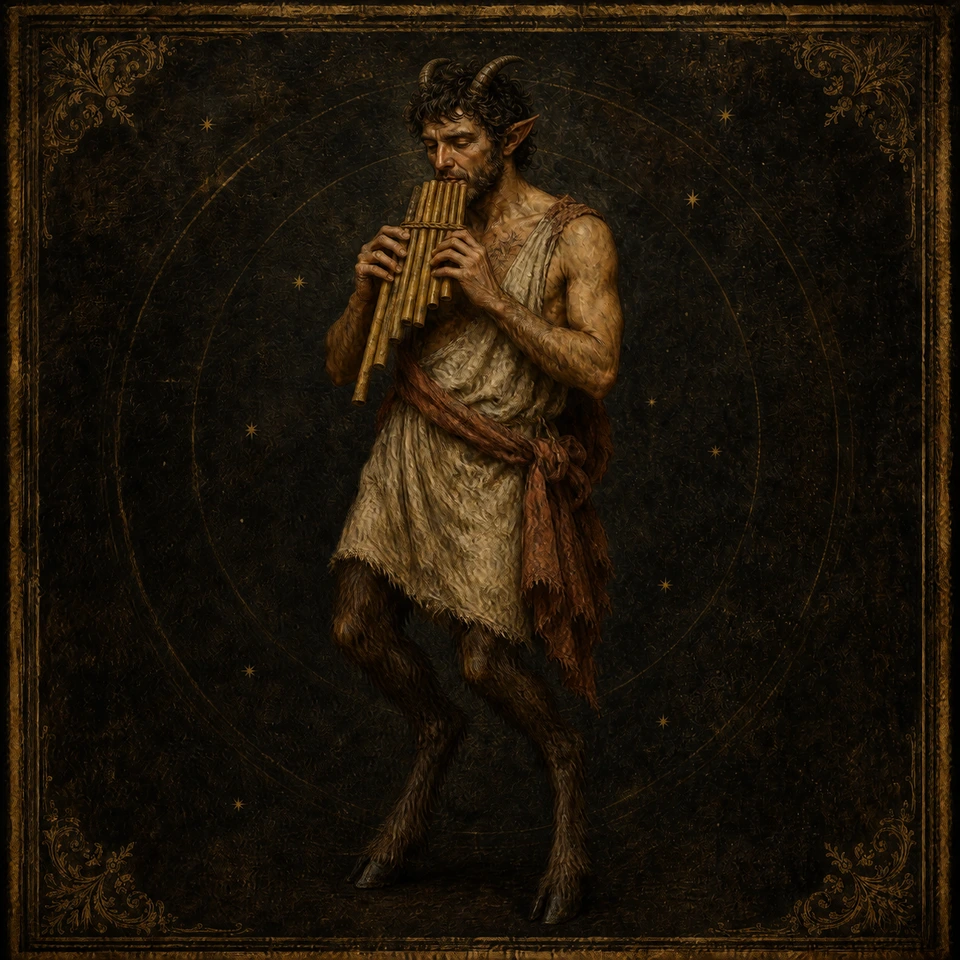
Haunting the rugged Arcadian mountains, the goat-footed Pan watches over flocks and cave sanctuaries while commanding the eerie tones of reed music. Despite his wildly conflicting ancient genealogies, he remains a powerful force of sudden divine encounter, chaotic dance, and wild prophecy.
Overview
On Mount Parthenion, above Tegea, the road to Sparta is interrupted. Philippides, the Athenian runner sent ahead of the Persian invasion, encounters Pan. The god addresses a grievance to the city through one mortal messenger: why do the Athenians neglect him when he is their friend, has helped them before, and will help them again? Herodotus leaves the promise hanging over the march to Marathon. After the battle, Athens answers with a sacred place beneath the Acropolis, sacrifices, and a torch race. Pan enters the city not as a rustic ornament, but as a power who demands remembrance.
His older ground is Arcadia. Homeric Hymn 19 follows him over rocky heights as hunter, flock-keeper, reed musician, and companion of mountain Nymphs. It gives him goat feet, two horns, a beard, and a mighty cry, then carries the frightening newborn to Olympus, where the gods welcome him with delight. The poem’s play upon his name means that all rejoiced in him. It does not make Pan the god of everything.
Pausanias walks through a harsher and more local sacred country. On Mount Maenalus, people say the sound of Pan’s pipes can still be heard. At Lycosura, a small image stands beside an undying fire; Pan answers prayer, punishes the wicked, and once spoke through the nymph Erato. Mount Lycaeus holds his sanctuary and grove beside athletic ground. At Melpeia in the Nomian Mountains, Arcadians say he discovered pipe music. No single formula binds these places. Each keeps its own obligation, memory, and danger.
Attica gives the cult a material body. Caves on the Acropolis slopes and elsewhere held terracotta figures, marble reliefs, pottery, inscriptions, and graffiti dedicated to Pan and the Nymphs. Later lamps show that people returned to some caves after the great Classical concentration of offerings had waned, but they cannot prove an unbroken ritual history. The surviving objects demand precision, not romance.
Pan’s family refuses a neat pedigree. The hymn makes Hermes his father and a daughter of Dryops his mother. Herodotus names Hermes and Penelope. Pseudo-Apollodorus, in the Delphi foundation story, calls him the son of Zeus and Hybris and the teacher who gave Apollo the art of prophecy. These accounts stand beside one another and remain irreconcilable. Ovid’s tale of Syrinx belongs to Roman poetry: the pursued nymph becomes reeds, their sound arrests Pan, and he binds unequal stalks into the pipe that bears her name. It is a powerful later account of the instrument, not permission to overwrite Greek cult or reduce Syrinx to Pan’s possession.
Ancient artists were equally unwilling to give him one face. A Greek bronze mirror shows a youthful human visage with pointed ears, short horns, and disordered hair. A Paestan lekythos gives him goat legs, a syrinx, and a hare. The god who confronts the runner at Parthenion is therefore the same figure whose form crosses human and animal, whose music moves through mountain sanctuaries, and whose promised aid ends in firelight and racing feet beneath the Athenian Acropolis.
Canonical identity
Canonical Identity
Pan's oldest surviving literary portrait anchors him tightly to Arcadian flocks, broken uplands, reed music, dance, and hunting. Homeric Hymn 19 establishes the physical parameters of his person: he is a divine, loud-voiced, two-horned, goat-footed god. The hymn concludes with a linguistic play on his name, stating that all the gods delighted in him. This ancient poetic wordplay serves only as a narrative device and does not declare Pan to be the embodiment of the universe, the master of all natural forces, or the Greek equivalent of an all-encompassing modern godhead.
Linguistic Identity
Pan is the Greek Πάν. In reconstructed Attic Greek, /pǎːn/ can be approximated as PAHN, though the original pitch accent cannot transfer cleanly into English.
Sources and evidence
TEXTUAL · Supported
Homeric Hymn 19 presents Pan as a goat-footed, two-horned god of shepherds, flocks, mountains, dance, and reed music.
- Source
- Anonymous Homeric Hymns; edited and translated by Hugh G. Evelyn-White, Homeric Hymns (1914)
- Reviewed edition
- Hugh G. Evelyn-White English translation of Homeric Hymn 19, To Pan, 1914 · translated by Hugh G. Evelyn-White · edited by Hugh G. Evelyn-White · Perseus Digital Library / Scaife ATLAS
- Exact locator
- Hymn 19 · Line 1-27
- Scope
- Classical Greece · Arcadia
- Authority
- ancient textual witness
- Certainty
- Secure within the named witness
The claim remains bounded to the named source, date, and place.
Open exact reviewed sourceTEXTUAL · Supported
The hymn says the gods called him Pan because he delighted them all, a poetic name explanation rather than proof that he personifies the universe.
- Source
- Anonymous Homeric Hymns; edited and translated by Hugh G. Evelyn-White, Homeric Hymns (1914)
- Reviewed edition
- Hugh G. Evelyn-White English translation of Homeric Hymn 19, To Pan, 1914 · translated by Hugh G. Evelyn-White · edited by Hugh G. Evelyn-White · Perseus Digital Library / Scaife ATLAS
- Exact locator
- Hymn 19 · Line 41-45
- Scope
- Classical Greece · Ancient Greece
- Authority
- ancient hymnic witness
- Certainty
- Secure poetic explanation
The similar sound of Pan and the Greek word for all does not make the god identical with the cosmos.
Open exact reviewed sourceTEXTUAL · Supported
A qualified fifth-century BC Attic reconstruction gives Πάν as /pǎːn/, approximated PAHN; the pitch accent cannot be reproduced exactly in English.
- Source
- Wiktionary contributors, Πάν
- Reviewed edition
- Wiktionary Ancient Greek pronunciation section, revision 88814487, 26 December 2025 · Wiktionary
- Exact locator
- Entry Πάν · Section Ancient Greek pronunciation, 5th-century BC Attic
- Scope
- Modern classical scholarship
- Authority
- collaborative lexical reconstruction
- Certainty
- Qualified pending academic phonology cross-check
The claim remains bounded to the named source, date, and place.
Open exact reviewed source2 reviewed sources for this section
- Anonymous Homeric Hymns; edited and translated by Hugh G. Evelyn-White, Homeric Hymns (1914)Hesiod, the Homeric Hymns and Homerica, London and New York, 1914 · Perseus Digital Library / Scaife ATLAS
- Wiktionary contributors, ΠάνAncient Greek pronunciation section, revision 88814487, 26 December 2025 · Wiktionary
Culture, tradition, period, and place
Pan belongs to ancient Greek religion, most densely to the Arcadian country around Maenalus, Lycosura, Mount Lycaeus, and the Nomian Mountains. The Homeric hymn preserves an early poetic Pan, Herodotus records his Classical Athenian claim, and Pausanias describes Arcadian places still bearing his worship centuries later. Those moments belong to one history, but they are not interchangeable.
Athens receives Pan through its own Marathon memory and its own caves beneath the Acropolis. Ovid writes the Syrinx transformation in Latin for a Roman audience. His poem is part of Pan’s later history, not a warrant for turning Greek and Roman testimony into a single mythology.
Sources and evidence
TEXTUAL · Supported
Homeric Hymn 19 places Hermes among the flocks of many-fountained Arcadia before Pan’s birth.
- Source
- Anonymous Homeric Hymns; edited and translated by Hugh G. Evelyn-White, Homeric Hymns (1914)
- Reviewed edition
- Hugh G. Evelyn-White English translation of Homeric Hymn 19, To Pan, 1914 · translated by Hugh G. Evelyn-White · edited by Hugh G. Evelyn-White · Perseus Digital Library / Scaife ATLAS
- Exact locator
- Hymn 19 · Line 28-42
- Scope
- Classical Greece · Arcadia
- Authority
- ancient textual witness
- Certainty
- Secure within the named witness
The claim remains bounded to the named source, date, and place.
Open exact reviewed sourceTEXTUAL · Supported
Herodotus reports Pan’s encounter with Philippides and says the Athenians later established sacred honors, sacrifices, and a torch race for him.
- Source
- Herodotus; translated by A. D. Godley, The Histories (1925)
- Reviewed edition
- A. D. Godley English translation, Loeb Classical Library volumes I-IV, 1920-1925 · translated by A. D. Godley · edited by A. D. Godley · Perseus Digital Library / Scaife ATLAS
- Exact locator
- Book 6 · Section 105
- Scope
- Classical Greece · Athens
- Authority
- ancient textual witness
- Certainty
- Secure within the named witness
The claim remains bounded to the named source, date, and place.
Open exact reviewed sourceTEXTUAL · Supported
Pausanias maps Pan’s local sanctuaries and mountain traditions across the Arcadian uplands.
- Source
- Pausanias; Spiro Greek edition and Jones/Ormerod translation volumes, Description of Greece (1935)
- Reviewed edition
- W. H. S. Jones and H. A. Ormerod English translation volumes, 1918-1935 · translated by W. H. S. Jones and H. A. Ormerod, volume-dependent · Perseus Digital Library / Scaife ATLAS
- Exact locator
- Book 8 · Chapter 36-38 · Section 36.7-8; 37.11-12; 38.5; 38.11
- Scope
- Greek religion under Roman imperial rule · Arcadia
- Authority
- ancient textual witness
- Certainty
- Secure within the named witness
The claim remains bounded to the named source, date, and place.
Open exact reviewed sourceTEXTUAL · Supported
Ovid’s Syrinx narrative is an Augustan Roman literary reception set in Arcadia, not a replacement for Greek cult evidence.
- Source
- Ovid; Hugo Magnus Latin edition and Brookes More translation, Metamorphoses (1922)
- Reviewed edition
- Brookes More English blank-verse translation of Ovid, Metamorphoses, 1922 · translated by Brookes More · Perseus Digital Library / Scaife ATLAS
- Exact locator
- Book 1 · Line 689-712
- Scope
- Augustan Roman literature · Arcadia
- Authority
- Augustan Roman poetic witness
- Certainty
- Secure Roman literary variant
The reed story is Roman literature and not a universal Greek offering prescription.
Open exact reviewed source4 reviewed sources for this section
- Anonymous Homeric Hymns; edited and translated by Hugh G. Evelyn-White, Homeric Hymns (1914)Hesiod, the Homeric Hymns and Homerica, London and New York, 1914 · Perseus Digital Library / Scaife ATLAS
- Herodotus; translated by A. D. Godley, The Histories (1925)A. D. Godley English translation, Loeb Classical Library volumes I-IV, 1920-1925; Perseus eng2 component · Perseus Digital Library / Scaife ATLAS
- Pausanias; Spiro Greek edition and Jones/Ormerod translation volumes, Description of Greece (1935)Perseus CTS edition corpus, 1903-1935 · Perseus Digital Library / Scaife ATLAS
- Ovid; Hugo Magnus Latin edition and Brookes More translation, Metamorphoses (1922)Perseus / Scaife edition corpus, 1892-1922 components · Perseus Digital Library / Scaife ATLAS
Historical development
The Homeric hymn places Pan in Arcadian song and ends his birth with a joyful reception among the gods. By the time of Herodotus, Athens remembered him through Philippides, Marathon, sacrifice, and the torch race. Pausanias, writing under Roman rule, still found a landscape marked by sanctuaries, a prophetic memory, an undying fire, and mountains where the pipe was said to sound.
Attic caves preserve the physical remainder of worship in reliefs, terracottas, vessels, inscriptions, and later lamps. The abundance falls away after its Classical height. Silence in the earth does not name the final worshipper, so neither uninterrupted survival nor abrupt extinction may be claimed.
Sources and evidence
TEXTUAL · Supported
The Hymn to Pan joins an Arcadian shepherd landscape to Pan’s acceptance among the Olympian gods.
- Source
- Anonymous Homeric Hymns; edited and translated by Hugh G. Evelyn-White, Homeric Hymns (1914)
- Reviewed edition
- Hugh G. Evelyn-White English translation of Homeric Hymn 19, To Pan, 1914 · translated by Hugh G. Evelyn-White · edited by Hugh G. Evelyn-White · Perseus Digital Library / Scaife ATLAS
- Exact locator
- Hymn 19 · Line 1-45
- Scope
- Classical Greece · Arcadia
- Authority
- ancient textual witness
- Certainty
- Secure within the named witness
The claim remains bounded to the named source, date, and place.
Open exact reviewed sourceARCHAEOLOGICAL · Supported
Palamidis identifies the Classical period as the peak of joint Pan-and-Nymph cave cult in Attica, followed by declining use in the Hellenistic and Imperial periods.
- Source
- Alaya Palamidis, Late Antique Lamps in Attic Caves: Evidence of Cult Practice? (2024)
- Reviewed edition
- Center for Hellenic Studies Research Bulletin 12 · Harvard University Center for Hellenic Studies
- Exact locator
- Section 1. The caves in the Classical, Hellenistic and Imperial period, paragraphs 1-3
- Scope
- Modern classical scholarship · Athens
- Authority
- current academic scholarship
- Certainty
- Strong archaeological synthesis
Declining deposits do not by themselves prove complete abandonment.
Open exact reviewed sourceTEXTUAL · Supported
Herodotus preserves the encounter with Philippides and the later Athenian honors as a Classical historiographic tradition.
- Source
- Herodotus; translated by A. D. Godley, The Histories (1925)
- Reviewed edition
- A. D. Godley English translation, Loeb Classical Library volumes I-IV, 1920-1925 · translated by A. D. Godley · edited by A. D. Godley · Perseus Digital Library / Scaife ATLAS
- Exact locator
- Book 6 · Section 105-106
- Scope
- Classical Greece · Athens
- Authority
- ancient textual witness
- Certainty
- Secure within the named witness
The claim remains bounded to the named source, date, and place.
Open exact reviewed sourceTEXTUAL · Supported
Pausanias records Arcadian sanctuaries, an oracle memory, a continually burning fire, and places tied to Pan’s pipe music.
- Source
- Pausanias; Spiro Greek edition and Jones/Ormerod translation volumes, Description of Greece (1935)
- Reviewed edition
- W. H. S. Jones and H. A. Ormerod English translation volumes, 1918-1935 · translated by W. H. S. Jones and H. A. Ormerod, volume-dependent · Perseus Digital Library / Scaife ATLAS
- Exact locator
- Book 8 · Chapter 36-38 · Section 36.7-8; 37.11-12; 38.5; 38.11
- Scope
- Greek religion under Roman imperial rule · Arcadia
- Authority
- ancient textual witness
- Certainty
- Secure within the named witness
The claim remains bounded to the named source, date, and place.
Open exact reviewed source4 reviewed sources for this section
- Anonymous Homeric Hymns; edited and translated by Hugh G. Evelyn-White, Homeric Hymns (1914)Hesiod, the Homeric Hymns and Homerica, London and New York, 1914 · Perseus Digital Library / Scaife ATLAS
- Alaya Palamidis, Late Antique Lamps in Attic Caves: Evidence of Cult Practice? (2024)Center for Hellenic Studies Research Bulletin 12 · Harvard University Center for Hellenic Studies
- Herodotus; translated by A. D. Godley, The Histories (1925)A. D. Godley English translation, Loeb Classical Library volumes I-IV, 1920-1925; Perseus eng2 component · Perseus Digital Library / Scaife ATLAS
- Pausanias; Spiro Greek edition and Jones/Ormerod translation volumes, Description of Greece (1935)Perseus CTS edition corpus, 1903-1935 · Perseus Digital Library / Scaife ATLAS
Attested roles and historical themes
Roles, powers, and limits
Pan guards flocks, hunts across rough country, plays the reeds, and moves with the Nymphs in dance. At Lycosura he answers prayer, exacts punishment from the wicked, and is remembered as a prophetic god speaking through Erato. On Mount Parthenion he promises help to a city that has neglected him.
This is a range of powers, not a license to make him the cause of every sudden fear, every animal impulse, or every sound heard in wild country. The modern habit of reducing Pan to “panic” strips away his music, worship, judgment, pastoral labor, and civic claim.
Sources and evidence
TEXTUAL · Supported
Pan ranges wooded mountains, watches flocks, hunts, plays reeds, and joins the Nymphs in song and dance.
- Source
- Anonymous Homeric Hymns; edited and translated by Hugh G. Evelyn-White, Homeric Hymns (1914)
- Reviewed edition
- Hugh G. Evelyn-White English translation of Homeric Hymn 19, To Pan, 1914 · translated by Hugh G. Evelyn-White · edited by Hugh G. Evelyn-White · Perseus Digital Library / Scaife ATLAS
- Exact locator
- Hymn 19 · Line 1-27
- Scope
- Classical Greece · Arcadia
- Authority
- ancient textual witness
- Certainty
- Secure within the named witness
The claim remains bounded to the named source, date, and place.
Open exact reviewed sourceTEXTUAL · Supported
At Lycosura, Pan could fulfill prayers, repay wrongdoing, and had once given oracles through the prophetess Erato.
- Source
- Pausanias; Spiro Greek edition and Jones/Ormerod translation volumes, Description of Greece (1935)
- Reviewed edition
- W. H. S. Jones and H. A. Ormerod English translation volumes, 1918-1935 · translated by W. H. S. Jones and H. A. Ormerod, volume-dependent · Perseus Digital Library / Scaife ATLAS
- Exact locator
- Book 8 · Chapter 37 · Section 11-12
- Scope
- Greek religion under Roman imperial rule · Arcadia
- Authority
- ancient textual witness
- Certainty
- Secure within the named witness
The claim remains bounded to the named source, date, and place.
Open exact reviewed sourceTEXTUAL · Supported
In Herodotus, Pan declares goodwill toward Athens and promises future help through Philippides.
- Source
- Herodotus; translated by A. D. Godley, The Histories (1925)
- Reviewed edition
- A. D. Godley English translation, Loeb Classical Library volumes I-IV, 1920-1925 · translated by A. D. Godley · edited by A. D. Godley · Perseus Digital Library / Scaife ATLAS
- Exact locator
- Book 6 · Section 105
- Scope
- Classical Greece · Tegea
- Authority
- ancient textual witness
- Certainty
- Secure within the named witness
The claim remains bounded to the named source, date, and place.
Open exact reviewed source3 reviewed sources for this section
- Anonymous Homeric Hymns; edited and translated by Hugh G. Evelyn-White, Homeric Hymns (1914)Hesiod, the Homeric Hymns and Homerica, London and New York, 1914 · Perseus Digital Library / Scaife ATLAS
- Pausanias; Spiro Greek edition and Jones/Ormerod translation volumes, Description of Greece (1935)Perseus CTS edition corpus, 1903-1935 · Perseus Digital Library / Scaife ATLAS
- Herodotus; translated by A. D. Godley, The Histories (1925)A. D. Godley English translation, Loeb Classical Library volumes I-IV, 1920-1925; Perseus eng2 component · Perseus Digital Library / Scaife ATLAS
Epithets and titles
Geographic Epithet
Nomian Pan
Πὰν Νόμιος · Pan of pasture or the Nomian Mountains
Melpeia in the Nomian Mountains, Arcadia · Second-century AD Pausanian witnessAt Melpeia, the title binds Pan to a named Arcadian place while preserving its pastoral force. Neither meaning should be sacrificed to the other.
1 reviewed source for this section
- Pausanias; Spiro Greek edition and Jones/Ormerod translation volumes, Description of Greece (1935)Perseus CTS edition corpus, 1903-1935 · Perseus Digital Library / Scaife ATLAS
Worship and cult
No surviving testimony gives Pan one central priesthood ruling a uniform Greek cult. Pausanias instead encounters him at Peraethenses, Lycosura, Mount Lycaeus, and Melpeia, where separate communities preserve separate practices and memories. Local worship is the substance of the record, not an inconvenience to be smoothed away.
Athens binds Pan to the crisis before Marathon. Sacrifice and a torch race answer the god’s complaint to Philippides. In the caves of the Acropolis slopes he receives worship beside the Nymphs, close companions in poetry and cult, yet neither name dissolves into the other.
Sources and evidence
TEXTUAL · Supported
Herodotus says the Athenians responded to the encounter by honoring Pan beneath the Acropolis with sacrifices and a torch race.
- Source
- Herodotus; translated by A. D. Godley, The Histories (1925)
- Reviewed edition
- A. D. Godley English translation, Loeb Classical Library volumes I-IV, 1920-1925 · translated by A. D. Godley · edited by A. D. Godley · Perseus Digital Library / Scaife ATLAS
- Exact locator
- Book 6 · Section 105
- Scope
- Classical Greece · Athenian Acropolis
- Authority
- ancient textual witness
- Certainty
- Secure within the named witness
The claim remains bounded to the named source, date, and place.
Open exact reviewed sourceTEXTUAL · Supported
Pausanias names sanctuaries at Peraethenses, Lycosura, Mount Lycaeus, and the Nomian Mountains.
- Source
- Pausanias; Spiro Greek edition and Jones/Ormerod translation volumes, Description of Greece (1935)
- Reviewed edition
- W. H. S. Jones and H. A. Ormerod English translation volumes, 1918-1935 · translated by W. H. S. Jones and H. A. Ormerod, volume-dependent · Perseus Digital Library / Scaife ATLAS
- Exact locator
- Book 8 · Chapter 36-38 · Section 36.7; 37.11; 38.5; 38.11
- Scope
- Greek religion under Roman imperial rule · Arcadia
- Authority
- ancient textual witness
- Certainty
- Secure within the named witness
The claim remains bounded to the named source, date, and place.
Open exact reviewed sourceARCHAEOLOGICAL · Supported
The Acropolis Museum identifies Pan and the Nymphs on the south slope and a cave of Pan on the northwest slope.
- Source
- Acropolis Museum, Small sanctuaries on the Acropolis slopes
- Reviewed edition
- Official thematic collection page · Acropolis Museum
- Exact locator
- Page Small sanctuaries on the Acropolis slopes · Section Sanctuaries of Pan and the Nymphs; Cave sanctuary of Pan
- Scope
- Classical Greece · Athenian Acropolis
- Authority
- official museum synthesis
- Certainty
- Secure sanctuary context
The claim remains bounded to the named source, date, and place.
Open exact reviewed source3 reviewed sources for this section
- Herodotus; translated by A. D. Godley, The Histories (1925)A. D. Godley English translation, Loeb Classical Library volumes I-IV, 1920-1925; Perseus eng2 component · Perseus Digital Library / Scaife ATLAS
- Pausanias; Spiro Greek edition and Jones/Ormerod translation volumes, Description of Greece (1935)Perseus CTS edition corpus, 1903-1935 · Perseus Digital Library / Scaife ATLAS
- Acropolis Museum, Small sanctuaries on the Acropolis slopesOfficial thematic collection page · Acropolis Museum
Temples, sanctuaries, and sacred places
Mount Maenalus is remembered through an unseen sound: those living around it say that Pan’s pipe can be heard upon the mountain. Mount Lycaeus joins his sanctuary and grove to athletic ground. Melpeia guards the claim that he discovered pipe music. At Lycosura, the small image, the prophetic memory, and the fire that is never allowed to die give the sanctuary its distinct gravity.
In Athens, worship enters caves beneath and around the Acropolis. These are particular sacred places, shaped by terrain, civic history, offerings, and human return. A modern room, grotto, or hillside does not inherit their sanctity merely by resembling them.
Sources and evidence
TEXTUAL · Supported
Mount Maenalus was especially sacred to Pan, and local people said they heard his pipes there.
- Source
- Pausanias; Spiro Greek edition and Jones/Ormerod translation volumes, Description of Greece (1935)
- Reviewed edition
- W. H. S. Jones and H. A. Ormerod English translation volumes, 1918-1935 · translated by W. H. S. Jones and H. A. Ormerod, volume-dependent · Perseus Digital Library / Scaife ATLAS
- Exact locator
- Book 8 · Chapter 36 · Section 8
- Scope
- Greek religion under Roman imperial rule · Arcadia
- Authority
- ancient textual witness
- Certainty
- Secure within the named witness
The claim remains bounded to the named source, date, and place.
Open exact reviewed sourceTEXTUAL · Supported
Mount Lycaeus held a sanctuary of Pan within a grove beside athletic grounds, and the Nomian Mountains held a sanctuary at Melpeia.
- Source
- Pausanias; Spiro Greek edition and Jones/Ormerod translation volumes, Description of Greece (1935)
- Reviewed edition
- W. H. S. Jones and H. A. Ormerod English translation volumes, 1918-1935 · translated by W. H. S. Jones and H. A. Ormerod, volume-dependent · Perseus Digital Library / Scaife ATLAS
- Exact locator
- Book 8 · Chapter 38 · Section 5; 11
- Scope
- Greek religion under Roman imperial rule · Arcadia
- Authority
- ancient textual witness
- Certainty
- Secure within the named witness
The claim remains bounded to the named source, date, and place.
Open exact reviewed sourceARCHAEOLOGICAL · Supported
The Acropolis Museum identifies Pan’s worship on the southern slope and a cave dedicated to him on the northwest slope.
- Source
- Acropolis Museum, Small sanctuaries on the Acropolis slopes
- Reviewed edition
- Official thematic collection page · Acropolis Museum
- Exact locator
- Page Small sanctuaries on the Acropolis slopes · Line 21-27
- Scope
- Classical Greece · Athenian Acropolis
- Authority
- official museum synthesis
- Certainty
- Secure sanctuary context
The claim remains bounded to the named source, date, and place.
Open exact reviewed source2 reviewed sources for this section
- Pausanias; Spiro Greek edition and Jones/Ormerod translation volumes, Description of Greece (1935)Perseus CTS edition corpus, 1903-1935 · Perseus Digital Library / Scaife ATLAS
- Acropolis Museum, Small sanctuaries on the Acropolis slopesOfficial thematic collection page · Acropolis Museum
Festivals and processions
After Marathon, Herodotus says, the Athenians established sacrifices for Pan and a torch race. The rite answers a remembered encounter between god, runner, and city. Herodotus does not preserve the complete calendar, route, officiants, or order of sacrifice, and those missing particulars must remain missing.
Pausanias places athletic grounds near Pan’s sanctuary on Mount Lycaeus. Nearness alone does not make every Lycaean contest a festival of Pan. The god must not be granted ownership where the ancient traveler grants only place.
Sources and evidence
TEXTUAL · Supported
Herodotus names recurring sacrifices and a torch race among Pan’s Athenian honors but does not preserve a complete calendar or ritual sequence.
- Source
- Herodotus; translated by A. D. Godley, The Histories (1925)
- Reviewed edition
- A. D. Godley English translation, Loeb Classical Library volumes I-IV, 1920-1925 · translated by A. D. Godley · edited by A. D. Godley · Perseus Digital Library / Scaife ATLAS
- Exact locator
- Book 6 · Section 105
- Scope
- Classical Greece · Athens
- Authority
- ancient textual witness
- Certainty
- Secure within the named witness
The claim remains bounded to the named source, date, and place.
Open exact reviewed sourceTEXTUAL · Supported
Pausanias places Pan’s Mount Lycaeus sanctuary and grove beside an athletic ground without calling the entire Lycaean festival Pan’s possession.
- Source
- Pausanias; Spiro Greek edition and Jones/Ormerod translation volumes, Description of Greece (1935)
- Reviewed edition
- W. H. S. Jones and H. A. Ormerod English translation volumes, 1918-1935 · translated by W. H. S. Jones and H. A. Ormerod, volume-dependent · Perseus Digital Library / Scaife ATLAS
- Exact locator
- Book 8 · Chapter 38 · Section 5
- Scope
- Greek religion under Roman imperial rule · Arcadia
- Authority
- ancient textual witness
- Certainty
- Secure within the named witness
The claim remains bounded to the named source, date, and place.
Open exact reviewed source2 reviewed sources for this section
- Herodotus; translated by A. D. Godley, The Histories (1925)A. D. Godley English translation, Loeb Classical Library volumes I-IV, 1920-1925; Perseus eng2 component · Perseus Digital Library / Scaife ATLAS
- Pausanias; Spiro Greek edition and Jones/Ormerod translation volumes, Description of Greece (1935)Perseus CTS edition corpus, 1903-1935 · Perseus Digital Library / Scaife ATLAS
Offerings, votives, and ritual evidence
At Lycosura, fire burns continually before Pan. In Attica, worshippers left terracotta figures, marble reliefs, drinking vessels, oil flasks, inscriptions, and graffiti in caves shared with the Nymphs. Fingerprints of devotion survive in clay, stone, and scratched words even when the spoken prayers are gone.
These remains describe ancient acts; they do not issue modern instructions. A cup does not prescribe a drink. An oil flask does not reveal a sacred fragrance. A guarded sanctuary flame does not command solitary or unsafe burning. Archaeology must be heard for what it preserves, not forced to authorize a ritual it never names.
Sources and evidence
TEXTUAL · Supported
A fire beside Pan’s sanctuary at Lycosura was kept continually burning.
- Source
- Pausanias; Spiro Greek edition and Jones/Ormerod translation volumes, Description of Greece (1935)
- Reviewed edition
- W. H. S. Jones and H. A. Ormerod English translation volumes, 1918-1935 · translated by W. H. S. Jones and H. A. Ormerod, volume-dependent · Perseus Digital Library / Scaife ATLAS
- Exact locator
- Book 8 · Chapter 37 · Section 11
- Scope
- Greek religion under Roman imperial rule · Arcadia
- Authority
- ancient textual witness
- Certainty
- Secure within the named witness
The claim remains bounded to the named source, date, and place.
Open exact reviewed sourceARCHAEOLOGICAL · Supported
Attic cave finds include terracotta figures, marble reliefs, drinking vessels, oil flasks, stone inscriptions, and vessel graffiti associated with Pan and the Nymphs.
- Source
- Alaya Palamidis, Late Antique Lamps in Attic Caves: Evidence of Cult Practice? (2024)
- Reviewed edition
- Center for Hellenic Studies Research Bulletin 12 · Harvard University Center for Hellenic Studies
- Exact locator
- Section 1. The caves in the Classical, Hellenistic and Imperial period, paragraphs 2-5
- Scope
- Modern classical scholarship · Athens
- Authority
- current academic scholarship
- Certainty
- Strong archaeological synthesis
Objects show visitation and dedication but do not create a universal offering list.
Open exact reviewed source2 reviewed sources for this section
- Pausanias; Spiro Greek edition and Jones/Ormerod translation volumes, Description of Greece (1935)Perseus CTS edition corpus, 1903-1935 · Perseus Digital Library / Scaife ATLAS
- Alaya Palamidis, Late Antique Lamps in Attic Caves: Evidence of Cult Practice? (2024)Center for Hellenic Studies Research Bulletin 12 · Harvard University Center for Hellenic Studies
Iconography and material culture
A late fourth-century BC bronze mirror gives Pan a youthful human face beneath short horns, pointed goat ears, and unruly hair. A Paestan lekythos gives him the goat legs, syrinx, and hare absent from that face. Ancient artists did not require one immutable portrait; they could press beauty, animal anatomy, music, or pursuit to the front.
The hymn and the objects nevertheless hold a recognizable body together: human face and torso, pointed ears, horns, goat legs, and hooves. The syrinx is played or carried. The hare belongs to a particular South Italian scene and cannot be made his universal emblem.
Sources and evidence
MATERIAL CULTURE · Supported
A late fourth-century BC Greek bronze mirror shows Pan’s human youthful face with pointed ears, short goat horns, and tousled hair.
- Source
- The Metropolitan Museum of Art, Open Access Collection and Collection API
- Reviewed edition
- Metropolitan Museum of Art object record 25.78.44a-d, Bronze box mirror with head of Pan, late 4th century BC · The Metropolitan Museum of Art
- Exact locator
- MuseumObjectId 251828 · Entry Accession 25.78.44a-d, Artwork Details and description
- Scope
- Classical Greece · Ancient Greece
- Authority
- official museum object entry
- Certainty
- Secure material evidence
The claim remains bounded to the named source, date, and place.
Open exact reviewed sourceMATERIAL CULTURE · Supported
A Paestan lekythos of about 330-320 BC shows goat-legged Pan holding a syrinx and hare opposite a draped woman.
- Source
- Cleveland Museum of Art, Black-Figure Lekythos (Oil Vessel): Pan Presenting Hare to Woman
- Reviewed edition
- Collection object 1985.1 · Cleveland Museum of Art
- Exact locator
- MuseumObjectId 1985.1 · Section Details and Description
- Scope
- Classical Greece · Ancient Greece
- Authority
- official museum object entry
- Certainty
- Secure material evidence
The claim remains bounded to the named source, date, and place.
Open exact reviewed source2 reviewed sources for this section
- The Metropolitan Museum of Art, Open Access Collection and Collection APILive collection data and eligible public-domain images · The Metropolitan Museum of Art
- Cleveland Museum of Art, Black-Figure Lekythos (Oil Vessel): Pan Presenting Hare to WomanCollection object 1985.1 · Cleveland Museum of Art
Animals, plants, and embodied forms
Pan does not merely travel with the goat. Horns, goat legs, and hooves belong to his embodied form. Sheep and goats surround the pastoral labor of the hymn, while a hare appears in one South Italian painted scene. That lone animal cannot bear the weight of a universal sacred offering.
Reeds sound before they become doctrine. They belong to Pan’s music, and in Ovid they become the transformed body of Syrinx, sighing when the wind passes through them. The Roman poem gives the plant grief and memory. It does not establish reeds as a Greek sacrificial substance.
Sources and evidence
TEXTUAL · Supported
Goat feet and two horns define Pan’s body in the Homeric Hymn, while the poem also binds him to sheep and goat-herding landscapes.
- Source
- Anonymous Homeric Hymns; edited and translated by Hugh G. Evelyn-White, Homeric Hymns (1914)
- Reviewed edition
- Hugh G. Evelyn-White English translation of Homeric Hymn 19, To Pan, 1914 · translated by Hugh G. Evelyn-White · edited by Hugh G. Evelyn-White · Perseus Digital Library / Scaife ATLAS
- Exact locator
- Hymn 19 · Line 1-12; 28-42
- Scope
- Classical Greece · Arcadia
- Authority
- ancient textual witness
- Certainty
- Secure within the named witness
The claim remains bounded to the named source, date, and place.
Open exact reviewed sourceTEXTUAL · Supported
Ovid’s Roman story makes Syrinx into marsh reeds and has Pan bind unequal reeds into the instrument that bears her name.
- Source
- Ovid; Hugo Magnus Latin edition and Brookes More translation, Metamorphoses (1922)
- Reviewed edition
- Brookes More English blank-verse translation of Ovid, Metamorphoses, 1922 · translated by Brookes More · Perseus Digital Library / Scaife ATLAS
- Exact locator
- Book 1 · Line 689-712
- Scope
- Augustan Roman literature · Arcadia
- Authority
- Augustan Roman poetic witness
- Certainty
- Secure Roman literary variant
The reed story is Roman literature and not a universal Greek offering prescription.
Open exact reviewed source3 reviewed sources for this section
- Anonymous Homeric Hymns; edited and translated by Hugh G. Evelyn-White, Homeric Hymns (1914)Hesiod, the Homeric Hymns and Homerica, London and New York, 1914 · Perseus Digital Library / Scaife ATLAS
- Ovid; Hugo Magnus Latin edition and Brookes More translation, Metamorphoses (1922)Perseus / Scaife edition corpus, 1892-1922 components · Perseus Digital Library / Scaife ATLAS
- Cleveland Museum of Art, Black-Figure Lekythos (Oil Vessel): Pan Presenting Hare to WomanCollection object 1985.1 · Cleveland Museum of Art
Relationships and genealogy
The genealogies do not consent to one family tree. Homeric Hymn 19 names Hermes and a daughter of Dryops. Herodotus also names Hermes, but gives Penelope as the mother. Pseudo-Apollodorus breaks with both when the Delphi story makes Pan the son of Zeus and Hybris, then names him as Apollo’s teacher in prophecy.
All three accounts must remain visible. Dryops’s daughter, Penelope, and Hybris are not disguised names for one mother, and Hermes cannot be silently joined to Zeus as a second father. Contradiction is part of Pan’s history.
Sources and evidence
TEXTUAL · Supported
Homeric Hymn 19 makes Hermes father of Pan and a daughter of Dryops his mother.
- Source
- Anonymous Homeric Hymns; edited and translated by Hugh G. Evelyn-White, Homeric Hymns (1914)
- Reviewed edition
- Hugh G. Evelyn-White English translation of Homeric Hymn 19, To Pan, 1914 · translated by Hugh G. Evelyn-White · edited by Hugh G. Evelyn-White · Perseus Digital Library / Scaife ATLAS
- Exact locator
- Hymn 19 · Line 28-45
- Scope
- Classical Greece · Arcadia
- Authority
- ancient textual witness
- Certainty
- Secure within the named witness
The claim remains bounded to the named source, date, and place.
Open exact reviewed sourceTEXTUAL · Supported
Herodotus reports a Greek genealogy in which Hermes and Penelope are Pan’s parents.
- Source
- Herodotus; translated by A. D. Godley, The Histories (1925)
- Reviewed edition
- A. D. Godley English translation, Loeb Classical Library volumes I-IV, 1920-1925 · translated by A. D. Godley · edited by A. D. Godley · Perseus Digital Library / Scaife ATLAS
- Exact locator
- Book 2 · Section 145
- Scope
- Classical Greece · Ancient Greece
- Authority
- ancient textual witness
- Certainty
- Secure within the named witness
The claim remains bounded to the named source, date, and place.
Open exact reviewed sourceTEXTUAL · Supported
Pseudo-Apollodorus calls Pan a son of Zeus and Hybris in the Delphi episode.
- Source
- Pseudo-Apollodorus; edited and translated by James G. Frazer, Library (1921)
- Reviewed edition
- James G. Frazer edition and English translation, Harvard University Press and William Heinemann, 1921 · translated by James G. Frazer · edited by James G. Frazer · Perseus Digital Library / Scaife ATLAS
- Exact locator
- Book 1 · Chapter 4 · Section 1
- Scope
- Greek religion under Roman imperial rule · Delphi
- Authority
- ancient textual witness
- Certainty
- Secure within the named witness
The claim remains bounded to the named source, date, and place.
Open exact reviewed source3 reviewed sources for this section
- Anonymous Homeric Hymns; edited and translated by Hugh G. Evelyn-White, Homeric Hymns (1914)Hesiod, the Homeric Hymns and Homerica, London and New York, 1914 · Perseus Digital Library / Scaife ATLAS
- Herodotus; translated by A. D. Godley, The Histories (1925)A. D. Godley English translation, Loeb Classical Library volumes I-IV, 1920-1925; Perseus eng2 component · Perseus Digital Library / Scaife ATLAS
- Pseudo-Apollodorus; edited and translated by James G. Frazer, Library (1921)Harvard University Press and William Heinemann edition, 1921 · Perseus Digital Library / Scaife ATLAS
Actual myths and source variants
In the Homeric birth, Hermes comes to a shepherd’s house, Pan is born in a form that terrifies his nurse, and the child is carried to Olympus wrapped in a hare skin. Terror gives way to divine delight. In Herodotus, Philippides crosses Parthenion, hears Pan’s complaint and promise, and returns to a city that later answers with worship.
Ovid’s Syrinx follows another and darker motion: pursuit, refusal, transformation, wind moving through reeds, and an instrument made from the altered body. Pseudo-Apollodorus preserves a separate Delphic claim, that Pan taught prophecy to Apollo. No other Delphic account should be made to say it.
Sources and evidence
TEXTUAL · Supported
The Homeric Hymn narrates Pan’s birth, rejection by his frightened nurse, swaddling by Hermes, and joyful reception among the gods.
- Source
- Anonymous Homeric Hymns; edited and translated by Hugh G. Evelyn-White, Homeric Hymns (1914)
- Reviewed edition
- Hugh G. Evelyn-White English translation of Homeric Hymn 19, To Pan, 1914 · translated by Hugh G. Evelyn-White · edited by Hugh G. Evelyn-White · Perseus Digital Library / Scaife ATLAS
- Exact locator
- Hymn 19 · Line 28-45
- Scope
- Classical Greece · Arcadia
- Authority
- ancient textual witness
- Certainty
- Secure within the named witness
The claim remains bounded to the named source, date, and place.
Open exact reviewed sourceTEXTUAL · Supported
Herodotus makes Philippides the messenger of Pan’s complaint and goodwill before the Battle of Marathon.
- Source
- Herodotus; translated by A. D. Godley, The Histories (1925)
- Reviewed edition
- A. D. Godley English translation, Loeb Classical Library volumes I-IV, 1920-1925 · translated by A. D. Godley · edited by A. D. Godley · Perseus Digital Library / Scaife ATLAS
- Exact locator
- Book 6 · Section 105
- Scope
- Classical Greece · Tegea
- Authority
- ancient textual witness
- Certainty
- Secure within the named witness
The claim remains bounded to the named source, date, and place.
Open exact reviewed sourceTEXTUAL · Supported
Ovid tells Syrinx’s flight and transformation as a Roman framed tale spoken by Mercury to Argus.
- Source
- Ovid; Hugo Magnus Latin edition and Brookes More translation, Metamorphoses (1922)
- Reviewed edition
- Brookes More English blank-verse translation of Ovid, Metamorphoses, 1922 · translated by Brookes More · Perseus Digital Library / Scaife ATLAS
- Exact locator
- Book 1 · Line 689-712
- Scope
- Augustan Roman literature · Arcadia
- Authority
- ancient textual witness
- Certainty
- Secure within the named witness
The claim remains bounded to the named source, date, and place.
Open exact reviewed sourceTEXTUAL · Supported
Pseudo-Apollodorus alone makes Pan Apollo’s teacher of prophecy within the existing shared Delphi foundation narrative.
- Source
- Pseudo-Apollodorus; edited and translated by James G. Frazer, Library (1921)
- Reviewed edition
- James G. Frazer edition and English translation, Harvard University Press and William Heinemann, 1921 · translated by James G. Frazer · edited by James G. Frazer · Perseus Digital Library / Scaife ATLAS
- Exact locator
- Book 1 · Chapter 4 · Section 1
- Scope
- Greek religion under Roman imperial rule · Delphi
- Authority
- ancient textual witness
- Certainty
- Secure within the named witness
The claim remains bounded to the named source, date, and place.
Open exact reviewed source4 reviewed sources for this section
- Anonymous Homeric Hymns; edited and translated by Hugh G. Evelyn-White, Homeric Hymns (1914)Hesiod, the Homeric Hymns and Homerica, London and New York, 1914 · Perseus Digital Library / Scaife ATLAS
- Herodotus; translated by A. D. Godley, The Histories (1925)A. D. Godley English translation, Loeb Classical Library volumes I-IV, 1920-1925; Perseus eng2 component · Perseus Digital Library / Scaife ATLAS
- Ovid; Hugo Magnus Latin edition and Brookes More translation, Metamorphoses (1922)Perseus / Scaife edition corpus, 1892-1922 components · Perseus Digital Library / Scaife ATLAS
- Pseudo-Apollodorus; edited and translated by James G. Frazer, Library (1921)Harvard University Press and William Heinemann edition, 1921 · Perseus Digital Library / Scaife ATLAS
Myth Library
Each myth gathers its attested participants into one source-grounded account, while distinct source traditions remain readable in their own variants.
Sanctuary Foundation
Apollo Founds His Oracle at Delphi
Greek witnesses give competing accounts of Apollo’s Delphic establishment: the Homeric Hymn’s search and coerced Cretan service, Python’s killing in mythography, Aeschylus’s peaceful succession, and Pausanias’s Eumolpia transfer through Themis with compensation to Poseidon.
- Role in this profile
- teacher from whom Apollo learns the art of prophecy in Pseudo-Apollodorus
- Place scope
- Delphi
- Witnesses
- 5
- Variants
- 5
Divine Birth And Welcome
The Birth of Pan
Homeric Hymn 19 makes Hermes the father of Pan and the bearer who presents the goat-footed infant to the delighted Olympians.
- Role in this profile
- newborn god with goat feet and horns who delights the immortals
- Place scope
- Arcadia · Mount Olympus
- Witnesses
- 1
- Variants
- 1
Divine Encounter And Cult Foundation
Philippides Encounters Pan Before Marathon
On his run toward Sparta, Philippides meets Pan near Mount Parthenion and carries the god’s complaint and promise of help back to Athens.
- Role in this profile
- confronts Philippides, declares goodwill, and asks Athens for honor
- Place scope
- Tegea · Athens
- Witnesses
- 1
- Variants
- 1
Pursuit Transformation And Instrument Origin
Pan and Syrinx
In Ovid’s Roman poem, Syrinx flees Pan, becomes marsh reeds, and gives her name to the unequal pipe he binds from the transformed stalks.
- Role in this profile
- pursues Syrinx, hears the changed reeds, and binds the pipe
- Place scope
- Arcadia
- Witnesses
- 1
- Variants
- 1
Equivalences, syncretisms, and identity boundaries
Pan’s Greek identity rests upon his name, divided body, Arcadian ground, music, kinship, and worship. The final pun in Homeric Hymn 19 explains that all the gods were delighted with him. It does not identify him with the cosmos, nature as a totality, or a universal horned divinity assembled from later occult systems.
Ovid keeps Pan’s Greek name inside a Latin poem and gives Syrinx a Roman literary form. That act of reception matters, but it does not erase the Greek hymn, merge Arcadian cult with Roman religion, or turn every later horned figure into Pan.
Sources and evidence
TEXTUAL · Supported
Homeric Hymn 19 describes Pan as a goat-footed, horned Greek god and uses a poetic wordplay on “all” without identifying him as the whole cosmos.
- Source
- Anonymous Homeric Hymns; edited and translated by Hugh G. Evelyn-White, Homeric Hymns (1914)
- Reviewed edition
- Hugh G. Evelyn-White English translation of Homeric Hymn 19, To Pan, 1914 · translated by Hugh G. Evelyn-White · edited by Hugh G. Evelyn-White · Perseus Digital Library / Scaife ATLAS
- Exact locator
- Hymn 19 · Line 1-45
- Scope
- Classical Greece · Ancient Greece
- Authority
- ancient poetic identity witness
- Certainty
- Certain within the named witness
The hymn controls Pan’s Greek identity and its own name explanation.
Open exact reviewed sourceTEXTUAL · Supported
Ovid receives Pan by name into a Latin poem and gives the Syrinx transformation its own Roman literary frame.
- Source
- Ovid; Hugo Magnus Latin edition and Brookes More translation, Metamorphoses (1922)
- Reviewed edition
- Brookes More English blank-verse translation of Ovid, Metamorphoses, 1922 · translated by Brookes More · Perseus Digital Library / Scaife ATLAS
- Exact locator
- Book 1 · Line 689-712
- Scope
- Augustan Roman literature · Arcadia
- Authority
- Augustan Roman poetic witness
- Certainty
- Secure Roman literary variant
The reed story is Roman literature and not a universal Greek offering prescription.
Open exact reviewed source2 reviewed sources for this section
- Anonymous Homeric Hymns; edited and translated by Hugh G. Evelyn-White, Homeric Hymns (1914)Hesiod, the Homeric Hymns and Homerica, London and New York, 1914 · Perseus Digital Library / Scaife ATLAS
- Ovid; Hugo Magnus Latin edition and Brookes More translation, Metamorphoses (1922)Perseus / Scaife edition corpus, 1892-1922 components · Perseus Digital Library / Scaife ATLAS
Correspondence index
Pan’s attested world is close enough to touch: Arcadian rock, mountain caves, guarded flocks, goat limbs, the company of Nymphs, the hunter’s course, the circling dance, the prophetic voice, and reeds cut into a pipe. Bronze and painted clay preserve his image because artists worked in those materials, not because either substance possessed a hidden planetary virtue.
Ancient worship gives Pan no universal planet, zodiac sign, gemstone, ritual metal, color, element, weekday, moon phase, compass point, incense, or fixed offering. Modern tables that supply them are modern constructions. They must not be smuggled backward into Greek religion.
Direct ancient correspondences
| Category | Direct correspondence | How and why | Evidence boundary |
|---|---|---|---|
| animal-embodied-form | Goat body, sheep and goats, local hareDirect historical association | The hymn gives goat feet, horns, and flocks; one Paestan image adds a hare. | Ancient Literary Embodied form, pastoral animals, and one image motif. 2 reviewed sources for this section
|
| direction-place | Arcadian mountains and Attic cavesDirect historical association | Named sanctuaries cluster in Arcadia and later Attica. | Ancient Cultic Places rather than compass directions. 2 reviewed sources for this section
|
| festival-time | Athenian sacrifices and torch raceDirect historical association | Herodotus reports recurring honors after the Marathon encounter. | Ancient Cultic Recurring observance secure; full calendar unresolved. 1 reviewed source for this section
|
| ritual-object-symbol-tool | Unequal-reed syrinxDirect historical association | Pan plays reeds in the hymn and holds the syrinx in Paestan art. | Ancient Material Musical attribute, not a required modern tool. 2 reviewed sources for this section
|
| intention-magical-power | Music, prophecy, answered prayer, and sudden aidDirect historical association | The sources give musical, oracular, moral, and crisis roles. | Ancient Cultic Historical roles, not guaranteed magical outcomes. 2 reviewed sources for this section
|
Contextual evidence, not a general correspondence
| Category | Direct correspondence | How and why | Evidence boundary |
|---|---|---|---|
| metal-material | Bronze mirror imageContextual evidence only | The Met mirror preserves a horned human-faced Pan. | Ancient Material Object material only, not a sacred-metal rule. 1 reviewed source for this section
|
| plant-tree | Reeds in the Roman Syrinx storyContextual evidence only | Ovid makes transformed reeds the body and sound of the syrinx. | Later Historical Roman narrative plant, not a Greek offering rule. 1 reviewed source for this section
|
| offering-ritual-material | Attic cave dedicationsContextual evidence only | Terracottas, reliefs, vessels, and inscriptions attest cave visitation. | Ancient Material Material pattern, not a universal offering list. 1 reviewed source for this section
|
8 expected categories currently not evidenced
celestial-body · Not evidenced
No celestial body evidenced
Pan's Arcadian and Attic witnesses give him no planet, star, constellation, or lunar rulership.
- Layer
- Research Boundary
- Scope
- No planet, star, or constellation is assigned.
zodiac · Not evidenced
No zodiac sign evidenced
Goat horns and legs belong to Pan's embodied form, not to an ancient zodiacal scheme.
- Layer
- Research Boundary
- Scope
- Goat anatomy does not create Capricorn rulership.
gemstone-crystal-mineral · Not evidenced
No gemstone evidenced
The cave finds and literary witnesses name no gemstone, crystal, or mineral for Pan.
- Layer
- Research Boundary
- Scope
- No stone is assigned.
color · Not evidenced
No ritual color evidenced
The surviving texts, cave finds, mirror, and lekythos establish no ritual color for Pan.
- Layer
- Research Boundary
- Scope
- No universal color is assigned.
classical-element · Not evidenced
No classical element evidenced
Mountain, cave, flock, and fire imagery does not place Pan under a formal four-element rulership.
- Layer
- Research Boundary
- Scope
- No formal elemental rulership is assigned.
weekday · Not evidenced
No weekday evidenced
Herodotus records recurring Athenian honors but assigns Pan no weekday.
- Layer
- Research Boundary
- Scope
- No weekday is assigned.
moon-phase · Not evidenced
No moon phase evidenced
Neither the literary accounts nor the sanctuary evidence connects Pan with a lunar phase.
- Layer
- Research Boundary
- Scope
- No lunar phase is assigned.
incense-perfume · Not evidenced
No incense evidenced
The cited rites and cave deposits name no incense, resin, perfume, or fumigation for Pan.
- Layer
- Research Boundary
- Scope
- No fragrance is assigned.
Sources and evidence
TEXTUAL · Supported
Pausanias binds Pan to named Arcadian mountains, sanctuaries, pipe music, prayer, punishment, and prophecy.
- Source
- Pausanias; Spiro Greek edition and Jones/Ormerod translation volumes, Description of Greece (1935)
- Reviewed edition
- W. H. S. Jones and H. A. Ormerod English translation volumes, 1918-1935 · translated by W. H. S. Jones and H. A. Ormerod, volume-dependent · Perseus Digital Library / Scaife ATLAS
- Exact locator
- Book 8 · Chapter 36-38 · Section 36.8; 37.11; 38.5; 38.11
- Scope
- Greek religion under Roman imperial rule · Arcadia
- Authority
- ancient textual witness
- Certainty
- Secure within the named witness
The claim remains bounded to the named source, date, and place.
Open exact reviewed sourceTEXTUAL · Supported
Homeric Hymn 19 binds Pan to flocks, goats, Nymphs, mountain hunting, dance, and reed music.
- Source
- Anonymous Homeric Hymns; edited and translated by Hugh G. Evelyn-White, Homeric Hymns (1914)
- Reviewed edition
- Hugh G. Evelyn-White English translation of Homeric Hymn 19, To Pan, 1914 · translated by Hugh G. Evelyn-White · edited by Hugh G. Evelyn-White · Perseus Digital Library / Scaife ATLAS
- Exact locator
- Hymn 19 · Line 1-27
- Scope
- Classical Greece · Arcadia
- Authority
- ancient textual witness
- Certainty
- Secure within the named witness
The claim remains bounded to the named source, date, and place.
Open exact reviewed sourceTEXTUAL · Supported
Herodotus binds Pan to sudden promised help and to recurring Athenian honors after Philippides reports the encounter.
- Source
- Herodotus; translated by A. D. Godley, The Histories (1925)
- Reviewed edition
- A. D. Godley English translation, Loeb Classical Library volumes I-IV, 1920-1925 · translated by A. D. Godley · edited by A. D. Godley · Perseus Digital Library / Scaife ATLAS
- Exact locator
- Book 6 · Section 105-106
- Scope
- Classical Greece · Athens
- Authority
- ancient textual witness
- Certainty
- Secure within the named witness
The claim remains bounded to the named source, date, and place.
Open exact reviewed sourceMATERIAL CULTURE · Supported
Met accession 25.78.44a-d is a bronze mirror whose relief preserves Pan’s head; bronze is the object medium, not a universal sacred metal.
- Source
- The Metropolitan Museum of Art, Open Access Collection and Collection API
- Reviewed edition
- Metropolitan Museum of Art object record 25.78.44a-d, Bronze box mirror with head of Pan, late 4th century BC · The Metropolitan Museum of Art
- Exact locator
- MuseumObjectId Object 251828, accession 25.78.44a-d · Section Artwork Details and description
- Scope
- Classical Greece · Ancient Greece
- Authority
- official museum object entry
- Certainty
- Secure material evidence
The claim remains bounded to the named source, date, and place.
Open exact reviewed sourceMATERIAL CULTURE · Supported
Cleveland accession 1985.1 is a ceramic lekythos showing Pan with syrinx and hare; ceramic is the object medium, not a universal sacred substance.
- Source
- Cleveland Museum of Art, Black-Figure Lekythos (Oil Vessel): Pan Presenting Hare to Woman
- Reviewed edition
- Collection object 1985.1 · Cleveland Museum of Art
- Exact locator
- MuseumObjectId 1985.1 · Section Details and Description
- Scope
- Classical Greece · Ancient Greece
- Authority
- official museum object entry
- Certainty
- Secure material evidence
The claim remains bounded to the named source, date, and place.
Open exact reviewed source5 reviewed sources for this section
- Pausanias; Spiro Greek edition and Jones/Ormerod translation volumes, Description of Greece (1935)Perseus CTS edition corpus, 1903-1935 · Perseus Digital Library / Scaife ATLAS
- Anonymous Homeric Hymns; edited and translated by Hugh G. Evelyn-White, Homeric Hymns (1914)Hesiod, the Homeric Hymns and Homerica, London and New York, 1914 · Perseus Digital Library / Scaife ATLAS
- Herodotus; translated by A. D. Godley, The Histories (1925)A. D. Godley English translation, Loeb Classical Library volumes I-IV, 1920-1925; Perseus eng2 component · Perseus Digital Library / Scaife ATLAS
- The Metropolitan Museum of Art, Open Access Collection and Collection APILive collection data and eligible public-domain images · The Metropolitan Museum of Art
- Cleveland Museum of Art, Black-Figure Lekythos (Oil Vessel): Pan Presenting Hare to WomanCollection object 1985.1 · Cleveland Museum of Art
Later reception and living significance
Ovid’s Augustan poem gives the syrinx an origin stained by pursuit. Syrinx refuses Pan, escapes through transformation, and is heard again when wind moves through the reeds; Pan then binds unequal stalks and gives the instrument her name. Mercury tells the story while trying to lull Argus. This Roman literary setting must remain named.
No single contemporary rite can claim inheritance from every ancient community that worshipped Pan. Mountains, music, flocks, caves, prophecy, and sudden aid retain their historical force, but they do not promise results, create a universal liturgy, or excuse the erasure of Syrinx’s refusal.
Sources and evidence
TEXTUAL · Supported
Ovid’s Syrinx tale is a Roman literary reception that explains the pipe without replacing the earlier Greek hymn or local cult evidence.
- Source
- Ovid; Hugo Magnus Latin edition and Brookes More translation, Metamorphoses (1922)
- Reviewed edition
- Brookes More English blank-verse translation of Ovid, Metamorphoses, 1922 · translated by Brookes More · Perseus Digital Library / Scaife ATLAS
- Exact locator
- Book 1 · Line 689-712
- Scope
- Augustan Roman literature · Arcadia
- Authority
- ancient textual witness
- Certainty
- Secure within the named witness
The claim remains bounded to the named source, date, and place.
Open exact reviewed source1 reviewed source for this section
- Ovid; Hugo Magnus Latin edition and Brookes More translation, Metamorphoses (1922)Perseus / Scaife edition corpus, 1892-1922 components · Perseus Digital Library / Scaife ATLAS
Evidence, conflicts, and research gaps
Homeric Hymn 19 preserves the birth and the early poetic body. Herodotus preserves Penelope’s maternity and the encounter before Marathon. Pausanias names the Arcadian sanctuaries, fire, oracle, and sacred mountains. Ovid alone gives the surviving Syrinx transformation in its Roman poetic form. Museum objects and excavated caves speak where literature cannot, through body, material, and place.
The genealogies conflict and must continue to conflict. The Attic deposits diminish without revealing one final date of abandonment. No complete priesthood, sacrificial tariff, Athenian festival calendar, or continuous modern rite has survived. Celestial, zodiacal, mineral, and similar occult assignments arrive from elsewhere and have no authority to fill those silences.
Sources and evidence
ARCHAEOLOGICAL · Supported
Palamidis warns that gaps in deposits and later lamps alone cannot securely prove either uninterrupted cult or total abandonment.
- Source
- Alaya Palamidis, Late Antique Lamps in Attic Caves: Evidence of Cult Practice? (2024)
- Reviewed edition
- Center for Hellenic Studies Research Bulletin 12 · Harvard University Center for Hellenic Studies
- Exact locator
- Section 1. The caves in the Classical, Hellenistic and Imperial period, paragraphs 2-3 and 10-13
- Scope
- Modern classical scholarship · Athens
- Authority
- current academic scholarship
- Certainty
- Secure methodological boundary
The claim remains bounded to the named source, date, and place.
Open exact reviewed source7 reviewed sources for this section
- Alaya Palamidis, Late Antique Lamps in Attic Caves: Evidence of Cult Practice? (2024)Center for Hellenic Studies Research Bulletin 12 · Harvard University Center for Hellenic Studies
- Anonymous Homeric Hymns; edited and translated by Hugh G. Evelyn-White, Homeric Hymns (1914)Hesiod, the Homeric Hymns and Homerica, London and New York, 1914 · Perseus Digital Library / Scaife ATLAS
- Herodotus; translated by A. D. Godley, The Histories (1925)A. D. Godley English translation, Loeb Classical Library volumes I-IV, 1920-1925; Perseus eng2 component · Perseus Digital Library / Scaife ATLAS
- Pausanias; Spiro Greek edition and Jones/Ormerod translation volumes, Description of Greece (1935)Perseus CTS edition corpus, 1903-1935 · Perseus Digital Library / Scaife ATLAS
- Ovid; Hugo Magnus Latin edition and Brookes More translation, Metamorphoses (1922)Perseus / Scaife edition corpus, 1892-1922 components · Perseus Digital Library / Scaife ATLAS
- The Metropolitan Museum of Art, Open Access Collection and Collection APILive collection data and eligible public-domain images · The Metropolitan Museum of Art
- Cleveland Museum of Art, Black-Figure Lekythos (Oil Vessel): Pan Presenting Hare to WomanCollection object 1985.1 · Cleveland Museum of Art
Direct connections and evidence
Explicit Source
Homeric Hymn 19 and Herodotus make Hermes Pan’s father
The two accounts agree upon Hermes, then part at the mother: the hymn names a daughter of Dryops, while Herodotus names Penelope. Pseudo-Apollodorus stands apart from both with Zeus and Hybris.
2 attestations · high confidence
- Anonymous Homeric Hymns; edited and translated by Hugh G. Evelyn-White, Homeric HymnsHugh G. Evelyn-White English translation of Homeric Hymn 19, To Pan, 1914 · translated by Hugh G. Evelyn-White · edited by Hugh G. Evelyn-White · Perseus Digital Library / Scaife ATLAS · Archaic Greece · Arcadia · Hymn Homeric Hymn 19 to Pan · Line 1-45
- Herodotus; translated by A. D. Godley, The HistoriesA. D. Godley English translation, Loeb Classical Library volumes I-IV, 1920-1925 · translated by A. D. Godley · edited by A. D. Godley · Perseus Digital Library / Scaife ATLAS · Classical Greece · Ancient Greece · Book 2 · Section 145
Explicit Source
Pseudo-Apollodorus calls Pan a son of Zeus and Hybris
Pseudo-Apollodorus places Zeus and Hybris in the Delphic account. That genealogy stands against the two accounts naming Hermes and cannot be merged with them.
1 attestation · high confidence
- Pseudo-Apollodorus; edited and translated by James G. Frazer, LibraryJames G. Frazer edition and English translation, Harvard University Press and William Heinemann, 1921 · translated by James G. Frazer · edited by James G. Frazer · Perseus Digital Library / Scaife ATLAS · Greek religion under Roman imperial rule · Delphi · Book 1 · Chapter 4 · Section 1
Archive scope and classification
- Figure classification
- God or goddess · certain
- Pantheon or tradition shelf
- Greek
- Cultures
- Greek
- Traditions
- Ancient Greek religion
- Periods
- Classical Greece, Greek religion under Roman imperial rule, Augustan Roman literature
- Places
- Arcadia, Tegea, Athens, Athenian Acropolis, Delphi
Arcadian worship stands at the center. Athens enters through Philippides and Marathon; Roman poetry enters later through Syrinx. Neither tradition is permitted to swallow the other.
Reviewed sources
- Anonymous Homeric Hymns; edited and translated by Hugh G. Evelyn-White, Homeric Hymns (1914)Hesiod, the Homeric Hymns and Homerica, London and New York, 1914 · Perseus Digital Library / Scaife ATLAS
- Pseudo-Apollodorus; edited and translated by James G. Frazer, Library (1921)Harvard University Press and William Heinemann edition, 1921 · Perseus Digital Library / Scaife ATLAS
- Pausanias; Spiro Greek edition and Jones/Ormerod translation volumes, Description of Greece (1935)Perseus CTS edition corpus, 1903-1935 · Perseus Digital Library / Scaife ATLAS
- The Metropolitan Museum of Art, Open Access Collection and Collection APILive collection data and eligible public-domain images · The Metropolitan Museum of Art
- Ovid; Hugo Magnus Latin edition and Brookes More translation, Metamorphoses (1922)Perseus / Scaife edition corpus, 1892-1922 components · Perseus Digital Library / Scaife ATLAS
- Herodotus; translated by A. D. Godley, The Histories (1925)A. D. Godley English translation, Loeb Classical Library volumes I-IV, 1920-1925; Perseus eng2 component · Perseus Digital Library / Scaife ATLAS
- Wiktionary contributors, ΠάνAncient Greek pronunciation section, revision 88814487, 26 December 2025 · Wiktionary
- Acropolis Museum, Small sanctuaries on the Acropolis slopesOfficial thematic collection page · Acropolis Museum
- Alaya Palamidis, Late Antique Lamps in Attic Caves: Evidence of Cult Practice? (2024)Center for Hellenic Studies Research Bulletin 12 · Harvard University Center for Hellenic Studies
- Cleveland Museum of Art, Black-Figure Lekythos (Oil Vessel): Pan Presenting Hare to WomanCollection object 1985.1 · Cleveland Museum of Art