
Greek · God or goddess · Certain
Hermes
Ἑρμῆς · Hermês
Pronunciation: /her.mɛ̂ːs/ · hehr-MEHSS
Research and editorial review by Cody Manes · Reviewed 2026-08-30
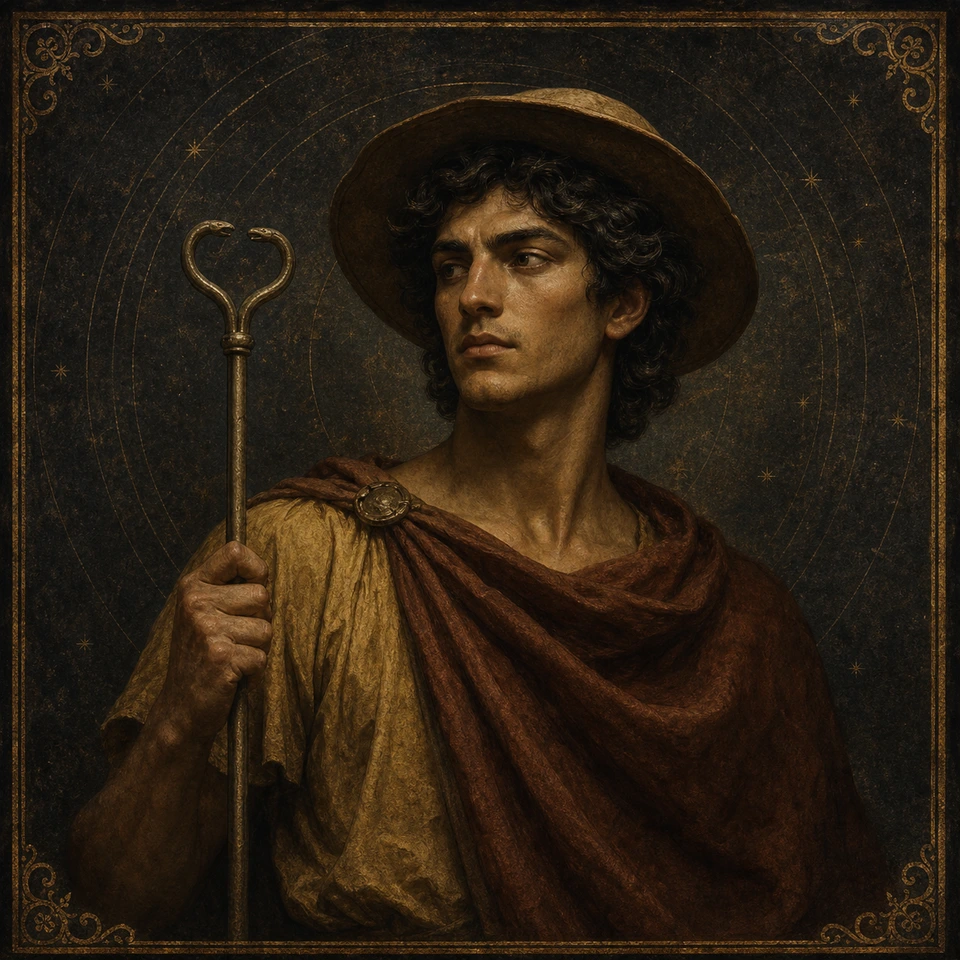
Facilitating seamless movement across borders, Hermes guides the dead and manages complex negotiated exchanges through masterfully crafted heraldic speech. Born to Zeus and Maia, he executes divine errands and ensures protected passage, standing wholly apart from his later Roman counterpart Mercury.
Overview
Before his first sunset, Hermes turns a tortoise shell into music and a quarrel over stolen cattle into a binding exchange with Apollo. He is not a mascot for speed, commerce, or clever theft. Homeric Hymn 4 makes invention, deception, restitution, music, and negotiated honor inseparable.
The hymn names him son of Zeus and Maia and places his birth in a cave on Mount Cyllene. The newborn slips out, makes the lyre, drives Apollo’s cattle backward to confuse pursuit, and returns to his cradle. Zeus laughs when the dispute reaches him, but the end is serious: Hermes gives Apollo the lyre and receives a staff, offices, and his brother’s affection. Pseudo-Apollodorus later compresses the theft and exchange. The two tellings stand side by side rather than being blended into one account.
Hermes’ mastery is passage under constraint. He takes Priam through sleeping guards to ransom Hector and later leads him out. He gives Odysseus moly and exact instructions before Circe’s house. Zeus sends him over the sea to order Calypso to release Odysseus, and sends him below to carry the demand for Persephone’s return. In Odyssey 24 he summons the slain suitors’ souls and conducts them only as far as the asphodel meadow. He is messenger and guide, never judge or ruler of the dead.
Later mythography makes the same mobility dangerous as well as protective. Hermes kills Argus while freeing Io, leads the competing goddesses to Paris, and helps Athena guide Perseus toward the Graeae. In Works and Days he gives Pandora speech and deceit and delivers her to Epimetheus. The stories do not make every command morally his own, but they do keep his agency visible.
Homeric Hymn 19 adds a domestic and Arcadian face. Hermes fathers Pan with the unnamed daughter of Dryops. When the nurse flees from the horned, goat-footed infant, Hermes wraps his son in mountain-hare skins, carries him to Olympus, and shows him to gods who rejoice, Dionysus especially. This genealogy remains one ancient variant, not a verdict against other parentages.
At Tanagra, Pausanias records Hermes Kriophoros and Promachos. A chosen youth bears a lamb around the city wall in memory of deliverance from pestilence; a separate local story remembers Hermes leading young men in defense. Two Attic lekythoi show traveler dress, petasos, chlamys, sandals, and kerykeion. One gives winged sandals, not a winged helmet. Roman Mercury, planetary correspondences, Hermetic literature, and the medical caduceus belong to later histories and do not replace Greek Hermes.
Canonical identity
Canonical Identity
Hermes is defined by intense motion and contradiction, entering Greek myth in Homeric Hymn 4 as the cave-born infant of Zeus and Maia who slips from his cradle to invent music, steal cattle, execute brilliant lies, and ultimately secure a seat among the Olympians. His canonical roles as a messenger, herald, thief, guide, traveler, negotiator, and purveyor of unexpected advantage coalesce into a single divine life, entirely preventing his reduction to a mere mascot for speed. Greek epic, hymn, and cult artifacts ground him firmly in his own setting, distinctly separate from Roman Mercury, Egyptian Thoth, Germanic Woden, Hermetic literature, and modern medical emblems.
Linguistic Identity
Hermes is the Greek Ἑρμῆς. A qualified fifth-century BC Attic reconstruction gives the pronunciation /her.mɛ̂ːs/, approximated as hehr-MEHSS, though this cannot capture the true ancient vowel length or pitch. The common English pronunciation HUR-meez stems from a distinctly different phonetic history. The planet Mercury and the chemical element mercury possess separate names and identities entirely disconnected from the Greek god.
Sources and evidence
TEXTUAL · Supported
Homeric Hymn 4 makes Hermes the son of Zeus and Maia, born on Mount Cyllene, and develops his offices through theft, invention, music, negotiation, and divine agreement.
- Source
- Anonymous Homeric Hymns; edited and translated by Hugh G. Evelyn-White, Homeric Hymns (1914)
- Reviewed edition
- Hugh G. Evelyn-White English translation of Homeric Hymn 4, To Hermes, 1914 · translated by Hugh G. Evelyn-White · edited by Hugh G. Evelyn-White · Perseus Digital Library / Scaife ATLAS
- Exact locator
- Entry Homeric Hymn 4 to Hermes · Line 1-20; 21-61; 62-140; 145-430; 435-568b
- Scope
- Archaic Greece · Mount Cyllene
- Authority
- Ancient Greek hymn in the Evelyn-White translation
- Certainty
- High
The hymn is a crafted archaic narrative, not a universal chronology for every local cult.
Open exact reviewed sourceMATERIAL CULTURE · Supported
Metropolitan Museum accession 25.78.2 shows Hermes in petasos and chlamys, wearing winged sandals and carrying a snake-ended kerykeion.
- Source
- The Metropolitan Museum of Art, Open Access Collection and Collection API
- Reviewed edition
- Live collection records and API; eligible Open Access objects only · The Metropolitan Museum of Art
- Exact locator
- MuseumObjectId Accession 25.78.2 · Entry Terracotta lekythos with Hermes; circa 480-470 BC
- Scope
- Classical Greece · Attica
- Authority
- Metropolitan Museum of Art catalogue
- Certainty
- High
The sandals are winged in this object; the petasos is not described as winged.
Open exact reviewed sourceMATERIAL CULTURE · Supported
British Museum 1863,0728.150 shows a beardless Hermes with neck-length wavy hair, petasos, chlamys, and kerykeion.
- Source
- British Museum, British Museum Collection
- Reviewed edition
- Live record-level official museum collection · British Museum
- Exact locator
- MuseumObjectId Museum number 1863,0728.150 (E597) · Entry Attic red-figure lekythos; circa 440-430 BC
- Scope
- Classical Greece · Attica
- Authority
- British Museum collection catalogue
- Certainty
- High
The catalog supports traveler dress and herald staff without a fixed universal age.
Open exact reviewed sourceTEXTUAL · Supported
The proper name Ἑρμῆς is transliterated Hermês, with a qualified fifth-century BC Attic reconstruction /her.mɛ̂ːs/.
- Source
- Wiktionary contributors, Ἑρμῆς
- Reviewed edition
- Permanent revision 88880372, last edited 2025-12-27 · Wiktionary
- Exact locator
- Entry Ἑρμῆς · Section Ancient Greek pronunciation
- Scope
- Classical Greece · Attica
- Authority
- Wiktionary, Ἑρμῆς entry, permanent revision 88880372
- Certainty
- Qualified historical reconstruction
The readable guide hehr-MEHSS approximates the segmental sounds but cannot reproduce ancient pitch accent exactly.
Open exact reviewed source4 reviewed sources for this section
- Anonymous Homeric Hymns; edited and translated by Hugh G. Evelyn-White, Homeric Hymns (1914)Hesiod, the Homeric Hymns and Homerica, London and New York, 1914 · Perseus Digital Library / Scaife ATLAS
- The Metropolitan Museum of Art, Open Access Collection and Collection APILive collection data and eligible public-domain images · The Metropolitan Museum of Art
- British Museum, British Museum CollectionLive official museum collection · British Museum
- Wiktionary contributors, ἙρμῆςPermanent revision 88880372, Ancient Greek pronunciation section · Wiktionary
Culture, tradition, period, and place
Hermes moves through Archaic hymn and epic, Classical civic and rural cult, vase painting, later mythography, and Roman-period descriptions of Greek sanctuaries. Mount Cyllene belongs to the birth hymn. Roads, gates, camp walls, pastures, caves, houses, and the path below are places where passage must be negotiated. Delphi enters his settlement with Apollo, Troy his protection of Priam, Aeaea his warning to Odysseus, and the underworld road his conduct of souls.
Tanagra gives local Boeotian worship in motion: a youth carries a lamb around the city wall for Hermes Kriophoros, while Hermes Promachos is remembered in civic defense. Attic objects show traveler dress and the herald staff. These places and periods share a god, but not one uniform ritual or appearance.
Sources and evidence
TEXTUAL · Supported
Homeric Hymn 4 makes Hermes the son of Zeus and Maia, born on Mount Cyllene, and develops his offices through theft, invention, music, negotiation, and divine agreement.
- Source
- Anonymous Homeric Hymns; edited and translated by Hugh G. Evelyn-White, Homeric Hymns (1914)
- Reviewed edition
- Hugh G. Evelyn-White English translation of Homeric Hymn 4, To Hermes, 1914 · translated by Hugh G. Evelyn-White · edited by Hugh G. Evelyn-White · Perseus Digital Library / Scaife ATLAS
- Exact locator
- Entry Homeric Hymn 4 to Hermes · Line 1-20; 21-61; 62-140; 145-430; 435-568b
- Scope
- Archaic Greece · Mount Cyllene
- Authority
- Ancient Greek hymn in the Evelyn-White translation
- Certainty
- High
The hymn is a crafted archaic narrative, not a universal chronology for every local cult.
Open exact reviewed sourceTEXTUAL · Supported
Zeus sends Hermes to guide Priam unseen through the Achaean camp and later lead him safely away after Hector’s ransom.
- Source
- Homer; Monro and Allen Greek edition with edition-specific translations, Iliad (1920)
- Reviewed edition
- A. T. Murray English translation, volumes I-II, 1924-1925 · translated by A. T. Murray · Perseus Digital Library / Scaife ATLAS
- Exact locator
- Book 24 · Line 334-467, 677-694
- Scope
- Archaic Greece · Troy and the Achaean war camp
- Authority
- Ancient Greek epic in the A. T. Murray translation
- Certainty
- High
Hermes protects passage across a lethal human boundary.
Open exact reviewed sourceTEXTUAL · Supported
Hermes gathers the souls of Penelope’s slain suitors with his wand and leads them along the path to the house of Hades.
- Source
- Homer; translated by A. T. Murray, Odyssey (1919)
- Reviewed edition
- A. T. Murray English translation, London: William Heinemann; New York: G. P. Putnam's Sons, 1919 · translated by A. T. Murray · Perseus Digital Library / Scaife ATLAS
- Exact locator
- Book 24 · Line 1-14
- Scope
- Archaic Greece · Greek underworld
- Authority
- Ancient Greek epic in the A. T. Murray translation
- Certainty
- High
This is a precise psychopomp scene, not proof that every dead soul appears with Hermes in every Greek source.
Open exact reviewed sourceTEXTUAL · Supported
At Tanagra, Pausanias describes Hermes Kriophoros and Promachos, a festival youth carrying a lamb around the wall, and local stories of pestilence averted and civic defense.
- Source
- Pausanias; Spiro Greek edition and Jones/Ormerod translation volumes, Description of Greece (1935)
- Reviewed edition
- W. H. S. Jones and H. A. Ormerod English translation volumes, 1918-1935 · translated by W. H. S. Jones and H. A. Ormerod, volume-dependent · Perseus Digital Library / Scaife ATLAS
- Exact locator
- Book 9 · Chapter 22 · Section 1-2
- Scope
- Greek religion under Roman imperial rule · Tanagra
- Authority
- Ancient Greek sanctuary and travel account
- Certainty
- High
The procession and titles are local Boeotian evidence.
Open exact reviewed sourceMATERIAL CULTURE · Supported
Metropolitan Museum accession 25.78.2 shows Hermes in petasos and chlamys, wearing winged sandals and carrying a snake-ended kerykeion.
- Source
- The Metropolitan Museum of Art, Open Access Collection and Collection API
- Reviewed edition
- Live collection records and API; eligible Open Access objects only · The Metropolitan Museum of Art
- Exact locator
- MuseumObjectId Accession 25.78.2 · Entry Terracotta lekythos with Hermes; circa 480-470 BC
- Scope
- Classical Greece · Attica
- Authority
- Metropolitan Museum of Art catalogue
- Certainty
- High
The sandals are winged in this object; the petasos is not described as winged.
Open exact reviewed sourceMATERIAL CULTURE · Supported
British Museum 1863,0728.150 shows a beardless Hermes with neck-length wavy hair, petasos, chlamys, and kerykeion.
- Source
- British Museum, British Museum Collection
- Reviewed edition
- Live record-level official museum collection · British Museum
- Exact locator
- MuseumObjectId Museum number 1863,0728.150 (E597) · Entry Attic red-figure lekythos; circa 440-430 BC
- Scope
- Classical Greece · Attica
- Authority
- British Museum collection catalogue
- Certainty
- High
The catalog supports traveler dress and herald staff without a fixed universal age.
Open exact reviewed source8 reviewed sources for this section
- Anonymous Homeric Hymns; edited and translated by Hugh G. Evelyn-White, Homeric Hymns (1914)Hesiod, the Homeric Hymns and Homerica, London and New York, 1914 · Perseus Digital Library / Scaife ATLAS
- Homer; Monro and Allen Greek edition with edition-specific translations, Iliad (1920)Perseus CTS edition corpus; Greek edition, Oxford, 1908-1920 · Perseus Digital Library / Scaife ATLAS
- Homer; translated by A. T. Murray, Odyssey (1919)A. T. Murray English translation, London: William Heinemann; New York: G. P. Putnam's Sons, 1919 · Perseus Digital Library / Scaife ATLAS
- Pausanias; Spiro Greek edition and Jones/Ormerod translation volumes, Description of Greece (1935)Perseus CTS edition corpus, 1903-1935 · Perseus Digital Library / Scaife ATLAS
- The Metropolitan Museum of Art, Open Access Collection and Collection APILive collection data and eligible public-domain images · The Metropolitan Museum of Art
- British Museum, British Museum CollectionLive official museum collection · British Museum
- Pseudo-Apollodorus; edited and translated by James G. Frazer, Library (1921)Harvard University Press and William Heinemann edition, 1921 · Perseus Digital Library / Scaife ATLAS
- Euripides; translated by Robert Potter; edited by Whitney J. Oates and Eugene O'Neill Jr., Ion (1938)1938 Complete Greek Drama translation hosted by the Perseus Digital Library · Perseus Digital Library
Historical development
Archaic poetry already presents Hermes as a divine messenger and an expert in exchange. Homeric Hymn 4 makes a full divine charter out of the cattle theft: invention and deceit provoke conflict, music creates desire, and negotiation assigns lasting honors. The Iliad and Odyssey show mature roles without retelling his childhood, guiding Priam, helping Odysseus, and leading the dead.
Greek objects make him legible through petasos, chlamys, sandals, and kerykeion, while age and beard can vary. Pausanias adds local titles and a Tanagran circuit around the wall. Later mythography and drama place Hermes in further rescues, deliveries, and divine commands. Roman Mercury, astrology, alchemy, and later allegory are historically important reception subjects, but none is documented by the Greek witnesses used here and none should be projected backward onto an Archaic hymn or Greek sanctuary.
Sources and evidence
TEXTUAL · Supported
On the day of his birth Hermes invents the lyre, steals Apollo’s cattle, conceals his tracks, and exchanges the instrument for reconciliation and new honors.
- Source
- Anonymous Homeric Hymns; edited and translated by Hugh G. Evelyn-White, Homeric Hymns (1914)
- Reviewed edition
- Hugh G. Evelyn-White English translation of Homeric Hymn 4, To Hermes, 1914 · translated by Hugh G. Evelyn-White · edited by Hugh G. Evelyn-White · Perseus Digital Library / Scaife ATLAS
- Exact locator
- Entry Homeric Hymn 4 to Hermes · Line 21-61; 62-140; 145-430; 435-568b
- Scope
- Archaic Greece · Ancient Greece
- Authority
- Ancient Greek hymn in the Evelyn-White translation
- Certainty
- High
Trickery and settlement belong to the same story.
Open exact reviewed sourceTEXTUAL · Supported
Zeus sends Hermes to guide Priam unseen through the Achaean camp and later lead him safely away after Hector’s ransom.
- Source
- Homer; Monro and Allen Greek edition with edition-specific translations, Iliad (1920)
- Reviewed edition
- A. T. Murray English translation, volumes I-II, 1924-1925 · translated by A. T. Murray · Perseus Digital Library / Scaife ATLAS
- Exact locator
- Book 24 · Line 334-467, 677-694
- Scope
- Archaic Greece · Troy and the Achaean war camp
- Authority
- Ancient Greek epic in the A. T. Murray translation
- Certainty
- High
Hermes protects passage across a lethal human boundary.
Open exact reviewed sourceTEXTUAL · Supported
Hermes gathers the souls of Penelope’s slain suitors with his wand and leads them along the path to the house of Hades.
- Source
- Homer; translated by A. T. Murray, Odyssey (1919)
- Reviewed edition
- A. T. Murray English translation, London: William Heinemann; New York: G. P. Putnam's Sons, 1919 · translated by A. T. Murray · Perseus Digital Library / Scaife ATLAS
- Exact locator
- Book 24 · Line 1-14
- Scope
- Archaic Greece · Greek underworld
- Authority
- Ancient Greek epic in the A. T. Murray translation
- Certainty
- High
This is a precise psychopomp scene, not proof that every dead soul appears with Hermes in every Greek source.
Open exact reviewed sourceTEXTUAL · Supported
At Tanagra, Pausanias describes Hermes Kriophoros and Promachos, a festival youth carrying a lamb around the wall, and local stories of pestilence averted and civic defense.
- Source
- Pausanias; Spiro Greek edition and Jones/Ormerod translation volumes, Description of Greece (1935)
- Reviewed edition
- W. H. S. Jones and H. A. Ormerod English translation volumes, 1918-1935 · translated by W. H. S. Jones and H. A. Ormerod, volume-dependent · Perseus Digital Library / Scaife ATLAS
- Exact locator
- Book 9 · Chapter 22 · Section 1-2
- Scope
- Greek religion under Roman imperial rule · Tanagra
- Authority
- Ancient Greek sanctuary and travel account
- Certainty
- High
The procession and titles are local Boeotian evidence.
Open exact reviewed sourceMATERIAL CULTURE · Supported
Metropolitan Museum accession 25.78.2 shows Hermes in petasos and chlamys, wearing winged sandals and carrying a snake-ended kerykeion.
- Source
- The Metropolitan Museum of Art, Open Access Collection and Collection API
- Reviewed edition
- Live collection records and API; eligible Open Access objects only · The Metropolitan Museum of Art
- Exact locator
- MuseumObjectId Accession 25.78.2 · Entry Terracotta lekythos with Hermes; circa 480-470 BC
- Scope
- Classical Greece · Attica
- Authority
- Metropolitan Museum of Art catalogue
- Certainty
- High
The sandals are winged in this object; the petasos is not described as winged.
Open exact reviewed source7 reviewed sources for this section
- Anonymous Homeric Hymns; edited and translated by Hugh G. Evelyn-White, Homeric Hymns (1914)Hesiod, the Homeric Hymns and Homerica, London and New York, 1914 · Perseus Digital Library / Scaife ATLAS
- Homer; Monro and Allen Greek edition with edition-specific translations, Iliad (1920)Perseus CTS edition corpus; Greek edition, Oxford, 1908-1920 · Perseus Digital Library / Scaife ATLAS
- Homer; translated by A. T. Murray, Odyssey (1919)A. T. Murray English translation, London: William Heinemann; New York: G. P. Putnam's Sons, 1919 · Perseus Digital Library / Scaife ATLAS
- Pausanias; Spiro Greek edition and Jones/Ormerod translation volumes, Description of Greece (1935)Perseus CTS edition corpus, 1903-1935 · Perseus Digital Library / Scaife ATLAS
- The Metropolitan Museum of Art, Open Access Collection and Collection APILive collection data and eligible public-domain images · The Metropolitan Museum of Art
- British Museum, British Museum CollectionLive official museum collection · British Museum
- Pseudo-Apollodorus; edited and translated by James G. Frazer, Library (1921)Harvard University Press and William Heinemann edition, 1921 · Perseus Digital Library / Scaife ATLAS
Attested roles and historical themes
Roles, powers, and limits
Hermes crosses thresholds that stop others. He opens the Achaean gates for Priam, carries a hidden infant from Athens to Delphi, frees Ares from a bronze jar, escorts Persephone upward, gives Odysseus the knowledge needed at Circe’s house, and conducts dead suitors below. These acts are not interchangeable. Messenger, rescuer, escort, psychopomp, and divine helper answer different dangers.
Trickery is equally precise. The infant reverses cattle tracks, hides evidence, performs innocence, then transforms stolen property into exchange. His wit does not grant unlimited license to deceive, and his protection does not erase harm done in the stories he serves. Zeus sends him, Apollo bargains with him, and underworld rulers retain their realm. Hermes succeeds through access, timing, speech, disguise, and movement, not absolute command.
Two envoy scenes sharpen the limit. On Ogygia Hermes speaks Zeus’ order to Calypso and stops at delivery; below the earth he conveys the demand for Persephone’s return. Neither passage makes him author of the command. Pseudo-Apollodorus also sends him with Athena toward the Graeae and makes him lead the goddesses to Paris. He opens a route or carries a decision, while judgment and consequence belong to others.
Sources and evidence
TEXTUAL · Supported
On the day of his birth Hermes invents the lyre, steals Apollo’s cattle, conceals his tracks, and exchanges the instrument for reconciliation and new honors.
- Source
- Anonymous Homeric Hymns; edited and translated by Hugh G. Evelyn-White, Homeric Hymns (1914)
- Reviewed edition
- Hugh G. Evelyn-White English translation of Homeric Hymn 4, To Hermes, 1914 · translated by Hugh G. Evelyn-White · edited by Hugh G. Evelyn-White · Perseus Digital Library / Scaife ATLAS
- Exact locator
- Entry Homeric Hymn 4 to Hermes · Line 21-61; 62-140; 145-430; 435-568b
- Scope
- Archaic Greece · Ancient Greece
- Authority
- Ancient Greek hymn in the Evelyn-White translation
- Certainty
- High
Trickery and settlement belong to the same story.
Open exact reviewed sourceTEXTUAL · Supported
Zeus sends Hermes to guide Priam unseen through the Achaean camp and later lead him safely away after Hector’s ransom.
- Source
- Homer; Monro and Allen Greek edition with edition-specific translations, Iliad (1920)
- Reviewed edition
- A. T. Murray English translation, volumes I-II, 1924-1925 · translated by A. T. Murray · Perseus Digital Library / Scaife ATLAS
- Exact locator
- Book 24 · Line 334-467, 677-694
- Scope
- Archaic Greece · Troy and the Achaean war camp
- Authority
- Ancient Greek epic in the A. T. Murray translation
- Certainty
- High
Hermes protects passage across a lethal human boundary.
Open exact reviewed sourceTEXTUAL · Supported
Hermes gathers the souls of Penelope’s slain suitors with his wand and leads them along the path to the house of Hades.
- Source
- Homer; translated by A. T. Murray, Odyssey (1919)
- Reviewed edition
- A. T. Murray English translation, London: William Heinemann; New York: G. P. Putnam's Sons, 1919 · translated by A. T. Murray · Perseus Digital Library / Scaife ATLAS
- Exact locator
- Book 24 · Line 1-14
- Scope
- Archaic Greece · Greek underworld
- Authority
- Ancient Greek epic in the A. T. Murray translation
- Certainty
- High
This is a precise psychopomp scene, not proof that every dead soul appears with Hermes in every Greek source.
Open exact reviewed sourceTEXTUAL · Supported
Hermes meets Odysseus before Circe’s house, gives him moly, explains its power, and tells him how to survive the encounter.
- Source
- Homer; translated by A. T. Murray, Odyssey (1919)
- Reviewed edition
- A. T. Murray English translation, London: William Heinemann; New York: G. P. Putnam's Sons, 1919 · translated by A. T. Murray · Perseus Digital Library / Scaife ATLAS
- Exact locator
- Book 10 · Line 274-307
- Scope
- Archaic Greece · Aeaea
- Authority
- Ancient Greek epic in the A. T. Murray translation
- Certainty
- High
The plant and instructions belong to one dangerous episode.
Open exact reviewed sourceTEXTUAL · Supported
In the Homeric Hymn to Demeter, Zeus sends Hermes below to demand Persephone’s release and escort her back to Demeter.
- Source
- Anonymous Homeric Hymns; edited and translated by Hugh G. Evelyn-White, Homeric Hymns (1914)
- Reviewed edition
- Hugh G. Evelyn-White English translation of Homeric Hymn 2, To Demeter, 1914 · translated by Hugh G. Evelyn-White · edited by Hugh G. Evelyn-White · Perseus Digital Library / Scaife ATLAS
- Exact locator
- Entry Homeric Hymn 2 to Demeter · Line 334-385
- Scope
- Archaic Greece · Greek underworld
- Authority
- Ancient Greek hymn in the Evelyn-White translation
- Certainty
- High
Messenger and escort roles operate within a negotiated settlement after abduction.
Open exact reviewed sourceTEXTUAL · Supported
Zeus sends Hermes over the sea to Ogygia to tell Calypso that Odysseus must be released.
- Source
- Homer; translated by A. T. Murray, Odyssey (1919)
- Reviewed edition
- A. T. Murray English translation, London: William Heinemann; New York: G. P. Putnam's Sons, 1919 · translated by A. T. Murray · Perseus Digital Library / Scaife ATLAS
- Exact locator
- Book 5 · Line 28-148
- Scope
- Archaic Greece · Ogygia
- Authority
- ancient textual witness
- Certainty
- High within the cited witness
The claim stops at Calypso’s assent and excludes later consequences.
Open exact reviewed source5 reviewed sources for this section
- Anonymous Homeric Hymns; edited and translated by Hugh G. Evelyn-White, Homeric Hymns (1914)Hesiod, the Homeric Hymns and Homerica, London and New York, 1914 · Perseus Digital Library / Scaife ATLAS
- Homer; Monro and Allen Greek edition with edition-specific translations, Iliad (1920)Perseus CTS edition corpus; Greek edition, Oxford, 1908-1920 · Perseus Digital Library / Scaife ATLAS
- Homer; translated by A. T. Murray, Odyssey (1919)A. T. Murray English translation, London: William Heinemann; New York: G. P. Putnam's Sons, 1919 · Perseus Digital Library / Scaife ATLAS
- Pseudo-Apollodorus; edited and translated by James G. Frazer, Library (1921)Harvard University Press and William Heinemann edition, 1921 · Perseus Digital Library / Scaife ATLAS
- Euripides; translated by Robert Potter; edited by Whitney J. Oates and Eugene O'Neill Jr., Ion (1938)1938 Complete Greek Drama translation hosted by the Perseus Digital Library · Perseus Digital Library
Epithets and titles
Poetic Epithet
Argus-slayer
Slayer of Argus
Greek poetic and mythographic traditions · Ancient Greek textual witnessesThe title recalls Hermes’ killing of Argus in the Io tradition.
2 reviewed sources for this section
- Anonymous Homeric Hymns; edited and translated by Hugh G. Evelyn-White, Homeric Hymns (1914)Hesiod, the Homeric Hymns and Homerica, London and New York, 1914 · Perseus Digital Library / Scaife ATLAS
- Pseudo-Apollodorus; edited and translated by James G. Frazer, Library (1921)Harvard University Press and William Heinemann edition, 1921 · Perseus Digital Library / Scaife ATLAS
Worship and cult
At Tanagra, worship becomes a route walked by a living community. Pausanias describes Hermes Kriophoros, Ram-bearer, and connects the title with deliverance from pestilence. A chosen youth carries a lamb around the walls during the festival. Hermes Promachos, Champion, belongs to another local memory in which he leads young men in defense of the city.
The two titles share Tanagra but do not merge into one universal office. Flock care, protection from pestilence, civic defense, youth, and the wall circuit converge in this city. Pausanias’ Tanagran passage does not supply the inscriptions, site histories, or rites needed to describe roads, gates, gymnasia, marketplaces, houses, and tombs as one uniform cult program.
Sources and evidence
TEXTUAL · Supported
At Tanagra, Pausanias describes Hermes Kriophoros and Promachos, a festival youth carrying a lamb around the wall, and local stories of pestilence averted and civic defense.
- Source
- Pausanias; Spiro Greek edition and Jones/Ormerod translation volumes, Description of Greece (1935)
- Reviewed edition
- W. H. S. Jones and H. A. Ormerod English translation volumes, 1918-1935 · translated by W. H. S. Jones and H. A. Ormerod, volume-dependent · Perseus Digital Library / Scaife ATLAS
- Exact locator
- Book 9 · Chapter 22 · Section 1-2
- Scope
- Greek religion under Roman imperial rule · Tanagra
- Authority
- Ancient Greek sanctuary and travel account
- Certainty
- High
The procession and titles are local Boeotian evidence.
Open exact reviewed source1 reviewed source for this section
- Pausanias; Spiro Greek edition and Jones/Ormerod translation volumes, Description of Greece (1935)Perseus CTS edition corpus, 1903-1935 · Perseus Digital Library / Scaife ATLAS
Temples, sanctuaries, and sacred places
Mount Cyllene is the cave landscape of the birth hymn, where Maia hides from the other gods and the newborn slips out into the night. Tanagra preserves both a sacred image and a civic circuit. Its wall is not scenery: the festival youth walks the boundary carrying a lamb, repeating a local act of protection.
Roads and gates become sacred through function in poetry. Hermes opens the guarded Achaean camp, knows the path of souls, and moves between Olympus, earth, and the underworld. Delphi receives the infant Ion whom he carries under Apollo’s command, while the Homeric Hymn to Demeter sends him into Hades’ house as Zeus’s envoy. Narrative passage does not automatically prove a shrine at every location, but it reveals why thresholds, roads, and boundary markers could bear his presence.
Sources and evidence
TEXTUAL · Supported
Homeric Hymn 4 makes Hermes the son of Zeus and Maia, born on Mount Cyllene, and develops his offices through theft, invention, music, negotiation, and divine agreement.
- Source
- Anonymous Homeric Hymns; edited and translated by Hugh G. Evelyn-White, Homeric Hymns (1914)
- Reviewed edition
- Hugh G. Evelyn-White English translation of Homeric Hymn 4, To Hermes, 1914 · translated by Hugh G. Evelyn-White · edited by Hugh G. Evelyn-White · Perseus Digital Library / Scaife ATLAS
- Exact locator
- Entry Homeric Hymn 4 to Hermes · Line 1-20; 21-61; 62-140; 145-430; 435-568b
- Scope
- Archaic Greece · Mount Cyllene
- Authority
- Ancient Greek hymn in the Evelyn-White translation
- Certainty
- High
The hymn is a crafted archaic narrative, not a universal chronology for every local cult.
Open exact reviewed sourceTEXTUAL · Supported
At Tanagra, Pausanias describes Hermes Kriophoros and Promachos, a festival youth carrying a lamb around the wall, and local stories of pestilence averted and civic defense.
- Source
- Pausanias; Spiro Greek edition and Jones/Ormerod translation volumes, Description of Greece (1935)
- Reviewed edition
- W. H. S. Jones and H. A. Ormerod English translation volumes, 1918-1935 · translated by W. H. S. Jones and H. A. Ormerod, volume-dependent · Perseus Digital Library / Scaife ATLAS
- Exact locator
- Book 9 · Chapter 22 · Section 1-2
- Scope
- Greek religion under Roman imperial rule · Tanagra
- Authority
- Ancient Greek sanctuary and travel account
- Certainty
- High
The procession and titles are local Boeotian evidence.
Open exact reviewed sourceTEXTUAL · Supported
Zeus sends Hermes to guide Priam unseen through the Achaean camp and later lead him safely away after Hector’s ransom.
- Source
- Homer; Monro and Allen Greek edition with edition-specific translations, Iliad (1920)
- Reviewed edition
- A. T. Murray English translation, volumes I-II, 1924-1925 · translated by A. T. Murray · Perseus Digital Library / Scaife ATLAS
- Exact locator
- Book 24 · Line 334-467, 677-694
- Scope
- Archaic Greece · Troy and the Achaean war camp
- Authority
- Ancient Greek epic in the A. T. Murray translation
- Certainty
- High
Hermes protects passage across a lethal human boundary.
Open exact reviewed sourceTEXTUAL · Supported
Hermes gathers the souls of Penelope’s slain suitors with his wand and leads them along the path to the house of Hades.
- Source
- Homer; translated by A. T. Murray, Odyssey (1919)
- Reviewed edition
- A. T. Murray English translation, London: William Heinemann; New York: G. P. Putnam's Sons, 1919 · translated by A. T. Murray · Perseus Digital Library / Scaife ATLAS
- Exact locator
- Book 24 · Line 1-14
- Scope
- Archaic Greece · Greek underworld
- Authority
- Ancient Greek epic in the A. T. Murray translation
- Certainty
- High
This is a precise psychopomp scene, not proof that every dead soul appears with Hermes in every Greek source.
Open exact reviewed sourceTEXTUAL · Supported
In the Homeric Hymn to Demeter, Zeus sends Hermes below to demand Persephone’s release and escort her back to Demeter.
- Source
- Anonymous Homeric Hymns; edited and translated by Hugh G. Evelyn-White, Homeric Hymns (1914)
- Reviewed edition
- Hugh G. Evelyn-White English translation of Homeric Hymn 2, To Demeter, 1914 · translated by Hugh G. Evelyn-White · edited by Hugh G. Evelyn-White · Perseus Digital Library / Scaife ATLAS
- Exact locator
- Entry Homeric Hymn 2 to Demeter · Line 334-385
- Scope
- Archaic Greece · Greek underworld
- Authority
- Ancient Greek hymn in the Evelyn-White translation
- Certainty
- High
Messenger and escort roles operate within a negotiated settlement after abduction.
Open exact reviewed source5 reviewed sources for this section
- Anonymous Homeric Hymns; edited and translated by Hugh G. Evelyn-White, Homeric Hymns (1914)Hesiod, the Homeric Hymns and Homerica, London and New York, 1914 · Perseus Digital Library / Scaife ATLAS
- Pausanias; Spiro Greek edition and Jones/Ormerod translation volumes, Description of Greece (1935)Perseus CTS edition corpus, 1903-1935 · Perseus Digital Library / Scaife ATLAS
- Homer; Monro and Allen Greek edition with edition-specific translations, Iliad (1920)Perseus CTS edition corpus; Greek edition, Oxford, 1908-1920 · Perseus Digital Library / Scaife ATLAS
- Homer; translated by A. T. Murray, Odyssey (1919)A. T. Murray English translation, London: William Heinemann; New York: G. P. Putnam's Sons, 1919 · Perseus Digital Library / Scaife ATLAS
- Euripides; translated by Robert Potter; edited by Whitney J. Oates and Eugene O'Neill Jr., Ion (1938)1938 Complete Greek Drama translation hosted by the Perseus Digital Library · Perseus Digital Library
Festivals and processions
Pausanias gives one vivid festival act at Tanagra. A youth judged the most handsome takes a lamb onto his shoulders and walks around the city wall. The rite recalls Hermes Kriophoros and the deliverance of the city from pestilence. Body, animal, wall, memory, and civic protection meet in a single procession.
The passage does not supply a universal date, priesthood, song, or sacrificial sequence. Hermes Promachos belongs to the same city but another story of young men and defense. Greek festivals called Hermaia require their own city-specific inscriptions, calendars, and institutional histories before their rules can be described. The Tanagran circuit is secure because Pausanias names its participants, action, setting, and local explanation. It cannot stand in for every festival of Hermes.
Sources and evidence
TEXTUAL · Supported
At Tanagra, Pausanias describes Hermes Kriophoros and Promachos, a festival youth carrying a lamb around the wall, and local stories of pestilence averted and civic defense.
- Source
- Pausanias; Spiro Greek edition and Jones/Ormerod translation volumes, Description of Greece (1935)
- Reviewed edition
- W. H. S. Jones and H. A. Ormerod English translation volumes, 1918-1935 · translated by W. H. S. Jones and H. A. Ormerod, volume-dependent · Perseus Digital Library / Scaife ATLAS
- Exact locator
- Book 9 · Chapter 22 · Section 1-2
- Scope
- Greek religion under Roman imperial rule · Tanagra
- Authority
- Ancient Greek sanctuary and travel account
- Certainty
- High
The procession and titles are local Boeotian evidence.
Open exact reviewed source1 reviewed source for this section
- Pausanias; Spiro Greek edition and Jones/Ormerod translation volumes, Description of Greece (1935)Perseus CTS edition corpus, 1903-1935 · Perseus Digital Library / Scaife ATLAS
Offerings, votives, and ritual evidence
The Tanagran lamb is carried around the wall by a chosen youth. Pausanias connects this act to Hermes Kriophoros and protection from pestilence, but the cited description must not be expanded into an invented sacrifice, menu, or household charm. The living animal, human bearer, and boundary route form the attested ritual image.
Homeric Hymn 4 describes the infant Hermes dividing slaughtered cattle into twelve portions and desiring sacrificial honor, yet he does not eat the meat. That scene helps define his divine ambition inside the poem. It is not a complete historical rite. Oaths, exchange, gifts, and heraldic speech also shape his myths: the lyre passes to Apollo, the wand and offices return to Hermes, and negotiated settlement ends the quarrel. These are narrative exchanges, not automatic offerings.
Sources and evidence
TEXTUAL · Supported
At Tanagra, Pausanias describes Hermes Kriophoros and Promachos, a festival youth carrying a lamb around the wall, and local stories of pestilence averted and civic defense.
- Source
- Pausanias; Spiro Greek edition and Jones/Ormerod translation volumes, Description of Greece (1935)
- Reviewed edition
- W. H. S. Jones and H. A. Ormerod English translation volumes, 1918-1935 · translated by W. H. S. Jones and H. A. Ormerod, volume-dependent · Perseus Digital Library / Scaife ATLAS
- Exact locator
- Book 9 · Chapter 22 · Section 1-2
- Scope
- Greek religion under Roman imperial rule · Tanagra
- Authority
- Ancient Greek sanctuary and travel account
- Certainty
- High
The procession and titles are local Boeotian evidence.
Open exact reviewed sourceTEXTUAL · Supported
On the day of his birth Hermes invents the lyre, steals Apollo’s cattle, conceals his tracks, and exchanges the instrument for reconciliation and new honors.
- Source
- Anonymous Homeric Hymns; edited and translated by Hugh G. Evelyn-White, Homeric Hymns (1914)
- Reviewed edition
- Hugh G. Evelyn-White English translation of Homeric Hymn 4, To Hermes, 1914 · translated by Hugh G. Evelyn-White · edited by Hugh G. Evelyn-White · Perseus Digital Library / Scaife ATLAS
- Exact locator
- Entry Homeric Hymn 4 to Hermes · Line 21-61; 62-140; 145-430; 435-568b
- Scope
- Archaic Greece · Ancient Greece
- Authority
- Ancient Greek hymn in the Evelyn-White translation
- Certainty
- High
Trickery and settlement belong to the same story.
Open exact reviewed source2 reviewed sources for this section
- Pausanias; Spiro Greek edition and Jones/Ormerod translation volumes, Description of Greece (1935)Perseus CTS edition corpus, 1903-1935 · Perseus Digital Library / Scaife ATLAS
- Anonymous Homeric Hymns; edited and translated by Hugh G. Evelyn-White, Homeric Hymns (1914)Hesiod, the Homeric Hymns and Homerica, London and New York, 1914 · Perseus Digital Library / Scaife ATLAS
Iconography and material culture
The kerykeion is a herald’s staff in the Greek evidence. A Metropolitan Museum lekythos shows Hermes in petasos and chlamys with winged sandals and a snake-ended staff. The British Museum lekythos shows a beardless traveler with wavy hair, petasos, chlamys, and kerykeion. The objects agree on travel and herald attributes while preserving different bodily and costume details.
The lyre belongs to invention and exchange with Apollo. Sandals enable swift passage in poetry and art, but a winged helmet is not required by either cited object. Purse, rooster, tortoise, ram, and herm pillar can belong to particular periods or scenes; no single portrait needs to carry them all. Later medical, alchemical, and commercial uses of staff imagery require separate evidence and cannot redefine the Greek objects.
Sources and evidence
MATERIAL CULTURE · Supported
Metropolitan Museum accession 25.78.2 shows Hermes in petasos and chlamys, wearing winged sandals and carrying a snake-ended kerykeion.
- Source
- The Metropolitan Museum of Art, Open Access Collection and Collection API
- Reviewed edition
- Live collection records and API; eligible Open Access objects only · The Metropolitan Museum of Art
- Exact locator
- MuseumObjectId Accession 25.78.2 · Entry Terracotta lekythos with Hermes; circa 480-470 BC
- Scope
- Classical Greece · Attica
- Authority
- Metropolitan Museum of Art catalogue
- Certainty
- High
The sandals are winged in this object; the petasos is not described as winged.
Open exact reviewed sourceMATERIAL CULTURE · Supported
British Museum 1863,0728.150 shows a beardless Hermes with neck-length wavy hair, petasos, chlamys, and kerykeion.
- Source
- British Museum, British Museum Collection
- Reviewed edition
- Live record-level official museum collection · British Museum
- Exact locator
- MuseumObjectId Museum number 1863,0728.150 (E597) · Entry Attic red-figure lekythos; circa 440-430 BC
- Scope
- Classical Greece · Attica
- Authority
- British Museum collection catalogue
- Certainty
- High
The catalog supports traveler dress and herald staff without a fixed universal age.
Open exact reviewed sourceTEXTUAL · Supported
On the day of his birth Hermes invents the lyre, steals Apollo’s cattle, conceals his tracks, and exchanges the instrument for reconciliation and new honors.
- Source
- Anonymous Homeric Hymns; edited and translated by Hugh G. Evelyn-White, Homeric Hymns (1914)
- Reviewed edition
- Hugh G. Evelyn-White English translation of Homeric Hymn 4, To Hermes, 1914 · translated by Hugh G. Evelyn-White · edited by Hugh G. Evelyn-White · Perseus Digital Library / Scaife ATLAS
- Exact locator
- Entry Homeric Hymn 4 to Hermes · Line 21-61; 62-140; 145-430; 435-568b
- Scope
- Archaic Greece · Ancient Greece
- Authority
- Ancient Greek hymn in the Evelyn-White translation
- Certainty
- High
Trickery and settlement belong to the same story.
Open exact reviewed source3 reviewed sources for this section
- The Metropolitan Museum of Art, Open Access Collection and Collection APILive collection data and eligible public-domain images · The Metropolitan Museum of Art
- British Museum, British Museum CollectionLive official museum collection · British Museum
- Anonymous Homeric Hymns; edited and translated by Hugh G. Evelyn-White, Homeric Hymns (1914)Hesiod, the Homeric Hymns and Homerica, London and New York, 1914 · Perseus Digital Library / Scaife ATLAS
Animals, plants, and embodied forms
Cattle and tortoise drive Homeric Hymn 4. Hermes kills a tortoise, stretches strings across its shell, and makes the lyre whose sound later wins Apollo. He steals Apollo’s cattle, reverses their tracks, and turns the quarrel into an exchange of instrument, staff, and divine offices. At Tanagra, the lamb belongs to a civic circuit and the Kriophoros title. These animals carry different meanings and are not one flat sacred list.
Moly appears when Hermes helps Odysseus against Circe. The root is black, the flower white, and the gods can pull it from the ground where mortals struggle. No secure botanical identity follows from the poem, and the plant must not be ingested in imitation. Its meaning lies in divine knowledge, protection from a particular drug, and the instructions surrounding its use.
Sources and evidence
TEXTUAL · Supported
On the day of his birth Hermes invents the lyre, steals Apollo’s cattle, conceals his tracks, and exchanges the instrument for reconciliation and new honors.
- Source
- Anonymous Homeric Hymns; edited and translated by Hugh G. Evelyn-White, Homeric Hymns (1914)
- Reviewed edition
- Hugh G. Evelyn-White English translation of Homeric Hymn 4, To Hermes, 1914 · translated by Hugh G. Evelyn-White · edited by Hugh G. Evelyn-White · Perseus Digital Library / Scaife ATLAS
- Exact locator
- Entry Homeric Hymn 4 to Hermes · Line 21-61; 62-140; 145-430; 435-568b
- Scope
- Archaic Greece · Ancient Greece
- Authority
- Ancient Greek hymn in the Evelyn-White translation
- Certainty
- High
Trickery and settlement belong to the same story.
Open exact reviewed sourceTEXTUAL · Supported
At Tanagra, Pausanias describes Hermes Kriophoros and Promachos, a festival youth carrying a lamb around the wall, and local stories of pestilence averted and civic defense.
- Source
- Pausanias; Spiro Greek edition and Jones/Ormerod translation volumes, Description of Greece (1935)
- Reviewed edition
- W. H. S. Jones and H. A. Ormerod English translation volumes, 1918-1935 · translated by W. H. S. Jones and H. A. Ormerod, volume-dependent · Perseus Digital Library / Scaife ATLAS
- Exact locator
- Book 9 · Chapter 22 · Section 1-2
- Scope
- Greek religion under Roman imperial rule · Tanagra
- Authority
- Ancient Greek sanctuary and travel account
- Certainty
- High
The procession and titles are local Boeotian evidence.
Open exact reviewed sourceTEXTUAL · Supported
Hermes meets Odysseus before Circe’s house, gives him moly, explains its power, and tells him how to survive the encounter.
- Source
- Homer; translated by A. T. Murray, Odyssey (1919)
- Reviewed edition
- A. T. Murray English translation, London: William Heinemann; New York: G. P. Putnam's Sons, 1919 · translated by A. T. Murray · Perseus Digital Library / Scaife ATLAS
- Exact locator
- Book 10 · Line 274-307
- Scope
- Archaic Greece · Aeaea
- Authority
- Ancient Greek epic in the A. T. Murray translation
- Certainty
- High
The plant and instructions belong to one dangerous episode.
Open exact reviewed source3 reviewed sources for this section
- Anonymous Homeric Hymns; edited and translated by Hugh G. Evelyn-White, Homeric Hymns (1914)Hesiod, the Homeric Hymns and Homerica, London and New York, 1914 · Perseus Digital Library / Scaife ATLAS
- Pausanias; Spiro Greek edition and Jones/Ormerod translation volumes, Description of Greece (1935)Perseus CTS edition corpus, 1903-1935 · Perseus Digital Library / Scaife ATLAS
- Homer; translated by A. T. Murray, Odyssey (1919)A. T. Murray English translation, London: William Heinemann; New York: G. P. Putnam's Sons, 1919 · Perseus Digital Library / Scaife ATLAS
Relationships and genealogy
Zeus and Maia are the parents named in Homeric Hymn 4. Maia lives apart in the Cyllenian cave, and the newborn repeatedly returns to her cradle while testing the world beyond it. Atlas is named as Maia’s father, placing Hermes within a wider lineage without making Atlas a patron of his roads or messages.
Apollo becomes the central counterpart of the birth hymn. Theft brings them into conflict; the lyre awakens Apollo’s desire; exchange creates affection and assigns offices. Zeus is father to both gods, and the hymn also speaks of Apollo and Hermes as brothers. Their dispute and exchange define one relationship without making every scene between them a repetition of the cattle story. Zeus judges and confirms the settlement. In other myths Hermes acts for Zeus, Demeter’s settlement, Dionysus’ survival, or vulnerable mortals, but each bond rests on its own action and witness.
Homeric Hymn 19 gives Hermes a son, Pan, by the unnamed daughter of Dryops. Hermes carries the feared newborn to Olympus and presents him to the delighted gods. This Arcadian telling remains beside other genealogies. Hymnic and Hesiodic evidence names Maia as Hermes’ mother and Atlas’ daughter, but that maternal lineage does not by itself make Hermes and Atlas direct partners in cult, office, or story.
Sources and evidence
TEXTUAL · Supported
Homeric Hymn 4 names Maia, daughter of Atlas, as Hermes’ mother and Zeus as his father.
- Source
- Anonymous Homeric Hymns; edited and translated by Hugh G. Evelyn-White, Homeric Hymns (1914)
- Reviewed edition
- Hugh G. Evelyn-White English translation of Homeric Hymn 4, To Hermes, 1914 · translated by Hugh G. Evelyn-White · edited by Hugh G. Evelyn-White · Perseus Digital Library / Scaife ATLAS
- Exact locator
- Entry Homeric Hymn 4 to Hermes · Line 1-20
- Scope
- Archaic Greece · Mount Cyllene
- Authority
- Ancient Greek hymn in the Evelyn-White translation
- Certainty
- High
The genealogy situates his birth in the cave on Cyllene.
Open exact reviewed sourceTEXTUAL · Supported
On the day of his birth Hermes invents the lyre, steals Apollo’s cattle, conceals his tracks, and exchanges the instrument for reconciliation and new honors.
- Source
- Anonymous Homeric Hymns; edited and translated by Hugh G. Evelyn-White, Homeric Hymns (1914)
- Reviewed edition
- Hugh G. Evelyn-White English translation of Homeric Hymn 4, To Hermes, 1914 · translated by Hugh G. Evelyn-White · edited by Hugh G. Evelyn-White · Perseus Digital Library / Scaife ATLAS
- Exact locator
- Entry Homeric Hymn 4 to Hermes · Line 21-61; 62-140; 145-430; 435-568b
- Scope
- Archaic Greece · Ancient Greece
- Authority
- Ancient Greek hymn in the Evelyn-White translation
- Certainty
- High
Trickery and settlement belong to the same story.
Open exact reviewed sourceTEXTUAL · Supported
In the Homeric Hymn to Demeter, Zeus sends Hermes below to demand Persephone’s release and escort her back to Demeter.
- Source
- Anonymous Homeric Hymns; edited and translated by Hugh G. Evelyn-White, Homeric Hymns (1914)
- Reviewed edition
- Hugh G. Evelyn-White English translation of Homeric Hymn 2, To Demeter, 1914 · translated by Hugh G. Evelyn-White · edited by Hugh G. Evelyn-White · Perseus Digital Library / Scaife ATLAS
- Exact locator
- Entry Homeric Hymn 2 to Demeter · Line 334-385
- Scope
- Archaic Greece · Greek underworld
- Authority
- Ancient Greek hymn in the Evelyn-White translation
- Certainty
- High
Messenger and escort roles operate within a negotiated settlement after abduction.
Open exact reviewed sourceTEXTUAL · Supported
Hesiod names Maia as Atlas’ daughter and says she bears Hermes, the herald of the immortals, to Zeus.
- Source
- Hesiod; edited and translated by Hugh G. Evelyn-White, Theogony (1914)
- Reviewed edition
- Hugh G. Evelyn-White edition and English translation in Hesiod, the Homeric Hymns and Homerica, 1914 · translated by Hugh G. Evelyn-White · edited by Hugh G. Evelyn-White · Perseus Digital Library / Scaife ATLAS
- Exact locator
- Entry Theogony · Line 938
- Scope
- Archaic Greece · Ancient Greece
- Authority
- ancient textual witness
- Certainty
- High within the cited witness
The line names Zeus and Maia as Hermes' parents and Atlas as Maia's father; it does not by itself establish any further relationship between Hermes and Atlas.
Open exact reviewed sourceTEXTUAL · Supported
Homeric Hymn 19 makes Hermes Pan’s father and shows him carrying the newborn from Arcadia to the Olympian assembly.
- Source
- Anonymous Homeric Hymns; edited and translated by Hugh G. Evelyn-White, Homeric Hymns (1914)
- Reviewed edition
- Hugh G. Evelyn-White English translation of Homeric Hymn 19, To Pan, 1914 · translated by Hugh G. Evelyn-White · edited by Hugh G. Evelyn-White · Perseus Digital Library / Scaife ATLAS
- Exact locator
- Hymn Homeric Hymn 19 to Pan · Line 1-45
- Scope
- Archaic Greece · Arcadia
- Authority
- ancient textual witness
- Certainty
- High within the cited witness
The hymn identifies Pan’s mother only as the daughter of Dryops.
Open exact reviewed source2 reviewed sources for this section
- Anonymous Homeric Hymns; edited and translated by Hugh G. Evelyn-White, Homeric Hymns (1914)Hesiod, the Homeric Hymns and Homerica, London and New York, 1914 · Perseus Digital Library / Scaife ATLAS
- Hesiod; edited and translated by Hugh G. Evelyn-White, Theogony (1914)Hesiod, the Homeric Hymns and Homerica, London and New York, 1914 · Perseus Digital Library / Scaife ATLAS
Actual myths and source variants
Homeric Hymn 4 begins with a newborn who refuses stillness. Hermes invents the lyre, steals Apollo’s cattle, hides the road, lies under questioning, plays music, and negotiates a place among the gods. The ending matters as much as the theft: Apollo receives the instrument, Hermes receives the staff and offices, and hostility becomes durable alliance.
Other myths change the scale. In the Iliad he guides Priam through enemy lines so a father can ransom his son. In the Odyssey he gives moly to Odysseus and later leads slain souls below. He frees Ares, carries Ion, escorts Persephone, helps secure Dionysus, gives Pandora speech and deceit, delivers her to Epimetheus, and kills Argus in Io’s story. Each source gives Hermes a distinct act. Their shared thread is passage under pressure, but the grief, coercion, rescue, deception, and divine command of each story remain intact.
Zeus also sends Hermes to conduct Hera, Athena, and Aphrodite to Paris. In another tale Pseudo-Apollodorus names Hermes and Athena as Perseus’ guides toward the Graeae. Homeric Hymn 19 makes Hermes Pan’s father and bearer, while Odyssey 5 sends him to Calypso. Each act is bounded by what Hermes actually does. Aphrodite merely invokes his name while deceiving Anchises, and Hesiod only compares Hecate’s favor to prosperity sought from Hermes; neither mention puts him into those scenes.
Sources and evidence
TEXTUAL · Supported
On the day of his birth Hermes invents the lyre, steals Apollo’s cattle, conceals his tracks, and exchanges the instrument for reconciliation and new honors.
- Source
- Anonymous Homeric Hymns; edited and translated by Hugh G. Evelyn-White, Homeric Hymns (1914)
- Reviewed edition
- Hugh G. Evelyn-White English translation of Homeric Hymn 4, To Hermes, 1914 · translated by Hugh G. Evelyn-White · edited by Hugh G. Evelyn-White · Perseus Digital Library / Scaife ATLAS
- Exact locator
- Entry Homeric Hymn 4 to Hermes · Line 21-61; 62-140; 145-430; 435-568b
- Scope
- Archaic Greece · Ancient Greece
- Authority
- Ancient Greek hymn in the Evelyn-White translation
- Certainty
- High
Trickery and settlement belong to the same story.
Open exact reviewed sourceTEXTUAL · Supported
Zeus sends Hermes to guide Priam unseen through the Achaean camp and later lead him safely away after Hector’s ransom.
- Source
- Homer; Monro and Allen Greek edition with edition-specific translations, Iliad (1920)
- Reviewed edition
- A. T. Murray English translation, volumes I-II, 1924-1925 · translated by A. T. Murray · Perseus Digital Library / Scaife ATLAS
- Exact locator
- Book 24 · Line 334-467, 677-694
- Scope
- Archaic Greece · Troy and the Achaean war camp
- Authority
- Ancient Greek epic in the A. T. Murray translation
- Certainty
- High
Hermes protects passage across a lethal human boundary.
Open exact reviewed sourceTEXTUAL · Supported
Hermes gathers the souls of Penelope’s slain suitors with his wand and leads them along the path to the house of Hades.
- Source
- Homer; translated by A. T. Murray, Odyssey (1919)
- Reviewed edition
- A. T. Murray English translation, London: William Heinemann; New York: G. P. Putnam's Sons, 1919 · translated by A. T. Murray · Perseus Digital Library / Scaife ATLAS
- Exact locator
- Book 24 · Line 1-14
- Scope
- Archaic Greece · Greek underworld
- Authority
- Ancient Greek epic in the A. T. Murray translation
- Certainty
- High
This is a precise psychopomp scene, not proof that every dead soul appears with Hermes in every Greek source.
Open exact reviewed sourceTEXTUAL · Supported
Hermes meets Odysseus before Circe’s house, gives him moly, explains its power, and tells him how to survive the encounter.
- Source
- Homer; translated by A. T. Murray, Odyssey (1919)
- Reviewed edition
- A. T. Murray English translation, London: William Heinemann; New York: G. P. Putnam's Sons, 1919 · translated by A. T. Murray · Perseus Digital Library / Scaife ATLAS
- Exact locator
- Book 10 · Line 274-307
- Scope
- Archaic Greece · Aeaea
- Authority
- Ancient Greek epic in the A. T. Murray translation
- Certainty
- High
The plant and instructions belong to one dangerous episode.
Open exact reviewed sourceTEXTUAL · Supported
In the Io tradition, Hermes kills the watchman Argus after Zeus sends him to free the guarded woman.
- Source
- Pseudo-Apollodorus; edited and translated by James G. Frazer, Library (1921)
- Reviewed edition
- James G. Frazer edition and English translation, Harvard University Press and William Heinemann, 1921 · translated by James G. Frazer · edited by James G. Frazer · Perseus Digital Library / Scaife ATLAS
- Exact locator
- Book 2 · Chapter 1 · Section 3
- Scope
- Greek religion under Roman imperial rule · Ancient Greece
- Authority
- Ancient Greek mythographic compilation
- Certainty
- High
The deed supports the Argus-slayer title but remains part of Io’s coercive story.
Open exact reviewed sourceTEXTUAL · Supported
In the Homeric Hymn to Demeter, Zeus sends Hermes below to demand Persephone’s release and escort her back to Demeter.
- Source
- Anonymous Homeric Hymns; edited and translated by Hugh G. Evelyn-White, Homeric Hymns (1914)
- Reviewed edition
- Hugh G. Evelyn-White English translation of Homeric Hymn 2, To Demeter, 1914 · translated by Hugh G. Evelyn-White · edited by Hugh G. Evelyn-White · Perseus Digital Library / Scaife ATLAS
- Exact locator
- Entry Homeric Hymn 2 to Demeter · Line 334-385
- Scope
- Archaic Greece · Greek underworld
- Authority
- Ancient Greek hymn in the Evelyn-White translation
- Certainty
- High
Messenger and escort roles operate within a negotiated settlement after abduction.
Open exact reviewed sourceTEXTUAL · Supported
In Works and Days, Hermes gives Pandora a shameless mind and deceitful nature, a voice, and lying words, then brings her to Epimetheus.
- Source
- Hesiod; edited and translated by Hugh G. Evelyn-White, Works and Days (1914)
- Reviewed edition
- Hugh G. Evelyn-White edition and English translation in Hesiod, the Homeric Hymns and Homerica, 1914 · translated by Hugh G. Evelyn-White · edited by Hugh G. Evelyn-White · Perseus Digital Library / Scaife ATLAS
- Exact locator
- Entry Works and Days · Line 60-105
- Scope
- Archaic Greece · Ancient Greece
- Authority
- Ancient Greek didactic poem in the Evelyn-White translation
- Certainty
- High
Hermes contributes speech, deception, and delivery; he does not create Pandora alone.
Open exact reviewed sourceTEXTUAL · Supported
Pseudo-Apollodorus says Zeus sends Hermes to lead Hera, Athena, and Aphrodite to Paris for the judgment.
- Source
- Pseudo-Apollodorus; edited and translated by James G. Frazer, Library (1921)
- Reviewed edition
- James G. Frazer edition and English translation, Harvard University Press and William Heinemann, 1921 · translated by James G. Frazer · edited by James G. Frazer · Perseus Digital Library / Scaife ATLAS
- Exact locator
- Entry Epitome · Section 3.1-3.5
- Scope
- Greek religion under Roman imperial rule · Mount Ida in the Troad
- Authority
- ancient textual witness
- Certainty
- High within the cited witness
Hermes is conductor to the judge, not contestant or judge.
Open exact reviewed sourceTEXTUAL · Supported
Pseudo-Apollodorus names Athena and Hermes as the gods who guide Perseus toward the Graeae.
- Source
- Pseudo-Apollodorus; edited and translated by James G. Frazer, Library (1921)
- Reviewed edition
- James G. Frazer edition and English translation, Harvard University Press and William Heinemann, 1921 · translated by James G. Frazer · edited by James G. Frazer · Perseus Digital Library / Scaife ATLAS
- Exact locator
- Entry Library · Section 2.4.2-3
- Scope
- Greek religion under Roman imperial rule · Ancient Greece
- Authority
- ancient textual witness
- Certainty
- High within the cited witness
Hermes’ role is bounded to the explicit shared guidance; Athena’s later shield guidance remains hers.
Open exact reviewed sourceTEXTUAL · Supported
Zeus sends Hermes over the sea to Ogygia to tell Calypso that Odysseus must be released.
- Source
- Homer; translated by A. T. Murray, Odyssey (1919)
- Reviewed edition
- A. T. Murray English translation, London: William Heinemann; New York: G. P. Putnam's Sons, 1919 · translated by A. T. Murray · Perseus Digital Library / Scaife ATLAS
- Exact locator
- Book 5 · Line 28-148
- Scope
- Archaic Greece · Ogygia
- Authority
- ancient textual witness
- Certainty
- High within the cited witness
The claim stops at Calypso’s assent and excludes later consequences.
Open exact reviewed sourceTEXTUAL · Supported
Homeric Hymn 19 makes Hermes Pan’s father and shows him carrying the newborn from Arcadia to the Olympian assembly.
- Source
- Anonymous Homeric Hymns; edited and translated by Hugh G. Evelyn-White, Homeric Hymns (1914)
- Reviewed edition
- Hugh G. Evelyn-White English translation of Homeric Hymn 19, To Pan, 1914 · translated by Hugh G. Evelyn-White · edited by Hugh G. Evelyn-White · Perseus Digital Library / Scaife ATLAS
- Exact locator
- Hymn Homeric Hymn 19 to Pan · Line 1-45
- Scope
- Archaic Greece · Arcadia
- Authority
- ancient textual witness
- Certainty
- High within the cited witness
The hymn identifies Pan’s mother only as the daughter of Dryops.
Open exact reviewed sourceTEXTUAL · Supported
Pseudo-Apollodorus compresses the cattle theft, Apollo’s discovery, and the exchange of lyre and cattle into a later mythographic sequence.
- Source
- Pseudo-Apollodorus; edited and translated by James G. Frazer, Library (1921)
- Reviewed edition
- James G. Frazer edition and English translation, Harvard University Press and William Heinemann, 1921 · translated by James G. Frazer · edited by James G. Frazer · Perseus Digital Library / Scaife ATLAS
- Exact locator
- Entry Library · Book 3 · Chapter 10 · Section 2
- Scope
- Greek religion under Roman imperial rule · Ancient Greece
- Authority
- ancient textual witness
- Certainty
- High within the cited witness
This compressed witness remains separate from the extended Hymn 4 sequence.
Open exact reviewed source7 reviewed sources for this section
- Anonymous Homeric Hymns; edited and translated by Hugh G. Evelyn-White, Homeric Hymns (1914)Hesiod, the Homeric Hymns and Homerica, London and New York, 1914 · Perseus Digital Library / Scaife ATLAS
- Homer; Monro and Allen Greek edition with edition-specific translations, Iliad (1920)Perseus CTS edition corpus; Greek edition, Oxford, 1908-1920 · Perseus Digital Library / Scaife ATLAS
- Homer; translated by A. T. Murray, Odyssey (1919)A. T. Murray English translation, London: William Heinemann; New York: G. P. Putnam's Sons, 1919 · Perseus Digital Library / Scaife ATLAS
- Pseudo-Apollodorus; edited and translated by James G. Frazer, Library (1921)Harvard University Press and William Heinemann edition, 1921 · Perseus Digital Library / Scaife ATLAS
- Hesiod; edited and translated by Hugh G. Evelyn-White, Works and Days (1914)Hesiod, the Homeric Hymns and Homerica, London and New York, 1914 · Perseus Digital Library / Scaife ATLAS
- Plato; translated by W. R. M. Lamb, Protagoras (1967)Plato in Twelve Volumes, Volume 3, 1967 reprint · Perseus Digital Library
- Euripides; translated by Robert Potter; edited by Whitney J. Oates and Eugene O'Neill Jr., Ion (1938)1938 Complete Greek Drama translation hosted by the Perseus Digital Library · Perseus Digital Library
Myth Library
Each myth gathers its attested participants into one source-grounded account, while distinct source traditions remain readable in their own variants.
Comic Divine Conflict
Ares, Hephaestus, and the Net
Helios sees Ares and Aphrodite having sex in Hephaestus' house and tells the wronged husband. Hephaestus traps the pair in invisible bonds, exposes them to the gods, and releases them only after Poseidon guarantees that Ares will pay.
- Role in this profile
- divine spectator who answers that he would accept the bonds to lie beside Aphrodite
- Place scope
- Ancient Greece
- Witnesses
- 1
- Variants
- 1
Divine Conflict And Exchange
Hermes Steals Apollo's Cattle and Gives Him the Lyre
The infant Hermes steals Apollo's cattle, conceals his tracks, and finally reconciles with Apollo through musical and pastoral exchanges, above all the lyre.
- Role in this profile
- infant thief, lyre-maker, musician, and negotiator
- Place scope
- Ancient Greece
- Witnesses
- 2
- Variants
- 2
Tragic Family Recognition
Creusa, Apollo, and Ion
Euripides' Ion confronts Apollo's sexual violence against Creusa, the exposure of their child, and a Delphic recognition that establishes Ion's maternal identity while leaving the god offstage.
- Role in this profile
- prologue speaker who carries the exposed infant from Athens to Delphi
- Place scope
- Athens · Delphi
- Witnesses
- 1
- Variants
- 1
Divine Conflict
Ares Imprisoned by the Aloadae
Otus and Ephialtes, sons of Poseidon and Iphimedeia in Pseudo-Apollodorus, imprison Ares in a bronze jar until Hermes releases him. Their wider revolt ends through Artemis ruse.
- Role in this profile
- rescuer who secretly releases the exhausted Ares
- Place scope
- Ancient Greece · Naxos
- Witnesses
- 2
- Variants
- 2
Divine Performance
The Charites in Apollo's Divine Dance
Apollo’s arrival on Olympus gathers the Charites into a linked divine dance with the Horai, Harmonia, Hebe, Aphrodite, Artemis, Ares, and Hermes.
- Role in this profile
- watchful god who plays beside Ares
- Place scope
- Ancient Greece
- Witnesses
- 1
- Variants
- 1
Hymnic Cycle
Demeter, Persephone, and the Eleusinian Settlement
Persephone gathers flowers with Tyche and other divine companions before she is seized by Hades with Zeus's consent, and Demeter's search brings her to Eleusis. After an interrupted attempt to make Demophon deathless, Demeter reveals herself, demands a temple, and withholds the seed until famine forces divine negotiation. Hades obeys the release order but secretly puts pomegranate seed in Persephone’s mouth; Zeus then assigns her a divided residence, and Hecate becomes her companion before Demeter teaches the Eleusinian rites.
- Role in this profile
- Zeus's envoy who descends to Hades and leads Persephone upward
- Place scope
- Eleusis · Attica
- Witnesses
- 2
- Variants
- 2
Birth And Genealogy
The Birth of Dionysus
Semele dies after asking Zeus to reveal his divine splendor. Zeus rescues the unborn Dionysus and completes the pregnancy in his own thigh before Hermes carries the infant into concealment.
- Role in this profile
- carrier who takes the newborn Dionysus into concealment
- Place scope
- Ancient Greece
- Witnesses
- 2
- Variants
- 2
Genealogy
The Birth and Divided Parentage of the Dioscuri
Greek witnesses place the brothers within competing Zeus and Tyndareus genealogies and attach their birth to Taygetus or the local claim of Pephnus.
- Role in this profile
- carries the newborn brothers to Pellana in Pausanias's local account
- Place scope
- Laconia · Mount Taygetus
- Witnesses
- 3
- Variants
- 3
Divine Retribution And Human Condition
Epimetheus and Pandora
Zeus answers Prometheus’s challenge by fashioning a dangerous gift. Epimetheus accepts her despite warning, and the Hesiodic witnesses diverge over her name, the jar, and the human consequences before later mythography makes Pandora his wife and Pyrrha their daughter.
- Role in this profile
- messenger who gives Pandora speech and guile, names her, and delivers her
- Place scope
- Ancient Greece
- Witnesses
- 3
- Variants
- 3
Philosophical Anthropogony
Epimetheus Distributes Mortal Powers
In the mythic speech of Plato’s Protagoras, Epimetheus distributes protections among mortal species, exhausts the available powers before reaching humankind, and leaves Prometheus to steal fire and technical skill before Zeus gives civic bonds.
- Role in this profile
- messenger who carries reverence and justice to humanity
- Place scope
- Ancient Greece
- Witnesses
- 1
- Variants
- 1
Mythographic Synthesis
Gaia and the Gigantes
Pseudo-Apollodorus makes Gaia bear the Gigantes in anger over the Titans and seek a protective drug before their war with the gods; the Pergamon Altar adds Phoibe’s long-torch combat beside Asteria.
- Role in this profile
- wears Hades’ helmet and kills Hippolytus
- Place scope
- Ancient Greece · Pergamon
- Witnesses
- 2
- Variants
- 2
Theogonic Punishment And Creation
Hephaestus Makes Pandora
Under Zeus' command, Hephaestus shapes the woman later named Pandora, while two Hesiodic poems preserve materially different versions.
- Role in this profile
- giver of a shameless mind, deceitful nature, and the name Pandora in Works and Days
- Place scope
- Ancient Greece
- Witnesses
- 2
- Variants
- 2
Transformation
Io, Argus, and the Gadfly
Pseudo-Apollodorus tells how Io becomes a cow, Hera sets Argus to guard her, Hermes kills the watchman, and Hera’s gadfly drives Io across distant lands.
- Role in this profile
- Kills Argus and frees Io
- Place scope
- Argos · Mycenae · Ancient Egypt · Ancient Greece
- Witnesses
- 1
- Variants
- 1
Divine Guidance Through War
Hermes Guides Priam to Achilles
Hermes disguises himself, leads Priam through the Achaean camp to ransom Hector, and later conducts him safely away.
- Role in this profile
- disguised guide who opens the camp, protects Priam’s passage, and leads him out again
- Place scope
- Troy and the Achaean war camp
- Witnesses
- 1
- Variants
- 1
Psychopomp Journey
Hermes Leads the Suitors’ Souls
Hermes summons the souls of the slain suitors with his wand and leads them along the underworld road.
- Role in this profile
- summons and conducts the suitors’ souls along the underworld road
- Place scope
- Greek underworld
- Witnesses
- 1
- Variants
- 1
Divine Aid And Counter Enchantment
Hermes Gives Odysseus Moly
Hermes stops Odysseus before Circe’s house, gives him moly, and explains the exact steps needed to resist her drug.
- Role in this profile
- gives moly and explains how to survive Circe’s drug and oath encounter
- Place scope
- Aeaea
- Witnesses
- 1
- Variants
- 1
Contest And War Prelude
The Judgment of Paris
Eris sets Hera, Athena, and Aphrodite against one another with an apple for the fairest, and Paris gives it to Aphrodite after she promises him Helen. The Iliad takes up the cost of that choice when Aphrodite rescues Paris from Menelaus and threatens Helen into returning to him.
- Role in this profile
- divine conductor whom Zeus sends to lead the three goddesses to Paris
- Place scope
- Mount Ida in the Troad · Ancient Greece
- Witnesses
- 3
- Variants
- 3
Heroic
Athena and Perseus
Athena and Hermes guide Perseus against Medusa. When he severs her head, Pegasus and Chrysaor emerge as children of Poseidon, and Athena later receives the Gorgons head.
- Role in this profile
- divine guide who accompanies Athena and Perseus toward the Graeae
- Place scope
- Ancient Greece
- Witnesses
- 1
- Variants
- 1
Divine Message And Release Command
Hermes Carries Zeus’ Command to Calypso
Zeus sends Hermes across the sea to Ogygia, where he commands Calypso to release Odysseus.
- Role in this profile
- envoy who crosses the sea and delivers Zeus’ command to Calypso
- Place scope
- Ogygia
- Witnesses
- 1
- Variants
- 1
Divine Birth And Welcome
The Birth of Pan
Homeric Hymn 19 makes Hermes the father of Pan and the bearer who presents the goat-footed infant to the delighted Olympians.
- Role in this profile
- father who serves as a shepherd in Arcadia and carries the newborn Pan to Olympus
- Place scope
- Arcadia · Mount Olympus
- Witnesses
- 1
- Variants
- 1
Tragic Bondage And Prophecy
Prometheus Bound and the Secret of Zeus
Prometheus Bound stages the divine culture hero chained at a remote crag, defending his gifts to mortals, prophesying Io's road, and withholding the secret of a marriage that could threaten Zeus.
- Role in this profile
- messenger who demands the marriage secret and threatens further punishment
- Place scope
- Ancient Greece
- Witnesses
- 1
- Variants
- 3
Flood Survival And Human Renewal
Deucalion and Pyrrha Survive the Flood
Warned by Prometheus, Deucalion builds a chest and survives Zeus’s flood with Pyrrha; after sacrifice and a request for renewed humanity, Zeus orders the survivors to throw stones that become people.
- Role in this profile
- carries Zeus's permission for Deucalion to choose a gift
- Place scope
- Ancient Greece
- Witnesses
- 1
- Variants
- 1
Equivalences, syncretisms, and identity boundaries
The sources here establish Greek Hermes in Greek hymn, epic, drama, mythography, cult description, and visual art. They do not establish Roman Mercury, Egyptian Thoth, Germanic Woden, or later Hermetic figures as interchangeable names for him. Similar duties, translated names, or later comparisons may be historically important, but each identification needs a dated witness from the culture making it.
The same boundary applies to objects. A Greek kerykeion belongs to Hermes’ heraldic and traveling roles in its own setting. Later planetary, alchemical, commercial, and medical signs have histories that cannot be recovered from two Greek lekythoi or from Homeric Hymn 4 alone. The Greek identity is secure. Cross-cultural equivalences remain separate historical claims, not settled ancient facts carried by the hymn or the two lekythoi.
Sources and evidence
TEXTUAL · Supported
Homeric Hymn 4 makes Hermes the son of Zeus and Maia, born on Mount Cyllene, and develops his offices through theft, invention, music, negotiation, and divine agreement.
- Source
- Anonymous Homeric Hymns; edited and translated by Hugh G. Evelyn-White, Homeric Hymns (1914)
- Reviewed edition
- Hugh G. Evelyn-White English translation of Homeric Hymn 4, To Hermes, 1914 · translated by Hugh G. Evelyn-White · edited by Hugh G. Evelyn-White · Perseus Digital Library / Scaife ATLAS
- Exact locator
- Entry Homeric Hymn 4 to Hermes · Line 1-20; 21-61; 62-140; 145-430; 435-568b
- Scope
- Archaic Greece · Mount Cyllene
- Authority
- Ancient Greek hymn in the Evelyn-White translation
- Certainty
- High
The hymn is a crafted archaic narrative, not a universal chronology for every local cult.
Open exact reviewed sourceMATERIAL CULTURE · Supported
Metropolitan Museum accession 25.78.2 shows Hermes in petasos and chlamys, wearing winged sandals and carrying a snake-ended kerykeion.
- Source
- The Metropolitan Museum of Art, Open Access Collection and Collection API
- Reviewed edition
- Live collection records and API; eligible Open Access objects only · The Metropolitan Museum of Art
- Exact locator
- MuseumObjectId Accession 25.78.2 · Entry Terracotta lekythos with Hermes; circa 480-470 BC
- Scope
- Classical Greece · Attica
- Authority
- Metropolitan Museum of Art catalogue
- Certainty
- High
The sandals are winged in this object; the petasos is not described as winged.
Open exact reviewed sourceMATERIAL CULTURE · Supported
British Museum 1863,0728.150 shows a beardless Hermes with neck-length wavy hair, petasos, chlamys, and kerykeion.
- Source
- British Museum, British Museum Collection
- Reviewed edition
- Live record-level official museum collection · British Museum
- Exact locator
- MuseumObjectId Museum number 1863,0728.150 (E597) · Entry Attic red-figure lekythos; circa 440-430 BC
- Scope
- Classical Greece · Attica
- Authority
- British Museum collection catalogue
- Certainty
- High
The catalog supports traveler dress and herald staff without a fixed universal age.
Open exact reviewed source3 reviewed sources for this section
- Anonymous Homeric Hymns; edited and translated by Hugh G. Evelyn-White, Homeric Hymns (1914)Hesiod, the Homeric Hymns and Homerica, London and New York, 1914 · Perseus Digital Library / Scaife ATLAS
- The Metropolitan Museum of Art, Open Access Collection and Collection APILive collection data and eligible public-domain images · The Metropolitan Museum of Art
- British Museum, British Museum CollectionLive official museum collection · British Museum
Correspondence index
The strongest associations are acted and visible: kerykeion, petasos, chlamys, sandals, lyre, tortoise shell, cattle, ram, roads, gates, boundaries, and the speech that turns conflict into exchange. Tanagra grounds ram-bearing and wall-circuit protection in local cult. Epic grounds the underworld road, Priam’s passage, and moly in particular narratives.
No Greek witness gathered here assigns Hermes a gemstone, zodiac sign, fixed color, four-element rulership, moon phase, incense, or universal weekday. Travel, negotiation, cunning, luck, guidance, and the conduct of souls are historically resonant themes because the narratives show them in action. They do not promise safe travel, successful theft, medical healing, or command over the dead. Later planetary or occult correspondences need their own dated sources.
Direct ancient correspondences
| Category | Direct correspondence | How and why | Evidence boundary |
|---|---|---|---|
| festival-time | Tanagran Kriophoros processionDirect historical association | A chosen youth carries a lamb around Tanagra’s wall during the local festival. | Ancient Cultic Date and wider ceremonial program remain unresolved 1 reviewed source for this section
|
| offering-ritual-material | Tanagran lamb-bearing circuitDirect historical association | Pausanias says a chosen youth carries a lamb around Tanagra’s wall for Hermes Kriophoros. | Ancient Cultic The passage does not provide a universal offering list or identify a sacrifice 1 reviewed source for this section
|
Contextual evidence, not a general correspondence
| Category | Direct correspondence | How and why | Evidence boundary |
|---|---|---|---|
| metal-material | Kerykeion and garment brooch shown in Attic vase paintingContextual evidence only | The catalogued images support the represented staff and garment fastening; neither catalogue identifies their depicted metal. | Ancient Material Painted attributes do not establish bronze, another material, or metal rulership 2 reviewed sources for this section
|
| plant-tree | MolyContextual evidence only | Hermes gives Odysseus the divine plant called moly before the Circe encounter. | Ancient Literary The plant is botanically unidentified and must not be ingested 1 reviewed source for this section
|
| animal-embodied-form | Tortoise, cattle, and Tanagran lambContextual evidence only | Tortoise and cattle belong to the literary birth hymn; the lamb belongs to a distinct Tanagran cult procession. | Ancient Literary The literary animals and the cultic lamb remain in their separate evidence layers 2 reviewed sources for this section
|
| direction-place | Roads, gates, Mount Cyllene, Tanagra, and underworld passageContextual evidence only | Mount Cyllene, the Achaean camp, Aeaea, Ogygia, and the underworld road are literary settings; Tanagra separately supplies cultic place evidence. | Ancient Literary No compass direction or universal road cult is established 4 reviewed sources for this section
|
| ritual-object-symbol-tool | Kerykeion, lyre, petasos, chlamys, and sandalsContextual evidence only | The staff and traveler dress appear in objects, while the lyre anchors the Apollo exchange. | Ancient Material The modern medical caduceus is a later use 3 reviewed sources for this section
|
| intention-magical-power | Travel, communication, negotiation, cunning, and guidanceContextual evidence only | Hermes repeatedly protects passage, delivers messages, bargains, disguises himself, and guides living and dead. | Ancient Literary These themes promise neither impunity nor guaranteed success 3 reviewed sources for this section
|
8 expected categories currently not evidenced
celestial-body · Not evidenced
No Greek celestial rulership attested
Roman Mercury and later planetary astrology do not establish an ancient Greek planet for Hermes.
- Layer
- Research Boundary
- Scope
- Planetary Mercury remains a later cross-cultural layer
12 reviewed sources for this section
- Anonymous Homeric Hymns; edited and translated by Hugh G. Evelyn-White, Homeric Hymns (1914)Hesiod, the Homeric Hymns and Homerica, London and New York, 1914 · Perseus Digital Library / Scaife ATLAS
- Homer; Monro and Allen Greek edition with edition-specific translations, Iliad (1920)Perseus CTS edition corpus; Greek edition, Oxford, 1908-1920 · Perseus Digital Library / Scaife ATLAS
- Homer; translated by A. T. Murray, Odyssey (1919)A. T. Murray English translation, London: William Heinemann; New York: G. P. Putnam's Sons, 1919 · Perseus Digital Library / Scaife ATLAS
- Pausanias; Spiro Greek edition and Jones/Ormerod translation volumes, Description of Greece (1935)Perseus CTS edition corpus, 1903-1935 · Perseus Digital Library / Scaife ATLAS
- The Metropolitan Museum of Art, Open Access Collection and Collection APILive collection data and eligible public-domain images · The Metropolitan Museum of Art
- British Museum, British Museum CollectionLive official museum collection · British Museum
- Pseudo-Apollodorus; edited and translated by James G. Frazer, Library (1921)Harvard University Press and William Heinemann edition, 1921 · Perseus Digital Library / Scaife ATLAS
- Hesiod; edited and translated by Hugh G. Evelyn-White, Works and Days (1914)Hesiod, the Homeric Hymns and Homerica, London and New York, 1914 · Perseus Digital Library / Scaife ATLAS
- Hesiod; edited and translated by Hugh G. Evelyn-White, Theogony (1914)Hesiod, the Homeric Hymns and Homerica, London and New York, 1914 · Perseus Digital Library / Scaife ATLAS
- Plato; translated by W. R. M. Lamb, Protagoras (1967)Plato in Twelve Volumes, Volume 3, 1967 reprint · Perseus Digital Library
- Euripides; translated by Robert Potter; edited by Whitney J. Oates and Eugene O'Neill Jr., Ion (1938)1938 Complete Greek Drama translation hosted by the Perseus Digital Library · Perseus Digital Library
- Wiktionary contributors, ἙρμῆςPermanent revision 88880372, Ancient Greek pronunciation section · Wiktionary
zodiac · Not evidenced
No Greek zodiac sign attested
No zodiac sign is assigned to Hermes in the cited Greek witnesses.
- Layer
- Research Boundary
- Scope
- Later astrological assignments require their own dated sources
12 reviewed sources for this section
- Anonymous Homeric Hymns; edited and translated by Hugh G. Evelyn-White, Homeric Hymns (1914)Hesiod, the Homeric Hymns and Homerica, London and New York, 1914 · Perseus Digital Library / Scaife ATLAS
- Homer; Monro and Allen Greek edition with edition-specific translations, Iliad (1920)Perseus CTS edition corpus; Greek edition, Oxford, 1908-1920 · Perseus Digital Library / Scaife ATLAS
- Homer; translated by A. T. Murray, Odyssey (1919)A. T. Murray English translation, London: William Heinemann; New York: G. P. Putnam's Sons, 1919 · Perseus Digital Library / Scaife ATLAS
- Pausanias; Spiro Greek edition and Jones/Ormerod translation volumes, Description of Greece (1935)Perseus CTS edition corpus, 1903-1935 · Perseus Digital Library / Scaife ATLAS
- The Metropolitan Museum of Art, Open Access Collection and Collection APILive collection data and eligible public-domain images · The Metropolitan Museum of Art
- British Museum, British Museum CollectionLive official museum collection · British Museum
- Pseudo-Apollodorus; edited and translated by James G. Frazer, Library (1921)Harvard University Press and William Heinemann edition, 1921 · Perseus Digital Library / Scaife ATLAS
- Hesiod; edited and translated by Hugh G. Evelyn-White, Works and Days (1914)Hesiod, the Homeric Hymns and Homerica, London and New York, 1914 · Perseus Digital Library / Scaife ATLAS
- Hesiod; edited and translated by Hugh G. Evelyn-White, Theogony (1914)Hesiod, the Homeric Hymns and Homerica, London and New York, 1914 · Perseus Digital Library / Scaife ATLAS
- Plato; translated by W. R. M. Lamb, Protagoras (1967)Plato in Twelve Volumes, Volume 3, 1967 reprint · Perseus Digital Library
- Euripides; translated by Robert Potter; edited by Whitney J. Oates and Eugene O'Neill Jr., Ion (1938)1938 Complete Greek Drama translation hosted by the Perseus Digital Library · Perseus Digital Library
- Wiktionary contributors, ἙρμῆςPermanent revision 88880372, Ancient Greek pronunciation section · Wiktionary
gemstone-crystal-mineral · Not evidenced
No gemstone attested
No gemstone or crystal is fixed for Hermes in these sources.
- Layer
- Research Boundary
- Scope
- Modern crystal pairings remain modern
12 reviewed sources for this section
- Anonymous Homeric Hymns; edited and translated by Hugh G. Evelyn-White, Homeric Hymns (1914)Hesiod, the Homeric Hymns and Homerica, London and New York, 1914 · Perseus Digital Library / Scaife ATLAS
- Homer; Monro and Allen Greek edition with edition-specific translations, Iliad (1920)Perseus CTS edition corpus; Greek edition, Oxford, 1908-1920 · Perseus Digital Library / Scaife ATLAS
- Homer; translated by A. T. Murray, Odyssey (1919)A. T. Murray English translation, London: William Heinemann; New York: G. P. Putnam's Sons, 1919 · Perseus Digital Library / Scaife ATLAS
- Pausanias; Spiro Greek edition and Jones/Ormerod translation volumes, Description of Greece (1935)Perseus CTS edition corpus, 1903-1935 · Perseus Digital Library / Scaife ATLAS
- The Metropolitan Museum of Art, Open Access Collection and Collection APILive collection data and eligible public-domain images · The Metropolitan Museum of Art
- British Museum, British Museum CollectionLive official museum collection · British Museum
- Pseudo-Apollodorus; edited and translated by James G. Frazer, Library (1921)Harvard University Press and William Heinemann edition, 1921 · Perseus Digital Library / Scaife ATLAS
- Hesiod; edited and translated by Hugh G. Evelyn-White, Works and Days (1914)Hesiod, the Homeric Hymns and Homerica, London and New York, 1914 · Perseus Digital Library / Scaife ATLAS
- Hesiod; edited and translated by Hugh G. Evelyn-White, Theogony (1914)Hesiod, the Homeric Hymns and Homerica, London and New York, 1914 · Perseus Digital Library / Scaife ATLAS
- Plato; translated by W. R. M. Lamb, Protagoras (1967)Plato in Twelve Volumes, Volume 3, 1967 reprint · Perseus Digital Library
- Euripides; translated by Robert Potter; edited by Whitney J. Oates and Eugene O'Neill Jr., Ion (1938)1938 Complete Greek Drama translation hosted by the Perseus Digital Library · Perseus Digital Library
- Wiktionary contributors, ἙρμῆςPermanent revision 88880372, Ancient Greek pronunciation section · Wiktionary
color · Not evidenced
No canonical color attested
No ritual color is fixed for Hermes.
- Layer
- Research Boundary
- Scope
- Vase pigment and modern Mercury palettes do not establish Greek color law
12 reviewed sources for this section
- Anonymous Homeric Hymns; edited and translated by Hugh G. Evelyn-White, Homeric Hymns (1914)Hesiod, the Homeric Hymns and Homerica, London and New York, 1914 · Perseus Digital Library / Scaife ATLAS
- Homer; Monro and Allen Greek edition with edition-specific translations, Iliad (1920)Perseus CTS edition corpus; Greek edition, Oxford, 1908-1920 · Perseus Digital Library / Scaife ATLAS
- Homer; translated by A. T. Murray, Odyssey (1919)A. T. Murray English translation, London: William Heinemann; New York: G. P. Putnam's Sons, 1919 · Perseus Digital Library / Scaife ATLAS
- Pausanias; Spiro Greek edition and Jones/Ormerod translation volumes, Description of Greece (1935)Perseus CTS edition corpus, 1903-1935 · Perseus Digital Library / Scaife ATLAS
- The Metropolitan Museum of Art, Open Access Collection and Collection APILive collection data and eligible public-domain images · The Metropolitan Museum of Art
- British Museum, British Museum CollectionLive official museum collection · British Museum
- Pseudo-Apollodorus; edited and translated by James G. Frazer, Library (1921)Harvard University Press and William Heinemann edition, 1921 · Perseus Digital Library / Scaife ATLAS
- Hesiod; edited and translated by Hugh G. Evelyn-White, Works and Days (1914)Hesiod, the Homeric Hymns and Homerica, London and New York, 1914 · Perseus Digital Library / Scaife ATLAS
- Hesiod; edited and translated by Hugh G. Evelyn-White, Theogony (1914)Hesiod, the Homeric Hymns and Homerica, London and New York, 1914 · Perseus Digital Library / Scaife ATLAS
- Plato; translated by W. R. M. Lamb, Protagoras (1967)Plato in Twelve Volumes, Volume 3, 1967 reprint · Perseus Digital Library
- Euripides; translated by Robert Potter; edited by Whitney J. Oates and Eugene O'Neill Jr., Ion (1938)1938 Complete Greek Drama translation hosted by the Perseus Digital Library · Perseus Digital Library
- Wiktionary contributors, ἙρμῆςPermanent revision 88880372, Ancient Greek pronunciation section · Wiktionary
classical-element · Not evidenced
No classical element attested
No four-element rulership is assigned to Hermes in these witnesses.
- Layer
- Research Boundary
- Scope
- Speed and breath do not prove an air correspondence
12 reviewed sources for this section
- Anonymous Homeric Hymns; edited and translated by Hugh G. Evelyn-White, Homeric Hymns (1914)Hesiod, the Homeric Hymns and Homerica, London and New York, 1914 · Perseus Digital Library / Scaife ATLAS
- Homer; Monro and Allen Greek edition with edition-specific translations, Iliad (1920)Perseus CTS edition corpus; Greek edition, Oxford, 1908-1920 · Perseus Digital Library / Scaife ATLAS
- Homer; translated by A. T. Murray, Odyssey (1919)A. T. Murray English translation, London: William Heinemann; New York: G. P. Putnam's Sons, 1919 · Perseus Digital Library / Scaife ATLAS
- Pausanias; Spiro Greek edition and Jones/Ormerod translation volumes, Description of Greece (1935)Perseus CTS edition corpus, 1903-1935 · Perseus Digital Library / Scaife ATLAS
- The Metropolitan Museum of Art, Open Access Collection and Collection APILive collection data and eligible public-domain images · The Metropolitan Museum of Art
- British Museum, British Museum CollectionLive official museum collection · British Museum
- Pseudo-Apollodorus; edited and translated by James G. Frazer, Library (1921)Harvard University Press and William Heinemann edition, 1921 · Perseus Digital Library / Scaife ATLAS
- Hesiod; edited and translated by Hugh G. Evelyn-White, Works and Days (1914)Hesiod, the Homeric Hymns and Homerica, London and New York, 1914 · Perseus Digital Library / Scaife ATLAS
- Hesiod; edited and translated by Hugh G. Evelyn-White, Theogony (1914)Hesiod, the Homeric Hymns and Homerica, London and New York, 1914 · Perseus Digital Library / Scaife ATLAS
- Plato; translated by W. R. M. Lamb, Protagoras (1967)Plato in Twelve Volumes, Volume 3, 1967 reprint · Perseus Digital Library
- Euripides; translated by Robert Potter; edited by Whitney J. Oates and Eugene O'Neill Jr., Ion (1938)1938 Complete Greek Drama translation hosted by the Perseus Digital Library · Perseus Digital Library
- Wiktionary contributors, ἙρμῆςPermanent revision 88880372, Ancient Greek pronunciation section · Wiktionary
weekday · Not evidenced
No ancient Greek weekday attested
Wednesday belongs to later Roman and Germanic interpretive history.
- Layer
- Research Boundary
- Scope
- It must not be backdated into Greek cult
12 reviewed sources for this section
- Anonymous Homeric Hymns; edited and translated by Hugh G. Evelyn-White, Homeric Hymns (1914)Hesiod, the Homeric Hymns and Homerica, London and New York, 1914 · Perseus Digital Library / Scaife ATLAS
- Homer; Monro and Allen Greek edition with edition-specific translations, Iliad (1920)Perseus CTS edition corpus; Greek edition, Oxford, 1908-1920 · Perseus Digital Library / Scaife ATLAS
- Homer; translated by A. T. Murray, Odyssey (1919)A. T. Murray English translation, London: William Heinemann; New York: G. P. Putnam's Sons, 1919 · Perseus Digital Library / Scaife ATLAS
- Pausanias; Spiro Greek edition and Jones/Ormerod translation volumes, Description of Greece (1935)Perseus CTS edition corpus, 1903-1935 · Perseus Digital Library / Scaife ATLAS
- The Metropolitan Museum of Art, Open Access Collection and Collection APILive collection data and eligible public-domain images · The Metropolitan Museum of Art
- British Museum, British Museum CollectionLive official museum collection · British Museum
- Pseudo-Apollodorus; edited and translated by James G. Frazer, Library (1921)Harvard University Press and William Heinemann edition, 1921 · Perseus Digital Library / Scaife ATLAS
- Hesiod; edited and translated by Hugh G. Evelyn-White, Works and Days (1914)Hesiod, the Homeric Hymns and Homerica, London and New York, 1914 · Perseus Digital Library / Scaife ATLAS
- Hesiod; edited and translated by Hugh G. Evelyn-White, Theogony (1914)Hesiod, the Homeric Hymns and Homerica, London and New York, 1914 · Perseus Digital Library / Scaife ATLAS
- Plato; translated by W. R. M. Lamb, Protagoras (1967)Plato in Twelve Volumes, Volume 3, 1967 reprint · Perseus Digital Library
- Euripides; translated by Robert Potter; edited by Whitney J. Oates and Eugene O'Neill Jr., Ion (1938)1938 Complete Greek Drama translation hosted by the Perseus Digital Library · Perseus Digital Library
- Wiktionary contributors, ἙρμῆςPermanent revision 88880372, Ancient Greek pronunciation section · Wiktionary
moon-phase · Not evidenced
No moon phase attested
No lunar phase is assigned to Hermes.
- Layer
- Research Boundary
- Scope
- Night travel in the hymn is narrative time, not lunar rulership
12 reviewed sources for this section
- Anonymous Homeric Hymns; edited and translated by Hugh G. Evelyn-White, Homeric Hymns (1914)Hesiod, the Homeric Hymns and Homerica, London and New York, 1914 · Perseus Digital Library / Scaife ATLAS
- Homer; Monro and Allen Greek edition with edition-specific translations, Iliad (1920)Perseus CTS edition corpus; Greek edition, Oxford, 1908-1920 · Perseus Digital Library / Scaife ATLAS
- Homer; translated by A. T. Murray, Odyssey (1919)A. T. Murray English translation, London: William Heinemann; New York: G. P. Putnam's Sons, 1919 · Perseus Digital Library / Scaife ATLAS
- Pausanias; Spiro Greek edition and Jones/Ormerod translation volumes, Description of Greece (1935)Perseus CTS edition corpus, 1903-1935 · Perseus Digital Library / Scaife ATLAS
- The Metropolitan Museum of Art, Open Access Collection and Collection APILive collection data and eligible public-domain images · The Metropolitan Museum of Art
- British Museum, British Museum CollectionLive official museum collection · British Museum
- Pseudo-Apollodorus; edited and translated by James G. Frazer, Library (1921)Harvard University Press and William Heinemann edition, 1921 · Perseus Digital Library / Scaife ATLAS
- Hesiod; edited and translated by Hugh G. Evelyn-White, Works and Days (1914)Hesiod, the Homeric Hymns and Homerica, London and New York, 1914 · Perseus Digital Library / Scaife ATLAS
- Hesiod; edited and translated by Hugh G. Evelyn-White, Theogony (1914)Hesiod, the Homeric Hymns and Homerica, London and New York, 1914 · Perseus Digital Library / Scaife ATLAS
- Plato; translated by W. R. M. Lamb, Protagoras (1967)Plato in Twelve Volumes, Volume 3, 1967 reprint · Perseus Digital Library
- Euripides; translated by Robert Potter; edited by Whitney J. Oates and Eugene O'Neill Jr., Ion (1938)1938 Complete Greek Drama translation hosted by the Perseus Digital Library · Perseus Digital Library
- Wiktionary contributors, ἙρμῆςPermanent revision 88880372, Ancient Greek pronunciation section · Wiktionary
incense-perfume · Not evidenced
No incense attested
The cited Greek cult passage prescribes no incense or perfume for Hermes.
- Layer
- Research Boundary
- Scope
- Later devotional choices remain later
12 reviewed sources for this section
- Anonymous Homeric Hymns; edited and translated by Hugh G. Evelyn-White, Homeric Hymns (1914)Hesiod, the Homeric Hymns and Homerica, London and New York, 1914 · Perseus Digital Library / Scaife ATLAS
- Homer; Monro and Allen Greek edition with edition-specific translations, Iliad (1920)Perseus CTS edition corpus; Greek edition, Oxford, 1908-1920 · Perseus Digital Library / Scaife ATLAS
- Homer; translated by A. T. Murray, Odyssey (1919)A. T. Murray English translation, London: William Heinemann; New York: G. P. Putnam's Sons, 1919 · Perseus Digital Library / Scaife ATLAS
- Pausanias; Spiro Greek edition and Jones/Ormerod translation volumes, Description of Greece (1935)Perseus CTS edition corpus, 1903-1935 · Perseus Digital Library / Scaife ATLAS
- The Metropolitan Museum of Art, Open Access Collection and Collection APILive collection data and eligible public-domain images · The Metropolitan Museum of Art
- British Museum, British Museum CollectionLive official museum collection · British Museum
- Pseudo-Apollodorus; edited and translated by James G. Frazer, Library (1921)Harvard University Press and William Heinemann edition, 1921 · Perseus Digital Library / Scaife ATLAS
- Hesiod; edited and translated by Hugh G. Evelyn-White, Works and Days (1914)Hesiod, the Homeric Hymns and Homerica, London and New York, 1914 · Perseus Digital Library / Scaife ATLAS
- Hesiod; edited and translated by Hugh G. Evelyn-White, Theogony (1914)Hesiod, the Homeric Hymns and Homerica, London and New York, 1914 · Perseus Digital Library / Scaife ATLAS
- Plato; translated by W. R. M. Lamb, Protagoras (1967)Plato in Twelve Volumes, Volume 3, 1967 reprint · Perseus Digital Library
- Euripides; translated by Robert Potter; edited by Whitney J. Oates and Eugene O'Neill Jr., Ion (1938)1938 Complete Greek Drama translation hosted by the Perseus Digital Library · Perseus Digital Library
- Wiktionary contributors, ἙρμῆςPermanent revision 88880372, Ancient Greek pronunciation section · Wiktionary
Sources and evidence
TEXTUAL · Supported
On the day of his birth Hermes invents the lyre, steals Apollo’s cattle, conceals his tracks, and exchanges the instrument for reconciliation and new honors.
- Source
- Anonymous Homeric Hymns; edited and translated by Hugh G. Evelyn-White, Homeric Hymns (1914)
- Reviewed edition
- Hugh G. Evelyn-White English translation of Homeric Hymn 4, To Hermes, 1914 · translated by Hugh G. Evelyn-White · edited by Hugh G. Evelyn-White · Perseus Digital Library / Scaife ATLAS
- Exact locator
- Entry Homeric Hymn 4 to Hermes · Line 21-61; 62-140; 145-430; 435-568b
- Scope
- Archaic Greece · Ancient Greece
- Authority
- Ancient Greek hymn in the Evelyn-White translation
- Certainty
- High
Trickery and settlement belong to the same story.
Open exact reviewed sourceTEXTUAL · Supported
Zeus sends Hermes to guide Priam unseen through the Achaean camp and later lead him safely away after Hector’s ransom.
- Source
- Homer; Monro and Allen Greek edition with edition-specific translations, Iliad (1920)
- Reviewed edition
- A. T. Murray English translation, volumes I-II, 1924-1925 · translated by A. T. Murray · Perseus Digital Library / Scaife ATLAS
- Exact locator
- Book 24 · Line 334-467, 677-694
- Scope
- Archaic Greece · Troy and the Achaean war camp
- Authority
- Ancient Greek epic in the A. T. Murray translation
- Certainty
- High
Hermes protects passage across a lethal human boundary.
Open exact reviewed sourceTEXTUAL · Supported
Hermes gathers the souls of Penelope’s slain suitors with his wand and leads them along the path to the house of Hades.
- Source
- Homer; translated by A. T. Murray, Odyssey (1919)
- Reviewed edition
- A. T. Murray English translation, London: William Heinemann; New York: G. P. Putnam's Sons, 1919 · translated by A. T. Murray · Perseus Digital Library / Scaife ATLAS
- Exact locator
- Book 24 · Line 1-14
- Scope
- Archaic Greece · Greek underworld
- Authority
- Ancient Greek epic in the A. T. Murray translation
- Certainty
- High
This is a precise psychopomp scene, not proof that every dead soul appears with Hermes in every Greek source.
Open exact reviewed sourceTEXTUAL · Supported
Hermes meets Odysseus before Circe’s house, gives him moly, explains its power, and tells him how to survive the encounter.
- Source
- Homer; translated by A. T. Murray, Odyssey (1919)
- Reviewed edition
- A. T. Murray English translation, London: William Heinemann; New York: G. P. Putnam's Sons, 1919 · translated by A. T. Murray · Perseus Digital Library / Scaife ATLAS
- Exact locator
- Book 10 · Line 274-307
- Scope
- Archaic Greece · Aeaea
- Authority
- Ancient Greek epic in the A. T. Murray translation
- Certainty
- High
The plant and instructions belong to one dangerous episode.
Open exact reviewed sourceTEXTUAL · Supported
At Tanagra, Pausanias describes Hermes Kriophoros and Promachos, a festival youth carrying a lamb around the wall, and local stories of pestilence averted and civic defense.
- Source
- Pausanias; Spiro Greek edition and Jones/Ormerod translation volumes, Description of Greece (1935)
- Reviewed edition
- W. H. S. Jones and H. A. Ormerod English translation volumes, 1918-1935 · translated by W. H. S. Jones and H. A. Ormerod, volume-dependent · Perseus Digital Library / Scaife ATLAS
- Exact locator
- Book 9 · Chapter 22 · Section 1-2
- Scope
- Greek religion under Roman imperial rule · Tanagra
- Authority
- Ancient Greek sanctuary and travel account
- Certainty
- High
The procession and titles are local Boeotian evidence.
Open exact reviewed sourceMATERIAL CULTURE · Supported
Metropolitan Museum accession 25.78.2 shows Hermes in petasos and chlamys, wearing winged sandals and carrying a snake-ended kerykeion.
- Source
- The Metropolitan Museum of Art, Open Access Collection and Collection API
- Reviewed edition
- Live collection records and API; eligible Open Access objects only · The Metropolitan Museum of Art
- Exact locator
- MuseumObjectId Accession 25.78.2 · Entry Terracotta lekythos with Hermes; circa 480-470 BC
- Scope
- Classical Greece · Attica
- Authority
- Metropolitan Museum of Art catalogue
- Certainty
- High
The sandals are winged in this object; the petasos is not described as winged.
Open exact reviewed sourceMATERIAL CULTURE · Supported
British Museum 1863,0728.150 shows a beardless Hermes with neck-length wavy hair, petasos, chlamys, and kerykeion.
- Source
- British Museum, British Museum Collection
- Reviewed edition
- Live record-level official museum collection · British Museum
- Exact locator
- MuseumObjectId Museum number 1863,0728.150 (E597) · Entry Attic red-figure lekythos; circa 440-430 BC
- Scope
- Classical Greece · Attica
- Authority
- British Museum collection catalogue
- Certainty
- High
The catalog supports traveler dress and herald staff without a fixed universal age.
Open exact reviewed source6 reviewed sources for this section
- Anonymous Homeric Hymns; edited and translated by Hugh G. Evelyn-White, Homeric Hymns (1914)Hesiod, the Homeric Hymns and Homerica, London and New York, 1914 · Perseus Digital Library / Scaife ATLAS
- Homer; Monro and Allen Greek edition with edition-specific translations, Iliad (1920)Perseus CTS edition corpus; Greek edition, Oxford, 1908-1920 · Perseus Digital Library / Scaife ATLAS
- Homer; translated by A. T. Murray, Odyssey (1919)A. T. Murray English translation, London: William Heinemann; New York: G. P. Putnam's Sons, 1919 · Perseus Digital Library / Scaife ATLAS
- Pausanias; Spiro Greek edition and Jones/Ormerod translation volumes, Description of Greece (1935)Perseus CTS edition corpus, 1903-1935 · Perseus Digital Library / Scaife ATLAS
- The Metropolitan Museum of Art, Open Access Collection and Collection APILive collection data and eligible public-domain images · The Metropolitan Museum of Art
- British Museum, British Museum CollectionLive official museum collection · British Museum
Later reception and living significance
The surviving Greek images resist the flattened silhouette familiar from later popular art. One lekythos gives Hermes winged sandals and a snake-ended kerykeion; another gives the beardless traveler petasos, chlamys, and staff without demanding identical details. Homeric Hymn 4 is equally difficult to compress: cattle theft, music, lying, restitution, affection, and new offices unfold together.
The ancient hymn, Pausanias passage, and two lekythoi say nothing about contemporary Pagan devotion, modern media, commercial logos, medical symbolism, digital communication, or modern planetary practice. A candle color, weekday rite, coin offering, travel charm, or online association therefore cannot be presented here as an ancient Greek rule. Those later and living histories require their own dated evidence and accountable voices.
Sources and evidence
TEXTUAL · Supported
On the day of his birth Hermes invents the lyre, steals Apollo’s cattle, conceals his tracks, and exchanges the instrument for reconciliation and new honors.
- Source
- Anonymous Homeric Hymns; edited and translated by Hugh G. Evelyn-White, Homeric Hymns (1914)
- Reviewed edition
- Hugh G. Evelyn-White English translation of Homeric Hymn 4, To Hermes, 1914 · translated by Hugh G. Evelyn-White · edited by Hugh G. Evelyn-White · Perseus Digital Library / Scaife ATLAS
- Exact locator
- Entry Homeric Hymn 4 to Hermes · Line 21-61; 62-140; 145-430; 435-568b
- Scope
- Archaic Greece · Ancient Greece
- Authority
- Ancient Greek hymn in the Evelyn-White translation
- Certainty
- High
Trickery and settlement belong to the same story.
Open exact reviewed sourceMATERIAL CULTURE · Supported
Metropolitan Museum accession 25.78.2 shows Hermes in petasos and chlamys, wearing winged sandals and carrying a snake-ended kerykeion.
- Source
- The Metropolitan Museum of Art, Open Access Collection and Collection API
- Reviewed edition
- Live collection records and API; eligible Open Access objects only · The Metropolitan Museum of Art
- Exact locator
- MuseumObjectId Accession 25.78.2 · Entry Terracotta lekythos with Hermes; circa 480-470 BC
- Scope
- Classical Greece · Attica
- Authority
- Metropolitan Museum of Art catalogue
- Certainty
- High
The sandals are winged in this object; the petasos is not described as winged.
Open exact reviewed sourceMATERIAL CULTURE · Supported
British Museum 1863,0728.150 shows a beardless Hermes with neck-length wavy hair, petasos, chlamys, and kerykeion.
- Source
- British Museum, British Museum Collection
- Reviewed edition
- Live record-level official museum collection · British Museum
- Exact locator
- MuseumObjectId Museum number 1863,0728.150 (E597) · Entry Attic red-figure lekythos; circa 440-430 BC
- Scope
- Classical Greece · Attica
- Authority
- British Museum collection catalogue
- Certainty
- High
The catalog supports traveler dress and herald staff without a fixed universal age.
Open exact reviewed source3 reviewed sources for this section
- Anonymous Homeric Hymns; edited and translated by Hugh G. Evelyn-White, Homeric Hymns (1914)Hesiod, the Homeric Hymns and Homerica, London and New York, 1914 · Perseus Digital Library / Scaife ATLAS
- The Metropolitan Museum of Art, Open Access Collection and Collection APILive collection data and eligible public-domain images · The Metropolitan Museum of Art
- British Museum, British Museum CollectionLive official museum collection · British Museum
Evidence, conflicts, and research gaps
Homeric Hymn 4 controls the birth, lyre, cattle theft, negotiation, and divine-office sequence and ends at line 568b in the exact Evelyn-White component. The Iliad controls Priam’s complete Book 24 encounter and Hermes’ narrower escort acts. Odyssey 5 controls the Ogygian message, Odyssey 10 the moly instructions, and Odyssey 24.1-14 the suitors’ journey only as far as the asphodel meadow. Homeric Hymn 2 controls the Persephone embassy; Hymn 19 controls Pan’s Arcadian birth and Olympian welcome. Pseudo-Apollodorus controls Argus, the Judgment escort, and the shared guidance of Perseus. Pausanias controls Tanagra. Metropolitan Museum 25.78.2 and British Museum 1863,0728.150 control the two object descriptions. The permanent Wiktionary revision supplies only qualified lexical and pronunciation evidence.
These witnesses do not describe Mount Cyllene archaeology, herm pillars, household and roadside cult, Athenian Hermaia, gymnasia, marketplaces, funerary practice, inscriptions, sacrifices, or local priesthoods. They also do not establish the histories of Roman Mercury, planetary and metallic Mercury, Hermetic literature, Thoth comparisons, astrology, alchemy, modern medicine, or accountable living devotion. Their silence marks an evidence boundary, not the end of those histories.
Sources and evidence
TEXTUAL · Supported
Homeric Hymn 4 makes Hermes the son of Zeus and Maia, born on Mount Cyllene, and develops his offices through theft, invention, music, negotiation, and divine agreement.
- Source
- Anonymous Homeric Hymns; edited and translated by Hugh G. Evelyn-White, Homeric Hymns (1914)
- Reviewed edition
- Hugh G. Evelyn-White English translation of Homeric Hymn 4, To Hermes, 1914 · translated by Hugh G. Evelyn-White · edited by Hugh G. Evelyn-White · Perseus Digital Library / Scaife ATLAS
- Exact locator
- Entry Homeric Hymn 4 to Hermes · Line 1-20; 21-61; 62-140; 145-430; 435-568b
- Scope
- Archaic Greece · Mount Cyllene
- Authority
- Ancient Greek hymn in the Evelyn-White translation
- Certainty
- High
The hymn is a crafted archaic narrative, not a universal chronology for every local cult.
Open exact reviewed sourceTEXTUAL · Supported
On the day of his birth Hermes invents the lyre, steals Apollo’s cattle, conceals his tracks, and exchanges the instrument for reconciliation and new honors.
- Source
- Anonymous Homeric Hymns; edited and translated by Hugh G. Evelyn-White, Homeric Hymns (1914)
- Reviewed edition
- Hugh G. Evelyn-White English translation of Homeric Hymn 4, To Hermes, 1914 · translated by Hugh G. Evelyn-White · edited by Hugh G. Evelyn-White · Perseus Digital Library / Scaife ATLAS
- Exact locator
- Entry Homeric Hymn 4 to Hermes · Line 21-61; 62-140; 145-430; 435-568b
- Scope
- Archaic Greece · Ancient Greece
- Authority
- Ancient Greek hymn in the Evelyn-White translation
- Certainty
- High
Trickery and settlement belong to the same story.
Open exact reviewed sourceTEXTUAL · Supported
Zeus sends Hermes to guide Priam unseen through the Achaean camp and later lead him safely away after Hector’s ransom.
- Source
- Homer; Monro and Allen Greek edition with edition-specific translations, Iliad (1920)
- Reviewed edition
- A. T. Murray English translation, volumes I-II, 1924-1925 · translated by A. T. Murray · Perseus Digital Library / Scaife ATLAS
- Exact locator
- Book 24 · Line 334-467, 677-694
- Scope
- Archaic Greece · Troy and the Achaean war camp
- Authority
- Ancient Greek epic in the A. T. Murray translation
- Certainty
- High
Hermes protects passage across a lethal human boundary.
Open exact reviewed sourceTEXTUAL · Supported
Hermes gathers the souls of Penelope’s slain suitors with his wand and leads them along the path to the house of Hades.
- Source
- Homer; translated by A. T. Murray, Odyssey (1919)
- Reviewed edition
- A. T. Murray English translation, London: William Heinemann; New York: G. P. Putnam's Sons, 1919 · translated by A. T. Murray · Perseus Digital Library / Scaife ATLAS
- Exact locator
- Book 24 · Line 1-14
- Scope
- Archaic Greece · Greek underworld
- Authority
- Ancient Greek epic in the A. T. Murray translation
- Certainty
- High
This is a precise psychopomp scene, not proof that every dead soul appears with Hermes in every Greek source.
Open exact reviewed sourceTEXTUAL · Supported
Hermes meets Odysseus before Circe’s house, gives him moly, explains its power, and tells him how to survive the encounter.
- Source
- Homer; translated by A. T. Murray, Odyssey (1919)
- Reviewed edition
- A. T. Murray English translation, London: William Heinemann; New York: G. P. Putnam's Sons, 1919 · translated by A. T. Murray · Perseus Digital Library / Scaife ATLAS
- Exact locator
- Book 10 · Line 274-307
- Scope
- Archaic Greece · Aeaea
- Authority
- Ancient Greek epic in the A. T. Murray translation
- Certainty
- High
The plant and instructions belong to one dangerous episode.
Open exact reviewed sourceTEXTUAL · Supported
At Tanagra, Pausanias describes Hermes Kriophoros and Promachos, a festival youth carrying a lamb around the wall, and local stories of pestilence averted and civic defense.
- Source
- Pausanias; Spiro Greek edition and Jones/Ormerod translation volumes, Description of Greece (1935)
- Reviewed edition
- W. H. S. Jones and H. A. Ormerod English translation volumes, 1918-1935 · translated by W. H. S. Jones and H. A. Ormerod, volume-dependent · Perseus Digital Library / Scaife ATLAS
- Exact locator
- Book 9 · Chapter 22 · Section 1-2
- Scope
- Greek religion under Roman imperial rule · Tanagra
- Authority
- Ancient Greek sanctuary and travel account
- Certainty
- High
The procession and titles are local Boeotian evidence.
Open exact reviewed sourceMATERIAL CULTURE · Supported
Metropolitan Museum accession 25.78.2 shows Hermes in petasos and chlamys, wearing winged sandals and carrying a snake-ended kerykeion.
- Source
- The Metropolitan Museum of Art, Open Access Collection and Collection API
- Reviewed edition
- Live collection records and API; eligible Open Access objects only · The Metropolitan Museum of Art
- Exact locator
- MuseumObjectId Accession 25.78.2 · Entry Terracotta lekythos with Hermes; circa 480-470 BC
- Scope
- Classical Greece · Attica
- Authority
- Metropolitan Museum of Art catalogue
- Certainty
- High
The sandals are winged in this object; the petasos is not described as winged.
Open exact reviewed sourceMATERIAL CULTURE · Supported
British Museum 1863,0728.150 shows a beardless Hermes with neck-length wavy hair, petasos, chlamys, and kerykeion.
- Source
- British Museum, British Museum Collection
- Reviewed edition
- Live record-level official museum collection · British Museum
- Exact locator
- MuseumObjectId Museum number 1863,0728.150 (E597) · Entry Attic red-figure lekythos; circa 440-430 BC
- Scope
- Classical Greece · Attica
- Authority
- British Museum collection catalogue
- Certainty
- High
The catalog supports traveler dress and herald staff without a fixed universal age.
Open exact reviewed sourceTEXTUAL · Supported
In the Io tradition, Hermes kills the watchman Argus after Zeus sends him to free the guarded woman.
- Source
- Pseudo-Apollodorus; edited and translated by James G. Frazer, Library (1921)
- Reviewed edition
- James G. Frazer edition and English translation, Harvard University Press and William Heinemann, 1921 · translated by James G. Frazer · edited by James G. Frazer · Perseus Digital Library / Scaife ATLAS
- Exact locator
- Book 2 · Chapter 1 · Section 3
- Scope
- Greek religion under Roman imperial rule · Ancient Greece
- Authority
- Ancient Greek mythographic compilation
- Certainty
- High
The deed supports the Argus-slayer title but remains part of Io’s coercive story.
Open exact reviewed sourceTEXTUAL · Supported
In the Homeric Hymn to Demeter, Zeus sends Hermes below to demand Persephone’s release and escort her back to Demeter.
- Source
- Anonymous Homeric Hymns; edited and translated by Hugh G. Evelyn-White, Homeric Hymns (1914)
- Reviewed edition
- Hugh G. Evelyn-White English translation of Homeric Hymn 2, To Demeter, 1914 · translated by Hugh G. Evelyn-White · edited by Hugh G. Evelyn-White · Perseus Digital Library / Scaife ATLAS
- Exact locator
- Entry Homeric Hymn 2 to Demeter · Line 334-385
- Scope
- Archaic Greece · Greek underworld
- Authority
- Ancient Greek hymn in the Evelyn-White translation
- Certainty
- High
Messenger and escort roles operate within a negotiated settlement after abduction.
Open exact reviewed sourceTEXTUAL · Supported
Homeric Hymn 4 names Maia, daughter of Atlas, as Hermes’ mother and Zeus as his father.
- Source
- Anonymous Homeric Hymns; edited and translated by Hugh G. Evelyn-White, Homeric Hymns (1914)
- Reviewed edition
- Hugh G. Evelyn-White English translation of Homeric Hymn 4, To Hermes, 1914 · translated by Hugh G. Evelyn-White · edited by Hugh G. Evelyn-White · Perseus Digital Library / Scaife ATLAS
- Exact locator
- Entry Homeric Hymn 4 to Hermes · Line 1-20
- Scope
- Archaic Greece · Mount Cyllene
- Authority
- Ancient Greek hymn in the Evelyn-White translation
- Certainty
- High
The genealogy situates his birth in the cave on Cyllene.
Open exact reviewed sourceTEXTUAL · Supported
In Works and Days, Hermes gives Pandora a shameless mind and deceitful nature, a voice, and lying words, then brings her to Epimetheus.
- Source
- Hesiod; edited and translated by Hugh G. Evelyn-White, Works and Days (1914)
- Reviewed edition
- Hugh G. Evelyn-White edition and English translation in Hesiod, the Homeric Hymns and Homerica, 1914 · translated by Hugh G. Evelyn-White · edited by Hugh G. Evelyn-White · Perseus Digital Library / Scaife ATLAS
- Exact locator
- Entry Works and Days · Line 60-105
- Scope
- Archaic Greece · Ancient Greece
- Authority
- Ancient Greek didactic poem in the Evelyn-White translation
- Certainty
- High
Hermes contributes speech, deception, and delivery; he does not create Pandora alone.
Open exact reviewed sourceTEXTUAL · Supported
The proper name Ἑρμῆς is transliterated Hermês, with a qualified fifth-century BC Attic reconstruction /her.mɛ̂ːs/.
- Source
- Wiktionary contributors, Ἑρμῆς
- Reviewed edition
- Permanent revision 88880372, last edited 2025-12-27 · Wiktionary
- Exact locator
- Entry Ἑρμῆς · Section Ancient Greek pronunciation
- Scope
- Classical Greece · Attica
- Authority
- Wiktionary, Ἑρμῆς entry, permanent revision 88880372
- Certainty
- Qualified historical reconstruction
The readable guide hehr-MEHSS approximates the segmental sounds but cannot reproduce ancient pitch accent exactly.
Open exact reviewed source12 reviewed sources for this section
- Anonymous Homeric Hymns; edited and translated by Hugh G. Evelyn-White, Homeric Hymns (1914)Hesiod, the Homeric Hymns and Homerica, London and New York, 1914 · Perseus Digital Library / Scaife ATLAS
- Homer; Monro and Allen Greek edition with edition-specific translations, Iliad (1920)Perseus CTS edition corpus; Greek edition, Oxford, 1908-1920 · Perseus Digital Library / Scaife ATLAS
- Homer; translated by A. T. Murray, Odyssey (1919)A. T. Murray English translation, London: William Heinemann; New York: G. P. Putnam's Sons, 1919 · Perseus Digital Library / Scaife ATLAS
- Pausanias; Spiro Greek edition and Jones/Ormerod translation volumes, Description of Greece (1935)Perseus CTS edition corpus, 1903-1935 · Perseus Digital Library / Scaife ATLAS
- The Metropolitan Museum of Art, Open Access Collection and Collection APILive collection data and eligible public-domain images · The Metropolitan Museum of Art
- British Museum, British Museum CollectionLive official museum collection · British Museum
- Pseudo-Apollodorus; edited and translated by James G. Frazer, Library (1921)Harvard University Press and William Heinemann edition, 1921 · Perseus Digital Library / Scaife ATLAS
- Hesiod; edited and translated by Hugh G. Evelyn-White, Works and Days (1914)Hesiod, the Homeric Hymns and Homerica, London and New York, 1914 · Perseus Digital Library / Scaife ATLAS
- Hesiod; edited and translated by Hugh G. Evelyn-White, Theogony (1914)Hesiod, the Homeric Hymns and Homerica, London and New York, 1914 · Perseus Digital Library / Scaife ATLAS
- Plato; translated by W. R. M. Lamb, Protagoras (1967)Plato in Twelve Volumes, Volume 3, 1967 reprint · Perseus Digital Library
- Euripides; translated by Robert Potter; edited by Whitney J. Oates and Eugene O'Neill Jr., Ion (1938)1938 Complete Greek Drama translation hosted by the Perseus Digital Library · Perseus Digital Library
- Wiktionary contributors, ἙρμῆςPermanent revision 88880372, Ancient Greek pronunciation section · Wiktionary
Direct connections and evidence
Explicit Source
Homeric Hymn 4 names Zeus as the father of Hermes
Homeric Hymn 4 and Hesiodic genealogy identify Zeus as Hermes’ father and Maia as his mother.
1 attestation · high confidence
- Anonymous Homeric Hymns; edited and translated by Hugh G. Evelyn-White, Homeric HymnsHugh G. Evelyn-White English translation of Homeric Hymn 4, To Hermes, 1914 · translated by Hugh G. Evelyn-White · edited by Hugh G. Evelyn-White · Perseus Digital Library / Scaife ATLAS · Archaic Greece · Mount Cyllene · Entry Homeric Hymn 4 to Hermes · Line 1-20
Explicit Source
Homeric Hymn 4 presents Hermes and Apollo as brothers who settle their conflict by exchange
The sibling relation is explicit within the hymn; their cattle dispute does not create a generic rivalry edge.
1 attestation · high confidence
- Anonymous Homeric Hymns; edited and translated by Hugh G. Evelyn-White, Homeric HymnsHugh G. Evelyn-White English translation of Homeric Hymn 4, To Hermes, 1914 · translated by Hugh G. Evelyn-White · edited by Hugh G. Evelyn-White · Perseus Digital Library / Scaife ATLAS · Archaic Greece · Ancient Greece · Entry Homeric Hymn 4 to Hermes · Line 435-568b
Explicit Source
Homeric Hymn 19 and Herodotus make Hermes Pan’s father
The two accounts agree upon Hermes, then part at the mother: the hymn names a daughter of Dryops, while Herodotus names Penelope. Pseudo-Apollodorus stands apart from both with Zeus and Hybris.
2 attestations · high confidence
- Anonymous Homeric Hymns; edited and translated by Hugh G. Evelyn-White, Homeric HymnsHugh G. Evelyn-White English translation of Homeric Hymn 19, To Pan, 1914 · translated by Hugh G. Evelyn-White · edited by Hugh G. Evelyn-White · Perseus Digital Library / Scaife ATLAS · Archaic Greece · Arcadia · Hymn Homeric Hymn 19 to Pan · Line 1-45
- Herodotus; translated by A. D. Godley, The HistoriesA. D. Godley English translation, Loeb Classical Library volumes I-IV, 1920-1925 · translated by A. D. Godley · edited by A. D. Godley · Perseus Digital Library / Scaife ATLAS · Classical Greece · Ancient Greece · Book 2 · Section 145
Archive scope and classification
- Figure classification
- God or goddess · certain
- Pantheon or tradition shelf
- Greek
- Cultures
- Greek
- Traditions
- Ancient Greek religion
- Periods
- Archaic Greece, Classical Greece, Greek religion under Roman imperial rule
- Places
- Ancient Greece, Attica, Arcadia, Boeotia
Greek hymn, epic, mythography, local cult, and accession-level material witnesses support the profile; archaeology, wider cult, later reception, and living-practice coverage remain partial.
Reviewed sources
- Hesiod; edited and translated by Hugh G. Evelyn-White, Theogony (1914)Hesiod, the Homeric Hymns and Homerica, London and New York, 1914 · Perseus Digital Library / Scaife ATLAS
- Anonymous Homeric Hymns; edited and translated by Hugh G. Evelyn-White, Homeric Hymns (1914)Hesiod, the Homeric Hymns and Homerica, London and New York, 1914 · Perseus Digital Library / Scaife ATLAS
- Homer; Monro and Allen Greek edition with edition-specific translations, Iliad (1920)Perseus CTS edition corpus; Greek edition, Oxford, 1908-1920 · Perseus Digital Library / Scaife ATLAS
- Homer; translated by A. T. Murray, Odyssey (1919)A. T. Murray English translation, London: William Heinemann; New York: G. P. Putnam's Sons, 1919 · Perseus Digital Library / Scaife ATLAS
- Pseudo-Apollodorus; edited and translated by James G. Frazer, Library (1921)Harvard University Press and William Heinemann edition, 1921 · Perseus Digital Library / Scaife ATLAS
- Pausanias; Spiro Greek edition and Jones/Ormerod translation volumes, Description of Greece (1935)Perseus CTS edition corpus, 1903-1935 · Perseus Digital Library / Scaife ATLAS
- The Metropolitan Museum of Art, Open Access Collection and Collection APILive collection data and eligible public-domain images · The Metropolitan Museum of Art
- British Museum, British Museum CollectionLive official museum collection · British Museum
- Herodotus; translated by A. D. Godley, The Histories (1925)A. D. Godley English translation, Loeb Classical Library volumes I-IV, 1920-1925; Perseus eng2 component · Perseus Digital Library / Scaife ATLAS
- Hesiod; edited and translated by Hugh G. Evelyn-White, Works and Days (1914)Hesiod, the Homeric Hymns and Homerica, London and New York, 1914 · Perseus Digital Library / Scaife ATLAS
- Euripides; translated by Robert Potter; edited by Whitney J. Oates and Eugene O'Neill Jr., Ion (1938)1938 Complete Greek Drama translation hosted by the Perseus Digital Library · Perseus Digital Library
- Plato; translated by W. R. M. Lamb, Protagoras (1967)Plato in Twelve Volumes, Volume 3, 1967 reprint · Perseus Digital Library
- Wiktionary contributors, ἙρμῆςPermanent revision 88880372, Ancient Greek pronunciation section · Wiktionary