Greek · Divine personification · Certain
Thanatos
Θάνατος · Thanatos
Pronunciation: /tʰá.na.tos/ · THA-na-tos, with raised pitch on THA
Research and editorial review by Cody Manes · Reviewed 2026-08-30
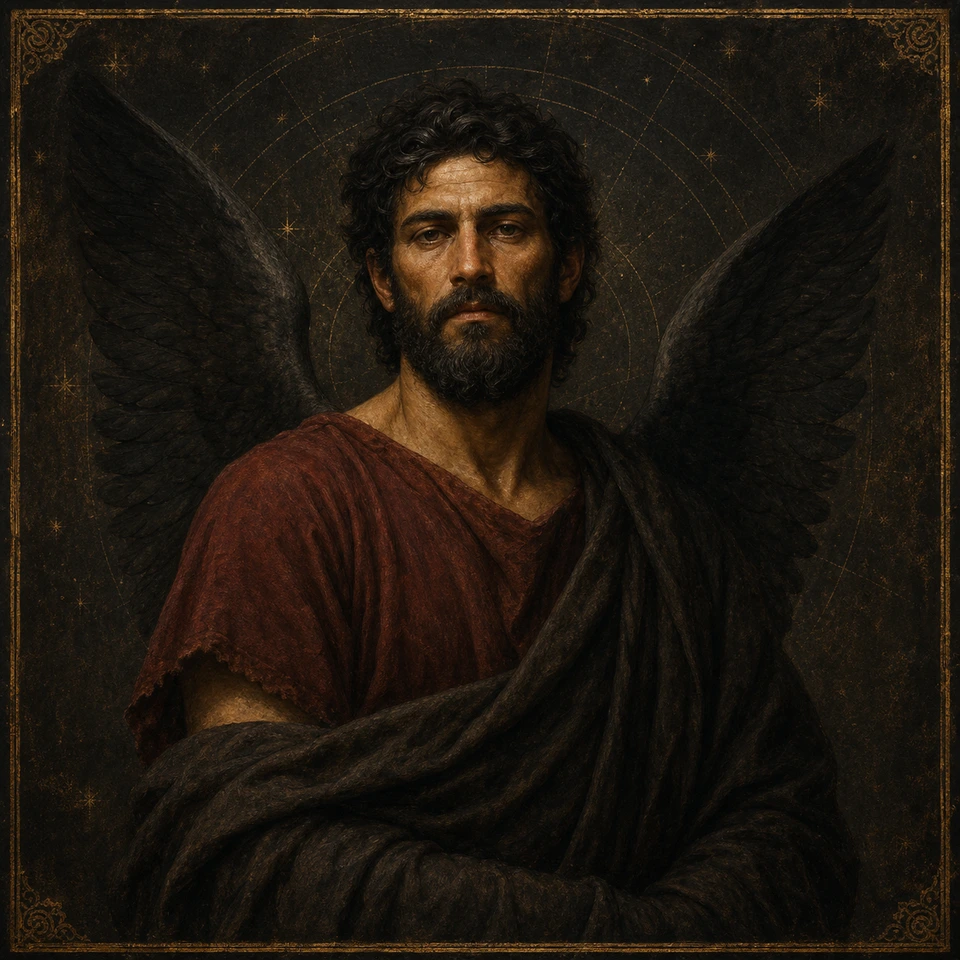
Moving with grim inevitability as the brother of Sleep and unyielding son of Night, Thanatos executes the absolute personification of death. His terrible duty stretches from bearing Sarpedon and claiming Alcestis to famously suffering capture by the cunning Sisyphus.
Overview
At Pherae, Apollo stands before Admetus’s house while a dark claimant approaches with a sword. Thanatos has come for Alcestis. She accepted death in her husband’s place, and the agreed hour has arrived. Apollo asks Death to wait and take an older person later. Thanatos refuses. The old, he says, bring him little honor. He enters to cut a lock of Alcestis’s hair and consecrate her to the powers below.
Euripides gives Death an argument, pride in his office, and the dignity of an opponent who cannot be bribed. The play also gives him one brutal defeat. Heracles plans to hide beside Alcestis’s tomb, seize Thanatos when he comes to the blood offering, lock both arms around him, and hold him through the struggle. When Alcestis returns veiled and silent, Heracles says that he fought the power who held her and won. Alcestis is surrendered under force, not granted willingly. Mortality has not been abolished; one hero has forced one exception.
Hesiod places Thanatos in a colder cosmic order. Night bears Death, Sleep, and the Dreams among a family of powers that press upon mortal life. Near Night’s remote house, Sleep and Death dwell beyond the Sun’s rays. Sleep travels peacefully over land and sea and is kindly to mortals. Death has an iron heart and bronze spirit. Once he takes someone, he does not let go. The brothers resemble each other at the threshold, but sleep returns its captives and death does not.
The Iliad gives finality a funerary duty. Patroclus kills Sarpedon, and Zeus does not reverse his son’s death. Apollo lifts the body from battle, washes away the blood, anoints it with ambrosia, and dresses it in immortal clothing. Hypnos and Thanatos then carry the Lycian prince home, where his people can raise mound and marker. Thanatos is not Sarpedon’s killer or judge. He is one of the swift bearers who restore the dead to kin and burial.
Another tradition imagines what happens when Death himself is captured. A story attributed to Pherecydes and preserved in the D scholia says that Zeus sends Thanatos after Sisyphus. The Corinthian sees him coming and binds him in powerful chains. No human being dies until the captive is freed. The release agent differs across modern editions of the difficult transmission. The ToposText translation names Hades, while A. H. Sommerstein’s translation prints Ares. The disagreement belongs in the story, because either reading makes the same terrible point: when Death is restrained, the mortal world breaks.
The ritual record splits. A fragment of Aeschylus’s lost *Niobe* says Death alone does not love gifts: sacrifice and libation cannot move him, he has no altar or hymn, and Persuasion stays away. A much later Orphic witness speaks differently. Thomas Taylor’s 1792 translation of Hymn LXXXVI, “To Death,” opens with a fumigation from manna. The prayer calls Death universal, beyond escape by sex or age, then asks him to delay and grant abundant old age. These witnesses cannot be melted into one timeless rite.
Classical painters gave Thanatos a human body and wings. A British Museum lekythos identifies the brothers lifting a warrior, perhaps Sarpedon, while preserving an earlier identification as Boreas and Zephyrus. A kantharos catalogue identifies bearded winged Thanatos bending to receive a dying youth behind an altar. Pausanias saw Sleep and Death together at Sparta and described Night holding the boys on the Chest of Cypselus at Olympia. These witnesses give no skull, skeleton, hood, scythe, or hourglass.
Greek fable transmission gives one final miniature. An exhausted old man calls Death, then recoils when Thanatos appears and asks only for help lifting his wood. Even suffering does not make the mortal eager to follow his own summons.
Greek Thanatos is not Hades, who governs the realm of the dead, nor Charon, who ferries them, nor Hypnos under a harsher name. He is Death made personal: Night’s son, Sleep’s brother, an unyielding taker in Hesiod, an honored bearer in Homer, the power Sisyphus chains, the armed claimant Heracles overpowers, the visitor the old man fears, and the divine person addressed by a prayer that knows no one escapes forever.
Canonical identity
Canonical Identity
Thanatos operates as Death actively embodied and named. Hesiod vividly details his character, ancestry, dwelling, and specific position among the children of Night. Even when Hesiod groups them within the same severe family, Thanatos remains strictly separate from Strife, Nemesis, Dreams, Sleep, the Keres, Fate, and Doom.
Linguistic Identity
Thanatos derives from the Greek Θάνατος. The LSJ documents the ordinary noun θάνατος with a short first alpha while also citing the personified figure alongside Hypnos. Combining LSJ's fixed vowel quantity and accent with Smyth's historical rules yields the qualified fifth-century Attic reconstruction /tʰá.na.tos/ (approximately THA-na-tos), featuring a raised pitch on the opening syllable. This specific ancient pronunciation completely invalidates any attempt to use the modern word "thanatos," a hooded skeleton, Hermes, Charon, Hades, or Roman Mors as alternate ancient names for this Greek figure.
Sources and evidence
SCHOLARLY INTERPRETATION · Supported
LSJ records θάνατος with short first alpha, masculine gender, and a distinct personified use beside Hypnos in Homer.
- Source
- Henry George Liddell and Robert Scott; Scaife ATLAS, θάνατος, LSJ entry
- Reviewed edition
- LSJ digital entry θάνατος, Scaife ATLAS URN lsj-n47876 · Tufts University
- Exact locator
- Entry θάνατος [θᾰ], ὁ · Section LSJ headword; Scaife ATLAS lsj-n47876 · RecordUrl https://atlas.perseus.tufts.edu/dictionaries/entry/urn%3Acite2%3Ascaife-viewer%3Adictionaries.v1%3Alsj-n47876/
- Scope
- Modern classical scholarship · Ancient Greece
- Authority
- historical lexicon
- Certainty
- High
The headword joins ordinary death and named Death without erasing the divine personification.
Open exact reviewed sourceSCHOLARLY INTERPRETATION · Supported
Smyth’s Attic sound and pitch rules support the qualified reconstruction /tʰá.na.tos/ when applied to LSJ θάνατος.
- Source
- Herbert Weir Smyth, A Greek Grammar for Colleges (1920)
- Reviewed edition
- Herbert Weir Smyth, A Greek Grammar for Colleges, American Book Company, 1920; Perseus text 1999.04.0007 · Perseus Digital Library
- Exact locator
- Entry A Greek Grammar for Colleges · Section §§1, 24, 150 · RecordUrl https://www.perseus.tufts.edu/hopper/text?doc=Perseus:text:1999.04.0007
- Scope
- Modern classical scholarship · Ancient Greece
- Authority
- historical grammar
- Certainty
- High
The readable guide marks the first-syllable raised pitch only approximately.
Open exact reviewed sourceTEXTUAL · Supported
Hesiod names Thanatos, Death, among the children born from Night without a partner.
- Source
- Hesiod; edited and translated by Hugh G. Evelyn-White, Theogony (1914)
- Reviewed edition
- Hugh G. Evelyn-White edition and English translation in Hesiod, the Homeric Hymns and Homerica, 1914 · translated by Hugh G. Evelyn-White · edited by Hugh G. Evelyn-White · Perseus Digital Library / Scaife ATLAS
- Exact locator
- Entry Theogony · Line 211-232
- Scope
- Archaic Greece · Ancient Greece
- Authority
- ancient literary witness
- Certainty
- High
Death remains distinct from Doom, Fate, Sleep, Dreams, Nemesis, and Strife.
Open exact reviewed sourceTEXTUAL · Supported
Hesiod contrasts Thanatos with kindly Hypnos even while the brothers share Night’s remote house.
- Source
- Hesiod; edited and translated by Hugh G. Evelyn-White, Theogony (1914)
- Reviewed edition
- Hugh G. Evelyn-White edition and English translation in Hesiod, the Homeric Hymns and Homerica, 1914 · translated by Hugh G. Evelyn-White · edited by Hugh G. Evelyn-White · Perseus Digital Library / Scaife ATLAS
- Exact locator
- Entry Theogony · Line 744-766
- Scope
- Archaic Greece · Ancient Greece
- Authority
- ancient literary witness
- Certainty
- High
Brotherhood establishes kinship, not interchangeability.
Open exact reviewed source3 reviewed sources for this section
- Henry George Liddell and Robert Scott; Scaife ATLAS, θάνατος, LSJ entryLSJ digital entry with exact headword, quantity, and cited personified use · Tufts University
- Herbert Weir Smyth, A Greek Grammar for Colleges (1920)American Book Company, 1920; Perseus text 1999.04.0007 · Perseus Digital Library
- Hesiod; edited and translated by Hugh G. Evelyn-White, Theogony (1914)Hesiod, the Homeric Hymns and Homerica, London and New York, 1914 · Perseus Digital Library / Scaife ATLAS
Culture, tradition, period, and place
Thanatos crosses several kinds of Greek evidence without belonging to one flat timeless setting. Archaic hexameter gives Night’s genealogy, the remote house beyond the Sun, and Sarpedon’s return to Lycia. Classical Athenian tragedy brings Death to Pherae, where he speaks with Apollo and claims Alcestis. Attic workshops painted a winged mature figure on vessels connected with death and burial.
Later witnesses look backward from different positions. The story attributed to fifth-century Pherecydes survives through a later D-scholion tradition and places Sisyphus’s return at Corinth. Pausanias, writing in the second century AD, saw paired images at Sparta and described the Chest of Cypselus at Olympia. The Orphic hymn collection is broadly late Hellenistic or Roman imperial in formation, while Taylor’s accessed translation is eighteenth-century English. Each date and place belongs to its own testimony.
Sources and evidence
TEXTUAL · Supported
Archaic Greek hexameter places Thanatos inside Night’s severe generation of personified powers.
- Source
- Hesiod; edited and translated by Hugh G. Evelyn-White, Theogony (1914)
- Reviewed edition
- Hugh G. Evelyn-White edition and English translation in Hesiod, the Homeric Hymns and Homerica, 1914 · translated by Hugh G. Evelyn-White · edited by Hugh G. Evelyn-White · Perseus Digital Library / Scaife ATLAS
- Exact locator
- Entry Theogony · Line 211-232
- Scope
- Archaic Greece · Ancient Greece
- Authority
- ancient literary witness
- Certainty
- High
The poem gives genealogy rather than a local sanctuary.
Open exact reviewed sourceTEXTUAL · Supported
The Iliad sends Thanatos and Hypnos from the Trojan battlefield to Lycia with Sarpedon’s body.
- Source
- Homer; Monro and Allen Greek edition with edition-specific translations, Iliad (1920)
- Reviewed edition
- A. T. Murray English translation, volumes I-II, 1924-1925 · translated by A. T. Murray · Perseus Digital Library / Scaife ATLAS
- Exact locator
- Entry Iliad · Book 16 · Line 480-505; 665-683
- Scope
- Archaic Greece · Lycia
- Authority
- ancient literary witness
- Certainty
- High
Lycia is the hero’s destination for burial, not a general cult center of Thanatos.
Open exact reviewed sourceTEXTUAL · Supported
Classical Athenian tragedy brings Thanatos to Pherae as an armed claimant speaking with Apollo.
- Source
- Euripides; translated by David Kovacs, Alcestis (1994)
- Reviewed edition
- David Kovacs English translation · translated by David Kovacs · edited by David Kovacs · Perseus Digital Library
- Exact locator
- Entry Alcestis · Line 24-76; 837-860; 1140-1143
- Scope
- Classical Greece · Pherae
- Authority
- ancient literary witness
- Certainty
- High
The Thessalian setting belongs to Euripides’ plot.
Open exact reviewed sourceMATERIAL CULTURE · Supported
An Attic white-ground lekythos of about 470-440 BC identifies winged Hypnos and Thanatos carrying a warrior.
- Source
- British Museum, British Museum Collection
- Reviewed edition
- British Museum Collection Online, lekythos 1884,0223.2 (D59) · Department of Greece and Rome, British Museum
- Exact locator
- MuseumObjectId 1884,0223.2 (D59) · Entry Official indexed object description; Sabouroff Painter; circa 470-440 BC · RecordUrl https://www.britishmuseum.org/collection/object/G_1884-0223-2
- Scope
- Classical Greece · Attica
- Authority
- institutional catalogue evidence
- Certainty
- High
The catalogue calls the warrior perhaps Sarpedon and preserves an earlier Boreas and Zephyrus identification.
Open exact reviewed sourceTEXTUAL · Supported
In the second century AD, Pausanias saw images of Sleep and Death near Aphrodite Ambologera at Sparta.
- Source
- Pausanias; Spiro Greek edition and Jones/Ormerod translation volumes, Description of Greece (1935)
- Reviewed edition
- W. H. S. Jones and H. A. Ormerod English translation volumes, 1918-1935 · translated by W. H. S. Jones and H. A. Ormerod, volume-dependent · Perseus Digital Library / Scaife ATLAS
- Exact locator
- Entry Description of Greece · Book 3 · Chapter 18 · Section 1
- Scope
- Greek religion under Roman imperial rule · Sparta
- Authority
- ancient sacred-landscape witness
- Certainty
- High
The brief notice places the brothers in a sacred civic landscape.
Open exact reviewed source5 reviewed sources for this section
- Hesiod; edited and translated by Hugh G. Evelyn-White, Theogony (1914)Hesiod, the Homeric Hymns and Homerica, London and New York, 1914 · Perseus Digital Library / Scaife ATLAS
- Homer; Monro and Allen Greek edition with edition-specific translations, Iliad (1920)Perseus CTS edition corpus; Greek edition, Oxford, 1908-1920 · Perseus Digital Library / Scaife ATLAS
- Euripides; translated by David Kovacs, Alcestis (1994)1994 translation hosted by the Perseus Digital Library · Perseus Digital Library
- British Museum, British Museum CollectionLive official museum collection · British Museum
- Pausanias; Spiro Greek edition and Jones/Ormerod translation volumes, Description of Greece (1935)Perseus CTS edition corpus, 1903-1935 · Perseus Digital Library / Scaife ATLAS
Historical development
The earliest surviving portrait is cosmic. Hesiod places Thanatos inside Night’s family, then gives him an iron heart, a bronze spirit, and a hold that does not loosen. Homer turns the same finality toward honorable burial when Thanatos and Hypnos carry Sarpedon home. The figure is not softened, but he can serve the dignity owed to the dead.
The attributed Pherecydes story tests the world without Death: Sisyphus binds him, no human dies, and another power must free him. Classical tragedy makes Death speak for himself. Euripides lets him reject Apollo’s plea, value the honor of a young death, and enter with a sword before Heracles later forces Alcestis from his grasp. Attic painters give him a mature bearded winged body. Pausanias preserves boyhood images in sacred landscapes, and the Orphic hymn adds direct invocation and a plea for delay. Greek fable transmission adds a smaller encounter: an exhausted old man calls Death, sees him appear, and asks only for help lifting his wood.
Sources and evidence
TEXTUAL · Supported
Hesiod gives Death an iron heart and bronze spirit and says that no one he seizes is released.
- Source
- Hesiod; edited and translated by Hugh G. Evelyn-White, Theogony (1914)
- Reviewed edition
- Hugh G. Evelyn-White edition and English translation in Hesiod, the Homeric Hymns and Homerica, 1914 · translated by Hugh G. Evelyn-White · edited by Hugh G. Evelyn-White · Perseus Digital Library / Scaife ATLAS
- Exact locator
- Entry Theogony · Line 744-766
- Scope
- Archaic Greece · Ancient Greece
- Authority
- ancient literary witness
- Certainty
- High
The contrast with Sleep creates an early moral and cosmic characterization.
Open exact reviewed sourceTEXTUAL · Supported
Homer gives Thanatos a solemn funerary task as one of Sarpedon’s twin bearers.
- Source
- Homer; Monro and Allen Greek edition with edition-specific translations, Iliad (1920)
- Reviewed edition
- A. T. Murray English translation, volumes I-II, 1924-1925 · translated by A. T. Murray · Perseus Digital Library / Scaife ATLAS
- Exact locator
- Entry Iliad · Book 16 · Line 480-505; 665-683
- Scope
- Archaic Greece · Lycia
- Authority
- ancient literary witness
- Certainty
- High
The bearer is neither killer nor judge in this episode.
Open exact reviewed sourceTEXTUAL · Supported
A story attributed to Pherecydes says Sisyphus binds Thanatos so that no human being dies until Death is freed.
- Source
- D Scholia to the Iliad; translated by R. Scott Smith et al.; Greek text edited by Helmut van Thiel, D Scholia to the Iliad, Mythological Narratives (2023)
- Reviewed edition
- R. Scott Smith et al. 2023 English translation of the D Scholia mythological narratives, with Helmut van Thiel 2014 Greek edition identified · translated by R. Scott Smith et al. · edited by R. Scott Smith; Greek edition by Helmut van Thiel · Greek Myth Lab, University of New Hampshire
- Exact locator
- Entry D Scholia to Iliad; Pherecydes fr. 119 Fowler · Section 6.153 · RecordUrl https://topostext.org/work/866
- Scope
- Classical Greece · Corinth
- Authority
- later scholion transmitting an attributed classical mythographic fragment
- Certainty
- High
The attributed classical story survives through a later scholion.
Open exact reviewed sourceTEXTUAL · Supported
Euripides makes Thanatos speak, defend his honor, enter with a sword, and suffer one forced release.
- Source
- Euripides; translated by David Kovacs, Alcestis (1994)
- Reviewed edition
- David Kovacs English translation · translated by David Kovacs · edited by David Kovacs · Perseus Digital Library
- Exact locator
- Entry Alcestis · Line 24-76; 837-860; 1140-1143
- Scope
- Classical Greece · Pherae
- Authority
- ancient literary witness
- Certainty
- High
The physical defeat remains a tragic exception.
Open exact reviewed sourceTEXTUAL · Supported
A fragment of Aeschylus’s lost Niobe says Thanatos alone rejects gifts, sacrifice, libation, altar, praise, and persuasion.
- Source
- Aeschylus; fragment preserved by Stobaeus; translated by Herbert Weir Smyth, Niobe fragment on Thanatos and gifts (1926)
- Reviewed edition
- Aeschylus, Volume II, translated by Herbert Weir Smyth, 1926, fragment 81 from Niobe · translated by Herbert Weir Smyth · edited by Herbert Weir Smyth · Loeb Classical Library
- Exact locator
- Entry Niobe fragment · Section Smyth fragment 81; Stobaeus Anthology 4.51.1 · RecordUrl https://www.theoi.com/Text/AeschylusFragments2.html
- Scope
- Classical Greece · Athens
- Authority
- fragment of a lost Greek tragedy preserved by later quotation
- Certainty
- High
The fragment survives through later quotation and belongs beside, not inside, the later Orphic hymn’s different ritual claim.
Open exact reviewed sourceMATERIAL CULTURE · Supported
An Attic red-figure kantharos of about 470-460 BC identifies a bearded winged Thanatos in a multi-figure death scene.
- Source
- British Museum, British Museum Collection
- Reviewed edition
- British Museum Collection Online, kantharos 1865,0103.23 (E155) · Department of Greece and Rome, British Museum
- Exact locator
- MuseumObjectId 1865,0103.23 (E155) · Entry Official indexed object description; Amphitrite Painter; circa 470-460 BC · RecordUrl https://www.britishmuseum.org/collection/object/G_1865-0103-23
- Scope
- Classical Greece · Attica
- Authority
- institutional catalogue evidence
- Certainty
- High
The official indexed description, not an independently inspected photograph, establishes the catalogue details.
Open exact reviewed sourceTEXTUAL · Supported
Taylor’s 1792 translation preserves an Orphic hymn that directly addresses Death and asks him to spare life into old age.
- Source
- Anonymous Orphic hymn poet; translated by Thomas Taylor, The Hymns of Orpheus (1792)
- Reviewed edition
- The Hymns of Orpheus, Thomas Taylor English translation, 1792 · translated by Thomas Taylor · Internet Archive
- Exact locator
- Entry Hymn LXXXVI, To Death · Page 225-227 · RecordUrl https://archive.org/download/dli.ministry.28841/16922.3759-The%2520Hymns%2520of%2520Orpheus%2520With%2520a%2520Preliminary%2520Dissertation%2520on%2520The%2520Life%2520and%2520Theology%2520of%2520Orpheusand_djvu.txt
- Scope
- Greek religion under Roman imperial rule · Ancient Greece
- Authority
- ancient ritual hymn in historical English translation
- Certainty
- High
The hymn adds ritual address without dating every element more narrowly than the collection permits.
Open exact reviewed sourceTEXTUAL · Supported
Chambry 78 preserves a Greek fable in which an exhausted old man summons Death, then asks only for help lifting his burden.
- Source
- Anonymous Greek fable tradition; edited by Émile Chambry; digital edition by Chloé Laruelle and Sorbonne Université, Aesopi Fabulae (2019)
- Reviewed edition
- Émile Chambry, Aesopi Fabulae, 1925-1926; Sorbonne Université Labex OBVIL digital edition, 2019 · edited by Émile Chambry; digital edition by Chloé Laruelle · Sorbonne Université
- Exact locator
- Entry Aesopi Fabulae · Section Chambry 78 = Perry 60, Γέρων καὶ θάνατος · RecordUrl https://obtic.huma-num.fr/obvil-web/corpus/fabula-numerica/anonymes_chambry
- Scope
- Modern classical scholarship · Ancient Greece
- Authority
- anonymous Greek fable in a modern critical edition
- Certainty
- High
The anonymous tale’s date is not narrowed to the lifetime traditionally assigned to Aesop.
Open exact reviewed source8 reviewed sources for this section
- Hesiod; edited and translated by Hugh G. Evelyn-White, Theogony (1914)Hesiod, the Homeric Hymns and Homerica, London and New York, 1914 · Perseus Digital Library / Scaife ATLAS
- Homer; Monro and Allen Greek edition with edition-specific translations, Iliad (1920)Perseus CTS edition corpus; Greek edition, Oxford, 1908-1920 · Perseus Digital Library / Scaife ATLAS
- D Scholia to the Iliad; translated by R. Scott Smith et al.; Greek text edited by Helmut van Thiel, D Scholia to the Iliad, Mythological Narratives (2023)2023 English translation with 2014 Greek text edition identified by ToposText · Greek Myth Lab, University of New Hampshire
- Euripides; translated by David Kovacs, Alcestis (1994)1994 translation hosted by the Perseus Digital Library · Perseus Digital Library
- Aeschylus; fragment preserved by Stobaeus; translated by Herbert Weir Smyth, Niobe fragment on Thanatos and gifts (1926)Herbert Weir Smyth, Aeschylus, Volume II, 1926, fragment 81 · Loeb Classical Library
- British Museum, British Museum CollectionLive official museum collection · British Museum
- Anonymous Orphic hymn poet; translated by Thomas Taylor, The Hymns of Orpheus (1792)Thomas Taylor English translation, 1792 · Internet Archive
- Anonymous Greek fable tradition; edited by Émile Chambry; digital edition by Chloé Laruelle and Sorbonne Université, Aesopi Fabulae (2019)Émile Chambry Greek edition, 1925-1926; Sorbonne Université digital edition, 2019 · Sorbonne Université
Attested roles and historical themes
Roles, powers, and limits
Thanatos embodies the final taking of life, not government of the underworld. Hesiod’s metal imagery expresses an unyielding boundary. The Sisyphus story proves the scale of that office by suspending all human death while Thanatos is chained. The Orphic hymn likewise addresses a power whose reach extends across sex, age, and mortal strength, though the worshipper still asks him to wait.
Other works give narrower acts. In the Iliad he is a bearer after death, returning Sarpedon to Lycia with Hypnos. In Alcestis he arrives as an armed claimant and prepares to cut the consecrating lock of hair. Heracles can ambush and overpower him, but only inside this exceptional tragedy and only through sustained force. Thanatos’s defeat preserves his dignity because the play does not make surrender easy, willing, or permanent.
Sources and evidence
TEXTUAL · Supported
Thanatos embodies the hold from which ordinary mortals do not return.
- Source
- Hesiod; edited and translated by Hugh G. Evelyn-White, Theogony (1914)
- Reviewed edition
- Hugh G. Evelyn-White edition and English translation in Hesiod, the Homeric Hymns and Homerica, 1914 · translated by Hugh G. Evelyn-White · edited by Hugh G. Evelyn-White · Perseus Digital Library / Scaife ATLAS
- Exact locator
- Entry Theogony · Line 744-766
- Scope
- Archaic Greece · Ancient Greece
- Authority
- ancient literary witness
- Certainty
- High
Hesiod does not make him ruler of Hades or judge of souls.
Open exact reviewed sourceTEXTUAL · Supported
Thanatos shares the honorable return of Sarpedon with Hypnos after Apollo prepares the body.
- Source
- Homer; Monro and Allen Greek edition with edition-specific translations, Iliad (1920)
- Reviewed edition
- A. T. Murray English translation, volumes I-II, 1924-1925 · translated by A. T. Murray · Perseus Digital Library / Scaife ATLAS
- Exact locator
- Entry Iliad · Book 16 · Line 480-505; 665-683
- Scope
- Archaic Greece · Lycia
- Authority
- ancient literary witness
- Certainty
- High
The brothers carry the dead hero to kin and burial.
Open exact reviewed sourceTEXTUAL · Supported
Thanatos comes with a sword to consecrate Alcestis for the dead, then Heracles restrains him until she is surrendered.
- Source
- Euripides; translated by David Kovacs, Alcestis (1994)
- Reviewed edition
- David Kovacs English translation · translated by David Kovacs · edited by David Kovacs · Perseus Digital Library
- Exact locator
- Entry Alcestis · Line 24-76; 837-860; 1140-1143
- Scope
- Classical Greece · Pherae
- Authority
- ancient literary witness
- Certainty
- High
Release is compelled by physical force, not given willingly.
Open exact reviewed sourceTEXTUAL · Supported
When Sisyphus binds Death, mortality stops for everyone until the captive power is released.
- Source
- D Scholia to the Iliad; translated by R. Scott Smith et al.; Greek text edited by Helmut van Thiel, D Scholia to the Iliad, Mythological Narratives (2023)
- Reviewed edition
- R. Scott Smith et al. 2023 English translation of the D Scholia mythological narratives, with Helmut van Thiel 2014 Greek edition identified · translated by R. Scott Smith et al. · edited by R. Scott Smith; Greek edition by Helmut van Thiel · Greek Myth Lab, University of New Hampshire
- Exact locator
- Entry D Scholia to Iliad; Pherecydes fr. 119 Fowler · Section 6.153 · RecordUrl https://topostext.org/work/866
- Scope
- Classical Greece · Corinth
- Authority
- later scholion transmitting an attributed classical mythographic fragment
- Certainty
- High
The story magnifies Thanatos’s cosmic necessity through his temporary restraint.
Open exact reviewed sourceTEXTUAL · Supported
The Orphic hymn calls Death universal and unavoidable, yet petitions him to delay his arrival.
- Source
- Anonymous Orphic hymn poet; translated by Thomas Taylor, The Hymns of Orpheus (1792)
- Reviewed edition
- The Hymns of Orpheus, Thomas Taylor English translation, 1792 · translated by Thomas Taylor · Internet Archive
- Exact locator
- Entry Hymn LXXXVI, To Death · Page 225-227 · RecordUrl https://archive.org/download/dli.ministry.28841/16922.3759-The%2520Hymns%2520of%2520Orpheus%2520With%2520a%2520Preliminary%2520Dissertation%2520on%2520The%2520Life%2520and%2520Theology%2520of%2520Orpheusand_djvu.txt
- Scope
- Greek religion under Roman imperial rule · Ancient Greece
- Authority
- ancient ritual hymn in historical English translation
- Certainty
- High
The prayer recognizes power without claiming permanent immunity.
Open exact reviewed source5 reviewed sources for this section
- Hesiod; edited and translated by Hugh G. Evelyn-White, Theogony (1914)Hesiod, the Homeric Hymns and Homerica, London and New York, 1914 · Perseus Digital Library / Scaife ATLAS
- Homer; Monro and Allen Greek edition with edition-specific translations, Iliad (1920)Perseus CTS edition corpus; Greek edition, Oxford, 1908-1920 · Perseus Digital Library / Scaife ATLAS
- Euripides; translated by David Kovacs, Alcestis (1994)1994 translation hosted by the Perseus Digital Library · Perseus Digital Library
- D Scholia to the Iliad; translated by R. Scott Smith et al.; Greek text edited by Helmut van Thiel, D Scholia to the Iliad, Mythological Narratives (2023)2023 English translation with 2014 Greek text edition identified by ToposText · Greek Myth Lab, University of New Hampshire
- Anonymous Orphic hymn poet; translated by Thomas Taylor, The Hymns of Orpheus (1792)Thomas Taylor English translation, 1792 · Internet Archive
Epithets and titles
No securely bounded cult epithet for Thanatos is established by these witnesses; ordinary descriptions are not treated as titles.
4 reviewed sources for this section
- Hesiod; edited and translated by Hugh G. Evelyn-White, Theogony (1914)Hesiod, the Homeric Hymns and Homerica, London and New York, 1914 · Perseus Digital Library / Scaife ATLAS
- Homer; Monro and Allen Greek edition with edition-specific translations, Iliad (1920)Perseus CTS edition corpus; Greek edition, Oxford, 1908-1920 · Perseus Digital Library / Scaife ATLAS
- Euripides; translated by David Kovacs, Alcestis (1994)1994 translation hosted by the Perseus Digital Library · Perseus Digital Library
- Pausanias; Spiro Greek edition and Jones/Ormerod translation volumes, Description of Greece (1935)Perseus CTS edition corpus, 1903-1935 · Perseus Digital Library / Scaife ATLAS
Worship and cult
Pausanias saw Sleep and Death together near Aphrodite Ambologera at Sparta. The paired images place Thanatos in a public sacred landscape, not merely in a poem. The short notice gives no separate temple, priesthood, sacrifice, or ceremonial rule for approaching them.
Aeschylus’s lost *Niobe* leaves a harder statement through Stobaeus: Death alone rejects gifts, sacrifice, libation, altar, praise, and persuasion. The later Orphic hymn does not agree. Taylor’s Hymn LXXXVI directly addresses Death, names manna as the fumigation, describes his universal reach, and asks him to spare human life into abundant age. The dramatic denial and the later ritual prescription remain side by side. Neither can stand for every Greek place or century. A white-ground lekythos provides funerary material culture with Thanatos and Hypnos, but the vessel yields no words spoken before it.
Sources and evidence
TEXTUAL · Supported
The Spartan images place Thanatos beside Hypnos in a public sacred setting near Aphrodite Ambologera.
- Source
- Pausanias; Spiro Greek edition and Jones/Ormerod translation volumes, Description of Greece (1935)
- Reviewed edition
- W. H. S. Jones and H. A. Ormerod English translation volumes, 1918-1935 · translated by W. H. S. Jones and H. A. Ormerod, volume-dependent · Perseus Digital Library / Scaife ATLAS
- Exact locator
- Entry Description of Greece · Book 3 · Chapter 18 · Section 1
- Scope
- Greek religion under Roman imperial rule · Sparta
- Authority
- ancient sacred-landscape witness
- Certainty
- High
Pausanias names no separate Thanatos temple, priesthood, or sacrifice there.
Open exact reviewed sourceTEXTUAL · Supported
Aeschylus’s Niobe fragment presents Death as the one god beyond gifts, sacrifice, libation, altar, hymn, and persuasion.
- Source
- Aeschylus; fragment preserved by Stobaeus; translated by Herbert Weir Smyth, Niobe fragment on Thanatos and gifts (1926)
- Reviewed edition
- Aeschylus, Volume II, translated by Herbert Weir Smyth, 1926, fragment 81 from Niobe · translated by Herbert Weir Smyth · edited by Herbert Weir Smyth · Loeb Classical Library
- Exact locator
- Entry Niobe fragment · Section Smyth fragment 81; Stobaeus Anthology 4.51.1 · RecordUrl https://www.theoi.com/Text/AeschylusFragments2.html
- Scope
- Classical Greece · Athens
- Authority
- fragment of a lost Greek tragedy preserved by later quotation
- Certainty
- High
The dramatic statement is not silently harmonized with the later Orphic hymn’s direct ritual address.
Open exact reviewed sourceTEXTUAL · Supported
The hymn to Death opens with a stated fumigation from manna and closes with a petition for abundant old age.
- Source
- Anonymous Orphic hymn poet; translated by Thomas Taylor, The Hymns of Orpheus (1792)
- Reviewed edition
- The Hymns of Orpheus, Thomas Taylor English translation, 1792 · translated by Thomas Taylor · Internet Archive
- Exact locator
- Entry Hymn LXXXVI, To Death · Page 225-227 · RecordUrl https://archive.org/download/dli.ministry.28841/16922.3759-The%2520Hymns%2520of%2520Orpheus%2520With%2520a%2520Preliminary%2520Dissertation%2520on%2520The%2520Life%2520and%2520Theology%2520of%2520Orpheusand_djvu.txt
- Scope
- Greek religion under Roman imperial rule · Ancient Greece
- Authority
- ancient ritual hymn in historical English translation
- Certainty
- High
The evidence is a bounded hymn prescription, not a universal Greek rite.
Open exact reviewed sourceMATERIAL CULTURE · Supported
The British Museum lekythos preserves Thanatos and Hypnos on an Attic funerary vessel.
- Source
- British Museum, British Museum Collection
- Reviewed edition
- British Museum Collection Online, lekythos 1884,0223.2 (D59) · Department of Greece and Rome, British Museum
- Exact locator
- MuseumObjectId 1884,0223.2 (D59) · Entry Official indexed object description; Sabouroff Painter; circa 470-440 BC · RecordUrl https://www.britishmuseum.org/collection/object/G_1884-0223-2
- Scope
- Classical Greece · Attica
- Authority
- institutional catalogue evidence
- Certainty
- High
The object record gives no spoken prayer or offering formula.
Open exact reviewed source4 reviewed sources for this section
- Pausanias; Spiro Greek edition and Jones/Ormerod translation volumes, Description of Greece (1935)Perseus CTS edition corpus, 1903-1935 · Perseus Digital Library / Scaife ATLAS
- Aeschylus; fragment preserved by Stobaeus; translated by Herbert Weir Smyth, Niobe fragment on Thanatos and gifts (1926)Herbert Weir Smyth, Aeschylus, Volume II, 1926, fragment 81 · Loeb Classical Library
- Anonymous Orphic hymn poet; translated by Thomas Taylor, The Hymns of Orpheus (1792)Thomas Taylor English translation, 1792 · Internet Archive
- British Museum, British Museum CollectionLive official museum collection · British Museum
Temples, sanctuaries, and sacred places
Sparta gives the firmest located sacred presence. Pausanias places the images of Sleep and Death near Aphrodite Ambologera, though he does not call the spot a sanctuary owned by Thanatos. Olympia gives another sacred setting because the Chest of Cypselus stood in Hera’s temple and showed Night holding her sons.
The other locations belong to narrative or production history. Lycia receives Sarpedon for burial. Pherae contains Admetus’s house and Alcestis’s tomb. Corinth receives Sisyphus after his escape. Night’s remote house lies beyond ordinary geography, and Attica is the workshop region of the classical vessels. Tomb, city, workshop, poetic edge of the world, and sanctuary are not interchangeable. No independent temple of Thanatos emerges from the named evidence.
Sources and evidence
TEXTUAL · Supported
Sparta gives the firmest located sacred presence for Thanatos through the paired images near Aphrodite Ambologera.
- Source
- Pausanias; Spiro Greek edition and Jones/Ormerod translation volumes, Description of Greece (1935)
- Reviewed edition
- W. H. S. Jones and H. A. Ormerod English translation volumes, 1918-1935 · translated by W. H. S. Jones and H. A. Ormerod, volume-dependent · Perseus Digital Library / Scaife ATLAS
- Exact locator
- Entry Description of Greece · Book 3 · Chapter 18 · Section 1
- Scope
- Greek religion under Roman imperial rule · Sparta
- Authority
- ancient sacred-landscape witness
- Certainty
- High
The passage does not call the place a sanctuary belonging to Death.
Open exact reviewed sourceMATERIAL CULTURE · Supported
At Olympia, the Chest of Cypselus stood in Hera’s temple and showed Night holding Sleep and Death as boys.
- Source
- Pausanias; Spiro Greek edition and Jones/Ormerod translation volumes, Description of Greece (1935)
- Reviewed edition
- W. H. S. Jones and H. A. Ormerod English translation volumes, 1918-1935 · translated by W. H. S. Jones and H. A. Ormerod, volume-dependent · Perseus Digital Library / Scaife ATLAS
- Exact locator
- Entry Description of Greece · Book 5 · Chapter 18 · Section 1
- Scope
- Greek religion under Roman imperial rule · Olympia
- Authority
- ancient monument description
- Certainty
- High
The monument belongs to Hera’s sanctuary setting.
Open exact reviewed sourceTEXTUAL · Supported
Pherae and Alcestis’s tomb are dramatic locations where Thanatos claims and loses one life.
- Source
- Euripides; translated by David Kovacs, Alcestis (1994)
- Reviewed edition
- David Kovacs English translation · translated by David Kovacs · edited by David Kovacs · Perseus Digital Library
- Exact locator
- Entry Alcestis · Line 24-76; 837-860; 1140-1143
- Scope
- Classical Greece · Pherae
- Authority
- ancient literary witness
- Certainty
- High
The play does not turn every tomb into a Thanatos sanctuary.
Open exact reviewed sourceTEXTUAL · Supported
Corinth is the human city to which Sisyphus returns after escaping death in the Pherecydes tradition.
- Source
- D Scholia to the Iliad; translated by R. Scott Smith et al.; Greek text edited by Helmut van Thiel, D Scholia to the Iliad, Mythological Narratives (2023)
- Reviewed edition
- R. Scott Smith et al. 2023 English translation of the D Scholia mythological narratives, with Helmut van Thiel 2014 Greek edition identified · translated by R. Scott Smith et al. · edited by R. Scott Smith; Greek edition by Helmut van Thiel · Greek Myth Lab, University of New Hampshire
- Exact locator
- Entry D Scholia to Iliad; Pherecydes fr. 119 Fowler · Section 6.153 · RecordUrl https://topostext.org/work/866
- Scope
- Classical Greece · Corinth
- Authority
- later scholion transmitting an attributed classical mythographic fragment
- Certainty
- High
The city is a mythic location in this account, not a Thanatos cult center.
Open exact reviewed source3 reviewed sources for this section
- Pausanias; Spiro Greek edition and Jones/Ormerod translation volumes, Description of Greece (1935)Perseus CTS edition corpus, 1903-1935 · Perseus Digital Library / Scaife ATLAS
- Euripides; translated by David Kovacs, Alcestis (1994)1994 translation hosted by the Perseus Digital Library · Perseus Digital Library
- D Scholia to the Iliad; translated by R. Scott Smith et al.; Greek text edited by Helmut van Thiel, D Scholia to the Iliad, Mythological Narratives (2023)2023 English translation with 2014 Greek text edition identified by ToposText · Greek Myth Lab, University of New Hampshire
Festivals and processions
No named annual festival or procession devoted to Thanatos appears in the located notices. Pausanias records the Spartan images without a calendar. The Orphic hymn gives an invocation and a fumigation, but it does not name a civic feast, month, recurring procession, or body of officials.
Sarpedon’s movement to Lycia is divine funerary transport inside epic, not a festival parade. Alcestis’s burial belongs to one tragic household, and Sisyphus’s chains belong to a myth of disrupted mortality. These scenes may carry ritual weight without becoming annual observances. A secure festival would require a dated calendar, inscription, or literary notice that actually names it.
Sources and evidence
TEXTUAL · Supported
Pausanias names the Spartan images without recording an annual festival or procession for Thanatos.
- Source
- Pausanias; Spiro Greek edition and Jones/Ormerod translation volumes, Description of Greece (1935)
- Reviewed edition
- W. H. S. Jones and H. A. Ormerod English translation volumes, 1918-1935 · translated by W. H. S. Jones and H. A. Ormerod, volume-dependent · Perseus Digital Library / Scaife ATLAS
- Exact locator
- Entry Description of Greece · Book 3 · Chapter 18 · Section 1
- Scope
- Greek religion under Roman imperial rule · Sparta
- Authority
- ancient sacred-landscape witness
- Certainty
- High
The sacred setting cannot supply an absent calendar.
Open exact reviewed sourceTEXTUAL · Supported
The hymn gives an invocation and fumigation but no festival name, civic procession, or annual date.
- Source
- Anonymous Orphic hymn poet; translated by Thomas Taylor, The Hymns of Orpheus (1792)
- Reviewed edition
- The Hymns of Orpheus, Thomas Taylor English translation, 1792 · translated by Thomas Taylor · Internet Archive
- Exact locator
- Entry Hymn LXXXVI, To Death · Page 225-227 · RecordUrl https://archive.org/download/dli.ministry.28841/16922.3759-The%2520Hymns%2520of%2520Orpheus%2520With%2520a%2520Preliminary%2520Dissertation%2520on%2520The%2520Life%2520and%2520Theology%2520of%2520Orpheusand_djvu.txt
- Scope
- Greek religion under Roman imperial rule · Ancient Greece
- Authority
- ancient ritual hymn in historical English translation
- Certainty
- High
A ritual text and a festival calendar are different forms of evidence.
Open exact reviewed source2 reviewed sources for this section
- Pausanias; Spiro Greek edition and Jones/Ormerod translation volumes, Description of Greece (1935)Perseus CTS edition corpus, 1903-1935 · Perseus Digital Library / Scaife ATLAS
- Anonymous Orphic hymn poet; translated by Thomas Taylor, The Hymns of Orpheus (1792)Thomas Taylor English translation, 1792 · Internet Archive
Offerings, votives, and ritual evidence
Aeschylus’s *Niobe* fragment declares that sacrifice and libation avail nothing with Thanatos, who has no altar or praise hymn. The later Orphic witness preserves a different ritual voice. Taylor’s translation of Hymn LXXXVI begins with the instruction “fumigation from manna.” That is the only directly named substance offered in the evidence gathered here. It belongs to a specific hymn, numbering system, translation, and broadly dated collection. The same prayer asks Death to grant abundant old age.
Other materials belong to stories of death rather than offerings made to Thanatos. Euripides gives him a sword to cut Alcestis’s hair and mark her for the powers below. Apollo washes, anoints, and clothes Sarpedon before the twin bearers carry him home. White-ground funerary ceramic preserves the brothers’ image. None of those acts becomes a human recipe, and the ancient scenes do not authorize dangerous imitation.
Sources and evidence
TEXTUAL · Supported
Taylor’s Hymn LXXXVI assigns a manna fumigation to the address to Death.
- Source
- Anonymous Orphic hymn poet; translated by Thomas Taylor, The Hymns of Orpheus (1792)
- Reviewed edition
- The Hymns of Orpheus, Thomas Taylor English translation, 1792 · translated by Thomas Taylor · Internet Archive
- Exact locator
- Entry Hymn LXXXVI, To Death · Page 225-227 · RecordUrl https://archive.org/download/dli.ministry.28841/16922.3759-The%2520Hymns%2520of%2520Orpheus%2520With%2520a%2520Preliminary%2520Dissertation%2520on%2520The%2520Life%2520and%2520Theology%2520of%2520Orpheusand_djvu.txt
- Scope
- Greek religion under Roman imperial rule · Ancient Greece
- Authority
- ancient ritual hymn in historical English translation
- Certainty
- High
The wording belongs to this historical translation and hymn.
Open exact reviewed sourceTEXTUAL · Supported
The earlier dramatic fragment says sacrifice and libation cannot move Thanatos and denies him an altar or praise hymn.
- Source
- Aeschylus; fragment preserved by Stobaeus; translated by Herbert Weir Smyth, Niobe fragment on Thanatos and gifts (1926)
- Reviewed edition
- Aeschylus, Volume II, translated by Herbert Weir Smyth, 1926, fragment 81 from Niobe · translated by Herbert Weir Smyth · edited by Herbert Weir Smyth · Loeb Classical Library
- Exact locator
- Entry Niobe fragment · Section Smyth fragment 81; Stobaeus Anthology 4.51.1 · RecordUrl https://www.theoi.com/Text/AeschylusFragments2.html
- Scope
- Classical Greece · Athens
- Authority
- fragment of a lost Greek tragedy preserved by later quotation
- Certainty
- High
The later Orphic fumigation remains a distinct witness rather than proof that the earlier claim was universally false.
Open exact reviewed sourceTEXTUAL · Supported
Thanatos says his sword will cut a lock of Alcestis’s hair and consecrate her to the powers below.
- Source
- Euripides; translated by David Kovacs, Alcestis (1994)
- Reviewed edition
- David Kovacs English translation · translated by David Kovacs · edited by David Kovacs · Perseus Digital Library
- Exact locator
- Entry Alcestis · Line 24-76; 837-860; 1140-1143
- Scope
- Classical Greece · Pherae
- Authority
- ancient literary witness
- Certainty
- High
The dramatic act marks death’s claim and is not a modern instruction.
Open exact reviewed sourceTEXTUAL · Supported
Apollo washes, anoints, and clothes Sarpedon before the twin brothers carry him away.
- Source
- Homer; Monro and Allen Greek edition with edition-specific translations, Iliad (1920)
- Reviewed edition
- A. T. Murray English translation, volumes I-II, 1924-1925 · translated by A. T. Murray · Perseus Digital Library / Scaife ATLAS
- Exact locator
- Entry Iliad · Book 16 · Line 480-505; 665-683
- Scope
- Archaic Greece · Lycia
- Authority
- ancient literary witness
- Certainty
- High
Divine care for a heroic corpse is not a human offering to Thanatos.
Open exact reviewed sourceMATERIAL CULTURE · Supported
The white-ground lekythos is funerary material culture bearing the paired image of Sleep and Death.
- Source
- British Museum, British Museum Collection
- Reviewed edition
- British Museum Collection Online, lekythos 1884,0223.2 (D59) · Department of Greece and Rome, British Museum
- Exact locator
- MuseumObjectId 1884,0223.2 (D59) · Entry Official indexed object description; Sabouroff Painter; circa 470-440 BC · RecordUrl https://www.britishmuseum.org/collection/object/G_1884-0223-2
- Scope
- Classical Greece · Attica
- Authority
- institutional catalogue evidence
- Certainty
- High
Its catalogue record does not establish what worshippers said or gave to Thanatos.
Open exact reviewed source5 reviewed sources for this section
- Anonymous Orphic hymn poet; translated by Thomas Taylor, The Hymns of Orpheus (1792)Thomas Taylor English translation, 1792 · Internet Archive
- Aeschylus; fragment preserved by Stobaeus; translated by Herbert Weir Smyth, Niobe fragment on Thanatos and gifts (1926)Herbert Weir Smyth, Aeschylus, Volume II, 1926, fragment 81 · Loeb Classical Library
- Euripides; translated by David Kovacs, Alcestis (1994)1994 translation hosted by the Perseus Digital Library · Perseus Digital Library
- Homer; Monro and Allen Greek edition with edition-specific translations, Iliad (1920)Perseus CTS edition corpus; Greek edition, Oxford, 1908-1920 · Perseus Digital Library / Scaife ATLAS
- British Museum, British Museum CollectionLive official museum collection · British Museum
Iconography and material culture
The strongest material form is winged and human. British Museum object 1884,0223.2 is an Attic white-ground lekythos attributed to the Sabouroff Painter. Its catalogue identifies mature bearded Thanatos beside youthful Hypnos as they lift a warrior, perhaps Sarpedon, while preserving an earlier Boreas and Zephyrus identification. British Museum object 1865,0103.23 is a kantharos attributed to the Amphitrite Painter; its catalogue identifies bearded winged Thanatos bending to receive a dying youth behind an altar.
Pausanias describes a different inherited image on the Chest of Cypselus: Night holds Sleep and Death as boys, one white and one black, with identifying inscriptions. His wording does not safely assign either color to either brother. The sword belongs specifically to Alcestis. Skull, skeleton, hood, scythe, and hourglass belong to none of these Greek witnesses.
Sources and evidence
MATERIAL CULTURE · Supported
The lekythos catalogue distinguishes mature bearded Thanatos from youthful Hypnos while the brothers lift a warrior.
- Source
- British Museum, British Museum Collection
- Reviewed edition
- British Museum Collection Online, lekythos 1884,0223.2 (D59) · Department of Greece and Rome, British Museum
- Exact locator
- MuseumObjectId 1884,0223.2 (D59) · Entry Official indexed object description; Sabouroff Painter; circa 470-440 BC · RecordUrl https://www.britishmuseum.org/collection/object/G_1884-0223-2
- Scope
- Classical Greece · Attica
- Authority
- institutional catalogue evidence
- Certainty
- High
The warrior remains only perhaps Sarpedon in the museum’s identification.
Open exact reviewed sourceMATERIAL CULTURE · Supported
The kantharos catalogue identifies bearded winged Thanatos bending to receive a dying youth behind an altar.
- Source
- British Museum, British Museum Collection
- Reviewed edition
- British Museum Collection Online, kantharos 1865,0103.23 (E155) · Department of Greece and Rome, British Museum
- Exact locator
- MuseumObjectId 1865,0103.23 (E155) · Entry Official indexed object description; Amphitrite Painter; circa 470-460 BC · RecordUrl https://www.britishmuseum.org/collection/object/G_1865-0103-23
- Scope
- Classical Greece · Attica
- Authority
- institutional catalogue evidence
- Certainty
- High
Hypnos is absent, but Thanatos is not the only figure in the scene.
Open exact reviewed sourceMATERIAL CULTURE · Supported
Pausanias describes Night holding white and black boys named Sleep and Death on the Chest of Cypselus.
- Source
- Pausanias; Spiro Greek edition and Jones/Ormerod translation volumes, Description of Greece (1935)
- Reviewed edition
- W. H. S. Jones and H. A. Ormerod English translation volumes, 1918-1935 · translated by W. H. S. Jones and H. A. Ormerod, volume-dependent · Perseus Digital Library / Scaife ATLAS
- Exact locator
- Entry Description of Greece · Book 5 · Chapter 18 · Section 1
- Scope
- Greek religion under Roman imperial rule · Olympia
- Authority
- ancient monument description
- Certainty
- High
His wording does not securely assign either color to one named brother.
Open exact reviewed sourceTEXTUAL · Supported
The sword belongs to Thanatos’s entrance and intended cutting of Alcestis’s hair in Euripides.
- Source
- Euripides; translated by David Kovacs, Alcestis (1994)
- Reviewed edition
- David Kovacs English translation · translated by David Kovacs · edited by David Kovacs · Perseus Digital Library
- Exact locator
- Entry Alcestis · Line 24-76; 837-860; 1140-1143
- Scope
- Classical Greece · Pherae
- Authority
- ancient literary witness
- Certainty
- High
It is a scene-bound attribute, not a general ritual tool.
Open exact reviewed source3 reviewed sources for this section
- British Museum, British Museum CollectionLive official museum collection · British Museum
- Pausanias; Spiro Greek edition and Jones/Ormerod translation volumes, Description of Greece (1935)Perseus CTS edition corpus, 1903-1935 · Perseus Digital Library / Scaife ATLAS
- Euripides; translated by David Kovacs, Alcestis (1994)1994 translation hosted by the Perseus Digital Library · Perseus Digital Library
Animals, plants, and embodied forms
Thanatos’s wings are part of a divine human body in Classical art. They do not establish an eagle, owl, raven, butterfly, or any other sacred species. The kantharos catalogue gives a mature bearded winged man. The lekythos gives winged brothers carrying a warrior. Pausanias preserves a boyhood form held by Night.
No animal transformation occurs in these accounts, and no plant is assigned to Thanatos. Feathers, funerary use, black and white contrast, and a vessel’s painted surface do not create animal or botanical correspondences. The Orphic hymn’s manna fumigation is a named ritual substance in one hymn, not evidence that a plant species was his embodied form or universal sacred plant.
Sources and evidence
MATERIAL CULTURE · Supported
The kantharos catalogue gives Thanatos a mature bearded human body and wings.
- Source
- British Museum, British Museum Collection
- Reviewed edition
- British Museum Collection Online, kantharos 1865,0103.23 (E155) · Department of Greece and Rome, British Museum
- Exact locator
- MuseumObjectId 1865,0103.23 (E155) · Entry Official indexed object description; Amphitrite Painter; circa 470-460 BC · RecordUrl https://www.britishmuseum.org/collection/object/G_1865-0103-23
- Scope
- Classical Greece · Attica
- Authority
- institutional catalogue evidence
- Certainty
- High
Wings do not identify a sacred bird or an animal transformation.
Open exact reviewed sourceMATERIAL CULTURE · Supported
The Chest of Cypselus presents Death and Sleep as boys held by Night.
- Source
- Pausanias; Spiro Greek edition and Jones/Ormerod translation volumes, Description of Greece (1935)
- Reviewed edition
- W. H. S. Jones and H. A. Ormerod English translation volumes, 1918-1935 · translated by W. H. S. Jones and H. A. Ormerod, volume-dependent · Perseus Digital Library / Scaife ATLAS
- Exact locator
- Entry Description of Greece · Book 5 · Chapter 18 · Section 1
- Scope
- Greek religion under Roman imperial rule · Olympia
- Authority
- ancient monument description
- Certainty
- High
This monument preserves a child form distinct from the mature Attic vase type.
Open exact reviewed sourceMATERIAL CULTURE · Supported
The lekythos identifies winged human brothers without assigning a sacred animal or plant to Thanatos.
- Source
- British Museum, British Museum Collection
- Reviewed edition
- British Museum Collection Online, lekythos 1884,0223.2 (D59) · Department of Greece and Rome, British Museum
- Exact locator
- MuseumObjectId 1884,0223.2 (D59) · Entry Official indexed object description; Sabouroff Painter; circa 470-440 BC · RecordUrl https://www.britishmuseum.org/collection/object/G_1884-0223-2
- Scope
- Classical Greece · Attica
- Authority
- institutional catalogue evidence
- Certainty
- High
Funerary setting and feathers do not create a species correspondence.
Open exact reviewed source2 reviewed sources for this section
- British Museum, British Museum CollectionLive official museum collection · British Museum
- Pausanias; Spiro Greek edition and Jones/Ormerod translation volumes, Description of Greece (1935)Perseus CTS edition corpus, 1903-1935 · Perseus Digital Library / Scaife ATLAS
Relationships and genealogy
Nyx is Thanatos’s mother, and Hesiod names no father in the birth passage. Hypnos is his brother and closest counterpart. Their resemblance makes their difference legible: Sleep is temporary and kindly, Death unyielding. The Iliad calls them twin bearers and sends them together over Sarpedon.
Shared scenes do not create new kinship. Apollo opposes Thanatos in Alcestis, while Heracles ambushes him and compels release. Zeus sends Death after Sisyphus in the attributed Pherecydes story. Hades or Ares frees him according to the edition. None becomes a parent, child, sibling, or cult partner through that action. Hades, Charon, Hermes, the Keres, and the Moirai touch the wider order of death while remaining separate figures with their own evidence.
Sources and evidence
TEXTUAL · Supported
Nyx is Thanatos’s mother in Hesiod’s genealogy.
- Source
- Hesiod; edited and translated by Hugh G. Evelyn-White, Theogony (1914)
- Reviewed edition
- Hugh G. Evelyn-White edition and English translation in Hesiod, the Homeric Hymns and Homerica, 1914 · translated by Hugh G. Evelyn-White · edited by Hugh G. Evelyn-White · Perseus Digital Library / Scaife ATLAS
- Exact locator
- Entry Theogony · Line 211-232
- Scope
- Archaic Greece · Ancient Greece
- Authority
- ancient literary witness
- Certainty
- High
The parentage is explicit and requires no father.
Open exact reviewed sourceTEXTUAL · Supported
Hypnos is Thanatos’s brother, yet Sleep remains kindly where Death is unyielding.
- Source
- Hesiod; edited and translated by Hugh G. Evelyn-White, Theogony (1914)
- Reviewed edition
- Hugh G. Evelyn-White edition and English translation in Hesiod, the Homeric Hymns and Homerica, 1914 · translated by Hugh G. Evelyn-White · edited by Hugh G. Evelyn-White · Perseus Digital Library / Scaife ATLAS
- Exact locator
- Entry Theogony · Line 744-766
- Scope
- Archaic Greece · Ancient Greece
- Authority
- ancient literary witness
- Certainty
- High
Kinship sharpens their difference.
Open exact reviewed sourceTEXTUAL · Supported
Hypnos and Thanatos act together as twin bearers over Sarpedon.
- Source
- Homer; Monro and Allen Greek edition with edition-specific translations, Iliad (1920)
- Reviewed edition
- A. T. Murray English translation, volumes I-II, 1924-1925 · translated by A. T. Murray · Perseus Digital Library / Scaife ATLAS
- Exact locator
- Entry Iliad · Book 16 · Line 480-505; 665-683
- Scope
- Archaic Greece · Lycia
- Authority
- ancient literary witness
- Certainty
- High
Shared action does not collapse the brothers into one figure.
Open exact reviewed sourceTEXTUAL · Supported
Apollo disputes Thanatos’s claim and Heracles later compels Alcestis’s release through force.
- Source
- Euripides; translated by David Kovacs, Alcestis (1994)
- Reviewed edition
- David Kovacs English translation · translated by David Kovacs · edited by David Kovacs · Perseus Digital Library
- Exact locator
- Entry Alcestis · Line 24-76; 837-860; 1140-1143
- Scope
- Classical Greece · Pherae
- Authority
- ancient literary witness
- Certainty
- High
Opposition in one tragedy creates neither genealogy nor cult kinship.
Open exact reviewed source3 reviewed sources for this section
- Hesiod; edited and translated by Hugh G. Evelyn-White, Theogony (1914)Hesiod, the Homeric Hymns and Homerica, London and New York, 1914 · Perseus Digital Library / Scaife ATLAS
- Homer; Monro and Allen Greek edition with edition-specific translations, Iliad (1920)Perseus CTS edition corpus; Greek edition, Oxford, 1908-1920 · Perseus Digital Library / Scaife ATLAS
- Euripides; translated by David Kovacs, Alcestis (1994)1994 translation hosted by the Perseus Digital Library · Perseus Digital Library
Actual myths and source variants
Five narrative groups define Thanatos. Hesiod makes him Night’s son and Sleep’s iron-hearted brother, dwelling near the threshold beyond the Sun. The Iliad makes him a swift bearer who returns Sarpedon to Lycia after Apollo prepares the dead hero. Euripides makes him the speaking claimant of Alcestis, then reports Heracles’s coercive victory after a physical struggle.
The fourth group comes from the tradition attributed to Pherecydes. Zeus sends Thanatos after Sisyphus. Sisyphus chains Death, and humanity stops dying until another divine power breaks the captivity. ToposText’s D-scholion translation names Hades as releaser; Sommerstein prints Ares and notes textual difficulty. Sisyphus later evades the underworld, returns to Corinth, and dies in old age. Chambry 78 adds the old laborer who summons Death but chooses the burden of life. The Orphic hymn remains worship evidence rather than a narrative episode.
Sources and evidence
TEXTUAL · Supported
At Night’s remote house, Sleep moves kindly while Death holds everyone he takes.
- Source
- Hesiod; edited and translated by Hugh G. Evelyn-White, Theogony (1914)
- Reviewed edition
- Hugh G. Evelyn-White edition and English translation in Hesiod, the Homeric Hymns and Homerica, 1914 · translated by Hugh G. Evelyn-White · edited by Hugh G. Evelyn-White · Perseus Digital Library / Scaife ATLAS
- Exact locator
- Entry Theogony · Line 744-766
- Scope
- Archaic Greece · Ancient Greece
- Authority
- ancient literary witness
- Certainty
- High
The house episode joins dwelling, brotherhood, and contrasting mortal effects.
Open exact reviewed sourceTEXTUAL · Supported
Thanatos and Hypnos return Sarpedon to Lycia after his death and divine preparation.
- Source
- Homer; Monro and Allen Greek edition with edition-specific translations, Iliad (1920)
- Reviewed edition
- A. T. Murray English translation, volumes I-II, 1924-1925 · translated by A. T. Murray · Perseus Digital Library / Scaife ATLAS
- Exact locator
- Entry Iliad · Book 16 · Line 480-505; 665-683
- Scope
- Archaic Greece · Lycia
- Authority
- ancient literary witness
- Certainty
- High
The homecoming protects burial honor without reversing death.
Open exact reviewed sourceTEXTUAL · Supported
Heracles ambushes and physically restrains Thanatos until Alcestis is released.
- Source
- Euripides; translated by David Kovacs, Alcestis (1994)
- Reviewed edition
- David Kovacs English translation · translated by David Kovacs · edited by David Kovacs · Perseus Digital Library
- Exact locator
- Entry Alcestis · Line 24-76; 837-860; 1140-1143
- Scope
- Classical Greece · Pherae
- Authority
- ancient literary witness
- Certainty
- High
Euripides reports the victory after the offstage struggle.
Open exact reviewed sourceTEXTUAL · Supported
Sisyphus binds Thanatos, halts human death, and later escapes back to Corinth in the account attributed to Pherecydes.
- Source
- D Scholia to the Iliad; translated by R. Scott Smith et al.; Greek text edited by Helmut van Thiel, D Scholia to the Iliad, Mythological Narratives (2023)
- Reviewed edition
- R. Scott Smith et al. 2023 English translation of the D Scholia mythological narratives, with Helmut van Thiel 2014 Greek edition identified · translated by R. Scott Smith et al. · edited by R. Scott Smith; Greek edition by Helmut van Thiel · Greek Myth Lab, University of New Hampshire
- Exact locator
- Entry D Scholia to Iliad; Pherecydes fr. 119 Fowler · Section 6.153 · RecordUrl https://topostext.org/work/866
- Scope
- Classical Greece · Corinth
- Authority
- later scholion transmitting an attributed classical mythographic fragment
- Certainty
- High
The ToposText translation names Hades as Death’s releaser.
Open exact reviewed sourceSCHOLARLY INTERPRETATION · Supported
Sommerstein’s translation of Pherecydes fr. 119 names Ares, not Hades, as the power who frees Death.
- Source
- A. H. Sommerstein, Notes on Aeschylean Fragments (2010)
- Reviewed edition
- A. H. Sommerstein, Prometheus 36.3 (2010), 193-212; DOI 10.14601/prometheus-11403 · Prometheus. Rivista di studi classici
- Exact locator
- Entry Notes on Aeschylean Fragments · Page 204-206 · Section Sisyphos Drapetes and Sisyphos Petrokylistes · RecordUrl https://oaj.fupress.net/index.php/prometheus/article/download/876/876/866
- Scope
- Modern classical scholarship · Corinth
- Authority
- modern classical scholarship
- Certainty
- Medium
The article notes corruption in the transmitted ending and keeps the lost-play reconstruction qualified.
Open exact reviewed sourceTEXTUAL · Supported
In Chambry 78, an old man calls Death during exhaustion and immediately asks him to lift the load of wood instead.
- Source
- Anonymous Greek fable tradition; edited by Émile Chambry; digital edition by Chloé Laruelle and Sorbonne Université, Aesopi Fabulae (2019)
- Reviewed edition
- Émile Chambry, Aesopi Fabulae, 1925-1926; Sorbonne Université Labex OBVIL digital edition, 2019 · edited by Émile Chambry; digital edition by Chloé Laruelle · Sorbonne Université
- Exact locator
- Entry Aesopi Fabulae · Section Chambry 78 = Perry 60, Γέρων καὶ θάνατος · RecordUrl https://obtic.huma-num.fr/obvil-web/corpus/fabula-numerica/anonymes_chambry
- Scope
- Modern classical scholarship · Ancient Greece
- Authority
- anonymous Greek fable in a modern critical edition
- Certainty
- High
The fable makes Death appear in person while exposing the caller’s attachment to life.
Open exact reviewed source6 reviewed sources for this section
- Hesiod; edited and translated by Hugh G. Evelyn-White, Theogony (1914)Hesiod, the Homeric Hymns and Homerica, London and New York, 1914 · Perseus Digital Library / Scaife ATLAS
- Homer; Monro and Allen Greek edition with edition-specific translations, Iliad (1920)Perseus CTS edition corpus; Greek edition, Oxford, 1908-1920 · Perseus Digital Library / Scaife ATLAS
- Euripides; translated by David Kovacs, Alcestis (1994)1994 translation hosted by the Perseus Digital Library · Perseus Digital Library
- D Scholia to the Iliad; translated by R. Scott Smith et al.; Greek text edited by Helmut van Thiel, D Scholia to the Iliad, Mythological Narratives (2023)2023 English translation with 2014 Greek text edition identified by ToposText · Greek Myth Lab, University of New Hampshire
- A. H. Sommerstein, Notes on Aeschylean Fragments (2010)Prometheus 36.3 (2010), 193-212 · Prometheus. Rivista di studi classici
- Anonymous Greek fable tradition; edited by Émile Chambry; digital edition by Chloé Laruelle and Sorbonne Université, Aesopi Fabulae (2019)Émile Chambry Greek edition, 1925-1926; Sorbonne Université digital edition, 2019 · Sorbonne Université
Myth Library
Each myth gathers its attested participants into one source-grounded account, while distinct source traditions remain readable in their own variants.
Divine Genealogy And Cosmic Dwelling
Night Bears Sleep, Death, and Dreams
Night emerges from Chaos, becomes mother to bright Day and a severe brood of personified powers, and crosses the bronze threshold where Sleep and Death reveal sharply different natures.
- Role in this profile
- is born beside Sleep and holds fast those he seizes
- Place scope
- Ancient Greece
- Witnesses
- 3
- Variants
- 3
Heroic Death And Divine Transport
Hypnos and Thanatos Carry Sarpedon
After Sarpedon falls, Apollo prepares his body and the twin brothers Sleep and Death bear him home to Lycia.
- Role in this profile
- shares the transport of Sarpedon with his twin brother
- Place scope
- Lycia
- Witnesses
- 1
- Variants
- 1
Tragic Substitution And Rescue
Thanatos Comes for Alcestis
Thanatos comes to claim Alcestis, but Heracles ambushes and physically overpowers Death at her tomb, compelling Alcestis’s release.
- Role in this profile
- comes with a sword to claim Alcestis, is ambushed and physically restrained by Heracles, and is compelled to surrender her
- Place scope
- Ancient Greece
- Witnesses
- 1
- Variants
- 1
Capture Of Death And Mortal Escape
Sisyphus Binds Thanatos
Sisyphus binds Thanatos and halts human death until the captive power is freed, with Hades and Ares preserved as conflicting release agents.
- Role in this profile
- comes to seize Sisyphus, is bound in powerful chains, and remains captive while no human being dies
- Place scope
- Corinth
- Witnesses
- 2
- Variants
- 2
Fable Of Death And Attachment To Life
The Old Man Calls Thanatos
An exhausted old man summons Death, then asks Thanatos only to help lift his burden.
- Role in this profile
- appears when the exhausted traveler calls Death and asks why he has been summoned
- Place scope
- Ancient Greece
- Witnesses
- 1
- Variants
- 1
Equivalences, syncretisms, and identity boundaries
Thanatos is not a storage name for every Greek power connected with death. Hesiod distinguishes him from Doom, Fate, the Keres, Sleep, Dreams, Nemesis, and Strife. Hypnos is brother and partner in Sarpedon’s transport, but sleep releases the living. The Sisyphus story distinguishes Death from Zeus, Hades, and Ares even where the release agent differs.
Thanatos is also not Hades, the sovereign of the underworld, or Charon, its ferryman. Greek material does not establish Roman Mors as an unqualified alternate identity, and the Attic bearded winged figure is not the later European hooded skeleton. Similar function, shared scene, translation habit, and later visual inheritance can create comparison. They do not erase the historical boundary of the Greek personification.
Sources and evidence
TEXTUAL · Supported
Hesiod lists Thanatos beside Doom, Fate, Sleep, Dreams, Nemesis, and Strife as distinct powers.
- Source
- Hesiod; edited and translated by Hugh G. Evelyn-White, Theogony (1914)
- Reviewed edition
- Hugh G. Evelyn-White edition and English translation in Hesiod, the Homeric Hymns and Homerica, 1914 · translated by Hugh G. Evelyn-White · edited by Hugh G. Evelyn-White · Perseus Digital Library / Scaife ATLAS
- Exact locator
- Entry Theogony · Line 211-232
- Scope
- Archaic Greece · Ancient Greece
- Authority
- ancient literary witness
- Certainty
- High
Shared maternity does not make these names interchangeable.
Open exact reviewed sourceTEXTUAL · Supported
Sleep and Death share a house and brotherhood while their effects on mortals remain opposite.
- Source
- Hesiod; edited and translated by Hugh G. Evelyn-White, Theogony (1914)
- Reviewed edition
- Hugh G. Evelyn-White edition and English translation in Hesiod, the Homeric Hymns and Homerica, 1914 · translated by Hugh G. Evelyn-White · edited by Hugh G. Evelyn-White · Perseus Digital Library / Scaife ATLAS
- Exact locator
- Entry Theogony · Line 744-766
- Scope
- Archaic Greece · Ancient Greece
- Authority
- ancient literary witness
- Certainty
- High
Hypnos is not a gentler name for Thanatos.
Open exact reviewed sourceTEXTUAL · Supported
The Sisyphus story distinguishes Thanatos from Hades and from the power who frees Death.
- Source
- D Scholia to the Iliad; translated by R. Scott Smith et al.; Greek text edited by Helmut van Thiel, D Scholia to the Iliad, Mythological Narratives (2023)
- Reviewed edition
- R. Scott Smith et al. 2023 English translation of the D Scholia mythological narratives, with Helmut van Thiel 2014 Greek edition identified · translated by R. Scott Smith et al. · edited by R. Scott Smith; Greek edition by Helmut van Thiel · Greek Myth Lab, University of New Hampshire
- Exact locator
- Entry D Scholia to Iliad; Pherecydes fr. 119 Fowler · Section 6.153 · RecordUrl https://topostext.org/work/866
- Scope
- Classical Greece · Corinth
- Authority
- later scholion transmitting an attributed classical mythographic fragment
- Certainty
- High
The text does not make Thanatos ruler of the underworld.
Open exact reviewed sourceMATERIAL CULTURE · Supported
The Attic catalogue type is a bearded winged man, not a hooded skeleton with a scythe.
- Source
- British Museum, British Museum Collection
- Reviewed edition
- British Museum Collection Online, kantharos 1865,0103.23 (E155) · Department of Greece and Rome, British Museum
- Exact locator
- MuseumObjectId 1865,0103.23 (E155) · Entry Official indexed object description; Amphitrite Painter; circa 470-460 BC · RecordUrl https://www.britishmuseum.org/collection/object/G_1865-0103-23
- Scope
- Classical Greece · Attica
- Authority
- institutional catalogue evidence
- Certainty
- High
Later European death imagery is not projected into the Classical object.
Open exact reviewed source3 reviewed sources for this section
- Hesiod; edited and translated by Hugh G. Evelyn-White, Theogony (1914)Hesiod, the Homeric Hymns and Homerica, London and New York, 1914 · Perseus Digital Library / Scaife ATLAS
- D Scholia to the Iliad; translated by R. Scott Smith et al.; Greek text edited by Helmut van Thiel, D Scholia to the Iliad, Mythological Narratives (2023)2023 English translation with 2014 Greek text edition identified by ToposText · Greek Myth Lab, University of New Hampshire
- British Museum, British Museum CollectionLive official museum collection · British Museum
Correspondence index
The direct ritual correspondence is narrow and historically divided. Aeschylus makes Thanatos resistant to gifts and persuasion. Taylor’s later Hymn LXXXVI names manna as the fumigation in an address to Death. White-ground funerary ceramic is contextual material culture, while wings and the Alcestis sword are source-bound attributes. Sparta and Olympia preserve sacred images; Lycia, Pherae, Corinth, and Night’s house ground burial, drama, escape, and cosmic genealogy rather than a compass direction.
Mortality, finality, burial, delay, and the kinship of Sleep and Death are historically rooted themes. They do not predict death or confer control over another person’s life. No planet, zodiac sign, gemstone, weekday, moon phase, classical element, sacred animal, plant species, or fixed ritual color is assigned. The black and white boys on the Chest of Cypselus cannot be turned into a palette when Pausanias does not say which brother is which.
Direct ancient correspondences
| Category | Direct correspondence | How and why | Evidence boundary |
|---|---|---|---|
| incense-perfume | Manna fumigation in Taylor’s Hymn LXXXVIDirect historical association | Taylor’s 1792 translation opens the address to Death with a fumigation from manna. | Ancient Cultic The prescription is bound to this historical translation and hymn, not generalized across Greek religion. 1 reviewed source for this section
|
| offering-ritual-material | Manna fumigation in a prayer for long lifeDirect historical association | The hymn names manna while asking Death to delay and grant abundant old age. | Ancient Cultic This bounded ritual witness does not turn narrative swords, corpse anointing, or pottery into offerings. 1 reviewed source for this section
|
Contextual evidence, not a general correspondence
| Category | Direct correspondence | How and why | Evidence boundary |
|---|---|---|---|
| metal-material | White-ground funerary ceramicContextual evidence only | An Attic white-ground lekythos carries the paired image of Hypnos and Thanatos lifting a warrior. | Ancient Material The vessel medium preserves funerary imagery and does not grant magical material rulership. 1 reviewed source for this section
|
| animal-embodied-form | Bearded winged human forms in Classical Attic cataloguesContextual evidence only | Two Attic vessel catalogues identify mature bearded Thanatos with a human body and wings. | Ancient Material The embodied form is object-bound iconography, not a sacred bird, ordinary transformation rule, or universal attribute. 1 reviewed source for this section
|
| color | White and black boys on the Chest of CypselusContextual evidence only | Pausanias describes contrasting boys named Sleep and Death without securely assigning either color to one brother. | Ancient Material The unresolved pair is monument imagery, not a fixed ritual palette. 1 reviewed source for this section
|
| direction-place | Night’s house, Lycia, Pherae, Corinth, Sparta, and OlympiaContextual evidence only | The named places ground cosmic dwelling, burial, tragic encounter, mythic escape, and sacred images. | Ancient Literary Literary and sacred places establish no compass direction. 5 reviewed sources for this section
|
| ritual-object-symbol-tool | Wings and the Alcestis swordContextual evidence only | Wings appear in Attic catalogues, and a sword marks Thanatos’s intended consecrating act in Euripides. | Ancient Literary Scene-bound attributes do not authorize dangerous ritual use. 2 reviewed sources for this section
|
| intention-magical-power | Mortality, finality, delay, and honored burialContextual evidence only | Hesiod stresses finality, Homer burial honor, the hymn delayed death, and tragedy one coerced exception. | Ancient Literary These ancient themes do not predict death or confer power over another person’s life. 4 reviewed sources for this section
|
8 expected categories currently not evidenced
celestial-body · Not evidenced
No celestial body attested
Night is Thanatos’s mother, but Hesiod gives him no planet, star, or heavenly rulership.
- Layer
- Research Boundary
- Scope
- Genealogy within Night’s family is not a celestial assignment.
1 reviewed source for this section
- Hesiod; edited and translated by Hugh G. Evelyn-White, Theogony (1914)Hesiod, the Homeric Hymns and Homerica, London and New York, 1914 · Perseus Digital Library / Scaife ATLAS
zodiac · Not evidenced
No zodiac sign attested
The poems, tragedy, hymn, monuments, and Attic catalogues name no zodiac sign for Thanatos.
- Layer
- Research Boundary
- Scope
- A later astrological pairing would need its own dated witness.
2 reviewed sources for this section
- Hesiod; edited and translated by Hugh G. Evelyn-White, Theogony (1914)Hesiod, the Homeric Hymns and Homerica, London and New York, 1914 · Perseus Digital Library / Scaife ATLAS
- Anonymous Orphic hymn poet; translated by Thomas Taylor, The Hymns of Orpheus (1792)Thomas Taylor English translation, 1792 · Internet Archive
gemstone-crystal-mineral · Not evidenced
No gemstone attested
No stone, crystal, or mineral is given to Thanatos in the literary, ritual, or material witnesses.
- Layer
- Research Boundary
- Scope
- Funerary use does not turn a mineral into his attribute.
2 reviewed sources for this section
- Anonymous Orphic hymn poet; translated by Thomas Taylor, The Hymns of Orpheus (1792)Thomas Taylor English translation, 1792 · Internet Archive
- British Museum, British Museum CollectionLive official museum collection · British Museum
plant-tree · Not evidenced
No sacred plant attested
The named witnesses assign no flower, tree, herb, or sacred plant species to Thanatos.
- Layer
- Research Boundary
- Scope
- Manna in the Orphic hymn is a fumigation term, not proof of a universal sacred plant.
2 reviewed sources for this section
- Anonymous Orphic hymn poet; translated by Thomas Taylor, The Hymns of Orpheus (1792)Thomas Taylor English translation, 1792 · Internet Archive
- British Museum, British Museum CollectionLive official museum collection · British Museum
classical-element · Not evidenced
No classical element attested
Neither cosmic darkness nor burial imagery gives Thanatos rule over earth, air, fire, or water.
- Layer
- Research Boundary
- Scope
- Scene and atmosphere do not create a four-element assignment.
2 reviewed sources for this section
- Hesiod; edited and translated by Hugh G. Evelyn-White, Theogony (1914)Hesiod, the Homeric Hymns and Homerica, London and New York, 1914 · Perseus Digital Library / Scaife ATLAS
- Homer; Monro and Allen Greek edition with edition-specific translations, Iliad (1920)Perseus CTS edition corpus; Greek edition, Oxford, 1908-1920 · Perseus Digital Library / Scaife ATLAS
weekday · Not evidenced
No weekday attested
The ancient texts and monuments attach no weekday to Thanatos.
- Layer
- Research Boundary
- Scope
- A weekday requires a dated ritual or astrological witness.
2 reviewed sources for this section
- Hesiod; edited and translated by Hugh G. Evelyn-White, Theogony (1914)Hesiod, the Homeric Hymns and Homerica, London and New York, 1914 · Perseus Digital Library / Scaife ATLAS
- Anonymous Orphic hymn poet; translated by Thomas Taylor, The Hymns of Orpheus (1792)Thomas Taylor English translation, 1792 · Internet Archive
moon-phase · Not evidenced
No moon phase attested
Night’s motherhood gives Thanatos no lunar phase or lunar office.
- Layer
- Research Boundary
- Scope
- Night and the Moon remain distinct divine identities.
1 reviewed source for this section
- Hesiod; edited and translated by Hugh G. Evelyn-White, Theogony (1914)Hesiod, the Homeric Hymns and Homerica, London and New York, 1914 · Perseus Digital Library / Scaife ATLAS
festival-time · Not evidenced
No named festival attested
The Spartan images and Orphic prayer provide no annual feast, procession, month, or civic calendar for Thanatos.
- Layer
- Research Boundary
- Scope
- Invocation, burial, and dramatic action are not festivals.
2 reviewed sources for this section
- Pausanias; Spiro Greek edition and Jones/Ormerod translation volumes, Description of Greece (1935)Perseus CTS edition corpus, 1903-1935 · Perseus Digital Library / Scaife ATLAS
- Anonymous Orphic hymn poet; translated by Thomas Taylor, The Hymns of Orpheus (1792)Thomas Taylor English translation, 1792 · Internet Archive
Sources and evidence
TEXTUAL · Supported
Manna fumigation is directly named in Taylor’s translation of the hymn to Death.
- Source
- Anonymous Orphic hymn poet; translated by Thomas Taylor, The Hymns of Orpheus (1792)
- Reviewed edition
- The Hymns of Orpheus, Thomas Taylor English translation, 1792 · translated by Thomas Taylor · Internet Archive
- Exact locator
- Entry Hymn LXXXVI, To Death · Page 225-227 · RecordUrl https://archive.org/download/dli.ministry.28841/16922.3759-The%2520Hymns%2520of%2520Orpheus%2520With%2520a%2520Preliminary%2520Dissertation%2520on%2520The%2520Life%2520and%2520Theology%2520of%2520Orpheusand_djvu.txt
- Scope
- Greek religion under Roman imperial rule · Ancient Greece
- Authority
- ancient ritual hymn in historical English translation
- Certainty
- High
The term remains tied to Hymn LXXXVI and its historical translation.
Open exact reviewed sourceTEXTUAL · Supported
Aeschylus’s fragment makes resistance to gifts and persuasion a direct literary attribute of Thanatos.
- Source
- Aeschylus; fragment preserved by Stobaeus; translated by Herbert Weir Smyth, Niobe fragment on Thanatos and gifts (1926)
- Reviewed edition
- Aeschylus, Volume II, translated by Herbert Weir Smyth, 1926, fragment 81 from Niobe · translated by Herbert Weir Smyth · edited by Herbert Weir Smyth · Loeb Classical Library
- Exact locator
- Entry Niobe fragment · Section Smyth fragment 81; Stobaeus Anthology 4.51.1 · RecordUrl https://www.theoi.com/Text/AeschylusFragments2.html
- Scope
- Classical Greece · Athens
- Authority
- fragment of a lost Greek tragedy preserved by later quotation
- Certainty
- High
That claim describes divine finality in one tragic witness and does not erase the later hymn’s fumigation.
Open exact reviewed sourceMATERIAL CULTURE · Supported
White-ground funerary ceramic bears the paired image of Hypnos and Thanatos.
- Source
- British Museum, British Museum Collection
- Reviewed edition
- British Museum Collection Online, lekythos 1884,0223.2 (D59) · Department of Greece and Rome, British Museum
- Exact locator
- MuseumObjectId 1884,0223.2 (D59) · Entry Official indexed object description; Sabouroff Painter; circa 470-440 BC · RecordUrl https://www.britishmuseum.org/collection/object/G_1884-0223-2
- Scope
- Classical Greece · Attica
- Authority
- institutional catalogue evidence
- Certainty
- High
The vessel medium is contextual material culture, not magical material rulership.
Open exact reviewed sourceMATERIAL CULTURE · Supported
Winged human form and the Alcestis sword are source-bound attributes of Thanatos.
- Source
- British Museum, British Museum Collection
- Reviewed edition
- British Museum Collection Online, kantharos 1865,0103.23 (E155) · Department of Greece and Rome, British Museum
- Exact locator
- MuseumObjectId 1865,0103.23 (E155) · Entry Official indexed object description; Amphitrite Painter; circa 470-460 BC · RecordUrl https://www.britishmuseum.org/collection/object/G_1865-0103-23
- Scope
- Classical Greece · Attica
- Authority
- institutional catalogue evidence
- Certainty
- High
Neither establishes a sacred bird or a dangerous ritual practice.
Open exact reviewed sourceTEXTUAL · Supported
Sparta and Olympia preserve sacred images, while Lycia, Pherae, Corinth, and Night’s house belong to narrative settings.
- Source
- Pausanias; Spiro Greek edition and Jones/Ormerod translation volumes, Description of Greece (1935)
- Reviewed edition
- W. H. S. Jones and H. A. Ormerod English translation volumes, 1918-1935 · translated by W. H. S. Jones and H. A. Ormerod, volume-dependent · Perseus Digital Library / Scaife ATLAS
- Exact locator
- Entry Description of Greece · Book 3 · Chapter 18 · Section 1
- Scope
- Greek religion under Roman imperial rule · Sparta
- Authority
- ancient sacred-landscape witness
- Certainty
- High
No compass direction follows from these places.
Open exact reviewed sourceTEXTUAL · Supported
Mortality, finality, kinship with Sleep, and the unyielding boundary recur in the ancient accounts.
- Source
- Hesiod; edited and translated by Hugh G. Evelyn-White, Theogony (1914)
- Reviewed edition
- Hugh G. Evelyn-White edition and English translation in Hesiod, the Homeric Hymns and Homerica, 1914 · translated by Hugh G. Evelyn-White · edited by Hugh G. Evelyn-White · Perseus Digital Library / Scaife ATLAS
- Exact locator
- Entry Theogony · Line 744-766
- Scope
- Archaic Greece · Ancient Greece
- Authority
- ancient literary witness
- Certainty
- High
These themes do not confer power over another person’s life or predict death.
Open exact reviewed sourceMATERIAL CULTURE · Supported
The named texts and objects establish no planet, zodiac sign, gemstone, weekday, moon phase, classical element, sacred species, or fixed ritual palette for Thanatos.
- Source
- Pausanias; Spiro Greek edition and Jones/Ormerod translation volumes, Description of Greece (1935)
- Reviewed edition
- W. H. S. Jones and H. A. Ormerod English translation volumes, 1918-1935 · translated by W. H. S. Jones and H. A. Ormerod, volume-dependent · Perseus Digital Library / Scaife ATLAS
- Exact locator
- Entry Description of Greece · Book 5 · Chapter 18 · Section 1
- Scope
- Greek religion under Roman imperial rule · Olympia
- Authority
- ancient monument description
- Certainty
- High
Night, burial, darkness, and contrasting colors are not automatic correspondence assignments.
Open exact reviewed source5 reviewed sources for this section
- Anonymous Orphic hymn poet; translated by Thomas Taylor, The Hymns of Orpheus (1792)Thomas Taylor English translation, 1792 · Internet Archive
- Aeschylus; fragment preserved by Stobaeus; translated by Herbert Weir Smyth, Niobe fragment on Thanatos and gifts (1926)Herbert Weir Smyth, Aeschylus, Volume II, 1926, fragment 81 · Loeb Classical Library
- British Museum, British Museum CollectionLive official museum collection · British Museum
- Pausanias; Spiro Greek edition and Jones/Ormerod translation volumes, Description of Greece (1935)Perseus CTS edition corpus, 1903-1935 · Perseus Digital Library / Scaife ATLAS
- Hesiod; edited and translated by Hugh G. Evelyn-White, Theogony (1914)Hesiod, the Homeric Hymns and Homerica, London and New York, 1914 · Perseus Digital Library / Scaife ATLAS
Later reception and living significance
Modern classical scholarship has recovered a difficult edge of Thanatos’s story through fragments. A. H. Sommerstein connects the lost Aeschylean Sisyphos Drapetes with Pherecydes fr. 119 and considers a foot-washing fragment as a possible ruse used to seize Death. The reconstruction is qualified because the play is lost and the surviving testimony is damaged. Sorbonne’s digital Chambry edition preserves another line of reception, the anonymous Greek fable in which an old laborer calls Death and then clings to life.
That scholarship is a later encounter with ancient evidence, not testimony for contemporary devotion. The named texts, objects, and modern article do not describe a living Thanatos community, shared modern liturgy, or present-day correspondence system. Personal reflection on mortality may be meaningful, but it cannot be presented as communal religion without a named community voice.
Sources and evidence
SCHOLARLY INTERPRETATION · Supported
Modern fragment scholarship connects Aeschylus’s lost Sisyphos Drapetes with the story in Pherecydes fr. 119 while keeping the reconstruction uncertain.
- Source
- A. H. Sommerstein, Notes on Aeschylean Fragments (2010)
- Reviewed edition
- A. H. Sommerstein, Prometheus 36.3 (2010), 193-212; DOI 10.14601/prometheus-11403 · Prometheus. Rivista di studi classici
- Exact locator
- Entry Notes on Aeschylean Fragments · Page 204-206 · Section Sisyphos Drapetes and Sisyphos Petrokylistes · RecordUrl https://oaj.fupress.net/index.php/prometheus/article/download/876/876/866
- Scope
- Modern classical scholarship · Corinth
- Authority
- modern classical scholarship
- Certainty
- Medium
The lost play’s details cannot be restored beyond the fragments and transmission.
Open exact reviewed sourceSCHOLARLY INTERPRETATION · Supported
The modern scholarly article concerns ancient fragments and their dramatic setting, not contemporary devotion or a ritual system.
- Source
- A. H. Sommerstein, Notes on Aeschylean Fragments (2010)
- Reviewed edition
- A. H. Sommerstein, Prometheus 36.3 (2010), 193-212; DOI 10.14601/prometheus-11403 · Prometheus. Rivista di studi classici
- Exact locator
- Entry Notes on Aeschylean Fragments · Page 204-206 · Section Sisyphos Drapetes and Sisyphos Petrokylistes · RecordUrl https://oaj.fupress.net/index.php/prometheus/article/download/876/876/866
- Scope
- Modern classical scholarship · Corinth
- Authority
- modern classical scholarship
- Certainty
- Medium
A modern study is later reception of evidence, not a living religious testimony.
Open exact reviewed sourceTEXTUAL · Supported
The Greek fable tradition preserves a compact encounter between Death and an old laborer in Chambry’s modern edition.
- Source
- Anonymous Greek fable tradition; edited by Émile Chambry; digital edition by Chloé Laruelle and Sorbonne Université, Aesopi Fabulae (2019)
- Reviewed edition
- Émile Chambry, Aesopi Fabulae, 1925-1926; Sorbonne Université Labex OBVIL digital edition, 2019 · edited by Émile Chambry; digital edition by Chloé Laruelle · Sorbonne Université
- Exact locator
- Entry Aesopi Fabulae · Section Chambry 78 = Perry 60, Γέρων καὶ θάνατος · RecordUrl https://obtic.huma-num.fr/obvil-web/corpus/fabula-numerica/anonymes_chambry
- Scope
- Modern classical scholarship · Ancient Greece
- Authority
- anonymous Greek fable in a modern critical edition
- Certainty
- High
The tale is direct literary reception, but its anonymous transmission resists a narrow historical date.
Open exact reviewed source2 reviewed sources for this section
- A. H. Sommerstein, Notes on Aeschylean Fragments (2010)Prometheus 36.3 (2010), 193-212 · Prometheus. Rivista di studi classici
- Anonymous Greek fable tradition; edited by Émile Chambry; digital edition by Chloé Laruelle and Sorbonne Université, Aesopi Fabulae (2019)Émile Chambry Greek edition, 1925-1926; Sorbonne Université digital edition, 2019 · Sorbonne Université
Evidence, conflicts, and research gaps
The record is strongest where distinct witnesses converge without saying the same thing. Hesiod gives ancestry and finality. Homer gives burial transport. Euripides gives speech, sword, coercion, and one exceptional defeat. Aeschylus denies the usefulness of gifts, sacrifice, libation, altar, hymn, and persuasion. The later Orphic hymn gives direct address and manna fumigation. Pausanias and the Attic vessels give located images and changing bodies. Chambry 78 preserves a direct fable encounter without proving a narrow date or historical Aesop authorship.
The sharpest conflict lies in the Sisyphus tradition. ToposText’s English D-scholion names Hades as the power who frees Death, while Sommerstein’s translation of Pherecydes fr. 119 names Ares and notes corruption in the transmission. Both remain visible. The British Museum object claims stop at exact indexed catalogue details because the photographs were not independently inspected.
Historical pronunciation is qualified through LSJ and Smyth. Cult history remains partial. No securely named priesthood, independent sanctuary, annual festival, civic calendar, or broad offering list has been established. Aeschylus and the Orphic hymn preserve conflicting ritual horizons, not one uniform practice across Greece.
Sources and evidence
SCHOLARLY INTERPRETATION · Supported
The Sisyphus tradition survives with a release-agent conflict: Sommerstein prints Ares where the ToposText English translation names Hades.
- Source
- A. H. Sommerstein, Notes on Aeschylean Fragments (2010)
- Reviewed edition
- A. H. Sommerstein, Prometheus 36.3 (2010), 193-212; DOI 10.14601/prometheus-11403 · Prometheus. Rivista di studi classici
- Exact locator
- Entry Notes on Aeschylean Fragments · Page 204-206 · Section Sisyphos Drapetes and Sisyphos Petrokylistes · RecordUrl https://oaj.fupress.net/index.php/prometheus/article/download/876/876/866
- Scope
- Modern classical scholarship · Corinth
- Authority
- modern classical scholarship
- Certainty
- Medium
The disagreement remains visible rather than being blended.
Open exact reviewed sourceTEXTUAL · Supported
Pausanias establishes sacred images at Sparta but leaves priesthood, sacrifice, festival, and independent temple unrecorded.
- Source
- Pausanias; Spiro Greek edition and Jones/Ormerod translation volumes, Description of Greece (1935)
- Reviewed edition
- W. H. S. Jones and H. A. Ormerod English translation volumes, 1918-1935 · translated by W. H. S. Jones and H. A. Ormerod, volume-dependent · Perseus Digital Library / Scaife ATLAS
- Exact locator
- Entry Description of Greece · Book 3 · Chapter 18 · Section 1
- Scope
- Greek religion under Roman imperial rule · Sparta
- Authority
- ancient sacred-landscape witness
- Certainty
- High
The absence of detail limits cult reconstruction.
Open exact reviewed sourceMATERIAL CULTURE · Supported
The official catalogue identifies the E155 object, date, painter attribution, and Thanatos scene.
- Source
- British Museum, British Museum Collection
- Reviewed edition
- British Museum Collection Online, kantharos 1865,0103.23 (E155) · Department of Greece and Rome, British Museum
- Exact locator
- MuseumObjectId 1865,0103.23 (E155) · Entry Official indexed object description; Amphitrite Painter; circa 470-460 BC · RecordUrl https://www.britishmuseum.org/collection/object/G_1865-0103-23
- Scope
- Classical Greece · Attica
- Authority
- institutional catalogue evidence
- Certainty
- High
No additional visual detail is inferred beyond the indexed catalogue text.
Open exact reviewed sourceSCHOLARLY INTERPRETATION · Supported
LSJ fixes θάνατος, its short first alpha, and written accent.
- Source
- Henry George Liddell and Robert Scott; Scaife ATLAS, θάνατος, LSJ entry
- Reviewed edition
- LSJ digital entry θάνατος, Scaife ATLAS URN lsj-n47876 · Tufts University
- Exact locator
- Entry θάνατος [θᾰ], ὁ · Section LSJ headword; Scaife ATLAS lsj-n47876 · RecordUrl https://atlas.perseus.tufts.edu/dictionaries/entry/urn%3Acite2%3Ascaife-viewer%3Adictionaries.v1%3Alsj-n47876/
- Scope
- Modern classical scholarship · Ancient Greece
- Authority
- historical lexicon
- Certainty
- High
Smyth separately provides the qualified Attic sound reconstruction.
Open exact reviewed sourceTEXTUAL · Supported
The Orphic hymn adds prayer and manna fumigation but does not name a civic sanctuary, priesthood, or annual festival.
- Source
- Anonymous Orphic hymn poet; translated by Thomas Taylor, The Hymns of Orpheus (1792)
- Reviewed edition
- The Hymns of Orpheus, Thomas Taylor English translation, 1792 · translated by Thomas Taylor · Internet Archive
- Exact locator
- Entry Hymn LXXXVI, To Death · Page 225-227 · RecordUrl https://archive.org/download/dli.ministry.28841/16922.3759-The%2520Hymns%2520of%2520Orpheus%2520With%2520a%2520Preliminary%2520Dissertation%2520on%2520The%2520Life%2520and%2520Theology%2520of%2520Orpheusand_djvu.txt
- Scope
- Greek religion under Roman imperial rule · Ancient Greece
- Authority
- ancient ritual hymn in historical English translation
- Certainty
- High
Cultic address and institutional cult remain distinct questions.
Open exact reviewed sourceTEXTUAL · Supported
Aeschylus’s Niobe fragment denies Thanatos gifts, sacrifice, libation, altar, hymn, and persuasion, while the later Orphic hymn directly addresses Death with a fumigation.
- Source
- Aeschylus; fragment preserved by Stobaeus; translated by Herbert Weir Smyth, Niobe fragment on Thanatos and gifts (1926)
- Reviewed edition
- Aeschylus, Volume II, translated by Herbert Weir Smyth, 1926, fragment 81 from Niobe · translated by Herbert Weir Smyth · edited by Herbert Weir Smyth · Loeb Classical Library
- Exact locator
- Entry Niobe fragment · Section Smyth fragment 81; Stobaeus Anthology 4.51.1 · RecordUrl https://www.theoi.com/Text/AeschylusFragments2.html
- Scope
- Classical Greece · Athens
- Authority
- fragment of a lost Greek tragedy preserved by later quotation
- Certainty
- High
The historically separated witnesses remain in tension and do not authorize one universal cult reconstruction.
Open exact reviewed sourceTEXTUAL · Supported
Chambry 78 preserves the Greek text of the old man’s encounter with Death, but the tale’s anonymous transmission does not establish archaic authorship.
- Source
- Anonymous Greek fable tradition; edited by Émile Chambry; digital edition by Chloé Laruelle and Sorbonne Université, Aesopi Fabulae (2019)
- Reviewed edition
- Émile Chambry, Aesopi Fabulae, 1925-1926; Sorbonne Université Labex OBVIL digital edition, 2019 · edited by Émile Chambry; digital edition by Chloé Laruelle · Sorbonne Université
- Exact locator
- Entry Aesopi Fabulae · Section Chambry 78 = Perry 60, Γέρων καὶ θάνατος · RecordUrl https://obtic.huma-num.fr/obvil-web/corpus/fabula-numerica/anonymes_chambry
- Scope
- Modern classical scholarship · Ancient Greece
- Authority
- anonymous Greek fable in a modern critical edition
- Certainty
- High
The profile retains the fable without assigning it to the historical Aesop.
Open exact reviewed source7 reviewed sources for this section
- A. H. Sommerstein, Notes on Aeschylean Fragments (2010)Prometheus 36.3 (2010), 193-212 · Prometheus. Rivista di studi classici
- Pausanias; Spiro Greek edition and Jones/Ormerod translation volumes, Description of Greece (1935)Perseus CTS edition corpus, 1903-1935 · Perseus Digital Library / Scaife ATLAS
- British Museum, British Museum CollectionLive official museum collection · British Museum
- Henry George Liddell and Robert Scott; Scaife ATLAS, θάνατος, LSJ entryLSJ digital entry with exact headword, quantity, and cited personified use · Tufts University
- Anonymous Orphic hymn poet; translated by Thomas Taylor, The Hymns of Orpheus (1792)Thomas Taylor English translation, 1792 · Internet Archive
- Aeschylus; fragment preserved by Stobaeus; translated by Herbert Weir Smyth, Niobe fragment on Thanatos and gifts (1926)Herbert Weir Smyth, Aeschylus, Volume II, 1926, fragment 81 · Loeb Classical Library
- Anonymous Greek fable tradition; edited by Émile Chambry; digital edition by Chloé Laruelle and Sorbonne Université, Aesopi Fabulae (2019)Émile Chambry Greek edition, 1925-1926; Sorbonne Université digital edition, 2019 · Sorbonne Université
Direct connections and evidence
Explicit Source
Hesiod and Homer place Sleep beside Death as his brother
Their kinship supports paired action and imagery while their functions remain distinct.
2 attestations · high confidence
- Hesiod; edited and translated by Hugh G. Evelyn-White, TheogonyHugh G. Evelyn-White edition and English translation in Hesiod, the Homeric Hymns and Homerica, 1914 · translated by Hugh G. Evelyn-White · edited by Hugh G. Evelyn-White · Perseus Digital Library / Scaife ATLAS · Archaic Greece · Ancient Greece · Entry Theogony · Line 744-766
- Homer; Monro and Allen Greek edition with edition-specific translations, IliadA. T. Murray English translation, volumes I-II, 1924-1925 · translated by A. T. Murray · Perseus Digital Library / Scaife ATLAS · Archaic Greece · Ancient Greece · Book 16 · Line 667-683
Explicit Source
Hesiod names Thanatos, Death, as a child of Nyx
Death remains a separate divine personification.
1 attestation · high confidence
- Hesiod; edited and translated by Hugh G. Evelyn-White, TheogonyHugh G. Evelyn-White English translation in Hesiod, the Homeric Hymns and Homerica, Loeb Classical Library, 1914, Perseus eng1 component · translated by Hugh G. Evelyn-White · edited by Hugh G. Evelyn-White · Perseus Digital Library · Archaic Greece · Ancient Greece · Entry Theogony · Line 211-213
Archive scope and classification
- Figure classification
- Divine personification · certain
- Pantheon or tradition shelf
- Greek
- Cultures
- Greek
- Traditions
- Ancient Greek religion
- Periods
- Archaic Greece, Classical Greece, Greek religion under Roman imperial rule, Modern classical scholarship
- Places
- Ancient Greece, Attica, Lycia, Pherae, Corinth, Sparta, Olympia
Greek poetic, tragic, mythographic, ritual, monument, fable, and material witnesses establish the personification; institutional cult remains only partially known.
Reviewed sources
- Hesiod; edited and translated by Hugh G. Evelyn-White, Theogony (1914)Hesiod, the Homeric Hymns and Homerica, London and New York, 1914 · Perseus Digital Library / Scaife ATLAS
- Homer; Monro and Allen Greek edition with edition-specific translations, Iliad (1920)Perseus CTS edition corpus; Greek edition, Oxford, 1908-1920 · Perseus Digital Library / Scaife ATLAS
- Pausanias; Spiro Greek edition and Jones/Ormerod translation volumes, Description of Greece (1935)Perseus CTS edition corpus, 1903-1935 · Perseus Digital Library / Scaife ATLAS
- British Museum, British Museum CollectionLive official museum collection · British Museum
- Euripides; translated by David Kovacs, Alcestis (1994)1994 translation hosted by the Perseus Digital Library · Perseus Digital Library
- Anonymous Orphic hymn poet; translated by Thomas Taylor, The Hymns of Orpheus (1792)Thomas Taylor English translation, 1792 · Internet Archive
- Herbert Weir Smyth, A Greek Grammar for Colleges (1920)American Book Company, 1920; Perseus text 1999.04.0007 · Perseus Digital Library
- Aeschylus; fragment preserved by Stobaeus; translated by Herbert Weir Smyth, Niobe fragment on Thanatos and gifts (1926)Herbert Weir Smyth, Aeschylus, Volume II, 1926, fragment 81 · Loeb Classical Library
- Anonymous Greek fable tradition; edited by Émile Chambry; digital edition by Chloé Laruelle and Sorbonne Université, Aesopi Fabulae (2019)Émile Chambry Greek edition, 1925-1926; Sorbonne Université digital edition, 2019 · Sorbonne Université
- D Scholia to the Iliad; translated by R. Scott Smith et al.; Greek text edited by Helmut van Thiel, D Scholia to the Iliad, Mythological Narratives (2023)2023 English translation with 2014 Greek text edition identified by ToposText · Greek Myth Lab, University of New Hampshire
- Henry George Liddell and Robert Scott; Scaife ATLAS, θάνατος, LSJ entryLSJ digital entry with exact headword, quantity, and cited personified use · Tufts University
- A. H. Sommerstein, Notes on Aeschylean Fragments (2010)Prometheus 36.3 (2010), 193-212 · Prometheus. Rivista di studi classici