
Greek · God or goddess · Certain
Triton
Τρίτων · Triton
Pronunciation: Ancient vocalization unresolved
Research and editorial review by Cody Manes · Reviewed 2026-08-31
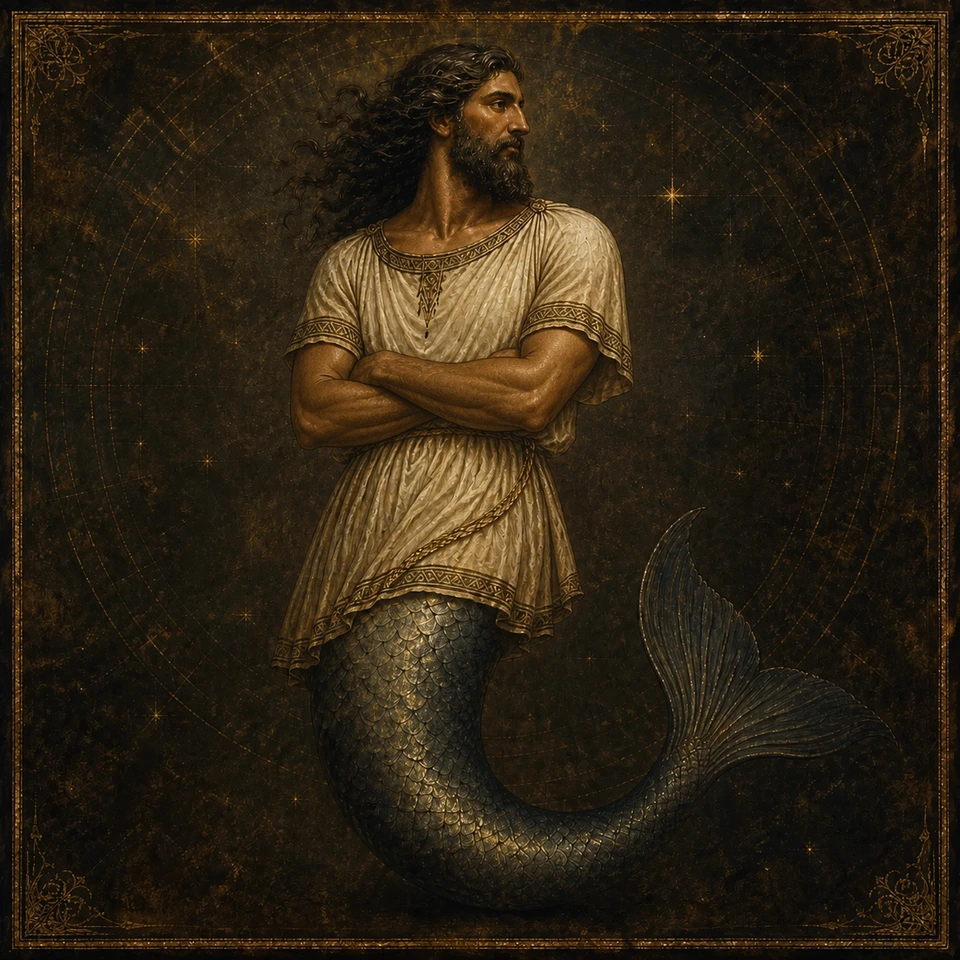
Rising from the depths as the singular offspring of Poseidon and Amphitrite, Triton commands the waters as a formidable sea deity. Depicted as a striking human-piscine hybrid in Archaic Attic art, he guided the Argo at Lake Tritonis and manifested as a genuinely dangerous local power at Tanagra.
Overview
The ship is stranded in Libyan shallows. Sand grinds under the Argo’s keel, and the crew can find no path from Lake Tritonis to the open sea. A young stranger comes over the shore. In Apollonius he calls himself Eurypylus, says that Poseidon is his father, and presses a clod of earth into Euphemus’ hand. Then he takes Apollo’s tripod and vanishes. Jason kills a chosen sheep and calls to Triton. The stranger returns in the body he had concealed: divine from head to waist, a great sea creature below. One complete arm reaches for the ship. His hand closes upon the keel. He drives Argo through the passage until wind and deep water can carry her.
This is Triton at his most active in surviving Greek narrative: not a decorative horn blower, but a god who crosses the border between human disguise and marine body, accepts a tripod, gives land, receives sacrifice, knows the hidden channel, and physically guides a ship. Herodotus tells another version. Jason gives Triton a bronze tripod; Triton reveals the channel, places the tripod in his temple, and foretells a hundred Greek cities around the lake. Pindar tells an older clod-gift tradition, yet his reviewed translation calls the stranger Eurypylus and Poseidon’s son without naming Triton. The accounts stand side by side. They do not become stronger by being fused.
Hesiod gives the bedrock identity. Triton is the powerful son of Poseidon and Amphitrite, living with both parents in a golden house beneath the sea. Pseudo-Apollodorus keeps that parentage and adds Rhode to the family list. Neither makes him a duplicate of Poseidon. His father rules more broadly; Triton’s surviving actions and local stories remain his own.
At Tanagra, Pausanias found a sanctuary shadowed by two deaths. In one, Triton attacks women who are purifying themselves before Dionysian rites. Their prayer brings Dionysus, who kills him. In the other, Triton raids cattle and small boats until the Tanagrans set wine as bait, wait for sleep, and sever his head. The wine is a weapon, not an offering. Pausanias preserves both accounts and refuses the comfort of one polished biography.
Attic pottery gives Triton flesh. British Museum 1836,0224.105 is an oinochoe, not a hydria. It shows Heracles grappling a bearded Triton whose human body runs into a fish tail below the waist. Met hydria 06.1021.48 preserves the same contest and warns that no surviving text spells out the story. British Museum cup 1864,1007.1685 names Triton and shows the anatomy the current portrait must respect: shoulders, two arms, a short chiton, a scaled piscine body, a dolphin in the left hand, and a lotus-finial sceptre in the right. Those objects belong to that painted scene. They are not universal badges.
Pausanias also describes Tritons in the plural, rough-haired, scaled, gilled, toothed, and furnished with human hands and nails. The named son in Hesiod must not dissolve into every Triton, Nereid, sea elder, or generic merman. Roman poets later gave Triton other scenes. Ovid makes him sound a conch to recall flood waters. Virgil makes him the destroyer of Misenus. These are Latin Roman receptions, not missing chapters of Archaic Greek religion.
Across the evidence, Triton holds a hard boundary. He can be guide and predator, divine son and locally slain power, human-seeming stranger and fully embodied sea god. What he is not is equally clear: he is not an armless torso, not a universal conch herald in every period, not Poseidon under another name, and not an empty surface for modern elemental tables.
Canonical identity
Canonical Identity
Triton is a formidable, singular divine son. Hesiod specifically situates him with Amphitrite and Poseidon inside a golden house beneath the waves, explicitly labeling him as powerful. Pseudo-Apollodorus completely corroborates this parentage. Triton is highly specific; he is not a generic merman, Proteus, or Nereus, nor is he synonymous with every later pluralized Triton. His isolated Greek identity must not be conflated with later Roman depictions found in Virgil and Ovid, as shared marine bodies and names do not overwrite profound differences in action, period, and language. The material record confirms this strict singularity; an inscription on the Attic cup 1864,1007.1685 definitively names the figure as Triton, uniting body, genealogy, and name without forcing every hybrid marine creature into the same identity.
Linguistic Identity
Triton is the Greek Τρίτων. Because a secure historical pronunciation has not been officially registered, the archive deliberately leaves the sound unresolved rather than disguising a modern English habit as authentic ancient speech.
Sources and evidence
TEXTUAL · Supported
Hesiod names Triton as the powerful divine son of Poseidon and Amphitrite who lives with both parents in a golden house beneath the sea.
- Source
- Hesiod; edited and translated by Hugh G. Evelyn-White, Theogony (1914)
- Reviewed edition
- Hugh G. Evelyn-White edition and English translation in Hesiod, the Homeric Hymns and Homerica, 1914 · translated by Hugh G. Evelyn-White · edited by Hugh G. Evelyn-White · Perseus Digital Library / Scaife ATLAS
- Exact locator
- Entry Theogony · Line 930-934
- Scope
- Archaic Greece · Ancient Greece
- Authority
- Ancient primary text
- Certainty
- High
Exact source, edition, locator, culture, period, and place are retained; the claim is a close original paraphrase.
Open exact reviewed source2 reviewed sources for this section
- Hesiod; edited and translated by Hugh G. Evelyn-White, Theogony (1914)Hesiod, the Homeric Hymns and Homerica, London and New York, 1914 · Perseus Digital Library / Scaife ATLAS
- Pseudo-Apollodorus; edited and translated by James G. Frazer, Library (1921)Harvard University Press and William Heinemann edition, 1921 · Perseus Digital Library / Scaife ATLAS
Culture, tradition, period, and place
The record begins in archaic Greek poetry and Attic vase painting, passes through classical lyric and historiography, reaches the Hellenistic Argonautica, and continues into Pausanias’s Greek account under Roman rule. Its places are equally distinct: Hesiod’s cosmic sea house, the Libyan Lake Tritonis of the Argonaut traditions, Attic workshops, Vulci as the reported findspot of one exported vase, and Tanagra in Boeotia.
Lake Tritonis is not Tanagra. A vessel made in Attica and found in Italy is not evidence for a Triton sanctuary at either place. Roman literary reception belongs to a later Latin world. Each setting answers a different question and none may be substituted for another.
The evidence also crosses media. Victory ode, historiography, epic, travel writing, and painted clay do not speak with one institutional voice. Pindar addresses Cyrene through song. Herodotus reports a Libyan story. Apollonius writes Hellenistic epic. Pausanias records local explanation and visible sanctuary. The vases preserve actions that prose does not.
11 reviewed sources for this section
- Hesiod; edited and translated by Hugh G. Evelyn-White, Theogony (1914)Hesiod, the Homeric Hymns and Homerica, London and New York, 1914 · Perseus Digital Library / Scaife ATLAS
- Pseudo-Apollodorus; edited and translated by James G. Frazer, Library (1921)Harvard University Press and William Heinemann edition, 1921 · Perseus Digital Library / Scaife ATLAS
- Pausanias; Spiro Greek edition and Jones/Ormerod translation volumes, Description of Greece (1935)Perseus CTS edition corpus, 1903-1935 · Perseus Digital Library / Scaife ATLAS
- Herodotus; translated by A. D. Godley, The Histories (1925)A. D. Godley English translation, Loeb Classical Library volumes I-IV, 1920-1925; Perseus eng2 component · Perseus Digital Library / Scaife ATLAS
- Pindar; translated by Diane Arnson Svarlien, Odes of Pindar (1990)1990 translation hosted by the Perseus Digital Library · Tufts University
- Apollonius Rhodius; translated by Edward P. Coleridge, The Argonautica (1889)English prose translation from R. Merkel's text, Bohn's Classical Library, London, 1889 · Perseus Catalog / Internet Archive
- British Museum, oinochoe, museum number 1836,0224.105Live official British Museum collection record · British Museum
- British Museum, cup, museum number 1864,1007.1685Live official British Museum collection record · British Museum
- The Metropolitan Museum of Art, Terracotta hydria, object 247220, accession 06.1021.48Live official Metropolitan Museum collection record · The Metropolitan Museum of Art
- Ovid; Hugo Magnus Latin edition and Brookes More translation, Metamorphoses (1922)Perseus / Scaife edition corpus, 1892-1922 components · Perseus Digital Library / Scaife ATLAS
- Virgil; edited by J. B. Greenough, Aeneid (1900)Ginn & Co. Latin edition, 1900, represented by Perseus · Perseus Digital Library
Historical development
Hesiod establishes divine sonship without describing Triton’s body. Sixth-century BC Attic painters give that body a mature bearded head and human torso joined to a single fish tail, often under the grip of Heracles. Pindar then tells of Eurypylus, Poseidon’s son, giving Libyan earth to Euphemus, but does not name Triton in the reviewed translation. Herodotus explicitly names Triton as the receiver of Jason’s tripod and guide through the lake.
Apollonius binds the strands together more fully. Eurypylus is Triton in disguise; the clod, tripod, sacrifice, transformed body, and hand upon Argo’s keel enter one Hellenistic sequence. Pausanias later fixes Triton at Tanagra and describes Tritons in the plural. Ovid and Virgil carry the figure into Latin epic. This is transmission through disagreement and expansion, not a straight evolution toward a single final form.
Sources and evidence
TEXTUAL · Supported
Herodotus reports that Triton received Jason’s tripod, showed the channel from Lake Tritonis, placed the tripod in his temple, and prophesied over it.
- Source
- Herodotus; translated by A. D. Godley, The Histories (1925)
- Reviewed edition
- A. D. Godley English translation, Loeb Classical Library volumes I-IV, 1920-1925 · translated by A. D. Godley · edited by A. D. Godley · Perseus Digital Library / Scaife ATLAS
- Exact locator
- Book 4 · Section 179
- Scope
- Classical Greece · Ancient Libya
- Authority
- Ancient primary text
- Certainty
- High
Exact source, edition, locator, culture, period, and place are retained; the claim is a close original paraphrase.
Open exact reviewed source11 reviewed sources for this section
- Hesiod; edited and translated by Hugh G. Evelyn-White, Theogony (1914)Hesiod, the Homeric Hymns and Homerica, London and New York, 1914 · Perseus Digital Library / Scaife ATLAS
- Pseudo-Apollodorus; edited and translated by James G. Frazer, Library (1921)Harvard University Press and William Heinemann edition, 1921 · Perseus Digital Library / Scaife ATLAS
- Pausanias; Spiro Greek edition and Jones/Ormerod translation volumes, Description of Greece (1935)Perseus CTS edition corpus, 1903-1935 · Perseus Digital Library / Scaife ATLAS
- Herodotus; translated by A. D. Godley, The Histories (1925)A. D. Godley English translation, Loeb Classical Library volumes I-IV, 1920-1925; Perseus eng2 component · Perseus Digital Library / Scaife ATLAS
- Pindar; translated by Diane Arnson Svarlien, Odes of Pindar (1990)1990 translation hosted by the Perseus Digital Library · Tufts University
- Apollonius Rhodius; translated by Edward P. Coleridge, The Argonautica (1889)English prose translation from R. Merkel's text, Bohn's Classical Library, London, 1889 · Perseus Catalog / Internet Archive
- British Museum, oinochoe, museum number 1836,0224.105Live official British Museum collection record · British Museum
- British Museum, cup, museum number 1864,1007.1685Live official British Museum collection record · British Museum
- The Metropolitan Museum of Art, Terracotta hydria, object 247220, accession 06.1021.48Live official Metropolitan Museum collection record · The Metropolitan Museum of Art
- Ovid; Hugo Magnus Latin edition and Brookes More translation, Metamorphoses (1922)Perseus / Scaife edition corpus, 1892-1922 components · Perseus Digital Library / Scaife ATLAS
- Virgil; edited by J. B. Greenough, Aeneid (1900)Ginn & Co. Latin edition, 1900, represented by Perseus · Perseus Digital Library
Attested roles and historical themes
Roles, powers, and limits
At Lake Tritonis, Triton possesses knowledge that mortal sailors lack. He knows the channel, receives or takes the tripod, gives the clod of earth, prophesies, and places his own hand on the ship. Guidance is physical as well as verbal. The Argonauts reach deep water because the god moves with them.
Tanagra preserves the opposite force. Triton attacks women, cattle, and small craft, then dies by Dionysus or communal deceit. In Attic art he meets Heracles as a bodily opponent. None of these roles grants him all of Poseidon’s rule over sea, earthquake, and horses. Nor does the later conch scene in Ovid control his earlier Greek functions.
The clod and tripod reveal another limit. Triton can give passage and guarantee a sign, but the colonial futures attached to those objects belong to particular Libyan and Cyrenaean traditions. They are not evidence that he universally governs settlement, prophecy, or every safe return by sea.
Sources and evidence
TEXTUAL · Supported
Apollonius makes Triton appear first as Eurypylus and then in his sea form, place a hand on Argo’s keel, and guide the ship from Lake Tritonis to open water.
- Source
- Apollonius Rhodius; translated by Edward P. Coleridge, The Argonautica (1889)
- Reviewed edition
- Edward P. Coleridge English prose translation of Apollonius Rhodius, The Argonautica, Bohn's Classical Library, 1889 · translated by Edward P. Coleridge · edited by Edward P. Coleridge; translated from R. Merkel's Greek text · Perseus Catalog / Internet Archive
- Exact locator
- Book 4 · Line 1515-1621
- Scope
- Hellenistic Greek world · Ancient Libya
- Authority
- Ancient primary text
- Certainty
- High
Exact source, edition, locator, culture, period, and place are retained; the claim is a close original paraphrase.
Open exact reviewed source5 reviewed sources for this section
- Apollonius Rhodius; translated by Edward P. Coleridge, The Argonautica (1889)English prose translation from R. Merkel's text, Bohn's Classical Library, London, 1889 · Perseus Catalog / Internet Archive
- Herodotus; translated by A. D. Godley, The Histories (1925)A. D. Godley English translation, Loeb Classical Library volumes I-IV, 1920-1925; Perseus eng2 component · Perseus Digital Library / Scaife ATLAS
- Pausanias; Spiro Greek edition and Jones/Ormerod translation volumes, Description of Greece (1935)Perseus CTS edition corpus, 1903-1935 · Perseus Digital Library / Scaife ATLAS
- British Museum, oinochoe, museum number 1836,0224.105Live official British Museum collection record · British Museum
- The Metropolitan Museum of Art, Terracotta hydria, object 247220, accession 06.1021.48Live official Metropolitan Museum collection record · The Metropolitan Museum of Art
Epithets and titles
No surviving Greek witness establishes a securely bounded cult epithet for singular Triton.
3 reviewed sources for this section
- Hesiod; edited and translated by Hugh G. Evelyn-White, Theogony (1914)Hesiod, the Homeric Hymns and Homerica, London and New York, 1914 · Perseus Digital Library / Scaife ATLAS
- Pseudo-Apollodorus; edited and translated by James G. Frazer, Library (1921)Harvard University Press and William Heinemann edition, 1921 · Perseus Digital Library / Scaife ATLAS
- Pausanias; Spiro Greek edition and Jones/Ormerod translation volumes, Description of Greece (1935)Perseus CTS edition corpus, 1903-1935 · Perseus Digital Library / Scaife ATLAS
Worship and cult
Tanagra provides direct sanctuary evidence. Pausanias sees a sacred place and records two deaths tied to it. The monument was not an invention of a modern table, yet the surviving report does not name priests, temple officials, an annual calendar, or a Triton offering list.
The Lake Tritonis traditions add temple and sacrificial language of another kind. Herodotus says Triton placed the tripod in his temple. Apollonius has Jason sacrifice a chosen sheep and pray to Triton and the powers of the lake. These are actions inside literary narratives. They attest what the stories imagine and remember; they do not become instructions for modern practice.
Even the strongest sacred evidence remains local and uneven. A temple in Herodotus, altars in Apollonius, and a sanctuary in Pausanias are three attestations in three literary settings, not proof of one continuous institution. Their value lies in their precision, not in inflating them into a pan-Greek church.
Sources and evidence
TEXTUAL · Supported
Pausanias records a sanctuary of Triton at Tanagra and places two incompatible death traditions beside it.
- Source
- Pausanias; Spiro Greek edition and Jones/Ormerod translation volumes, Description of Greece (1935)
- Reviewed edition
- W. H. S. Jones and H. A. Ormerod English translation volumes, 1918-1935 · translated by W. H. S. Jones and H. A. Ormerod, volume-dependent · Perseus Digital Library / Scaife ATLAS
- Exact locator
- Book 9 · Chapter 20 · Section 4
- Scope
- Greek religion under Roman imperial rule · Boeotia
- Authority
- Ancient primary text
- Certainty
- High
Exact source, edition, locator, culture, period, and place are retained; the claim is a close original paraphrase.
Open exact reviewed source3 reviewed sources for this section
- Pausanias; Spiro Greek edition and Jones/Ormerod translation volumes, Description of Greece (1935)Perseus CTS edition corpus, 1903-1935 · Perseus Digital Library / Scaife ATLAS
- Herodotus; translated by A. D. Godley, The Histories (1925)A. D. Godley English translation, Loeb Classical Library volumes I-IV, 1920-1925; Perseus eng2 component · Perseus Digital Library / Scaife ATLAS
- Apollonius Rhodius; translated by Edward P. Coleridge, The Argonautica (1889)English prose translation from R. Merkel's text, Bohn's Classical Library, London, 1889 · Perseus Catalog / Internet Archive
Temples, sanctuaries, and sacred places
Tanagra in Boeotia is the securely named sanctuary site. Lake Tritonis in ancient Libya carries another sacred geography: Herodotus gives Triton a temple there, and Apollonius names the lake, harbor, route, and altars raised after deliverance. These accounts preserve Greek ways of locating divine power far from mainland sanctuaries.
Hesiod’s golden house beneath the sea is a divine dwelling, not an excavated temple. Attic workshops are places of manufacture. Vulci is the reported findspot of one oinochoe. Museum galleries are modern custodial locations. The differences matter.
The lake itself bears competing memories. Herodotus roots the tripod and prophecy among Libyan communities around its shores. Pindar turns the clod toward Cyrene’s foundation. Apollonius makes the same difficult landscape a place of deliverance. Geography is active in each account, but its meaning changes with the teller.
11 reviewed sources for this section
- Hesiod; edited and translated by Hugh G. Evelyn-White, Theogony (1914)Hesiod, the Homeric Hymns and Homerica, London and New York, 1914 · Perseus Digital Library / Scaife ATLAS
- Pseudo-Apollodorus; edited and translated by James G. Frazer, Library (1921)Harvard University Press and William Heinemann edition, 1921 · Perseus Digital Library / Scaife ATLAS
- Pausanias; Spiro Greek edition and Jones/Ormerod translation volumes, Description of Greece (1935)Perseus CTS edition corpus, 1903-1935 · Perseus Digital Library / Scaife ATLAS
- Herodotus; translated by A. D. Godley, The Histories (1925)A. D. Godley English translation, Loeb Classical Library volumes I-IV, 1920-1925; Perseus eng2 component · Perseus Digital Library / Scaife ATLAS
- Pindar; translated by Diane Arnson Svarlien, Odes of Pindar (1990)1990 translation hosted by the Perseus Digital Library · Tufts University
- Apollonius Rhodius; translated by Edward P. Coleridge, The Argonautica (1889)English prose translation from R. Merkel's text, Bohn's Classical Library, London, 1889 · Perseus Catalog / Internet Archive
- British Museum, oinochoe, museum number 1836,0224.105Live official British Museum collection record · British Museum
- British Museum, cup, museum number 1864,1007.1685Live official British Museum collection record · British Museum
- The Metropolitan Museum of Art, Terracotta hydria, object 247220, accession 06.1021.48Live official Metropolitan Museum collection record · The Metropolitan Museum of Art
- Ovid; Hugo Magnus Latin edition and Brookes More translation, Metamorphoses (1922)Perseus / Scaife edition corpus, 1892-1922 components · Perseus Digital Library / Scaife ATLAS
- Virgil; edited by J. B. Greenough, Aeneid (1900)Ginn & Co. Latin edition, 1900, represented by Perseus · Perseus Digital Library
Festivals and processions
The Tanagran women purify themselves before rites of Dionysus. Pausanias does not call the occasion a festival of Triton. His attack interrupts the women’s preparation and makes Dionysus the divine rescuer in one version.
No securely named annual Triton festival or procession survives in the reviewed Greek evidence. The Argonauts’ sacrifice is an emergency act after recognition of the god, not a recurring calendar observance.
The silence matters because later retellings often turn any divine encounter into a feast day. Here the sources do not. The women’s preparatory purification, the Argonauts’ emergency sacrifice, and the Tanagran sanctuary remain separate. No procession route, fixed date, sacred month, contest, hymn program, or recurring public meal is supplied for Triton.
11 reviewed sources for this section
- Hesiod; edited and translated by Hugh G. Evelyn-White, Theogony (1914)Hesiod, the Homeric Hymns and Homerica, London and New York, 1914 · Perseus Digital Library / Scaife ATLAS
- Pseudo-Apollodorus; edited and translated by James G. Frazer, Library (1921)Harvard University Press and William Heinemann edition, 1921 · Perseus Digital Library / Scaife ATLAS
- Pausanias; Spiro Greek edition and Jones/Ormerod translation volumes, Description of Greece (1935)Perseus CTS edition corpus, 1903-1935 · Perseus Digital Library / Scaife ATLAS
- Herodotus; translated by A. D. Godley, The Histories (1925)A. D. Godley English translation, Loeb Classical Library volumes I-IV, 1920-1925; Perseus eng2 component · Perseus Digital Library / Scaife ATLAS
- Pindar; translated by Diane Arnson Svarlien, Odes of Pindar (1990)1990 translation hosted by the Perseus Digital Library · Tufts University
- Apollonius Rhodius; translated by Edward P. Coleridge, The Argonautica (1889)English prose translation from R. Merkel's text, Bohn's Classical Library, London, 1889 · Perseus Catalog / Internet Archive
- British Museum, oinochoe, museum number 1836,0224.105Live official British Museum collection record · British Museum
- British Museum, cup, museum number 1864,1007.1685Live official British Museum collection record · British Museum
- The Metropolitan Museum of Art, Terracotta hydria, object 247220, accession 06.1021.48Live official Metropolitan Museum collection record · The Metropolitan Museum of Art
- Ovid; Hugo Magnus Latin edition and Brookes More translation, Metamorphoses (1922)Perseus / Scaife edition corpus, 1892-1922 components · Perseus Digital Library / Scaife ATLAS
- Virgil; edited by J. B. Greenough, Aeneid (1900)Ginn & Co. Latin edition, 1900, represented by Perseus · Perseus Digital Library
Offerings, votives, and ritual evidence
Apollonius has Jason choose a sheep, sacrifice it beside the lake, and pray to Triton after the stranger vanishes with the tripod. Herodotus makes the tripod itself the object Triton requests and installs in his temple. These actions belong to two different narrative structures and should remain so.
At Tanagra, wine is bait. Triton drinks, sleeps, and is beheaded. It is not a votive gift. The women’s purification belongs to Dionysian rites whose procedure Pausanias does not disclose. None of these scenes authorizes dangerous water rites, intoxication, animal sacrifice, or improvised imitation.
The tripod is equally resistant to simplification. In Herodotus, Jason surrenders it so Triton will show the exit, and Triton installs it in his temple before speaking prophecy. In Apollonius, Orpheus sets it out, Triton carries it away, and the crew only later understands the divine encounter. One object, two narrative mechanics.
Sources and evidence
TEXTUAL · Supported
The rival Tanagran account makes wine a trap used to intoxicate and behead Triton after attacks on cattle and small vessels.
- Source
- Pausanias; Spiro Greek edition and Jones/Ormerod translation volumes, Description of Greece (1935)
- Reviewed edition
- W. H. S. Jones and H. A. Ormerod English translation volumes, 1918-1935 · translated by W. H. S. Jones and H. A. Ormerod, volume-dependent · Perseus Digital Library / Scaife ATLAS
- Exact locator
- Book 9 · Chapter 20 · Section 4
- Scope
- Greek religion under Roman imperial rule · Boeotia
- Authority
- Ancient primary text
- Certainty
- High
Exact source, edition, locator, culture, period, and place are retained; the claim is a close original paraphrase.
Open exact reviewed source3 reviewed sources for this section
- Apollonius Rhodius; translated by Edward P. Coleridge, The Argonautica (1889)English prose translation from R. Merkel's text, Bohn's Classical Library, London, 1889 · Perseus Catalog / Internet Archive
- Herodotus; translated by A. D. Godley, The Histories (1925)A. D. Godley English translation, Loeb Classical Library volumes I-IV, 1920-1925; Perseus eng2 component · Perseus Digital Library / Scaife ATLAS
- Pausanias; Spiro Greek edition and Jones/Ormerod translation volumes, Description of Greece (1935)Perseus CTS edition corpus, 1903-1935 · Perseus Digital Library / Scaife ATLAS
Iconography and material culture
The body comes first: bearded human head, shoulders, chest, two complete arms, and a lower body that continues into one scaled fish tail. The British Museum oinochoe 1836,0224.105 shows the Heracles contest and two dolphins. The name-inscribed cup 1864,1007.1685 gives Triton a short chiton, a dolphin in the left hand, and a lotus-finial sceptre in the right. The Met hydria 06.1021.48 repeats the wrestling scene.
Dolphin and sceptre are secure for the inscribed cup, not mandatory for every image. Heracles belongs to a painted contest, not to Triton’s permanent portrait. Ovid’s conch is later Latin literature. A trident is not required by the reviewed early Greek record. The corrected portrait should therefore preserve complete anatomy and omit held objects rather than mutilate the arms to hide hands.
Complete arms are not a modern concession. Apollonius requires a hand on the keel. The inscribed cup requires a left arm carrying a dolphin and a right arm crossing the body with a sceptre. Wrestling scenes require shoulders, elbows, and leverage. Removing the limbs destroys historical action as well as anatomy.
Sources and evidence
MATERIAL CULTURE · Supported
British Museum 1836,0224.105 is an Attic black-figure oinochoe showing Heracles and Triton; Triton has long tresses, a pointed beard, and a fish tail below the waist.
- Source
- British Museum, oinochoe, museum number 1836,0224.105
- Reviewed edition
- British Museum collection record for oinochoe 1836,0224.105 · British Museum
- Exact locator
- MuseumObjectId 1836,0224.105 · Entry Object type and official description
- Scope
- Archaic Greece · Attica
- Authority
- Accession-level material record
- Certainty
- High
Exact source, edition, locator, culture, period, and place are retained; the claim is a close original paraphrase.
Open exact reviewed sourceMATERIAL CULTURE · Supported
British Museum 1864,1007.1685 names Triton and shows both arms, a short chiton, a scaly piscine body, a dolphin in his left hand, and a lotus-finial sceptre in his right.
- Source
- British Museum, cup, museum number 1864,1007.1685
- Reviewed edition
- British Museum collection record for cup 1864,1007.1685 · British Museum
- Exact locator
- MuseumObjectId 1864,1007.1685 · Entry Zone with Triton and Nereids
- Scope
- Archaic Greece · Attica
- Authority
- Accession-level material record
- Certainty
- High
Exact source, edition, locator, culture, period, and place are retained; the claim is a close original paraphrase.
Open exact reviewed source4 reviewed sources for this section
- British Museum, oinochoe, museum number 1836,0224.105Live official British Museum collection record · British Museum
- British Museum, cup, museum number 1864,1007.1685Live official British Museum collection record · British Museum
- The Metropolitan Museum of Art, Terracotta hydria, object 247220, accession 06.1021.48Live official Metropolitan Museum collection record · The Metropolitan Museum of Art
- Ovid; Hugo Magnus Latin edition and Brookes More translation, Metamorphoses (1922)Perseus / Scaife edition corpus, 1892-1922 components · Perseus Digital Library / Scaife ATLAS
Animals, plants, and embodied forms
Triton’s embodied form is continuous. The human upper body does not sit on a costume tail; it becomes the piscine body. Pausanias’s plural Tritons add scales, gills, hard nails, beastlike teeth, and tails compared to dolphins. That comparison does not transform the singular god into a dolphin.
Dolphins appear beside the contest on 1836,0224.105 and as held objects on 1864,1007.1685. These are material associations with exact objects. No plant is assigned to Triton. Reeds, coral, seaweed, and lotus cannot be promoted into universal correspondences merely because one sceptre has a lotus finial.
The fish tail likewise bears no single zoological taxonomy. Vase painters make a visual transition suited to a divine marine body; Pausanias offers comparisons to fish, dolphins, frogs, and beasts. These analogies are descriptive. They do not turn the profile into a bestiary or license invented sacred species.
Sources and evidence
TEXTUAL · Supported
Pausanias describes Tritons in the plural with rough hair, scales, gills, human noses, beastlike teeth, hands and nails, and dolphin-like tails.
- Source
- Pausanias; Spiro Greek edition and Jones/Ormerod translation volumes, Description of Greece (1935)
- Reviewed edition
- W. H. S. Jones and H. A. Ormerod English translation volumes, 1918-1935 · translated by W. H. S. Jones and H. A. Ormerod, volume-dependent · Perseus Digital Library / Scaife ATLAS
- Exact locator
- Book 9 · Chapter 21 · Section 1
- Scope
- Greek religion under Roman imperial rule · Boeotia
- Authority
- Ancient primary text
- Certainty
- High
Exact source, edition, locator, culture, period, and place are retained; the claim is a close original paraphrase.
Open exact reviewed source3 reviewed sources for this section
- Pausanias; Spiro Greek edition and Jones/Ormerod translation volumes, Description of Greece (1935)Perseus CTS edition corpus, 1903-1935 · Perseus Digital Library / Scaife ATLAS
- British Museum, oinochoe, museum number 1836,0224.105Live official British Museum collection record · British Museum
- British Museum, cup, museum number 1864,1007.1685Live official British Museum collection record · British Museum
Relationships and genealogy
Poseidon and Amphitrite are Triton’s parents in Hesiod and Pseudo-Apollodorus. Hesiod places the three together under the sea. Pseudo-Apollodorus adds Rhode, while other passages preserve conflicting ancestries for Amphitrite. The stable point is Triton’s parentage, not a single frictionless family tree.
Euphemus and Jason meet Triton within the Argonaut traditions; they are not relatives. Heracles opposes him in art. Dionysus kills him in one Tanagran account but disappears from the rival wine version. Shared action does not create genealogy, cult partnership, or equivalence.
The name Eurypylus creates a further boundary. Pindar and Apollonius both call the Libyan stranger Poseidon’s son, yet only Apollonius identifies that figure as Triton. The comparison is historically important, but the difference must remain visible whenever the earlier ode is cited.
Sources and evidence
TEXTUAL · Supported
Pseudo-Apollodorus keeps Poseidon and Amphitrite as Triton’s parents and adds Rhode to the family list.
- Source
- Pseudo-Apollodorus; edited and translated by James G. Frazer, Library (1921)
- Reviewed edition
- James G. Frazer edition and English translation, Harvard University Press and William Heinemann, 1921 · translated by James G. Frazer · edited by James G. Frazer · Perseus Digital Library / Scaife ATLAS
- Exact locator
- Book 1 · Chapter 4 · Section 5
- Scope
- Greek religion under Roman imperial rule · Ancient Greece
- Authority
- Ancient primary text
- Certainty
- High
Exact source, edition, locator, culture, period, and place are retained; the claim is a close original paraphrase.
Open exact reviewed source6 reviewed sources for this section
- Hesiod; edited and translated by Hugh G. Evelyn-White, Theogony (1914)Hesiod, the Homeric Hymns and Homerica, London and New York, 1914 · Perseus Digital Library / Scaife ATLAS
- Pseudo-Apollodorus; edited and translated by James G. Frazer, Library (1921)Harvard University Press and William Heinemann edition, 1921 · Perseus Digital Library / Scaife ATLAS
- Apollonius Rhodius; translated by Edward P. Coleridge, The Argonautica (1889)English prose translation from R. Merkel's text, Bohn's Classical Library, London, 1889 · Perseus Catalog / Internet Archive
- Pausanias; Spiro Greek edition and Jones/Ormerod translation volumes, Description of Greece (1935)Perseus CTS edition corpus, 1903-1935 · Perseus Digital Library / Scaife ATLAS
- British Museum, oinochoe, museum number 1836,0224.105Live official British Museum collection record · British Museum
- The Metropolitan Museum of Art, Terracotta hydria, object 247220, accession 06.1021.48Live official Metropolitan Museum collection record · The Metropolitan Museum of Art
Actual myths and source variants
Four narrative bodies define the profile. The golden-house genealogy secures Triton’s parents and divine dwelling. The Lake Tritonis cycle preserves three incompatible meetings: Pindar’s unnamed Eurypylus gives earth, Herodotus’s Triton receives a tripod and reveals a channel, and Apollonius’s Triton combines clod, tripod, sacrifice, transformation, and direct guidance of Argo.
Tanagra supplies two deaths, one by Dionysus and one by intoxication and beheading. Attic painting supplies the Heracles contest without a surviving literary narration. These are not episodes in one seamless life. They are independent acts of memory with different dates, places, media, and claims.
The controlling pattern is repetition with change. Earth, tripod, lake, ship, sanctuary, wine, and wrestling return in different combinations. A complete profile preserves those combinations, including absences. It does not borrow the hand on the keel for Herodotus, insert the tripod into Pindar, or invent a spoken ending for the painted fight.
Sources and evidence
TEXTUAL · Supported
One Tanagran account has Dionysus kill Triton after he attacks women preparing for Dionysian rites.
- Source
- Pausanias; Spiro Greek edition and Jones/Ormerod translation volumes, Description of Greece (1935)
- Reviewed edition
- W. H. S. Jones and H. A. Ormerod English translation volumes, 1918-1935 · translated by W. H. S. Jones and H. A. Ormerod, volume-dependent · Perseus Digital Library / Scaife ATLAS
- Exact locator
- Book 9 · Chapter 20 · Section 4
- Scope
- Greek religion under Roman imperial rule · Boeotia
- Authority
- Ancient primary text
- Certainty
- High
Exact source, edition, locator, culture, period, and place are retained; the claim is a close original paraphrase.
Open exact reviewed sourceMATERIAL CULTURE · Supported
Met object 247220, accession 06.1021.48, shows Herakles wrestling Triton and states that no surviving ancient source spells out the story.
- Source
- The Metropolitan Museum of Art, Terracotta hydria, object 247220, accession 06.1021.48
- Reviewed edition
- Metropolitan Museum collection record for object 247220, accession 06.1021.48 · The Metropolitan Museum of Art
- Exact locator
- MuseumObjectId 06.1021.48 · RecordUrl https://www.metmuseum.org/art/collection/search/247220 · Entry Object description
- Scope
- Archaic Greece · Attica
- Authority
- Accession-level material record
- Certainty
- High
Exact source, edition, locator, culture, period, and place are retained; the claim is a close original paraphrase.
Open exact reviewed source9 reviewed sources for this section
- Hesiod; edited and translated by Hugh G. Evelyn-White, Theogony (1914)Hesiod, the Homeric Hymns and Homerica, London and New York, 1914 · Perseus Digital Library / Scaife ATLAS
- Pseudo-Apollodorus; edited and translated by James G. Frazer, Library (1921)Harvard University Press and William Heinemann edition, 1921 · Perseus Digital Library / Scaife ATLAS
- Pausanias; Spiro Greek edition and Jones/Ormerod translation volumes, Description of Greece (1935)Perseus CTS edition corpus, 1903-1935 · Perseus Digital Library / Scaife ATLAS
- Herodotus; translated by A. D. Godley, The Histories (1925)A. D. Godley English translation, Loeb Classical Library volumes I-IV, 1920-1925; Perseus eng2 component · Perseus Digital Library / Scaife ATLAS
- Pindar; translated by Diane Arnson Svarlien, Odes of Pindar (1990)1990 translation hosted by the Perseus Digital Library · Tufts University
- Apollonius Rhodius; translated by Edward P. Coleridge, The Argonautica (1889)English prose translation from R. Merkel's text, Bohn's Classical Library, London, 1889 · Perseus Catalog / Internet Archive
- British Museum, oinochoe, museum number 1836,0224.105Live official British Museum collection record · British Museum
- British Museum, cup, museum number 1864,1007.1685Live official British Museum collection record · British Museum
- The Metropolitan Museum of Art, Terracotta hydria, object 247220, accession 06.1021.48Live official Metropolitan Museum collection record · The Metropolitan Museum of Art
Myth Library
Each myth gathers its attested participants into one source-grounded account, while distinct source traditions remain readable in their own variants.
Theogony
Birth and Golden House of Triton
Hesiod places Triton with Amphitrite and Poseidon in a golden house beneath the sea; Pseudo-Apollodorus keeps Triton but changes Amphitrite's genealogy and adds Rhode among the couple's children.
- Role in this profile
- son of Amphitrite and Poseidon, living with them in the golden house in Hesiod
- Place scope
- Ancient Greece
- Witnesses
- 2
- Variants
- 2
Argonautic Guidance With Source Variants
Triton Guides the Argo from Lake Tritonis
At Lake Tritonis, Greek sources give different meetings with Poseidon’s son: a clod of earth, a tripod and prophecy, or Triton’s own hand guiding Argo to open water.
- Role in this profile
- appears explicitly in Herodotus and Apollonius, receives the tripod, gives a route, and guides Argo by hand
- Place scope
- Ancient Libya
- Witnesses
- 3
- Variants
- 3
Local Cult Aetiology With Rival Deaths
Triton of Tanagra
Tanagra preserves two deaths for Triton: Dionysus kills him after an attack on women, or local people intoxicate and behead him after raids.
- Role in this profile
- attacks in both local accounts and dies by Dionysus or by a Tanagran trap
- Place scope
- Boeotia
- Witnesses
- 1
- Variants
- 2
Materially Attested Visual Narrative
Heracles Wrestles Triton in Attic Art
Attic black-figure vessels show Heracles locked around Triton’s human upper body as the sea god’s scaled body runs into a single tail; no surviving ancient text narrates the contest.
- Role in this profile
- meets Heracles in a close bodily grapple across Archaic painted vessels
- Place scope
- Attica
- Witnesses
- 2
- Variants
- 2
Equivalences, syncretisms, and identity boundaries
The singular Greek Triton is not the plural class Pausanias describes. He is not Nereus or Proteus, whose genealogies and stories remain distinct. He is not Poseidon in a lesser mask. He is not a generic merman assembled from later fantasy.
Roman poetry must remain Roman. Ovid’s flood messenger with a conch and Virgil’s destroyer of Misenus are important later receptions, but neither may be smuggled backward into Hesiod, Pindar, Attic vase painting, or Tanagran cult. The Greek record is strong enough to stand without borrowed Roman furniture.
Even the plural Tritons require restraint. Pausanias describes a kind of marine being after discussing the Tanagran sanctuary, but grammatical proximity is not a genealogy. The plural bodies help interpret ancient expectations of hybrid anatomy. They do not prove that every plural member shares the named son’s parents, house, myths, or cult.
11 reviewed sources for this section
- Hesiod; edited and translated by Hugh G. Evelyn-White, Theogony (1914)Hesiod, the Homeric Hymns and Homerica, London and New York, 1914 · Perseus Digital Library / Scaife ATLAS
- Pseudo-Apollodorus; edited and translated by James G. Frazer, Library (1921)Harvard University Press and William Heinemann edition, 1921 · Perseus Digital Library / Scaife ATLAS
- Pausanias; Spiro Greek edition and Jones/Ormerod translation volumes, Description of Greece (1935)Perseus CTS edition corpus, 1903-1935 · Perseus Digital Library / Scaife ATLAS
- Herodotus; translated by A. D. Godley, The Histories (1925)A. D. Godley English translation, Loeb Classical Library volumes I-IV, 1920-1925; Perseus eng2 component · Perseus Digital Library / Scaife ATLAS
- Pindar; translated by Diane Arnson Svarlien, Odes of Pindar (1990)1990 translation hosted by the Perseus Digital Library · Tufts University
- Apollonius Rhodius; translated by Edward P. Coleridge, The Argonautica (1889)English prose translation from R. Merkel's text, Bohn's Classical Library, London, 1889 · Perseus Catalog / Internet Archive
- British Museum, oinochoe, museum number 1836,0224.105Live official British Museum collection record · British Museum
- British Museum, cup, museum number 1864,1007.1685Live official British Museum collection record · British Museum
- The Metropolitan Museum of Art, Terracotta hydria, object 247220, accession 06.1021.48Live official Metropolitan Museum collection record · The Metropolitan Museum of Art
- Ovid; Hugo Magnus Latin edition and Brookes More translation, Metamorphoses (1922)Perseus / Scaife edition corpus, 1892-1922 components · Perseus Digital Library / Scaife ATLAS
- Virgil; edited by J. B. Greenough, Aeneid (1900)Ginn & Co. Latin edition, 1900, represented by Perseus · Perseus Digital Library
Correspondence index
The direct historical layer gives sea dwelling, Lake Tritonis, Tanagra, a hybrid human-piscine body, one tail, complete arms, the Argonautic clod and tripod, a chosen sheep within Apollonius’s narrative, and wine used as hostile bait at Tanagra. The exact objects add ceramic medium, dolphins, short chiton, and a lotus-finial sceptre in bounded scenes.
No planet, zodiac sign, gemstone, ritual metal, fixed color, classical element, weekday, moon phase, compass direction, incense, plant, guaranteed intention, or universal modern offering is attested. Sea imagery does not automatically prove the philosophical element water. Dangerous narrative acts do not become ritual advice.
Two positive ritual materials therefore stay contextual. The tripod belongs to Argonautic exchange and guidance. The chosen sheep belongs to Jason’s recognition and appeal in Apollonius. Wine belongs to a killing trap. None can be lifted from narrative circumstance and sold as a timeless devotional key.
Direct ancient correspondences
| Category | Direct correspondence | How and why | Evidence boundary |
|---|---|---|---|
| animal-embodied-form | Human upper body, two complete arms, and one fish tailDirect historical association | Text and named objects require a continuous, fully limbed hybrid body. | Ancient Material Hands may be concealed by pose, but arms may not be deleted 4 reviewed sources for this section
|
Contextual evidence, not a general correspondence
| Category | Direct correspondence | How and why | Evidence boundary |
|---|---|---|---|
| metal-material | Attic ceramic vesselsContextual evidence only | An oinochoe, cup, and hydria preserve Triton’s form and narratives. | Ancient Material Ceramic medium is material evidence, not magical rulership 3 reviewed sources for this section
|
| direction-place | Golden sea house, Lake Tritonis, and TanagraContextual evidence only | Greek witnesses locate divine dwelling, guidance, temple memory, and sanctuary. | Ancient Literary No compass direction is established 4 reviewed sources for this section
|
| offering-ritual-material | Chosen sheep in Apollonius; wine as hostile bait at TanagraContextual evidence only | One narrative contains sacrifice after recognition; another uses wine to incapacitate Triton. | Ancient Literary Neither scene is a modern instruction 2 reviewed sources for this section
|
| ritual-object-symbol-tool | Tripod in the Lake Tritonis traditionsContextual evidence only | Triton receives or takes Apollo’s tripod in Herodotus and Apollonius. | Ancient Literary The object belongs to specific Argonautic narratives 2 reviewed sources for this section
|
| intention-magical-power | Guidance through danger, marine force, and contested boundariesContextual evidence only | Greek narratives make Triton guide a ship, attack at Tanagra, and wrestle Heracles in art. | Ancient Literary No promise of magical control or risky water rite follows 4 reviewed sources for this section
|
10 expected categories currently not evidenced
celestial-body · Not evidenced
No celestial body attested
No planet or star is assigned to Triton.
- Layer
- Research Boundary
- Scope
- Sea divinity is not celestial rulership
zodiac · Not evidenced
No zodiac sign attested
No zodiac sign appears in the reviewed witnesses.
- Layer
- Research Boundary
- Scope
- Later astrology requires dated testimony
gemstone-crystal-mineral · Not evidenced
No gemstone attested
No stone or crystal is named for Triton.
- Layer
- Research Boundary
- Scope
- Modern pairings remain modern
plant-tree · Not evidenced
No plant attested
No plant belongs to Triton here.
- Layer
- Research Boundary
- Scope
- Marsh frog comparison is not botanical evidence
color · Not evidenced
No fixed ritual color attested
Vase colors arise from technique rather than Triton’s cult palette.
- Layer
- Research Boundary
- Scope
- Later sea colors remain later
classical-element · Not evidenced
No classical element attested
The sea setting does not assign a philosophical element.
- Layer
- Research Boundary
- Scope
- Water imagery is not elemental rulership
weekday · Not evidenced
No weekday attested
No weekday belongs to Triton.
- Layer
- Research Boundary
- Scope
- Modern calendars do not establish ancient practice
moon-phase · Not evidenced
No moon phase attested
No lunar phase is assigned to Triton.
- Layer
- Research Boundary
- Scope
- Tides and moon are not inferred
festival-time · Not evidenced
No Triton festival attested
The women prepare for Dionysian rites, not a Triton feast.
- Layer
- Research Boundary
- Scope
- Local story does not create a calendar
incense-perfume · Not evidenced
No incense attested
No incense or perfume is prescribed.
- Layer
- Research Boundary
- Scope
- Marine scent imagery remains analogy
11 reviewed sources for this section
- Hesiod; edited and translated by Hugh G. Evelyn-White, Theogony (1914)Hesiod, the Homeric Hymns and Homerica, London and New York, 1914 · Perseus Digital Library / Scaife ATLAS
- Pseudo-Apollodorus; edited and translated by James G. Frazer, Library (1921)Harvard University Press and William Heinemann edition, 1921 · Perseus Digital Library / Scaife ATLAS
- Pausanias; Spiro Greek edition and Jones/Ormerod translation volumes, Description of Greece (1935)Perseus CTS edition corpus, 1903-1935 · Perseus Digital Library / Scaife ATLAS
- Herodotus; translated by A. D. Godley, The Histories (1925)A. D. Godley English translation, Loeb Classical Library volumes I-IV, 1920-1925; Perseus eng2 component · Perseus Digital Library / Scaife ATLAS
- Pindar; translated by Diane Arnson Svarlien, Odes of Pindar (1990)1990 translation hosted by the Perseus Digital Library · Tufts University
- Apollonius Rhodius; translated by Edward P. Coleridge, The Argonautica (1889)English prose translation from R. Merkel's text, Bohn's Classical Library, London, 1889 · Perseus Catalog / Internet Archive
- British Museum, oinochoe, museum number 1836,0224.105Live official British Museum collection record · British Museum
- British Museum, cup, museum number 1864,1007.1685Live official British Museum collection record · British Museum
- The Metropolitan Museum of Art, Terracotta hydria, object 247220, accession 06.1021.48Live official Metropolitan Museum collection record · The Metropolitan Museum of Art
- Ovid; Hugo Magnus Latin edition and Brookes More translation, Metamorphoses (1922)Perseus / Scaife edition corpus, 1892-1922 components · Perseus Digital Library / Scaife ATLAS
- Virgil; edited by J. B. Greenough, Aeneid (1900)Ginn & Co. Latin edition, 1900, represented by Perseus · Perseus Digital Library
Later reception and living significance
Ovid’s Latin poem calls Triton to sound the conch and drive the flood waters back. Virgil’s Latin epic makes Triton drown Misenus after a challenge sounded on the shell horn. These Roman scenes explain why the conch became powerful in later visual memory. They do not prove that every Greek image carried it.
No accountable Triton-specific contemporary devotional witness has been reviewed. Modern occult tables, planetary assignments, elemental simplifications, ecological slogans, and popular marine characters remain modern constructions unless a separately dated source is named.
The later image history may be large, but size does not erase sequence. A shell horn in Roman epic can explain later familiarity without becoming evidence for an Archaic vase. Fountains, heraldic marine attendants, Renaissance ornament, and popular entertainment require their own dated objects and texts before entering a historical claim.
Sources and evidence
TEXTUAL · Supported
Ovid’s Latin Metamorphoses makes Triton sound a conch to recall the flood waters, a Roman literary scene that does not define Archaic Greek Triton.
- Source
- Ovid; Hugo Magnus Latin edition and Brookes More translation, Metamorphoses (1922)
- Reviewed edition
- Brookes More English blank-verse translation of Ovid, Metamorphoses, 1922 · translated by Brookes More · Perseus Digital Library / Scaife ATLAS
- Exact locator
- Book 1 · Line 330-347
- Scope
- Augustan Roman literature · Rome
- Authority
- Ancient primary text
- Certainty
- High
Exact source, edition, locator, culture, period, and place are retained; the claim is a close original paraphrase.
Open exact reviewed sourceTEXTUAL · Supported
Virgil’s Latin Aeneid reports that Triton drowned Misenus after the mortal challenged the gods with a shell horn.
- Source
- Virgil; edited by J. B. Greenough, Aeneid (1900)
- Reviewed edition
- J. B. Greenough Latin edition, Ginn & Co., 1900, Perseus component · edited by J. B. Greenough · Perseus Digital Library
- Exact locator
- Book 6 · Line 160-174
- Scope
- Augustan Roman literature · Rome
- Authority
- Ancient primary text
- Certainty
- High
Exact source, edition, locator, culture, period, and place are retained; the claim is a close original paraphrase.
Open exact reviewed source2 reviewed sources for this section
- Ovid; Hugo Magnus Latin edition and Brookes More translation, Metamorphoses (1922)Perseus / Scaife edition corpus, 1892-1922 components · Perseus Digital Library / Scaife ATLAS
- Virgil; edited by J. B. Greenough, Aeneid (1900)Ginn & Co. Latin edition, 1900, represented by Perseus · Perseus Digital Library
Evidence, conflicts, and research gaps
Hesiod controls identity and parentage. Pindar, Herodotus, and Apollonius control three Lake Tritonis traditions whose differences are essential. Pausanias controls Tanagra and plural anatomy. British Museum 1836,0224.105 is the exact oinochoe witness; 1864,1007.1685 is the exact inscribed cup; Met 06.1021.48 is the exact hydria and the strongest warning against inventing a lost literary story. Ovid and Virgil control Roman reception only.
Historical pronunciation remains unresolved. Tanagra still needs inscriptional and archaeological closure beyond Pausanias. No priesthood, annual Triton festival, or broad Greek offering system is established. Pindar’s Eurypylus must not be called Triton without explaining that the explicit identification comes from later comparison, above all Apollonius.
The surviving evidence is sufficient to reject familiar inventions, but not to close every question. Future work should seek a direct archaeological publication for Tanagra, catalogue the broader Attic Heracles and Triton corpus without duplicating scenes, and test whether inscriptions or scholia clarify local names. Until then, precise uncertainty is stronger than borrowed certainty.
Sources and evidence
TEXTUAL · Supported
Pindar’s Pythian 4 calls the stranger Eurypylus and Poseidon’s son but does not explicitly name him Triton in the reviewed translation.
- Source
- Pindar; translated by Diane Arnson Svarlien, Odes of Pindar (1990)
- Reviewed edition
- Diane Arnson Svarlien English translation, 1990 · translated by Diane Arnson Svarlien · Tufts University
- Exact locator
- Entry Pythian 4 · Line 19-56
- Scope
- Classical Greece · Ancient Libya
- Authority
- Ancient primary text
- Certainty
- High
Exact source, edition, locator, culture, period, and place are retained; the claim is a close original paraphrase.
Open exact reviewed source11 reviewed sources for this section
- Hesiod; edited and translated by Hugh G. Evelyn-White, Theogony (1914)Hesiod, the Homeric Hymns and Homerica, London and New York, 1914 · Perseus Digital Library / Scaife ATLAS
- Pseudo-Apollodorus; edited and translated by James G. Frazer, Library (1921)Harvard University Press and William Heinemann edition, 1921 · Perseus Digital Library / Scaife ATLAS
- Pausanias; Spiro Greek edition and Jones/Ormerod translation volumes, Description of Greece (1935)Perseus CTS edition corpus, 1903-1935 · Perseus Digital Library / Scaife ATLAS
- Herodotus; translated by A. D. Godley, The Histories (1925)A. D. Godley English translation, Loeb Classical Library volumes I-IV, 1920-1925; Perseus eng2 component · Perseus Digital Library / Scaife ATLAS
- Pindar; translated by Diane Arnson Svarlien, Odes of Pindar (1990)1990 translation hosted by the Perseus Digital Library · Tufts University
- Apollonius Rhodius; translated by Edward P. Coleridge, The Argonautica (1889)English prose translation from R. Merkel's text, Bohn's Classical Library, London, 1889 · Perseus Catalog / Internet Archive
- British Museum, oinochoe, museum number 1836,0224.105Live official British Museum collection record · British Museum
- British Museum, cup, museum number 1864,1007.1685Live official British Museum collection record · British Museum
- The Metropolitan Museum of Art, Terracotta hydria, object 247220, accession 06.1021.48Live official Metropolitan Museum collection record · The Metropolitan Museum of Art
- Ovid; Hugo Magnus Latin edition and Brookes More translation, Metamorphoses (1922)Perseus / Scaife edition corpus, 1892-1922 components · Perseus Digital Library / Scaife ATLAS
- Virgil; edited by J. B. Greenough, Aeneid (1900)Ginn & Co. Latin edition, 1900, represented by Perseus · Perseus Digital Library
Direct connections and evidence
Explicit Source
Hesiod and Pseudo-Apollodorus name Triton as Amphitrite's son
Both witnesses name Amphitrite as Triton's mother; Amphitrite's own parentage differs by source.
2 attestations · high confidence
- Hesiod; edited and translated by Hugh G. Evelyn-White, TheogonyHugh G. Evelyn-White edition and English translation in Hesiod, the Homeric Hymns and Homerica, 1914 · translated by Hugh G. Evelyn-White · edited by Hugh G. Evelyn-White · Perseus Digital Library / Scaife ATLAS · Archaic Greece · Ancient Greece · Entry Theogony · Line 930-934
- Pseudo-Apollodorus; edited and translated by James G. Frazer, LibraryJames G. Frazer edition and English translation, Harvard University Press and William Heinemann, 1921 · translated by James G. Frazer · edited by James G. Frazer · Perseus Digital Library / Scaife ATLAS · Greek religion under Roman imperial rule · Ancient Greece · Entry Library · Book 1 · Section 4.5
Explicit Source
Hesiod names Poseidon and Amphitrite as Triton’s parents
Triton’s singular identity remains distinct from later plural Tritons.
1 attestation · high confidence
- Hesiod; edited and translated by Hugh G. Evelyn-White, TheogonyHugh G. Evelyn-White edition and English translation in Hesiod, the Homeric Hymns and Homerica, 1914 · translated by Hugh G. Evelyn-White · edited by Hugh G. Evelyn-White · Perseus Digital Library / Scaife ATLAS · Archaic Greece · Ancient Greece · Entry Theogony · Line 930-934
Explicit Source
Hesiod and Pseudo-Apollodorus name Triton as Poseidon’s son
Both witnesses preserve Poseidon’s fatherhood.
2 attestations · high confidence
- Hesiod; edited and translated by Hugh G. Evelyn-White, TheogonyHugh G. Evelyn-White edition and English translation in Hesiod, the Homeric Hymns and Homerica, 1914 · translated by Hugh G. Evelyn-White · edited by Hugh G. Evelyn-White · Perseus Digital Library / Scaife ATLAS · Archaic Greece · Ancient Greece · Entry Theogony · Line 930-934
- Pseudo-Apollodorus; edited and translated by James G. Frazer, LibraryJames G. Frazer edition and English translation, Harvard University Press and William Heinemann, 1921 · translated by James G. Frazer · edited by James G. Frazer · Perseus Digital Library / Scaife ATLAS · Greek religion under Roman imperial rule · Ancient Greece · Entry Library · Book 1 · Section 1.4.5
Archive scope and classification
- Figure classification
- God or goddess · certain
- Pantheon or tradition shelf
- Greek
- Cultures
- Greek
- Traditions
- Ancient Greek religion
- Periods
- Archaic Greece, Classical Greece, Hellenistic Greek world, Greek religion under Roman imperial rule
- Places
- Ancient Greece, Attica, Boeotia, Ancient Libya
Singular identity, genealogy, Lake Tritonis narratives, local sanctuary, material form, Roman reception boundary, and exhaustive plausible myth disposition are reviewed.
Reviewed sources
- Hesiod; edited and translated by Hugh G. Evelyn-White, Theogony (1914)Hesiod, the Homeric Hymns and Homerica, London and New York, 1914 · Perseus Digital Library / Scaife ATLAS
- Pseudo-Apollodorus; edited and translated by James G. Frazer, Library (1921)Harvard University Press and William Heinemann edition, 1921 · Perseus Digital Library / Scaife ATLAS
- Pausanias; Spiro Greek edition and Jones/Ormerod translation volumes, Description of Greece (1935)Perseus CTS edition corpus, 1903-1935 · Perseus Digital Library / Scaife ATLAS
- Ovid; Hugo Magnus Latin edition and Brookes More translation, Metamorphoses (1922)Perseus / Scaife edition corpus, 1892-1922 components · Perseus Digital Library / Scaife ATLAS
- Virgil; edited by J. B. Greenough, Aeneid (1900)Ginn & Co. Latin edition, 1900, represented by Perseus · Perseus Digital Library
- Herodotus; translated by A. D. Godley, The Histories (1925)A. D. Godley English translation, Loeb Classical Library volumes I-IV, 1920-1925; Perseus eng2 component · Perseus Digital Library / Scaife ATLAS
- Pindar; translated by Diane Arnson Svarlien, Odes of Pindar (1990)1990 translation hosted by the Perseus Digital Library · Tufts University
- Apollonius Rhodius; translated by Edward P. Coleridge, The Argonautica (1889)English prose translation from R. Merkel's text, Bohn's Classical Library, London, 1889 · Perseus Catalog / Internet Archive
- British Museum, oinochoe, museum number 1836,0224.105Live official British Museum collection record · British Museum
- British Museum, cup, museum number 1864,1007.1685Live official British Museum collection record · British Museum
- The Metropolitan Museum of Art, Terracotta hydria, object 247220, accession 06.1021.48Live official Metropolitan Museum collection record · The Metropolitan Museum of Art