
Greek · God or goddess · Certain
Poseidon
Ποσειδῶν · Poseidōn
Pronunciation: /po.seː.dɔ̂ːn/ · poh-seh-DAWN
Research and editorial review by Cody Manes · Reviewed 2026-08-30
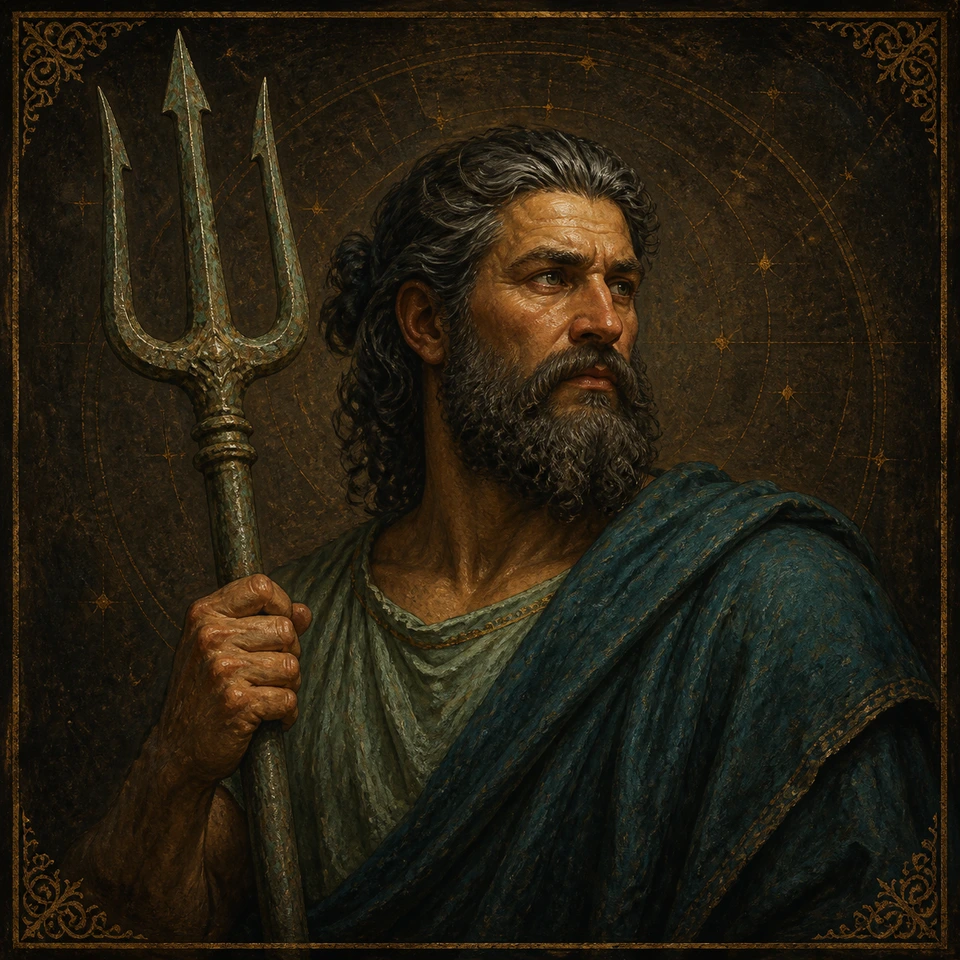
Wielding devastating earth-shaking force and total mastery of the sea, Poseidon drives maritime travel and the chaotic power of horses. His ancient worship shaped massive sanctuary structures and fueled intense civic rivalries across deeply localized regional cults.
Overview
Poseidon's mastery begins where sea passage, shaking ground, and horse power meet. Homeric Hymn 22 invokes him as mover of earth and sea, horse-tamer, and savior of ships, while the Iliad lets him defend an allotted realm without surrendering his dignity to Zeus. He is not a one-note storm tyrant or a decorative king of blue water. Greek worship and narrative make him builder, protector, rival, father, assailant, healer, and dangerous answerer of prayer.
At Cape Sounion, Poseidon's temple stands above a prominent sea route. At the Corinthian Isthmus, worship unfolded among games, dedications, horses, and harbor traffic. At Kionia on Tenos, a sanctuary shared with Amphitrite gathered a sacred way, fountains, an altar, a dining hall, votive monuments, and a healing hall around the temple. These places make Poseidon more than a literary storm. They show communities building for him, competing before him, asking for help, and marking dangerous passages between land and water.
Archaic poetry gives that presence an unstable edge. Homeric Hymn 22 praises the mover of earth and sea, lord of Helicon and Aegae, tamer of horses, and savior of ships. The same power that can preserve a vessel can crush one. In the Odyssey, Polyphemus calls upon Poseidon after Odysseus blinds him. The god raises the sea against the wanderer's raft and later strikes the Phaeacian ship that carried him home. Maritime protection and maritime terror belong to the same divine field, separated by story, prayer, and allegiance.
The sea is a realm, not his whole identity. In Iliad 15, Poseidon answers Zeus's command by recalling how three brothers divided the cosmos by lot. Zeus received the sky, Hades the underworld, and Poseidon the gray sea, while earth and Olympus remained common. He yields to Iris's warning but refuses the language of inferiority. The scene gives him both jurisdiction and limit: a great god with an allotted sphere, shared ground, powerful brothers, and disputes that no simple title can erase.
Horses pull another line through his identity. The hymn names him horse-tamer. Isthmian imagery includes horses. In Arcadian traditions preserved by Pausanias, he takes stallion form while pursuing Demeter. That pursuit ends in sexual assault and must not be sweetened into a romance. Local myth gives rise to Arion and, at Phigalia, to the unnamed Despoina tradition and the furious withdrawal of Black Demeter. Equine power here carries mastery, transformation, violence, and regional memory.
Poseidon's family spreads across conflicting witnesses. Hesiod makes him a son of Cronus and Rhea, spouse of Amphitrite, and father of Triton in a golden house beneath the sea. Bacchylides turns Theseus' descent beneath the waves into proof of divine parentage, with Amphitrite receiving the hero. The Odyssey makes Polyphemus his son through the Cyclops' prayer. Later mythography enlarges the genealogies again. These relationships belong to their own poems and compilations. They do not create automatic cult partnerships or flatten every child into one harmonious family tree.
Other stories force his power into mortal lives. Pindar makes Poseidon's desire for Pelops the beginning of an alliance that ends with a golden chariot and winged horses for the deadly race against Oenomaus. Pseudo-Apollodorus names him in the births of the Aloadae, Pegasus, and Chrysaor, gives Idas a winged chariot from him, and preserves Caeneus's requested transformation after intercourse with the god. The source does not report Caeneus's consent to that encounter. These are distinct narratives of desire, descent, gift, transformation, and danger, not evidence for a single gentle patronage.
Athens remembers him through rivalry. Pseudo-Apollodorus tells how Poseidon struck the Acropolis and produced a sea sign while Athena planted the olive. The judgment favored Athena, yet the salt-water well and trident marks kept Poseidon inside Athenian sacred memory. His defeat explains civic priority without expelling him from the city. Pausanias preserves another lost judgment at Argos, where the river gods award the land to Hera and Poseidon answers by stripping away their water before a later flood. Elsewhere he builds Troy's walls with Apollo, accuses Ares after the death of Halirrhothius, receives Theseus beneath the sea, and answers Polyphemus against Odysseus.
The epics refuse to make his loyalties simple. The Iliad remembers Hera, Athena, and Poseidon attempting to bind Zeus until Thetis brings Briareus. In the Trojan fighting, Poseidon opposes Troy yet lifts Aeneas out of Achilles' reach because fate and sacrifice demand the man's survival. In the Odyssey he first saves Ajax from the sea, then hears the survivor's boast and splits the rock beneath him. Rescue, punishment, rebellion, obedience, and divided allegiance all belong to the record.
Ancient art gives him a mature bearded body and several attributes rather than one fixed costume. Getty 86.AE.195 shows him seated with a trident. The British Museum catalogue for E140 identifies an inscribed Poseidon holding a dolphin and sceptre. Hesiod keeps Triton as his son, not a second name. Hellenion now publishes devotional material for Poseidon within its Hymnodia program. That living witness belongs to one named community and cannot speak for every modern practitioner.
Canonical identity
Canonical Identity
Poseidon is the powerful figure glorified in Homeric Hymn 22 as the savior of ships, the horse-tamer, and the mover of earth and sea. He retains a strictly isolated Greek identity that must never be merged with Triton, Nereus, or Oceanus. Furthermore, he is entirely separate from the later identities of Roman Neptune and the planet Neptune; a shared aquatic realm or translated name never transforms these distinct figures into aliases.
Linguistic Identity
The LSJ documents the Ancient Greek headword Ποσειδῶν, conventionally transliterated as Poseidōn. Applying Smyth's fifth-century Attic rules supports a qualified reconstruction of /po.seː.dɔ̂ ːn/, roughly poh-seh-DAWN, though English reading guides cannot execute the ancient pitch. Modern General American English has adopted a wholly different trajectory, with the pinned CMU Pronouncing Dictionary dictating /pəˈsaɪdən/ (approximately puh-SYE-duhn).
Sources and evidence
TEXTUAL · Supported
LSJ records Ποσειδῶν as the Greek headword for Poseidon and preserves its inflected forms.
- Source
- Henry George Liddell and Robert Scott; Scaife ATLAS, Ποσειδῶν, LSJ entry
- Reviewed edition
- LSJ digital entry Ποσειδῶν, Scaife ATLAS URN lsj-n85893 · Tufts University
- Exact locator
- Entry Ποσειδῶν · Section LSJ headword, inflected forms, and short definition · RecordUrl https://atlas.perseus.tufts.edu/dictionaries/entry/urn%3Acite2%3Ascaife-viewer%3Adictionaries.v1%3Alsj-n85893/
- Scope
- Unspecified · Ancient Greece
- Authority
- Liddell and Scott, LSJ, Scaife ATLAS headword Ποσειδῶν
- Certainty
- Secure within the named witness
The lexicon anchors the written Greek name and accent. Historical sound values come from a separate grammar.
Open exact reviewed sourceTEXTUAL · Supported
Smyth's fifth-century Attic letter, vowel, and circumflex rules applied to Ποσειδῶν support the qualified reconstruction /po.seː.dɔ̂ːn/.
- Source
- Herbert Weir Smyth, A Greek Grammar for Colleges (1920)
- Reviewed edition
- Herbert Weir Smyth, A Greek Grammar for Colleges, American Book Company, 1920; Perseus text 1999.04.0007 · Perseus Digital Library
- Exact locator
- Entry A Greek Grammar for Colleges · Section §§1, 4, 23-26, 149-150 · RecordUrl https://www.perseus.tufts.edu/hopper/text?doc=Perseus:text:1999.04.0007
- Scope
- Classical Greece · Attica
- Authority
- Herbert Weir Smyth, A Greek Grammar for Colleges, 1920
- Certainty
- Qualified
The English guide approximates the vowels and cannot reproduce the ancient pitch contour.
Open exact reviewed sourceTEXTUAL · Supported
Modern General American English pronounces Poseidon /pəˈsaɪdən/, approximately puh-SYE-duhn.
- Source
- Carnegie Mellon University Speech Group, CMU Pronouncing Dictionary
- Reviewed edition
- cmudict data file at commit 74790861f652b15e4ac49015a90074ad62a27690 · Carnegie Mellon University
- Exact locator
- Entry poseidon · Section ARPABET P AH0 S AY1 D AH0 N, line 94394 · RecordUrl https://raw.githubusercontent.com/cmusphinx/cmudict/74790861f652b15e4ac49015a90074ad62a27690/cmudict.dict
- Scope
- Modern classical scholarship
- Authority
- CMU Pronouncing Dictionary, pinned commit 74790861f652b15e4ac49015a90074ad62a27690
- Certainty
- Qualified
This is a current English pronunciation, not an ancient Greek sound.
Open exact reviewed sourceTEXTUAL · Supported
Homeric Hymn 22 names Poseidon as mover of earth and sea, horse-tamer, and savior of ships.
- Source
- Anonymous Homeric Hymns; edited and translated by Hugh G. Evelyn-White, Homeric Hymns (1914)
- Reviewed edition
- Hugh G. Evelyn-White English translation of Homeric Hymn 22, To Poseidon, 1914 · translated by Hugh G. Evelyn-White · Perseus Digital Library / Scaife ATLAS
- Exact locator
- Entry Homeric Hymn 22 to Poseidon · Line 1-5
- Scope
- Archaic Greece · Ancient Greece
- Authority
- Homeric Hymn 22, Evelyn-White 1914 English component
- Certainty
- Secure within the named witness
The compact invocation joins several powers without reducing the god to one realm.
Open exact reviewed source4 reviewed sources for this section
- Henry George Liddell and Robert Scott; Scaife ATLAS, Ποσειδῶν, LSJ entryLSJ digital entry with exact headword and inflection · Tufts University
- Herbert Weir Smyth, A Greek Grammar for Colleges (1920)American Book Company, 1920; Perseus text 1999.04.0007 · Perseus Digital Library
- Carnegie Mellon University Speech Group, CMU Pronouncing DictionaryPinned repository commit 74790861f652b15e4ac49015a90074ad62a27690 · Carnegie Mellon University
- Anonymous Homeric Hymns; edited and translated by Hugh G. Evelyn-White, Homeric Hymns (1914)Hesiod, the Homeric Hymns and Homerica, London and New York, 1914 · Perseus Digital Library / Scaife ATLAS
Culture, tradition, period, and place
Poseidon belongs to ancient Greek religion across many communities, yet each place gives his presence a different weight. Archaic epic and hymn preserve powers, titles, family, and conflict. Classical Attic pottery makes him visible in named or recognizable scenes. Sanctuaries at the Corinthian Isthmus, Cape Sounion, the Athenian Acropolis, and Kionia on Tenos root the god in harbor traffic, civic memory, festival grounds, healing, and monumental architecture.
The surviving span is long. Archaic poems stand beside fifth-century BC temples and vases, Hellenistic building at Kionia, and Pausanias's second-century AD observations. These communities did not repeat one unchanged practice. Maritime, seismic, equestrian, civic, and therapeutic powers took local form over centuries.
Sources and evidence
TEXTUAL · Supported
Homeric Hymn 22 preserves an archaic Greek invocation of Poseidon linked with Helicon and Aegae.
- Source
- Anonymous Homeric Hymns; edited and translated by Hugh G. Evelyn-White, Homeric Hymns (1914)
- Reviewed edition
- Hugh G. Evelyn-White English translation of Homeric Hymn 22, To Poseidon, 1914 · translated by Hugh G. Evelyn-White · Perseus Digital Library / Scaife ATLAS
- Exact locator
- Entry Homeric Hymn 22 to Poseidon · Line 1-5
- Scope
- Archaic Greece · Ancient Greece
- Authority
- Homeric Hymn 22, Evelyn-White 1914 English component
- Certainty
- Secure within the named witness
The named places belong to the hymn and do not define every sanctuary.
Open exact reviewed sourceMATERIAL CULTURE · Supported
Getty 86.AE.195 preserves a Classical Attic image of Poseidon.
- Source
- J. Paul Getty Trust, Getty Open Content Program
- Reviewed edition
- J. Paul Getty Museum object record 86.AE.195, Attic Red-Figure Pelike, about 470 BC · J. Paul Getty Museum
- Exact locator
- MuseumObjectId 86.AE.195 · RecordUrl https://www.getty.edu/art/collection/object/103W48 · Entry Full Artwork Details and side A description
- Scope
- Classical Greece · Attica
- Authority
- Getty Museum catalogue for 86.AE.195
- Certainty
- Secure within the named witness
The object fixes one fifth-century Attic visual setting.
Open exact reviewed sourceTEXTUAL · Supported
Pausanias describes Poseidon's sanctuary at the Corinthian Isthmus during the Roman imperial period.
- Source
- Pausanias; Spiro Greek edition and Jones/Ormerod translation volumes, Description of Greece (1935)
- Reviewed edition
- W. H. S. Jones and H. A. Ormerod English translation volumes, 1918-1935 · translated by W. H. S. Jones and H. A. Ormerod, volume-dependent · Perseus Digital Library / Scaife ATLAS
- Exact locator
- Entry Description of Greece · Book 2 · Section 1.7-1.9
- Scope
- Greek religion under Roman imperial rule · Corinthian Isthmus
- Authority
- Pausanias, Description of Greece, Jones and Ormerod English component
- Certainty
- Secure within the named witness
His account preserves a later view of a much older sacred landscape.
Open exact reviewed sourceMATERIAL CULTURE · Supported
The official Sounion history identifies the fifth-century BC temple and sanctuary of Poseidon at Cape Sounion.
- Source
- Hellenic Ministry of Culture, Sounion
- Reviewed edition
- Live official archaeological-site record reviewed 2026-08-29 · Hellenic Ministry of Culture
- Exact locator
- Entry Sounion archaeological site · Section Sanctuary and Temple of Poseidon
- Scope
- Classical Greece · Attica
- Authority
- Hellenic Ministry archaeological interpretation of Sounion
- Certainty
- Secure within the named witness
The temple belongs to the Attic cape and its maritime approaches.
Open exact reviewed sourceMATERIAL CULTURE · Supported
The Kionia sanctuary began in the late fourth century BC and continued into Roman rule.
- Source
- Natassa Angelopoulou; translated by Freya Evenson, The Sanctuary of Poseidon and Amphitrite at Kionia, Tenos (2019)
- Reviewed edition
- Bilingual archaeological-site guide 170 MYK.GR/EN, 2019 · translated by Freya Evenson · edited by Natassa Angelopoulou · Hellenic Republic Ministry of Culture and Sports
- Exact locator
- Entry English archaeological guide · Page 1-3
- Scope
- Hellenistic Greek world · Kionia
- Authority
- Official archaeological guide to Kionia
- Certainty
- Secure within the named witness
The long life of the sanctuary preserves local change rather than one frozen practice.
Open exact reviewed sourceMATERIAL CULTURE · Supported
The Acropolis Museum identifies the Erechtheion as a Classical Athenian sanctuary connected with Athena Polias and Poseidon-Erechtheus.
- Source
- Acropolis Museum curatorial staff, Erechtheion
- Reviewed edition
- Live official Acropolis Museum monument interpretation reviewed 2026-08-29 · Acropolis Museum
- Exact locator
- Entry The Erechtheion · Section Poseidon-Erechtheus and the sacred signs
- Scope
- Classical Greece · Athenian Acropolis
- Authority
- Acropolis Museum interpretation of the Erechtheion
- Certainty
- Secure within the named witness
The Athenian setting joins cults without erasing their distinct names.
Open exact reviewed source6 reviewed sources for this section
- Anonymous Homeric Hymns; edited and translated by Hugh G. Evelyn-White, Homeric Hymns (1914)Hesiod, the Homeric Hymns and Homerica, London and New York, 1914 · Perseus Digital Library / Scaife ATLAS
- J. Paul Getty Trust, Getty Open Content ProgramLive museum collection and open-content program · J. Paul Getty Museum
- Pausanias; Spiro Greek edition and Jones/Ormerod translation volumes, Description of Greece (1935)Perseus CTS edition corpus, 1903-1935 · Perseus Digital Library / Scaife ATLAS
- Hellenic Ministry of Culture, SounionLive official archaeological-site record · Hellenic Ministry of Culture
- Natassa Angelopoulou; translated by Freya Evenson, The Sanctuary of Poseidon and Amphitrite at Kionia, Tenos (2019)Bilingual archaeological-site guide 170 MYK.GR/EN · Hellenic Republic Ministry of Culture and Sports
- Acropolis Museum curatorial staff, ErechtheionLive official monument interpretation · Acropolis Museum
Historical development
Archaic poetry presents Poseidon as a great power with boundaries. In Iliad 15 he recalls the lots that gave him the gray sea, while earth and Olympus remained common ground among the brothers. Homeric Hymn 22 joins the moving of sea and earth, mastery of horses, and rescue of ships in one act of praise. Hesiod places him among the children of Cronus and Rhea who survive the older ruler's violence and enter the victorious divine generation.
Cities then gave those powers stone, bronze, pottery, and public space. Athens preserved the sea-water sign and trident marks within the Acropolis. The Isthmus joined Poseidon to games, dedications, horses, and passage between gulfs. Sounion raised his temple over an exposed cape. At Kionia, Poseidon and Amphitrite shared a sanctuary where healing, dining, fountains, sacrifice, and votive display shaped worship from the late fourth century BC into Roman rule. No single stage replaced the others.
Sources and evidence
TEXTUAL · Supported
In Iliad 15 Poseidon recalls the lots that gave him the gray sea while earth and Olympus remained common.
- Source
- Homer; Monro and Allen Greek edition with edition-specific translations, Iliad (1920)
- Reviewed edition
- A. T. Murray English translation, volumes I-II, 1924-1925 · translated by A. T. Murray · Perseus Digital Library / Scaife ATLAS
- Exact locator
- Entry Iliad · Book 15 · Line 184-219
- Scope
- Archaic Greece · Ancient Greece
- Authority
- Homer, Iliad, Murray 1924-1925 English component
- Certainty
- Secure within the named witness
The speech defines jurisdiction and rivalry inside the epic.
Open exact reviewed sourceTEXTUAL · Supported
Homeric Hymn 22 joins earth-moving, sea power, horse mastery, and the saving of ships.
- Source
- Anonymous Homeric Hymns; edited and translated by Hugh G. Evelyn-White, Homeric Hymns (1914)
- Reviewed edition
- Hugh G. Evelyn-White English translation of Homeric Hymn 22, To Poseidon, 1914 · translated by Hugh G. Evelyn-White · Perseus Digital Library / Scaife ATLAS
- Exact locator
- Entry Homeric Hymn 22 to Poseidon · Line 1-5
- Scope
- Archaic Greece · Ancient Greece
- Authority
- Homeric Hymn 22, Evelyn-White 1914 English component
- Certainty
- Secure within the named witness
The hymn gathers several powers in a single archaic prayer.
Open exact reviewed sourceTEXTUAL · Supported
Hesiod places Poseidon among the children of Cronus and Rhea who emerge into the victorious divine generation.
- Source
- Hesiod; edited and translated by Hugh G. Evelyn-White, Theogony (1914)
- Reviewed edition
- Hugh G. Evelyn-White edition and English translation in Hesiod, the Homeric Hymns and Homerica, 1914 · translated by Hugh G. Evelyn-White · edited by Hugh G. Evelyn-White · Perseus Digital Library / Scaife ATLAS
- Exact locator
- Entry Theogony · Line 453-506
- Scope
- Archaic Greece · Ancient Greece
- Authority
- Hesiod, Theogony, Evelyn-White 1914 English component
- Certainty
- Secure within the named witness
The genealogy fixes Poseidon's place in the succession story.
Open exact reviewed sourceTEXTUAL · Supported
Pausanias records the sea-water well and trident marks associated with Poseidon on the Athenian Acropolis.
- Source
- Pausanias; Spiro Greek edition and Jones/Ormerod translation volumes, Description of Greece (1935)
- Reviewed edition
- W. H. S. Jones and H. A. Ormerod English translation volumes, 1918-1935 · translated by W. H. S. Jones and H. A. Ormerod, volume-dependent · Perseus Digital Library / Scaife ATLAS
- Exact locator
- Entry Description of Greece · Book 1 · Section 26.5
- Scope
- Greek religion under Roman imperial rule · Athenian Acropolis
- Authority
- Pausanias, Description of Greece, Jones and Ormerod English component
- Certainty
- Secure within the named witness
The sacred signs kept Poseidon within Athenian memory.
Open exact reviewed sourceTEXTUAL · Supported
Pausanias describes Poseidon's Isthmian sanctuary, games, images, and dedications.
- Source
- Pausanias; Spiro Greek edition and Jones/Ormerod translation volumes, Description of Greece (1935)
- Reviewed edition
- W. H. S. Jones and H. A. Ormerod English translation volumes, 1918-1935 · translated by W. H. S. Jones and H. A. Ormerod, volume-dependent · Perseus Digital Library / Scaife ATLAS
- Exact locator
- Entry Description of Greece · Book 2 · Section 1.7-1.9
- Scope
- Greek religion under Roman imperial rule · Corinthian Isthmus
- Authority
- Pausanias, Description of Greece, Jones and Ormerod English component
- Certainty
- Secure within the named witness
Competition and costly display belonged to the sanctuary landscape.
Open exact reviewed sourceMATERIAL CULTURE · Supported
The Classical temple of Poseidon stood within the sanctuary at Cape Sounion.
- Source
- Hellenic Ministry of Culture, Sounion
- Reviewed edition
- Live official archaeological-site record reviewed 2026-08-29 · Hellenic Ministry of Culture
- Exact locator
- Entry Sounion archaeological site · Section Sanctuary and Temple of Poseidon
- Scope
- Classical Greece · Attica
- Authority
- Hellenic Ministry archaeological interpretation of Sounion
- Certainty
- Secure within the named witness
The cape gave monumental form to Poseidon's maritime presence.
Open exact reviewed sourceMATERIAL CULTURE · Supported
Kionia joined Poseidon and Amphitrite in a sanctuary of sacrifice, dining, healing, fountains, and votive display.
- Source
- Natassa Angelopoulou; translated by Freya Evenson, The Sanctuary of Poseidon and Amphitrite at Kionia, Tenos (2019)
- Reviewed edition
- Bilingual archaeological-site guide 170 MYK.GR/EN, 2019 · translated by Freya Evenson · edited by Natassa Angelopoulou · Hellenic Republic Ministry of Culture and Sports
- Exact locator
- Entry English archaeological guide · Page 1-3
- Scope
- Hellenistic Greek world · Kionia
- Authority
- Official archaeological guide to Kionia
- Certainty
- Secure within the named witness
The Hellenistic and Roman sanctuary carried a distinct Tenian form of worship.
Open exact reviewed source6 reviewed sources for this section
- Homer; Monro and Allen Greek edition with edition-specific translations, Iliad (1920)Perseus CTS edition corpus; Greek edition, Oxford, 1908-1920 · Perseus Digital Library / Scaife ATLAS
- Anonymous Homeric Hymns; edited and translated by Hugh G. Evelyn-White, Homeric Hymns (1914)Hesiod, the Homeric Hymns and Homerica, London and New York, 1914 · Perseus Digital Library / Scaife ATLAS
- Hesiod; edited and translated by Hugh G. Evelyn-White, Theogony (1914)Hesiod, the Homeric Hymns and Homerica, London and New York, 1914 · Perseus Digital Library / Scaife ATLAS
- Pausanias; Spiro Greek edition and Jones/Ormerod translation volumes, Description of Greece (1935)Perseus CTS edition corpus, 1903-1935 · Perseus Digital Library / Scaife ATLAS
- Hellenic Ministry of Culture, SounionLive official archaeological-site record · Hellenic Ministry of Culture
- Natassa Angelopoulou; translated by Freya Evenson, The Sanctuary of Poseidon and Amphitrite at Kionia, Tenos (2019)Bilingual archaeological-site guide 170 MYK.GR/EN · Hellenic Republic Ministry of Culture and Sports
Attested roles and historical themes
Roles, powers, and limits
Poseidon can steady a voyage or tear it open. Homeric Hymn 22 asks him to save ships even as it names him mover of earth and sea. In the Odyssey he drives wind and water against Odysseus, while Iliad 15 makes the sea his allotted realm. Greek praise and narrative place one formidable power on both sides of maritime dependence.
Horse-taming belongs to the hymn as firmly as sea power. Earth-shaking language gives him seismic force, yet it does not turn every historical earthquake into a divine message. His limits are clearest in conflict. He yields to Zeus after asserting equal birth, loses Attica in Pseudo-Apollodorus's judgment, and acts within divine households and civic settlements rather than above every god and place.
Sources and evidence
TEXTUAL · Supported
Homeric Hymn 22 praises Poseidon as mover of earth and sea, horse-tamer, and savior of ships.
- Source
- Anonymous Homeric Hymns; edited and translated by Hugh G. Evelyn-White, Homeric Hymns (1914)
- Reviewed edition
- Hugh G. Evelyn-White English translation of Homeric Hymn 22, To Poseidon, 1914 · translated by Hugh G. Evelyn-White · Perseus Digital Library / Scaife ATLAS
- Exact locator
- Entry Homeric Hymn 22 to Poseidon · Line 1-5
- Scope
- Archaic Greece · Ancient Greece
- Authority
- Homeric Hymn 22, Evelyn-White 1914 English component
- Certainty
- Secure within the named witness
Protection and dangerous force stand together in the invocation.
Open exact reviewed sourceTEXTUAL · Supported
The Odyssey makes Poseidon the divine adversary who drives storms against Odysseus and strikes the returning Phaeacian ship.
- Source
- Homer; translated by A. T. Murray, Odyssey (1919)
- Reviewed edition
- A. T. Murray English translation, London: William Heinemann; New York: G. P. Putnam's Sons, 1919 · translated by A. T. Murray · Perseus Digital Library / Scaife ATLAS
- Exact locator
- Entry Odyssey · Book 5, 9, 13 · Line 5.282-387; 9.526-535; 13.125-164
- Scope
- Archaic Greece · Ancient Greece
- Authority
- Homer, Odyssey, Murray 1919 English component
- Certainty
- Secure within the named witness
His anger operates through prayer, sea, and the obligations of hosts.
Open exact reviewed sourceTEXTUAL · Supported
Poseidon asserts equal birth with Zeus in Iliad 15 but yields after Iris warns him of the Erinyes.
- Source
- Homer; Monro and Allen Greek edition with edition-specific translations, Iliad (1920)
- Reviewed edition
- A. T. Murray English translation, volumes I-II, 1924-1925 · translated by A. T. Murray · Perseus Digital Library / Scaife ATLAS
- Exact locator
- Entry Iliad · Book 15 · Line 184-219
- Scope
- Archaic Greece · Ancient Greece
- Authority
- Homer, Iliad, Murray 1924-1925 English component
- Certainty
- Secure within the named witness
The epic gives him dignity, jurisdiction, and a limit.
Open exact reviewed sourceTEXTUAL · Supported
Pseudo-Apollodorus awards Attica to Athena after Poseidon and Athena present rival signs.
- Source
- Pseudo-Apollodorus; edited and translated by James G. Frazer, Library (1921)
- Reviewed edition
- James G. Frazer edition and English translation, Harvard University Press and William Heinemann, 1921 · translated by James G. Frazer · edited by James G. Frazer · Perseus Digital Library / Scaife ATLAS
- Exact locator
- Entry Library · Book 3 · Section 14.1
- Scope
- Greek religion under Roman imperial rule · Attica
- Authority
- Pseudo-Apollodorus, Library, Frazer 1921 English component
- Certainty
- Secure within the named witness
Defeat in the judgment does not remove Poseidon from Athenian sacred memory.
Open exact reviewed source4 reviewed sources for this section
- Anonymous Homeric Hymns; edited and translated by Hugh G. Evelyn-White, Homeric Hymns (1914)Hesiod, the Homeric Hymns and Homerica, London and New York, 1914 · Perseus Digital Library / Scaife ATLAS
- Homer; translated by A. T. Murray, Odyssey (1919)A. T. Murray English translation, London: William Heinemann; New York: G. P. Putnam's Sons, 1919 · Perseus Digital Library / Scaife ATLAS
- Homer; Monro and Allen Greek edition with edition-specific translations, Iliad (1920)Perseus CTS edition corpus; Greek edition, Oxford, 1908-1920 · Perseus Digital Library / Scaife ATLAS
- Pseudo-Apollodorus; edited and translated by James G. Frazer, Library (1921)Harvard University Press and William Heinemann edition, 1921 · Perseus Digital Library / Scaife ATLAS
Epithets and titles
Poetic Epithet
Ennosigaios
Ἐννοσίγαιος · Earth-shaker
Greek poetic tradition · Archaic hymn witnessHomeric Hymn 22 joins the earth-moving title to sea power, horse mastery, and protection of ships.
1 reviewed source for this section
- Anonymous Homeric Hymns; edited and translated by Hugh G. Evelyn-White, Homeric Hymns (1914)Hesiod, the Homeric Hymns and Homerica, London and New York, 1914 · Perseus Digital Library / Scaife ATLAS
Functional Title
Hippios
Ἵππιος · Of horses
Greek traditions · Ancient GreekHorse mastery is explicit in Homeric Hymn 22; the title remains rooted in named Greek poetic and local settings.
2 reviewed sources for this section
- Anonymous Homeric Hymns; edited and translated by Hugh G. Evelyn-White, Homeric Hymns (1914)Hesiod, the Homeric Hymns and Homerica, London and New York, 1914 · Perseus Digital Library / Scaife ATLAS
- Pausanias; Spiro Greek edition and Jones/Ormerod translation volumes, Description of Greece (1935)Perseus CTS edition corpus, 1903-1935 · Perseus Digital Library / Scaife ATLAS
Worship and cult
At Kionia, worshippers approached a built sanctuary shared by Poseidon and Amphitrite. A sacred way led to the altar, while fountains, a healing hall, a dining hall, votive monuments, and the temple shaped the wider sanctuary. The archaeological guide describes healing sought from both deities and a local concern with fertility directed especially toward Amphitrite. That fertility emphasis belongs to Tenos rather than to every cult of Poseidon.
The Isthmian sanctuary worked on another civic scale, with competition, images, costly gifts, and movement through the Corinthian narrows. At Sounion, the temple occupied a cape where sea routes and land converged. People organized movement, expense, spectacle, petition, and memory around Poseidon without leaving one universal rite.
Sources and evidence
MATERIAL CULTURE · Supported
The sanctuary at Kionia joined Poseidon and Amphitrite in healing, sacrifice, dining, votive practice, and monumental display.
- Source
- Natassa Angelopoulou; translated by Freya Evenson, The Sanctuary of Poseidon and Amphitrite at Kionia, Tenos (2019)
- Reviewed edition
- Bilingual archaeological-site guide 170 MYK.GR/EN, 2019 · translated by Freya Evenson · edited by Natassa Angelopoulou · Hellenic Republic Ministry of Culture and Sports
- Exact locator
- Entry English archaeological guide · Page 1-3
- Scope
- Hellenistic Greek world · Kionia
- Authority
- Official archaeological guide to Kionia
- Certainty
- Secure within the named witness
Fertility receives special Amphitrite emphasis in the Tenian setting.
Open exact reviewed sourceTEXTUAL · Supported
The Isthmian sanctuary joined competition, images, dedications, and movement through the Corinthian narrows.
- Source
- Pausanias; Spiro Greek edition and Jones/Ormerod translation volumes, Description of Greece (1935)
- Reviewed edition
- W. H. S. Jones and H. A. Ormerod English translation volumes, 1918-1935 · translated by W. H. S. Jones and H. A. Ormerod, volume-dependent · Perseus Digital Library / Scaife ATLAS
- Exact locator
- Entry Description of Greece · Book 2 · Section 1.7-1.9
- Scope
- Greek religion under Roman imperial rule · Corinthian Isthmus
- Authority
- Pausanias, Description of Greece, Jones and Ormerod English component
- Certainty
- Secure within the named witness
The public scale differs from Kionia without becoming a universal cult pattern.
Open exact reviewed sourceMATERIAL CULTURE · Supported
Poseidon's sanctuary and temple occupied Cape Sounion above a prominent sea approach.
- Source
- Hellenic Ministry of Culture, Sounion
- Reviewed edition
- Live official archaeological-site record reviewed 2026-08-29 · Hellenic Ministry of Culture
- Exact locator
- Entry Sounion archaeological site · Section Sanctuary and Temple of Poseidon
- Scope
- Classical Greece · Attica
- Authority
- Hellenic Ministry archaeological interpretation of Sounion
- Certainty
- Secure within the named witness
The monument binds worship to the cape and its routes.
Open exact reviewed source3 reviewed sources for this section
- Natassa Angelopoulou; translated by Freya Evenson, The Sanctuary of Poseidon and Amphitrite at Kionia, Tenos (2019)Bilingual archaeological-site guide 170 MYK.GR/EN · Hellenic Republic Ministry of Culture and Sports
- Pausanias; Spiro Greek edition and Jones/Ormerod translation volumes, Description of Greece (1935)Perseus CTS edition corpus, 1903-1935 · Perseus Digital Library / Scaife ATLAS
- Hellenic Ministry of Culture, SounionLive official archaeological-site record · Hellenic Ministry of Culture
Temples, sanctuaries, and sacred places
Cape Sounion, the Corinthian Isthmus, the Athenian Acropolis, Kionia, Helicon, and Aegae carried different kinds of sacred weight. Sounion preserves a major classical temple above the sea. The Isthmus held a sanctuary complex tied to competition and movement between gulfs. Kionia preserves a joint healing sanctuary. The Acropolis kept a salt-water well and trident marks beside Athena's civic precedence.
Helicon and Aegae enter through Homeric Hymn 22, where Poseidon is addressed as their lord. The hymn's named landscapes, Pausanias's sanctuary descriptions, and surviving walls do not tell the same kind of story, but together they reveal a god rooted in distinct Greek places rather than a featureless ruler of every coast.
Sources and evidence
MATERIAL CULTURE · Supported
Cape Sounion preserves a major Classical temple and sanctuary of Poseidon.
- Source
- Hellenic Ministry of Culture, Sounion
- Reviewed edition
- Live official archaeological-site record reviewed 2026-08-29 · Hellenic Ministry of Culture
- Exact locator
- Entry Sounion archaeological site · Section Sanctuary and Temple of Poseidon
- Scope
- Classical Greece · Attica
- Authority
- Hellenic Ministry archaeological interpretation of Sounion
- Certainty
- Secure within the named witness
The site belongs to its Attic cape rather than to every coastline.
Open exact reviewed sourceTEXTUAL · Supported
Pausanias locates Poseidon's sanctuary, games, and dedications at the Corinthian Isthmus.
- Source
- Pausanias; Spiro Greek edition and Jones/Ormerod translation volumes, Description of Greece (1935)
- Reviewed edition
- W. H. S. Jones and H. A. Ormerod English translation volumes, 1918-1935 · translated by W. H. S. Jones and H. A. Ormerod, volume-dependent · Perseus Digital Library / Scaife ATLAS
- Exact locator
- Entry Description of Greece · Book 2 · Section 1.7-1.9
- Scope
- Greek religion under Roman imperial rule · Corinthian Isthmus
- Authority
- Pausanias, Description of Greece, Jones and Ormerod English component
- Certainty
- Secure within the named witness
The sanctuary stands within the movement between two gulfs.
Open exact reviewed sourceMATERIAL CULTURE · Supported
Kionia preserves a joint sanctuary of Poseidon and Amphitrite on Tenos.
- Source
- Natassa Angelopoulou; translated by Freya Evenson, The Sanctuary of Poseidon and Amphitrite at Kionia, Tenos (2019)
- Reviewed edition
- Bilingual archaeological-site guide 170 MYK.GR/EN, 2019 · translated by Freya Evenson · edited by Natassa Angelopoulou · Hellenic Republic Ministry of Culture and Sports
- Exact locator
- Entry English archaeological guide · Page 1-3
- Scope
- Hellenistic Greek world · Kionia
- Authority
- Official archaeological guide to Kionia
- Certainty
- Secure within the named witness
Its healing and dining spaces belong to one island sanctuary.
Open exact reviewed sourceMATERIAL CULTURE · Supported
The Acropolis Museum connects the Erechtheion with Poseidon-Erechtheus and the sacred signs of the contest.
- Source
- Acropolis Museum curatorial staff, Erechtheion
- Reviewed edition
- Live official Acropolis Museum monument interpretation reviewed 2026-08-29 · Acropolis Museum
- Exact locator
- Entry The Erechtheion · Section Poseidon-Erechtheus and the sacred signs
- Scope
- Classical Greece · Athenian Acropolis
- Authority
- Acropolis Museum interpretation of the Erechtheion
- Certainty
- Secure within the named witness
The Athenian complex preserves a local conjunction of cult and civic memory.
Open exact reviewed sourceTEXTUAL · Supported
Homeric Hymn 22 addresses Poseidon as lord of Helicon and Aegae.
- Source
- Anonymous Homeric Hymns; edited and translated by Hugh G. Evelyn-White, Homeric Hymns (1914)
- Reviewed edition
- Hugh G. Evelyn-White English translation of Homeric Hymn 22, To Poseidon, 1914 · translated by Hugh G. Evelyn-White · Perseus Digital Library / Scaife ATLAS
- Exact locator
- Entry Homeric Hymn 22 to Poseidon · Line 1-5
- Scope
- Archaic Greece · Ancient Greece
- Authority
- Homeric Hymn 22, Evelyn-White 1914 English component
- Certainty
- Secure within the named witness
These are poetic sacred geographies named by the hymn.
Open exact reviewed source5 reviewed sources for this section
- Hellenic Ministry of Culture, SounionLive official archaeological-site record · Hellenic Ministry of Culture
- Pausanias; Spiro Greek edition and Jones/Ormerod translation volumes, Description of Greece (1935)Perseus CTS edition corpus, 1903-1935 · Perseus Digital Library / Scaife ATLAS
- Natassa Angelopoulou; translated by Freya Evenson, The Sanctuary of Poseidon and Amphitrite at Kionia, Tenos (2019)Bilingual archaeological-site guide 170 MYK.GR/EN · Hellenic Republic Ministry of Culture and Sports
- Acropolis Museum curatorial staff, ErechtheionLive official monument interpretation · Acropolis Museum
- Anonymous Homeric Hymns; edited and translated by Hugh G. Evelyn-White, Homeric Hymns (1914)Hesiod, the Homeric Hymns and Homerica, London and New York, 1914 · Perseus Digital Library / Scaife ATLAS
Festivals and processions
The Isthmian games unfolded within Poseidon's sanctuary at the Corinthian narrows. Pausanias moves among victor images, temple sculpture, and dedications, so competition belonged to a sacred landscape rather than a detached athletic schedule. At Kionia, the archaeological guide names Poseidia or Poseidonia and dramatic contests associated with the sanctuary.
The surviving accounts do not preserve a complete calendar or route for every gathering. They do show communities assembling for competition, sacrifice, dining, and display at particular sanctuaries. Those local acts cannot be transferred intact into a timeless festival date.
Sources and evidence
TEXTUAL · Supported
Pausanias places the Isthmian games, victor images, temple sculpture, and dedications within Poseidon's sanctuary.
- Source
- Pausanias; Spiro Greek edition and Jones/Ormerod translation volumes, Description of Greece (1935)
- Reviewed edition
- W. H. S. Jones and H. A. Ormerod English translation volumes, 1918-1935 · translated by W. H. S. Jones and H. A. Ormerod, volume-dependent · Perseus Digital Library / Scaife ATLAS
- Exact locator
- Entry Description of Greece · Book 2 · Section 1.7-1.9
- Scope
- Greek religion under Roman imperial rule · Corinthian Isthmus
- Authority
- Pausanias, Description of Greece, Jones and Ormerod English component
- Certainty
- Secure within the named witness
Competition belongs to a sanctuary landscape, not a detached athletic schedule.
Open exact reviewed sourceMATERIAL CULTURE · Supported
The Kionia guide names Poseidia or Poseidonia and dramatic contests connected with the sanctuary.
- Source
- Natassa Angelopoulou; translated by Freya Evenson, The Sanctuary of Poseidon and Amphitrite at Kionia, Tenos (2019)
- Reviewed edition
- Bilingual archaeological-site guide 170 MYK.GR/EN, 2019 · translated by Freya Evenson · edited by Natassa Angelopoulou · Hellenic Republic Ministry of Culture and Sports
- Exact locator
- Entry Poseidia or Poseidonia and dramatic contests · Page 1
- Scope
- Hellenistic Greek world · Kionia
- Authority
- Official archaeological guide to Kionia
- Certainty
- Secure within the named witness
The festival names belong to the Tenian setting and its historical phases.
Open exact reviewed source2 reviewed sources for this section
- Pausanias; Spiro Greek edition and Jones/Ormerod translation volumes, Description of Greece (1935)Perseus CTS edition corpus, 1903-1935 · Perseus Digital Library / Scaife ATLAS
- Natassa Angelopoulou; translated by Freya Evenson, The Sanctuary of Poseidon and Amphitrite at Kionia, Tenos (2019)Bilingual archaeological-site guide 170 MYK.GR/EN · Hellenic Republic Ministry of Culture and Sports
Offerings, votives, and ritual evidence
At Kionia, an altar for sacrifice, a dining hall, fountains, votive monuments, and a healing hall bring approach, healing, shared food, and commemoration into one sanctuary setting. The buildings and deposits do not reduce worship to a list of favored substances. They show bodies moving through sacred space and dedicators leaving durable signs of gratitude, status, or hope.
Pausanias names lavish works at the Isthmus, including dedications connected with Herodes Atticus. Those costly objects belong to a public sanctuary and its patrons. Bronze in an image is not automatically a sacred metal, and water in a fountain is not automatically an offering.
Sources and evidence
MATERIAL CULTURE · Supported
Kionia preserves an altar, dining hall, healing hall, fountains, and votive monuments within the sanctuary complex.
- Source
- Natassa Angelopoulou; translated by Freya Evenson, The Sanctuary of Poseidon and Amphitrite at Kionia, Tenos (2019)
- Reviewed edition
- Bilingual archaeological-site guide 170 MYK.GR/EN, 2019 · translated by Freya Evenson · edited by Natassa Angelopoulou · Hellenic Republic Ministry of Culture and Sports
- Exact locator
- Entry Altar, Hestiatorion, Therapeuterion, fountains, and votives · Page 2-3
- Scope
- Hellenistic Greek world · Kionia
- Authority
- Official archaeological guide to Kionia
- Certainty
- Secure within the named witness
The arrangement preserves movement, healing, shared food, and dedication in one place.
Open exact reviewed sourceTEXTUAL · Supported
Pausanias names costly dedications and images at the Isthmian sanctuary, including works connected with Herodes Atticus.
- Source
- Pausanias; Spiro Greek edition and Jones/Ormerod translation volumes, Description of Greece (1935)
- Reviewed edition
- W. H. S. Jones and H. A. Ormerod English translation volumes, 1918-1935 · translated by W. H. S. Jones and H. A. Ormerod, volume-dependent · Perseus Digital Library / Scaife ATLAS
- Exact locator
- Entry Description of Greece · Book 2 · Section 1.7-1.9
- Scope
- Greek religion under Roman imperial rule · Corinthian Isthmus
- Authority
- Pausanias, Description of Greece, Jones and Ormerod English component
- Certainty
- Secure within the named witness
The objects belong to public patronage and sanctuary display.
Open exact reviewed source2 reviewed sources for this section
- Natassa Angelopoulou; translated by Freya Evenson, The Sanctuary of Poseidon and Amphitrite at Kionia, Tenos (2019)Bilingual archaeological-site guide 170 MYK.GR/EN · Hellenic Republic Ministry of Culture and Sports
- Pausanias; Spiro Greek edition and Jones/Ormerod translation volumes, Description of Greece (1935)Perseus CTS edition corpus, 1903-1935 · Perseus Digital Library / Scaife ATLAS
Iconography and material culture
The trident is Poseidon's clearest surviving visual attribute. Getty 86.AE.195 is an Attic red-figure pelike of about 470 BC whose catalogue description identifies a mature seated Poseidon holding a trident. The British Museum catalogue for E140 identifies an inscribed, bearded, olive-wreathed Poseidon in chiton and mantle, holding a dolphin and sceptre.
The two Attic objects preserve different poses and attributes. One secures the trident; the other joins dolphin and sceptre to a named figure. Neither establishes one compulsory costume for every century or one universal set of objects for worshippers.
Sources and evidence
MATERIAL CULTURE · Supported
Getty 86.AE.195 is an Attic red-figure pelike of about 470 BC showing Poseidon seated with a trident.
- Source
- J. Paul Getty Trust, Getty Open Content Program
- Reviewed edition
- J. Paul Getty Museum object record 86.AE.195, Attic Red-Figure Pelike, about 470 BC · J. Paul Getty Museum
- Exact locator
- MuseumObjectId 86.AE.195 · RecordUrl https://www.getty.edu/art/collection/object/103W48 · Entry Full Artwork Details and side A description
- Scope
- Classical Greece · Attica
- Authority
- Getty Museum catalogue for 86.AE.195
- Certainty
- Secure within the named witness
The catalogue secures the object, date, figure, and trident. No unlisted visual detail is added.
Open exact reviewed sourceMATERIAL CULTURE · Supported
The British Museum catalogue for E140 identifies an inscribed Poseidon, bearded and olive-wreathed in chiton and mantle, holding a dolphin and sceptre.
- Source
- British Museum, British Museum Collection
- Reviewed edition
- British Museum object record 1873,0820.375 (E140), Attic red-figure skyphos · British Museum
- Exact locator
- MuseumObjectId 1873,0820.375 (E140) · RecordUrl https://www.britishmuseum.org/collection/object/G_1873-0820-375 · Entry Official indexed object description
- Scope
- Archaic Greece · Attica
- Authority
- British Museum catalogue for 1873,0820.375 (E140)
- Certainty
- Secure within the named witness
The official catalogue identifies the figure and named attributes; no further visual detail is added.
Open exact reviewed source2 reviewed sources for this section
- J. Paul Getty Trust, Getty Open Content ProgramLive museum collection and open-content program · J. Paul Getty Museum
- British Museum, British Museum CollectionLive official museum collection · British Museum
Animals, plants, and embodied forms
The horse stands on firmer ground than a generalized menagerie. Homeric Hymn 22 calls Poseidon a tamer of horses, and Pausanias places horses in the Isthmian sanctuary. In Arcadian traditions he takes stallion form while pursuing Demeter. The encounter is sexual assault, not pastoral romance. Horse mastery, transformation, violence, and local cult memory meet in those named settings without making every horse sacred to Poseidon.
Bacchylides sends dolphins carrying Theseus toward the sea household, and Pseudo-Apollodorus gives Athena the olive in the contest for Attica. The dolphin belongs to its poem, while the olive remains Athena's sign. No plant becomes Poseidon's property through defeat or proximity.
Sources and evidence
TEXTUAL · Supported
Homeric Hymn 22 calls Poseidon a tamer of horses.
- Source
- Anonymous Homeric Hymns; edited and translated by Hugh G. Evelyn-White, Homeric Hymns (1914)
- Reviewed edition
- Hugh G. Evelyn-White English translation of Homeric Hymn 22, To Poseidon, 1914 · translated by Hugh G. Evelyn-White · Perseus Digital Library / Scaife ATLAS
- Exact locator
- Entry Homeric Hymn 22 to Poseidon · Line 1-5
- Scope
- Archaic Greece · Ancient Greece
- Authority
- Homeric Hymn 22, Evelyn-White 1914 English component
- Certainty
- Secure within the named witness
Horse mastery is explicit in the hymn rather than inferred from later symbolism.
Open exact reviewed sourceTEXTUAL · Supported
Pausanias preserves Arcadian accounts in which Poseidon takes stallion form while pursuing and assaulting Demeter.
- Source
- Pausanias; Spiro Greek edition and Jones/Ormerod translation volumes, Description of Greece (1935)
- Reviewed edition
- W. H. S. Jones and H. A. Ormerod English translation volumes, 1918-1935 · translated by W. H. S. Jones and H. A. Ormerod, volume-dependent · Perseus Digital Library / Scaife ATLAS
- Exact locator
- Entry Description of Greece · Book 8 · Section 25.4-10; 42.1-7
- Scope
- Greek religion under Roman imperial rule · Arcadia
- Authority
- Pausanias, Description of Greece, Jones and Ormerod English component
- Certainty
- Secure within the named witness
The sexual violence and local equine transformation remain explicit.
Open exact reviewed sourceTEXTUAL · Supported
Bacchylides sends dolphins carrying Theseus toward Poseidon's sea household.
- Source
- Bacchylides; translated by Diane Arnson Svarlien, Dithyrambs (1996)
- Reviewed edition
- Diane Arnson Svarlien English translation, Odes · translated by Diane Arnson Svarlien · Perseus Digital Library / Scaife ATLAS
- Exact locator
- Entry Dithyramb 17 · Line 90-116
- Scope
- Classical Greece · Ancient Greece
- Authority
- Bacchylides, Dithyramb 17, Svarlien 1996 English component
- Certainty
- Secure within the named witness
The dolphins belong to the sea-descent poem and do not establish a universal sacred animal.
Open exact reviewed sourceTEXTUAL · Supported
Pseudo-Apollodorus assigns the olive sign in the Attic contest to Athena, not Poseidon.
- Source
- Pseudo-Apollodorus; edited and translated by James G. Frazer, Library (1921)
- Reviewed edition
- James G. Frazer edition and English translation, Harvard University Press and William Heinemann, 1921 · translated by James G. Frazer · edited by James G. Frazer · Perseus Digital Library / Scaife ATLAS
- Exact locator
- Entry Library · Book 3 · Section 14.1
- Scope
- Greek religion under Roman imperial rule · Attica
- Authority
- Pseudo-Apollodorus, Library, Frazer 1921 English component
- Certainty
- Secure within the named witness
The rival sign does not become Poseidon's plant correspondence.
Open exact reviewed source4 reviewed sources for this section
- Anonymous Homeric Hymns; edited and translated by Hugh G. Evelyn-White, Homeric Hymns (1914)Hesiod, the Homeric Hymns and Homerica, London and New York, 1914 · Perseus Digital Library / Scaife ATLAS
- Pausanias; Spiro Greek edition and Jones/Ormerod translation volumes, Description of Greece (1935)Perseus CTS edition corpus, 1903-1935 · Perseus Digital Library / Scaife ATLAS
- Bacchylides; translated by Diane Arnson Svarlien, Dithyrambs (1996)Odes, English translation · Perseus Digital Library / Scaife ATLAS
- Pseudo-Apollodorus; edited and translated by James G. Frazer, Library (1921)Harvard University Press and William Heinemann edition, 1921 · Perseus Digital Library / Scaife ATLAS
Relationships and genealogy
Hesiod names Poseidon as a son of Cronus and Rhea, brother to Zeus, Hades, Hera, Demeter, and Hestia. The same poem joins him with Amphitrite and makes Triton their son in a golden house beneath the sea. The Odyssey gives him Polyphemus as a son through the Cyclops's prayer, while Bacchylides makes Theseus prove a divine claim in Poseidon's sea realm. Pseudo-Apollodorus names the Aloadae as his sons through Iphimedeia and makes Pegasus and Chrysaor spring from Medusa's severed neck as children of Poseidon. These lineages remain source-bound rather than parts of one peaceful household.
Relationships also carry conflict. Athena opposes him in the Attic contest, Hera receives Argos after river gods judge against him, and Zeus survives an attempted binding in which Poseidon joins Hera and Athena. Apollo works beside him for Laomedon and later recalls the king's betrayal. Demeter's Arcadian traditions preserve pursuit and sexual assault, not a consensual romance. Each relationship keeps the action, place, and witness that give it shape.
Sources and evidence
TEXTUAL · Supported
Hesiod names Poseidon among the children of Cronus and Rhea.
- Source
- Hesiod; edited and translated by Hugh G. Evelyn-White, Theogony (1914)
- Reviewed edition
- Hugh G. Evelyn-White edition and English translation in Hesiod, the Homeric Hymns and Homerica, 1914 · translated by Hugh G. Evelyn-White · edited by Hugh G. Evelyn-White · Perseus Digital Library / Scaife ATLAS
- Exact locator
- Entry Theogony · Line 453-506
- Scope
- Archaic Greece · Ancient Greece
- Authority
- Hesiod, Theogony, Evelyn-White 1914 English component
- Certainty
- Secure within the named witness
The succession genealogy places him among the six divine siblings.
Open exact reviewed sourceTEXTUAL · Supported
Hesiod makes Amphitrite the spouse of Poseidon and Triton their son in a golden house beneath the sea.
- Source
- Hesiod; edited and translated by Hugh G. Evelyn-White, Theogony (1914)
- Reviewed edition
- Hugh G. Evelyn-White edition and English translation in Hesiod, the Homeric Hymns and Homerica, 1914 · translated by Hugh G. Evelyn-White · edited by Hugh G. Evelyn-White · Perseus Digital Library / Scaife ATLAS
- Exact locator
- Entry Theogony · Line 930-934
- Scope
- Archaic Greece · Ancient Greece
- Authority
- Hesiod, Theogony, Evelyn-White 1914 English component
- Certainty
- Secure within the named witness
The marriage and parentage belong to this genealogical witness.
Open exact reviewed sourceTEXTUAL · Supported
Polyphemus calls Poseidon his father when he prays against Odysseus in the Odyssey.
- Source
- Homer; translated by A. T. Murray, Odyssey (1919)
- Reviewed edition
- A. T. Murray English translation, London: William Heinemann; New York: G. P. Putnam's Sons, 1919 · translated by A. T. Murray · Perseus Digital Library / Scaife ATLAS
- Exact locator
- Entry Odyssey · Book 5, 9, 13 · Line 5.282-387; 9.526-535; 13.125-164
- Scope
- Archaic Greece · Ancient Greece
- Authority
- Homer, Odyssey, Murray 1919 English component
- Certainty
- Secure within the named witness
The prayer establishes the relationship inside the epic conflict.
Open exact reviewed sourceTEXTUAL · Supported
Bacchylides makes Theseus prove his claim to Poseidon's paternity by descending into the sea.
- Source
- Bacchylides; translated by Diane Arnson Svarlien, Dithyrambs (1996)
- Reviewed edition
- Diane Arnson Svarlien English translation, Odes · translated by Diane Arnson Svarlien · Perseus Digital Library / Scaife ATLAS
- Exact locator
- Entry Dithyramb 17 · Line 90-116
- Scope
- Classical Greece · Ancient Greece
- Authority
- Bacchylides, Dithyramb 17, Svarlien 1996 English component
- Certainty
- Secure within the named witness
The poem gives the claim a sea-household test rather than a universal genealogy.
Open exact reviewed sourceTEXTUAL · Supported
In Iliad 21 Poseidon recalls building Troy's walls beside Apollo and Laomedon's refusal to pay them.
- Source
- Homer; Monro and Allen Greek edition with edition-specific translations, Iliad (1920)
- Reviewed edition
- A. T. Murray English translation, volumes I-II, 1924-1925 · translated by A. T. Murray · Perseus Digital Library / Scaife ATLAS
- Exact locator
- Entry Iliad · Book 21 · Line 441-457
- Scope
- Archaic Greece · Ancient Greece
- Authority
- Homer, Iliad, Murray 1924-1925 English component
- Certainty
- Secure within the named witness
The shared labor becomes a remembered grievance in the epic.
Open exact reviewed sourceTEXTUAL · Supported
Pausanias preserves Arcadian traditions of Poseidon pursuing and assaulting Demeter in equine form.
- Source
- Pausanias; Spiro Greek edition and Jones/Ormerod translation volumes, Description of Greece (1935)
- Reviewed edition
- W. H. S. Jones and H. A. Ormerod English translation volumes, 1918-1935 · translated by W. H. S. Jones and H. A. Ormerod, volume-dependent · Perseus Digital Library / Scaife ATLAS
- Exact locator
- Entry Description of Greece · Book 8 · Section 25.4-10; 42.1-7
- Scope
- Greek religion under Roman imperial rule · Arcadia
- Authority
- Pausanias, Description of Greece, Jones and Ormerod English component
- Certainty
- Secure within the named witness
The relationship is one of violence and regional cult memory, not romance.
Open exact reviewed sourceTEXTUAL · Supported
Pseudo-Apollodorus names Otus and Ephialtes as sons of Poseidon and Iphimedeia before recounting their revolt.
- Source
- Pseudo-Apollodorus; edited and translated by James G. Frazer, Library (1921)
- Reviewed edition
- James G. Frazer edition and English translation, Harvard University Press and William Heinemann, 1921 · translated by James G. Frazer · edited by James G. Frazer · Perseus Digital Library / Scaife ATLAS
- Exact locator
- Entry Library · Book 1 · Chapter 7 · Section 4
- Scope
- Greek religion under Roman imperial rule · Attica
- Authority
- Pseudo-Apollodorus, Library, Frazer 1921 English component
- Certainty
- Secure within the named witness
This later mythographic genealogy does not make the Aloadae peaceful members of Poseidon’s sea household.
Open exact reviewed sourceTEXTUAL · Supported
Pseudo-Apollodorus makes Pegasus and Chrysaor spring from Medusa’s severed neck as children begotten by Poseidon.
- Source
- Pseudo-Apollodorus; edited and translated by James G. Frazer, Library (1921)
- Reviewed edition
- James G. Frazer edition and English translation, Harvard University Press and William Heinemann, 1921 · translated by James G. Frazer · edited by James G. Frazer · Perseus Digital Library / Scaife ATLAS
- Exact locator
- Entry Library · Book 2 · Chapter 4 · Section 2
- Scope
- Greek religion under Roman imperial rule · Attica
- Authority
- Pseudo-Apollodorus, Library, Frazer 1921 English component
- Certainty
- Secure within the named witness
The Greek mythographer does not include Ovid’s later temple-transformation narrative.
Open exact reviewed source6 reviewed sources for this section
- Hesiod; edited and translated by Hugh G. Evelyn-White, Theogony (1914)Hesiod, the Homeric Hymns and Homerica, London and New York, 1914 · Perseus Digital Library / Scaife ATLAS
- Homer; translated by A. T. Murray, Odyssey (1919)A. T. Murray English translation, London: William Heinemann; New York: G. P. Putnam's Sons, 1919 · Perseus Digital Library / Scaife ATLAS
- Bacchylides; translated by Diane Arnson Svarlien, Dithyrambs (1996)Odes, English translation · Perseus Digital Library / Scaife ATLAS
- Homer; Monro and Allen Greek edition with edition-specific translations, Iliad (1920)Perseus CTS edition corpus; Greek edition, Oxford, 1908-1920 · Perseus Digital Library / Scaife ATLAS
- Pausanias; Spiro Greek edition and Jones/Ormerod translation volumes, Description of Greece (1935)Perseus CTS edition corpus, 1903-1935 · Perseus Digital Library / Scaife ATLAS
- Pseudo-Apollodorus; edited and translated by James G. Frazer, Library (1921)Harvard University Press and William Heinemann edition, 1921 · Perseus Digital Library / Scaife ATLAS
Actual myths and source variants
Poseidon's myths move by impact. He strikes the Acropolis and leaves a sea sign where Athena raises the olive. At Argos, river gods judge for Hera and the defeated god punishes the country through its water. He follows Demeter in stallion form through Arcadian country. He builds Troy's wall with Apollo and remembers Laomedon's refusal to pay. He receives Theseus in the sea household that proves the hero's claim. He hears Polyphemus's prayer and turns Odysseus's route home into a contest with wind, wave, and seafaring hosts.
Pindar gives Pelops a golden chariot and winged horses from Poseidon for the deadly race against Oenomaus. Pseudo-Apollodorus makes the god father of the Aloadae, Pegasus, and Chrysaor, giver of Idas's winged chariot, and agent in Caeneus's transformation. In the Iliad, he joins an attempt to bind Zeus but later rescues Aeneas from Achilles. In the Odyssey, he saves Ajax from the sea, then splits the rock after the survivor boasts that he escaped without the gods.
Hesiod places Triton in a golden house with Poseidon and Amphitrite. Iliad 15 explains Poseidon's sea rule through a tense argument about the three brothers' allotments. These poems, local reports, and later compilations preserve different moments rather than one master biography. Later variants cannot silently rewrite earlier ones.
Sources and evidence
TEXTUAL · Supported
Pseudo-Apollodorus tells how Poseidon and Athena present rival signs in their contest for Attica.
- Source
- Pseudo-Apollodorus; edited and translated by James G. Frazer, Library (1921)
- Reviewed edition
- James G. Frazer edition and English translation, Harvard University Press and William Heinemann, 1921 · translated by James G. Frazer · edited by James G. Frazer · Perseus Digital Library / Scaife ATLAS
- Exact locator
- Entry Library · Book 3 · Section 14.1
- Scope
- Greek religion under Roman imperial rule · Attica
- Authority
- Pseudo-Apollodorus, Library, Frazer 1921 English component
- Certainty
- Secure within the named witness
The judgment explains Athena's civic priority while retaining Poseidon in the story.
Open exact reviewed sourceTEXTUAL · Supported
Pausanias preserves distinct Thelpusan and Phigalian accounts of Poseidon and Demeter.
- Source
- Pausanias; Spiro Greek edition and Jones/Ormerod translation volumes, Description of Greece (1935)
- Reviewed edition
- W. H. S. Jones and H. A. Ormerod English translation volumes, 1918-1935 · translated by W. H. S. Jones and H. A. Ormerod, volume-dependent · Perseus Digital Library / Scaife ATLAS
- Exact locator
- Entry Description of Greece · Book 8 · Section 25.4-10; 42.1-7
- Scope
- Greek religion under Roman imperial rule · Arcadia
- Authority
- Pausanias, Description of Greece, Jones and Ormerod English component
- Certainty
- Secure within the named witness
The two local narratives share coercion and equine transformation but retain different offspring and cult consequences.
Open exact reviewed sourceTEXTUAL · Supported
Iliad 21 recalls Poseidon and Apollo building Troy's wall and Laomedon withholding their payment.
- Source
- Homer; Monro and Allen Greek edition with edition-specific translations, Iliad (1920)
- Reviewed edition
- A. T. Murray English translation, volumes I-II, 1924-1925 · translated by A. T. Murray · Perseus Digital Library / Scaife ATLAS
- Exact locator
- Entry Iliad · Book 21 · Line 441-457
- Scope
- Archaic Greece · Ancient Greece
- Authority
- Homer, Iliad, Murray 1924-1925 English component
- Certainty
- Secure within the named witness
The betrayal belongs to Poseidon's speech within the Trojan battle.
Open exact reviewed sourceTEXTUAL · Supported
Bacchylides sends Theseus into Poseidon's sea household to prove divine parentage.
- Source
- Bacchylides; translated by Diane Arnson Svarlien, Dithyrambs (1996)
- Reviewed edition
- Diane Arnson Svarlien English translation, Odes · translated by Diane Arnson Svarlien · Perseus Digital Library / Scaife ATLAS
- Exact locator
- Entry Dithyramb 17 · Line 90-116
- Scope
- Classical Greece · Ancient Greece
- Authority
- Bacchylides, Dithyramb 17, Svarlien 1996 English component
- Certainty
- Secure within the named witness
The poem gives Amphitrite an active receiving role and does not return Minos's ring.
Open exact reviewed sourceTEXTUAL · Supported
The Odyssey links Polyphemus's prayer with Poseidon's storms against Odysseus and the punishment of the Phaeacian ship.
- Source
- Homer; translated by A. T. Murray, Odyssey (1919)
- Reviewed edition
- A. T. Murray English translation, London: William Heinemann; New York: G. P. Putnam's Sons, 1919 · translated by A. T. Murray · Perseus Digital Library / Scaife ATLAS
- Exact locator
- Entry Odyssey · Book 5, 9, 13 · Line 5.282-387; 9.526-535; 13.125-164
- Scope
- Archaic Greece · Ancient Greece
- Authority
- Homer, Odyssey, Murray 1919 English component
- Certainty
- Secure within the named witness
The conflict unfolds across Books 5, 9, and 13 rather than as one isolated storm.
Open exact reviewed sourceTEXTUAL · Supported
Hesiod places Triton in a golden house with Poseidon and Amphitrite beneath the sea.
- Source
- Hesiod; edited and translated by Hugh G. Evelyn-White, Theogony (1914)
- Reviewed edition
- Hugh G. Evelyn-White edition and English translation in Hesiod, the Homeric Hymns and Homerica, 1914 · translated by Hugh G. Evelyn-White · edited by Hugh G. Evelyn-White · Perseus Digital Library / Scaife ATLAS
- Exact locator
- Entry Theogony · Line 930-934
- Scope
- Archaic Greece · Ancient Greece
- Authority
- Hesiod, Theogony, Evelyn-White 1914 English component
- Certainty
- Secure within the named witness
The passage gives a compact family scene rather than a full life story.
Open exact reviewed sourceTEXTUAL · Supported
Iliad 15 explains Poseidon's sea realm through the lot drawn among the three brothers.
- Source
- Homer; Monro and Allen Greek edition with edition-specific translations, Iliad (1920)
- Reviewed edition
- A. T. Murray English translation, volumes I-II, 1924-1925 · translated by A. T. Murray · Perseus Digital Library / Scaife ATLAS
- Exact locator
- Entry Iliad · Book 15 · Line 184-219
- Scope
- Archaic Greece · Ancient Greece
- Authority
- Homer, Iliad, Murray 1924-1925 English component
- Certainty
- Secure within the named witness
The earth and Olympus remain common in Poseidon's own account.
Open exact reviewed sourceTEXTUAL · Supported
Pindar makes Poseidon carry Pelops to Zeus and later give him a golden chariot and winged horses for the deadly race against Oenomaus.
- Source
- Pindar; translated by Diane Arnson Svarlien, Odes of Pindar (1990)
- Reviewed edition
- Diane Arnson Svarlien English translation, 1990 · translated by Diane Arnson Svarlien · Tufts University
- Exact locator
- Entry Olympian 1 · Line 25-45; 65-89
- Scope
- Classical Greece · Ancient Greece
- Authority
- Pindar, Olympian 1, Svarlien 1990 English component
- Certainty
- Secure within the named witness
The ode rejects the cannibal-banquet version and tells its own desire, gift, race, and marriage sequence.
Open exact reviewed sourceTEXTUAL · Supported
Pseudo-Apollodorus says that after intercourse with Poseidon, Caeneus asks to become an invulnerable man and later dies beneath the centaurs’ fir trees.
- Source
- Pseudo-Apollodorus; edited and translated by James G. Frazer, Library (1921)
- Reviewed edition
- James G. Frazer edition and English translation, Harvard University Press and William Heinemann, 1921 · translated by James G. Frazer · edited by James G. Frazer · Perseus Digital Library / Scaife ATLAS
- Exact locator
- Entry Epitome · Book E · Chapter 1 · Section 22
- Scope
- Greek religion under Roman imperial rule · Attica
- Authority
- Pseudo-Apollodorus, Library, Frazer 1921 English component
- Certainty
- Secure within the named witness
The source reports intercourse but does not report consent; the requested transformation and the later death remain distinct actions.
Open exact reviewed sourceTEXTUAL · Supported
Pausanias says the rivers award Argos to Hera over Poseidon and preserves a punishment through lost water and a later flood.
- Source
- Pausanias; Spiro Greek edition and Jones/Ormerod translation volumes, Description of Greece (1935)
- Reviewed edition
- W. H. S. Jones and H. A. Ormerod English translation volumes, 1918-1935 · translated by W. H. S. Jones and H. A. Ormerod, volume-dependent · Perseus Digital Library / Scaife ATLAS
- Exact locator
- Entry Description of Greece · Book 2 · Section 15.5; 22.4
- Scope
- Greek religion under Roman imperial rule · Argos
- Authority
- Pausanias, Description of Greece, Jones and Ormerod English component
- Certainty
- Secure within the named witness
The Argive judgment is a local land dispute, not a second version of the Athenian olive contest.
Open exact reviewed sourceTEXTUAL · Supported
The Iliad recalls Hera, Poseidon, and Athena attempting to bind Zeus until Thetis brings Briareus and the conspirators withdraw.
- Source
- Homer; Monro and Allen Greek edition with edition-specific translations, Iliad (1920)
- Reviewed edition
- A. T. Murray English translation, volumes I-II, 1924-1925 · translated by A. T. Murray · Perseus Digital Library / Scaife ATLAS
- Exact locator
- Entry Iliad · Book 1 · Line 396-406
- Scope
- Archaic Greece · Ancient Greece
- Authority
- Homer, Iliad, Murray 1924-1925 English component
- Certainty
- Secure within the named witness
The compressed allusion preserves an attempted divine revolt without narrating its beginning.
Open exact reviewed sourceTEXTUAL · Supported
Pseudo-Apollodorus says Idas carries Marpessa away in a winged chariot received from Poseidon.
- Source
- Pseudo-Apollodorus; edited and translated by James G. Frazer, Library (1921)
- Reviewed edition
- James G. Frazer edition and English translation, Harvard University Press and William Heinemann, 1921 · translated by James G. Frazer · edited by James G. Frazer · Perseus Digital Library / Scaife ATLAS
- Exact locator
- Entry Library · Book 1 · Chapter 7 · Section 8-9
- Scope
- Greek religion under Roman imperial rule · Attica
- Authority
- Pseudo-Apollodorus, Library, Frazer 1921 English component
- Certainty
- Secure within the named witness
The gift makes Poseidon a direct participant in the opening of Marpessa and Idas story without making him an arbiter of her later choice.
Open exact reviewed sourceTEXTUAL · Supported
In Iliad 20 Poseidon removes Aeneas from Achilles, citing fate, the Trojan line, and the mortal man’s acceptable sacrifices.
- Source
- Homer; Monro and Allen Greek edition with edition-specific translations, Iliad (1920)
- Reviewed edition
- A. T. Murray English translation, volumes I-II, 1924-1925 · translated by A. T. Murray · Perseus Digital Library / Scaife ATLAS
- Exact locator
- Entry Iliad · Book 20 · Line 288-339
- Scope
- Archaic Greece · Ancient Greece
- Authority
- Homer, Iliad, Murray 1924-1925 English component
- Certainty
- Secure within the named witness
Poseidon rescues a Trojan while otherwise opposing Troy; the intervention preserves divided allegiance.
Open exact reviewed sourceTEXTUAL · Supported
In Odyssey 4 Poseidon first saves Ajax from the sea, then splits the rock beneath him after Ajax boasts that he escaped despite the gods.
- Source
- Homer; translated by A. T. Murray, Odyssey (1919)
- Reviewed edition
- A. T. Murray English translation, London: William Heinemann; New York: G. P. Putnam's Sons, 1919 · translated by A. T. Murray · Perseus Digital Library / Scaife ATLAS
- Exact locator
- Entry Odyssey · Book 4 · Line 499-511
- Scope
- Archaic Greece · Ancient Greece
- Authority
- Homer, Odyssey, Murray 1919 English component
- Certainty
- Secure within the named witness
The same episode places rescue and punishment on either side of the survivor’s boast.
Open exact reviewed source7 reviewed sources for this section
- Pseudo-Apollodorus; edited and translated by James G. Frazer, Library (1921)Harvard University Press and William Heinemann edition, 1921 · Perseus Digital Library / Scaife ATLAS
- Pausanias; Spiro Greek edition and Jones/Ormerod translation volumes, Description of Greece (1935)Perseus CTS edition corpus, 1903-1935 · Perseus Digital Library / Scaife ATLAS
- Homer; Monro and Allen Greek edition with edition-specific translations, Iliad (1920)Perseus CTS edition corpus; Greek edition, Oxford, 1908-1920 · Perseus Digital Library / Scaife ATLAS
- Bacchylides; translated by Diane Arnson Svarlien, Dithyrambs (1996)Odes, English translation · Perseus Digital Library / Scaife ATLAS
- Homer; translated by A. T. Murray, Odyssey (1919)A. T. Murray English translation, London: William Heinemann; New York: G. P. Putnam's Sons, 1919 · Perseus Digital Library / Scaife ATLAS
- Hesiod; edited and translated by Hugh G. Evelyn-White, Theogony (1914)Hesiod, the Homeric Hymns and Homerica, London and New York, 1914 · Perseus Digital Library / Scaife ATLAS
- Pindar; translated by Diane Arnson Svarlien, Odes of Pindar (1990)1990 translation hosted by the Perseus Digital Library · Tufts University
Myth Library
Each myth gathers its attested participants into one source-grounded account, while distinct source traditions remain readable in their own variants.
Comic Divine Conflict
Ares, Hephaestus, and the Net
Helios sees Ares and Aphrodite having sex in Hephaestus' house and tells the wronged husband. Hephaestus traps the pair in invisible bonds, exposes them to the gods, and releases them only after Poseidon guarantees that Ares will pay.
- Role in this profile
- god who guarantees that Ares will pay and persuades Hephaestus to release the lovers
- Place scope
- Ancient Greece
- Witnesses
- 1
- Variants
- 1
Tragic Divine Retribution
Hippolytus and Phaedra
Aphrodite punishes Hippolytus for rejecting her honors by making his stepmother Phaedra desire him. Secrecy, the nurse's disclosure, Phaedra's suicide and accusation, Theseus' curse, and a fatal chariot wreck complete the destruction Aphrodite announces at the play's opening.
- Role in this profile
- god whose promised curse to Theseus brings the fatal sea-bull against Hippolytus
- Place scope
- Troezen
- Witnesses
- 1
- Variants
- 1
Theogony
Birth and Golden House of Triton
Hesiod places Triton with Amphitrite and Poseidon in a golden house beneath the sea; Pseudo-Apollodorus keeps Triton but changes Amphitrite's genealogy and adds Rhode among the couple's children.
- Role in this profile
- Amphitrite's spouse and Triton's father
- Place scope
- Ancient Greece
- Witnesses
- 2
- Variants
- 2
Heroic
Minos' Ring and Theseus' Sea Descent
Minos throws a ring into the sea to test Theseus' claim to Poseidon as father; Bacchylides returns the hero in Amphitrite's cloak and rose wreath, while Pseudo-Apollodorus returns him with the ring and her crown.
- Role in this profile
- divine father whose sea household answers Minos' challenge to Theseus
- Place scope
- Ancient Greece
- Witnesses
- 3
- Variants
- 2
Late Reception
Amphitrite's Flight and the Dolphin's Embassy
Amphitrite flees Poseidon in two imperial-era accounts, but Oppian ends her flight in coercive seizure while Pseudo-Hyginus makes Delphinus persuade her, arrange the marriage, and receive a place among the stars.
- Role in this profile
- pursuer who becomes Amphitrite's husband, called Neptune in the Latin account
- Place scope
- Ancient Greece
- Witnesses
- 2
- Variants
- 2
Epic Allusion
Apollo, Poseidon, and Laomedon
The Iliad recalls that Apollo herded cattle for Laomedon while Poseidon built Troy's wall, after which the king withheld their agreed wage and threatened them.
- Role in this profile
- divine servant who builds the Trojan wall and recalls Laomedon's betrayal
- Place scope
- Troy and the Achaean war camp
- Witnesses
- 1
- Variants
- 0
Aetiology
Ares, Alcippe, and the Areopagus
After Halirrhothius assaults Alcippe, Ares kills him and stands trial before the gods, a myth attached to the Athenian Areopagus and the judgment of homicide.
- Role in this profile
- father of Halirrhothius and accuser in the divine trial
- Place scope
- Athens
- Witnesses
- 2
- Variants
- 2
Journey Conflict And Death
Artemis and the Death of Orion
After blindness, guidance toward the sunrise, restored sight, and Eos’ desire, Orion reaches Delos and dies by Artemis’ hand under two rival explanations.
- Role in this profile
- father who grants Orion the power to stride across the sea
- Place scope
- Delos
- Witnesses
- 1
- Variants
- 1
Civic Foundation
The Contest for Attica
Athena and Poseidon present rival signs for Attica, and Athena receives the judgment.
- Role in this profile
- rival claimant who strikes the Acropolis and produces the sea sign
- Place scope
- Attica · Athenian Acropolis
- Witnesses
- 2
- Variants
- 2
Regional Variant Cluster
Demeter and Poseidon in Arcadia
Pausanias preserves two Arcadian traditions in which Poseidon pursues Demeter. The Thelpusan account explains Demeter Erinys and the birth of the horse Arion, while the Phigalian account belongs to Black Demeter, her withdrawal into a cave, famine, the birth of the distinct goddess Despoina, and rites attached to a local image.
- Role in this profile
- pursuer who takes stallion form and assaults Demeter in the Arcadian accounts
- Place scope
- Thelpusa · Phigalia
- Witnesses
- 1
- Variants
- 2
Mythographic Synthesis
Gaia and the Gigantes
Pseudo-Apollodorus makes Gaia bear the Gigantes in anger over the Titans and seek a protective drug before their war with the gods; the Pergamon Altar adds Phoibe’s long-torch combat beside Asteria.
- Role in this profile
- breaks off part of Cos and casts it upon Polybotes
- Place scope
- Ancient Greece · Pergamon
- Witnesses
- 2
- Variants
- 2
Cosmic Allotment
Division of the Cosmos
In the Iliad, Poseidon recalls how the three sons of Cronus cast lots: Zeus received the sky, Poseidon the sea, and Hades the misty darkness, while earth and Olympus remained common to all.
- Role in this profile
- speaker who receives the sea by lot and invokes the division to resist Zeus's command
- Place scope
- Ancient Greece
- Witnesses
- 1
- Variants
- 1
Local Land Dispute
Poseidon and Helios Divide Corinth
Briareus awards the Corinthian Isthmus to Poseidon and the height above the city to Helios, who later gives Acrocorinth to Aphrodite.
- Role in this profile
- receives the Isthmus and adjoining land in Briareus’s judgment
- Place scope
- Corinth
- Witnesses
- 1
- Variants
- 1
Epic
Hera Beguiles Zeus on Ida
Hera borrows Aphrodite’s embroidered zone, bargains with Sleep, and draws Zeus into love and sleep on Mount Ida so Poseidon can aid the Achaeans.
- Role in this profile
- Renews Achaean aid while Zeus sleeps
- Place scope
- Mount Ida in the Troad
- Witnesses
- 1
- Variants
- 1
Divine Oath And Honor
Hestia's Oath and Honors
Hestia refuses Apollo and Poseidon, swears before Zeus to remain unmarried, and receives central household and temple honors.
- Role in this profile
- seeks marriage with Hestia and is refused
- Place scope
- Ancient Greece
- Witnesses
- 1
- Variants
- 1
Epic
Iris in the Trojan War
Across the Iliad, Iris carries commands, warnings, summons, and prayers between Olympus, Troy, the ships, and the winds.
- Role in this profile
- receives Zeus’s order to leave battle and softens after Iris challenges his answer
- Place scope
- Ancient Greece · Mount Ida in the Troad
- Witnesses
- 7
- Variants
- 7
Theogony
Cronus and the Swallowed Children
Cronus swallows five children born by Rhea, but she hides Zeus and gives Cronus a wrapped stone; Zeus survives, the children return, and the feared succession begins.
- Role in this profile
- swallowed son of Cronus and Rhea who returns with the divine siblings
- Place scope
- Ancient Greece · Crete · Olympia · Arcadia
- Witnesses
- 4
- Variants
- 4
Epic
Poseidon and Odysseus
Polyphemus calls upon his father after Odysseus blinds him, and Poseidon carries that grievance through storm, delayed homecoming, and punishment of the Phaeacian ship.
- Role in this profile
- answers the injury to Polyphemus with storm and punishment across Odysseus’ homecoming
- Place scope
- Ancient Greece
- Witnesses
- 3
- Variants
- 1
Contest And Divine Aid
Poseidon Gives Pelops the Winged Chariot
Pindar rejects the banquet in which the gods consume Pelops. Poseidon carries the youth to Zeus, later hears his prayer, and gives him a golden chariot with winged horses for the deadly race against Oenomaus.
- Role in this profile
- god who carries Pelops to Zeus and later gives him the golden chariot and winged horses
- Place scope
- Ancient Greece
- Witnesses
- 1
- Variants
- 1
Transformation And Death
Poseidon and the Transformation of Caeneus
Pseudo-Apollodorus says that after intercourse with Poseidon, Caeneus asks to become an invulnerable man. The centaurs later overcome that invulnerability by burying him beneath fir trees.
- Role in this profile
- god whose sexual encounter with Caeneus precedes the requested transformation
- Place scope
- Ancient Greece
- Witnesses
- 1
- Variants
- 1
Local Land Dispute
Hera and Poseidon Contest Argos
Pausanias says the river gods Inachus, Cephisus, and Asterion judge Argos to belong to Hera. Poseidon punishes the judgment by taking away their water, while another local passage remembers his flood at Argos.
- Role in this profile
- rival claimant who punishes the judgment through lost water and flood
- Place scope
- Argos
- Witnesses
- 1
- Variants
- 1
Divine Conflict
Hera, Poseidon, and Athena Attempt to Bind Zeus
The Iliad recalls Hera, Poseidon, and Athena attempting to bind Zeus. Thetis summons Briareus, whose presence frightens the conspirators away from the king.
- Role in this profile
- one of the three Olympians who attempt to bind Zeus
- Place scope
- Ancient Greece
- Witnesses
- 1
- Variants
- 1
Rescue
Poseidon Rescues Aeneas from Achilles
Although he stands against Troy, Poseidon removes Aeneas from Achilles because fate requires the Dardanian line to survive and because the mortal has honored the gods with sacrifice.
- Role in this profile
- god who removes Aeneas from the duel and explains why he must survive
- Place scope
- Ancient Greece
- Witnesses
- 1
- Variants
- 1
Divine Punishment
Poseidon Splits the Rock beneath Ajax
Poseidon drives Ajax to the rocks of Gyrae and initially saves him. When Ajax boasts that he escaped the sea despite the gods, Poseidon splits the rock and the survivor drowns.
- Role in this profile
- god who first saves Ajax and then splits the rock beneath him
- Place scope
- Ancient Greece
- Witnesses
- 1
- Variants
- 1
Courtship Conflict
Marpessa Chooses Idas over Apollo
The Iliad recalls Idas facing Apollo with his bow and Marpessa mourning after Apollo carried her away; Pseudo-Apollodorus gives Zeus's arbitration, Marpessa's choice of Idas, and her fear of divine abandonment in old age, while Pausanias preserves local genealogy and a distinct visual scene.
- Role in this profile
- god who gives Idas the winged chariot used to carry Marpessa away
- Place scope
- Ancient Greece
- Witnesses
- 4
- Variants
- 3
Divine Conflict
Ares Imprisoned by the Aloadae
Otus and Ephialtes, sons of Poseidon and Iphimedeia in Pseudo-Apollodorus, imprison Ares in a bronze jar until Hermes releases him. Their wider revolt ends through Artemis ruse.
- Role in this profile
- father of Otus and Ephialtes through Iphimedeia in the later mythographic witness
- Place scope
- Ancient Greece · Naxos
- Witnesses
- 2
- Variants
- 2
Heroic
Athena and Perseus
Athena and Hermes guide Perseus against Medusa. When he severs her head, Pegasus and Chrysaor emerge as children of Poseidon, and Athena later receives the Gorgons head.
- Role in this profile
- father of Pegasus and Chrysaor with Medusa in Pseudo-Apollodorus
- Place scope
- Ancient Greece
- Witnesses
- 1
- Variants
- 1
Local Birth And Concealment
Rhea Hides Poseidon in Arcadia
An Arcadian tradition gives Poseidon a separate rescue: Rhea hides the newborn among lambs and makes Cronus swallow a foal instead.
- Role in this profile
- newborn hidden within the flock until Cronus leaves
- Place scope
- Arcadia
- Witnesses
- 1
- Variants
- 1
Prophecy And Divine Counsel
Themis Foretells the Fate of Thetis
Themis warns Zeus and Poseidon that Thetis will bear a son stronger than his father, then counsels marriage to the mortal Peleus.
- Role in this profile
- rival suitor who relinquishes Thetis when her stronger-son destiny is revealed
- Place scope
- Ancient Greece
- Witnesses
- 1
- Variants
- 1
Sanctuary Foundation
Apollo Founds His Oracle at Delphi
Greek witnesses give competing accounts of Apollo’s Delphic establishment: the Homeric Hymn’s search and coerced Cretan service, Python’s killing in mythography, Aeschylus’s peaceful succession, and Pausanias’s Eumolpia transfer through Themis with compensation to Poseidon.
- Role in this profile
- former claimant compensated with Calaureia after Apollo receives Delphi in the Eumolpia tradition
- Place scope
- Delphi
- Witnesses
- 5
- Variants
- 5
Equivalences, syncretisms, and identity boundaries
Hesiod keeps Oceanus and Nereus genealogically distinct from Poseidon and names Triton as the son of Poseidon and Amphitrite. Similar maritime functions do not erase those identities. The planet Neptune is a modern astronomical namesake, not an ancient Greek title.
Roman Neptune belongs to another language and cult history. A dated Greek or Roman identification can connect the two figures historically, but it cannot turn every Roman attribute into Greek evidence. Poseidon remains the Greek figure named in the poetry, sanctuaries, and Attic objects described here.
Sources and evidence
TEXTUAL · Supported
Hesiod names Oceanus, Nereus, Poseidon, and Triton as distinct figures within separate genealogical passages.
- Source
- Hesiod; edited and translated by Hugh G. Evelyn-White, Theogony (1914)
- Reviewed edition
- Hugh G. Evelyn-White edition and English translation in Hesiod, the Homeric Hymns and Homerica, 1914 · translated by Hugh G. Evelyn-White · edited by Hugh G. Evelyn-White · Perseus Digital Library / Scaife ATLAS
- Exact locator
- Entry Theogony · Line 233-239; 337-370; 930-934
- Scope
- Archaic Greece · Ancient Greece
- Authority
- Hesiod, Theogony, Evelyn-White 1914 English component
- Certainty
- Secure within the named witness
Shared maritime imagery does not erase their separate genealogies.
Open exact reviewed sourceTEXTUAL · Supported
Hesiod names Triton as the son of Poseidon and Amphitrite rather than another name for Poseidon.
- Source
- Hesiod; edited and translated by Hugh G. Evelyn-White, Theogony (1914)
- Reviewed edition
- Hugh G. Evelyn-White edition and English translation in Hesiod, the Homeric Hymns and Homerica, 1914 · translated by Hugh G. Evelyn-White · edited by Hugh G. Evelyn-White · Perseus Digital Library / Scaife ATLAS
- Exact locator
- Entry Theogony · Line 930-934
- Scope
- Archaic Greece · Ancient Greece
- Authority
- Hesiod, Theogony, Evelyn-White 1914 English component
- Certainty
- Secure within the named witness
The family relationship keeps father and son distinct.
Open exact reviewed source1 reviewed source for this section
- Hesiod; edited and translated by Hugh G. Evelyn-White, Theogony (1914)Hesiod, the Homeric Hymns and Homerica, London and New York, 1914 · Perseus Digital Library / Scaife ATLAS
Correspondence index
The strongest historical associations keep their original setting. Homeric Hymn 22 praises the horse-tamer and savior of ships. Pausanias places his sanctuary and games at the Corinthian Isthmus. Sounion anchors a temple above the sea route. Attic pottery gives the trident, dolphin, and sceptre to named or catalogued images of Poseidon.
Other familiar assignments do not arise from these Greek settings. A bronze-colored weapon does not create a sacred metal, and sea color does not create a permanent ritual color. Sea rule alone assigns no planet, zodiac sign, moon phase, weekday, incense, crystal, or four-element classification. The surviving horse, trident, sanctuaries, games, and ship-saving prayer remain stronger when modern resemblance is not mistaken for ancient practice.
Direct ancient correspondences
| Category | Direct correspondence | How and why | Evidence boundary |
|---|---|---|---|
| direction-place | Corinthian Isthmus and Cape SounionDirect historical association | Pausanias anchors Poseidon at the Corinthian Isthmus, while the official Sounion history anchors his temple on the Attic cape. | Ancient Cultic These are particular sacred places and sea routes, not compass directions or dominion over every coast. 2 reviewed sources for this section
|
| festival-time | Isthmian gamesDirect historical association | Pausanias places athletic competition, victor images, and dedications within Poseidon's Isthmian sanctuary. | Ancient Cultic The festival belongs to the Corinthian sacred landscape rather than a transferable modern date. 1 reviewed source for this section
|
| ritual-object-symbol-tool | Trident, dolphin, and sceptre in named Attic objectsDirect historical association | The Getty pelike gives Poseidon a trident; the British Museum catalogue for E140 names dolphin and sceptre with the inscribed god. | Ancient Material These are secure object-bound attributes, not compulsory implements for every worshipper. 2 reviewed sources for this section
|
Contextual evidence, not a general correspondence
| Category | Direct correspondence | How and why | Evidence boundary |
|---|---|---|---|
| animal | Horse in named Greek settingsContextual evidence only | Homeric Hymn 22 calls Poseidon a horse-tamer, and Pausanias preserves his stallion form in Arcadian accounts. | Ancient Literary Horse mastery and transformation are securely attested, but neither makes every horse a universal sacred animal. 2 reviewed sources for this section
|
| intention-magical-power | Saving ships in Homeric Hymn 22Contextual evidence only | The hymn directly asks Poseidon to be a savior of ships amid the dangers of sea passage. | Ancient Literary The prayer expresses maritime dependence and does not promise guaranteed safety. 1 reviewed source for this section
|
11 expected categories currently not evidenced
celestial-body · Not evidenced
No celestial body established
Homeric Hymn 22 praises Poseidon through earth, sea, horses, named places, and ships without giving him a star or planet.
- Layer
- Research Boundary
- Scope
- The hymn leaves the sky to other divine powers; no celestial assignment follows from the sea.
1 reviewed source for this section
- Anonymous Homeric Hymns; edited and translated by Hugh G. Evelyn-White, Homeric Hymns (1914)Hesiod, the Homeric Hymns and Homerica, London and New York, 1914 · Perseus Digital Library / Scaife ATLAS
zodiac · Not evidenced
No zodiac sign established
Poseidon's archaic hymn names no zodiac sign among his powers or places.
- Layer
- Research Boundary
- Scope
- Aquatic resemblance belongs to later interpretation unless a dated practice names the sign.
1 reviewed source for this section
- Anonymous Homeric Hymns; edited and translated by Hugh G. Evelyn-White, Homeric Hymns (1914)Hesiod, the Homeric Hymns and Homerica, London and New York, 1914 · Perseus Digital Library / Scaife ATLAS
gemstone-crystal-mineral · Not evidenced
No gemstone established
The Getty pelike is a painted ceramic object and names no sacred gemstone for Poseidon.
- Layer
- Research Boundary
- Scope
- Museum material cannot become a cult mineral without a separate historical witness.
1 reviewed source for this section
- J. Paul Getty Trust, Getty Open Content ProgramLive museum collection and open-content program · J. Paul Getty Museum
metal-material · Not evidenced
No sacred metal established
Poseidon's painted trident is an attribute, but the Getty catalogue gives no universal sacred metal.
- Layer
- Research Boundary
- Scope
- The imagined substance of a weapon does not create a cult-wide material rule.
1 reviewed source for this section
- J. Paul Getty Trust, Getty Open Content ProgramLive museum collection and open-content program · J. Paul Getty Museum
plant-tree · Not evidenced
No plant established
In the Attic contest, Pseudo-Apollodorus gives the olive to Athena rather than Poseidon.
- Layer
- Research Boundary
- Scope
- Athena's victorious sign does not become Poseidon's plant through rivalry.
1 reviewed source for this section
- Pseudo-Apollodorus; edited and translated by James G. Frazer, Library (1921)Harvard University Press and William Heinemann edition, 1921 · Perseus Digital Library / Scaife ATLAS
color · Not evidenced
No universal color established
The Attic pelike preserves its own painted palette without assigning Poseidon a permanent ritual color.
- Layer
- Research Boundary
- Scope
- Sea resemblance and vessel pigment remain modern or object-bound unless a cult record says more.
1 reviewed source for this section
- J. Paul Getty Trust, Getty Open Content ProgramLive museum collection and open-content program · J. Paul Getty Museum
classical-element · Not evidenced
No classical element established
Iliad 15 gives Poseidon the sea by lot, not a place inside a four-element philosophical scheme.
- Layer
- Research Boundary
- Scope
- A divine realm and a later elemental taxonomy remain different historical categories.
1 reviewed source for this section
- Homer; Monro and Allen Greek edition with edition-specific translations, Iliad (1920)Perseus CTS edition corpus; Greek edition, Oxford, 1908-1920 · Perseus Digital Library / Scaife ATLAS
weekday · Not evidenced
No weekday established
Hellenion's public Poseidon material sets no weekly observance for every practitioner.
- Layer
- Research Boundary
- Scope
- A community may keep its own calendar without creating a universal weekday.
1 reviewed source for this section
- Hellenion, HymnodiaLive official community program page · Hellenion
moon-phase · Not evidenced
No moon phase established
The Odyssey's storms and voyages carry no lunar-phase assignment for Poseidon.
- Layer
- Research Boundary
- Scope
- Tidal resemblance cannot be read back into an epic that names no phase.
1 reviewed source for this section
- Homer; translated by A. T. Murray, Odyssey (1919)A. T. Murray English translation, London: William Heinemann; New York: G. P. Putnam's Sons, 1919 · Perseus Digital Library / Scaife ATLAS
incense-perfume · Not evidenced
No incense established
The Kionia guide names sacrifice, dining, healing, fountains, and votives without naming incense or perfume.
- Layer
- Research Boundary
- Scope
- The Tenian sanctuary gives no aromatic rule for other places or periods.
1 reviewed source for this section
- Natassa Angelopoulou; translated by Freya Evenson, The Sanctuary of Poseidon and Amphitrite at Kionia, Tenos (2019)Bilingual archaeological-site guide 170 MYK.GR/EN · Hellenic Republic Ministry of Culture and Sports
modern-offerings · Not evidenced
No universal modern offering established
Hellenion's Hymnodia page preserves public devotion but gives no offering rule for all Poseidon worshippers.
- Layer
- Research Boundary
- Scope
- Living communities retain their own authority and local practice.
1 reviewed source for this section
- Hellenion, HymnodiaLive official community program page · Hellenion
Sources and evidence
TEXTUAL · Supported
Homeric Hymn 22 directly supports horse-taming as a Poseidon association.
- Source
- Anonymous Homeric Hymns; edited and translated by Hugh G. Evelyn-White, Homeric Hymns (1914)
- Reviewed edition
- Hugh G. Evelyn-White English translation of Homeric Hymn 22, To Poseidon, 1914 · translated by Hugh G. Evelyn-White · Perseus Digital Library / Scaife ATLAS
- Exact locator
- Entry Homeric Hymn 22 to Poseidon · Line 1-5
- Scope
- Archaic Greece · Ancient Greece
- Authority
- Homeric Hymn 22, Evelyn-White 1914 English component
- Certainty
- Secure within the named witness
The association is poetic and historical, not a rule about every horse.
Open exact reviewed sourceTEXTUAL · Supported
Homeric Hymn 22 asks Poseidon to be a savior of ships.
- Source
- Anonymous Homeric Hymns; edited and translated by Hugh G. Evelyn-White, Homeric Hymns (1914)
- Reviewed edition
- Hugh G. Evelyn-White English translation of Homeric Hymn 22, To Poseidon, 1914 · translated by Hugh G. Evelyn-White · Perseus Digital Library / Scaife ATLAS
- Exact locator
- Entry Homeric Hymn 22 to Poseidon · Line 1-5
- Scope
- Archaic Greece · Ancient Greece
- Authority
- Homeric Hymn 22, Evelyn-White 1914 English component
- Certainty
- Secure within the named witness
The prayer arises from maritime danger and does not promise guaranteed safety.
Open exact reviewed sourceTEXTUAL · Supported
Pausanias directly associates Poseidon with the Corinthian Isthmus and its games.
- Source
- Pausanias; Spiro Greek edition and Jones/Ormerod translation volumes, Description of Greece (1935)
- Reviewed edition
- W. H. S. Jones and H. A. Ormerod English translation volumes, 1918-1935 · translated by W. H. S. Jones and H. A. Ormerod, volume-dependent · Perseus Digital Library / Scaife ATLAS
- Exact locator
- Entry Description of Greece · Book 2 · Section 1.7-1.9
- Scope
- Greek religion under Roman imperial rule · Corinthian Isthmus
- Authority
- Pausanias, Description of Greece, Jones and Ormerod English component
- Certainty
- Secure within the named witness
This is a local cult and festival setting.
Open exact reviewed sourceMATERIAL CULTURE · Supported
The official site history directly associates Poseidon with the sanctuary and temple at Cape Sounion.
- Source
- Hellenic Ministry of Culture, Sounion
- Reviewed edition
- Live official archaeological-site record reviewed 2026-08-29 · Hellenic Ministry of Culture
- Exact locator
- Entry Sounion archaeological site · Section Sanctuary and Temple of Poseidon
- Scope
- Classical Greece · Attica
- Authority
- Hellenic Ministry archaeological interpretation of Sounion
- Certainty
- Secure within the named witness
Sounion is a specific cult place rather than a compass direction.
Open exact reviewed sourceMATERIAL CULTURE · Supported
Getty 86.AE.195 directly supports the trident as an ancient visual attribute of Poseidon.
- Source
- J. Paul Getty Trust, Getty Open Content Program
- Reviewed edition
- J. Paul Getty Museum object record 86.AE.195, Attic Red-Figure Pelike, about 470 BC · J. Paul Getty Museum
- Exact locator
- MuseumObjectId 86.AE.195 · RecordUrl https://www.getty.edu/art/collection/object/103W48 · Entry Full Artwork Details and side A description
- Scope
- Classical Greece · Attica
- Authority
- Getty Museum catalogue for 86.AE.195
- Certainty
- Secure within the named witness
The object secures a visual attribute without prescribing a ritual implement.
Open exact reviewed sourceMATERIAL CULTURE · Supported
The British Museum catalogue for E140 associates an inscribed Poseidon with dolphin and sceptre.
- Source
- British Museum, British Museum Collection
- Reviewed edition
- British Museum object record 1873,0820.375 (E140), Attic red-figure skyphos · British Museum
- Exact locator
- MuseumObjectId 1873,0820.375 (E140) · RecordUrl https://www.britishmuseum.org/collection/object/G_1873-0820-375 · Entry Official indexed object description
- Scope
- Archaic Greece · Attica
- Authority
- British Museum catalogue for 1873,0820.375 (E140)
- Certainty
- Secure within the named witness
The official catalogue identifies the object-bound attributes; no broader animal or tool rule follows.
Open exact reviewed sourceTEXTUAL · Supported
Homeric Hymn 22 assigns sea, earth-moving, horse, place, and ship-saving roles but no star or planet.
- Source
- Anonymous Homeric Hymns; edited and translated by Hugh G. Evelyn-White, Homeric Hymns (1914)
- Reviewed edition
- Hugh G. Evelyn-White English translation of Homeric Hymn 22, To Poseidon, 1914 · translated by Hugh G. Evelyn-White · Perseus Digital Library / Scaife ATLAS
- Exact locator
- Entry Homeric Hymn 22 to Poseidon · Line 1-5
- Scope
- Archaic Greece · Ancient Greece
- Authority
- Homeric Hymn 22, Evelyn-White 1914 English component
- Certainty
- Secure within the named witness
The compact invocation gives no celestial body to Poseidon.
Open exact reviewed sourceTEXTUAL · Supported
Homeric Hymn 22 names no zodiac sign among Poseidon's powers and places.
- Source
- Anonymous Homeric Hymns; edited and translated by Hugh G. Evelyn-White, Homeric Hymns (1914)
- Reviewed edition
- Hugh G. Evelyn-White English translation of Homeric Hymn 22, To Poseidon, 1914 · translated by Hugh G. Evelyn-White · Perseus Digital Library / Scaife ATLAS
- Exact locator
- Entry Homeric Hymn 22 to Poseidon · Line 1-5
- Scope
- Archaic Greece · Ancient Greece
- Authority
- Homeric Hymn 22, Evelyn-White 1914 English component
- Certainty
- Secure within the named witness
Aquatic imagery alone cannot supply a zodiac relationship.
Open exact reviewed sourceMATERIAL CULTURE · Supported
Getty 86.AE.195 identifies ceramic fabric, painted technique, Poseidon, and trident but no sacred gemstone.
- Source
- J. Paul Getty Trust, Getty Open Content Program
- Reviewed edition
- J. Paul Getty Museum object record 86.AE.195, Attic Red-Figure Pelike, about 470 BC · J. Paul Getty Museum
- Exact locator
- MuseumObjectId 86.AE.195 · RecordUrl https://www.getty.edu/art/collection/object/103W48 · Entry Full Artwork Details and side A description
- Scope
- Classical Greece · Attica
- Authority
- Getty Museum catalogue for 86.AE.195
- Certainty
- Secure within the named witness
Object material and sacred mineral are different claims.
Open exact reviewed sourceMATERIAL CULTURE · Supported
Getty 86.AE.195 secures a painted trident but does not identify a sacred metal for Poseidon.
- Source
- J. Paul Getty Trust, Getty Open Content Program
- Reviewed edition
- J. Paul Getty Museum object record 86.AE.195, Attic Red-Figure Pelike, about 470 BC · J. Paul Getty Museum
- Exact locator
- MuseumObjectId 86.AE.195 · RecordUrl https://www.getty.edu/art/collection/object/103W48 · Entry Full Artwork Details and side A description
- Scope
- Classical Greece · Attica
- Authority
- Getty Museum catalogue for 86.AE.195
- Certainty
- Secure within the named witness
The depicted weapon does not turn its imagined material into a universal cult assignment.
Open exact reviewed sourceTEXTUAL · Supported
Pseudo-Apollodorus gives the olive sign in the Attic contest to Athena rather than Poseidon.
- Source
- Pseudo-Apollodorus; edited and translated by James G. Frazer, Library (1921)
- Reviewed edition
- James G. Frazer edition and English translation, Harvard University Press and William Heinemann, 1921 · translated by James G. Frazer · edited by James G. Frazer · Perseus Digital Library / Scaife ATLAS
- Exact locator
- Entry Library · Book 3 · Section 14.1
- Scope
- Greek religion under Roman imperial rule · Attica
- Authority
- Pseudo-Apollodorus, Library, Frazer 1921 English component
- Certainty
- Secure within the named witness
Defeat beside a plant does not create a plant correspondence.
Open exact reviewed sourceMATERIAL CULTURE · Supported
The Getty catalogue establishes an Attic painted object but no permanent ritual color for Poseidon.
- Source
- J. Paul Getty Trust, Getty Open Content Program
- Reviewed edition
- J. Paul Getty Museum object record 86.AE.195, Attic Red-Figure Pelike, about 470 BC · J. Paul Getty Museum
- Exact locator
- MuseumObjectId 86.AE.195 · RecordUrl https://www.getty.edu/art/collection/object/103W48 · Entry Full Artwork Details and side A description
- Scope
- Classical Greece · Attica
- Authority
- Getty Museum catalogue for 86.AE.195
- Certainty
- Secure within the named witness
A vessel palette belongs to that object and technique.
Open exact reviewed sourceTEXTUAL · Supported
Iliad 15 gives Poseidon the sea by lot but does not place him within a four-element philosophical scheme.
- Source
- Homer; Monro and Allen Greek edition with edition-specific translations, Iliad (1920)
- Reviewed edition
- A. T. Murray English translation, volumes I-II, 1924-1925 · translated by A. T. Murray · Perseus Digital Library / Scaife ATLAS
- Exact locator
- Entry Iliad · Book 15 · Line 184-219
- Scope
- Archaic Greece · Ancient Greece
- Authority
- Homer, Iliad, Murray 1924-1925 English component
- Certainty
- Secure within the named witness
A mythic realm and a later elemental taxonomy are not the same thing.
Open exact reviewed sourceTEXTUAL · Supported
Hellenion's public Poseidon listing presents devotional material without assigning a universal weekday.
- Source
- Hellenion, Hymnodia
- Reviewed edition
- Live first-party community program page reviewed 2026-08-30 · Hellenion
- Exact locator
- Entry Hymnodia · Section Poseidon
- Scope
- Contemporary living religion · International online religious community
- Authority
- Hellenion public Hymnodia program
- Certainty
- Secure within the named witness
The community page gives no weekly rule.
Open exact reviewed sourceTEXTUAL · Supported
The Odyssey's Poseidon passages use storms and sea travel without assigning him a moon phase.
- Source
- Homer; translated by A. T. Murray, Odyssey (1919)
- Reviewed edition
- A. T. Murray English translation, London: William Heinemann; New York: G. P. Putnam's Sons, 1919 · translated by A. T. Murray · Perseus Digital Library / Scaife ATLAS
- Exact locator
- Entry Odyssey · Book 5, 9, 13 · Line 5.282-387; 9.526-535; 13.125-164
- Scope
- Archaic Greece · Ancient Greece
- Authority
- Homer, Odyssey, Murray 1919 English component
- Certainty
- Secure within the named witness
Tides and lunar resemblance do not create a devotional phase in the epic.
Open exact reviewed sourceMATERIAL CULTURE · Supported
The Kionia guide names sacrifice, dining, fountains, healing, and votives but no incense or perfume for Poseidon.
- Source
- Natassa Angelopoulou; translated by Freya Evenson, The Sanctuary of Poseidon and Amphitrite at Kionia, Tenos (2019)
- Reviewed edition
- Bilingual archaeological-site guide 170 MYK.GR/EN, 2019 · translated by Freya Evenson · edited by Natassa Angelopoulou · Hellenic Republic Ministry of Culture and Sports
- Exact locator
- Entry Altar, Hestiatorion, Therapeuterion, fountains, and votives · Page 2-3
- Scope
- Hellenistic Greek world · Kionia
- Authority
- Official archaeological guide to Kionia
- Certainty
- Secure within the named witness
The local ritual setting does not name an aromatic substance.
Open exact reviewed sourceTEXTUAL · Supported
Hellenion's public Hymnodia page presents devotional writing without establishing one offering rule for all modern practitioners.
- Source
- Hellenion, Hymnodia
- Reviewed edition
- Live first-party community program page reviewed 2026-08-30 · Hellenion
- Exact locator
- Entry Hymnodia · Section Poseidon
- Scope
- Contemporary living religion · International online religious community
- Authority
- Hellenion public Hymnodia program
- Certainty
- Secure within the named witness
One community program cannot legislate universal practice.
Open exact reviewed source10 reviewed sources for this section
- Anonymous Homeric Hymns; edited and translated by Hugh G. Evelyn-White, Homeric Hymns (1914)Hesiod, the Homeric Hymns and Homerica, London and New York, 1914 · Perseus Digital Library / Scaife ATLAS
- Pausanias; Spiro Greek edition and Jones/Ormerod translation volumes, Description of Greece (1935)Perseus CTS edition corpus, 1903-1935 · Perseus Digital Library / Scaife ATLAS
- Hellenic Ministry of Culture, SounionLive official archaeological-site record · Hellenic Ministry of Culture
- J. Paul Getty Trust, Getty Open Content ProgramLive museum collection and open-content program · J. Paul Getty Museum
- British Museum, British Museum CollectionLive official museum collection · British Museum
- Pseudo-Apollodorus; edited and translated by James G. Frazer, Library (1921)Harvard University Press and William Heinemann edition, 1921 · Perseus Digital Library / Scaife ATLAS
- Homer; Monro and Allen Greek edition with edition-specific translations, Iliad (1920)Perseus CTS edition corpus; Greek edition, Oxford, 1908-1920 · Perseus Digital Library / Scaife ATLAS
- Hellenion, HymnodiaLive official community program page · Hellenion
- Homer; translated by A. T. Murray, Odyssey (1919)A. T. Murray English translation, London: William Heinemann; New York: G. P. Putnam's Sons, 1919 · Perseus Digital Library / Scaife ATLAS
- Natassa Angelopoulou; translated by Freya Evenson, The Sanctuary of Poseidon and Amphitrite at Kionia, Tenos (2019)Bilingual archaeological-site guide 170 MYK.GR/EN · Hellenic Republic Ministry of Culture and Sports
Later reception and living significance
Hellenion includes devotional material for Poseidon in its public Hymnodia program. This is the voice of one named contemporary Hellenic polytheist organization, not a universal rule for every practitioner, festival, or offering.
The ancient trident images still circulate as powerful visual inheritance, but the Attic objects do not dictate one modern emblem or ritual. Broader Pagan, occult, ecological, scientific, literary, film, game, and visual-art receptions require their own named communities and works before they can be told as history.
Sources and evidence
TEXTUAL · Supported
Hellenion publicly includes devotional material for Poseidon within its Hymnodia program.
- Source
- Hellenion, Hymnodia
- Reviewed edition
- Live first-party community program page reviewed 2026-08-30 · Hellenion
- Exact locator
- Entry Hymnodia · Section Poseidon
- Scope
- Contemporary living religion · International online religious community
- Authority
- Hellenion public Hymnodia program
- Certainty
- Secure within the named witness
This supports one accountable Hellenic polytheist organization and no universal modern practice.
Open exact reviewed source1 reviewed source for this section
- Hellenion, HymnodiaLive official community program page · Hellenion
Evidence, conflicts, and research gaps
Archaic hymn and epic preserve Poseidon's powers, allotment, family, and conflicts. Pausanias records the Acropolis and Isthmus from the second century AD. Sounion and Kionia survive through official archaeological interpretation, while the Getty and British Museum catalogues identify two Attic objects. Hellenion speaks only for its own contemporary program. Together these materials form a long record, but not a single voice.
Several questions remain open. Regional epithets and inscriptions beyond the sanctuaries named here need a dedicated historical study. The relationship between Poseidon and Erechtheus deserves fuller Attic treatment. The many local genealogies beyond the children explicitly named here require separate source closure rather than a swollen invented family tree. LSJ, Smyth, and CMUdict distinguish the qualified ancient reconstruction from modern American English, while broader later reception remains unwritten.
Sources and evidence
TEXTUAL · Supported
Homeric Hymn 22 preserves Poseidon's powers, named places, horse title, and ship-saving prayer in five lines.
- Source
- Anonymous Homeric Hymns; edited and translated by Hugh G. Evelyn-White, Homeric Hymns (1914)
- Reviewed edition
- Hugh G. Evelyn-White English translation of Homeric Hymn 22, To Poseidon, 1914 · translated by Hugh G. Evelyn-White · Perseus Digital Library / Scaife ATLAS
- Exact locator
- Entry Homeric Hymn 22 to Poseidon · Line 1-5
- Scope
- Archaic Greece · Ancient Greece
- Authority
- Homeric Hymn 22, Evelyn-White 1914 English component
- Certainty
- Secure within the named witness
The hymn is compact praise rather than a cult calendar.
Open exact reviewed sourceTEXTUAL · Supported
The Iliad preserves Poseidon's allotment speech and his memory of labor for Laomedon.
- Source
- Homer; Monro and Allen Greek edition with edition-specific translations, Iliad (1920)
- Reviewed edition
- A. T. Murray English translation, volumes I-II, 1924-1925 · translated by A. T. Murray · Perseus Digital Library / Scaife ATLAS
- Exact locator
- Entry Iliad · Book 15 and 21 · Line 15.184-219; 21.441-457
- Scope
- Archaic Greece · Ancient Greece
- Authority
- Homer, Iliad, Murray 1924-1925 English component
- Certainty
- Secure within the named witness
Epic conflict gives divine speech and action rather than routine sanctuary practice.
Open exact reviewed sourceTEXTUAL · Supported
The Odyssey preserves Poseidon's conflict with Odysseus across Books 5, 9, and 13.
- Source
- Homer; translated by A. T. Murray, Odyssey (1919)
- Reviewed edition
- A. T. Murray English translation, London: William Heinemann; New York: G. P. Putnam's Sons, 1919 · translated by A. T. Murray · Perseus Digital Library / Scaife ATLAS
- Exact locator
- Entry Odyssey · Book 5, 9, 13 · Line 5.282-387; 9.526-535; 13.125-164
- Scope
- Archaic Greece · Ancient Greece
- Authority
- Homer, Odyssey, Murray 1919 English component
- Certainty
- Secure within the named witness
The episodes connect prayer, storm, voyage, and punishment.
Open exact reviewed sourceTEXTUAL · Supported
Pausanias preserves Athenian, Isthmian, and Arcadian Poseidon traditions in a second-century AD account.
- Source
- Pausanias; Spiro Greek edition and Jones/Ormerod translation volumes, Description of Greece (1935)
- Reviewed edition
- W. H. S. Jones and H. A. Ormerod English translation volumes, 1918-1935 · translated by W. H. S. Jones and H. A. Ormerod, volume-dependent · Perseus Digital Library / Scaife ATLAS
- Exact locator
- Entry Description of Greece · Book 1, 2, 8 · Section 1.26.5; 2.1.7-9; 8.25.4-10; 8.42.1-7
- Scope
- Greek religion under Roman imperial rule · Ancient Greece
- Authority
- Pausanias, Description of Greece, Jones and Ormerod English component
- Certainty
- Secure within the named witness
The local reports remain distinct in place and narrative consequence.
Open exact reviewed sourceMATERIAL CULTURE · Supported
The official Sounion history identifies the sanctuary and Classical temple of Poseidon.
- Source
- Hellenic Ministry of Culture, Sounion
- Reviewed edition
- Live official archaeological-site record reviewed 2026-08-29 · Hellenic Ministry of Culture
- Exact locator
- Entry Sounion archaeological site · Section Sanctuary and Temple of Poseidon
- Scope
- Classical Greece · Attica
- Authority
- Hellenic Ministry archaeological interpretation of Sounion
- Certainty
- Secure within the named witness
The institutional account anchors the cape and monument.
Open exact reviewed sourceMATERIAL CULTURE · Supported
The Kionia guide identifies the sanctuary's chronology, festivals, ritual buildings, healing, and joint divine dedication.
- Source
- Natassa Angelopoulou; translated by Freya Evenson, The Sanctuary of Poseidon and Amphitrite at Kionia, Tenos (2019)
- Reviewed edition
- Bilingual archaeological-site guide 170 MYK.GR/EN, 2019 · translated by Freya Evenson · edited by Natassa Angelopoulou · Hellenic Republic Ministry of Culture and Sports
- Exact locator
- Entry English archaeological guide · Page 1-3
- Scope
- Hellenistic Greek world · Kionia
- Authority
- Official archaeological guide to Kionia
- Certainty
- Secure within the named witness
The evidence belongs to Tenos and its long sanctuary history.
Open exact reviewed sourceMATERIAL CULTURE · Supported
The Getty catalogue identifies 86.AE.195 as an Attic pelike with a seated Poseidon and trident.
- Source
- J. Paul Getty Trust, Getty Open Content Program
- Reviewed edition
- J. Paul Getty Museum object record 86.AE.195, Attic Red-Figure Pelike, about 470 BC · J. Paul Getty Museum
- Exact locator
- MuseumObjectId 86.AE.195 · RecordUrl https://www.getty.edu/art/collection/object/103W48 · Entry Full Artwork Details and side A description
- Scope
- Classical Greece · Attica
- Authority
- Getty Museum catalogue for 86.AE.195
- Certainty
- Secure within the named witness
The object preserves one Classical Attic image.
Open exact reviewed sourceMATERIAL CULTURE · Supported
The British Museum catalogue identifies E140 as an inscribed Attic image of Poseidon with dolphin and sceptre.
- Source
- British Museum, British Museum Collection
- Reviewed edition
- British Museum object record 1873,0820.375 (E140), Attic red-figure skyphos · British Museum
- Exact locator
- MuseumObjectId 1873,0820.375 (E140) · RecordUrl https://www.britishmuseum.org/collection/object/G_1873-0820-375 · Entry Official indexed object description
- Scope
- Archaic Greece · Attica
- Authority
- British Museum catalogue for 1873,0820.375 (E140)
- Certainty
- Secure within the named witness
The official catalogue identifies the named attributes; no further visual detail is added.
Open exact reviewed sourceTEXTUAL · Supported
Hellenion presents Poseidon within its contemporary Hymnodia program.
- Source
- Hellenion, Hymnodia
- Reviewed edition
- Live first-party community program page reviewed 2026-08-30 · Hellenion
- Exact locator
- Entry Hymnodia · Section Poseidon
- Scope
- Contemporary living religion · International online religious community
- Authority
- Hellenion public Hymnodia program
- Certainty
- Secure within the named witness
The page speaks for one modern organization.
Open exact reviewed sourceTEXTUAL · Supported
LSJ spelling and Smyth phonological rules support a qualified ancient pronunciation distinct from modern American English.
- Source
- Herbert Weir Smyth, A Greek Grammar for Colleges (1920)
- Reviewed edition
- Herbert Weir Smyth, A Greek Grammar for Colleges, American Book Company, 1920; Perseus text 1999.04.0007 · Perseus Digital Library
- Exact locator
- Entry A Greek Grammar for Colleges · Section §§1, 4, 23-26, 149-150 · RecordUrl https://www.perseus.tufts.edu/hopper/text?doc=Perseus:text:1999.04.0007
- Scope
- Classical Greece · Attica
- Authority
- Herbert Weir Smyth, A Greek Grammar for Colleges, 1920
- Certainty
- Qualified
The reconstructed ancient form remains qualified even after the stronger source rebase.
Open exact reviewed source10 reviewed sources for this section
- Anonymous Homeric Hymns; edited and translated by Hugh G. Evelyn-White, Homeric Hymns (1914)Hesiod, the Homeric Hymns and Homerica, London and New York, 1914 · Perseus Digital Library / Scaife ATLAS
- Homer; Monro and Allen Greek edition with edition-specific translations, Iliad (1920)Perseus CTS edition corpus; Greek edition, Oxford, 1908-1920 · Perseus Digital Library / Scaife ATLAS
- Homer; translated by A. T. Murray, Odyssey (1919)A. T. Murray English translation, London: William Heinemann; New York: G. P. Putnam's Sons, 1919 · Perseus Digital Library / Scaife ATLAS
- Pausanias; Spiro Greek edition and Jones/Ormerod translation volumes, Description of Greece (1935)Perseus CTS edition corpus, 1903-1935 · Perseus Digital Library / Scaife ATLAS
- Hellenic Ministry of Culture, SounionLive official archaeological-site record · Hellenic Ministry of Culture
- Natassa Angelopoulou; translated by Freya Evenson, The Sanctuary of Poseidon and Amphitrite at Kionia, Tenos (2019)Bilingual archaeological-site guide 170 MYK.GR/EN · Hellenic Republic Ministry of Culture and Sports
- J. Paul Getty Trust, Getty Open Content ProgramLive museum collection and open-content program · J. Paul Getty Museum
- British Museum, British Museum CollectionLive official museum collection · British Museum
- Hellenion, HymnodiaLive official community program page · Hellenion
- Herbert Weir Smyth, A Greek Grammar for Colleges (1920)American Book Company, 1920; Perseus text 1999.04.0007 · Perseus Digital Library
Direct connections and evidence
Explicit Source
Hesiod and Bacchylides name Amphitrite as Poseidon's wife or spouse
This marriage is secure in multiple poetic witnesses, while Amphitrite's parentage and the couple's children vary by source.
2 attestations · high confidence
- Hesiod; edited and translated by Hugh G. Evelyn-White, TheogonyHugh G. Evelyn-White edition and English translation in Hesiod, the Homeric Hymns and Homerica, 1914 · translated by Hugh G. Evelyn-White · edited by Hugh G. Evelyn-White · Perseus Digital Library / Scaife ATLAS · Archaic Greece · Ancient Greece · Entry Theogony · Line 930-934
- Bacchylides; translated by Diane Arnson Svarlien, DithyrambsDiane Arnson Svarlien English translation, Odes · translated by Diane Arnson Svarlien · Perseus Digital Library / Scaife ATLAS · Classical Greece · Ancient Greece · Entry Dithyramb 17 · Line 109-116
Explicit Source
Athena and Poseidon contend for Attica through rival signs
Their opposition belongs to the civic-foundation contest; it does not imply a universal rivalry in every cult or story.
1 attestation · high confidence
- Pseudo-Apollodorus; edited and translated by James G. Frazer, LibraryJames G. Frazer edition and English translation, Harvard University Press and William Heinemann, 1921 · translated by James G. Frazer · edited by James G. Frazer · Perseus Digital Library / Scaife ATLAS · Greek religion under Roman imperial rule · Attica · Entry Library · Section 3.14.1
Explicit Source
Cronus and Rhea are parents of Poseidon
Direct parent-child relationship only; sea rule belongs to Poseidon's own evidence.
1 attestation · high confidence
- Hesiod; edited and translated by Hugh G. Evelyn-White, TheogonyHugh G. Evelyn-White edition and English translation in Hesiod, the Homeric Hymns and Homerica, 1914 · translated by Hugh G. Evelyn-White · edited by Hugh G. Evelyn-White · Perseus Digital Library / Scaife ATLAS · Archaic Greece · Ancient Greece · Entry Theogony · Line 453-458
Explicit Source
Hades and Poseidon are brothers whose shares are divided by lot
Poseidon names Hades as a brother when distinguishing sea from the misty darkness and keeping earth and Olympus common.
1 attestation · high confidence
- Homer; Monro and Allen Greek edition with edition-specific translations, IliadMonro and Allen Greek edition represented by the Perseus CTS corpus, Oxford, 1908-1920 · edited by David Binning Monro and Thomas William Allen · Perseus Digital Library / Scaife ATLAS · Archaic Greece · Ancient Greece · Book 15 · Line 187-193
Explicit Source
Hesiod names Hera and Poseidon in the same sibling generation of Cronus and Rhea
Theogony 453-458 gives Hera and Poseidon the same parents; the relationship does not imply shared cult or correspondence.
1 attestation · high confidence
- Hesiod; edited and translated by Hugh G. Evelyn-White, TheogonyHugh G. Evelyn-White edition and English translation in Hesiod, the Homeric Hymns and Homerica, 1914 · translated by Hugh G. Evelyn-White · edited by Hugh G. Evelyn-White · Perseus Digital Library / Scaife ATLAS · Archaic Greece · Ancient Greece · Entry Theogony · Line 453-458
Explicit Source
Hesiod names Rhea as Poseidon’s mother
This direct genealogy accompanies the separately preserved link to Cronus.
1 attestation · high confidence
- Hesiod; edited and translated by Hugh G. Evelyn-White, TheogonyHugh G. Evelyn-White edition and English translation in Hesiod, the Homeric Hymns and Homerica, 1914 · translated by Hugh G. Evelyn-White · edited by Hugh G. Evelyn-White · Perseus Digital Library / Scaife ATLAS · Archaic Greece · Ancient Greece · Entry Theogony · Line 453-458
Explicit Source
Hesiod names Poseidon and Amphitrite as Triton’s parents
Triton’s singular identity remains distinct from later plural Tritons.
1 attestation · high confidence
- Hesiod; edited and translated by Hugh G. Evelyn-White, TheogonyHugh G. Evelyn-White edition and English translation in Hesiod, the Homeric Hymns and Homerica, 1914 · translated by Hugh G. Evelyn-White · edited by Hugh G. Evelyn-White · Perseus Digital Library / Scaife ATLAS · Archaic Greece · Ancient Greece · Entry Theogony · Line 930-934
Explicit Source
Hesiod names Poseidon and Demeter in the same sibling generation of Cronus and Rhea
Theogony 453-458 gives the same parents; siblinghood creates no automatic cult or correspondence.
1 attestation · high confidence
- Hesiod; edited and translated by Hugh G. Evelyn-White, TheogonyHugh G. Evelyn-White edition and English translation in Hesiod, the Homeric Hymns and Homerica, 1914 · translated by Hugh G. Evelyn-White · edited by Hugh G. Evelyn-White · Perseus Digital Library / Scaife ATLAS · Archaic Greece · Ancient Greece · Entry Theogony · Line 453-458
Explicit Source
Hesiod names Poseidon and Hestia in the same sibling generation of Cronus and Rhea
Theogony 453-458 gives the same parents; siblinghood creates no automatic cult or correspondence.
1 attestation · high confidence
- Hesiod; edited and translated by Hugh G. Evelyn-White, TheogonyHugh G. Evelyn-White edition and English translation in Hesiod, the Homeric Hymns and Homerica, 1914 · translated by Hugh G. Evelyn-White · edited by Hugh G. Evelyn-White · Perseus Digital Library / Scaife ATLAS · Archaic Greece · Ancient Greece · Entry Theogony · Line 453-458
Explicit Source
Hesiod names Poseidon and Zeus in the same sibling generation of Cronus and Rhea
Theogony 453-458 gives the same parents; siblinghood creates no automatic cult or correspondence.
1 attestation · high confidence
- Hesiod; edited and translated by Hugh G. Evelyn-White, TheogonyHugh G. Evelyn-White edition and English translation in Hesiod, the Homeric Hymns and Homerica, 1914 · translated by Hugh G. Evelyn-White · edited by Hugh G. Evelyn-White · Perseus Digital Library / Scaife ATLAS · Archaic Greece · Ancient Greece · Entry Theogony · Line 453-458
Explicit Source
Hesiod names Rhea as Poseidon’s mother
The bond with Poseidon belongs to the succession genealogy and does not transfer that child’s powers to Rhea.
1 attestation · high confidence
- Hesiod; edited and translated by Hugh G. Evelyn-White, TheogonyHugh G. Evelyn-White edition and English translation in Hesiod, the Homeric Hymns and Homerica, 1914 · translated by Hugh G. Evelyn-White · edited by Hugh G. Evelyn-White · Perseus Digital Library / Scaife ATLAS · Archaic Greece · Ancient Greece · Entry Theogony · Line 453-458
Explicit Source
Hesiod and Pseudo-Apollodorus name Triton as Poseidon’s son
Both witnesses preserve Poseidon’s fatherhood.
2 attestations · high confidence
- Hesiod; edited and translated by Hugh G. Evelyn-White, TheogonyHugh G. Evelyn-White edition and English translation in Hesiod, the Homeric Hymns and Homerica, 1914 · translated by Hugh G. Evelyn-White · edited by Hugh G. Evelyn-White · Perseus Digital Library / Scaife ATLAS · Archaic Greece · Ancient Greece · Entry Theogony · Line 930-934
- Pseudo-Apollodorus; edited and translated by James G. Frazer, LibraryJames G. Frazer edition and English translation, Harvard University Press and William Heinemann, 1921 · translated by James G. Frazer · edited by James G. Frazer · Perseus Digital Library / Scaife ATLAS · Greek religion under Roman imperial rule · Ancient Greece · Entry Library · Book 1 · Section 1.4.5
Archive scope and classification
- Figure classification
- God or goddess · certain
- Pantheon or tradition shelf
- Greek
- Cultures
- Greek
- Traditions
- Ancient Greek religion
- Periods
- Archaic Greece, Classical Greece, Hellenistic Greek world, Greek religion under Roman imperial rule
- Places
- Ancient Greece, Attica, Athenian Acropolis, Corinthian Isthmus, Tenos, Kionia
Greek poetry, mythography, archaeology, accessioned objects, source-scoped relationships, public Hellenion material, and the preserved governed image support this historical scope.
Reviewed sources
- Hesiod; edited and translated by Hugh G. Evelyn-White, Theogony (1914)Hesiod, the Homeric Hymns and Homerica, London and New York, 1914 · Perseus Digital Library / Scaife ATLAS
- Anonymous Homeric Hymns; edited and translated by Hugh G. Evelyn-White, Homeric Hymns (1914)Hesiod, the Homeric Hymns and Homerica, London and New York, 1914 · Perseus Digital Library / Scaife ATLAS
- Homer; Monro and Allen Greek edition with edition-specific translations, Iliad (1920)Perseus CTS edition corpus; Greek edition, Oxford, 1908-1920 · Perseus Digital Library / Scaife ATLAS
- Homer; translated by A. T. Murray, Odyssey (1919)A. T. Murray English translation, London: William Heinemann; New York: G. P. Putnam's Sons, 1919 · Perseus Digital Library / Scaife ATLAS
- Pseudo-Apollodorus; edited and translated by James G. Frazer, Library (1921)Harvard University Press and William Heinemann edition, 1921 · Perseus Digital Library / Scaife ATLAS
- Pausanias; Spiro Greek edition and Jones/Ormerod translation volumes, Description of Greece (1935)Perseus CTS edition corpus, 1903-1935 · Perseus Digital Library / Scaife ATLAS
- J. Paul Getty Trust, Getty Open Content ProgramLive museum collection and open-content program · J. Paul Getty Museum
- British Museum, British Museum CollectionLive official museum collection · British Museum
- Bacchylides; translated by Diane Arnson Svarlien, Dithyrambs (1996)Odes, English translation · Perseus Digital Library / Scaife ATLAS
- Natassa Angelopoulou; translated by Freya Evenson, The Sanctuary of Poseidon and Amphitrite at Kionia, Tenos (2019)Bilingual archaeological-site guide 170 MYK.GR/EN · Hellenic Republic Ministry of Culture and Sports
- Pindar; translated by Diane Arnson Svarlien, Odes of Pindar (1990)1990 translation hosted by the Perseus Digital Library · Tufts University
- Acropolis Museum curatorial staff, ErechtheionLive official monument interpretation · Acropolis Museum
- Hellenion, HymnodiaLive official community program page · Hellenion
- Carnegie Mellon University Speech Group, CMU Pronouncing DictionaryPinned repository commit 74790861f652b15e4ac49015a90074ad62a27690 · Carnegie Mellon University
- Herbert Weir Smyth, A Greek Grammar for Colleges (1920)American Book Company, 1920; Perseus text 1999.04.0007 · Perseus Digital Library
- Hellenic Ministry of Culture, SounionLive official archaeological-site record · Hellenic Ministry of Culture
- Henry George Liddell and Robert Scott; Scaife ATLAS, Ποσειδῶν, LSJ entryLSJ digital entry with exact headword and inflection · Tufts University