
Greek · God or goddess · Certain
Amphitrite
Ἀμφιτρίτη · Amphitrítē
Pronunciation: /am.pʰi.triː.tɛː/ · am-phi-TREE-tay
Research and editorial review by Cody Manes · Reviewed 2026-08-31
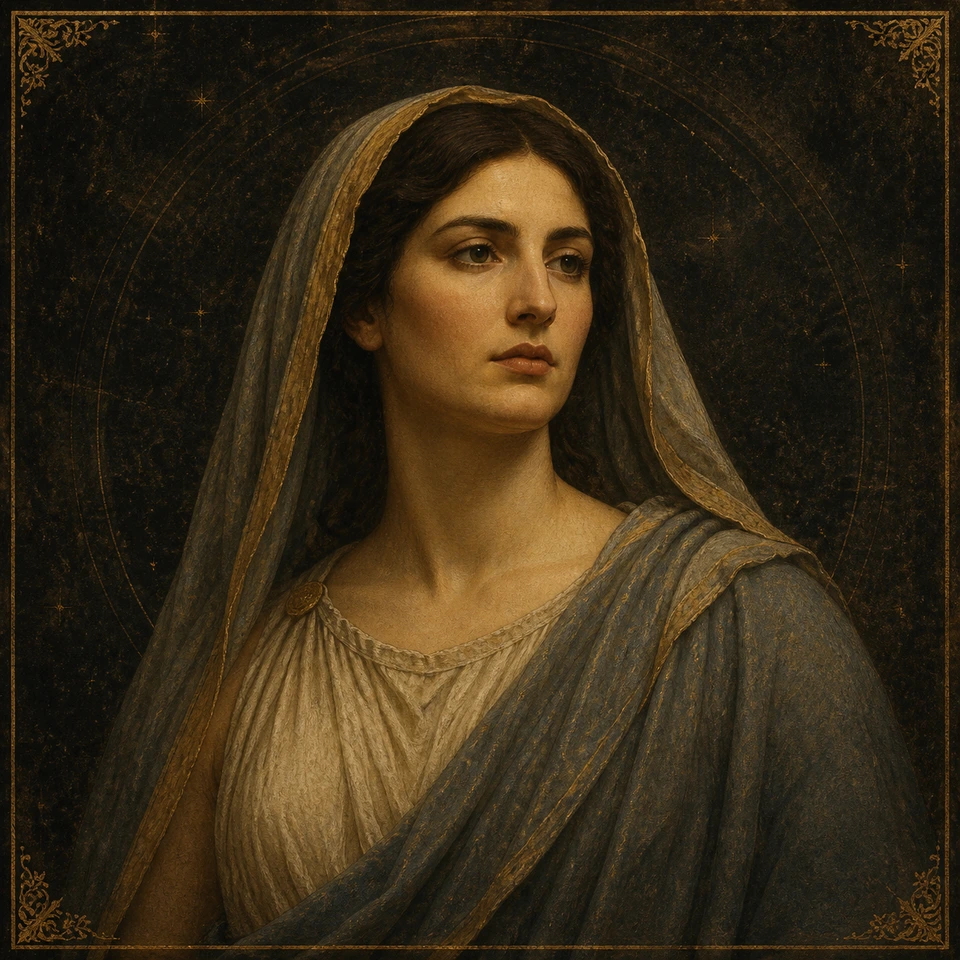
A commanding presence of the ancient sea, Amphitrite stands in early poetry as Poseidon's spouse and the mother of Triton. Her legacy endures through securely attested healing rites at Kionia on Tenos, alongside deeply rooted Nereid and Oceanid genealogies.
Overview
At Kionia on the island of Tenos, a sacred way led worshippers into a sanctuary shared by Poseidon and Amphitrite. The complex held a temple, fountain, healing hall, dining rooms, altar, votive monuments, and over-life-size statues of the divine pair. Founded in the late fourth century BC and active until the middle of the third century AD, it gives Amphitrite a firm place in practiced Greek religion. Historical testimony credited both deities with healing, while women unable to conceive sought Amphitrite in particular. She was not merely Poseidon's silent wife in a poem. At Tenos, people approached her as a divine recipient within an organized maritime and therapeutic cult.
Poetry reveals a figure with more than one shape. In the Odyssey, loud-groaning Amphitrite can be almost indistinguishable from the perilous sea, raising innumerable monsters around Odysseus' path. Hesiod names her among the Nereids, grants her and two sisters the power to calm wind and waves, and later places her beside Poseidon as Triton's mother. The Homeric Hymn to Apollo counts her among the elder goddesses who gather during Leto's labor. Sea, goddess, spouse, mother, and wave-calming power coexist across these poems, but no single witness combines them into a tidy biography.
The difference becomes sharper in the material record. Archaic clay plaques from Penteskouphia near Corinth place Amphitrite beside Poseidon and sometimes label her as his spouse. Yet Poseidon dominates the dedicatory setting, and no preserved plaque in the studied group addresses Amphitrite alone. The plaques make her presence visible without settling whether she possessed an independent Corinthian cult. Several centuries later, Pausanias saw her represented with Poseidon at the Isthmian sanctuary. That sculpture confirms a durable place in the god's public imagery, not the exact status of the earlier plaques.
Artists pictured Amphitrite as a dignified human goddess. On an Attic cup now in the Louvre, made about 500 to 490 BC, she sits in a chiton and veiled himation and receives Theseus in the sea hall. A figure from the Parthenon's west pediment, Akr. 954, is probably Amphitrite, perhaps stepping down from Poseidon's chariot with one leg left bare by her chiton. At Tenos, dolphins and hippocamps adorned the joint sanctuary. Each object captures a particular scene or institution. The leaf crown in the Theseus cup, the chariot on the Acropolis, and the marine creatures at Kionia are not interchangeable badges.
Her family is equally resistant to simplification. Hesiod makes Amphitrite a daughter of Nereus and Doris and gives her Triton by Poseidon. Pseudo-Apollodorus lists an Amphitrite among the Oceanids, another among the Nereids, then calls Poseidon's wife a daughter of Ocean and names both Triton and Rhode as their children. These strands preserve competing ways of placing her within the sea's divine generations. They agree on Poseidon and Triton, but not on parentage or the full list of children.
The myths show Amphitrite acting inside the sea household. When Minos throws his ring into the water and challenges Theseus to prove Poseidon's fatherhood, Bacchylides sends the hero down with dolphins. Amphitrite receives him and returns him in her purple cloak and a rose wreath once given to her by Aphrodite. Pseudo-Apollodorus tells the test differently: Theseus comes back with the ring and a crown from Amphitrite. The distinction matters because her gift changes with the storyteller, as does the meaning of the hero's proof.
A later marriage narrative is harsher. Oppian says Amphitrite fled Poseidon, a dolphin found her, and Poseidon carried her away and overcame her against her will. Pseudo-Hyginus changes the sequence: she flees to Atlas to preserve her virginity, Delphinus persuades her to accept Neptune, and the dolphin receives a place among the stars for arranging the marriage. One account preserves coercion; the other turns the dolphin into a successful envoy. Neither should be softened into a timeless romance, and neither explains the much earlier Hesiodic marriage reference.
European art later expanded Amphitrite into a grand personification and queen of the sea. Michel Anguier's bronze figure, known through a Metropolitan Museum cast dated 1700 after a 1652 model, belongs to that reception history. Modern lists go further, attaching shells, pearls, blue, water, the moon, or generalized fertility. The ancient evidence is narrower but more substantial: dangerous and calming sea power in poetry, joint worship and healing at Tenos, disputed Corinthian cult presence, formal draped images, conflicting genealogies, and three narratives in which gifts, force, kinship, and divine status change from one witness to another.
Canonical identity
Canonical Identity
Amphitrite defines her identity through her mythological actions rather than existing as a generic term for female sea power. Hesiod introduces her as a specifically named Nereid who marries Poseidon, calms the ocean waves, and gives birth to Triton. The Odyssey evokes her as a loud-groaning presence nearly indistinguishable from the dangerous sea itself, while the Homeric Hymn to Apollo places her securely among the elder goddesses surrounding Leto. Through these varied accounts, she maintains a distinct personal identity entirely separate from Thetis, the Oceanids, the other Nereids, and later folklore mermaids.
Linguistic Identity
The English name Amphitrite originates from the Ancient Greek Ἀμφιτρίτη, which is transliterated as Amphitrítē. A qualified fifth-century BC Attic reconstruction provides the pronunciation /am.pʰi.triː.tɛː/, roughly equivalent to am-phi-TREE-tay. This phonetic model serves as a useful historical approximation rather than a universal standard, acknowledging that Greek pronunciation shifted considerably across different centuries and dialects. The underlying etymology of her name currently remains disputed among scholars.
Sources and evidence
SCHOLARLY INTERPRETATION · Supported
Archaic and Classical witnesses use Amphitrite as an anthropomorphic Nereid, spouse and mother, elder goddess, and poetic name for the sea.
- Source
- Jennifer Larson, Amphitrite in and out of the Olympian Pantheon (2019)
- Reviewed edition
- Les Etudes classiques 87, 2019, pages 29-40 · Peeters Publishers
- Exact locator
- Page 29-34 · Entry Odyssey, Hesiod, and Homeric Hymn identity analysis
- Scope
- Modern classical scholarship · Ancient Greece
- Authority
- peer-reviewed classical scholarship
- Certainty
- Qualified
The specialist synthesis preserves differences among genres rather than making one early identity universal.
Open exact reviewed sourceTEXTUAL · Supported
The Ancient Greek name is Ἀμφιτρίτη, transliterated Amphitrítē, with a proposed fifth-century BC Attic pronunciation /am.pʰi.triː.tɛː/.
- Source
- Wiktionary contributors, Amphitrite in Ancient Greek
- Reviewed edition
- Live Ancient Greek lexical entry reviewed 2026-08-29 · Wiktionary
- Exact locator
- Entry Ancient Greek Ἀμφιτρίτη, pronunciation section
- Scope
- Classical Greece · Attica
- Authority
- collaborative historical lexicon
- Certainty
- Provisional
The phonological reconstruction is not generalized to every Greek dialect or century.
Open exact reviewed sourceTEXTUAL · Supported
The Homeric Hymn to Apollo places loud-groaning Amphitrite among the elder goddesses present during Leto's labor.
- Source
- Anonymous Homeric Hymns; edited and translated by Hugh G. Evelyn-White, Homeric Hymns (1914)
- Reviewed edition
- Hugh G. Evelyn-White edition and English translation in Hesiod, the Homeric Hymns and Homerica, 1914 · translated by Hugh G. Evelyn-White · edited by Hugh G. Evelyn-White · Perseus Digital Library / Scaife ATLAS
- Exact locator
- Hymn Homeric Hymn 3 to Apollo · Line 91-94
- Scope
- Archaic Greece · Ancient Greece
- Authority
- primary Greek hymn
- Certainty
- Secure
Supports a poetic epithet and assembly role, not a local cult title.
Open exact reviewed source5 reviewed sources for this section
- Wiktionary contributors, Amphitrite in Ancient GreekAncient Greek lexical entry, pronunciation section · Wiktionary
- Jennifer Larson, Amphitrite in and out of the Olympian Pantheon (2019)Les Etudes classiques 87, pages 29-40 · Peeters Publishers
- Hesiod; edited and translated by Hugh G. Evelyn-White, Theogony (1914)Hesiod, the Homeric Hymns and Homerica, London and New York, 1914 · Perseus Digital Library / Scaife ATLAS
- Homer; translated by A. T. Murray, Odyssey (1919)A. T. Murray English translation, London: William Heinemann; New York: G. P. Putnam's Sons, 1919 · Perseus Digital Library / Scaife ATLAS
- Anonymous Homeric Hymns; edited and translated by Hugh G. Evelyn-White, Homeric Hymns (1914)Hesiod, the Homeric Hymns and Homerica, London and New York, 1914 · Perseus Digital Library / Scaife ATLAS
Culture, tradition, period, and place
Amphitrite belongs to ancient Greek religion, poetry, and art, but her surviving presence moves from one setting to another. Archaic epic and hymn preserve her sea power, genealogy, and title. Clay plaques from Penteskouphia near Corinth place her beside Poseidon in a debated cultic setting. Classical Athens gives her a heroic and Olympian visual role through the Theseus cup and the probable figure from the Parthenon's west pediment.
Her clearest sanctuary stands at Kionia on Tenos. Founded in the late fourth century BC, it flourished through Hellenistic and Roman phases and remained active until the middle of the third century AD. Pausanias later records her in monumental groups at the Corinthian Isthmus and elsewhere. Oppian's Greek poem and Pseudo-Hyginus' Latin star myth belong to the Roman imperial world. Reading those late stories beside, rather than inside, the earlier evidence shows how Amphitrite's image continued to change.
Sources and evidence
SCHOLARLY INTERPRETATION · Supported
Archaic and Classical witnesses use Amphitrite as an anthropomorphic Nereid, spouse and mother, elder goddess, and poetic name for the sea.
- Source
- Jennifer Larson, Amphitrite in and out of the Olympian Pantheon (2019)
- Reviewed edition
- Les Etudes classiques 87, 2019, pages 29-40 · Peeters Publishers
- Exact locator
- Page 29-34 · Entry Odyssey, Hesiod, and Homeric Hymn identity analysis
- Scope
- Modern classical scholarship · Ancient Greece
- Authority
- peer-reviewed classical scholarship
- Certainty
- Qualified
The specialist synthesis preserves differences among genres rather than making one early identity universal.
Open exact reviewed sourceARCHAEOLOGICAL · Supported
The Kionia sanctuary on Tenos was dedicated jointly to Poseidon and Amphitrite from the late fourth century BC until abandonment in the middle of the third century AD.
- Source
- Natassa Angelopoulou; translated by Freya Evenson, The Sanctuary of Poseidon and Amphitrite at Kionia, Tenos (2019)
- Reviewed edition
- Bilingual archaeological-site guide 170 MYK.GR/EN, 2019 · translated by Freya Evenson · edited by Natassa Angelopoulou · Hellenic Republic Ministry of Culture and Sports
- Exact locator
- Page English page 1 · Entry sanctuary dedication and chronology
- Scope
- Hellenistic Greek world · Kionia
- Authority
- official archaeological site publication
- Certainty
- Secure
The chronological range includes later phases and does not imply unchanged practice.
Open exact reviewed source5 reviewed sources for this section
- Jennifer Larson, Amphitrite in and out of the Olympian Pantheon (2019)Les Etudes classiques 87, pages 29-40 · Peeters Publishers
- Natassa Angelopoulou; translated by Freya Evenson, The Sanctuary of Poseidon and Amphitrite at Kionia, Tenos (2019)Bilingual archaeological-site guide 170 MYK.GR/EN · Hellenic Republic Ministry of Culture and Sports
- Pausanias; Spiro Greek edition and Jones/Ormerod translation volumes, Description of Greece (1935)Perseus CTS edition corpus, 1903-1935 · Perseus Digital Library / Scaife ATLAS
- Oppian; edited and translated by A. W. Mair, Halieutica or Fishing, Book 1 (1928)Loeb Classical Library English translation · LacusCurtius, University of Chicago
- Pseudo-Hyginus, AstronomicaPackard Humanities Institute Latin text, 2.17.1 · Packard Humanities Institute Latin Texts
Historical development
Amphitrite enters the surviving record with several identities already in motion. Homeric poetry can make her the sounding, dangerous sea. Hesiod gives her a body, parents, sisters, a husband, a son, and the ability to quiet waves. The Homeric Hymn to Apollo places her among an older divine assembly. These poems do not preserve a simple origin story; they show that archaic audiences could recognize her in different religious and poetic roles.
Objects and sanctuaries then add new settings. Penteskouphia's plaques place her beside Poseidon without proving a separate cult. Classical Athenian art brings her into Theseus' sea descent and the divine spectacle of the Parthenon. Hellenistic Tenos supplies the strongest institutional evidence through a joint temple, healing practice, votives, ritual dining, and monumental statues. By the Roman imperial period, Pausanias records her in public sculpture, while Oppian and Latin mythography elaborate the dolphin-assisted marriage. The sequence is a history of changing emphasis, not one unchanged sea-queen tradition.
Sources and evidence
SCHOLARLY INTERPRETATION · Supported
Archaic Penteskouphia plaques place Amphitrite beside Poseidon, but the lack of a preserved dedication to her alone leaves independent cult interpretation disputed.
- Source
- Jennifer Larson, Amphitrite in and out of the Olympian Pantheon (2019)
- Reviewed edition
- Les Etudes classiques 87, 2019, pages 29-40 · Peeters Publishers
- Exact locator
- Page 34-36 · Entry Penteskouphia plaques, labels, and cult debate
- Scope
- Archaic Greece · Penteskouphia
- Authority
- peer-reviewed classical scholarship
- Certainty
- Disputed cult inference
Secure presence is distinguished from an uncertain conclusion about independent worship.
Open exact reviewed sourceARCHAEOLOGICAL · Supported
The Kionia sanctuary on Tenos was dedicated jointly to Poseidon and Amphitrite from the late fourth century BC until abandonment in the middle of the third century AD.
- Source
- Natassa Angelopoulou; translated by Freya Evenson, The Sanctuary of Poseidon and Amphitrite at Kionia, Tenos (2019)
- Reviewed edition
- Bilingual archaeological-site guide 170 MYK.GR/EN, 2019 · translated by Freya Evenson · edited by Natassa Angelopoulou · Hellenic Republic Ministry of Culture and Sports
- Exact locator
- Page English page 1 · Entry sanctuary dedication and chronology
- Scope
- Hellenistic Greek world · Kionia
- Authority
- official archaeological site publication
- Certainty
- Secure
The chronological range includes later phases and does not imply unchanged practice.
Open exact reviewed source7 reviewed sources for this section
- Jennifer Larson, Amphitrite in and out of the Olympian Pantheon (2019)Les Etudes classiques 87, pages 29-40 · Peeters Publishers
- Homer; translated by A. T. Murray, Odyssey (1919)A. T. Murray English translation, London: William Heinemann; New York: G. P. Putnam's Sons, 1919 · Perseus Digital Library / Scaife ATLAS
- Hesiod; edited and translated by Hugh G. Evelyn-White, Theogony (1914)Hesiod, the Homeric Hymns and Homerica, London and New York, 1914 · Perseus Digital Library / Scaife ATLAS
- Anonymous Homeric Hymns; edited and translated by Hugh G. Evelyn-White, Homeric Hymns (1914)Hesiod, the Homeric Hymns and Homerica, London and New York, 1914 · Perseus Digital Library / Scaife ATLAS
- Musée du Louvre, Cup MNB 166 / G 104: Theseus and Amphitrite (2026)Live official collection record, updated 8 April 2026 · Département des Antiquités grecques, étrusques et romaines, Musée du Louvre
- Acropolis Museum curatorial staff, Parthenon. West pediment. AmphitriteLive official object catalog for inventory Akr. 954 · Acropolis Museum
- Natassa Angelopoulou; translated by Freya Evenson, The Sanctuary of Poseidon and Amphitrite at Kionia, Tenos (2019)Bilingual archaeological-site guide 170 MYK.GR/EN · Hellenic Republic Ministry of Culture and Sports
Attested roles and historical themes
Roles, powers, and limits
Hesiod gives Amphitrite an active power over the sea's condition. With Cymodoce and Cymatolege, she can calm winds and settle the waves of the misty water. The Odyssey shows the opposite face of the same environment: loud-groaning Amphitrite raises innumerable sea monsters around a sailor's course. In one poem she helps quiet danger; in another her name carries the danger itself.
At Kionia, poetic force became a local religious function. Amphitrite shared a healing cult with Poseidon and was especially credited with helping women who could not conceive. That testimony explains why worshippers approached her at this sanctuary, but it does not turn her into a universal goddess of medicine, fertility, childbirth, every body of water, or every marine creature. Her powers remain strongest when their setting is kept visible: the sea of archaic poetry and the healing sanctuary on Tenos.
Sources and evidence
TEXTUAL · Supported
Hesiod names Amphitrite with Cymodoce and Cymatolege as powers who calm winds and waves on the misty sea.
- Source
- Hesiod; edited and translated by Hugh G. Evelyn-White, Theogony (1914)
- Reviewed edition
- Hugh G. Evelyn-White edition and English translation in Hesiod, the Homeric Hymns and Homerica, 1914 · translated by Hugh G. Evelyn-White · edited by Hugh G. Evelyn-White · Perseus Digital Library / Scaife ATLAS
- Exact locator
- Entry Theogony · Line 240-264
- Scope
- Archaic Greece · Ancient Greece
- Authority
- primary Greek hexameter poetry
- Certainty
- Secure
The function is shared with two named sisters in this passage.
Open exact reviewed sourceTEXTUAL · Supported
Odyssey 12 says loud-groaning Amphitrite rears sea monsters in countless numbers.
- Source
- Homer; translated by A. T. Murray, Odyssey (1919)
- Reviewed edition
- A. T. Murray English translation, London: William Heinemann; New York: G. P. Putnam's Sons, 1919 · translated by A. T. Murray · Perseus Digital Library / Scaife ATLAS
- Exact locator
- Entry Odyssey · Book 12 · Line 95-97
- Scope
- Archaic Greece · Ancient Greece
- Authority
- primary Greek epic
- Certainty
- Secure
The poetic usage joins Amphitrite closely to the dangerous sea without establishing zoological rulership.
Open exact reviewed sourceRITUAL ATTESTED · Supported
Historical testimony at Tenos credited Amphitrite with healing women who could not conceive.
- Source
- Natassa Angelopoulou; translated by Freya Evenson, The Sanctuary of Poseidon and Amphitrite at Kionia, Tenos (2019)
- Reviewed edition
- Bilingual archaeological-site guide 170 MYK.GR/EN, 2019 · translated by Freya Evenson · edited by Natassa Angelopoulou · Hellenic Republic Ministry of Culture and Sports
- Exact locator
- Page English page 1 · Entry healing functions of Poseidon and Amphitrite
- Scope
- Hellenistic Greek world · Kionia
- Authority
- official archaeological site publication
- Certainty
- Secure within local testimony
Local cult testimony only, not medical advice or a guaranteed outcome.
Open exact reviewed source3 reviewed sources for this section
- Hesiod; edited and translated by Hugh G. Evelyn-White, Theogony (1914)Hesiod, the Homeric Hymns and Homerica, London and New York, 1914 · Perseus Digital Library / Scaife ATLAS
- Homer; translated by A. T. Murray, Odyssey (1919)A. T. Murray English translation, London: William Heinemann; New York: G. P. Putnam's Sons, 1919 · Perseus Digital Library / Scaife ATLAS
- Natassa Angelopoulou; translated by Freya Evenson, The Sanctuary of Poseidon and Amphitrite at Kionia, Tenos (2019)Bilingual archaeological-site guide 170 MYK.GR/EN · Hellenic Republic Ministry of Culture and Sports
Epithets and titles
Poetic Epithet
Loud-groaning
ἀγάστονος · Loud-groaning
Greek epic and hymn tradition · Archaic Greek poetic witnessesA poetic title tied to the sound and danger of the sea, not a documented local cult title.
2 reviewed sources for this section
- Anonymous Homeric Hymns; edited and translated by Hugh G. Evelyn-White, Homeric Hymns (1914)Hesiod, the Homeric Hymns and Homerica, London and New York, 1914 · Perseus Digital Library / Scaife ATLAS
- Homer; translated by A. T. Murray, Odyssey (1919)A. T. Murray English translation, London: William Heinemann; New York: G. P. Putnam's Sons, 1919 · Perseus Digital Library / Scaife ATLAS
Poetic Epithet
Ox-eyed
Ox-eyed
Bacchylides' Aegean heroic song · Classical Greek lyric witnessBacchylides applies this dignifying poetic title when Amphitrite receives Theseus in the sea hall.
1 reviewed source for this section
- Bacchylides; translated by Diane Arnson Svarlien, Dithyrambs (1996)Odes, English translation · Perseus Digital Library / Scaife ATLAS
Worship and cult
At Kionia, Amphitrite belonged to a cult complex built for repeated public use. Worshippers entered along a sacred way, sacrificed at an altar, left votive monuments, sought healing, and dined in rooms made for communal ritual. A temple held over-life-size statues of Amphitrite and Poseidon. The site's long life, from the late fourth century BC into the third century AD, shows a durable joint cult in which she was addressed as more than a literary figure. Women unable to conceive were particularly associated with her healing aid.
The Corinthian evidence is less decisive. Inscribed plaques from Penteskouphia sometimes name Amphitrite beside Poseidon or identify her as his spouse, yet Poseidon remains the dominant recipient and no preserved dedication in the studied group is directed to her alone. Corinth therefore reveals a visible divine partner whose independent cult status remains debated. Tenos supplies the secure worship center; it does not make every Greek shoreline another Amphitrite sanctuary.
Sources and evidence
ARCHAEOLOGICAL · Supported
The Kionia sanctuary on Tenos was dedicated jointly to Poseidon and Amphitrite from the late fourth century BC until abandonment in the middle of the third century AD.
- Source
- Natassa Angelopoulou; translated by Freya Evenson, The Sanctuary of Poseidon and Amphitrite at Kionia, Tenos (2019)
- Reviewed edition
- Bilingual archaeological-site guide 170 MYK.GR/EN, 2019 · translated by Freya Evenson · edited by Natassa Angelopoulou · Hellenic Republic Ministry of Culture and Sports
- Exact locator
- Page English page 1 · Entry sanctuary dedication and chronology
- Scope
- Hellenistic Greek world · Kionia
- Authority
- official archaeological site publication
- Certainty
- Secure
The chronological range includes later phases and does not imply unchanged practice.
Open exact reviewed sourceRITUAL ATTESTED · Supported
Historical testimony at Tenos credited Amphitrite with healing women who could not conceive.
- Source
- Natassa Angelopoulou; translated by Freya Evenson, The Sanctuary of Poseidon and Amphitrite at Kionia, Tenos (2019)
- Reviewed edition
- Bilingual archaeological-site guide 170 MYK.GR/EN, 2019 · translated by Freya Evenson · edited by Natassa Angelopoulou · Hellenic Republic Ministry of Culture and Sports
- Exact locator
- Page English page 1 · Entry healing functions of Poseidon and Amphitrite
- Scope
- Hellenistic Greek world · Kionia
- Authority
- official archaeological site publication
- Certainty
- Secure within local testimony
Local cult testimony only, not medical advice or a guaranteed outcome.
Open exact reviewed sourceSCHOLARLY INTERPRETATION · Supported
Archaic Penteskouphia plaques place Amphitrite beside Poseidon, but the lack of a preserved dedication to her alone leaves independent cult interpretation disputed.
- Source
- Jennifer Larson, Amphitrite in and out of the Olympian Pantheon (2019)
- Reviewed edition
- Les Etudes classiques 87, 2019, pages 29-40 · Peeters Publishers
- Exact locator
- Page 34-36 · Entry Penteskouphia plaques, labels, and cult debate
- Scope
- Archaic Greece · Penteskouphia
- Authority
- peer-reviewed classical scholarship
- Certainty
- Disputed cult inference
Secure presence is distinguished from an uncertain conclusion about independent worship.
Open exact reviewed source2 reviewed sources for this section
- Natassa Angelopoulou; translated by Freya Evenson, The Sanctuary of Poseidon and Amphitrite at Kionia, Tenos (2019)Bilingual archaeological-site guide 170 MYK.GR/EN · Hellenic Republic Ministry of Culture and Sports
- Jennifer Larson, Amphitrite in and out of the Olympian Pantheon (2019)Les Etudes classiques 87, pages 29-40 · Peeters Publishers
Temples, sanctuaries, and sacred places
Kionia lies on the coast of Tenos, about three kilometers west of the island's main settlement. The sanctuary began in the late fourth century BC, acquired major buildings in the Hellenistic period, and remained active until the middle of the third century AD. Its fountain, healing hall, dining spaces, altar, sacred way, temple, and votive monuments joined water, healing, sacrifice, movement, and shared meals in one religious landscape. Amphitrite's place there was both architectural and devotional.
The Corinthian Isthmus offers a different kind of presence. Pausanias saw Amphitrite in a sculptural group with Poseidon, while nearby Penteskouphia preserves much earlier inscribed plaques whose cult meaning is still debated. Athens gives her powerful images, including the Theseus cup and the probable Parthenon figure, but those works do not by themselves establish an independent Athenian cult center. Each place preserves a different relationship between image, story, and worship.
Sources and evidence
ARCHAEOLOGICAL · Supported
The Kionia sanctuary on Tenos was dedicated jointly to Poseidon and Amphitrite from the late fourth century BC until abandonment in the middle of the third century AD.
- Source
- Natassa Angelopoulou; translated by Freya Evenson, The Sanctuary of Poseidon and Amphitrite at Kionia, Tenos (2019)
- Reviewed edition
- Bilingual archaeological-site guide 170 MYK.GR/EN, 2019 · translated by Freya Evenson · edited by Natassa Angelopoulou · Hellenic Republic Ministry of Culture and Sports
- Exact locator
- Page English page 1 · Entry sanctuary dedication and chronology
- Scope
- Hellenistic Greek world · Kionia
- Authority
- official archaeological site publication
- Certainty
- Secure
The chronological range includes later phases and does not imply unchanged practice.
Open exact reviewed sourceMATERIAL CULTURE · Supported
Pausanias describes Amphitrite represented with Poseidon in the sculptural group at the Isthmian sanctuary.
- Source
- Pausanias; Spiro Greek edition and Jones/Ormerod translation volumes, Description of Greece (1935)
- Reviewed edition
- Spiro Greek edition and Jones/Ormerod English volumes represented by the Perseus CTS corpus, 1903-1935 · translated by W. H. S. Jones and H. A. Ormerod, volume-dependent · edited by Friedrich Spiro for the Greek edition · Perseus Digital Library / Scaife ATLAS
- Exact locator
- Entry Description of Greece · Book 2 · Chapter 1 · Section 7-8
- Scope
- Greek religion under Roman imperial rule · Corinthian Isthmus
- Authority
- primary Greek periegetic testimony
- Certainty
- Secure description
Describes a monumental group and does not prove an independent archaic Amphitrite cult.
Open exact reviewed source3 reviewed sources for this section
- Natassa Angelopoulou; translated by Freya Evenson, The Sanctuary of Poseidon and Amphitrite at Kionia, Tenos (2019)Bilingual archaeological-site guide 170 MYK.GR/EN · Hellenic Republic Ministry of Culture and Sports
- Pausanias; Spiro Greek edition and Jones/Ormerod translation volumes, Description of Greece (1935)Perseus CTS edition corpus, 1903-1935 · Perseus Digital Library / Scaife ATLAS
- Jennifer Larson, Amphitrite in and out of the Olympian Pantheon (2019)Les Etudes classiques 87, pages 29-40 · Peeters Publishers
Festivals and processions
Dramatic contests called the Poseidia or Posidonia took place at the Kionia sanctuary. The celebration unfolded within the same complex where Amphitrite and Poseidon shared temple space, healing functions, statues, sacrifices, and votive activity. Its setting therefore belongs to her cult history.
The official account nevertheless names Poseidon as the festival's honoree. Amphitrite's presence in the sanctuary does not make the contests a separate festival in her name. No surviving evidence here gives her an independent annual feast, fixed season, weekday, or lunar observance. The Poseidia shows how closely the two deities could share sacred space while retaining different emphasis within its calendar.
Sources and evidence
RITUAL ATTESTED · Supported
Poseidia or Posidonia with dramatic contests was celebrated at Kionia in honor of Poseidon.
- Source
- Natassa Angelopoulou; translated by Freya Evenson, The Sanctuary of Poseidon and Amphitrite at Kionia, Tenos (2019)
- Reviewed edition
- Bilingual archaeological-site guide 170 MYK.GR/EN, 2019 · translated by Freya Evenson · edited by Natassa Angelopoulou · Hellenic Republic Ministry of Culture and Sports
- Exact locator
- Page English page 1 · Entry Poseidia or Posidonia and dramatic contests
- Scope
- Hellenistic Greek world · Kionia
- Authority
- official archaeological site publication
- Certainty
- Secure
The festival is contextual to Amphitrite's joint sanctuary but is not reassigned to her.
Open exact reviewed source1 reviewed source for this section
- Natassa Angelopoulou; translated by Freya Evenson, The Sanctuary of Poseidon and Amphitrite at Kionia, Tenos (2019)Bilingual archaeological-site guide 170 MYK.GR/EN · Hellenic Republic Ministry of Culture and Sports
Offerings, votives, and ritual evidence
Ritual at Kionia left traces in both architecture and objects. Worshippers sacrificed at the altar, traveled the sacred way, ate in purpose-built dining rooms, pursued healing, and set up votive monuments. These acts made the joint sanctuary a place where divine aid, communal ceremony, and public memory met. Not every surviving sacrifice or monument can be assigned to Amphitrite alone, but she stood among the named recipients of the complex.
At Penteskouphia, the clay plaques are votive objects in their own right. Some place Amphitrite beside Poseidon, and their inscriptions preserve her presence within the Corinthian religious landscape. Their meaning depends on the individual object rather than a single formula for worship. Ancient evidence does not provide a general modern offering kit of shells, seawater, pearls, blue candles, incense, food, or drink. What survives is more concrete: plaques, altar sacrifice, sacred movement, dining, healing, statues, and votive monuments.
Sources and evidence
ARCHAEOLOGICAL · Supported
The Kionia complex preserved an altar, ritual dining rooms, a healing hall, a sacred way, and spaces for votive monuments.
- Source
- Natassa Angelopoulou; translated by Freya Evenson, The Sanctuary of Poseidon and Amphitrite at Kionia, Tenos (2019)
- Reviewed edition
- Bilingual archaeological-site guide 170 MYK.GR/EN, 2019 · translated by Freya Evenson · edited by Natassa Angelopoulou · Hellenic Republic Ministry of Culture and Sports
- Exact locator
- Page English pages 2-3 · Entry healing hall, dining hall, altar, sacred way, and votives
- Scope
- Hellenistic Greek world · Kionia
- Authority
- official archaeological site publication
- Certainty
- Secure
The architecture establishes sanctuary practice but not the recipient of every individual act.
Open exact reviewed sourceSCHOLARLY INTERPRETATION · Supported
Archaic Penteskouphia plaques place Amphitrite beside Poseidon, but the lack of a preserved dedication to her alone leaves independent cult interpretation disputed.
- Source
- Jennifer Larson, Amphitrite in and out of the Olympian Pantheon (2019)
- Reviewed edition
- Les Etudes classiques 87, 2019, pages 29-40 · Peeters Publishers
- Exact locator
- Page 34-36 · Entry Penteskouphia plaques, labels, and cult debate
- Scope
- Archaic Greece · Penteskouphia
- Authority
- peer-reviewed classical scholarship
- Certainty
- Disputed cult inference
Secure presence is distinguished from an uncertain conclusion about independent worship.
Open exact reviewed source2 reviewed sources for this section
- Natassa Angelopoulou; translated by Freya Evenson, The Sanctuary of Poseidon and Amphitrite at Kionia, Tenos (2019)Bilingual archaeological-site guide 170 MYK.GR/EN · Hellenic Republic Ministry of Culture and Sports
- Jennifer Larson, Amphitrite in and out of the Olympian Pantheon (2019)Les Etudes classiques 87, pages 29-40 · Peeters Publishers
Iconography and material culture
Ancient artists gave Amphitrite a human body and the dress of a dignified Greek goddess. On Louvre cup G 104, she sits in a chiton with a himation drawn over her head as a veil. She holds a leaf crown for Theseus, making the object part of their encounter in the sea hall. On the Parthenon's west pediment, figure Akr. 954 is probably Amphitrite, perhaps dismounting from Poseidon's chariot in a chiton that leaves her left leg bare. The museum preserves the identification as probable.
At Kionia, Telesinos of Athens made over-life-size cult statues of Amphitrite and Poseidon early in the second century BC, while dolphins and hippocamps decorated the sanctuary. These images show how dress, posture, vehicle, gift, and marine ornament worked within particular scenes. The leaf crown belongs to Theseus' reception, the chariot to a pedimental reconstruction, and the animals to a joint sanctuary. Mermaid tails, tridents, shell crowns, and fantasy armor do not appear in these ancient objects and images.
Sources and evidence
MATERIAL CULTURE · Supported
Louvre cup G 104, made in Athens about 500 to 490 BC, depicts Amphitrite seated in a chiton and veiled himation while holding a leaf crown in the Theseus scene.
- Source
- Musée du Louvre, Cup MNB 166 / G 104: Theseus and Amphitrite (2026)
- Reviewed edition
- Musée du Louvre live collection record cl010269995 for MNB 166 / G 104, updated 8 April 2026 · Département des Antiquités grecques, étrusques et romaines, Musée du Louvre
- Exact locator
- MuseumObjectId MNB 166 / G 104 · Entry collection record cl010269995
- Scope
- Archaic Greece · Athens
- Authority
- official museum object catalog
- Certainty
- Secure
The crown, seat, and clothing belong to this narrative image.
Open exact reviewed sourceMATERIAL CULTURE · Supported
The Acropolis Museum identifies Akr. 954 from the Parthenon west pediment as probably Amphitrite, most possibly shown dismounting from Poseidon's chariot in a chiton that left her left leg bare.
- Source
- Acropolis Museum curatorial staff, Parthenon. West pediment. Amphitrite
- Reviewed edition
- Live official Acropolis Museum object catalog reviewed 2026-08-29 · Acropolis Museum
- Exact locator
- MuseumObjectId Akr. 954 · Entry Parthenon west pediment, probable Amphitrite dismounting in a chiton with left leg bare
- Scope
- Classical Greece · Athenian Acropolis
- Authority
- official museum object catalog
- Certainty
- Probable identification
The probable identification, reconstructed action, chiton, and left-leg-bare detail follow the museum record.
Open exact reviewed sourceMATERIAL CULTURE · Supported
Early in the second century BC Telesinos of Athens made over-life-size cult statues of Amphitrite and Poseidon for the Kionia temple, which also bore dolphin and hippocamp decoration.
- Source
- Natassa Angelopoulou; translated by Freya Evenson, The Sanctuary of Poseidon and Amphitrite at Kionia, Tenos (2019)
- Reviewed edition
- Bilingual archaeological-site guide 170 MYK.GR/EN, 2019 · translated by Freya Evenson · edited by Natassa Angelopoulou · Hellenic Republic Ministry of Culture and Sports
- Exact locator
- Page English pages 1-2 · Entry temple statues and marine decoration
- Scope
- Hellenistic Greek world · Kionia
- Authority
- official archaeological site publication
- Certainty
- Secure
The marine decoration belongs to the joint sanctuary and is not assigned exclusively to Amphitrite.
Open exact reviewed source3 reviewed sources for this section
- Musée du Louvre, Cup MNB 166 / G 104: Theseus and Amphitrite (2026)Live official collection record, updated 8 April 2026 · Département des Antiquités grecques, étrusques et romaines, Musée du Louvre
- Acropolis Museum curatorial staff, Parthenon. West pediment. AmphitriteLive official object catalog for inventory Akr. 954 · Acropolis Museum
- Natassa Angelopoulou; translated by Freya Evenson, The Sanctuary of Poseidon and Amphitrite at Kionia, Tenos (2019)Bilingual archaeological-site guide 170 MYK.GR/EN · Hellenic Republic Ministry of Culture and Sports
Animals, plants, and embodied forms
Dolphins repeatedly move through Amphitrite's stories and sacred surroundings. In Bacchylides, they carry Theseus down to the sea hall where she receives him. In the imperial marriage accounts, a dolphin finds her or persuades her to accept the sea god. At Kionia, dolphins and hippocamps form part of the sanctuary's decoration. The recurrence makes the dolphin a strong historical companion to her narrative and material worlds, though no surviving passage calls it her exclusive sacred animal.
The rose appears in a much narrower scene. Bacchylides says Amphitrite places a rose wreath on Theseus and identifies it as a marriage gift she once received from Aphrodite. That detail gives the wreath a history within the poem and helps mark Theseus' transformed return from the sea. It does not make every rose a cult plant of Amphitrite. Coral, pearls, seaweed, horses, fish, and other marine forms likewise lack evidence as universal personal correspondences.
Sources and evidence
TEXTUAL · Supported
Bacchylides 17 has dolphins carry Theseus to the sea hall, where Amphitrite receives him and gives him her purple cloak and rose wreath.
- Source
- Bacchylides; translated by Diane Arnson Svarlien, Dithyrambs (1996)
- Reviewed edition
- Diane Arnson Svarlien English translation, Odes · translated by Diane Arnson Svarlien · Perseus Digital Library / Scaife ATLAS
- Exact locator
- Entry Dithyramb 17 · Line 90-116
- Scope
- Classical Greece · Ancient Greece
- Authority
- primary Greek lyric
- Certainty
- Secure
The ode does not narrate Theseus returning Minos' ring.
Open exact reviewed sourceMATERIAL CULTURE · Supported
Early in the second century BC Telesinos of Athens made over-life-size cult statues of Amphitrite and Poseidon for the Kionia temple, which also bore dolphin and hippocamp decoration.
- Source
- Natassa Angelopoulou; translated by Freya Evenson, The Sanctuary of Poseidon and Amphitrite at Kionia, Tenos (2019)
- Reviewed edition
- Bilingual archaeological-site guide 170 MYK.GR/EN, 2019 · translated by Freya Evenson · edited by Natassa Angelopoulou · Hellenic Republic Ministry of Culture and Sports
- Exact locator
- Page English pages 1-2 · Entry temple statues and marine decoration
- Scope
- Hellenistic Greek world · Kionia
- Authority
- official archaeological site publication
- Certainty
- Secure
The marine decoration belongs to the joint sanctuary and is not assigned exclusively to Amphitrite.
Open exact reviewed source4 reviewed sources for this section
- Bacchylides; translated by Diane Arnson Svarlien, Dithyrambs (1996)Odes, English translation · Perseus Digital Library / Scaife ATLAS
- Oppian; edited and translated by A. W. Mair, Halieutica or Fishing, Book 1 (1928)Loeb Classical Library English translation · LacusCurtius, University of Chicago
- Pseudo-Hyginus, AstronomicaPackard Humanities Institute Latin text, 2.17.1 · Packard Humanities Institute Latin Texts
- Natassa Angelopoulou; translated by Freya Evenson, The Sanctuary of Poseidon and Amphitrite at Kionia, Tenos (2019)Bilingual archaeological-site guide 170 MYK.GR/EN · Hellenic Republic Ministry of Culture and Sports
Relationships and genealogy
Hesiod places Amphitrite within the family of Nereus and Doris, then names her as Poseidon's spouse and Triton's mother. His Triton lives with both parents in a golden house beneath the sea. The arrangement gives Amphitrite a clear place among the Nereids and at the center of a divine household.
Pseudo-Apollodorus preserves a less orderly genealogy. One list includes an Amphitrite among the Oceanids, another includes her among the Nereids, and the marriage account calls Poseidon's wife a daughter of Ocean. That passage names Triton and Rhode as their children. Both authors agree on Poseidon and Triton, while Rhode and the daughter-of-Ocean parentage belong to the later mythographer. Keeping those versions distinct reveals how ancient genealogies organized sea divinities differently instead of forcing every Nereid, Oceanid, and spouse into one family tree.
Sources and evidence
TEXTUAL · Supported
Hesiod lists Amphitrite among the daughters of Nereus and Doris.
- Source
- Hesiod; edited and translated by Hugh G. Evelyn-White, Theogony (1914)
- Reviewed edition
- Hugh G. Evelyn-White edition and English translation in Hesiod, the Homeric Hymns and Homerica, 1914 · translated by Hugh G. Evelyn-White · edited by Hugh G. Evelyn-White · Perseus Digital Library / Scaife ATLAS
- Exact locator
- Entry Theogony · Line 240-264
- Scope
- Archaic Greece · Ancient Greece
- Authority
- primary Greek hexameter poetry
- Certainty
- Secure
This Nereid genealogy remains distinct from the later daughter-of-Ocean version.
Open exact reviewed sourceTEXTUAL · Supported
Hesiod says Amphitrite bore Triton to Poseidon and that Triton lived with his parents in a golden house beneath the sea.
- Source
- Hesiod; edited and translated by Hugh G. Evelyn-White, Theogony (1914)
- Reviewed edition
- Hugh G. Evelyn-White edition and English translation in Hesiod, the Homeric Hymns and Homerica, 1914 · translated by Hugh G. Evelyn-White · edited by Hugh G. Evelyn-White · Perseus Digital Library / Scaife ATLAS
- Exact locator
- Entry Theogony · Line 930-934
- Scope
- Archaic Greece · Ancient Greece
- Authority
- primary Greek hexameter poetry
- Certainty
- Secure
Supports one parental and household configuration.
Open exact reviewed sourceTEXTUAL · Supported
Pseudo-Apollodorus lists Amphitrite among both Oceanids and Nereids, then calls Poseidon's wife a daughter of Ocean and names Triton and Rhode as their children.
- Source
- Pseudo-Apollodorus; edited and translated by James G. Frazer, Library (1921)
- Reviewed edition
- James G. Frazer edition and English translation, Harvard University Press and William Heinemann, 1921 · translated by James G. Frazer · edited by James G. Frazer · Perseus Digital Library / Scaife ATLAS
- Exact locator
- Entry Library · Book 1 · Section 1.2.2; 1.2.7; 1.4.5
- Scope
- Greek religion under Roman imperial rule · Ancient Greece
- Authority
- primary mythographic compilation
- Certainty
- Secure text, unresolved harmonization
The conflicting classifications remain separate rather than being resolved by assumption.
Open exact reviewed source3 reviewed sources for this section
- Hesiod; edited and translated by Hugh G. Evelyn-White, Theogony (1914)Hesiod, the Homeric Hymns and Homerica, London and New York, 1914 · Perseus Digital Library / Scaife ATLAS
- Pseudo-Apollodorus; edited and translated by James G. Frazer, Library (1921)Harvard University Press and William Heinemann edition, 1921 · Perseus Digital Library / Scaife ATLAS
- Bacchylides; translated by Diane Arnson Svarlien, Dithyrambs (1996)Odes, English translation · Perseus Digital Library / Scaife ATLAS
Actual myths and source variants
Amphitrite's three principal narratives unfold inside the sea and the household she shares with Poseidon. Hesiod gives the household its shortest and most luminous image: Triton lives with his parents in a golden house beneath the water. Pseudo-Apollodorus keeps Triton but changes Amphitrite's genealogy and adds Rhode. The family remains recognizable even as its ancestry expands and shifts.
In the Theseus story, Amphitrite receives a living hero who has dived into the sea to prove Poseidon's fatherhood. Bacchylides sends him back in her purple cloak and rose wreath; Pseudo-Apollodorus gives him the lost ring and her crown. The late marriage story turns toward Amphitrite's own loss of freedom. Oppian ends her flight with seizure against her will. Pseudo-Hyginus instead makes Delphinus a persuasive envoy who arranges her marriage to Neptune and earns a place among the stars. The shared outlines matter, but the changed gifts and changed agency are what distinguish each telling.
Sources and evidence
TEXTUAL · Supported
Hesiod says Amphitrite bore Triton to Poseidon and that Triton lived with his parents in a golden house beneath the sea.
- Source
- Hesiod; edited and translated by Hugh G. Evelyn-White, Theogony (1914)
- Reviewed edition
- Hugh G. Evelyn-White edition and English translation in Hesiod, the Homeric Hymns and Homerica, 1914 · translated by Hugh G. Evelyn-White · edited by Hugh G. Evelyn-White · Perseus Digital Library / Scaife ATLAS
- Exact locator
- Entry Theogony · Line 930-934
- Scope
- Archaic Greece · Ancient Greece
- Authority
- primary Greek hexameter poetry
- Certainty
- Secure
Supports one parental and household configuration.
Open exact reviewed sourceTEXTUAL · Supported
Pseudo-Apollodorus lists Amphitrite among both Oceanids and Nereids, then calls Poseidon's wife a daughter of Ocean and names Triton and Rhode as their children.
- Source
- Pseudo-Apollodorus; edited and translated by James G. Frazer, Library (1921)
- Reviewed edition
- James G. Frazer edition and English translation, Harvard University Press and William Heinemann, 1921 · translated by James G. Frazer · edited by James G. Frazer · Perseus Digital Library / Scaife ATLAS
- Exact locator
- Entry Library · Book 1 · Section 1.2.2; 1.2.7; 1.4.5
- Scope
- Greek religion under Roman imperial rule · Ancient Greece
- Authority
- primary mythographic compilation
- Certainty
- Secure text, unresolved harmonization
The conflicting classifications remain separate rather than being resolved by assumption.
Open exact reviewed sourceTEXTUAL · Supported
Bacchylides 17 has dolphins carry Theseus to the sea hall, where Amphitrite receives him and gives him her purple cloak and rose wreath.
- Source
- Bacchylides; translated by Diane Arnson Svarlien, Dithyrambs (1996)
- Reviewed edition
- Diane Arnson Svarlien English translation, Odes · translated by Diane Arnson Svarlien · Perseus Digital Library / Scaife ATLAS
- Exact locator
- Entry Dithyramb 17 · Line 90-116
- Scope
- Classical Greece · Ancient Greece
- Authority
- primary Greek lyric
- Certainty
- Secure
The ode does not narrate Theseus returning Minos' ring.
Open exact reviewed sourceMATERIAL CULTURE · Supported
Pausanias reports an Athenian painting of Theseus rising from the sea with Amphitrite.
- Source
- Pausanias; Spiro Greek edition and Jones/Ormerod translation volumes, Description of Greece (1935)
- Reviewed edition
- Spiro Greek edition and Jones/Ormerod English volumes represented by the Perseus CTS corpus, 1903-1935 · translated by W. H. S. Jones and H. A. Ormerod, volume-dependent · edited by Friedrich Spiro for the Greek edition · Perseus Digital Library / Scaife ATLAS
- Exact locator
- Entry Description of Greece · Book 1 · Chapter 17 · Section 3
- Scope
- Greek religion under Roman imperial rule · Athens
- Authority
- primary Greek periegetic testimony
- Certainty
- Secure description
Later visual testimony for the Theseus sea-hall tradition.
Open exact reviewed source7 reviewed sources for this section
- Hesiod; edited and translated by Hugh G. Evelyn-White, Theogony (1914)Hesiod, the Homeric Hymns and Homerica, London and New York, 1914 · Perseus Digital Library / Scaife ATLAS
- Pseudo-Apollodorus; edited and translated by James G. Frazer, Library (1921)Harvard University Press and William Heinemann edition, 1921 · Perseus Digital Library / Scaife ATLAS
- Bacchylides; translated by Diane Arnson Svarlien, Dithyrambs (1996)Odes, English translation · Perseus Digital Library / Scaife ATLAS
- Jacob Stern, The Structure of Bacchylides' Ode 17 (1967)Revue belge de Philologie et d'Histoire 45.1 · Persée
- Oppian; edited and translated by A. W. Mair, Halieutica or Fishing, Book 1 (1928)Loeb Classical Library English translation · LacusCurtius, University of Chicago
- Pseudo-Hyginus, AstronomicaPackard Humanities Institute Latin text, 2.17.1 · Packard Humanities Institute Latin Texts
- Pausanias; Spiro Greek edition and Jones/Ormerod translation volumes, Description of Greece (1935)Perseus CTS edition corpus, 1903-1935 · Perseus Digital Library / Scaife ATLAS
Myth Library
Each myth gathers its attested participants into one source-grounded account, while distinct source traditions remain readable in their own variants.
Theogony
Birth and Golden House of Triton
Hesiod places Triton with Amphitrite and Poseidon in a golden house beneath the sea; Pseudo-Apollodorus keeps Triton but changes Amphitrite's genealogy and adds Rhode among the couple's children.
- Role in this profile
- mother of Triton and Poseidon's spouse in both genealogical traditions
- Place scope
- Ancient Greece
- Witnesses
- 2
- Variants
- 2
Heroic
Minos' Ring and Theseus' Sea Descent
Minos throws a ring into the sea to test Theseus' claim to Poseidon as father; Bacchylides returns the hero in Amphitrite's cloak and rose wreath, while Pseudo-Apollodorus returns him with the ring and her crown.
- Role in this profile
- divine host who receives Theseus and equips his return
- Place scope
- Ancient Greece
- Witnesses
- 3
- Variants
- 2
Late Reception
Amphitrite's Flight and the Dolphin's Embassy
Amphitrite flees Poseidon in two imperial-era accounts, but Oppian ends her flight in coercive seizure while Pseudo-Hyginus makes Delphinus persuade her, arrange the marriage, and receive a place among the stars.
- Role in this profile
- fleeing goddess who becomes Poseidon's bride under two conflicting imperial accounts
- Place scope
- Ancient Greece
- Witnesses
- 2
- Variants
- 2
Divine Genealogy
Nereus and the Nereids
The truthful sea elder Nereus joins Doris and becomes father of the many Nereids, including Amphitrite and Thetis.
- Role in this profile
- appears by name among the Nereid daughters in Hesiod
- Place scope
- Ancient Greece
- Witnesses
- 2
- Variants
- 2
Equivalences, syncretisms, and identity boundaries
Pseudo-Hyginus retells Amphitrite's marriage in Latin and calls the sea god Neptune. The Roman name shows the story moving through a Roman literary setting while Amphitrite keeps her Greek-derived identity. It does not record a cult merger between her and every Roman female power of the sea.
Salacia, Thetis, Tethys, the Nereids, the Oceanids, and Amphitrite occupy related or comparable marine worlds, but resemblance is not identity. Poseidon is her spouse in the principal genealogies; other sea figures may be kin, alternate classifications, or participants in neighboring traditions. Later European art often enlarges her into a general queen or personification of the sea. That artistic afterlife explains familiar modern images without turning mermaids, Salacia, or a generic Sea Goddess into ancient aliases.
3 reviewed sources for this section
- Pseudo-Hyginus, AstronomicaPackard Humanities Institute Latin text, 2.17.1 · Packard Humanities Institute Latin Texts
- Jennifer Larson, Amphitrite in and out of the Olympian Pantheon (2019)Les Etudes classiques 87, pages 29-40 · Peeters Publishers
- The Metropolitan Museum of Art, Open Access Collection and Collection APILive collection data and eligible public-domain images · The Metropolitan Museum of Art
Correspondence index
Amphitrite's secure associations arise from particular stories, objects, and rites. Bacchylides gives Theseus her purple cloak and a rose wreath inside one sea-descent narrative. Dolphins carry the hero, intervene in the later marriage stories, and decorate the joint sanctuary at Tenos. Kionia adds cult statues, altar sacrifice, votive monuments, ritual dining, healing, and the setting of the Poseidia, whose named honoree was Poseidon.
These connections become more meaningful when their limits remain attached. The rose is a narrative gift, not a universal sacred plant. Purple belongs to one garment, not a timeless color code. A dolphin placed among the stars in Pseudo-Hyginus does not make Amphitrite a constellation ruler. Her life in the sea does not by itself create a Classical element, planet, zodiac, gemstone, metal, weekday, moon phase, direction, incense, season, or standard modern offering. The evidence falls into four layers: direct cult practice, recurring context, details confined to one scene, and categories for which no support survives.
Direct ancient correspondences
| Category | Direct correspondence | How and why | Evidence boundary |
|---|---|---|---|
| ritual-object-symbol-tool | Over-life-size cult statue by TelesinosDirect historical association | Early in the second century BC, the Athenian sculptor Telesinos made over-life-size cult statues of Amphitrite and Poseidon for their temple at Kionia. | Ancient Cultic The statue is a direct historical cult object from the joint sanctuary on Tenos. It shows Amphitrite's embodied place in worship, not a handheld magical tool or a timeless personal emblem. 1 reviewed source for this section
|
| intention-magical-power | Healing infertility at KioniaDirect historical association | Historical testimony credited Amphitrite with helping women who could not conceive at the sanctuary she shared with Poseidon on Tenos. | Ancient Cultic This was a local ancient healing function. It describes what worshippers sought from her at Kionia, not medical advice, a guaranteed outcome, or a universal modern fertility intention. 1 reviewed source for this section
|
Contextual evidence, not a general correspondence
| Category | Direct correspondence | How and why | Evidence boundary |
|---|---|---|---|
| plant-mythic | Rose wreath in Bacchylides 17Contextual evidence only | In Bacchylides 17, Amphitrite welcomes Theseus in the sea hall and crowns him with a rose wreath that Aphrodite had given her at marriage. | Ancient Literary This is a Classical Greek narrative gift with its own history inside the poem. It makes the rose important to the episode, not a universal sacred plant or a standing ritual instruction. 1 reviewed source for this section
|
| animal | DolphinContextual evidence only | Dolphins carry Theseus to Amphitrite, find or persuade her in the late marriage accounts, and appear in the decoration of the joint sanctuary at Tenos. | Ancient Literary The association crosses Classical lyric, imperial mythography, and Hellenistic sanctuary art. Its recurrence is strong, though no surviving source calls the dolphin Amphitrite's exclusive sacred animal. 4 reviewed sources for this section
|
| color | Purple cloak in Bacchylides 17Contextual evidence only | Bacchylides marks Theseus' return from the sea hall by clothing him in Amphitrite's purple cloak. | Ancient Literary Purple belongs to a single garment in Dithyramb 17. The vivid gift proves the hero's divine reception within that poem, but it does not establish one universal color for Amphitrite. 1 reviewed source for this section
|
| festival-time | Poseidia or Posidonia at KioniaContextual evidence only | Dramatic contests called the Poseidia or Posidonia took place at Kionia, inside the sanctuary shared by Amphitrite and Poseidon. | Ancient Cultic The festival belongs to the Tenian cult calendar, but the official account names Poseidon as its honoree. Amphitrite's presence in the complex does not make it her independent festival or a universal season. 1 reviewed source for this section
|
| offering-ritual-material | Sacrifice and votive monuments at the joint Kionia sanctuaryContextual evidence only | At Kionia, worshippers sacrificed at an altar and left votive monuments within a complex that also supported healing and ritual dining. | Ancient Cultic These practices belong to the Hellenistic and Roman life of a sanctuary shared with Poseidon. Individual offerings are not always assigned to Amphitrite alone, and the evidence supplies no modern offering menu. 1 reviewed source for this section
|
9 expected categories currently not evidenced
celestial-body · Not evidenced
No celestial body or planet evidenced
Amphitrite's ancient poetry, cult evidence, and images do not connect her with a planet, star, or celestial body.
- Layer
- Research Boundary
- Scope
- In Pseudo-Hyginus, Neptune rewards Delphinus with a place among the stars after the dolphin arranges the marriage. The constellation honors the dolphin's action; it does not give Amphitrite celestial rulership.
zodiac · Not evidenced
No zodiac sign evidenced
No ancient source or accountable modern tradition in the evidence assigns Amphitrite to a zodiac sign.
- Layer
- Research Boundary
- Scope
- Her sea setting does not by itself establish Pisces, Cancer, Aquarius, or any other sign. A zodiac connection would require its own astrological or devotional witness.
gemstone-crystal-mineral · Not evidenced
No stone or mineral evidenced
Neither Amphitrite's poems, sanctuary record, nor ancient images give her a gemstone, crystal, pearl, coral, or mineral correspondence.
- Layer
- Research Boundary
- Scope
- Marine materials may suit later art or personal devotion, but they are not an ancient relationship unless a source directly places them in her cult or story.
metal-material · Not evidenced
No metal or material correspondence evidenced
No surviving source in Amphitrite's dossier associates her with a personal metal or recurring ritual material.
- Layer
- Research Boundary
- Scope
- Bronze, clay, marble, and painted ceramic describe the media of particular artworks and votives. The substance of an object is not automatically a divine correspondence.
classical-element · Not evidenced
No Classical element evidenced
Ancient writers bind Amphitrite to the sea, yet none assigns her to the later formal category of the Classical element water.
- Layer
- Research Boundary
- Scope
- A sea goddess and a system of elemental correspondences answer different historical questions. The former cannot be converted into the latter by resemblance alone.
weekday · Not evidenced
No weekday evidenced
No surviving cult calendar, astrological text, or accountable modern practice here gives Amphitrite a weekday.
- Layer
- Research Boundary
- Scope
- A day cannot be borrowed through Poseidon, the sea, a planet, or a later artistic convention without its own evidence.
moon-phase · Not evidenced
No moon phase evidenced
Amphitrite's surviving evidence gives her no new, full, waning, or other lunar phase.
- Layer
- Research Boundary
- Scope
- Modern associations between the moon and tides do not establish an ancient moon-phase observance or a shared contemporary devotional rule.
direction-place · Not evidenced
No ritual direction evidenced
No source assigns Amphitrite a cardinal point or ritual direction.
- Layer
- Research Boundary
- Scope
- A coast, island, voyage, or western horizon can locate an image or story without becoming a directional correspondence.
incense-perfume · Not evidenced
No incense or resin evidenced
No ancient rite or accountable modern practice in the evidence names an incense, resin, perfume, or fumigation specifically for Amphitrite.
- Layer
- Research Boundary
- Scope
- A fragrant substance cannot be inferred from the sea, a marriage scene, or later devotional aesthetics without a direct ritual witness.
Sources and evidence
TEXTUAL · Supported
Bacchylides 17 has dolphins carry Theseus to the sea hall, where Amphitrite receives him and gives him her purple cloak and rose wreath.
- Source
- Bacchylides; translated by Diane Arnson Svarlien, Dithyrambs (1996)
- Reviewed edition
- Diane Arnson Svarlien English translation, Odes · translated by Diane Arnson Svarlien · Perseus Digital Library / Scaife ATLAS
- Exact locator
- Entry Dithyramb 17 · Line 90-116
- Scope
- Classical Greece · Ancient Greece
- Authority
- primary Greek lyric
- Certainty
- Secure
The ode does not narrate Theseus returning Minos' ring.
Open exact reviewed sourceRITUAL ATTESTED · Supported
Historical testimony at Tenos credited Amphitrite with healing women who could not conceive.
- Source
- Natassa Angelopoulou; translated by Freya Evenson, The Sanctuary of Poseidon and Amphitrite at Kionia, Tenos (2019)
- Reviewed edition
- Bilingual archaeological-site guide 170 MYK.GR/EN, 2019 · translated by Freya Evenson · edited by Natassa Angelopoulou · Hellenic Republic Ministry of Culture and Sports
- Exact locator
- Page English page 1 · Entry healing functions of Poseidon and Amphitrite
- Scope
- Hellenistic Greek world · Kionia
- Authority
- official archaeological site publication
- Certainty
- Secure within local testimony
Local cult testimony only, not medical advice or a guaranteed outcome.
Open exact reviewed sourceMATERIAL CULTURE · Supported
Early in the second century BC Telesinos of Athens made over-life-size cult statues of Amphitrite and Poseidon for the Kionia temple, which also bore dolphin and hippocamp decoration.
- Source
- Natassa Angelopoulou; translated by Freya Evenson, The Sanctuary of Poseidon and Amphitrite at Kionia, Tenos (2019)
- Reviewed edition
- Bilingual archaeological-site guide 170 MYK.GR/EN, 2019 · translated by Freya Evenson · edited by Natassa Angelopoulou · Hellenic Republic Ministry of Culture and Sports
- Exact locator
- Page English pages 1-2 · Entry temple statues and marine decoration
- Scope
- Hellenistic Greek world · Kionia
- Authority
- official archaeological site publication
- Certainty
- Secure
The marine decoration belongs to the joint sanctuary and is not assigned exclusively to Amphitrite.
Open exact reviewed sourceARCHAEOLOGICAL · Supported
The Kionia complex preserved an altar, ritual dining rooms, a healing hall, a sacred way, and spaces for votive monuments.
- Source
- Natassa Angelopoulou; translated by Freya Evenson, The Sanctuary of Poseidon and Amphitrite at Kionia, Tenos (2019)
- Reviewed edition
- Bilingual archaeological-site guide 170 MYK.GR/EN, 2019 · translated by Freya Evenson · edited by Natassa Angelopoulou · Hellenic Republic Ministry of Culture and Sports
- Exact locator
- Page English pages 2-3 · Entry healing hall, dining hall, altar, sacred way, and votives
- Scope
- Hellenistic Greek world · Kionia
- Authority
- official archaeological site publication
- Certainty
- Secure
The architecture establishes sanctuary practice but not the recipient of every individual act.
Open exact reviewed sourceRITUAL ATTESTED · Supported
Poseidia or Posidonia with dramatic contests was celebrated at Kionia in honor of Poseidon.
- Source
- Natassa Angelopoulou; translated by Freya Evenson, The Sanctuary of Poseidon and Amphitrite at Kionia, Tenos (2019)
- Reviewed edition
- Bilingual archaeological-site guide 170 MYK.GR/EN, 2019 · translated by Freya Evenson · edited by Natassa Angelopoulou · Hellenic Republic Ministry of Culture and Sports
- Exact locator
- Page English page 1 · Entry Poseidia or Posidonia and dramatic contests
- Scope
- Hellenistic Greek world · Kionia
- Authority
- official archaeological site publication
- Certainty
- Secure
The festival is contextual to Amphitrite's joint sanctuary but is not reassigned to her.
Open exact reviewed source4 reviewed sources for this section
- Bacchylides; translated by Diane Arnson Svarlien, Dithyrambs (1996)Odes, English translation · Perseus Digital Library / Scaife ATLAS
- Natassa Angelopoulou; translated by Freya Evenson, The Sanctuary of Poseidon and Amphitrite at Kionia, Tenos (2019)Bilingual archaeological-site guide 170 MYK.GR/EN · Hellenic Republic Ministry of Culture and Sports
- Oppian; edited and translated by A. W. Mair, Halieutica or Fishing, Book 1 (1928)Loeb Classical Library English translation · LacusCurtius, University of Chicago
- Pseudo-Hyginus, AstronomicaPackard Humanities Institute Latin text, 2.17.1 · Packard Humanities Institute Latin Texts
Later reception and living significance
Roman imperial writers had already widened Amphitrite's image into a fleeing bride, sea queen, and figure within the story of the constellation Delphinus. Early modern European sculptors carried that process further by treating her as one of the great personified powers of the sea. The Metropolitan Museum's bronze Amphitrite, dated 1700 after Michel Anguier's model of 1652, shows how strongly that later courtly and allegorical image could differ from the seated, veiled goddess on an Archaic cup.
Contemporary Pagan and devotional interest continues Amphitrite's religious significance, but public evidence does not reveal one shared modern rite, offering list, or correspondence system. Individual and private devotion can be sincere without becoming a rule for all practitioners. Mermaid forms, shell regalia, generalized ocean magic, and modern color lists belong to reception unless an accountable modern community places them within its own practice. They should not replace the draped goddess, joint sanctuary, and source-specific myths preserved from antiquity.
Sources and evidence
MATERIAL CULTURE · Supported
The Metropolitan Museum holds Michel Anguier's bronze Amphitrite, dated 1700 after a model of 1652.
- Source
- The Metropolitan Museum of Art, Open Access Collection and Collection API
- Reviewed edition
- Live collection records and API; eligible Open Access objects only · The Metropolitan Museum of Art
- Exact locator
- MuseumObjectId 2019.283.29 · RecordUrl https://www.metmuseum.org/art/collection/search/826293 · Entry Amphitrite, bronze, 1700, after a model of 1652
- Scope
- European early modern reception
- Authority
- official museum object catalog
- Certainty
- Secure
Documents early modern European bronze sculpture and reception, not ancient Greek iconography or worship.
Open exact reviewed source3 reviewed sources for this section
- Oppian; edited and translated by A. W. Mair, Halieutica or Fishing, Book 1 (1928)Loeb Classical Library English translation · LacusCurtius, University of Chicago
- Pseudo-Hyginus, AstronomicaPackard Humanities Institute Latin text, 2.17.1 · Packard Humanities Institute Latin Texts
- The Metropolitan Museum of Art, Open Access Collection and Collection APILive collection data and eligible public-domain images · The Metropolitan Museum of Art
Evidence, conflicts, and research gaps
Amphitrite's clearest portrait emerges where poetry, archaeology, museum objects, travel writing, mythography, and specialist study illuminate one another. Hesiod and Homer preserve her archaic identities. Kionia secures worship, healing, ritual space, and cult statues. Louvre G 104 and Akr. 954 show two different visual settings. Exact passages keep the major disagreements visible: Nereid or daughter of Ocean, cloak and wreath or ring and crown, coercion or persuasion.
Important questions remain open. Her name has no settled etymology, and the fifth-century BC Attic pronunciation still needs a stronger academic phonology cross-check. A full object-level study of the Penteskouphia plaques could sharpen the Corinthian cult question, while a complete epigraphic edition for Tenos could refine titles, dedicants, and chronology. Akr. 954 remains a probable identification, and no accountable public source yet demonstrates a broad modern devotional consensus. These gaps mark the edges of present knowledge while leaving Amphitrite's ancient poetic, cultic, and visual presence unmistakable.
Sources and evidence
SCHOLARLY INTERPRETATION · Supported
Archaic and Classical witnesses use Amphitrite as an anthropomorphic Nereid, spouse and mother, elder goddess, and poetic name for the sea.
- Source
- Jennifer Larson, Amphitrite in and out of the Olympian Pantheon (2019)
- Reviewed edition
- Les Etudes classiques 87, 2019, pages 29-40 · Peeters Publishers
- Exact locator
- Page 29-34 · Entry Odyssey, Hesiod, and Homeric Hymn identity analysis
- Scope
- Modern classical scholarship · Ancient Greece
- Authority
- peer-reviewed classical scholarship
- Certainty
- Qualified
The specialist synthesis preserves differences among genres rather than making one early identity universal.
Open exact reviewed sourceTEXTUAL · Supported
The Ancient Greek name is Ἀμφιτρίτη, transliterated Amphitrítē, with a proposed fifth-century BC Attic pronunciation /am.pʰi.triː.tɛː/.
- Source
- Wiktionary contributors, Amphitrite in Ancient Greek
- Reviewed edition
- Live Ancient Greek lexical entry reviewed 2026-08-29 · Wiktionary
- Exact locator
- Entry Ancient Greek Ἀμφιτρίτη, pronunciation section
- Scope
- Classical Greece · Attica
- Authority
- collaborative historical lexicon
- Certainty
- Provisional
The phonological reconstruction is not generalized to every Greek dialect or century.
Open exact reviewed sourceSCHOLARLY INTERPRETATION · Supported
Archaic Penteskouphia plaques place Amphitrite beside Poseidon, but the lack of a preserved dedication to her alone leaves independent cult interpretation disputed.
- Source
- Jennifer Larson, Amphitrite in and out of the Olympian Pantheon (2019)
- Reviewed edition
- Les Etudes classiques 87, 2019, pages 29-40 · Peeters Publishers
- Exact locator
- Page 34-36 · Entry Penteskouphia plaques, labels, and cult debate
- Scope
- Archaic Greece · Penteskouphia
- Authority
- peer-reviewed classical scholarship
- Certainty
- Disputed cult inference
Secure presence is distinguished from an uncertain conclusion about independent worship.
Open exact reviewed source5 reviewed sources for this section
- Jennifer Larson, Amphitrite in and out of the Olympian Pantheon (2019)Les Etudes classiques 87, pages 29-40 · Peeters Publishers
- Wiktionary contributors, Amphitrite in Ancient GreekAncient Greek lexical entry, pronunciation section · Wiktionary
- Natassa Angelopoulou; translated by Freya Evenson, The Sanctuary of Poseidon and Amphitrite at Kionia, Tenos (2019)Bilingual archaeological-site guide 170 MYK.GR/EN · Hellenic Republic Ministry of Culture and Sports
- Musée du Louvre, Cup MNB 166 / G 104: Theseus and Amphitrite (2026)Live official collection record, updated 8 April 2026 · Département des Antiquités grecques, étrusques et romaines, Musée du Louvre
- Acropolis Museum curatorial staff, Parthenon. West pediment. AmphitriteLive official object catalog for inventory Akr. 954 · Acropolis Museum
Direct connections and evidence
Explicit Source
Hesiod and Bacchylides name Amphitrite as Poseidon's wife or spouse
This marriage is secure in multiple poetic witnesses, while Amphitrite's parentage and the couple's children vary by source.
2 attestations · high confidence
- Hesiod; edited and translated by Hugh G. Evelyn-White, TheogonyHugh G. Evelyn-White edition and English translation in Hesiod, the Homeric Hymns and Homerica, 1914 · translated by Hugh G. Evelyn-White · edited by Hugh G. Evelyn-White · Perseus Digital Library / Scaife ATLAS · Archaic Greece · Ancient Greece · Entry Theogony · Line 930-934
- Bacchylides; translated by Diane Arnson Svarlien, DithyrambsDiane Arnson Svarlien English translation, Odes · translated by Diane Arnson Svarlien · Perseus Digital Library / Scaife ATLAS · Classical Greece · Ancient Greece · Entry Dithyramb 17 · Line 109-116
Explicit Source
Hesiod names Amphitrite among the daughters of Nereus and Doris
This Nereid genealogy is source-scoped and does not erase Pseudo-Apollodorus' conflicting daughter-of-Ocean account.
1 attestation · high confidence
- Hesiod; edited and translated by Hugh G. Evelyn-White, TheogonyHugh G. Evelyn-White edition and English translation in Hesiod, the Homeric Hymns and Homerica, 1914 · translated by Hugh G. Evelyn-White · edited by Hugh G. Evelyn-White · Perseus Digital Library / Scaife ATLAS · Archaic Greece · Ancient Greece · Entry Theogony · Line 240-264
Explicit Source
Hesiod and Pseudo-Apollodorus name Triton as Amphitrite's son
Both witnesses name Amphitrite as Triton's mother; Amphitrite's own parentage differs by source.
2 attestations · high confidence
- Hesiod; edited and translated by Hugh G. Evelyn-White, TheogonyHugh G. Evelyn-White edition and English translation in Hesiod, the Homeric Hymns and Homerica, 1914 · translated by Hugh G. Evelyn-White · edited by Hugh G. Evelyn-White · Perseus Digital Library / Scaife ATLAS · Archaic Greece · Ancient Greece · Entry Theogony · Line 930-934
- Pseudo-Apollodorus; edited and translated by James G. Frazer, LibraryJames G. Frazer edition and English translation, Harvard University Press and William Heinemann, 1921 · translated by James G. Frazer · edited by James G. Frazer · Perseus Digital Library / Scaife ATLAS · Greek religion under Roman imperial rule · Ancient Greece · Entry Library · Book 1 · Section 4.5
Archive scope and classification
- Figure classification
- God or goddess · certain
- Pantheon or tradition shelf
- Greek
- Cultures
- Greek
- Traditions
- Ancient Greek religion
- Periods
- Archaic Greece, Classical Greece, Hellenistic Greek world, Greek religion under Roman imperial rule
- Places
- Ancient Greece, Penteskouphia, Corinthian Isthmus, Athens, Athenian Acropolis, Tenos, Kionia
Reviewed evidence and the verified canonical image close the profile prerequisites across identity, cult, myth, genealogy variants, material culture, relationships, correspondences, and reception.
Reviewed sources
- Hesiod; edited and translated by Hugh G. Evelyn-White, Theogony (1914)Hesiod, the Homeric Hymns and Homerica, London and New York, 1914 · Perseus Digital Library / Scaife ATLAS
- Anonymous Homeric Hymns; edited and translated by Hugh G. Evelyn-White, Homeric Hymns (1914)Hesiod, the Homeric Hymns and Homerica, London and New York, 1914 · Perseus Digital Library / Scaife ATLAS
- Homer; translated by A. T. Murray, Odyssey (1919)A. T. Murray English translation, London: William Heinemann; New York: G. P. Putnam's Sons, 1919 · Perseus Digital Library / Scaife ATLAS
- Pseudo-Apollodorus; edited and translated by James G. Frazer, Library (1921)Harvard University Press and William Heinemann edition, 1921 · Perseus Digital Library / Scaife ATLAS
- Pausanias; Spiro Greek edition and Jones/Ormerod translation volumes, Description of Greece (1935)Perseus CTS edition corpus, 1903-1935 · Perseus Digital Library / Scaife ATLAS
- The Metropolitan Museum of Art, Open Access Collection and Collection APILive collection data and eligible public-domain images · The Metropolitan Museum of Art
- Musée du Louvre, Cup MNB 166 / G 104: Theseus and Amphitrite (2026)Live official collection record, updated 8 April 2026 · Département des Antiquités grecques, étrusques et romaines, Musée du Louvre
- Bacchylides; translated by Diane Arnson Svarlien, Dithyrambs (1996)Odes, English translation · Perseus Digital Library / Scaife ATLAS
- Jennifer Larson, Amphitrite in and out of the Olympian Pantheon (2019)Les Etudes classiques 87, pages 29-40 · Peeters Publishers
- Natassa Angelopoulou; translated by Freya Evenson, The Sanctuary of Poseidon and Amphitrite at Kionia, Tenos (2019)Bilingual archaeological-site guide 170 MYK.GR/EN · Hellenic Republic Ministry of Culture and Sports
- Acropolis Museum curatorial staff, Parthenon. West pediment. AmphitriteLive official object catalog for inventory Akr. 954 · Acropolis Museum
- Wiktionary contributors, Amphitrite in Ancient GreekAncient Greek lexical entry, pronunciation section · Wiktionary
- Oppian; edited and translated by A. W. Mair, Halieutica or Fishing, Book 1 (1928)Loeb Classical Library English translation · LacusCurtius, University of Chicago
- Pseudo-Hyginus, AstronomicaPackard Humanities Institute Latin text, 2.17.1 · Packard Humanities Institute Latin Texts
- Jacob Stern, The Structure of Bacchylides' Ode 17 (1967)Revue belge de Philologie et d'Histoire 45.1 · Persée