
Planet · Certain
Sun
Research and editorial review by Cody Manes · Reviewed
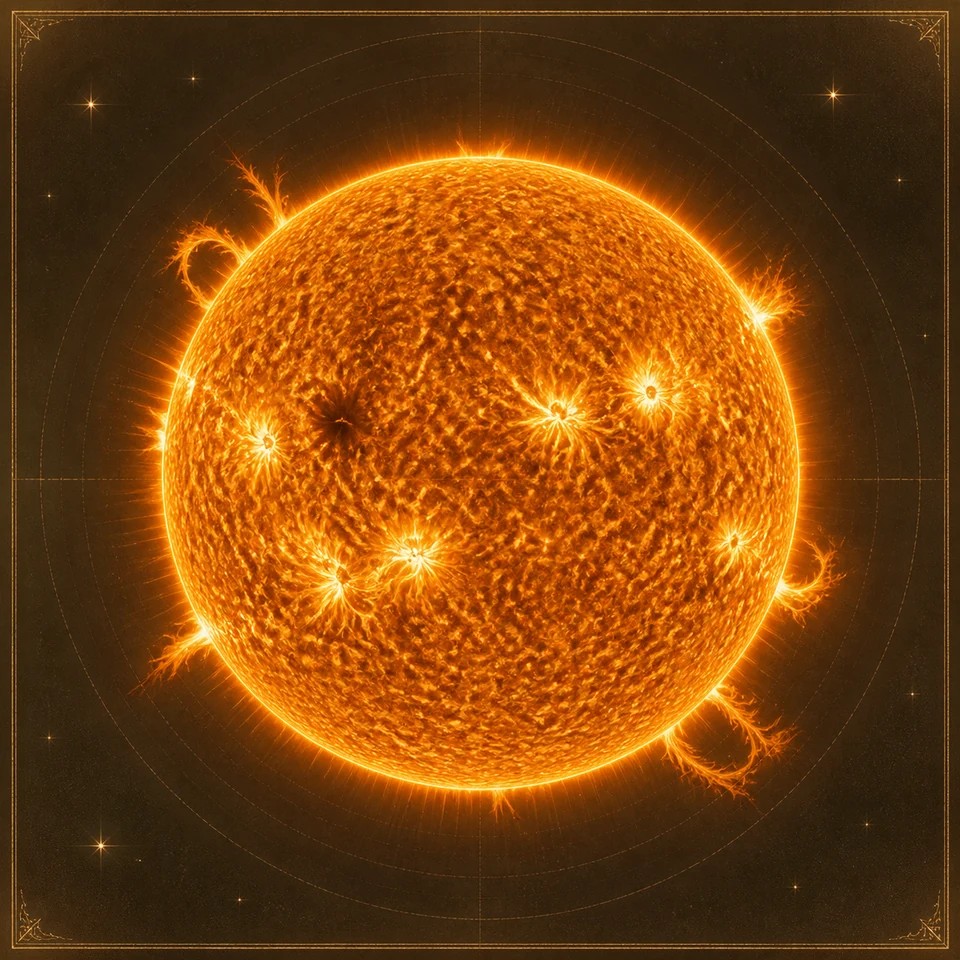
The solar luminary in historical planetary correspondence systems.
Overview
The Sun is the central luminary of the classical planetary order: a visible source of light whose correspondence layer gathers sovereignty, radiance, clarity, and vital force. In Ptolemy’s astrology it is hot and moderately dry, of common influence, and ruler of Leo. Later Renaissance and Solomonic sources surround it with solar plants, resins, gold, golden-yellow color, and Sunday.
Historical and Astrological Context
Ancient and medieval astrologers counted the Sun among the seven wandering lights even though modern astronomy distinguishes it as a star. That historical vocabulary is preserved because the planetary system is the structure in which the correspondences were recorded. Ptolemy assigns the Sun the house of Leo; later occult authors elaborate the solar family of plants, stones, metals, colors, and ritual times.
Traditional and Modern Rulerships
Ptolemy assigns Leo to the Sun in Book I, Chapter XX. This is a classical domicile relationship. The database keeps that source-specific claim apart from later materials that carry solar correspondences without making a zodiacal rulership claim.
Traditional Qualities
Ptolemy describes the Sun as heating and moderately drying. In his following classification the Sun is of common influence, capable of operating differently according to its associations. These are historical astrological qualities, not physical measurements of the star.
Plants, Stones, Metals, and Ritual Materials
Agrippa’s solar layer includes marigold, lemon balm, ginger, bay, cedar, palm, frankincense, and mastic. The Key of Solomon connects the Sun with Sunday, gold, and golden-yellow. Each relationship remains attached to its own source instead of being collapsed into a universal solar list.
Modern Practice
Solar work in later practice often emphasizes visibility, confidence, authority, success, and the steady return of light. The historical record here supports timing and material symbolism; it does not turn every two-step graph path into a new direct correspondence.
Safety and Physical Boundaries
Planetary records describe symbolic and historical relationships. They do not authorize ingestion, burning, topical use, or handling of connected materials. Each physical entity carries its own safety review, and hazardous records are excluded from default ritual candidates.
Sources
Claudius Ptolemy, Tetrabiblos; Heinrich Cornelius Agrippa, Three Books of Occult Philosophy; S. L. MacGregor Mathers, The Key of Solomon.
Direct connections and evidence
Explicit Source
element under Sun
1 attestation · high confidence
- Heinrich Cornelius Agrippa, Three Books of Occult Philosophy, Book OneBook One, English edition based on the 1651 J. F. translation · Library of Congress · Renaissance Europe, c. 1533 · Renaissance Europe · Book Book One · Chapter XXIII · Section Of those things which are under the Sun · Page 91-95
Explicit Source
plant or tree under Sun
1 attestation · high confidence
- Heinrich Cornelius Agrippa, Three Books of Occult Philosophy, Book OneBook One, English edition based on the 1651 J. F. translation · Library of Congress · Renaissance Europe, c. 1533 · Renaissance Europe · Book Book One · Chapter XXIII · Section Of those things which are under the Sun · Page 91-95
Explicit Source
plant or tree under Sun
1 attestation · high confidence
- Heinrich Cornelius Agrippa, Three Books of Occult Philosophy, Book OneBook One, English edition based on the 1651 J. F. translation · Library of Congress · Renaissance Europe, c. 1533 · Renaissance Europe · Book Book One · Chapter XXIII · Section Of those things which are under the Sun · Page 91-95
Explicit Source
plant or tree under Sun
1 attestation · high confidence
- Heinrich Cornelius Agrippa, Three Books of Occult Philosophy, Book OneBook One, English edition based on the 1651 J. F. translation · Library of Congress · Renaissance Europe, c. 1533 · Renaissance Europe · Book Book One · Chapter XXIII · Section Of those things which are under the Sun · Page 91-95
Explicit Source
plant or tree under Sun
1 attestation · high confidence
- Heinrich Cornelius Agrippa, Three Books of Occult Philosophy, Book OneBook One, English edition based on the 1651 J. F. translation · Library of Congress · Renaissance Europe, c. 1533 · Renaissance Europe · Book Book One · Chapter XXIII · Section Of those things which are under the Sun · Page 91-95
Explicit Source
plant or tree under Sun
1 attestation · high confidence
- Heinrich Cornelius Agrippa, Three Books of Occult Philosophy, Book OneBook One, English edition based on the 1651 J. F. translation · Library of Congress · Renaissance Europe, c. 1533 · Renaissance Europe · Book Book One · Chapter XXIII · Section Of those things which are under the Sun · Page 91-95
Explicit Source
plant or tree under Sun
1 attestation · high confidence
- Heinrich Cornelius Agrippa, Three Books of Occult Philosophy, Book OneBook One, English edition based on the 1651 J. F. translation · Library of Congress · Renaissance Europe, c. 1533 · Renaissance Europe · Book Book One · Chapter XXIII · Section Of those things which are under the Sun · Page 91-95
Cross Source
tree associated with the Sun
2 attestations · high confidence
- Heinrich Cornelius Agrippa, Three Books of Occult Philosophy, Book OneBook One, English edition based on the 1651 J. F. translation · Library of Congress · Renaissance Europe, c. 1533 · Renaissance Europe · Book Book One · Chapter XXIII · Section Of those things which are under the Sun · Page 91-95
- Nicholas Culpeper, The Complete HerbalNew edition with additions by Thomas Kelly · Project Gutenberg · Seventeenth-century England · England · Entry Ash Tree · Section Government and virtues · Page 15
Explicit Source
plant or tree under Sun
Agrippa's solar attribution is preserved alongside his Jovial attribution and Culpeper's Venusian attribution; the database does not reconcile the alternatives.
1 attestation · high confidence
- Heinrich Cornelius Agrippa, Three Books of Occult Philosophy, Book OneBook One, English edition based on the 1651 J. F. translation · Library of Congress · Renaissance Europe, c. 1533 · Renaissance Europe · Book Book One · Chapter XXIII · Section Of those things which are under the Sun · Page 91-95
Explicit Source
plant or tree under Sun
1 attestation · high confidence
- Heinrich Cornelius Agrippa, Three Books of Occult Philosophy, Book OneBook One, English edition based on the 1651 J. F. translation · Library of Congress · Renaissance Europe, c. 1533 · Renaissance Europe · Book Book One · Chapter XXIII · Section Of those things which are under the Sun · Page 91-95
Explicit Source
aromatic material under Sun
1 attestation · high confidence
- Heinrich Cornelius Agrippa, Three Books of Occult Philosophy, Book OneBook One, English edition based on the 1651 J. F. translation · Library of Congress · Renaissance Europe, c. 1533 · Renaissance Europe · Book Book One · Chapter XXIII · Section Of those things which are under the Sun · Page 91-95
Explicit Source
aromatic material under Sun
1 attestation · high confidence
- Heinrich Cornelius Agrippa, Three Books of Occult Philosophy, Book OneBook One, English edition based on the 1651 J. F. translation · Library of Congress · Renaissance Europe, c. 1533 · Renaissance Europe · Book Book One · Chapter XXIII · Section Of those things which are under the Sun · Page 91-95
Explicit Source
weekday of Sun
1 attestation · high confidence
- S. L. MacGregor Mathers, translator and editor, The Key of Solomon the King (Clavicula Salomonis)First edition · Wellcome Collection · British occult revival, 1889 edition · Britain · Section Table of the Archangels, Angels, Metals, Days of the Week, and Colours attributed to each Planet · Page 8 · Table Days and planets
Explicit Source
metal ruled by Sun
1 attestation · high confidence
- S. L. MacGregor Mathers, translator and editor, The Key of Solomon the King (Clavicula Salomonis)First edition · Wellcome Collection · British occult revival, 1889 edition · Britain · Book Book I · Chapter XVIII · Section Concerning the Holy Pentacles or Medals · Page 56
Explicit Source
color ruled by Sun
1 attestation · high confidence
- S. L. MacGregor Mathers, translator and editor, The Key of Solomon the King (Clavicula Salomonis)First edition · Wellcome Collection · British occult revival, 1889 edition · Britain · Book Book I · Chapter XVIII · Section Concerning the Holy Pentacles or Medals · Page 56-57
Explicit Source
traditional ruler of Leo
Classical domicile rulership recorded directly from Ptolemy; later and modern co-rulership layers remain separate.
1 attestation · high confidence
- Claudius Ptolemy; J. M. Ashmand, translator, Tetrabiblos; or, QuadripartiteW. Foulsham 1900 printing of Ashmand’s 1822 English version · Project Gutenberg · Second century CE · Roman Egypt · Book Book I · Chapter Chapter XX — The Houses of the Planets · Section The Houses of the Planets · Page 28–29
Explicit Source
Hathor is attested as a solar Eye of Ra
An ancient solar association, not modern astrological rulership.
2 attestations · high confidence
- James P. Allen; Society of Biblical Literature, The Ancient Egyptian Pyramid TextsWritings from the Ancient World 23 · James P. Allen; Society of Biblical Literature · Egyptian Old Kingdom · Ancient Egypt · Entry Pyramid Text 405 · Page printed p. 96 / PDF p. 108
- Museo Egizio Papyrus Collection; Lutz Popko and Eleonora Mander, editors, Papyrus Cat.1982, Myth of the Heavenly CowLive institutional object and papyrus catalogue record · Museo Egizio, Turin · Egyptian New Kingdom · Thebes · MuseumObjectId Cat.1982 · Section verso
Explicit Source
A later literary identification of Apollo with Helios creates a contextual solar association
The association belongs to later reception and does not turn early Apollo into the Sun by default.
1 attestation · contextual confidence
- Elena Bianchelli, editor; University of Georgia contributors, The Children of Zeus: Apollo (page 87 lower), Gantz Early Greek Myth companionUniversity of Georgia Gantz companion, Apollo page 87 lower · University of Georgia · Greek religion under Roman imperial rule · Page The Children of Zeus: Apollo, page 87 lower · Entry Pseudo-Eratosthenes, Katasterismoi 24; Helios addressed as Apollo
Reviewed sources
- Heinrich Cornelius Agrippa, Three Books of Occult Philosophy, Book One (1898)Book One, English edition based on the 1651 J. F. translation · Library of Congress
- Nicholas Culpeper, The Complete Herbal (1850)New edition with additions by Thomas Kelly · Project Gutenberg
- S. L. MacGregor Mathers, translator and editor, The Key of Solomon the King (Clavicula Salomonis) (1889)First edition · Wellcome Collection
- Claudius Ptolemy; J. M. Ashmand, translator, Tetrabiblos; or, Quadripartite (1900)W. Foulsham 1900 printing of Ashmand’s 1822 English version · Project Gutenberg
- James P. Allen; Society of Biblical Literature, The Ancient Egyptian Pyramid Texts (2005)Writings from the Ancient World 23 · James P. Allen; Society of Biblical Literature
- Museo Egizio Papyrus Collection; Lutz Popko and Eleonora Mander, editors, Papyrus Cat.1982, Myth of the Heavenly CowLive institutional object and papyrus catalogue record · Museo Egizio, Turin
- Elena Bianchelli, editor; University of Georgia contributors, The Children of Zeus: Apollo (page 87 lower), Gantz Early Greek Myth companion (2021)University of Georgia online companion page edited January 2021 · University of Georgia