
Egyptian · Solar deity · Certain
Hathor
Ḥw.t-ḥr · Ḥw.t-ḥr
Pronunciation: Ancient vocalization unresolved
Research and editorial review by Cody Manes · Reviewed 2026-08-29
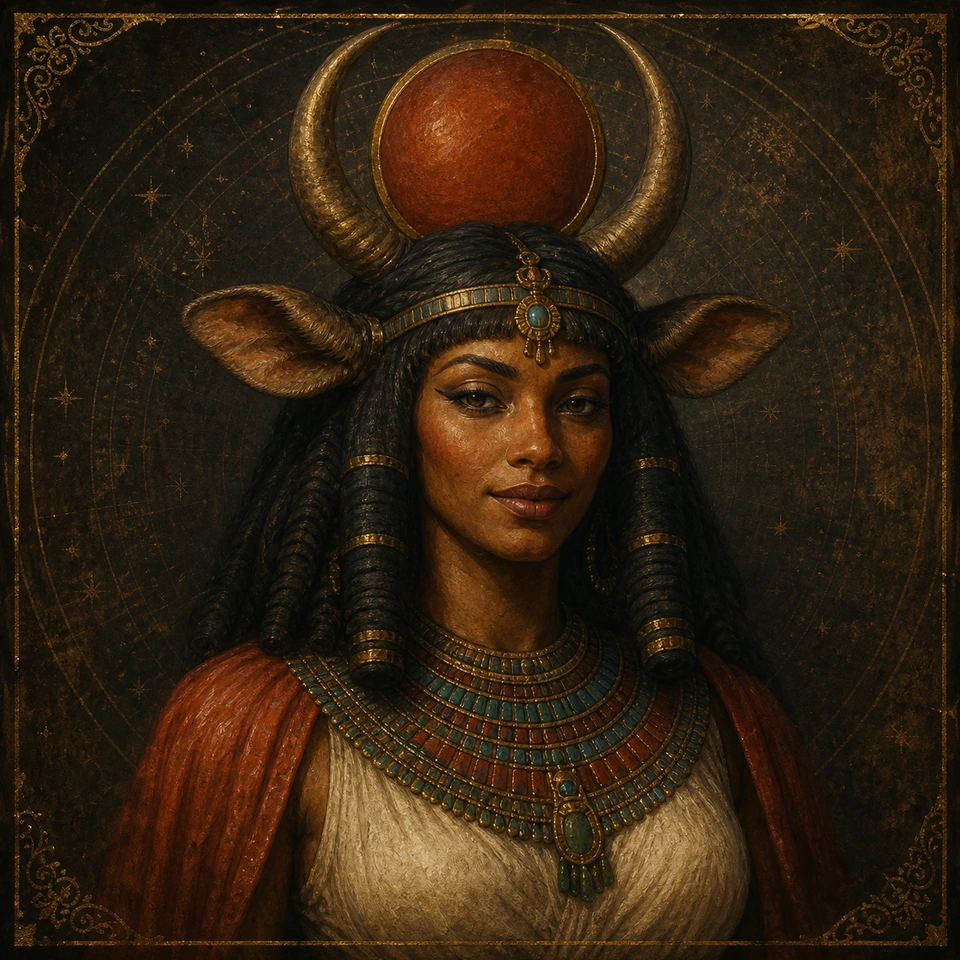
Ancient Egyptian goddess attested in royal, solar, maternal, musical, funerary, and local temple roles from the Old Kingdom through Roman Egypt; her identities, myths, and relationships vary by source, period, and place.
Overview
Hathor stands among the longest-attested and most theologically mobile goddesses of ancient Egypt. Her Egyptian name is conventionally transliterated Ḥw.t-ḥr and often interpreted as “Horus's enclosure” or “house of Horus.” The hieroglyphic writing preserves a consonantal structure and visual composition, but not enough vowel information to justify a confident ancient IPA pronunciation. “Hathor” is the familiar English form, not a reconstructed native utterance.
The surviving material record opens with named Dynasty 4 objects from Menkaure's Giza complex and continues through late Old Kingdom Pyramid Texts and priestess titles. These early witnesses show why one-dimensional summaries fail. Depending on the textual tradition, Hathor appears as the king's divine mother, a partner of Horus, a solar Eye, a royal and funerary power, or the goddess called Mistress of Sycamore. Middle Kingdom inscriptions at Serabit el-Khadim give her the local title Mistress of Turquoise within mining-expedition religion. New Kingdom chapels, votives, menats, sistra, royal nursing scenes, and western-mountain imagery deepen her material presence. The great surviving temple at Dendera and its detailed festival calendars reflect highly developed Ptolemaic and Roman theology; they are not timeless mirrors of every earlier period.
Her iconography is profoundly plural. Dated objects show Hathor as a woman, a cow, a woman with bovine ears, a frontal bovine emblem, and a cow bearing the solar disk. Cow form can be a true divine embodiment rather than merely a “sacred animal.” Menats and sistra are attested cult instruments and votive objects, distinct from modern magical correspondences.
Three central narrative traditions anchor her mythology here. In the Heavenly Cow tradition, Hathor acts as Ra's punitive Eye and is pacified before destruction becomes total. In the Contendings of Horus and Seth, she helps restore the withdrawn solar judge and later heals the blinded Horus. In the Distant Solar Eye traditions, Dendera places Hathor in the returning Eye role while Papyrus Leiden I 384 names Tefnut. These remain distinct, source-scoped variants rather than a forced merging of goddesses.
Hathor's relationships shift according to text and locality. A source can call her daughter of Ra, wife of Horus, mother of the king, or member of a late Dendera divine family without producing one contradiction-free genealogy. Ptolemaic material sometimes identifies her with Aphrodite, yet both remain separate historical figures. Bat, Isis, Tefnut, Sekhmet, and Baalat Gebal likewise retain their own identities and boundaries.
Modern reception forms its own distinct layer. Public sources from one contemporary Kemetic Orthodox institution recognize Hathor or Het-Heru, but that institution does not speak for all Kemetic religions and states that it does not currently classify itself as Pagan. Private practice and universal modern lists of offerings, gemstones, zodiac rulerships, colors, herbs, or magical intentions remain outside the record unless accountable evidence supports them. Where the evidence is thin, disputed, local, late, or silent, the boundary remains visible and open to future research.
Canonical identity
Hathor is the canonical English display name. The reviewed ancient Egyptian transliteration is Ḥw.t-ḥr. Its literal structure supports “Horus's enclosure” or “house of Horus”; more elaborate theological glosses are interpretations, not alternate literal translations. The original sign sequence survives in facsimile, so the exact transliteration is used here rather than a synthesized modern Unicode approximation.
A secure ancient vocalization is not supplied. Egyptian hieroglyphic, hieratic, and demotic writing generally omits the vowels required for a period-specific pronunciation. That limit remains explicit rather than being filled with a fabricated IPA. Het-Heru is retained as a modern community-public spelling recognized by one accountable living institution, not projected back as the uniquely correct ancient sound.
Bat, Baalat Gebal, Isis, Tefnut, Sekhmet, and Aphrodite are not aliases. Bovine imagery, an Eye-of-Ra function, a local composite, or historical interpretatio connects figures only where source-scoped evidence establishes the relationship.
Sources and evidence
TEXTUAL · Supported
The Ancient Egyptian divine name is transliterated Ḥw.t-ḥr and is classified as a divine name for Hathor.
- Source
- Thesaurus Linguae Aegyptiae, Berlin-Brandenburg and Saxon Academies, Token ID ICAAcaPufZm81ULdkPt6u82XtW4: Ḥw.t-ḥr
- Reviewed edition
- TLA Corpus edition 20, web app 2.5.2 · Thesaurus Linguae Aegyptiae, Berlin-Brandenburg and Saxon Academies
- Exact locator
- Entry Token ICAAcaPufZm81ULdkPt6u82XtW4, lines 60 and 126-144
- Scope
- Egyptian Middle Kingdom · Ancient Egypt
- Authority
- academic digital corpus
- Certainty
- Secure
Supports spelling and identity, not vocalization.
Open exact reviewed sourceTEXTUAL · Supported
A secure ancient pronunciation cannot be supplied from the consonantal hieroglyphic spelling alone.
- Source
- UCL Digital Egypt for Universities, Language sound (2002)
- Reviewed edition
- UCL Digital Egypt language sound page · UCL Digital Egypt for Universities
- Exact locator
- Entry Paragraphs beginning 'For the Egyptian language' and 'Today there remain many uncertainties'
- Scope
- Ancient Egyptian diachronic scope · Ancient Egypt
- Authority
- university institutional resource
- Certainty
- Secure
This establishes the pronunciation limit: conventional English “Hathor” is not a reconstructed native vocalization.
Open exact reviewed sourceTEXTUAL · Supported
Baalat Gebal is a Byblian poliad deity whose proposed identification with Hathor may have changed over time; she should remain a distinct entity.
- Source
- Sofiane Bouhafs; ENiM, Entités divines et lieux de cultes à Byblos entre le IIe et le Ie millénaire d'après les inscriptions hiéroglyphiques giblites (2023)
- Reviewed edition
- ENiM 16, pp. 205-228 · Sofiane Bouhafs; ENiM
- Exact locator
- Entry Printed pp. 205-206, French resume and English abstract
- Scope
- Ancient Egyptian diachronic scope · Byblos (Jbeil)
- Authority
- peer-reviewed scholar
- Certainty
- Secure boundary; historical equations disputed/diachronic
Any proposed Hathor-Baalat identification must remain source-, period-, and place-specific.
Open exact reviewed sourceLIVING TRADITION PUBLIC · Supported
A contemporary Kemetic Orthodox institution publicly lists Hathor and Het-Heru among spellings it recognizes.
- Source
- Kemetic Orthodox Religion / House of Netjer, Alternate Spellings
- Reviewed edition
- Official public name list · Kemetic Orthodox Religion
- Exact locator
- Entry Hathor; Het-Heru
- Scope
- Contemporary living religion · International online religious community
- Authority
- accountable first-party community source
- Certainty
- Secure for this institution only
The spelling and recognition are not generalized to every modern Kemetic community.
Open exact reviewed source5 reviewed sources for this section
- Thesaurus Linguae Aegyptiae, Berlin-Brandenburg and Saxon Academies, Token ID ICAAcaPufZm81ULdkPt6u82XtW4: Ḥw.t-ḥrTLA Corpus edition 20, web app 2.5.2 · Thesaurus Linguae Aegyptiae, Berlin-Brandenburg and Saxon Academies
- UCL Digital Egypt for Universities, Language sound (2002)UCL Digital Egypt language sound page · UCL Digital Egypt for Universities
- Sofiane Bouhafs; ENiM, Entités divines et lieux de cultes à Byblos entre le IIe et le Ie millénaire d'après les inscriptions hiéroglyphiques giblites (2023)ENiM 16, pp. 205-228 · Sofiane Bouhafs; ENiM
- Kemetic Orthodox Religion / House of Netjer, Alternate SpellingsOfficial public name list · Kemetic Orthodox Religion
- Chiara Reali; Universidad Nacional de Rosario / CONICET portal, Egyptian-Levantine cultural contacts: considerations about the iconography of female deities on the sealings from Avaris (2017)Claroscuro 16, pp. 1-51 · Chiara Reali; Universidad Nacional de Rosario / CONICET portal
Culture, tradition, period, and place
Hathor belongs to ancient Egyptian religious traditions across more than two millennia, but the broad label “Egyptian pantheon” cannot substitute for historical setting. The evidence comes from particular languages, monuments, communities, dynasties, and places: Giza and Saqqara, Serabit el-Khadim, Thebes and Deir el-Bahri, Dendera, Edfu, and contact zones including Byblos.
Royal pyramid texts, elite titles, mining-sanctuary inscriptions, temple walls, votive objects, funerary objects, and later Demotic narratives are not interchangeable types of proof. Each carries its own period and place. Ptolemaic Greek-Egyptian interpretatio and modern Kemetic public religion remain separate historical layers.
3 reviewed sources for this section
- James P. Allen; Society of Biblical Literature, The Ancient Egyptian Pyramid Texts (2005)Writings from the Ancient World 23 · James P. Allen; Society of Biblical Literature
- Charles Bonnet and Dominique Valbelle; Académie des Inscriptions et Belles-Lettres / Persée, Le temple d'Hathor, maîtresse de la turquoise, à Sérabit el-Khadim (troisième campagne) (1995)Comptes rendus 139.4, pp. 915-941 · Charles Bonnet and Dominique Valbelle; Académie des Inscriptions et Belles-Lettres / Persée
- Filip Coppens; UCLA Encyclopedia of Egyptology, Temple Festivals of the Ptolemaic and Roman Periods (2009)UCLA Encyclopedia of Egyptology, version 1 January 2009 · Filip Coppens; UCLA Encyclopedia of Egyptology
Historical development
The earliest secure evidence reviewed here belongs to Dynasty 4; it does not establish Hathor's absolute first appearance. A Menkaure triad from the king's Valley Temple names and depicts Hathor, while anonymous bovine faces on earlier objects such as the Narmer Palette remain disputed between Hathor, Bat, and other readings. Late Old Kingdom Pyramid Texts and a large corpus of priestess titles establish textual and institutional depth without proving uniform doctrine or duties.
Middle Kingdom evidence brings local development into sharper view. At Serabit el-Khadim in South Sinai, Hathor was Mistress of Turquoise within a sanctuary serving expedition and mining contexts. Theban evidence at Deir el-Bahri grows through the Middle and New Kingdoms; Hatshepsut's monument includes a Hathor chapel, while later objects bind the goddess to royal nourishment, votive practice, and the western mountain.
The extant temple at Dendera is principally Ptolemaic and Roman in fabric and detailed inscription, although the site preserves earlier remains. Its theology, divine family configurations, procession routes, and calendrical rites show a late learned temple system, not a timeless transcript of Old Kingdom practice. Every date and local form therefore remains attached to its evidence.
Sources and evidence
MATERIAL CULTURE · Supported
A Dynasty 4 greywacke triad from Menkaure's Valley Temple names and depicts Menkaure, Hathor, and the deified Hare nome.
- Source
- Digital Giza, Harvard University and Museum of Fine Arts Boston, Triad of Menkaure, Hathor, and deified Hare nome
- Reviewed edition
- Digital Giza Menkaure Valley Temple site and object inventory · Digital Giza, Harvard University and Museum of Fine Arts Boston
- Exact locator
- Entry Menkaure Valley Temple site record, Sculptures: MFAB_09.200
- Scope
- Egyptian Old Kingdom · Giza
- Authority
- institutional archaeological catalog
- Certainty
- Secure
This is the earliest secure material evidence reviewed here; it does not establish Hathor’s absolute first attestation.
Open exact reviewed sourceARCHAEOLOGICAL · Supported
Dendera preserves a well-known Ptolemaic/Roman Hathor temple and important earlier Old Kingdom and First Intermediate Period remains.
- Source
- UCL Digital Egypt for Universities, Dendera (2002)
- Reviewed edition
- UCL Digital Egypt Dendera site page · UCL Digital Egypt for Universities
- Exact locator
- Entry Dendera site chronology and bibliography
- Scope
- Roman Egypt · Dendera (Iunet)
- Authority
- university institutional resource
- Certainty
- Secure at site level
The earlier remains establish an older site history, not continuity of every later rite.
Open exact reviewed source3 reviewed sources for this section
- Digital Giza, Harvard University and Museum of Fine Arts Boston, Triad of Menkaure, Hathor, and deified Hare nomeDigital Giza Menkaure Valley Temple site and object inventory · Digital Giza, Harvard University and Museum of Fine Arts Boston
- UCL Digital Egypt for Universities, Dendera (2002)UCL Digital Egypt Dendera site page · UCL Digital Egypt for Universities
- James P. Allen; Society of Biblical Literature, The Ancient Egyptian Pyramid Texts (2005)Writings from the Ancient World 23 · James P. Allen; Society of Biblical Literature
Attested roles and historical themes
Roles, powers, and limits
Hathor's attested functions include royal motherhood and legitimation, solar Eye activity, protection and danger, nourishment, music and ritual sound, funerary rebirth in the Theban west, healing inside a specific myth episode, and the return of ordered divine presence in late temple theology. These roles accumulate across sources; they do not reduce to a single “goddess of love” formula.
The Eye can punish humanity in the Heavenly Cow tradition and return pacified in Dendera theology. The cow can nurse a king or emerge from the western mountain. A Pyramid Text can call the king her son, while another calls her wife of Horus. Each role belongs to its particular witness. No literary action becomes medical advice, and no domain is treated as unlimited power.
Sources and evidence
TEXTUAL · Supported
Pyramid Text 335 associates the ascended king's kilt with Hathor.
- Source
- James P. Allen; Society of Biblical Literature, The Ancient Egyptian Pyramid Texts (2005)
- Reviewed edition
- Writings from the Ancient World 23 · James P. Allen; Society of Biblical Literature
- Exact locator
- Entry PT 335, printed p. 74 / PDF p. 86
- Scope
- Egyptian Old Kingdom · Ancient Egypt
- Authority
- critical translator
- Certainty
- Secure text; interpretation open
The ritual image remains specific to Pyramid Text 335 rather than becoming a universal attribute.
Open exact reviewed sourceTEXTUAL · Supported
Pyramid Text 405 places the solar eye on Hathor's brow within daily conception and rebirth imagery.
- Source
- James P. Allen; Society of Biblical Literature, The Ancient Egyptian Pyramid Texts (2005)
- Reviewed edition
- Writings from the Ancient World 23 · James P. Allen; Society of Biblical Literature
- Exact locator
- Entry PT 405, printed p. 96 / PDF p. 108
- Scope
- Egyptian Old Kingdom · Ancient Egypt
- Authority
- critical translator
- Certainty
- Secure text; theology source-scoped
This supports a solar association without reducing Hathor to a solely solar deity.
Open exact reviewed sourceMATERIAL CULTURE · Supported
BM EA43071 depicts Hathor as a cow emerging from the western mountain, a Theban motif associated with burial and rebirth.
- Source
- British Museum, Painted linen tunic EA43071
- Reviewed edition
- British Museum Collections Online object EA43071 · British Museum
- Exact locator
- Entry EA43071 description, findspot discussion, and Strudwick curator's comment
- Scope
- Egyptian New Kingdom · Deir el-Bahri
- Authority
- museum curator
- Certainty
- Secure motif; object date/provenance qualified
The object’s exact provenance and date remain qualified in the museum record.
Open exact reviewed sourceMATERIAL CULTURE · Supported
BM EA689 depicts the Hathor-cow suckling a king against the mountains of Deir el-Bahri.
- Source
- British Museum, Stela EA689 from the Temple of Mentuhotep
- Reviewed edition
- British Museum Collections Online object EA689 · British Museum
- Exact locator
- Entry EA689 object description and findspot fields
- Scope
- Egyptian New Kingdom · Deir el-Bahri
- Authority
- museum curator
- Certainty
- Secure
Royal nursing imagery carries cultic and ideological meaning without fixing every mythic genealogy.
Open exact reviewed sourceINSCRIPTIONAL · Supported
EA20760 includes the throne name of Amenhotep III alongside Hathor's imagery and epithet.
- Source
- British Museum, Bronze menat-counterpoise amulet EA20760
- Reviewed edition
- British Museum Collections Online object EA20760 · British Museum
- Exact locator
- Entry EA20760 description and inscriptions
- Scope
- Egyptian New Kingdom · Thebes
- Authority
- museum curator
- Certainty
- Secure
The shared object connects royal and Hathoric imagery without proving exclusive patronage.
Open exact reviewed source4 reviewed sources for this section
- James P. Allen; Society of Biblical Literature, The Ancient Egyptian Pyramid Texts (2005)Writings from the Ancient World 23 · James P. Allen; Society of Biblical Literature
- British Museum, Painted linen tunic EA43071British Museum Collections Online object EA43071 · British Museum
- British Museum, Stela EA689 from the Temple of MentuhotepBritish Museum Collections Online object EA689 · British Museum
- British Museum, Bronze menat-counterpoise amulet EA20760British Museum Collections Online object EA20760 · British Museum
Epithets and titles
Cult Epithet
Mistress of Sycamore
Mistress of the sycamore fig
Giza and later Theban material · Old Kingdom through New Kingdom witnessesAttested in dated material; local and object scope preserved.
2 reviewed sources for this section
- Florence Dunn Friedman; Harvard Egyptological Studies, The Menkaure Triads (2015)Harvard Egyptological Studies 1 contribution · Florence Dunn Friedman; Harvard Egyptological Studies
- British Museum, Bronze menat-counterpoise amulet EA20760British Museum Collections Online object EA20760 · British Museum
Geographic Epithet
Mistress of Turquoise
Lady / Mistress of Turquoise
Serabit el-Khadim, South Sinai · Middle KingdomA local mining-sanctuary title, not a universal modern crystal correspondence.
3 reviewed sources for this section
- Charles Bonnet and Dominique Valbelle; Académie des Inscriptions et Belles-Lettres / Persée, Le temple d'Hathor, maîtresse de la turquoise, à Sérabit el-Khadim (troisième campagne) (1995)Comptes rendus 139.4, pp. 915-941 · Charles Bonnet and Dominique Valbelle; Académie des Inscriptions et Belles-Lettres / Persée
- UCL Petrie Museum / Digital Egypt, Stela UC 14302, Serabit el-KhadimDigital Egypt object page · UCL Petrie Museum / Digital Egypt
- British Museum, Figure EA41748 from Serabit el-KhadimBritish Museum Collections Online object EA41748 · British Museum
Theological Title
Golden One
The Golden One
Thebes · New Kingdom object witnessThe object visually invokes the title through the gold sign; the curator interpretation is identified.
1 reviewed source for this section
- British Museum, Bronze menat-counterpoise amulet EA20760British Museum Collections Online object EA20760 · British Museum
Geographic Epithet
Lady of Byblos
Lady of Byblos
Egyptian contact and reception involving Byblos · Third Intermediate Period object witnessAn Egyptian Hathor epithet; it does not merge Hathor with Baalat Gebal.
2 reviewed sources for this section
- The Metropolitan Museum of Art, Vessel fragment inscribed for Hathor, Lady of ByblosLive institutional object catalogue · The Metropolitan Museum of Art
- Sofiane Bouhafs; ENiM, Entités divines et lieux de cultes à Byblos entre le IIe et le Ie millénaire d'après les inscriptions hiéroglyphiques giblites (2023)ENiM 16, pp. 205-228 · Sofiane Bouhafs; ENiM
Worship and cult
Hathor's cult was not one institution operating unchanged across Egypt. Old Kingdom inscriptions document more than 250 women bearing Hathor-priestess titles, especially around Giza and Saqqara, but titles alone do not reveal one standard job description. New Kingdom objects support menat use by priestesses, later broadening among elite women, and small menats dedicated by visitors at sanctuaries.
At Serabit el-Khadim, stelae and objects place worship in an expedition and mining-sanctuary setting. At Deir el-Bahri, royal building, bovine imagery, and probable votive deposition bind Hathor to a specific Theban landscape. These object-specific practices remain anchored to their historical settings rather than being recast as a universal offering list or modern ritual manual.
Sources and evidence
MATERIAL CULTURE · Supported
Stela UC 14302 shows a person offering to Hathor, identified in the inscription as Lady of Turquoise.
- Source
- UCL Petrie Museum / Digital Egypt, Stela UC 14302, Serabit el-Khadim
- Reviewed edition
- Digital Egypt object page · UCL Petrie Museum / Digital Egypt
- Exact locator
- Entry Object page line 6
- Scope
- Egyptian Middle Kingdom · Serabit el-Khadim
- Authority
- museum/university catalog
- Certainty
- Secure
The scene securely establishes an offering act, while the offering contents remain unidentified.
Open exact reviewed sourceINSCRIPTIONAL · Supported
More than 250 women bearing Hathor-priestess titles are documented for the Old Kingdom, especially in capital necropolises such as Giza and Saqqara; some also held Neith priestess titles.
- Source
- Olga V. Tomashevich; Russian Academy of Sciences expedition publication, On the Titles of Herenka, Priestess of Hathor and Neith in the Old Kingdom (2010)
- Reviewed edition
- Excursus I in The Tomb of Khafraankh G 7948, vol. 1 · Olga V. Tomashevich; Russian Academy of Sciences expedition publication
- Exact locator
- Entry Excursus I, printed pp. 132-138, especially opening of p. 132
- Scope
- Egyptian Old Kingdom · Giza
- Authority
- epigrapher/scholar
- Certainty
- Secure as source's documented count; quantify with attribution
The titles establish institutional presence without defining one uniform set of daily duties.
Open exact reviewed sourceRITUAL ATTESTED · Supported
The menat collar was originally worn by priestesses of Hathor, and its beads were shaken to produce sound in her worship; later use broadened.
- Source
- British Museum, Bronze menat-counterpoise amulet EA20760
- Reviewed edition
- British Museum Collections Online object EA20760 · British Museum
- Exact locator
- Entry EA20760 curator's comments
- Scope
- Egyptian New Kingdom · Thebes
- Authority
- museum curator
- Certainty
- Secure with chronological qualification
Later use by high-ranking women means that not every menat bearer can be identified as a Hathor priestess.
Open exact reviewed sourceRITUAL ATTESTED · Supported
In the New Kingdom, small menats were dedicated to Hathor by visitors to her sanctuaries.
- Source
- Metropolitan Museum of Art, Menat counterpoise with figures of Hathor as a woman and a cow, 26.7.1175
- Reviewed edition
- Met collection object 26.7.1175 · Metropolitan Museum of Art
- Exact locator
- Entry Met object 26.7.1175 overview
- Scope
- Egyptian New Kingdom · Ancient Egypt
- Authority
- museum curator
- Certainty
- Secure as institutional synthesis
This is one attested class of votive object, not a complete offering inventory.
Open exact reviewed sourceMATERIAL CULTURE · Supported
Met 23.3.103, a cow-with-sun-disk plaque from debris of Hathor's Deir el-Bahri shrine, was probably deposited as a donation.
- Source
- Metropolitan Museum of Art, Cow plaque 23.3.103
- Reviewed edition
- Met collection object 23.3.103 · Metropolitan Museum of Art
- Exact locator
- Entry Met object 23.3.103 overview and artwork details
- Scope
- Ancient Egyptian diachronic scope · Deir el-Bahri
- Authority
- museum curator
- Certainty
- Probable
The museum catalog’s qualification “probably” remains essential to the interpretation.
Open exact reviewed source5 reviewed sources for this section
- UCL Petrie Museum / Digital Egypt, Stela UC 14302, Serabit el-KhadimDigital Egypt object page · UCL Petrie Museum / Digital Egypt
- Olga V. Tomashevich; Russian Academy of Sciences expedition publication, On the Titles of Herenka, Priestess of Hathor and Neith in the Old Kingdom (2010)Excursus I in The Tomb of Khafraankh G 7948, vol. 1 · Olga V. Tomashevich; Russian Academy of Sciences expedition publication
- British Museum, Bronze menat-counterpoise amulet EA20760British Museum Collections Online object EA20760 · British Museum
- Metropolitan Museum of Art, Menat counterpoise with figures of Hathor as a woman and a cow, 26.7.1175Met collection object 26.7.1175 · Metropolitan Museum of Art
- Metropolitan Museum of Art, Cow plaque 23.3.103Met collection object 23.3.103 · Metropolitan Museum of Art
Temples, sanctuaries, and sacred places
Dendera, ancient Iunet, was a principal cult center. Its surviving monumental temple records a late, highly developed Hathoric theology, but earlier site remains prevent the place from being reduced to the Ptolemaic and Roman building alone. Serabit el-Khadim preserves a Middle Kingdom sanctuary of Hathor as Mistress of Turquoise. Deir el-Bahri includes Hathoric architecture and imagery within the Theban western landscape, notably Hatshepsut's chapel.
Edfu enters the record through late processional and divine-family connections with Dendera. Giza and Saqqara supply Old Kingdom royal, mortuary, and priestly evidence. Byblos is a contact zone, not permission to collapse Hathor into the distinct Byblian city goddess Baalat Gebal.
Sources and evidence
ARCHAEOLOGICAL · Supported
Dendera, ancient Iunet, was a principal cult center of Hathor.
- Source
- UCL Digital Egypt for Universities, Dendera (2002)
- Reviewed edition
- UCL Digital Egypt Dendera site page · UCL Digital Egypt for Universities
- Exact locator
- Entry Opening Dendera site overview
- Scope
- Ptolemaic and Roman Egypt · Dendera (Iunet)
- Authority
- university institutional resource
- Certainty
- Secure
The extant Ptolemaic and Roman fabric represents only part of Dendera’s longer cult history.
Open exact reviewed sourceARCHAEOLOGICAL · Supported
Serabit el-Khadim contained a Middle Kingdom sanctuary of Hathor in her local form Mistress of Turquoise.
- Source
- Charles Bonnet and Dominique Valbelle; Académie des Inscriptions et Belles-Lettres / Persée, Le temple d'Hathor, maîtresse de la turquoise, à Sérabit el-Khadim (troisième campagne) (1995)
- Reviewed edition
- Comptes rendus 139.4, pp. 915-941 · Charles Bonnet and Dominique Valbelle; Académie des Inscriptions et Belles-Lettres / Persée
- Exact locator
- Entry Printed pp. 915-916 and p. 915 n. 2
- Scope
- Egyptian Middle Kingdom · Serabit el-Khadim
- Authority
- excavators/archaeologists
- Certainty
- Secure
The epithet and sanctuary belong to the local South Sinai setting.
Open exact reviewed sourceARCHAEOLOGICAL · Supported
Hatshepsut's Deir el-Bahri temple incorporated a Hathor chapel dated to her reign.
- Source
- Polish Centre of Mediterranean Archaeology, University of Warsaw, Deir el-Bahari, Polish-French Epigraphic Mission: Hathor Project
- Reviewed edition
- PCMA Hathor Project page · Polish Centre of Mediterranean Archaeology, University of Warsaw
- Exact locator
- Entry PCMA project metadata: site type, location, dating, and mission
- Scope
- Egyptian New Kingdom · Deir el-Bahri
- Authority
- archaeological mission
- Certainty
- Secure
This establishes royal and cultic integration without identifying Hatshepsut as Hathor.
Open exact reviewed source3 reviewed sources for this section
- UCL Digital Egypt for Universities, Dendera (2002)UCL Digital Egypt Dendera site page · UCL Digital Egypt for Universities
- Charles Bonnet and Dominique Valbelle; Académie des Inscriptions et Belles-Lettres / Persée, Le temple d'Hathor, maîtresse de la turquoise, à Sérabit el-Khadim (troisième campagne) (1995)Comptes rendus 139.4, pp. 915-941 · Charles Bonnet and Dominique Valbelle; Académie des Inscriptions et Belles-Lettres / Persée
- Polish Centre of Mediterranean Archaeology, University of Warsaw, Deir el-Bahari, Polish-French Epigraphic Mission: Hathor ProjectPCMA Hathor Project page · Polish Centre of Mediterranean Archaeology, University of Warsaw
Festivals and processions
Late Dendera and Edfu evidence documents public and temple-centered processions in which Hathor's cult image traveled, received purification and adornment, and entered relationships with local divine communities. The Beautiful Feast of Behdet carried Hathor's statue roughly 180 km by boat from Dendera to Edfu, with stops and rites for ancestral gods. New Year ceremonies moved divine images toward the roof for solar revitalization.
The Dendera Festival of Intoxication belongs to a local Ptolemaic and Roman calendar focused on the return and enthronement of the raging goddess. Its historical use of intoxication imagery is not a recommendation for modern drinking. The Beautiful Reunion is treated here as a cult cycle rather than a canonical myth until direct Edfu editions establish the most accurate narrative form.
Sources and evidence
RITUAL ATTESTED · Supported
In the Ptolemaic Beautiful Feast of Behdet, Hathor's cult statue traveled about 180 km by boat from Dendera to Edfu, with stops including Thebes and Hierakonpolis.
- Source
- Filip Coppens; UCLA Encyclopedia of Egyptology, Temple Festivals of the Ptolemaic and Roman Periods (2009)
- Reviewed edition
- UCLA Encyclopedia of Egyptology, version 1 January 2009 · Filip Coppens; UCLA Encyclopedia of Egyptology
- Exact locator
- Entry Printed pp. 4-5 / PDF pp. 5-6; Edfu wall references Edfou V 28-35, 124-136 and Edfou X pls. CXXI-CXXII, CXXVI-CXXVII
- Scope
- Ptolemaic Egypt · Dendera (Iunet)
- Authority
- academic Egyptologist
- Certainty
- Secure for late temple record
The detailed itinerary belongs to this Ptolemaic witness and is not backdated without earlier evidence.
Open exact reviewed sourceRITUAL ATTESTED · Supported
A central act of the Beautiful Feast involved Horus, Hathor, and the Edfu deities visiting the Behdet necropolis to bring offerings to ancestor gods for regeneration.
- Source
- Filip Coppens; UCLA Encyclopedia of Egyptology, Temple Festivals of the Ptolemaic and Roman Periods (2009)
- Reviewed edition
- UCLA Encyclopedia of Egyptology, version 1 January 2009 · Filip Coppens; UCLA Encyclopedia of Egyptology
- Exact locator
- Entry Printed p. 5 / PDF p. 6
- Scope
- Ptolemaic Egypt · Edfu (Behdet)
- Authority
- academic Egyptologist
- Certainty
- Secure for late temple record
This is a historical cult description, not a modern ritual instruction.
Open exact reviewed sourceRITUAL ATTESTED · Supported
Dendera's late temple calendar records repeated Hathor processions, including journeys to the mammisi and New Year rites involving purification, clothing, adornment, roof procession, and solar revitalization of statues.
- Source
- Filip Coppens; UCLA Encyclopedia of Egyptology, Temple Festivals of the Ptolemaic and Roman Periods (2009)
- Reviewed edition
- UCLA Encyclopedia of Egyptology, version 1 January 2009 · Filip Coppens; UCLA Encyclopedia of Egyptology
- Exact locator
- Entry Printed p. 4 / PDF p. 5
- Scope
- Ptolemaic and Roman Egypt · Dendera (Iunet)
- Authority
- academic Egyptologist
- Certainty
- Secure for late temple record
The calendrical setting keeps daily and annual rites distinct and late-period in scope.
Open exact reviewed sourceRITUAL ATTESTED · Supported
Dendera's Festival of Intoxication is documented as a local late temple festival focused on the return and enthronement of the raging goddess.
- Source
- Filip Coppens; UCLA Encyclopedia of Egyptology, Temple Festivals of the Ptolemaic and Roman Periods (2009)
- Reviewed edition
- UCLA Encyclopedia of Egyptology, version 1 January 2009 · Filip Coppens; UCLA Encyclopedia of Egyptology
- Exact locator
- Entry Printed p. 8 / PDF p. 9, with Cauville 2002 and Sternberg-el-Hotabi 1992 references
- Scope
- Ptolemaic and Roman Egypt · Dendera (Iunet)
- Authority
- academic Egyptologist
- Certainty
- Secure for late temple record
This late local festival is historical evidence, not a modern drinking instruction.
Open exact reviewed source3 reviewed sources for this section
- Filip Coppens; UCLA Encyclopedia of Egyptology, Temple Festivals of the Ptolemaic and Roman Periods (2009)UCLA Encyclopedia of Egyptology, version 1 January 2009 · Filip Coppens; UCLA Encyclopedia of Egyptology
- Louis V. Zabkar, A Study of the Ba Concept in Ancient Egyptian Texts (1968)Studies in Ancient Oriental Civilization 34, xiv + 163 pp. · Institute for the Study of Ancient Cultures, University of Chicago
- Beatriz Pañeda Murcia, Divine Cohabitations in Sanctuaries of the Graeco-Roman World (2021)Doctoral thesis, 742 pp., CC BY-NC-ND 3.0 ES · Carlos III University of Madrid and École Pratique des Hautes Études
Offerings, votives, and ritual evidence
The surviving evidence is deliberately specific: a person offers before Hathor on a Serabit stela, visitors dedicate small menats in New Kingdom sanctuaries, a cow plaque at Deir el-Bahri was probably deposited as a donation, and late festival texts describe offerings to ancestral gods. The object or inscription controls what may be said.
Together these witnesses yield a set of local, dated practices rather than a timeless offering inventory. The red beer of the Heavenly Cow narrative is a plot device inside a funerary-cosmological text, not by itself a temple norm or modern devotional instruction. The same boundary applies to mirrors, music, dance, wine, and other motifs that appear in broader Hathoric reception.
3 reviewed sources for this section
- UCL Petrie Museum / Digital Egypt, Stela UC 14302, Serabit el-KhadimDigital Egypt object page · UCL Petrie Museum / Digital Egypt
- Metropolitan Museum of Art, Menat counterpoise with figures of Hathor as a woman and a cow, 26.7.1175Met collection object 26.7.1175 · Metropolitan Museum of Art
- Metropolitan Museum of Art, Cow plaque 23.3.103Met collection object 23.3.103 · Metropolitan Museum of Art
Iconography and material culture
Dated material shows multiple coexisting forms: Hathor as a woman, as a cow, as a woman or emblem with bovine ears, and as a cow with a solar disk. A New Kingdom menat counterpoise combines human, frontal bovine, and full cow manifestations on one object. Another object records Mistress of the Sycamore and visually invokes the Golden One.
Menats and sistra have material and ritual histories. The sistrum can bear a Hathor head and figures who adore or clap; menat beads can be sounded in worship and dedicated as votives. These objects are neither decorative fantasy props nor automatic magical correspondences. Predynastic bovine faces remain a disputed identification boundary. The modern collection portrait shown on this page is not archaeological evidence.
Sources and evidence
INSCRIPTIONAL · Supported
MFA 09.200 names Hathor with the cult title Mistress of Sycamore and gives her a central royal composition.
- Source
- Florence Dunn Friedman; Harvard Egyptological Studies, The Menkaure Triads (2015)
- Reviewed edition
- Harvard Egyptological Studies 1 contribution · Florence Dunn Friedman; Harvard Egyptological Studies
- Exact locator
- Entry Printed p. 32, fig. 2.6 and nn. 77-78
- Scope
- Egyptian Old Kingdom · Giza
- Authority
- archaeologist/scholar
- Certainty
- Secure for title and composition; interpretation qualified
Political meaning beyond the object remains attributed to the scholar.
Open exact reviewed sourceINSCRIPTIONAL · Supported
The hieroglyphic inscription on BM EA41748 calls its subject beloved of Hathor, Mistress of Turquoise.
- Source
- British Museum, Figure EA41748 from Serabit el-Khadim
- Reviewed edition
- British Museum Collections Online object EA41748 · British Museum
- Exact locator
- Entry EA41748 description and curator's comments, right-shoulder inscription
- Scope
- Egyptian Middle Kingdom · Serabit el-Khadim
- Authority
- museum curator
- Certainty
- Secure
The object supplies a direct, named witness to the epithet.
Open exact reviewed sourceMATERIAL CULTURE · Supported
BM EA36310 is an arched sistrum decorated with a cow-eared Hathor head and female ritual figures.
- Source
- British Museum, Arched sistrum EA36310
- Reviewed edition
- British Museum Collections Online object EA36310 · British Museum
- Exact locator
- Entry Museum number EA36310 object description
- Scope
- Egyptian Late Period · Ancient Egypt
- Authority
- museum curator
- Certainty
- Secure
This dated object shows one historical sistrum form rather than a timeless canonical design.
Open exact reviewed sourceMATERIAL CULTURE · Supported
EA20760 combines Hathor in human form, as a frontal cow-eared emblem, and as a cow with a sun disk, demonstrating coexisting New Kingdom manifestations.
- Source
- British Museum, Bronze menat-counterpoise amulet EA20760
- Reviewed edition
- British Museum Collections Online object EA20760 · British Museum
- Exact locator
- Entry EA20760 description
- Scope
- Egyptian New Kingdom · Thebes
- Authority
- museum curator
- Certainty
- Secure
The three attested forms coexist on this object; they are not a rule for every image of Hathor.
Open exact reviewed sourceINSCRIPTIONAL · Supported
EA20760 bears Mistress of the sycamore fig and visually references the epithet Golden One through the gold sign.
- Source
- British Museum, Bronze menat-counterpoise amulet EA20760
- Reviewed edition
- British Museum Collections Online object EA20760 · British Museum
- Exact locator
- Entry EA20760 description, inscription and shaft/fetish discussion
- Scope
- Egyptian New Kingdom · Thebes
- Authority
- museum curator
- Certainty
- Secure for cataloged reading
The text-inscribed epithet and curator-interpreted visual reference remain explicitly distinguished.
Open exact reviewed source5 reviewed sources for this section
- Florence Dunn Friedman; Harvard Egyptological Studies, The Menkaure Triads (2015)Harvard Egyptological Studies 1 contribution · Florence Dunn Friedman; Harvard Egyptological Studies
- British Museum, Figure EA41748 from Serabit el-KhadimBritish Museum Collections Online object EA41748 · British Museum
- British Museum, Arched sistrum EA36310British Museum Collections Online object EA36310 · British Museum
- British Museum, Bronze menat-counterpoise amulet EA20760British Museum Collections Online object EA20760 · British Museum
- Chiara Reali; Universidad Nacional de Rosario / CONICET portal, Egyptian-Levantine cultural contacts: considerations about the iconography of female deities on the sealings from Avaris (2017)Claroscuro 16, pp. 1-51 · Chiara Reali; Universidad Nacional de Rosario / CONICET portal
Animals, plants, and embodied forms
The cow is an attested divine form and royal-maternal image of Hathor. When a source depicts the goddess herself as bovine, that manifestation is more precise than a generic “sacred animal” label. Gazelle milk occurs in the Contendings as the means by which Hathor heals Horus's eyes; the episode remains a narrative event rather than a general animal, medicine, or offering correspondence.
Sycamore titles are securely attested, including Mistress of Sycamore and a source-scoped southern sycamore epithet. A title alone does not establish every proposed tree relationship. Until direct attestations for the Egyptian sycamore fig are fully reviewed, this remains a source-bounded epithet rather than a universal plant correspondence.
3 reviewed sources for this section
- Florence Dunn Friedman; Harvard Egyptological Studies, The Menkaure Triads (2015)Harvard Egyptological Studies 1 contribution · Florence Dunn Friedman; Harvard Egyptological Studies
- British Museum, Bronze menat-counterpoise amulet EA20760British Museum Collections Online object EA20760 · British Museum
- Alan H. Gardiner, The Library of A. Chester Beatty: Description of a Hieratic Papyrus with a Mythological Story, Love-Songs, and Other Miscellaneous Texts (1931)Institution-hosted facsimile of Gardiner's description and translation; transcription also published as Late-Egyptian Stories, Bibliotheca Aegyptiaca I, 1932, pp. 37-60 · Chester Beatty Library
Relationships and genealogy
Hathor's family relationships are plural and contextual. The Heavenly Cow tradition names her as Ra's daughter. A late Old Kingdom Pyramid Text can call her wife of Horus, while royal texts and images cast the king as her son or nursing child. The Contendings calls the solar judge her father in its own narrative frame.
At late Dendera, Hathor forms a local divine household with Horus of Edfu and with child figures such as Ihy or, in another configuration, Harsomtus. These are local theological relationships, not one universal family tree. Horus of Edfu is not interchangeable with every form of Horus, and Ihy remains distinct from Harsomtus. Participation in the same myth likewise creates no genealogy by implication.
Sources and evidence
TEXTUAL · Supported
Pyramid Text 303 calls the deceased king Hathor's son within an ascension text.
- Source
- James P. Allen; Society of Biblical Literature, The Ancient Egyptian Pyramid Texts (2005)
- Reviewed edition
- Writings from the Ancient World 23 · James P. Allen; Society of Biblical Literature
- Exact locator
- Entry PT 303, printed p. 60 / PDF p. 72
- Scope
- Egyptian Old Kingdom · Ancient Egypt
- Authority
- critical translator
- Certainty
- Secure text; role source-scoped
This genealogy belongs to Pyramid Text 303 and is not harmonized with later or local family traditions.
Open exact reviewed sourceTEXTUAL · Supported
Pyramid Text 561A addresses Hathor as wife of Horus and king of the land.
- Source
- James P. Allen; Society of Biblical Literature, The Ancient Egyptian Pyramid Texts (2005)
- Reviewed edition
- Writings from the Ancient World 23 · James P. Allen; Society of Biblical Literature
- Exact locator
- Entry PT 561A, printed p. 192 / PDF p. 204
- Scope
- Egyptian Old Kingdom · Ancient Egypt
- Authority
- critical translator
- Certainty
- Secure text; relationship variant source-scoped
The wife-of-Horus relationship belongs to this witness; mother and daughter roles in other sources remain distinct.
Open exact reviewed source3 reviewed sources for this section
- James P. Allen; Society of Biblical Literature, The Ancient Egyptian Pyramid Texts (2005)Writings from the Ancient World 23 · James P. Allen; Society of Biblical Literature
- Museo Egizio Papyrus Collection; Lutz Popko and Eleonora Mander, editors, Papyrus Cat.1982, Myth of the Heavenly CowLive institutional object and papyrus catalogue record · Museo Egizio, Turin
- Beatriz Pañeda Murcia, Divine Cohabitations in Sanctuaries of the Graeco-Roman World (2021)Doctoral thesis, 742 pp., CC BY-NC-ND 3.0 ES · Carlos III University of Madrid and École Pratique des Hautes Études
Actual myths and source variants
Three shared narratives anchor the Myth Library: Destruction of Mankind and the Heavenly Cow, the Contendings of Horus and Seth, and the Return of the Distant Solar Eye. Each preserves Hathor's particular role while allowing every connected figure to share the same source-controlled account.
The first shows Hathor as Ra's punitive Eye and the crisis in which destruction is halted. The second preserves two bounded Hathor episodes within a continuous Ramesside narrative. The third is explicitly a variant cluster: Dendera makes Hathor the returning Eye, while Papyrus Leiden I 384 names Tefnut. The Seven Hathors remain a separate plural divine group rather than being replaced by singular Hathor.
4 reviewed sources for this section
- Charles Maystre, Le livre de la Vache du Ciel dans les tombeaux de la Vallée des Rois (1941)BIFAO 40, pp. 53-115, DOI 10.3406/bifao.1941.2012 · Bulletin de l'Institut français d'archéologie orientale via Persée
- Alan H. Gardiner, The Library of A. Chester Beatty: Description of a Hieratic Papyrus with a Mythological Story, Love-Songs, and Other Miscellaneous Texts (1931)Institution-hosted facsimile of Gardiner's description and translation; transcription also published as Late-Egyptian Stories, Bibliotheca Aegyptiaca I, 1932, pp. 37-60 · Chester Beatty Library
- Barbara A. Richter, On the Heels of the Wandering Goddess: The Myth and the Festival at the Temples of the Wadi el-Hallel and Dendera (2010)In Monika Dolińska and Horst Beinlich, eds., Interconnections between Temples, pp. 155-186 · Proceedings of the 8th Ägyptologische Tempeltagung; author-hosted copy
- Thesaurus Linguae Aegyptiae editorial project, Papyrus Leiden I 384 / Myth of the Solar EyeLive scholarly text-corpus object record · Berlin-Brandenburg Academy of Sciences and Humanities
Myth Library
Each myth gathers its attested participants into one source-grounded account, while distinct source traditions remain readable in their own variants.
Cosmic
Destruction of Mankind and the Heavenly Cow
Aged Ra responds to humanity's rebellion by sending his daughter Hathor as the punitive solar Eye. When the destruction becomes excessive, red-colored beer is spread before her; drinking it ends the slaughter, after which the cosmos is reorganized and Ra withdraws to the sky borne by the heavenly cow.
- Role in this profile
- daughter and punitive Eye of Ra who is pacified before the slaughter becomes total
- Place scope
- Ancient Egypt · Thebes
- Witnesses
- 4
- Variants
- 4
Epic
The Contendings of Horus and Seth
Horus and Seth pursue rival claims to Osiris's kingship through prolonged hearings, ordeals, deception, violence, and divine intervention. Hathor intervenes twice in the preserved narrative: she restores the withdrawn solar judge to participation, and later finds the blinded Horus and heals his eyes with gazelle milk.
- Role in this profile
- intervener who restores the solar judge and healer who restores Horus's sight
- Place scope
- Deir el-Medina, Thebes
- Witnesses
- 2
- Variants
- 0
Transformation
Return of the Distant Solar Eye
Egyptian temple and Demotic traditions recount the departure, appeasement, and return of the solar Eye as a dangerous goddess. The principal Demotic Leiden narrative names Tefnut, while Ptolemaic Dendera ritual texts place Hathor in the returning Eye function; these are related source-scoped realizations, not interchangeable names in one flattened story.
- Role in this profile
- principal Dendera manifestation of the returning right Eye of Ra
- Place scope
- Dendera (Iunet) · Roman Egypt
- Witnesses
- 2
- Variants
- 2
Equivalences, syncretisms, and identity boundaries
A Ptolemaic foundation plaque at Cusae identifies Aphrodite Urania in Greek with Hathor Who-is-in-Heaven in Egyptian. This is strong local material evidence for historical interpretatio and supports a reciprocal relationship while preserving two entities.
Baalat Gebal remains the distinct city goddess of Byblos. “Hathor, Lady of Byblos” on Egyptian material and a possible equation in contact settings require direction, date, and object-level analysis; they do not make Baalat an alias. Dendera can combine Hathor with Isis or align Hathor with Tefnut in an Eye-of-Ra context, but exact composite wording and period must govern any published relationship. Bat and Sekhmet likewise remain distinct despite bovine or solar-eye overlap.
Sources and evidence
MATERIAL CULTURE · Disputed
The bovine heads on the Narmer Palette cannot be securely identified as Hathor; readings as Hathor, Bat, or another bovine sign remain disputed.
- Source
- Chiara Reali; Universidad Nacional de Rosario / CONICET portal, Egyptian-Levantine cultural contacts: considerations about the iconography of female deities on the sealings from Avaris (2017)
- Reviewed edition
- Claroscuro 16, pp. 1-51 · Chiara Reali; Universidad Nacional de Rosario / CONICET portal
- Exact locator
- Entry Printed p. 20 / PDF p. 21, n. 91; printed p. 23 / PDF p. 24, n. 105
- Scope
- Modern Egyptology and museum interpretation · Ancient Egypt
- Authority
- peer-reviewed scholar
- Certainty
- Disputed
The surviving evidence therefore does not establish a secure depiction of Hathor before Dynasty 4.
Open exact reviewed sourceINSCRIPTIONAL · Ambiguous
EA41748's Proto-Sinaitic text includes Baalat, whom the British Museum describes as perhaps identified with Hathor; the identification is possible, not certain.
- Source
- British Museum, Figure EA41748 from Serabit el-Khadim
- Reviewed edition
- British Museum Collections Online object EA41748 · British Museum
- Exact locator
- Entry EA41748 curator's comments, left-shoulder/base Proto-Sinaitic inscription
- Scope
- Egyptian Middle Kingdom · Serabit el-Khadim
- Authority
- museum curator
- Certainty
- Possible
The object supports a possible identification while Baalat Gebal remains a distinct goddess.
Open exact reviewed sourceMATERIAL CULTURE · Supported
A Ptolemaic foundation plaque at Cusae names Aphrodite Urania in Greek and Hathor Who-is-in-Heaven in Egyptian, documenting a local historical interpretatio without merging the figures.
- Source
- The Metropolitan Museum of Art, Foundation plaque for a temple dedicated to Hathor / Aphrodite at Cusae
- Reviewed edition
- Live institutional object catalogue, accession 48.45 · The Metropolitan Museum of Art
- Exact locator
- MuseumObjectId Met accession 48.45
- Scope
- Ptolemaic Egypt · Cusae (Qis)
- Authority
- institutional museum catalog
- Certainty
- Secure object-level identification; scope local and historical
This supports a reciprocal historical identification while preserving Hathor and Aphrodite as distinct figures.
Open exact reviewed source5 reviewed sources for this section
- Chiara Reali; Universidad Nacional de Rosario / CONICET portal, Egyptian-Levantine cultural contacts: considerations about the iconography of female deities on the sealings from Avaris (2017)Claroscuro 16, pp. 1-51 · Chiara Reali; Universidad Nacional de Rosario / CONICET portal
- British Museum, Figure EA41748 from Serabit el-KhadimBritish Museum Collections Online object EA41748 · British Museum
- The Metropolitan Museum of Art, Foundation plaque for a temple dedicated to Hathor / Aphrodite at CusaeLive institutional object catalogue, accession 48.45 · The Metropolitan Museum of Art
- Sofiane Bouhafs; ENiM, Entités divines et lieux de cultes à Byblos entre le IIe et le Ie millénaire d'après les inscriptions hiéroglyphiques giblites (2023)ENiM 16, pp. 205-228 · Sofiane Bouhafs; ENiM
- Barbara A. Richter, On the Heels of the Wandering Goddess: The Myth and the Festival at the Temples of the Wadi el-Hallel and Dendera (2010)In Monika Dolińska and Horst Beinlich, eds., Interconnections between Temples, pp. 155-186 · Proceedings of the 8th Ägyptologische Tempeltagung; author-hosted copy
Correspondence index
Hathor's correspondences remain bound to the places, periods, and historical acts that give them meaning. Ancient witnesses preserve her as the solar Eye, the Golden One, Mistress of Turquoise, and Mistress of the Sycamore; they show her in bovine form, at the Theban western mountain, amid the sound and movement of menat and sistrum, in mirrors made under her sign, at named cult places, and in particular offering scenes. A title, manifestation, object, or local rite is shown for what it is. None becomes a universal modern prescription.
Later occult tables belong to a different historical layer. In the 1909 first edition of 777, the two rows headed Hathoor place Venus, copper, emerald, and myrtle within Crowley's Hermetic-Qabalistic system. These are early Thelemic correspondences, not ancient Egyptian rites, and Hathor's later identification with Aphrodite does not carry them backward into Egyptian cult. No reviewed witness establishes a universal zodiac sign, classical element, planetary weekday, season, moon phase, time of day, healing system, or modern offering system for her. Her ancient solar theology remains real; modern magical assignments must still declare their own date and tradition.
Direct ancient correspondences
| Category | Direct correspondence | How and why | Evidence boundary |
|---|---|---|---|
| celestial-body | SunDirect historical association | Hathor has an ancient solar association as the Eye of Ra. Pyramid Text 405 places the solar eye on Hathor's brow, and the Book of the Heavenly Cow presents her as Ra's daughter and punitive Eye. | Ancient Literary Egyptian religion; Old Kingdom Pyramid Text witness and New Kingdom Heavenly Cow witness; Egypt. Solar Eye theology is not exclusive classification, modern planetary rulership, a classical fire correspondence, or identity with Ra. 2 reviewed sources for this section
|
| gemstone-crystal-mineral | TurquoiseDirect historical association | Hathor is explicitly titled Mistress or Lady of Turquoise at Serabit el-Khadim. The mineral is named in a local divine epithet at the Sinai mining-expedition sanctuary, not inferred from modern crystal lore. | Ancient Material Egyptian mining-expedition temple cult; Middle Kingdom; Serabit el-Khadim, South Sinai. Local Sinai title and cult economy; not a universal modern healing-crystal claim, not a general color correspondence, and not evidence for every blue-green mineral. 3 reviewed sources for this section
|
| metal-material | GoldDirect historical association | Hathor bears the epithet Golden One. A New Kingdom menat counterpoise visually writes the Golden One epithet with the gold sign alongside Hathor's named sycamore title. | Ancient Material Hathor cult; Dynasty 18, reign of Amenhotep III; Thebes. Epithet and material symbolism, not proof that all gold objects are Hathoric, not a universal offering instruction, and not a generic yellow-general color correspondence. 1 reviewed source for this section
|
| plant-tree | Egyptian sycamore fig (Ficus sycomorus)Direct historical association | Hathor is named Mistress of the sycamore fig. The tree appears in an explicit Hathor epithet in Old Kingdom and New Kingdom dated material witnesses. | Ancient Material Egyptian royal and Hathor cult; Dynasty 4 Giza and Dynasty 18 Thebes. Use Ficus sycomorus, not Acer pseudoplatanus or an unspecific modern sycamore. Preserve title and location scope. 2 reviewed sources for this section
|
| animal-manifestation | CowDirect historical association | Hathor is attested in cow form and bovine emblem form. Multiple dated objects depict Hathor as a cow, a cow with solar disk, a cow-eared frontal emblem, and a nursing cow. | Ancient Material Egyptian religion; Old Kingdom through New Kingdom material record; Giza and Thebes including Deir el-Bahri. Do not identify every early bovine face as Hathor; the Narmer Palette remains disputed, and Bat remains a distinct deity. 3 reviewed sources for this section
|
| direction-place | West / western mountainDirect historical association | Theban Hathor appears as a cow emerging from the western mountain in a burial-and-rebirth motif. A named museum object preserves the western mountain motif and its funerary interpretation. | Ancient Material Theban funerary and Hathor cult; 19th Dynasty?, ca. 1275 BC?; Thebes, possibly Deir el-Bahri. This is a Theban funerary western-mountain association, not a universal compass-direction rule or evidence for every sunset practice. 1 reviewed source for this section
|
| ritual-object-symbol-tool | Menat collar/counterpoiseDirect historical association | The menat was worn and sounded in Hathor's worship and dedicated at her sanctuaries. Museum records document priestess use, sound production, Hathor imagery, and small votive menats. | Ancient Cultic Hathor cult; New Kingdom and later use; Egyptian sanctuaries including Thebes. Later elite use prevents identifying every menat bearer as a Hathor priestess; do not reconstruct sound or ritual instructions beyond the catalog evidence. 2 reviewed sources for this section
|
| ritual-object-symbol-tool | SistrumDirect historical association | Sistra bearing Hathor's head belong to her ritual material culture. A Late Period arched sistrum carries a cow-eared Hathor head and female ritual figures; Medinet Habu also pairs the menat and sistrum with Hathor. | Ancient Cultic Egyptian temple ritual; New Kingdom and Late Period witnesses; Egypt. Do not treat one dated sistrum form as timeless or claim every Egyptian sistrum belonged exclusively to Hathor. 2 reviewed sources for this section
|
| ritual-object-symbol-tool | MirrorDirect historical association | Mirrors could carry Hathor's emblem and form part of Hathoric material symbolism. A New Kingdom mirror handle uses the cow-eared emblem identified with Bat and Hathor; the object is securely dated and located. | Ancient Cultic Egyptian elite and religious material culture; Dynasty 18, ca. 1479-1425 BC; Thebes. The emblem is identified with both Bat and Hathor; object media of gold and silver do not create separate symbolic metal correspondences, and the mirror is not a modern divination instruction. 1 reviewed source for this section
|
| offering-food-drink | Beer and milk offering vesselsDirect historical association | An Intef II stela presents beer and milk to Re and Hathor in a paired offering scene. The museum record identifies the two vessels, the two divine recipients, the Hathor hymn, and the mortuary offering prayer. | Ancient Cultic Egyptian royal funerary religion; Dynasty 11, ca. 2108-2059 BC; Thebes, El Tarif possibly. Paired scene, not a universal Hathor offering list; no ingestion advice and no allocation of beer versus milk beyond the museum's wording. 1 reviewed source for this section
|
| offering-food-drink | WineDirect historical association | A Roman-period Dendur relief depicts wine offered jointly to Harendotes and Hathor. The curatorial caption identifies the offering material, the ruler, and both recipients. | Ancient Cultic Roman-period Egyptian temple religion; reign of Augustus; Temple of Dendur, Nubia. Joint Dendur offering, not exclusive to Hathor and not a modern devotional or consumption instruction. 1 reviewed source for this section
|
| offering-plant | Flowers, species unspecifiedDirect historical association | Ramesses III is shown offering flowers to Hathor at Medinet Habu. The Epigraphic Survey plate caption identifies the offering and recipient but not a botanical species. | Ancient Cultic New Kingdom Egyptian temple religion; Ramesses III; Medinet Habu, Thebes. Do not turn an unspecific flower offering into lotus, rose, or any modern herb correspondence. 1 reviewed source for this section
|
| offering-ritual-material | Libation, liquid unspecifiedDirect historical association | Ramesses III is shown presenting a libation to Hathor at Medinet Habu. The plate caption names the ritual act and recipient while leaving the liquid unspecified. | Ancient Cultic New Kingdom Egyptian temple religion; Ramesses III; Medinet Habu, Thebes. Do not silently relabel this libation as water, beer, milk, or wine. 1 reviewed source for this section
|
| offering-ritual-material | Ointment, composition unspecifiedDirect historical association | Ramesses III is shown presenting ointment to Hathor at Medinet Habu. The Epigraphic Survey plate caption names the material class and recipient. | Ancient Cultic New Kingdom Egyptian temple religion; Ramesses III; Medinet Habu, Thebes. Do not infer a modern essential oil, resin, perfume, topical recipe, or medical use. 1 reviewed source for this section
|
| place-cult-center | Dendera (Iunet)Direct historical association | Dendera was a principal cult center of Hathor. Institutional site evidence and late temple ritual records document the cult center and its qualified chronology. | Ancient Cultic Egyptian temple religion; earlier remains through Ptolemaic and Roman temple evidence; Dendera. Do not equate the extant Ptolemaic and Roman fabric with every earlier phase or backdate every late festival. 2 reviewed sources for this section
|
| place-cult-center | Serabit el-KhadimDirect historical association | Serabit el-Khadim housed Hathor's sanctuary as Mistress of Turquoise. Archaeological publication and inscriptions connect the local sanctuary, mining-expedition context, Hathor, and turquoise title. | Ancient Cultic Egyptian mining-expedition temple cult; Middle Kingdom with later additions; South Sinai. Local Sinai sanctuary and title; do not generalize the mining context to all Hathor cults. 2 reviewed sources for this section
|
| place-cult-center | Deir el-BahriDirect historical association | Deir el-Bahri preserves Hathor chapels, shrine material, cow imagery, and royal nursing iconography. Archaeological mission and museum objects independently document cult architecture and material imagery. | Ancient Cultic Theban royal mortuary and Hathor cult; Middle and New Kingdom evidence; Deir el-Bahri. Royal mortuary context does not make every Deir el-Bahri object a Hathor offering or collapse the site's other cults. 3 reviewed sources for this section
|
Later historical correspondence systems
| Category | Direct correspondence | How and why | Evidence boundary |
|---|---|---|---|
| planet | VenusDirect historical association | Crowley's 1909 Hermetic-Qabalistic table places Hathoor at two Venus-coded key-scale rows. Table I column VII explicitly gives Sphere of Venus at row 7 and Venus at row 14; columns XIX and XX explicitly list Hathoor at both rows. | Later Historical Hermetic Qabalah, ceremonial magic, and early Thelemic reception; 1909; London publication. 1909 occult reception only; not ancient Egyptian astronomy or cult, not derived from the Ptolemaic Aphrodite identification, and not proof of universal modern practice. 1 reviewed source for this section
|
| metal | CopperDirect historical association | Crowley's row 14 places Hathoor and copper on the same key scale. Columns XIX and XX list Hathoor at row 14; column LXXXI lists Copper at row 14. | Later Historical Hermetic Qabalah, ceremonial magic, and early Thelemic reception; 1909; London publication. Later occult table only; not an ancient Hathor metal, and not inferred from bronze mirror media. 1 reviewed source for this section
|
| gemstone-crystal-mineral | EmeraldDirect historical association | Crowley's 1909 table assigns emerald to both key-scale rows at which Hathoor appears. Column XL lists Emerald at row 7 and Emerald, Turquoise at row 14; columns XIX and XX list Hathoor at both rows. | Later Historical Hermetic Qabalah, ceremonial magic, and early Thelemic reception; 1909; London publication. Later occult table only; not ancient Egyptian gem evidence and not a modern crystal-healing claim. 1 reviewed source for this section
|
| plant-tree | MyrtleDirect historical association | Crowley's row 14 aligns Hathoor with myrtle. Column XXXIX lists Myrtle among the row 14 plants, while columns XIX and XX list Hathoor at row 14. | Later Historical Hermetic Qabalah, ceremonial magic, and early Thelemic reception; 1909; London publication. Later occult table only; no ancient Egyptian sacred-tree claim and no internal-use or medicinal instruction. 1 reviewed source for this section
|
| plant-perfume | RoseDirect historical association | Crowley's table places rose at both Hathoor rows in the plant column and at row 7 in the perfume column. Column XXXIX lists Rose at row 7 and Myrtle, Rose, Clover at row 14; column XLII includes Rose at row 7. | Later Historical Hermetic Qabalah, ceremonial magic, and early Thelemic reception; 1909; London publication. Later occult table only; not ancient Egyptian cult evidence, not a species-level claim, and not an ingestion or topical-use instruction. 1 reviewed source for this section
|
| animal | Lynx at row 7; sparrow, dove, and swan at row 14Direct historical association | Crowley's two Hathoor rows carry different animal correspondences. Column XXXVIII lists Lynx at row 7 and Sparrow, Dove, Swan at row 14, corresponding to the two Hathoor placements. | Later Historical Hermetic Qabalah, ceremonial magic, and early Thelemic reception; 1909; London publication. Later occult table only; none of these animals becomes an ancient Hathor sacred animal from this source. 1 reviewed source for this section
|
| color | Multiple color scales, not one unqualified colorDirect historical association | Crowley's Hathoor rows carry distinct colors in three separate scales. Row 7 gives Emerald, Bright yellow green, and Olive flecked gold across columns XVI-XVIII; row 14 gives Sky blue, Early spring green, and Bright rose or cerise rayed pale green. | Later Historical Hermetic Qabalah, ceremonial magic, and early Thelemic reception; 1909; London publication. No single Hathor color is supported. These are 1909 occult table values, not ancient symbolic colors; gold and turquoise ancient evidence are material/title evidence, not color evidence. 1 reviewed source for this section
|
| symbol-tool | Lamp and girdle at row 7; girdle at row 14Direct historical association | Crowley's magical-weapons column places lamp and girdle at one Hathoor row and girdle at the other. Column XLI aligns these tools by key-scale row rather than claiming ancient Egyptian cult objects. | Later Historical Hermetic Qabalah, ceremonial magic, and early Thelemic reception; 1909; London publication. Later occult table only; do not merge lamp or girdle with ancient Hathor ritual objects. 1 reviewed source for this section
|
Contextual evidence, not a general correspondence
| Category | Direct correspondence | How and why | Evidence boundary |
|---|---|---|---|
| incense-perfume | Red sandalContextual evidence only | Crowley's row 7 lists red sandal among perfumes aligned with Hathoor. Column XLII lists Benzoin, Rose, Red Sandal at row 7; columns XIX and XX list Hathoor at row 7. | Later Historical Hermetic Qabalah, ceremonial magic, and early Thelemic reception; 1909; London publication. Perfume table, not proof of burning practice, safety, ancient use, or an exact botanical species without further evidence. 1 reviewed source for this section
|
| intention-magical-power | Beauty and love-philtresContextual evidence only | Crowley's magical-powers column assigns Vision of Beauty Triumphant to row 7 and Love-philtres to row 14, the two Hathoor rows. The relationship is an correspondence within the table’s own key-scale system, not an ancient cult function. | Later Historical Hermetic Qabalah, ceremonial magic, and early Thelemic reception; 1909; London publication. Historical description only, no philtre recipe, ingestion instruction, coercive practice, ancient backdating, or generalized intention claim. 1 reviewed source for this section
|
8 expected categories currently not evidenced
zodiac · Not evidenced
No zodiac sign evidenced
Neither the reviewed ancient evidence nor the 1909 Hathoor rows directly assigns a zodiac sign.
- Layer
- Research Boundary
- Scope
- Taurus and Libra cannot be inferred through the later Venus or Aphrodite relationships.
classical-element · Not evidenced
No classical element evidenced
No reviewed source directly associates Hathor with fire, water, air, or earth.
- Layer
- Research Boundary
- Scope
- Solar, sky, river, drink, and bovine imagery do not by themselves establish a classical-element correspondence.
weekday · Not evidenced
No weekday evidenced
The reviewed sources do not directly assign Hathor to a weekday.
- Layer
- Research Boundary
- Scope
- Friday is not inferred through the later Venus row.
season · Not evidenced
No season evidenced
No reviewed source directly associates Hathor with spring, summer, autumn, or winter.
- Layer
- Research Boundary
- Scope
- Festival dates and the phrase early spring green in a color table do not establish a seasonal correspondence.
moon-phase · Not evidenced
No moon phase evidenced
No lunar-phase practice or rulership is directly assigned to Hathor in the reviewed evidence.
- Layer
- Research Boundary
- Scope
- Solar Eye and mirror imagery do not imply a lunar phase.
time-of-day · Not evidenced
No time of day evidenced
No reviewed source directly associates Hathor with dawn, noon, dusk, midnight, or another time of day.
- Layer
- Research Boundary
- Scope
- Daily rebirth language does not by itself establish a clock-time association.
healing · Not evidenced
No universal healing correspondence evidenced
Hathor heals Horus in one source-bounded myth episode, but the reviewed evidence establishes no general therapeutic substance or healing system.
- Layer
- Research Boundary
- Scope
- Narrative healing is not medical advice or a universal materia medica.
modern-offerings · Not evidenced
No universal modern offering list evidenced
The reviewed accountable community-public sources do not publish a universal Hathor-specific offering list.
- Layer
- Research Boundary
- Scope
- Ancient offerings and narrative drinks are not silently converted into modern instructions.
Sources and evidence
TEXTUAL · Supported
Hathor has an ancient solar association as the Eye of Ra. Pyramid Text 405 places the solar eye on Hathor's brow, and the Book of the Heavenly Cow presents her as Ra's daughter and punitive Eye.
- Source
- James P. Allen; Society of Biblical Literature, The Ancient Egyptian Pyramid Texts (2005)
- Reviewed edition
- Writings from the Ancient World 23 · James P. Allen; Society of Biblical Literature
- Exact locator
- Entry Pyramid Text 405, printed p. 96 / PDF p. 108
- Scope
- Egyptian Old Kingdom · Ancient Egypt
- Authority
- James P. Allen; Society of Biblical Literature
- Certainty
- High within the stated source, period, place, and mechanism
Solar Eye theology is not exclusive classification, modern planetary rulership, a classical fire correspondence, or identity with Ra.
Open exact reviewed sourceTEXTUAL · Supported
Hathor has an ancient solar association as the Eye of Ra. Pyramid Text 405 places the solar eye on Hathor's brow, and the Book of the Heavenly Cow presents her as Ra's daughter and punitive Eye.
- Source
- Museo Egizio Papyrus Collection; Lutz Popko and Eleonora Mander, editors, Papyrus Cat.1982, Myth of the Heavenly Cow
- Reviewed edition
- Live institutional object and papyrus catalogue record · Museo Egizio, Turin
- Exact locator
- Entry Papyrus Cat.1982 verso institutional synopsis and witness record
- Scope
- Egyptian New Kingdom · Thebes
- Authority
- Museo Egizio, Turin
- Certainty
- High within the stated source, period, place, and mechanism
Solar Eye theology is not exclusive classification, modern planetary rulership, a classical fire correspondence, or identity with Ra.
Open exact reviewed sourceMATERIAL CULTURE · Supported
Hathor is explicitly titled Mistress or Lady of Turquoise at Serabit el-Khadim. The mineral is named in a local divine epithet at the Sinai mining-expedition sanctuary, not inferred from modern crystal lore.
- Source
- UCL Petrie Museum / Digital Egypt, Stela UC 14302, Serabit el-Khadim
- Reviewed edition
- Digital Egypt object page · UCL Petrie Museum / Digital Egypt
- Exact locator
- Entry UC 14302 object page, line 6: Hathor Lady of Turquoise and offering scene
- Scope
- Egyptian Middle Kingdom · Serabit el-Khadim
- Authority
- UCL Petrie Museum / Digital Egypt
- Certainty
- High within the stated source, period, place, and mechanism
Local Sinai title and cult economy; not a universal modern healing-crystal claim, not a general color correspondence, and not evidence for every blue-green mineral.
Open exact reviewed sourceMATERIAL CULTURE · Supported
Hathor is explicitly titled Mistress or Lady of Turquoise at Serabit el-Khadim. The mineral is named in a local divine epithet at the Sinai mining-expedition sanctuary, not inferred from modern crystal lore.
- Source
- British Museum, Figure EA41748 from Serabit el-Khadim
- Reviewed edition
- British Museum Collections Online object EA41748 · British Museum
- Exact locator
- Entry EA41748 right-shoulder inscription: beloved of Hathor, Mistress of Turquoise
- Scope
- Ancient Egyptian diachronic scope · Ancient Egypt
- Authority
- British Museum
- Certainty
- High within the stated source, period, place, and mechanism
Local Sinai title and cult economy; not a universal modern healing-crystal claim, not a general color correspondence, and not evidence for every blue-green mineral.
Open exact reviewed sourceSCHOLARLY INTERPRETATION · Supported
Hathor is explicitly titled Mistress or Lady of Turquoise at Serabit el-Khadim. The mineral is named in a local divine epithet at the Sinai mining-expedition sanctuary, not inferred from modern crystal lore.
- Source
- Charles Bonnet and Dominique Valbelle; Académie des Inscriptions et Belles-Lettres / Persée, Le temple d'Hathor, maîtresse de la turquoise, à Sérabit el-Khadim (troisième campagne) (1995)
- Reviewed edition
- Comptes rendus 139.4, pp. 915-941 · Charles Bonnet and Dominique Valbelle; Académie des Inscriptions et Belles-Lettres / Persée
- Exact locator
- Entry Printed pp. 915-916 and p. 915 n. 2
- Scope
- Egyptian Middle Kingdom · Serabit el-Khadim
- Authority
- Charles Bonnet and Dominique Valbelle; Académie des Inscriptions et Belles-Lettres / Persée
- Certainty
- High within the stated source, period, place, and mechanism
Local Sinai title and cult economy; not a universal modern healing-crystal claim, not a general color correspondence, and not evidence for every blue-green mineral.
Open exact reviewed sourceMATERIAL CULTURE · Supported
Hathor bears the epithet Golden One. A New Kingdom menat counterpoise visually writes the Golden One epithet with the gold sign alongside Hathor's named sycamore title.
- Source
- British Museum, Bronze menat-counterpoise amulet EA20760
- Reviewed edition
- British Museum Collections Online object EA20760 · British Museum
- Exact locator
- Entry EA20760 description, inscriptions, and shaft/fetish discussion: gold sign references Golden One
- Scope
- Egyptian New Kingdom · Thebes
- Authority
- British Museum
- Certainty
- High within the stated source, period, place, and mechanism
Epithet and material symbolism, not proof that all gold objects are Hathoric, not a universal offering instruction, and not a generic yellow-general color correspondence.
Open exact reviewed sourceSCHOLARLY INTERPRETATION · Supported
Hathor is named Mistress of the sycamore fig. The tree appears in an explicit Hathor epithet in Old Kingdom and New Kingdom dated material witnesses.
- Source
- Florence Dunn Friedman; Harvard Egyptological Studies, The Menkaure Triads (2015)
- Reviewed edition
- Harvard Egyptological Studies 1 contribution · Florence Dunn Friedman; Harvard Egyptological Studies
- Exact locator
- Entry Printed p. 32, fig. 2.6 and nn. 77-78: Menkaure triad title Mistress of Sycamore
- Scope
- Egyptian Old Kingdom · Giza
- Authority
- Florence Dunn Friedman; Harvard Egyptological Studies
- Certainty
- High within the stated source, period, place, and mechanism
Use Ficus sycomorus, not Acer pseudoplatanus or an unspecific modern sycamore. Preserve title and location scope.
Open exact reviewed sourceMATERIAL CULTURE · Supported
Hathor is named Mistress of the sycamore fig. The tree appears in an explicit Hathor epithet in Old Kingdom and New Kingdom dated material witnesses.
- Source
- British Museum, Bronze menat-counterpoise amulet EA20760
- Reviewed edition
- British Museum Collections Online object EA20760 · British Museum
- Exact locator
- Entry EA20760 description and inscription: Mistress of the sycamore fig
- Scope
- Egyptian New Kingdom · Thebes
- Authority
- British Museum
- Certainty
- High within the stated source, period, place, and mechanism
Use Ficus sycomorus, not Acer pseudoplatanus or an unspecific modern sycamore. Preserve title and location scope.
Open exact reviewed sourceMATERIAL CULTURE · Supported
Hathor is attested in cow form and bovine emblem form. Multiple dated objects depict Hathor as a cow, a cow with solar disk, a cow-eared frontal emblem, and a nursing cow.
- Source
- British Museum, Bronze menat-counterpoise amulet EA20760
- Reviewed edition
- British Museum Collections Online object EA20760 · British Museum
- Exact locator
- Entry EA20760 description: human Hathor, frontal cow-eared emblem, and cow with sun disk
- Scope
- Egyptian New Kingdom · Thebes
- Authority
- British Museum
- Certainty
- High within the stated source, period, place, and mechanism
Do not identify every early bovine face as Hathor; the Narmer Palette remains disputed, and Bat remains a distinct deity.
Open exact reviewed sourceMATERIAL CULTURE · Supported
Hathor is attested in cow form and bovine emblem form. Multiple dated objects depict Hathor as a cow, a cow with solar disk, a cow-eared frontal emblem, and a nursing cow.
- Source
- Metropolitan Museum of Art, Cow plaque 23.3.103
- Reviewed edition
- Met collection object 23.3.103 · Metropolitan Museum of Art
- Exact locator
- Entry Met 23.3.103 overview and artwork details: Hathor cow with sun disk from Deir el-Bahri shrine debris
- Scope
- Egyptian New Kingdom · Deir el-Bahri
- Authority
- Metropolitan Museum of Art
- Certainty
- High within the stated source, period, place, and mechanism
Do not identify every early bovine face as Hathor; the Narmer Palette remains disputed, and Bat remains a distinct deity.
Open exact reviewed sourceMATERIAL CULTURE · Supported
Hathor is attested in cow form and bovine emblem form. Multiple dated objects depict Hathor as a cow, a cow with solar disk, a cow-eared frontal emblem, and a nursing cow.
- Source
- British Museum, Stela EA689 from the Temple of Mentuhotep
- Reviewed edition
- British Museum Collections Online object EA689 · British Museum
- Exact locator
- Entry EA689 object description: Hathor cow suckling the king at Deir el-Bahri
- Scope
- Egyptian New Kingdom · Deir el-Bahri
- Authority
- British Museum
- Certainty
- High within the stated source, period, place, and mechanism
Do not identify every early bovine face as Hathor; the Narmer Palette remains disputed, and Bat remains a distinct deity.
Open exact reviewed sourceMATERIAL CULTURE · Supported
Theban Hathor appears as a cow emerging from the western mountain in a burial-and-rebirth motif. A named museum object preserves the western mountain motif and its funerary interpretation.
- Source
- British Museum, Painted linen tunic EA43071
- Reviewed edition
- British Museum Collections Online object EA43071 · British Museum
- Exact locator
- Entry EA43071 description, findspot discussion, and Strudwick curator's comment
- Scope
- Egyptian New Kingdom · Thebes
- Authority
- British Museum
- Certainty
- High within the stated source, period, place, and mechanism
This is a Theban funerary western-mountain association, not a universal compass-direction rule or evidence for every sunset practice.
Open exact reviewed sourceMATERIAL CULTURE · Supported
The menat was worn and sounded in Hathor's worship and dedicated at her sanctuaries. Museum records document priestess use, sound production, Hathor imagery, and small votive menats.
- Source
- British Museum, Bronze menat-counterpoise amulet EA20760
- Reviewed edition
- British Museum Collections Online object EA20760 · British Museum
- Exact locator
- Entry EA20760 curator's comments: originally worn by Hathor priestesses and shaken in worship; later use broadened
- Scope
- Egyptian New Kingdom · Thebes
- Authority
- British Museum
- Certainty
- High within the stated source, period, place, and mechanism
Later elite use prevents identifying every menat bearer as a Hathor priestess; do not reconstruct sound or ritual instructions beyond the catalog evidence.
Open exact reviewed sourceMATERIAL CULTURE · Supported
The menat was worn and sounded in Hathor's worship and dedicated at her sanctuaries. Museum records document priestess use, sound production, Hathor imagery, and small votive menats.
- Source
- Metropolitan Museum of Art, Menat counterpoise with figures of Hathor as a woman and a cow, 26.7.1175
- Reviewed edition
- Met collection object 26.7.1175 · Metropolitan Museum of Art
- Exact locator
- Entry Met 26.7.1175 overview: small menats dedicated to Hathor by New Kingdom sanctuary visitors
- Scope
- Egyptian New Kingdom · Thebes
- Authority
- Metropolitan Museum of Art
- Certainty
- High within the stated source, period, place, and mechanism
Later elite use prevents identifying every menat bearer as a Hathor priestess; do not reconstruct sound or ritual instructions beyond the catalog evidence.
Open exact reviewed sourceMATERIAL CULTURE · Supported
Sistra bearing Hathor's head belong to her ritual material culture. A Late Period arched sistrum carries a cow-eared Hathor head and female ritual figures; Medinet Habu also pairs the menat and sistrum with Hathor.
- Source
- British Museum, Arched sistrum EA36310
- Reviewed edition
- British Museum Collections Online object EA36310 · British Museum
- Exact locator
- Entry EA36310 object description: arched sistrum with Hathor head and female ritual figures
- Scope
- Ancient Egyptian diachronic scope · Ancient Egypt
- Authority
- British Museum
- Certainty
- High within the stated source, period, place, and mechanism
Do not treat one dated sistrum form as timeless or claim every Egyptian sistrum belonged exclusively to Hathor.
Open exact reviewed sourceMATERIAL CULTURE · Supported
Sistra bearing Hathor's head belong to her ritual material culture. A Late Period arched sistrum carries a cow-eared Hathor head and female ritual figures; Medinet Habu also pairs the menat and sistrum with Hathor.
- Source
- The Epigraphic Survey, Medinet Habu, Volume V: The Temple Proper, Part I (1957)
- Reviewed edition
- OIP 83, 1957 institutional digital facsimile · Institute for the Study of Ancient Cultures, University of Chicago
- Exact locator
- Entry OIP 83, plate 272C: adoring Hathor and receiving menat collar and sistrum
- Scope
- Egyptian New Kingdom · Thebes
- Authority
- Institute for the Study of Ancient Cultures, University of Chicago
- Certainty
- High within the stated source, period, place, and mechanism
Do not treat one dated sistrum form as timeless or claim every Egyptian sistrum belonged exclusively to Hathor.
Open exact reviewed sourceMATERIAL CULTURE · Supported
Mirrors could carry Hathor's emblem and form part of Hathoric material symbolism. A New Kingdom mirror handle uses the cow-eared emblem identified with Bat and Hathor; the object is securely dated and located.
- Source
- The Metropolitan Museum of Art, Egyptian Art Department, Mirror with Handle in the Form of a Hathor Emblem
- Reviewed edition
- Met live collection record for object 26.8.97 · The Metropolitan Museum of Art
- Exact locator
- Entry Met 26.8.97 overview and artwork details
- Scope
- Egyptian New Kingdom · Thebes
- Authority
- The Metropolitan Museum of Art
- Certainty
- Qualified; identity or ontology review remains required
The emblem is identified with both Bat and Hathor; object media of gold and silver do not create separate symbolic metal correspondences, and the mirror is not a modern divination instruction.
Open exact reviewed sourceRITUAL ATTESTED · Supported
An Intef II stela presents beer and milk to Re and Hathor in a paired offering scene. The museum record identifies the two vessels, the two divine recipients, the Hathor hymn, and the mortuary offering prayer.
- Source
- The Metropolitan Museum of Art, Egyptian Art Department, Stela of King Intef II Wahankh
- Reviewed edition
- Met live collection record for accession 13.182.3 · The Metropolitan Museum of Art
- Exact locator
- Entry Met accession 13.182.3 overview and artwork details
- Scope
- Ancient Egyptian diachronic scope · Ancient Egypt
- Authority
- The Metropolitan Museum of Art
- Certainty
- High within the stated source, period, place, and mechanism
Paired scene, not a universal Hathor offering list; no ingestion advice and no allocation of beer versus milk beyond the museum's wording.
Open exact reviewed sourceRITUAL ATTESTED · Supported
A Roman-period Dendur relief depicts wine offered jointly to Harendotes and Hathor. The curatorial caption identifies the offering material, the ruler, and both recipients.
- Source
- Isabel Stünkel, The Temple's Cult and Decoration (2025)
- Reviewed edition
- Met online essay, revised September 10, 2025 · The Metropolitan Museum of Art
- Exact locator
- Entry Caption and offering-scenes discussion: Augustus offers wine to Harendotes and Hathor
- Scope
- Roman Egypt · Ancient Egypt
- Authority
- The Metropolitan Museum of Art
- Certainty
- High within the stated source, period, place, and mechanism
Joint Dendur offering, not exclusive to Hathor and not a modern devotional or consumption instruction.
Open exact reviewed sourceRITUAL ATTESTED · Supported
Ramesses III is shown offering flowers to Hathor at Medinet Habu. The Epigraphic Survey plate caption identifies the offering and recipient but not a botanical species.
- Source
- The Epigraphic Survey, Medinet Habu, Volume V: The Temple Proper, Part I (1957)
- Reviewed edition
- OIP 83, 1957 institutional digital facsimile · Institute for the Study of Ancient Cultures, University of Chicago
- Exact locator
- Entry OIP 83, plate 281A: flowers to Hathor
- Scope
- Egyptian New Kingdom · Thebes
- Authority
- Institute for the Study of Ancient Cultures, University of Chicago
- Certainty
- High within the stated source, period, place, and mechanism
Do not turn an unspecific flower offering into lotus, rose, or any modern herb correspondence.
Open exact reviewed sourceRITUAL ATTESTED · Supported
Ramesses III is shown presenting a libation to Hathor at Medinet Habu. The plate caption names the ritual act and recipient while leaving the liquid unspecified.
- Source
- The Epigraphic Survey, Medinet Habu, Volume V: The Temple Proper, Part I (1957)
- Reviewed edition
- OIP 83, 1957 institutional digital facsimile · Institute for the Study of Ancient Cultures, University of Chicago
- Exact locator
- Entry OIP 83, plate 273C: libation to Hathor
- Scope
- Egyptian New Kingdom · Thebes
- Authority
- Institute for the Study of Ancient Cultures, University of Chicago
- Certainty
- High within the stated source, period, place, and mechanism
Do not silently relabel this libation as water, beer, milk, or wine.
Open exact reviewed sourceRITUAL ATTESTED · Supported
Ramesses III is shown presenting ointment to Hathor at Medinet Habu. The Epigraphic Survey plate caption names the material class and recipient.
- Source
- The Epigraphic Survey, Medinet Habu, Volume V: The Temple Proper, Part I (1957)
- Reviewed edition
- OIP 83, 1957 institutional digital facsimile · Institute for the Study of Ancient Cultures, University of Chicago
- Exact locator
- Entry OIP 83, plate 274B: ointment to Hathor
- Scope
- Egyptian New Kingdom · Thebes
- Authority
- Institute for the Study of Ancient Cultures, University of Chicago
- Certainty
- High within the stated source, period, place, and mechanism
Do not infer a modern essential oil, resin, perfume, topical recipe, or medical use.
Open exact reviewed sourceARCHAEOLOGICAL · Supported
Dendera was a principal cult center of Hathor. Institutional site evidence and late temple ritual records document the cult center and its qualified chronology.
- Source
- UCL Digital Egypt for Universities, Dendera (2002)
- Reviewed edition
- UCL Digital Egypt Dendera site page · UCL Digital Egypt for Universities
- Exact locator
- Entry Opening Dendera site overview and chronology
- Scope
- Ptolemaic and Roman Egypt · Dendera (Iunet)
- Authority
- UCL Digital Egypt for Universities
- Certainty
- High within the stated source, period, place, and mechanism
Do not equate the extant Ptolemaic and Roman fabric with every earlier phase or backdate every late festival.
Open exact reviewed sourceARCHAEOLOGICAL · Supported
Dendera was a principal cult center of Hathor. Institutional site evidence and late temple ritual records document the cult center and its qualified chronology.
- Source
- Filip Coppens; UCLA Encyclopedia of Egyptology, Temple Festivals of the Ptolemaic and Roman Periods (2009)
- Reviewed edition
- UCLA Encyclopedia of Egyptology, version 1 January 2009 · Filip Coppens; UCLA Encyclopedia of Egyptology
- Exact locator
- Entry Printed pp. 4-8 / PDF pp. 5-9
- Scope
- Ptolemaic and Roman Egypt · Dendera (Iunet)
- Authority
- Filip Coppens; UCLA Encyclopedia of Egyptology
- Certainty
- High within the stated source, period, place, and mechanism
Do not equate the extant Ptolemaic and Roman fabric with every earlier phase or backdate every late festival.
Open exact reviewed sourceARCHAEOLOGICAL · Supported
Serabit el-Khadim housed Hathor's sanctuary as Mistress of Turquoise. Archaeological publication and inscriptions connect the local sanctuary, mining-expedition context, Hathor, and turquoise title.
- Source
- Charles Bonnet and Dominique Valbelle; Académie des Inscriptions et Belles-Lettres / Persée, Le temple d'Hathor, maîtresse de la turquoise, à Sérabit el-Khadim (troisième campagne) (1995)
- Reviewed edition
- Comptes rendus 139.4, pp. 915-941 · Charles Bonnet and Dominique Valbelle; Académie des Inscriptions et Belles-Lettres / Persée
- Exact locator
- Entry Printed pp. 915-916 and p. 915 n. 2
- Scope
- Egyptian Middle Kingdom · Serabit el-Khadim
- Authority
- Charles Bonnet and Dominique Valbelle; Académie des Inscriptions et Belles-Lettres / Persée
- Certainty
- High within the stated source, period, place, and mechanism
Local Sinai sanctuary and title; do not generalize the mining context to all Hathor cults.
Open exact reviewed sourceARCHAEOLOGICAL · Supported
Serabit el-Khadim housed Hathor's sanctuary as Mistress of Turquoise. Archaeological publication and inscriptions connect the local sanctuary, mining-expedition context, Hathor, and turquoise title.
- Source
- UCL Petrie Museum / Digital Egypt, Stela UC 14302, Serabit el-Khadim
- Reviewed edition
- Digital Egypt object page · UCL Petrie Museum / Digital Egypt
- Exact locator
- Entry UC 14302 object page, line 6
- Scope
- Egyptian Middle Kingdom · Serabit el-Khadim
- Authority
- UCL Petrie Museum / Digital Egypt
- Certainty
- High within the stated source, period, place, and mechanism
Local Sinai sanctuary and title; do not generalize the mining context to all Hathor cults.
Open exact reviewed sourceARCHAEOLOGICAL · Supported
Deir el-Bahri preserves Hathor chapels, shrine material, cow imagery, and royal nursing iconography. Archaeological mission and museum objects independently document cult architecture and material imagery.
- Source
- Polish Centre of Mediterranean Archaeology, University of Warsaw, Deir el-Bahari, Polish-French Epigraphic Mission: Hathor Project
- Reviewed edition
- PCMA Hathor Project page · Polish Centre of Mediterranean Archaeology, University of Warsaw
- Exact locator
- Entry Project metadata for Hatshepsut temple Hathor chapel
- Scope
- Ancient Egyptian diachronic scope · Ancient Egypt
- Authority
- Polish Centre of Mediterranean Archaeology, University of Warsaw
- Certainty
- High within the stated source, period, place, and mechanism
Royal mortuary context does not make every Deir el-Bahri object a Hathor offering or collapse the site's other cults.
Open exact reviewed sourceARCHAEOLOGICAL · Supported
Deir el-Bahri preserves Hathor chapels, shrine material, cow imagery, and royal nursing iconography. Archaeological mission and museum objects independently document cult architecture and material imagery.
- Source
- Metropolitan Museum of Art, Cow plaque 23.3.103
- Reviewed edition
- Met collection object 23.3.103 · Metropolitan Museum of Art
- Exact locator
- Entry Met 23.3.103 overview and artwork details
- Scope
- Egyptian New Kingdom · Deir el-Bahri
- Authority
- Metropolitan Museum of Art
- Certainty
- High within the stated source, period, place, and mechanism
Royal mortuary context does not make every Deir el-Bahri object a Hathor offering or collapse the site's other cults.
Open exact reviewed sourceARCHAEOLOGICAL · Supported
Deir el-Bahri preserves Hathor chapels, shrine material, cow imagery, and royal nursing iconography. Archaeological mission and museum objects independently document cult architecture and material imagery.
- Source
- British Museum, Stela EA689 from the Temple of Mentuhotep
- Reviewed edition
- British Museum Collections Online object EA689 · British Museum
- Exact locator
- Entry EA689 object description and findspot
- Scope
- Egyptian New Kingdom · Deir el-Bahri
- Authority
- British Museum
- Certainty
- High within the stated source, period, place, and mechanism
Royal mortuary context does not make every Deir el-Bahri object a Hathor offering or collapse the site's other cults.
Open exact reviewed sourceTEXTUAL · Supported
Crowley's 1909 Hermetic-Qabalistic table places Hathoor at two Venus-coded key-scale rows. Table I column VII explicitly gives Sphere of Venus at row 7 and Venus at row 14; columns XIX and XX explicitly list Hathoor at both rows.
- Source
- Aleister Crowley, 777 (1909)
- Reviewed edition
- First edition scan, Casa Fernando Pessoa copy 0038575 · Casa Fernando Pessoa
- Exact locator
- Entry Table I, printed p. 2 / PDF p. 20, column VII, rows 7 and 14; printed p. 6 / PDF p. 24, columns XIX and XX, rows 7 and 14
- Scope
- British occult publication, 1909 · London publication context
- Authority
- University of Michigan / Google Books
- Certainty
- High within the stated source, period, place, and mechanism
1909 occult reception only; not ancient Egyptian astronomy or cult, not derived from the Ptolemaic Aphrodite identification, and not proof of universal modern practice.
Open exact reviewed sourceTEXTUAL · Supported
Crowley's row 14 places Hathoor and copper on the same key scale. Columns XIX and XX list Hathoor at row 14; column LXXXI lists Copper at row 14.
- Source
- Aleister Crowley, 777 (1909)
- Reviewed edition
- First edition scan, Casa Fernando Pessoa copy 0038575 · Casa Fernando Pessoa
- Exact locator
- Entry Table I, printed p. 6 / PDF p. 24, columns XIX-XX, row 14; printed p. 18 / PDF p. 36, column LXXXI, row 14
- Scope
- British occult publication, 1909 · London publication context
- Authority
- University of Michigan / Google Books
- Certainty
- High within the stated source, period, place, and mechanism
Later occult table only; not an ancient Hathor metal, and not inferred from bronze mirror media.
Open exact reviewed sourceTEXTUAL · Supported
Crowley's 1909 table assigns emerald to both key-scale rows at which Hathoor appears. Column XL lists Emerald at row 7 and Emerald, Turquoise at row 14; columns XIX and XX list Hathoor at both rows.
- Source
- Aleister Crowley, 777 (1909)
- Reviewed edition
- First edition scan, Casa Fernando Pessoa copy 0038575 · Casa Fernando Pessoa
- Exact locator
- Entry Table I, printed p. 6 / PDF p. 24, rows 7 and 14; printed p. 10 / PDF p. 28, column XL, rows 7 and 14
- Scope
- British occult publication, 1909 · London publication context
- Authority
- University of Michigan / Google Books
- Certainty
- High within the stated source, period, place, and mechanism
Later occult table only; not ancient Egyptian gem evidence and not a modern crystal-healing claim.
Open exact reviewed sourceTEXTUAL · Supported
Crowley's row 14 aligns Hathoor with myrtle. Column XXXIX lists Myrtle among the row 14 plants, while columns XIX and XX list Hathoor at row 14.
- Source
- Aleister Crowley, 777 (1909)
- Reviewed edition
- First edition scan, Casa Fernando Pessoa copy 0038575 · Casa Fernando Pessoa
- Exact locator
- Entry Table I, printed p. 6 / PDF p. 24, row 14; printed p. 10 / PDF p. 28, column XXXIX, row 14
- Scope
- British occult publication, 1909 · London publication context
- Authority
- University of Michigan / Google Books
- Certainty
- High within the stated source, period, place, and mechanism
Later occult table only; no ancient Egyptian sacred-tree claim and no internal-use or medicinal instruction.
Open exact reviewed sourceTEXTUAL · Supported
Crowley's row 7 lists red sandal among perfumes aligned with Hathoor. Column XLII lists Benzoin, Rose, Red Sandal at row 7; columns XIX and XX list Hathoor at row 7.
- Source
- Aleister Crowley, 777 (1909)
- Reviewed edition
- First edition scan, Casa Fernando Pessoa copy 0038575 · Casa Fernando Pessoa
- Exact locator
- Entry Table I, printed p. 6 / PDF p. 24, row 7; printed p. 13 / PDF p. 31, column XLII, row 7
- Scope
- British occult publication, 1909 · London publication context
- Authority
- University of Michigan / Google Books
- Certainty
- Qualified; identity or ontology review remains required
Perfume table, not proof of burning practice, safety, ancient use, or an exact botanical species without further evidence.
Open exact reviewed sourceTEXTUAL · Supported
Crowley's table places rose at both Hathoor rows in the plant column and at row 7 in the perfume column. Column XXXIX lists Rose at row 7 and Myrtle, Rose, Clover at row 14; column XLII includes Rose at row 7.
- Source
- Aleister Crowley, 777 (1909)
- Reviewed edition
- First edition scan, Casa Fernando Pessoa copy 0038575 · Casa Fernando Pessoa
- Exact locator
- Entry Table I, printed p. 6 / PDF p. 24, rows 7 and 14; printed p. 10 / PDF p. 28, column XXXIX, rows 7 and 14; printed p. 13 / PDF p. 31, column XLII, row 7
- Scope
- British occult publication, 1909 · London publication context
- Authority
- University of Michigan / Google Books
- Certainty
- High within the stated source, period, place, and mechanism
Later occult table only; not ancient Egyptian cult evidence, not a species-level claim, and not an ingestion or topical-use instruction.
Open exact reviewed sourceTEXTUAL · Supported
Crowley's two Hathoor rows carry different animal correspondences. Column XXXVIII lists Lynx at row 7 and Sparrow, Dove, Swan at row 14, corresponding to the two Hathoor placements.
- Source
- Aleister Crowley, 777 (1909)
- Reviewed edition
- First edition scan, Casa Fernando Pessoa copy 0038575 · Casa Fernando Pessoa
- Exact locator
- Entry Table I, printed p. 6 / PDF p. 24, rows 7 and 14; printed p. 10 / PDF p. 28, column XXXVIII, rows 7 and 14
- Scope
- British occult publication, 1909 · London publication context
- Authority
- University of Michigan / Google Books
- Certainty
- High within the stated source, period, place, and mechanism
Later occult table only; none of these animals becomes an ancient Hathor sacred animal from this source.
Open exact reviewed sourceTEXTUAL · Supported
Crowley's Hathoor rows carry distinct colors in three separate scales. Row 7 gives Emerald, Bright yellow green, and Olive flecked gold across columns XVI-XVIII; row 14 gives Sky blue, Early spring green, and Bright rose or cerise rayed pale green.
- Source
- Aleister Crowley, 777 (1909)
- Reviewed edition
- First edition scan, Casa Fernando Pessoa copy 0038575 · Casa Fernando Pessoa
- Exact locator
- Entry Table I, printed p. 6 / PDF p. 24, rows 7 and 14; printed p. 7 / PDF p. 25, columns XVI-XVIII, rows 7 and 14
- Scope
- British occult publication, 1909 · London publication context
- Authority
- University of Michigan / Google Books
- Certainty
- High within the stated source, period, place, and mechanism
No single Hathor color is supported. These are 1909 occult table values, not ancient symbolic colors; gold and turquoise ancient evidence are material/title evidence, not color evidence.
Open exact reviewed sourceTEXTUAL · Supported
Crowley's magical-powers column assigns Vision of Beauty Triumphant to row 7 and Love-philtres to row 14, the two Hathoor rows. The relationship is an correspondence within the table’s own key-scale system, not an ancient cult function.
- Source
- Aleister Crowley, 777 (1909)
- Reviewed edition
- First edition scan, Casa Fernando Pessoa copy 0038575 · Casa Fernando Pessoa
- Exact locator
- Entry Table I, printed p. 6 / PDF p. 24, rows 7 and 14; printed p. 12 / PDF p. 30, column XLV, rows 7 and 14
- Scope
- British occult publication, 1909 · London publication context
- Authority
- University of Michigan / Google Books
- Certainty
- High within the stated source, period, place, and mechanism
Historical description only, no philtre recipe, ingestion instruction, coercive practice, ancient backdating, or generalized intention claim.
Open exact reviewed sourceTEXTUAL · Supported
Crowley's magical-weapons column places lamp and girdle at one Hathoor row and girdle at the other. Column XLI aligns these tools by key-scale row rather than claiming ancient Egyptian cult objects.
- Source
- Aleister Crowley, 777 (1909)
- Reviewed edition
- First edition scan, Casa Fernando Pessoa copy 0038575 · Casa Fernando Pessoa
- Exact locator
- Entry Table I, printed p. 6 / PDF p. 24, rows 7 and 14; printed p. 13 / PDF p. 31, column XLI, rows 7 and 14
- Scope
- British occult publication, 1909 · London publication context
- Authority
- University of Michigan / Google Books
- Certainty
- High within the stated source, period, place, and mechanism
Later occult table only; do not merge lamp or girdle with ancient Hathor ritual objects.
Open exact reviewed source20 reviewed sources for this section
- James P. Allen; Society of Biblical Literature, The Ancient Egyptian Pyramid Texts (2005)Writings from the Ancient World 23 · James P. Allen; Society of Biblical Literature
- Museo Egizio Papyrus Collection; Lutz Popko and Eleonora Mander, editors, Papyrus Cat.1982, Myth of the Heavenly CowLive institutional object and papyrus catalogue record · Museo Egizio, Turin
- UCL Petrie Museum / Digital Egypt, Stela UC 14302, Serabit el-KhadimDigital Egypt object page · UCL Petrie Museum / Digital Egypt
- British Museum, Figure EA41748 from Serabit el-KhadimBritish Museum Collections Online object EA41748 · British Museum
- Charles Bonnet and Dominique Valbelle; Académie des Inscriptions et Belles-Lettres / Persée, Le temple d'Hathor, maîtresse de la turquoise, à Sérabit el-Khadim (troisième campagne) (1995)Comptes rendus 139.4, pp. 915-941 · Charles Bonnet and Dominique Valbelle; Académie des Inscriptions et Belles-Lettres / Persée
- British Museum, Bronze menat-counterpoise amulet EA20760British Museum Collections Online object EA20760 · British Museum
- Florence Dunn Friedman; Harvard Egyptological Studies, The Menkaure Triads (2015)Harvard Egyptological Studies 1 contribution · Florence Dunn Friedman; Harvard Egyptological Studies
- Metropolitan Museum of Art, Cow plaque 23.3.103Met collection object 23.3.103 · Metropolitan Museum of Art
- British Museum, Stela EA689 from the Temple of MentuhotepBritish Museum Collections Online object EA689 · British Museum
- British Museum, Painted linen tunic EA43071British Museum Collections Online object EA43071 · British Museum
- Metropolitan Museum of Art, Menat counterpoise with figures of Hathor as a woman and a cow, 26.7.1175Met collection object 26.7.1175 · Metropolitan Museum of Art
- British Museum, Arched sistrum EA36310British Museum Collections Online object EA36310 · British Museum
- The Epigraphic Survey, Medinet Habu, Volume V: The Temple Proper, Part I (1957)Oriental Institute Publications 83 · Institute for the Study of Ancient Cultures, University of Chicago
- The Metropolitan Museum of Art, Egyptian Art Department, Mirror with Handle in the Form of a Hathor EmblemLive collection record, object 26.8.97 · The Metropolitan Museum of Art
- The Metropolitan Museum of Art, Egyptian Art Department, Stela of King Intef II WahankhLive collection record, object 13.182.3 · The Metropolitan Museum of Art
- Isabel Stünkel, The Temple's Cult and Decoration (2025)Met essay, published 2018 and revised September 10, 2025 · The Metropolitan Museum of Art
- UCL Digital Egypt for Universities, Dendera (2002)UCL Digital Egypt Dendera site page · UCL Digital Egypt for Universities
- Filip Coppens; UCLA Encyclopedia of Egyptology, Temple Festivals of the Ptolemaic and Roman Periods (2009)UCLA Encyclopedia of Egyptology, version 1 January 2009 · Filip Coppens; UCLA Encyclopedia of Egyptology
- Polish Centre of Mediterranean Archaeology, University of Warsaw, Deir el-Bahari, Polish-French Epigraphic Mission: Hathor ProjectPCMA Hathor Project page · Polish Centre of Mediterranean Archaeology, University of Warsaw
- Aleister Crowley, 777 (1909)First edition, London, 1909 · University of Michigan / Google Books
Later reception and living significance
Ptolemaic and Roman interpretatio is already a later reception layer within antiquity: Greek dedications could present Hathor through Aphrodite while Egyptian texts retained Hathor's own name and local forms. Modern Egyptology and museums continue to debate the identification and function of particular Hathoric objects; those arguments are attributed rather than converted into certainty.
One contemporary Kemetic Orthodox institution publicly recognizes Hathor or Het-Heru among the Names of Netjer. Its public self-description is evidence for that institution only. It does not represent every Kemetic religion or practitioner, and it states that it does not currently classify itself as Pagan. Member-only practice and universal modern offering lists remain outside this public account.
Post-antique literature, visual art, occultism, and popular culture remain an explicit research gap. Until stronger sources are reviewed, those later layers remain open rather than being filled with unverified examples or correspondences.
Sources and evidence
LIVING TRADITION PUBLIC · Supported
Kemetic Orthodoxy is a contemporary living religion founded in the late 1980s by Rev. Tamara L. Siuda.
- Source
- Kemetic Orthodox Religion / House of Netjer, What is Kemetic Orthodoxy?
- Reviewed edition
- Official community-public institutional page · Kemetic Orthodox Religion
- Exact locator
- Entry Official public About page: founding and self-description
- Scope
- Contemporary living religion · International online religious community
- Authority
- accountable first-party community source
- Certainty
- Secure for institutional self-description
One living institution does not represent all modern Kemetic religions.
Open exact reviewed sourceLIVING TRADITION PUBLIC · Supported
The Kemetic Orthodox institution states publicly that it does not currently classify itself as Pagan.
- Source
- Kemetic Orthodox Religion / House of Netjer, Frequently Asked Questions
- Reviewed edition
- Official community-public institutional page · Kemetic Orthodox Religion
- Exact locator
- Entry FAQ self-identification boundary
- Scope
- Contemporary living religion · International online religious community
- Authority
- accountable first-party community source
- Certainty
- Secure for current institutional self-description
The institution’s own self-description is preserved without relabeling it.
Open exact reviewed sourceSCHOLARLY INTERPRETATION · Disputed
Modern scholarship has connected a mobile-limbed Egyptian female figure with the Hathor episode in the Contendings, but the object identification and performance context remain argued interpretations.
- Source
- Nicholas Reeves, A Rare Mechanical Figure from Ancient Egypt (2015)
- Reviewed edition
- Metropolitan Museum Journal 50, pp. 43-61 · The Metropolitan Museum of Art
- Exact locator
- Page 48-55 · Entry Hathor episode and mechanical-figure interpretation
- Scope
- Modern Egyptology and museum interpretation
- Authority
- peer-reviewed museum-journal scholarship
- Certainty
- Debated scholarly attribution
The argument is displayed as an interpretation, not a certain identification for every similar object.
Open exact reviewed source5 reviewed sources for this section
- Kemetic Orthodox Religion / House of Netjer, What is Kemetic Orthodoxy?Official community-public institutional page · Kemetic Orthodox Religion
- Kemetic Orthodox Religion / House of Netjer, Frequently Asked QuestionsOfficial community-public institutional page · Kemetic Orthodox Religion
- Nicholas Reeves, A Rare Mechanical Figure from Ancient Egypt (2015)Metropolitan Museum Journal 50, pp. 43-61 · The Metropolitan Museum of Art
- Kemetic Orthodox Religion / House of Netjer, Alternate SpellingsOfficial public name list · Kemetic Orthodox Religion
- Marilyn C. Krogh and Brooke Ashley Pillifant, Kemetic Orthodoxy: Ancient Egyptian Religion on the Internet - A Research Note (2004)Sociology of Religion 65.2, pp. 167-175, DOI 10.2307/3712405 · Sociology of Religion, Oxford Academic
Evidence, conflicts, and research gaps
This account draws on named primary texts, institutional object records, archaeology, critical editions, specialist scholarship, and community-public modern sources. Its expandable evidence records distinguish evidence form, authority, source edition, exact locator, period, place, certainty, and access status. A museum object can be primary material evidence while its curator's historical synthesis is secondary interpretation; both are labeled.
Open gaps include a securely vocalized ancient pronunciation; the absolute earliest named Hathor attestation; direct early Dendera inscriptions; period-specific priestly duties; a Hathor-specific daily temple ritual corpus; a complete offering inventory; the diachronic Hathor/Baalat chronology; full funerary development between textual corpora; direct editions for the Dendera Distant Eye passages; and the appropriate narrative classification for the Beautiful Reunion cult cycle.
These gaps remain visible because they mark the present boundary of the evidence. Future additions must rest on strong sources rather than copied summaries, search snippets, or modern devotional assumptions.
3 reviewed sources for this section
- UCL Digital Egypt for Universities, Language sound (2002)UCL Digital Egypt language sound page · UCL Digital Egypt for Universities
- Chiara Reali; Universidad Nacional de Rosario / CONICET portal, Egyptian-Levantine cultural contacts: considerations about the iconography of female deities on the sealings from Avaris (2017)Claroscuro 16, pp. 1-51 · Chiara Reali; Universidad Nacional de Rosario / CONICET portal
- Filip Coppens; UCLA Encyclopedia of Egyptology, Temple Festivals of the Ptolemaic and Roman Periods (2009)UCLA Encyclopedia of Egyptology, version 1 January 2009 · Filip Coppens; UCLA Encyclopedia of Egyptology
Direct connections and evidence
Explicit Source
Hathor is named as a daughter of Ra in the Heavenly Cow tradition
This is one source-scoped genealogy, not a universal family tree.
1 attestation · high confidence
- Museo Egizio Papyrus Collection; Lutz Popko and Eleonora Mander, editors, Papyrus Cat.1982, Myth of the Heavenly CowLive institutional object and papyrus catalogue record · Museo Egizio, Turin · Egyptian New Kingdom · Thebes · MuseumObjectId Cat.1982 · Section verso · RecordUrl https://collezionepapiri.museoegizio.it/en-GB/document/137
Explicit Source
Hathor and Aphrodite were historically identified in a Ptolemaic Cusae dedication
Local interpretatio; the two canonical entities remain separate.
1 attestation · high confidence
- The Metropolitan Museum of Art, Foundation plaque for a temple dedicated to Hathor / Aphrodite at CusaeLive institutional object catalogue, accession 48.45 · The Metropolitan Museum of Art · Ptolemaic Egypt · Cusae (Qis) · MuseumObjectId Met accession 48.45 · RecordUrl https://www.metmuseum.org/art/collection/search/545999
Explicit Source
Hathor is attested as a solar Eye of Ra
An ancient solar association, not modern astrological rulership.
2 attestations · high confidence
- James P. Allen; Society of Biblical Literature, The Ancient Egyptian Pyramid TextsWritings from the Ancient World 23 · James P. Allen; Society of Biblical Literature · Egyptian Old Kingdom · Ancient Egypt · Entry Pyramid Text 405 · Page printed p. 96 / PDF p. 108
- Museo Egizio Papyrus Collection; Lutz Popko and Eleonora Mander, editors, Papyrus Cat.1982, Myth of the Heavenly CowLive institutional object and papyrus catalogue record · Museo Egizio, Turin · Egyptian New Kingdom · Thebes · MuseumObjectId Cat.1982 · Section verso
Explicit Source
Hathor bears the historically attested epithet Golden One
An explicit epithet and material sign, not a universal color or offering instruction.
1 attestation · high confidence
- British Museum, Bronze menat-counterpoise amulet EA20760British Museum Collections Online object EA20760 · British Museum · Egyptian New Kingdom · Thebes · MuseumObjectId British Museum EA20760 · Entry Description and inscriptions: gold sign references the Golden One
Explicit Source
Crowley’s 1909 tables place Hathoor at two Venus-coded key-scale rows
Later occult reception only; never inferred through Aphrodite or backdated into ancient Egypt.
1 attestation · high confidence
- Aleister Crowley, 777First edition scan, Casa Fernando Pessoa copy 0038575 · Casa Fernando Pessoa · British occult publication, 1909 · London publication context · Page printed pp. 2 and 6 / PDF pp. 20 and 24 · Table Table I, column VII and columns XIX-XX, rows 7 and 14
Explicit Source
Crowley’s 1909 row 14 aligns Hathoor with copper
Later occult reception only; not an ancient Hathor metal and not inferred from mirror construction.
1 attestation · high confidence
- Aleister Crowley, 777First edition scan, Casa Fernando Pessoa copy 0038575 · Casa Fernando Pessoa · British occult publication, 1909 · London publication context · Page printed pp. 6 and 18 / PDF pp. 24 and 36 · Table Table I, columns XIX-XX and LXXXI, row 14
Explicit Source
Crowley’s 1909 tables place emerald at both Hathoor key-scale rows
Later occult reception only; not ancient Egyptian gem evidence or a crystal-healing claim.
1 attestation · high confidence
- Aleister Crowley, 777First edition scan, Casa Fernando Pessoa copy 0038575 · Casa Fernando Pessoa · British occult publication, 1909 · London publication context · Page printed pp. 6 and 10 / PDF pp. 24 and 28 · Table Table I, columns XIX-XX and XL, rows 7 and 14
Explicit Source
Crowley’s 1909 row 14 aligns Hathoor with myrtle
Later occult reception only; not an ancient Egyptian sacred-tree or medicinal-use claim.
1 attestation · high confidence
- Aleister Crowley, 777First edition scan, Casa Fernando Pessoa copy 0038575 · Casa Fernando Pessoa · British occult publication, 1909 · London publication context · Page printed pp. 6 and 10 / PDF pp. 24 and 28 · Table Table I, columns XIX-XX and XXXIX, row 14
Archive scope and classification
- Figure classification
- Solar deity, God or goddess · certain
- Pantheon or tradition shelf
- Egyptian
- Cultures
- Ancient Egyptian
- Traditions
- Ancient Egyptian religion
- Periods
- Egyptian Old Kingdom, Egyptian Middle Kingdom, Egyptian New Kingdom, Egyptian Late Period, Ptolemaic Egypt, Roman Egypt
- Places
- Giza, Saqqara, Serabit el-Khadim, Thebes, Deir el-Bahri, Dendera (Iunet), Edfu (Behdet)
Reviewed Hathor dossier preserves period, place, material, textual, mythic, and living-tradition layers separately; unresolved pronunciation, early-attestation, local-genealogy, and correspondence gaps remain explicit.
Reviewed sources
- Aleister Crowley, 777 (1909)First edition, London, 1909 · University of Michigan / Google Books
- Thesaurus Linguae Aegyptiae, Berlin-Brandenburg and Saxon Academies, Token ID ICAAcaPufZm81ULdkPt6u82XtW4: Ḥw.t-ḥrTLA Corpus edition 20, web app 2.5.2 · Thesaurus Linguae Aegyptiae, Berlin-Brandenburg and Saxon Academies
- UCL Digital Egypt for Universities, Language sound (2002)UCL Digital Egypt language sound page · UCL Digital Egypt for Universities
- James P. Allen; Cambridge University Press, The Ancient Egyptian Language: An Historical Study (2013)Cambridge University Press first edition · James P. Allen; Cambridge University Press
- James P. Allen; Society of Biblical Literature, The Ancient Egyptian Pyramid Texts (2005)Writings from the Ancient World 23 · James P. Allen; Society of Biblical Literature
- Digital Giza, Harvard University and Museum of Fine Arts Boston, Triad of Menkaure, Hathor, and deified Hare nomeDigital Giza Menkaure Valley Temple site and object inventory · Digital Giza, Harvard University and Museum of Fine Arts Boston
- Florence Dunn Friedman; Harvard Egyptological Studies, The Menkaure Triads (2015)Harvard Egyptological Studies 1 contribution · Florence Dunn Friedman; Harvard Egyptological Studies
- Chiara Reali; Universidad Nacional de Rosario / CONICET portal, Egyptian-Levantine cultural contacts: considerations about the iconography of female deities on the sealings from Avaris (2017)Claroscuro 16, pp. 1-51 · Chiara Reali; Universidad Nacional de Rosario / CONICET portal
- UCL Digital Egypt for Universities, Dendera (2002)UCL Digital Egypt Dendera site page · UCL Digital Egypt for Universities
- Charles Bonnet and Dominique Valbelle; Académie des Inscriptions et Belles-Lettres / Persée, Le temple d'Hathor, maîtresse de la turquoise, à Sérabit el-Khadim (troisième campagne) (1995)Comptes rendus 139.4, pp. 915-941 · Charles Bonnet and Dominique Valbelle; Académie des Inscriptions et Belles-Lettres / Persée
- UCL Petrie Museum / Digital Egypt, Stela UC 14302, Serabit el-KhadimDigital Egypt object page · UCL Petrie Museum / Digital Egypt
- British Museum, Figure EA41748 from Serabit el-KhadimBritish Museum Collections Online object EA41748 · British Museum
- Sofiane Bouhafs; ENiM, Entités divines et lieux de cultes à Byblos entre le IIe et le Ie millénaire d'après les inscriptions hiéroglyphiques giblites (2023)ENiM 16, pp. 205-228 · Sofiane Bouhafs; ENiM
- Olga V. Tomashevich; Russian Academy of Sciences expedition publication, On the Titles of Herenka, Priestess of Hathor and Neith in the Old Kingdom (2010)Excursus I in The Tomb of Khafraankh G 7948, vol. 1 · Olga V. Tomashevich; Russian Academy of Sciences expedition publication
- British Museum, Bronze menat-counterpoise amulet EA20760British Museum Collections Online object EA20760 · British Museum
- British Museum, Arched sistrum EA36310British Museum Collections Online object EA36310 · British Museum
- Metropolitan Museum of Art, Menat counterpoise with figures of Hathor as a woman and a cow, 26.7.1175Met collection object 26.7.1175 · Metropolitan Museum of Art
- Metropolitan Museum of Art, Cow plaque 23.3.103Met collection object 23.3.103 · Metropolitan Museum of Art
- Polish Centre of Mediterranean Archaeology, University of Warsaw, Deir el-Bahari, Polish-French Epigraphic Mission: Hathor ProjectPCMA Hathor Project page · Polish Centre of Mediterranean Archaeology, University of Warsaw
- Filip Coppens; UCLA Encyclopedia of Egyptology, Temple Festivals of the Ptolemaic and Roman Periods (2009)UCLA Encyclopedia of Egyptology, version 1 January 2009 · Filip Coppens; UCLA Encyclopedia of Egyptology
- British Museum, Painted linen tunic EA43071British Museum Collections Online object EA43071 · British Museum
- British Museum, Stela EA689 from the Temple of MentuhotepBritish Museum Collections Online object EA689 · British Museum
- Museo Egizio Papyrus Collection; Lutz Popko and Eleonora Mander, editors, Papyrus Cat.1982, Myth of the Heavenly CowLive institutional object and papyrus catalogue record · Museo Egizio, Turin
- Charles Maystre, Le livre de la Vache du Ciel dans les tombeaux de la Vallée des Rois (1941)BIFAO 40, pp. 53-115, DOI 10.3406/bifao.1941.2012 · Bulletin de l'Institut français d'archéologie orientale via Persée
- Alan H. Gardiner, The Library of A. Chester Beatty: Description of a Hieratic Papyrus with a Mythological Story, Love-Songs, and Other Miscellaneous Texts (1931)Institution-hosted facsimile of Gardiner's description and translation; transcription also published as Late-Egyptian Stories, Bibliotheca Aegyptiaca I, 1932, pp. 37-60 · Chester Beatty Library
- Nicholas Reeves, A Rare Mechanical Figure from Ancient Egypt (2015)Metropolitan Museum Journal 50, pp. 43-61 · The Metropolitan Museum of Art
- Conradus Leemans, Monuments égyptiens du Musée d'antiquités des Pays-Bas à Leide, II (1856)Public-domain facsimile, DOI 10.11588/diglit.3604 · Heidelberg University Library
- Thesaurus Linguae Aegyptiae editorial project, Papyrus Leiden I 384 / Myth of the Solar EyeLive scholarly text-corpus object record · Berlin-Brandenburg Academy of Sciences and Humanities
- Barbara A. Richter, On the Heels of the Wandering Goddess: The Myth and the Festival at the Temples of the Wadi el-Hallel and Dendera (2010)In Monika Dolińska and Horst Beinlich, eds., Interconnections between Temples, pp. 155-186 · Proceedings of the 8th Ägyptologische Tempeltagung; author-hosted copy
- Louis V. Zabkar, A Study of the Ba Concept in Ancient Egyptian Texts (1968)Studies in Ancient Oriental Civilization 34, xiv + 163 pp. · Institute for the Study of Ancient Cultures, University of Chicago
- Beatriz Pañeda Murcia, Divine Cohabitations in Sanctuaries of the Graeco-Roman World (2021)Doctoral thesis, 742 pp., CC BY-NC-ND 3.0 ES · Carlos III University of Madrid and École Pratique des Hautes Études
- The Metropolitan Museum of Art, Foundation plaque for a temple dedicated to Hathor / Aphrodite at CusaeLive institutional object catalogue, accession 48.45 · The Metropolitan Museum of Art
- The Metropolitan Museum of Art, Vessel fragment inscribed for Hathor, Lady of ByblosLive institutional object catalogue · The Metropolitan Museum of Art
- The Metropolitan Museum of Art, Alphabet Origins: From Kipling to Sinai (2014)Institutional research essay · The Metropolitan Museum of Art
- Kemetic Orthodox Religion / House of Netjer, What is Kemetic Orthodoxy?Official community-public institutional page · Kemetic Orthodox Religion
- Kemetic Orthodox Religion / House of Netjer, Frequently Asked QuestionsOfficial community-public institutional page · Kemetic Orthodox Religion
- Kemetic Orthodox Religion / House of Netjer, Alternate SpellingsOfficial public name list · Kemetic Orthodox Religion
- Marilyn C. Krogh and Brooke Ashley Pillifant, Kemetic Orthodoxy: Ancient Egyptian Religion on the Internet - A Research Note (2004)Sociology of Religion 65.2, pp. 167-175, DOI 10.2307/3712405 · Sociology of Religion, Oxford Academic
- The Metropolitan Museum of Art, Egyptian Art Department, Stela of King Intef II WahankhLive collection record, object 13.182.3 · The Metropolitan Museum of Art
- Isabel Stünkel, The Temple's Cult and Decoration (2025)Met essay, published 2018 and revised September 10, 2025 · The Metropolitan Museum of Art
- The Metropolitan Museum of Art, Egyptian Art Department, Mirror with Handle in the Form of a Hathor EmblemLive collection record, object 26.8.97 · The Metropolitan Museum of Art
- The Epigraphic Survey, Medinet Habu, Volume V: The Temple Proper, Part I (1957)Oriental Institute Publications 83 · Institute for the Study of Ancient Cultures, University of Chicago