
Greek · God or goddess · Certain
Artemis
Ἄρτεμις · Ártemis
Pronunciation: /ár.te.mis/ · AR-teh-miss
Research and editorial review by Cody Manes · Reviewed 2026-08-31
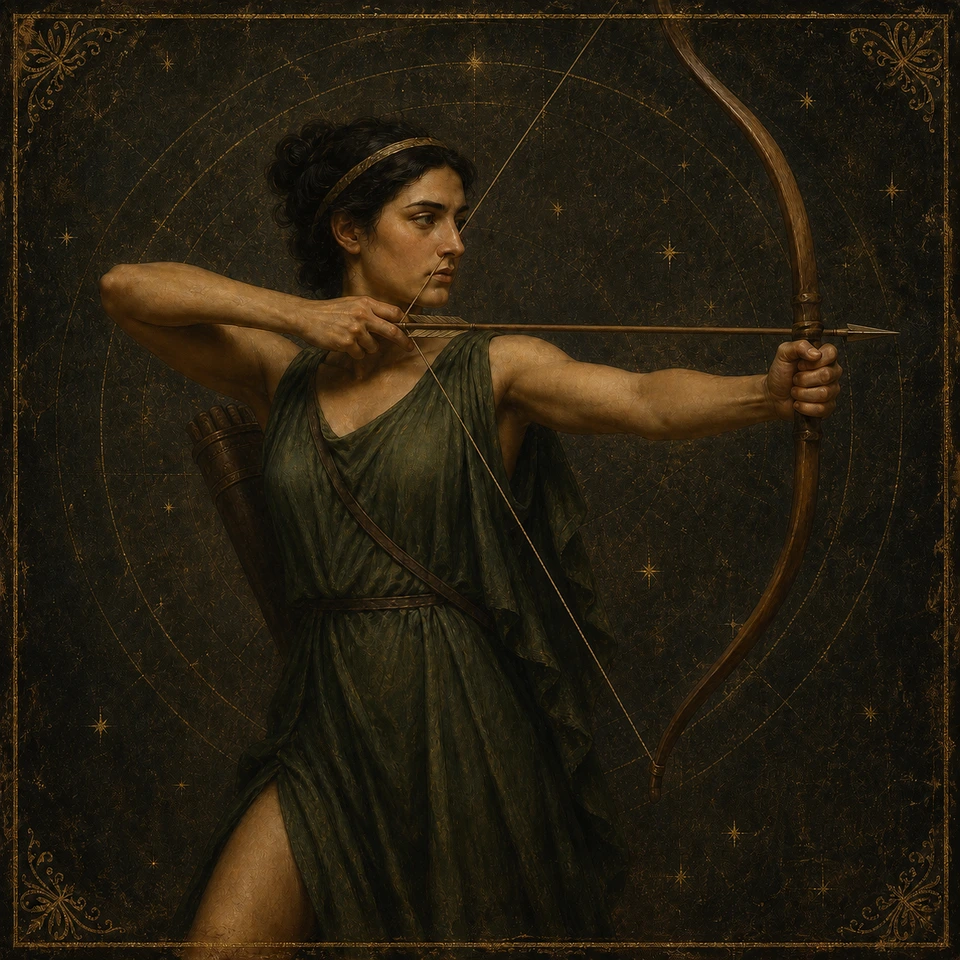
Guiding the sharp edge of the hunt, Artemis rules over archery and the fragile threshold of life transitions. Her ancient presence survives in ritual testimony and sanctuary archaeology, anchoring distinct local cults across Delos, Brauron, Sparta, and Letoon.
Overview
At Delos, a young woman approaching marriage cut a lock of hair, wound it around a spindle, and left it at a tomb within an Artemis sanctuary. A young man bound his own hair around a green branch and placed it at another tomb. Herodotus sets these gestures inside a longer story of offerings traveling from the far north toward the sacred island. The details are intimate and physical: hair, wood, thread, tomb, journey. They bring Artemis into view not as an abstract moon emblem, but as a goddess encountered where a life crossed from one state into another.
The island held her beside Leto and Apollo without dissolving the three into one cult. Temples, altars, dedications, performances, and sacred embassies accumulated across Delos, while stories made the family bond part of the landscape. At Letoon near Xanthos, another triad of temples stood in a Lycian federal sanctuary marked by Greek, Lycian, and Aramaic writing. Brauron gave Artemis a sanctuary in Attica and a civic presence through Artemis Brauronia on the Athenian Acropolis. Sparta knew Orthia through an image and an ordeal at the altar. The goddess remained recognizable across these places, but each community met her through its own institutions and stories.
Homeric Hymn 27 begins with motion. Artemis hunts across shadowed mountains, bends the golden bow, and sends arrows among wild creatures. Then she lays the bow aside, enters Apollo’s house, and leads the Muses and Graces in dance. The poem refuses a narrow choice between wilderness and ordered song. The hunter also directs a chorus. The daughter of Zeus and Leto moves from mountain pursuit into a divine hall, and neither setting exhausts her.
Ancient objects make that movement visible. An Attic amphora in the British Museum names Artemis and gives her bow and arrow, Doric chiton, fringed shawl, earrings, and a radiated taenia. A Hellenistic bronze in the Metropolitan Museum clothes her in a short peplos and hunting boots, with a quiver ready at her back. These are not later fantasy costumes. They are securely identified ancient images that show how artists made an active archer legible through dress, posture, and equipment.
Her myths carry sharper consequences. Actaeon becomes a stag and is torn apart by the hounds he once commanded, although Pseudo-Apollodorus preserves two rival causes for the punishment. Callisto is approached by Zeus in the likeness of Artemis or Apollo, then transformed and killed through conflicting divine agents before becoming the Bear among the stars. The encounter is coercive, and the alternatives cannot be flattened into a moral about one angry goddess. With Apollo, Artemis kills Niobe’s children and defends Leto against Tityos. In Euripides’ Hippolytus she appears after devastation, speaks the truth, and reconciles a dying son with the father whose curse helped destroy him.
Other stories widen the danger. At Aulis, Artemis' anger stops the fleet until Iphigenia is brought to the altar, then the goddess carries the girl to the Taurian land and leaves a deer in her place. When Oeneus forgets Artemis in the first-fruit offerings, the Calydonian countryside pays for one king's omission through a boar that destroys crops, cattle, and people. Orion reaches Delos after blindness, healing, and Eos' desire, only to die by Artemis' hand under two rival explanations. The Aloadae threaten heaven, imprison Ares, and claim divine brides before Artemis turns their weapons against one another. These myths do not repeat one simple lesson. They ask what happens when sacrifice, pride, hunting, desire, and divine anger collide.
The familiar modern picture of a universal moon goddess covers only one layer of a far larger history. Greek Artemis remains distinct from Selene, Hecate, Diana, Luna, and Etruscan Aritimi or Artumes. The reviewed sources do not give her a planet, zodiac sign, moon phase, gemstone, metal, color, element, weekday, direction, or incense. What they do give is richer: the tension of a bow, a chorus in Apollo’s hall, hair placed at a Delian tomb, the dangerous image at Orthia, separate temples at Letoon, transformed bodies in myth, and a living modern community that still names her in public libation.
Canonical identity
Canonical Identity
Artemis is securely established as an ancient Greek goddess, identified by Hesiod as the daughter of Zeus and Leto and the sibling of Apollo. While later storytelling frequently characterizes the siblings as twins, Hesiod's foundational passage does not explicitly use that term. Her canonical identity remains historically bound to Greek communities and rites. She must be kept distinct from Roman Diana, Etruscan Aritimi or Artumes, Greek Selene, Greek Hecate, and Roman Luna, as later functional overlaps do not erase the specific cultures and languages that defined each figure.
Linguistic Identity
Her Greek name is Ἄρτεμις, transliterated as Ártemis. A qualified fifth-century BC Attic reconstruction provides /ár.te.mis/, roughly approximated as AR-teh-miss. This reconstruction reflects a specific academic model of one dialect and period, meaning it does not represent the speech of every ancient individual. Because the name's etymology remains uncertain, any phonetic resemblance to modern words cannot be treated as a valid origin story.
Sources and evidence
TEXTUAL · Supported
The Ancient Greek name is Ἄρτεμις, transliterated Ártemis, with a qualified fifth-century BC Attic reconstruction /ár.te.mis/.
- Source
- Wiktionary contributors, Ἄρτεμις
- Reviewed edition
- Wiktionary live revision reviewed 2026-08-29 · Wiktionary
- Exact locator
- Entry Ἄρτεμις · Section Ancient Greek pronunciation
- Scope
- Classical Greece · Attica
- Authority
- institutional or lexical reference
- Certainty
- Qualified
The reconstruction does not establish a single pronunciation for every Greek dialect and century.
Open exact reviewed source1 reviewed source for this section
- Wiktionary contributors, ἌρτεμιςLive collaborative lexical entry reviewed 2026-08-29 · Wiktionary
Culture, tradition, period, and place
Artemis appears across Greek poetry, sanctuaries, images, and local rites from the archaic period through Roman imperial testimony, but no single city supplies a universal form. Delos places her in the family sanctuary of Leto and Apollo. Attica preserves Brauronian worship and an image of Artemis Brauronia on the Acropolis. Sparta remembers Artemis Orthia through a local image and a severe rite. Letoon places her beside Leto and Apollo within a Lycian federal sanctuary where Greek, Lycian, and Aramaic writing met.
These sites do not form a simple developmental ladder from one original cult. They show communities addressing the same goddess through different landscapes and institutions. Pausanias writes in the second century AD about places that claimed much older customs, so his descriptions are precious testimony but not direct transcripts of archaic practice. The evidence is strongest when each statement stays tied to its source, date, and named place.
Sources and evidence
ARCHAEOLOGICAL · Supported
The official Delos archaeological account places Artemis with Apollo and Leto in a sanctuary landscape served by buildings, dedications, performances, and visiting sacred embassies.
- Source
- Hellenic Ministry of Culture, Archaeological Site of Delos
- Reviewed edition
- Ephorate of Antiquities of Cyclades official site entry · Hellenic Ministry of Culture
- Exact locator
- Page Archaeological Site of Delos · Section Sanctuary and theoric missions
- Scope
- Classical Greece · Delos
- Authority
- institutional or lexical reference
- Certainty
- Qualified
This is shared Delian sanctuary evidence and does not assign every Apollonian building or festival solely to Artemis.
Open exact reviewed sourceTEXTUAL · Supported
Pausanias locates Artemis Brauronia on the Athenian Acropolis and connects the image at Brauron with a Taurian tradition.
- Source
- Pausanias; Spiro Greek edition and Jones/Ormerod translation volumes, Description of Greece (1935)
- Reviewed edition
- Spiro Greek edition and Jones/Ormerod English volumes represented by the Perseus CTS corpus, 1903-1935 · translated by W. H. S. Jones and H. A. Ormerod, volume-dependent · edited by Friedrich Spiro for the Greek edition · Perseus Digital Library / Scaife ATLAS
- Exact locator
- Entry Description of Greece · Section 1.23.7 and 1.33.1
- Scope
- Greek religion under Roman imperial rule · Attica
- Authority
- primary textual witness
- Certainty
- High
Imperial-period testimony preserves local sanctuary and image traditions; it does not make every Taurian tale historical fact.
Open exact reviewed sourceRITUAL ATTESTED · Supported
At Sparta, Pausanias describes the sanctuary image and a severe local rite of Artemis Orthia whose form was explained through Spartan tradition.
- Source
- Pausanias; Spiro Greek edition and Jones/Ormerod translation volumes, Description of Greece (1935)
- Reviewed edition
- Spiro Greek edition and Jones/Ormerod English volumes represented by the Perseus CTS corpus, 1903-1935 · translated by W. H. S. Jones and H. A. Ormerod, volume-dependent · edited by Friedrich Spiro for the Greek edition · Perseus Digital Library / Scaife ATLAS
- Exact locator
- Entry Description of Greece · Section 3.16.7-11
- Scope
- Greek religion under Roman imperial rule · Sparta
- Authority
- primary textual witness
- Certainty
- High
The rite is local Spartan testimony and is not generalized as ordinary Artemis worship.
Open exact reviewed sourceARCHAEOLOGICAL · Supported
At Letoon near Xanthos, three temples honored Leto, Artemis, and Apollo within a Lycian federal sanctuary marked by a trilingual inscription of 337 BC.
- Source
- UNESCO World Heritage Centre, Xanthos-Letoon (1988)
- Reviewed edition
- World Heritage List entry 484, English site description · United Nations Educational, Scientific and Cultural Organization
- Exact locator
- Entry World Heritage property 484 · Section Description and Outstanding Universal Value
- Scope
- Lycian Classical and Hellenistic periods · Letoon
- Authority
- institutional or lexical reference
- Certainty
- Qualified
The Lycian setting is preserved rather than absorbed into a single undifferentiated Greek cult story.
Open exact reviewed source3 reviewed sources for this section
- Hellenic Ministry of Culture, Archaeological Site of DelosEphorate of Antiquities of Cyclades official site record · Hellenic Ministry of Culture
- Pausanias; Spiro Greek edition and Jones/Ormerod translation volumes, Description of Greece (1935)Perseus CTS edition corpus, 1903-1935 · Perseus Digital Library / Scaife ATLAS
- UNESCO World Heritage Centre, Xanthos-Letoon (1988)World Heritage List entry 484 · United Nations Educational, Scientific and Cultural Organization
Historical development
Archaic hexameter already presents Artemis as daughter of Zeus and Leto, sister of Apollo, archer, hunter, and participant in divine song and dance. Classical tragedy gives another angle: in Euripides’ Hippolytus she is the honored patron whose late arrival exposes a household catastrophe caused through Aphrodite’s anger. Classical visual art gives her practical dress, bow, arrow, and carefully identified divine presence rather than a generic forest maiden.
Later evidence enlarges the geography. Hellenistic bronze preserves hunting dress and quiver. Imperial-period Pausanias records local titles, sanctuary images, and rites in Attica and Sparta. At Letoon, the sanctuary’s Lycian political and multilingual setting prevents a purely mainland Greek account. Modern Hellenic polytheist practice belongs to another historical layer: Hellenion’s public libation is evidence for that organization now, not proof that an ancient festival survived unchanged.
Sources and evidence
TEXTUAL · Supported
Homeric Hymn 27 presents Artemis carrying a golden bow and arrows, hunting wild creatures, delighting in archery, and then joining the Muses and Graces in dance at Apollo’s house.
- Source
- Anonymous Homeric Hymns; edited and translated by Hugh G. Evelyn-White, Homeric Hymns (1914)
- Reviewed edition
- Hugh G. Evelyn-White edition and English translation in Hesiod, the Homeric Hymns and Homerica, 1914 · translated by Hugh G. Evelyn-White · edited by Hugh G. Evelyn-White · Perseus Digital Library / Scaife ATLAS
- Exact locator
- Hymn 27 · Line 1-22
- Scope
- Archaic Greece · Ancient Greece
- Authority
- primary textual witness
- Certainty
- High
Poetic functions are retained as one hymn’s account rather than expanded into a universal domain list.
Open exact reviewed sourceMATERIAL CULTURE · Supported
British Museum amphora E274 names Artemis and shows her in a Doric chiton and fringed shawl, holding bow and arrow and wearing earrings and a radiated taenia.
- Source
- British Museum, British Museum Collection
- Reviewed edition
- Live record-level official museum collection · British Museum
- Exact locator
- MuseumObjectId 1842,0517.3 (E274) · Entry Attic red-figure neck-amphora, 460-440 BC
- Scope
- Classical Greece · Attica
- Authority
- institutional collection catalog
- Certainty
- Qualified
The cataloged object supports dress and archery attributes without authorizing a copied image or pose.
Open exact reviewed sourceMATERIAL CULTURE · Supported
Metropolitan Museum bronze 1980.303.3 shows Artemis in a short peplos with overfold, hunting boots, and a quiver.
- Source
- The Metropolitan Museum of Art, Open Access Collection and Collection API
- Reviewed edition
- Live collection records and API; eligible Open Access objects only · The Metropolitan Museum of Art
- Exact locator
- MuseumObjectId 1980.303.3 · Entry Bronze statuette of Artemis
- Scope
- Hellenistic Greek world · Ancient Greece
- Authority
- institutional collection catalog
- Certainty
- Qualified
The object supplies a secure material witness for hunting dress and quiver, not a complete sacred-animal system.
Open exact reviewed sourceLIVING TRADITION PUBLIC · Supported
Hellenion publicly schedules a communal libation to Artemis on the second Saturday in April.
- Source
- Hellenion, Libation to Artemis
- Reviewed edition
- Live Hellenion worship page reviewed 2026-08-29 · Hellenion
- Exact locator
- Page Libation to Artemis · Section second Saturday in April
- Scope
- Contemporary living religion · International online religious community
- Authority
- institutional or lexical reference
- Certainty
- Qualified
This is attributed to one named organization and is not described as an ancient date or universal contemporary practice.
Open exact reviewed source4 reviewed sources for this section
- Anonymous Homeric Hymns; edited and translated by Hugh G. Evelyn-White, Homeric Hymns (1914)Hesiod, the Homeric Hymns and Homerica, London and New York, 1914 · Perseus Digital Library / Scaife ATLAS
- British Museum, British Museum CollectionLive official museum collection · British Museum
- The Metropolitan Museum of Art, Open Access Collection and Collection APILive collection data and eligible public-domain images · The Metropolitan Museum of Art
- Hellenion, Libation to ArtemisLive organizational worship page reviewed 2026-08-29 · Hellenion
Attested roles and historical themes
Roles, powers, and limits
Homeric Hymn 27 lets action define Artemis. She draws a golden bow, sends arrows across the mountains, hunts wild creatures, sets the weapon aside, and enters Apollo’s house to lead a dance among the Muses and Graces. The poem joins wilderness and cultured performance without forcing one to cancel the other. Bow, hunt, song, siblinghood, and movement between mountain and divine hall occupy the same short composition.
Other sources make her power dangerous. She can punish, transform, or kill in myth. She and Apollo strike Niobe’s children in epic and mythography. In the Tityos narrative she acts in defense of Leto. In Hippolytus she cannot prevent the young man’s destruction, but she reveals the truth and restores recognition between father and son. These roles are not promises of uncomplicated protection. Artemis guards boundaries and exacts consequences within particular stories whose violence remains part of her record.
Sources and evidence
TEXTUAL · Supported
Homeric Hymn 27 presents Artemis carrying a golden bow and arrows, hunting wild creatures, delighting in archery, and then joining the Muses and Graces in dance at Apollo’s house.
- Source
- Anonymous Homeric Hymns; edited and translated by Hugh G. Evelyn-White, Homeric Hymns (1914)
- Reviewed edition
- Hugh G. Evelyn-White edition and English translation in Hesiod, the Homeric Hymns and Homerica, 1914 · translated by Hugh G. Evelyn-White · edited by Hugh G. Evelyn-White · Perseus Digital Library / Scaife ATLAS
- Exact locator
- Hymn 27 · Line 1-22
- Scope
- Archaic Greece · Ancient Greece
- Authority
- primary textual witness
- Certainty
- High
Poetic functions are retained as one hymn’s account rather than expanded into a universal domain list.
Open exact reviewed sourceTEXTUAL · Supported
Pseudo-Apollodorus gives rival causes for Actaeon’s destruction: Zeus’ anger over Semele or Artemis’ anger after Actaeon saw her bathing; Artemis changes him into a stag and his own hounds tear him apart.
- Source
- Pseudo-Apollodorus; edited and translated by James G. Frazer, Library (1921)
- Reviewed edition
- James G. Frazer edition and English translation, Harvard University Press and William Heinemann, 1921 · translated by James G. Frazer · edited by James G. Frazer · Perseus Digital Library / Scaife ATLAS
- Exact locator
- Entry Library · Section 3.4.4
- Scope
- Greek religion under Roman imperial rule · Ancient Greece
- Authority
- primary textual witness
- Certainty
- High
The source’s alternatives are preserved rather than harmonized.
Open exact reviewed sourceTEXTUAL · Supported
Pseudo-Apollodorus says Zeus approached Callisto in the likeness of Artemis or Apollo, and then preserves alternative agents for her transformation and death before Zeus saves the child Arcas and sets Callisto among the stars.
- Source
- Pseudo-Apollodorus; edited and translated by James G. Frazer, Library (1921)
- Reviewed edition
- James G. Frazer edition and English translation, Harvard University Press and William Heinemann, 1921 · translated by James G. Frazer · edited by James G. Frazer · Perseus Digital Library / Scaife ATLAS
- Exact locator
- Entry Library · Section 3.8.2
- Scope
- Greek religion under Roman imperial rule · Arcadia
- Authority
- primary textual witness
- Certainty
- High
The coercive encounter and all alternative agents remain explicit.
Open exact reviewed sourceTEXTUAL · Supported
In Euripides’ Hippolytus, the young man honors Artemis and rejects Aphrodite; Artemis appears after his fatal wreck to expose the deception and reconcile him with Theseus.
- Source
- Euripides; translated by E. P. Coleridge, Hippolytus (1906)
- Reviewed edition
- E. P. Coleridge English translation in The Plays of Euripides, 1906 · translated by E. P. Coleridge · Perseus Digital Library / Scaife ATLAS
- Exact locator
- Entry Hippolytus · Line 1-1466
- Scope
- Classical Greece · Troezen
- Authority
- primary textual witness
- Certainty
- High
The tragedy does not turn mythic patronage into a general cult relationship.
Open exact reviewed source3 reviewed sources for this section
- Anonymous Homeric Hymns; edited and translated by Hugh G. Evelyn-White, Homeric Hymns (1914)Hesiod, the Homeric Hymns and Homerica, London and New York, 1914 · Perseus Digital Library / Scaife ATLAS
- Pseudo-Apollodorus; edited and translated by James G. Frazer, Library (1921)Harvard University Press and William Heinemann edition, 1921 · Perseus Digital Library / Scaife ATLAS
- Euripides; translated by E. P. Coleridge, Hippolytus (1906)The Plays of Euripides, 1906 · Perseus Digital Library / Scaife ATLAS
Epithets and titles
Geographic Epithet
Brauronia
Of Brauron
Brauron and Athens in Attica · Imperial testimony to older cultThe title belongs to a specific Attic sanctuary and civic image.
1 reviewed source for this section
- Pausanias; Spiro Greek edition and Jones/Ormerod translation volumes, Description of Greece (1935)Perseus CTS edition corpus, 1903-1935 · Perseus Digital Library / Scaife ATLAS
Cult Epithet
Orthia
Orthia
Sparta · Imperial testimony to older local cultThe title and severe altar rite are locally Spartan and not universal Artemis worship.
1 reviewed source for this section
- Pausanias; Spiro Greek edition and Jones/Ormerod translation volumes, Description of Greece (1935)Perseus CTS edition corpus, 1903-1935 · Perseus Digital Library / Scaife ATLAS
Poetic Epithet
Golden-shafted
She of the golden arrows
Greek hymnic poetry · Archaic witnessA poetic archery title in Homeric Hymn 27.
1 reviewed source for this section
- Anonymous Homeric Hymns; edited and translated by Hugh G. Evelyn-White, Homeric Hymns (1914)Hesiod, the Homeric Hymns and Homerica, London and New York, 1914 · Perseus Digital Library / Scaife ATLAS
Worship and cult
At Brauron, worship took shape around a sanctuary, a locally famous image, and traditions connecting Artemis with Iphigenia and the Taurian land. Pausanias also saw an image of Artemis Brauronia on the Athenian Acropolis, carrying the local title into the civic heart of Athens. The sanctuary and image make this more than a literary nickname, yet the surviving account still comes through an imperial-period traveler looking back at older places.
At Sparta, Artemis Orthia belonged to another religious world. Pausanias describes a wooden image, stories about its dangerous power, and a rite in which young men were whipped at the altar. The account is harsh and local. It should neither be softened into symbolic discomfort nor presented as the normal pattern of Artemis worship everywhere. Delos and Letoon show still other settings, one insular and pan-Hellenic, the other Lycian and federal.
Sources and evidence
TEXTUAL · Supported
Pausanias locates Artemis Brauronia on the Athenian Acropolis and connects the image at Brauron with a Taurian tradition.
- Source
- Pausanias; Spiro Greek edition and Jones/Ormerod translation volumes, Description of Greece (1935)
- Reviewed edition
- Spiro Greek edition and Jones/Ormerod English volumes represented by the Perseus CTS corpus, 1903-1935 · translated by W. H. S. Jones and H. A. Ormerod, volume-dependent · edited by Friedrich Spiro for the Greek edition · Perseus Digital Library / Scaife ATLAS
- Exact locator
- Entry Description of Greece · Section 1.23.7 and 1.33.1
- Scope
- Greek religion under Roman imperial rule · Attica
- Authority
- primary textual witness
- Certainty
- High
Imperial-period testimony preserves local sanctuary and image traditions; it does not make every Taurian tale historical fact.
Open exact reviewed sourceRITUAL ATTESTED · Supported
At Sparta, Pausanias describes the sanctuary image and a severe local rite of Artemis Orthia whose form was explained through Spartan tradition.
- Source
- Pausanias; Spiro Greek edition and Jones/Ormerod translation volumes, Description of Greece (1935)
- Reviewed edition
- Spiro Greek edition and Jones/Ormerod English volumes represented by the Perseus CTS corpus, 1903-1935 · translated by W. H. S. Jones and H. A. Ormerod, volume-dependent · edited by Friedrich Spiro for the Greek edition · Perseus Digital Library / Scaife ATLAS
- Exact locator
- Entry Description of Greece · Section 3.16.7-11
- Scope
- Greek religion under Roman imperial rule · Sparta
- Authority
- primary textual witness
- Certainty
- High
The rite is local Spartan testimony and is not generalized as ordinary Artemis worship.
Open exact reviewed sourceTEXTUAL · Supported
Herodotus reports Hyperborean offerings at Delos and describes young women and men dedicating cut hair at tombs associated with Artemis sanctuaries before marriage.
- Source
- Herodotus; translated by A. D. Godley, The Histories (1925)
- Reviewed edition
- A. D. Godley English translation, Loeb Classical Library volumes I-IV, 1920-1925 · translated by A. D. Godley · edited by A. D. Godley · Perseus Digital Library / Scaife ATLAS
- Exact locator
- Entry Histories · Book 4 · Section 32-36
- Scope
- Classical Greece · Delos
- Authority
- primary textual witness
- Certainty
- High
The recipients and accompanying divinities vary within the report, so the rites remain locally and textually qualified.
Open exact reviewed sourceLIVING TRADITION PUBLIC · Supported
Hellenion publicly schedules a communal libation to Artemis on the second Saturday in April.
- Source
- Hellenion, Libation to Artemis
- Reviewed edition
- Live Hellenion worship page reviewed 2026-08-29 · Hellenion
- Exact locator
- Page Libation to Artemis · Section second Saturday in April
- Scope
- Contemporary living religion · International online religious community
- Authority
- institutional or lexical reference
- Certainty
- Qualified
This is attributed to one named organization and is not described as an ancient date or universal contemporary practice.
Open exact reviewed source3 reviewed sources for this section
- Pausanias; Spiro Greek edition and Jones/Ormerod translation volumes, Description of Greece (1935)Perseus CTS edition corpus, 1903-1935 · Perseus Digital Library / Scaife ATLAS
- Herodotus; translated by A. D. Godley, The Histories (1925)A. D. Godley English translation, Loeb Classical Library volumes I-IV, 1920-1925; Perseus eng2 component · Perseus Digital Library / Scaife ATLAS
- Hellenion, Libation to ArtemisLive organizational worship page reviewed 2026-08-29 · Hellenion
Temples, sanctuaries, and sacred places
Delos joins Artemis to a sacred island dense with altars, temples, dedications, performances, and arriving embassies. The family relation to Leto and Apollo matters, but Artemis has her own sanctuaries and rites within that shared landscape. Herodotus places tomb honors and hair dedications at named Artemis sites on the island, showing people moving through sacred space with offerings tied to marriage and inherited story.
Brauron in Attica, Artemis Orthia’s sanctuary at Sparta, and Letoon near Xanthos reveal three sharply different centers. Brauron binds local worship to Athenian memory and Taurian myth. Orthia’s sanctuary binds the goddess to Spartan institutions and an ordeal at the altar. Letoon sets separate temples for Leto, Artemis, and Apollo in a multilingual Lycian center. Geography here is not decorative scenery. Each place organizes a different human encounter with the goddess.
Sources and evidence
ARCHAEOLOGICAL · Supported
The official Delos archaeological account places Artemis with Apollo and Leto in a sanctuary landscape served by buildings, dedications, performances, and visiting sacred embassies.
- Source
- Hellenic Ministry of Culture, Archaeological Site of Delos
- Reviewed edition
- Ephorate of Antiquities of Cyclades official site entry · Hellenic Ministry of Culture
- Exact locator
- Page Archaeological Site of Delos · Section Sanctuary and theoric missions
- Scope
- Classical Greece · Delos
- Authority
- institutional or lexical reference
- Certainty
- Qualified
This is shared Delian sanctuary evidence and does not assign every Apollonian building or festival solely to Artemis.
Open exact reviewed sourceARCHAEOLOGICAL · Supported
At Letoon near Xanthos, three temples honored Leto, Artemis, and Apollo within a Lycian federal sanctuary marked by a trilingual inscription of 337 BC.
- Source
- UNESCO World Heritage Centre, Xanthos-Letoon (1988)
- Reviewed edition
- World Heritage List entry 484, English site description · United Nations Educational, Scientific and Cultural Organization
- Exact locator
- Entry World Heritage property 484 · Section Description and Outstanding Universal Value
- Scope
- Lycian Classical and Hellenistic periods · Letoon
- Authority
- institutional or lexical reference
- Certainty
- Qualified
The Lycian setting is preserved rather than absorbed into a single undifferentiated Greek cult story.
Open exact reviewed sourceTEXTUAL · Supported
Pausanias locates Artemis Brauronia on the Athenian Acropolis and connects the image at Brauron with a Taurian tradition.
- Source
- Pausanias; Spiro Greek edition and Jones/Ormerod translation volumes, Description of Greece (1935)
- Reviewed edition
- Spiro Greek edition and Jones/Ormerod English volumes represented by the Perseus CTS corpus, 1903-1935 · translated by W. H. S. Jones and H. A. Ormerod, volume-dependent · edited by Friedrich Spiro for the Greek edition · Perseus Digital Library / Scaife ATLAS
- Exact locator
- Entry Description of Greece · Section 1.23.7 and 1.33.1
- Scope
- Greek religion under Roman imperial rule · Attica
- Authority
- primary textual witness
- Certainty
- High
Imperial-period testimony preserves local sanctuary and image traditions; it does not make every Taurian tale historical fact.
Open exact reviewed source3 reviewed sources for this section
- Hellenic Ministry of Culture, Archaeological Site of DelosEphorate of Antiquities of Cyclades official site record · Hellenic Ministry of Culture
- UNESCO World Heritage Centre, Xanthos-Letoon (1988)World Heritage List entry 484 · United Nations Educational, Scientific and Cultural Organization
- Pausanias; Spiro Greek edition and Jones/Ormerod translation volumes, Description of Greece (1935)Perseus CTS edition corpus, 1903-1935 · Perseus Digital Library / Scaife ATLAS
Festivals and processions
The reviewed evidence supports local sacred times rather than one universal Artemis calendar. At Delos, Herodotus reports recurring offerings sent along a remembered route from the Hyperboreans and rites involving hair before marriage. Sacred embassies and performances belonged to the island’s wider sanctuary life, but shared Delian activity cannot be assigned to Artemis alone without a specific witness.
Pausanias’ Spartan account describes a rite at the altar of Orthia, not an adaptable seasonal celebration. Hellenion’s second-Saturday-in-April libation belongs to the named modern organization and its own public calendar. The evidence therefore shows time marked through pilgrimage, life transition, ordeal, and present-day communal scheduling, while leaving unsupported claims about weekdays, moon phases, and a single annual season outside the historical record.
Sources and evidence
RITUAL ATTESTED · Supported
At Sparta, Pausanias describes the sanctuary image and a severe local rite of Artemis Orthia whose form was explained through Spartan tradition.
- Source
- Pausanias; Spiro Greek edition and Jones/Ormerod translation volumes, Description of Greece (1935)
- Reviewed edition
- Spiro Greek edition and Jones/Ormerod English volumes represented by the Perseus CTS corpus, 1903-1935 · translated by W. H. S. Jones and H. A. Ormerod, volume-dependent · edited by Friedrich Spiro for the Greek edition · Perseus Digital Library / Scaife ATLAS
- Exact locator
- Entry Description of Greece · Section 3.16.7-11
- Scope
- Greek religion under Roman imperial rule · Sparta
- Authority
- primary textual witness
- Certainty
- High
The rite is local Spartan testimony and is not generalized as ordinary Artemis worship.
Open exact reviewed sourceTEXTUAL · Supported
Herodotus reports Hyperborean offerings at Delos and describes young women and men dedicating cut hair at tombs associated with Artemis sanctuaries before marriage.
- Source
- Herodotus; translated by A. D. Godley, The Histories (1925)
- Reviewed edition
- A. D. Godley English translation, Loeb Classical Library volumes I-IV, 1920-1925 · translated by A. D. Godley · edited by A. D. Godley · Perseus Digital Library / Scaife ATLAS
- Exact locator
- Entry Histories · Book 4 · Section 32-36
- Scope
- Classical Greece · Delos
- Authority
- primary textual witness
- Certainty
- High
The recipients and accompanying divinities vary within the report, so the rites remain locally and textually qualified.
Open exact reviewed sourceLIVING TRADITION PUBLIC · Supported
Hellenion publicly schedules a communal libation to Artemis on the second Saturday in April.
- Source
- Hellenion, Libation to Artemis
- Reviewed edition
- Live Hellenion worship page reviewed 2026-08-29 · Hellenion
- Exact locator
- Page Libation to Artemis · Section second Saturday in April
- Scope
- Contemporary living religion · International online religious community
- Authority
- institutional or lexical reference
- Certainty
- Qualified
This is attributed to one named organization and is not described as an ancient date or universal contemporary practice.
Open exact reviewed source3 reviewed sources for this section
- Pausanias; Spiro Greek edition and Jones/Ormerod translation volumes, Description of Greece (1935)Perseus CTS edition corpus, 1903-1935 · Perseus Digital Library / Scaife ATLAS
- Herodotus; translated by A. D. Godley, The Histories (1925)A. D. Godley English translation, Loeb Classical Library volumes I-IV, 1920-1925; Perseus eng2 component · Perseus Digital Library / Scaife ATLAS
- Hellenion, Libation to ArtemisLive organizational worship page reviewed 2026-08-29 · Hellenion
Offerings, votives, and ritual evidence
Herodotus gives the most concrete surviving offering sequence. Wrapped offerings travel toward Delos through a chain of peoples. On the island, young women cut a lock of hair before marriage, wind it around a spindle, and place it on a tomb; young men bind their hair around a green branch and dedicate it at another tomb. Recipient identities and accompanying divine figures remain uncertain inside the report, which is precisely why the local details matter.
The rites are historical descriptions, not instructions lifted out of context. The same caution applies at Orthia, where a violent Spartan ordeal cannot become a general devotional exercise. Hellenion’s modern libation is public and accountable, but it represents one organization. No reviewed evidence supports a universal list of incense, stones, metals, colors, or consumable offerings for Artemis.
Sources and evidence
TEXTUAL · Supported
Herodotus reports Hyperborean offerings at Delos and describes young women and men dedicating cut hair at tombs associated with Artemis sanctuaries before marriage.
- Source
- Herodotus; translated by A. D. Godley, The Histories (1925)
- Reviewed edition
- A. D. Godley English translation, Loeb Classical Library volumes I-IV, 1920-1925 · translated by A. D. Godley · edited by A. D. Godley · Perseus Digital Library / Scaife ATLAS
- Exact locator
- Entry Histories · Book 4 · Section 32-36
- Scope
- Classical Greece · Delos
- Authority
- primary textual witness
- Certainty
- High
The recipients and accompanying divinities vary within the report, so the rites remain locally and textually qualified.
Open exact reviewed sourceLIVING TRADITION PUBLIC · Supported
Hellenion publicly schedules a communal libation to Artemis on the second Saturday in April.
- Source
- Hellenion, Libation to Artemis
- Reviewed edition
- Live Hellenion worship page reviewed 2026-08-29 · Hellenion
- Exact locator
- Page Libation to Artemis · Section second Saturday in April
- Scope
- Contemporary living religion · International online religious community
- Authority
- institutional or lexical reference
- Certainty
- Qualified
This is attributed to one named organization and is not described as an ancient date or universal contemporary practice.
Open exact reviewed source2 reviewed sources for this section
- Herodotus; translated by A. D. Godley, The Histories (1925)A. D. Godley English translation, Loeb Classical Library volumes I-IV, 1920-1925; Perseus eng2 component · Perseus Digital Library / Scaife ATLAS
- Hellenion, Libation to ArtemisLive organizational worship page reviewed 2026-08-29 · Hellenion
Iconography and material culture
A bow, arrow, and quiver recur across text and securely identified ancient objects. Homeric Hymn 27 gives Artemis the golden bow and arrows as instruments she actively uses. British Museum amphora E274 names her and shows bow and arrow with a Doric chiton, fringed shawl, earrings, and a radiated taenia. The Met bronze shows a short peplos, overfold, hunting boots, and quiver.
These objects are not interchangeable ornaments. Bow and arrow enact the hunt and the reach of divine punishment; quiver carries the weapon; garments and boots make movement visible. The museum objects also correct the narrow modern habit of defining Artemis through a crescent alone. No reviewed object here requires a crescent crown, and later lunar familiarity should not erase Greek material evidence.
Sources and evidence
MATERIAL CULTURE · Supported
British Museum amphora E274 names Artemis and shows her in a Doric chiton and fringed shawl, holding bow and arrow and wearing earrings and a radiated taenia.
- Source
- British Museum, British Museum Collection
- Reviewed edition
- Live record-level official museum collection · British Museum
- Exact locator
- MuseumObjectId 1842,0517.3 (E274) · Entry Attic red-figure neck-amphora, 460-440 BC
- Scope
- Classical Greece · Attica
- Authority
- institutional collection catalog
- Certainty
- Qualified
The cataloged object supports dress and archery attributes without authorizing a copied image or pose.
Open exact reviewed sourceTEXTUAL · Supported
Homeric Hymn 27 presents Artemis carrying a golden bow and arrows, hunting wild creatures, delighting in archery, and then joining the Muses and Graces in dance at Apollo’s house.
- Source
- Anonymous Homeric Hymns; edited and translated by Hugh G. Evelyn-White, Homeric Hymns (1914)
- Reviewed edition
- Hugh G. Evelyn-White edition and English translation in Hesiod, the Homeric Hymns and Homerica, 1914 · translated by Hugh G. Evelyn-White · edited by Hugh G. Evelyn-White · Perseus Digital Library / Scaife ATLAS
- Exact locator
- Hymn 27 · Line 1-22
- Scope
- Archaic Greece · Ancient Greece
- Authority
- primary textual witness
- Certainty
- High
Poetic functions are retained as one hymn’s account rather than expanded into a universal domain list.
Open exact reviewed sourceMATERIAL CULTURE · Supported
Metropolitan Museum bronze 1980.303.3 shows Artemis in a short peplos with overfold, hunting boots, and a quiver.
- Source
- The Metropolitan Museum of Art, Open Access Collection and Collection API
- Reviewed edition
- Live collection records and API; eligible Open Access objects only · The Metropolitan Museum of Art
- Exact locator
- MuseumObjectId 1980.303.3 · Entry Bronze statuette of Artemis
- Scope
- Hellenistic Greek world · Ancient Greece
- Authority
- institutional collection catalog
- Certainty
- Qualified
The object supplies a secure material witness for hunting dress and quiver, not a complete sacred-animal system.
Open exact reviewed source3 reviewed sources for this section
- British Museum, British Museum CollectionLive official museum collection · British Museum
- Anonymous Homeric Hymns; edited and translated by Hugh G. Evelyn-White, Homeric Hymns (1914)Hesiod, the Homeric Hymns and Homerica, London and New York, 1914 · Perseus Digital Library / Scaife ATLAS
- The Metropolitan Museum of Art, Open Access Collection and Collection APILive collection data and eligible public-domain images · The Metropolitan Museum of Art
Animals, plants, and embodied forms
Wild animals enter Artemis’ world first as creatures pursued through the mountains in Homeric Hymn 27. Actaeon becomes a stag and is destroyed by his own hunting pack. Callisto becomes a bear through one of two divine agents in Pseudo-Apollodorus. These are vivid animal forms and narrative actions, but they do not establish a universal list in which every deer, hound, stag, or bear carries the same ritual meaning.
The distinction is important. Quarry in a hymn, a punitive transformation, an animal disguise, and a modern emblem are four different relationships. The reviewed sources do not identify a plant or tree as Artemis’ universal correspondence. Green branches appear in a Delian hair rite, yet the branch is part of that action rather than proof of a timeless sacred species.
Sources and evidence
MATERIAL CULTURE · Supported
Metropolitan Museum bronze 1980.303.3 shows Artemis in a short peplos with overfold, hunting boots, and a quiver.
- Source
- The Metropolitan Museum of Art, Open Access Collection and Collection API
- Reviewed edition
- Live collection records and API; eligible Open Access objects only · The Metropolitan Museum of Art
- Exact locator
- MuseumObjectId 1980.303.3 · Entry Bronze statuette of Artemis
- Scope
- Hellenistic Greek world · Ancient Greece
- Authority
- institutional collection catalog
- Certainty
- Qualified
The object supplies a secure material witness for hunting dress and quiver, not a complete sacred-animal system.
Open exact reviewed sourceTEXTUAL · Supported
Homeric Hymn 27 presents Artemis carrying a golden bow and arrows, hunting wild creatures, delighting in archery, and then joining the Muses and Graces in dance at Apollo’s house.
- Source
- Anonymous Homeric Hymns; edited and translated by Hugh G. Evelyn-White, Homeric Hymns (1914)
- Reviewed edition
- Hugh G. Evelyn-White edition and English translation in Hesiod, the Homeric Hymns and Homerica, 1914 · translated by Hugh G. Evelyn-White · edited by Hugh G. Evelyn-White · Perseus Digital Library / Scaife ATLAS
- Exact locator
- Hymn 27 · Line 1-22
- Scope
- Archaic Greece · Ancient Greece
- Authority
- primary textual witness
- Certainty
- High
Poetic functions are retained as one hymn’s account rather than expanded into a universal domain list.
Open exact reviewed sourceTEXTUAL · Supported
Pseudo-Apollodorus gives rival causes for Actaeon’s destruction: Zeus’ anger over Semele or Artemis’ anger after Actaeon saw her bathing; Artemis changes him into a stag and his own hounds tear him apart.
- Source
- Pseudo-Apollodorus; edited and translated by James G. Frazer, Library (1921)
- Reviewed edition
- James G. Frazer edition and English translation, Harvard University Press and William Heinemann, 1921 · translated by James G. Frazer · edited by James G. Frazer · Perseus Digital Library / Scaife ATLAS
- Exact locator
- Entry Library · Section 3.4.4
- Scope
- Greek religion under Roman imperial rule · Ancient Greece
- Authority
- primary textual witness
- Certainty
- High
The source’s alternatives are preserved rather than harmonized.
Open exact reviewed sourceTEXTUAL · Supported
Pseudo-Apollodorus says Zeus approached Callisto in the likeness of Artemis or Apollo, and then preserves alternative agents for her transformation and death before Zeus saves the child Arcas and sets Callisto among the stars.
- Source
- Pseudo-Apollodorus; edited and translated by James G. Frazer, Library (1921)
- Reviewed edition
- James G. Frazer edition and English translation, Harvard University Press and William Heinemann, 1921 · translated by James G. Frazer · edited by James G. Frazer · Perseus Digital Library / Scaife ATLAS
- Exact locator
- Entry Library · Section 3.8.2
- Scope
- Greek religion under Roman imperial rule · Arcadia
- Authority
- primary textual witness
- Certainty
- High
The coercive encounter and all alternative agents remain explicit.
Open exact reviewed source3 reviewed sources for this section
- The Metropolitan Museum of Art, Open Access Collection and Collection APILive collection data and eligible public-domain images · The Metropolitan Museum of Art
- Anonymous Homeric Hymns; edited and translated by Hugh G. Evelyn-White, Homeric Hymns (1914)Hesiod, the Homeric Hymns and Homerica, London and New York, 1914 · Perseus Digital Library / Scaife ATLAS
- Pseudo-Apollodorus; edited and translated by James G. Frazer, Library (1921)Harvard University Press and William Heinemann edition, 1921 · Perseus Digital Library / Scaife ATLAS
Relationships and genealogy
Hesiod names Artemis and Apollo as children of Zeus and Leto. That supports two parentage relationships and a sibling relationship already shared with Apollo. It does not, by itself, supply a complete family biography or the stronger word twin. Leto is not merely a genealogical label: in the Tityos story Artemis acts with Apollo against an attacker who threatens their mother.
Mythic company does not automatically become a family or cult bond. Hippolytus honors Artemis in Euripides’ tragedy, but his role is preserved through the shared myth rather than converted into an unsupported kinship. Callisto belongs to Artemis’ company in the mythographic tradition, yet the coercive actions of Zeus and the source’s conflicting agents must remain visible. Every relationship stated beyond participation needs its own attestation.
Sources and evidence
TEXTUAL · Supported
Hesiod names Artemis and Apollo as children of Zeus and Leto.
- Source
- Hesiod; edited and translated by Hugh G. Evelyn-White, Theogony (1914)
- Reviewed edition
- Hugh G. Evelyn-White edition and English translation in Hesiod, the Homeric Hymns and Homerica, 1914 · translated by Hugh G. Evelyn-White · edited by Hugh G. Evelyn-White · Perseus Digital Library / Scaife ATLAS
- Exact locator
- Entry Theogony · Line 918-920
- Scope
- Archaic Greece · Ancient Greece
- Authority
- primary textual witness
- Certainty
- High
The passage supports parentage and siblinghood but does not itself call the pair twins.
Open exact reviewed source1 reviewed source for this section
- Hesiod; edited and translated by Hugh G. Evelyn-White, Theogony (1914)Hesiod, the Homeric Hymns and Homerica, London and New York, 1914 · Perseus Digital Library / Scaife ATLAS
Actual myths and source variants
Artemis’ myths move through defense, punishment, transformed bodies, and grief. With Apollo she kills Niobe’s children after Niobe exalts her own fertility over Leto, and Homer’s Priam remembers the slaughter while urging Achilles to eat amid mourning. Against Tityos, Artemis and Apollo answer an attack on Leto. At Delos, offerings and tomb stories bind the goddess to a route imagined across distant peoples.
Actaeon’s story makes the hunter into quarry, but its cause is not stable even within Pseudo-Apollodorus. Callisto’s story is still less stable: Zeus comes in Artemis’ or Apollo’s likeness, Zeus or Hera causes the bear transformation, and Artemis or Hera delivers death. The alternatives prevent a convenient moral in which Artemis simply punishes a broken vow. In Hippolytus she receives fierce devotion, arrives too late to prevent death, and tells the truth. In one Adonis variant she sends the boar that kills him. The shared stories preserve action before interpretation and keep each source’s choices separate.
Three major cycles make neglect and sacrifice bodily. Artemis stops the fleet at Aulis until Iphigenia is led to the altar, yet she removes the girl at the final moment, leaves a deer in her place, and establishes her as a priestess in the Taurian land. In Calydon, Oeneus remembers every god but Artemis in the first-fruit offerings. Her answer is a boar that ruins fields and kills people, drawing Atalanta, Meleager, and many other heroes into a hunt whose prize opens a second round of family violence.
Orion and the Aloadae show Artemis killing through sharply different means. Pseudo-Apollodorus says Orion dies on Delos, either after challenging her at quoits or after attacking Opis. The Aloadae demand Hera and Artemis as brides, bind Ares, and raise mountains against heaven. Artemis becomes a deer, runs between the brothers, and lets their own thrown spears destroy them. Elsewhere she acts at the edge of another god's story: Pindar makes her the killer of Coronis, while a Delphic dedication shows her and Leto restraining Apollo during his struggle with Heracles over the tripod.
Sources and evidence
TEXTUAL · Supported
Pseudo-Apollodorus gives rival causes for Actaeon’s destruction: Zeus’ anger over Semele or Artemis’ anger after Actaeon saw her bathing; Artemis changes him into a stag and his own hounds tear him apart.
- Source
- Pseudo-Apollodorus; edited and translated by James G. Frazer, Library (1921)
- Reviewed edition
- James G. Frazer edition and English translation, Harvard University Press and William Heinemann, 1921 · translated by James G. Frazer · edited by James G. Frazer · Perseus Digital Library / Scaife ATLAS
- Exact locator
- Entry Library · Section 3.4.4
- Scope
- Greek religion under Roman imperial rule · Ancient Greece
- Authority
- primary textual witness
- Certainty
- High
The source’s alternatives are preserved rather than harmonized.
Open exact reviewed sourceTEXTUAL · Supported
Pseudo-Apollodorus says Zeus approached Callisto in the likeness of Artemis or Apollo, and then preserves alternative agents for her transformation and death before Zeus saves the child Arcas and sets Callisto among the stars.
- Source
- Pseudo-Apollodorus; edited and translated by James G. Frazer, Library (1921)
- Reviewed edition
- James G. Frazer edition and English translation, Harvard University Press and William Heinemann, 1921 · translated by James G. Frazer · edited by James G. Frazer · Perseus Digital Library / Scaife ATLAS
- Exact locator
- Entry Library · Section 3.8.2
- Scope
- Greek religion under Roman imperial rule · Arcadia
- Authority
- primary textual witness
- Certainty
- High
The coercive encounter and all alternative agents remain explicit.
Open exact reviewed sourceTEXTUAL · Supported
In Euripides’ Hippolytus, the young man honors Artemis and rejects Aphrodite; Artemis appears after his fatal wreck to expose the deception and reconcile him with Theseus.
- Source
- Euripides; translated by E. P. Coleridge, Hippolytus (1906)
- Reviewed edition
- E. P. Coleridge English translation in The Plays of Euripides, 1906 · translated by E. P. Coleridge · Perseus Digital Library / Scaife ATLAS
- Exact locator
- Entry Hippolytus · Line 1-1466
- Scope
- Classical Greece · Troezen
- Authority
- primary textual witness
- Certainty
- High
The tragedy does not turn mythic patronage into a general cult relationship.
Open exact reviewed sourceTEXTUAL · Supported
Pseudo-Apollodorus says Artemis stops the Achaean fleet at Aulis, requires Iphigenia, then carries her to the Taurian land, substitutes a deer, and makes her a priestess.
- Source
- Pseudo-Apollodorus; edited and translated by James G. Frazer, Library (1921)
- Reviewed edition
- James G. Frazer edition and English translation, Harvard University Press and William Heinemann, 1921 · translated by James G. Frazer · edited by James G. Frazer · Perseus Digital Library / Scaife ATLAS
- Exact locator
- Entry Epitome · Section 3.21-22
- Scope
- Greek religion under Roman imperial rule · Aulis
- Authority
- primary textual witness
- Certainty
- High
The witness preserves two causes for Artemis’ anger and an alternative in which Iphigenia becomes immortal.
Open exact reviewed sourceTEXTUAL · Supported
Pseudo-Apollodorus says Artemis kills Orion on Delos and preserves two rival causes: a contest at quoits or violence offered to Opis.
- Source
- Pseudo-Apollodorus; edited and translated by James G. Frazer, Library (1921)
- Reviewed edition
- James G. Frazer edition and English translation, Harvard University Press and William Heinemann, 1921 · translated by James G. Frazer · edited by James G. Frazer · Perseus Digital Library / Scaife ATLAS
- Exact locator
- Entry Library · Section 1.4.3-5
- Scope
- Greek religion under Roman imperial rule · Delos
- Authority
- primary textual witness
- Certainty
- High
The two causes remain alternatives inside the same mythographic sequence.
Open exact reviewed sourceTEXTUAL · Supported
After Oeneus omits Artemis from the first-fruit offerings, Pseudo-Apollodorus says she sends the great Calydonian boar that devastates fields, cattle, and people.
- Source
- Pseudo-Apollodorus; edited and translated by James G. Frazer, Library (1921)
- Reviewed edition
- James G. Frazer edition and English translation, Harvard University Press and William Heinemann, 1921 · translated by James G. Frazer · edited by James G. Frazer · Perseus Digital Library / Scaife ATLAS
- Exact locator
- Entry Library · Section 1.8.2-3
- Scope
- Greek religion under Roman imperial rule · Calydon
- Authority
- primary textual witness
- Certainty
- High
The neglected offering begins the disaster; the hunt and dispute over the hide lead into Meleager’s death.
Open exact reviewed sourceTEXTUAL · Supported
Pseudo-Apollodorus says Artemis destroys Otus and Ephialtes by taking a deer’s form and leaping between them so that each brother strikes the other.
- Source
- Pseudo-Apollodorus; edited and translated by James G. Frazer, Library (1921)
- Reviewed edition
- James G. Frazer edition and English translation, Harvard University Press and William Heinemann, 1921 · translated by James G. Frazer · edited by James G. Frazer · Perseus Digital Library / Scaife ATLAS
- Exact locator
- Entry Library · Section 1.7.4
- Scope
- Greek religion under Roman imperial rule · Naxos
- Authority
- primary textual witness
- Certainty
- High
The ruse closes the same Aloadae sequence that includes their assault on heaven and imprisonment of Ares.
Open exact reviewed sourceTEXTUAL · Supported
In Pindar’s third Pythian ode, Artemis kills the pregnant Coronis before Apollo rescues Asclepius from the pyre.
- Source
- Pindar; translated by Diane Arnson Svarlien, Odes of Pindar (1990)
- Reviewed edition
- Diane Arnson Svarlien English translation, 1990 · translated by Diane Arnson Svarlien · Tufts University
- Exact locator
- Entry Pythian 3 · Line 5-58
- Scope
- Classical Greece · Ancient Greece
- Authority
- primary textual witness
- Certainty
- High
Pseudo-Apollodorus instead makes Apollo the killer, so Artemis’ role is limited to Pindar’s telling.
Open exact reviewed sourceTEXTUAL · Supported
Pausanias describes a Delphic dedication in which Artemis and Leto restrain Apollo while Athena restrains Heracles during the struggle for the tripod.
- Source
- Pausanias; Spiro Greek edition and Jones/Ormerod translation volumes, Description of Greece (1935)
- Reviewed edition
- Spiro Greek edition and Jones/Ormerod English volumes represented by the Perseus CTS corpus, 1903-1935 · translated by W. H. S. Jones and H. A. Ormerod, volume-dependent · edited by Friedrich Spiro for the Greek edition · Perseus Digital Library / Scaife ATLAS
- Exact locator
- Book 10 · Chapter 13 · Section 7
- Scope
- Greek religion under Roman imperial rule · Delphi
- Authority
- primary textual witness
- Certainty
- High
This is a described sanctuary image; Pseudo-Apollodorus narrates the struggle without Artemis in the prose action.
Open exact reviewed source2 reviewed sources for this section
- Pseudo-Apollodorus; edited and translated by James G. Frazer, Library (1921)Harvard University Press and William Heinemann edition, 1921 · Perseus Digital Library / Scaife ATLAS
- Euripides; translated by E. P. Coleridge, Hippolytus (1906)The Plays of Euripides, 1906 · Perseus Digital Library / Scaife ATLAS
Myth Library
Each myth gathers its attested participants into one source-grounded account, while distinct source traditions remain readable in their own variants.
Transformation And Death
Artemis and Actaeon
Actaeon is transformed into a stag and killed by his own hounds, while Pseudo-Apollodorus preserves two rival causes for the punishment and closes with the hounds grieving for the master they destroyed.
- Role in this profile
- goddess who transforms Actaeon in one of the source’s rival explanations
- Place scope
- Ancient Greece
- Witnesses
- 1
- Variants
- 1
Coercion Transformation And Catasterism
Artemis and Callisto
Zeus approaches Callisto in divine disguise, after which Pseudo-Apollodorus preserves conflicting agents for her transformation and death before Arcas is rescued and Callisto is set among the stars.
- Role in this profile
- leader whose likeness Zeus assumes in one alternative and who transforms or shoots Callisto in other alternatives
- Place scope
- Arcadia
- Witnesses
- 1
- Variants
- 1
Sacrifice Rescue And Translation
Iphigenia at Aulis and in the Taurian Land
The windbound Achaean fleet is told to sacrifice Iphigenia to Artemis, but the goddess removes the girl at the altar, leaves a deer in her place, and establishes her as a priestess in the Taurian land.
- Role in this profile
- goddess whose anger stills the fleet and who removes Iphigenia from the altar
- Place scope
- Aulis · Land of the Taurians
- Witnesses
- 1
- Variants
- 1
Journey Conflict And Death
Artemis and the Death of Orion
After blindness, guidance toward the sunrise, restored sight, and Eos’ desire, Orion reaches Delos and dies by Artemis’ hand under two rival explanations.
- Role in this profile
- goddess who kills Orion on Delos under two rival explanations
- Place scope
- Delos
- Witnesses
- 1
- Variants
- 1
Heroic
The Calydonian Boar Hunt
When Oeneus omits Artemis from the first-fruit offerings, she sends a devastating boar; the hunt ends with Atalanta winning the first wound, Meleager killing the beast, and a quarrel over the hide turning victory into family bloodshed.
- Role in this profile
- goddess who sends the boar after Oeneus omits her offering
- Place scope
- Calydon
- Witnesses
- 1
- Variants
- 1
Divine Conflict
Ares Imprisoned by the Aloadae
Otus and Ephialtes, sons of Poseidon and Iphimedeia in Pseudo-Apollodorus, imprison Ares in a bronze jar until Hermes releases him. Their wider revolt ends through Artemis ruse.
- Role in this profile
- goddess who becomes a deer and causes the Aloadae to kill one another
- Place scope
- Ancient Greece · Naxos
- Witnesses
- 2
- Variants
- 2
Divine Punishment
Apollo, Artemis, and the Children of Niobe
Greek and Roman sources tell how Apollo and Artemis kill Niobe's children after her offense against Leto, but disagree over the children's number, survivors, and the story's setting and aftermath.
- Role in this profile
- avenger of Leto who kills Niobe's daughters in the early epic account
- Witnesses
- 3
- Variants
- 3
Assault And Punishment
Tityos Attacks Leto
The Odyssey sees Tityos punished eternally for assaulting Leto, while Pseudo-Apollodorus makes Apollo and Artemis kill him in their mother's defense and Pausanias describes a Spartan throne image of the combat.
- Role in this profile
- defender who shoots Tityos alongside Apollo in later sources
- Place scope
- Ancient Greece
- Witnesses
- 3
- Variants
- 3
Ritual Aetiology
Hyperborean Offerings and the Delian Maidens
Herodotus reports a Delian tradition that a Hyperborean tribute for Eileithyia passed through a chain of peoples to Delos, where Hyperoche and Laodice were honored near Artemis's sanctuary and Delian youths dedicated their hair.
- Role in this profile
- Delian goddess whose sanctuary contains the tomb and hair-dedication setting described by Herodotus
- Place scope
- Delos
- Witnesses
- 1
- Variants
- 1
Tragic Divine Retribution
Hippolytus and Phaedra
Aphrodite punishes Hippolytus for rejecting her honors by making his stepmother Phaedra desire him. Secrecy, the nurse's disclosure, Phaedra's suicide and accusation, Theseus' curse, and a fatal chariot wreck complete the destruction Aphrodite announces at the play's opening.
- Role in this profile
- patron honored by Hippolytus who reveals the truth and reconciles father and son at the end
- Place scope
- Troezen
- Witnesses
- 1
- Variants
- 1
Custody Death And Ritual Reception
Adonis Between Aphrodite and Persephone
Pseudo-Apollodorus preserves competing parentages, then follows Panyasis: Aphrodite's anger drives Smyrna toward her father Thias, a nurse conceals their incest for twelve nights, and Smyrna becomes the myrrh tree from which Adonis is born. Aphrodite hides the infant with Persephone, Zeus divides his year when Persephone refuses to return him, and Artemis's anger brings his boar death. Theocritus and Ovid reshape the later mourning in Alexandrian and Roman settings.
- Role in this profile
- goddess whose anger sends the boar that kills Adonis in Pseudo-Apollodorus
- Place scope
- Ancient Greece · Alexandria in Egypt
- Witnesses
- 3
- Variants
- 3
Divine Genealogy
Coronis and the Birth of Asclepius
Pindar, Pseudo-Apollodorus, and Pausanias preserve incompatible accounts of Coronis, Apollo, and Asclepius, including violent death and rescue from a funeral pyre in some tellings and a local Epidaurian birth tradition in another.
- Role in this profile
- agent of Coronis's death in Pindar
- Place scope
- Ancient Greece
- Witnesses
- 3
- Variants
- 3
Sanctuary Conflict
Heracles and the Delphic Tripod
After the Delphic oracle refuses him an answer, Heracles seizes the tripod and struggles with Apollo until Zeus separates them; Pausanias later identifies a Delphic dedication showing the contest.
- Role in this profile
- goddess who restrains Apollo with Leto in the Delphic dedication
- Place scope
- Delphi
- Witnesses
- 2
- Variants
- 2
Mythographic Synthesis
Gaia and the Gigantes
Pseudo-Apollodorus makes Gaia bear the Gigantes in anger over the Titans and seek a protective drug before their war with the gods; the Pergamon Altar adds Phoibe’s long-torch combat beside Asteria.
- Role in this profile
- kills Gration
- Place scope
- Ancient Greece · Pergamon
- Witnesses
- 2
- Variants
- 2
Divine Performance
The Charites in Apollo's Divine Dance
Apollo’s arrival on Olympus gathers the Charites into a linked divine dance with the Horai, Harmonia, Hebe, Aphrodite, Artemis, Ares, and Hermes.
- Role in this profile
- Apollo’s sister, prominent among the dancers
- Place scope
- Ancient Greece
- Witnesses
- 1
- Variants
- 1
Marriage And Conflicting Fates
Dionysus and Ariadne
Hesiod makes Ariadne the immortal wife of Dionysus, while the Odyssey preserves a fatal outcome in which Artemis kills her on Dia at Dionysus' testimony.
- Role in this profile
- goddess who kills Ariadne on Dia in the Odyssey
- Place scope
- Naxos
- Witnesses
- 2
- Variants
- 2
Heroic Labor Cycle
The Twelve Labors of Heracles
Pseudo-Apollodorus orders ten commands into twelve credited labors after Eurystheus rejects the Hydra and Augean tasks. The cycle depends on companions, divine conditions, bargaining, travel, strategy, and violence as much as bodily strength.
- Role in this profile
- confronts Heracles over the captured Ceryneian hind
- Place scope
- Ancient Greece
- Witnesses
- 1
- Variants
- 1
Equivalences, syncretisms, and identity boundaries
Greek Artemis and Roman Diana must not be treated as one goddess by default. Roman authors, cults, images, and titles belong to Diana unless a source explicitly speaks to identification or translation. Etruscan Aritimi or Artumes is also not a spelling variant to be folded into Artemis without evidence. Shared hunting functions and similar weapons can document reception or comparison, but resemblance alone cannot prove identity.
Artemis is likewise not Selene, Hecate, or Luna. Later traditions can associate divine figures through lunar language, yet no ancient witness establishes a universal planet, moon-phase, or zodiac assignment for Artemis. The boundary preserves rather than denies historical change: a future explicit witness may describe an identification, but that witness must be presented with its own date, language, and scope.
Correspondence index
The strongest direct correspondences are the bow, arrow, and quiver attested in hymn and ancient art. Hunting wild creatures is a recurring literary function, while stag, hounds, and bear belong to particular transformations and narrative scenes. At Delos, cut hair, spindle, and green branch appear within local rites before marriage. Hellenion’s April libation supplies a clearly modern communal layer.
The remaining popular assignments are not supported by the reviewed evidence. No planet, zodiac sign, gemstone, sacred metal, universal plant, ritual color, Classical element, weekday, moon phase, cardinal direction, or incense can be claimed. Artemis’ later lunar reputation does not license a moon-phase scheme. The available evidence falls into direct ancient attributes, local ritual context, scene-specific animals and materials, and one named modern practice.
Direct ancient correspondences
| Category | Direct correspondence | How and why | Evidence boundary |
|---|---|---|---|
| ritual-object-symbol-tool | Bow, arrow, and quiverDirect historical association | Homeric Hymn 27 and two securely identified ancient objects repeatedly give Artemis the equipment of an archer. | Ancient Material The objects support hunting and archery identity without becoming a generic modern weapon rite. 3 reviewed sources for this section
|
Contextual evidence, not a general correspondence
| Category | Direct correspondence | How and why | Evidence boundary |
|---|---|---|---|
| animal-embodied-form | Wild quarry, stag, hounds, and bearContextual evidence only | Homeric Hymn 27 shows Artemis hunting wild creatures, while Actaeon and Callisto narratives use stag, hounds, and bear in specific transformations. | Ancient Literary Quarry, hunting companions, punitive transformation, and catasterism are different relationships, not one universal sacred-animal list. 2 reviewed sources for this section
|
| direction-place | Delos, Brauron, Sparta, and Letoon as historical placesContextual evidence only | Named sanctuaries establish geographical settings for worship without assigning Artemis a cardinal direction. | Ancient Cultic The places remain distinct local cult centers rather than an abstract north, south, east, or west correspondence. 3 reviewed sources for this section
|
| festival-time | Delian transition rites, Spartan ordeal, and Hellenion April libationContextual evidence only | Ancient evidence marks local rites and transitions, while Hellenion names a current annual date for its own community. | Ancient Cultic No single universal season or festival date is inferred across places and periods. 3 reviewed sources for this section
|
| offering-ritual-material | Cut hair, spindle, green branch, and modern libationContextual evidence only | Herodotus describes local Delian hair dedications with spindle and branch, while Hellenion documents its own modern group libation. | Ancient Cultic The ancient rite is not a reusable instruction and the current libation is not projected backward. 2 reviewed sources for this section
|
| intention-magical-power | Hunting, boundary protection, and truth after catastropheContextual evidence only | Ancient texts show Artemis hunting, defending Leto, punishing transgression, and revealing the truth to Hippolytus and Theseus. | Ancient Literary These narrative and cultic functions do not promise outcomes or supply a generic spell procedure. 3 reviewed sources for this section
|
10 expected categories currently not evidenced
celestial-body · Not evidenced
No planet or celestial body correspondence evidenced
No reviewed source assigns Artemis a planet or celestial body as a formal correspondence.
- Layer
- Research Boundary
- Scope
- Later lunar language cannot be converted into an ancient rulership or merged with Selene or Luna.
zodiac · Not evidenced
No zodiac sign evidenced
No reviewed ancient cult, literary, astrological, or material witness assigns Artemis a zodiac sign.
- Layer
- Research Boundary
- Scope
- A hunting role or later lunar association does not establish zodiac rulership.
gemstone-crystal-mineral · Not evidenced
No gemstone, crystal, or mineral evidenced
No reviewed source gives Artemis a gemstone, crystal, or mineral correspondence.
- Layer
- Research Boundary
- Scope
- Stone used in a sanctuary or sculpture is material evidence, not a magical mineral relationship.
metal-material · Not evidenced
No sacred metal correspondence evidenced
Bronze survives as the material of a particular Hellenistic statuette, not as an assigned sacred metal.
- Layer
- Research Boundary
- Scope
- Artwork material cannot be generalized into ritual correspondence.
plant-tree · Not evidenced
No universal plant or tree evidenced
A green branch appears in one Delian hair rite, but the reviewed account does not identify its species or make it Artemis’ universal plant.
- Layer
- Research Boundary
- Scope
- The branch remains part of a local action rather than a timeless botanical rule.
color · Not evidenced
No ritual color evidenced
No reviewed source establishes a universal ritual color for Artemis.
- Layer
- Research Boundary
- Scope
- Garment colors in art and modern green or silver associations require their own evidence.
classical-element · Not evidenced
No Classical element evidenced
No reviewed ancient witness assigns Artemis to fire, air, water, or earth as a formal element.
- Layer
- Research Boundary
- Scope
- Mountains, forests, hunting, and later lunar imagery do not create an elemental assignment.
weekday · Not evidenced
No weekday evidenced
No reviewed source supports a weekday assignment for Artemis.
- Layer
- Research Boundary
- Scope
- A day cannot be borrowed from later planetary systems without an explicit witness.
moon-phase · Not evidenced
No moon phase evidenced
No reviewed source assigns Artemis a moon phase.
- Layer
- Research Boundary
- Scope
- Later familiarity with Artemis as lunar does not merge her with Selene or establish a phase scheme.
incense-perfume · Not evidenced
No incense or perfume evidenced
No reviewed source establishes an incense or perfume correspondence for Artemis.
- Layer
- Research Boundary
- Scope
- A modern offering list would require an accountable current source, and an ancient claim would require its own witness.
Sources and evidence
TEXTUAL · Supported
Homeric Hymn 27 presents Artemis carrying a golden bow and arrows, hunting wild creatures, delighting in archery, and then joining the Muses and Graces in dance at Apollo’s house.
- Source
- Anonymous Homeric Hymns; edited and translated by Hugh G. Evelyn-White, Homeric Hymns (1914)
- Reviewed edition
- Hugh G. Evelyn-White edition and English translation in Hesiod, the Homeric Hymns and Homerica, 1914 · translated by Hugh G. Evelyn-White · edited by Hugh G. Evelyn-White · Perseus Digital Library / Scaife ATLAS
- Exact locator
- Hymn 27 · Line 1-22
- Scope
- Archaic Greece · Ancient Greece
- Authority
- primary textual witness
- Certainty
- High
Poetic functions are retained as one hymn’s account rather than expanded into a universal domain list.
Open exact reviewed sourceTEXTUAL · Supported
Herodotus reports Hyperborean offerings at Delos and describes young women and men dedicating cut hair at tombs associated with Artemis sanctuaries before marriage.
- Source
- Herodotus; translated by A. D. Godley, The Histories (1925)
- Reviewed edition
- A. D. Godley English translation, Loeb Classical Library volumes I-IV, 1920-1925 · translated by A. D. Godley · edited by A. D. Godley · Perseus Digital Library / Scaife ATLAS
- Exact locator
- Entry Histories · Book 4 · Section 32-36
- Scope
- Classical Greece · Delos
- Authority
- primary textual witness
- Certainty
- High
The recipients and accompanying divinities vary within the report, so the rites remain locally and textually qualified.
Open exact reviewed sourceMATERIAL CULTURE · Supported
British Museum amphora E274 names Artemis and shows her in a Doric chiton and fringed shawl, holding bow and arrow and wearing earrings and a radiated taenia.
- Source
- British Museum, British Museum Collection
- Reviewed edition
- Live record-level official museum collection · British Museum
- Exact locator
- MuseumObjectId 1842,0517.3 (E274) · Entry Attic red-figure neck-amphora, 460-440 BC
- Scope
- Classical Greece · Attica
- Authority
- institutional collection catalog
- Certainty
- Qualified
The cataloged object supports dress and archery attributes without authorizing a copied image or pose.
Open exact reviewed sourceMATERIAL CULTURE · Supported
Metropolitan Museum bronze 1980.303.3 shows Artemis in a short peplos with overfold, hunting boots, and a quiver.
- Source
- The Metropolitan Museum of Art, Open Access Collection and Collection API
- Reviewed edition
- Live collection records and API; eligible Open Access objects only · The Metropolitan Museum of Art
- Exact locator
- MuseumObjectId 1980.303.3 · Entry Bronze statuette of Artemis
- Scope
- Hellenistic Greek world · Ancient Greece
- Authority
- institutional collection catalog
- Certainty
- Qualified
The object supplies a secure material witness for hunting dress and quiver, not a complete sacred-animal system.
Open exact reviewed sourceLIVING TRADITION PUBLIC · Supported
Hellenion publicly schedules a communal libation to Artemis on the second Saturday in April.
- Source
- Hellenion, Libation to Artemis
- Reviewed edition
- Live Hellenion worship page reviewed 2026-08-29 · Hellenion
- Exact locator
- Page Libation to Artemis · Section second Saturday in April
- Scope
- Contemporary living religion · International online religious community
- Authority
- institutional or lexical reference
- Certainty
- Qualified
This is attributed to one named organization and is not described as an ancient date or universal contemporary practice.
Open exact reviewed source5 reviewed sources for this section
- Anonymous Homeric Hymns; edited and translated by Hugh G. Evelyn-White, Homeric Hymns (1914)Hesiod, the Homeric Hymns and Homerica, London and New York, 1914 · Perseus Digital Library / Scaife ATLAS
- Herodotus; translated by A. D. Godley, The Histories (1925)A. D. Godley English translation, Loeb Classical Library volumes I-IV, 1920-1925; Perseus eng2 component · Perseus Digital Library / Scaife ATLAS
- British Museum, British Museum CollectionLive official museum collection · British Museum
- The Metropolitan Museum of Art, Open Access Collection and Collection APILive collection data and eligible public-domain images · The Metropolitan Museum of Art
- Hellenion, Libation to ArtemisLive organizational worship page reviewed 2026-08-29 · Hellenion
Later reception and living significance
Artemis continues to receive public religious attention. Hellenion’s scheduled libation shows one organized Hellenic polytheist community addressing her through a named communal practice. That evidence deserves the same precise attribution given to an ancient sanctuary. It does not speak for every reconstructionist, devotional, Pagan, or witchcraft community.
Modern art and devotion often foreground wilderness, independence, archery, and the moon. Some of these themes grow from ancient roles; others depend on later identification and modern spiritual use. The historical boundary is not a dismissal of living religion. It lets current practitioners be heard in their own time while preventing a modern moon phase, crystal, color, or incense list from being presented as archaic Greek custom.
Sources and evidence
LIVING TRADITION PUBLIC · Supported
Hellenion publicly schedules a communal libation to Artemis on the second Saturday in April.
- Source
- Hellenion, Libation to Artemis
- Reviewed edition
- Live Hellenion worship page reviewed 2026-08-29 · Hellenion
- Exact locator
- Page Libation to Artemis · Section second Saturday in April
- Scope
- Contemporary living religion · International online religious community
- Authority
- institutional or lexical reference
- Certainty
- Qualified
This is attributed to one named organization and is not described as an ancient date or universal contemporary practice.
Open exact reviewed source1 reviewed source for this section
- Hellenion, Libation to ArtemisLive organizational worship page reviewed 2026-08-29 · Hellenion
Evidence, conflicts, and research gaps
The dossier rests on archaic poetry, classical epic historiography and tragedy, later mythography and travel writing, institutional archaeology, accession-level museum descriptions, one qualified lexical source, and one named modern community. Together they secure identity, parentage, hunting and archery roles, several local cult centers, material iconography, major narrative participation, and a limited modern practice layer.
Important gaps remain. The pronunciation needs an academic phonology cross-check. A positive Artemis-Diana identification should wait for a directly reviewed historical witness. Brauron and Orthia deserve deeper inscriptional and archaeological coverage beyond Pausanias. Ephesian Artemis requires a separately scoped study because its cult image and Anatolian history cannot be reduced to the mainland huntress. Additional witnesses are needed for Callisto, Actaeon, Iphigenia, Orion, the Calydonian hunt, and the Aloadae before their wider ancient variants can be mapped beyond the witnesses reviewed here. Shorter appearances in the Gigantomachy and the Ceryneian hind cycle remain named research gaps for later shared treatment rather than being inflated from a single passing action. No source has yet closed the popular lunar, planetary, gemstone, metal, color, element, weekday, direction, or incense assignments.
Sources and evidence
TEXTUAL · Supported
The Ancient Greek name is Ἄρτεμις, transliterated Ártemis, with a qualified fifth-century BC Attic reconstruction /ár.te.mis/.
- Source
- Wiktionary contributors, Ἄρτεμις
- Reviewed edition
- Wiktionary live revision reviewed 2026-08-29 · Wiktionary
- Exact locator
- Entry Ἄρτεμις · Section Ancient Greek pronunciation
- Scope
- Classical Greece · Attica
- Authority
- institutional or lexical reference
- Certainty
- Qualified
The reconstruction does not establish a single pronunciation for every Greek dialect and century.
Open exact reviewed sourceTEXTUAL · Supported
Hesiod names Artemis and Apollo as children of Zeus and Leto.
- Source
- Hesiod; edited and translated by Hugh G. Evelyn-White, Theogony (1914)
- Reviewed edition
- Hugh G. Evelyn-White edition and English translation in Hesiod, the Homeric Hymns and Homerica, 1914 · translated by Hugh G. Evelyn-White · edited by Hugh G. Evelyn-White · Perseus Digital Library / Scaife ATLAS
- Exact locator
- Entry Theogony · Line 918-920
- Scope
- Archaic Greece · Ancient Greece
- Authority
- primary textual witness
- Certainty
- High
The passage supports parentage and siblinghood but does not itself call the pair twins.
Open exact reviewed sourceTEXTUAL · Supported
Homeric Hymn 27 presents Artemis carrying a golden bow and arrows, hunting wild creatures, delighting in archery, and then joining the Muses and Graces in dance at Apollo’s house.
- Source
- Anonymous Homeric Hymns; edited and translated by Hugh G. Evelyn-White, Homeric Hymns (1914)
- Reviewed edition
- Hugh G. Evelyn-White edition and English translation in Hesiod, the Homeric Hymns and Homerica, 1914 · translated by Hugh G. Evelyn-White · edited by Hugh G. Evelyn-White · Perseus Digital Library / Scaife ATLAS
- Exact locator
- Hymn 27 · Line 1-22
- Scope
- Archaic Greece · Ancient Greece
- Authority
- primary textual witness
- Certainty
- High
Poetic functions are retained as one hymn’s account rather than expanded into a universal domain list.
Open exact reviewed sourceTEXTUAL · Supported
Herodotus reports Hyperborean offerings at Delos and describes young women and men dedicating cut hair at tombs associated with Artemis sanctuaries before marriage.
- Source
- Herodotus; translated by A. D. Godley, The Histories (1925)
- Reviewed edition
- A. D. Godley English translation, Loeb Classical Library volumes I-IV, 1920-1925 · translated by A. D. Godley · edited by A. D. Godley · Perseus Digital Library / Scaife ATLAS
- Exact locator
- Entry Histories · Book 4 · Section 32-36
- Scope
- Classical Greece · Delos
- Authority
- primary textual witness
- Certainty
- High
The recipients and accompanying divinities vary within the report, so the rites remain locally and textually qualified.
Open exact reviewed sourceARCHAEOLOGICAL · Supported
The official Delos archaeological account places Artemis with Apollo and Leto in a sanctuary landscape served by buildings, dedications, performances, and visiting sacred embassies.
- Source
- Hellenic Ministry of Culture, Archaeological Site of Delos
- Reviewed edition
- Ephorate of Antiquities of Cyclades official site entry · Hellenic Ministry of Culture
- Exact locator
- Page Archaeological Site of Delos · Section Sanctuary and theoric missions
- Scope
- Classical Greece · Delos
- Authority
- institutional or lexical reference
- Certainty
- Qualified
This is shared Delian sanctuary evidence and does not assign every Apollonian building or festival solely to Artemis.
Open exact reviewed sourceTEXTUAL · Supported
Pausanias locates Artemis Brauronia on the Athenian Acropolis and connects the image at Brauron with a Taurian tradition.
- Source
- Pausanias; Spiro Greek edition and Jones/Ormerod translation volumes, Description of Greece (1935)
- Reviewed edition
- Spiro Greek edition and Jones/Ormerod English volumes represented by the Perseus CTS corpus, 1903-1935 · translated by W. H. S. Jones and H. A. Ormerod, volume-dependent · edited by Friedrich Spiro for the Greek edition · Perseus Digital Library / Scaife ATLAS
- Exact locator
- Entry Description of Greece · Section 1.23.7 and 1.33.1
- Scope
- Greek religion under Roman imperial rule · Attica
- Authority
- primary textual witness
- Certainty
- High
Imperial-period testimony preserves local sanctuary and image traditions; it does not make every Taurian tale historical fact.
Open exact reviewed sourceRITUAL ATTESTED · Supported
At Sparta, Pausanias describes the sanctuary image and a severe local rite of Artemis Orthia whose form was explained through Spartan tradition.
- Source
- Pausanias; Spiro Greek edition and Jones/Ormerod translation volumes, Description of Greece (1935)
- Reviewed edition
- Spiro Greek edition and Jones/Ormerod English volumes represented by the Perseus CTS corpus, 1903-1935 · translated by W. H. S. Jones and H. A. Ormerod, volume-dependent · edited by Friedrich Spiro for the Greek edition · Perseus Digital Library / Scaife ATLAS
- Exact locator
- Entry Description of Greece · Section 3.16.7-11
- Scope
- Greek religion under Roman imperial rule · Sparta
- Authority
- primary textual witness
- Certainty
- High
The rite is local Spartan testimony and is not generalized as ordinary Artemis worship.
Open exact reviewed sourceARCHAEOLOGICAL · Supported
At Letoon near Xanthos, three temples honored Leto, Artemis, and Apollo within a Lycian federal sanctuary marked by a trilingual inscription of 337 BC.
- Source
- UNESCO World Heritage Centre, Xanthos-Letoon (1988)
- Reviewed edition
- World Heritage List entry 484, English site description · United Nations Educational, Scientific and Cultural Organization
- Exact locator
- Entry World Heritage property 484 · Section Description and Outstanding Universal Value
- Scope
- Lycian Classical and Hellenistic periods · Letoon
- Authority
- institutional or lexical reference
- Certainty
- Qualified
The Lycian setting is preserved rather than absorbed into a single undifferentiated Greek cult story.
Open exact reviewed sourceMATERIAL CULTURE · Supported
British Museum amphora E274 names Artemis and shows her in a Doric chiton and fringed shawl, holding bow and arrow and wearing earrings and a radiated taenia.
- Source
- British Museum, British Museum Collection
- Reviewed edition
- Live record-level official museum collection · British Museum
- Exact locator
- MuseumObjectId 1842,0517.3 (E274) · Entry Attic red-figure neck-amphora, 460-440 BC
- Scope
- Classical Greece · Attica
- Authority
- institutional collection catalog
- Certainty
- Qualified
The cataloged object supports dress and archery attributes without authorizing a copied image or pose.
Open exact reviewed sourceMATERIAL CULTURE · Supported
Metropolitan Museum bronze 1980.303.3 shows Artemis in a short peplos with overfold, hunting boots, and a quiver.
- Source
- The Metropolitan Museum of Art, Open Access Collection and Collection API
- Reviewed edition
- Live collection records and API; eligible Open Access objects only · The Metropolitan Museum of Art
- Exact locator
- MuseumObjectId 1980.303.3 · Entry Bronze statuette of Artemis
- Scope
- Hellenistic Greek world · Ancient Greece
- Authority
- institutional collection catalog
- Certainty
- Qualified
The object supplies a secure material witness for hunting dress and quiver, not a complete sacred-animal system.
Open exact reviewed sourceTEXTUAL · Supported
Pseudo-Apollodorus gives rival causes for Actaeon’s destruction: Zeus’ anger over Semele or Artemis’ anger after Actaeon saw her bathing; Artemis changes him into a stag and his own hounds tear him apart.
- Source
- Pseudo-Apollodorus; edited and translated by James G. Frazer, Library (1921)
- Reviewed edition
- James G. Frazer edition and English translation, Harvard University Press and William Heinemann, 1921 · translated by James G. Frazer · edited by James G. Frazer · Perseus Digital Library / Scaife ATLAS
- Exact locator
- Entry Library · Section 3.4.4
- Scope
- Greek religion under Roman imperial rule · Ancient Greece
- Authority
- primary textual witness
- Certainty
- High
The source’s alternatives are preserved rather than harmonized.
Open exact reviewed sourceTEXTUAL · Supported
Pseudo-Apollodorus says Zeus approached Callisto in the likeness of Artemis or Apollo, and then preserves alternative agents for her transformation and death before Zeus saves the child Arcas and sets Callisto among the stars.
- Source
- Pseudo-Apollodorus; edited and translated by James G. Frazer, Library (1921)
- Reviewed edition
- James G. Frazer edition and English translation, Harvard University Press and William Heinemann, 1921 · translated by James G. Frazer · edited by James G. Frazer · Perseus Digital Library / Scaife ATLAS
- Exact locator
- Entry Library · Section 3.8.2
- Scope
- Greek religion under Roman imperial rule · Arcadia
- Authority
- primary textual witness
- Certainty
- High
The coercive encounter and all alternative agents remain explicit.
Open exact reviewed sourceTEXTUAL · Supported
In Euripides’ Hippolytus, the young man honors Artemis and rejects Aphrodite; Artemis appears after his fatal wreck to expose the deception and reconcile him with Theseus.
- Source
- Euripides; translated by E. P. Coleridge, Hippolytus (1906)
- Reviewed edition
- E. P. Coleridge English translation in The Plays of Euripides, 1906 · translated by E. P. Coleridge · Perseus Digital Library / Scaife ATLAS
- Exact locator
- Entry Hippolytus · Line 1-1466
- Scope
- Classical Greece · Troezen
- Authority
- primary textual witness
- Certainty
- High
The tragedy does not turn mythic patronage into a general cult relationship.
Open exact reviewed sourceLIVING TRADITION PUBLIC · Supported
Hellenion publicly schedules a communal libation to Artemis on the second Saturday in April.
- Source
- Hellenion, Libation to Artemis
- Reviewed edition
- Live Hellenion worship page reviewed 2026-08-29 · Hellenion
- Exact locator
- Page Libation to Artemis · Section second Saturday in April
- Scope
- Contemporary living religion · International online religious community
- Authority
- institutional or lexical reference
- Certainty
- Qualified
This is attributed to one named organization and is not described as an ancient date or universal contemporary practice.
Open exact reviewed source12 reviewed sources for this section
- Wiktionary contributors, ἌρτεμιςLive collaborative lexical entry reviewed 2026-08-29 · Wiktionary
- Hesiod; edited and translated by Hugh G. Evelyn-White, Theogony (1914)Hesiod, the Homeric Hymns and Homerica, London and New York, 1914 · Perseus Digital Library / Scaife ATLAS
- Anonymous Homeric Hymns; edited and translated by Hugh G. Evelyn-White, Homeric Hymns (1914)Hesiod, the Homeric Hymns and Homerica, London and New York, 1914 · Perseus Digital Library / Scaife ATLAS
- Herodotus; translated by A. D. Godley, The Histories (1925)A. D. Godley English translation, Loeb Classical Library volumes I-IV, 1920-1925; Perseus eng2 component · Perseus Digital Library / Scaife ATLAS
- Hellenic Ministry of Culture, Archaeological Site of DelosEphorate of Antiquities of Cyclades official site record · Hellenic Ministry of Culture
- Pausanias; Spiro Greek edition and Jones/Ormerod translation volumes, Description of Greece (1935)Perseus CTS edition corpus, 1903-1935 · Perseus Digital Library / Scaife ATLAS
- UNESCO World Heritage Centre, Xanthos-Letoon (1988)World Heritage List entry 484 · United Nations Educational, Scientific and Cultural Organization
- British Museum, British Museum CollectionLive official museum collection · British Museum
- The Metropolitan Museum of Art, Open Access Collection and Collection APILive collection data and eligible public-domain images · The Metropolitan Museum of Art
- Pseudo-Apollodorus; edited and translated by James G. Frazer, Library (1921)Harvard University Press and William Heinemann edition, 1921 · Perseus Digital Library / Scaife ATLAS
- Euripides; translated by E. P. Coleridge, Hippolytus (1906)The Plays of Euripides, 1906 · Perseus Digital Library / Scaife ATLAS
- Hellenion, Libation to ArtemisLive organizational worship page reviewed 2026-08-29 · Hellenion
Direct connections and evidence
Explicit Source
Hesiod names Apollo and Artemis as children of Zeus and Leto
The shared parentage supports a sibling relationship. This passage does not itself call them twins.
1 attestation · high confidence
- Hesiod; edited and translated by Hugh G. Evelyn-White, TheogonyHugh G. Evelyn-White edition and English translation in Hesiod, the Homeric Hymns and Homerica, 1914 · translated by Hugh G. Evelyn-White · edited by Hugh G. Evelyn-White · Perseus Digital Library / Scaife ATLAS · Archaic Greece · Ancient Greece · Entry Theogony · Line 918-920
Explicit Source
Hesiod names Zeus as Artemis’ father
Hesiod names Zeus and Leto together as parents of Artemis and Apollo.
1 attestation · high confidence
- Hesiod; edited and translated by Hugh G. Evelyn-White, TheogonyHugh G. Evelyn-White edition and English translation in Hesiod, the Homeric Hymns and Homerica, 1914 · translated by Hugh G. Evelyn-White · edited by Hugh G. Evelyn-White · Perseus Digital Library / Scaife ATLAS · Archaic Greece · Ancient Greece · Entry Theogony · Line 918-920
Explicit Source
Hesiod names Leto as Artemis’ mother
Hesiod names Zeus and Leto together as parents of Artemis and Apollo.
1 attestation · high confidence
- Hesiod; edited and translated by Hugh G. Evelyn-White, TheogonyHugh G. Evelyn-White edition and English translation in Hesiod, the Homeric Hymns and Homerica, 1914 · translated by Hugh G. Evelyn-White · edited by Hugh G. Evelyn-White · Perseus Digital Library / Scaife ATLAS · Archaic Greece · Ancient Greece · Entry Theogony · Line 918-920
Archive scope and classification
- Figure classification
- God or goddess · certain
- Pantheon or tradition shelf
- Greek
- Cultures
- Greek
- Traditions
- Ancient Greek religion
- Periods
- Archaic Greece, Classical Greece, Hellenistic Greek world, Greek religion under Roman imperial rule, Contemporary living religion
- Places
- Ancient Greece, Delos, Attica, Athens, Sparta, Letoon, Aulis, Land of the Taurians, Calydon, Naxos
The completed dossier preserves local cults, thirteen source-scoped major and shared myths, coercion and violence, ancient material evidence, modern public practice, and Greek, Roman, Etruscan, and lunar identity boundaries as distinct layers.
Reviewed sources
- Hesiod; edited and translated by Hugh G. Evelyn-White, Theogony (1914)Hesiod, the Homeric Hymns and Homerica, London and New York, 1914 · Perseus Digital Library / Scaife ATLAS
- Anonymous Homeric Hymns; edited and translated by Hugh G. Evelyn-White, Homeric Hymns (1914)Hesiod, the Homeric Hymns and Homerica, London and New York, 1914 · Perseus Digital Library / Scaife ATLAS
- Homer; Monro and Allen Greek edition with edition-specific translations, Iliad (1920)Perseus CTS edition corpus; Greek edition, Oxford, 1908-1920 · Perseus Digital Library / Scaife ATLAS
- Pseudo-Apollodorus; edited and translated by James G. Frazer, Library (1921)Harvard University Press and William Heinemann edition, 1921 · Perseus Digital Library / Scaife ATLAS
- Pausanias; Spiro Greek edition and Jones/Ormerod translation volumes, Description of Greece (1935)Perseus CTS edition corpus, 1903-1935 · Perseus Digital Library / Scaife ATLAS
- The Metropolitan Museum of Art, Open Access Collection and Collection APILive collection data and eligible public-domain images · The Metropolitan Museum of Art
- British Museum, British Museum CollectionLive official museum collection · British Museum
- Euripides; translated by E. P. Coleridge, Hippolytus (1906)The Plays of Euripides, 1906 · Perseus Digital Library / Scaife ATLAS
- Herodotus; translated by A. D. Godley, The Histories (1925)A. D. Godley English translation, Loeb Classical Library volumes I-IV, 1920-1925; Perseus eng2 component · Perseus Digital Library / Scaife ATLAS
- Hellenic Ministry of Culture, Archaeological Site of DelosEphorate of Antiquities of Cyclades official site record · Hellenic Ministry of Culture
- UNESCO World Heritage Centre, Xanthos-Letoon (1988)World Heritage List entry 484 · United Nations Educational, Scientific and Cultural Organization
- Pindar; translated by Diane Arnson Svarlien, Odes of Pindar (1990)1990 translation hosted by the Perseus Digital Library · Tufts University
- Hellenion, Libation to ArtemisLive organizational worship page reviewed 2026-08-29 · Hellenion
- Wiktionary contributors, ἌρτεμιςLive collaborative lexical entry reviewed 2026-08-29 · Wiktionary