
Greek · God or goddess · Certain
Leto
Λητώ · Lētṓ
Pronunciation: /lɛː.tɔ̌ː/ · leh-TOH
Research and editorial review by Cody Manes · Reviewed 2026-08-30
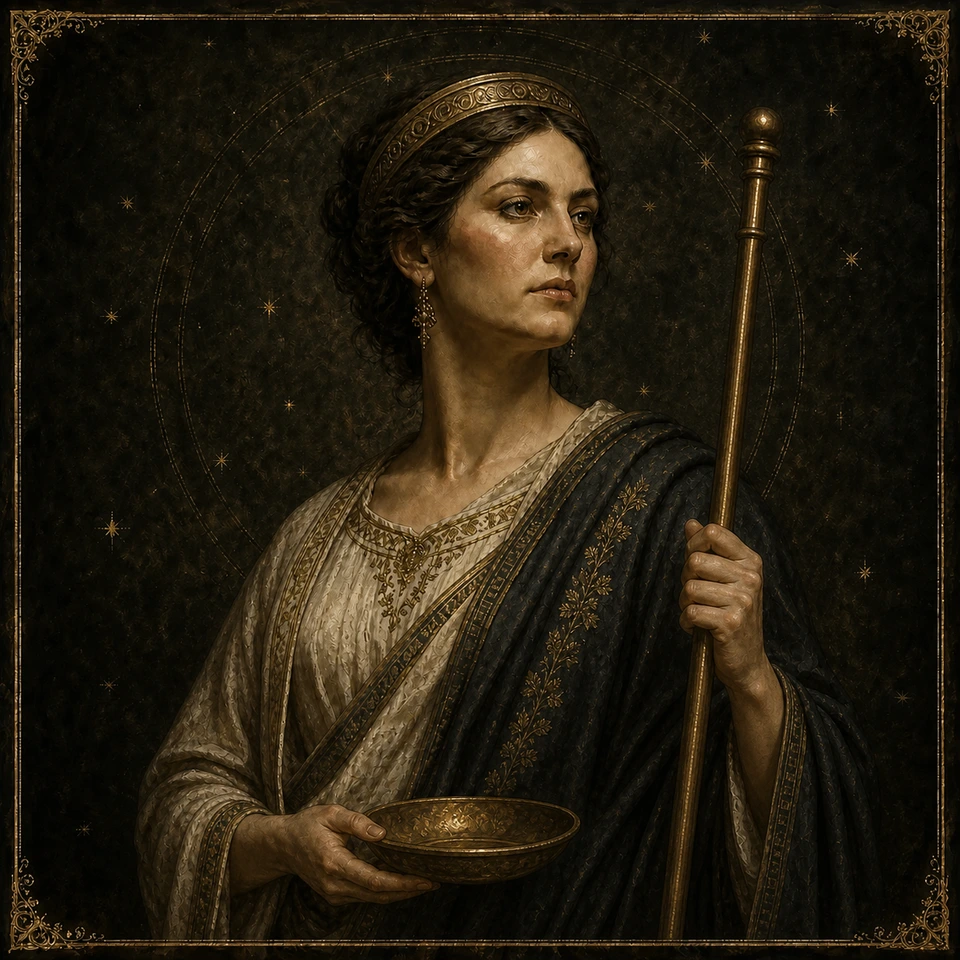
Enduring severe mythological trials, Leto stands as the revered mother of Apollo and Artemis following their famed Delian birth. Her presence radiates healing and protection in epic poetry, surviving in the archaeological record through named sanctuaries and fully draped ancient statues.
Overview
Leto enters the oldest surviving Greek poetry under pressure. She is in labor, moving from coast to island while rich lands recoil from the child she carries. The Homeric Hymn to Apollo makes the fear audible. No place wants to receive a son expected to rule fiercely among gods and mortals. Rocky Delos finally listens, but even the poor island demands a promise before opening itself to the birth. Leto swears that Apollo will establish his altar and honor the place. Refuge becomes covenant, and a barren shore becomes sacred through the risk it accepts.
The labor remains cruel. Hera keeps Eileithyia away while goddesses wait around Leto for nine days and nights. Iris slips out to fetch the childbirth goddess with a necklace as inducement. When Eileithyia reaches Delos, Leto grips the palm, kneels in the meadow, and gives birth. Themis feeds the newborn nectar and ambrosia. Apollo rises from his bindings and claims the lyre, the curved bow, and the work of declaring Zeus's purpose. Callimachus tells the birth differently. His Delos is the wandering Asteria, rivers and islands speak, Hera's resistance spreads across a Hellenistic landscape, and the island becomes fixed through the event. These are related poems, not pieces of one seamless chronology.
Leto does not vanish once her children are grown. In the opening of the hymn she stands beside Zeus, takes Apollo's bow and quiver from his shoulders, hangs them on a golden peg, and leads him to his seat. Later, gold-tressed Leto and Zeus delight in his music while Artemis dances among the immortals. The Iliad gives her quieter acts with real force. At sacred Pergamum she and Artemis heal the wounded Aeneas. After Hera beats Artemis in the battle of the gods, Hermes refuses to strike Leto, and Leto gathers her daughter's scattered bow and arrows from the dust. These scenes make her a healer, witness, and mother who restores what violence has thrown down.
Other myths sharpen the danger around her. Tityos assaults Leto on the road to Pytho. The Odyssey shows his endless punishment in the underworld; the Library says Apollo and Artemis kill him with arrows; Pausanias sees the sibling-defense scene worked into the throne at Amyclae. Niobe's boast against Leto brings a more terrible answer. Apollo and Artemis kill Niobe's children, but the Iliad, later mythography, and Ovid disagree over their number, survivors, speeches, and aftermath. Leto's honor stands at the cause of the violence without making grief or dead children ornamental.
Cult and material evidence prevent her from becoming only a literary mother. At Letoon in Lycia, an ancient federal sanctuary held three temples dedicated separately to Leto, Artemis, and Apollo. In mainland Greece, Pausanias describes a sanctuary of Leto at Argos, a divided temple at Mantineia with a sanctuary for Leto and her children, and images of the family in Sparta. Delos remained a great sacred center whose temples, altars, gifts, and visiting missions accumulated around the divine family. The places are connected, but Lycian federal religion, Delian pilgrimage, Argive sanctuary life, and Spartan public images cannot be folded into one rite.
Ancient artists give Leto a composed, fully clothed body. One Attic amphora shows long tresses, a fillet, and an embroidered chiton as she carries both infants. A later hydria dresses her in a patterned long chiton, mantle, and ornamented stephane; she bears a sceptre and pours a libation from an oinochoe. These are scene-bound attributes, not a timeless inventory. No ancient witness reviewed here makes the moon, wolf, swan, frog, crystal, color, weekday, or compass point her possession. Ovid's peasants become frogs in a Latin Latona story, but punished bodies do not become a sacred animal.
Leto is therefore best understood as an ancient Greek goddess whose identity joins Titan ancestry, divine maternity, refuge, endurance, healing, and cult at named sanctuaries. She is not a generic mother archetype and not automatically a first-generation Titaness. The Latin name Latona belongs to Roman reception and requires its own cultural boundary. What survives is precise and powerful: a vow on bare rock, a palm gripped in labor, children who answer insults with lethal force, a mother gathering arrows from battlefield dust, and temples that gave her presence durable stone.
Canonical identity
Canonical Identity
Leto is definitively recognized as a goddess, descending directly from the first-generation Titans Coeus and Phoebe. However, this descent does not automatically grant her a universal cosmic office or label her a first-generation Titaness herself. The Homeric Hymn and Hesiod firmly establish her maternity, her desperate search for refuge, her divine genealogy, and her esteemed presence among the immortals. Because her etymology remains uncertain, scholars cannot use it as definitive proof that she originated in a specific region or wielded a hidden universal function.
Linguistic Identity
The ancient Greek name is Λητώ, officially transliterated as Lētṓ. A qualified fifth-century BC Attic reconstruction estimates the sound as /lɛː.tɔ̌ ː/, approximated as leh-TOH. The record preserves regional dialectal variations of the identical name, including Aeolic Λᾱ́των and Doric Λᾱτώ or Λητόᾱ. The form Latona strictly belongs to Latin reception and must not replace the Greek form when discussing a purely Greek context.
Sources and evidence
TEXTUAL · Supported
The name Λητώ is transliterated Lētṓ, with a qualified fifth-century BC Attic reconstruction /lɛː.tɔ̌ː/ and several dialectal forms.
- Source
- Wiktionary contributors, Λητώ
- Reviewed edition
- Permanent revision 92068723, last edited 2026-08-19 · Wiktionary
- Exact locator
- Entry Λητώ · Section Ancient Greek alternative forms and pronunciation · RecordUrl https://en.wiktionary.org/w/index.php?title=%CE%9B%CE%B7%CF%84%CF%8E&oldid=92068723
- Scope
- Classical Greece · Attica
- Authority
- Collaborative Ancient Greek lexical and pronunciation reference
- Certainty
- Qualified
The guide leh-TOH is approximate and the etymology remains disputed.
Open exact reviewed sourceTEXTUAL · Supported
Hesiod says Phoebe joined Coeus and bore Leto and Asteria, preserving both parents and the sister relationship.
- Source
- Hesiod; edited and translated by Hugh G. Evelyn-White, Theogony (1914)
- Reviewed edition
- Hugh G. Evelyn-White edition and English translation in Hesiod, the Homeric Hymns and Homerica, 1914 · translated by Hugh G. Evelyn-White · edited by Hugh G. Evelyn-White · Perseus Digital Library / Scaife ATLAS
- Exact locator
- Entry Theogony · Line 404-410
- Scope
- Archaic Greece · Ancient Greece
- Authority
- Hesiod’s Theogony in the Evelyn-White edition
- Certainty
- Certain
The genealogy establishes descent from Titans without calling Leto a first-generation Titaness.
Open exact reviewed sourceTEXTUAL · Supported
Homeric Hymn 3 calls Leto queenly and gold-tressed, shows her handling Apollo's bow and quiver beside Zeus, and later has her rejoice at Apollo's music.
- Source
- Anonymous Homeric Hymns; edited and translated by Hugh G. Evelyn-White, Homeric Hymns (1914)
- Reviewed edition
- Hugh G. Evelyn-White English translation of Homeric Hymn 3 to Apollo, 1914 · translated by Hugh G. Evelyn-White · edited by Hugh G. Evelyn-White · Perseus Digital Library / Scaife ATLAS
- Exact locator
- Hymn Homeric Hymn 3 to Apollo · Line 1-18; 179-206
- Scope
- Archaic Greece · Ancient Greece
- Authority
- The Homeric Hymns in the Evelyn-White edition
- Certainty
- Certain
Poetic titles do not create royal office or ritual color assignments.
Open exact reviewed source3 reviewed sources for this section
- Wiktionary contributors, ΛητώPermanent revision 92068723, Ancient Greek pronunciation section · Wiktionary
- Hesiod; edited and translated by Hugh G. Evelyn-White, Theogony (1914)Hesiod, the Homeric Hymns and Homerica, London and New York, 1914 · Perseus Digital Library / Scaife ATLAS
- Anonymous Homeric Hymns; edited and translated by Hugh G. Evelyn-White, Homeric Hymns (1914)Hesiod, the Homeric Hymns and Homerica, London and New York, 1914 · Perseus Digital Library / Scaife ATLAS
Culture, tradition, period, and place
Leto belongs to ancient Greek religion and Greek-language poetry from the Archaic period through Hellenistic and Roman-imperial witnesses. The Iliad, Odyssey, Hesiod, and Homeric Hymn preserve her earliest surviving literary horizons. Callimachus reshapes the Delian birth in the third century BC, while Pausanias describes sanctuaries and images centuries later.
Her geography is plural. Delos holds the most famous birth and pilgrimage landscape. Pergamum in the Iliad is a place of healing. Argos, Sparta, Mantineia, Amyclae, and Delphi preserve mainland sanctuary or image contexts. Letoon belonged to the Lycian federal world in southwestern Anatolia, where Lycian, Greek, Roman, and later histories met. No broad label such as Greek pantheon can replace those local settings.
Sources and evidence
TEXTUAL · Supported
Hesiod says Phoebe joined Coeus and bore Leto and Asteria, preserving both parents and the sister relationship.
- Source
- Hesiod; edited and translated by Hugh G. Evelyn-White, Theogony (1914)
- Reviewed edition
- Hugh G. Evelyn-White edition and English translation in Hesiod, the Homeric Hymns and Homerica, 1914 · translated by Hugh G. Evelyn-White · edited by Hugh G. Evelyn-White · Perseus Digital Library / Scaife ATLAS
- Exact locator
- Entry Theogony · Line 404-410
- Scope
- Archaic Greece · Ancient Greece
- Authority
- Hesiod’s Theogony in the Evelyn-White edition
- Certainty
- Certain
The genealogy establishes descent from Titans without calling Leto a first-generation Titaness.
Open exact reviewed sourceTEXTUAL · Supported
Homeric Hymn 3 follows Leto's search for refuge, her sworn bargain with Delos, Hera's obstruction of Eileithyia, and Apollo's birth beside palm, hill, meadow, and Inopus.
- Source
- Anonymous Homeric Hymns; edited and translated by Hugh G. Evelyn-White, Homeric Hymns (1914)
- Reviewed edition
- Hugh G. Evelyn-White English translation of Homeric Hymn 3 to Apollo, 1914 · translated by Hugh G. Evelyn-White · edited by Hugh G. Evelyn-White · Perseus Digital Library / Scaife ATLAS
- Exact locator
- Hymn Homeric Hymn 3 to Apollo · Line 25-139
- Scope
- Archaic Greece · Delos
- Authority
- The Homeric Hymns in the Evelyn-White edition
- Certainty
- Certain
Apollo's promised temple and hecatombs remain his cult honor, not a personal offering list for Leto.
Open exact reviewed sourceTEXTUAL · Supported
Callimachus makes Delos the wandering Asteria, expands Hera's resistance through speaking landscapes and prophecy, and fixes the island through Apollo's birth.
- Source
- Callimachus; translated by A. W. Mair, Hymns (1921)
- Reviewed edition
- A. W. Mair English translation of Callimachus, Hymn 4, To Delos, Loeb Classical Library, 1921 · translated by A. W. Mair · Perseus Digital Library
- Exact locator
- Hymn Hymn 4 to Delos · Line 55-274
- Scope
- Hellenistic Greek world · Delos
- Authority
- Callimachus’s Hymns in the Mair edition
- Certainty
- Certain
The wandering-island sequence is not inserted into the Homeric Hymn's stationary-island bargain.
Open exact reviewed sourceTEXTUAL · Supported
In Iliad 5, Apollo carries wounded Aeneas to sacred Pergamum, where Leto and Artemis heal him and restore his splendor.
- Source
- Homer; Monro and Allen Greek edition with edition-specific translations, Iliad (1920)
- Reviewed edition
- A. T. Murray English translation, volumes I-II, 1924-1925 · translated by A. T. Murray · Perseus Digital Library / Scaife ATLAS
- Exact locator
- Book 5 · Line 445-453
- Scope
- Archaic Greece · Ancient Greece
- Authority
- Homer’s Iliad in the A. T. Murray edition
- Certainty
- Certain
A single epic healing action does not establish a universal medical cult.
Open exact reviewed sourceTEXTUAL · Supported
Pausanias describes a sanctuary of Leto at Argos with an image attributed to Praxiteles and a neighboring Chloris figure tied to the Niobe tradition.
- Source
- Pausanias; Spiro Greek edition and Jones/Ormerod translation volumes, Description of Greece (1935)
- Reviewed edition
- W. H. S. Jones and H. A. Ormerod English translation volumes, 1918-1935 · translated by W. H. S. Jones and H. A. Ormerod, volume-dependent · Perseus Digital Library / Scaife ATLAS
- Exact locator
- Book 2 · Chapter 21 · Section 8-9
- Scope
- Greek religion under Roman imperial rule · Ancient Greece
- Authority
- Pausanias’s Description of Greece in the Jones edition
- Certainty
- Certain
The Praxiteles attribution is reported by Pausanias and not independently reauthenticated here.
Open exact reviewed sourceTEXTUAL · Supported
Pausanias reports images of Leto with Apollo and Artemis in the Spartan market-place and a sanctuary of Leto and her children in a divided temple at Mantineia.
- Source
- Pausanias; Spiro Greek edition and Jones/Ormerod translation volumes, Description of Greece (1935)
- Reviewed edition
- W. H. S. Jones and H. A. Ormerod English translation volumes, 1918-1935 · translated by W. H. S. Jones and H. A. Ormerod, volume-dependent · Perseus Digital Library / Scaife ATLAS
- Exact locator
- Entry Description of Greece · Section 3.11.9; 8.9.1
- Scope
- Greek religion under Roman imperial rule · Ancient Greece
- Authority
- Pausanias’s Description of Greece in the Jones edition
- Certainty
- Certain
The two locations remain distinct and do not establish one family rite.
Open exact reviewed sourceARCHAEOLOGICAL · Supported
The Hellenic Ministry's Delos account describes the sanctuary landscape through temples, altars, gifts, festivals, buildings, and visiting sacred missions around Apollo and Artemis.
- Source
- Hellenic Ministry of Culture, Archaeological Site of Delos
- Reviewed edition
- Ephorate of Antiquities of Cyclades official site entry · Hellenic Ministry of Culture
- Exact locator
- Page The Archaeological Site and Museum of Delos · Entry Sanctuary, theoric missions, festivals, gifts, altars, and buildings
- Scope
- Ancient Greek diachrony · Delos
- Authority
- Hellenic Ministry archaeological account of Delos
- Certainty
- Certain
Leto's birth tradition gives her a place in the sacred landscape, while specific monuments remain individually attributed.
Open exact reviewed sourceARCHAEOLOGICAL · Supported
UNESCO identifies Letoon as the ancient federal sanctuary of Lycia and the Lycian League, with separate temples for Leto, Artemis, and Apollo and a trilingual inscription dated 337 BC.
- Source
- UNESCO World Heritage Centre, Xanthos-Letoon (1988)
- Reviewed edition
- World Heritage List entry 484, English site description · United Nations Educational, Scientific and Cultural Organization
- Exact locator
- Entry World Heritage property 484 · Section Outstanding Universal Value, Brief synthesis, Letoon federal sanctuary, temples, and trilingual inscription
- Scope
- Classical Greece · Lycia
- Authority
- UNESCO Xanthos-Letoon heritage synthesis
- Certainty
- Certain
The sanctuary is culturally Lycian and cannot be reduced to a mainland Greek replica.
Open exact reviewed source8 reviewed sources for this section
- Homer; Monro and Allen Greek edition with edition-specific translations, Iliad (1920)Perseus CTS edition corpus; Greek edition, Oxford, 1908-1920 · Perseus Digital Library / Scaife ATLAS
- Homer; translated by A. T. Murray, Odyssey (1919)A. T. Murray English translation, London: William Heinemann; New York: G. P. Putnam's Sons, 1919 · Perseus Digital Library / Scaife ATLAS
- Hesiod; edited and translated by Hugh G. Evelyn-White, Theogony (1914)Hesiod, the Homeric Hymns and Homerica, London and New York, 1914 · Perseus Digital Library / Scaife ATLAS
- Anonymous Homeric Hymns; edited and translated by Hugh G. Evelyn-White, Homeric Hymns (1914)Hesiod, the Homeric Hymns and Homerica, London and New York, 1914 · Perseus Digital Library / Scaife ATLAS
- Callimachus; translated by A. W. Mair, Hymns (1921)1921 Loeb edition hosted by the Perseus Digital Library · Perseus Digital Library
- Pausanias; Spiro Greek edition and Jones/Ormerod translation volumes, Description of Greece (1935)Perseus CTS edition corpus, 1903-1935 · Perseus Digital Library / Scaife ATLAS
- Hellenic Ministry of Culture, Archaeological Site of DelosEphorate of Antiquities of Cyclades official site record · Hellenic Ministry of Culture
- UNESCO World Heritage Centre, Xanthos-Letoon (1988)World Heritage List entry 484 · United Nations Educational, Scientific and Cultural Organization
Historical development
Archaic poetry already shows several Leto traditions at once. Hesiod anchors her in Titan genealogy and names Apollo and Artemis as her children by Zeus. The Iliad makes her a healer at Pergamum, an ally within the Trojan divine company, the mother behind the Niobe story, and a figure who retrieves Artemis's weapons. The Homeric Hymn gathers maternity, refuge, divine honor, Delian ritual imagination, and Olympian performance into one composition.
Hellenistic Callimachus enlarges the birth landscape. Delos becomes the wandering Asteria, Hera's resistance spreads through speaking rivers and islands, and Apollo's future is projected into the poem's own political world. Material and sanctuary evidence supplies another history. Attic artists gave Leto recognizable dress and ceremonial objects, while Letoon and the sanctuaries named by Pausanias show worship in several communities.
Latin Ovid later calls her Latona and develops Niobe's catastrophe and the transformation of Lycian peasants into frogs. Those poems belong to Roman literary reception. They cannot be pushed backward into Archaic cult or used to make frogs an ancient Greek sacred animal.
Sources and evidence
TEXTUAL · Supported
Hesiod says Phoebe joined Coeus and bore Leto and Asteria, preserving both parents and the sister relationship.
- Source
- Hesiod; edited and translated by Hugh G. Evelyn-White, Theogony (1914)
- Reviewed edition
- Hugh G. Evelyn-White edition and English translation in Hesiod, the Homeric Hymns and Homerica, 1914 · translated by Hugh G. Evelyn-White · edited by Hugh G. Evelyn-White · Perseus Digital Library / Scaife ATLAS
- Exact locator
- Entry Theogony · Line 404-410
- Scope
- Archaic Greece · Ancient Greece
- Authority
- Hesiod’s Theogony in the Evelyn-White edition
- Certainty
- Certain
The genealogy establishes descent from Titans without calling Leto a first-generation Titaness.
Open exact reviewed sourceTEXTUAL · Supported
Hesiod says Leto joined Zeus in love and bore Apollo and Artemis, naming both children in one parental statement.
- Source
- Hesiod; edited and translated by Hugh G. Evelyn-White, Theogony (1914)
- Reviewed edition
- Hugh G. Evelyn-White edition and English translation in Hesiod, the Homeric Hymns and Homerica, 1914 · translated by Hugh G. Evelyn-White · edited by Hugh G. Evelyn-White · Perseus Digital Library / Scaife ATLAS
- Exact locator
- Entry Theogony · Line 918-920
- Scope
- Archaic Greece · Ancient Greece
- Authority
- Hesiod’s Theogony in the Evelyn-White edition
- Certainty
- Certain
The wording supports divine partnership and parentage, not a universal claim that Leto held Hera's marital status.
Open exact reviewed sourceTEXTUAL · Supported
Homeric Hymn 3 follows Leto's search for refuge, her sworn bargain with Delos, Hera's obstruction of Eileithyia, and Apollo's birth beside palm, hill, meadow, and Inopus.
- Source
- Anonymous Homeric Hymns; edited and translated by Hugh G. Evelyn-White, Homeric Hymns (1914)
- Reviewed edition
- Hugh G. Evelyn-White English translation of Homeric Hymn 3 to Apollo, 1914 · translated by Hugh G. Evelyn-White · edited by Hugh G. Evelyn-White · Perseus Digital Library / Scaife ATLAS
- Exact locator
- Hymn Homeric Hymn 3 to Apollo · Line 25-139
- Scope
- Archaic Greece · Delos
- Authority
- The Homeric Hymns in the Evelyn-White edition
- Certainty
- Certain
Apollo's promised temple and hecatombs remain his cult honor, not a personal offering list for Leto.
Open exact reviewed sourceTEXTUAL · Supported
Homeric Hymn 3 calls Leto queenly and gold-tressed, shows her handling Apollo's bow and quiver beside Zeus, and later has her rejoice at Apollo's music.
- Source
- Anonymous Homeric Hymns; edited and translated by Hugh G. Evelyn-White, Homeric Hymns (1914)
- Reviewed edition
- Hugh G. Evelyn-White English translation of Homeric Hymn 3 to Apollo, 1914 · translated by Hugh G. Evelyn-White · edited by Hugh G. Evelyn-White · Perseus Digital Library / Scaife ATLAS
- Exact locator
- Hymn Homeric Hymn 3 to Apollo · Line 1-18; 179-206
- Scope
- Archaic Greece · Ancient Greece
- Authority
- The Homeric Hymns in the Evelyn-White edition
- Certainty
- Certain
Poetic titles do not create royal office or ritual color assignments.
Open exact reviewed sourceTEXTUAL · Supported
Callimachus makes Delos the wandering Asteria, expands Hera's resistance through speaking landscapes and prophecy, and fixes the island through Apollo's birth.
- Source
- Callimachus; translated by A. W. Mair, Hymns (1921)
- Reviewed edition
- A. W. Mair English translation of Callimachus, Hymn 4, To Delos, Loeb Classical Library, 1921 · translated by A. W. Mair · Perseus Digital Library
- Exact locator
- Hymn Hymn 4 to Delos · Line 55-274
- Scope
- Hellenistic Greek world · Delos
- Authority
- Callimachus’s Hymns in the Mair edition
- Certainty
- Certain
The wandering-island sequence is not inserted into the Homeric Hymn's stationary-island bargain.
Open exact reviewed sourceTEXTUAL · Supported
In Iliad 5, Apollo carries wounded Aeneas to sacred Pergamum, where Leto and Artemis heal him and restore his splendor.
- Source
- Homer; Monro and Allen Greek edition with edition-specific translations, Iliad (1920)
- Reviewed edition
- A. T. Murray English translation, volumes I-II, 1924-1925 · translated by A. T. Murray · Perseus Digital Library / Scaife ATLAS
- Exact locator
- Book 5 · Line 445-453
- Scope
- Archaic Greece · Ancient Greece
- Authority
- Homer’s Iliad in the A. T. Murray edition
- Certainty
- Certain
A single epic healing action does not establish a universal medical cult.
Open exact reviewed sourceTEXTUAL · Supported
In Iliad 21, Hermes refuses to fight Leto, and she gathers Artemis's curved bow and scattered arrows after Hera has struck her daughter.
- Source
- Homer; Monro and Allen Greek edition with edition-specific translations, Iliad (1920)
- Reviewed edition
- A. T. Murray English translation, volumes I-II, 1924-1925 · translated by A. T. Murray · Perseus Digital Library / Scaife ATLAS
- Exact locator
- Book 21 · Line 497-504
- Scope
- Archaic Greece · Ancient Greece
- Authority
- Homer’s Iliad in the A. T. Murray edition
- Certainty
- Certain
Hermes' refusal and Leto's retrieval are brief actions within the Theomachy.
Open exact reviewed sourceTEXTUAL · Supported
Pausanias describes a sanctuary of Leto at Argos with an image attributed to Praxiteles and a neighboring Chloris figure tied to the Niobe tradition.
- Source
- Pausanias; Spiro Greek edition and Jones/Ormerod translation volumes, Description of Greece (1935)
- Reviewed edition
- W. H. S. Jones and H. A. Ormerod English translation volumes, 1918-1935 · translated by W. H. S. Jones and H. A. Ormerod, volume-dependent · Perseus Digital Library / Scaife ATLAS
- Exact locator
- Book 2 · Chapter 21 · Section 8-9
- Scope
- Greek religion under Roman imperial rule · Ancient Greece
- Authority
- Pausanias’s Description of Greece in the Jones edition
- Certainty
- Certain
The Praxiteles attribution is reported by Pausanias and not independently reauthenticated here.
Open exact reviewed sourceARCHAEOLOGICAL · Supported
UNESCO identifies Letoon as the ancient federal sanctuary of Lycia and the Lycian League, with separate temples for Leto, Artemis, and Apollo and a trilingual inscription dated 337 BC.
- Source
- UNESCO World Heritage Centre, Xanthos-Letoon (1988)
- Reviewed edition
- World Heritage List entry 484, English site description · United Nations Educational, Scientific and Cultural Organization
- Exact locator
- Entry World Heritage property 484 · Section Outstanding Universal Value, Brief synthesis, Letoon federal sanctuary, temples, and trilingual inscription
- Scope
- Classical Greece · Lycia
- Authority
- UNESCO Xanthos-Letoon heritage synthesis
- Certainty
- Certain
The sanctuary is culturally Lycian and cannot be reduced to a mainland Greek replica.
Open exact reviewed sourceMATERIAL CULTURE · Supported
British Museum 1836,0224.42, an Attic black-figure amphora around 520 BC, identifies Leto with long tresses, fillet, embroidered chiton, diploidion, and the infant Apollo and Artemis.
- Source
- British Museum, British Museum Collection
- Reviewed edition
- Live record-level official museum collection · British Museum
- Exact locator
- MuseumObjectId 1836,0224.42 · Entry object description and production date
- Scope
- Archaic Greece · Attica
- Authority
- British Museum accession catalogue
- Certainty
- Certain
The canonical portrait does not copy the vessel scene or include the infants.
Open exact reviewed sourceMATERIAL CULTURE · Supported
British Museum 1843,1103.20, an Attic red-figure hydria dated 470 to 460 BC, identifies Leto in patterned chiton, mantle, and stephane with upright sceptre and oinochoe libation.
- Source
- British Museum, British Museum Collection
- Reviewed edition
- Live record-level official museum collection · British Museum
- Exact locator
- MuseumObjectId 1843,1103.20 · Entry object description and production date
- Scope
- Classical Greece · Attica
- Authority
- British Museum accession catalogue
- Certainty
- Certain
The objects are scene-bound attributes rather than a universal ritual kit.
Open exact reviewed sourceTEXTUAL · Supported
Ovid's Latin Metamorphoses expands Latona's Niobe story and then tells how Lycian villagers who deny her water are transformed into frogs.
- Source
- Ovid; Hugo Magnus Latin edition and Brookes More translation, Metamorphoses (1922)
- Reviewed edition
- Brookes More English blank-verse translation of Ovid, Metamorphoses, 1922 · translated by Brookes More · Perseus Digital Library / Scaife ATLAS
- Exact locator
- Book 6 · Line 146-381
- Scope
- Augustan Roman literature · Lycia
- Authority
- Ovid's Metamorphoses in the Brookes More 1922 English translation
- Certainty
- Certain
Roman Latona reception is not backdated into Greek cult, and transformed villagers are not a sacred animal.
Open exact reviewed source8 reviewed sources for this section
- Hesiod; edited and translated by Hugh G. Evelyn-White, Theogony (1914)Hesiod, the Homeric Hymns and Homerica, London and New York, 1914 · Perseus Digital Library / Scaife ATLAS
- Homer; Monro and Allen Greek edition with edition-specific translations, Iliad (1920)Perseus CTS edition corpus; Greek edition, Oxford, 1908-1920 · Perseus Digital Library / Scaife ATLAS
- Anonymous Homeric Hymns; edited and translated by Hugh G. Evelyn-White, Homeric Hymns (1914)Hesiod, the Homeric Hymns and Homerica, London and New York, 1914 · Perseus Digital Library / Scaife ATLAS
- Callimachus; translated by A. W. Mair, Hymns (1921)1921 Loeb edition hosted by the Perseus Digital Library · Perseus Digital Library
- Pausanias; Spiro Greek edition and Jones/Ormerod translation volumes, Description of Greece (1935)Perseus CTS edition corpus, 1903-1935 · Perseus Digital Library / Scaife ATLAS
- UNESCO World Heritage Centre, Xanthos-Letoon (1988)World Heritage List entry 484 · United Nations Educational, Scientific and Cultural Organization
- British Museum, British Museum CollectionLive official museum collection · British Museum
- Ovid; Hugo Magnus Latin edition and Brookes More translation, Metamorphoses (1922)Perseus / Scaife edition corpus, 1892-1922 components · Perseus Digital Library / Scaife ATLAS
Attested roles and historical themes
Roles, powers, and limits
Leto's strongest roles emerge through action. She endures wandering and labor, negotiates a refuge with Delos, gives birth to Apollo and Artemis, heals Aeneas with Artemis, intercedes for Apollo in later mythography, and gathers her daughter's weapons after divine violence. In hymn she manages Apollo's bow and quiver in Zeus's house and rejoices in his music. These are active forms of maternity, restoration, mediation, and divine dignity.
Her power has boundaries. She does not command every childbirth, every island, or every act of motherhood. Eileithyia remains a distinct childbirth goddess whose delayed arrival matters in the Delian birth. Artemis and Apollo carry out the punishments of Tityos and Niobe's family. Leto's connection to healing at Pergamum does not make her a universal medical goddess. Titan ancestry does not create dominion over night, hidden wisdom, stars, or the moon.
Sources and evidence
TEXTUAL · Supported
Homeric Hymn 3 follows Leto's search for refuge, her sworn bargain with Delos, Hera's obstruction of Eileithyia, and Apollo's birth beside palm, hill, meadow, and Inopus.
- Source
- Anonymous Homeric Hymns; edited and translated by Hugh G. Evelyn-White, Homeric Hymns (1914)
- Reviewed edition
- Hugh G. Evelyn-White English translation of Homeric Hymn 3 to Apollo, 1914 · translated by Hugh G. Evelyn-White · edited by Hugh G. Evelyn-White · Perseus Digital Library / Scaife ATLAS
- Exact locator
- Hymn Homeric Hymn 3 to Apollo · Line 25-139
- Scope
- Archaic Greece · Delos
- Authority
- The Homeric Hymns in the Evelyn-White edition
- Certainty
- Certain
Apollo's promised temple and hecatombs remain his cult honor, not a personal offering list for Leto.
Open exact reviewed sourceTEXTUAL · Supported
Homeric Hymn 3 calls Leto queenly and gold-tressed, shows her handling Apollo's bow and quiver beside Zeus, and later has her rejoice at Apollo's music.
- Source
- Anonymous Homeric Hymns; edited and translated by Hugh G. Evelyn-White, Homeric Hymns (1914)
- Reviewed edition
- Hugh G. Evelyn-White English translation of Homeric Hymn 3 to Apollo, 1914 · translated by Hugh G. Evelyn-White · edited by Hugh G. Evelyn-White · Perseus Digital Library / Scaife ATLAS
- Exact locator
- Hymn Homeric Hymn 3 to Apollo · Line 1-18; 179-206
- Scope
- Archaic Greece · Ancient Greece
- Authority
- The Homeric Hymns in the Evelyn-White edition
- Certainty
- Certain
Poetic titles do not create royal office or ritual color assignments.
Open exact reviewed sourceTEXTUAL · Supported
In Iliad 5, Apollo carries wounded Aeneas to sacred Pergamum, where Leto and Artemis heal him and restore his splendor.
- Source
- Homer; Monro and Allen Greek edition with edition-specific translations, Iliad (1920)
- Reviewed edition
- A. T. Murray English translation, volumes I-II, 1924-1925 · translated by A. T. Murray · Perseus Digital Library / Scaife ATLAS
- Exact locator
- Book 5 · Line 445-453
- Scope
- Archaic Greece · Ancient Greece
- Authority
- Homer’s Iliad in the A. T. Murray edition
- Certainty
- Certain
A single epic healing action does not establish a universal medical cult.
Open exact reviewed sourceTEXTUAL · Supported
In Iliad 21, Hermes refuses to fight Leto, and she gathers Artemis's curved bow and scattered arrows after Hera has struck her daughter.
- Source
- Homer; Monro and Allen Greek edition with edition-specific translations, Iliad (1920)
- Reviewed edition
- A. T. Murray English translation, volumes I-II, 1924-1925 · translated by A. T. Murray · Perseus Digital Library / Scaife ATLAS
- Exact locator
- Book 21 · Line 497-504
- Scope
- Archaic Greece · Ancient Greece
- Authority
- Homer’s Iliad in the A. T. Murray edition
- Certainty
- Certain
Hermes' refusal and Leto's retrieval are brief actions within the Theomachy.
Open exact reviewed sourceTEXTUAL · Supported
Pseudo-Apollodorus says Leto interceded when Zeus meant to cast Apollo into Tartarus after the killing of the Cyclopes.
- Source
- Pseudo-Apollodorus; edited and translated by James G. Frazer, Library (1921)
- Reviewed edition
- James G. Frazer edition and English translation, Harvard University Press and William Heinemann, 1921 · translated by James G. Frazer · edited by James G. Frazer · Perseus Digital Library / Scaife ATLAS
- Exact locator
- Book 3 · Chapter 10 · Section 4
- Scope
- Greek religion under Roman imperial rule · Ancient Greece
- Authority
- Pseudo-Apollodorus’s Library in the Frazer edition
- Certainty
- Certain
The intervention belongs to this witness and is absent from Euripides' prologue. Frazer's English translation uses Latona; this Greek profile normalizes the narrative figure to Leto without erasing the Latin-name boundary.
Open exact reviewed sourceTEXTUAL · Supported
Pseudo-Apollodorus says Tityos seized Leto after being overcome by lust and that Apollo and Artemis shot him in defense of their mother.
- Source
- Pseudo-Apollodorus; edited and translated by James G. Frazer, Library (1921)
- Reviewed edition
- James G. Frazer edition and English translation, Harvard University Press and William Heinemann, 1921 · translated by James G. Frazer · edited by James G. Frazer · Perseus Digital Library / Scaife ATLAS
- Exact locator
- Book 1 · Chapter 4 · Section 1
- Scope
- Greek religion under Roman imperial rule · Ancient Greece
- Authority
- Pseudo-Apollodorus’s Library in the Frazer edition
- Certainty
- Certain
No instigator is named in this exact passage. Frazer's English translation uses Latona; this Greek profile normalizes the narrative figure to Leto without erasing the Latin-name boundary.
Open exact reviewed sourceTEXTUAL · Supported
Hesiod says Leto joined Zeus in love and bore Apollo and Artemis, naming both children in one parental statement.
- Source
- Hesiod; edited and translated by Hugh G. Evelyn-White, Theogony (1914)
- Reviewed edition
- Hugh G. Evelyn-White edition and English translation in Hesiod, the Homeric Hymns and Homerica, 1914 · translated by Hugh G. Evelyn-White · edited by Hugh G. Evelyn-White · Perseus Digital Library / Scaife ATLAS
- Exact locator
- Entry Theogony · Line 918-920
- Scope
- Archaic Greece · Ancient Greece
- Authority
- Hesiod’s Theogony in the Evelyn-White edition
- Certainty
- Certain
The wording supports divine partnership and parentage, not a universal claim that Leto held Hera's marital status.
Open exact reviewed source4 reviewed sources for this section
- Anonymous Homeric Hymns; edited and translated by Hugh G. Evelyn-White, Homeric Hymns (1914)Hesiod, the Homeric Hymns and Homerica, London and New York, 1914 · Perseus Digital Library / Scaife ATLAS
- Homer; Monro and Allen Greek edition with edition-specific translations, Iliad (1920)Perseus CTS edition corpus; Greek edition, Oxford, 1908-1920 · Perseus Digital Library / Scaife ATLAS
- Pseudo-Apollodorus; edited and translated by James G. Frazer, Library (1921)Harvard University Press and William Heinemann edition, 1921 · Perseus Digital Library / Scaife ATLAS
- Hesiod; edited and translated by Hugh G. Evelyn-White, Theogony (1914)Hesiod, the Homeric Hymns and Homerica, London and New York, 1914 · Perseus Digital Library / Scaife ATLAS
Epithets and titles
Poetic Epithet
Queenly Leto
Queenly Leto
Delian and Olympian hymn settings · Archaic Greek hymnic witnessThe address belongs to the hymn's poetic voice and does not by itself establish a royal office or cult title.
1 reviewed source for this section
- Anonymous Homeric Hymns; edited and translated by Hugh G. Evelyn-White, Homeric Hymns (1914)Hesiod, the Homeric Hymns and Homerica, London and New York, 1914 · Perseus Digital Library / Scaife ATLAS
Poetic Epithet
Gold-tressed Leto
Gold-tressed Leto
Olympian performance in the Homeric Hymn to Apollo · Archaic Greek hymnic witnessThe phrase describes Leto within a particular performance scene and does not establish a ritual color.
1 reviewed source for this section
- Anonymous Homeric Hymns; edited and translated by Hugh G. Evelyn-White, Homeric Hymns (1914)Hesiod, the Homeric Hymns and Homerica, London and New York, 1914 · Perseus Digital Library / Scaife ATLAS
Worship and cult
Leto received worship in built sanctuaries, not only in poetry. UNESCO identifies Letoon as the ancient federal sanctuary of Lycia and the Lycian League of Cities. Three temples there were dedicated separately to Leto, Artemis, and Apollo, and inscriptions made the sanctuary a place where religious and political decisions were declared. The setting gives Leto an institutional presence within Lycian public life.
Pausanias supplies mainland evidence. Argos had a sanctuary of Leto with an image attributed to Praxiteles. Mantineia possessed a sanctuary of Leto and her children in one half of a divided temple, with images also attributed to Praxiteles. Sparta displayed Leto beside Artemis and Apollo in the market-place. These witnesses establish worship and public representation, but they do not yield one universal priesthood, liturgy, or calendar.
Sources and evidence
ARCHAEOLOGICAL · Supported
UNESCO identifies Letoon as the ancient federal sanctuary of Lycia and the Lycian League, with separate temples for Leto, Artemis, and Apollo and a trilingual inscription dated 337 BC.
- Source
- UNESCO World Heritage Centre, Xanthos-Letoon (1988)
- Reviewed edition
- World Heritage List entry 484, English site description · United Nations Educational, Scientific and Cultural Organization
- Exact locator
- Entry World Heritage property 484 · Section Outstanding Universal Value, Brief synthesis, Letoon federal sanctuary, temples, and trilingual inscription
- Scope
- Classical Greece · Lycia
- Authority
- UNESCO Xanthos-Letoon heritage synthesis
- Certainty
- Certain
The sanctuary is culturally Lycian and cannot be reduced to a mainland Greek replica.
Open exact reviewed sourceTEXTUAL · Supported
Pausanias describes a sanctuary of Leto at Argos with an image attributed to Praxiteles and a neighboring Chloris figure tied to the Niobe tradition.
- Source
- Pausanias; Spiro Greek edition and Jones/Ormerod translation volumes, Description of Greece (1935)
- Reviewed edition
- W. H. S. Jones and H. A. Ormerod English translation volumes, 1918-1935 · translated by W. H. S. Jones and H. A. Ormerod, volume-dependent · Perseus Digital Library / Scaife ATLAS
- Exact locator
- Book 2 · Chapter 21 · Section 8-9
- Scope
- Greek religion under Roman imperial rule · Ancient Greece
- Authority
- Pausanias’s Description of Greece in the Jones edition
- Certainty
- Certain
The Praxiteles attribution is reported by Pausanias and not independently reauthenticated here.
Open exact reviewed sourceTEXTUAL · Supported
Pausanias reports images of Leto with Apollo and Artemis in the Spartan market-place and a sanctuary of Leto and her children in a divided temple at Mantineia.
- Source
- Pausanias; Spiro Greek edition and Jones/Ormerod translation volumes, Description of Greece (1935)
- Reviewed edition
- W. H. S. Jones and H. A. Ormerod English translation volumes, 1918-1935 · translated by W. H. S. Jones and H. A. Ormerod, volume-dependent · Perseus Digital Library / Scaife ATLAS
- Exact locator
- Entry Description of Greece · Section 3.11.9; 8.9.1
- Scope
- Greek religion under Roman imperial rule · Ancient Greece
- Authority
- Pausanias’s Description of Greece in the Jones edition
- Certainty
- Certain
The two locations remain distinct and do not establish one family rite.
Open exact reviewed source2 reviewed sources for this section
- UNESCO World Heritage Centre, Xanthos-Letoon (1988)World Heritage List entry 484 · United Nations Educational, Scientific and Cultural Organization
- Pausanias; Spiro Greek edition and Jones/Ormerod translation volumes, Description of Greece (1935)Perseus CTS edition corpus, 1903-1935 · Perseus Digital Library / Scaife ATLAS
Temples, sanctuaries, and sacred places
Delos and Letoon are the two clearest large sacred landscapes. The hymn makes Delos the island that accepts Leto's labor in return for Apollo's promised honor. The official archaeological account describes the later sanctuary through temples, altars, gifts, buildings, and visiting sacred missions. Letoon was a Lycian federal sanctuary with separate temples for Leto and her children, a trilingual inscription of 337 BC, and a sacred water source later monumentalized by a nymphaeum.
Mainland sites preserve smaller but no less exact evidence. Argos had Leto's own sanctuary. Mantineia held a family sanctuary inside a divided temple. Sparta placed her image in the market-place beside those of her children. Amyclae and Delphi displayed myths in which she or her children acted. Pergamum belongs to epic sacred geography, where she heals Aeneas within Apollo's sanctuary, not to proof of a separately excavated Leto cult there.
Sources and evidence
TEXTUAL · Supported
Homeric Hymn 3 follows Leto's search for refuge, her sworn bargain with Delos, Hera's obstruction of Eileithyia, and Apollo's birth beside palm, hill, meadow, and Inopus.
- Source
- Anonymous Homeric Hymns; edited and translated by Hugh G. Evelyn-White, Homeric Hymns (1914)
- Reviewed edition
- Hugh G. Evelyn-White English translation of Homeric Hymn 3 to Apollo, 1914 · translated by Hugh G. Evelyn-White · edited by Hugh G. Evelyn-White · Perseus Digital Library / Scaife ATLAS
- Exact locator
- Hymn Homeric Hymn 3 to Apollo · Line 25-139
- Scope
- Archaic Greece · Delos
- Authority
- The Homeric Hymns in the Evelyn-White edition
- Certainty
- Certain
Apollo's promised temple and hecatombs remain his cult honor, not a personal offering list for Leto.
Open exact reviewed sourceTEXTUAL · Supported
In Iliad 5, Apollo carries wounded Aeneas to sacred Pergamum, where Leto and Artemis heal him and restore his splendor.
- Source
- Homer; Monro and Allen Greek edition with edition-specific translations, Iliad (1920)
- Reviewed edition
- A. T. Murray English translation, volumes I-II, 1924-1925 · translated by A. T. Murray · Perseus Digital Library / Scaife ATLAS
- Exact locator
- Book 5 · Line 445-453
- Scope
- Archaic Greece · Ancient Greece
- Authority
- Homer’s Iliad in the A. T. Murray edition
- Certainty
- Certain
A single epic healing action does not establish a universal medical cult.
Open exact reviewed sourceTEXTUAL · Supported
Pausanias describes a sanctuary of Leto at Argos with an image attributed to Praxiteles and a neighboring Chloris figure tied to the Niobe tradition.
- Source
- Pausanias; Spiro Greek edition and Jones/Ormerod translation volumes, Description of Greece (1935)
- Reviewed edition
- W. H. S. Jones and H. A. Ormerod English translation volumes, 1918-1935 · translated by W. H. S. Jones and H. A. Ormerod, volume-dependent · Perseus Digital Library / Scaife ATLAS
- Exact locator
- Book 2 · Chapter 21 · Section 8-9
- Scope
- Greek religion under Roman imperial rule · Ancient Greece
- Authority
- Pausanias’s Description of Greece in the Jones edition
- Certainty
- Certain
The Praxiteles attribution is reported by Pausanias and not independently reauthenticated here.
Open exact reviewed sourceTEXTUAL · Supported
Pausanias reports images of Leto with Apollo and Artemis in the Spartan market-place and a sanctuary of Leto and her children in a divided temple at Mantineia.
- Source
- Pausanias; Spiro Greek edition and Jones/Ormerod translation volumes, Description of Greece (1935)
- Reviewed edition
- W. H. S. Jones and H. A. Ormerod English translation volumes, 1918-1935 · translated by W. H. S. Jones and H. A. Ormerod, volume-dependent · Perseus Digital Library / Scaife ATLAS
- Exact locator
- Entry Description of Greece · Section 3.11.9; 8.9.1
- Scope
- Greek religion under Roman imperial rule · Ancient Greece
- Authority
- Pausanias’s Description of Greece in the Jones edition
- Certainty
- Certain
The two locations remain distinct and do not establish one family rite.
Open exact reviewed sourceMATERIAL CULTURE · Supported
Pausanias describes Apollo and Artemis shooting Tityos on the throne at Amyclae and Leto with Artemis restraining Apollo in a Delphic dedication of the tripod struggle.
- Source
- Pausanias; Spiro Greek edition and Jones/Ormerod translation volumes, Description of Greece (1935)
- Reviewed edition
- W. H. S. Jones and H. A. Ormerod English translation volumes, 1918-1935 · translated by W. H. S. Jones and H. A. Ormerod, volume-dependent · Perseus Digital Library / Scaife ATLAS
- Exact locator
- Entry Description of Greece · Section 3.18.15; 10.13.7
- Scope
- Greek religion under Roman imperial rule · Ancient Greece
- Authority
- Pausanias’s Description of Greece in the Jones edition
- Certainty
- Certain
Each scene is material testimony and does not supply every event found in prose.
Open exact reviewed sourceARCHAEOLOGICAL · Supported
The Hellenic Ministry's Delos account describes the sanctuary landscape through temples, altars, gifts, festivals, buildings, and visiting sacred missions around Apollo and Artemis.
- Source
- Hellenic Ministry of Culture, Archaeological Site of Delos
- Reviewed edition
- Ephorate of Antiquities of Cyclades official site entry · Hellenic Ministry of Culture
- Exact locator
- Page The Archaeological Site and Museum of Delos · Entry Sanctuary, theoric missions, festivals, gifts, altars, and buildings
- Scope
- Ancient Greek diachrony · Delos
- Authority
- Hellenic Ministry archaeological account of Delos
- Certainty
- Certain
Leto's birth tradition gives her a place in the sacred landscape, while specific monuments remain individually attributed.
Open exact reviewed sourceARCHAEOLOGICAL · Supported
UNESCO identifies Letoon as the ancient federal sanctuary of Lycia and the Lycian League, with separate temples for Leto, Artemis, and Apollo and a trilingual inscription dated 337 BC.
- Source
- UNESCO World Heritage Centre, Xanthos-Letoon (1988)
- Reviewed edition
- World Heritage List entry 484, English site description · United Nations Educational, Scientific and Cultural Organization
- Exact locator
- Entry World Heritage property 484 · Section Outstanding Universal Value, Brief synthesis, Letoon federal sanctuary, temples, and trilingual inscription
- Scope
- Classical Greece · Lycia
- Authority
- UNESCO Xanthos-Letoon heritage synthesis
- Certainty
- Certain
The sanctuary is culturally Lycian and cannot be reduced to a mainland Greek replica.
Open exact reviewed source5 reviewed sources for this section
- Anonymous Homeric Hymns; edited and translated by Hugh G. Evelyn-White, Homeric Hymns (1914)Hesiod, the Homeric Hymns and Homerica, London and New York, 1914 · Perseus Digital Library / Scaife ATLAS
- Homer; Monro and Allen Greek edition with edition-specific translations, Iliad (1920)Perseus CTS edition corpus; Greek edition, Oxford, 1908-1920 · Perseus Digital Library / Scaife ATLAS
- Pausanias; Spiro Greek edition and Jones/Ormerod translation volumes, Description of Greece (1935)Perseus CTS edition corpus, 1903-1935 · Perseus Digital Library / Scaife ATLAS
- Hellenic Ministry of Culture, Archaeological Site of DelosEphorate of Antiquities of Cyclades official site record · Hellenic Ministry of Culture
- UNESCO World Heritage Centre, Xanthos-Letoon (1988)World Heritage List entry 484 · United Nations Educational, Scientific and Cultural Organization
Festivals and processions
The Homeric Hymn places Leto within Delos's festival soundscape. Ionians gather with wives and children, contests unfold in boxing, dancing, and song, and the Delian maidens sing Apollo, Artemis, and Leto. Her name therefore belongs to a public performance setting on the island. The official archaeological account also preserves Delos as a destination for visiting sacred missions, gifts, festivals, altars, and buildings.
Neither witness establishes an independently named festival devoted only to Leto. The hymn celebrates Apollo's island and the divine family within it. Pausanias's sanctuaries at Argos and Mantineia do not supply a surviving date or procession. No weekday, moon phase, or fixed modern calendar date should be attached to her from this evidence.
Sources and evidence
TEXTUAL · Supported
Homeric Hymn 3 places Leto within Delian festival song, where Ionians gather and the Delian maidens hymn Apollo, Artemis, and Leto.
- Source
- Anonymous Homeric Hymns; edited and translated by Hugh G. Evelyn-White, Homeric Hymns (1914)
- Reviewed edition
- Hugh G. Evelyn-White English translation of Homeric Hymn 3 to Apollo, 1914 · translated by Hugh G. Evelyn-White · edited by Hugh G. Evelyn-White · Perseus Digital Library / Scaife ATLAS
- Exact locator
- Hymn Homeric Hymn 3 to Apollo · Line 146-178
- Scope
- Archaic Greece · Delos
- Authority
- The Homeric Hymns in the Evelyn-White edition
- Certainty
- Certain
The passage does not name an independently dated festival devoted solely to Leto.
Open exact reviewed sourceARCHAEOLOGICAL · Supported
The Hellenic Ministry's Delos account describes the sanctuary landscape through temples, altars, gifts, festivals, buildings, and visiting sacred missions around Apollo and Artemis.
- Source
- Hellenic Ministry of Culture, Archaeological Site of Delos
- Reviewed edition
- Ephorate of Antiquities of Cyclades official site entry · Hellenic Ministry of Culture
- Exact locator
- Page The Archaeological Site and Museum of Delos · Entry Sanctuary, theoric missions, festivals, gifts, altars, and buildings
- Scope
- Ancient Greek diachrony · Delos
- Authority
- Hellenic Ministry archaeological account of Delos
- Certainty
- Certain
Leto's birth tradition gives her a place in the sacred landscape, while specific monuments remain individually attributed.
Open exact reviewed sourceTEXTUAL · Supported
Pausanias describes a sanctuary of Leto at Argos with an image attributed to Praxiteles and a neighboring Chloris figure tied to the Niobe tradition.
- Source
- Pausanias; Spiro Greek edition and Jones/Ormerod translation volumes, Description of Greece (1935)
- Reviewed edition
- W. H. S. Jones and H. A. Ormerod English translation volumes, 1918-1935 · translated by W. H. S. Jones and H. A. Ormerod, volume-dependent · Perseus Digital Library / Scaife ATLAS
- Exact locator
- Book 2 · Chapter 21 · Section 8-9
- Scope
- Greek religion under Roman imperial rule · Ancient Greece
- Authority
- Pausanias’s Description of Greece in the Jones edition
- Certainty
- Certain
The Praxiteles attribution is reported by Pausanias and not independently reauthenticated here.
Open exact reviewed sourceTEXTUAL · Supported
Pausanias reports images of Leto with Apollo and Artemis in the Spartan market-place and a sanctuary of Leto and her children in a divided temple at Mantineia.
- Source
- Pausanias; Spiro Greek edition and Jones/Ormerod translation volumes, Description of Greece (1935)
- Reviewed edition
- W. H. S. Jones and H. A. Ormerod English translation volumes, 1918-1935 · translated by W. H. S. Jones and H. A. Ormerod, volume-dependent · Perseus Digital Library / Scaife ATLAS
- Exact locator
- Entry Description of Greece · Section 3.11.9; 8.9.1
- Scope
- Greek religion under Roman imperial rule · Ancient Greece
- Authority
- Pausanias’s Description of Greece in the Jones edition
- Certainty
- Certain
The two locations remain distinct and do not establish one family rite.
Open exact reviewed source3 reviewed sources for this section
- Anonymous Homeric Hymns; edited and translated by Hugh G. Evelyn-White, Homeric Hymns (1914)Hesiod, the Homeric Hymns and Homerica, London and New York, 1914 · Perseus Digital Library / Scaife ATLAS
- Hellenic Ministry of Culture, Archaeological Site of DelosEphorate of Antiquities of Cyclades official site record · Hellenic Ministry of Culture
- Pausanias; Spiro Greek edition and Jones/Ormerod translation volumes, Description of Greece (1935)Perseus CTS edition corpus, 1903-1935 · Perseus Digital Library / Scaife ATLAS
Offerings, votives, and ritual evidence
The strongest ritual evidence is architectural and inscriptional. At Letoon, temples and public inscriptions placed Leto inside a federal sanctuary. At Delos, sacred missions carried gifts into a landscape of altars and buildings. Pausanias's sanctuaries and images show durable local investment in divine presence. These remains prove approach, dedication, and public memory even when a particular food or drink is not named for Leto.
The Homeric Hymn promises hecatombs and rising sacrificial savor to Apollo as part of Leto's bargain with Delos. That promise cannot be reassigned as Leto's personal offering rule. A red-figure hydria shows Leto pouring from an oinochoe, but a represented libation is not a general instruction about what every worshipper gave her. No incense, grain, wine, milk, honey, cake, flower, or animal victim exclusive to her is established here.
Sources and evidence
TEXTUAL · Supported
Homeric Hymn 3 follows Leto's search for refuge, her sworn bargain with Delos, Hera's obstruction of Eileithyia, and Apollo's birth beside palm, hill, meadow, and Inopus.
- Source
- Anonymous Homeric Hymns; edited and translated by Hugh G. Evelyn-White, Homeric Hymns (1914)
- Reviewed edition
- Hugh G. Evelyn-White English translation of Homeric Hymn 3 to Apollo, 1914 · translated by Hugh G. Evelyn-White · edited by Hugh G. Evelyn-White · Perseus Digital Library / Scaife ATLAS
- Exact locator
- Hymn Homeric Hymn 3 to Apollo · Line 25-139
- Scope
- Archaic Greece · Delos
- Authority
- The Homeric Hymns in the Evelyn-White edition
- Certainty
- Certain
Apollo's promised temple and hecatombs remain his cult honor, not a personal offering list for Leto.
Open exact reviewed sourceTEXTUAL · Supported
Pausanias describes a sanctuary of Leto at Argos with an image attributed to Praxiteles and a neighboring Chloris figure tied to the Niobe tradition.
- Source
- Pausanias; Spiro Greek edition and Jones/Ormerod translation volumes, Description of Greece (1935)
- Reviewed edition
- W. H. S. Jones and H. A. Ormerod English translation volumes, 1918-1935 · translated by W. H. S. Jones and H. A. Ormerod, volume-dependent · Perseus Digital Library / Scaife ATLAS
- Exact locator
- Book 2 · Chapter 21 · Section 8-9
- Scope
- Greek religion under Roman imperial rule · Ancient Greece
- Authority
- Pausanias’s Description of Greece in the Jones edition
- Certainty
- Certain
The Praxiteles attribution is reported by Pausanias and not independently reauthenticated here.
Open exact reviewed sourceARCHAEOLOGICAL · Supported
The Hellenic Ministry's Delos account describes the sanctuary landscape through temples, altars, gifts, festivals, buildings, and visiting sacred missions around Apollo and Artemis.
- Source
- Hellenic Ministry of Culture, Archaeological Site of Delos
- Reviewed edition
- Ephorate of Antiquities of Cyclades official site entry · Hellenic Ministry of Culture
- Exact locator
- Page The Archaeological Site and Museum of Delos · Entry Sanctuary, theoric missions, festivals, gifts, altars, and buildings
- Scope
- Ancient Greek diachrony · Delos
- Authority
- Hellenic Ministry archaeological account of Delos
- Certainty
- Certain
Leto's birth tradition gives her a place in the sacred landscape, while specific monuments remain individually attributed.
Open exact reviewed sourceARCHAEOLOGICAL · Supported
UNESCO identifies Letoon as the ancient federal sanctuary of Lycia and the Lycian League, with separate temples for Leto, Artemis, and Apollo and a trilingual inscription dated 337 BC.
- Source
- UNESCO World Heritage Centre, Xanthos-Letoon (1988)
- Reviewed edition
- World Heritage List entry 484, English site description · United Nations Educational, Scientific and Cultural Organization
- Exact locator
- Entry World Heritage property 484 · Section Outstanding Universal Value, Brief synthesis, Letoon federal sanctuary, temples, and trilingual inscription
- Scope
- Classical Greece · Lycia
- Authority
- UNESCO Xanthos-Letoon heritage synthesis
- Certainty
- Certain
The sanctuary is culturally Lycian and cannot be reduced to a mainland Greek replica.
Open exact reviewed sourceMATERIAL CULTURE · Supported
British Museum 1843,1103.20, an Attic red-figure hydria dated 470 to 460 BC, identifies Leto in patterned chiton, mantle, and stephane with upright sceptre and oinochoe libation.
- Source
- British Museum, British Museum Collection
- Reviewed edition
- Live record-level official museum collection · British Museum
- Exact locator
- MuseumObjectId 1843,1103.20 · Entry object description and production date
- Scope
- Classical Greece · Attica
- Authority
- British Museum accession catalogue
- Certainty
- Certain
The objects are scene-bound attributes rather than a universal ritual kit.
Open exact reviewed source5 reviewed sources for this section
- Anonymous Homeric Hymns; edited and translated by Hugh G. Evelyn-White, Homeric Hymns (1914)Hesiod, the Homeric Hymns and Homerica, London and New York, 1914 · Perseus Digital Library / Scaife ATLAS
- Pausanias; Spiro Greek edition and Jones/Ormerod translation volumes, Description of Greece (1935)Perseus CTS edition corpus, 1903-1935 · Perseus Digital Library / Scaife ATLAS
- Hellenic Ministry of Culture, Archaeological Site of DelosEphorate of Antiquities of Cyclades official site record · Hellenic Ministry of Culture
- UNESCO World Heritage Centre, Xanthos-Letoon (1988)World Heritage List entry 484 · United Nations Educational, Scientific and Cultural Organization
- British Museum, British Museum CollectionLive official museum collection · British Museum
Iconography and material culture
Two British Museum vessels securely identify Leto. An Attic black-figure amphora around 520 BC shows her with long tresses, a fillet, and a long embroidered chiton with diploidion while carrying the infant Apollo and Artemis. An Attic red-figure hydria dated 470 to 460 BC shows a patterned long chiton, mantle, ornamented stephane, upright sceptre, and a libation poured from an oinochoe.
The attributes remain tied to their scenes. Infants make maternity visible on the amphora. Sceptre, vessel, stephane, and full drapery establish ceremonial dignity on the hydria. Pausanias adds family sculpture at Mantineia, the sibling defense against Tityos at Amyclae, and Leto restraining Apollo at Delphi. Together, the vessels and sculptures show how Greek artists made Leto’s maternity and ceremonial dignity visible without giving her one fixed attribute.
Sources and evidence
MATERIAL CULTURE · Supported
British Museum 1836,0224.42, an Attic black-figure amphora around 520 BC, identifies Leto with long tresses, fillet, embroidered chiton, diploidion, and the infant Apollo and Artemis.
- Source
- British Museum, British Museum Collection
- Reviewed edition
- Live record-level official museum collection · British Museum
- Exact locator
- MuseumObjectId 1836,0224.42 · Entry object description and production date
- Scope
- Archaic Greece · Attica
- Authority
- British Museum accession catalogue
- Certainty
- Certain
The canonical portrait does not copy the vessel scene or include the infants.
Open exact reviewed sourceMATERIAL CULTURE · Supported
British Museum 1843,1103.20, an Attic red-figure hydria dated 470 to 460 BC, identifies Leto in patterned chiton, mantle, and stephane with upright sceptre and oinochoe libation.
- Source
- British Museum, British Museum Collection
- Reviewed edition
- Live record-level official museum collection · British Museum
- Exact locator
- MuseumObjectId 1843,1103.20 · Entry object description and production date
- Scope
- Classical Greece · Attica
- Authority
- British Museum accession catalogue
- Certainty
- Certain
The objects are scene-bound attributes rather than a universal ritual kit.
Open exact reviewed sourceTEXTUAL · Supported
Pausanias reports images of Leto with Apollo and Artemis in the Spartan market-place and a sanctuary of Leto and her children in a divided temple at Mantineia.
- Source
- Pausanias; Spiro Greek edition and Jones/Ormerod translation volumes, Description of Greece (1935)
- Reviewed edition
- W. H. S. Jones and H. A. Ormerod English translation volumes, 1918-1935 · translated by W. H. S. Jones and H. A. Ormerod, volume-dependent · Perseus Digital Library / Scaife ATLAS
- Exact locator
- Entry Description of Greece · Section 3.11.9; 8.9.1
- Scope
- Greek religion under Roman imperial rule · Ancient Greece
- Authority
- Pausanias’s Description of Greece in the Jones edition
- Certainty
- Certain
The two locations remain distinct and do not establish one family rite.
Open exact reviewed sourceMATERIAL CULTURE · Supported
Pausanias describes Apollo and Artemis shooting Tityos on the throne at Amyclae and Leto with Artemis restraining Apollo in a Delphic dedication of the tripod struggle.
- Source
- Pausanias; Spiro Greek edition and Jones/Ormerod translation volumes, Description of Greece (1935)
- Reviewed edition
- W. H. S. Jones and H. A. Ormerod English translation volumes, 1918-1935 · translated by W. H. S. Jones and H. A. Ormerod, volume-dependent · Perseus Digital Library / Scaife ATLAS
- Exact locator
- Entry Description of Greece · Section 3.18.15; 10.13.7
- Scope
- Greek religion under Roman imperial rule · Ancient Greece
- Authority
- Pausanias’s Description of Greece in the Jones edition
- Certainty
- Certain
Each scene is material testimony and does not supply every event found in prose.
Open exact reviewed source2 reviewed sources for this section
- British Museum, British Museum CollectionLive official museum collection · British Museum
- Pausanias; Spiro Greek edition and Jones/Ormerod translation volumes, Description of Greece (1935)Perseus CTS edition corpus, 1903-1935 · Perseus Digital Library / Scaife ATLAS
Animals, plants, and embodied forms
No sacred animal is established for Leto. Ovid's Latin story turns inhospitable Lycian peasants into frogs after they muddy water and refuse Latona a drink. The transformation marks punishment within one Roman poem. It does not make the frog a Greek cult companion, emblem, offering, or divine body. Wolves and swans likewise lack support in the sources reviewed here.
The palm at Delos is real within the birth poem. Leto grips it as she kneels in labor beside Mount Cynthus and the Inopus. The tree carries the body's strain and fixes the scene in a landscape, but the passage does not call every palm sacred to Leto. Her clearest embodied form is human and matronly: fully draped, long-haired, crowned with a stephane or fillet, sometimes bearing children, sceptre, or libation vessel according to the scene.
Sources and evidence
TEXTUAL · Supported
Homeric Hymn 3 follows Leto's search for refuge, her sworn bargain with Delos, Hera's obstruction of Eileithyia, and Apollo's birth beside palm, hill, meadow, and Inopus.
- Source
- Anonymous Homeric Hymns; edited and translated by Hugh G. Evelyn-White, Homeric Hymns (1914)
- Reviewed edition
- Hugh G. Evelyn-White English translation of Homeric Hymn 3 to Apollo, 1914 · translated by Hugh G. Evelyn-White · edited by Hugh G. Evelyn-White · Perseus Digital Library / Scaife ATLAS
- Exact locator
- Hymn Homeric Hymn 3 to Apollo · Line 25-139
- Scope
- Archaic Greece · Delos
- Authority
- The Homeric Hymns in the Evelyn-White edition
- Certainty
- Certain
Apollo's promised temple and hecatombs remain his cult honor, not a personal offering list for Leto.
Open exact reviewed sourceMATERIAL CULTURE · Supported
British Museum 1836,0224.42, an Attic black-figure amphora around 520 BC, identifies Leto with long tresses, fillet, embroidered chiton, diploidion, and the infant Apollo and Artemis.
- Source
- British Museum, British Museum Collection
- Reviewed edition
- Live record-level official museum collection · British Museum
- Exact locator
- MuseumObjectId 1836,0224.42 · Entry object description and production date
- Scope
- Archaic Greece · Attica
- Authority
- British Museum accession catalogue
- Certainty
- Certain
The canonical portrait does not copy the vessel scene or include the infants.
Open exact reviewed sourceMATERIAL CULTURE · Supported
British Museum 1843,1103.20, an Attic red-figure hydria dated 470 to 460 BC, identifies Leto in patterned chiton, mantle, and stephane with upright sceptre and oinochoe libation.
- Source
- British Museum, British Museum Collection
- Reviewed edition
- Live record-level official museum collection · British Museum
- Exact locator
- MuseumObjectId 1843,1103.20 · Entry object description and production date
- Scope
- Classical Greece · Attica
- Authority
- British Museum accession catalogue
- Certainty
- Certain
The objects are scene-bound attributes rather than a universal ritual kit.
Open exact reviewed sourceTEXTUAL · Supported
Ovid's Latin Metamorphoses expands Latona's Niobe story and then tells how Lycian villagers who deny her water are transformed into frogs.
- Source
- Ovid; Hugo Magnus Latin edition and Brookes More translation, Metamorphoses (1922)
- Reviewed edition
- Brookes More English blank-verse translation of Ovid, Metamorphoses, 1922 · translated by Brookes More · Perseus Digital Library / Scaife ATLAS
- Exact locator
- Book 6 · Line 146-381
- Scope
- Augustan Roman literature · Lycia
- Authority
- Ovid's Metamorphoses in the Brookes More 1922 English translation
- Certainty
- Certain
Roman Latona reception is not backdated into Greek cult, and transformed villagers are not a sacred animal.
Open exact reviewed source3 reviewed sources for this section
- Anonymous Homeric Hymns; edited and translated by Hugh G. Evelyn-White, Homeric Hymns (1914)Hesiod, the Homeric Hymns and Homerica, London and New York, 1914 · Perseus Digital Library / Scaife ATLAS
- British Museum, British Museum CollectionLive official museum collection · British Museum
- Ovid; Hugo Magnus Latin edition and Brookes More translation, Metamorphoses (1922)Perseus / Scaife edition corpus, 1892-1922 components · Perseus Digital Library / Scaife ATLAS
Relationships and genealogy
Hesiod makes Leto a daughter of Coeus and Phoebe and sister of Asteria. Pseudo-Apollodorus preserves the same four names in compressed genealogy. The Homeric Hymn confirms the paternal line when Delos addresses her as the glorious daughter of great Coeus. Phoebe's place must remain equally visible even though the hymn does not name her in that address.
Zeus and Leto are parents of Apollo and Artemis in Hesiod. The hymn presents Leto beside Zeus as their grown son enters the divine house, but it does not turn Hera's later hostility into proof of a marriage rank for Leto. Apollo and Artemis are linked to her as children, healers, defenders, and sources of devastating vengeance. Asteria remains a securely named sister, but her own surviving traditions require dedicated treatment before that kinship is carried beyond this passage.
Sources and evidence
TEXTUAL · Supported
Hesiod says Phoebe joined Coeus and bore Leto and Asteria, preserving both parents and the sister relationship.
- Source
- Hesiod; edited and translated by Hugh G. Evelyn-White, Theogony (1914)
- Reviewed edition
- Hugh G. Evelyn-White edition and English translation in Hesiod, the Homeric Hymns and Homerica, 1914 · translated by Hugh G. Evelyn-White · edited by Hugh G. Evelyn-White · Perseus Digital Library / Scaife ATLAS
- Exact locator
- Entry Theogony · Line 404-410
- Scope
- Archaic Greece · Ancient Greece
- Authority
- Hesiod’s Theogony in the Evelyn-White edition
- Certainty
- Certain
The genealogy establishes descent from Titans without calling Leto a first-generation Titaness.
Open exact reviewed sourceTEXTUAL · Supported
Hesiod says Leto joined Zeus in love and bore Apollo and Artemis, naming both children in one parental statement.
- Source
- Hesiod; edited and translated by Hugh G. Evelyn-White, Theogony (1914)
- Reviewed edition
- Hugh G. Evelyn-White edition and English translation in Hesiod, the Homeric Hymns and Homerica, 1914 · translated by Hugh G. Evelyn-White · edited by Hugh G. Evelyn-White · Perseus Digital Library / Scaife ATLAS
- Exact locator
- Entry Theogony · Line 918-920
- Scope
- Archaic Greece · Ancient Greece
- Authority
- Hesiod’s Theogony in the Evelyn-White edition
- Certainty
- Certain
The wording supports divine partnership and parentage, not a universal claim that Leto held Hera's marital status.
Open exact reviewed sourceTEXTUAL · Supported
Homeric Hymn 3 calls Leto queenly and gold-tressed, shows her handling Apollo's bow and quiver beside Zeus, and later has her rejoice at Apollo's music.
- Source
- Anonymous Homeric Hymns; edited and translated by Hugh G. Evelyn-White, Homeric Hymns (1914)
- Reviewed edition
- Hugh G. Evelyn-White English translation of Homeric Hymn 3 to Apollo, 1914 · translated by Hugh G. Evelyn-White · edited by Hugh G. Evelyn-White · Perseus Digital Library / Scaife ATLAS
- Exact locator
- Hymn Homeric Hymn 3 to Apollo · Line 1-18; 179-206
- Scope
- Archaic Greece · Ancient Greece
- Authority
- The Homeric Hymns in the Evelyn-White edition
- Certainty
- Certain
Poetic titles do not create royal office or ritual color assignments.
Open exact reviewed sourceTEXTUAL · Supported
Pseudo-Apollodorus names Coeus and Phoebe as parents of Asteria and Leto in a compressed genealogy.
- Source
- Pseudo-Apollodorus; edited and translated by James G. Frazer, Library (1921)
- Reviewed edition
- James G. Frazer edition and English translation, Harvard University Press and William Heinemann, 1921 · translated by James G. Frazer · edited by James G. Frazer · Perseus Digital Library / Scaife ATLAS
- Exact locator
- Book 1 · Chapter 2 · Section 2
- Scope
- Greek religion under Roman imperial rule · Ancient Greece
- Authority
- Pseudo-Apollodorus’s Library in the Frazer edition
- Certainty
- Certain
The later mythographer preserves the same four-person family without Hesiod's narrative texture. Frazer's English translation uses Latona; this Greek profile normalizes the narrative figure to Leto without erasing the Latin-name boundary.
Open exact reviewed source3 reviewed sources for this section
- Hesiod; edited and translated by Hugh G. Evelyn-White, Theogony (1914)Hesiod, the Homeric Hymns and Homerica, London and New York, 1914 · Perseus Digital Library / Scaife ATLAS
- Anonymous Homeric Hymns; edited and translated by Hugh G. Evelyn-White, Homeric Hymns (1914)Hesiod, the Homeric Hymns and Homerica, London and New York, 1914 · Perseus Digital Library / Scaife ATLAS
- Pseudo-Apollodorus; edited and translated by James G. Frazer, Library (1921)Harvard University Press and William Heinemann edition, 1921 · Perseus Digital Library / Scaife ATLAS
Actual myths and source variants
Leto's principal story is the Delian birth. The Homeric Hymn follows her search for refuge, Delos's fear, the sworn promise of Apollo's temple, Hera's obstruction of Eileithyia, nine days of labor, and the birth beside palm and meadow. Callimachus keeps the danger but transforms the island into wandering Asteria and fills the route with speaking landscapes and prophecy. The two tellings remain separately readable.
Tityos brings violence directly against Leto. The Odyssey shows the offender stretched in the underworld beneath two vultures. Pseudo-Apollodorus narrates the assault and has Apollo and Artemis shoot him. Pausanias describes that defensive version on the throne at Amyclae. Niobe's story reverses the direction of danger: a mortal mother's insult against Leto is answered by the deaths of her children. Epic, mythography, and Latin poetry disagree over numbers, survivors, and aftermath.
Leto also acts inside other cycles. She rejoices during Apollo's divine performance. She intercedes when Zeus threatens Apollo after the Cyclopes are killed, but only in Pseudo-Apollodorus; Euripides tells the retaliation and mortal service without her. In Pausanias's Delphic dedication, Leto and Artemis restrain Apollo as Athena restrains Heracles during the struggle for the tripod. Her genealogy with Coeus, Phoebe, and Asteria forms another shared narrative with its own witnesses.
The Iliad's healing of Aeneas and retrieval of Artemis's weapons remain short source-bound actions rather than duplicate stories. Ovid's frogs remain Roman Latona reception until that Latin identity can be represented separately. Herodotus's Hyperborean account leaves the gods accompanying Arge and Opis unnamed, so Leto is not inserted into that Delian tradition by conjecture.
Sources and evidence
TEXTUAL · Supported
Homeric Hymn 3 follows Leto's search for refuge, her sworn bargain with Delos, Hera's obstruction of Eileithyia, and Apollo's birth beside palm, hill, meadow, and Inopus.
- Source
- Anonymous Homeric Hymns; edited and translated by Hugh G. Evelyn-White, Homeric Hymns (1914)
- Reviewed edition
- Hugh G. Evelyn-White English translation of Homeric Hymn 3 to Apollo, 1914 · translated by Hugh G. Evelyn-White · edited by Hugh G. Evelyn-White · Perseus Digital Library / Scaife ATLAS
- Exact locator
- Hymn Homeric Hymn 3 to Apollo · Line 25-139
- Scope
- Archaic Greece · Delos
- Authority
- The Homeric Hymns in the Evelyn-White edition
- Certainty
- Certain
Apollo's promised temple and hecatombs remain his cult honor, not a personal offering list for Leto.
Open exact reviewed sourceTEXTUAL · Supported
Homeric Hymn 3 calls Leto queenly and gold-tressed, shows her handling Apollo's bow and quiver beside Zeus, and later has her rejoice at Apollo's music.
- Source
- Anonymous Homeric Hymns; edited and translated by Hugh G. Evelyn-White, Homeric Hymns (1914)
- Reviewed edition
- Hugh G. Evelyn-White English translation of Homeric Hymn 3 to Apollo, 1914 · translated by Hugh G. Evelyn-White · edited by Hugh G. Evelyn-White · Perseus Digital Library / Scaife ATLAS
- Exact locator
- Hymn Homeric Hymn 3 to Apollo · Line 1-18; 179-206
- Scope
- Archaic Greece · Ancient Greece
- Authority
- The Homeric Hymns in the Evelyn-White edition
- Certainty
- Certain
Poetic titles do not create royal office or ritual color assignments.
Open exact reviewed sourceTEXTUAL · Supported
Callimachus makes Delos the wandering Asteria, expands Hera's resistance through speaking landscapes and prophecy, and fixes the island through Apollo's birth.
- Source
- Callimachus; translated by A. W. Mair, Hymns (1921)
- Reviewed edition
- A. W. Mair English translation of Callimachus, Hymn 4, To Delos, Loeb Classical Library, 1921 · translated by A. W. Mair · Perseus Digital Library
- Exact locator
- Hymn Hymn 4 to Delos · Line 55-274
- Scope
- Hellenistic Greek world · Delos
- Authority
- Callimachus’s Hymns in the Mair edition
- Certainty
- Certain
The wandering-island sequence is not inserted into the Homeric Hymn's stationary-island bargain.
Open exact reviewed sourceTEXTUAL · Supported
In Iliad 5, Apollo carries wounded Aeneas to sacred Pergamum, where Leto and Artemis heal him and restore his splendor.
- Source
- Homer; Monro and Allen Greek edition with edition-specific translations, Iliad (1920)
- Reviewed edition
- A. T. Murray English translation, volumes I-II, 1924-1925 · translated by A. T. Murray · Perseus Digital Library / Scaife ATLAS
- Exact locator
- Book 5 · Line 445-453
- Scope
- Archaic Greece · Ancient Greece
- Authority
- Homer’s Iliad in the A. T. Murray edition
- Certainty
- Certain
A single epic healing action does not establish a universal medical cult.
Open exact reviewed sourceTEXTUAL · Supported
In Iliad 21, Hermes refuses to fight Leto, and she gathers Artemis's curved bow and scattered arrows after Hera has struck her daughter.
- Source
- Homer; Monro and Allen Greek edition with edition-specific translations, Iliad (1920)
- Reviewed edition
- A. T. Murray English translation, volumes I-II, 1924-1925 · translated by A. T. Murray · Perseus Digital Library / Scaife ATLAS
- Exact locator
- Book 21 · Line 497-504
- Scope
- Archaic Greece · Ancient Greece
- Authority
- Homer’s Iliad in the A. T. Murray edition
- Certainty
- Certain
Hermes' refusal and Leto's retrieval are brief actions within the Theomachy.
Open exact reviewed sourceTEXTUAL · Supported
Iliad 24 recalls Apollo and Artemis killing Niobe's children after she compared herself with Leto, followed by delayed burial and enduring grief at Sipylus.
- Source
- Homer; Monro and Allen Greek edition with edition-specific translations, Iliad (1920)
- Reviewed edition
- A. T. Murray English translation, volumes I-II, 1924-1925 · translated by A. T. Murray · Perseus Digital Library / Scaife ATLAS
- Exact locator
- Book 24 · Line 602-617
- Scope
- Archaic Greece · Ancient Greece
- Authority
- Homer’s Iliad in the A. T. Murray edition
- Certainty
- Certain
The epic count and aftermath remain distinct from later mythography and Ovid.
Open exact reviewed sourceTEXTUAL · Supported
Odyssey 11 shows Tityos stretched in the underworld while vultures tear his liver because he assaulted Leto on her way to Pytho.
- Source
- Homer; translated by A. T. Murray, Odyssey (1919)
- Reviewed edition
- A. T. Murray English translation, London: William Heinemann; New York: G. P. Putnam's Sons, 1919 · translated by A. T. Murray · Perseus Digital Library / Scaife ATLAS
- Exact locator
- Book 11 · Line 576-581
- Scope
- Archaic Greece · Ancient Greece
- Authority
- Homer’s Odyssey in the A. T. Murray edition
- Certainty
- Certain
The passage does not name Apollo and Artemis as Tityos's killers.
Open exact reviewed sourceTEXTUAL · Supported
Pseudo-Apollodorus says Leto interceded when Zeus meant to cast Apollo into Tartarus after the killing of the Cyclopes.
- Source
- Pseudo-Apollodorus; edited and translated by James G. Frazer, Library (1921)
- Reviewed edition
- James G. Frazer edition and English translation, Harvard University Press and William Heinemann, 1921 · translated by James G. Frazer · edited by James G. Frazer · Perseus Digital Library / Scaife ATLAS
- Exact locator
- Book 3 · Chapter 10 · Section 4
- Scope
- Greek religion under Roman imperial rule · Ancient Greece
- Authority
- Pseudo-Apollodorus’s Library in the Frazer edition
- Certainty
- Certain
The intervention belongs to this witness and is absent from Euripides' prologue. Frazer's English translation uses Latona; this Greek profile normalizes the narrative figure to Leto without erasing the Latin-name boundary.
Open exact reviewed sourceTEXTUAL · Supported
Pseudo-Apollodorus says Tityos seized Leto after being overcome by lust and that Apollo and Artemis shot him in defense of their mother.
- Source
- Pseudo-Apollodorus; edited and translated by James G. Frazer, Library (1921)
- Reviewed edition
- James G. Frazer edition and English translation, Harvard University Press and William Heinemann, 1921 · translated by James G. Frazer · edited by James G. Frazer · Perseus Digital Library / Scaife ATLAS
- Exact locator
- Book 1 · Chapter 4 · Section 1
- Scope
- Greek religion under Roman imperial rule · Ancient Greece
- Authority
- Pseudo-Apollodorus’s Library in the Frazer edition
- Certainty
- Certain
No instigator is named in this exact passage. Frazer's English translation uses Latona; this Greek profile normalizes the narrative figure to Leto without erasing the Latin-name boundary.
Open exact reviewed sourceTEXTUAL · Supported
Euripides' Alcestis prologue recounts Apollo's retaliation against the Cyclopes and service to Admetus without assigning Leto an intercession.
- Source
- Euripides; translated by David Kovacs, Alcestis (1994)
- Reviewed edition
- David Kovacs English translation · translated by David Kovacs · edited by David Kovacs · Perseus Digital Library
- Exact locator
- Entry Alcestis · Line 1-27
- Scope
- Classical Greece · Ancient Greece
- Authority
- Euripides’s Alcestis in the Kovacs edition
- Certainty
- Certain
The reviewed absence prevents the later Library detail from being backfilled into Euripides.
Open exact reviewed sourceMATERIAL CULTURE · Supported
Pausanias describes Apollo and Artemis shooting Tityos on the throne at Amyclae and Leto with Artemis restraining Apollo in a Delphic dedication of the tripod struggle.
- Source
- Pausanias; Spiro Greek edition and Jones/Ormerod translation volumes, Description of Greece (1935)
- Reviewed edition
- W. H. S. Jones and H. A. Ormerod English translation volumes, 1918-1935 · translated by W. H. S. Jones and H. A. Ormerod, volume-dependent · Perseus Digital Library / Scaife ATLAS
- Exact locator
- Entry Description of Greece · Section 3.18.15; 10.13.7
- Scope
- Greek religion under Roman imperial rule · Ancient Greece
- Authority
- Pausanias’s Description of Greece in the Jones edition
- Certainty
- Certain
Each scene is material testimony and does not supply every event found in prose.
Open exact reviewed sourceTEXTUAL · Supported
Hesiod says Phoebe joined Coeus and bore Leto and Asteria, preserving both parents and the sister relationship.
- Source
- Hesiod; edited and translated by Hugh G. Evelyn-White, Theogony (1914)
- Reviewed edition
- Hugh G. Evelyn-White edition and English translation in Hesiod, the Homeric Hymns and Homerica, 1914 · translated by Hugh G. Evelyn-White · edited by Hugh G. Evelyn-White · Perseus Digital Library / Scaife ATLAS
- Exact locator
- Entry Theogony · Line 404-410
- Scope
- Archaic Greece · Ancient Greece
- Authority
- Hesiod’s Theogony in the Evelyn-White edition
- Certainty
- Certain
The genealogy establishes descent from Titans without calling Leto a first-generation Titaness.
Open exact reviewed sourceTEXTUAL · Supported
Ovid's Latin Metamorphoses expands Latona's Niobe story and then tells how Lycian villagers who deny her water are transformed into frogs.
- Source
- Ovid; Hugo Magnus Latin edition and Brookes More translation, Metamorphoses (1922)
- Reviewed edition
- Brookes More English blank-verse translation of Ovid, Metamorphoses, 1922 · translated by Brookes More · Perseus Digital Library / Scaife ATLAS
- Exact locator
- Book 6 · Line 146-381
- Scope
- Augustan Roman literature · Lycia
- Authority
- Ovid's Metamorphoses in the Brookes More 1922 English translation
- Certainty
- Certain
Roman Latona reception is not backdated into Greek cult, and transformed villagers are not a sacred animal.
Open exact reviewed sourceTEXTUAL · Supported
Herodotus reports that Arge and Opis came to Delos with the gods themselves, but he does not name Leto among those gods.
- Source
- Herodotus; translated by A. D. Godley, The Histories (1925)
- Reviewed edition
- A. D. Godley English translation, Loeb Classical Library volumes I-IV, 1920-1925 · translated by A. D. Godley · edited by A. D. Godley · Perseus Digital Library / Scaife ATLAS
- Exact locator
- Entry Histories · Book 4 · Section 35
- Scope
- Classical Greece · Delos
- Authority
- Herodotus’s Histories in the Godley edition
- Certainty
- Secure as a bounded absence in Herodotus’s attributed report
The silence is confined to Herodotus 4.35 and does not disprove other local traditions.
Open exact reviewed source10 reviewed sources for this section
- Anonymous Homeric Hymns; edited and translated by Hugh G. Evelyn-White, Homeric Hymns (1914)Hesiod, the Homeric Hymns and Homerica, London and New York, 1914 · Perseus Digital Library / Scaife ATLAS
- Callimachus; translated by A. W. Mair, Hymns (1921)1921 Loeb edition hosted by the Perseus Digital Library · Perseus Digital Library
- Homer; Monro and Allen Greek edition with edition-specific translations, Iliad (1920)Perseus CTS edition corpus; Greek edition, Oxford, 1908-1920 · Perseus Digital Library / Scaife ATLAS
- Homer; translated by A. T. Murray, Odyssey (1919)A. T. Murray English translation, London: William Heinemann; New York: G. P. Putnam's Sons, 1919 · Perseus Digital Library / Scaife ATLAS
- Pseudo-Apollodorus; edited and translated by James G. Frazer, Library (1921)Harvard University Press and William Heinemann edition, 1921 · Perseus Digital Library / Scaife ATLAS
- Pausanias; Spiro Greek edition and Jones/Ormerod translation volumes, Description of Greece (1935)Perseus CTS edition corpus, 1903-1935 · Perseus Digital Library / Scaife ATLAS
- Euripides; translated by David Kovacs, Alcestis (1994)1994 translation hosted by the Perseus Digital Library · Perseus Digital Library
- Ovid; Hugo Magnus Latin edition and Brookes More translation, Metamorphoses (1922)Perseus / Scaife edition corpus, 1892-1922 components · Perseus Digital Library / Scaife ATLAS
- Hesiod; edited and translated by Hugh G. Evelyn-White, Theogony (1914)Hesiod, the Homeric Hymns and Homerica, London and New York, 1914 · Perseus Digital Library / Scaife ATLAS
- Herodotus; translated by A. D. Godley, The Histories (1925)A. D. Godley English translation, Loeb Classical Library volumes I-IV, 1920-1925; Perseus eng2 component · Perseus Digital Library / Scaife ATLAS
Myth Library
Each myth gathers its attested participants into one source-grounded account, while distinct source traditions remain readable in their own variants.
Divine Birth
The Birth of Apollo at Delos
Leto finds refuge on Delos and gives birth to Apollo after the island receives a sworn promise of honor; Callimachus later reshapes the birth through Delos's wanderings, Hera's resistance, and the island's fixing in place.
- Role in this profile
- laboring mother who searches for refuge and secures Delos's consent
- Place scope
- Delos
- Witnesses
- 2
- Variants
- 2
Divine Punishment
Apollo, Artemis, and the Children of Niobe
Greek and Roman sources tell how Apollo and Artemis kill Niobe's children after her offense against Leto, but disagree over the children's number, survivors, and the story's setting and aftermath.
- Role in this profile
- insulted mother whose honor Apollo and Artemis defend
- Witnesses
- 3
- Variants
- 3
Mythographic Synthesis
The Cyclopes, Apollo's Service to Admetus, and the Fates
After Zeus kills Asclepius, Apollo kills the Cyclopes and serves Admetus; he gains a death-substitution condition from the Fates, while Aeschylus preserves the Erinyes’ accusation that he corrupted an older allotment.
- Role in this profile
- mother who intercedes when Zeus would cast Apollo into Tartarus
- Place scope
- Pherae
- Witnesses
- 4
- Variants
- 3
Sanctuary Conflict
Heracles and the Delphic Tripod
After the Delphic oracle refuses him an answer, Heracles seizes the tripod and struggles with Apollo until Zeus separates them; Pausanias later identifies a Delphic dedication showing the contest.
- Role in this profile
- goddess who restrains Apollo with Artemis in the Delphic dedication
- Place scope
- Delphi
- Witnesses
- 2
- Variants
- 2
Assault And Punishment
Tityos Attacks Leto
The Odyssey sees Tityos punished eternally for assaulting Leto, while Pseudo-Apollodorus makes Apollo and Artemis kill him in their mother's defense and Pausanias describes a Spartan throne image of the combat.
- Role in this profile
- traveler and mother whom Tityos assaults
- Place scope
- Ancient Greece
- Witnesses
- 3
- Variants
- 3
Divine Performance
The Charites in Apollo's Divine Dance
Apollo’s arrival on Olympus gathers the Charites into a linked divine dance with the Horai, Harmonia, Hebe, Aphrodite, Artemis, Ares, and Hermes.
- Role in this profile
- mother who rejoices while watching Apollo
- Place scope
- Ancient Greece
- Witnesses
- 1
- Variants
- 1
Divine Genealogy
Coeus and Phoebe Become Parents of Leto and Asteria
Hesiod and Pseudo-Apollodorus make Coeus and Phoebe parents of Leto and Asteria; Diodorus gives Leto alone in the relevant Cretan statement, while Hyginus names Polus, Latone, and Asterie in Latin.
- Role in this profile
- daughter of Coeus and Phoebe whose ancestry is invoked at Delos
- Place scope
- Ancient Greece · Delos · Crete
- Witnesses
- 5
- Variants
- 5
Mythographic Synthesis
Gaia and the Gigantes
Pseudo-Apollodorus makes Gaia bear the Gigantes in anger over the Titans and seek a protective drug before their war with the gods; the Pergamon Altar adds Phoibe’s long-torch combat beside Asteria.
- Role in this profile
- figure in the southeast Pergamon Gigantomachy grouping
- Place scope
- Ancient Greece · Pergamon
- Witnesses
- 2
- Variants
- 2
Equivalences, syncretisms, and identity boundaries
Greek Λητώ and Latin Latona are historically connected names, but cultural translation is not permission to erase language, period, and cult setting. Greek epic and hymn, Lycian worship at Letoon, and Latin Ovidian poetry preserve different settings and must not be collapsed into a single timeless cult. The frog transformation belongs to Latona in a Latin poem, not automatically to every Greek sanctuary of Leto.
Leto is also distinct from her mother Phoebe, her sister Asteria, the childbirth goddess Eileithyia, and her children Artemis and Apollo. A moon association cannot be inferred from Artemis, and a childbirth office cannot be transferred wholesale from Eileithyia. Similar mother figures in other cultures are not cognates or equivalents without direct historical evidence.
Sources and evidence
TEXTUAL · Supported
The name Λητώ is transliterated Lētṓ, with a qualified fifth-century BC Attic reconstruction /lɛː.tɔ̌ː/ and several dialectal forms.
- Source
- Wiktionary contributors, Λητώ
- Reviewed edition
- Permanent revision 92068723, last edited 2026-08-19 · Wiktionary
- Exact locator
- Entry Λητώ · Section Ancient Greek alternative forms and pronunciation · RecordUrl https://en.wiktionary.org/w/index.php?title=%CE%9B%CE%B7%CF%84%CF%8E&oldid=92068723
- Scope
- Classical Greece · Attica
- Authority
- Collaborative Ancient Greek lexical and pronunciation reference
- Certainty
- Qualified
The guide leh-TOH is approximate and the etymology remains disputed.
Open exact reviewed sourceTEXTUAL · Supported
Hesiod says Phoebe joined Coeus and bore Leto and Asteria, preserving both parents and the sister relationship.
- Source
- Hesiod; edited and translated by Hugh G. Evelyn-White, Theogony (1914)
- Reviewed edition
- Hugh G. Evelyn-White edition and English translation in Hesiod, the Homeric Hymns and Homerica, 1914 · translated by Hugh G. Evelyn-White · edited by Hugh G. Evelyn-White · Perseus Digital Library / Scaife ATLAS
- Exact locator
- Entry Theogony · Line 404-410
- Scope
- Archaic Greece · Ancient Greece
- Authority
- Hesiod’s Theogony in the Evelyn-White edition
- Certainty
- Certain
The genealogy establishes descent from Titans without calling Leto a first-generation Titaness.
Open exact reviewed sourceTEXTUAL · Supported
Homeric Hymn 3 follows Leto's search for refuge, her sworn bargain with Delos, Hera's obstruction of Eileithyia, and Apollo's birth beside palm, hill, meadow, and Inopus.
- Source
- Anonymous Homeric Hymns; edited and translated by Hugh G. Evelyn-White, Homeric Hymns (1914)
- Reviewed edition
- Hugh G. Evelyn-White English translation of Homeric Hymn 3 to Apollo, 1914 · translated by Hugh G. Evelyn-White · edited by Hugh G. Evelyn-White · Perseus Digital Library / Scaife ATLAS
- Exact locator
- Hymn Homeric Hymn 3 to Apollo · Line 25-139
- Scope
- Archaic Greece · Delos
- Authority
- The Homeric Hymns in the Evelyn-White edition
- Certainty
- Certain
Apollo's promised temple and hecatombs remain his cult honor, not a personal offering list for Leto.
Open exact reviewed sourceTEXTUAL · Supported
Ovid's Latin Metamorphoses expands Latona's Niobe story and then tells how Lycian villagers who deny her water are transformed into frogs.
- Source
- Ovid; Hugo Magnus Latin edition and Brookes More translation, Metamorphoses (1922)
- Reviewed edition
- Brookes More English blank-verse translation of Ovid, Metamorphoses, 1922 · translated by Brookes More · Perseus Digital Library / Scaife ATLAS
- Exact locator
- Book 6 · Line 146-381
- Scope
- Augustan Roman literature · Lycia
- Authority
- Ovid's Metamorphoses in the Brookes More 1922 English translation
- Certainty
- Certain
Roman Latona reception is not backdated into Greek cult, and transformed villagers are not a sacred animal.
Open exact reviewed sourceTEXTUAL · Supported
Pseudo-Apollodorus names Coeus and Phoebe as parents of Asteria and Leto in a compressed genealogy.
- Source
- Pseudo-Apollodorus; edited and translated by James G. Frazer, Library (1921)
- Reviewed edition
- James G. Frazer edition and English translation, Harvard University Press and William Heinemann, 1921 · translated by James G. Frazer · edited by James G. Frazer · Perseus Digital Library / Scaife ATLAS
- Exact locator
- Book 1 · Chapter 2 · Section 2
- Scope
- Greek religion under Roman imperial rule · Ancient Greece
- Authority
- Pseudo-Apollodorus’s Library in the Frazer edition
- Certainty
- Certain
The later mythographer preserves the same four-person family without Hesiod's narrative texture. Frazer's English translation uses Latona; this Greek profile normalizes the narrative figure to Leto without erasing the Latin-name boundary.
Open exact reviewed sourceARCHAEOLOGICAL · Supported
UNESCO identifies Letoon as the ancient federal sanctuary of Lycia and the Lycian League, with separate temples for Leto, Artemis, and Apollo and a trilingual inscription dated 337 BC.
- Source
- UNESCO World Heritage Centre, Xanthos-Letoon (1988)
- Reviewed edition
- World Heritage List entry 484, English site description · United Nations Educational, Scientific and Cultural Organization
- Exact locator
- Entry World Heritage property 484 · Section Outstanding Universal Value, Brief synthesis, Letoon federal sanctuary, temples, and trilingual inscription
- Scope
- Classical Greece · Lycia
- Authority
- UNESCO Xanthos-Letoon heritage synthesis
- Certainty
- Certain
The sanctuary is culturally Lycian and cannot be reduced to a mainland Greek replica.
Open exact reviewed source6 reviewed sources for this section
- Wiktionary contributors, ΛητώPermanent revision 92068723, Ancient Greek pronunciation section · Wiktionary
- Hesiod; edited and translated by Hugh G. Evelyn-White, Theogony (1914)Hesiod, the Homeric Hymns and Homerica, London and New York, 1914 · Perseus Digital Library / Scaife ATLAS
- Anonymous Homeric Hymns; edited and translated by Hugh G. Evelyn-White, Homeric Hymns (1914)Hesiod, the Homeric Hymns and Homerica, London and New York, 1914 · Perseus Digital Library / Scaife ATLAS
- Ovid; Hugo Magnus Latin edition and Brookes More translation, Metamorphoses (1922)Perseus / Scaife edition corpus, 1892-1922 components · Perseus Digital Library / Scaife ATLAS
- Pseudo-Apollodorus; edited and translated by James G. Frazer, Library (1921)Harvard University Press and William Heinemann edition, 1921 · Perseus Digital Library / Scaife ATLAS
- UNESCO World Heritage Centre, Xanthos-Letoon (1988)World Heritage List entry 484 · United Nations Educational, Scientific and Cultural Organization
Correspondence index
Direct historical associations include Delos, Letoon, the palm beside Leto's labor, matronly drapery, the stephane, sceptre, oinochoe, and her children Apollo and Artemis. Each belongs to a poem, sanctuary, or image. Refuge, endurance, maternity, healing, and restoration are faithful themes drawn from those settings, but they are not guaranteed magical results.
No planet, zodiac sign, gemstone, sacred metal, ritual color, philosophical element, weekday, moon phase, compass direction, incense, exclusive offering, or sacred animal is established. Frogs remain transformed humans in Ovid. The palm remains part of Delian birth geography. Bronze and ceramic remain object materials. The canonical portrait's colors remain artistic choices rather than ancient ritual prescriptions.
Contextual evidence, not a general correspondence
| Category | Direct correspondence | How and why | Evidence boundary |
|---|---|---|---|
| plant-tree | Palm at the Delian birthContextual evidence only | Leto grips a palm while giving birth beside Mount Cynthus, but the poem does not establish every palm as her sacred plant. | Ancient Literary Birthplace vegetation is retained without turning it into a universal cult assignment 1 reviewed source for this section
|
| animal-embodied-form | Fully draped matronly human formContextual evidence only | Attic vessels securely identify Leto in mature female form; no sacred animal is supported, and Ovid's frogs are punished humans. | Ancient Material Embodied iconography is not an animal assignment 2 reviewed sources for this section
|
| direction-place | Delos, Letoon, Argos, Mantineia, Sparta, Amyclae, Delphi, and epic PergamumContextual evidence only | Named sacred, civic, material, and literary places are attested, but none establishes a compass direction. | Ancient Cultic Cult geography is not a directional assignment 5 reviewed sources for this section
|
| festival-time | Delian festival performanceContextual evidence only | The hymn places Leto within Delian song and festival gathering but does not name an independent Leto festival or fixed date. | Ancient Cultic No weekday, month day, or lunar observance is assigned 2 reviewed sources for this section
|
| ritual-object-symbol-tool | Sceptre, oinochoe, stephane, and matronly drapery in Attic artContextual evidence only | The hydria gives Leto an upright sceptre, libation vessel, ornamented stephane, and full dress within one identified scene. | Ancient Material Scene-bound attributes are not a universal ritual kit 1 reviewed source for this section
|
| intention-magical-power | Refuge, endurance, maternity, healing, protection, and restorationContextual evidence only | These themes describe Leto's attested actions and sacred settings; they are not promises of a modern spell result. | Ancient Literary Historical roles do not become automatic modern instructions 3 reviewed sources for this section
|
10 expected categories currently not evidenced
celestial-body · Not evidenced
No celestial body attested
The Homeric Hymn, Iliad, Pausanias, Letoon evidence, British Museum objects, and Ovid do not assign Leto a planet or star.
- Layer
- Research Boundary
- Scope
- No celestial assignment follows from Titan ancestry or Artemis's later lunar reception
6 reviewed sources for this section
- Anonymous Homeric Hymns; edited and translated by Hugh G. Evelyn-White, Homeric Hymns (1914)Hesiod, the Homeric Hymns and Homerica, London and New York, 1914 · Perseus Digital Library / Scaife ATLAS
- Homer; Monro and Allen Greek edition with edition-specific translations, Iliad (1920)Perseus CTS edition corpus; Greek edition, Oxford, 1908-1920 · Perseus Digital Library / Scaife ATLAS
- Pausanias; Spiro Greek edition and Jones/Ormerod translation volumes, Description of Greece (1935)Perseus CTS edition corpus, 1903-1935 · Perseus Digital Library / Scaife ATLAS
- UNESCO World Heritage Centre, Xanthos-Letoon (1988)World Heritage List entry 484 · United Nations Educational, Scientific and Cultural Organization
- British Museum, British Museum CollectionLive official museum collection · British Museum
- Ovid; Hugo Magnus Latin edition and Brookes More translation, Metamorphoses (1922)Perseus / Scaife edition corpus, 1892-1922 components · Perseus Digital Library / Scaife ATLAS
zodiac · Not evidenced
No zodiac sign attested
None of the named literary, sanctuary, or material witnesses gives Leto a zodiac sign.
- Layer
- Research Boundary
- Scope
- A sign cannot be inferred from maternity, refuge, or family relationships
6 reviewed sources for this section
- Anonymous Homeric Hymns; edited and translated by Hugh G. Evelyn-White, Homeric Hymns (1914)Hesiod, the Homeric Hymns and Homerica, London and New York, 1914 · Perseus Digital Library / Scaife ATLAS
- Homer; Monro and Allen Greek edition with edition-specific translations, Iliad (1920)Perseus CTS edition corpus; Greek edition, Oxford, 1908-1920 · Perseus Digital Library / Scaife ATLAS
- Pausanias; Spiro Greek edition and Jones/Ormerod translation volumes, Description of Greece (1935)Perseus CTS edition corpus, 1903-1935 · Perseus Digital Library / Scaife ATLAS
- UNESCO World Heritage Centre, Xanthos-Letoon (1988)World Heritage List entry 484 · United Nations Educational, Scientific and Cultural Organization
- British Museum, British Museum CollectionLive official museum collection · British Museum
- Ovid; Hugo Magnus Latin edition and Brookes More translation, Metamorphoses (1922)Perseus / Scaife edition corpus, 1892-1922 components · Perseus Digital Library / Scaife ATLAS
gemstone-crystal-mineral · Not evidenced
No gemstone or mineral attested
The named literary, sanctuary, and museum witnesses connect no gemstone, crystal, or mineral with Leto.
- Layer
- Research Boundary
- Scope
- Modern crystal lists require accountable dated sources
6 reviewed sources for this section
- Anonymous Homeric Hymns; edited and translated by Hugh G. Evelyn-White, Homeric Hymns (1914)Hesiod, the Homeric Hymns and Homerica, London and New York, 1914 · Perseus Digital Library / Scaife ATLAS
- Homer; Monro and Allen Greek edition with edition-specific translations, Iliad (1920)Perseus CTS edition corpus; Greek edition, Oxford, 1908-1920 · Perseus Digital Library / Scaife ATLAS
- Pausanias; Spiro Greek edition and Jones/Ormerod translation volumes, Description of Greece (1935)Perseus CTS edition corpus, 1903-1935 · Perseus Digital Library / Scaife ATLAS
- UNESCO World Heritage Centre, Xanthos-Letoon (1988)World Heritage List entry 484 · United Nations Educational, Scientific and Cultural Organization
- British Museum, British Museum CollectionLive official museum collection · British Museum
- Ovid; Hugo Magnus Latin edition and Brookes More translation, Metamorphoses (1922)Perseus / Scaife edition corpus, 1892-1922 components · Perseus Digital Library / Scaife ATLAS
metal-material · Not evidenced
No sacred metal attested
Bronze vessels and sceptre details belong to individual images and do not establish a metal under Leto’s rule.
- Layer
- Research Boundary
- Scope
- Object material is not a universal correspondence
6 reviewed sources for this section
- Anonymous Homeric Hymns; edited and translated by Hugh G. Evelyn-White, Homeric Hymns (1914)Hesiod, the Homeric Hymns and Homerica, London and New York, 1914 · Perseus Digital Library / Scaife ATLAS
- Homer; Monro and Allen Greek edition with edition-specific translations, Iliad (1920)Perseus CTS edition corpus; Greek edition, Oxford, 1908-1920 · Perseus Digital Library / Scaife ATLAS
- Pausanias; Spiro Greek edition and Jones/Ormerod translation volumes, Description of Greece (1935)Perseus CTS edition corpus, 1903-1935 · Perseus Digital Library / Scaife ATLAS
- UNESCO World Heritage Centre, Xanthos-Letoon (1988)World Heritage List entry 484 · United Nations Educational, Scientific and Cultural Organization
- British Museum, British Museum CollectionLive official museum collection · British Museum
- Ovid; Hugo Magnus Latin edition and Brookes More translation, Metamorphoses (1922)Perseus / Scaife edition corpus, 1892-1922 components · Perseus Digital Library / Scaife ATLAS
color · Not evidenced
No ritual color attested
Painted garment colors belong to individual vessels and do not establish a ritual color for Leto.
- Layer
- Research Boundary
- Scope
- Visual color is not assigned as ancient ritual evidence
6 reviewed sources for this section
- Anonymous Homeric Hymns; edited and translated by Hugh G. Evelyn-White, Homeric Hymns (1914)Hesiod, the Homeric Hymns and Homerica, London and New York, 1914 · Perseus Digital Library / Scaife ATLAS
- Homer; Monro and Allen Greek edition with edition-specific translations, Iliad (1920)Perseus CTS edition corpus; Greek edition, Oxford, 1908-1920 · Perseus Digital Library / Scaife ATLAS
- Pausanias; Spiro Greek edition and Jones/Ormerod translation volumes, Description of Greece (1935)Perseus CTS edition corpus, 1903-1935 · Perseus Digital Library / Scaife ATLAS
- UNESCO World Heritage Centre, Xanthos-Letoon (1988)World Heritage List entry 484 · United Nations Educational, Scientific and Cultural Organization
- British Museum, British Museum CollectionLive official museum collection · British Museum
- Ovid; Hugo Magnus Latin edition and Brookes More translation, Metamorphoses (1922)Perseus / Scaife edition corpus, 1892-1922 components · Perseus Digital Library / Scaife ATLAS
classical-element · Not evidenced
No classical element attested
Island, water, and childbirth settings do not place Leto within a formal system of classical elements.
- Layer
- Research Boundary
- Scope
- Landscape does not create philosophical rulership
6 reviewed sources for this section
- Anonymous Homeric Hymns; edited and translated by Hugh G. Evelyn-White, Homeric Hymns (1914)Hesiod, the Homeric Hymns and Homerica, London and New York, 1914 · Perseus Digital Library / Scaife ATLAS
- Homer; Monro and Allen Greek edition with edition-specific translations, Iliad (1920)Perseus CTS edition corpus; Greek edition, Oxford, 1908-1920 · Perseus Digital Library / Scaife ATLAS
- Pausanias; Spiro Greek edition and Jones/Ormerod translation volumes, Description of Greece (1935)Perseus CTS edition corpus, 1903-1935 · Perseus Digital Library / Scaife ATLAS
- UNESCO World Heritage Centre, Xanthos-Letoon (1988)World Heritage List entry 484 · United Nations Educational, Scientific and Cultural Organization
- British Museum, British Museum CollectionLive official museum collection · British Museum
- Ovid; Hugo Magnus Latin edition and Brookes More translation, Metamorphoses (1922)Perseus / Scaife edition corpus, 1892-1922 components · Perseus Digital Library / Scaife ATLAS
weekday · Not evidenced
No weekday attested
The named ancient witnesses give Leto no weekday and no planetary sequence from which one could be derived.
- Layer
- Research Boundary
- Scope
- No weekday is borrowed from a planetary scheme
6 reviewed sources for this section
- Anonymous Homeric Hymns; edited and translated by Hugh G. Evelyn-White, Homeric Hymns (1914)Hesiod, the Homeric Hymns and Homerica, London and New York, 1914 · Perseus Digital Library / Scaife ATLAS
- Homer; Monro and Allen Greek edition with edition-specific translations, Iliad (1920)Perseus CTS edition corpus; Greek edition, Oxford, 1908-1920 · Perseus Digital Library / Scaife ATLAS
- Pausanias; Spiro Greek edition and Jones/Ormerod translation volumes, Description of Greece (1935)Perseus CTS edition corpus, 1903-1935 · Perseus Digital Library / Scaife ATLAS
- UNESCO World Heritage Centre, Xanthos-Letoon (1988)World Heritage List entry 484 · United Nations Educational, Scientific and Cultural Organization
- British Museum, British Museum CollectionLive official museum collection · British Museum
- Ovid; Hugo Magnus Latin edition and Brookes More translation, Metamorphoses (1922)Perseus / Scaife edition corpus, 1892-1922 components · Perseus Digital Library / Scaife ATLAS
moon-phase · Not evidenced
No moon phase attested
The named witnesses give Leto no moon phase, and Artemis’s later lunar reception cannot be transferred to her mother.
- Layer
- Research Boundary
- Scope
- Artemis's later lunar associations cannot be transferred to her mother
6 reviewed sources for this section
- Anonymous Homeric Hymns; edited and translated by Hugh G. Evelyn-White, Homeric Hymns (1914)Hesiod, the Homeric Hymns and Homerica, London and New York, 1914 · Perseus Digital Library / Scaife ATLAS
- Homer; Monro and Allen Greek edition with edition-specific translations, Iliad (1920)Perseus CTS edition corpus; Greek edition, Oxford, 1908-1920 · Perseus Digital Library / Scaife ATLAS
- Pausanias; Spiro Greek edition and Jones/Ormerod translation volumes, Description of Greece (1935)Perseus CTS edition corpus, 1903-1935 · Perseus Digital Library / Scaife ATLAS
- UNESCO World Heritage Centre, Xanthos-Letoon (1988)World Heritage List entry 484 · United Nations Educational, Scientific and Cultural Organization
- British Museum, British Museum CollectionLive official museum collection · British Museum
- Ovid; Hugo Magnus Latin edition and Brookes More translation, Metamorphoses (1922)Perseus / Scaife edition corpus, 1892-1922 components · Perseus Digital Library / Scaife ATLAS
incense-perfume · Not evidenced
No incense or perfume attested
Apollo’s promised sacrificial savor on Delos names no incense, resin, or perfume for Leto.
- Layer
- Research Boundary
- Scope
- No resin or fragrance correspondence is established
6 reviewed sources for this section
- Anonymous Homeric Hymns; edited and translated by Hugh G. Evelyn-White, Homeric Hymns (1914)Hesiod, the Homeric Hymns and Homerica, London and New York, 1914 · Perseus Digital Library / Scaife ATLAS
- Homer; Monro and Allen Greek edition with edition-specific translations, Iliad (1920)Perseus CTS edition corpus; Greek edition, Oxford, 1908-1920 · Perseus Digital Library / Scaife ATLAS
- Pausanias; Spiro Greek edition and Jones/Ormerod translation volumes, Description of Greece (1935)Perseus CTS edition corpus, 1903-1935 · Perseus Digital Library / Scaife ATLAS
- UNESCO World Heritage Centre, Xanthos-Letoon (1988)World Heritage List entry 484 · United Nations Educational, Scientific and Cultural Organization
- British Museum, British Museum CollectionLive official museum collection · British Museum
- Ovid; Hugo Magnus Latin edition and Brookes More translation, Metamorphoses (1922)Perseus / Scaife edition corpus, 1892-1922 components · Perseus Digital Library / Scaife ATLAS
offering-ritual-material · Not evidenced
No exclusive offering established
Sanctuaries and a painted libation establish ritual context, but no witness names an offering exclusive to Leto.
- Layer
- Research Boundary
- Scope
- Apollo's Delian hecatombs and one image cannot become a personal offering list
6 reviewed sources for this section
- Anonymous Homeric Hymns; edited and translated by Hugh G. Evelyn-White, Homeric Hymns (1914)Hesiod, the Homeric Hymns and Homerica, London and New York, 1914 · Perseus Digital Library / Scaife ATLAS
- Homer; Monro and Allen Greek edition with edition-specific translations, Iliad (1920)Perseus CTS edition corpus; Greek edition, Oxford, 1908-1920 · Perseus Digital Library / Scaife ATLAS
- Pausanias; Spiro Greek edition and Jones/Ormerod translation volumes, Description of Greece (1935)Perseus CTS edition corpus, 1903-1935 · Perseus Digital Library / Scaife ATLAS
- UNESCO World Heritage Centre, Xanthos-Letoon (1988)World Heritage List entry 484 · United Nations Educational, Scientific and Cultural Organization
- British Museum, British Museum CollectionLive official museum collection · British Museum
- Ovid; Hugo Magnus Latin edition and Brookes More translation, Metamorphoses (1922)Perseus / Scaife edition corpus, 1892-1922 components · Perseus Digital Library / Scaife ATLAS
Sources and evidence
TEXTUAL · Supported
Homeric Hymn 3 follows Leto's search for refuge, her sworn bargain with Delos, Hera's obstruction of Eileithyia, and Apollo's birth beside palm, hill, meadow, and Inopus.
- Source
- Anonymous Homeric Hymns; edited and translated by Hugh G. Evelyn-White, Homeric Hymns (1914)
- Reviewed edition
- Hugh G. Evelyn-White English translation of Homeric Hymn 3 to Apollo, 1914 · translated by Hugh G. Evelyn-White · edited by Hugh G. Evelyn-White · Perseus Digital Library / Scaife ATLAS
- Exact locator
- Hymn Homeric Hymn 3 to Apollo · Line 25-139
- Scope
- Archaic Greece · Delos
- Authority
- The Homeric Hymns in the Evelyn-White edition
- Certainty
- Certain
Apollo's promised temple and hecatombs remain his cult honor, not a personal offering list for Leto.
Open exact reviewed sourceTEXTUAL · Supported
In Iliad 5, Apollo carries wounded Aeneas to sacred Pergamum, where Leto and Artemis heal him and restore his splendor.
- Source
- Homer; Monro and Allen Greek edition with edition-specific translations, Iliad (1920)
- Reviewed edition
- A. T. Murray English translation, volumes I-II, 1924-1925 · translated by A. T. Murray · Perseus Digital Library / Scaife ATLAS
- Exact locator
- Book 5 · Line 445-453
- Scope
- Archaic Greece · Ancient Greece
- Authority
- Homer’s Iliad in the A. T. Murray edition
- Certainty
- Certain
A single epic healing action does not establish a universal medical cult.
Open exact reviewed sourceTEXTUAL · Supported
Pausanias describes a sanctuary of Leto at Argos with an image attributed to Praxiteles and a neighboring Chloris figure tied to the Niobe tradition.
- Source
- Pausanias; Spiro Greek edition and Jones/Ormerod translation volumes, Description of Greece (1935)
- Reviewed edition
- W. H. S. Jones and H. A. Ormerod English translation volumes, 1918-1935 · translated by W. H. S. Jones and H. A. Ormerod, volume-dependent · Perseus Digital Library / Scaife ATLAS
- Exact locator
- Book 2 · Chapter 21 · Section 8-9
- Scope
- Greek religion under Roman imperial rule · Ancient Greece
- Authority
- Pausanias’s Description of Greece in the Jones edition
- Certainty
- Certain
The Praxiteles attribution is reported by Pausanias and not independently reauthenticated here.
Open exact reviewed sourceARCHAEOLOGICAL · Supported
UNESCO identifies Letoon as the ancient federal sanctuary of Lycia and the Lycian League, with separate temples for Leto, Artemis, and Apollo and a trilingual inscription dated 337 BC.
- Source
- UNESCO World Heritage Centre, Xanthos-Letoon (1988)
- Reviewed edition
- World Heritage List entry 484, English site description · United Nations Educational, Scientific and Cultural Organization
- Exact locator
- Entry World Heritage property 484 · Section Outstanding Universal Value, Brief synthesis, Letoon federal sanctuary, temples, and trilingual inscription
- Scope
- Classical Greece · Lycia
- Authority
- UNESCO Xanthos-Letoon heritage synthesis
- Certainty
- Certain
The sanctuary is culturally Lycian and cannot be reduced to a mainland Greek replica.
Open exact reviewed sourceMATERIAL CULTURE · Supported
British Museum 1836,0224.42, an Attic black-figure amphora around 520 BC, identifies Leto with long tresses, fillet, embroidered chiton, diploidion, and the infant Apollo and Artemis.
- Source
- British Museum, British Museum Collection
- Reviewed edition
- Live record-level official museum collection · British Museum
- Exact locator
- MuseumObjectId 1836,0224.42 · Entry object description and production date
- Scope
- Archaic Greece · Attica
- Authority
- British Museum accession catalogue
- Certainty
- Certain
The canonical portrait does not copy the vessel scene or include the infants.
Open exact reviewed sourceMATERIAL CULTURE · Supported
British Museum 1843,1103.20, an Attic red-figure hydria dated 470 to 460 BC, identifies Leto in patterned chiton, mantle, and stephane with upright sceptre and oinochoe libation.
- Source
- British Museum, British Museum Collection
- Reviewed edition
- Live record-level official museum collection · British Museum
- Exact locator
- MuseumObjectId 1843,1103.20 · Entry object description and production date
- Scope
- Classical Greece · Attica
- Authority
- British Museum accession catalogue
- Certainty
- Certain
The objects are scene-bound attributes rather than a universal ritual kit.
Open exact reviewed sourceTEXTUAL · Supported
Ovid's Latin Metamorphoses expands Latona's Niobe story and then tells how Lycian villagers who deny her water are transformed into frogs.
- Source
- Ovid; Hugo Magnus Latin edition and Brookes More translation, Metamorphoses (1922)
- Reviewed edition
- Brookes More English blank-verse translation of Ovid, Metamorphoses, 1922 · translated by Brookes More · Perseus Digital Library / Scaife ATLAS
- Exact locator
- Book 6 · Line 146-381
- Scope
- Augustan Roman literature · Lycia
- Authority
- Ovid's Metamorphoses in the Brookes More 1922 English translation
- Certainty
- Certain
Roman Latona reception is not backdated into Greek cult, and transformed villagers are not a sacred animal.
Open exact reviewed source6 reviewed sources for this section
- Anonymous Homeric Hymns; edited and translated by Hugh G. Evelyn-White, Homeric Hymns (1914)Hesiod, the Homeric Hymns and Homerica, London and New York, 1914 · Perseus Digital Library / Scaife ATLAS
- Homer; Monro and Allen Greek edition with edition-specific translations, Iliad (1920)Perseus CTS edition corpus; Greek edition, Oxford, 1908-1920 · Perseus Digital Library / Scaife ATLAS
- Pausanias; Spiro Greek edition and Jones/Ormerod translation volumes, Description of Greece (1935)Perseus CTS edition corpus, 1903-1935 · Perseus Digital Library / Scaife ATLAS
- UNESCO World Heritage Centre, Xanthos-Letoon (1988)World Heritage List entry 484 · United Nations Educational, Scientific and Cultural Organization
- British Museum, British Museum CollectionLive official museum collection · British Museum
- Ovid; Hugo Magnus Latin edition and Brookes More translation, Metamorphoses (1922)Perseus / Scaife edition corpus, 1892-1922 components · Perseus Digital Library / Scaife ATLAS
Later reception and living significance
Ovid gives Latona two enduring Latin scenes. His Niobe episode expands public boast, successive deaths, and metamorphosis far beyond the Iliad's brief use of the story within Priam's mourning. The following Lycian episode turns villagers into frogs after they deny a thirsty mother access to water. Within Ovid's Roman poem, neither scene can stand as evidence for Archaic Greek worship.
For modern Pagan readers, Leto's stories can hold refuge, pregnancy, bodily endurance, protection, and the costs of injured honor without turning a mother under siege into a passive emblem. No customary offering list or feast day is established by a publicly attested Leto-specific modern rite.
Sources and evidence
TEXTUAL · Supported
Iliad 24 recalls Apollo and Artemis killing Niobe's children after she compared herself with Leto, followed by delayed burial and enduring grief at Sipylus.
- Source
- Homer; Monro and Allen Greek edition with edition-specific translations, Iliad (1920)
- Reviewed edition
- A. T. Murray English translation, volumes I-II, 1924-1925 · translated by A. T. Murray · Perseus Digital Library / Scaife ATLAS
- Exact locator
- Book 24 · Line 602-617
- Scope
- Archaic Greece · Ancient Greece
- Authority
- Homer’s Iliad in the A. T. Murray edition
- Certainty
- Certain
The epic count and aftermath remain distinct from later mythography and Ovid.
Open exact reviewed sourceTEXTUAL · Supported
Ovid's Latin Metamorphoses expands Latona's Niobe story and then tells how Lycian villagers who deny her water are transformed into frogs.
- Source
- Ovid; Hugo Magnus Latin edition and Brookes More translation, Metamorphoses (1922)
- Reviewed edition
- Brookes More English blank-verse translation of Ovid, Metamorphoses, 1922 · translated by Brookes More · Perseus Digital Library / Scaife ATLAS
- Exact locator
- Book 6 · Line 146-381
- Scope
- Augustan Roman literature · Lycia
- Authority
- Ovid's Metamorphoses in the Brookes More 1922 English translation
- Certainty
- Certain
Roman Latona reception is not backdated into Greek cult, and transformed villagers are not a sacred animal.
Open exact reviewed sourceTEXTUAL · Supported
Homeric Hymn 3 follows Leto's search for refuge, her sworn bargain with Delos, Hera's obstruction of Eileithyia, and Apollo's birth beside palm, hill, meadow, and Inopus.
- Source
- Anonymous Homeric Hymns; edited and translated by Hugh G. Evelyn-White, Homeric Hymns (1914)
- Reviewed edition
- Hugh G. Evelyn-White English translation of Homeric Hymn 3 to Apollo, 1914 · translated by Hugh G. Evelyn-White · edited by Hugh G. Evelyn-White · Perseus Digital Library / Scaife ATLAS
- Exact locator
- Hymn Homeric Hymn 3 to Apollo · Line 25-139
- Scope
- Archaic Greece · Delos
- Authority
- The Homeric Hymns in the Evelyn-White edition
- Certainty
- Certain
Apollo's promised temple and hecatombs remain his cult honor, not a personal offering list for Leto.
Open exact reviewed sourceARCHAEOLOGICAL · Supported
UNESCO identifies Letoon as the ancient federal sanctuary of Lycia and the Lycian League, with separate temples for Leto, Artemis, and Apollo and a trilingual inscription dated 337 BC.
- Source
- UNESCO World Heritage Centre, Xanthos-Letoon (1988)
- Reviewed edition
- World Heritage List entry 484, English site description · United Nations Educational, Scientific and Cultural Organization
- Exact locator
- Entry World Heritage property 484 · Section Outstanding Universal Value, Brief synthesis, Letoon federal sanctuary, temples, and trilingual inscription
- Scope
- Classical Greece · Lycia
- Authority
- UNESCO Xanthos-Letoon heritage synthesis
- Certainty
- Certain
The sanctuary is culturally Lycian and cannot be reduced to a mainland Greek replica.
Open exact reviewed source4 reviewed sources for this section
- Homer; Monro and Allen Greek edition with edition-specific translations, Iliad (1920)Perseus CTS edition corpus; Greek edition, Oxford, 1908-1920 · Perseus Digital Library / Scaife ATLAS
- Ovid; Hugo Magnus Latin edition and Brookes More translation, Metamorphoses (1922)Perseus / Scaife edition corpus, 1892-1922 components · Perseus Digital Library / Scaife ATLAS
- Anonymous Homeric Hymns; edited and translated by Hugh G. Evelyn-White, Homeric Hymns (1914)Hesiod, the Homeric Hymns and Homerica, London and New York, 1914 · Perseus Digital Library / Scaife ATLAS
- UNESCO World Heritage Centre, Xanthos-Letoon (1988)World Heritage List entry 484 · United Nations Educational, Scientific and Cultural Organization
Evidence, conflicts, and research gaps
The evidence is strongest where witnesses converge without becoming identical: Coeus and Phoebe as parents, Zeus as father of Apollo and Artemis, the Delian birth, Leto's place in the Niobe and Tityos stories, named sanctuaries, and fully draped ancient images. Exact disagreement remains visible. Callimachus does not simply continue the Homeric Hymn. The Odyssey does not name the children as Tityos's killers. Euripides does not include Leto's intercession. Pausanias's images do not reproduce every literary event.
Several gaps remain open. No Mycenaean attestation has been established. The etymology is disputed. Asteria's own traditions have not yet been separately resolved here despite the secure sisterhood. No independent festival, exclusive offering, sacred animal, sacred plant, or accountable public modern practice witness has been established. Ovid's frogs remain Roman Latona reception until that Latin tradition can be presented in its own cultural frame. Pronunciation rests on a qualified collaborative reconstruction pending academic historical-phonology review.
Rights also differ. The 1921 Callimachus translation is public domain. UNESCO's English description is CC BY-SA IGO 3.0. Wiktionary's lexical text is CC BY-SA 4.0. Perseus and Scaife components are used as reference-only because rights vary by edition and digital form. British Museum catalog evidence is accession-specific and does not transfer image rights. All narrative language here is fresh paraphrase.
Sources and evidence
TEXTUAL · Supported
The name Λητώ is transliterated Lētṓ, with a qualified fifth-century BC Attic reconstruction /lɛː.tɔ̌ː/ and several dialectal forms.
- Source
- Wiktionary contributors, Λητώ
- Reviewed edition
- Permanent revision 92068723, last edited 2026-08-19 · Wiktionary
- Exact locator
- Entry Λητώ · Section Ancient Greek alternative forms and pronunciation · RecordUrl https://en.wiktionary.org/w/index.php?title=%CE%9B%CE%B7%CF%84%CF%8E&oldid=92068723
- Scope
- Classical Greece · Attica
- Authority
- Collaborative Ancient Greek lexical and pronunciation reference
- Certainty
- Qualified
The guide leh-TOH is approximate and the etymology remains disputed.
Open exact reviewed sourceTEXTUAL · Supported
Hesiod says Phoebe joined Coeus and bore Leto and Asteria, preserving both parents and the sister relationship.
- Source
- Hesiod; edited and translated by Hugh G. Evelyn-White, Theogony (1914)
- Reviewed edition
- Hugh G. Evelyn-White edition and English translation in Hesiod, the Homeric Hymns and Homerica, 1914 · translated by Hugh G. Evelyn-White · edited by Hugh G. Evelyn-White · Perseus Digital Library / Scaife ATLAS
- Exact locator
- Entry Theogony · Line 404-410
- Scope
- Archaic Greece · Ancient Greece
- Authority
- Hesiod’s Theogony in the Evelyn-White edition
- Certainty
- Certain
The genealogy establishes descent from Titans without calling Leto a first-generation Titaness.
Open exact reviewed sourceTEXTUAL · Supported
Hesiod says Leto joined Zeus in love and bore Apollo and Artemis, naming both children in one parental statement.
- Source
- Hesiod; edited and translated by Hugh G. Evelyn-White, Theogony (1914)
- Reviewed edition
- Hugh G. Evelyn-White edition and English translation in Hesiod, the Homeric Hymns and Homerica, 1914 · translated by Hugh G. Evelyn-White · edited by Hugh G. Evelyn-White · Perseus Digital Library / Scaife ATLAS
- Exact locator
- Entry Theogony · Line 918-920
- Scope
- Archaic Greece · Ancient Greece
- Authority
- Hesiod’s Theogony in the Evelyn-White edition
- Certainty
- Certain
The wording supports divine partnership and parentage, not a universal claim that Leto held Hera's marital status.
Open exact reviewed sourceTEXTUAL · Supported
Homeric Hymn 3 follows Leto's search for refuge, her sworn bargain with Delos, Hera's obstruction of Eileithyia, and Apollo's birth beside palm, hill, meadow, and Inopus.
- Source
- Anonymous Homeric Hymns; edited and translated by Hugh G. Evelyn-White, Homeric Hymns (1914)
- Reviewed edition
- Hugh G. Evelyn-White English translation of Homeric Hymn 3 to Apollo, 1914 · translated by Hugh G. Evelyn-White · edited by Hugh G. Evelyn-White · Perseus Digital Library / Scaife ATLAS
- Exact locator
- Hymn Homeric Hymn 3 to Apollo · Line 25-139
- Scope
- Archaic Greece · Delos
- Authority
- The Homeric Hymns in the Evelyn-White edition
- Certainty
- Certain
Apollo's promised temple and hecatombs remain his cult honor, not a personal offering list for Leto.
Open exact reviewed sourceTEXTUAL · Supported
Homeric Hymn 3 calls Leto queenly and gold-tressed, shows her handling Apollo's bow and quiver beside Zeus, and later has her rejoice at Apollo's music.
- Source
- Anonymous Homeric Hymns; edited and translated by Hugh G. Evelyn-White, Homeric Hymns (1914)
- Reviewed edition
- Hugh G. Evelyn-White English translation of Homeric Hymn 3 to Apollo, 1914 · translated by Hugh G. Evelyn-White · edited by Hugh G. Evelyn-White · Perseus Digital Library / Scaife ATLAS
- Exact locator
- Hymn Homeric Hymn 3 to Apollo · Line 1-18; 179-206
- Scope
- Archaic Greece · Ancient Greece
- Authority
- The Homeric Hymns in the Evelyn-White edition
- Certainty
- Certain
Poetic titles do not create royal office or ritual color assignments.
Open exact reviewed sourceTEXTUAL · Supported
Homeric Hymn 3 places Leto within Delian festival song, where Ionians gather and the Delian maidens hymn Apollo, Artemis, and Leto.
- Source
- Anonymous Homeric Hymns; edited and translated by Hugh G. Evelyn-White, Homeric Hymns (1914)
- Reviewed edition
- Hugh G. Evelyn-White English translation of Homeric Hymn 3 to Apollo, 1914 · translated by Hugh G. Evelyn-White · edited by Hugh G. Evelyn-White · Perseus Digital Library / Scaife ATLAS
- Exact locator
- Hymn Homeric Hymn 3 to Apollo · Line 146-178
- Scope
- Archaic Greece · Delos
- Authority
- The Homeric Hymns in the Evelyn-White edition
- Certainty
- Certain
The passage does not name an independently dated festival devoted solely to Leto.
Open exact reviewed sourceTEXTUAL · Supported
Callimachus makes Delos the wandering Asteria, expands Hera's resistance through speaking landscapes and prophecy, and fixes the island through Apollo's birth.
- Source
- Callimachus; translated by A. W. Mair, Hymns (1921)
- Reviewed edition
- A. W. Mair English translation of Callimachus, Hymn 4, To Delos, Loeb Classical Library, 1921 · translated by A. W. Mair · Perseus Digital Library
- Exact locator
- Hymn Hymn 4 to Delos · Line 55-274
- Scope
- Hellenistic Greek world · Delos
- Authority
- Callimachus’s Hymns in the Mair edition
- Certainty
- Certain
The wandering-island sequence is not inserted into the Homeric Hymn's stationary-island bargain.
Open exact reviewed sourceTEXTUAL · Supported
In Iliad 5, Apollo carries wounded Aeneas to sacred Pergamum, where Leto and Artemis heal him and restore his splendor.
- Source
- Homer; Monro and Allen Greek edition with edition-specific translations, Iliad (1920)
- Reviewed edition
- A. T. Murray English translation, volumes I-II, 1924-1925 · translated by A. T. Murray · Perseus Digital Library / Scaife ATLAS
- Exact locator
- Book 5 · Line 445-453
- Scope
- Archaic Greece · Ancient Greece
- Authority
- Homer’s Iliad in the A. T. Murray edition
- Certainty
- Certain
A single epic healing action does not establish a universal medical cult.
Open exact reviewed sourceTEXTUAL · Supported
In Iliad 21, Hermes refuses to fight Leto, and she gathers Artemis's curved bow and scattered arrows after Hera has struck her daughter.
- Source
- Homer; Monro and Allen Greek edition with edition-specific translations, Iliad (1920)
- Reviewed edition
- A. T. Murray English translation, volumes I-II, 1924-1925 · translated by A. T. Murray · Perseus Digital Library / Scaife ATLAS
- Exact locator
- Book 21 · Line 497-504
- Scope
- Archaic Greece · Ancient Greece
- Authority
- Homer’s Iliad in the A. T. Murray edition
- Certainty
- Certain
Hermes' refusal and Leto's retrieval are brief actions within the Theomachy.
Open exact reviewed sourceTEXTUAL · Supported
Iliad 24 recalls Apollo and Artemis killing Niobe's children after she compared herself with Leto, followed by delayed burial and enduring grief at Sipylus.
- Source
- Homer; Monro and Allen Greek edition with edition-specific translations, Iliad (1920)
- Reviewed edition
- A. T. Murray English translation, volumes I-II, 1924-1925 · translated by A. T. Murray · Perseus Digital Library / Scaife ATLAS
- Exact locator
- Book 24 · Line 602-617
- Scope
- Archaic Greece · Ancient Greece
- Authority
- Homer’s Iliad in the A. T. Murray edition
- Certainty
- Certain
The epic count and aftermath remain distinct from later mythography and Ovid.
Open exact reviewed sourceTEXTUAL · Supported
Odyssey 11 shows Tityos stretched in the underworld while vultures tear his liver because he assaulted Leto on her way to Pytho.
- Source
- Homer; translated by A. T. Murray, Odyssey (1919)
- Reviewed edition
- A. T. Murray English translation, London: William Heinemann; New York: G. P. Putnam's Sons, 1919 · translated by A. T. Murray · Perseus Digital Library / Scaife ATLAS
- Exact locator
- Book 11 · Line 576-581
- Scope
- Archaic Greece · Ancient Greece
- Authority
- Homer’s Odyssey in the A. T. Murray edition
- Certainty
- Certain
The passage does not name Apollo and Artemis as Tityos's killers.
Open exact reviewed sourceTEXTUAL · Supported
Pseudo-Apollodorus names Coeus and Phoebe as parents of Asteria and Leto in a compressed genealogy.
- Source
- Pseudo-Apollodorus; edited and translated by James G. Frazer, Library (1921)
- Reviewed edition
- James G. Frazer edition and English translation, Harvard University Press and William Heinemann, 1921 · translated by James G. Frazer · edited by James G. Frazer · Perseus Digital Library / Scaife ATLAS
- Exact locator
- Book 1 · Chapter 2 · Section 2
- Scope
- Greek religion under Roman imperial rule · Ancient Greece
- Authority
- Pseudo-Apollodorus’s Library in the Frazer edition
- Certainty
- Certain
The later mythographer preserves the same four-person family without Hesiod's narrative texture. Frazer's English translation uses Latona; this Greek profile normalizes the narrative figure to Leto without erasing the Latin-name boundary.
Open exact reviewed sourceTEXTUAL · Supported
Pseudo-Apollodorus says Leto interceded when Zeus meant to cast Apollo into Tartarus after the killing of the Cyclopes.
- Source
- Pseudo-Apollodorus; edited and translated by James G. Frazer, Library (1921)
- Reviewed edition
- James G. Frazer edition and English translation, Harvard University Press and William Heinemann, 1921 · translated by James G. Frazer · edited by James G. Frazer · Perseus Digital Library / Scaife ATLAS
- Exact locator
- Book 3 · Chapter 10 · Section 4
- Scope
- Greek religion under Roman imperial rule · Ancient Greece
- Authority
- Pseudo-Apollodorus’s Library in the Frazer edition
- Certainty
- Certain
The intervention belongs to this witness and is absent from Euripides' prologue. Frazer's English translation uses Latona; this Greek profile normalizes the narrative figure to Leto without erasing the Latin-name boundary.
Open exact reviewed sourceTEXTUAL · Supported
Pseudo-Apollodorus says Tityos seized Leto after being overcome by lust and that Apollo and Artemis shot him in defense of their mother.
- Source
- Pseudo-Apollodorus; edited and translated by James G. Frazer, Library (1921)
- Reviewed edition
- James G. Frazer edition and English translation, Harvard University Press and William Heinemann, 1921 · translated by James G. Frazer · edited by James G. Frazer · Perseus Digital Library / Scaife ATLAS
- Exact locator
- Book 1 · Chapter 4 · Section 1
- Scope
- Greek religion under Roman imperial rule · Ancient Greece
- Authority
- Pseudo-Apollodorus’s Library in the Frazer edition
- Certainty
- Certain
No instigator is named in this exact passage. Frazer's English translation uses Latona; this Greek profile normalizes the narrative figure to Leto without erasing the Latin-name boundary.
Open exact reviewed sourceTEXTUAL · Supported
Euripides' Alcestis prologue recounts Apollo's retaliation against the Cyclopes and service to Admetus without assigning Leto an intercession.
- Source
- Euripides; translated by David Kovacs, Alcestis (1994)
- Reviewed edition
- David Kovacs English translation · translated by David Kovacs · edited by David Kovacs · Perseus Digital Library
- Exact locator
- Entry Alcestis · Line 1-27
- Scope
- Classical Greece · Ancient Greece
- Authority
- Euripides’s Alcestis in the Kovacs edition
- Certainty
- Certain
The reviewed absence prevents the later Library detail from being backfilled into Euripides.
Open exact reviewed sourceTEXTUAL · Supported
Pausanias describes a sanctuary of Leto at Argos with an image attributed to Praxiteles and a neighboring Chloris figure tied to the Niobe tradition.
- Source
- Pausanias; Spiro Greek edition and Jones/Ormerod translation volumes, Description of Greece (1935)
- Reviewed edition
- W. H. S. Jones and H. A. Ormerod English translation volumes, 1918-1935 · translated by W. H. S. Jones and H. A. Ormerod, volume-dependent · Perseus Digital Library / Scaife ATLAS
- Exact locator
- Book 2 · Chapter 21 · Section 8-9
- Scope
- Greek religion under Roman imperial rule · Ancient Greece
- Authority
- Pausanias’s Description of Greece in the Jones edition
- Certainty
- Certain
The Praxiteles attribution is reported by Pausanias and not independently reauthenticated here.
Open exact reviewed sourceTEXTUAL · Supported
Pausanias reports images of Leto with Apollo and Artemis in the Spartan market-place and a sanctuary of Leto and her children in a divided temple at Mantineia.
- Source
- Pausanias; Spiro Greek edition and Jones/Ormerod translation volumes, Description of Greece (1935)
- Reviewed edition
- W. H. S. Jones and H. A. Ormerod English translation volumes, 1918-1935 · translated by W. H. S. Jones and H. A. Ormerod, volume-dependent · Perseus Digital Library / Scaife ATLAS
- Exact locator
- Entry Description of Greece · Section 3.11.9; 8.9.1
- Scope
- Greek religion under Roman imperial rule · Ancient Greece
- Authority
- Pausanias’s Description of Greece in the Jones edition
- Certainty
- Certain
The two locations remain distinct and do not establish one family rite.
Open exact reviewed sourceMATERIAL CULTURE · Supported
Pausanias describes Apollo and Artemis shooting Tityos on the throne at Amyclae and Leto with Artemis restraining Apollo in a Delphic dedication of the tripod struggle.
- Source
- Pausanias; Spiro Greek edition and Jones/Ormerod translation volumes, Description of Greece (1935)
- Reviewed edition
- W. H. S. Jones and H. A. Ormerod English translation volumes, 1918-1935 · translated by W. H. S. Jones and H. A. Ormerod, volume-dependent · Perseus Digital Library / Scaife ATLAS
- Exact locator
- Entry Description of Greece · Section 3.18.15; 10.13.7
- Scope
- Greek religion under Roman imperial rule · Ancient Greece
- Authority
- Pausanias’s Description of Greece in the Jones edition
- Certainty
- Certain
Each scene is material testimony and does not supply every event found in prose.
Open exact reviewed sourceARCHAEOLOGICAL · Supported
The Hellenic Ministry's Delos account describes the sanctuary landscape through temples, altars, gifts, festivals, buildings, and visiting sacred missions around Apollo and Artemis.
- Source
- Hellenic Ministry of Culture, Archaeological Site of Delos
- Reviewed edition
- Ephorate of Antiquities of Cyclades official site entry · Hellenic Ministry of Culture
- Exact locator
- Page The Archaeological Site and Museum of Delos · Entry Sanctuary, theoric missions, festivals, gifts, altars, and buildings
- Scope
- Ancient Greek diachrony · Delos
- Authority
- Hellenic Ministry archaeological account of Delos
- Certainty
- Certain
Leto's birth tradition gives her a place in the sacred landscape, while specific monuments remain individually attributed.
Open exact reviewed sourceARCHAEOLOGICAL · Supported
UNESCO identifies Letoon as the ancient federal sanctuary of Lycia and the Lycian League, with separate temples for Leto, Artemis, and Apollo and a trilingual inscription dated 337 BC.
- Source
- UNESCO World Heritage Centre, Xanthos-Letoon (1988)
- Reviewed edition
- World Heritage List entry 484, English site description · United Nations Educational, Scientific and Cultural Organization
- Exact locator
- Entry World Heritage property 484 · Section Outstanding Universal Value, Brief synthesis, Letoon federal sanctuary, temples, and trilingual inscription
- Scope
- Classical Greece · Lycia
- Authority
- UNESCO Xanthos-Letoon heritage synthesis
- Certainty
- Certain
The sanctuary is culturally Lycian and cannot be reduced to a mainland Greek replica.
Open exact reviewed sourceMATERIAL CULTURE · Supported
British Museum 1836,0224.42, an Attic black-figure amphora around 520 BC, identifies Leto with long tresses, fillet, embroidered chiton, diploidion, and the infant Apollo and Artemis.
- Source
- British Museum, British Museum Collection
- Reviewed edition
- Live record-level official museum collection · British Museum
- Exact locator
- MuseumObjectId 1836,0224.42 · Entry object description and production date
- Scope
- Archaic Greece · Attica
- Authority
- British Museum accession catalogue
- Certainty
- Certain
The canonical portrait does not copy the vessel scene or include the infants.
Open exact reviewed sourceMATERIAL CULTURE · Supported
British Museum 1843,1103.20, an Attic red-figure hydria dated 470 to 460 BC, identifies Leto in patterned chiton, mantle, and stephane with upright sceptre and oinochoe libation.
- Source
- British Museum, British Museum Collection
- Reviewed edition
- Live record-level official museum collection · British Museum
- Exact locator
- MuseumObjectId 1843,1103.20 · Entry object description and production date
- Scope
- Classical Greece · Attica
- Authority
- British Museum accession catalogue
- Certainty
- Certain
The objects are scene-bound attributes rather than a universal ritual kit.
Open exact reviewed sourceTEXTUAL · Supported
Ovid's Latin Metamorphoses expands Latona's Niobe story and then tells how Lycian villagers who deny her water are transformed into frogs.
- Source
- Ovid; Hugo Magnus Latin edition and Brookes More translation, Metamorphoses (1922)
- Reviewed edition
- Brookes More English blank-verse translation of Ovid, Metamorphoses, 1922 · translated by Brookes More · Perseus Digital Library / Scaife ATLAS
- Exact locator
- Book 6 · Line 146-381
- Scope
- Augustan Roman literature · Lycia
- Authority
- Ovid's Metamorphoses in the Brookes More 1922 English translation
- Certainty
- Certain
Roman Latona reception is not backdated into Greek cult, and transformed villagers are not a sacred animal.
Open exact reviewed sourceTEXTUAL · Supported
Herodotus reports that Arge and Opis came to Delos with the gods themselves, but he does not name Leto among those gods.
- Source
- Herodotus; translated by A. D. Godley, The Histories (1925)
- Reviewed edition
- A. D. Godley English translation, Loeb Classical Library volumes I-IV, 1920-1925 · translated by A. D. Godley · edited by A. D. Godley · Perseus Digital Library / Scaife ATLAS
- Exact locator
- Entry Histories · Book 4 · Section 35
- Scope
- Classical Greece · Delos
- Authority
- Herodotus’s Histories in the Godley edition
- Certainty
- Secure as a bounded absence in Herodotus’s attributed report
The silence is confined to Herodotus 4.35 and does not disprove other local traditions.
Open exact reviewed source14 reviewed sources for this section
- Wiktionary contributors, ΛητώPermanent revision 92068723, Ancient Greek pronunciation section · Wiktionary
- Hesiod; edited and translated by Hugh G. Evelyn-White, Theogony (1914)Hesiod, the Homeric Hymns and Homerica, London and New York, 1914 · Perseus Digital Library / Scaife ATLAS
- Anonymous Homeric Hymns; edited and translated by Hugh G. Evelyn-White, Homeric Hymns (1914)Hesiod, the Homeric Hymns and Homerica, London and New York, 1914 · Perseus Digital Library / Scaife ATLAS
- Callimachus; translated by A. W. Mair, Hymns (1921)1921 Loeb edition hosted by the Perseus Digital Library · Perseus Digital Library
- Homer; Monro and Allen Greek edition with edition-specific translations, Iliad (1920)Perseus CTS edition corpus; Greek edition, Oxford, 1908-1920 · Perseus Digital Library / Scaife ATLAS
- Homer; translated by A. T. Murray, Odyssey (1919)A. T. Murray English translation, London: William Heinemann; New York: G. P. Putnam's Sons, 1919 · Perseus Digital Library / Scaife ATLAS
- Pseudo-Apollodorus; edited and translated by James G. Frazer, Library (1921)Harvard University Press and William Heinemann edition, 1921 · Perseus Digital Library / Scaife ATLAS
- Pausanias; Spiro Greek edition and Jones/Ormerod translation volumes, Description of Greece (1935)Perseus CTS edition corpus, 1903-1935 · Perseus Digital Library / Scaife ATLAS
- Euripides; translated by David Kovacs, Alcestis (1994)1994 translation hosted by the Perseus Digital Library · Perseus Digital Library
- Ovid; Hugo Magnus Latin edition and Brookes More translation, Metamorphoses (1922)Perseus / Scaife edition corpus, 1892-1922 components · Perseus Digital Library / Scaife ATLAS
- Hellenic Ministry of Culture, Archaeological Site of DelosEphorate of Antiquities of Cyclades official site record · Hellenic Ministry of Culture
- UNESCO World Heritage Centre, Xanthos-Letoon (1988)World Heritage List entry 484 · United Nations Educational, Scientific and Cultural Organization
- British Museum, British Museum CollectionLive official museum collection · British Museum
- Herodotus; translated by A. D. Godley, The Histories (1925)A. D. Godley English translation, Loeb Classical Library volumes I-IV, 1920-1925; Perseus eng2 component · Perseus Digital Library / Scaife ATLAS
Direct connections and evidence
Explicit Source
Hesiod names Leto as Apollo's mother
The Delian birth hymn gives Leto's labor and Apollo's birth a separate narrative setting.
1 attestation · high confidence
- Hesiod; edited and translated by Hugh G. Evelyn-White, TheogonyHugh G. Evelyn-White edition and English translation in Hesiod, the Homeric Hymns and Homerica, 1914 · translated by Hugh G. Evelyn-White · edited by Hugh G. Evelyn-White · Perseus Digital Library / Scaife ATLAS · Archaic Greece · Ancient Greece · Entry Theogony · Line 918-920
Explicit Source
Hesiod names Leto as Artemis’ mother
Hesiod names Zeus and Leto together as parents of Artemis and Apollo.
1 attestation · high confidence
- Hesiod; edited and translated by Hugh G. Evelyn-White, TheogonyHugh G. Evelyn-White edition and English translation in Hesiod, the Homeric Hymns and Homerica, 1914 · translated by Hugh G. Evelyn-White · edited by Hugh G. Evelyn-White · Perseus Digital Library / Scaife ATLAS · Archaic Greece · Ancient Greece · Entry Theogony · Line 918-920
Explicit Source
Hesiod, the Homeric Hymn to Apollo, and Pseudo-Apollodorus name Coeus as Leto's father
Direct genealogy; Leto's cult places and children create no automatic Coeus edges.
3 attestations · high confidence
- Hesiod; edited and translated by Hugh G. Evelyn-White, TheogonyHugh G. Evelyn-White edition and English translation in Hesiod, the Homeric Hymns and Homerica, 1914 · translated by Hugh G. Evelyn-White · edited by Hugh G. Evelyn-White · Perseus Digital Library / Scaife ATLAS · Archaic Greece · Ancient Greece · Entry Theogony · Line 404-410
- Anonymous Homeric Hymns; edited and translated by Hugh G. Evelyn-White, Homeric HymnsHugh G. Evelyn-White edition and English translation in Hesiod, the Homeric Hymns and Homerica, 1914 · translated by Hugh G. Evelyn-White · edited by Hugh G. Evelyn-White · Perseus Digital Library / Scaife ATLAS · Archaic Greece · Delos · Entry Homeric Hymn to Apollo · Line 60-65
- Pseudo-Apollodorus; edited and translated by James G. Frazer, LibraryJames G. Frazer edition and English translation, Harvard University Press and William Heinemann, 1921 · translated by James G. Frazer · edited by James G. Frazer · Perseus Digital Library / Scaife ATLAS · Greek religion under Roman imperial rule · Ancient Greece · Book 1 · Chapter 2 · Section 2
Cross Source
Hesiod and Pseudo-Apollodorus name Phoebe as Leto's mother
Phoebe remains a distinct Titaness identity; the relationship is genealogical and does not create a lunar or oracular inheritance for Leto.
2 attestations · high confidence
- Hesiod; edited and translated by Hugh G. Evelyn-White, TheogonyHugh G. Evelyn-White edition and English translation in Hesiod, the Homeric Hymns and Homerica, 1914 · translated by Hugh G. Evelyn-White · edited by Hugh G. Evelyn-White · Perseus Digital Library / Scaife ATLAS · Archaic Greece · Ancient Greece · Entry Theogony · Line 404-410
- Pseudo-Apollodorus; edited and translated by James G. Frazer, LibraryJames G. Frazer edition and English translation, Harvard University Press and William Heinemann, 1921 · translated by James G. Frazer · edited by James G. Frazer · Perseus Digital Library / Scaife ATLAS · Greek religion under Roman imperial rule · Ancient Greece · Book 1 · Chapter 2 · Section 2
Cross Source
Hesiod and Pseudo-Apollodorus name Zeus as the father of Leto's children
The relationship expresses divine partnership and parentage without assigning Leto Hera's marital status.
2 attestations · high confidence
- Hesiod; edited and translated by Hugh G. Evelyn-White, TheogonyHugh G. Evelyn-White edition and English translation in Hesiod, the Homeric Hymns and Homerica, 1914 · translated by Hugh G. Evelyn-White · edited by Hugh G. Evelyn-White · Perseus Digital Library / Scaife ATLAS · Archaic Greece · Ancient Greece · Entry Theogony · Line 918-920
- Pseudo-Apollodorus; edited and translated by James G. Frazer, LibraryJames G. Frazer edition and English translation, Harvard University Press and William Heinemann, 1921 · translated by James G. Frazer · edited by James G. Frazer · Perseus Digital Library / Scaife ATLAS · Greek religion under Roman imperial rule · Ancient Greece · Book 1 · Chapter 4 · Section 1
Archive scope and classification
- Figure classification
- God or goddess · certain
- Pantheon or tradition shelf
- Greek
- Cultures
- Greek
- Traditions
- Ancient Greek religion
- Periods
- Archaic Greece, Classical Greece, Hellenistic Greek world, Greek religion under Roman imperial rule
- Places
- Ancient Greece, Delos, Lycia, Attica, Sparta, Delphi
Greek divine identity is certain. Titan ancestry, maternity, cult, literary action, and iconography remain source-scoped; Roman Latona and later occult systems are not merged.
Reviewed sources
- Hesiod; edited and translated by Hugh G. Evelyn-White, Theogony (1914)Hesiod, the Homeric Hymns and Homerica, London and New York, 1914 · Perseus Digital Library / Scaife ATLAS
- Anonymous Homeric Hymns; edited and translated by Hugh G. Evelyn-White, Homeric Hymns (1914)Hesiod, the Homeric Hymns and Homerica, London and New York, 1914 · Perseus Digital Library / Scaife ATLAS
- Homer; Monro and Allen Greek edition with edition-specific translations, Iliad (1920)Perseus CTS edition corpus; Greek edition, Oxford, 1908-1920 · Perseus Digital Library / Scaife ATLAS
- Homer; translated by A. T. Murray, Odyssey (1919)A. T. Murray English translation, London: William Heinemann; New York: G. P. Putnam's Sons, 1919 · Perseus Digital Library / Scaife ATLAS
- Pseudo-Apollodorus; edited and translated by James G. Frazer, Library (1921)Harvard University Press and William Heinemann edition, 1921 · Perseus Digital Library / Scaife ATLAS
- Pausanias; Spiro Greek edition and Jones/Ormerod translation volumes, Description of Greece (1935)Perseus CTS edition corpus, 1903-1935 · Perseus Digital Library / Scaife ATLAS
- British Museum, British Museum CollectionLive official museum collection · British Museum
- Ovid; Hugo Magnus Latin edition and Brookes More translation, Metamorphoses (1922)Perseus / Scaife edition corpus, 1892-1922 components · Perseus Digital Library / Scaife ATLAS
- Herodotus; translated by A. D. Godley, The Histories (1925)A. D. Godley English translation, Loeb Classical Library volumes I-IV, 1920-1925; Perseus eng2 component · Perseus Digital Library / Scaife ATLAS
- Hellenic Ministry of Culture, Archaeological Site of DelosEphorate of Antiquities of Cyclades official site record · Hellenic Ministry of Culture
- UNESCO World Heritage Centre, Xanthos-Letoon (1988)World Heritage List entry 484 · United Nations Educational, Scientific and Cultural Organization
- Euripides; translated by David Kovacs, Alcestis (1994)1994 translation hosted by the Perseus Digital Library · Perseus Digital Library
- Callimachus; translated by A. W. Mair, Hymns (1921)1921 Loeb edition hosted by the Perseus Digital Library · Perseus Digital Library
- Wiktionary contributors, ΛητώPermanent revision 92068723, Ancient Greek pronunciation section · Wiktionary