
Greek · Mythic/divine figure - deity status uncertain · Certain
Atlas
Ἄτλας · Átlas
Pronunciation: /á.tlaːs/ · AH-tlahs
Research and editorial review by Cody Manes · Reviewed 2026-08-31
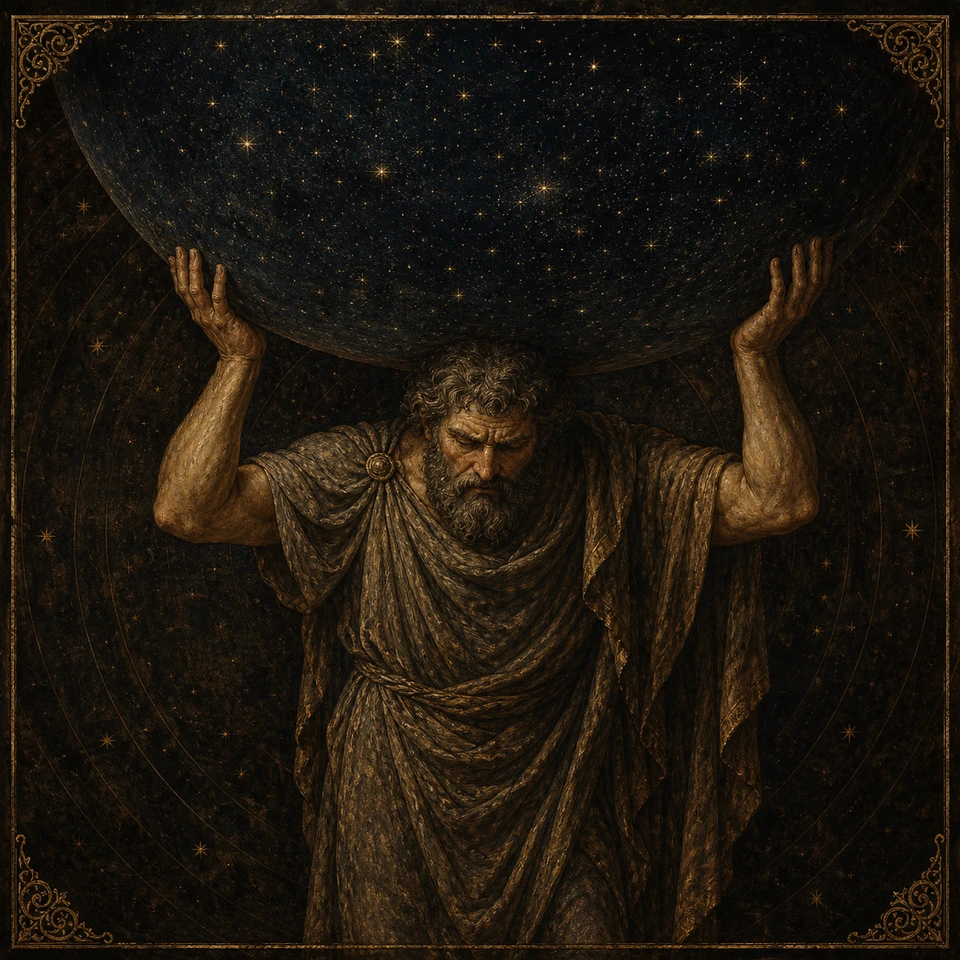
Shouldering the crushing weight of heaven, Atlas fundamentally separates the earth from the sky in mythic tradition. Though central to the legendary Hesperides labor of Heracles and later grouped with the Titans, no secure evidence of his direct cult worship has survived.
Overview
Heracles stands under the sky while Atlas walks away with three apples. For one impossible interval, the cosmic burden changes shoulders. Atlas returns from the Hesperides and discovers freedom. He offers to carry the fruit onward, meaning to leave Heracles fixed beneath heaven. Heracles answers with a smaller deception: hold the weight for one moment while I settle a pad upon my head. Atlas sets down the apples, takes back the sky, and watches the hero leave.
That later mythographic scene is famous because it makes Atlas’ permanent condition movable. The archaic poems are less uniform. Hesiod places him at the earth’s limits before the Hesperides, supporting wide heaven with head and tireless hands under a hard necessity assigned by Zeus. The Odyssey calls him a dangerous knower of the sea depths and gives him long pillars that keep earth and sky apart. Pseudo-Apollodorus later places the sky on his shoulders. Body, pillars, and shoulders are not three descriptions to melt into one. They are different ancient models of how the world remains open between ground and heaven.
Atlas also belongs to a family whose lines change by source. Hesiod makes him a son of Iapetus and Clymene, brother to Menoetius, Prometheus, and Epimetheus. Pseudo-Apollodorus names Asia instead of Clymene. The Odyssey calls Calypso his daughter. Hesiod does not include Atlas among the earlier twelve first-generation Titans, although later tradition commonly groups him with the Titan generation. Divine genealogy and cosmic labor are secure. Direct worship is not.
Ancient objects preserve the Hesperides story without repeating one composition. Pausanias describes the lost Chest of Cypselus with Atlas supporting heaven and earth, carrying the apples, and facing an armed Heracles. A surviving Western Greek amphora in the British Museum splits the action across its two sides. Heracles, not Atlas, bears a heaven hemisphere on one side. Atlas approaches the tree, serpent, and Hesperides on the other. The vessel makes the exchange legible, but it also prevents a modern artist from assigning Atlas the exact pose that belongs there to Heracles.
The Atlas of Greek poetry is not the modern terrestrial globe-bearer. He is not a map book, mountain chain, ocean, vertebra, architectural support, anatomical volume, or moon of Saturn. Those names belong to later reception. Nor do the texts give him a planet, zodiac sign, gemstone, metal, color, element, weekday, moon phase, incense, offering list, or universal ritual direction. Apples and serpent stay within the Hesperides scene. Sea knowledge does not make him an ocean ruler.
No sanctuary, priesthood, festival, sacrifice, or dedication to Atlas is established here. That absence does not make him small. It makes his surviving power literary, genealogical, cosmic, and visual. He stands where the Greek imagination placed the price of separation itself: at the far boundary, beneath the pressure of heaven, enduring an order he did not choose and briefly learning how it feels to set it down.
Canonical identity
Canonical Identity
Atlas operates as a named mythic and divine figure who physically stands between earth and heaven, bearing the sky or acting as a celestial pillar. Hesiod identifies him as the son of Iapetus and Clymene, though he is not included in the earlier catalog of the twelve first-generation Titans. Because later traditions commonly group him with the Titan generation, and because his lineage survives without direct evidence of sanctuary worship, his primary classification remains a mythic and divine figure with "Titan" acting as a qualified generational descriptor.
Linguistic Identity
The Greek form is Ἄτλας. A qualified fifth-century BC Attic reconstruction provides the sound /á.tlaːs/, approximately AH-tlahs. This approximation cannot perfectly capture the original Greek pitch accent or the long final alpha. Within this context, the name exclusively identifies the ancient divine figure and must not be conflated with a map book, mountain range, ocean, anatomical vertebra, or a Saturnian moon.
Sources and evidence
TEXTUAL · Supported
The Ancient Greek name is Ἄτλας, transliterated Átlas, with a qualified fifth-century BC Attic reconstruction /á.tlaːs/.
- Source
- Wiktionary contributors, Ἄτλας
- Reviewed edition
- Wiktionary live revision reviewed 2026-08-29 · Wiktionary
- Exact locator
- Entry Ἄτλας · Section Ancient Greek pronunciation
- Scope
- Classical Greece · Attica
- Authority
- institutional or lexical reference
- Certainty
- Qualified
The readable guide cannot reproduce pitch accent or the long final alpha exactly.
Open exact reviewed sourceTEXTUAL · Supported
Hesiod does not include Atlas in the earlier first-generation list of twelve Titans, although later genealogical classification commonly places him with the Titan generation.
- Source
- Hesiod; edited and translated by Hugh G. Evelyn-White, Theogony (1914)
- Reviewed edition
- Hugh G. Evelyn-White edition and English translation in Hesiod, the Homeric Hymns and Homerica, 1914 · translated by Hugh G. Evelyn-White · edited by Hugh G. Evelyn-White · Perseus Digital Library / Scaife ATLAS
- Exact locator
- Entry Theogony · Line 133-138; 507-520
- Scope
- Archaic Greece · Ancient Greece
- Authority
- primary textual witness
- Certainty
- High
The text supports the generational distinction; it does not settle every later use of Titan.
Open exact reviewed source2 reviewed sources for this section
- Wiktionary contributors, ἌτλαςLive collaborative lexical entry reviewed 2026-08-29 · Wiktionary
- Hesiod; edited and translated by Hugh G. Evelyn-White, Theogony (1914)Hesiod, the Homeric Hymns and Homerica, London and New York, 1914 · Perseus Digital Library / Scaife ATLAS
Culture, tradition, period, and place
Atlas enters archaic Greek poetry at the far limit of earth and sea. Hesiod locates him before the Hesperides, while the Odyssey gives him knowledge of the sea depths and pillars that divide earth from sky. These are poetic geographies, not coordinates for the Atlas Mountains or the Atlantic Ocean.
Classical Western Greek vase painting carries the Hesperides episode into Campanian material culture. Later Greek mythography and Roman-period travel writing reshape his genealogy, burden, and encounter with Heracles. Pseudo-Hyginus adds Atlas to a Latin Amphitrite story. Each witness belongs to its own language, period, and narrative purpose.
Sources and evidence
TEXTUAL · Supported
At the limits of the earth, before the Hesperides, Hesiod’s Atlas supports the wide heaven with head and unwearying hands under a hard necessity imposed by Zeus.
- Source
- Hesiod; edited and translated by Hugh G. Evelyn-White, Theogony (1914)
- Reviewed edition
- Hugh G. Evelyn-White edition and English translation in Hesiod, the Homeric Hymns and Homerica, 1914 · translated by Hugh G. Evelyn-White · edited by Hugh G. Evelyn-White · Perseus Digital Library / Scaife ATLAS
- Exact locator
- Entry Theogony · Line 517-520
- Scope
- Archaic Greece · Ancient Greece
- Authority
- primary textual witness
- Certainty
- High
The burden is heaven, not a modern globe of Earth.
Open exact reviewed sourceTEXTUAL · Supported
The Odyssey calls Atlas a dangerous knower of the sea’s depths who holds the long pillars keeping earth and heaven apart.
- Source
- Homer; translated by A. T. Murray, Odyssey (1919)
- Reviewed edition
- A. T. Murray English translation, London: William Heinemann; New York: G. P. Putnam's Sons, 1919 · translated by A. T. Murray · Perseus Digital Library / Scaife ATLAS
- Exact locator
- Entry Odyssey · Book 1 · Line 52-54
- Scope
- Archaic Greece · Ancient Greece
- Authority
- primary textual witness
- Certainty
- High
Homer’s pillars remain distinct from Hesiod’s bodily sky-bearing.
Open exact reviewed sourceMATERIAL CULTURE · Supported
British Museum amphora F148 divides the Hesperides scene across its sides: Heracles bears a heaven hemisphere on one side, while Atlas approaches the tree and its guardians on the other.
- Source
- British Museum, British Museum Collection
- Reviewed edition
- Live record-level official museum collection · British Museum
- Exact locator
- MuseumObjectId 1772,0320.432 (F148) · Entry Western Greek red-figure neck-amphora, circa 470-425 BC
- Scope
- Classical Greece · Ancient Greece
- Authority
- institutional collection catalog
- Certainty
- Qualified
The object must not be used to place Atlas in Heracles’ exact pose.
Open exact reviewed source3 reviewed sources for this section
- Hesiod; edited and translated by Hugh G. Evelyn-White, Theogony (1914)Hesiod, the Homeric Hymns and Homerica, London and New York, 1914 · Perseus Digital Library / Scaife ATLAS
- Homer; translated by A. T. Murray, Odyssey (1919)A. T. Murray English translation, London: William Heinemann; New York: G. P. Putnam's Sons, 1919 · Perseus Digital Library / Scaife ATLAS
- British Museum, British Museum CollectionLive official museum collection · British Museum
Historical development
The oldest evidence already disagrees about how Atlas performs his cosmic labor. Hesiod puts heaven on head and hands. The Odyssey gives long pillars. Later mythography puts the sky on his shoulders and connects that burden to Heracles’ labor. The differences are historical evidence, not mistakes to be repaired into one picture.
Images also change the emphasis. A fifth-century BC amphora divides Heracles’ temporary sky-bearing from Atlas’ approach to the Hesperides. Pausanias, centuries later, describes a lost chest where Atlas bears heaven and earth and holds the apples. Later architectural and allegorical figures called Atlantes belong to reception after these myths, while the modern map-book meaning lies further still.
Sources and evidence
TEXTUAL · Supported
At the limits of the earth, before the Hesperides, Hesiod’s Atlas supports the wide heaven with head and unwearying hands under a hard necessity imposed by Zeus.
- Source
- Hesiod; edited and translated by Hugh G. Evelyn-White, Theogony (1914)
- Reviewed edition
- Hugh G. Evelyn-White edition and English translation in Hesiod, the Homeric Hymns and Homerica, 1914 · translated by Hugh G. Evelyn-White · edited by Hugh G. Evelyn-White · Perseus Digital Library / Scaife ATLAS
- Exact locator
- Entry Theogony · Line 517-520
- Scope
- Archaic Greece · Ancient Greece
- Authority
- primary textual witness
- Certainty
- High
The burden is heaven, not a modern globe of Earth.
Open exact reviewed sourceTEXTUAL · Supported
The Odyssey calls Atlas a dangerous knower of the sea’s depths who holds the long pillars keeping earth and heaven apart.
- Source
- Homer; translated by A. T. Murray, Odyssey (1919)
- Reviewed edition
- A. T. Murray English translation, London: William Heinemann; New York: G. P. Putnam's Sons, 1919 · translated by A. T. Murray · Perseus Digital Library / Scaife ATLAS
- Exact locator
- Entry Odyssey · Book 1 · Line 52-54
- Scope
- Archaic Greece · Ancient Greece
- Authority
- primary textual witness
- Certainty
- High
Homer’s pillars remain distinct from Hesiod’s bodily sky-bearing.
Open exact reviewed sourceTEXTUAL · Supported
Pseudo-Apollodorus includes Atlas among the sons of Iapetus and says he holds the sky upon his shoulders.
- Source
- Pseudo-Apollodorus; edited and translated by James G. Frazer, Library (1921)
- Reviewed edition
- James G. Frazer edition and English translation, Harvard University Press and William Heinemann, 1921 · translated by James G. Frazer · edited by James G. Frazer · Perseus Digital Library / Scaife ATLAS
- Exact locator
- Entry Library · Book 1 · Chapter 2 · Section 3
- Scope
- Greek religion under Roman imperial rule · Ancient Greece
- Authority
- primary textual witness
- Certainty
- High
Later mythography uses a shoulder-bearing model without replacing the archaic witnesses.
Open exact reviewed sourceMATERIAL CULTURE · Supported
British Museum amphora F148 divides the Hesperides scene across its sides: Heracles bears a heaven hemisphere on one side, while Atlas approaches the tree and its guardians on the other.
- Source
- British Museum, British Museum Collection
- Reviewed edition
- Live record-level official museum collection · British Museum
- Exact locator
- MuseumObjectId 1772,0320.432 (F148) · Entry Western Greek red-figure neck-amphora, circa 470-425 BC
- Scope
- Classical Greece · Ancient Greece
- Authority
- institutional collection catalog
- Certainty
- Qualified
The object must not be used to place Atlas in Heracles’ exact pose.
Open exact reviewed sourceTEXTUAL · Supported
Pausanias describes the lost Chest of Cypselus with Atlas supporting heaven and earth, carrying the Hesperidean apples, while Heracles advances with a sword.
- Source
- Pausanias; Spiro Greek edition and Jones/Ormerod translation volumes, Description of Greece (1935)
- Reviewed edition
- Spiro Greek edition and Jones/Ormerod English volumes represented by the Perseus CTS corpus, 1903-1935 · translated by W. H. S. Jones and H. A. Ormerod, volume-dependent · edited by Friedrich Spiro for the Greek edition · Perseus Digital Library / Scaife ATLAS
- Exact locator
- Entry Description of Greece · Book 5 · Section 18.4
- Scope
- Greek religion under Roman imperial rule · Ancient Greece
- Authority
- primary textual witness
- Certainty
- High
The object is known through Pausanias’ description and does not survive.
Open exact reviewed source5 reviewed sources for this section
- Hesiod; edited and translated by Hugh G. Evelyn-White, Theogony (1914)Hesiod, the Homeric Hymns and Homerica, London and New York, 1914 · Perseus Digital Library / Scaife ATLAS
- Homer; translated by A. T. Murray, Odyssey (1919)A. T. Murray English translation, London: William Heinemann; New York: G. P. Putnam's Sons, 1919 · Perseus Digital Library / Scaife ATLAS
- Pseudo-Apollodorus; edited and translated by James G. Frazer, Library (1921)Harvard University Press and William Heinemann edition, 1921 · Perseus Digital Library / Scaife ATLAS
- British Museum, British Museum CollectionLive official museum collection · British Museum
- Pausanias; Spiro Greek edition and Jones/Ormerod translation volumes, Description of Greece (1935)Perseus CTS edition corpus, 1903-1935 · Perseus Digital Library / Scaife ATLAS
Attested roles and historical themes
Roles, powers, and limits
Atlas holds a cosmic boundary. In Hesiod the task is an imposed necessity under Zeus. In the Odyssey he knows the depths of the sea and keeps earth and heaven apart through pillars. His strength is immense, but the Hesperides story shows that strength does not make him free. He can set down the burden only when another body accepts it.
No ancient witness here makes Atlas ruler of Earth, geography, planets, maps, endurance magic, or bodybuilding. He does not carry the modern globe. His sea knowledge does not make him an ocean god, and his far-western setting does not make west a universal ritual direction.
Sources and evidence
TEXTUAL · Supported
At the limits of the earth, before the Hesperides, Hesiod’s Atlas supports the wide heaven with head and unwearying hands under a hard necessity imposed by Zeus.
- Source
- Hesiod; edited and translated by Hugh G. Evelyn-White, Theogony (1914)
- Reviewed edition
- Hugh G. Evelyn-White edition and English translation in Hesiod, the Homeric Hymns and Homerica, 1914 · translated by Hugh G. Evelyn-White · edited by Hugh G. Evelyn-White · Perseus Digital Library / Scaife ATLAS
- Exact locator
- Entry Theogony · Line 517-520
- Scope
- Archaic Greece · Ancient Greece
- Authority
- primary textual witness
- Certainty
- High
The burden is heaven, not a modern globe of Earth.
Open exact reviewed sourceTEXTUAL · Supported
The Odyssey calls Atlas a dangerous knower of the sea’s depths who holds the long pillars keeping earth and heaven apart.
- Source
- Homer; translated by A. T. Murray, Odyssey (1919)
- Reviewed edition
- A. T. Murray English translation, London: William Heinemann; New York: G. P. Putnam's Sons, 1919 · translated by A. T. Murray · Perseus Digital Library / Scaife ATLAS
- Exact locator
- Entry Odyssey · Book 1 · Line 52-54
- Scope
- Archaic Greece · Ancient Greece
- Authority
- primary textual witness
- Certainty
- High
Homer’s pillars remain distinct from Hesiod’s bodily sky-bearing.
Open exact reviewed sourceTEXTUAL · Supported
Pseudo-Apollodorus includes Atlas among the sons of Iapetus and says he holds the sky upon his shoulders.
- Source
- Pseudo-Apollodorus; edited and translated by James G. Frazer, Library (1921)
- Reviewed edition
- James G. Frazer edition and English translation, Harvard University Press and William Heinemann, 1921 · translated by James G. Frazer · edited by James G. Frazer · Perseus Digital Library / Scaife ATLAS
- Exact locator
- Entry Library · Book 1 · Chapter 2 · Section 3
- Scope
- Greek religion under Roman imperial rule · Ancient Greece
- Authority
- primary textual witness
- Certainty
- High
Later mythography uses a shoulder-bearing model without replacing the archaic witnesses.
Open exact reviewed source3 reviewed sources for this section
- Hesiod; edited and translated by Hugh G. Evelyn-White, Theogony (1914)Hesiod, the Homeric Hymns and Homerica, London and New York, 1914 · Perseus Digital Library / Scaife ATLAS
- Homer; translated by A. T. Murray, Odyssey (1919)A. T. Murray English translation, London: William Heinemann; New York: G. P. Putnam's Sons, 1919 · Perseus Digital Library / Scaife ATLAS
- Pseudo-Apollodorus; edited and translated by James G. Frazer, Library (1921)Harvard University Press and William Heinemann edition, 1921 · Perseus Digital Library / Scaife ATLAS
Epithets and titles
No securely localized Atlas epithet with an exact primary or institutional locator is included; cosmic role and later namesakes are not converted into titles.
2 reviewed sources for this section
- Hesiod; edited and translated by Hugh G. Evelyn-White, Theogony (1914)Hesiod, the Homeric Hymns and Homerica, London and New York, 1914 · Perseus Digital Library / Scaife ATLAS
- Homer; translated by A. T. Murray, Odyssey (1919)A. T. Murray English translation, London: William Heinemann; New York: G. P. Putnam's Sons, 1919 · Perseus Digital Library / Scaife ATLAS
Worship and cult
No sanctuary, priesthood, sacrifice, festival, dedication, or named body of worshippers for Atlas is established by this evidence. Poetry, mythography, a surviving vase, and a traveler’s description show that he mattered deeply in Greek imagination, but narrative importance is not the same as cult.
The absence controls classification and practice. Atlas can be presented as a divine genealogical figure with a cosmic role without claiming that ancient communities prayed, sacrificed, or made pilgrimage to him. New cult evidence would need a precise inscription, object, sanctuary context, or accountable historical study.
Temples, sanctuaries, and sacred places
Atlas’ strongest ancient location is a cosmic margin near the Hesperides, not a documented sanctuary. Hesiod’s far limit and Homer’s sea-depth setting create a charged boundary between known land, deep water, earth, and sky. That landscape belongs to poetry and should not be turned into a temple site.
Olympia enters only because Pausanias saw and described the Chest of Cypselus there. The object’s presence at Olympia does not prove worship of Atlas. Campania enters through the production place of a surviving vase, which documents visual reception rather than a local Atlas cult.
Sources and evidence
TEXTUAL · Supported
At the limits of the earth, before the Hesperides, Hesiod’s Atlas supports the wide heaven with head and unwearying hands under a hard necessity imposed by Zeus.
- Source
- Hesiod; edited and translated by Hugh G. Evelyn-White, Theogony (1914)
- Reviewed edition
- Hugh G. Evelyn-White edition and English translation in Hesiod, the Homeric Hymns and Homerica, 1914 · translated by Hugh G. Evelyn-White · edited by Hugh G. Evelyn-White · Perseus Digital Library / Scaife ATLAS
- Exact locator
- Entry Theogony · Line 517-520
- Scope
- Archaic Greece · Ancient Greece
- Authority
- primary textual witness
- Certainty
- High
The burden is heaven, not a modern globe of Earth.
Open exact reviewed sourceTEXTUAL · Supported
The Odyssey calls Atlas a dangerous knower of the sea’s depths who holds the long pillars keeping earth and heaven apart.
- Source
- Homer; translated by A. T. Murray, Odyssey (1919)
- Reviewed edition
- A. T. Murray English translation, London: William Heinemann; New York: G. P. Putnam's Sons, 1919 · translated by A. T. Murray · Perseus Digital Library / Scaife ATLAS
- Exact locator
- Entry Odyssey · Book 1 · Line 52-54
- Scope
- Archaic Greece · Ancient Greece
- Authority
- primary textual witness
- Certainty
- High
Homer’s pillars remain distinct from Hesiod’s bodily sky-bearing.
Open exact reviewed sourceTEXTUAL · Supported
Pausanias describes the lost Chest of Cypselus with Atlas supporting heaven and earth, carrying the Hesperidean apples, while Heracles advances with a sword.
- Source
- Pausanias; Spiro Greek edition and Jones/Ormerod translation volumes, Description of Greece (1935)
- Reviewed edition
- Spiro Greek edition and Jones/Ormerod English volumes represented by the Perseus CTS corpus, 1903-1935 · translated by W. H. S. Jones and H. A. Ormerod, volume-dependent · edited by Friedrich Spiro for the Greek edition · Perseus Digital Library / Scaife ATLAS
- Exact locator
- Entry Description of Greece · Book 5 · Section 18.4
- Scope
- Greek religion under Roman imperial rule · Ancient Greece
- Authority
- primary textual witness
- Certainty
- High
The object is known through Pausanias’ description and does not survive.
Open exact reviewed sourceMATERIAL CULTURE · Supported
British Museum amphora F148 divides the Hesperides scene across its sides: Heracles bears a heaven hemisphere on one side, while Atlas approaches the tree and its guardians on the other.
- Source
- British Museum, British Museum Collection
- Reviewed edition
- Live record-level official museum collection · British Museum
- Exact locator
- MuseumObjectId 1772,0320.432 (F148) · Entry Western Greek red-figure neck-amphora, circa 470-425 BC
- Scope
- Classical Greece · Ancient Greece
- Authority
- institutional collection catalog
- Certainty
- Qualified
The object must not be used to place Atlas in Heracles’ exact pose.
Open exact reviewed source4 reviewed sources for this section
- Hesiod; edited and translated by Hugh G. Evelyn-White, Theogony (1914)Hesiod, the Homeric Hymns and Homerica, London and New York, 1914 · Perseus Digital Library / Scaife ATLAS
- Homer; translated by A. T. Murray, Odyssey (1919)A. T. Murray English translation, London: William Heinemann; New York: G. P. Putnam's Sons, 1919 · Perseus Digital Library / Scaife ATLAS
- Pausanias; Spiro Greek edition and Jones/Ormerod translation volumes, Description of Greece (1935)Perseus CTS edition corpus, 1903-1935 · Perseus Digital Library / Scaife ATLAS
- British Museum, British Museum CollectionLive official museum collection · British Museum
Festivals and processions
No Atlas festival, procession, sacred day, or fixed ritual season is established. The Hesperides labor belongs to heroic narrative, not to a calendar by itself. Pausanias’ sight of the chest at Olympia does not convert its pictured figures into festival recipients.
Modern dates linked to maps, exploration, strength, or astronomy also remain unsupported by ancient evidence. A weekday, moon phase, zodiac season, or planet day would require its own historical or accountable living-practice source.
Offerings, votives, and ritual evidence
The Hesperidean apples are objects pursued within Heracles’ labor. They are not documented offerings to Atlas. The tree, guardian serpent, and heavenly burden likewise belong to a story and its images, not to a ritual kit.
No incense, libation, food, votive object, prayer formula, or sacrifice to Atlas is supported here. Modern practice can develop new forms, but no named living community has publicly attested a shared rite for Atlas. Silence is more faithful than turning famous story objects into devotional instructions.
Sources and evidence
TEXTUAL · Supported
In Pseudo-Apollodorus, Heracles takes the celestial burden while Atlas fetches three apples, then escapes by asking Atlas to hold the sky again for a moment.
- Source
- Pseudo-Apollodorus; edited and translated by James G. Frazer, Library (1921)
- Reviewed edition
- James G. Frazer edition and English translation, Harvard University Press and William Heinemann, 1921 · translated by James G. Frazer · edited by James G. Frazer · Perseus Digital Library / Scaife ATLAS
- Exact locator
- Entry Library · Book 2 · Chapter 5 · Section 11
- Scope
- Greek religion under Roman imperial rule · Ancient Greece
- Authority
- primary textual witness
- Certainty
- High
The same passage also reports an alternative in which Heracles takes the apples himself after killing the guardian serpent.
Open exact reviewed source1 reviewed source for this section
- Pseudo-Apollodorus; edited and translated by James G. Frazer, Library (1921)Harvard University Press and William Heinemann edition, 1921 · Perseus Digital Library / Scaife ATLAS
Iconography and material culture
The British Museum amphora F148 is the firm surviving object. One side shows Heracles beneath a hemisphere of heaven. The other shows Atlas approaching the Hesperides tree with its guarded fruit. The division identifies Atlas without granting him Heracles’ exact pose.
Pausanias supplies a second but lost composition: Atlas supports heaven and earth, carries the apples, and faces an advancing Heracles. Together the witnesses establish sky burden, pillars, apples, tree, and serpent as context-dependent images. None supports a modern terrestrial globe. The Farnese Atlas cannot support further claims without an institutional catalogue and direct object study.
Sources and evidence
TEXTUAL · Supported
At the limits of the earth, before the Hesperides, Hesiod’s Atlas supports the wide heaven with head and unwearying hands under a hard necessity imposed by Zeus.
- Source
- Hesiod; edited and translated by Hugh G. Evelyn-White, Theogony (1914)
- Reviewed edition
- Hugh G. Evelyn-White edition and English translation in Hesiod, the Homeric Hymns and Homerica, 1914 · translated by Hugh G. Evelyn-White · edited by Hugh G. Evelyn-White · Perseus Digital Library / Scaife ATLAS
- Exact locator
- Entry Theogony · Line 517-520
- Scope
- Archaic Greece · Ancient Greece
- Authority
- primary textual witness
- Certainty
- High
The burden is heaven, not a modern globe of Earth.
Open exact reviewed sourceTEXTUAL · Supported
The Odyssey calls Atlas a dangerous knower of the sea’s depths who holds the long pillars keeping earth and heaven apart.
- Source
- Homer; translated by A. T. Murray, Odyssey (1919)
- Reviewed edition
- A. T. Murray English translation, London: William Heinemann; New York: G. P. Putnam's Sons, 1919 · translated by A. T. Murray · Perseus Digital Library / Scaife ATLAS
- Exact locator
- Entry Odyssey · Book 1 · Line 52-54
- Scope
- Archaic Greece · Ancient Greece
- Authority
- primary textual witness
- Certainty
- High
Homer’s pillars remain distinct from Hesiod’s bodily sky-bearing.
Open exact reviewed sourceTEXTUAL · Supported
Pausanias describes the lost Chest of Cypselus with Atlas supporting heaven and earth, carrying the Hesperidean apples, while Heracles advances with a sword.
- Source
- Pausanias; Spiro Greek edition and Jones/Ormerod translation volumes, Description of Greece (1935)
- Reviewed edition
- Spiro Greek edition and Jones/Ormerod English volumes represented by the Perseus CTS corpus, 1903-1935 · translated by W. H. S. Jones and H. A. Ormerod, volume-dependent · edited by Friedrich Spiro for the Greek edition · Perseus Digital Library / Scaife ATLAS
- Exact locator
- Entry Description of Greece · Book 5 · Section 18.4
- Scope
- Greek religion under Roman imperial rule · Ancient Greece
- Authority
- primary textual witness
- Certainty
- High
The object is known through Pausanias’ description and does not survive.
Open exact reviewed sourceMATERIAL CULTURE · Supported
British Museum amphora F148 divides the Hesperides scene across its sides: Heracles bears a heaven hemisphere on one side, while Atlas approaches the tree and its guardians on the other.
- Source
- British Museum, British Museum Collection
- Reviewed edition
- Live record-level official museum collection · British Museum
- Exact locator
- MuseumObjectId 1772,0320.432 (F148) · Entry Western Greek red-figure neck-amphora, circa 470-425 BC
- Scope
- Classical Greece · Ancient Greece
- Authority
- institutional collection catalog
- Certainty
- Qualified
The object must not be used to place Atlas in Heracles’ exact pose.
Open exact reviewed source4 reviewed sources for this section
- Hesiod; edited and translated by Hugh G. Evelyn-White, Theogony (1914)Hesiod, the Homeric Hymns and Homerica, London and New York, 1914 · Perseus Digital Library / Scaife ATLAS
- Homer; translated by A. T. Murray, Odyssey (1919)A. T. Murray English translation, London: William Heinemann; New York: G. P. Putnam's Sons, 1919 · Perseus Digital Library / Scaife ATLAS
- Pausanias; Spiro Greek edition and Jones/Ormerod translation volumes, Description of Greece (1935)Perseus CTS edition corpus, 1903-1935 · Perseus Digital Library / Scaife ATLAS
- British Museum, British Museum CollectionLive official museum collection · British Museum
Animals, plants, and embodied forms
The apple-bearing tree and guardian serpent belong to the Hesperides episode. Pseudo-Apollodorus preserves an alternate account in which Heracles kills the serpent and takes the fruit himself. The British Museum vase places the tree, serpent, and Hesperides in the scene Atlas approaches.
Neither tree nor serpent becomes Atlas’ universal sacred plant or animal. Their meaning depends on the guarded garden and Heracles’ labor. No reviewed source supplies a species for a ritual plant, a sacred animal, or an embodied animal form of Atlas.
Sources and evidence
TEXTUAL · Supported
In Pseudo-Apollodorus, Heracles takes the celestial burden while Atlas fetches three apples, then escapes by asking Atlas to hold the sky again for a moment.
- Source
- Pseudo-Apollodorus; edited and translated by James G. Frazer, Library (1921)
- Reviewed edition
- James G. Frazer edition and English translation, Harvard University Press and William Heinemann, 1921 · translated by James G. Frazer · edited by James G. Frazer · Perseus Digital Library / Scaife ATLAS
- Exact locator
- Entry Library · Book 2 · Chapter 5 · Section 11
- Scope
- Greek religion under Roman imperial rule · Ancient Greece
- Authority
- primary textual witness
- Certainty
- High
The same passage also reports an alternative in which Heracles takes the apples himself after killing the guardian serpent.
Open exact reviewed sourceMATERIAL CULTURE · Supported
British Museum amphora F148 divides the Hesperides scene across its sides: Heracles bears a heaven hemisphere on one side, while Atlas approaches the tree and its guardians on the other.
- Source
- British Museum, British Museum Collection
- Reviewed edition
- Live record-level official museum collection · British Museum
- Exact locator
- MuseumObjectId 1772,0320.432 (F148) · Entry Western Greek red-figure neck-amphora, circa 470-425 BC
- Scope
- Classical Greece · Ancient Greece
- Authority
- institutional collection catalog
- Certainty
- Qualified
The object must not be used to place Atlas in Heracles’ exact pose.
Open exact reviewed source2 reviewed sources for this section
- Pseudo-Apollodorus; edited and translated by James G. Frazer, Library (1921)Harvard University Press and William Heinemann edition, 1921 · Perseus Digital Library / Scaife ATLAS
- British Museum, British Museum CollectionLive official museum collection · British Museum
Relationships and genealogy
Hesiod names Iapetus and Clymene as Atlas’ parents and gives him Menoetius, Prometheus, and Epimetheus as brothers. Pseudo-Apollodorus keeps Iapetus but substitutes Asia for Clymene. The two mother traditions remain separate rather than being combined into one woman with two names.
The Odyssey calls Calypso his daughter. The two direct sibling connections are limited to Prometheus and Epimetheus because their identities and Hesiodic parentage are both secure here. Heracles belongs through a shared myth, not through an invented family or cult bond.
Sources and evidence
TEXTUAL · Supported
Hesiod names Atlas among the sons of Iapetus and Clymene, beside Menoetius, Prometheus, and Epimetheus.
- Source
- Hesiod; edited and translated by Hugh G. Evelyn-White, Theogony (1914)
- Reviewed edition
- Hugh G. Evelyn-White edition and English translation in Hesiod, the Homeric Hymns and Homerica, 1914 · translated by Hugh G. Evelyn-White · edited by Hugh G. Evelyn-White · Perseus Digital Library / Scaife ATLAS
- Exact locator
- Entry Theogony · Line 507-516
- Scope
- Archaic Greece · Ancient Greece
- Authority
- primary textual witness
- Certainty
- High
This genealogy supports siblinghood within Hesiod and keeps Clymene distinct from the later Asia variant.
Open exact reviewed sourceTEXTUAL · Supported
The Odyssey names Atlas as the father of Calypso.
- Source
- Homer; translated by A. T. Murray, Odyssey (1919)
- Reviewed edition
- A. T. Murray English translation, London: William Heinemann; New York: G. P. Putnam's Sons, 1919 · translated by A. T. Murray · Perseus Digital Library / Scaife ATLAS
- Exact locator
- Entry Odyssey · Book 1 · Line 52-54
- Scope
- Archaic Greece · Ancient Greece
- Authority
- primary textual witness
- Certainty
- High
This epic genealogy is retained in prose; no direct Calypso connection is asserted.
Open exact reviewed sourceTEXTUAL · Supported
Pseudo-Apollodorus makes Asia, rather than Hesiod’s Clymene, the mother of Atlas and his brothers.
- Source
- Pseudo-Apollodorus; edited and translated by James G. Frazer, Library (1921)
- Reviewed edition
- James G. Frazer edition and English translation, Harvard University Press and William Heinemann, 1921 · translated by James G. Frazer · edited by James G. Frazer · Perseus Digital Library / Scaife ATLAS
- Exact locator
- Entry Library · Book 1 · Chapter 2 · Section 3
- Scope
- Greek religion under Roman imperial rule · Ancient Greece
- Authority
- primary textual witness
- Certainty
- High
The mother traditions remain separate source variants.
Open exact reviewed source3 reviewed sources for this section
- Hesiod; edited and translated by Hugh G. Evelyn-White, Theogony (1914)Hesiod, the Homeric Hymns and Homerica, London and New York, 1914 · Perseus Digital Library / Scaife ATLAS
- Homer; translated by A. T. Murray, Odyssey (1919)A. T. Murray English translation, London: William Heinemann; New York: G. P. Putnam's Sons, 1919 · Perseus Digital Library / Scaife ATLAS
- Pseudo-Apollodorus; edited and translated by James G. Frazer, Library (1921)Harvard University Press and William Heinemann edition, 1921 · Perseus Digital Library / Scaife ATLAS
Actual myths and source variants
Atlas’ central story is the burden itself. Hesiod’s body, Homer’s pillars, and Pseudo-Apollodorus’ shoulders describe different mechanics, yet all place him at the structure holding heaven away from earth. The Heracles cycle makes that stable cosmic condition suddenly negotiable. Heracles takes the weight, Atlas walks free, and a second trick forces him back beneath it.
The Hesperides account also branches: Atlas may fetch three apples, or Heracles may kill the serpent and take them directly. Ancient objects arrange the scene differently again. A late Latin story gives Atlas a quieter role as the distant refuge to which Amphitrite flees. He has no part in Oppian’s coercive Greek version, so the shared Amphitrite myth preserves that boundary.
Sources and evidence
TEXTUAL · Supported
At the limits of the earth, before the Hesperides, Hesiod’s Atlas supports the wide heaven with head and unwearying hands under a hard necessity imposed by Zeus.
- Source
- Hesiod; edited and translated by Hugh G. Evelyn-White, Theogony (1914)
- Reviewed edition
- Hugh G. Evelyn-White edition and English translation in Hesiod, the Homeric Hymns and Homerica, 1914 · translated by Hugh G. Evelyn-White · edited by Hugh G. Evelyn-White · Perseus Digital Library / Scaife ATLAS
- Exact locator
- Entry Theogony · Line 517-520
- Scope
- Archaic Greece · Ancient Greece
- Authority
- primary textual witness
- Certainty
- High
The burden is heaven, not a modern globe of Earth.
Open exact reviewed sourceTEXTUAL · Supported
The Odyssey calls Atlas a dangerous knower of the sea’s depths who holds the long pillars keeping earth and heaven apart.
- Source
- Homer; translated by A. T. Murray, Odyssey (1919)
- Reviewed edition
- A. T. Murray English translation, London: William Heinemann; New York: G. P. Putnam's Sons, 1919 · translated by A. T. Murray · Perseus Digital Library / Scaife ATLAS
- Exact locator
- Entry Odyssey · Book 1 · Line 52-54
- Scope
- Archaic Greece · Ancient Greece
- Authority
- primary textual witness
- Certainty
- High
Homer’s pillars remain distinct from Hesiod’s bodily sky-bearing.
Open exact reviewed sourceTEXTUAL · Supported
Pseudo-Apollodorus includes Atlas among the sons of Iapetus and says he holds the sky upon his shoulders.
- Source
- Pseudo-Apollodorus; edited and translated by James G. Frazer, Library (1921)
- Reviewed edition
- James G. Frazer edition and English translation, Harvard University Press and William Heinemann, 1921 · translated by James G. Frazer · edited by James G. Frazer · Perseus Digital Library / Scaife ATLAS
- Exact locator
- Entry Library · Book 1 · Chapter 2 · Section 3
- Scope
- Greek religion under Roman imperial rule · Ancient Greece
- Authority
- primary textual witness
- Certainty
- High
Later mythography uses a shoulder-bearing model without replacing the archaic witnesses.
Open exact reviewed sourceTEXTUAL · Supported
In Pseudo-Apollodorus, Heracles takes the celestial burden while Atlas fetches three apples, then escapes by asking Atlas to hold the sky again for a moment.
- Source
- Pseudo-Apollodorus; edited and translated by James G. Frazer, Library (1921)
- Reviewed edition
- James G. Frazer edition and English translation, Harvard University Press and William Heinemann, 1921 · translated by James G. Frazer · edited by James G. Frazer · Perseus Digital Library / Scaife ATLAS
- Exact locator
- Entry Library · Book 2 · Chapter 5 · Section 11
- Scope
- Greek religion under Roman imperial rule · Ancient Greece
- Authority
- primary textual witness
- Certainty
- High
The same passage also reports an alternative in which Heracles takes the apples himself after killing the guardian serpent.
Open exact reviewed sourceTEXTUAL · Supported
Pseudo-Hyginus says Amphitrite fled to Atlas before Delphinus persuaded her to marry Neptune.
- Source
- Pseudo-Hyginus, Astronomica
- Reviewed edition
- Packard Humanities Institute searchable Latin text, Astronomica 2.17.1 · Packard Humanities Institute Latin Texts
- Exact locator
- Entry Astronomica · Book 2 · Section 17.1
- Scope
- Greek religion under Roman imperial rule · Ancient Greece
- Authority
- primary textual witness
- Certainty
- High
Atlas belongs only to this late Latin variant and has no role in Oppian’s Greek account.
Open exact reviewed source4 reviewed sources for this section
- Hesiod; edited and translated by Hugh G. Evelyn-White, Theogony (1914)Hesiod, the Homeric Hymns and Homerica, London and New York, 1914 · Perseus Digital Library / Scaife ATLAS
- Homer; translated by A. T. Murray, Odyssey (1919)A. T. Murray English translation, London: William Heinemann; New York: G. P. Putnam's Sons, 1919 · Perseus Digital Library / Scaife ATLAS
- Pseudo-Apollodorus; edited and translated by James G. Frazer, Library (1921)Harvard University Press and William Heinemann edition, 1921 · Perseus Digital Library / Scaife ATLAS
- Pseudo-Hyginus, AstronomicaPackard Humanities Institute Latin text, 2.17.1 · Packard Humanities Institute Latin Texts
Myth Library
Each myth gathers its attested participants into one source-grounded account, while distinct source traditions remain readable in their own variants.
Cosmic Burden
Atlas Bears or Separates the Sky
Atlas occupies the boundary between earth and heaven, but archaic witnesses disagree about the mechanics: Hesiod gives a bodily burden, the Odyssey gives separating pillars, and later mythography places the sky on his shoulders.
- Role in this profile
- bearer of heaven or keeper of the pillars that separate earth and sky
- Place scope
- Ancient Greece
- Witnesses
- 3
- Variants
- 3
Heroic Labor And Trick
Atlas, Heracles, and the Apples of the Hesperides
Heracles temporarily takes the sky while Atlas retrieves the Hesperidean apples, then escapes Atlas’ attempt to leave him with the burden by asking Atlas to shoulder it once more.
- Role in this profile
- sky-bearer who fetches the apples and tries to leave Heracles with the burden
- Place scope
- Ancient Greece
- Witnesses
- 3
- Variants
- 3
Genealogical Cycle
The Sons of Iapetus and Their Fates
Hesiod and Pseudo-Apollodorus preserve competing maternal genealogies for Iapetus’s four sons and attach different punishments and burdens to each brother.
- Role in this profile
- Son condemned to uphold heaven
- Place scope
- Ancient Greece
- Witnesses
- 2
- Variants
- 2
Heroic Labor Cycle
The Twelve Labors of Heracles
Pseudo-Apollodorus orders ten commands into twelve credited labors after Eurystheus rejects the Hydra and Augean tasks. The cycle depends on companions, divine conditions, bargaining, travel, strategy, and violence as much as bodily strength.
- Role in this profile
- fetches the Hesperides' apples while Heracles bears heaven
- Place scope
- Ancient Greece
- Witnesses
- 1
- Variants
- 1
Equivalences, syncretisms, and identity boundaries
Atlas has no historical equivalence or fused identity established here. His name later spreads across mountains, the Atlantic, maps, anatomy, architecture, and astronomy, but naming does not turn those things into the Greek figure. Saturn’s moon Atlas is an astronomical namesake, not the ancient Atlas or a planet correspondence.
Atlas is also not Heracles. Their bodies exchange the sky in one story, and the surviving vase shows Heracles performing the bearing action. Atlantes used as architectural supports and later allegorical map-bearers belong to reception, not to the archaic figure’s original identity.
Sources and evidence
MATERIAL CULTURE · Supported
British Museum amphora F148 divides the Hesperides scene across its sides: Heracles bears a heaven hemisphere on one side, while Atlas approaches the tree and its guardians on the other.
- Source
- British Museum, British Museum Collection
- Reviewed edition
- Live record-level official museum collection · British Museum
- Exact locator
- MuseumObjectId 1772,0320.432 (F148) · Entry Western Greek red-figure neck-amphora, circa 470-425 BC
- Scope
- Classical Greece · Ancient Greece
- Authority
- institutional collection catalog
- Certainty
- Qualified
The object must not be used to place Atlas in Heracles’ exact pose.
Open exact reviewed source1 reviewed source for this section
- British Museum, British Museum CollectionLive official museum collection · British Museum
Correspondence index
Direct evidence centers on the sky burden, separating pillars, far cosmic limit, and the Hesperides narrative complex. Apples, tree, serpent, and Hesperides remain confined to that heroic scene. Sea-depth knowledge belongs to Homeric characterization and does not establish ocean rulership or the water element.
No planet, zodiac sign, gemstone, metal, color, Classical element, weekday, moon phase, incense, offering list, or formal ritual direction is supported. Modern endurance symbolism can be meaningful to present practitioners, but no accountable public source has been closed and it cannot be backdated into Greek worship.
Contextual evidence, not a general correspondence
| Category | Direct correspondence | How and why | Evidence boundary |
|---|---|---|---|
| plant-tree | The Hesperidean apple treeContextual evidence only | Atlas approaches or enters the guarded apple-bearing garden in the Heracles cycle. | Ancient Literary The tree belongs to one mythic scene and is not a universal sacred plant or offering. 2 reviewed sources for this section
|
| animal-embodied-form | The guardian serpent at the Hesperides treeContextual evidence only | The serpent guards the apples in the direct-taking alternative and appears in the vase scene. | Ancient Literary It is not Atlas’ animal form or a universal sacred animal. 2 reviewed sources for this section
|
| direction-place | The far limit near the HesperidesContextual evidence only | Hesiod places Atlas before the Hesperides at the limits of the earth. | Ancient Literary Poetic geography does not establish west as a universal ritual direction. 1 reviewed source for this section
|
| ritual-object-symbol-tool | Heavenly burden, pillars, and scene-specific applesContextual evidence only | Texts and images give Atlas heaven, separating pillars, and the Hesperides complex. | Ancient Material These are cosmic or narrative attributes, not interchangeable ritual tools. 4 reviewed sources for this section
|
| intention-magical-power | Endurance under imposed burden and maintenance of a cosmic boundaryContextual evidence only | Ancient stories make Atlas endure the separation of earth and heaven under constraint. | Ancient Literary The theme does not prove modern endurance spellwork, bodybuilding patronage, or promised outcomes. 2 reviewed sources for this section
|
11 expected categories currently not evidenced
celestial-body · Not evidenced
No planet or celestial-body rulership evidenced
Atlas bears or separates heaven in ancient texts, but no witness assigns him a planet or celestial body.
- Layer
- Research Boundary
- Scope
- Saturn’s moon Atlas is a modern astronomical namesake, not an ancient correspondence.
zodiac · Not evidenced
No zodiac sign evidenced
No reviewed ancient or accountable modern source gives Atlas a zodiac sign.
- Layer
- Research Boundary
- Scope
- Sky-bearing cannot be converted into astrological rulership.
gemstone-crystal-mineral · Not evidenced
No gemstone, crystal, or mineral evidenced
No source assigns Atlas a stone or mineral correspondence.
- Layer
- Research Boundary
- Scope
- Rocky modern imagery and the Atlas Mountains do not supply one.
metal-material · Not evidenced
No sacred metal or material correspondence evidenced
No source assigns Atlas a sacred metal.
- Layer
- Research Boundary
- Scope
- The materials of later statues or printed maps belong to objects, not to ancient ritual.
color · Not evidenced
No ritual color evidenced
No source establishes a color correspondence for Atlas.
- Layer
- Research Boundary
- Scope
- Blue celestial spheres and modern map colors are later artistic choices.
classical-element · Not evidenced
No Classical element evidenced
No source assigns Atlas to fire, air, water, or earth as a formal element.
- Layer
- Research Boundary
- Scope
- Sea knowledge, sky burden, and physical stance do not create an element.
weekday · Not evidenced
No weekday evidenced
No source gives Atlas a weekday.
- Layer
- Research Boundary
- Scope
- Planetary day systems cannot be inferred from Saturnian modern namesakes.
moon-phase · Not evidenced
No moon phase evidenced
No source assigns Atlas a moon phase.
- Layer
- Research Boundary
- Scope
- A modern moon bearing his name is not a Greek lunar relationship.
festival-time · Not evidenced
No festival or sacred time evidenced
No Atlas festival, procession, season, or sacred day is established.
- Layer
- Research Boundary
- Scope
- Heroic narrative and an object seen at Olympia do not create a calendar.
incense-perfume · Not evidenced
No incense or perfume evidenced
No source supplies incense or perfume for Atlas.
- Layer
- Research Boundary
- Scope
- Modern suggestions require an accountable public practice source.
offering-ritual-material · Not evidenced
No offering or votive material evidenced
The Hesperidean apples are the object of Heracles’ labor, not offerings to Atlas.
- Layer
- Research Boundary
- Scope
- Tree, fruit, and serpent remain within their narrative setting.
Sources and evidence
TEXTUAL · Supported
At the limits of the earth, before the Hesperides, Hesiod’s Atlas supports the wide heaven with head and unwearying hands under a hard necessity imposed by Zeus.
- Source
- Hesiod; edited and translated by Hugh G. Evelyn-White, Theogony (1914)
- Reviewed edition
- Hugh G. Evelyn-White edition and English translation in Hesiod, the Homeric Hymns and Homerica, 1914 · translated by Hugh G. Evelyn-White · edited by Hugh G. Evelyn-White · Perseus Digital Library / Scaife ATLAS
- Exact locator
- Entry Theogony · Line 517-520
- Scope
- Archaic Greece · Ancient Greece
- Authority
- primary textual witness
- Certainty
- High
The burden is heaven, not a modern globe of Earth.
Open exact reviewed sourceTEXTUAL · Supported
The Odyssey calls Atlas a dangerous knower of the sea’s depths who holds the long pillars keeping earth and heaven apart.
- Source
- Homer; translated by A. T. Murray, Odyssey (1919)
- Reviewed edition
- A. T. Murray English translation, London: William Heinemann; New York: G. P. Putnam's Sons, 1919 · translated by A. T. Murray · Perseus Digital Library / Scaife ATLAS
- Exact locator
- Entry Odyssey · Book 1 · Line 52-54
- Scope
- Archaic Greece · Ancient Greece
- Authority
- primary textual witness
- Certainty
- High
Homer’s pillars remain distinct from Hesiod’s bodily sky-bearing.
Open exact reviewed sourceTEXTUAL · Supported
In Pseudo-Apollodorus, Heracles takes the celestial burden while Atlas fetches three apples, then escapes by asking Atlas to hold the sky again for a moment.
- Source
- Pseudo-Apollodorus; edited and translated by James G. Frazer, Library (1921)
- Reviewed edition
- James G. Frazer edition and English translation, Harvard University Press and William Heinemann, 1921 · translated by James G. Frazer · edited by James G. Frazer · Perseus Digital Library / Scaife ATLAS
- Exact locator
- Entry Library · Book 2 · Chapter 5 · Section 11
- Scope
- Greek religion under Roman imperial rule · Ancient Greece
- Authority
- primary textual witness
- Certainty
- High
The same passage also reports an alternative in which Heracles takes the apples himself after killing the guardian serpent.
Open exact reviewed sourceMATERIAL CULTURE · Supported
British Museum amphora F148 divides the Hesperides scene across its sides: Heracles bears a heaven hemisphere on one side, while Atlas approaches the tree and its guardians on the other.
- Source
- British Museum, British Museum Collection
- Reviewed edition
- Live record-level official museum collection · British Museum
- Exact locator
- MuseumObjectId 1772,0320.432 (F148) · Entry Western Greek red-figure neck-amphora, circa 470-425 BC
- Scope
- Classical Greece · Ancient Greece
- Authority
- institutional collection catalog
- Certainty
- Qualified
The object must not be used to place Atlas in Heracles’ exact pose.
Open exact reviewed source4 reviewed sources for this section
- Hesiod; edited and translated by Hugh G. Evelyn-White, Theogony (1914)Hesiod, the Homeric Hymns and Homerica, London and New York, 1914 · Perseus Digital Library / Scaife ATLAS
- Homer; translated by A. T. Murray, Odyssey (1919)A. T. Murray English translation, London: William Heinemann; New York: G. P. Putnam's Sons, 1919 · Perseus Digital Library / Scaife ATLAS
- Pseudo-Apollodorus; edited and translated by James G. Frazer, Library (1921)Harvard University Press and William Heinemann edition, 1921 · Perseus Digital Library / Scaife ATLAS
- British Museum, British Museum CollectionLive official museum collection · British Museum
Later reception and living significance
Modern English meets Atlas constantly through the printed atlas, maps, strength imagery, architectural supports, anatomy, oceans, mountains, and astronomy. These uses testify to the myth’s enormous afterlife, especially the image of a body sustaining overwhelming weight. They also create the profile’s greatest risk of confusion.
No named living Pagan community source has been established for Atlas. Modern devotional claims, strength magic, burden rituals, and planetary assignments therefore remain unasserted. Later meanings can be studied in their own periods without being presented as ancient Greek cult.
Evidence, conflicts, and research gaps
Archaic poetry secures the name, genealogy, sea knowledge, pillars, and sky burden. Later mythography secures the Heracles exchange and the Asia genealogy. Pausanias and the British Museum preserve two different material scenes. Pseudo-Hyginus supplies the Atlas episode in Amphitrite’s Latin flight story.
Major gaps remain. No cult evidence or completed portrait has been established. Pronunciation awaits academic phonology review. Iapetus, Clymene, Asia, Menoetius, and Calypso need further identity work before genealogy can become direct connections. The Farnese Atlas needs an institutional catalog and rights review. Later architectural Atlantes, map history, and modern public practice require their own focused evidence.
Sources and evidence
TEXTUAL · Supported
The Ancient Greek name is Ἄτλας, transliterated Átlas, with a qualified fifth-century BC Attic reconstruction /á.tlaːs/.
- Source
- Wiktionary contributors, Ἄτλας
- Reviewed edition
- Wiktionary live revision reviewed 2026-08-29 · Wiktionary
- Exact locator
- Entry Ἄτλας · Section Ancient Greek pronunciation
- Scope
- Classical Greece · Attica
- Authority
- institutional or lexical reference
- Certainty
- Qualified
The readable guide cannot reproduce pitch accent or the long final alpha exactly.
Open exact reviewed sourceTEXTUAL · Supported
Hesiod names Atlas among the sons of Iapetus and Clymene, beside Menoetius, Prometheus, and Epimetheus.
- Source
- Hesiod; edited and translated by Hugh G. Evelyn-White, Theogony (1914)
- Reviewed edition
- Hugh G. Evelyn-White edition and English translation in Hesiod, the Homeric Hymns and Homerica, 1914 · translated by Hugh G. Evelyn-White · edited by Hugh G. Evelyn-White · Perseus Digital Library / Scaife ATLAS
- Exact locator
- Entry Theogony · Line 507-516
- Scope
- Archaic Greece · Ancient Greece
- Authority
- primary textual witness
- Certainty
- High
This genealogy supports siblinghood within Hesiod and keeps Clymene distinct from the later Asia variant.
Open exact reviewed sourceTEXTUAL · Supported
Hesiod does not include Atlas in the earlier first-generation list of twelve Titans, although later genealogical classification commonly places him with the Titan generation.
- Source
- Hesiod; edited and translated by Hugh G. Evelyn-White, Theogony (1914)
- Reviewed edition
- Hugh G. Evelyn-White edition and English translation in Hesiod, the Homeric Hymns and Homerica, 1914 · translated by Hugh G. Evelyn-White · edited by Hugh G. Evelyn-White · Perseus Digital Library / Scaife ATLAS
- Exact locator
- Entry Theogony · Line 133-138; 507-520
- Scope
- Archaic Greece · Ancient Greece
- Authority
- primary textual witness
- Certainty
- High
The text supports the generational distinction; it does not settle every later use of Titan.
Open exact reviewed sourceTEXTUAL · Supported
At the limits of the earth, before the Hesperides, Hesiod’s Atlas supports the wide heaven with head and unwearying hands under a hard necessity imposed by Zeus.
- Source
- Hesiod; edited and translated by Hugh G. Evelyn-White, Theogony (1914)
- Reviewed edition
- Hugh G. Evelyn-White edition and English translation in Hesiod, the Homeric Hymns and Homerica, 1914 · translated by Hugh G. Evelyn-White · edited by Hugh G. Evelyn-White · Perseus Digital Library / Scaife ATLAS
- Exact locator
- Entry Theogony · Line 517-520
- Scope
- Archaic Greece · Ancient Greece
- Authority
- primary textual witness
- Certainty
- High
The burden is heaven, not a modern globe of Earth.
Open exact reviewed sourceTEXTUAL · Supported
The Odyssey calls Atlas a dangerous knower of the sea’s depths who holds the long pillars keeping earth and heaven apart.
- Source
- Homer; translated by A. T. Murray, Odyssey (1919)
- Reviewed edition
- A. T. Murray English translation, London: William Heinemann; New York: G. P. Putnam's Sons, 1919 · translated by A. T. Murray · Perseus Digital Library / Scaife ATLAS
- Exact locator
- Entry Odyssey · Book 1 · Line 52-54
- Scope
- Archaic Greece · Ancient Greece
- Authority
- primary textual witness
- Certainty
- High
Homer’s pillars remain distinct from Hesiod’s bodily sky-bearing.
Open exact reviewed sourceTEXTUAL · Supported
The Odyssey names Atlas as the father of Calypso.
- Source
- Homer; translated by A. T. Murray, Odyssey (1919)
- Reviewed edition
- A. T. Murray English translation, London: William Heinemann; New York: G. P. Putnam's Sons, 1919 · translated by A. T. Murray · Perseus Digital Library / Scaife ATLAS
- Exact locator
- Entry Odyssey · Book 1 · Line 52-54
- Scope
- Archaic Greece · Ancient Greece
- Authority
- primary textual witness
- Certainty
- High
This epic genealogy is retained in prose; no direct Calypso connection is asserted.
Open exact reviewed sourceTEXTUAL · Supported
Pseudo-Apollodorus makes Asia, rather than Hesiod’s Clymene, the mother of Atlas and his brothers.
- Source
- Pseudo-Apollodorus; edited and translated by James G. Frazer, Library (1921)
- Reviewed edition
- James G. Frazer edition and English translation, Harvard University Press and William Heinemann, 1921 · translated by James G. Frazer · edited by James G. Frazer · Perseus Digital Library / Scaife ATLAS
- Exact locator
- Entry Library · Book 1 · Chapter 2 · Section 3
- Scope
- Greek religion under Roman imperial rule · Ancient Greece
- Authority
- primary textual witness
- Certainty
- High
The mother traditions remain separate source variants.
Open exact reviewed sourceTEXTUAL · Supported
Pseudo-Apollodorus includes Atlas among the sons of Iapetus and says he holds the sky upon his shoulders.
- Source
- Pseudo-Apollodorus; edited and translated by James G. Frazer, Library (1921)
- Reviewed edition
- James G. Frazer edition and English translation, Harvard University Press and William Heinemann, 1921 · translated by James G. Frazer · edited by James G. Frazer · Perseus Digital Library / Scaife ATLAS
- Exact locator
- Entry Library · Book 1 · Chapter 2 · Section 3
- Scope
- Greek religion under Roman imperial rule · Ancient Greece
- Authority
- primary textual witness
- Certainty
- High
Later mythography uses a shoulder-bearing model without replacing the archaic witnesses.
Open exact reviewed sourceTEXTUAL · Supported
In Pseudo-Apollodorus, Heracles takes the celestial burden while Atlas fetches three apples, then escapes by asking Atlas to hold the sky again for a moment.
- Source
- Pseudo-Apollodorus; edited and translated by James G. Frazer, Library (1921)
- Reviewed edition
- James G. Frazer edition and English translation, Harvard University Press and William Heinemann, 1921 · translated by James G. Frazer · edited by James G. Frazer · Perseus Digital Library / Scaife ATLAS
- Exact locator
- Entry Library · Book 2 · Chapter 5 · Section 11
- Scope
- Greek religion under Roman imperial rule · Ancient Greece
- Authority
- primary textual witness
- Certainty
- High
The same passage also reports an alternative in which Heracles takes the apples himself after killing the guardian serpent.
Open exact reviewed sourceTEXTUAL · Supported
Pausanias describes the lost Chest of Cypselus with Atlas supporting heaven and earth, carrying the Hesperidean apples, while Heracles advances with a sword.
- Source
- Pausanias; Spiro Greek edition and Jones/Ormerod translation volumes, Description of Greece (1935)
- Reviewed edition
- Spiro Greek edition and Jones/Ormerod English volumes represented by the Perseus CTS corpus, 1903-1935 · translated by W. H. S. Jones and H. A. Ormerod, volume-dependent · edited by Friedrich Spiro for the Greek edition · Perseus Digital Library / Scaife ATLAS
- Exact locator
- Entry Description of Greece · Book 5 · Section 18.4
- Scope
- Greek religion under Roman imperial rule · Ancient Greece
- Authority
- primary textual witness
- Certainty
- High
The object is known through Pausanias’ description and does not survive.
Open exact reviewed sourceMATERIAL CULTURE · Supported
British Museum amphora F148 divides the Hesperides scene across its sides: Heracles bears a heaven hemisphere on one side, while Atlas approaches the tree and its guardians on the other.
- Source
- British Museum, British Museum Collection
- Reviewed edition
- Live record-level official museum collection · British Museum
- Exact locator
- MuseumObjectId 1772,0320.432 (F148) · Entry Western Greek red-figure neck-amphora, circa 470-425 BC
- Scope
- Classical Greece · Ancient Greece
- Authority
- institutional collection catalog
- Certainty
- Qualified
The object must not be used to place Atlas in Heracles’ exact pose.
Open exact reviewed sourceTEXTUAL · Supported
Pseudo-Hyginus says Amphitrite fled to Atlas before Delphinus persuaded her to marry Neptune.
- Source
- Pseudo-Hyginus, Astronomica
- Reviewed edition
- Packard Humanities Institute searchable Latin text, Astronomica 2.17.1 · Packard Humanities Institute Latin Texts
- Exact locator
- Entry Astronomica · Book 2 · Section 17.1
- Scope
- Greek religion under Roman imperial rule · Ancient Greece
- Authority
- primary textual witness
- Certainty
- High
Atlas belongs only to this late Latin variant and has no role in Oppian’s Greek account.
Open exact reviewed source7 reviewed sources for this section
- Wiktionary contributors, ἌτλαςLive collaborative lexical entry reviewed 2026-08-29 · Wiktionary
- Hesiod; edited and translated by Hugh G. Evelyn-White, Theogony (1914)Hesiod, the Homeric Hymns and Homerica, London and New York, 1914 · Perseus Digital Library / Scaife ATLAS
- Homer; translated by A. T. Murray, Odyssey (1919)A. T. Murray English translation, London: William Heinemann; New York: G. P. Putnam's Sons, 1919 · Perseus Digital Library / Scaife ATLAS
- Pseudo-Apollodorus; edited and translated by James G. Frazer, Library (1921)Harvard University Press and William Heinemann edition, 1921 · Perseus Digital Library / Scaife ATLAS
- Pausanias; Spiro Greek edition and Jones/Ormerod translation volumes, Description of Greece (1935)Perseus CTS edition corpus, 1903-1935 · Perseus Digital Library / Scaife ATLAS
- British Museum, British Museum CollectionLive official museum collection · British Museum
- Pseudo-Hyginus, AstronomicaPackard Humanities Institute Latin text, 2.17.1 · Packard Humanities Institute Latin Texts
Direct connections and evidence
Explicit Source
Hesiod names Atlas as a son of Iapetus and Clymene
Hesiodic genealogy only; Pseudo-Apollodorus keeps Iapetus as father but names Asia rather than Clymene as mother.
1 attestation · high confidence
- Hesiod; edited and translated by Hugh G. Evelyn-White, TheogonyHugh G. Evelyn-White edition and English translation in Hesiod, the Homeric Hymns and Homerica, 1914 · translated by Hugh G. Evelyn-White · edited by Hugh G. Evelyn-White · Perseus Digital Library / Scaife ATLAS · Archaic Greece · Ancient Greece · Entry Theogony · Line 507-516
Explicit Source
Hesiod names Atlas and Prometheus as sons of Iapetus and Clymene
Prometheus shares Atlas’ Hesiodic parentage; the family bond creates no cultic association.
1 attestation · high confidence
- Hesiod; edited and translated by Hugh G. Evelyn-White, TheogonyHugh G. Evelyn-White edition and English translation in Hesiod, the Homeric Hymns and Homerica, 1914 · translated by Hugh G. Evelyn-White · edited by Hugh G. Evelyn-White · Perseus Digital Library / Scaife ATLAS · Archaic Greece · Ancient Greece · Entry Theogony · Line 507-516
Explicit Source
Hesiod names Atlas and Epimetheus as sons of Iapetus and Clymene
Epimetheus shares Atlas’ Hesiodic parentage; their later narrative careers remain distinct.
1 attestation · high confidence
- Hesiod; edited and translated by Hugh G. Evelyn-White, TheogonyHugh G. Evelyn-White edition and English translation in Hesiod, the Homeric Hymns and Homerica, 1914 · translated by Hugh G. Evelyn-White · edited by Hugh G. Evelyn-White · Perseus Digital Library / Scaife ATLAS · Archaic Greece · Ancient Greece · Entry Theogony · Line 507-516
Archive scope and classification
- Figure classification
- Mythic/divine figure - deity status uncertain, Titan or Titaness · ambiguous
- Pantheon or tradition shelf
- Greek
- Cultures
- Greek
- Traditions
- Ancient Greek religion
- Periods
- Archaic Greece, Classical Greece, Greek religion under Roman imperial rule
- Places
- Ancient Greece
Identity, qualified Titan classification, genealogy, sky-bearing variants, Hesperides material evidence, relationships, correspondence boundaries, reception, image, and explicit cult gaps are reviewed. Secure direct cult evidence has not survived.
Reviewed sources
- Hesiod; edited and translated by Hugh G. Evelyn-White, Theogony (1914)Hesiod, the Homeric Hymns and Homerica, London and New York, 1914 · Perseus Digital Library / Scaife ATLAS
- Homer; translated by A. T. Murray, Odyssey (1919)A. T. Murray English translation, London: William Heinemann; New York: G. P. Putnam's Sons, 1919 · Perseus Digital Library / Scaife ATLAS
- Pseudo-Apollodorus; edited and translated by James G. Frazer, Library (1921)Harvard University Press and William Heinemann edition, 1921 · Perseus Digital Library / Scaife ATLAS
- Pausanias; Spiro Greek edition and Jones/Ormerod translation volumes, Description of Greece (1935)Perseus CTS edition corpus, 1903-1935 · Perseus Digital Library / Scaife ATLAS
- British Museum, British Museum CollectionLive official museum collection · British Museum
- Pseudo-Hyginus, AstronomicaPackard Humanities Institute Latin text, 2.17.1 · Packard Humanities Institute Latin Texts
- Wiktionary contributors, ἌτλαςLive collaborative lexical entry reviewed 2026-08-29 · Wiktionary