
Greek · Culture hero · Certain
Prometheus
Προμηθεύς · Promētheús
Pronunciation: /pro.mɛː.tʰěu̯s/ · proh-meh-THEH-oos
Research and editorial review by Cody Manes · Reviewed 2026-08-30
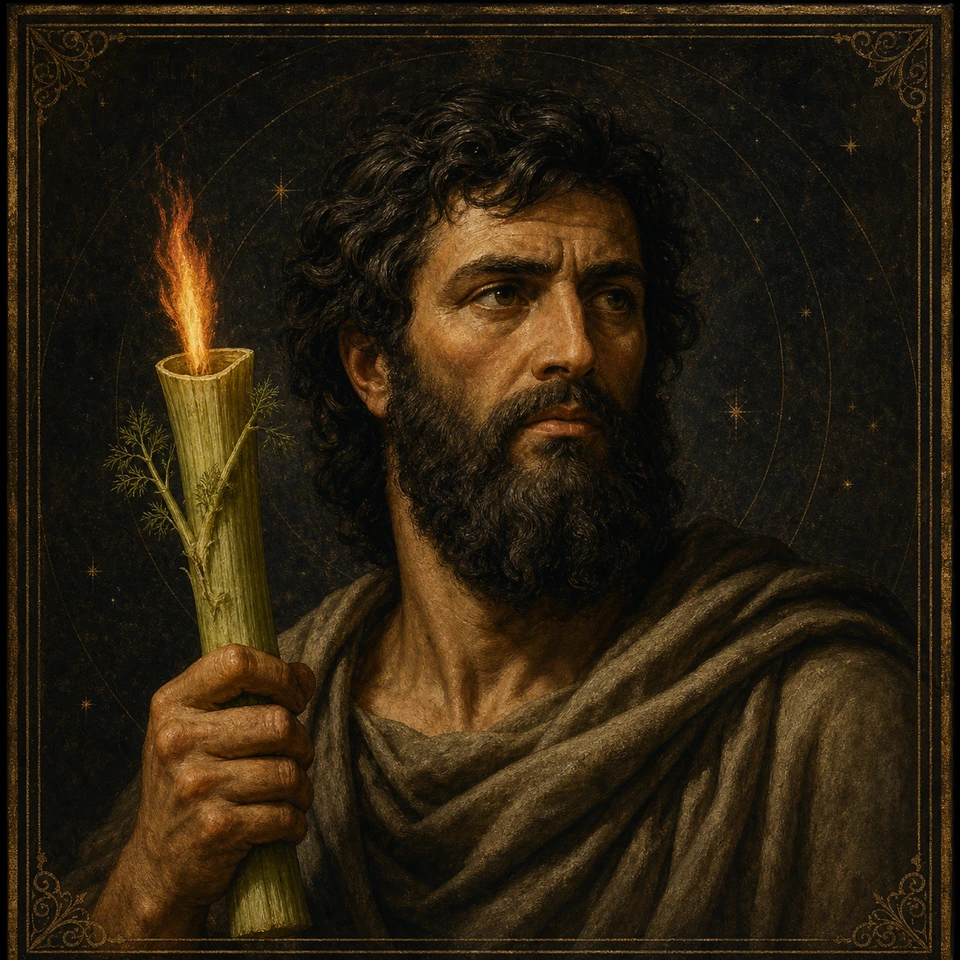
Operating as a brilliant culture hero and son of Iapetus, Prometheus forever altered the mortal condition through stolen fire and intricate sacrificial division. His chaotic legacy of brutal punishment and eventual release is deeply woven into ancient flood warnings and celebrated through specialized Athenian torch races.
Overview
Prometheus enters surviving Greek poetry with a knife in his hand and an ox between gods and mortals. At Mecone he cuts the animal into two deceptive portions. Meat and organs disappear inside the unappealing stomach. White bones shine beneath fat. Zeus takes the glittering share, and Hesiod uses that choice to explain why mortals burn bones for gods while keeping the meat. The victory is poisoned. Zeus withholds fire, and the contest moves from the altar into the conditions of human survival.
Prometheus carries the stolen flame back inside a hollow fennel stalk. Fire cooks, warms, works material, and glows after dark, but Hesiod refuses to make the gift painless. Zeus orders a counter-gift. Hephaestus shapes a woman, Athena adorns her, Hermes gives her speech and a difficult mind, and Works and Days names her Pandora. Prometheus warns Epimetheus never to accept a gift from Zeus. Epimetheus accepts her. The jar opens, afflictions scatter, and Hope remains beneath the rim.
Punishment turns Prometheus’s immortal body into a cycle. Zeus binds him, and an eagle consumes his liver by day. The organ grows again at night. Heracles kills the bird and releases him, but Hesiod says the act occurs with Zeus’s consent and increases Heracles’s glory. Pseudo-Apollodorus adds Chiron as a substitute and an olive bond that preserves a sign of the sentence. Freedom does not erase the order that imposed the chains.
Prometheus Bound makes the prisoner speak. On a remote Scythian crag, Hephaestus reluctantly fastens him while Power demands obedience. Before the Oceanids, Prometheus claims gifts far beyond the fennel flame: number, writing, domesticated labor, ships, medicine, divination, and metals. Io arrives in torment and hears the map of her future. Hermes demands the secret of a marriage that could endanger Zeus. Prometheus refuses. Thunder and collapse close the play before release. Its traditional attribution to Aeschylus is disputed, and its enlarged theology belongs to this tragic telling.
Later Greek mythography extends foresight into family. Prometheus warns his son Deucalion before Zeus sends the flood. Deucalion builds a chest, survives with Pyrrha, and helps restore humanity through stones cast behind them. After Heracles frees Prometheus, the adviser tells the hero to send Atlas for the Hesperidean apples rather than enter the garden himself. Knowledge does not perform the labor, but it makes survival and success possible.
Historical cult evidence is concentrated at Athens. Pausanias saw an altar of Prometheus in the Academy. Runners carried torches from it toward the city, and victory belonged to the bearer whose flame survived. That civic fire is not identical to the stolen ember of poetry, yet both make continuity of flame central. Pausanias names no priesthood, sacrifice list, calendar date, or private rite for the altar.
Prometheus is securely a Greek deity and culture hero. He is not one of the original twelve Titans named in Hesiod’s birth catalogue, although later Greek literature calls him Titan. He is not Hephaestus or Epimetheus. The fennel stalk, flame, eagle, chains, liver, and running torch each arise in a particular poem, drama, image, or cult place. Their force grows when those boundaries remain intact.
Plato’s Protagoras gives the brothers another setting. Epimetheus distributes protections among mortal creatures but reaches humanity with nothing left. Prometheus responds by stealing fire and technical skill, while Zeus later gives the civic bonds that allow people to live together. The philosophical speech is not the Pandora sequence, and its argument does not become cult evidence.
Pseudo-Apollodorus gives Prometheus another beginning for humanity. He moulds human beings from water and earth, gives them fire hidden in fennel, and suffers the Caucasian eagle until Heracles intervenes. This later mythographic sequence is neither Hesiod’s Mecone sacrifice nor Plato’s distribution of mortal powers.
Canonical identity
Canonical Identity
Prometheus operates decisively as a culture hero and a divine son of Iapetus. His earliest surviving narratives are deeply tied to mortal hardship, sacrificial division, the theft of fire, intense binding, and eventual release. While the dramatic tradition and later Greek literature frequently label him a Titan, Hesiod restricts that specific generational title by naming the original Titans before introducing Prometheus among Iapetus's sons; thus, his classification as deity and culture hero is absolute, while "Titan" remains a historically qualified descriptor. He is violently opposed in tragedy by the smith Hephaestus, and Epimetheus serves strictly as his brother, not an alternate alias.
Linguistic Identity
The ancient headword is Προμηθεύς (Promētheús), carrying the short definition of Prometheus or forethought according to the Scaife ATLAS. While this lexical gloss illuminates interpretations, it does not invent a cult power independently. The ancient pronunciation remains a reconstruction relying on Smyth’s grammar and the Scaife headword, whereas the CMUdict provides a distinctly separate modern US English pronunciation; crucially, neither pronunciation dictates correspondence, cult, or myth.
Sources and evidence
TEXTUAL · Supported
Scaife ATLAS gives the Ancient Greek headword Προμηθεύς and the short definition Prometheus or forethought.
- Source
- Scaife ATLAS, Προμηθεύς short definition
- Reviewed edition
- Scaife ATLAS short-definition entry 74264 for Προμηθεύς · Tufts University
- Exact locator
- Entry Προμηθεύς · Section Scaife short-def-74264
- Scope
- Modern classical scholarship · Ancient Greece
- Authority
- Scaife ATLAS short-definition entry
- Certainty
- Certain
The entry gives the headword and short gloss only.
Open exact reviewed sourceSCHOLARLY INTERPRETATION · Supported
Smyth’s letter, long-vowel, diphthong, and acute-accent rules support the qualified fifth-century Attic reconstruction /pro.mɛː.tʰěu̯s/ when applied to Προμηθεύς.
- Source
- Herbert Weir Smyth, A Greek Grammar for Colleges (1920)
- Reviewed edition
- Herbert Weir Smyth, A Greek Grammar for Colleges, American Book Company, 1920; Perseus text 1999.04.0007 · Perseus Digital Library
- Exact locator
- Entry A Greek Grammar for Colleges · Section §§1, 4, 24, 150
- Scope
- Modern classical scholarship · Attica
- Authority
- Herbert Weir Smyth, A Greek Grammar for Colleges
- Certainty
- Qualified
The reconstruction remains qualified because the grammar gives rules rather than an audio witness.
Open exact reviewed sourceTEXTUAL · Supported
The pinned CMUdict entry gives modern US English prometheus as P R AH0 M IY1 TH IY2 AH0 S.
- Source
- Carnegie Mellon University Speech Group, CMU Pronouncing Dictionary
- Reviewed edition
- cmudict data file at commit 74790861f652b15e4ac49015a90074ad62a27690 · Carnegie Mellon University
- Exact locator
- Entry prometheus · Section ARPABET P R AH0 M IY1 TH IY2 AH0 S; pinned line 96087
- Scope
- Modern classical scholarship
- Authority
- Carnegie Mellon University Pronouncing Dictionary
- Certainty
- Certain
This is current General American English, not Ancient Greek.
Open exact reviewed sourceTEXTUAL · Supported
Hesiod names the original Titan generation before presenting Prometheus as a son of Iapetus, so later Titan language requires historical qualification.
- Source
- Hesiod; edited and translated by Hugh G. Evelyn-White, Theogony (1914)
- Reviewed edition
- Hugh G. Evelyn-White edition and English translation in Hesiod, the Homeric Hymns and Homerica, 1914 · translated by Hugh G. Evelyn-White · edited by Hugh G. Evelyn-White · Perseus Digital Library / Scaife ATLAS
- Exact locator
- Entry Theogony · Line 133-138; 507-516
- Scope
- Archaic Greece · Ancient Greece
- Authority
- Hesiod, Theogony
- Certainty
- Certain
The genealogy supports divine identity and Iapetid descent without placing him in the first birth list.
Open exact reviewed source4 reviewed sources for this section
- Scaife ATLAS, Προμηθεύς short definitionScaife ATLAS dictionary short-def entry 74264 · Tufts University
- Herbert Weir Smyth, A Greek Grammar for Colleges (1920)American Book Company, 1920; Perseus text 1999.04.0007 · Perseus Digital Library
- Carnegie Mellon University Speech Group, CMU Pronouncing DictionaryPinned repository commit 74790861f652b15e4ac49015a90074ad62a27690 · Carnegie Mellon University
- Hesiod; edited and translated by Hugh G. Evelyn-White, Theogony (1914)Hesiod, the Homeric Hymns and Homerica, London and New York, 1914 · Perseus Digital Library / Scaife ATLAS
Culture, tradition, period, and place
Archaic Greek poetry gives the earliest surviving narrative structure. Hesiod’s Prometheus stands inside a contest over sacrifice, fire, and Zeus’s ordering of mortal life. Fifth-century Athenian drama turns the bound figure into a speaking benefactor and seer. Plato gives the brothers a philosophical account of mortal equipment and civic order. Later Greek mythography gathers human making, flood survival, release, and Hesperides advice into longer sequences.
Place changes with genre. Mecone is a mythic meeting ground of gods and mortals. The remote crag of Prometheus Bound is dramatic geography at the edge of Scythia. Pseudo-Apollodorus ties the flood to Parnassus and the punishment to the Caucasus. Athens gives the clearest historical cult location: an altar in the Academy from which runners carried burning torches toward the city.
A Roman Gallic medallion belongs to a later provincial setting. It continues the punishment and rescue image without turning Roman Gaul into a Greek sanctuary or making Hercules and Heracles interchangeable in every historical context.
Sources and evidence
TEXTUAL · Supported
Theogony places Prometheus in the Archaic Greek disputes over sacrifice, fire, Zeus’s order, punishment, and release.
- Source
- Hesiod; edited and translated by Hugh G. Evelyn-White, Theogony (1914)
- Reviewed edition
- Hugh G. Evelyn-White edition and English translation in Hesiod, the Homeric Hymns and Homerica, 1914 · translated by Hugh G. Evelyn-White · edited by Hugh G. Evelyn-White · Perseus Digital Library / Scaife ATLAS
- Exact locator
- Entry Theogony · Line 507-616
- Scope
- Archaic Greece · Ancient Greece
- Authority
- Hesiod, Theogony
- Certainty
- Certain
The poem is the earliest surviving continuous Prometheus witness used here.
Open exact reviewed sourceTEXTUAL · Supported
Prometheus Bound places the speaking prisoner on a remote Scythian crag and expands his benefactions and defiance in tragedy.
- Source
- Traditionally attributed to Aeschylus; translated by Herbert Weir Smyth, Prometheus Bound (1922)
- Reviewed edition
- Herbert Weir Smyth English translation in Aeschylus, volume I, 1922; Perseus modernization · translated by Herbert Weir Smyth · Perseus Digital Library / Scaife ATLAS
- Exact locator
- Entry Prometheus Bound · Line 1-1093
- Scope
- Classical Greece · Scythian wilderness in Prometheus Bound
- Authority
- Prometheus Bound, Smyth 1922 English translation
- Certainty
- Certain
The dramatic landscape is not treated as an excavated sanctuary.
Open exact reviewed sourceTEXTUAL · Supported
The Library places Prometheus in genealogy, the Caucasian punishment, Parnassian flood survival, and the Hesperides labor.
- Source
- Pseudo-Apollodorus; edited and translated by James G. Frazer, Library (1921)
- Reviewed edition
- James G. Frazer edition and English translation, Harvard University Press and William Heinemann, 1921 · translated by James G. Frazer · edited by James G. Frazer · Perseus Digital Library / Scaife ATLAS
- Exact locator
- Entry Library · Section 1.2.3; 1.7.1-2; 2.5.11
- Scope
- Greek religion under Roman imperial rule · Ancient Greece
- Authority
- Pseudo-Apollodorus, Library
- Certainty
- Certain
These settings belong to later Greek mythography.
Open exact reviewed sourceTEXTUAL · Supported
Pausanias locates Prometheus’s altar and the torch-race starting point in the Academy at Athens.
- Source
- Pausanias; Spiro Greek edition and Jones/Ormerod translation volumes, Description of Greece (1935)
- Reviewed edition
- W. H. S. Jones and H. A. Ormerod English translation volumes, 1918-1935 · translated by W. H. S. Jones and H. A. Ormerod, volume-dependent · Perseus Digital Library / Scaife ATLAS
- Exact locator
- Entry Description of Greece · Book 1 · Chapter 30 · Section 2
- Scope
- Greek religion under Roman imperial rule · Athens
- Authority
- Pausanias, Description of Greece
- Certainty
- Certain
The named Athenian place is direct cult geography.
Open exact reviewed sourceTEXTUAL · Supported
Plato’s Protagoras gives the brothers a Classical Athenian philosophical account of mortal equipment and civic order.
- Source
- Plato; translated by W. R. M. Lamb, Protagoras (1967)
- Reviewed edition
- W. R. M. Lamb translation in Plato in Twelve Volumes, Volume 3, 1967 reprint · translated by W. R. M. Lamb · Perseus Digital Library
- Exact locator
- Entry Protagoras · Section 320c-322d
- Scope
- Classical Greece · Athens
- Authority
- Plato, Protagoras
- Certainty
- Certain
The speech is philosophical myth, not Archaic cult testimony.
Open exact reviewed sourceMATERIAL CULTURE · Supported
The Met catalogue identifies a mid-second-century AD Roman Gallic medallion fragment depicting the punishment and rescue of Prometheus.
- Source
- The Metropolitan Museum of Art, Open Access Collection and Collection API
- Reviewed edition
- Live collection records and API; eligible Open Access objects only · The Metropolitan Museum of Art
- Exact locator
- MuseumObjectId 17.194.2139 · RecordUrl https://www.metmuseum.org/art/collection/search/250475
- Scope
- Greek religion under Roman imperial rule · Roman Gaul
- Authority
- Metropolitan Museum of Art collection catalogue
- Certainty
- Certain
The object belongs to Roman Gaul and remains separate from Greek cult geography.
Open exact reviewed source6 reviewed sources for this section
- Hesiod; edited and translated by Hugh G. Evelyn-White, Theogony (1914)Hesiod, the Homeric Hymns and Homerica, London and New York, 1914 · Perseus Digital Library / Scaife ATLAS
- Traditionally attributed to Aeschylus; translated by Herbert Weir Smyth, Prometheus Bound (1922)Herbert Weir Smyth English translation, 1922, modernized by Perseus · Perseus Digital Library / Scaife ATLAS
- Pseudo-Apollodorus; edited and translated by James G. Frazer, Library (1921)Harvard University Press and William Heinemann edition, 1921 · Perseus Digital Library / Scaife ATLAS
- Pausanias; Spiro Greek edition and Jones/Ormerod translation volumes, Description of Greece (1935)Perseus CTS edition corpus, 1903-1935 · Perseus Digital Library / Scaife ATLAS
- Plato; translated by W. R. M. Lamb, Protagoras (1967)Plato in Twelve Volumes, Volume 3, 1967 reprint · Perseus Digital Library
- The Metropolitan Museum of Art, Open Access Collection and Collection APILive collection data and eligible public-domain images · The Metropolitan Museum of Art
Historical development
Hesiod already contains the hard skeleton: Iapetid genealogy, unequal ox portions at Mecone, removal and theft of fire, the fashioned woman, chains, the devouring eagle, and Heracles’s release. Works and Days gives the hollow fennel stalk, names Pandora, and adds Prometheus’s rejected warning to Epimetheus.
Prometheus Bound transforms the sufferer into the voice of a civic and technical imagination. He claims a vast catalogue of arts, reads Io’s future, and holds a secret that could threaten Zeus. The play ends before release, inside defiance and storm. Its traditional attribution to Aeschylus is disputed, so authorship and theology remain qualified.
Plato’s Protagoras makes Epimetheus the distributor of animal powers and Prometheus the giver of fire and technical skill to vulnerable humanity. Pseudo-Apollodorus also makes Prometheus the human maker, shaping people from water and earth before giving them concealed fire. These are different anthropogonies, not lost pieces of Hesiod.
Pausanias preserves the Athenian altar and torch race centuries later. A Roman Gallic medallion then carries the bound body, attacking eagle, and armed rescuer into provincial Roman art. Historical development here is change in genre, claim, place, and medium, not a single doctrine unfolding without interruption.
Sources and evidence
TEXTUAL · Supported
Theogony joins Iapetid genealogy, Mecone, withheld and stolen fire, the fashioned woman, binding, eagle, and Heracles’s release.
- Source
- Hesiod; edited and translated by Hugh G. Evelyn-White, Theogony (1914)
- Reviewed edition
- Hugh G. Evelyn-White edition and English translation in Hesiod, the Homeric Hymns and Homerica, 1914 · translated by Hugh G. Evelyn-White · edited by Hugh G. Evelyn-White · Perseus Digital Library / Scaife ATLAS
- Exact locator
- Entry Theogony · Line 507-616
- Scope
- Archaic Greece · Ancient Greece
- Authority
- Hesiod, Theogony
- Certainty
- Certain
The poem compresses several later-expanded themes.
Open exact reviewed sourceTEXTUAL · Supported
Works and Days adds the hollow fennel carrier, names Pandora, preserves Prometheus’s warning, and narrates the jar.
- Source
- Hesiod; edited and translated by Hugh G. Evelyn-White, Works and Days (1914)
- Reviewed edition
- Hugh G. Evelyn-White edition and English translation in Hesiod, the Homeric Hymns and Homerica, 1914 · translated by Hugh G. Evelyn-White · edited by Hugh G. Evelyn-White · Perseus Digital Library / Scaife ATLAS
- Exact locator
- Entry Works and Days · Line 42-108
- Scope
- Archaic Greece · Ancient Greece
- Authority
- Hesiod, Works and Days
- Certainty
- Certain
The poem differs from the Theogony’s unnamed fashioned woman.
Open exact reviewed sourceTEXTUAL · Supported
Prometheus Bound gives the prisoner a catalogue of arts, Io’s future, a dangerous marriage secret, and an ending in storm.
- Source
- Traditionally attributed to Aeschylus; translated by Herbert Weir Smyth, Prometheus Bound (1922)
- Reviewed edition
- Herbert Weir Smyth English translation in Aeschylus, volume I, 1922; Perseus modernization · translated by Herbert Weir Smyth · Perseus Digital Library / Scaife ATLAS
- Exact locator
- Entry Prometheus Bound · Line 1-1093
- Scope
- Classical Greece · Scythian wilderness in Prometheus Bound
- Authority
- Prometheus Bound, Smyth 1922 English translation
- Certainty
- Certain
Traditional Aeschylean attribution remains disputed.
Open exact reviewed sourceTEXTUAL · Supported
Pausanias preserves a later historical witness to the Academy altar and torch race.
- Source
- Pausanias; Spiro Greek edition and Jones/Ormerod translation volumes, Description of Greece (1935)
- Reviewed edition
- W. H. S. Jones and H. A. Ormerod English translation volumes, 1918-1935 · translated by W. H. S. Jones and H. A. Ormerod, volume-dependent · Perseus Digital Library / Scaife ATLAS
- Exact locator
- Entry Description of Greece · Book 1 · Chapter 30 · Section 2
- Scope
- Greek religion under Roman imperial rule · Athens
- Authority
- Pausanias, Description of Greece
- Certainty
- Certain
The passage gives cult place and action without a full calendar.
Open exact reviewed sourceMATERIAL CULTURE · Supported
A Roman Gallic terracotta medallion continues the bound-body, eagle, and armed-rescuer image in provincial Roman art.
- Source
- The Metropolitan Museum of Art, Open Access Collection and Collection API
- Reviewed edition
- Live collection records and API; eligible Open Access objects only · The Metropolitan Museum of Art
- Exact locator
- MuseumObjectId 17.194.2139 · RecordUrl https://www.metmuseum.org/art/collection/search/250475
- Scope
- Greek religion under Roman imperial rule · Roman Gaul
- Authority
- Metropolitan Museum of Art collection catalogue
- Certainty
- Certain
The provincial object is later reception, not Classical Greek cult imagery.
Open exact reviewed sourceTEXTUAL · Supported
Protagoras makes Epimetheus distribute animal powers and Prometheus repair humanity’s lack with fire and technical skill.
- Source
- Plato; translated by W. R. M. Lamb, Protagoras (1967)
- Reviewed edition
- W. R. M. Lamb translation in Plato in Twelve Volumes, Volume 3, 1967 reprint · translated by W. R. M. Lamb · Perseus Digital Library
- Exact locator
- Entry Protagoras · Section 320c-322d
- Scope
- Classical Greece · Athens
- Authority
- Plato, Protagoras
- Certainty
- Certain
Zeus later gives civic bonds in the same speech.
Open exact reviewed sourceTEXTUAL · Supported
The Library makes Prometheus mould human beings from water and earth before giving them concealed fire.
- Source
- Pseudo-Apollodorus; edited and translated by James G. Frazer, Library (1921)
- Reviewed edition
- James G. Frazer edition and English translation, Harvard University Press and William Heinemann, 1921 · translated by James G. Frazer · edited by James G. Frazer · Perseus Digital Library / Scaife ATLAS
- Exact locator
- Entry Library · Book 1 · Chapter 7 · Section 1
- Scope
- Greek religion under Roman imperial rule · Ancient Greece
- Authority
- Pseudo-Apollodorus, Library
- Certainty
- Certain
This later human-making role does not occur in Hesiod’s Mecone episode.
Open exact reviewed source7 reviewed sources for this section
- Hesiod; edited and translated by Hugh G. Evelyn-White, Theogony (1914)Hesiod, the Homeric Hymns and Homerica, London and New York, 1914 · Perseus Digital Library / Scaife ATLAS
- Hesiod; edited and translated by Hugh G. Evelyn-White, Works and Days (1914)Hesiod, the Homeric Hymns and Homerica, London and New York, 1914 · Perseus Digital Library / Scaife ATLAS
- Traditionally attributed to Aeschylus; translated by Herbert Weir Smyth, Prometheus Bound (1922)Herbert Weir Smyth English translation, 1922, modernized by Perseus · Perseus Digital Library / Scaife ATLAS
- Pausanias; Spiro Greek edition and Jones/Ormerod translation volumes, Description of Greece (1935)Perseus CTS edition corpus, 1903-1935 · Perseus Digital Library / Scaife ATLAS
- The Metropolitan Museum of Art, Open Access Collection and Collection APILive collection data and eligible public-domain images · The Metropolitan Museum of Art
- Plato; translated by W. R. M. Lamb, Protagoras (1967)Plato in Twelve Volumes, Volume 3, 1967 reprint · Perseus Digital Library
- Pseudo-Apollodorus; edited and translated by James G. Frazer, Library (1921)Harvard University Press and William Heinemann edition, 1921 · Perseus Digital Library / Scaife ATLAS
Attested roles and historical themes
Roles, powers, and limits
In Archaic poetry Prometheus is cunning enough to challenge Zeus and bold enough to restore fire, but not strong enough to escape punishment. His benefit to humanity is real and costly. As father and forewarner in the later flood narrative, he preserves Deucalion by practical counsel. As adviser to Heracles, he converts knowledge into a workable plan.
The dramatic figure is larger. He teaches measure, signs, transport, healing, divination, and metalwork, and he knows the dangerous future of Zeus’s marriage. Those roles belong to Prometheus Bound. They do not prove that every Athenian worshipper approached his altar for every craft, prophecy, medicine, or act of rebellion.
His limits are equally attested. He is chained, wounded, dependent on Heracles for physical release, and forced to negotiate within Zeus’s order. In Plato’s Protagoras, fire and technical wisdom answer bodily vulnerability, while civic wisdom remains with Zeus. Prometheus repairs one mortal lack but does not govern the whole human condition.
Sources and evidence
TEXTUAL · Supported
Works and Days makes Prometheus the thief who restores fire in a hollow fennel stalk despite Zeus’s prohibition.
- Source
- Hesiod; edited and translated by Hugh G. Evelyn-White, Works and Days (1914)
- Reviewed edition
- Hugh G. Evelyn-White edition and English translation in Hesiod, the Homeric Hymns and Homerica, 1914 · translated by Hugh G. Evelyn-White · edited by Hugh G. Evelyn-White · Perseus Digital Library / Scaife ATLAS
- Exact locator
- Entry Works and Days · Line 42-58
- Scope
- Archaic Greece · Ancient Greece
- Authority
- Hesiod, Works and Days
- Certainty
- Certain
The gift provokes the counter-gift rather than ending mortal hardship.
Open exact reviewed sourceTEXTUAL · Supported
Prometheus Bound attributes number, writing, animal labor, ships, medicine, divination, and metal knowledge to Prometheus.
- Source
- Traditionally attributed to Aeschylus; translated by Herbert Weir Smyth, Prometheus Bound (1922)
- Reviewed edition
- Herbert Weir Smyth English translation in Aeschylus, volume I, 1922; Perseus modernization · translated by Herbert Weir Smyth · Perseus Digital Library / Scaife ATLAS
- Exact locator
- Entry Prometheus Bound · Line 436-506
- Scope
- Classical Greece · Scythian wilderness in Prometheus Bound
- Authority
- Prometheus Bound, Smyth 1922 English translation
- Certainty
- Certain
The catalogue belongs to the tragedy.
Open exact reviewed sourceTEXTUAL · Supported
The Library makes Prometheus warn Deucalion before the flood and advise Heracles to use Atlas in the Hesperides labor.
- Source
- Pseudo-Apollodorus; edited and translated by James G. Frazer, Library (1921)
- Reviewed edition
- James G. Frazer edition and English translation, Harvard University Press and William Heinemann, 1921 · translated by James G. Frazer · edited by James G. Frazer · Perseus Digital Library / Scaife ATLAS
- Exact locator
- Entry Library · Section 1.7.2; 2.5.11
- Scope
- Greek religion under Roman imperial rule · Ancient Greece
- Authority
- Pseudo-Apollodorus, Library
- Certainty
- Certain
Counsel changes survival and heroic strategy without performing the labor.
Open exact reviewed sourceTEXTUAL · Supported
Theogony makes Prometheus unable to escape binding and the eagle until Heracles intervenes with Zeus’s consent.
- Source
- Hesiod; edited and translated by Hugh G. Evelyn-White, Theogony (1914)
- Reviewed edition
- Hugh G. Evelyn-White edition and English translation in Hesiod, the Homeric Hymns and Homerica, 1914 · translated by Hugh G. Evelyn-White · edited by Hugh G. Evelyn-White · Perseus Digital Library / Scaife ATLAS
- Exact locator
- Entry Theogony · Line 521-534
- Scope
- Archaic Greece · Ancient Greece
- Authority
- Hesiod, Theogony
- Certainty
- Certain
Cunning does not overturn Zeus’s order.
Open exact reviewed sourceTEXTUAL · Supported
In Protagoras, Prometheus gives fire and technical wisdom, while civic wisdom remains with Zeus.
- Source
- Plato; translated by W. R. M. Lamb, Protagoras (1967)
- Reviewed edition
- W. R. M. Lamb translation in Plato in Twelve Volumes, Volume 3, 1967 reprint · translated by W. R. M. Lamb · Perseus Digital Library
- Exact locator
- Entry Protagoras · Section 320c-322d
- Scope
- Classical Greece · Athens
- Authority
- Plato, Protagoras
- Certainty
- Certain
The speech gives him a bounded remedy for human vulnerability.
Open exact reviewed source5 reviewed sources for this section
- Hesiod; edited and translated by Hugh G. Evelyn-White, Works and Days (1914)Hesiod, the Homeric Hymns and Homerica, London and New York, 1914 · Perseus Digital Library / Scaife ATLAS
- Traditionally attributed to Aeschylus; translated by Herbert Weir Smyth, Prometheus Bound (1922)Herbert Weir Smyth English translation, 1922, modernized by Perseus · Perseus Digital Library / Scaife ATLAS
- Pseudo-Apollodorus; edited and translated by James G. Frazer, Library (1921)Harvard University Press and William Heinemann edition, 1921 · Perseus Digital Library / Scaife ATLAS
- Hesiod; edited and translated by Hugh G. Evelyn-White, Theogony (1914)Hesiod, the Homeric Hymns and Homerica, London and New York, 1914 · Perseus Digital Library / Scaife ATLAS
- Plato; translated by W. R. M. Lamb, Protagoras (1967)Plato in Twelve Volumes, Volume 3, 1967 reprint · Perseus Digital Library
Epithets and titles
Poetic Epithet
Ready-witted
Ready-witted
Archaic Greek hexameter tradition · Archaic GreekEvelyn-White renders the characterization in the Prometheus passage; it is a poetic description rather than a localized cult title.
1 reviewed source for this section
- Hesiod; edited and translated by Hugh G. Evelyn-White, Theogony (1914)Hesiod, the Homeric Hymns and Homerica, London and New York, 1914 · Perseus Digital Library / Scaife ATLAS
Worship and cult
Pausanias gives the clearest direct cult witness. Inside the Athenian Academy stood an altar of Prometheus. Runners began there with burning torches and raced toward the city, trying to keep the flame alive. If the leader’s torch failed, the next surviving flame could win. Living fire, speed, and endurance meet at a named altar.
The same passage names no priesthood, sacrifice, prayer, initiation, or household custom. Nearby altars of the Muses, Hermes, Athena, and Heracles do not merge those cults with Prometheus. Prometheus Bound is religious drama, not a ritual manual. Hesiod’s Mecone sacrifice explains a division between gods and mortals; Prometheus arranges the portions but is not the god receiving them.
Sources and evidence
TEXTUAL · Supported
Pausanias describes Prometheus’s Academy altar and a race won by carrying living fire toward the city.
- Source
- Pausanias; Spiro Greek edition and Jones/Ormerod translation volumes, Description of Greece (1935)
- Reviewed edition
- W. H. S. Jones and H. A. Ormerod English translation volumes, 1918-1935 · translated by W. H. S. Jones and H. A. Ormerod, volume-dependent · Perseus Digital Library / Scaife ATLAS
- Exact locator
- Entry Description of Greece · Book 1 · Chapter 30 · Section 2
- Scope
- Greek religion under Roman imperial rule · Athens
- Authority
- Pausanias, Description of Greece
- Certainty
- Certain
The account names neither priesthood nor private rite.
Open exact reviewed sourceTEXTUAL · Supported
At Mecone Prometheus arranges the sacrificial portions, but Hesiod does not make him the divine recipient of the ox.
- Source
- Hesiod; edited and translated by Hugh G. Evelyn-White, Theogony (1914)
- Reviewed edition
- Hugh G. Evelyn-White edition and English translation in Hesiod, the Homeric Hymns and Homerica, 1914 · translated by Hugh G. Evelyn-White · edited by Hugh G. Evelyn-White · Perseus Digital Library / Scaife ATLAS
- Exact locator
- Entry Theogony · Line 535-616
- Scope
- Archaic Greece · Ancient Greece
- Authority
- Hesiod, Theogony
- Certainty
- Certain
The episode explains a mortal-divine sacrificial division.
Open exact reviewed source2 reviewed sources for this section
- Pausanias; Spiro Greek edition and Jones/Ormerod translation volumes, Description of Greece (1935)Perseus CTS edition corpus, 1903-1935 · Perseus Digital Library / Scaife ATLAS
- Hesiod; edited and translated by Hugh G. Evelyn-White, Theogony (1914)Hesiod, the Homeric Hymns and Homerica, London and New York, 1914 · Perseus Digital Library / Scaife ATLAS
Temples, sanctuaries, and sacred places
The Academy at Athens is the secure sacred place because Pausanias names both the altar and the torch race that began from it. The grove was dense with heroic, divine, philosophical, and civic associations. Prometheus belongs there through his own altar, not by borrowing the nearby installations of Hermes, Athena, the Muses, or Heracles.
Mecone, Parnassus, the Hesperidean boundary, the Caucasus, and the Scythian crag belong to narrative geography. They carry divine negotiation, flood survival, heroic labor, punishment, and dramatic exile. None becomes a documented sanctuary merely because action occurs there. The texts provide no pilgrimage rite and no archaeologically fixed prison rock.
Sources and evidence
TEXTUAL · Supported
The Athenian Academy is a secure sacred place for Prometheus because Pausanias names his altar there.
- Source
- Pausanias; Spiro Greek edition and Jones/Ormerod translation volumes, Description of Greece (1935)
- Reviewed edition
- W. H. S. Jones and H. A. Ormerod English translation volumes, 1918-1935 · translated by W. H. S. Jones and H. A. Ormerod, volume-dependent · Perseus Digital Library / Scaife ATLAS
- Exact locator
- Entry Description of Greece · Book 1 · Chapter 30 · Section 2
- Scope
- Greek religion under Roman imperial rule · Athens
- Authority
- Pausanias, Description of Greece
- Certainty
- Certain
Nearby altars remain distinct cult installations.
Open exact reviewed sourceTEXTUAL · Supported
Mecone is the narrative meeting place for Prometheus’s division of the ox between gods and mortals.
- Source
- Hesiod; edited and translated by Hugh G. Evelyn-White, Theogony (1914)
- Reviewed edition
- Hugh G. Evelyn-White edition and English translation in Hesiod, the Homeric Hymns and Homerica, 1914 · translated by Hugh G. Evelyn-White · edited by Hugh G. Evelyn-White · Perseus Digital Library / Scaife ATLAS
- Exact locator
- Entry Theogony · Line 535-616
- Scope
- Archaic Greece · Ancient Greece
- Authority
- Hesiod, Theogony
- Certainty
- Certain
A mythic setting does not by itself prove a sanctuary.
Open exact reviewed sourceTEXTUAL · Supported
The Library names Parnassus for flood survival, the Caucasus for punishment, and the Hesperides boundary for Prometheus’s advice.
- Source
- Pseudo-Apollodorus; edited and translated by James G. Frazer, Library (1921)
- Reviewed edition
- James G. Frazer edition and English translation, Harvard University Press and William Heinemann, 1921 · translated by James G. Frazer · edited by James G. Frazer · Perseus Digital Library / Scaife ATLAS
- Exact locator
- Entry Library · Section 1.7.1-2; 2.5.11
- Scope
- Greek religion under Roman imperial rule · Ancient Greece
- Authority
- Pseudo-Apollodorus, Library
- Certainty
- Certain
These places carry narrative action rather than a common Prometheus pilgrimage cult.
Open exact reviewed sourceTEXTUAL · Supported
Prometheus Bound opens on a remote Scythian crag where Hephaestus fastens the prisoner.
- Source
- Traditionally attributed to Aeschylus; translated by Herbert Weir Smyth, Prometheus Bound (1922)
- Reviewed edition
- Herbert Weir Smyth English translation in Aeschylus, volume I, 1922; Perseus modernization · translated by Herbert Weir Smyth · Perseus Digital Library / Scaife ATLAS
- Exact locator
- Entry Prometheus Bound · Line 1-87
- Scope
- Classical Greece · Scythian wilderness in Prometheus Bound
- Authority
- Prometheus Bound, Smyth 1922 English translation
- Certainty
- Certain
Dramatic geography is not an archaeologically fixed prison rock.
Open exact reviewed source4 reviewed sources for this section
- Pausanias; Spiro Greek edition and Jones/Ormerod translation volumes, Description of Greece (1935)Perseus CTS edition corpus, 1903-1935 · Perseus Digital Library / Scaife ATLAS
- Hesiod; edited and translated by Hugh G. Evelyn-White, Theogony (1914)Hesiod, the Homeric Hymns and Homerica, London and New York, 1914 · Perseus Digital Library / Scaife ATLAS
- Pseudo-Apollodorus; edited and translated by James G. Frazer, Library (1921)Harvard University Press and William Heinemann edition, 1921 · Perseus Digital Library / Scaife ATLAS
- Traditionally attributed to Aeschylus; translated by Herbert Weir Smyth, Prometheus Bound (1922)Herbert Weir Smyth English translation, 1922, modernized by Perseus · Perseus Digital Library / Scaife ATLAS
Festivals and processions
The torch race from the Academy is an attested civic contest bound to Prometheus’s altar. Its rule is material and unforgiving: the torch must remain lit. Extinguished flame removes the runner’s claim, allowing the next bearer with living fire to prevail.
Pausanias does not name the festival, month, annual frequency, or procession order. The event therefore remains a dated ancient torch race rather than a modern calendar reconstructed from symbolism. A late-Classical vase catalogue places a labeled Prometheus figure in an Anthesteria scene, but one painted appearance does not establish a second festival office, ritual duty, or calendar rule for him.
Sources and evidence
TEXTUAL · Supported
Pausanias describes the Academy torch race but gives no festival name, month, annual frequency, or procession order.
- Source
- Pausanias; Spiro Greek edition and Jones/Ormerod translation volumes, Description of Greece (1935)
- Reviewed edition
- W. H. S. Jones and H. A. Ormerod English translation volumes, 1918-1935 · translated by W. H. S. Jones and H. A. Ormerod, volume-dependent · Perseus Digital Library / Scaife ATLAS
- Exact locator
- Entry Description of Greece · Book 1 · Chapter 30 · Section 2
- Scope
- Greek religion under Roman imperial rule · Athens
- Authority
- Pausanias, Description of Greece
- Certainty
- Certain
The surviving rule concerns the flame remaining lit.
Open exact reviewed sourceMATERIAL CULTURE · Supported
The Beazley catalogue places a labeled Prometheus figure in an Anthesteria scene on a late-Classical Attic vase.
- Source
- Classical Art Research Centre, University of Oxford, Beazley Archive Pottery Database
- Reviewed edition
- Live record-level Beazley Archive Pottery Database · Classical Art Research Centre
- Exact locator
- Entry CARC Beazley record 28128, UUID FC58DD68-E6BC-49F1-8644-CE7BA8258736 · MuseumObjectId Athens 3rd Ephoreia 3500
- Scope
- Classical Greece · Athens
- Authority
- Classical Art Research Centre pottery catalogue
- Certainty
- Certain
One painted appearance does not establish a festival office or ritual duty.
Open exact reviewed source2 reviewed sources for this section
- Pausanias; Spiro Greek edition and Jones/Ormerod translation volumes, Description of Greece (1935)Perseus CTS edition corpus, 1903-1935 · Perseus Digital Library / Scaife ATLAS
- Classical Art Research Centre, University of Oxford, Beazley Archive Pottery DatabaseLive scholarly vase-painting catalogue · Classical Art Research Centre
Offerings, votives, and ritual evidence
A named altar implies sacrificial capacity, yet Pausanias does not say what was placed or burned there. The only described action is the carrying of torches from the Academy into Athens. No grain, wine, incense, victim, or crafted votive can be assigned to this altar from his account.
Hesiod’s ox at Mecone belongs to a mythic negotiation that explains why fat-covered bones burn for gods while mortals retain meat. Prometheus arranges the portions; he is not the recipient. The hollow fennel stalk likewise carries stolen fire in narrative. It is an exact ancient object, not an offering list or an instruction for handling flame.
Sources and evidence
TEXTUAL · Supported
Pausanias names Prometheus’s altar and torch race without identifying an offering deposited or burned there.
- Source
- Pausanias; Spiro Greek edition and Jones/Ormerod translation volumes, Description of Greece (1935)
- Reviewed edition
- W. H. S. Jones and H. A. Ormerod English translation volumes, 1918-1935 · translated by W. H. S. Jones and H. A. Ormerod, volume-dependent · Perseus Digital Library / Scaife ATLAS
- Exact locator
- Entry Description of Greece · Book 1 · Chapter 30 · Section 2
- Scope
- Greek religion under Roman imperial rule · Athens
- Authority
- Pausanias, Description of Greece
- Certainty
- Certain
The account cannot supply a food, drink, incense, or victim list.
Open exact reviewed sourceTEXTUAL · Supported
The Mecone ox is divided by Prometheus for gods and mortals; it is not described as an offering made to Prometheus.
- Source
- Hesiod; edited and translated by Hugh G. Evelyn-White, Theogony (1914)
- Reviewed edition
- Hugh G. Evelyn-White edition and English translation in Hesiod, the Homeric Hymns and Homerica, 1914 · translated by Hugh G. Evelyn-White · edited by Hugh G. Evelyn-White · Perseus Digital Library / Scaife ATLAS
- Exact locator
- Entry Theogony · Line 535-616
- Scope
- Archaic Greece · Ancient Greece
- Authority
- Hesiod, Theogony
- Certainty
- Certain
The animal belongs to an aetiology of sacrifice.
Open exact reviewed sourceTEXTUAL · Supported
The hollow fennel stalk carries stolen fire in Works and Days.
- Source
- Hesiod; edited and translated by Hugh G. Evelyn-White, Works and Days (1914)
- Reviewed edition
- Hugh G. Evelyn-White edition and English translation in Hesiod, the Homeric Hymns and Homerica, 1914 · translated by Hugh G. Evelyn-White · edited by Hugh G. Evelyn-White · Perseus Digital Library / Scaife ATLAS
- Exact locator
- Entry Works and Days · Line 42-58
- Scope
- Archaic Greece · Ancient Greece
- Authority
- Hesiod, Works and Days
- Certainty
- Certain
A narrative carrier is not an ancient offering prescription.
Open exact reviewed source3 reviewed sources for this section
- Pausanias; Spiro Greek edition and Jones/Ormerod translation volumes, Description of Greece (1935)Perseus CTS edition corpus, 1903-1935 · Perseus Digital Library / Scaife ATLAS
- Hesiod; edited and translated by Hugh G. Evelyn-White, Theogony (1914)Hesiod, the Homeric Hymns and Homerica, London and New York, 1914 · Perseus Digital Library / Scaife ATLAS
- Hesiod; edited and translated by Hugh G. Evelyn-White, Works and Days (1914)Hesiod, the Homeric Hymns and Homerica, London and New York, 1914 · Perseus Digital Library / Scaife ATLAS
Iconography and material culture
A late-Classical Attic vase gives a restrained visual anchor. The scholarly catalogue reports a vanished white label identifying Prometheus above a mature bearded figure in an Anthesteria scene. The page provides no image, and the label is no longer visible. The catalogue therefore supports one documented male type, while the wreath belongs to that Dionysian scene rather than to Prometheus everywhere.
Later art favors punishment and rescue. A Roman Gallic terracotta medallion shows Prometheus bound with arms extended while an eagle attacks his chest and Hercules waits below with bow and arrow. Its mid-second-century AD provincial date remains essential.
Fennel stalk and stolen flame are secure Hesiodic objects. Chains, eagle, liver, bow, and rescuer belong to punishment and release. No single object or body type governs every period.
Sources and evidence
MATERIAL CULTURE · Supported
CARC record 28128 reports a vanished white Prometheus label above a mature bearded figure in an Anthesteria scene.
- Source
- Classical Art Research Centre, University of Oxford, Beazley Archive Pottery Database
- Reviewed edition
- Live record-level Beazley Archive Pottery Database · Classical Art Research Centre
- Exact locator
- Entry CARC Beazley record 28128, UUID FC58DD68-E6BC-49F1-8644-CE7BA8258736 · MuseumObjectId Athens 3rd Ephoreia 3500
- Scope
- Classical Greece · Athens
- Authority
- Classical Art Research Centre pottery catalogue
- Certainty
- Certain
The page says No Image, so no unseen costume or pose is added.
Open exact reviewed sourceMATERIAL CULTURE · Supported
Met object 250475 shows bound Prometheus, an eagle attacking his chest, and Hercules below with bow and arrow.
- Source
- The Metropolitan Museum of Art, Open Access Collection and Collection API
- Reviewed edition
- Live collection records and API; eligible Open Access objects only · The Metropolitan Museum of Art
- Exact locator
- MuseumObjectId 17.194.2139 · RecordUrl https://www.metmuseum.org/art/collection/search/250475
- Scope
- Greek religion under Roman imperial rule · Roman Gaul
- Authority
- Metropolitan Museum of Art collection catalogue
- Certainty
- Certain
The object is a Roman Gallic terracotta medallion fragment.
Open exact reviewed sourceTEXTUAL · Supported
Works and Days binds the hollow fennel stalk to the stolen flame.
- Source
- Hesiod; edited and translated by Hugh G. Evelyn-White, Works and Days (1914)
- Reviewed edition
- Hugh G. Evelyn-White edition and English translation in Hesiod, the Homeric Hymns and Homerica, 1914 · translated by Hugh G. Evelyn-White · edited by Hugh G. Evelyn-White · Perseus Digital Library / Scaife ATLAS
- Exact locator
- Entry Works and Days · Line 42-58
- Scope
- Archaic Greece · Ancient Greece
- Authority
- Hesiod, Works and Days
- Certainty
- Certain
The object is secure in this poem without becoming a universal ritual tool.
Open exact reviewed sourceTEXTUAL · Supported
Theogony binds Prometheus and gives the eagle and renewing liver their punishment context.
- Source
- Hesiod; edited and translated by Hugh G. Evelyn-White, Theogony (1914)
- Reviewed edition
- Hugh G. Evelyn-White edition and English translation in Hesiod, the Homeric Hymns and Homerica, 1914 · translated by Hugh G. Evelyn-White · edited by Hugh G. Evelyn-White · Perseus Digital Library / Scaife ATLAS
- Exact locator
- Entry Theogony · Line 521-534
- Scope
- Archaic Greece · Ancient Greece
- Authority
- Hesiod, Theogony
- Certainty
- Certain
These are instruments and effects of violence, not protective emblems.
Open exact reviewed source4 reviewed sources for this section
- Classical Art Research Centre, University of Oxford, Beazley Archive Pottery DatabaseLive scholarly vase-painting catalogue · Classical Art Research Centre
- The Metropolitan Museum of Art, Open Access Collection and Collection APILive collection data and eligible public-domain images · The Metropolitan Museum of Art
- Hesiod; edited and translated by Hugh G. Evelyn-White, Works and Days (1914)Hesiod, the Homeric Hymns and Homerica, London and New York, 1914 · Perseus Digital Library / Scaife ATLAS
- Hesiod; edited and translated by Hugh G. Evelyn-White, Theogony (1914)Hesiod, the Homeric Hymns and Homerica, London and New York, 1914 · Perseus Digital Library / Scaife ATLAS
Animals, plants, and embodied forms
The hollow fennel stalk is the strongest plant association. Its pithy interior hides and carries the stolen fire in Works and Days. The poem does not call fennel sacred to Prometheus in every setting, and it gives no medicine, incense, or ingestion practice. The stalk is a carrier chosen for a dangerous task.
The eagle is the strongest animal association and the most hostile. It descends to consume the renewing liver until Heracles kills it. It is an executioner of Zeus’s sentence, not a familiar or protective emblem. The ox belongs to the Mecone division as sacrificial body. The olive bond appears only in Pseudo-Apollodorus’s later release terms. Neither animal nor plant becomes a cult-wide sacred species through these episodes.
Sources and evidence
TEXTUAL · Supported
Fennel serves as the hollow carrier of stolen fire in Works and Days.
- Source
- Hesiod; edited and translated by Hugh G. Evelyn-White, Works and Days (1914)
- Reviewed edition
- Hugh G. Evelyn-White edition and English translation in Hesiod, the Homeric Hymns and Homerica, 1914 · translated by Hugh G. Evelyn-White · edited by Hugh G. Evelyn-White · Perseus Digital Library / Scaife ATLAS
- Exact locator
- Entry Works and Days · Line 42-58
- Scope
- Archaic Greece · Ancient Greece
- Authority
- Hesiod, Works and Days
- Certainty
- Certain
The poem gives no medicinal, incense, or ingestion use.
Open exact reviewed sourceTEXTUAL · Supported
The eagle executes Zeus’s repeated bodily punishment, while the ox is the sacrificial body divided at Mecone.
- Source
- Hesiod; edited and translated by Hugh G. Evelyn-White, Theogony (1914)
- Reviewed edition
- Hugh G. Evelyn-White edition and English translation in Hesiod, the Homeric Hymns and Homerica, 1914 · translated by Hugh G. Evelyn-White · edited by Hugh G. Evelyn-White · Perseus Digital Library / Scaife ATLAS
- Exact locator
- Entry Theogony · Line 521-534; 535-560
- Scope
- Archaic Greece · Ancient Greece
- Authority
- Hesiod, Theogony
- Certainty
- Certain
Neither animal is described as Prometheus’s protective familiar.
Open exact reviewed sourceTEXTUAL · Supported
Pseudo-Apollodorus adds an olive bond to the terms of Prometheus’s release.
- Source
- Pseudo-Apollodorus; edited and translated by James G. Frazer, Library (1921)
- Reviewed edition
- James G. Frazer edition and English translation, Harvard University Press and William Heinemann, 1921 · translated by James G. Frazer · edited by James G. Frazer · Perseus Digital Library / Scaife ATLAS
- Exact locator
- Entry Library · Book 2 · Chapter 5 · Section 11
- Scope
- Greek religion under Roman imperial rule · Ancient Greece
- Authority
- Pseudo-Apollodorus, Library
- Certainty
- Certain
The olive belongs to this later release condition rather than a cult-wide sacred tree.
Open exact reviewed source3 reviewed sources for this section
- Hesiod; edited and translated by Hugh G. Evelyn-White, Works and Days (1914)Hesiod, the Homeric Hymns and Homerica, London and New York, 1914 · Perseus Digital Library / Scaife ATLAS
- Hesiod; edited and translated by Hugh G. Evelyn-White, Theogony (1914)Hesiod, the Homeric Hymns and Homerica, London and New York, 1914 · Perseus Digital Library / Scaife ATLAS
- Pseudo-Apollodorus; edited and translated by James G. Frazer, Library (1921)Harvard University Press and William Heinemann edition, 1921 · Perseus Digital Library / Scaife ATLAS
Relationships and genealogy
Hesiod names Iapetus as father, Clymene as mother, and Atlas, Menoetius, and Epimetheus as brothers. Pseudo-Apollodorus keeps Iapetus but calls the mother Asia. Prometheus Bound makes Themis, identified with Gaia, the source of maternal prophecy. These women are not alternate spellings. They are conflicting genealogical traditions.
Pseudo-Apollodorus makes Deucalion the son of Prometheus and gives the father a decisive warning before the flood. The father-son bond survives in the flood narrative itself. Zeus is adversary, ruler, punisher, and eventual consenter across the narratives, but those actions do not create kinship or one timeless moral opposition.
Sources and evidence
TEXTUAL · Supported
Hesiod names Iapetus and Clymene as parents of Prometheus and Atlas, Menoetius, and Epimetheus as brothers.
- Source
- Hesiod; edited and translated by Hugh G. Evelyn-White, Theogony (1914)
- Reviewed edition
- Hugh G. Evelyn-White edition and English translation in Hesiod, the Homeric Hymns and Homerica, 1914 · translated by Hugh G. Evelyn-White · edited by Hugh G. Evelyn-White · Perseus Digital Library / Scaife ATLAS
- Exact locator
- Entry Theogony · Line 133-138; 507-516
- Scope
- Archaic Greece · Ancient Greece
- Authority
- Hesiod, Theogony
- Certainty
- Certain
This is the Archaic genealogy used for the governed relationships.
Open exact reviewed sourceTEXTUAL · Supported
The Library names Asia as Prometheus’s mother and Deucalion as his son.
- Source
- Pseudo-Apollodorus; edited and translated by James G. Frazer, Library (1921)
- Reviewed edition
- James G. Frazer edition and English translation, Harvard University Press and William Heinemann, 1921 · translated by James G. Frazer · edited by James G. Frazer · Perseus Digital Library / Scaife ATLAS
- Exact locator
- Entry Library · Section 1.2.3; 1.7.2
- Scope
- Greek religion under Roman imperial rule · Ancient Greece
- Authority
- Pseudo-Apollodorus, Library
- Certainty
- Certain
These later genealogical statements remain distinct from Hesiod and tragedy.
Open exact reviewed sourceTEXTUAL · Supported
Prometheus Bound identifies Themis with Gaia as the maternal source of Prometheus’s knowledge.
- Source
- Traditionally attributed to Aeschylus; translated by Herbert Weir Smyth, Prometheus Bound (1922)
- Reviewed edition
- Herbert Weir Smyth English translation in Aeschylus, volume I, 1922; Perseus modernization · translated by Herbert Weir Smyth · Perseus Digital Library / Scaife ATLAS
- Exact locator
- Entry Prometheus Bound · Line 209-210; 873-874
- Scope
- Classical Greece · Scythian wilderness in Prometheus Bound
- Authority
- Prometheus Bound, Smyth 1922 English translation
- Certainty
- Certain
The dramatic genealogy is not merged with Clymene or Asia.
Open exact reviewed source3 reviewed sources for this section
- Hesiod; edited and translated by Hugh G. Evelyn-White, Theogony (1914)Hesiod, the Homeric Hymns and Homerica, London and New York, 1914 · Perseus Digital Library / Scaife ATLAS
- Pseudo-Apollodorus; edited and translated by James G. Frazer, Library (1921)Harvard University Press and William Heinemann edition, 1921 · Perseus Digital Library / Scaife ATLAS
- Traditionally attributed to Aeschylus; translated by Herbert Weir Smyth, Prometheus Bound (1922)Herbert Weir Smyth English translation, 1922, modernized by Perseus · Perseus Digital Library / Scaife ATLAS
Actual myths and source variants
The Mecone and fire narrative preserves sacrificial division and the fennel theft before Zeus’s counter-gift. The Pandora sequence carries Prometheus’s warning, Epimetheus’s acceptance, the jar, and the differences between Hesiod’s poems and later mythography.
Prometheus Bound stands separately because its speaking benefactor, catalogue of arts, Io prophecy, maternal genealogy, and unfinished defiance belong to tragedy. Heracles’s release preserves both the Hesiodic ending and Pseudo-Apollodorus’s Chiron and olive-bond terms. Deucalion’s flood makes Prometheus a forewarner and father. The Hesperides myth receives his adviser role without making him apple gatherer, sky bearer, or garden guardian.
Plato’s Protagoras remains another story: Prometheus repairs humanity’s lack after Epimetheus distributes mortal powers. The Library preserves a separate anthropogony in which Prometheus moulds human beings from water and earth, gives them hidden fire, is fastened to the Caucasus, and is freed through Heracles. Each action remains in the witness that gives it shape.
Sources and evidence
TEXTUAL · Supported
Theogony narrates the deceptive ox portions, Zeus’s response, the fire contest, and Prometheus’s punishment.
- Source
- Hesiod; edited and translated by Hugh G. Evelyn-White, Theogony (1914)
- Reviewed edition
- Hugh G. Evelyn-White edition and English translation in Hesiod, the Homeric Hymns and Homerica, 1914 · translated by Hugh G. Evelyn-White · edited by Hugh G. Evelyn-White · Perseus Digital Library / Scaife ATLAS
- Exact locator
- Entry Theogony · Line 507-616
- Scope
- Archaic Greece · Ancient Greece
- Authority
- Hesiod, Theogony
- Certainty
- Certain
The fashioned woman remains unnamed in this poem.
Open exact reviewed sourceTEXTUAL · Supported
Works and Days gives the hidden fennel fire, names Pandora, preserves Prometheus’s warning, and narrates the jar.
- Source
- Hesiod; edited and translated by Hugh G. Evelyn-White, Works and Days (1914)
- Reviewed edition
- Hugh G. Evelyn-White edition and English translation in Hesiod, the Homeric Hymns and Homerica, 1914 · translated by Hugh G. Evelyn-White · edited by Hugh G. Evelyn-White · Perseus Digital Library / Scaife ATLAS
- Exact locator
- Entry Works and Days · Line 42-108
- Scope
- Archaic Greece · Ancient Greece
- Authority
- Hesiod, Works and Days
- Certainty
- Certain
Its Pandora sequence remains distinct from the Theogony’s compressed account.
Open exact reviewed sourceTEXTUAL · Supported
Prometheus Bound narrates the binding, catalogue of arts, Io encounter, marriage secret, Hermes’s demand, refusal, and storm.
- Source
- Traditionally attributed to Aeschylus; translated by Herbert Weir Smyth, Prometheus Bound (1922)
- Reviewed edition
- Herbert Weir Smyth English translation in Aeschylus, volume I, 1922; Perseus modernization · translated by Herbert Weir Smyth · Perseus Digital Library / Scaife ATLAS
- Exact locator
- Entry Prometheus Bound · Line 1-1093
- Scope
- Classical Greece · Scythian wilderness in Prometheus Bound
- Authority
- Prometheus Bound, Smyth 1922 English translation
- Certainty
- Certain
The play ends before release.
Open exact reviewed sourceTEXTUAL · Supported
Pseudo-Apollodorus makes Prometheus mould humans from water and earth and give them hidden fennel fire.
- Source
- Pseudo-Apollodorus; edited and translated by James G. Frazer, Library (1921)
- Reviewed edition
- James G. Frazer edition and English translation, Harvard University Press and William Heinemann, 1921 · translated by James G. Frazer · edited by James G. Frazer · Perseus Digital Library / Scaife ATLAS
- Exact locator
- Entry Library · Book 1 · Chapter 7 · Section 1
- Scope
- Greek religion under Roman imperial rule · Ancient Greece
- Authority
- Pseudo-Apollodorus, Library
- Certainty
- Certain
This human-making episode remains separate from Hesiod and Plato.
Open exact reviewed sourceTEXTUAL · Supported
Pseudo-Apollodorus makes Prometheus father and forewarner of Deucalion before Zeus’s flood.
- Source
- Pseudo-Apollodorus; edited and translated by James G. Frazer, Library (1921)
- Reviewed edition
- James G. Frazer edition and English translation, Harvard University Press and William Heinemann, 1921 · translated by James G. Frazer · edited by James G. Frazer · Perseus Digital Library / Scaife ATLAS
- Exact locator
- Entry Library · Book 1 · Chapter 7 · Section 2
- Scope
- Greek religion under Roman imperial rule · Ancient Greece
- Authority
- Pseudo-Apollodorus, Library
- Certainty
- Certain
Prometheus advises survival but does not travel in the chest.
Open exact reviewed sourceTEXTUAL · Supported
Pseudo-Apollodorus joins Prometheus’s release terms to his advice that Heracles should use Atlas to obtain the apples.
- Source
- Pseudo-Apollodorus; edited and translated by James G. Frazer, Library (1921)
- Reviewed edition
- James G. Frazer edition and English translation, Harvard University Press and William Heinemann, 1921 · translated by James G. Frazer · edited by James G. Frazer · Perseus Digital Library / Scaife ATLAS
- Exact locator
- Entry Library · Book 2 · Chapter 5 · Section 11
- Scope
- Greek religion under Roman imperial rule · Ancient Greece
- Authority
- Pseudo-Apollodorus, Library
- Certainty
- Certain
Prometheus advises; he does not gather the apples or bear the sky.
Open exact reviewed sourceTEXTUAL · Supported
Plato’s Protagoras makes Prometheus repair the human lack after Epimetheus distributes the mortal powers.
- Source
- Plato; translated by W. R. M. Lamb, Protagoras (1967)
- Reviewed edition
- W. R. M. Lamb translation in Plato in Twelve Volumes, Volume 3, 1967 reprint · translated by W. R. M. Lamb · Perseus Digital Library
- Exact locator
- Entry Protagoras · Section 320c-322d
- Scope
- Classical Greece · Athens
- Authority
- Plato, Protagoras
- Certainty
- Certain
The speech is a distinct philosophical anthropogony.
Open exact reviewed source5 reviewed sources for this section
- Hesiod; edited and translated by Hugh G. Evelyn-White, Theogony (1914)Hesiod, the Homeric Hymns and Homerica, London and New York, 1914 · Perseus Digital Library / Scaife ATLAS
- Hesiod; edited and translated by Hugh G. Evelyn-White, Works and Days (1914)Hesiod, the Homeric Hymns and Homerica, London and New York, 1914 · Perseus Digital Library / Scaife ATLAS
- Traditionally attributed to Aeschylus; translated by Herbert Weir Smyth, Prometheus Bound (1922)Herbert Weir Smyth English translation, 1922, modernized by Perseus · Perseus Digital Library / Scaife ATLAS
- Pseudo-Apollodorus; edited and translated by James G. Frazer, Library (1921)Harvard University Press and William Heinemann edition, 1921 · Perseus Digital Library / Scaife ATLAS
- Plato; translated by W. R. M. Lamb, Protagoras (1967)Plato in Twelve Volumes, Volume 3, 1967 reprint · Perseus Digital Library
Myth Library
Each myth gathers its attested participants into one source-grounded account, while distinct source traditions remain readable in their own variants.
Divine Contest And Theft Of Fire
Prometheus at Mecone and the Theft of Fire
Prometheus divides the ox at Mecone, Zeus withholds fire from mortals, and Prometheus carries the stolen flame back inside a hollow fennel stalk.
- Role in this profile
- divides the ox at Mecone and steals fire in a hollow fennel stalk
- Place scope
- Ancient Greece
- Witnesses
- 2
- Variants
- 2
Tragic Bondage And Prophecy
Prometheus Bound and the Secret of Zeus
Prometheus Bound stages the divine culture hero chained at a remote crag, defending his gifts to mortals, prophesying Io's road, and withholding the secret of a marriage that could threaten Zeus.
- Role in this profile
- bound benefactor, teacher, seer, and defiant keeper of Zeus's dangerous marriage secret
- Place scope
- Ancient Greece
- Witnesses
- 1
- Variants
- 3
Heroic Release
Heracles Frees Prometheus
Heracles kills the eagle tormenting Prometheus and releases him, with Hesiod stressing Zeus's consent and Pseudo-Apollodorus adding Chiron and the olive bond.
- Role in this profile
- bound sufferer released after the eagle is killed
- Place scope
- Ancient Greece
- Witnesses
- 2
- Variants
- 2
Flood Survival And Human Renewal
Deucalion and Pyrrha Survive the Flood
Warned by Prometheus, Deucalion builds a chest and survives Zeus’s flood with Pyrrha; after sacrifice and a request for renewed humanity, Zeus orders the survivors to throw stones that become people.
- Role in this profile
- father and forewarner who tells Deucalion to build the chest
- Place scope
- Ancient Greece
- Witnesses
- 1
- Variants
- 1
Heroic Labor And Trick
Atlas, Heracles, and the Apples of the Hesperides
Heracles temporarily takes the sky while Atlas retrieves the Hesperidean apples, then escapes Atlas’ attempt to leave him with the burden by asking Atlas to shoulder it once more.
- Role in this profile
- freed adviser who tells Heracles to ask Atlas for the apples
- Place scope
- Ancient Greece
- Witnesses
- 3
- Variants
- 3
Divine Retribution And Human Condition
Epimetheus and Pandora
Zeus answers Prometheus’s challenge by fashioning a dangerous gift. Epimetheus accepts her despite warning, and the Hesiodic witnesses diverge over her name, the jar, and the human consequences before later mythography makes Pandora his wife and Pyrrha their daughter.
- Role in this profile
- brother whose conflict with Zeus causes the counter-gift and whose warning Epimetheus ignores
- Place scope
- Ancient Greece
- Witnesses
- 3
- Variants
- 3
Philosophical Anthropogony
Epimetheus Distributes Mortal Powers
In the mythic speech of Plato’s Protagoras, Epimetheus distributes protections among mortal species, exhausts the available powers before reaching humankind, and leaves Prometheus to steal fire and technical skill before Zeus gives civic bonds.
- Role in this profile
- inspector who repairs the human lack by stealing fire and technical wisdom
- Place scope
- Ancient Greece
- Witnesses
- 1
- Variants
- 1
Tragic Punishment And Mythographic Variant
Hephaestus Binds Prometheus
Hephaestus reluctantly binds Prometheus under violent command in tragedy, while Pseudo-Apollodorus gives a shorter Caucasus version.
- Role in this profile
- captive punished for giving fire and arts to mortals
- Place scope
- Scythian wilderness in Prometheus Bound · Mount Caucasus in Scythia
- Witnesses
- 2
- Variants
- 2
Theogonic Punishment And Creation
Hephaestus Makes Pandora
Under Zeus' command, Hephaestus shapes the woman later named Pandora, while two Hesiodic poems preserve materially different versions.
- Role in this profile
- brother who warns Epimetheus never to accept a gift from Zeus
- Place scope
- Ancient Greece
- Witnesses
- 2
- Variants
- 2
Genealogical Cycle
The Sons of Iapetus and Their Fates
Hesiod and Pseudo-Apollodorus preserve competing maternal genealogies for Iapetus’s four sons and attach different punishments and burdens to each brother.
- Role in this profile
- Son bound and tormented until Heracles kills the eagle
- Place scope
- Ancient Greece
- Witnesses
- 2
- Variants
- 2
Anthropogony Fire Theft And Punishment
Prometheus Moulds Humans and Gives Them Fire
Pseudo-Apollodorus makes Prometheus mould humans from water and earth, give them hidden fennel fire, suffer the eagle, and receive release through Heracles.
- Role in this profile
- moulds humans, gives them hidden fire, suffers punishment, and is released
- Place scope
- Ancient Greece
- Witnesses
- 1
- Variants
- 1
Equivalences, syncretisms, and identity boundaries
Prometheus is not Hephaestus. Both intersect fire and human craft, and Hephaestus helps fashion Pandora and fastens the dramatic chains, but narrative contact does not erase separate identity or cult. Epimetheus is a brother with his own disastrous action. Atlas shares parentage and a connected Heracles sequence without becoming another face of Prometheus.
The Roman Gallic medallion preserves a later punishment scene and names the rescuer Hercules in its Roman setting. That continuity does not turn Prometheus into a Roman god with a newly proven provincial cult. Modern astronomical and chemical namesakes likewise remain namesakes. Ancient poems, an Athenian altar, a tragic character, and later objects must not be flattened into one universal identity.
Sources and evidence
TEXTUAL · Supported
Hesiod names Prometheus, Epimetheus, and Atlas as distinct sons of Iapetus with different fates.
- Source
- Hesiod; edited and translated by Hugh G. Evelyn-White, Theogony (1914)
- Reviewed edition
- Hugh G. Evelyn-White edition and English translation in Hesiod, the Homeric Hymns and Homerica, 1914 · translated by Hugh G. Evelyn-White · edited by Hugh G. Evelyn-White · Perseus Digital Library / Scaife ATLAS
- Exact locator
- Entry Theogony · Line 133-138; 507-516
- Scope
- Archaic Greece · Ancient Greece
- Authority
- Hesiod, Theogony
- Certainty
- Certain
Shared parentage does not create equivalence.
Open exact reviewed sourceTEXTUAL · Supported
Prometheus Bound makes Hephaestus the reluctant smith who binds Prometheus at Zeus’s command.
- Source
- Traditionally attributed to Aeschylus; translated by Herbert Weir Smyth, Prometheus Bound (1922)
- Reviewed edition
- Herbert Weir Smyth English translation in Aeschylus, volume I, 1922; Perseus modernization · translated by Herbert Weir Smyth · Perseus Digital Library / Scaife ATLAS
- Exact locator
- Entry Prometheus Bound · Line 1-87
- Scope
- Classical Greece · Scythian wilderness in Prometheus Bound
- Authority
- Prometheus Bound, Smyth 1922 English translation
- Certainty
- Certain
Fire and craft overlap without merging the two divine identities.
Open exact reviewed sourceMATERIAL CULTURE · Supported
The Roman Gallic medallion preserves the punishment story and names Hercules as rescuer in a Roman provincial object.
- Source
- The Metropolitan Museum of Art, Open Access Collection and Collection API
- Reviewed edition
- Live collection records and API; eligible Open Access objects only · The Metropolitan Museum of Art
- Exact locator
- MuseumObjectId 17.194.2139 · RecordUrl https://www.metmuseum.org/art/collection/search/250475
- Scope
- Greek religion under Roman imperial rule · Roman Gaul
- Authority
- Metropolitan Museum of Art collection catalogue
- Certainty
- Certain
Narrative continuity does not prove a Roman Prometheus cult in Gaul.
Open exact reviewed source3 reviewed sources for this section
- Hesiod; edited and translated by Hugh G. Evelyn-White, Theogony (1914)Hesiod, the Homeric Hymns and Homerica, London and New York, 1914 · Perseus Digital Library / Scaife ATLAS
- Traditionally attributed to Aeschylus; translated by Herbert Weir Smyth, Prometheus Bound (1922)Herbert Weir Smyth English translation, 1922, modernized by Perseus · Perseus Digital Library / Scaife ATLAS
- The Metropolitan Museum of Art, Open Access Collection and Collection APILive collection data and eligible public-domain images · The Metropolitan Museum of Art
Correspondence index
The strongest historical associations are narrow and vivid: the hollow fennel stalk carrying fire, the hostile eagle, the altar at the Academy, and the torch race whose flame must survive the run. Fire is central as stolen substance and civic flame, but no ancient witness places Prometheus inside a formal four-element rulership.
Metals belong to the dramatic catalogue of arts, not to a personal sacred metal. Forethought, technical knowledge, warning, resistance, and endurance are historical themes rather than guaranteed magical outcomes. The ancient witnesses assign no planet, zodiac sign, gemstone, ritual color, weekday, moon phase, incense, or complete offering list. Each positive association stays tied to its poem, play, or cult place.
Direct ancient correspondences
| Category | Direct correspondence | How and why | Evidence boundary |
|---|---|---|---|
| plant-tree | Hollow fennel stalkDirect historical association | Works and Days makes fennel the physical carrier of stolen fire. | Ancient Literary One narrative object is not expanded into a universal herbal practice. 1 reviewed source for this section
|
| direction-place | Athenian AcademyDirect historical association | Pausanias locates his altar and the torch-race start in the Academy. | Ancient Cultic The Academy is a specific cult place, not a compass direction. 1 reviewed source for this section
|
| festival-time | Torch race from the AcademyDirect historical association | Pausanias describes the contest to carry a living flame into the city. | Ancient Cultic He gives no festival name, month, or universal annual calendar. 1 reviewed source for this section
|
| ritual-object-symbol-tool | Fennel stalk and running torchDirect historical association | The fennel stalk carries stolen fire in poetry, while torches carry flame from his altar in civic practice. | Ancient Literary The two objects belong to different historical settings. 2 reviewed sources for this section
|
Contextual evidence, not a general correspondence
| Category | Direct correspondence | How and why | Evidence boundary |
|---|---|---|---|
| metal-material | Metal knowledge among the dramatic artsContextual evidence only | Prometheus Bound includes knowledge of metals among the arts given to mortals. | Ancient Literary The tragedy names no personal sacred metal. 1 reviewed source for this section
|
| animal-embodied-form | Caucasian eagle as tormentorContextual evidence only | The eagle consumes the renewing liver until Heracles kills it. | Ancient Literary The bird is an agent of punishment, not a sacred helper. 1 reviewed source for this section
|
| classical-element | Fire as stolen gift and carried flameContextual evidence only | Fire is central to the Hesiodic theft and the Academy torch race. | Ancient Literary No ancient witness places Prometheus within a formal four-element rulership. 2 reviewed sources for this section
|
| offering-ritual-material | Altar attested, offerings unspecifiedContextual evidence only | The Academy altar proves a cult installation, but Pausanias names no offering deposited there. | Ancient Cultic No food, drink, victim, or modern offering list is inferred. 1 reviewed source for this section
|
| intention-magical-power | Forethought, technical knowledge, warning, and resistanceContextual evidence only | The lexical gloss, fire theft, dramatic arts, flood warning, and defiance support these historical themes. | Ancient Literary They do not guarantee invention, protection, prophecy, or success in a modern working. 2 reviewed sources for this section
|
7 expected categories currently not evidenced
celestial-body · Not evidenced
No ancient celestial assignment
Hesiod’s fire contest, the Academy torch race, and the tragedy’s arts name no planet or star for Prometheus.
- Layer
- Research Boundary
- Scope
- Later astronomical namesakes do not alter the ancient figure.
4 reviewed sources for this section
- Hesiod; edited and translated by Hugh G. Evelyn-White, Theogony (1914)Hesiod, the Homeric Hymns and Homerica, London and New York, 1914 · Perseus Digital Library / Scaife ATLAS
- Hesiod; edited and translated by Hugh G. Evelyn-White, Works and Days (1914)Hesiod, the Homeric Hymns and Homerica, London and New York, 1914 · Perseus Digital Library / Scaife ATLAS
- Pausanias; Spiro Greek edition and Jones/Ormerod translation volumes, Description of Greece (1935)Perseus CTS edition corpus, 1903-1935 · Perseus Digital Library / Scaife ATLAS
- Traditionally attributed to Aeschylus; translated by Herbert Weir Smyth, Prometheus Bound (1922)Herbert Weir Smyth English translation, 1922, modernized by Perseus · Perseus Digital Library / Scaife ATLAS
zodiac · Not evidenced
No zodiac assignment in the ancient witnesses
The Archaic poems, tragedy, and Academy cult passage give Prometheus no zodiac sign.
- Layer
- Research Boundary
- Scope
- Forethought and fire do not create astrology without a dated astrological witness.
4 reviewed sources for this section
- Hesiod; edited and translated by Hugh G. Evelyn-White, Theogony (1914)Hesiod, the Homeric Hymns and Homerica, London and New York, 1914 · Perseus Digital Library / Scaife ATLAS
- Hesiod; edited and translated by Hugh G. Evelyn-White, Works and Days (1914)Hesiod, the Homeric Hymns and Homerica, London and New York, 1914 · Perseus Digital Library / Scaife ATLAS
- Pausanias; Spiro Greek edition and Jones/Ormerod translation volumes, Description of Greece (1935)Perseus CTS edition corpus, 1903-1935 · Perseus Digital Library / Scaife ATLAS
- Traditionally attributed to Aeschylus; translated by Herbert Weir Smyth, Prometheus Bound (1922)Herbert Weir Smyth English translation, 1922, modernized by Perseus · Perseus Digital Library / Scaife ATLAS
gemstone-crystal-mineral · Not evidenced
No sacred stone in the named evidence
Mecone, the fennel theft, the chains, and the Academy altar contain no gemstone or crystal assigned to Prometheus.
- Layer
- Research Boundary
- Scope
- Obsidian and red stones are not inferred from fire or punishment.
4 reviewed sources for this section
- Hesiod; edited and translated by Hugh G. Evelyn-White, Theogony (1914)Hesiod, the Homeric Hymns and Homerica, London and New York, 1914 · Perseus Digital Library / Scaife ATLAS
- Hesiod; edited and translated by Hugh G. Evelyn-White, Works and Days (1914)Hesiod, the Homeric Hymns and Homerica, London and New York, 1914 · Perseus Digital Library / Scaife ATLAS
- Pausanias; Spiro Greek edition and Jones/Ormerod translation volumes, Description of Greece (1935)Perseus CTS edition corpus, 1903-1935 · Perseus Digital Library / Scaife ATLAS
- Traditionally attributed to Aeschylus; translated by Herbert Weir Smyth, Prometheus Bound (1922)Herbert Weir Smyth English translation, 1922, modernized by Perseus · Perseus Digital Library / Scaife ATLAS
color · Not evidenced
No ritual color in the poem, play, or cult passage
Neither the Hesiodic flame nor Pausanias’s running torches receives a prescribed ritual color.
- Layer
- Research Boundary
- Scope
- Scene color cannot become a cult rule without evidence.
4 reviewed sources for this section
- Hesiod; edited and translated by Hugh G. Evelyn-White, Theogony (1914)Hesiod, the Homeric Hymns and Homerica, London and New York, 1914 · Perseus Digital Library / Scaife ATLAS
- Hesiod; edited and translated by Hugh G. Evelyn-White, Works and Days (1914)Hesiod, the Homeric Hymns and Homerica, London and New York, 1914 · Perseus Digital Library / Scaife ATLAS
- Pausanias; Spiro Greek edition and Jones/Ormerod translation volumes, Description of Greece (1935)Perseus CTS edition corpus, 1903-1935 · Perseus Digital Library / Scaife ATLAS
- Traditionally attributed to Aeschylus; translated by Herbert Weir Smyth, Prometheus Bound (1922)Herbert Weir Smyth English translation, 1922, modernized by Perseus · Perseus Digital Library / Scaife ATLAS
weekday · Not evidenced
No weekday in the ancient evidence
The poems, tragedy, and Academy passage assign no weekday to Prometheus.
- Layer
- Research Boundary
- Scope
- No day is borrowed from a later planetary scheme.
4 reviewed sources for this section
- Hesiod; edited and translated by Hugh G. Evelyn-White, Theogony (1914)Hesiod, the Homeric Hymns and Homerica, London and New York, 1914 · Perseus Digital Library / Scaife ATLAS
- Hesiod; edited and translated by Hugh G. Evelyn-White, Works and Days (1914)Hesiod, the Homeric Hymns and Homerica, London and New York, 1914 · Perseus Digital Library / Scaife ATLAS
- Pausanias; Spiro Greek edition and Jones/Ormerod translation volumes, Description of Greece (1935)Perseus CTS edition corpus, 1903-1935 · Perseus Digital Library / Scaife ATLAS
- Traditionally attributed to Aeschylus; translated by Herbert Weir Smyth, Prometheus Bound (1922)Herbert Weir Smyth English translation, 1922, modernized by Perseus · Perseus Digital Library / Scaife ATLAS
moon-phase · Not evidenced
No lunar phase in the ancient evidence
The named Greek witnesses connect Prometheus with no lunar phase.
- Layer
- Research Boundary
- Scope
- An astronomical namesake cannot create a lunar rite for the ancient deity.
4 reviewed sources for this section
- Hesiod; edited and translated by Hugh G. Evelyn-White, Theogony (1914)Hesiod, the Homeric Hymns and Homerica, London and New York, 1914 · Perseus Digital Library / Scaife ATLAS
- Hesiod; edited and translated by Hugh G. Evelyn-White, Works and Days (1914)Hesiod, the Homeric Hymns and Homerica, London and New York, 1914 · Perseus Digital Library / Scaife ATLAS
- Pausanias; Spiro Greek edition and Jones/Ormerod translation volumes, Description of Greece (1935)Perseus CTS edition corpus, 1903-1935 · Perseus Digital Library / Scaife ATLAS
- Traditionally attributed to Aeschylus; translated by Herbert Weir Smyth, Prometheus Bound (1922)Herbert Weir Smyth English translation, 1922, modernized by Perseus · Perseus Digital Library / Scaife ATLAS
incense-perfume · Not evidenced
No named incense in the cult passage
Pausanias names the altar and torch race without incense, resin, or perfume.
- Layer
- Research Boundary
- Scope
- Sacrificial smoke at Mecone does not identify a fragrance for Prometheus.
2 reviewed sources for this section
- Pausanias; Spiro Greek edition and Jones/Ormerod translation volumes, Description of Greece (1935)Perseus CTS edition corpus, 1903-1935 · Perseus Digital Library / Scaife ATLAS
- Hesiod; edited and translated by Hugh G. Evelyn-White, Theogony (1914)Hesiod, the Homeric Hymns and Homerica, London and New York, 1914 · Perseus Digital Library / Scaife ATLAS
Sources and evidence
TEXTUAL · Supported
Works and Days directly associates Prometheus with fire hidden in a hollow fennel stalk.
- Source
- Hesiod; edited and translated by Hugh G. Evelyn-White, Works and Days (1914)
- Reviewed edition
- Hugh G. Evelyn-White edition and English translation in Hesiod, the Homeric Hymns and Homerica, 1914 · translated by Hugh G. Evelyn-White · edited by Hugh G. Evelyn-White · Perseus Digital Library / Scaife ATLAS
- Exact locator
- Entry Works and Days · Line 42-58
- Scope
- Archaic Greece · Ancient Greece
- Authority
- Hesiod, Works and Days
- Certainty
- Certain
The plant and flame stay within their narrative scope.
Open exact reviewed sourceTEXTUAL · Supported
Theogony directly associates the eagle with Prometheus as the agent that consumes his renewing liver.
- Source
- Hesiod; edited and translated by Hugh G. Evelyn-White, Theogony (1914)
- Reviewed edition
- Hugh G. Evelyn-White edition and English translation in Hesiod, the Homeric Hymns and Homerica, 1914 · translated by Hugh G. Evelyn-White · edited by Hugh G. Evelyn-White · Perseus Digital Library / Scaife ATLAS
- Exact locator
- Entry Theogony · Line 521-534
- Scope
- Archaic Greece · Ancient Greece
- Authority
- Hesiod, Theogony
- Certainty
- Certain
The bird is hostile and not a sacred helper.
Open exact reviewed sourceTEXTUAL · Supported
Pausanias directly associates Prometheus with the Academy altar and a race of living torches.
- Source
- Pausanias; Spiro Greek edition and Jones/Ormerod translation volumes, Description of Greece (1935)
- Reviewed edition
- W. H. S. Jones and H. A. Ormerod English translation volumes, 1918-1935 · translated by W. H. S. Jones and H. A. Ormerod, volume-dependent · Perseus Digital Library / Scaife ATLAS
- Exact locator
- Entry Description of Greece · Book 1 · Chapter 30 · Section 2
- Scope
- Greek religion under Roman imperial rule · Athens
- Authority
- Pausanias, Description of Greece
- Certainty
- Certain
The place and object are cultic; no compass direction or calendar date is given.
Open exact reviewed sourceTEXTUAL · Supported
Prometheus Bound includes metal knowledge among the arts attributed to Prometheus.
- Source
- Traditionally attributed to Aeschylus; translated by Herbert Weir Smyth, Prometheus Bound (1922)
- Reviewed edition
- Herbert Weir Smyth English translation in Aeschylus, volume I, 1922; Perseus modernization · translated by Herbert Weir Smyth · Perseus Digital Library / Scaife ATLAS
- Exact locator
- Entry Prometheus Bound · Line 436-506
- Scope
- Classical Greece · Scythian wilderness in Prometheus Bound
- Authority
- Prometheus Bound, Smyth 1922 English translation
- Certainty
- Certain
The drama does not name a personal sacred metal.
Open exact reviewed sourceTEXTUAL · Supported
The Scaife short definition connects Προμηθεύς with Prometheus or forethought.
- Source
- Scaife ATLAS, Προμηθεύς short definition
- Reviewed edition
- Scaife ATLAS short-definition entry 74264 for Προμηθεύς · Tufts University
- Exact locator
- Entry Προμηθεύς · Section Scaife short-def-74264
- Scope
- Modern classical scholarship · Ancient Greece
- Authority
- Scaife ATLAS short-definition entry
- Certainty
- Certain
A lexical gloss supports a bounded theme, not guaranteed magical foresight.
Open exact reviewed source5 reviewed sources for this section
- Hesiod; edited and translated by Hugh G. Evelyn-White, Works and Days (1914)Hesiod, the Homeric Hymns and Homerica, London and New York, 1914 · Perseus Digital Library / Scaife ATLAS
- Hesiod; edited and translated by Hugh G. Evelyn-White, Theogony (1914)Hesiod, the Homeric Hymns and Homerica, London and New York, 1914 · Perseus Digital Library / Scaife ATLAS
- Pausanias; Spiro Greek edition and Jones/Ormerod translation volumes, Description of Greece (1935)Perseus CTS edition corpus, 1903-1935 · Perseus Digital Library / Scaife ATLAS
- Traditionally attributed to Aeschylus; translated by Herbert Weir Smyth, Prometheus Bound (1922)Herbert Weir Smyth English translation, 1922, modernized by Perseus · Perseus Digital Library / Scaife ATLAS
- Scaife ATLAS, Προμηθεύς short definitionScaife ATLAS dictionary short-def entry 74264 · Tufts University
Later reception and living significance
The modern US English name has its own pronunciation, given by CMUdict as P R AH0 M IY1 TH IY2 AH0 S at the pinned repository line. That living sound is later than the Attic reconstruction and does not replace it.
Political, technological, scientific, ecological, literary, and occult uses of Prometheus require their own dated evidence. The ancient poems and Athenian altar cannot certify a single modern meaning or a universal devotional method. Modern practice may draw powerfully on fire, forethought, endurance, or resistance, but those choices remain contemporary interpretation rather than an unnamed ancient command.
Sources and evidence
TEXTUAL · Supported
CMUdict gives the pinned current US English pronunciation of Prometheus.
- Source
- Carnegie Mellon University Speech Group, CMU Pronouncing Dictionary
- Reviewed edition
- cmudict data file at commit 74790861f652b15e4ac49015a90074ad62a27690 · Carnegie Mellon University
- Exact locator
- Entry prometheus · Section ARPABET P R AH0 M IY1 TH IY2 AH0 S; pinned line 96087
- Scope
- Modern classical scholarship
- Authority
- Carnegie Mellon University Pronouncing Dictionary
- Certainty
- Certain
Modern pronunciation remains separate from ancient phonology and practice.
Open exact reviewed source1 reviewed source for this section
- Carnegie Mellon University Speech Group, CMU Pronouncing DictionaryPinned repository commit 74790861f652b15e4ac49015a90074ad62a27690 · Carnegie Mellon University
Evidence, conflicts, and research gaps
Hesiod gives the earliest surviving genealogy, Mecone division, fire contest, fashioned woman, binding, eagle, and release. Prometheus Bound gives the speaking benefactor, expanded arts, Io’s route, the Themis-Gaia genealogy, and the final refusal before the storm. Pseudo-Apollodorus gives Asia as mother, human moulding, Deucalion’s warning, later release terms, and Hesperides advice. Plato gives the philosophical distribution of mortal powers. Pausanias gives the Academy altar and torch race. The Beazley and Met catalogues preserve two bounded visual witnesses.
The evidence leaves hard questions. No Mycenaean attestation appears in these witnesses. The tragedy’s authorship and date remain disputed. No exhaustive inscriptional or archaeological cult survey is claimed. Pausanias names no offerings or calendar date. The Beazley page has no image and reports a vanished label. The Met object belongs to Roman Gaul, not Classical Athens. Scaife and Smyth support a qualified ancient pronunciation; CMUdict supports modern US English only.
Sources and evidence
TEXTUAL · Supported
Theogony gives Prometheus’s Archaic genealogy, Mecone contest, punishment, eagle, and release.
- Source
- Hesiod; edited and translated by Hugh G. Evelyn-White, Theogony (1914)
- Reviewed edition
- Hugh G. Evelyn-White edition and English translation in Hesiod, the Homeric Hymns and Homerica, 1914 · translated by Hugh G. Evelyn-White · edited by Hugh G. Evelyn-White · Perseus Digital Library / Scaife ATLAS
- Exact locator
- Entry Theogony · Line 507-616
- Scope
- Archaic Greece · Ancient Greece
- Authority
- Hesiod, Theogony
- Certainty
- Certain
Its witness does not include a Mycenaean attestation or Athenian cult calendar.
Open exact reviewed sourceTEXTUAL · Supported
Works and Days gives the fennel fire, named Pandora, rejected warning, and jar.
- Source
- Hesiod; edited and translated by Hugh G. Evelyn-White, Works and Days (1914)
- Reviewed edition
- Hugh G. Evelyn-White edition and English translation in Hesiod, the Homeric Hymns and Homerica, 1914 · translated by Hugh G. Evelyn-White · edited by Hugh G. Evelyn-White · Perseus Digital Library / Scaife ATLAS
- Exact locator
- Entry Works and Days · Line 42-108
- Scope
- Archaic Greece · Ancient Greece
- Authority
- Hesiod, Works and Days
- Certainty
- Certain
Its sequence does not describe Prometheus’s Academy altar.
Open exact reviewed sourceTEXTUAL · Supported
Prometheus Bound gives the speaking benefactor, expanded arts, Io, maternal prophecy, marriage secret, and storm.
- Source
- Traditionally attributed to Aeschylus; translated by Herbert Weir Smyth, Prometheus Bound (1922)
- Reviewed edition
- Herbert Weir Smyth English translation in Aeschylus, volume I, 1922; Perseus modernization · translated by Herbert Weir Smyth · Perseus Digital Library / Scaife ATLAS
- Exact locator
- Entry Prometheus Bound · Line 1-1093
- Scope
- Classical Greece · Scythian wilderness in Prometheus Bound
- Authority
- Prometheus Bound, Smyth 1922 English translation
- Certainty
- Certain
The traditional attribution remains disputed, and the play gives no release scene.
Open exact reviewed sourceTEXTUAL · Supported
The Library gives Asia, human moulding, Deucalion’s warning, release terms, and Hesperides advice.
- Source
- Pseudo-Apollodorus; edited and translated by James G. Frazer, Library (1921)
- Reviewed edition
- James G. Frazer edition and English translation, Harvard University Press and William Heinemann, 1921 · translated by James G. Frazer · edited by James G. Frazer · Perseus Digital Library / Scaife ATLAS
- Exact locator
- Entry Library · Section 1.2.3; 1.7.1-2; 2.5.11
- Scope
- Greek religion under Roman imperial rule · Ancient Greece
- Authority
- Pseudo-Apollodorus, Library
- Certainty
- Certain
Later mythography must not be backdated into Hesiod.
Open exact reviewed sourceTEXTUAL · Supported
Protagoras gives the philosophical distribution of mortal powers and Prometheus’s technical remedy.
- Source
- Plato; translated by W. R. M. Lamb, Protagoras (1967)
- Reviewed edition
- W. R. M. Lamb translation in Plato in Twelve Volumes, Volume 3, 1967 reprint · translated by W. R. M. Lamb · Perseus Digital Library
- Exact locator
- Entry Protagoras · Section 320c-322d
- Scope
- Classical Greece · Athens
- Authority
- Plato, Protagoras
- Certainty
- Certain
The speech does not establish ritual or cult office.
Open exact reviewed sourceTEXTUAL · Supported
Pausanias gives the Academy altar and torch race but no offerings, priesthood, or calendar date.
- Source
- Pausanias; Spiro Greek edition and Jones/Ormerod translation volumes, Description of Greece (1935)
- Reviewed edition
- W. H. S. Jones and H. A. Ormerod English translation volumes, 1918-1935 · translated by W. H. S. Jones and H. A. Ormerod, volume-dependent · Perseus Digital Library / Scaife ATLAS
- Exact locator
- Entry Description of Greece · Book 1 · Chapter 30 · Section 2
- Scope
- Greek religion under Roman imperial rule · Athens
- Authority
- Pausanias, Description of Greece
- Certainty
- Certain
The bounded silence remains historically important.
Open exact reviewed sourceMATERIAL CULTURE · Supported
CARC record 28128 reports the Prometheus label and bearded figure but provides no image and says the label is vanished.
- Source
- Classical Art Research Centre, University of Oxford, Beazley Archive Pottery Database
- Reviewed edition
- Live record-level Beazley Archive Pottery Database · Classical Art Research Centre
- Exact locator
- Entry CARC Beazley record 28128, UUID FC58DD68-E6BC-49F1-8644-CE7BA8258736 · MuseumObjectId Athens 3rd Ephoreia 3500
- Scope
- Classical Greece · Athens
- Authority
- Classical Art Research Centre pottery catalogue
- Certainty
- Certain
No unseen visual detail is inferred.
Open exact reviewed sourceMATERIAL CULTURE · Supported
The Met catalogue gives the Roman Gallic object’s date, material, provenance, named figures, and public-domain status.
- Source
- The Metropolitan Museum of Art, Open Access Collection and Collection API
- Reviewed edition
- Live collection records and API; eligible Open Access objects only · The Metropolitan Museum of Art
- Exact locator
- MuseumObjectId 17.194.2139 · RecordUrl https://www.metmuseum.org/art/collection/search/250475
- Scope
- Greek religion under Roman imperial rule · Roman Gaul
- Authority
- Metropolitan Museum of Art collection catalogue
- Certainty
- Certain
The object does not prove Classical Greek cult iconography.
Open exact reviewed sourceTEXTUAL · Supported
Scaife gives the exact headword Προμηθεύς and a short lexical gloss only.
- Source
- Scaife ATLAS, Προμηθεύς short definition
- Reviewed edition
- Scaife ATLAS short-definition entry 74264 for Προμηθεύς · Tufts University
- Exact locator
- Entry Προμηθεύς · Section Scaife short-def-74264
- Scope
- Modern classical scholarship · Ancient Greece
- Authority
- Scaife ATLAS short-definition entry
- Certainty
- Certain
No pronunciation or inflection is claimed from the entry.
Open exact reviewed sourceSCHOLARLY INTERPRETATION · Supported
Smyth gives the historical phonological rules used for the qualified Attic reconstruction.
- Source
- Herbert Weir Smyth, A Greek Grammar for Colleges (1920)
- Reviewed edition
- Herbert Weir Smyth, A Greek Grammar for Colleges, American Book Company, 1920; Perseus text 1999.04.0007 · Perseus Digital Library
- Exact locator
- Entry A Greek Grammar for Colleges · Section §§1, 4, 24, 150
- Scope
- Modern classical scholarship · Attica
- Authority
- Herbert Weir Smyth, A Greek Grammar for Colleges
- Certainty
- Qualified
The grammar does not supply a Prometheus audio recording.
Open exact reviewed sourceTEXTUAL · Supported
CMUdict gives current US English pronunciation at a pinned commit and exact line.
- Source
- Carnegie Mellon University Speech Group, CMU Pronouncing Dictionary
- Reviewed edition
- cmudict data file at commit 74790861f652b15e4ac49015a90074ad62a27690 · Carnegie Mellon University
- Exact locator
- Entry prometheus · Section ARPABET P R AH0 M IY1 TH IY2 AH0 S; pinned line 96087
- Scope
- Modern classical scholarship
- Authority
- Carnegie Mellon University Pronouncing Dictionary
- Certainty
- Certain
The modern English entry does not reconstruct Ancient Greek.
Open exact reviewed source11 reviewed sources for this section
- Hesiod; edited and translated by Hugh G. Evelyn-White, Theogony (1914)Hesiod, the Homeric Hymns and Homerica, London and New York, 1914 · Perseus Digital Library / Scaife ATLAS
- Hesiod; edited and translated by Hugh G. Evelyn-White, Works and Days (1914)Hesiod, the Homeric Hymns and Homerica, London and New York, 1914 · Perseus Digital Library / Scaife ATLAS
- Traditionally attributed to Aeschylus; translated by Herbert Weir Smyth, Prometheus Bound (1922)Herbert Weir Smyth English translation, 1922, modernized by Perseus · Perseus Digital Library / Scaife ATLAS
- Pseudo-Apollodorus; edited and translated by James G. Frazer, Library (1921)Harvard University Press and William Heinemann edition, 1921 · Perseus Digital Library / Scaife ATLAS
- Plato; translated by W. R. M. Lamb, Protagoras (1967)Plato in Twelve Volumes, Volume 3, 1967 reprint · Perseus Digital Library
- Pausanias; Spiro Greek edition and Jones/Ormerod translation volumes, Description of Greece (1935)Perseus CTS edition corpus, 1903-1935 · Perseus Digital Library / Scaife ATLAS
- Classical Art Research Centre, University of Oxford, Beazley Archive Pottery DatabaseLive scholarly vase-painting catalogue · Classical Art Research Centre
- The Metropolitan Museum of Art, Open Access Collection and Collection APILive collection data and eligible public-domain images · The Metropolitan Museum of Art
- Scaife ATLAS, Προμηθεύς short definitionScaife ATLAS dictionary short-def entry 74264 · Tufts University
- Herbert Weir Smyth, A Greek Grammar for Colleges (1920)American Book Company, 1920; Perseus text 1999.04.0007 · Perseus Digital Library
- Carnegie Mellon University Speech Group, CMU Pronouncing DictionaryPinned repository commit 74790861f652b15e4ac49015a90074ad62a27690 · Carnegie Mellon University
Direct connections and evidence
Explicit Source
Hesiod names Atlas and Prometheus as sons of Iapetus and Clymene
Prometheus shares Atlas’ Hesiodic parentage; the family bond creates no cultic association.
1 attestation · high confidence
- Hesiod; edited and translated by Hugh G. Evelyn-White, TheogonyHugh G. Evelyn-White edition and English translation in Hesiod, the Homeric Hymns and Homerica, 1914 · translated by Hugh G. Evelyn-White · edited by Hugh G. Evelyn-White · Perseus Digital Library / Scaife ATLAS · Archaic Greece · Ancient Greece · Entry Theogony · Line 507-516
Explicit Source
Hesiod names Prometheus and Epimetheus among the sons of Iapetus and Clymene
The sibling link is explicit; it does not transfer Prometheus’s cult, fire, fennel stalk, punishment, or culture-hero functions to Epimetheus.
1 attestation · high confidence
- Hesiod; edited and translated by Hugh G. Evelyn-White, TheogonyHugh G. Evelyn-White edition and English translation in Hesiod, the Homeric Hymns and Homerica, 1914 · translated by Hugh G. Evelyn-White · edited by Hugh G. Evelyn-White · Perseus Digital Library / Scaife ATLAS · Archaic Greece · Ancient Greece · Entry Theogony · Line 507-516
Explicit Source
Hesiod names Prometheus as a son of Iapetus and Clymene
Hesiodic genealogy only; Prometheus’s functions and punishments remain his own.
1 attestation · high confidence
- Hesiod; edited and translated by Hugh G. Evelyn-White, TheogonyHugh G. Evelyn-White edition and English translation in Hesiod, the Homeric Hymns and Homerica, 1914 · translated by Hugh G. Evelyn-White · edited by Hugh G. Evelyn-White · Perseus Digital Library / Scaife ATLAS · Archaic Greece · Ancient Greece · Entry Theogony · Line 507-514
Archive scope and classification
- Figure classification
- Culture hero, God or goddess · certain
- Pantheon or tradition shelf
- Greek
- Cultures
- Greek
- Traditions
- Ancient Greek religion
- Periods
- Archaic Greece, Classical Greece, Greek religion under Roman imperial rule
- Places
- Ancient Greece, Athens
Secure deity and culture-hero identity. Later Titan classification is retained as reception because Hesiod does not include Prometheus among the first twelve Titans.
Reviewed sources
- Hesiod; edited and translated by Hugh G. Evelyn-White, Theogony (1914)Hesiod, the Homeric Hymns and Homerica, London and New York, 1914 · Perseus Digital Library / Scaife ATLAS
- Pseudo-Apollodorus; edited and translated by James G. Frazer, Library (1921)Harvard University Press and William Heinemann edition, 1921 · Perseus Digital Library / Scaife ATLAS
- Pausanias; Spiro Greek edition and Jones/Ormerod translation volumes, Description of Greece (1935)Perseus CTS edition corpus, 1903-1935 · Perseus Digital Library / Scaife ATLAS
- The Metropolitan Museum of Art, Open Access Collection and Collection APILive collection data and eligible public-domain images · The Metropolitan Museum of Art
- Classical Art Research Centre, University of Oxford, Beazley Archive Pottery DatabaseLive scholarly vase-painting catalogue · Classical Art Research Centre
- Hesiod; edited and translated by Hugh G. Evelyn-White, Works and Days (1914)Hesiod, the Homeric Hymns and Homerica, London and New York, 1914 · Perseus Digital Library / Scaife ATLAS
- Plato; translated by W. R. M. Lamb, Protagoras (1967)Plato in Twelve Volumes, Volume 3, 1967 reprint · Perseus Digital Library
- Traditionally attributed to Aeschylus; translated by Herbert Weir Smyth, Prometheus Bound (1922)Herbert Weir Smyth English translation, 1922, modernized by Perseus · Perseus Digital Library / Scaife ATLAS
- Carnegie Mellon University Speech Group, CMU Pronouncing DictionaryPinned repository commit 74790861f652b15e4ac49015a90074ad62a27690 · Carnegie Mellon University
- Herbert Weir Smyth, A Greek Grammar for Colleges (1920)American Book Company, 1920; Perseus text 1999.04.0007 · Perseus Digital Library
- Scaife ATLAS, Προμηθεύς short definitionScaife ATLAS dictionary short-def entry 74264 · Tufts University