
Greek · Titan or Titaness · Certain
Iapetus
Ἰαπετός · Iapetós
Pronunciation: /iː.a.pe.tós/ · ee-ah-peh-TOSS
Research and editorial review by Cody Manes · Reviewed 2026-08-30
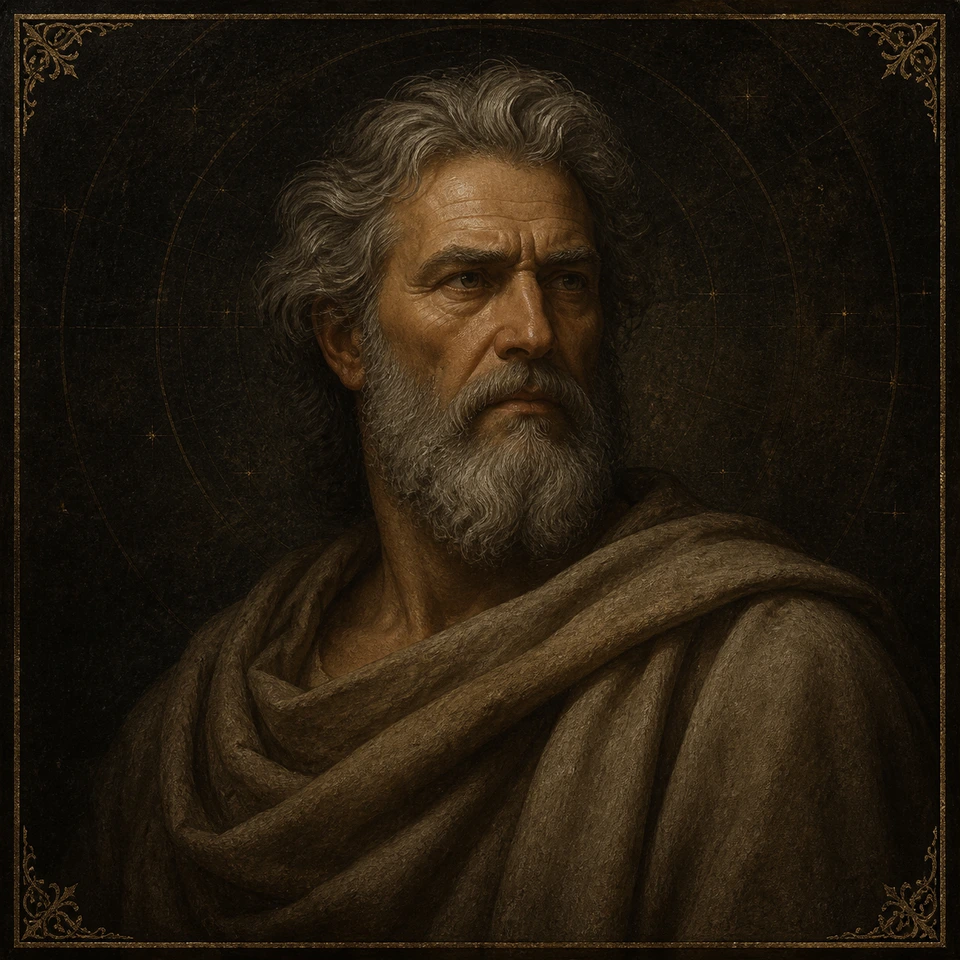
Tracing his lineage directly to Gaia and Uranus, the first-generation Titan Iapetus fathered the mythic heavyweights Atlas, Menoetius, Prometheus, and Epimetheus. His ancient identity remains entirely disconnected from the dramatic deeds of his sons and the distant moon that now carries his title.
Overview
Deep beneath the earth, in a region untouched by the rays of the sun or the movement of the wind, Iapetus remains beside Cronus. The Iliad provides this single stark image of the elder Titan, defining him through removal from the living weather of the world. It does not tell how he arrived there, who captured him, or what he did in battle. No weapon flashes. No chain is described. He stands among the eldest Greek divine generation, yet the surviving poems give him a far quieter presence than the sons who made his lineage famous. Hesiod names him between Hyperion and Crius among the children of Gaia and starry Ouranos. Much later in the Theogony, Clymene bears him Atlas, Menoetius, Prometheus, and Epimetheus. Their burdens and punishments unfold one after another, while the father remains immovable at the root of the branch.
That distinction keeps the family line clear. Atlas carries heaven at the world’s limit. Menoetius is struck down for violent presumption. Prometheus endures bonds and the eagle until Heracles intervenes. Epimetheus accepts Zeus’s fashioned woman. None of these acts is Iapetus’s deed. They make him father of a consequential Titan house, not a hidden smith, world-pillar, fire thief, creator, or god of hindsight.
Pseudo-Apollodorus preserves the Titan generation and the four sons, but changes their mother. Asia replaces Clymene. The mythographer also says Zeus struck Menoetius with a thunderbolt in the Titan battle and cast him into Tartarus. The maternal names and battle detail belong to that later witness. They cannot be pasted invisibly into Hesiod’s earlier sequence.
Centuries after those texts, Iapetus became the name of a moon of Saturn. NASA dates Giovanni Cassini’s discovery to 25 October 1671 and credits John Herschel with the later Titan-family naming proposal. The moon’s dark and bright hemispheres belong to physical astronomy, not to the Titan’s ancient religious identity.
Neither Hesiod, the Iliad, nor Pseudo-Apollodorus gives Iapetus a body, temple, priesthood, festival, offering, sacred animal, plant, weapon, or ritual tool. The modern portrait answers that silence with restraint: an older bearded Greek figure in a heavy himation, without hammer, pillar, globe, weapon, or visible hands. It does not pretend to reproduce a lost statue.
Iapetus therefore carries a particular kind of weight. He belongs to the first divine order and fathers figures through whom Greek poetry thinks about cosmic burden, destructive arrogance, defiance, foresight, and catastrophic acceptance. He is the point where an elder Titan line divides into four destinies, and the grave companion of Cronus in a depth where sunlight and wind no longer reach.
Canonical identity
Canonical Identity
Iapetus maintains a secure primary classification as a Titan, and a broader parent classification as a deity, because Hesiod specifically places him among the very first children born to Gaia and starry Uranus. This ancient genealogical classification stands strictly on its own; it does not confer upon him a moral doctrine, a specific weapon, an identified craft, a compass direction, or rulership over mortal existence.
Linguistic Identity
Iapetus is the conventional English rendering of the Greek Ἰαπετός, which transliterates as either Iapetós or Iapetos. A qualified fifth-century BC Attic reconstruction produces /iː.a.pe.tós/ (approximated as ee-ah-peh-TOSS), though English stress patterns fail to capture the Greek pitch accent or the long opening vowel. A definitive modern English pronunciation remains unresolved within this record.
Sources and evidence
TEXTUAL · Supported
The Greek name is Ἰαπετός, transliterated Iapetós or Iapetos, with a qualified fifth-century BC Attic reconstruction /iː.a.pe.tós/.
- Source
- Wiktionary contributors, Ἰαπετός
- Reviewed edition
- Wiktionary permanent revision 88846246 for Ἰαπετός, reviewed 2026-08-30 · Wiktionary
- Exact locator
- Entry Ἰαπετός · Section Ancient Greek pronunciation and proper noun
- Scope
- Classical Greece · Attica
- Authority
- Collaborative Ancient Greek lexical and pronunciation reference
- Certainty
- Qualified historical reconstruction
The guide ee-ah-peh-TOSS approximates vowel length and stress but cannot reproduce ancient pitch accent.
Open exact reviewed sourceTEXTUAL · Supported
Hesiod names Iapetus among the children of Gaia and starry Uranus who form the first Titan generation.
- Source
- Hesiod; edited and translated by Hugh G. Evelyn-White, Theogony (1914)
- Reviewed edition
- Hugh G. Evelyn-White edition and English translation in Hesiod, the Homeric Hymns and Homerica, 1914 · translated by Hugh G. Evelyn-White · edited by Hugh G. Evelyn-White · Perseus Digital Library / Scaife ATLAS
- Exact locator
- Line 132-138
- Scope
- Archaic Greece · Ancient Greece
- Authority
- Ancient Greek genealogical poem in the Evelyn-White translation
- Certainty
- Certain within the named witness
The passage establishes generation and parentage without assigning Iapetus a craft, direction, weapon, or mortal-race function.
Open exact reviewed source2 reviewed sources for this section
- Wiktionary contributors, ἸαπετόςPermanent revision 88846246 of the Ancient Greek lexical entry · Wiktionary
- Hesiod; edited and translated by Hugh G. Evelyn-White, Theogony (1914)Hesiod, the Homeric Hymns and Homerica, London and New York, 1914 · Perseus Digital Library / Scaife ATLAS
Culture, tradition, period, and place
Iapetus belongs first to Greek-language theogonic and epic poetry. Hesiod’s Archaic Theogony names his generation and gives the long family sequence in which Clymene bears his four sons. The Iliad places him beside Cronus in a remote cosmic depth beyond sun and wind. These are poems, not maps of one uniform civic religion.
Pseudo-Apollodorus writes much later and orders the Titan families into compact prose. His maternal name Asia is valuable precisely because it differs from Hesiod’s Clymene. The later mythographer preserves an ancient Greek story-world under Roman imperial conditions without becoming evidence for every earlier audience.
Sources and evidence
TEXTUAL · Supported
The Archaic Greek Theogony is the earliest surviving source here to place Iapetus within divine genealogy.
- Source
- Hesiod; edited and translated by Hugh G. Evelyn-White, Theogony (1914)
- Reviewed edition
- Hugh G. Evelyn-White edition and English translation in Hesiod, the Homeric Hymns and Homerica, 1914 · translated by Hugh G. Evelyn-White · edited by Hugh G. Evelyn-White · Perseus Digital Library / Scaife ATLAS
- Exact locator
- Line 132-138, 507-534
- Scope
- Archaic Greece · Ancient Greece
- Authority
- Ancient Greek genealogical poem in the Evelyn-White translation
- Certainty
- Certain within the named witness
A broad Greek literary scope does not imply uniform civic worship.
Open exact reviewed sourceTEXTUAL · Supported
Pseudo-Apollodorus preserves Iapetus in a later Greek mythographic genealogy under Roman imperial rule.
- Source
- Pseudo-Apollodorus; edited and translated by James G. Frazer, Library (1921)
- Reviewed edition
- James G. Frazer edition and English translation, Harvard University Press and William Heinemann, 1921 · translated by James G. Frazer · edited by James G. Frazer · Perseus Digital Library / Scaife ATLAS
- Exact locator
- Book 1 · Chapter 1-2 · Section 1.1.3; 1.2.3
- Scope
- Greek religion under Roman imperial rule · Ancient Greece
- Authority
- Ancient Greek mythographic compilation in the Frazer translation
- Certainty
- Certain within the named witness
The later synthesis remains chronologically distinct from Hesiod.
Open exact reviewed source3 reviewed sources for this section
- Hesiod; edited and translated by Hugh G. Evelyn-White, Theogony (1914)Hesiod, the Homeric Hymns and Homerica, London and New York, 1914 · Perseus Digital Library / Scaife ATLAS
- Homer; Monro and Allen Greek edition with edition-specific translations, Iliad (1920)Perseus CTS edition corpus; Greek edition, Oxford, 1908-1920 · Perseus Digital Library / Scaife ATLAS
- Pseudo-Apollodorus; edited and translated by James G. Frazer, Library (1921)Harvard University Press and William Heinemann edition, 1921 · Perseus Digital Library / Scaife ATLAS
Historical development
Hesiod’s surviving portrait is almost entirely genealogical. Iapetus stands among the twelve elder children of Earth and Heaven, then reappears as father of a branch defined by severe divine consequences. Hesiod lets the sons dominate the action: Atlas endures the sky, Menoetius falls to Erebus, Prometheus is bound and tormented, and Epimetheus accepts Zeus’s fashioned woman.
The Iliad adds the father’s own condition in a few stark lines, naming him with Cronus where neither sunlight nor wind reaches. Later mythography keeps the generation and sons but changes their mother to Asia and ties Menoetius’s thunderbolt explicitly to the Titan battle. What changes is genealogy and explanatory detail, not evidence for a lost personal cult biography.
Sources and evidence
TEXTUAL · Supported
The genealogy develops from Hesiod’s Clymene as mother of four sons to Pseudo-Apollodorus’s Asia as their mother.
- Source
- Pseudo-Apollodorus; edited and translated by James G. Frazer, Library (1921)
- Reviewed edition
- James G. Frazer edition and English translation, Harvard University Press and William Heinemann, 1921 · translated by James G. Frazer · edited by James G. Frazer · Perseus Digital Library / Scaife ATLAS
- Exact locator
- Book 1 · Chapter 2 · Section 3
- Scope
- Greek religion under Roman imperial rule · Ancient Greece
- Authority
- Ancient Greek mythographic compilation in the Frazer translation
- Certainty
- Certain within the named witness
Asia is a source-specific maternal variant and is not silently treated as another name for Clymene.
Open exact reviewed source3 reviewed sources for this section
- Hesiod; edited and translated by Hugh G. Evelyn-White, Theogony (1914)Hesiod, the Homeric Hymns and Homerica, London and New York, 1914 · Perseus Digital Library / Scaife ATLAS
- Homer; Monro and Allen Greek edition with edition-specific translations, Iliad (1920)Perseus CTS edition corpus; Greek edition, Oxford, 1908-1920 · Perseus Digital Library / Scaife ATLAS
- Pseudo-Apollodorus; edited and translated by James G. Frazer, Library (1921)Harvard University Press and William Heinemann edition, 1921 · Perseus Digital Library / Scaife ATLAS
Attested roles and historical themes
Roles, powers, and limits
Iapetus’s secure roles are elder Titan, son of Gaia and Uranus, father of four consequential sons, and companion of Cronus in the Iliad’s deep confinement. His story creates a generational frame around endurance, reckless violence, forethought, and afterthought, but those qualities belong to Atlas, Menoetius, Prometheus, and Epimetheus as the poems narrate them.
No surviving ancient passage calls Iapetus lord of mortality, maker of humankind, western pillar, smith, or god of craftsmanship. Atlas bears heaven; Prometheus steals and suffers; Epimetheus accepts the dangerous gift. The father cannot collect all three sons’ burdens into one universal power.
Sources and evidence
TEXTUAL · Supported
Hesiod’s most sustained role for Iapetus is father of Atlas, Menoetius, Prometheus, and Epimetheus, whose different fates follow in sequence.
- Source
- Hesiod; edited and translated by Hugh G. Evelyn-White, Theogony (1914)
- Reviewed edition
- Hugh G. Evelyn-White edition and English translation in Hesiod, the Homeric Hymns and Homerica, 1914 · translated by Hugh G. Evelyn-White · edited by Hugh G. Evelyn-White · Perseus Digital Library / Scaife ATLAS
- Exact locator
- Line 507-534
- Scope
- Archaic Greece · Ancient Greece
- Authority
- Ancient Greek genealogical poem in the Evelyn-White translation
- Certainty
- Certain within the named witness
The sons’ burdens, punishments, inventions, and errors remain their own deeds.
Open exact reviewed sourceTEXTUAL · Supported
The Iliad names Iapetus with Cronus in a depth beyond the rays of Helios and beyond the winds.
- Source
- Homer; Monro and Allen Greek edition with edition-specific translations, Iliad (1920)
- Reviewed edition
- A. T. Murray English translation, volumes I-II, 1924-1925 · translated by A. T. Murray · Perseus Digital Library / Scaife ATLAS
- Exact locator
- Book 8 · Line 478-481
- Scope
- Archaic Greece · Ancient Greece
- Authority
- Ancient Greek epic in the A. T. Murray 1924-1925 English translation
- Certainty
- Certain within the named witness
The passage gives a condition and cosmic location, not a weapon, office, or narrated battle deed.
Open exact reviewed source2 reviewed sources for this section
- Hesiod; edited and translated by Hugh G. Evelyn-White, Theogony (1914)Hesiod, the Homeric Hymns and Homerica, London and New York, 1914 · Perseus Digital Library / Scaife ATLAS
- Homer; Monro and Allen Greek edition with edition-specific translations, Iliad (1920)Perseus CTS edition corpus; Greek edition, Oxford, 1908-1920 · Perseus Digital Library / Scaife ATLAS
Epithets and titles
No securely localized ancient epithet is established for Iapetus. Titan, father, prisoner, and later supposed domains are not converted into titles.
3 reviewed sources for this section
- Hesiod; edited and translated by Hugh G. Evelyn-White, Theogony (1914)Hesiod, the Homeric Hymns and Homerica, London and New York, 1914 · Perseus Digital Library / Scaife ATLAS
- Homer; Monro and Allen Greek edition with edition-specific translations, Iliad (1920)Perseus CTS edition corpus; Greek edition, Oxford, 1908-1920 · Perseus Digital Library / Scaife ATLAS
- Pseudo-Apollodorus; edited and translated by James G. Frazer, Library (1921)Harvard University Press and William Heinemann edition, 1921 · Perseus Digital Library / Scaife ATLAS
Worship and cult
Hesiod, Homer, and Pseudo-Apollodorus preserve Iapetus as a divine genealogical and literary figure, but their relevant passages describe no priesthood, sanctuary staff, civic sacrifice, household rite, mystery, hymn of invocation, or named community of worshippers. The texts secure identity without yielding a recoverable liturgy.
That silence does not prove that no ancient person ever addressed him. It does prevent genealogy from supplying rites, offerings, or a sacred calendar. Cronus, Prometheus, and the other Titans keep their own cult histories, which do not pass to Iapetus through kinship.
Sources and evidence
TEXTUAL · Blocked
No individual priesthood, sacrifice, household rite, or civic worship of Iapetus is specified in the reviewed literary passages.
- Source
- Hesiod; edited and translated by Hugh G. Evelyn-White, Theogony (1914)
- Reviewed edition
- Hugh G. Evelyn-White edition and English translation in Hesiod, the Homeric Hymns and Homerica, 1914 · translated by Hugh G. Evelyn-White · edited by Hugh G. Evelyn-White · Perseus Digital Library / Scaife ATLAS
- Exact locator
- Line 132-138, 507-534
- Scope
- Archaic Greece · Ancient Greece
- Authority
- Ancient Greek genealogical poem in the Evelyn-White translation
- Certainty
- Not evidenced in the named passages
Divine and Titan identity does not by itself supply a recoverable ritual system.
Open exact reviewed source3 reviewed sources for this section
- Hesiod; edited and translated by Hugh G. Evelyn-White, Theogony (1914)Hesiod, the Homeric Hymns and Homerica, London and New York, 1914 · Perseus Digital Library / Scaife ATLAS
- Homer; Monro and Allen Greek edition with edition-specific translations, Iliad (1920)Perseus CTS edition corpus; Greek edition, Oxford, 1908-1920 · Perseus Digital Library / Scaife ATLAS
- Pseudo-Apollodorus; edited and translated by James G. Frazer, Library (1921)Harvard University Press and William Heinemann edition, 1921 · Perseus Digital Library / Scaife ATLAS
Temples, sanctuaries, and sacred places
The Iliad’s geography is powerful and bleak. Zeus speaks of Cronus and Iapetus dwelling far below, beyond the rays of Helios and the reach of winds. The scene establishes remoteness and confinement, not a temple precinct. A place of punishment is not automatically a sacred center.
Hesiod, Homer, and Pseudo-Apollodorus attach no city, mountain, island, cave, oracle, pilgrimage route, or sanctuary to Iapetus. The western edge where Atlas bears heaven belongs to the son’s burden and does not become the father’s cult landscape.
Sources and evidence
TEXTUAL · Supported
The Iliad’s remote depth for Iapetus and Cronus is a poetic place of confinement, not an identified sanctuary or pilgrimage site.
- Source
- Homer; Monro and Allen Greek edition with edition-specific translations, Iliad (1920)
- Reviewed edition
- A. T. Murray English translation, volumes I-II, 1924-1925 · translated by A. T. Murray · Perseus Digital Library / Scaife ATLAS
- Exact locator
- Book 8 · Line 478-481
- Scope
- Archaic Greece · Ancient Greece
- Authority
- Ancient Greek epic in the A. T. Murray 1924-1925 English translation
- Certainty
- Certain within the named witness
Tartarean setting and sacred geography remain different claim types.
Open exact reviewed source2 reviewed sources for this section
- Homer; Monro and Allen Greek edition with edition-specific translations, Iliad (1920)Perseus CTS edition corpus; Greek edition, Oxford, 1908-1920 · Perseus Digital Library / Scaife ATLAS
- Hesiod; edited and translated by Hugh G. Evelyn-White, Theogony (1914)Hesiod, the Homeric Hymns and Homerica, London and New York, 1914 · Perseus Digital Library / Scaife ATLAS
Festivals and processions
No festival, procession, sacred month, seasonal observance, athletic contest, or recurring public date for Iapetus appears in Hesiod, Homer, or Pseudo-Apollodorus. The Titan generation and the sons’ punishments are narrative structures, not a ritual calendar.
Cronus’s festivals and Promethean torch traditions belong to their own figures and settings. A public rite for Iapetus would require its own community, date, practice, and testimony before it could be described as a shared tradition.
Sources and evidence
TEXTUAL · Blocked
No named feast, procession, month, contest, or seasonal observance for Iapetus occurs in the reviewed genealogical and epic passages.
- Source
- Hesiod; edited and translated by Hugh G. Evelyn-White, Theogony (1914)
- Reviewed edition
- Hugh G. Evelyn-White edition and English translation in Hesiod, the Homeric Hymns and Homerica, 1914 · translated by Hugh G. Evelyn-White · edited by Hugh G. Evelyn-White · Perseus Digital Library / Scaife ATLAS
- Exact locator
- Line 132-138, 507-534
- Scope
- Archaic Greece · Ancient Greece
- Authority
- Ancient Greek genealogical poem in the Evelyn-White translation
- Certainty
- Not evidenced in the named passages
No date is inherited from Cronus or from any son.
Open exact reviewed source3 reviewed sources for this section
- Hesiod; edited and translated by Hugh G. Evelyn-White, Theogony (1914)Hesiod, the Homeric Hymns and Homerica, London and New York, 1914 · Perseus Digital Library / Scaife ATLAS
- Homer; Monro and Allen Greek edition with edition-specific translations, Iliad (1920)Perseus CTS edition corpus; Greek edition, Oxford, 1908-1920 · Perseus Digital Library / Scaife ATLAS
- Pseudo-Apollodorus; edited and translated by James G. Frazer, Library (1921)Harvard University Press and William Heinemann edition, 1921 · Perseus Digital Library / Scaife ATLAS
Offerings, votives, and ritual evidence
No libation, sacrifice, incense, food, mineral, cloth, votive object, prayer posture, or temple rule is named for Iapetus in the surviving texts. Nothing in his genealogy authorizes burning, ingestion, anointing, or the ritual use of a particular material.
Prometheus’s sacrificial division, Atlas’s apples, and the fashioned woman received by Epimetheus belong to their own narratives. They are not offerings to Iapetus. A father’s place at the root of a family does not make every object in his descendants’ stories his possession.
Sources and evidence
TEXTUAL · Blocked
No offering, incense, libation, votive material, prayer formula, or sacrificial rule for Iapetus appears in the reviewed passages.
- Source
- Pseudo-Apollodorus; edited and translated by James G. Frazer, Library (1921)
- Reviewed edition
- James G. Frazer edition and English translation, Harvard University Press and William Heinemann, 1921 · translated by James G. Frazer · edited by James G. Frazer · Perseus Digital Library / Scaife ATLAS
- Exact locator
- Book 1 · Chapter 1-2 · Section 1.1.3; 1.2.3
- Scope
- Greek religion under Roman imperial rule · Ancient Greece
- Authority
- Ancient Greek mythographic compilation in the Frazer translation
- Certainty
- Not evidenced in the named passages
No son’s cult or material association passes to the father by genealogy.
Open exact reviewed source2 reviewed sources for this section
- Hesiod; edited and translated by Hugh G. Evelyn-White, Theogony (1914)Hesiod, the Homeric Hymns and Homerica, London and New York, 1914 · Perseus Digital Library / Scaife ATLAS
- Pseudo-Apollodorus; edited and translated by James G. Frazer, Library (1921)Harvard University Press and William Heinemann edition, 1921 · Perseus Digital Library / Scaife ATLAS
Iconography and material culture
Hesiod, Homer, and Pseudo-Apollodorus give Iapetus no face, age, hair, clothing, posture, hands, weapon, crown, staff, vehicle, or personal emblem. They also identify no statue, vase figure, relief, coin, inscription, or cult image as his.
That literary silence rules out many tempting inventions. Hammer, anvil, pillar, globe, western sun, weapon, and chains belong either to other figures or to later imagination. A generic bearded Titan can serve later art, but it is a convention rather than recovered ancient iconography. The texts preserve Iapetus’s name and family more clearly than his appearance.
Sources and evidence
TEXTUAL · Blocked
The reviewed texts give Iapetus no individualized body type, clothing, weapon, tool, vehicle, or personal emblem.
- Source
- Homer; Monro and Allen Greek edition with edition-specific translations, Iliad (1920)
- Reviewed edition
- A. T. Murray English translation, volumes I-II, 1924-1925 · translated by A. T. Murray · Perseus Digital Library / Scaife ATLAS
- Exact locator
- Book 8 · Line 478-481
- Scope
- Archaic Greece · Ancient Greece
- Authority
- Ancient Greek epic in the A. T. Murray 1924-1925 English translation
- Certainty
- No individualized attribute in the passage
The preserved modern image is restrained interpretation, not a claim of an ancient portrait type.
Open exact reviewed source3 reviewed sources for this section
- Hesiod; edited and translated by Hugh G. Evelyn-White, Theogony (1914)Hesiod, the Homeric Hymns and Homerica, London and New York, 1914 · Perseus Digital Library / Scaife ATLAS
- Homer; Monro and Allen Greek edition with edition-specific translations, Iliad (1920)Perseus CTS edition corpus; Greek edition, Oxford, 1908-1920 · Perseus Digital Library / Scaife ATLAS
- Pseudo-Apollodorus; edited and translated by James G. Frazer, Library (1921)Harvard University Press and William Heinemann edition, 1921 · Perseus Digital Library / Scaife ATLAS
Animals, plants, and embodied forms
No animal, plant, tree, hybrid body, or transformation is securely assigned to Iapetus. The eagle that consumes Prometheus’s liver belongs to Zeus’s punishment of Prometheus and does not become the father’s bird.
No plant grows from Iapetus’s body, marks a sanctuary, or appears as his gift in the surviving texts. Apples remain within Atlas’s Hesperides story. The dark and bright terrain of the later moon bearing his name is physical astronomy, not an ancient animal, plant, or embodied form of the Titan.
Sources and evidence
TEXTUAL · Blocked
No animal, plant, transformation, or embodied form is assigned to Iapetus in the reviewed genealogies.
- Source
- Hesiod; edited and translated by Hugh G. Evelyn-White, Theogony (1914)
- Reviewed edition
- Hugh G. Evelyn-White edition and English translation in Hesiod, the Homeric Hymns and Homerica, 1914 · translated by Hugh G. Evelyn-White · edited by Hugh G. Evelyn-White · Perseus Digital Library / Scaife ATLAS
- Exact locator
- Line 132-138, 507-534
- Scope
- Archaic Greece · Ancient Greece
- Authority
- Ancient Greek genealogical poem in the Evelyn-White translation
- Certainty
- Not evidenced in the named passages
The eagle tormenting Prometheus belongs to the son’s punishment narrative.
Open exact reviewed source2 reviewed sources for this section
- Hesiod; edited and translated by Hugh G. Evelyn-White, Theogony (1914)Hesiod, the Homeric Hymns and Homerica, London and New York, 1914 · Perseus Digital Library / Scaife ATLAS
- Alicia Cermak, Iapetus (2017)NASA Science web article, published 2017-12-01; updated 2024-11-03 · NASA Science
Relationships and genealogy
Gaia and Uranus are Iapetus’s parents in Hesiod. The same birth list makes Oceanus, Coeus, Crius, Hyperion, Theia, Rhea, Themis, Mnemosyne, Phoebe, Tethys, and Cronus his siblings. The complete generation matters more than a selective pair of famous names.
Hesiod joins Iapetus with Clymene and names Atlas, Menoetius, Prometheus, and Epimetheus as their sons. Pseudo-Apollodorus keeps Iapetus and the four sons but names Asia as mother. Clymene and Asia remain separate maternal traditions. Neither becomes an alias merely to smooth the genealogy.
Atlas, Prometheus, and Epimetheus retain their own deeds, identities, and direct genealogies. Menoetius, Clymene, and Asia are fully named here, but the surviving passages do not yet support equally detailed individual histories for them.
Sources and evidence
TEXTUAL · Supported
Hesiod names Gaia and Uranus as parents of the Titan generation that includes Iapetus.
- Source
- Hesiod; edited and translated by Hugh G. Evelyn-White, Theogony (1914)
- Reviewed edition
- Hugh G. Evelyn-White edition and English translation in Hesiod, the Homeric Hymns and Homerica, 1914 · translated by Hugh G. Evelyn-White · edited by Hugh G. Evelyn-White · Perseus Digital Library / Scaife ATLAS
- Exact locator
- Line 132-138
- Scope
- Archaic Greece · Ancient Greece
- Authority
- Ancient Greek genealogical poem in the Evelyn-White translation
- Certainty
- Certain within the named witness
The complete sibling generation remains readable in the shared birth narrative.
Open exact reviewed sourceTEXTUAL · Supported
Hesiod makes Clymene and Iapetus parents of Atlas, Menoetius, Prometheus, and Epimetheus.
- Source
- Hesiod; edited and translated by Hugh G. Evelyn-White, Theogony (1914)
- Reviewed edition
- Hugh G. Evelyn-White edition and English translation in Hesiod, the Homeric Hymns and Homerica, 1914 · translated by Hugh G. Evelyn-White · edited by Hugh G. Evelyn-White · Perseus Digital Library / Scaife ATLAS
- Exact locator
- Line 507-514
- Scope
- Archaic Greece · Ancient Greece
- Authority
- Ancient Greek genealogical poem in the Evelyn-White translation
- Certainty
- Certain within the named witness
Clymene remains a named mother even though the present sources do not support a fuller individual history.
Open exact reviewed sourceTEXTUAL · Supported
Pseudo-Apollodorus names Asia, rather than Clymene, as mother of the same four sons by Iapetus.
- Source
- Pseudo-Apollodorus; edited and translated by James G. Frazer, Library (1921)
- Reviewed edition
- James G. Frazer edition and English translation, Harvard University Press and William Heinemann, 1921 · translated by James G. Frazer · edited by James G. Frazer · Perseus Digital Library / Scaife ATLAS
- Exact locator
- Book 1 · Chapter 2 · Section 3
- Scope
- Greek religion under Roman imperial rule · Ancient Greece
- Authority
- Ancient Greek mythographic compilation in the Frazer translation
- Certainty
- Certain within the named witness
The two maternal genealogies remain separate source variants.
Open exact reviewed source2 reviewed sources for this section
- Hesiod; edited and translated by Hugh G. Evelyn-White, Theogony (1914)Hesiod, the Homeric Hymns and Homerica, London and New York, 1914 · Perseus Digital Library / Scaife ATLAS
- Pseudo-Apollodorus; edited and translated by James G. Frazer, Library (1921)Harvard University Press and William Heinemann edition, 1921 · Perseus Digital Library / Scaife ATLAS
Actual myths and source variants
Two narratives carry Iapetus’s surviving story beyond a bare list of names. The birth of the Titans gives Iapetus his parents, generation, and siblings without assigning every Titan the same deed in the overthrow of Uranus. The sons-of-Iapetus sequence then gives his family narrative motion through four sharply different fates.
Hesiod’s version begins with Clymene and follows Atlas, Menoetius, Prometheus, and Epimetheus into burden, ruin, torment, and disastrous acceptance. Pseudo-Apollodorus changes the mother to Asia and explicitly puts Menoetius’s thunderbolt in the Titan battle. Each witness keeps its own maternal name and causal detail.
The Iliad’s four-line glimpse of Iapetus with Cronus is important but static. It does not narrate his capture, name his opponent, or describe a personal Titanomachy exploit. The scene belongs in his history and limits rather than being stretched into a third tale.
Sources and evidence
TEXTUAL · Supported
Hesiod follows the birth of Iapetus’s sons with Atlas’s burden, Menoetius’s fall, Prometheus’s torment and release, and Epimetheus’s acceptance of Zeus’s fashioned woman.
- Source
- Hesiod; edited and translated by Hugh G. Evelyn-White, Theogony (1914)
- Reviewed edition
- Hugh G. Evelyn-White edition and English translation in Hesiod, the Homeric Hymns and Homerica, 1914 · translated by Hugh G. Evelyn-White · edited by Hugh G. Evelyn-White · Perseus Digital Library / Scaife ATLAS
- Exact locator
- Line 507-534
- Scope
- Archaic Greece · Ancient Greece
- Authority
- Ancient Greek genealogical poem in the Evelyn-White translation
- Certainty
- Certain within the named witness
Iapetus is the named father and does not perform the sons’ actions.
Open exact reviewed source3 reviewed sources for this section
- Hesiod; edited and translated by Hugh G. Evelyn-White, Theogony (1914)Hesiod, the Homeric Hymns and Homerica, London and New York, 1914 · Perseus Digital Library / Scaife ATLAS
- Homer; Monro and Allen Greek edition with edition-specific translations, Iliad (1920)Perseus CTS edition corpus; Greek edition, Oxford, 1908-1920 · Perseus Digital Library / Scaife ATLAS
- Pseudo-Apollodorus; edited and translated by James G. Frazer, Library (1921)Harvard University Press and William Heinemann edition, 1921 · Perseus Digital Library / Scaife ATLAS
Myth Library
Each myth gathers its attested participants into one source-grounded account, while distinct source traditions remain readable in their own variants.
Divine Genealogy
The Birth of the First Titans
Gaia and Uranus bring forth twelve named Titans, whose shared birth establishes a generation without assigning every sibling the same deed or cosmic office.
- Role in this profile
- first-generation Titan born from Gaia and Ouranos
- Place scope
- Ancient Greece
- Witnesses
- 4
- Variants
- 4
Genealogical Cycle
The Sons of Iapetus and Their Fates
Hesiod and Pseudo-Apollodorus preserve competing maternal genealogies for Iapetus’s four sons and attach different punishments and burdens to each brother.
- Role in this profile
- Father whose four sons begin the sequence
- Place scope
- Ancient Greece
- Witnesses
- 2
- Variants
- 2
Equivalences, syncretisms, and identity boundaries
Iapetus remains distinct from Atlas, Menoetius, Prometheus, and Epimetheus. Genealogy relates them without transferring sky-bearing, violent presumption, fire-theft, foresight, afterthought, or Pandora’s acceptance to the father. Clymene and Asia are variant mothers, not automatically one goddess under two names.
The name Iapetus was later applied to a moon of Saturn. NASA’s astronomical page describes the discovery and the Titan-family naming logic. The moon is a physical world in the Saturn system, not a celestial body worshipped under the ancient Titan’s identity. Shared naming is reception, not equivalence or correspondence.
Sources and evidence
TEXTUAL · Supported
The Saturnian moon Iapetus bears the Titan’s name but is an astronomical body, not another form of the Greek divine figure.
- Source
- Alicia Cermak, Iapetus (2017)
- Reviewed edition
- NASA Science, Iapetus, published 2017-12-01 and updated 2024-11-03 · NASA Science
- Exact locator
- Section Discovery; How Iapetus Got its Name
- Scope
- Modern astronomical reception · International astronomical reception
- Authority
- NASA Science astronomy overview
- Certainty
- Secure modern naming history
Shared naming creates a reception boundary, not an ancient celestial correspondence.
Open exact reviewed source2 reviewed sources for this section
- Hesiod; edited and translated by Hugh G. Evelyn-White, Theogony (1914)Hesiod, the Homeric Hymns and Homerica, London and New York, 1914 · Perseus Digital Library / Scaife ATLAS
- Alicia Cermak, Iapetus (2017)NASA Science web article, published 2017-12-01; updated 2024-11-03 · NASA Science
Correspondence index
Hesiod, Homer, and Pseudo-Apollodorus assign Iapetus no planet, zodiac sign, stone, metal, plant, animal, color, classical element, weekday, moon phase, direction, season, incense, offering, ritual object, or magical intention. None can be recovered simply by resembling a relative’s story.
Atlas does not give his father a western direction or pillar. Prometheus does not give him fire, craft, intelligence, or metalwork. Epimetheus does not make him a patron of hindsight. The Saturnian moon does not create ancient celestial rulership. Any later occult association needs its own named and dated witness.
16 expected categories currently not evidenced
celestial-body · Not evidenced
No ancient celestial body evidenced
Hesiod, Homer, and Pseudo-Apollodorus assign Iapetus no planet or star; the Saturnian moon is a modern namesake.
- Layer
- Research Boundary
- Scope
- The moon named Iapetus belongs to modern astronomical reception, not ancient divine identity.
zodiac · Not evidenced
No zodiac sign evidenced
No zodiac rulership appears in the Greek genealogical, epic, or mythographic passages.
- Layer
- Research Boundary
- Scope
- No zodiac rulership appears in the reviewed witnesses.
gemstone-crystal-mineral · Not evidenced
No stone or mineral evidenced
No stone, crystal, or mineral belongs to Iapetus in the surviving passages.
- Layer
- Research Boundary
- Scope
- No mineral follows from confinement or Titan ancestry.
metal-material · Not evidenced
No metal or ritual material evidenced
No metal or ritual material is assigned to Iapetus; Promethean craft cannot be inherited through kinship.
- Layer
- Research Boundary
- Scope
- Prometheus’s later craft reception cannot be inherited by his father.
plant-tree · Not evidenced
No plant or tree evidenced
No plant or tree marks Iapetus, his worship, or his body in the surviving passages.
- Layer
- Research Boundary
- Scope
- No sacred plant appears in the controlled passages.
animal-embodied-form · Not evidenced
No animal or embodied form evidenced
No animal or transformed body belongs to Iapetus; the eagle remains part of Prometheus’s punishment.
- Layer
- Research Boundary
- Scope
- Prometheus’s eagle remains part of the son’s punishment.
color · Not evidenced
No ritual color evidenced
No ritual color is assigned to Iapetus; portrait pigments and the moon’s surface colors are later and physical.
- Layer
- Research Boundary
- Scope
- The modern portrait palette and the moon’s surface colors are not ancient correspondences.
classical-element · Not evidenced
No classical element evidenced
Gaia and Uranus as parents do not confer earth, air, or another classical element upon their son.
- Layer
- Research Boundary
- Scope
- Gaia and Uranus as parents do not confer earth or air rulership.
weekday · Not evidenced
No weekday evidenced
No weekday follows from Iapetus’s genealogy or from the later moon that bears his name.
- Layer
- Research Boundary
- Scope
- No day follows from a planet or descendant.
moon-phase · Not evidenced
No moon phase evidenced
The Saturnian namesake does not establish a lunar phase or ritual cycle for the Titan.
- Layer
- Research Boundary
- Scope
- The Saturnian moon’s name creates no lunar practice for the Titan.
direction-place · Not evidenced
No ritual direction evidenced
The Iliadic depth is a narrative setting, while Atlas’s western limit belongs to Atlas rather than his father.
- Layer
- Research Boundary
- Scope
- Atlas’s western limit and the Iliadic depth are narrative settings, not ritual directions.
festival-time · Not evidenced
No season or festival time evidenced
No feast, sacred month, season, procession, or recurring observance is named for Iapetus.
- Layer
- Research Boundary
- Scope
- No named feast, month, or recurring date is preserved.
incense-perfume · Not evidenced
No incense or perfume evidenced
No incense, perfume, or burned aromatic is named for Iapetus.
- Layer
- Research Boundary
- Scope
- No burning material is named.
offering-ritual-material · Not evidenced
No offering evidenced
No sacrifice, libation, votive, food, cloth, or other offering is assigned to Iapetus.
- Layer
- Research Boundary
- Scope
- No son’s object or sacrifice is transferred through genealogy.
ritual-object-symbol-tool · Not evidenced
No ritual object, symbol, or tool evidenced
No hammer, pillar, globe, weapon, chain, or ritual tool is assigned to Iapetus.
- Layer
- Research Boundary
- Scope
- Hammer, pillar, globe, weapon, and chains remain excluded.
intention-magical-power · Not evidenced
No magical intention evidenced
Mortality, craft, foresight, hindsight, and endurance belong to later inference or to his sons, not to an attested power of Iapetus.
- Layer
- Research Boundary
- Scope
- Mortality, craft, foresight, hindsight, and endurance require later accountable testimony.
Sources and evidence
TEXTUAL · Blocked
No reviewed source assigns Iapetus a planet, zodiac sign, stone, metal, plant, animal, color, element, weekday, moon phase, direction, season, incense, offering, ritual tool, or magical intention.
- Source
- Hesiod; edited and translated by Hugh G. Evelyn-White, Theogony (1914)
- Reviewed edition
- Hugh G. Evelyn-White edition and English translation in Hesiod, the Homeric Hymns and Homerica, 1914 · translated by Hugh G. Evelyn-White · edited by Hugh G. Evelyn-White · Perseus Digital Library / Scaife ATLAS
- Exact locator
- Line 132-138, 507-534
- Scope
- Archaic Greece · Ancient Greece
- Authority
- Ancient Greek genealogical poem in the Evelyn-White translation
- Certainty
- Not evidenced in the named ancient passages
Popular claims about mortality, craft, a western pillar, and the human race remain unsupported here.
Open exact reviewed source3 reviewed sources for this section
- Hesiod; edited and translated by Hugh G. Evelyn-White, Theogony (1914)Hesiod, the Homeric Hymns and Homerica, London and New York, 1914 · Perseus Digital Library / Scaife ATLAS
- Pseudo-Apollodorus; edited and translated by James G. Frazer, Library (1921)Harvard University Press and William Heinemann edition, 1921 · Perseus Digital Library / Scaife ATLAS
- Alicia Cermak, Iapetus (2017)NASA Science web article, published 2017-12-01; updated 2024-11-03 · NASA Science
Later reception and living significance
Modern astronomy carried the Titan’s name far beyond Greek poetry. NASA dates Giovanni Cassini’s discovery of the Saturnian moon to 25 October 1671 and describes John Herschel’s proposal that Saturn’s moons bear names from the family of Kronos. The astronomical Iapetus has contrasting hemispheres, an equatorial ridge, and a distant orbit, but none of those physical traits can be backdated as the Titan’s ancient symbolism.
A shared contemporary devotional tradition specific to Iapetus cannot yet be described from a named public community. Individual practices may exist, but no universal rite, title, offering, or doctrine follows from the moon or from the better-known stories of Iapetus’s sons.
Sources and evidence
TEXTUAL · Supported
NASA dates Cassini’s discovery of the Saturnian moon Iapetus to 25 October 1671 and describes John Herschel’s proposal to name Saturn’s moons for the family of Kronos.
- Source
- Alicia Cermak, Iapetus (2017)
- Reviewed edition
- NASA Science, Iapetus, published 2017-12-01 and updated 2024-11-03 · NASA Science
- Exact locator
- Section Discovery; How Iapetus Got its Name
- Scope
- Modern astronomical reception · International astronomical reception
- Authority
- NASA Science astronomy overview
- Certainty
- Secure within the institutional page
This is modern scientific reception and supplies no ancient cult or magical association.
Open exact reviewed source1 reviewed source for this section
- Alicia Cermak, Iapetus (2017)NASA Science web article, published 2017-12-01; updated 2024-11-03 · NASA Science
Evidence, conflicts, and research gaps
Hesiod anchors Iapetus’s identity, parentage, Clymene genealogy, and the four sons’ sequence. The Iliad contributes the depth beyond sunlight and wind. Pseudo-Apollodorus preserves a later genealogy with Asia and a different account of Menoetius’s fall. The permanent lexical revision supports only the Greek forms and a qualified historical pronunciation. NASA documents the modern astronomical namesake.
Cult and material history remain thin. The literary witnesses describe no individualized sanctuary, festival, offering, portrait, animal, plant, or ancient correspondence. Menoetius, Clymene, Asia, and Pseudo-Apollodorus’s additional Dione require their own full identity studies. The pronunciation still needs an academic phonology cross-check, and inscriptional, archaeological, and object research may yet sharpen the negative fields.
The greatest interpretive danger is inheritance by association. The sons’ famous deeds and punishments make Iapetus seem fuller than the surviving passages allow. His grave genealogical weight can stand without turning his descendants into a bundle of borrowed powers.
Sources and evidence
TEXTUAL · Supported
The named witnesses secure identity, genealogy, variant motherhood, the sons’ fate sequence, and an Iliadic confinement setting, while cult and individualized material evidence remain unresolved.
- Source
- Hesiod; edited and translated by Hugh G. Evelyn-White, Theogony (1914)
- Reviewed edition
- Hugh G. Evelyn-White edition and English translation in Hesiod, the Homeric Hymns and Homerica, 1914 · translated by Hugh G. Evelyn-White · edited by Hugh G. Evelyn-White · Perseus Digital Library / Scaife ATLAS
- Exact locator
- Line 132-138, 507-534
- Scope
- Archaic Greece · Ancient Greece
- Authority
- Ancient Greek genealogical poem in the Evelyn-White translation
- Certainty
- Secure positive claims with explicit unresolved fields
Further epigraphic, archaeological, and lexicographic review may refine the negative fields without changing the supported genealogy.
Open exact reviewed source5 reviewed sources for this section
- Wiktionary contributors, ἸαπετόςPermanent revision 88846246 of the Ancient Greek lexical entry · Wiktionary
- Hesiod; edited and translated by Hugh G. Evelyn-White, Theogony (1914)Hesiod, the Homeric Hymns and Homerica, London and New York, 1914 · Perseus Digital Library / Scaife ATLAS
- Homer; Monro and Allen Greek edition with edition-specific translations, Iliad (1920)Perseus CTS edition corpus; Greek edition, Oxford, 1908-1920 · Perseus Digital Library / Scaife ATLAS
- Pseudo-Apollodorus; edited and translated by James G. Frazer, Library (1921)Harvard University Press and William Heinemann edition, 1921 · Perseus Digital Library / Scaife ATLAS
- Alicia Cermak, Iapetus (2017)NASA Science web article, published 2017-12-01; updated 2024-11-03 · NASA Science
Direct connections and evidence
Explicit Source
Hesiod names Atlas as a son of Iapetus and Clymene
Hesiodic genealogy only; Pseudo-Apollodorus keeps Iapetus as father but names Asia rather than Clymene as mother.
1 attestation · high confidence
- Hesiod; edited and translated by Hugh G. Evelyn-White, TheogonyHugh G. Evelyn-White edition and English translation in Hesiod, the Homeric Hymns and Homerica, 1914 · translated by Hugh G. Evelyn-White · edited by Hugh G. Evelyn-White · Perseus Digital Library / Scaife ATLAS · Archaic Greece · Ancient Greece · Entry Theogony · Line 507-516
Explicit Source
Hesiod names Epimetheus as a son of Iapetus and Clymene
Iapetus remains father in Pseudo-Apollodorus, whose later genealogy names Asia rather than Clymene as mother.
1 attestation · high confidence
- Hesiod; edited and translated by Hugh G. Evelyn-White, TheogonyHugh G. Evelyn-White edition and English translation in Hesiod, the Homeric Hymns and Homerica, 1914 · translated by Hugh G. Evelyn-White · edited by Hugh G. Evelyn-White · Perseus Digital Library / Scaife ATLAS · Archaic Greece · Ancient Greece · Entry Theogony · Line 507-516
Explicit Source
Hesiod names Iapetus among the children of Gaia
Parentage only; descent does not create an earth or elemental correspondence.
1 attestation · high confidence
- Hesiod; edited and translated by Hugh G. Evelyn-White, TheogonyHugh G. Evelyn-White edition and English translation in Hesiod, the Homeric Hymns and Homerica, 1914 · translated by Hugh G. Evelyn-White · edited by Hugh G. Evelyn-White · Perseus Digital Library / Scaife ATLAS · Archaic Greece · Ancient Greece · Entry Theogony · Line 132-138
Explicit Source
Hesiod names Iapetus among the children of Uranus
Parentage only; descent does not create planetary or sky rulership.
1 attestation · high confidence
- Hesiod; edited and translated by Hugh G. Evelyn-White, TheogonyHugh G. Evelyn-White edition and English translation in Hesiod, the Homeric Hymns and Homerica, 1914 · translated by Hugh G. Evelyn-White · edited by Hugh G. Evelyn-White · Perseus Digital Library / Scaife ATLAS · Archaic Greece · Ancient Greece · Entry Theogony · Line 132-138
Explicit Source
Hesiod names Prometheus as a son of Iapetus and Clymene
Hesiodic genealogy only; Prometheus’s functions and punishments remain his own.
1 attestation · high confidence
- Hesiod; edited and translated by Hugh G. Evelyn-White, TheogonyHugh G. Evelyn-White edition and English translation in Hesiod, the Homeric Hymns and Homerica, 1914 · translated by Hugh G. Evelyn-White · edited by Hugh G. Evelyn-White · Perseus Digital Library / Scaife ATLAS · Archaic Greece · Ancient Greece · Entry Theogony · Line 507-514
Explicit Source
Hesiod names Iapetus and Oceanus in the same generation born from Gaia and Ouranos
Sibling genealogy only; it transfers no office, deed, cult, or correspondence between the two figures.
1 attestation · high confidence
- Hesiod; edited and translated by Hugh G. Evelyn-White, TheogonyHugh G. Evelyn-White edition and English translation in Hesiod, the Homeric Hymns and Homerica, 1914 · translated by Hugh G. Evelyn-White · edited by Hugh G. Evelyn-White · Perseus Digital Library / Scaife ATLAS · Archaic Greece · Ancient Greece · Entry Theogony · Line 132-138
Explicit Source
Hesiod names Iapetus and Coeus in the same generation born from Gaia and Ouranos
Sibling genealogy only; it transfers no office, deed, cult, or correspondence between the two figures.
1 attestation · high confidence
- Hesiod; edited and translated by Hugh G. Evelyn-White, TheogonyHugh G. Evelyn-White edition and English translation in Hesiod, the Homeric Hymns and Homerica, 1914 · translated by Hugh G. Evelyn-White · edited by Hugh G. Evelyn-White · Perseus Digital Library / Scaife ATLAS · Archaic Greece · Ancient Greece · Entry Theogony · Line 132-138
Explicit Source
Hesiod names Iapetus and Crius in the same generation born from Gaia and Ouranos
Sibling genealogy only; it transfers no office, deed, cult, or correspondence between the two figures.
1 attestation · high confidence
- Hesiod; edited and translated by Hugh G. Evelyn-White, TheogonyHugh G. Evelyn-White edition and English translation in Hesiod, the Homeric Hymns and Homerica, 1914 · translated by Hugh G. Evelyn-White · edited by Hugh G. Evelyn-White · Perseus Digital Library / Scaife ATLAS · Archaic Greece · Ancient Greece · Entry Theogony · Line 132-138
Explicit Source
Hesiod names Iapetus and Hyperion in the same generation born from Gaia and Ouranos
Sibling genealogy only; it transfers no office, deed, cult, or correspondence between the two figures.
1 attestation · high confidence
- Hesiod; edited and translated by Hugh G. Evelyn-White, TheogonyHugh G. Evelyn-White edition and English translation in Hesiod, the Homeric Hymns and Homerica, 1914 · translated by Hugh G. Evelyn-White · edited by Hugh G. Evelyn-White · Perseus Digital Library / Scaife ATLAS · Archaic Greece · Ancient Greece · Entry Theogony · Line 132-138
Explicit Source
Hesiod names Iapetus and Theia in the same generation born from Gaia and Ouranos
Sibling genealogy only; it transfers no office, deed, cult, or correspondence between the two figures.
1 attestation · high confidence
- Hesiod; edited and translated by Hugh G. Evelyn-White, TheogonyHugh G. Evelyn-White edition and English translation in Hesiod, the Homeric Hymns and Homerica, 1914 · translated by Hugh G. Evelyn-White · edited by Hugh G. Evelyn-White · Perseus Digital Library / Scaife ATLAS · Archaic Greece · Ancient Greece · Entry Theogony · Line 132-138
Explicit Source
Hesiod names Iapetus and Rhea in the same generation born from Gaia and Ouranos
Sibling genealogy only; it transfers no office, deed, cult, or correspondence between the two figures.
1 attestation · high confidence
- Hesiod; edited and translated by Hugh G. Evelyn-White, TheogonyHugh G. Evelyn-White edition and English translation in Hesiod, the Homeric Hymns and Homerica, 1914 · translated by Hugh G. Evelyn-White · edited by Hugh G. Evelyn-White · Perseus Digital Library / Scaife ATLAS · Archaic Greece · Ancient Greece · Entry Theogony · Line 132-138
Explicit Source
Hesiod names Iapetus and Themis in the same generation born from Gaia and Ouranos
Sibling genealogy only; it transfers no office, deed, cult, or correspondence between the two figures.
1 attestation · high confidence
- Hesiod; edited and translated by Hugh G. Evelyn-White, TheogonyHugh G. Evelyn-White edition and English translation in Hesiod, the Homeric Hymns and Homerica, 1914 · translated by Hugh G. Evelyn-White · edited by Hugh G. Evelyn-White · Perseus Digital Library / Scaife ATLAS · Archaic Greece · Ancient Greece · Entry Theogony · Line 132-138
Explicit Source
Hesiod names Iapetus and Mnemosyne in the same generation born from Gaia and Ouranos
Sibling genealogy only; it transfers no office, deed, cult, or correspondence between the two figures.
1 attestation · high confidence
- Hesiod; edited and translated by Hugh G. Evelyn-White, TheogonyHugh G. Evelyn-White edition and English translation in Hesiod, the Homeric Hymns and Homerica, 1914 · translated by Hugh G. Evelyn-White · edited by Hugh G. Evelyn-White · Perseus Digital Library / Scaife ATLAS · Archaic Greece · Ancient Greece · Entry Theogony · Line 132-138
Explicit Source
Hesiod names Iapetus and Phoebe in the same generation born from Gaia and Ouranos
Sibling genealogy only; it transfers no office, deed, cult, or correspondence between the two figures.
1 attestation · high confidence
- Hesiod; edited and translated by Hugh G. Evelyn-White, TheogonyHugh G. Evelyn-White edition and English translation in Hesiod, the Homeric Hymns and Homerica, 1914 · translated by Hugh G. Evelyn-White · edited by Hugh G. Evelyn-White · Perseus Digital Library / Scaife ATLAS · Archaic Greece · Ancient Greece · Entry Theogony · Line 132-138
Explicit Source
Hesiod names Iapetus and Tethys in the same generation born from Gaia and Ouranos
Sibling genealogy only; it transfers no office, deed, cult, or correspondence between the two figures.
1 attestation · high confidence
- Hesiod; edited and translated by Hugh G. Evelyn-White, TheogonyHugh G. Evelyn-White edition and English translation in Hesiod, the Homeric Hymns and Homerica, 1914 · translated by Hugh G. Evelyn-White · edited by Hugh G. Evelyn-White · Perseus Digital Library / Scaife ATLAS · Archaic Greece · Ancient Greece · Entry Theogony · Line 132-138
Explicit Source
Hesiod names Iapetus and Cronus in the same generation born from Gaia and Ouranos
Sibling genealogy only; it transfers no office, deed, cult, or correspondence between the two figures.
1 attestation · high confidence
- Hesiod; edited and translated by Hugh G. Evelyn-White, TheogonyHugh G. Evelyn-White edition and English translation in Hesiod, the Homeric Hymns and Homerica, 1914 · translated by Hugh G. Evelyn-White · edited by Hugh G. Evelyn-White · Perseus Digital Library / Scaife ATLAS · Archaic Greece · Ancient Greece · Entry Theogony · Line 132-138
Archive scope and classification
- Figure classification
- Titan or Titaness, God or goddess · certain
- Pantheon or tradition shelf
- Greek
- Cultures
- Greek
- Traditions
- Ancient Greek religion
- Periods
- Archaic Greece, Greek religion under Roman imperial rule
- Places
- Ancient Greece
Greek poetry and mythography support identity, genealogy, maternal variants, the sons’ fate sequence, and Iliadic confinement; cult, material, and living-practice coverage remains partial.
Reviewed sources
- Hesiod; edited and translated by Hugh G. Evelyn-White, Theogony (1914)Hesiod, the Homeric Hymns and Homerica, London and New York, 1914 · Perseus Digital Library / Scaife ATLAS
- Homer; Monro and Allen Greek edition with edition-specific translations, Iliad (1920)Perseus CTS edition corpus; Greek edition, Oxford, 1908-1920 · Perseus Digital Library / Scaife ATLAS
- Pseudo-Apollodorus; edited and translated by James G. Frazer, Library (1921)Harvard University Press and William Heinemann edition, 1921 · Perseus Digital Library / Scaife ATLAS
- Wiktionary contributors, ἸαπετόςPermanent revision 88846246 of the Ancient Greek lexical entry · Wiktionary
- Alicia Cermak, Iapetus (2017)NASA Science web article, published 2017-12-01; updated 2024-11-03 · NASA Science