Greek · Divine personification · Certain
Eos
Ἠώς · Ēṓs
Pronunciation: /ɛː.ɔ̌ːs/ · eh-AWSS
Research and editorial review by Cody Manes · Reviewed 2026-08-30
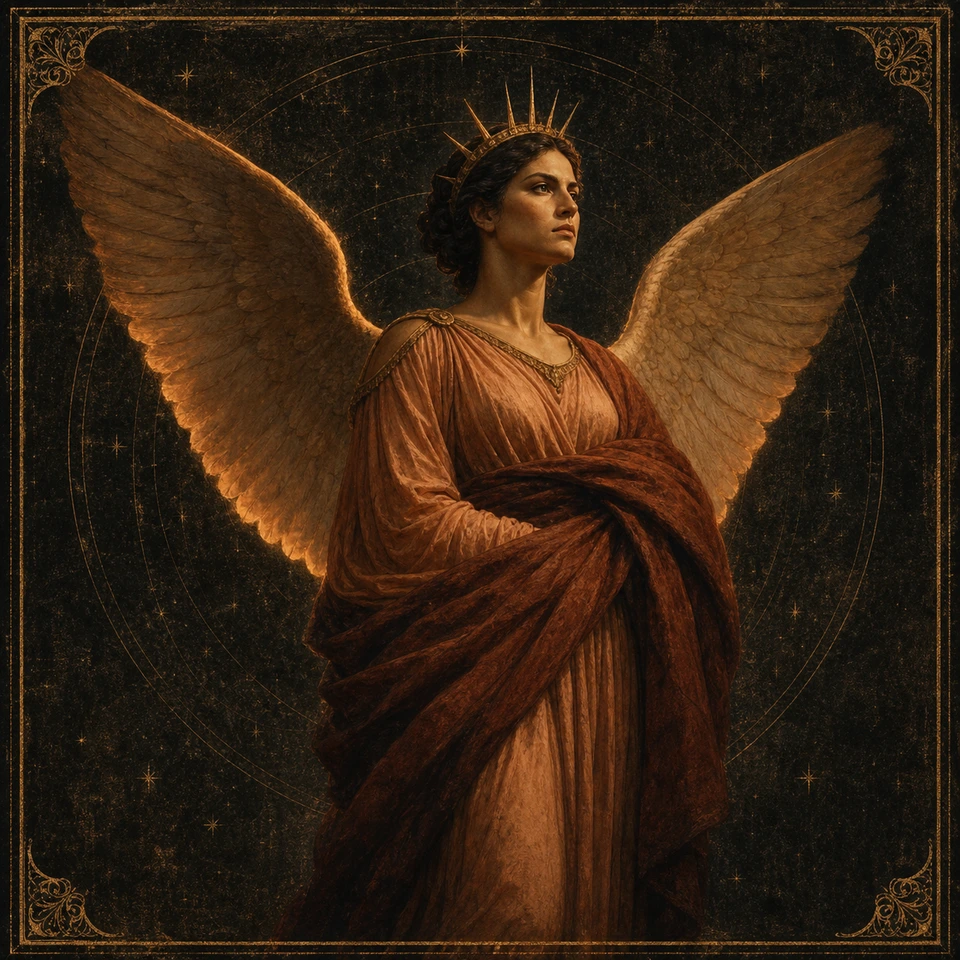
Breaking the horizon as the personification of first light, Eos embodies cyclical recurrence and intense desire. She represents a tragic intersection in ancient myth, defining the agonizing boundary between eternal divine duration and decaying mortal age.
Overview
Dawn rises from Tithonus' bed and carries light to gods and mortals. In the opening of Iliad 11, that motion is enough to restart the world. Night does not simply fade. A goddess stands up, crosses the threshold, and makes sight, travel, labor, and battle possible again. Eos is the first pressure of day against darkness.
Her Greek name is Ἠώς, and Hesiod places her in a precise divine family. Hyperion and Theia are her parents; Helios and Selene are her siblings. She is Dawn beside Sun and Moon, not another name for either. With Astraeus she bears winds and stars. Genealogy places her at the meeting of light, air, and celestial motion, but it does not grant her ownership of every star, planet, or weather power.
The most famous hymn about her is not gentle. Eos carries away the beautiful Trojan Tithonus and asks Zeus to make him immortal. She forgets to ask for undying youth. At first they live together beside Ocean, but grey hair comes, then weakness, then endless age. Eos feeds and clothes him before closing him in a chamber where his voice continues without bodily strength. The early Greek hymn does not rescue him by turning him into a cicada. Immortality without youth remains the wound.
Other men pass through her desire. Homer says she took Orion before Artemis killed him. Pseudo-Apollodorus has Eos carry the restored hunter to Delos, where Artemis' two conflicting motives for killing him remain unresolved. Hesiod makes Cephalus father by Eos of Phaethon. Pausanias later saw Day carrying Cephalus on the Royal Stoa at Athens and on Apollo's throne at Amyclae. The name Hemera belongs to those monuments, preserving an ancient overlap between Dawn and Day without making them casually interchangeable.
Motherhood carries Eos into the Trojan cycle. Hesiod calls Memnon and Emathion her sons by Tithonus. At Olympia, Pausanias saw Day and Thetis entreating Zeus while Achilles and Memnon stood at opposite ends of the monument ready to fight. The sculpture makes two mothers' petitions frame the combat of their mortal sons. The lost Aethiopis cannot be rewritten from that scene, but the grief is visible.
Attic pottery gives Eos a body in motion. She has one pair of powerful wings, long dress and mantle, jewelry, a rayed stephane, knotted hair, and the urgent forward drive of pursuit. Roman Aurora remains a distinct Roman figure. No reviewed evidence gives Eos a temple cult, zodiac sign, crystal, metal, incense, sacred plant, weekday, or moon phase. Dawn itself is direct and ancient; the rest needs its own witness.
Canonical identity
Canonical Identity
Eos is the ancient Greek goddess who operates as the absolute divine personification of dawn. Her identity is fundamentally temporal and visible, distinct from solar representations; Eos opens the day with first light, while Helios reigns as the Sun and Selene as the Moon. Hesiod deliberately identifies these three as siblings rather than interchangeable cosmic labels. While ancient poets sometimes use "Hemera" (Day) in closely overlapping narrative scenes (such as the abduction of Cephalus), this textual overlap requires contextual explanation rather than an automatic, permanent merger of the two figures. Furthermore, the Greek Eos is wholly separate from the Roman Aurora.
Linguistic Identity
Her name in ancient Greek is Ἠώς, transliterated directly as Ēṓs. A qualified fifth-century BC Attic reconstruction estimates the pronunciation as /ɛː.ɔ̌ ːs/, roughly eh-AWSS, featuring a rising pitch contour that standard English spelling cannot accurately capture.
Sources and evidence
TEXTUAL · Supported
The Greek form Ἠώς has a qualified fifth-century BC Attic reconstruction /ɛː.ɔ̌ːs/.
- Source
- Wiktionary contributors, Ἠώς
- Reviewed edition
- Wiktionary live revision reviewed 2026-08-30 · Wiktionary
- Exact locator
- Entry Ἠώς · Section Ancient Greek pronunciation
- Scope
- Classical Greece · Attica
- Authority
- collaborative lexical reference
- Certainty
- Qualified
The readable guide cannot reproduce the rising pitch accent exactly.
Open exact reviewed source4 reviewed sources for this section
- Wiktionary contributors, ἨώςLive collaborative lexical entry reviewed 2026-08-30 · Wiktionary
- Hesiod; edited and translated by Hugh G. Evelyn-White, Theogony (1914)Hesiod, the Homeric Hymns and Homerica, London and New York, 1914 · Perseus Digital Library / Scaife ATLAS
- Homer; Monro and Allen Greek edition with edition-specific translations, Iliad (1920)Perseus CTS edition corpus; Greek edition, Oxford, 1908-1920 · Perseus Digital Library / Scaife ATLAS
- Pausanias; Spiro Greek edition and Jones/Ormerod translation volumes, Description of Greece (1935)Perseus CTS edition corpus, 1903-1935 · Perseus Digital Library / Scaife ATLAS
Culture, tradition, period, and place
Eos moves through archaic epic, genealogy, hymn, Classical Attic pottery, and monuments described by Pausanias under Roman rule. Her oldest surviving settings are cosmic and narrative: Ocean's edge, the bed of Tithonus, the daily arrival of light, and the genealogies that connect Dawn to Sun, Moon, winds, stars, Memnon, and Phaethon.
Attica gives her visible pursuit scenes and the story of Cephalus. Delos or Ortygia belongs to Orion's death traditions. Olympia held an image of Day petitioning Zeus for her child beside Achilles and Memnon. These are literary and material settings, not evidence for one centralized Eos cult spread unchanged across Greece.
8 reviewed sources for this section
- Hesiod; edited and translated by Hugh G. Evelyn-White, Theogony (1914)Hesiod, the Homeric Hymns and Homerica, London and New York, 1914 · Perseus Digital Library / Scaife ATLAS
- Homer; Monro and Allen Greek edition with edition-specific translations, Iliad (1920)Perseus CTS edition corpus; Greek edition, Oxford, 1908-1920 · Perseus Digital Library / Scaife ATLAS
- Anonymous Homeric Hymns; edited and translated by Hugh G. Evelyn-White, Homeric Hymns (1914)Hesiod, the Homeric Hymns and Homerica, London and New York, 1914 · Perseus Digital Library / Scaife ATLAS
- Homer; translated by A. T. Murray, Odyssey (1919)A. T. Murray English translation, London: William Heinemann; New York: G. P. Putnam's Sons, 1919 · Perseus Digital Library / Scaife ATLAS
- Pseudo-Apollodorus; edited and translated by James G. Frazer, Library (1921)Harvard University Press and William Heinemann edition, 1921 · Perseus Digital Library / Scaife ATLAS
- Pausanias; Spiro Greek edition and Jones/Ormerod translation volumes, Description of Greece (1935)Perseus CTS edition corpus, 1903-1935 · Perseus Digital Library / Scaife ATLAS
- British Museum, British Museum CollectionLive official museum collection · British Museum
- The Metropolitan Museum of Art, Open Access Collection and Collection APILive collection data and eligible public-domain images · The Metropolitan Museum of Art
Historical development
Hesiod places Dawn inside an ordered cosmos. Hyperion and Theia produce Helios, Selene, and Eos; Eos and Astraeus then produce winds and stars. Homer makes her arrival the rhythm of narrated time. A day begins because Dawn rises, leaves Tithonus' bed, and carries light to mortals and immortals. The divine personification is therefore both a family member and the recurring edge between night and day.
The Homeric Hymn to Aphrodite turns that radiance toward mortality through Tithonus. Classical vase painters emphasize wings, pursuit, clothing, and speed. Pausanias later saw Cephalus' abduction and the Memnon conflict built into major monuments. The evidence changes genre and medium, but urgency, transition, desire, and loss remain close to her.
6 reviewed sources for this section
- Hesiod; edited and translated by Hugh G. Evelyn-White, Theogony (1914)Hesiod, the Homeric Hymns and Homerica, London and New York, 1914 · Perseus Digital Library / Scaife ATLAS
- Homer; Monro and Allen Greek edition with edition-specific translations, Iliad (1920)Perseus CTS edition corpus; Greek edition, Oxford, 1908-1920 · Perseus Digital Library / Scaife ATLAS
- Anonymous Homeric Hymns; edited and translated by Hugh G. Evelyn-White, Homeric Hymns (1914)Hesiod, the Homeric Hymns and Homerica, London and New York, 1914 · Perseus Digital Library / Scaife ATLAS
- Pausanias; Spiro Greek edition and Jones/Ormerod translation volumes, Description of Greece (1935)Perseus CTS edition corpus, 1903-1935 · Perseus Digital Library / Scaife ATLAS
- British Museum, British Museum CollectionLive official museum collection · British Museum
- The Metropolitan Museum of Art, Open Access Collection and Collection APILive collection data and eligible public-domain images · The Metropolitan Museum of Art
Attested roles and historical themes
Roles, powers, and limits
Eos opens the day and bears light ahead of full daylight. Homeric narration relies on her movement: she rises, leaves the chamber of Tithonus, and makes action possible again after night. This power is not a decorative sunrise backdrop. Dawn changes what can be seen, where journeys resume, and when mortal work or battle begins.
Her stories also test the boundary between divine and mortal duration. She can seize beautiful men, carry them across space, and ask Zeus for an immortal lover. She cannot make a careless request harmless. Tithonus survives but ages without end. Orion still dies. Memnon still enters combat. Dawn returns every morning, while the mortals she loves remain subject to time and death.
Sources and evidence
TEXTUAL · Supported
The Iliad opens a new day with Dawn rising from Tithonus' bed to carry light to gods and mortals.
- Source
- Homer; Monro and Allen Greek edition with edition-specific translations, Iliad (1920)
- Reviewed edition
- Monro and Allen Greek edition represented by the Perseus CTS corpus, Oxford, 1908-1920 · edited by David Binning Monro and Thomas William Allen · Perseus Digital Library / Scaife ATLAS
- Exact locator
- Book 11 · Line 1-2
- Scope
- Archaic Greece · Ancient Greece
- Authority
- primary literary witness
- Certainty
- Certain
The repeated epic action is emergence into the sky, not proof of a separate cult.
Open exact reviewed source5 reviewed sources for this section
- Homer; Monro and Allen Greek edition with edition-specific translations, Iliad (1920)Perseus CTS edition corpus; Greek edition, Oxford, 1908-1920 · Perseus Digital Library / Scaife ATLAS
- Anonymous Homeric Hymns; edited and translated by Hugh G. Evelyn-White, Homeric Hymns (1914)Hesiod, the Homeric Hymns and Homerica, London and New York, 1914 · Perseus Digital Library / Scaife ATLAS
- Homer; translated by A. T. Murray, Odyssey (1919)A. T. Murray English translation, London: William Heinemann; New York: G. P. Putnam's Sons, 1919 · Perseus Digital Library / Scaife ATLAS
- Pseudo-Apollodorus; edited and translated by James G. Frazer, Library (1921)Harvard University Press and William Heinemann edition, 1921 · Perseus Digital Library / Scaife ATLAS
- Pausanias; Spiro Greek edition and Jones/Ormerod translation volumes, Description of Greece (1935)Perseus CTS edition corpus, 1903-1935 · Perseus Digital Library / Scaife ATLAS
Epithets and titles
Poetic Epithet
Golden-throned
Golden-throned
Homeric hymnic poetry · Archaic Greek poetic witnessUsed in the Tithonus episode of Hymn 5.
1 reviewed source for this section
- Anonymous Homeric Hymns; edited and translated by Hugh G. Evelyn-White, Homeric Hymns (1914)Hesiod, the Homeric Hymns and Homerica, London and New York, 1914 · Perseus Digital Library / Scaife ATLAS
Poetic Epithet
Early-born
Early-born
Homeric hymnic poetry · Archaic Greek poetic witnessA temporal epithet within the Tithonus narrative.
1 reviewed source for this section
- Anonymous Homeric Hymns; edited and translated by Hugh G. Evelyn-White, Homeric Hymns (1914)Hesiod, the Homeric Hymns and Homerica, London and New York, 1914 · Perseus Digital Library / Scaife ATLAS
Worship and cult
No securely described sanctuary, priesthood, sacrifice, or civic festival centered on Eos appears in the evidence used here. Pausanias describes her through public monuments, but an image on a stoa, throne, or pedestal is not by itself proof of an independent cult. The distinction protects the history from being filled with rites that the witnesses do not name.
This does not make Eos merely literary. Divine personifications could carry religious meaning without leaving the same institutional evidence as major civic gods. What survives most clearly is poetic invocation, cosmic genealogy, myth, and visual presence. A future cult account needs inscriptions, altar evidence, or archaeological publication tied explicitly to her name.
8 reviewed sources for this section
- Hesiod; edited and translated by Hugh G. Evelyn-White, Theogony (1914)Hesiod, the Homeric Hymns and Homerica, London and New York, 1914 · Perseus Digital Library / Scaife ATLAS
- Homer; Monro and Allen Greek edition with edition-specific translations, Iliad (1920)Perseus CTS edition corpus; Greek edition, Oxford, 1908-1920 · Perseus Digital Library / Scaife ATLAS
- Anonymous Homeric Hymns; edited and translated by Hugh G. Evelyn-White, Homeric Hymns (1914)Hesiod, the Homeric Hymns and Homerica, London and New York, 1914 · Perseus Digital Library / Scaife ATLAS
- Homer; translated by A. T. Murray, Odyssey (1919)A. T. Murray English translation, London: William Heinemann; New York: G. P. Putnam's Sons, 1919 · Perseus Digital Library / Scaife ATLAS
- Pseudo-Apollodorus; edited and translated by James G. Frazer, Library (1921)Harvard University Press and William Heinemann edition, 1921 · Perseus Digital Library / Scaife ATLAS
- Pausanias; Spiro Greek edition and Jones/Ormerod translation volumes, Description of Greece (1935)Perseus CTS edition corpus, 1903-1935 · Perseus Digital Library / Scaife ATLAS
- British Museum, British Museum CollectionLive official museum collection · British Museum
- The Metropolitan Museum of Art, Open Access Collection and Collection APILive collection data and eligible public-domain images · The Metropolitan Museum of Art
Temples, sanctuaries, and sacred places
The streams of Ocean and the ends of the earth belong to the Tithonus hymn as a mythic dwelling, not a mapped sanctuary. Attica anchors Cephalus through the Royal Stoa image and Classical pottery. Amyclae places the abduction on the ornate throne of Apollo. Olympia joins the mothers Day and Thetis before Zeus, with their sons facing combat at the edges of the sculptural group.
These places preserve stories in civic and sacred landscapes without proving that each location maintained worship of Eos herself. Delos enters the Orion sequence through Pseudo-Apollodorus, while the Odyssey names Ortygia. The locations and sources remain distinct even when later readers identify the islands.
6 reviewed sources for this section
- Anonymous Homeric Hymns; edited and translated by Hugh G. Evelyn-White, Homeric Hymns (1914)Hesiod, the Homeric Hymns and Homerica, London and New York, 1914 · Perseus Digital Library / Scaife ATLAS
- Homer; translated by A. T. Murray, Odyssey (1919)A. T. Murray English translation, London: William Heinemann; New York: G. P. Putnam's Sons, 1919 · Perseus Digital Library / Scaife ATLAS
- Pseudo-Apollodorus; edited and translated by James G. Frazer, Library (1921)Harvard University Press and William Heinemann edition, 1921 · Perseus Digital Library / Scaife ATLAS
- Pausanias; Spiro Greek edition and Jones/Ormerod translation volumes, Description of Greece (1935)Perseus CTS edition corpus, 1903-1935 · Perseus Digital Library / Scaife ATLAS
- British Museum, British Museum CollectionLive official museum collection · British Museum
- The Metropolitan Museum of Art, Open Access Collection and Collection APILive collection data and eligible public-domain images · The Metropolitan Museum of Art
Festivals and processions
Dawn is a recurring time, but no named Eos festival or dated procession appears in the reviewed evidence. Daily recurrence must not be converted into an annual calendar observance without testimony. Homer can begin a new scene with rosy-fingered Dawn, yet poetic structure is not automatically a liturgical schedule.
No procession route, festival official, contest, or sacrificial date can be assigned. The most responsible historical account therefore keeps the calendrical field open. Later spiritual practice may honor sunrise, but such observance needs an accountable modern source and must not be described as inherited ancient festival custom.
1 reviewed source for this section
- Homer; Monro and Allen Greek edition with edition-specific translations, Iliad (1920)Perseus CTS edition corpus; Greek edition, Oxford, 1908-1920 · Perseus Digital Library / Scaife ATLAS
Offerings, votives, and ritual evidence
No named offering to Eos survives in these witnesses. The Homeric Hymn gives Tithonus food, ambrosia, and rich clothing inside Eos' house, but those acts are care for an aging immortal husband, not cult offerings made by worshippers. Pausanias' monuments show petition and abduction, not an altar rite.
Sunrise water, candles, flowers, incense, or colored cloth may appear in later personal devotion, but none can be backdated here. Ancient poetry provides language for Dawn's arrival; it does not supply a complete ritual instruction. Medical or sleep claims also require evidence of their own.
2 reviewed sources for this section
- Anonymous Homeric Hymns; edited and translated by Hugh G. Evelyn-White, Homeric Hymns (1914)Hesiod, the Homeric Hymns and Homerica, London and New York, 1914 · Perseus Digital Library / Scaife ATLAS
- Pausanias; Spiro Greek edition and Jones/Ormerod translation volumes, Description of Greece (1935)Perseus CTS edition corpus, 1903-1935 · Perseus Digital Library / Scaife ATLAS
Iconography and material culture
Wings are Eos' strongest surviving visual attribute. The British Museum's Attic krater gives her one powerful pair, a long chiton and mantle, necklace, knotted hair, and a long-rayed stephane. The Metropolitan Museum amphora shows her pursuing Tithonus with forward force. Motion matters as much as costume. Dawn is caught crossing darkness rather than posing outside time.
Pausanias adds monumental narrative: Day carries Cephalus, and at Olympia she petitions Zeus for Memnon. No torch, rooster, flower, or handheld solar disk becomes universal from these witnesses. The rayed headpiece belongs to a named object; it does not make Eos identical with Helios or authorize a modern halo.
Sources and evidence
TEXTUAL · Supported
Pausanias describes Day carrying Cephalus on the Athenian Royal Stoa and on the throne at Amyclae.
- Source
- Pausanias; Spiro Greek edition and Jones/Ormerod translation volumes, Description of Greece (1935)
- Reviewed edition
- Spiro Greek edition and Jones/Ormerod English volumes represented by the Perseus CTS corpus, 1903-1935 · translated by W. H. S. Jones and H. A. Ormerod, volume-dependent · edited by Friedrich Spiro for the Greek edition · Perseus Digital Library / Scaife ATLAS
- Exact locator
- Book 1 and 3 · Chapter 3 and 18 · Section 1 and 12
- Scope
- Greek religion under Roman imperial rule · Athens
- Authority
- primary literary witness
- Certainty
- Certain
Pausanias names Hemera or Day; identification with Eos remains a qualified ancient overlap.
Open exact reviewed sourceTEXTUAL · Supported
At Olympia, Pausanias saw Day and Thetis entreating Zeus between images of Achilles and Memnon prepared to fight.
- Source
- Pausanias; Spiro Greek edition and Jones/Ormerod translation volumes, Description of Greece (1935)
- Reviewed edition
- Spiro Greek edition and Jones/Ormerod English volumes represented by the Perseus CTS corpus, 1903-1935 · translated by W. H. S. Jones and H. A. Ormerod, volume-dependent · edited by Friedrich Spiro for the Greek edition · Perseus Digital Library / Scaife ATLAS
- Exact locator
- Book 5 · Chapter 22 · Section 2
- Scope
- Greek religion under Roman imperial rule · Ancient Greece
- Authority
- primary literary witness
- Certainty
- Certain
The monument makes maternal petition and the paired combatants visible without preserving a full epic narrative.
Open exact reviewed sourceMATERIAL CULTURE · Supported
A Classical Attic calyx-krater gives Eos powerful wings, long dress, mantle, necklace, and a long-rayed stephane.
- Source
- British Museum, British Museum Collection
- Reviewed edition
- Live record-level official museum collection · British Museum
- Exact locator
- MuseumObjectId 1867,0508.1133
- Scope
- Classical Greece · Attica
- Authority
- institutional collection catalog
- Certainty
- Certain
British Museum E466, about 430 BC.
Open exact reviewed sourceMATERIAL CULTURE · Supported
An Attic Nolan amphora shows winged Eos pursuing Tithonus with forceful movement against the darkness before dawn.
- Source
- The Metropolitan Museum of Art, Open Access Collection and Collection API
- Reviewed edition
- Live collection records and API; eligible Open Access objects only · The Metropolitan Museum of Art
- Exact locator
- MuseumObjectId 25.189.3
- Scope
- Classical Greece · Attica
- Authority
- institutional collection catalog
- Certainty
- Certain
Brygos Painter, about 480-470 BC.
Open exact reviewed source3 reviewed sources for this section
- British Museum, British Museum CollectionLive official museum collection · British Museum
- The Metropolitan Museum of Art, Open Access Collection and Collection APILive collection data and eligible public-domain images · The Metropolitan Museum of Art
- Pausanias; Spiro Greek edition and Jones/Ormerod translation volumes, Description of Greece (1935)Perseus CTS edition corpus, 1903-1935 · Perseus Digital Library / Scaife ATLAS
Animals, plants, and embodied forms
No sacred animal or plant is securely assigned to Eos in the sources used here. Wings make her a winged goddess, not a bird goddess, and no particular species is named as her companion. The absent rooster in the material evidence matters because modern dawn imagery can easily import it from a generalized sunrise vocabulary.
Flowers and fresh growth may suit later poetry, but suitability is not attestation. The Tithonus hymn speaks of the flower of youth as a metaphor for his mortal prime. That phrase describes age and beauty; it does not establish a sacred blossom belonging to Eos.
3 reviewed sources for this section
- Anonymous Homeric Hymns; edited and translated by Hugh G. Evelyn-White, Homeric Hymns (1914)Hesiod, the Homeric Hymns and Homerica, London and New York, 1914 · Perseus Digital Library / Scaife ATLAS
- British Museum, British Museum CollectionLive official museum collection · British Museum
- The Metropolitan Museum of Art, Open Access Collection and Collection APILive collection data and eligible public-domain images · The Metropolitan Museum of Art
Relationships and genealogy
Hesiod names Hyperion and Theia as the parents of Eos, Helios, and Selene. Her sibling relations with Sun and Moon explain cosmic proximity without merging their identities. With Astraeus she bears the winds, the morning star, and the other stars. With Tithonus she bears Memnon and Emathion; with Cephalus she bears Phaethon in Hesiod's genealogy.
The surviving family is wider than the available divine identities. Hyperion, Theia, and Astraeus require their own future profiles before direct links can be made without premature cross-ownership. Helios and Selene already have stable identities, so those sibling links can be stated directly. Genealogy does not give Eos rulership over all winds, stars, sunlight, or lunar time.
Sources and evidence
TEXTUAL · Supported
Hesiod names Eos as the daughter of Hyperion and Theia and sister of Helios and Selene.
- Source
- Hesiod; edited and translated by Hugh G. Evelyn-White, Theogony (1914)
- Reviewed edition
- Hugh G. Evelyn-White edition and English translation in Hesiod, the Homeric Hymns and Homerica, 1914 · translated by Hugh G. Evelyn-White · edited by Hugh G. Evelyn-White · Perseus Digital Library / Scaife ATLAS
- Exact locator
- Entry Theogony · Line 371-374
- Scope
- Archaic Greece · Ancient Greece
- Authority
- primary literary witness
- Certainty
- Certain
Hesiod names Hyperion and Theia, leaving cult practice unstated.
Open exact reviewed sourceTEXTUAL · Supported
Hesiod joins Eos with Astraeus and names their children as the winds and stars, including the morning star.
- Source
- Hesiod; edited and translated by Hugh G. Evelyn-White, Theogony (1914)
- Reviewed edition
- Hugh G. Evelyn-White edition and English translation in Hesiod, the Homeric Hymns and Homerica, 1914 · translated by Hugh G. Evelyn-White · edited by Hugh G. Evelyn-White · Perseus Digital Library / Scaife ATLAS
- Exact locator
- Entry Theogony · Line 378-382
- Scope
- Archaic Greece · Ancient Greece
- Authority
- primary literary witness
- Certainty
- Certain
The genealogy does not turn Eos into ruler of every star or wind.
Open exact reviewed sourceTEXTUAL · Supported
Hesiod calls Memnon and Emathion the sons of Eos and Tithonus.
- Source
- Hesiod; edited and translated by Hugh G. Evelyn-White, Theogony (1914)
- Reviewed edition
- Hugh G. Evelyn-White edition and English translation in Hesiod, the Homeric Hymns and Homerica, 1914 · translated by Hugh G. Evelyn-White · edited by Hugh G. Evelyn-White · Perseus Digital Library / Scaife ATLAS
- Exact locator
- Entry Theogony · Line 984-985
- Scope
- Archaic Greece · Ancient Greece
- Authority
- primary literary witness
- Certainty
- Certain
Theogony secures parentage, bronze helmet, rank, and Aethiopian kingship without narrating the duel.
Open exact reviewed source1 reviewed source for this section
- Hesiod; edited and translated by Hugh G. Evelyn-White, Theogony (1914)Hesiod, the Homeric Hymns and Homerica, London and New York, 1914 · Perseus Digital Library / Scaife ATLAS
Actual myths and source variants
Tithonus gives Eos her most relentless story. She carries him away, asks Zeus to make him immortal, and forgets to ask that age leave him. She feeds and clothes him as his body weakens, then shuts him behind shining doors when he can no longer move. The hymn does not turn him into a cicada. Endless voice and helpless age are severe enough.
Cephalus appears differently across witnesses. Hesiod makes him father by Eos of Phaethon, while Pausanias sees Day carrying him on Athenian and Amyclaean monuments. Orion is carried by Eos toward the island where Artemis kills him. Memnon is her son by Tithonus and faces Achilles in the Olympia group while the mothers petition Zeus. Desire, abduction, motherhood, and grief recur, but each source decides what Eos actually does.
Sources and evidence
TEXTUAL · Supported
The Homeric Hymn to Aphrodite tells how Eos obtained immortality but not youth for Tithonus, leaving him to endless age.
- Source
- Anonymous Homeric Hymns; edited and translated by Hugh G. Evelyn-White, Homeric Hymns (1914)
- Reviewed edition
- Hugh G. Evelyn-White edition and English translation in Hesiod, the Homeric Hymns and Homerica, 1914 · translated by Hugh G. Evelyn-White · edited by Hugh G. Evelyn-White · Perseus Digital Library / Scaife ATLAS
- Exact locator
- Hymn 5 · Line 218-246
- Scope
- Archaic Greece · Ancient Greece
- Authority
- primary literary witness
- Certainty
- Certain
The hymn preserves abduction, divine request, care, withdrawal, confinement, and relentless aging.
Open exact reviewed sourceTEXTUAL · Supported
In the Odyssey, Calypso recalls Eos taking Orion until Artemis killed him on Ortygia.
- Source
- Homer; translated by A. T. Murray, Odyssey (1919)
- Reviewed edition
- A. T. Murray English translation, London: William Heinemann; New York: G. P. Putnam's Sons, 1919 · translated by A. T. Murray · Perseus Digital Library / Scaife ATLAS
- Exact locator
- Book 5 · Line 121-124
- Scope
- Archaic Greece
- Authority
- primary literary witness
- Certainty
- Certain
The Odyssey gives a compressed death tradition distinct from the fuller Pseudo-Apollodorus sequence; it does not identify Ortygia with Delos.
Open exact reviewed sourceTEXTUAL · Supported
Hesiod names Cephalus as the father by Eos of Phaethon, whom Aphrodite later carries away.
- Source
- Hesiod; edited and translated by Hugh G. Evelyn-White, Theogony (1914)
- Reviewed edition
- Hugh G. Evelyn-White edition and English translation in Hesiod, the Homeric Hymns and Homerica, 1914 · translated by Hugh G. Evelyn-White · edited by Hugh G. Evelyn-White · Perseus Digital Library / Scaife ATLAS
- Exact locator
- Entry Theogony · Line 986-991
- Scope
- Archaic Greece · Ancient Greece
- Authority
- primary literary witness
- Certainty
- Certain
Hesiod supplies genealogy and Aphrodite's later seizure of Phaethon, not a continuous Cephalus romance.
Open exact reviewed source5 reviewed sources for this section
- Anonymous Homeric Hymns; edited and translated by Hugh G. Evelyn-White, Homeric Hymns (1914)Hesiod, the Homeric Hymns and Homerica, London and New York, 1914 · Perseus Digital Library / Scaife ATLAS
- Hesiod; edited and translated by Hugh G. Evelyn-White, Theogony (1914)Hesiod, the Homeric Hymns and Homerica, London and New York, 1914 · Perseus Digital Library / Scaife ATLAS
- Homer; translated by A. T. Murray, Odyssey (1919)A. T. Murray English translation, London: William Heinemann; New York: G. P. Putnam's Sons, 1919 · Perseus Digital Library / Scaife ATLAS
- Pseudo-Apollodorus; edited and translated by James G. Frazer, Library (1921)Harvard University Press and William Heinemann edition, 1921 · Perseus Digital Library / Scaife ATLAS
- Pausanias; Spiro Greek edition and Jones/Ormerod translation volumes, Description of Greece (1935)Perseus CTS edition corpus, 1903-1935 · Perseus Digital Library / Scaife ATLAS
Myth Library
Each myth gathers its attested participants into one source-grounded account, while distinct source traditions remain readable in their own variants.
Journey Conflict And Death
Artemis and the Death of Orion
After blindness, guidance toward the sunrise, restored sight, and Eos’ desire, Orion reaches Delos and dies by Artemis’ hand under two rival explanations.
- Role in this profile
- goddess who desires Orion and carries him to Delos
- Place scope
- Delos
- Witnesses
- 1
- Variants
- 1
Abduction Immortality And Aging
Eos and Tithonus
Eos wins immortality for Tithonus but forgets undying youth, leaving the mortal man to weaken through endless age.
- Role in this profile
- dawn goddess who carries Tithonus away, asks Zeus for his immortality, and later confines him in endless age
- Place scope
- Ancient Greece
- Witnesses
- 1
- Variants
- 1
Abduction Genealogy And Transformation
Eos and Cephalus
Hesiod makes Eos and Cephalus parents of Phaethon, while Pausanias describes Day carrying the beautiful Cephalus on monuments at Athens and Amyclae.
- Role in this profile
- goddess who bears Phaethon to Cephalus in Hesiod and carries Cephalus away in Pausanias' monuments
- Place scope
- Ancient Greece · Athens
- Witnesses
- 3
- Variants
- 3
Genealogy Petition And Combat
Memnon and Achilles
Hesiod names Memnon as Eos' son, while an Olympia monument set Day and Thetis before Zeus as Achilles and Memnon faced each other in combat.
- Role in this profile
- mother of Memnon who petitions Zeus in the Olympia sculptural group
- Place scope
- Ancient Greece
- Witnesses
- 2
- Variants
- 2
Mythographic Synthesis
Gaia and the Gigantes
Pseudo-Apollodorus makes Gaia bear the Gigantes in anger over the Titans and seek a protective drug before their war with the gods; the Pergamon Altar adds Phoibe’s long-torch combat beside Asteria.
- Role in this profile
- is forbidden by Zeus to shine while he searches for the protective drug
- Place scope
- Ancient Greece · Pergamon
- Witnesses
- 2
- Variants
- 2
Hymnic Divine Course
Helios Crosses the Sky
Helios rises in radiance, drives his stallions to heaven’s height, sees gods and mortals below, and descends again toward Ocean.
- Role in this profile
- sister named in the far-shining family of the Sun
- Place scope
- Ancient Greece
- Witnesses
- 1
- Variants
- 1
Divine Genealogy
Hyperion, Theia, and the Celestial Children
Hesiod and Pseudo-Apollodorus make Hyperion and Theia parents of Eos, Helios, and Selene, while Homeric Hymn 31 names Euryphaessa as the children’s mother.
- Role in this profile
- Daughter embodying Dawn
- Place scope
- Ancient Greece
- Witnesses
- 3
- Variants
- 3
Equivalences, syncretisms, and identity boundaries
Roman Aurora is the closest familiar comparison, but she belongs to Roman language, literature, cult, and art. Aurora must not replace Eos inside Greek witnesses. Hemera, Day, creates a subtler Greek boundary. Pausanias calls the figure carrying Cephalus Hemera, while other Greek traditions attach the same abduction to Eos. The overlap is ancient and real, but it remains source-specific rather than an excuse to erase both names.
Eos is also distinct from Helios and Selene. Hesiod makes them siblings. Dawn announces and opens daylight; the Sun is not simply another title for her, and the Moon is not her night form. Wings, rays, and luminous color do not override genealogy or naming.
2 reviewed sources for this section
- Hesiod; edited and translated by Hugh G. Evelyn-White, Theogony (1914)Hesiod, the Homeric Hymns and Homerica, London and New York, 1914 · Perseus Digital Library / Scaife ATLAS
- Pausanias; Spiro Greek edition and Jones/Ormerod translation volumes, Description of Greece (1935)Perseus CTS edition corpus, 1903-1935 · Perseus Digital Library / Scaife ATLAS
Correspondence index
Eos has one direct temporal association: dawn. She also carries a source-bound eastern and Ocean-edge setting, the rosy language of Homer, and ancient images of wings, rays, dress, and urgent pursuit. These features belong to particular poems and objects before they belong to any later spiritual system.
No zodiac sign, planet, moon phase, weekday, crystal, metal, plant, animal, incense, classical element, or universal magical intention is assigned in the surviving evidence used here. Dawn light is not a celestial body. Rosy-fingered is a poetic epithet, not a paint swatch. Her relation to Astraeus' children does not make every star or wind her private correspondence.
Direct ancient correspondences
| Category | Direct correspondence | How and why | Evidence boundary |
|---|---|---|---|
| festival-time | DawnDirect historical association | Homer repeatedly makes Eos the divine arrival of morning and the bearer of light. | Ancient Literary A time of day, not a named annual festival 1 reviewed source for this section
|
| ritual-object-symbol-tool | Wings, long-rayed stephane, and flowing dressDirect historical association | Attic pottery gives Eos a coherent visual language of wings, rays, garments, and forceful movement. | Ancient Material Object-specific iconography, not a universal ritual toolkit 2 reviewed sources for this section
|
Contextual evidence, not a general correspondence
| Category | Direct correspondence | How and why | Evidence boundary |
|---|---|---|---|
| celestial-body | Dawn light, not a celestial bodyContextual evidence only | Eos carries first light and opens the day, while Hesiod names Helios separately as her brother. | Ancient Literary Luminous appearance does not make her the Sun or a planet 2 reviewed sources for this section
|
| animal-embodied-form | Wings without a sacred birdContextual evidence only | Attic artists make Eos winged, but no bird species becomes her companion or transformed body. | Ancient Material Anatomical wings and animal correspondence remain different claims 2 reviewed sources for this section
|
| color | Rosy-fingered DawnContextual evidence only | Homer gives Dawn a rosy epithet as morning appears. | Ancient Literary A poetic phrase does not establish one universal ritual color 1 reviewed source for this section
|
| direction-place | Ocean edge and the eastern dawnContextual evidence only | The Tithonus hymn places Eos by Ocean at the ends of the earth, and dawn opens the bright horizon. | Ancient Literary Mythic geography does not establish a compass rite 1 reviewed source for this section
|
10 expected categories currently not evidenced
zodiac · Not evidenced
No zodiac sign attested
Her ancient timing is dawn rather than a zodiacal division of the year.
- Layer
- Research Boundary
- Scope
- Later astrological claims require a named authority
gemstone-crystal-mineral · Not evidenced
No gemstone or mineral attested
Poetry and painted pottery give light, cloth, and motion without a sacred stone.
- Layer
- Research Boundary
- Scope
- Color resemblance cannot create a crystal correspondence
metal-material · Not evidenced
No sacred metal attested
Bronze, ceramic, and pigment can carry her image, but object material is not divine metal rulership.
- Layer
- Research Boundary
- Scope
- Each ancient object keeps its own manufacture and date
plant-tree · Not evidenced
No sacred plant attested
The flower of youth in the Tithonus hymn is a metaphor for mortal prime.
- Layer
- Research Boundary
- Scope
- Metaphor does not establish a botanical attribute
classical-element · Not evidenced
No classical element attested
Air, fire, and light may surround dawn imagery, but no four-element rulership is named.
- Layer
- Research Boundary
- Scope
- Visual brightness is not an elemental assignment
weekday · Not evidenced
No weekday attested
Daily return is a time-of-day pattern, not a planetary weekday.
- Layer
- Research Boundary
- Scope
- No weekly cult schedule survives in these witnesses
moon-phase · Not evidenced
No moon phase attested
Selene is Eos' sister and remains the separate Moon goddess.
- Layer
- Research Boundary
- Scope
- The transition out of night does not create lunar phase rulership
incense-perfume · Not evidenced
No incense attested
No resin, perfume, or smoke offering to Eos is named.
- Layer
- Research Boundary
- Scope
- Later sunrise incense remains a modern claim unless sourced
offering-ritual-material · Not evidenced
No named offering attested
Food, ambrosia, and clothing in the Tithonus hymn are household care for him.
- Layer
- Research Boundary
- Scope
- Care inside a myth is not worshippers' offering practice
intention-magical-power · Not evidenced
No universal magical intention attested
Ancient Eos embodies dawn and acts in specific myths of desire, time, and loss.
- Layer
- Research Boundary
- Scope
- Renewal language does not prove a historical spell purpose
Sources and evidence
TEXTUAL · Supported
The Iliad calls Dawn rosy-fingered when morning appears over land and sea.
- Source
- Homer; Monro and Allen Greek edition with edition-specific translations, Iliad (1920)
- Reviewed edition
- Monro and Allen Greek edition represented by the Perseus CTS corpus, Oxford, 1908-1920 · edited by David Binning Monro and Thomas William Allen · Perseus Digital Library / Scaife ATLAS
- Exact locator
- Book 1 · Line 477-479
- Scope
- Archaic Greece · Ancient Greece
- Authority
- primary literary witness
- Certainty
- Certain
A poetic color phrase is not a universal pigment rule.
Open exact reviewed source1 reviewed source for this section
- Homer; Monro and Allen Greek edition with edition-specific translations, Iliad (1920)Perseus CTS edition corpus; Greek edition, Oxford, 1908-1920 · Perseus Digital Library / Scaife ATLAS
Later reception and living significance
Eos remains vivid because dawn is still encountered bodily: the dark thins, edges sharpen, and color returns before the Sun stands high. Ancient artists understood that motion and gave her wings, streaming cloth, and pursuit. Modern poetry and devotional imagination continue to find meaning in beginning, recurrence, desire, and the cost of time.
That continuing force does not establish one universal modern rite. No accountable public community witness for Eos is included here. Historical evidence can support informed devotion, but it cannot provide medical promises, guarantee renewal, or turn every sunrise practice into an ancient survival. Roman Aurora and modern angel imagery remain separate inheritances.
2 reviewed sources for this section
- British Museum, British Museum CollectionLive official museum collection · British Museum
- The Metropolitan Museum of Art, Open Access Collection and Collection APILive collection data and eligible public-domain images · The Metropolitan Museum of Art
Evidence, conflicts, and research gaps
Primary Greek evidence carries most of the surviving picture: Hesiod for family, Homer for recurring dawn and Orion, the Homeric Hymn for Tithonus, Pseudo-Apollodorus for the fuller Orion sequence, and Pausanias for monuments. British Museum and Metropolitan Museum entries secure dress, wings, movement, and object dates. A qualified lexical reference supports pronunciation only.
The central gap is cult. No reviewed inscription, altar, priesthood, or festival centered on Eos has yet been secured. The lost epic Aethiopis would matter for Memnon but survives only indirectly and cannot be reconstructed as continuous narrative here. Hemera's relation to Eos needs dedicated study, as do Roman Aurora, later cicada tellings of Tithonus, and accountable modern practice.
9 reviewed sources for this section
- Wiktionary contributors, ἨώςLive collaborative lexical entry reviewed 2026-08-30 · Wiktionary
- Hesiod; edited and translated by Hugh G. Evelyn-White, Theogony (1914)Hesiod, the Homeric Hymns and Homerica, London and New York, 1914 · Perseus Digital Library / Scaife ATLAS
- Anonymous Homeric Hymns; edited and translated by Hugh G. Evelyn-White, Homeric Hymns (1914)Hesiod, the Homeric Hymns and Homerica, London and New York, 1914 · Perseus Digital Library / Scaife ATLAS
- Homer; Monro and Allen Greek edition with edition-specific translations, Iliad (1920)Perseus CTS edition corpus; Greek edition, Oxford, 1908-1920 · Perseus Digital Library / Scaife ATLAS
- Homer; translated by A. T. Murray, Odyssey (1919)A. T. Murray English translation, London: William Heinemann; New York: G. P. Putnam's Sons, 1919 · Perseus Digital Library / Scaife ATLAS
- Pseudo-Apollodorus; edited and translated by James G. Frazer, Library (1921)Harvard University Press and William Heinemann edition, 1921 · Perseus Digital Library / Scaife ATLAS
- Pausanias; Spiro Greek edition and Jones/Ormerod translation volumes, Description of Greece (1935)Perseus CTS edition corpus, 1903-1935 · Perseus Digital Library / Scaife ATLAS
- British Museum, British Museum CollectionLive official museum collection · British Museum
- The Metropolitan Museum of Art, Open Access Collection and Collection APILive collection data and eligible public-domain images · The Metropolitan Museum of Art
Direct connections and evidence
Explicit Source
Hesiod names Helios as Eos' brother
Dawn and Sun share Hyperion and Theia as parents but remain distinct divine persons.
1 attestation · high confidence
- Hesiod; edited and translated by Hugh G. Evelyn-White, TheogonyHugh G. Evelyn-White edition and English translation in Hesiod, the Homeric Hymns and Homerica, 1914 · translated by Hugh G. Evelyn-White · edited by Hugh G. Evelyn-White · Perseus Digital Library / Scaife ATLAS · Archaic Greece · Ancient Greece · Entry Theogony · Line 371-374
Explicit Source
Hesiod names Selene as Eos' sister
Dawn and Moon share Hyperion and Theia as parents without becoming alternate forms.
2 attestations · high confidence
- Hesiod; edited and translated by Hugh G. Evelyn-White, TheogonyHugh G. Evelyn-White edition and English translation in Hesiod, the Homeric Hymns and Homerica, 1914 · translated by Hugh G. Evelyn-White · edited by Hugh G. Evelyn-White · Perseus Digital Library / Scaife ATLAS · Archaic Greece · Ancient Greece · Entry Theogony · Line 371-374
- Pseudo-Apollodorus; edited and translated by James G. Frazer, LibraryJames G. Frazer edition and English translation, Harvard University Press and William Heinemann, 1921 · translated by James G. Frazer · edited by James G. Frazer · Perseus Digital Library / Scaife ATLAS · Greek religion under Roman imperial rule · Ancient Greece · Entry Library · Book 1 · Section 2.2
Explicit Source
Hesiod names Eos as a child of Hyperion and Theia
Hesiodic parentage only; Eos remains a distinct divine person and does not transfer celestial attributes to Hyperion.
1 attestation · high confidence
- Hesiod; edited and translated by Hugh G. Evelyn-White, TheogonyHugh G. Evelyn-White edition and English translation in Hesiod, the Homeric Hymns and Homerica, 1914 · translated by Hugh G. Evelyn-White · edited by Hugh G. Evelyn-White · Perseus Digital Library / Scaife ATLAS · Archaic Greece · Ancient Greece · Entry Theogony · Line 371-374
Explicit Source
Hesiod names Theia as mother of Eos
Eos remains the distinct goddess of Dawn.
1 attestation · high confidence
- Hesiod; edited and translated by Hugh G. Evelyn-White, TheogonyHugh G. Evelyn-White edition and English translation in Hesiod, the Homeric Hymns and Homerica, 1914 · translated by Hugh G. Evelyn-White · edited by Hugh G. Evelyn-White · Perseus Digital Library / Scaife ATLAS · Archaic Greece · Ancient Greece · Entry Theogony · Line 371-374
Archive scope and classification
- Figure classification
- Divine personification · certain
- Pantheon or tradition shelf
- Greek
- Cultures
- Greek
- Traditions
- Ancient Greek religion
- Periods
- Archaic Greece, Classical Greece, Greek religion under Roman imperial rule
- Places
- Ancient Greece, Attica, Athens, Delos
Poetic identity, genealogy, three major narratives, one live shared myth, Attic iconography, and ancient identity boundaries are reviewed; cult evidence remains an explicit gap.
Reviewed sources
- Hesiod; edited and translated by Hugh G. Evelyn-White, Theogony (1914)Hesiod, the Homeric Hymns and Homerica, London and New York, 1914 · Perseus Digital Library / Scaife ATLAS
- Anonymous Homeric Hymns; edited and translated by Hugh G. Evelyn-White, Homeric Hymns (1914)Hesiod, the Homeric Hymns and Homerica, London and New York, 1914 · Perseus Digital Library / Scaife ATLAS
- Homer; Monro and Allen Greek edition with edition-specific translations, Iliad (1920)Perseus CTS edition corpus; Greek edition, Oxford, 1908-1920 · Perseus Digital Library / Scaife ATLAS
- Homer; translated by A. T. Murray, Odyssey (1919)A. T. Murray English translation, London: William Heinemann; New York: G. P. Putnam's Sons, 1919 · Perseus Digital Library / Scaife ATLAS
- Pseudo-Apollodorus; edited and translated by James G. Frazer, Library (1921)Harvard University Press and William Heinemann edition, 1921 · Perseus Digital Library / Scaife ATLAS
- Pausanias; Spiro Greek edition and Jones/Ormerod translation volumes, Description of Greece (1935)Perseus CTS edition corpus, 1903-1935 · Perseus Digital Library / Scaife ATLAS
- The Metropolitan Museum of Art, Open Access Collection and Collection APILive collection data and eligible public-domain images · The Metropolitan Museum of Art
- British Museum, British Museum CollectionLive official museum collection · British Museum
- Wiktionary contributors, ἨώςLive collaborative lexical entry reviewed 2026-08-30 · Wiktionary