Greek · Titan or Titaness · Certain
Theia
Θεία · Theía
Pronunciation: Ancient vocalization unresolved
Research and editorial review by Cody Manes · Reviewed 2026-08-30
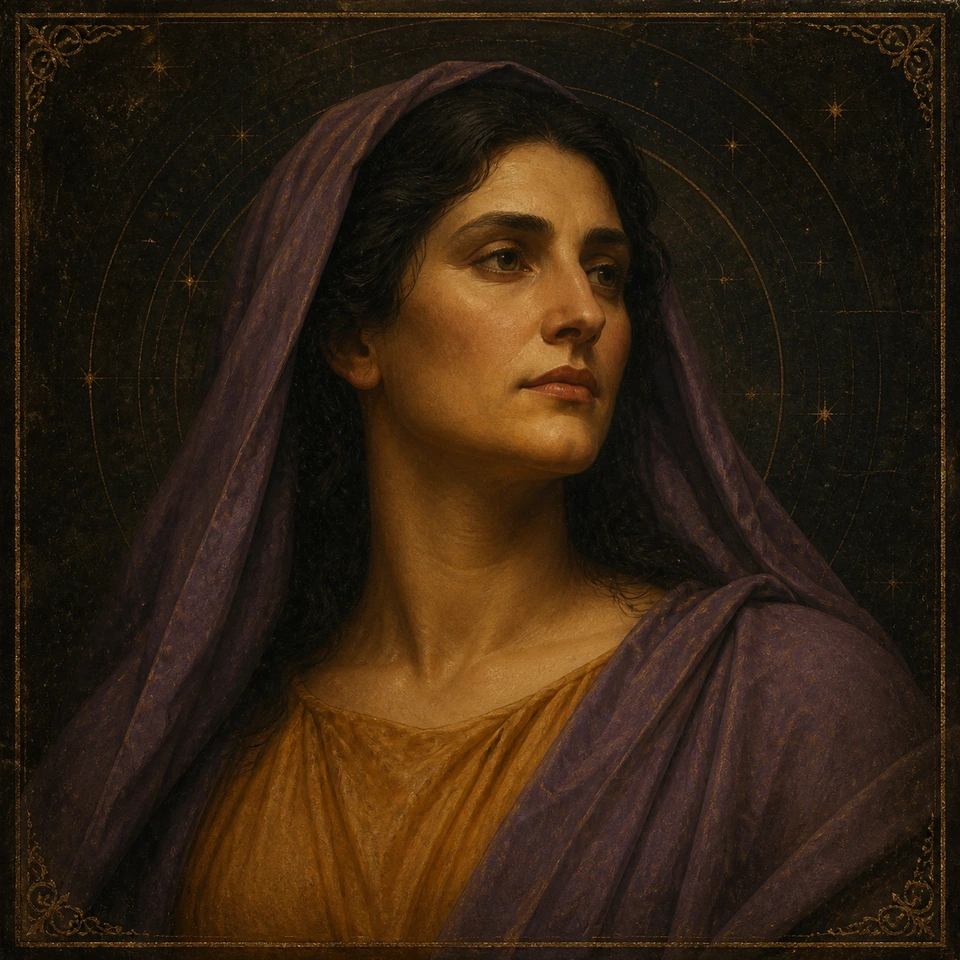
Bathed in Pindaric poetry describing intense radiance and gold, the first-generation Titaness Theia illuminates the ancient cosmos. Alongside her partner Hyperion, she successfully birthed the celestial trinity of Eos, Helios, and Selene.
Overview
Theia first appears as a name spoken into the architecture of the world. Gaia and Uranus bring forth the Titans, six sons and six daughters, and Hesiod places Theia among the daughters. No ray crown rises over her. No jewel enters her hand. Her earliest shape is generational: a divine woman born between Earth and Sky before the younger gods inherit their brighter stories.
Her own family condenses the lights of heaven. Theia joins with Hyperion and bears Eos, Helios, and Selene. Dawn, Sun, and Moon emerge as siblings, each with a separate body and later mythology. Their mother does not become all three. She stands behind the cycle without taking her children's chariots, horses, rays, veils, or celestial motion.
Pindar lets Theia blaze in an athletic victory song. Isthmian 5 begins by calling on many-named Theia, mother of the Sun, before measuring gold against all other possessions. The image turns on mortal stakes: contest, honor, public reputation, and the hard distinction between a victory remembered and one lost to obscurity. Gold gleams because human communities prize it, and the victor's achievement gleams under the same language. The ode does not turn Theia into a mine, jewel, crystal, or promise of wealth.
Pseudo-Apollodorus later arranges the Titan family in prose. Thia appears among the children of Earth and Sky and becomes mother with Hyperion of Dawn, Sun, and Moon. The same mythographer says that all the Titans except Oceanus attacked Uranus. The collective wording includes Theia after the Titan list, but it gives her no individual speech, weapon, or blow. Hesiod's assault is different. Gaia suffers under Uranus's confinement of their children, makes the sickle, and calls for resistance. Cronus alone answers, ambushes his father, cuts him, and spills blood upon Earth. The two tellings must remain separate.
Another poem opens a fracture in the celestial family. Homeric Hymn 31 names Euryphaessa, not Theia, as Hyperion's partner and the mother of Eos, Selene, and Helios. The hymn pours its color and movement into Helios: golden helmet, rays, horses, and chariot. Those attributes belong to the son. The changed maternal name remains visible rather than being explained away as an alias without evidence.
Diodorus preserves a more distant parallel, not another Theia genealogy. In his Atlantic Libyan account Basileia, daughter of Uranus, marries her brother Hyperion and bears Helios and Selene. Their brothers kill Hyperion and destroy Helios; Selene then ends her own life, and the grieving Basileia disappears after wandering with drums and cymbals. The people honor mother and children as divine. The structure resembles Theia's family, but the woman is named Basileia and the violent account belongs to its own reported tradition. Similarity does not authorize an identification.
The surviving poems and mythography name no temple, priesthood, festival, offering list, inscription, or individualized ancient portrait for Theia. That absence does not erase her divine identity. It fixes the surviving outline: Titan genealogy, celestial motherhood, a Pindaric invocation rooted in victory and human valuation, and a source conflict over the mother's name. Theia is not a personification of sight, radiance, wealth, or gold.
Canonical identity
Canonical Identity
Theia is a firmly established first-generation Titaness and Greek deity. Hesiod explicitly lists her among the six daughters born to Uranus and Gaia. This ancient name definitively establishes her kinship and generation without arbitrarily assigning her authority over human eyesight, a universal light office, a sun disk, or a specific jewel. She is entirely distinct from Selene, Helios, and Eos, and she does not function as a personification of gold, wealth, radiance, or sight.
Linguistic Identity
Theia originates from the Greek Θεία. Pseudo-Apollodorus utilized the spelling "Thia," which simply represents a historical English variation of the exact same ancient name, rather than indicating a separate mythological figure. The true ancient pronunciation currently remains unresolved and is therefore left unguessed.
Sources and evidence
TEXTUAL · Supported
Hesiod names Theia among the six Titan daughters born from Gaia and Uranus.
- Source
- Hesiod; edited and translated by Hugh G. Evelyn-White, Theogony (1914)
- Reviewed edition
- Hugh G. Evelyn-White edition and English translation in Hesiod, the Homeric Hymns and Homerica, 1914 · translated by Hugh G. Evelyn-White · edited by Hugh G. Evelyn-White · Perseus Digital Library / Scaife ATLAS
- Exact locator
- Entry Theogony · Line 132-138
- Scope
- Archaic Greece · Ancient Greece
- Authority
- Hesiod, Theogony
- Certainty
- Certain
Source-specific claim.
Open exact reviewed source2 reviewed sources for this section
- Hesiod; edited and translated by Hugh G. Evelyn-White, Theogony (1914)Hesiod, the Homeric Hymns and Homerica, London and New York, 1914 · Perseus Digital Library / Scaife ATLAS
- Pseudo-Apollodorus; edited and translated by James G. Frazer, Library (1921)Harvard University Press and William Heinemann edition, 1921 · Perseus Digital Library / Scaife ATLAS
Culture, tradition, period, and place
Archaic Greek theogony supplies Theia's earliest surviving family setting. Hesiod names her among the Titans and makes her partner of Hyperion and mother of Dawn, Sun, and Moon. Pindar's Classical victory ode invokes her through radiance and the value mortals place on gold.
Pseudo-Apollodorus later preserves the Titan list and celestial family in Greek mythographic prose. Homeric Hymn 31 names a different mother, Euryphaessa, for the same three children. These works span distinct Greek literary settings. They establish no single local temple, priesthood, civic calendar, or universal Mediterranean light cult.
4 reviewed sources for this section
- Hesiod; edited and translated by Hugh G. Evelyn-White, Theogony (1914)Hesiod, the Homeric Hymns and Homerica, London and New York, 1914 · Perseus Digital Library / Scaife ATLAS
- Pindar; translated by Diane Arnson Svarlien, Odes of Pindar (1990)1990 translation hosted by the Perseus Digital Library · Tufts University
- Pseudo-Apollodorus; edited and translated by James G. Frazer, Library (1921)Harvard University Press and William Heinemann edition, 1921 · Perseus Digital Library / Scaife ATLAS
- Anonymous Homeric Hymns; edited and translated by Hugh G. Evelyn-White, Homeric Hymns (1914)Hesiod, the Homeric Hymns and Homerica, London and New York, 1914 · Perseus Digital Library / Scaife ATLAS
Historical development
Hesiod gives Theia generational position and a brilliant family without turning her into one of her children. Eos is Dawn, Helios is Sun, and Selene is Moon. Theia is their mother. Pindar later addresses her directly as many-named and mother of the Sun, joining radiance to the exceptional value that gold carries among mortals.
The Library compresses her into ordered genealogy under the spelling Thia. Hymn 31 creates a genuine maternal variant by naming Euryphaessa. Diodorus later reports an Atlantic Libyan genealogy with a similar Hyperion, Helios, and Selene structure, but its mother is Basileia and the children meet violent deaths. That parallel is evidence for the range of Greek family traditions, not permission to rename Basileia as Theia. Each layer has its own date, place claim, and literary purpose.
Sources and evidence
TEXTUAL · Supported
Pseudo-Apollodorus preserves Theia, spelled Thia in the translation, among the Titans born from Earth and Sky.
- Source
- Pseudo-Apollodorus; edited and translated by James G. Frazer, Library (1921)
- Reviewed edition
- James G. Frazer edition and English translation, Harvard University Press and William Heinemann, 1921 · translated by James G. Frazer · edited by James G. Frazer · Perseus Digital Library / Scaife ATLAS
- Exact locator
- Entry Library · Book 1 · Chapter 1 · Section 3
- Scope
- Greek religion under Roman imperial rule · Ancient Greece
- Authority
- Pseudo-Apollodorus, Library
- Certainty
- Certain
Source-specific claim.
Open exact reviewed source5 reviewed sources for this section
- Hesiod; edited and translated by Hugh G. Evelyn-White, Theogony (1914)Hesiod, the Homeric Hymns and Homerica, London and New York, 1914 · Perseus Digital Library / Scaife ATLAS
- Pindar; translated by Diane Arnson Svarlien, Odes of Pindar (1990)1990 translation hosted by the Perseus Digital Library · Tufts University
- Pseudo-Apollodorus; edited and translated by James G. Frazer, Library (1921)Harvard University Press and William Heinemann edition, 1921 · Perseus Digital Library / Scaife ATLAS
- Anonymous Homeric Hymns; edited and translated by Hugh G. Evelyn-White, Homeric Hymns (1914)Hesiod, the Homeric Hymns and Homerica, London and New York, 1914 · Perseus Digital Library / Scaife ATLAS
- Diodorus Siculus; translated by C. H. Oldfather, Library of History, Book III and Book V selections (1935)Loeb Classical Library Volume II (1935) and Volume III (1939), digital transcription by LacusCurtius · LacusCurtius, University of Chicago
Attested roles and historical themes
Roles, powers, and limits
Theia's clearest roles are Titan daughter, partner, mother, and recipient of Pindaric invocation. Her children articulate the recurring lights of day and night, while the ode presents her radiance beside gold's supreme value in human judgment.
That Pindaric brightness carries material and social stakes. The song honors athletic victory, public reputation, and the human act of ranking gold above other possessions. It does not dissolve Theia into an abstract slogan or make her a harmless emblem of illumination. Nor does it make her ruler of mines, jewelry, sight, wealth, or every shining substance. Motherhood transfers none of Helios's chariot, Selene's lunar journey, or Eos's dawn body to her.
Sources and evidence
TEXTUAL · Supported
Pindar invokes many-named Theia as mother of the Sun and connects her radiance with the exceptional value people give to gold.
- Source
- Pindar; translated by Diane Arnson Svarlien, Odes of Pindar (1990)
- Reviewed edition
- Diane Arnson Svarlien English translation, 1990 · translated by Diane Arnson Svarlien · Tufts University
- Exact locator
- Entry Isthmian 5 · Line 1-3
- Scope
- Classical Greece · Ancient Greece
- Authority
- Pindar, Isthmian 5
- Certainty
- Qualified
The poetic association supports radiance and value in this ode, not a universal metal rulership, gemstone system, or offering rule.
Open exact reviewed source3 reviewed sources for this section
- Hesiod; edited and translated by Hugh G. Evelyn-White, Theogony (1914)Hesiod, the Homeric Hymns and Homerica, London and New York, 1914 · Perseus Digital Library / Scaife ATLAS
- Pindar; translated by Diane Arnson Svarlien, Odes of Pindar (1990)1990 translation hosted by the Perseus Digital Library · Tufts University
- Pseudo-Apollodorus; edited and translated by James G. Frazer, Library (1921)Harvard University Press and William Heinemann edition, 1921 · Perseus Digital Library / Scaife ATLAS
Epithets and titles
Poetic Epithet
Many-named
Many-named
Isthmian victory-ode tradition · Classical GreekPindaric address, not a localized cult title.
1 reviewed source for this section
- Pindar; translated by Diane Arnson Svarlien, Odes of Pindar (1990)1990 translation hosted by the Perseus Digital Library · Tufts University
Poetic Epithet
Mother of the Sun
Mother of the Sun
Isthmian victory-ode tradition · Classical GreekPindaric maternal address tied to Helios, not a claim that Theia is the Sun.
1 reviewed source for this section
- Pindar; translated by Diane Arnson Svarlien, Odes of Pindar (1990)1990 translation hosted by the Perseus Digital Library · Tufts University
Worship and cult
Pindar's direct invocation shows that Theia could be addressed in elevated Greek poetry. It does not by itself identify a temple, altar, priesthood, sacrifice, civic office, or recurring ritual. The ode praises an athletic victor through glory, radiance, and precious value.
No securely localized Greek cult for Theia appears in Hesiod, Pindar, Pseudo-Apollodorus, or Homeric Hymn 31. Literary dignity and divine identity remain real even when no sanctuary program survives.
1 reviewed source for this section
- Pindar; translated by Diane Arnson Svarlien, Odes of Pindar (1990)1990 translation hosted by the Perseus Digital Library · Tufts University
Temples, sanctuaries, and sacred places
No temple, sanctuary, mountain, spring, city, or regional cult center is assigned to Theia in Hesiod, Pindar, Pseudo-Apollodorus, or Homeric Hymn 31. Hesiod and the Library place her inside divine genealogy rather than a named human landscape. Pindar's Isthmian ode has a performance and victory setting, but that does not make the Isthmus a sanctuary dedicated to Theia.
The heavens traversed by Helios, Selene, and Eos belong to the children's own identities. Their paths do not become their mother's temple.
3 reviewed sources for this section
- Hesiod; edited and translated by Hugh G. Evelyn-White, Theogony (1914)Hesiod, the Homeric Hymns and Homerica, London and New York, 1914 · Perseus Digital Library / Scaife ATLAS
- Pindar; translated by Diane Arnson Svarlien, Odes of Pindar (1990)1990 translation hosted by the Perseus Digital Library · Tufts University
- Pseudo-Apollodorus; edited and translated by James G. Frazer, Library (1921)Harvard University Press and William Heinemann edition, 1921 · Perseus Digital Library / Scaife ATLAS
Festivals and processions
No annual festival, procession, sacred month, or seasonal observance for Theia is secured. Isthmian 5 is a victory ode, not a ritual calendar for her. Its invocation cannot be expanded into a feast merely because the poem celebrates human achievement.
The daily and nightly appearances of her children are cosmic rhythms, not evidence for a Theia festival at dawn, noon, sunset, a moon phase, or an equinox.
2 reviewed sources for this section
- Hesiod; edited and translated by Hugh G. Evelyn-White, Theogony (1914)Hesiod, the Homeric Hymns and Homerica, London and New York, 1914 · Perseus Digital Library / Scaife ATLAS
- Pindar; translated by Diane Arnson Svarlien, Odes of Pindar (1990)1990 translation hosted by the Perseus Digital Library · Tufts University
Offerings, votives, and ritual evidence
No ancient offering list, votive formula, libation rule, incense, sacrifice, or ritual tool for Theia is established. Pindar’s gold expresses extraordinary value and radiance within praise. It does not instruct worshippers to offer gold, wear jewelry, purchase crystals, or seek wealth through a rite.
The surviving evidence therefore supports no food, drink, precious metal, gemstone, flame, or perfume as her historical offering.
1 reviewed source for this section
- Pindar; translated by Diane Arnson Svarlien, Odes of Pindar (1990)1990 translation hosted by the Perseus Digital Library · Tufts University
Iconography and material culture
No individualized ancient portrait attribute is secured by the surviving poems and mythographies. Theia receives no jewel, gemstone, metal ingot, sun disk, moon, star crown, ray halo, chariot, torch, or permanent handheld object. Pindar’s gold is verbal imagery of value, not a surviving cult object.
Helios’s rays, Selene’s moon, and Eos’s dawn remain the children’s attributes. Transferring them to their mother would turn genealogy into false iconography.
2 reviewed sources for this section
- Hesiod; edited and translated by Hugh G. Evelyn-White, Theogony (1914)Hesiod, the Homeric Hymns and Homerica, London and New York, 1914 · Perseus Digital Library / Scaife ATLAS
- Pindar; translated by Diane Arnson Svarlien, Odes of Pindar (1990)1990 translation hosted by the Perseus Digital Library · Tufts University
Animals, plants, and embodied forms
No animal, plant, or transformed body is assigned to Theia by Hesiod, Pindar, Pseudo-Apollodorus, or Homeric Hymn 31. Neither the celestial children nor Pindar's gold becomes a sacred creature, tree, flower, or bodily metamorphosis for their mother.
Horses and chariots belong to solar and lunar narratives elsewhere, not automatically to Theia. Saffron, heliotrope, sunflower, eagle, lion, and other bright or golden associations remain unattested for her. Her body remains that of a Titaness in genealogy, without an attested hybrid, animal manifestation, or vegetal emblem.
2 reviewed sources for this section
- Hesiod; edited and translated by Hugh G. Evelyn-White, Theogony (1914)Hesiod, the Homeric Hymns and Homerica, London and New York, 1914 · Perseus Digital Library / Scaife ATLAS
- Pindar; translated by Diane Arnson Svarlien, Odes of Pindar (1990)1990 translation hosted by the Perseus Digital Library · Tufts University
Relationships and genealogy
Gaia and Uranus are Theia's parents in the first Titan genealogy. Hyperion is her partner in Hesiod and Pseudo-Apollodorus. Their children are Eos, Helios, and Selene, three distinct divine figures whose daily and nightly appearances do not collapse into their mother.
Homeric Hymn 31 changes the maternal name to Euryphaessa while retaining Hyperion and the three siblings. Theia and Euryphaessa are therefore kept as separate source forms rather than silently identified. The variant may reflect poetic tradition, an epithet, or another genealogy, but the hymn does not explain the relationship.
Sources and evidence
TEXTUAL · Supported
Hesiod joins Theia with Hyperion as mother of Eos, Helios, and Selene.
- Source
- Hesiod; edited and translated by Hugh G. Evelyn-White, Theogony (1914)
- Reviewed edition
- Hugh G. Evelyn-White edition and English translation in Hesiod, the Homeric Hymns and Homerica, 1914 · translated by Hugh G. Evelyn-White · edited by Hugh G. Evelyn-White · Perseus Digital Library / Scaife ATLAS
- Exact locator
- Entry Theogony · Line 371-374
- Scope
- Archaic Greece · Ancient Greece
- Authority
- Hesiod, Theogony
- Certainty
- Certain
Source-specific claim.
Open exact reviewed sourceTEXTUAL · Supported
Pseudo-Apollodorus likewise names Thia and Hyperion as parents of Dawn, Sun, and Moon.
- Source
- Pseudo-Apollodorus; edited and translated by James G. Frazer, Library (1921)
- Reviewed edition
- James G. Frazer edition and English translation, Harvard University Press and William Heinemann, 1921 · translated by James G. Frazer · edited by James G. Frazer · Perseus Digital Library / Scaife ATLAS
- Exact locator
- Entry Library · Book 1 · Chapter 2 · Section 2
- Scope
- Greek religion under Roman imperial rule · Ancient Greece
- Authority
- Pseudo-Apollodorus, Library
- Certainty
- Certain
Source-specific claim.
Open exact reviewed source3 reviewed sources for this section
- Hesiod; edited and translated by Hugh G. Evelyn-White, Theogony (1914)Hesiod, the Homeric Hymns and Homerica, London and New York, 1914 · Perseus Digital Library / Scaife ATLAS
- Pseudo-Apollodorus; edited and translated by James G. Frazer, Library (1921)Harvard University Press and William Heinemann edition, 1921 · Perseus Digital Library / Scaife ATLAS
- Anonymous Homeric Hymns; edited and translated by Hugh G. Evelyn-White, Homeric Hymns (1914)Hesiod, the Homeric Hymns and Homerica, London and New York, 1914 · Perseus Digital Library / Scaife ATLAS
Actual myths and source variants
Three linked narratives define Theia. She enters among the first Titans. Pseudo-Apollodorus's later overthrow account says all Titans except Oceanus attack Uranus, collectively implicating Theia after the Titan list but giving her no personal act. Her central genealogy joins her with Hyperion and names Eos, Helios, and Selene.
The overthrow is not a bloodless change of office. Gaia suffers under Uranus's confinement of their children and makes the sickle; Cronus ambushes his father, mutilates him, and spills blood upon Earth. Pseudo-Apollodorus broadens responsibility to the other Titans except Oceanus while preserving Cronus as the wielder. Theia's collective implication neither invents a blow for her nor conceals the physical violence.
The family story has a controlled conflict. Hesiod and the Library name Theia or Thia as mother. Hymn 31 names Euryphaessa and turns its attention to Helios's equipment and journey. The solar attributes remain the son's. The alternate mother is not erased, and no unsupported equivalence forces every witness into one seamless household.
Sources and evidence
TEXTUAL · Supported
Homeric Hymn 31 names Euryphaessa, not Theia, as Hyperion’s partner and mother of Eos, Selene, and Helios.
- Source
- Anonymous Homeric Hymns; edited and translated by Hugh G. Evelyn-White, Homeric Hymns (1914)
- Reviewed edition
- Hugh G. Evelyn-White English translation of Homeric Hymn 31 to Helios, 1914 · translated by Hugh G. Evelyn-White · edited by Hugh G. Evelyn-White · Perseus Digital Library / Scaife ATLAS
- Exact locator
- Entry Homeric Hymn 31 · Line 1-6
- Scope
- Ancient Greek diachrony · Ancient Greece
- Authority
- Homeric Hymn 31
- Certainty
- Disputed
The maternal names remain separate variants; identity between Theia and Euryphaessa is not assumed.
Open exact reviewed sourceTEXTUAL · Supported
Pseudo-Apollodorus says all Titans except Oceanus attacked Uranus, wording that includes Theia collectively after the preceding Titan list but gives her no individual action.
- Source
- Pseudo-Apollodorus; edited and translated by James G. Frazer, Library (1921)
- Reviewed edition
- James G. Frazer edition and English translation, Harvard University Press and William Heinemann, 1921 · translated by James G. Frazer · edited by James G. Frazer · Perseus Digital Library / Scaife ATLAS
- Exact locator
- Entry Library · Book 1 · Chapter 1 · Section 3-4
- Scope
- Greek religion under Roman imperial rule · Ancient Greece
- Authority
- Pseudo-Apollodorus, Library
- Certainty
- Qualified
The collective wording is not expanded into a private speech, weapon, or blow.
Open exact reviewed source3 reviewed sources for this section
- Hesiod; edited and translated by Hugh G. Evelyn-White, Theogony (1914)Hesiod, the Homeric Hymns and Homerica, London and New York, 1914 · Perseus Digital Library / Scaife ATLAS
- Pseudo-Apollodorus; edited and translated by James G. Frazer, Library (1921)Harvard University Press and William Heinemann edition, 1921 · Perseus Digital Library / Scaife ATLAS
- Anonymous Homeric Hymns; edited and translated by Hugh G. Evelyn-White, Homeric Hymns (1914)Hesiod, the Homeric Hymns and Homerica, London and New York, 1914 · Perseus Digital Library / Scaife ATLAS
Myth Library
Each myth gathers its attested participants into one source-grounded account, while distinct source traditions remain readable in their own variants.
Divine Genealogy
The Birth of the First Titans
Gaia and Uranus bring forth twelve named Titans, whose shared birth establishes a generation without assigning every sibling the same deed or cosmic office.
- Role in this profile
- enters as a first-generation Titan daughter of Gaia and Uranus
- Place scope
- Ancient Greece
- Witnesses
- 4
- Variants
- 4
Theogonic Succession
The Titans Overthrow Uranus
Hesiod makes Cronus the sole child who answers Gaia, while Pseudo-Apollodorus makes every Titan except Oceanus join the violent attack and thereby gives Theia only a collective role.
- Role in this profile
- belongs to Pseudo-Apollodorus’s collective attacking Titans after Oceanus alone is excepted
- Place scope
- Ancient Greece
- Witnesses
- 2
- Variants
- 2
Divine Genealogy
Hyperion, Theia, and the Celestial Children
Hesiod and Pseudo-Apollodorus make Hyperion and Theia parents of Eos, Helios, and Selene, while Homeric Hymn 31 names Euryphaessa as the children’s mother.
- Role in this profile
- Mother in Hesiod and Pseudo-Apollodorus
- Place scope
- Ancient Greece
- Witnesses
- 3
- Variants
- 3
Equivalences, syncretisms, and identity boundaries
Theia is not Helios, Selene, Eos, Apollo, Artemis, or a generic goddess of light. She is mother of the celestial siblings only where the relevant genealogy says so. The spelling Thia belongs to the Library translation. Euryphaessa remains an alternate maternal name in Hymn 31 rather than an automatic alias.
Diodorus's Basileia is not silently renamed Theia. She occupies a structurally parallel genealogy with Hyperion, Helios, and Selene, but Diodorus names her Basileia and gives that family a different catastrophe. Gold, jewels, crystals, eyesight, brilliance, and wealth likewise do not create an equivalence. Pindar's three lines support a precise poetic association of radiance and human value, not a universal cult office or magical system.
Sources and evidence
TEXTUAL · Supported
Diodorus names Basileia, not Theia, as the daughter of Uranus who marries Hyperion and bears Helios and Selene in his Atlantic Libyan account.
- Source
- Diodorus Siculus; translated by C. H. Oldfather, Library of History, Book III and Book V selections (1935)
- Reviewed edition
- C. H. Oldfather English translation, Loeb Classical Library Volume II, Books 2.35-4.58, 1935 · translated by C. H. Oldfather · LacusCurtius, University of Chicago
- Exact locator
- Book 3 · Chapter 57 · Section 2-6
- Scope
- Roman Republican period · Ancient Libya
- Authority
- Diodorus Siculus, Library of History
- Certainty
- Certain that the reported mother is Basileia; structural comparison with Theia remains interpretive and does not establish identity
Identity firewall. The shared Hyperion, Helios, and Selene structure creates no Theia alias, relationship, cult, or myth participation.
Open exact reviewed source5 reviewed sources for this section
- Hesiod; edited and translated by Hugh G. Evelyn-White, Theogony (1914)Hesiod, the Homeric Hymns and Homerica, London and New York, 1914 · Perseus Digital Library / Scaife ATLAS
- Pindar; translated by Diane Arnson Svarlien, Odes of Pindar (1990)1990 translation hosted by the Perseus Digital Library · Tufts University
- Pseudo-Apollodorus; edited and translated by James G. Frazer, Library (1921)Harvard University Press and William Heinemann edition, 1921 · Perseus Digital Library / Scaife ATLAS
- Anonymous Homeric Hymns; edited and translated by Hugh G. Evelyn-White, Homeric Hymns (1914)Hesiod, the Homeric Hymns and Homerica, London and New York, 1914 · Perseus Digital Library / Scaife ATLAS
- Diodorus Siculus; translated by C. H. Oldfather, Library of History, Book III and Book V selections (1935)Loeb Classical Library Volume II (1935) and Volume III (1939), digital transcription by LacusCurtius · LacusCurtius, University of Chicago
Correspondence index
The strongest associations stay close to ancient language: Hyperion, Eos, Helios, Selene, radiance, many-named address, and gold as an image of exceptional value. The celestial bodies belong to the children. Gold belongs to Pindar’s comparison, not a ritual law.
No zodiac sign, gemstone, sacred color, classical element, weekday, moon phase, direction, festival, incense, offering, animal, plant, or ritual object is established. The evidence does not promise wealth, beauty, vision, fame, or control of sun and moon.
Contextual evidence, not a general correspondence
| Category | Direct correspondence | How and why | Evidence boundary |
|---|---|---|---|
| celestial-body | Mother of Eos, Helios, and SeleneContextual evidence only | Theia mothers Dawn, Sun, and Moon in two genealogies, but she is not herself a planet, sun, or moon. | Ancient Literary The two genealogies make Theia mother of Dawn, Sun, and Moon without making her a celestial body. 3 reviewed sources for this section
|
| metal-material | Gold in Pindar’s language of valueContextual evidence only | Pindar connects Theia’s radiance with the value given to gold; the ode does not make gold her cult metal or offering. | Ancient Literary Isthmian 5 compares Theia's radiance with gold's human value; it supplies no cult metal, offering, or magical rulership. 1 reviewed source for this section
|
| intention-magical-power | Radiance, value, motherhood, and generational continuityContextual evidence only | Ancient poetry supports reflection on brightness and kinship, not promises of wealth, beauty, vision, or celestial control. | Ancient Literary The ancient evidence supports poetic reflection on radiance, reputation, kinship, and value, not a promise of wealth, beauty, sight, or celestial control. 3 reviewed sources for this section
|
13 expected categories currently not evidenced
zodiac · Not evidenced
No zodiac sign
No zodiac rulership is established.
- Layer
- Research Boundary
- Scope
- Hesiod, Pindar, Pseudo-Apollodorus, and Homeric Hymn 31 assign no zodiac sign to Theia.
gemstone-crystal-mineral · Not evidenced
No gemstone or crystal
Pindar’s gold language does not establish gems, crystals, or minerals.
- Layer
- Research Boundary
- Scope
- Pindar names gold, not a gemstone or crystal, and the genealogies add no mineral.
plant-tree · Not evidenced
No identified plant
No sacred plant is established.
- Layer
- Research Boundary
- Scope
- The ancient poems and mythography name no plant or tree as Theia's attribute.
animal-embodied-form · Not evidenced
No canonical animal
No animal or transformed body belongs to the reviewed narratives.
- Layer
- Research Boundary
- Scope
- The ancient poems and mythography assign Theia no animal or transformed body.
color · Not evidenced
No canonical color
Saffron and violet in the portrait are artistic choices, not ancient sacred colors.
- Layer
- Research Boundary
- Scope
- The saffron and violet portrait palette is modern art direction; no named ancient witness makes either color sacred to Theia.
classical-element · Not evidenced
No classical element
Brightness and celestial children do not establish fire, air, water, or earth rulership.
- Layer
- Research Boundary
- Scope
- Brightness and celestial children do not assign Theia fire, air, water, or earth.
weekday · Not evidenced
No weekday
No weekday is securely linked to Theia.
- Layer
- Research Boundary
- Scope
- No dated ancient ritual or astrological text named above assigns Theia a weekday.
moon-phase · Not evidenced
No moon phase
Motherhood of Selene does not establish lunar phases for Theia.
- Layer
- Research Boundary
- Scope
- Motherhood of Selene does not transfer a lunar phase to Theia.
direction-place · Not evidenced
No compass direction or sanctuary
No cardinal direction or localized sacred place is established.
- Layer
- Research Boundary
- Scope
- No cardinal direction or localized Theia sanctuary appears in the named ancient works.
festival-time · Not evidenced
No secure festival time
No feast, month, or season is established.
- Layer
- Research Boundary
- Scope
- No festival name, month, procession, or seasonal observance for Theia appears in the named ancient works.
incense-perfume · Not evidenced
No incense or perfume
No fumigant or scent is specified.
- Layer
- Research Boundary
- Scope
- No named ancient witness prescribes a fumigant, incense, or perfume for Theia.
offering-ritual-material · Not evidenced
No attested offering
Gold in an athletic victory ode is not an offering instruction.
- Layer
- Research Boundary
- Scope
- Gold in an athletic victory ode is a comparison of value, not an offering instruction.
ritual-object-symbol-tool · Not evidenced
No personal ritual object
No jewel, disk, crown, chariot, torch, or handheld tool is assigned to Theia.
- Layer
- Research Boundary
- Scope
- No named ancient witness gives Theia a jewel, disk, crown, chariot, torch, or handheld ritual tool.
3 reviewed sources for this section
- Hesiod; edited and translated by Hugh G. Evelyn-White, Theogony (1914)Hesiod, the Homeric Hymns and Homerica, London and New York, 1914 · Perseus Digital Library / Scaife ATLAS
- Pindar; translated by Diane Arnson Svarlien, Odes of Pindar (1990)1990 translation hosted by the Perseus Digital Library · Tufts University
- Pseudo-Apollodorus; edited and translated by James G. Frazer, Library (1921)Harvard University Press and William Heinemann edition, 1921 · Perseus Digital Library / Scaife ATLAS
Later reception and living significance
NASA uses Theia for the hypothetical massive impactor in a Moon-formation model and explicitly says the object was named after the mythological Greek Titan because she is Selene's mother. The scientific namesake is not the ancient deity: it supplies no Greek pronunciation, function, iconography, cult, or correspondence.
No accountable public Theia-specific devotional witness is registered. A contemporary devotional practice, offering, magical function, or living-tradition claim therefore needs its own named community testimony.
Sources and evidence
TEXTUAL · Supported
NASA describes a hypothetical massive impactor called Theia and says it was named after the mythological Greek Titan mother of Selene.
- Source
- Tracy Vogel; science advisors Prabal Saxena, Sarah Valencia, and Bill Bottke, Moon Formation (2026)
- Reviewed edition
- NASA Science, Moon Formation, updated 2026-07-23 · NASA Science
- Exact locator
- Entry Moon Formation · Section How did the Moon form?, second paragraph
- Scope
- Modern institutional astronomy · Global astronomical observation
- Authority
- NASA Science astronomy overview
- Certainty
- Secure modern scientific namesake boundary
Modern reception only. The shared name creates no identity, ancient function, cult, iconography, or correspondence for the Titaness.
Open exact reviewed source1 reviewed source for this section
- Tracy Vogel; science advisors Prabal Saxena, Sarah Valencia, and Bill Bottke, Moon Formation (2026)NASA Science web resource, updated 2026-07-23 · NASA Science
Evidence, conflicts, and research gaps
Hesiod secures Titan birth and the family with Hyperion. Pindar supplies direct invocation and the precise radiance-and-gold passage. Pseudo-Apollodorus confirms later genealogy and collective overthrow wording. Homeric Hymn 31 preserves Euryphaessa as the alternate mother. Diodorus controls the separate Basileia account and its violent family history. Each statement remains bound to its own work and locator.
No secure Linear B form, ancient pronunciation, localized cult epithet, temple, priesthood, festival, offering list, inscription, individualized ancient portrait, or accountable public modern devotional witness is established. The relationship between Theia and Euryphaessa remains unresolved, and no reviewed witness identifies Basileia with Theia. Pindar's gold is literary and cannot establish gemstones, metal rulership, wealth magic, or a cult offering.
5 reviewed sources for this section
- Hesiod; edited and translated by Hugh G. Evelyn-White, Theogony (1914)Hesiod, the Homeric Hymns and Homerica, London and New York, 1914 · Perseus Digital Library / Scaife ATLAS
- Pindar; translated by Diane Arnson Svarlien, Odes of Pindar (1990)1990 translation hosted by the Perseus Digital Library · Tufts University
- Pseudo-Apollodorus; edited and translated by James G. Frazer, Library (1921)Harvard University Press and William Heinemann edition, 1921 · Perseus Digital Library / Scaife ATLAS
- Anonymous Homeric Hymns; edited and translated by Hugh G. Evelyn-White, Homeric Hymns (1914)Hesiod, the Homeric Hymns and Homerica, London and New York, 1914 · Perseus Digital Library / Scaife ATLAS
- Diodorus Siculus; translated by C. H. Oldfather, Library of History, Book III and Book V selections (1935)Loeb Classical Library Volume II (1935) and Volume III (1939), digital transcription by LacusCurtius · LacusCurtius, University of Chicago
Direct connections and evidence
Explicit Source
Hesiod joins Hyperion and Theia as parents of the celestial siblings
Hesiodic union only; Hymn 31 names Euryphaessa instead and remains a separate variant.
1 attestation · high confidence
- Hesiod; edited and translated by Hugh G. Evelyn-White, TheogonyHugh G. Evelyn-White edition and English translation in Hesiod, the Homeric Hymns and Homerica, 1914 · translated by Hugh G. Evelyn-White · edited by Hugh G. Evelyn-White · Perseus Digital Library / Scaife ATLAS · Archaic Greece · Ancient Greece · Entry Theogony · Line 371-374
Explicit Source
Hesiod names Iapetus and Theia in the same generation born from Gaia and Ouranos
Sibling genealogy only; it transfers no office, deed, cult, or correspondence between the two figures.
1 attestation · high confidence
- Hesiod; edited and translated by Hugh G. Evelyn-White, TheogonyHugh G. Evelyn-White edition and English translation in Hesiod, the Homeric Hymns and Homerica, 1914 · translated by Hugh G. Evelyn-White · edited by Hugh G. Evelyn-White · Perseus Digital Library / Scaife ATLAS · Archaic Greece · Ancient Greece · Entry Theogony · Line 132-138
Explicit Source
Hesiod names Mnemosyne and Theia in the same generation born from Gaia and Ouranos
Sibling genealogy only; it transfers no office, deed, cult, or correspondence between the two figures.
1 attestation · high confidence
- Hesiod; edited and translated by Hugh G. Evelyn-White, TheogonyHugh G. Evelyn-White edition and English translation in Hesiod, the Homeric Hymns and Homerica, 1914 · translated by Hugh G. Evelyn-White · edited by Hugh G. Evelyn-White · Perseus Digital Library / Scaife ATLAS · Archaic Greece · Ancient Greece · Entry Theogony · Line 132-138
Explicit Source
Hesiod names Rhea and Theia in the same generation born from Gaia and Ouranos
Sibling genealogy only; it transfers no office, deed, cult, or correspondence between the two figures.
1 attestation · high confidence
- Hesiod; edited and translated by Hugh G. Evelyn-White, TheogonyHugh G. Evelyn-White edition and English translation in Hesiod, the Homeric Hymns and Homerica, 1914 · translated by Hugh G. Evelyn-White · edited by Hugh G. Evelyn-White · Perseus Digital Library / Scaife ATLAS · Archaic Greece · Ancient Greece · Entry Theogony · Line 132-138
Explicit Source
Selene is a daughter of Theia
Theia is Selene’s mother in both Hesiod and Pseudo-Apollodorus.
2 attestations · high confidence
- Hesiod; edited and translated by Hugh G. Evelyn-White, TheogonyHugh G. Evelyn-White edition and English translation in Hesiod, the Homeric Hymns and Homerica, 1914 · translated by Hugh G. Evelyn-White · edited by Hugh G. Evelyn-White · Perseus Digital Library / Scaife ATLAS · Archaic Greece · Ancient Greece · Entry Theogony · Line 371-374
- Pseudo-Apollodorus; edited and translated by James G. Frazer, LibraryJames G. Frazer edition and English translation, Harvard University Press and William Heinemann, 1921 · translated by James G. Frazer · edited by James G. Frazer · Perseus Digital Library / Scaife ATLAS · Greek religion under Roman imperial rule · Ancient Greece · Entry Library · Book 1 · Section 2.2
Explicit Source
Hesiod names Theia as a daughter of Gaia
Genealogy does not create an earth correspondence.
1 attestation · high confidence
- Hesiod; edited and translated by Hugh G. Evelyn-White, TheogonyHugh G. Evelyn-White edition and English translation in Hesiod, the Homeric Hymns and Homerica, 1914 · translated by Hugh G. Evelyn-White · edited by Hugh G. Evelyn-White · Perseus Digital Library / Scaife ATLAS · Archaic Greece · Ancient Greece · Entry Theogony · Line 132-138
Explicit Source
Hesiod names Theia as a daughter of Uranus
Genealogy does not create planetary or sky rulership.
1 attestation · high confidence
- Hesiod; edited and translated by Hugh G. Evelyn-White, TheogonyHugh G. Evelyn-White edition and English translation in Hesiod, the Homeric Hymns and Homerica, 1914 · translated by Hugh G. Evelyn-White · edited by Hugh G. Evelyn-White · Perseus Digital Library / Scaife ATLAS · Archaic Greece · Ancient Greece · Entry Theogony · Line 132-138
Explicit Source
Hesiod names Theia as mother of Eos
Eos remains the distinct goddess of Dawn.
1 attestation · high confidence
- Hesiod; edited and translated by Hugh G. Evelyn-White, TheogonyHugh G. Evelyn-White edition and English translation in Hesiod, the Homeric Hymns and Homerica, 1914 · translated by Hugh G. Evelyn-White · edited by Hugh G. Evelyn-White · Perseus Digital Library / Scaife ATLAS · Archaic Greece · Ancient Greece · Entry Theogony · Line 371-374
Explicit Source
Hesiod names Theia as mother of Helios
Helios retains his distinct solar identity and equipment.
1 attestation · high confidence
- Hesiod; edited and translated by Hugh G. Evelyn-White, TheogonyHugh G. Evelyn-White edition and English translation in Hesiod, the Homeric Hymns and Homerica, 1914 · translated by Hugh G. Evelyn-White · edited by Hugh G. Evelyn-White · Perseus Digital Library / Scaife ATLAS · Archaic Greece · Ancient Greece · Entry Theogony · Line 371-374
Explicit Source
Hesiod names Theia as mother of Selene
Selene remains the distinct lunar goddess.
1 attestation · high confidence
- Hesiod; edited and translated by Hugh G. Evelyn-White, TheogonyHugh G. Evelyn-White edition and English translation in Hesiod, the Homeric Hymns and Homerica, 1914 · translated by Hugh G. Evelyn-White · edited by Hugh G. Evelyn-White · Perseus Digital Library / Scaife ATLAS · Archaic Greece · Ancient Greece · Entry Theogony · Line 371-374
Archive scope and classification
- Figure classification
- Titan or Titaness, God or goddess · certain
- Pantheon or tradition shelf
- Greek
- Cultures
- Greek
- Traditions
- Ancient Greek religion
- Periods
- Archaic Greece, Classical Greece, Greek religion under Roman imperial rule
- Places
- Ancient Greece
Secure Titaness and deity. Family and Pindaric invocation are attested; cult and individualized iconography remain unresolved.
Reviewed sources
- Hesiod; edited and translated by Hugh G. Evelyn-White, Theogony (1914)Hesiod, the Homeric Hymns and Homerica, London and New York, 1914 · Perseus Digital Library / Scaife ATLAS
- Anonymous Homeric Hymns; edited and translated by Hugh G. Evelyn-White, Homeric Hymns (1914)Hesiod, the Homeric Hymns and Homerica, London and New York, 1914 · Perseus Digital Library / Scaife ATLAS
- Pseudo-Apollodorus; edited and translated by James G. Frazer, Library (1921)Harvard University Press and William Heinemann edition, 1921 · Perseus Digital Library / Scaife ATLAS
- Pindar; translated by Diane Arnson Svarlien, Odes of Pindar (1990)1990 translation hosted by the Perseus Digital Library · Tufts University
- Diodorus Siculus; translated by C. H. Oldfather, Library of History, Book III and Book V selections (1935)Loeb Classical Library Volume II (1935) and Volume III (1939), digital transcription by LacusCurtius · LacusCurtius, University of Chicago
- Tracy Vogel; science advisors Prabal Saxena, Sarah Valencia, and Bill Bottke, Moon Formation (2026)NASA Science web resource, updated 2026-07-23 · NASA Science