Greek · Titan or Titaness · Certain
Hyperion
Ὑπερίων · Huperiōn
Pronunciation: /hy.pe.rǐː.ɔːn/ · HUE-peh-REE-own
Research and editorial review by Cody Manes · Reviewed 2026-08-30
A towering first-generation Titan, Hyperion partners with Theia in early Hesiodic tradition. He anchors the celestial lineage as the father of Eos, Helios, and Selene, remaining a distinct mythological entity despite later poetic blurring with his solar son.
Overview
Hyperion stands near the beginning of the Greek divine family, but the surviving early poetry gives him less action than radiance by descent. Hesiod names him among the twelve Titan children of Gaia and starry Uranus. Later in the Theogony, Theia and Hyperion become parents of Eos, Helios, and Selene: Dawn, Sun, and Moon. Their children cross the sky in forms visible to gods and mortals, while the father remains a grave genealogical presence behind them.
That difference matters because ancient poetry sometimes blurs the name. The Homeric Hymn to Demeter calls Helios the Son of Hyperion, a clear patronymic boundary. The Odyssey, however, can speak of "Helios Hyperion" when describing the solar god's cattle, daily ascent, and demand for vengeance. In those epic passages, the chariot, rays, and sacred herds belong to Helios. They cannot be lifted from the son and placed into the hands of the elder Titan merely because the father's name colors the verse.
Hyperion's oldest story is therefore family. Earth and Heaven produce Oceanus, Coeus, Crius, Hyperion, Iapetus, Theia, Rhea, Themis, Mnemosyne, Phoebe, Tethys, and Cronus. Hesiod does not describe Hyperion joining the attack on Uranus or fighting a named duel in the Titanomachy. Pseudo-Apollodorus later compresses Titan action more collectively, but that is not permission to invent an individual battle exploit. Silence is part of the portrait.
Even the celestial household has variants. Hesiod names Theia as mother of Eos, Helios, and Selene. Pseudo-Apollodorus uses the spelling Thia. Homeric Hymn 31 instead gives Hyperion a sister-wife named Euryphaessa, then turns to the brilliant body of Helios with golden helmet, rays, horses, and chariot. The maternal difference remains visible, and the hymn's solar equipment stays with the child it praises.
Diodorus Siculus preserves two much later ways of making Hyperion more active. In Book 5, he rationalizes the Titan as the first careful observer to understand and teach the movements of sun, moon, stars, and seasons. Fatherhood becomes a figure for originating knowledge about celestial bodies. This is a learned first-century BC interpretation, not a lost line of Hesiod.
Book 3 reports a harsher Atlantic Libyan story. Basileia inherits royal power, marries her brother Hyperion, and bears Helios and Selene. Her jealous brothers murder Hyperion, drown the young Helios in the Eridanus, and drive Selene to death through grief. A vision promises that the children will become the Sun and Moon. Eos is absent, Basileia replaces Theia, and Hyperion dies. The account is not a missing chapter of the Theogony but a separate dynastic transformation tale.
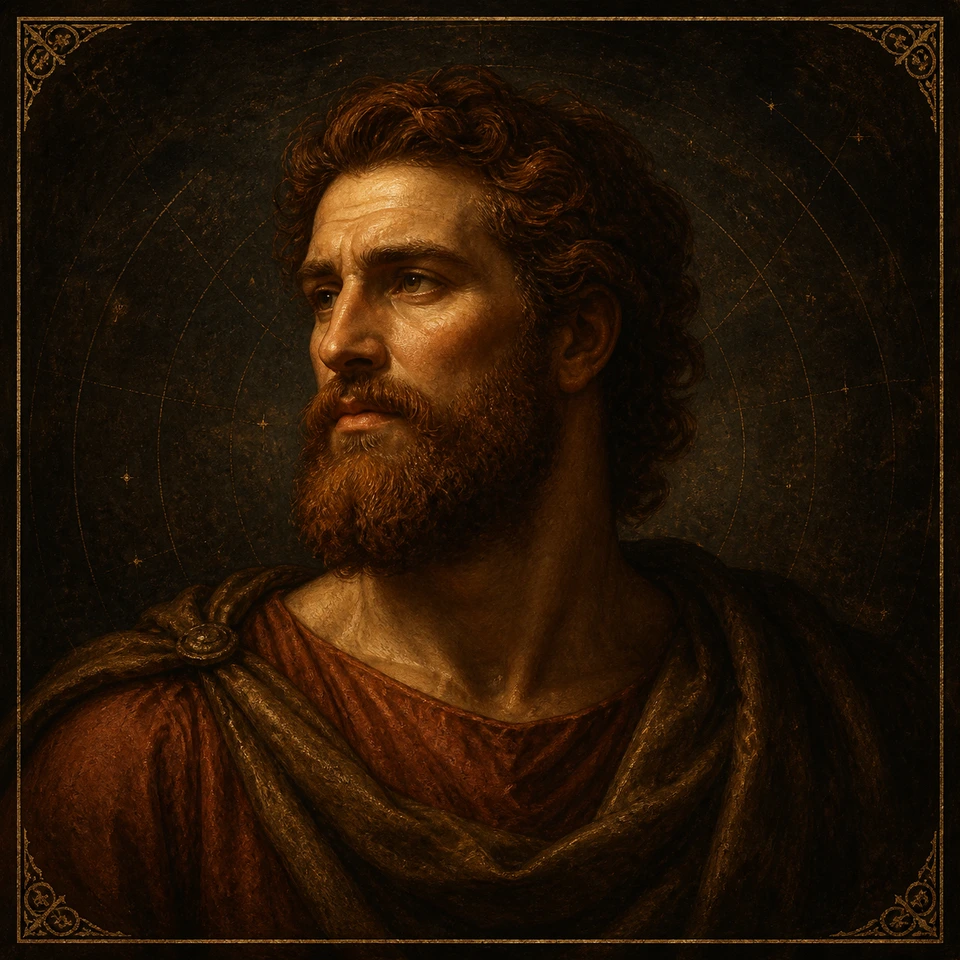
Material evidence remains thin. No secure ancient portrait type, temple, priesthood, festival, offering system, or personal emblem belongs specifically to the elder Titan in the named evidence. The modern portrait therefore excludes sun disk, ray crown, chariot, horses, torch, and globe. Its mature bearded figure offers a restrained Greek interpretation without pretending that an ancient artist fixed Hyperion's face.
John Keats supplies a powerful later voice. Hyperion: A Fragment makes the fallen Titan confront the Olympian succession through wounded grandeur, vast landscapes, and ruined power. That Romantic poem belongs to 1820, not an ancient sanctuary. No accountable public source for contemporary Hyperion devotion is included, so genealogy, cosmic scale, observation, and elder dignity remain historical or literary themes rather than universal modern practices.
Canonical identity
Canonical Identity
Hyperion stands as a divine son of Gaia and Uranus, cementing his status as a first-generation Titan. He operates with strict genealogical boundaries; in Hesiod and the Hymn to Demeter, Hyperion is exclusively the father, while Helios remains the son. Therefore, he is not merely an alternate shelf name for Helios, even though certain epic diction occasionally employs the combined phrase "Helios Hyperion".
Linguistic Identity
Hyperion serves as the conventional English form of the Greek Ὑπερίων, transliterated as Huperiōn. A qualified fifth-century BC Attic reconstruction yields /hy.pe.rǐː.ɔːn/ (roughly HUE-peh-REE-own), distinguished by a front rounded opening vowel and a complex ancient pitch that English stress cannot replicate. The familiar modern English pronunciation, hy-PEER-ee-un, is a much later phonetic development.
Sources and evidence
TEXTUAL · Supported
The Greek name is Ὑπερίων, transliterated Huperiōn or Hyperion, with a qualified fifth-century BC Attic reconstruction /hy.pe.rǐː.ɔːn/.
- Source
- Wiktionary contributors, Ὑπερίων
- Reviewed edition
- Permanent revision 88815815 of the Ancient Greek entry for Ὑπερίων · Wiktionary
- Exact locator
- Entry Ὑπερίων · Section Ancient Greek pronunciation
- Scope
- Classical Greece · Attica
- Authority
- Wiktionary contributors, permanent revision 88815815
- Certainty
- Qualified historical reconstruction
The initial vowel is a front rounded sound not exactly reproduced by an English guide.
Open exact reviewed source3 reviewed sources for this section
- Wiktionary contributors, ὙπερίωνLive Ancient Greek lexical entry · Wiktionary
- Hesiod; edited and translated by Hugh G. Evelyn-White, Theogony (1914)Hesiod, the Homeric Hymns and Homerica, London and New York, 1914 · Perseus Digital Library / Scaife ATLAS
- Anonymous Homeric Hymns; edited and translated by Hugh G. Evelyn-White, Homeric Hymns (1914)Hesiod, the Homeric Hymns and Homerica, London and New York, 1914 · Perseus Digital Library / Scaife ATLAS
Culture, tradition, period, and place
Hyperion’s oldest secure setting is Greek theogonic poetry. Hesiod names him within the first Titan generation, then returns to him as partner of Theia and father of three luminous children. Pseudo-Apollodorus compresses the same structures centuries later. Homeric hymns and epic reveal how poetic language could slide between father, patronymic, and solar title.
Diodorus writes in a different intellectual world. One passage turns Hyperion into an early observer who teaches celestial cycles. Another reports an Atlantic Libyan story of Basileia, murder, and transformed children. Neither late account can be made into the hidden meaning of Hesiod.
Sources and evidence
TEXTUAL · Supported
Pseudo-Apollodorus preserves Hyperion in the later mythographic list of Titans born to Earth and Sky.
- Source
- Pseudo-Apollodorus; edited and translated by James G. Frazer, Library (1921)
- Reviewed edition
- James G. Frazer edition and English translation, Harvard University Press and William Heinemann, 1921 · translated by James G. Frazer · edited by James G. Frazer · Perseus Digital Library / Scaife ATLAS
- Exact locator
- Book 1 · Chapter 1 · Section 3
- Scope
- Greek religion under Roman imperial rule · Ancient Greece
- Authority
- Pseudo-Apollodorus, Library
- Certainty
- Certain within the mythographer
The compressed list confirms identity without supplying a cult or individual Titanomachy deed.
Open exact reviewed source4 reviewed sources for this section
- Pseudo-Apollodorus; edited and translated by James G. Frazer, Library (1921)Harvard University Press and William Heinemann edition, 1921 · Perseus Digital Library / Scaife ATLAS
- Hesiod; edited and translated by Hugh G. Evelyn-White, Theogony (1914)Hesiod, the Homeric Hymns and Homerica, London and New York, 1914 · Perseus Digital Library / Scaife ATLAS
- Anonymous Homeric Hymns; edited and translated by Hugh G. Evelyn-White, Homeric Hymns (1914)Hesiod, the Homeric Hymns and Homerica, London and New York, 1914 · Perseus Digital Library / Scaife ATLAS
- Diodorus Siculus; translated by C. H. Oldfather, Library of History, Book III and Book V selections (1935)Loeb Classical Library Volume II (1935) and Volume III (1939), digital transcription by LacusCurtius · LacusCurtius, University of Chicago
Historical development
The Archaic evidence gives Hyperion kinship before it gives biography. He belongs to the Titan generation born from Earth and Heaven, and his union produces Dawn, Sun, and Moon. The Homeric Hymn to Helios changes the mother’s name to Euryphaessa, demonstrating that genealogy remained fluid even when the three children stayed together.
Later writers seek explanation. Pseudo-Apollodorus organizes the family into mythographic sequence. Diodorus makes fatherhood a metaphor for the discovery of celestial knowledge and elsewhere preserves a violent dynastic death. Keats then transforms the Titan into a British Romantic voice of fallen grandeur.
5 reviewed sources for this section
- Hesiod; edited and translated by Hugh G. Evelyn-White, Theogony (1914)Hesiod, the Homeric Hymns and Homerica, London and New York, 1914 · Perseus Digital Library / Scaife ATLAS
- Anonymous Homeric Hymns; edited and translated by Hugh G. Evelyn-White, Homeric Hymns (1914)Hesiod, the Homeric Hymns and Homerica, London and New York, 1914 · Perseus Digital Library / Scaife ATLAS
- Pseudo-Apollodorus; edited and translated by James G. Frazer, Library (1921)Harvard University Press and William Heinemann edition, 1921 · Perseus Digital Library / Scaife ATLAS
- Diodorus Siculus; translated by C. H. Oldfather, Library of History, Book III and Book V selections (1935)Loeb Classical Library Volume II (1935) and Volume III (1939), digital transcription by LacusCurtius · LacusCurtius, University of Chicago
- John Keats; edited by M. Robertson, Hyperion (1909)Poems Published in 1820, Clarendon Press reprint and notes, 1909; Project Gutenberg eBook 23684 · Project Gutenberg
Attested roles and historical themes
Roles, powers, and limits
Hyperion’s secure early role is genealogical and generational. He joins the elder Titans and fathers Eos, Helios, and Selene. Hesiod does not call him ruler of light, keeper of the east, lord of observation, or driver of a solar chariot. Those attractive titles outrun the poem.
Diodorus supplies a later role as observer and teacher of the movements that create seasons. It is a rationalizing interpretation, not timeless theology. Hyperion’s limits are equally important: no surviving early passage selected here gives him a named Titanomachy deed, independent solar journey, oracle, healing power, or dominion over every star.
Sources and evidence
TEXTUAL · Supported
Diodorus rationalizes Hyperion as the first observer to understand and teach the motions of the sun, moon, stars, and seasons.
- Source
- Diodorus Siculus; translated by C. H. Oldfather, Library of History, Book III and Book V selections (1935)
- Reviewed edition
- C. H. Oldfather English translation, Loeb Classical Library Volume III, Books 4.59-8, 1939 · translated by C. H. Oldfather · LacusCurtius, University of Chicago
- Exact locator
- Book 5 · Chapter 67 · Section 1
- Scope
- Roman Republican period · Ancient Greece
- Authority
- Diodorus Siculus, Library of History
- Certainty
- Certain within Diodorus’s report
This learned culture-hero interpretation is late and cannot be backdated into Hesiod.
Open exact reviewed source2 reviewed sources for this section
- Diodorus Siculus; translated by C. H. Oldfather, Library of History, Book III and Book V selections (1935)Loeb Classical Library Volume II (1935) and Volume III (1939), digital transcription by LacusCurtius · LacusCurtius, University of Chicago
- Hesiod; edited and translated by Hugh G. Evelyn-White, Theogony (1914)Hesiod, the Homeric Hymns and Homerica, London and New York, 1914 · Perseus Digital Library / Scaife ATLAS
Epithets and titles
No securely localized epithet belonging to the elder Titan Hyperion is included; poetic use of Hyperion for Helios is an identity boundary, not a title silently assigned back to the father.
3 reviewed sources for this section
- Hesiod; edited and translated by Hugh G. Evelyn-White, Theogony (1914)Hesiod, the Homeric Hymns and Homerica, London and New York, 1914 · Perseus Digital Library / Scaife ATLAS
- Anonymous Homeric Hymns; edited and translated by Hugh G. Evelyn-White, Homeric Hymns (1914)Hesiod, the Homeric Hymns and Homerica, London and New York, 1914 · Perseus Digital Library / Scaife ATLAS
- Homer; translated by A. T. Murray, Odyssey (1919)A. T. Murray English translation, London: William Heinemann; New York: G. P. Putnam's Sons, 1919 · Perseus Digital Library / Scaife ATLAS
Worship and cult
No temple, priesthood, civic office, household rite, or initiatory cult securely dedicated to the elder Titan Hyperion appears in the named witnesses. This does not prove that no one ever invoked him. It means that a complete ancient ritual system cannot be recovered from genealogy and later poetry.
Helios had cults and offerings of his own, but the elder Titan does not inherit them through fatherhood or an ambiguous poetic name. No public modern community source is included for Hyperion-specific worship, so no modern prayer, rite, offering, or devotional calendar is supplied.
2 reviewed sources for this section
- Hesiod; edited and translated by Hugh G. Evelyn-White, Theogony (1914)Hesiod, the Homeric Hymns and Homerica, London and New York, 1914 · Perseus Digital Library / Scaife ATLAS
- Homer; translated by A. T. Murray, Odyssey (1919)A. T. Murray English translation, London: William Heinemann; New York: G. P. Putnam's Sons, 1919 · Perseus Digital Library / Scaife ATLAS
Temples, sanctuaries, and sacred places
Hyperion’s early poems give no securely individualized sanctuary landscape. Gaia and Uranus place him in a cosmic family, not at one excavated temple. The broad Greek setting belongs to the language and transmission of the poems, not to a claim that every Greek city worshipped him.
Diodorus’s Basileia story is explicitly framed among peoples near the Ocean in Libya, while Keats’s fallen Titan inhabits a modern poetic world. Neither setting licenses an ancient Greek cult center. No mountain, island, compass quarter, or celestial station is assigned as Hyperion’s universal sacred place.
3 reviewed sources for this section
- Hesiod; edited and translated by Hugh G. Evelyn-White, Theogony (1914)Hesiod, the Homeric Hymns and Homerica, London and New York, 1914 · Perseus Digital Library / Scaife ATLAS
- Diodorus Siculus; translated by C. H. Oldfather, Library of History, Book III and Book V selections (1935)Loeb Classical Library Volume II (1935) and Volume III (1939), digital transcription by LacusCurtius · LacusCurtius, University of Chicago
- John Keats; edited by M. Robertson, Hyperion (1909)Poems Published in 1820, Clarendon Press reprint and notes, 1909; Project Gutenberg eBook 23684 · Project Gutenberg
Festivals and processions
No named ancient festival or procession for the elder Hyperion is securely established. The daily course of Helios and the cycles discussed by Diodorus are not festival calendars. A child's movement across heaven does not create a feast day for the father.
No accountable public modern source supplies a Hyperion-specific festival either. A modern date or Titan observance cannot be backdated into Greek religion without testimony from the community that practices it.
1 reviewed source for this section
- Diodorus Siculus; translated by C. H. Oldfather, Library of History, Book III and Book V selections (1935)Loeb Classical Library Volume II (1935) and Volume III (1939), digital transcription by LacusCurtius · LacusCurtius, University of Chicago
Offerings, votives, and ritual evidence
No securely attested offering menu, sacrifice, libation, incense, robe, votive type, or prayer formula belongs specifically to Hyperion. The cattle of "Helios Hyperion" in the Odyssey belong to the solar god whose daily journey the poem describes. They cannot be reassigned to the elder Titan.
Genealogical poetry preserves sacred family relationships without becoming a ritual recipe. Fire, oil, gold, sunflower, amber, and solar incense all require later accountable testimony before they can be connected to Hyperion.
2 reviewed sources for this section
- Homer; translated by A. T. Murray, Odyssey (1919)A. T. Murray English translation, London: William Heinemann; New York: G. P. Putnam's Sons, 1919 · Perseus Digital Library / Scaife ATLAS
- Hesiod; edited and translated by Hugh G. Evelyn-White, Theogony (1914)Hesiod, the Homeric Hymns and Homerica, London and New York, 1914 · Perseus Digital Library / Scaife ATLAS
Iconography and material culture
No ancient object securely identified as an individualized portrait of the Titan Hyperion controls his appearance. The modern portrait avoids the son's sun disk, ray crown, chariot, horses, torch, and globe. Its mature bearded Greek figure is a conservative interpretation rather than a claimed ancient portrait type.
Text supplies kinship, not costume. Even "far-shining" Euryphaessa and the radiant children do not place rays on Hyperion's head. Warm side lighting remains artistic atmosphere, not an attested divine attribute.
2 reviewed sources for this section
- Hesiod; edited and translated by Hugh G. Evelyn-White, Theogony (1914)Hesiod, the Homeric Hymns and Homerica, London and New York, 1914 · Perseus Digital Library / Scaife ATLAS
- Anonymous Homeric Hymns; edited and translated by Hugh G. Evelyn-White, Homeric Hymns (1914)Hesiod, the Homeric Hymns and Homerica, London and New York, 1914 · Perseus Digital Library / Scaife ATLAS
Animals, plants, and embodied forms
No animal or plant is securely assigned to Hyperion in the named ancient evidence. Helios's immortal cattle and sheep in the Odyssey belong to Helios, even when the poem calls him Hyperion in compressed solar diction. They do not become the elder Titan's sacred herd.
Celestial parentage does not establish sunflower, heliotrope, laurel, eagle, lion, or horse. Those associations require a dated witness of their own. Hyperion's anthropomorphic form is a cautious modern interpretation, not a recovered ancient portrait.
1 reviewed source for this section
- Homer; translated by A. T. Murray, Odyssey (1919)A. T. Murray English translation, London: William Heinemann; New York: G. P. Putnam's Sons, 1919 · Perseus Digital Library / Scaife ATLAS
Relationships and genealogy
Hesiod makes Hyperion a son of Gaia and Uranus, brother within the twelve-Titan generation, and partner of Theia. Their children are Eos, Helios, and Selene. Pseudo-Apollodorus repeats the core line with the spelling Thia. The Homeric Hymn to Helios instead calls the mother Euryphaessa, his sister-wife.
Diodorus’s Atlantic Libyan account changes the family again. Basileia, eldest daughter of Uranus, chooses Hyperion, bears Helios and Selene, and loses husband and children to dynastic violence. Eos is absent. That genealogy must stand beside, not inside, Hesiod’s.
Sources and evidence
TEXTUAL · Supported
Hesiod names Hyperion among the twelve Titan children born to Earth and starry Heaven.
- Source
- Hesiod; edited and translated by Hugh G. Evelyn-White, Theogony (1914)
- Reviewed edition
- Hugh G. Evelyn-White edition and English translation in Hesiod, the Homeric Hymns and Homerica, 1914 · translated by Hugh G. Evelyn-White · edited by Hugh G. Evelyn-White · Perseus Digital Library / Scaife ATLAS
- Exact locator
- Line 132-138
- Scope
- Archaic Greece · Ancient Greece
- Authority
- Hesiod, Theogony
- Certainty
- Certain within the poem
The sibling list is genealogical and does not assign identical functions to all Titans.
Open exact reviewed sourceTEXTUAL · Supported
Hesiod makes Theia and Hyperion the parents of Helios, Selene, and Eos.
- Source
- Hesiod; edited and translated by Hugh G. Evelyn-White, Theogony (1914)
- Reviewed edition
- Hugh G. Evelyn-White edition and English translation in Hesiod, the Homeric Hymns and Homerica, 1914 · translated by Hugh G. Evelyn-White · edited by Hugh G. Evelyn-White · Perseus Digital Library / Scaife ATLAS
- Exact locator
- Line 371-374
- Scope
- Archaic Greece · Ancient Greece
- Authority
- Hesiod, Theogony
- Certainty
- Certain within the poem
Genealogical parentage does not transfer the children’s chariots, rays, lunar forms, or dawn colors to their father.
Open exact reviewed sourceTEXTUAL · Supported
Pseudo-Apollodorus likewise names Dawn, Sun, and Moon as children of Hyperion and Thia.
- Source
- Pseudo-Apollodorus; edited and translated by James G. Frazer, Library (1921)
- Reviewed edition
- James G. Frazer edition and English translation, Harvard University Press and William Heinemann, 1921 · translated by James G. Frazer · edited by James G. Frazer · Perseus Digital Library / Scaife ATLAS
- Exact locator
- Book 1 · Chapter 2 · Section 2
- Scope
- Greek religion under Roman imperial rule · Ancient Greece
- Authority
- Pseudo-Apollodorus, Library
- Certainty
- Certain within the mythographer
Theia and Thia are spelling forms of the same Titaness in these Greek witnesses.
Open exact reviewed source4 reviewed sources for this section
- Hesiod; edited and translated by Hugh G. Evelyn-White, Theogony (1914)Hesiod, the Homeric Hymns and Homerica, London and New York, 1914 · Perseus Digital Library / Scaife ATLAS
- Pseudo-Apollodorus; edited and translated by James G. Frazer, Library (1921)Harvard University Press and William Heinemann edition, 1921 · Perseus Digital Library / Scaife ATLAS
- Anonymous Homeric Hymns; edited and translated by Hugh G. Evelyn-White, Homeric Hymns (1914)Hesiod, the Homeric Hymns and Homerica, London and New York, 1914 · Perseus Digital Library / Scaife ATLAS
- Diodorus Siculus; translated by C. H. Oldfather, Library of History, Book III and Book V selections (1935)Loeb Classical Library Volume II (1935) and Volume III (1939), digital transcription by LacusCurtius · LacusCurtius, University of Chicago
Actual myths and source variants
Hyperion has few early stories centered on action, so genealogy itself becomes the narrative spine. Earth and Heaven produce the Titan generation. Hyperion and Theia then produce Dawn, Sun, and Moon, a family whose daily manifestations fill the sky even though the father receives no described journey of his own. Hymn 31 preserves the same children but names Euryphaessa as mother.
Diodorus offers the major divergent tale. Basileia marries Hyperion, jealous brothers murder him, Helios is drowned, Selene dies in grief, and the children become celestial divinities. Hesiodic birth, hymnic maternal variation, and late dynastic tragedy remain separate tellings with separate motives and dates.
Pseudo-Apollodorus keeps Hyperion within the Titan family but does not give him an individual exploit in the war against Zeus. That restraint matters. A place in the defeated generation is not the same as a narrated battle scene, and later images of Hyperion as a fallen combatant should not be projected backward into a witness that merely names the kinship group.
Sources and evidence
TEXTUAL · Supported
Homeric Hymn 31 names Euryphaessa, rather than Theia under that name, as Hyperion’s sister-wife and mother of Eos, Selene, and Helios.
- Source
- Anonymous Homeric Hymns; edited and translated by Hugh G. Evelyn-White, Homeric Hymns (1914)
- Reviewed edition
- Hugh G. Evelyn-White English translation of Homeric Hymn 31 to Helios, 1914 · translated by Hugh G. Evelyn-White · edited by Hugh G. Evelyn-White · Perseus Digital Library / Scaife ATLAS
- Exact locator
- Hymn 31 · Line 1-6
- Scope
- Ancient Greek diachrony · Ancient Greece
- Authority
- Homeric Hymns
- Certainty
- Certain within the hymn
Euryphaessa remains a source-specific named genealogy rather than being silently merged with Theia.
Open exact reviewed sourceTEXTUAL · Supported
In a different account reported by Diodorus, Basileia marries Hyperion, their jealous brothers kill him, and Helios and Selene later become celestial divinities.
- Source
- Diodorus Siculus; translated by C. H. Oldfather, Library of History, Book III and Book V selections (1935)
- Reviewed edition
- C. H. Oldfather English translation, Loeb Classical Library Volume II, Books 2.35-4.58, 1935 · translated by C. H. Oldfather · LacusCurtius, University of Chicago
- Exact locator
- Book 3 · Chapter 57 · Section 2-6
- Scope
- Roman Republican period · Ancient Libya
- Authority
- Diodorus Siculus, Library of History
- Certainty
- Certain within Diodorus’s report
The violent Atlantic Libyan account materially differs from Hesiodic genealogy and remains a separate variant.
Open exact reviewed source4 reviewed sources for this section
- Hesiod; edited and translated by Hugh G. Evelyn-White, Theogony (1914)Hesiod, the Homeric Hymns and Homerica, London and New York, 1914 · Perseus Digital Library / Scaife ATLAS
- Pseudo-Apollodorus; edited and translated by James G. Frazer, Library (1921)Harvard University Press and William Heinemann edition, 1921 · Perseus Digital Library / Scaife ATLAS
- Anonymous Homeric Hymns; edited and translated by Hugh G. Evelyn-White, Homeric Hymns (1914)Hesiod, the Homeric Hymns and Homerica, London and New York, 1914 · Perseus Digital Library / Scaife ATLAS
- Diodorus Siculus; translated by C. H. Oldfather, Library of History, Book III and Book V selections (1935)Loeb Classical Library Volume II (1935) and Volume III (1939), digital transcription by LacusCurtius · LacusCurtius, University of Chicago
Myth Library
Each myth gathers its attested participants into one source-grounded account, while distinct source traditions remain readable in their own variants.
Hymnic Divine Course
Helios Crosses the Sky
Helios rises in radiance, drives his stallions to heaven’s height, sees gods and mortals below, and descends again toward Ocean.
- Role in this profile
- fathers Helios, Eos, and Selene with Euryphaessa
- Place scope
- Ancient Greece
- Witnesses
- 1
- Variants
- 1
Divine Genealogy
Hyperion, Theia, and the Celestial Children
Hesiod and Pseudo-Apollodorus make Hyperion and Theia parents of Eos, Helios, and Selene, while Homeric Hymn 31 names Euryphaessa as the children’s mother.
- Role in this profile
- Father of Eos, Helios, and Selene
- Place scope
- Ancient Greece
- Witnesses
- 3
- Variants
- 3
Dynastic Murder And Transformation
The Death of Hyperion in Diodorus
Diodorus reports an Atlantic Libyan tradition in which Basileia marries Hyperion, her brothers murder him and the young Helios, Selene dies in grief, and the children become Sun and Moon.
- Role in this profile
- Royal husband murdered by Basileia’s brothers
- Place scope
- Ancient Libya
- Witnesses
- 1
- Variants
- 1
Divine Genealogy
The Birth of the First Titans
Gaia and Uranus bring forth twelve named Titans, whose shared birth establishes a generation without assigning every sibling the same deed or cosmic office.
- Role in this profile
- first-generation Titan born from Gaia and Ouranos
- Place scope
- Ancient Greece
- Witnesses
- 4
- Variants
- 4
Equivalences, syncretisms, and identity boundaries
Hyperion and Helios overlap in language without collapsing in identity. The Hymn to Demeter calls Helios the Son of Hyperion. The Odyssey can call that same solar god “Helios Hyperion,” a poetic compression used around the cattle and the Sun’s daily movement. Context decides whether the word names father, son, or patronymic coloring.
NASA identifies Hyperion as an irregular moon of Saturn. That astronomical body is a modern namesake, not the Greek Titan made physical. The Roman Sun, later light-Titan systems, and fictional bearers of the name likewise remain separate unless their own sources establish a historical identification. Similar brightness does not establish equivalence. Diodorus’s observer of celestial motions is a late interpretation of the Titan, not proof that he is the starry sky itself.
Sources and evidence
TEXTUAL · Supported
The Homeric Hymn to Demeter calls Helios the Son of Hyperion, preserving a father-son distinction.
- Source
- Anonymous Homeric Hymns; edited and translated by Hugh G. Evelyn-White, Homeric Hymns (1914)
- Reviewed edition
- Hugh G. Evelyn-White English translation of Homeric Hymn 2 to Demeter, 1914 · translated by Hugh G. Evelyn-White · edited by Hugh G. Evelyn-White · Perseus Digital Library / Scaife ATLAS
- Exact locator
- Hymn 2 · Line 62-75
- Scope
- Archaic Greece · Ancient Greece
- Authority
- Homeric Hymns
- Certainty
- Certain within the hymn
The patronymic supports distinction even though other poetic passages can use Hyperion with Helios.
Open exact reviewed sourceTEXTUAL · Supported
The Odyssey repeatedly calls the solar god Helios Hyperion, showing that Hyperion can function as a solar name or patronymic in epic diction.
- Source
- Homer; translated by A. T. Murray, Odyssey (1919)
- Reviewed edition
- A. T. Murray English translation, London: William Heinemann; New York: G. P. Putnam's Sons, 1919 · translated by A. T. Murray · Perseus Digital Library / Scaife ATLAS
- Exact locator
- Book 12 · Line 127-140, 260-276, 374-383
- Scope
- Archaic Greece · Ancient Greece
- Authority
- Homer, Odyssey
- Certainty
- Certain within the epic diction
These passages concern Helios’s cattle and daily course, not deeds securely assigned to the elder Titan.
Open exact reviewed sourceTEXTUAL · Supported
NASA identifies Hyperion as an irregular moon of Saturn, a modern astronomical namesake distinct from the Greek Titan.
- Source
- NASA Science Editorial Team, Hyperion
- Reviewed edition
- NASA Science page for Saturn’s moon Hyperion, reviewed 2026-08-30 · NASA Science
- Exact locator
- Entry Hyperion · Section Overview
- Scope
- Modern institutional astronomy · Global astronomical observation
- Authority
- NASA Science
- Certainty
- Secure for the astronomical body and namesake boundary
The shared name creates neither a divine identity nor a celestial correspondence for the Titan.
Open exact reviewed source4 reviewed sources for this section
- Anonymous Homeric Hymns; edited and translated by Hugh G. Evelyn-White, Homeric Hymns (1914)Hesiod, the Homeric Hymns and Homerica, London and New York, 1914 · Perseus Digital Library / Scaife ATLAS
- Homer; translated by A. T. Murray, Odyssey (1919)A. T. Murray English translation, London: William Heinemann; New York: G. P. Putnam's Sons, 1919 · Perseus Digital Library / Scaife ATLAS
- Diodorus Siculus; translated by C. H. Oldfather, Library of History, Book III and Book V selections (1935)Loeb Classical Library Volume II (1935) and Volume III (1939), digital transcription by LacusCurtius · LacusCurtius, University of Chicago
- NASA Science Editorial Team, HyperionNASA Science, Saturn moons · NASA Science
Correspondence index
Hyperion's strongest association is genealogical: father of Dawn, Sun, and Moon. Diodorus later connects him with observation of sun, moon, stars, and seasons. These support a historical relationship to celestial knowledge, not rulership over a planet or permission to copy Helios's solar apparatus.
No zodiac sign, gemstone, metal, plant, animal, color, Classical element, weekday, moon phase, direction, festival, incense, offering, or ritual tool is securely his in the named evidence. Observation and patient study remain a later literary theme, not a guaranteed magical result.
Contextual evidence, not a general correspondence
| Category | Direct correspondence | How and why | Evidence boundary |
|---|---|---|---|
| celestial-body | Father of Eos, Helios, and SeleneContextual evidence only | Hesiod links Hyperion genealogically to Dawn, Sun, and Moon. | Ancient Literary Parentage is not identity, planetary rulership, or transfer of the children’s attributes. 1 reviewed source for this section
|
| animal-embodied-form | Helios’s cattle are excludedContextual evidence only | The Odyssey’s cattle belong to the solar son even when epic calls him Helios Hyperion. | Ancient Literary They do not become the elder Titan’s sacred animals. 1 reviewed source for this section
|
| intention-magical-power | Observation of celestial cycles in DiodorusContextual evidence only | Diodorus rationalizes Hyperion as an observer and teacher of heavenly motions and seasons. | Later Historical This late account supports a theme of study, not a guaranteed magical result. 1 reviewed source for this section
|
13 expected categories currently not evidenced
zodiac · Not evidenced
No zodiac sign evidenced
No ancient witness here assigns Hyperion a zodiac sign.
- Layer
- Research Boundary
- Scope
- Celestial parentage does not imply Leo, Aquarius, or another sign.
gemstone-crystal-mineral · Not evidenced
No gemstone, crystal, or mineral evidenced
No mineral receives a direct historical assignment.
- Layer
- Research Boundary
- Scope
- Sunstone, amber, citrine, and gold-colored stones require dated modern testimony.
metal-material · Not evidenced
No sacred metal evidenced
No metal is securely consecrated to Hyperion.
- Layer
- Research Boundary
- Scope
- Solar analogy does not establish gold or bronze.
plant-tree · Not evidenced
No plant or tree evidenced
No plant is assigned to Hyperion in the named witnesses.
- Layer
- Research Boundary
- Scope
- Sunflower and heliotrope belong to later naming and analogy unless independently sourced.
color · Not evidenced
No ritual color evidenced
No historical rite fixes a color for Hyperion.
- Layer
- Research Boundary
- Scope
- Warm light in modern art is not an ancient color correspondence.
classical-element · Not evidenced
No Classical element evidenced
No source here assigns a formal element.
- Layer
- Research Boundary
- Scope
- Fathering luminous children does not make him Fire or Air.
weekday · Not evidenced
No weekday evidenced
No weekday is securely assigned.
- Layer
- Research Boundary
- Scope
- Helios’s later Sunday associations cannot be inherited by Hyperion.
moon-phase · Not evidenced
No moon phase evidenced
No lunar phase is assigned to Hyperion.
- Layer
- Research Boundary
- Scope
- Fatherhood of Selene does not establish a phase or lunar rite.
direction-place · Not evidenced
No universal direction or cult place evidenced
No sanctuary or compass quarter is securely his.
- Layer
- Research Boundary
- Scope
- Celestial language does not establish east as a cultic direction.
festival-time · Not evidenced
No festival or sacred date evidenced
No named ancient observance for Hyperion is securely preserved.
- Layer
- Research Boundary
- Scope
- Seasons in Diodorus describe knowledge, not a festival calendar.
incense-perfume · Not evidenced
No incense or perfume evidenced
No aromatic material is historically assigned.
- Layer
- Research Boundary
- Scope
- Solar incense lists require accountable later testimony.
offering-ritual-material · Not evidenced
No specific offering evidenced
No food, libation, animal, garment, or votive type is securely Hyperion’s.
- Layer
- Research Boundary
- Scope
- Helios’s cattle and offerings remain the son’s evidence.
ritual-object-symbol-tool · Not evidenced
No ancient ritual object evidenced
No ray crown, chariot, torch, globe, or astronomical instrument is assigned to Hyperion.
- Layer
- Research Boundary
- Scope
- Modern portrait choices remain interpretations, not recovered objects.
2 reviewed sources for this section
- Hesiod; edited and translated by Hugh G. Evelyn-White, Theogony (1914)Hesiod, the Homeric Hymns and Homerica, London and New York, 1914 · Perseus Digital Library / Scaife ATLAS
- Diodorus Siculus; translated by C. H. Oldfather, Library of History, Book III and Book V selections (1935)Loeb Classical Library Volume II (1935) and Volume III (1939), digital transcription by LacusCurtius · LacusCurtius, University of Chicago
Later reception and living significance
John Keats gives Hyperion the later life that ancient narrative withholds. In Hyperion: A Fragment, published in 1820, the Titan becomes a dethroned power confronting the rise of the Olympians. The poem's ruined temples, vast voices, and wounded majesty shape a distinct British Romantic image of the fallen elder god.
That figure is compelling but modern. Keats does not recover a lost Greek scripture, while other later uses of the name remain namesakes rather than divine identities. No accountable public source for a contemporary devotional tradition centered specifically on Hyperion is included.
Sources and evidence
TEXTUAL · Supported
John Keats’s Hyperion: A Fragment recasts Hyperion as a dethroned Titan confronting the Olympian succession.
- Source
- John Keats; edited by M. Robertson, Hyperion (1909)
- Reviewed edition
- M. Robertson, editor, Keats: Poems Published in 1820, Oxford at the Clarendon Press, 1909; Project Gutenberg eBook 23684 · edited by M. Robertson · Project Gutenberg
- Exact locator
- Entry Hyperion · Section Books I-III
- Scope
- British Romantic publication in 1820 · London publication context
- Authority
- John Keats, Hyperion
- Certainty
- Certain within the poem
Keats’s monumental fallen ruler belongs to nineteenth-century reception, not ancient cult.
Open exact reviewed source1 reviewed source for this section
- John Keats; edited by M. Robertson, Hyperion (1909)Poems Published in 1820, Clarendon Press reprint and notes, 1909; Project Gutenberg eBook 23684 · Project Gutenberg
Evidence, conflicts, and research gaps
Hesiod controls the earliest genealogy. Homeric Hymns clarify both father-son language and the Euryphaessa variant. The Odyssey demonstrates the solar-name ambiguity. Pseudo-Apollodorus preserves later mythographic organization, while Diodorus supplies rationalization and a divergent death story. Keats belongs only to reception, and NASA controls only the astronomical namesake.
The gaps are substantial: no secure individual cult center, festival, priesthood, offering system, ancient portrait type, Titanomachy deed, or direct magical correspondence. The pronunciation is reconstructed. Euryphaessa's relation to Theia requires further philological work, and the Diodoran Basileia tradition must not be harmonized with Hesiod.
8 reviewed sources for this section
- Wiktionary contributors, ὙπερίωνLive Ancient Greek lexical entry · Wiktionary
- Hesiod; edited and translated by Hugh G. Evelyn-White, Theogony (1914)Hesiod, the Homeric Hymns and Homerica, London and New York, 1914 · Perseus Digital Library / Scaife ATLAS
- Anonymous Homeric Hymns; edited and translated by Hugh G. Evelyn-White, Homeric Hymns (1914)Hesiod, the Homeric Hymns and Homerica, London and New York, 1914 · Perseus Digital Library / Scaife ATLAS
- Pseudo-Apollodorus; edited and translated by James G. Frazer, Library (1921)Harvard University Press and William Heinemann edition, 1921 · Perseus Digital Library / Scaife ATLAS
- Diodorus Siculus; translated by C. H. Oldfather, Library of History, Book III and Book V selections (1935)Loeb Classical Library Volume II (1935) and Volume III (1939), digital transcription by LacusCurtius · LacusCurtius, University of Chicago
- John Keats; edited by M. Robertson, Hyperion (1909)Poems Published in 1820, Clarendon Press reprint and notes, 1909; Project Gutenberg eBook 23684 · Project Gutenberg
- Homer; translated by A. T. Murray, Odyssey (1919)A. T. Murray English translation, London: William Heinemann; New York: G. P. Putnam's Sons, 1919 · Perseus Digital Library / Scaife ATLAS
- NASA Science Editorial Team, HyperionNASA Science, Saturn moons · NASA Science
Direct connections and evidence
Explicit Source
Hesiod names Hyperion as a son of Gaia
Hesiodic descent from Gaia only; no independent earth correspondence follows from genealogy.
1 attestation · high confidence
- Hesiod; edited and translated by Hugh G. Evelyn-White, TheogonyHugh G. Evelyn-White edition and English translation in Hesiod, the Homeric Hymns and Homerica, 1914 · translated by Hugh G. Evelyn-White · edited by Hugh G. Evelyn-White · Perseus Digital Library / Scaife ATLAS · Archaic Greece · Ancient Greece · Entry Theogony · Line 132-138
Explicit Source
Hesiod names Hyperion as a son of Uranus
Hesiodic descent from starry Uranus only; no planet or sky rulership follows from the name.
1 attestation · high confidence
- Hesiod; edited and translated by Hugh G. Evelyn-White, TheogonyHugh G. Evelyn-White edition and English translation in Hesiod, the Homeric Hymns and Homerica, 1914 · translated by Hugh G. Evelyn-White · edited by Hugh G. Evelyn-White · Perseus Digital Library / Scaife ATLAS · Archaic Greece · Ancient Greece · Entry Theogony · Line 132-138
Explicit Source
Hesiod joins Hyperion and Theia as parents of the celestial siblings
Hesiodic union only; Hymn 31 names Euryphaessa instead and remains a separate variant.
1 attestation · high confidence
- Hesiod; edited and translated by Hugh G. Evelyn-White, TheogonyHugh G. Evelyn-White edition and English translation in Hesiod, the Homeric Hymns and Homerica, 1914 · translated by Hugh G. Evelyn-White · edited by Hugh G. Evelyn-White · Perseus Digital Library / Scaife ATLAS · Archaic Greece · Ancient Greece · Entry Theogony · Line 371-374
Explicit Source
Hesiod names Eos as a child of Hyperion and Theia
Hesiodic parentage only; Eos remains a distinct divine person and does not transfer celestial attributes to Hyperion.
1 attestation · high confidence
- Hesiod; edited and translated by Hugh G. Evelyn-White, TheogonyHugh G. Evelyn-White edition and English translation in Hesiod, the Homeric Hymns and Homerica, 1914 · translated by Hugh G. Evelyn-White · edited by Hugh G. Evelyn-White · Perseus Digital Library / Scaife ATLAS · Archaic Greece · Ancient Greece · Entry Theogony · Line 371-374
Explicit Source
Hesiod names Helios as a child of Hyperion and Theia
Hesiodic parentage only; Helios remains a distinct divine person and does not transfer celestial attributes to Hyperion.
1 attestation · high confidence
- Hesiod; edited and translated by Hugh G. Evelyn-White, TheogonyHugh G. Evelyn-White edition and English translation in Hesiod, the Homeric Hymns and Homerica, 1914 · translated by Hugh G. Evelyn-White · edited by Hugh G. Evelyn-White · Perseus Digital Library / Scaife ATLAS · Archaic Greece · Ancient Greece · Entry Theogony · Line 371-374
Explicit Source
Hesiod names Selene as a child of Hyperion and Theia
Hesiodic parentage only; Selene remains a distinct divine person and does not transfer celestial attributes to Hyperion.
2 attestations · high confidence
- Hesiod; edited and translated by Hugh G. Evelyn-White, TheogonyHugh G. Evelyn-White edition and English translation in Hesiod, the Homeric Hymns and Homerica, 1914 · translated by Hugh G. Evelyn-White · edited by Hugh G. Evelyn-White · Perseus Digital Library / Scaife ATLAS · Archaic Greece · Ancient Greece · Entry Theogony · Line 371-374
- Pseudo-Apollodorus; edited and translated by James G. Frazer, LibraryJames G. Frazer edition and English translation, Harvard University Press and William Heinemann, 1921 · translated by James G. Frazer · edited by James G. Frazer · Perseus Digital Library / Scaife ATLAS · Greek religion under Roman imperial rule · Ancient Greece · Entry Library · Book 1 · Section 2.2
Explicit Source
Hesiod names Iapetus and Hyperion in the same generation born from Gaia and Ouranos
Sibling genealogy only; it transfers no office, deed, cult, or correspondence between the two figures.
1 attestation · high confidence
- Hesiod; edited and translated by Hugh G. Evelyn-White, TheogonyHugh G. Evelyn-White edition and English translation in Hesiod, the Homeric Hymns and Homerica, 1914 · translated by Hugh G. Evelyn-White · edited by Hugh G. Evelyn-White · Perseus Digital Library / Scaife ATLAS · Archaic Greece · Ancient Greece · Entry Theogony · Line 132-138
Explicit Source
Hesiod names Mnemosyne and Hyperion in the same generation born from Gaia and Ouranos
Sibling genealogy only; it transfers no office, deed, cult, or correspondence between the two figures.
1 attestation · high confidence
- Hesiod; edited and translated by Hugh G. Evelyn-White, TheogonyHugh G. Evelyn-White edition and English translation in Hesiod, the Homeric Hymns and Homerica, 1914 · translated by Hugh G. Evelyn-White · edited by Hugh G. Evelyn-White · Perseus Digital Library / Scaife ATLAS · Archaic Greece · Ancient Greece · Entry Theogony · Line 132-138
Explicit Source
Hesiod names Rhea and Hyperion in the same generation born from Gaia and Ouranos
Sibling genealogy only; it transfers no office, deed, cult, or correspondence between the two figures.
1 attestation · high confidence
- Hesiod; edited and translated by Hugh G. Evelyn-White, TheogonyHugh G. Evelyn-White edition and English translation in Hesiod, the Homeric Hymns and Homerica, 1914 · translated by Hugh G. Evelyn-White · edited by Hugh G. Evelyn-White · Perseus Digital Library / Scaife ATLAS · Archaic Greece · Ancient Greece · Entry Theogony · Line 132-138
Archive scope and classification
- Figure classification
- Titan or Titaness, God or goddess · certain
- Pantheon or tradition shelf
- Greek
- Cultures
- Greek
- Traditions
- Ancient Greek religion
- Periods
- Archaic Greece, Greek religion under Roman imperial rule
- Places
- Ancient Greece
Identity, genealogy, Helios boundary, source-scoped variants, later rationalization, Keats reception, astronomical namesake, and explicit cult and iconographic gaps remain separately evidenced.
Reviewed sources
- Hesiod; edited and translated by Hugh G. Evelyn-White, Theogony (1914)Hesiod, the Homeric Hymns and Homerica, London and New York, 1914 · Perseus Digital Library / Scaife ATLAS
- Anonymous Homeric Hymns; edited and translated by Hugh G. Evelyn-White, Homeric Hymns (1914)Hesiod, the Homeric Hymns and Homerica, London and New York, 1914 · Perseus Digital Library / Scaife ATLAS
- Homer; translated by A. T. Murray, Odyssey (1919)A. T. Murray English translation, London: William Heinemann; New York: G. P. Putnam's Sons, 1919 · Perseus Digital Library / Scaife ATLAS
- Pseudo-Apollodorus; edited and translated by James G. Frazer, Library (1921)Harvard University Press and William Heinemann edition, 1921 · Perseus Digital Library / Scaife ATLAS
- John Keats; edited by M. Robertson, Hyperion (1909)Poems Published in 1820, Clarendon Press reprint and notes, 1909; Project Gutenberg eBook 23684 · Project Gutenberg
- Wiktionary contributors, ὙπερίωνLive Ancient Greek lexical entry · Wiktionary
- Diodorus Siculus; translated by C. H. Oldfather, Library of History, Book III and Book V selections (1935)Loeb Classical Library Volume II (1935) and Volume III (1939), digital transcription by LacusCurtius · LacusCurtius, University of Chicago
- NASA Science Editorial Team, HyperionNASA Science, Saturn moons · NASA Science