Greek · Solar deity · Certain
Helios
Ἥλιος · Hḗlios
Pronunciation: /hɛ̌ː.li.os/ · HEH-lee-os
Research and editorial review by Cody Manes · Reviewed 2026-08-31
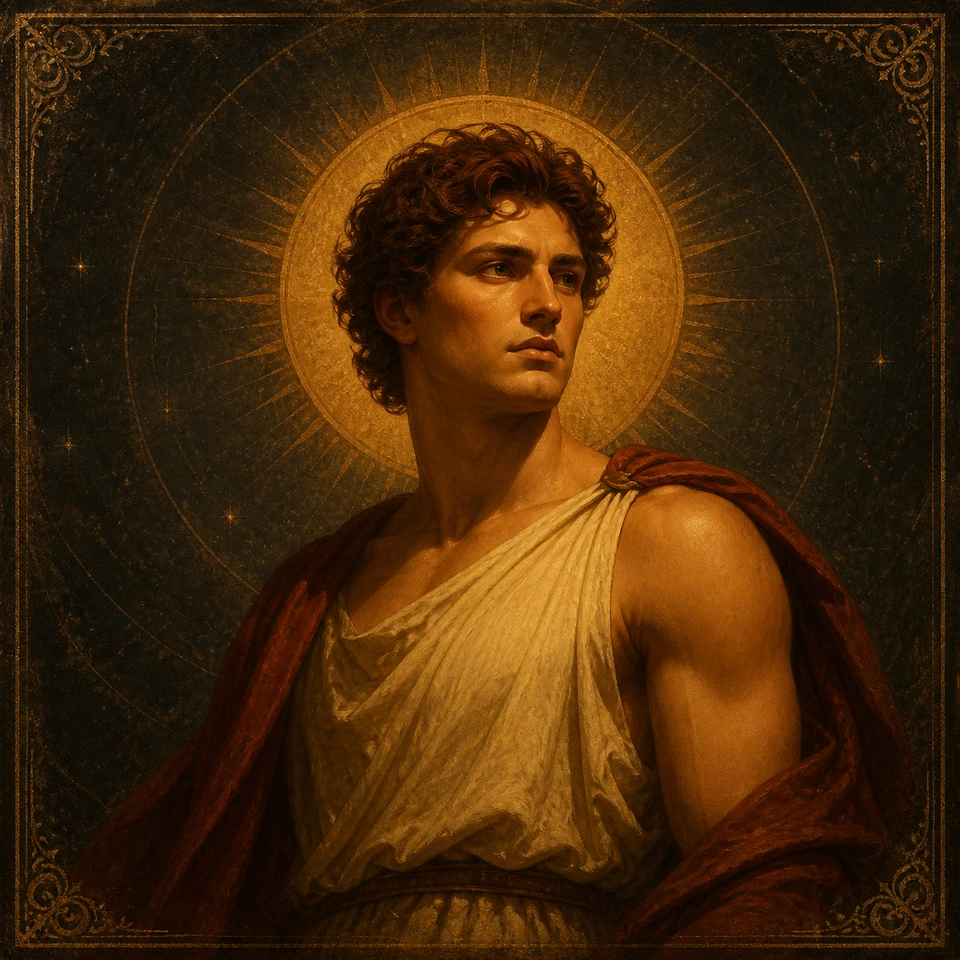
Crossing the sky as a tireless chariot driver, Helios acts as the wide-seeing witness of the ancient world and the guardian of sacred herds. He anchors vital eastern and Rhodian genealogies, commanding local reverence at high places like Acrocorinth, Taleton, and Rhodes.
Overview
Before the sky brightens, stallions take the weight of a golden-yoked chariot. Helios rises clothed in radiance, his hair and garment moving, a bright disc and rays around his head. He looks down on mortals and gods, climbs to the height of heaven, checks the team, and drives toward Ocean. Day is not scenery in Homeric Hymn 31. It is the repeated labor of a seeing god, whose journey gives light a body, direction, and returning rhythm.
Hesiod frames him as a son of Theia and Hyperion, brother to Selene and Eos. Through Perseis he fathers Circe and Aeetes. Other poets give him daughters who guard deathless herds, sons who root Rhodian cities in a solar family, and a gaze that penetrates secrets hidden from other gods.
That gaze can rescue or condemn. When Demeter searches for Persephone, Helios tells her that Hades took the girl with Zeus’s consent. When Ares and Aphrodite meet in Hephaestus’s house, he sees them and reports the affair. On Thrinacia, Odysseus’s starving crew kills his forbidden cattle. Lampetie tells her father, Helios demands justice from Zeus, and lightning tears the ship apart. Sight carries knowledge into consequence.
Rhodes gives the cosmic god a civic home. Pindar says Helios was absent when the immortals divided the earth. He saw an island rising from the sea, claimed it before it reached the light, and joined with the nymph Rhodes. Their descendants gave lineage to Ialysus, Cameirus, and Lindus. At Corinth, Briareus awarded him the height above the city while Poseidon received the Isthmus. On Taleton in Laconia, worshippers sacrificed horses to the Sun.
Ancient material culture gives this cosmic journey physical weight. An inscribed Attic lekythos shows Helios rising in a quadriga, bearing a radiated disc and control rod. A red-figure krater gives him a mature beardless face, short chiton, flying mantle, and a great solar nimbus. Hellenistic Rhodes raised the Colossus, whose fallen bronze still astonished Pliny. Pliny’s surviving description does not place the statue astride the harbor.
In Roman poetry, Ovid’s Phaethon becomes a chariot catastrophe: a son demands proof, wins an oath, loses control of the horses, scorches the earth, and dies by Jupiter’s bolt. The Latin epic preserves a Roman solar telling rather than another chapter of the Greek god’s life. Greek Helios, Roman Sol, and Apollo require separate histories unless a dated witness explicitly joins them. That boundary lets the Greek evidence keep its own shape. Pindar’s island ancestor, Homer’s injured herd-owner, the hymn’s sky driver, Pausanias’s claimant at Corinth, and the painted radiate god belong to related Greek traditions without becoming a single universal Sun figure.
Canonical identity
Canonical Identity
Helios is the direct, male divine personification of the ancient Greek Sun. Hesiod establishes his specific lineage as the child of the Titans Theia and Hyperion, and the sibling of Selene and Eos. He is strictly a solar deity and does not hold the rank of an older Titan himself. While certain later texts blur Apollo and Helios, Hesiod’s foundational genealogy treats them as completely separate divine individuals. Similarly, Ovid’s later poetic chariot and Pliny’s Colossus do not forge a single continuous identity between the Greek Helios and the Roman Sol.
Linguistic Identity
His proper name, Ἥλιος, is identical to the ordinary Greek word for Sun, with epic verse frequently utilizing the variant Ἠέλιος. A qualified fifth-century BC Attic reconstruction provides /hɛ̌ː.li.os/, approximated as HEH-lee-os, featuring a long first vowel and a falling pitch. The standard English pronunciation, HEE-lee-os, represents a much later phonetic development.
Sources and evidence
SCHOLARLY INTERPRETATION · Supported
The name Ἥλιος means Sun; the fifth-century BC Attic reconstruction /hɛ̌ː.li.os/ remains qualified, and epic poetry also preserves Ἠέλιος.
- Source
- Wiktionary contributors, Ἥλιος
- Reviewed edition
- Wiktionary live revision reviewed 2026-08-30 · Wiktionary
- Exact locator
- Entry Ἥλιος · Section Ancient Greek pronunciation, etymology, and alternative forms
- Scope
- Classical Greece · Attica
- Authority
- Wiktionary, Ἥλιος entry
- Certainty
- Qualified
The lexical entry supports the two Greek forms and reconstructed sound only.
Open exact reviewed sourceTEXTUAL · Supported
Hesiod makes Helios, Selene, and Eos children of Theia and Hyperion.
- Source
- Hesiod; edited and translated by Hugh G. Evelyn-White, Theogony (1914)
- Reviewed edition
- Hugh G. Evelyn-White edition and English translation in Hesiod, the Homeric Hymns and Homerica, 1914 · translated by Hugh G. Evelyn-White · edited by Hugh G. Evelyn-White · Perseus Digital Library / Scaife ATLAS
- Exact locator
- Entry Theogony · Line 371-374
- Scope
- Archaic Greece · Ancient Greece
- Authority
- Hesiod, Theogony
- Certainty
- High
Theogony 371-374 fixes this genealogy without making Helios one of the older Titans.
Open exact reviewed sourceSCHOLARLY INTERPRETATION · Supported
A later Katasterismoi witness identifies Helios as Apollo, while earlier Greek genealogies keep the two gods distinct.
- Source
- Elena Bianchelli, editor; University of Georgia contributors, The Children of Zeus: Apollo (page 87 lower), Gantz Early Greek Myth companion (2021)
- Reviewed edition
- University of Georgia Gantz companion, Apollo page 87 lower · University of Georgia
- Exact locator
- Page The Children of Zeus: Apollo, page 87 lower · Entry Pseudo-Eratosthenes, Katasterismoi 24; Mythographi Graeci 3.1, pages 28-30
- Scope
- Greek religion under Roman imperial rule
- Authority
- University of Georgia, Gantz companion excerpt
- Certainty
- Contextual
The identification is a dated literary equation, not a universal identity claim.
Open exact reviewed source3 reviewed sources for this section
- Wiktionary contributors, ἭλιοςLive collaborative lexical entry reviewed 2026-08-30 · Wiktionary
- Hesiod; edited and translated by Hugh G. Evelyn-White, Theogony (1914)Hesiod, the Homeric Hymns and Homerica, London and New York, 1914 · Perseus Digital Library / Scaife ATLAS
- Elena Bianchelli, editor; University of Georgia contributors, The Children of Zeus: Apollo (page 87 lower), Gantz Early Greek Myth companion (2021)University of Georgia online companion page edited January 2021 · University of Georgia
Culture, tradition, period, and place
Archaic poetry gives Helios a cosmic route and a penetrating gaze. He crosses the sky in Homeric Hymn 31, sees the affair of Ares and Aphrodite in the Odyssey, guards inviolable herds through his daughters on Thrinacia, and tells Demeter who seized Persephone. Light makes him mobile and knowing.
Classical Rhodes gives him an island homeland through Pindar’s foundation story. Corinth remembers a high place awarded to him above the city. Laconia preserves horse sacrifice at Taleton. Attic pottery shows a radiated, beardless driver rising in a quadriga. These Greek settings precede the Roman literary Sun of Ovid and Pliny’s Roman-period account of the Rhodian Colossus.
Sources and evidence
TEXTUAL · Supported
Homeric Hymn 31 gives Helios a daily, visible journey from ascent to Ocean in a golden-yoked chariot.
- Source
- Anonymous Homeric Hymns; edited and translated by Hugh G. Evelyn-White, Homeric Hymns (1914)
- Reviewed edition
- Hugh G. Evelyn-White edition and English translation in Hesiod, the Homeric Hymns and Homerica, 1914 · translated by Hugh G. Evelyn-White · edited by Hugh G. Evelyn-White · Perseus Digital Library / Scaife ATLAS
- Exact locator
- Hymn 31 · Line 1-19
- Scope
- Archaic Greece · Ancient Greece
- Authority
- Homeric Hymns 2 and 31
- Certainty
- High
The hymn supplies movement, radiance, clothing, horses, gaze, and prayer.
Open exact reviewed sourceTEXTUAL · Supported
The Odyssey locates Helios’s deathless cattle and sheep on Thrinacia under the care of Phaethusa and Lampetie.
- Source
- Homer; translated by A. T. Murray, Odyssey (1919)
- Reviewed edition
- A. T. Murray English translation, London: William Heinemann; New York: G. P. Putnam's Sons, 1919 · translated by A. T. Murray · Perseus Digital Library / Scaife ATLAS
- Exact locator
- Book 12 · Line 127-141, 260-419
- Scope
- Archaic Greece · Ancient Greece
- Authority
- Homer, Odyssey
- Certainty
- High
Books 11 and 12 distinguish the mythic grazing island from a documented human sanctuary.
Open exact reviewed sourceTEXTUAL · Supported
Pindar binds Helios to Rhodes through divine allotment, marriage, and the genealogy of the island’s three cities.
- Source
- Pindar; translated by Diane Arnson Svarlien, Odes of Pindar (1990)
- Reviewed edition
- Diane Arnson Svarlien English translation, 1990 · translated by Diane Arnson Svarlien · Tufts University
- Exact locator
- Entry Olympian 7 · Line 54-76
- Scope
- Classical Greece · Rhodes
- Authority
- Pindar, Olympian 7
- Certainty
- High
Olympian 7 speaks inside Rhodian civic praise for Diagoras.
Open exact reviewed sourceTEXTUAL · Supported
Pausanias preserves Helios’s claim to Acrocorinth beside Poseidon’s Isthmian portion.
- Source
- Pausanias; Spiro Greek edition and Jones/Ormerod translation volumes, Description of Greece (1935)
- Reviewed edition
- Spiro Greek edition and Jones/Ormerod English volumes represented by the Perseus CTS corpus, 1903-1935 · translated by W. H. S. Jones and H. A. Ormerod, volume-dependent · edited by Friedrich Spiro for the Greek edition · Perseus Digital Library / Scaife ATLAS
- Exact locator
- Book 2 · Chapter 1 and 4 · Section 1.6; 4.6
- Scope
- Greek religion under Roman imperial rule · Corinth
- Authority
- Pausanias, Description of Greece
- Certainty
- High
The local judgment assigns different terrain rather than merging the gods.
Open exact reviewed sourceMATERIAL CULTURE · Supported
An Attic red-figure krater of about 430 BC shows a radiate, beardless Helios driving four winged horses from Ocean.
- Source
- British Museum, British Museum Collection
- Reviewed edition
- Live record-level official museum collection · British Museum
- Exact locator
- MuseumObjectId 1867,0508.1133 (E466) · Entry Helios; circa 430 BC
- Scope
- Classical Greece · Attica
- Authority
- British Museum, collection catalogue
- Certainty
- High
British Museum 1867,0508.1133 anchors the Classical Attic material setting.
Open exact reviewed source8 reviewed sources for this section
- Anonymous Homeric Hymns; edited and translated by Hugh G. Evelyn-White, Homeric Hymns (1914)Hesiod, the Homeric Hymns and Homerica, London and New York, 1914 · Perseus Digital Library / Scaife ATLAS
- Homer; translated by A. T. Murray, Odyssey (1919)A. T. Murray English translation, London: William Heinemann; New York: G. P. Putnam's Sons, 1919 · Perseus Digital Library / Scaife ATLAS
- Pindar; translated by Diane Arnson Svarlien, Odes of Pindar (1990)1990 translation hosted by the Perseus Digital Library · Tufts University
- Pausanias; Spiro Greek edition and Jones/Ormerod translation volumes, Description of Greece (1935)Perseus CTS edition corpus, 1903-1935 · Perseus Digital Library / Scaife ATLAS
- British Museum, British Museum CollectionLive official museum collection · British Museum
- The Metropolitan Museum of Art, Open Access Collection and Collection APILive collection data and eligible public-domain images · The Metropolitan Museum of Art
- Ovid; Hugo Magnus Latin edition and Brookes More translation, Metamorphoses (1922)Perseus / Scaife edition corpus, 1892-1922 components · Perseus Digital Library / Scaife ATLAS
- Pliny the Elder; Latin text edited by Karl Mayhoff, Naturalis Historia, Liber XXXIV (1897)Karl Mayhoff Teubner Latin text, 1897; LacusCurtius electronic transcription · LacusCurtius, University of Chicago host
Historical development
Helios begins in surviving Greek poetry as both the visible Sun and an acting god. Hesiod supplies the luminous family. Hymns and epic give him horses, chariot, sight, oath-bearing authority, divine property, and children ranging from the Colchian Aeetes and Circe to the guardians of Thrinacia.
Local tradition adds geography. Rhodes becomes his allotment and genealogical center; Acrocorinth becomes his awarded height; Taleton becomes a summit of sacrifice. Hellenistic Rhodes made solar devotion monumental in the Colossus. Roman authors then amplified Phaethon and described the fallen statue. The later convergence of Helios, Apollo, Phoebus, and Sol is historically important, but it cannot be projected backward over earlier Greek poetry and local cult traditions.
Sources and evidence
TEXTUAL · Supported
Archaic genealogy places Helios among the luminous children of Theia and Hyperion.
- Source
- Hesiod; edited and translated by Hugh G. Evelyn-White, Theogony (1914)
- Reviewed edition
- Hugh G. Evelyn-White edition and English translation in Hesiod, the Homeric Hymns and Homerica, 1914 · translated by Hugh G. Evelyn-White · edited by Hugh G. Evelyn-White · Perseus Digital Library / Scaife ATLAS
- Exact locator
- Entry Theogony · Line 371-374
- Scope
- Archaic Greece · Ancient Greece
- Authority
- Hesiod, Theogony
- Certainty
- High
This early family frame precedes later Apollo and Sol identifications.
Open exact reviewed sourceTEXTUAL · Supported
Hesiod makes Circe and Aeetes children of Helios and Perseis.
- Source
- Hesiod; edited and translated by Hugh G. Evelyn-White, Theogony (1914)
- Reviewed edition
- Hugh G. Evelyn-White edition and English translation in Hesiod, the Homeric Hymns and Homerica, 1914 · translated by Hugh G. Evelyn-White · edited by Hugh G. Evelyn-White · Perseus Digital Library / Scaife ATLAS
- Exact locator
- Entry Theogony · Line 956-962
- Scope
- Archaic Greece · Ancient Greece
- Authority
- Hesiod, Theogony
- Certainty
- High
Theogony 956-962 roots an eastern family line in the Sun.
Open exact reviewed sourceTEXTUAL · Supported
Rhodian foundation poetry turns the cosmic Sun into an island ancestor and civic power.
- Source
- Pindar; translated by Diane Arnson Svarlien, Odes of Pindar (1990)
- Reviewed edition
- Diane Arnson Svarlien English translation, 1990 · translated by Diane Arnson Svarlien · Tufts University
- Exact locator
- Entry Olympian 7 · Line 54-76
- Scope
- Classical Greece · Rhodes
- Authority
- Pindar, Olympian 7
- Certainty
- High
Pindar’s telling is local, genealogical, and embedded in victory praise.
Open exact reviewed sourceTEXTUAL · Supported
Pliny remembers Chares’s bronze Colossus of the Sun as a seventy-cubit Rhodian work that remained astonishing after its fall.
- Source
- Pliny the Elder; Latin text edited by Karl Mayhoff, Naturalis Historia, Liber XXXIV (1897)
- Reviewed edition
- Karl Mayhoff's 1897 Teubner Latin text, LacusCurtius electronic transcription · edited by Karl Mayhoff · LacusCurtius, University of Chicago host
- Exact locator
- Book 34 · Section 41
- Scope
- Greek religion under Roman imperial rule · Rhodes
- Authority
- Pliny the Elder, Natural History 34
- Certainty
- High
Natural History 34.41 reports scale, maker, fall, and ruin, but not a harbor-straddling pose.
Open exact reviewed sourceTEXTUAL · Supported
Ovid’s Phaethon makes the Roman poetic Sun a grieving father whose chariot cannot be safely handed to a mortal son.
- Source
- Ovid; Hugo Magnus Latin edition and Brookes More translation, Metamorphoses (1922)
- Reviewed edition
- Perseus/Scaife corpus with Hugo Magnus Latin and Brookes More English components, 1892-1922 · translated by Brookes More for the registered English component · edited by Hugo Magnus for the registered Latin component · Perseus Digital Library / Scaife ATLAS
- Exact locator
- Book 1-2 · Line 1.747-2.400
- Scope
- Greek religion under Roman imperial rule · Rome
- Authority
- Ovid, Metamorphoses
- Certainty
- High
Metamorphoses 1.747-2.400 belongs to Latin reception, not early Greek genealogy.
Open exact reviewed source8 reviewed sources for this section
- Hesiod; edited and translated by Hugh G. Evelyn-White, Theogony (1914)Hesiod, the Homeric Hymns and Homerica, London and New York, 1914 · Perseus Digital Library / Scaife ATLAS
- Anonymous Homeric Hymns; edited and translated by Hugh G. Evelyn-White, Homeric Hymns (1914)Hesiod, the Homeric Hymns and Homerica, London and New York, 1914 · Perseus Digital Library / Scaife ATLAS
- Homer; translated by A. T. Murray, Odyssey (1919)A. T. Murray English translation, London: William Heinemann; New York: G. P. Putnam's Sons, 1919 · Perseus Digital Library / Scaife ATLAS
- Pindar; translated by Diane Arnson Svarlien, Odes of Pindar (1990)1990 translation hosted by the Perseus Digital Library · Tufts University
- Pausanias; Spiro Greek edition and Jones/Ormerod translation volumes, Description of Greece (1935)Perseus CTS edition corpus, 1903-1935 · Perseus Digital Library / Scaife ATLAS
- Pliny the Elder; Latin text edited by Karl Mayhoff, Naturalis Historia, Liber XXXIV (1897)Karl Mayhoff Teubner Latin text, 1897; LacusCurtius electronic transcription · LacusCurtius, University of Chicago host
- Ovid; Hugo Magnus Latin edition and Brookes More translation, Metamorphoses (1922)Perseus / Scaife edition corpus, 1892-1922 components · Perseus Digital Library / Scaife ATLAS
- Elena Bianchelli, editor; University of Georgia contributors, The Children of Zeus: Apollo (page 87 lower), Gantz Early Greek Myth companion (2021)University of Georgia online companion page edited January 2021 · University of Georgia
Attested roles and historical themes
Roles, powers, and limits
Helios shines, travels, sees, reports, guards, fathers, and demands justice. Hymn 31 makes his light a moving divine body, carried by stallions across heaven. His piercing gaze falls on immortals and mortals alike. In the Demeter hymn, that sight becomes truthful speech. In the Odyssey’s net song, sight becomes disclosure.
The cattle episode gives the gaze a harder limit. Even on a distant island, slaughter reaches him through Lampetie, and he can demand punishment from Zeus. His threat to shine in Hades imagines cosmic order disrupted if sacred violation goes unanswered. Helios does not govern every prophecy, fire, or act of truth merely because the Sun sees widely.
Sources and evidence
TEXTUAL · Supported
Helios’s radiance is an action: he drives, climbs, looks down, checks the team, and descends.
- Source
- Anonymous Homeric Hymns; edited and translated by Hugh G. Evelyn-White, Homeric Hymns (1914)
- Reviewed edition
- Hugh G. Evelyn-White edition and English translation in Hesiod, the Homeric Hymns and Homerica, 1914 · translated by Hugh G. Evelyn-White · edited by Hugh G. Evelyn-White · Perseus Digital Library / Scaife ATLAS
- Exact locator
- Hymn 31 · Line 1-19
- Scope
- Archaic Greece · Ancient Greece
- Authority
- Homeric Hymns 2 and 31
- Certainty
- High
Hymn 31 presents light through the god’s moving body and horses.
Open exact reviewed sourceTEXTUAL · Supported
Helios tells Demeter that Hades seized Persephone with Zeus’s consent.
- Source
- Anonymous Homeric Hymns; edited and translated by Hugh G. Evelyn-White, Homeric Hymns (1914)
- Reviewed edition
- Hugh G. Evelyn-White edition and English translation in Hesiod, the Homeric Hymns and Homerica, 1914 · translated by Hugh G. Evelyn-White · edited by Hugh G. Evelyn-White · Perseus Digital Library / Scaife ATLAS
- Exact locator
- Hymn 2 · Line 19-87
- Scope
- Archaic Greece · Ancient Greece
- Authority
- Homeric Hymns 2 and 31
- Certainty
- High
Homeric Hymn 2 turns his all-seeing gaze into decisive testimony.
Open exact reviewed sourceTEXTUAL · Supported
After the Thrinacian slaughter, Helios demands payment from Zeus and threatens to shine among the dead.
- Source
- Homer; translated by A. T. Murray, Odyssey (1919)
- Reviewed edition
- A. T. Murray English translation, London: William Heinemann; New York: G. P. Putnam's Sons, 1919 · translated by A. T. Murray · Perseus Digital Library / Scaife ATLAS
- Exact locator
- Book 12 · Line 127-141, 260-419
- Scope
- Archaic Greece · Ancient Greece
- Authority
- Homer, Odyssey
- Certainty
- High
Odyssey 12 gives his sight a limit and a consequence.
Open exact reviewed source2 reviewed sources for this section
- Anonymous Homeric Hymns; edited and translated by Hugh G. Evelyn-White, Homeric Hymns (1914)Hesiod, the Homeric Hymns and Homerica, London and New York, 1914 · Perseus Digital Library / Scaife ATLAS
- Homer; translated by A. T. Murray, Odyssey (1919)A. T. Murray English translation, London: William Heinemann; New York: G. P. Putnam's Sons, 1919 · Perseus Digital Library / Scaife ATLAS
Epithets and titles
Poetic Epithet
Tireless
Tireless
Greek hymnic and genealogical poetry · Archaic Greek poetic witnessesThe title suits the repeated crossing of heaven and appears in early poetic praise.
2 reviewed sources for this section
- Anonymous Homeric Hymns; edited and translated by Hugh G. Evelyn-White, Homeric Hymns (1914)Hesiod, the Homeric Hymns and Homerica, London and New York, 1914 · Perseus Digital Library / Scaife ATLAS
- Hesiod; edited and translated by Hugh G. Evelyn-White, Theogony (1914)Hesiod, the Homeric Hymns and Homerica, London and New York, 1914 · Perseus Digital Library / Scaife ATLAS
Poetic Epithet
Son of Hyperion
Ὑπεριονίδης · Son of Hyperion
Greek hymnic poetry · Archaic Greek hymnic witnessThe patronymic keeps Helios distinct from his father Hyperion.
1 reviewed source for this section
- Anonymous Homeric Hymns; edited and translated by Hugh G. Evelyn-White, Homeric Hymns (1914)Hesiod, the Homeric Hymns and Homerica, London and New York, 1914 · Perseus Digital Library / Scaife ATLAS
Worship and cult
Rhodes grants Helios his clearest civic home. Pindar’s Olympian 7 calls the island his allotted land and weaves its cities into his descendants’ genealogy. The ode praises the Rhodian boxer Diagoras, so athletics, civic memory, divine kinship, and the bright island meet in one public song.
Corinth and Laconia preserve different forms of reverence. Acrocorinth belongs to Helios in a local judgment before passing to Aphrodite. On Taleton, worshippers offered horses on a summit sacred to the Sun. Island, citadel, and mountain do not collapse into one solar liturgy. Each place carries its own local bond with him.
Sources and evidence
TEXTUAL · Supported
Olympian 7 makes Helios’s bond with Rhodes part of public civic praise.
- Source
- Pindar; translated by Diane Arnson Svarlien, Odes of Pindar (1990)
- Reviewed edition
- Diane Arnson Svarlien English translation, 1990 · translated by Diane Arnson Svarlien · Tufts University
- Exact locator
- Entry Olympian 7 · Line 54-76
- Scope
- Classical Greece · Rhodes
- Authority
- Pindar, Olympian 7
- Certainty
- High
The ode joins divine allotment, local ancestry, and a Rhodian athlete’s honor.
Open exact reviewed sourceTEXTUAL · Supported
Acrocorinth preserves a local sacred claim of Helios before its transfer to Aphrodite.
- Source
- Pausanias; Spiro Greek edition and Jones/Ormerod translation volumes, Description of Greece (1935)
- Reviewed edition
- Spiro Greek edition and Jones/Ormerod English volumes represented by the Perseus CTS corpus, 1903-1935 · translated by W. H. S. Jones and H. A. Ormerod, volume-dependent · edited by Friedrich Spiro for the Greek edition · Perseus Digital Library / Scaife ATLAS
- Exact locator
- Book 2 · Chapter 1 and 4 · Section 1.6; 4.6
- Scope
- Greek religion under Roman imperial rule · Corinth
- Authority
- Pausanias, Description of Greece
- Certainty
- High
Pausanias keeps the solar height distinct from Poseidon’s Isthmus.
Open exact reviewed sourceTEXTUAL · Supported
The Taygetus peak Taleton was sacred to Helios and received horse sacrifice.
- Source
- Pausanias; Spiro Greek edition and Jones/Ormerod translation volumes, Description of Greece (1935)
- Reviewed edition
- Spiro Greek edition and Jones/Ormerod English volumes represented by the Perseus CTS corpus, 1903-1935 · translated by W. H. S. Jones and H. A. Ormerod, volume-dependent · edited by Friedrich Spiro for the Greek edition · Perseus Digital Library / Scaife ATLAS
- Exact locator
- Book 3 · Chapter 20 · Section 4
- Scope
- Greek religion under Roman imperial rule · Laconia
- Authority
- Pausanias, Description of Greece
- Certainty
- High
Pausanias 3.20.4 provides the specific Laconian rite and location.
Open exact reviewed source2 reviewed sources for this section
- Pindar; translated by Diane Arnson Svarlien, Odes of Pindar (1990)1990 translation hosted by the Perseus Digital Library · Tufts University
- Pausanias; Spiro Greek edition and Jones/Ormerod translation volumes, Description of Greece (1935)Perseus CTS edition corpus, 1903-1935 · Perseus Digital Library / Scaife ATLAS
Temples, sanctuaries, and sacred places
Rhodes rises from the sea as Helios’s chosen portion. Pindar ties the god to the nymph Rhodes and the ancestral lines of Ialysus, Cameirus, and Lindus. The island’s solar identity is genealogical and civic, not merely a good place to watch sunrise.
Acrocorinth marks another kind of claim. Briareus gives the high ground to Helios while Poseidon receives the Isthmus. Taleton on Taygetus adds a Laconian summit where horses were sacrificed. Thrinacia, by contrast, is the mythic grazing place of his deathless herds rather than a documented human sanctuary in the Odyssey.
Sources and evidence
TEXTUAL · Supported
Rhodes is Helios’s chosen island portion in Pindar’s foundation account.
- Source
- Pindar; translated by Diane Arnson Svarlien, Odes of Pindar (1990)
- Reviewed edition
- Diane Arnson Svarlien English translation, 1990 · translated by Diane Arnson Svarlien · Tufts University
- Exact locator
- Entry Olympian 7 · Line 54-76
- Scope
- Classical Greece · Rhodes
- Authority
- Pindar, Olympian 7
- Certainty
- High
Sea-emergence, oath, and genealogy establish the place bond.
Open exact reviewed sourceTEXTUAL · Supported
Briareus awards the height above Corinth to Helios while Poseidon receives the Isthmus.
- Source
- Pausanias; Spiro Greek edition and Jones/Ormerod translation volumes, Description of Greece (1935)
- Reviewed edition
- Spiro Greek edition and Jones/Ormerod English volumes represented by the Perseus CTS corpus, 1903-1935 · translated by W. H. S. Jones and H. A. Ormerod, volume-dependent · edited by Friedrich Spiro for the Greek edition · Perseus Digital Library / Scaife ATLAS
- Exact locator
- Book 2 · Chapter 1 and 4 · Section 1.6; 4.6
- Scope
- Greek religion under Roman imperial rule · Corinth
- Authority
- Pausanias, Description of Greece
- Certainty
- High
The division explains two sacred landscapes within one region.
Open exact reviewed sourceTEXTUAL · Supported
Taleton adds a mountain summit to the mainland geography of Helios.
- Source
- Pausanias; Spiro Greek edition and Jones/Ormerod translation volumes, Description of Greece (1935)
- Reviewed edition
- Spiro Greek edition and Jones/Ormerod English volumes represented by the Perseus CTS corpus, 1903-1935 · translated by W. H. S. Jones and H. A. Ormerod, volume-dependent · edited by Friedrich Spiro for the Greek edition · Perseus Digital Library / Scaife ATLAS
- Exact locator
- Book 3 · Chapter 20 · Section 4
- Scope
- Greek religion under Roman imperial rule · Laconia
- Authority
- Pausanias, Description of Greece
- Certainty
- High
The passage also names the local horse sacrifice.
Open exact reviewed source3 reviewed sources for this section
- Pindar; translated by Diane Arnson Svarlien, Odes of Pindar (1990)1990 translation hosted by the Perseus Digital Library · Tufts University
- Pausanias; Spiro Greek edition and Jones/Ormerod translation volumes, Description of Greece (1935)Perseus CTS edition corpus, 1903-1935 · Perseus Digital Library / Scaife ATLAS
- Homer; translated by A. T. Murray, Odyssey (1919)A. T. Murray English translation, London: William Heinemann; New York: G. P. Putnam's Sons, 1919 · Perseus Digital Library / Scaife ATLAS
Festivals and processions
Pindar’s Olympian 7 praises Helios in Rhodes but gives no festival name, calendar date, procession, or officiants. Its public song honors the boxer Diagoras and the island’s divine ancestry; an epinician ode is not a festival handbook.
Neither the Sun’s yearly course nor modern solstice observance supplies the missing ritual history. A Rhodian solar calendar needs dated inscriptions or historical testimony, and contemporary observance needs accountable community testimony before it can be attributed to an established Helios tradition.
11 reviewed sources for this section
- Pliny the Elder; Latin text edited by Karl Mayhoff, Naturalis Historia, Liber XXXIV (1897)Karl Mayhoff Teubner Latin text, 1897; LacusCurtius electronic transcription · LacusCurtius, University of Chicago host
- Hesiod; edited and translated by Hugh G. Evelyn-White, Theogony (1914)Hesiod, the Homeric Hymns and Homerica, London and New York, 1914 · Perseus Digital Library / Scaife ATLAS
- Anonymous Homeric Hymns; edited and translated by Hugh G. Evelyn-White, Homeric Hymns (1914)Hesiod, the Homeric Hymns and Homerica, London and New York, 1914 · Perseus Digital Library / Scaife ATLAS
- Homer; translated by A. T. Murray, Odyssey (1919)A. T. Murray English translation, London: William Heinemann; New York: G. P. Putnam's Sons, 1919 · Perseus Digital Library / Scaife ATLAS
- Pindar; translated by Diane Arnson Svarlien, Odes of Pindar (1990)1990 translation hosted by the Perseus Digital Library · Tufts University
- Pausanias; Spiro Greek edition and Jones/Ormerod translation volumes, Description of Greece (1935)Perseus CTS edition corpus, 1903-1935 · Perseus Digital Library / Scaife ATLAS
- Ovid; Hugo Magnus Latin edition and Brookes More translation, Metamorphoses (1922)Perseus / Scaife edition corpus, 1892-1922 components · Perseus Digital Library / Scaife ATLAS
- British Museum, British Museum CollectionLive official museum collection · British Museum
- The Metropolitan Museum of Art, Open Access Collection and Collection APILive collection data and eligible public-domain images · The Metropolitan Museum of Art
- Pseudo-Apollodorus; edited and translated by James G. Frazer, Library (1921)Harvard University Press and William Heinemann edition, 1921 · Perseus Digital Library / Scaife ATLAS
- Elena Bianchelli, editor; University of Georgia contributors, The Children of Zeus: Apollo (page 87 lower), Gantz Early Greek Myth companion (2021)University of Georgia online companion page edited January 2021 · University of Georgia
Offerings, votives, and ritual evidence
At Taleton, Pausanias records a severe and specific rite: people sacrificed horses to Helios on the Taygetus peak. He compares the custom with Persian practice but does not make one the origin of the other. Historical animal sacrifice must not be converted into contemporary instruction.
Homeric Hymn 31 offers verbal praise and asks Helios for substance that cheers the heart. Pindar offers performed civic praise. The cattle on Thrinacia are not offerings; they are the god’s inviolable property. Killing them is the offense that destroys Odysseus’s crew.
Sources and evidence
TEXTUAL · Supported
Horse sacrifice at Taleton is a historically specific Laconian act.
- Source
- Pausanias; Spiro Greek edition and Jones/Ormerod translation volumes, Description of Greece (1935)
- Reviewed edition
- Spiro Greek edition and Jones/Ormerod English volumes represented by the Perseus CTS corpus, 1903-1935 · translated by W. H. S. Jones and H. A. Ormerod, volume-dependent · edited by Friedrich Spiro for the Greek edition · Perseus Digital Library / Scaife ATLAS
- Exact locator
- Book 3 · Chapter 20 · Section 4
- Scope
- Greek religion under Roman imperial rule · Laconia
- Authority
- Pausanias, Description of Greece
- Certainty
- High
The ancient killing is evidence of cult and never contemporary instruction.
Open exact reviewed sourceTEXTUAL · Supported
Homeric Hymn 31 ends with praise and a request for heart-cheering substance.
- Source
- Anonymous Homeric Hymns; edited and translated by Hugh G. Evelyn-White, Homeric Hymns (1914)
- Reviewed edition
- Hugh G. Evelyn-White edition and English translation in Hesiod, the Homeric Hymns and Homerica, 1914 · translated by Hugh G. Evelyn-White · edited by Hugh G. Evelyn-White · Perseus Digital Library / Scaife ATLAS
- Exact locator
- Hymn 31 · Line 1-19
- Scope
- Archaic Greece · Ancient Greece
- Authority
- Homeric Hymns 2 and 31
- Certainty
- High
The closing petition supports spoken praise, not a modern ingredient list.
Open exact reviewed sourceTEXTUAL · Supported
The cattle and sheep of Thrinacia are inviolable property, not offerings to Helios.
- Source
- Homer; translated by A. T. Murray, Odyssey (1919)
- Reviewed edition
- A. T. Murray English translation, London: William Heinemann; New York: G. P. Putnam's Sons, 1919 · translated by A. T. Murray · Perseus Digital Library / Scaife ATLAS
- Exact locator
- Book 12 · Line 127-141, 260-419
- Scope
- Archaic Greece · Ancient Greece
- Authority
- Homer, Odyssey
- Certainty
- High
Their killing is the offense that triggers divine punishment.
Open exact reviewed source4 reviewed sources for this section
- Pausanias; Spiro Greek edition and Jones/Ormerod translation volumes, Description of Greece (1935)Perseus CTS edition corpus, 1903-1935 · Perseus Digital Library / Scaife ATLAS
- Anonymous Homeric Hymns; edited and translated by Hugh G. Evelyn-White, Homeric Hymns (1914)Hesiod, the Homeric Hymns and Homerica, London and New York, 1914 · Perseus Digital Library / Scaife ATLAS
- Pindar; translated by Diane Arnson Svarlien, Odes of Pindar (1990)1990 translation hosted by the Perseus Digital Library · Tufts University
- Homer; translated by A. T. Murray, Odyssey (1919)A. T. Murray English translation, London: William Heinemann; New York: G. P. Putnam's Sons, 1919 · Perseus Digital Library / Scaife ATLAS
Iconography and material culture
Ancient artists repeatedly mark Helios by the radiated head and the moving chariot. British Museum krater 1867,0508.1133 portrays a mature, beardless man with a large radiated disc, short chiton, and mantle streaming from both shoulders. Metropolitan Museum lekythos 41.162.29 names Helios by inscription as he rises in a quadriga with a long control rod.
Hymn 31 adds a golden helmet, bright locks, fine garment, stallions, and golden yoke. The Colossus of Rhodes was a monumental Hellenistic work, but Pliny’s Roman-period report does not preserve enough detail to validate the modern fantasy of a statue straddling the harbor. Apollo’s lyre, bow, and laurel are not automatic Helios attributes.
Sources and evidence
MATERIAL CULTURE · Supported
British Museum 1867,0508.1133 shows Helios with radiated disc, short chiton, flying mantle, reins, goad, chariot, and four winged horses.
- Source
- British Museum, British Museum Collection
- Reviewed edition
- Live record-level official museum collection · British Museum
- Exact locator
- MuseumObjectId 1867,0508.1133 (E466) · Entry Helios; circa 430 BC
- Scope
- Classical Greece · Attica
- Authority
- British Museum, collection catalogue
- Certainty
- High
The Attic vessel fixes a detailed Classical image of solar ascent.
Open exact reviewed sourceMATERIAL CULTURE · Supported
Metropolitan Museum 41.162.29 names Helios by inscription as he rises in a quadriga with a solar disc and control rod.
- Source
- The Metropolitan Museum of Art, Open Access Collection and Collection API
- Reviewed edition
- Live collection records and API; eligible Open Access objects only · The Metropolitan Museum of Art
- Exact locator
- MuseumObjectId Accession 41.162.29 · Entry Helios rising in quadriga; Sappho Painter; circa 500 BC
- Scope
- Archaic Greece · Attica
- Authority
- Metropolitan Museum of Art, collection catalogue
- Certainty
- High
The circa 500 BC lekythos also places Nyx, Eos, and sacrificing Heracles in the scene.
Open exact reviewed sourceTEXTUAL · Supported
Hymn 31 clothes Helios in a golden helmet, bright locks, fine garment, rays, and a golden-yoked team.
- Source
- Anonymous Homeric Hymns; edited and translated by Hugh G. Evelyn-White, Homeric Hymns (1914)
- Reviewed edition
- Hugh G. Evelyn-White edition and English translation in Hesiod, the Homeric Hymns and Homerica, 1914 · translated by Hugh G. Evelyn-White · edited by Hugh G. Evelyn-White · Perseus Digital Library / Scaife ATLAS
- Exact locator
- Hymn 31 · Line 1-19
- Scope
- Archaic Greece · Ancient Greece
- Authority
- Homeric Hymns 2 and 31
- Certainty
- High
Poetic equipment and painted-vessel details reinforce one another without becoming a fixed costume.
Open exact reviewed sourceTEXTUAL · Supported
The fallen Colossus proves monumental Rhodian solar sculpture, not the familiar modern image of legs spanning the harbor.
- Source
- Pliny the Elder; Latin text edited by Karl Mayhoff, Naturalis Historia, Liber XXXIV (1897)
- Reviewed edition
- Karl Mayhoff's 1897 Teubner Latin text, LacusCurtius electronic transcription · edited by Karl Mayhoff · LacusCurtius, University of Chicago host
- Exact locator
- Book 34 · Section 41
- Scope
- Greek religion under Roman imperial rule · Rhodes
- Authority
- Pliny the Elder, Natural History 34
- Certainty
- High
Pliny describes the statue’s size and ruin without that pose.
Open exact reviewed source4 reviewed sources for this section
- British Museum, British Museum CollectionLive official museum collection · British Museum
- The Metropolitan Museum of Art, Open Access Collection and Collection APILive collection data and eligible public-domain images · The Metropolitan Museum of Art
- Anonymous Homeric Hymns; edited and translated by Hugh G. Evelyn-White, Homeric Hymns (1914)Hesiod, the Homeric Hymns and Homerica, London and New York, 1914 · Perseus Digital Library / Scaife ATLAS
- Pliny the Elder; Latin text edited by Karl Mayhoff, Naturalis Historia, Liber XXXIV (1897)Karl Mayhoff Teubner Latin text, 1897; LacusCurtius electronic transcription · LacusCurtius, University of Chicago host
Animals, plants, and embodied forms
Horses carry Helios across the sky in both hymn and surviving art; worshippers also offered horses on Taleton’s summit. On Thrinacia, cattle and sheep belong to him in carefully numbered, deathless herds guarded by Lampetie and Phaethusa. These animals express motion, sacred possession, vigilance, and the terrible cost of violation.
The Homeric Hymns, the Odyssey, and Pausanias name no sacred plant for Helios: not the sunflower, laurel, or another botanical emblem. Any such association needs its own dated history rather than inference from brightness or later identifications.
Sources and evidence
TEXTUAL · Supported
Stallions carry Helios through heaven in early Greek hymn.
- Source
- Anonymous Homeric Hymns; edited and translated by Hugh G. Evelyn-White, Homeric Hymns (1914)
- Reviewed edition
- Hugh G. Evelyn-White edition and English translation in Hesiod, the Homeric Hymns and Homerica, 1914 · translated by Hugh G. Evelyn-White · edited by Hugh G. Evelyn-White · Perseus Digital Library / Scaife ATLAS
- Exact locator
- Hymn 31 · Line 1-19
- Scope
- Archaic Greece · Ancient Greece
- Authority
- Homeric Hymns 2 and 31
- Certainty
- High
The team expresses motion and recurring labor.
Open exact reviewed sourceTEXTUAL · Supported
Cattle and sheep form numbered, deathless herds guarded by Helios’s daughters on Thrinacia.
- Source
- Homer; translated by A. T. Murray, Odyssey (1919)
- Reviewed edition
- A. T. Murray English translation, London: William Heinemann; New York: G. P. Putnam's Sons, 1919 · translated by A. T. Murray · Perseus Digital Library / Scaife ATLAS
- Exact locator
- Book 12 · Line 127-141, 260-419
- Scope
- Archaic Greece · Ancient Greece
- Authority
- Homer, Odyssey
- Certainty
- High
The Odyssey makes them sacred possessions rather than interchangeable solar emblems.
Open exact reviewed sourceTEXTUAL · Supported
Horses also enter Helios’s Laconian cult through sacrifice at Taleton.
- Source
- Pausanias; Spiro Greek edition and Jones/Ormerod translation volumes, Description of Greece (1935)
- Reviewed edition
- Spiro Greek edition and Jones/Ormerod English volumes represented by the Perseus CTS corpus, 1903-1935 · translated by W. H. S. Jones and H. A. Ormerod, volume-dependent · edited by Friedrich Spiro for the Greek edition · Perseus Digital Library / Scaife ATLAS
- Exact locator
- Book 3 · Chapter 20 · Section 4
- Scope
- Greek religion under Roman imperial rule · Laconia
- Authority
- Pausanias, Description of Greece
- Certainty
- High
The local rite must remain separate from the cosmic chariot team.
Open exact reviewed source4 reviewed sources for this section
- Anonymous Homeric Hymns; edited and translated by Hugh G. Evelyn-White, Homeric Hymns (1914)Hesiod, the Homeric Hymns and Homerica, London and New York, 1914 · Perseus Digital Library / Scaife ATLAS
- Homer; translated by A. T. Murray, Odyssey (1919)A. T. Murray English translation, London: William Heinemann; New York: G. P. Putnam's Sons, 1919 · Perseus Digital Library / Scaife ATLAS
- Pausanias; Spiro Greek edition and Jones/Ormerod translation volumes, Description of Greece (1935)Perseus CTS edition corpus, 1903-1935 · Perseus Digital Library / Scaife ATLAS
- The Metropolitan Museum of Art, Open Access Collection and Collection APILive collection data and eligible public-domain images · The Metropolitan Museum of Art
Relationships and genealogy
Theia and Hyperion are Helios’s parents in Hesiod; Selene and Eos are his siblings. Hymn 31 calls the mother Euryphaessa, a far-shining name that belongs to its own hymnic wording. The difference should remain visible instead of being silently normalized.
With Perseis, Helios fathers Circe and Aeetes, making him an ancestor of Medea through Aeetes. The Odyssey gives him Lampetie and Phaethusa by Neaera. Pindar gives him seven sons with Rhodes. Ovid’s Phaethon belongs to a later Roman retelling. The family expands across sources, regions, and genres without becoming one undifferentiated genealogy.
Sources and evidence
TEXTUAL · Supported
Theia and Hyperion are Helios’s parents; Selene and Eos are his siblings in Hesiod.
- Source
- Hesiod; edited and translated by Hugh G. Evelyn-White, Theogony (1914)
- Reviewed edition
- Hugh G. Evelyn-White edition and English translation in Hesiod, the Homeric Hymns and Homerica, 1914 · translated by Hugh G. Evelyn-White · edited by Hugh G. Evelyn-White · Perseus Digital Library / Scaife ATLAS
- Exact locator
- Entry Theogony · Line 371-374
- Scope
- Archaic Greece · Ancient Greece
- Authority
- Hesiod, Theogony
- Certainty
- High
The genealogy supports the two structured sibling relationships.
Open exact reviewed sourceTEXTUAL · Supported
Homeric Hymn 31 names Euryphaessa as Helios’s far-shining mother.
- Source
- Anonymous Homeric Hymns; edited and translated by Hugh G. Evelyn-White, Homeric Hymns (1914)
- Reviewed edition
- Hugh G. Evelyn-White edition and English translation in Hesiod, the Homeric Hymns and Homerica, 1914 · translated by Hugh G. Evelyn-White · edited by Hugh G. Evelyn-White · Perseus Digital Library / Scaife ATLAS
- Exact locator
- Hymn 31 · Line 1-19
- Scope
- Archaic Greece · Ancient Greece
- Authority
- Homeric Hymns 2 and 31
- Certainty
- High
The hymnic name remains visible beside Hesiod’s Theia rather than silently disappearing.
Open exact reviewed sourceTEXTUAL · Supported
Perseis bears Circe and Aeetes to Helios in the Theogony.
- Source
- Hesiod; edited and translated by Hugh G. Evelyn-White, Theogony (1914)
- Reviewed edition
- Hugh G. Evelyn-White edition and English translation in Hesiod, the Homeric Hymns and Homerica, 1914 · translated by Hugh G. Evelyn-White · edited by Hugh G. Evelyn-White · Perseus Digital Library / Scaife ATLAS
- Exact locator
- Entry Theogony · Line 956-962
- Scope
- Archaic Greece · Ancient Greece
- Authority
- Hesiod, Theogony
- Certainty
- High
This makes Medea a later descendant through Aeetes.
Open exact reviewed sourceTEXTUAL · Supported
Helios and the nymph Rhodes have seven sons in Olympian 7, including the line of the island’s three eponymous founders.
- Source
- Pindar; translated by Diane Arnson Svarlien, Odes of Pindar (1990)
- Reviewed edition
- Diane Arnson Svarlien English translation, 1990 · translated by Diane Arnson Svarlien · Tufts University
- Exact locator
- Entry Olympian 7 · Line 54-76
- Scope
- Classical Greece · Rhodes
- Authority
- Pindar, Olympian 7
- Certainty
- High
The family is inseparable from Pindar’s Rhodian setting.
Open exact reviewed sourceTEXTUAL · Supported
Ovid’s Phaethon is a son of the Roman poetic Sun.
- Source
- Ovid; Hugo Magnus Latin edition and Brookes More translation, Metamorphoses (1922)
- Reviewed edition
- Perseus/Scaife corpus with Hugo Magnus Latin and Brookes More English components, 1892-1922 · translated by Brookes More for the registered English component · edited by Hugo Magnus for the registered Latin component · Perseus Digital Library / Scaife ATLAS
- Exact locator
- Book 1-2 · Line 1.747-2.400
- Scope
- Greek religion under Roman imperial rule · Rome
- Authority
- Ovid, Metamorphoses
- Certainty
- High
The Latin relationship belongs to reception and is not inserted as a direct Greek Helios genealogy edge.
Open exact reviewed source5 reviewed sources for this section
- Hesiod; edited and translated by Hugh G. Evelyn-White, Theogony (1914)Hesiod, the Homeric Hymns and Homerica, London and New York, 1914 · Perseus Digital Library / Scaife ATLAS
- Anonymous Homeric Hymns; edited and translated by Hugh G. Evelyn-White, Homeric Hymns (1914)Hesiod, the Homeric Hymns and Homerica, London and New York, 1914 · Perseus Digital Library / Scaife ATLAS
- Homer; translated by A. T. Murray, Odyssey (1919)A. T. Murray English translation, London: William Heinemann; New York: G. P. Putnam's Sons, 1919 · Perseus Digital Library / Scaife ATLAS
- Pindar; translated by Diane Arnson Svarlien, Odes of Pindar (1990)1990 translation hosted by the Perseus Digital Library · Tufts University
- Ovid; Hugo Magnus Latin edition and Brookes More translation, Metamorphoses (1922)Perseus / Scaife edition corpus, 1892-1922 components · Perseus Digital Library / Scaife ATLAS
Actual myths and source variants
Helios moves through stories as driver, witness, proprietor, island ancestor, local claimant, and unexpected ally. Hymn 31 makes the daily crossing a divine action. The Odyssey gives his sight moral consequence when he exposes Ares and Aphrodite and when his daughters report the killing of the Thrinacian herds. Homeric Hymn 2 places him beside grieving Demeter as the witness who names Hades and Zeus.
Pindar roots him in Rhodes; Pausanias divides Corinthian terrain between Helios and Poseidon. Pseudo-Apollodorus adds the golden cup lent to Heracles for the westward crossing toward Geryon. Ovid’s Phaethon belongs to Roman reception and therefore remains outside Helios’s direct Greek myth links. These tellings preserve different genres, places, and divine identities rather than pouring every solar story into one life.
Sources and evidence
TEXTUAL · Supported
The hymn’s solar crossing is a complete praise narrative of kinship, ascent, gaze, descent, and petition.
- Source
- Anonymous Homeric Hymns; edited and translated by Hugh G. Evelyn-White, Homeric Hymns (1914)
- Reviewed edition
- Hugh G. Evelyn-White edition and English translation in Hesiod, the Homeric Hymns and Homerica, 1914 · translated by Hugh G. Evelyn-White · edited by Hugh G. Evelyn-White · Perseus Digital Library / Scaife ATLAS
- Exact locator
- Hymn 31 · Line 1-19
- Scope
- Archaic Greece · Ancient Greece
- Authority
- Homeric Hymns 2 and 31
- Certainty
- High
Its witness is Homeric Hymn 31.1-19.
Open exact reviewed sourceTEXTUAL · Supported
Odyssey 12 joins repeated warning, starvation, sacrilege, report, divine demand, and shipwreck.
- Source
- Homer; translated by A. T. Murray, Odyssey (1919)
- Reviewed edition
- A. T. Murray English translation, London: William Heinemann; New York: G. P. Putnam's Sons, 1919 · translated by A. T. Murray · Perseus Digital Library / Scaife ATLAS
- Exact locator
- Book 12 · Line 127-141, 260-419
- Scope
- Archaic Greece · Ancient Greece
- Authority
- Homer, Odyssey
- Certainty
- High
The crew’s hunger explains the choice without erasing the violated boundary.
Open exact reviewed sourceTEXTUAL · Supported
Olympian 7 tells how an omitted lot becomes Helios’s chosen island and ancestral home.
- Source
- Pindar; translated by Diane Arnson Svarlien, Odes of Pindar (1990)
- Reviewed edition
- Diane Arnson Svarlien English translation, 1990 · translated by Diane Arnson Svarlien · Tufts University
- Exact locator
- Entry Olympian 7 · Line 54-76
- Scope
- Classical Greece · Rhodes
- Authority
- Pindar, Olympian 7
- Certainty
- High
The story belongs to Rhodian civic praise.
Open exact reviewed sourceTEXTUAL · Supported
Pausanias preserves the territorial judgment that gives Helios Acrocorinth and Poseidon the Isthmus.
- Source
- Pausanias; Spiro Greek edition and Jones/Ormerod translation volumes, Description of Greece (1935)
- Reviewed edition
- Spiro Greek edition and Jones/Ormerod English volumes represented by the Perseus CTS corpus, 1903-1935 · translated by W. H. S. Jones and H. A. Ormerod, volume-dependent · edited by Friedrich Spiro for the Greek edition · Perseus Digital Library / Scaife ATLAS
- Exact locator
- Book 2 · Chapter 1 and 4 · Section 1.6; 4.6
- Scope
- Greek religion under Roman imperial rule · Corinth
- Authority
- Pausanias, Description of Greece
- Certainty
- High
A later gift carries the solar height to Aphrodite.
Open exact reviewed sourceTEXTUAL · Supported
Pseudo-Apollodorus says Helios lends Heracles a golden goblet for the Ocean crossing toward Geryon and receives it back after the return.
- Source
- Pseudo-Apollodorus; edited and translated by James G. Frazer, Library (1921)
- Reviewed edition
- James G. Frazer edition and English translation, Harvard University Press and William Heinemann, 1921 · translated by James G. Frazer · edited by James G. Frazer · Perseus Digital Library / Scaife ATLAS
- Exact locator
- Book 2 · Chapter 5 · Section 10
- Scope
- Greek religion under Roman imperial rule · Ancient Greece
- Authority
- Pseudo-Apollodorus, Library
- Certainty
- High
Library 2.5.10 binds the solar vessel to Heracles’s tenth labor.
Open exact reviewed source6 reviewed sources for this section
- Anonymous Homeric Hymns; edited and translated by Hugh G. Evelyn-White, Homeric Hymns (1914)Hesiod, the Homeric Hymns and Homerica, London and New York, 1914 · Perseus Digital Library / Scaife ATLAS
- Homer; translated by A. T. Murray, Odyssey (1919)A. T. Murray English translation, London: William Heinemann; New York: G. P. Putnam's Sons, 1919 · Perseus Digital Library / Scaife ATLAS
- Pindar; translated by Diane Arnson Svarlien, Odes of Pindar (1990)1990 translation hosted by the Perseus Digital Library · Tufts University
- Pausanias; Spiro Greek edition and Jones/Ormerod translation volumes, Description of Greece (1935)Perseus CTS edition corpus, 1903-1935 · Perseus Digital Library / Scaife ATLAS
- Ovid; Hugo Magnus Latin edition and Brookes More translation, Metamorphoses (1922)Perseus / Scaife edition corpus, 1892-1922 components · Perseus Digital Library / Scaife ATLAS
- Pseudo-Apollodorus; edited and translated by James G. Frazer, Library (1921)Harvard University Press and William Heinemann edition, 1921 · Perseus Digital Library / Scaife ATLAS
Myth Library
Each myth gathers its attested participants into one source-grounded account, while distinct source traditions remain readable in their own variants.
Hymnic Divine Course
Helios Crosses the Sky
Helios rises in radiance, drives his stallions to heaven’s height, sees gods and mortals below, and descends again toward Ocean.
- Role in this profile
- drives the golden-yoked chariot, shines on gods and mortals, and looks down from the sky
- Place scope
- Ancient Greece
- Witnesses
- 1
- Variants
- 1
Sacrilege And Divine Punishment
Odysseus and the Cattle of Helios
Odysseus’s starving crew kills Helios’s forbidden cattle on Thrinacia, and the Sun demands the destruction of their ship.
- Role in this profile
- owns the deathless herds, hears Lampetie’s report, and demands punishment from Zeus
- Place scope
- Ancient Greece
- Witnesses
- 1
- Variants
- 1
Island Foundation
Helios Receives Rhodes
Helios misses the first division of the earth, sees Rhodes rising from the sea, and receives the island as his divine allotment.
- Role in this profile
- claims the island he sees rising from the sea and fathers its seven solar sons
- Place scope
- Rhodes
- Witnesses
- 1
- Variants
- 1
Local Land Dispute
Poseidon and Helios Divide Corinth
Briareus awards the Corinthian Isthmus to Poseidon and the height above the city to Helios, who later gives Acrocorinth to Aphrodite.
- Role in this profile
- receives the height above Corinth and later gives Acrocorinth to Aphrodite
- Place scope
- Corinth
- Witnesses
- 1
- Variants
- 1
Heroic Journey Episode
Heracles and the Golden Cup of Helios
Scorched on the western road, Heracles aims his bow at Helios; the Sun admires his daring and lends him the golden vessel that carries the hero across Ocean toward Geryon.
- Role in this profile
- answers Heracles’s drawn bow by lending the golden vessel for the Ocean crossing
- Place scope
- Ancient Greece
- Witnesses
- 1
- Variants
- 1
Hymnic Cycle
Demeter, Persephone, and the Eleusinian Settlement
Persephone gathers flowers with Tyche and other divine companions before she is seized by Hades with Zeus's consent, and Demeter's search brings her to Eleusis. After an interrupted attempt to make Demophon deathless, Demeter reveals herself, demands a temple, and withholds the seed until famine forces divine negotiation. Hades obeys the release order but secretly puts pomegranate seed in Persephone’s mouth; Zeus then assigns her a divided residence, and Hecate becomes her companion before Demeter teaches the Eleusinian rites.
- Role in this profile
- witness who tells Demeter that Hades took Persephone with Zeus's consent
- Place scope
- Eleusis · Attica
- Witnesses
- 2
- Variants
- 2
Comic Divine Conflict
Ares, Hephaestus, and the Net
Helios sees Ares and Aphrodite having sex in Hephaestus' house and tells the wronged husband. Hephaestus traps the pair in invisible bonds, exposes them to the gods, and releases them only after Poseidon guarantees that Ares will pay.
- Role in this profile
- witness who sees the lovers and informs Hephaestus
- Place scope
- Ancient Greece
- Witnesses
- 1
- Variants
- 1
Mythographic Synthesis
Gaia and the Gigantes
Pseudo-Apollodorus makes Gaia bear the Gigantes in anger over the Titans and seek a protective drug before their war with the gods; the Pergamon Altar adds Phoibe’s long-torch combat beside Asteria.
- Role in this profile
- is forbidden by Zeus to shine while he searches for the protective drug
- Place scope
- Ancient Greece · Pergamon
- Witnesses
- 2
- Variants
- 2
Divine Genealogy
Hyperion, Theia, and the Celestial Children
Hesiod and Pseudo-Apollodorus make Hyperion and Theia parents of Eos, Helios, and Selene, while Homeric Hymn 31 names Euryphaessa as the children’s mother.
- Role in this profile
- Son embodying the Sun
- Place scope
- Ancient Greece
- Witnesses
- 3
- Variants
- 3
Dynastic Murder And Transformation
The Death of Hyperion in Diodorus
Diodorus reports an Atlantic Libyan tradition in which Basileia marries Hyperion, her brothers murder him and the young Helios, Selene dies in grief, and the children become Sun and Moon.
- Role in this profile
- Child drowned and transformed into the Sun
- Place scope
- Ancient Libya
- Witnesses
- 1
- Variants
- 1
Equivalences, syncretisms, and identity boundaries
Helios and Apollo are not interchangeable throughout Greek history. Hesiod gives them separate parents and generations: Helios is born to Theia and Hyperion, while Apollo belongs to Zeus and Leto. A later Katasterismoi fragment can identify Helios as Apollo, but that particular literary equation cannot rewrite the earlier genealogies.
Ovid’s chariot-driving Sun belongs to Latin epic, and the poem provides no full history of Roman solar cult. Greek Helios, Greek Apollo, and Roman Sol therefore remain distinct unless a dated witness explicitly makes a particular identification. Shared radiance, a chariot, or the title Phoebus cannot establish identity by resemblance alone.
Sources and evidence
TEXTUAL · Supported
Helios and Apollo occupy separate genealogies in early Greek hexameter.
- Source
- Hesiod; edited and translated by Hugh G. Evelyn-White, Theogony (1914)
- Reviewed edition
- Hugh G. Evelyn-White edition and English translation in Hesiod, the Homeric Hymns and Homerica, 1914 · translated by Hugh G. Evelyn-White · edited by Hugh G. Evelyn-White · Perseus Digital Library / Scaife ATLAS
- Exact locator
- Entry Theogony · Line 371-374
- Scope
- Archaic Greece · Ancient Greece
- Authority
- Hesiod, Theogony
- Certainty
- High
Helios descends from Theia and Hyperion rather than Zeus and Leto.
Open exact reviewed sourceSCHOLARLY INTERPRETATION · Supported
Pseudo-Eratosthenes preserves a later literary identification of Helios as Apollo.
- Source
- Elena Bianchelli, editor; University of Georgia contributors, The Children of Zeus: Apollo (page 87 lower), Gantz Early Greek Myth companion (2021)
- Reviewed edition
- University of Georgia Gantz companion, Apollo page 87 lower · University of Georgia
- Exact locator
- Page The Children of Zeus: Apollo, page 87 lower · Entry Pseudo-Eratosthenes, Katasterismoi 24; Mythographi Graeci 3.1, pages 28-30
- Scope
- Greek religion under Roman imperial rule
- Authority
- University of Georgia, Gantz companion excerpt
- Certainty
- Contextual
The equation is explicit but historically limited.
Open exact reviewed sourceTEXTUAL · Supported
Ovid’s Sun or Phoebus drives a Roman epic chariot and fathers Phaethon.
- Source
- Ovid; Hugo Magnus Latin edition and Brookes More translation, Metamorphoses (1922)
- Reviewed edition
- Perseus/Scaife corpus with Hugo Magnus Latin and Brookes More English components, 1892-1922 · translated by Brookes More for the registered English component · edited by Hugo Magnus for the registered Latin component · Perseus Digital Library / Scaife ATLAS
- Exact locator
- Book 1-2 · Line 1.747-2.400
- Scope
- Greek religion under Roman imperial rule · Rome
- Authority
- Ovid, Metamorphoses
- Certainty
- High
That Latin figure informs later imagery without erasing Greek Helios or Roman Sol as distinct identities.
Open exact reviewed source3 reviewed sources for this section
- Hesiod; edited and translated by Hugh G. Evelyn-White, Theogony (1914)Hesiod, the Homeric Hymns and Homerica, London and New York, 1914 · Perseus Digital Library / Scaife ATLAS
- Ovid; Hugo Magnus Latin edition and Brookes More translation, Metamorphoses (1922)Perseus / Scaife edition corpus, 1892-1922 components · Perseus Digital Library / Scaife ATLAS
- Elena Bianchelli, editor; University of Georgia contributors, The Children of Zeus: Apollo (page 87 lower), Gantz Early Greek Myth companion (2021)University of Georgia online companion page edited January 2021 · University of Georgia
Correspondence index
The Sun itself is Helios’s direct ancient identity. Horses, quadriga, radiated disc, bright garment, golden helmet, control rod, cattle, sheep, Rhodes, Acrocorinth, and Taleton all have ancient support, but their contexts differ. Gold describes equipment and brilliance; it does not establish a universal magical metal law.
No ancient zodiac sign, gemstone, fixed color, four-element rulership, weekday, moon phase, compass direction, incense, or single plant emerges here. Sight, illumination, oath, vigilance, sacred boundaries, and the protection of what belongs to the god are defensible themes. Modern solar magic must identify itself as modern.
Direct ancient correspondences
| Category | Direct correspondence | How and why | Evidence boundary |
|---|---|---|---|
| celestial-body | The SunDirect historical association | Helios is the divine Sun who crosses the sky and shines on gods and mortals. | Ancient Literary Divine identity, not a later planetary rulership 1 reviewed source for this section
|
| animal-embodied-form | Horses, cattle, and sheepDirect historical association | Horses draw the chariot and receive sacrifice at Taleton; cattle and sheep form the guarded Thrinacian herds. | Ancient Literary Narrative and local cult animals, not interchangeable emblems 3 reviewed sources for this section
|
| direction-place | Rhodes, Acrocorinth, and TaletonDirect historical association | Rhodian allotment, Corinthian height, and Laconian summit give Helios named sacred geography. | Ancient Cultic Place evidence does not establish a compass direction 2 reviewed sources for this section
|
| offering-ritual-material | Horse sacrifice at TaletonDirect historical association | Pausanias reports horses sacrificed to Helios on the Taygetus peak. | Ancient Cultic Historical local evidence, never contemporary instruction 1 reviewed source for this section
|
| ritual-object-symbol-tool | Quadriga, radiated disc, and control rodDirect historical association | Attic vessels show Helios with radiated disc, chariot horses, Greek dress, and a long control rod. | Ancient Material Ancient solar iconography, not an automatic ritual toolkit 2 reviewed sources for this section
|
Contextual evidence, not a general correspondence
| Category | Direct correspondence | How and why | Evidence boundary |
|---|---|---|---|
| metal-material | Gold in hymn and bronze in the ColossusContextual evidence only | Hymn 31 gives Helios golden equipment, while Pliny describes a monumental bronze Sun at Rhodes. | Ancient Material Descriptive and sculptural materials, not universal magical rulership 2 reviewed sources for this section
|
| intention-magical-power | Illumination, witness, vigilance, and boundaryContextual evidence only | Helios sees hidden acts, tells Demeter the truth, guards sacred herds, and demands justice. | Ancient Literary Narrative powers do not become a promise of omniscience for worshippers 2 reviewed sources for this section
|
9 expected categories currently not evidenced
zodiac · Not evidenced
No zodiac sign attested
Neither the hymns, epic, Pindar, nor Pausanias assigns Helios a zodiac sign.
- Layer
- Research Boundary
- Scope
- Solar identity does not automatically create Leo rulership
11 reviewed sources for this section
- Pliny the Elder; Latin text edited by Karl Mayhoff, Naturalis Historia, Liber XXXIV (1897)Karl Mayhoff Teubner Latin text, 1897; LacusCurtius electronic transcription · LacusCurtius, University of Chicago host
- Hesiod; edited and translated by Hugh G. Evelyn-White, Theogony (1914)Hesiod, the Homeric Hymns and Homerica, London and New York, 1914 · Perseus Digital Library / Scaife ATLAS
- Anonymous Homeric Hymns; edited and translated by Hugh G. Evelyn-White, Homeric Hymns (1914)Hesiod, the Homeric Hymns and Homerica, London and New York, 1914 · Perseus Digital Library / Scaife ATLAS
- Homer; translated by A. T. Murray, Odyssey (1919)A. T. Murray English translation, London: William Heinemann; New York: G. P. Putnam's Sons, 1919 · Perseus Digital Library / Scaife ATLAS
- Pindar; translated by Diane Arnson Svarlien, Odes of Pindar (1990)1990 translation hosted by the Perseus Digital Library · Tufts University
- Pausanias; Spiro Greek edition and Jones/Ormerod translation volumes, Description of Greece (1935)Perseus CTS edition corpus, 1903-1935 · Perseus Digital Library / Scaife ATLAS
- Ovid; Hugo Magnus Latin edition and Brookes More translation, Metamorphoses (1922)Perseus / Scaife edition corpus, 1892-1922 components · Perseus Digital Library / Scaife ATLAS
- British Museum, British Museum CollectionLive official museum collection · British Museum
- The Metropolitan Museum of Art, Open Access Collection and Collection APILive collection data and eligible public-domain images · The Metropolitan Museum of Art
- Pseudo-Apollodorus; edited and translated by James G. Frazer, Library (1921)Harvard University Press and William Heinemann edition, 1921 · Perseus Digital Library / Scaife ATLAS
- Elena Bianchelli, editor; University of Georgia contributors, The Children of Zeus: Apollo (page 87 lower), Gantz Early Greek Myth companion (2021)University of Georgia online companion page edited January 2021 · University of Georgia
gemstone-crystal-mineral · Not evidenced
No gemstone attested
No gemstone or crystal is named for Helios.
- Layer
- Research Boundary
- Scope
- Later sunstone lists require dated testimony
11 reviewed sources for this section
- Pliny the Elder; Latin text edited by Karl Mayhoff, Naturalis Historia, Liber XXXIV (1897)Karl Mayhoff Teubner Latin text, 1897; LacusCurtius electronic transcription · LacusCurtius, University of Chicago host
- Hesiod; edited and translated by Hugh G. Evelyn-White, Theogony (1914)Hesiod, the Homeric Hymns and Homerica, London and New York, 1914 · Perseus Digital Library / Scaife ATLAS
- Anonymous Homeric Hymns; edited and translated by Hugh G. Evelyn-White, Homeric Hymns (1914)Hesiod, the Homeric Hymns and Homerica, London and New York, 1914 · Perseus Digital Library / Scaife ATLAS
- Homer; translated by A. T. Murray, Odyssey (1919)A. T. Murray English translation, London: William Heinemann; New York: G. P. Putnam's Sons, 1919 · Perseus Digital Library / Scaife ATLAS
- Pindar; translated by Diane Arnson Svarlien, Odes of Pindar (1990)1990 translation hosted by the Perseus Digital Library · Tufts University
- Pausanias; Spiro Greek edition and Jones/Ormerod translation volumes, Description of Greece (1935)Perseus CTS edition corpus, 1903-1935 · Perseus Digital Library / Scaife ATLAS
- Ovid; Hugo Magnus Latin edition and Brookes More translation, Metamorphoses (1922)Perseus / Scaife edition corpus, 1892-1922 components · Perseus Digital Library / Scaife ATLAS
- British Museum, British Museum CollectionLive official museum collection · British Museum
- The Metropolitan Museum of Art, Open Access Collection and Collection APILive collection data and eligible public-domain images · The Metropolitan Museum of Art
- Pseudo-Apollodorus; edited and translated by James G. Frazer, Library (1921)Harvard University Press and William Heinemann edition, 1921 · Perseus Digital Library / Scaife ATLAS
- Elena Bianchelli, editor; University of Georgia contributors, The Children of Zeus: Apollo (page 87 lower), Gantz Early Greek Myth companion (2021)University of Georgia online companion page edited January 2021 · University of Georgia
plant-tree · Not evidenced
No sacred plant attested
The Homeric Hymns, the Odyssey, and Pausanias name no plant species for Helios.
- Layer
- Research Boundary
- Scope
- No sunflower, laurel, or other plant link appears in those texts.
11 reviewed sources for this section
- Pliny the Elder; Latin text edited by Karl Mayhoff, Naturalis Historia, Liber XXXIV (1897)Karl Mayhoff Teubner Latin text, 1897; LacusCurtius electronic transcription · LacusCurtius, University of Chicago host
- Hesiod; edited and translated by Hugh G. Evelyn-White, Theogony (1914)Hesiod, the Homeric Hymns and Homerica, London and New York, 1914 · Perseus Digital Library / Scaife ATLAS
- Anonymous Homeric Hymns; edited and translated by Hugh G. Evelyn-White, Homeric Hymns (1914)Hesiod, the Homeric Hymns and Homerica, London and New York, 1914 · Perseus Digital Library / Scaife ATLAS
- Homer; translated by A. T. Murray, Odyssey (1919)A. T. Murray English translation, London: William Heinemann; New York: G. P. Putnam's Sons, 1919 · Perseus Digital Library / Scaife ATLAS
- Pindar; translated by Diane Arnson Svarlien, Odes of Pindar (1990)1990 translation hosted by the Perseus Digital Library · Tufts University
- Pausanias; Spiro Greek edition and Jones/Ormerod translation volumes, Description of Greece (1935)Perseus CTS edition corpus, 1903-1935 · Perseus Digital Library / Scaife ATLAS
- Ovid; Hugo Magnus Latin edition and Brookes More translation, Metamorphoses (1922)Perseus / Scaife edition corpus, 1892-1922 components · Perseus Digital Library / Scaife ATLAS
- British Museum, British Museum CollectionLive official museum collection · British Museum
- The Metropolitan Museum of Art, Open Access Collection and Collection APILive collection data and eligible public-domain images · The Metropolitan Museum of Art
- Pseudo-Apollodorus; edited and translated by James G. Frazer, Library (1921)Harvard University Press and William Heinemann edition, 1921 · Perseus Digital Library / Scaife ATLAS
- Elena Bianchelli, editor; University of Georgia contributors, The Children of Zeus: Apollo (page 87 lower), Gantz Early Greek Myth companion (2021)University of Georgia online companion page edited January 2021 · University of Georgia
color · Not evidenced
No canonical color attested
Brightness and gold do not fix a ritual color.
- Layer
- Research Boundary
- Scope
- Modern yellow and orange lists require their own authority
11 reviewed sources for this section
- Pliny the Elder; Latin text edited by Karl Mayhoff, Naturalis Historia, Liber XXXIV (1897)Karl Mayhoff Teubner Latin text, 1897; LacusCurtius electronic transcription · LacusCurtius, University of Chicago host
- Hesiod; edited and translated by Hugh G. Evelyn-White, Theogony (1914)Hesiod, the Homeric Hymns and Homerica, London and New York, 1914 · Perseus Digital Library / Scaife ATLAS
- Anonymous Homeric Hymns; edited and translated by Hugh G. Evelyn-White, Homeric Hymns (1914)Hesiod, the Homeric Hymns and Homerica, London and New York, 1914 · Perseus Digital Library / Scaife ATLAS
- Homer; translated by A. T. Murray, Odyssey (1919)A. T. Murray English translation, London: William Heinemann; New York: G. P. Putnam's Sons, 1919 · Perseus Digital Library / Scaife ATLAS
- Pindar; translated by Diane Arnson Svarlien, Odes of Pindar (1990)1990 translation hosted by the Perseus Digital Library · Tufts University
- Pausanias; Spiro Greek edition and Jones/Ormerod translation volumes, Description of Greece (1935)Perseus CTS edition corpus, 1903-1935 · Perseus Digital Library / Scaife ATLAS
- Ovid; Hugo Magnus Latin edition and Brookes More translation, Metamorphoses (1922)Perseus / Scaife edition corpus, 1892-1922 components · Perseus Digital Library / Scaife ATLAS
- British Museum, British Museum CollectionLive official museum collection · British Museum
- The Metropolitan Museum of Art, Open Access Collection and Collection APILive collection data and eligible public-domain images · The Metropolitan Museum of Art
- Pseudo-Apollodorus; edited and translated by James G. Frazer, Library (1921)Harvard University Press and William Heinemann edition, 1921 · Perseus Digital Library / Scaife ATLAS
- Elena Bianchelli, editor; University of Georgia contributors, The Children of Zeus: Apollo (page 87 lower), Gantz Early Greek Myth companion (2021)University of Georgia online companion page edited January 2021 · University of Georgia
classical-element · Not evidenced
No four-element rulership attested
The Sun’s heat does not by itself assign Helios to the element fire.
- Layer
- Research Boundary
- Scope
- Later elemental systems must be dated
11 reviewed sources for this section
- Pliny the Elder; Latin text edited by Karl Mayhoff, Naturalis Historia, Liber XXXIV (1897)Karl Mayhoff Teubner Latin text, 1897; LacusCurtius electronic transcription · LacusCurtius, University of Chicago host
- Hesiod; edited and translated by Hugh G. Evelyn-White, Theogony (1914)Hesiod, the Homeric Hymns and Homerica, London and New York, 1914 · Perseus Digital Library / Scaife ATLAS
- Anonymous Homeric Hymns; edited and translated by Hugh G. Evelyn-White, Homeric Hymns (1914)Hesiod, the Homeric Hymns and Homerica, London and New York, 1914 · Perseus Digital Library / Scaife ATLAS
- Homer; translated by A. T. Murray, Odyssey (1919)A. T. Murray English translation, London: William Heinemann; New York: G. P. Putnam's Sons, 1919 · Perseus Digital Library / Scaife ATLAS
- Pindar; translated by Diane Arnson Svarlien, Odes of Pindar (1990)1990 translation hosted by the Perseus Digital Library · Tufts University
- Pausanias; Spiro Greek edition and Jones/Ormerod translation volumes, Description of Greece (1935)Perseus CTS edition corpus, 1903-1935 · Perseus Digital Library / Scaife ATLAS
- Ovid; Hugo Magnus Latin edition and Brookes More translation, Metamorphoses (1922)Perseus / Scaife edition corpus, 1892-1922 components · Perseus Digital Library / Scaife ATLAS
- British Museum, British Museum CollectionLive official museum collection · British Museum
- The Metropolitan Museum of Art, Open Access Collection and Collection APILive collection data and eligible public-domain images · The Metropolitan Museum of Art
- Pseudo-Apollodorus; edited and translated by James G. Frazer, Library (1921)Harvard University Press and William Heinemann edition, 1921 · Perseus Digital Library / Scaife ATLAS
- Elena Bianchelli, editor; University of Georgia contributors, The Children of Zeus: Apollo (page 87 lower), Gantz Early Greek Myth companion (2021)University of Georgia online companion page edited January 2021 · University of Georgia
weekday · Not evidenced
No Greek weekday attested
The Greek hymns, epic, Pindar, and Pausanias assign Helios no weekday.
- Layer
- Research Boundary
- Scope
- A Sunday assignment requires its own dated planetary-week evidence.
11 reviewed sources for this section
- Pliny the Elder; Latin text edited by Karl Mayhoff, Naturalis Historia, Liber XXXIV (1897)Karl Mayhoff Teubner Latin text, 1897; LacusCurtius electronic transcription · LacusCurtius, University of Chicago host
- Hesiod; edited and translated by Hugh G. Evelyn-White, Theogony (1914)Hesiod, the Homeric Hymns and Homerica, London and New York, 1914 · Perseus Digital Library / Scaife ATLAS
- Anonymous Homeric Hymns; edited and translated by Hugh G. Evelyn-White, Homeric Hymns (1914)Hesiod, the Homeric Hymns and Homerica, London and New York, 1914 · Perseus Digital Library / Scaife ATLAS
- Homer; translated by A. T. Murray, Odyssey (1919)A. T. Murray English translation, London: William Heinemann; New York: G. P. Putnam's Sons, 1919 · Perseus Digital Library / Scaife ATLAS
- Pindar; translated by Diane Arnson Svarlien, Odes of Pindar (1990)1990 translation hosted by the Perseus Digital Library · Tufts University
- Pausanias; Spiro Greek edition and Jones/Ormerod translation volumes, Description of Greece (1935)Perseus CTS edition corpus, 1903-1935 · Perseus Digital Library / Scaife ATLAS
- Ovid; Hugo Magnus Latin edition and Brookes More translation, Metamorphoses (1922)Perseus / Scaife edition corpus, 1892-1922 components · Perseus Digital Library / Scaife ATLAS
- British Museum, British Museum CollectionLive official museum collection · British Museum
- The Metropolitan Museum of Art, Open Access Collection and Collection APILive collection data and eligible public-domain images · The Metropolitan Museum of Art
- Pseudo-Apollodorus; edited and translated by James G. Frazer, Library (1921)Harvard University Press and William Heinemann edition, 1921 · Perseus Digital Library / Scaife ATLAS
- Elena Bianchelli, editor; University of Georgia contributors, The Children of Zeus: Apollo (page 87 lower), Gantz Early Greek Myth companion (2021)University of Georgia online companion page edited January 2021 · University of Georgia
moon-phase · Not evidenced
No moon phase attested
Helios has no lunar phase assignment.
- Layer
- Research Boundary
- Scope
- Selene is his sibling, not his phase
11 reviewed sources for this section
- Pliny the Elder; Latin text edited by Karl Mayhoff, Naturalis Historia, Liber XXXIV (1897)Karl Mayhoff Teubner Latin text, 1897; LacusCurtius electronic transcription · LacusCurtius, University of Chicago host
- Hesiod; edited and translated by Hugh G. Evelyn-White, Theogony (1914)Hesiod, the Homeric Hymns and Homerica, London and New York, 1914 · Perseus Digital Library / Scaife ATLAS
- Anonymous Homeric Hymns; edited and translated by Hugh G. Evelyn-White, Homeric Hymns (1914)Hesiod, the Homeric Hymns and Homerica, London and New York, 1914 · Perseus Digital Library / Scaife ATLAS
- Homer; translated by A. T. Murray, Odyssey (1919)A. T. Murray English translation, London: William Heinemann; New York: G. P. Putnam's Sons, 1919 · Perseus Digital Library / Scaife ATLAS
- Pindar; translated by Diane Arnson Svarlien, Odes of Pindar (1990)1990 translation hosted by the Perseus Digital Library · Tufts University
- Pausanias; Spiro Greek edition and Jones/Ormerod translation volumes, Description of Greece (1935)Perseus CTS edition corpus, 1903-1935 · Perseus Digital Library / Scaife ATLAS
- Ovid; Hugo Magnus Latin edition and Brookes More translation, Metamorphoses (1922)Perseus / Scaife edition corpus, 1892-1922 components · Perseus Digital Library / Scaife ATLAS
- British Museum, British Museum CollectionLive official museum collection · British Museum
- The Metropolitan Museum of Art, Open Access Collection and Collection APILive collection data and eligible public-domain images · The Metropolitan Museum of Art
- Pseudo-Apollodorus; edited and translated by James G. Frazer, Library (1921)Harvard University Press and William Heinemann edition, 1921 · Perseus Digital Library / Scaife ATLAS
- Elena Bianchelli, editor; University of Georgia contributors, The Children of Zeus: Apollo (page 87 lower), Gantz Early Greek Myth companion (2021)University of Georgia online companion page edited January 2021 · University of Georgia
festival-time · Not evidenced
No festival calendar established
These passages do not fully document a named Helios festival and date.
- Layer
- Research Boundary
- Scope
- A Rhodian festival study remains open
11 reviewed sources for this section
- Pliny the Elder; Latin text edited by Karl Mayhoff, Naturalis Historia, Liber XXXIV (1897)Karl Mayhoff Teubner Latin text, 1897; LacusCurtius electronic transcription · LacusCurtius, University of Chicago host
- Hesiod; edited and translated by Hugh G. Evelyn-White, Theogony (1914)Hesiod, the Homeric Hymns and Homerica, London and New York, 1914 · Perseus Digital Library / Scaife ATLAS
- Anonymous Homeric Hymns; edited and translated by Hugh G. Evelyn-White, Homeric Hymns (1914)Hesiod, the Homeric Hymns and Homerica, London and New York, 1914 · Perseus Digital Library / Scaife ATLAS
- Homer; translated by A. T. Murray, Odyssey (1919)A. T. Murray English translation, London: William Heinemann; New York: G. P. Putnam's Sons, 1919 · Perseus Digital Library / Scaife ATLAS
- Pindar; translated by Diane Arnson Svarlien, Odes of Pindar (1990)1990 translation hosted by the Perseus Digital Library · Tufts University
- Pausanias; Spiro Greek edition and Jones/Ormerod translation volumes, Description of Greece (1935)Perseus CTS edition corpus, 1903-1935 · Perseus Digital Library / Scaife ATLAS
- Ovid; Hugo Magnus Latin edition and Brookes More translation, Metamorphoses (1922)Perseus / Scaife edition corpus, 1892-1922 components · Perseus Digital Library / Scaife ATLAS
- British Museum, British Museum CollectionLive official museum collection · British Museum
- The Metropolitan Museum of Art, Open Access Collection and Collection APILive collection data and eligible public-domain images · The Metropolitan Museum of Art
- Pseudo-Apollodorus; edited and translated by James G. Frazer, Library (1921)Harvard University Press and William Heinemann edition, 1921 · Perseus Digital Library / Scaife ATLAS
- Elena Bianchelli, editor; University of Georgia contributors, The Children of Zeus: Apollo (page 87 lower), Gantz Early Greek Myth companion (2021)University of Georgia online companion page edited January 2021 · University of Georgia
incense-perfume · Not evidenced
No incense attested
No incense or perfume is prescribed for Helios.
- Layer
- Research Boundary
- Scope
- Later solar incense tables cannot be backdated
11 reviewed sources for this section
- Pliny the Elder; Latin text edited by Karl Mayhoff, Naturalis Historia, Liber XXXIV (1897)Karl Mayhoff Teubner Latin text, 1897; LacusCurtius electronic transcription · LacusCurtius, University of Chicago host
- Hesiod; edited and translated by Hugh G. Evelyn-White, Theogony (1914)Hesiod, the Homeric Hymns and Homerica, London and New York, 1914 · Perseus Digital Library / Scaife ATLAS
- Anonymous Homeric Hymns; edited and translated by Hugh G. Evelyn-White, Homeric Hymns (1914)Hesiod, the Homeric Hymns and Homerica, London and New York, 1914 · Perseus Digital Library / Scaife ATLAS
- Homer; translated by A. T. Murray, Odyssey (1919)A. T. Murray English translation, London: William Heinemann; New York: G. P. Putnam's Sons, 1919 · Perseus Digital Library / Scaife ATLAS
- Pindar; translated by Diane Arnson Svarlien, Odes of Pindar (1990)1990 translation hosted by the Perseus Digital Library · Tufts University
- Pausanias; Spiro Greek edition and Jones/Ormerod translation volumes, Description of Greece (1935)Perseus CTS edition corpus, 1903-1935 · Perseus Digital Library / Scaife ATLAS
- Ovid; Hugo Magnus Latin edition and Brookes More translation, Metamorphoses (1922)Perseus / Scaife edition corpus, 1892-1922 components · Perseus Digital Library / Scaife ATLAS
- British Museum, British Museum CollectionLive official museum collection · British Museum
- The Metropolitan Museum of Art, Open Access Collection and Collection APILive collection data and eligible public-domain images · The Metropolitan Museum of Art
- Pseudo-Apollodorus; edited and translated by James G. Frazer, Library (1921)Harvard University Press and William Heinemann edition, 1921 · Perseus Digital Library / Scaife ATLAS
- Elena Bianchelli, editor; University of Georgia contributors, The Children of Zeus: Apollo (page 87 lower), Gantz Early Greek Myth companion (2021)University of Georgia online companion page edited January 2021 · University of Georgia
Sources and evidence
TEXTUAL · Supported
The direct celestial association is the visible Sun itself.
- Source
- Anonymous Homeric Hymns; edited and translated by Hugh G. Evelyn-White, Homeric Hymns (1914)
- Reviewed edition
- Hugh G. Evelyn-White edition and English translation in Hesiod, the Homeric Hymns and Homerica, 1914 · translated by Hugh G. Evelyn-White · edited by Hugh G. Evelyn-White · Perseus Digital Library / Scaife ATLAS
- Exact locator
- Hymn 31 · Line 1-19
- Scope
- Archaic Greece · Ancient Greece
- Authority
- Homeric Hymns 2 and 31
- Certainty
- High
Hymn 31 treats Helios as a divine body in motion, not as an abstract planetary ruler.
Open exact reviewed sourceTEXTUAL · Supported
Gold describes hymnic equipment and bronze forms the Rhodian Colossus.
- Source
- Pliny the Elder; Latin text edited by Karl Mayhoff, Naturalis Historia, Liber XXXIV (1897)
- Reviewed edition
- Karl Mayhoff's 1897 Teubner Latin text, LacusCurtius electronic transcription · edited by Karl Mayhoff · LacusCurtius, University of Chicago host
- Exact locator
- Book 34 · Section 41
- Scope
- Greek religion under Roman imperial rule · Rhodes
- Authority
- Pliny the Elder, Natural History 34
- Certainty
- High
These are contextual materials, not universal magical rulerships.
Open exact reviewed sourceTEXTUAL · Supported
Horses, cattle, and sheep have direct literary or cultic links to Helios.
- Source
- Homer; translated by A. T. Murray, Odyssey (1919)
- Reviewed edition
- A. T. Murray English translation, London: William Heinemann; New York: G. P. Putnam's Sons, 1919 · translated by A. T. Murray · Perseus Digital Library / Scaife ATLAS
- Exact locator
- Book 12 · Line 127-141, 260-419
- Scope
- Archaic Greece · Ancient Greece
- Authority
- Homer, Odyssey
- Certainty
- High
Each animal keeps its own chariot, herd, or sacrificial setting.
Open exact reviewed sourceTEXTUAL · Supported
Rhodes is Helios’s strongest direct place association.
- Source
- Pindar; translated by Diane Arnson Svarlien, Odes of Pindar (1990)
- Reviewed edition
- Diane Arnson Svarlien English translation, 1990 · translated by Diane Arnson Svarlien · Tufts University
- Exact locator
- Entry Olympian 7 · Line 54-76
- Scope
- Classical Greece · Rhodes
- Authority
- Pindar, Olympian 7
- Certainty
- High
Acrocorinth and Taleton add separate mainland localities.
Open exact reviewed sourceTEXTUAL · Supported
Horse sacrifice at Taleton is the direct ancient offering evidence.
- Source
- Pausanias; Spiro Greek edition and Jones/Ormerod translation volumes, Description of Greece (1935)
- Reviewed edition
- Spiro Greek edition and Jones/Ormerod English volumes represented by the Perseus CTS corpus, 1903-1935 · translated by W. H. S. Jones and H. A. Ormerod, volume-dependent · edited by Friedrich Spiro for the Greek edition · Perseus Digital Library / Scaife ATLAS
- Exact locator
- Book 3 · Chapter 20 · Section 4
- Scope
- Greek religion under Roman imperial rule · Laconia
- Authority
- Pausanias, Description of Greece
- Certainty
- High
Historical animal sacrifice is not a modern devotional instruction.
Open exact reviewed sourceMATERIAL CULTURE · Supported
Quadriga, radiated disc, and control rod are attested in Attic material imagery.
- Source
- The Metropolitan Museum of Art, Open Access Collection and Collection API
- Reviewed edition
- Live collection records and API; eligible Open Access objects only · The Metropolitan Museum of Art
- Exact locator
- MuseumObjectId Accession 41.162.29 · Entry Helios rising in quadriga; Sappho Painter; circa 500 BC
- Scope
- Archaic Greece · Attica
- Authority
- Metropolitan Museum of Art, collection catalogue
- Certainty
- High
Metropolitan Museum 41.162.29 provides the inscribed comparandum.
Open exact reviewed sourceTEXTUAL · Supported
Illumination, witness, and vigilance arise contextually from Helios’s narrative sight.
- Source
- Anonymous Homeric Hymns; edited and translated by Hugh G. Evelyn-White, Homeric Hymns (1914)
- Reviewed edition
- Hugh G. Evelyn-White edition and English translation in Hesiod, the Homeric Hymns and Homerica, 1914 · translated by Hugh G. Evelyn-White · edited by Hugh G. Evelyn-White · Perseus Digital Library / Scaife ATLAS
- Exact locator
- Hymn 2 · Line 19-87
- Scope
- Archaic Greece · Ancient Greece
- Authority
- Homeric Hymns 2 and 31
- Certainty
- High
The Demeter hymn supports truthful disclosure, not a promise of omniscience to worshippers.
Open exact reviewed source6 reviewed sources for this section
- Anonymous Homeric Hymns; edited and translated by Hugh G. Evelyn-White, Homeric Hymns (1914)Hesiod, the Homeric Hymns and Homerica, London and New York, 1914 · Perseus Digital Library / Scaife ATLAS
- Pliny the Elder; Latin text edited by Karl Mayhoff, Naturalis Historia, Liber XXXIV (1897)Karl Mayhoff Teubner Latin text, 1897; LacusCurtius electronic transcription · LacusCurtius, University of Chicago host
- Homer; translated by A. T. Murray, Odyssey (1919)A. T. Murray English translation, London: William Heinemann; New York: G. P. Putnam's Sons, 1919 · Perseus Digital Library / Scaife ATLAS
- Pindar; translated by Diane Arnson Svarlien, Odes of Pindar (1990)1990 translation hosted by the Perseus Digital Library · Tufts University
- Pausanias; Spiro Greek edition and Jones/Ormerod translation volumes, Description of Greece (1935)Perseus CTS edition corpus, 1903-1935 · Perseus Digital Library / Scaife ATLAS
- The Metropolitan Museum of Art, Open Access Collection and Collection APILive collection data and eligible public-domain images · The Metropolitan Museum of Art
Later reception and living significance
Ovid’s Phaethon and Pliny’s fallen Colossus provide two ancient foundations for later reception. Ovid narrates the borrowed solar chariot, scorched earth, and fatal thunderbolt. Pliny gives measurements, material, and remembered wonder for the broken Rhodian bronze, but his description does not place it astride the harbor.
Ovid and Pliny do not tell us how later painters, sculptors, games, films, or astronomers remade Helios, nor do they establish Sunday symbolism or contemporary Pagan devotion. Those afterlives need their own dated histories, while present-day devotion also needs accountable community testimony. The Roman poem and monument can be described fully even where their later journeys remain open.
Sources and evidence
TEXTUAL · Supported
Ovid’s Phaethon became a durable image of dangerous inheritance, failed control, scorched earth, and paternal grief.
- Source
- Ovid; Hugo Magnus Latin edition and Brookes More translation, Metamorphoses (1922)
- Reviewed edition
- Perseus/Scaife corpus with Hugo Magnus Latin and Brookes More English components, 1892-1922 · translated by Brookes More for the registered English component · edited by Hugo Magnus for the registered Latin component · Perseus Digital Library / Scaife ATLAS
- Exact locator
- Book 1-2 · Line 1.747-2.400
- Scope
- Greek religion under Roman imperial rule · Rome
- Authority
- Ovid, Metamorphoses
- Certainty
- High
Its later importance does not turn a Roman epic episode into early Greek cult.
Open exact reviewed sourceTEXTUAL · Supported
The ruined Colossus continued to magnify Rhodes in later historical memory.
- Source
- Pliny the Elder; Latin text edited by Karl Mayhoff, Naturalis Historia, Liber XXXIV (1897)
- Reviewed edition
- Karl Mayhoff's 1897 Teubner Latin text, LacusCurtius electronic transcription · edited by Karl Mayhoff · LacusCurtius, University of Chicago host
- Exact locator
- Book 34 · Section 41
- Scope
- Greek religion under Roman imperial rule · Rhodes
- Authority
- Pliny the Elder, Natural History 34
- Certainty
- High
Pliny’s measurements do not authorize the modern harbor-straddling reconstruction.
Open exact reviewed source2 reviewed sources for this section
- Ovid; Hugo Magnus Latin edition and Brookes More translation, Metamorphoses (1922)Perseus / Scaife edition corpus, 1892-1922 components · Perseus Digital Library / Scaife ATLAS
- Pliny the Elder; Latin text edited by Karl Mayhoff, Naturalis Historia, Liber XXXIV (1897)Karl Mayhoff Teubner Latin text, 1897; LacusCurtius electronic transcription · LacusCurtius, University of Chicago host
Evidence, conflicts, and research gaps
Hesiod, the Homeric Hymns, the Odyssey, Pindar, Pausanias, Pseudo-Apollodorus, and Ovid speak from different genres and centuries. Their evidence converges on the visible Sun, luminous genealogy, chariot, penetrating sight, sacred herds, Rhodian belonging, and later chariot catastrophe. It does not establish one timeless theology.
The British Museum krater and Metropolitan Museum lekythos give accession-level material anchors for radiated head, Greek dress, quadriga, reins or control rod, and the emergence of day. Pliny describes the fallen Colossus in the Roman imperial period but does not support the modern harbor-straddling pose. The reconstructed Attic pronunciation remains qualified. A broad Rhodian inscriptional survey, a securely reconstructed festival calendar, named priesthoods, and accountable contemporary community testimony remain open.
Sources and evidence
SCHOLARLY INTERPRETATION · Supported
The Attic pronunciation is a qualified reconstruction rather than a surviving recording.
- Source
- Wiktionary contributors, Ἥλιος
- Reviewed edition
- Wiktionary live revision reviewed 2026-08-30 · Wiktionary
- Exact locator
- Entry Ἥλιος · Section Ancient Greek pronunciation, etymology, and alternative forms
- Scope
- Classical Greece · Attica
- Authority
- Wiktionary, Ἥλιος entry
- Certainty
- Qualified
The readable guide simplifies vowel length and pitch.
Open exact reviewed sourceMATERIAL CULTURE · Supported
The British Museum krater gives a dated Attic image of the radiate chariot driver.
- Source
- British Museum, British Museum Collection
- Reviewed edition
- Live record-level official museum collection · British Museum
- Exact locator
- MuseumObjectId 1867,0508.1133 (E466) · Entry Helios; circa 430 BC
- Scope
- Classical Greece · Attica
- Authority
- British Museum, collection catalogue
- Certainty
- High
Museum number 1867,0508.1133 preserves object, date, medium, and detailed scene description.
Open exact reviewed sourceMATERIAL CULTURE · Supported
The Metropolitan Museum lekythos independently preserves an inscribed Helios in the rising quadriga scene.
- Source
- The Metropolitan Museum of Art, Open Access Collection and Collection API
- Reviewed edition
- Live collection records and API; eligible Open Access objects only · The Metropolitan Museum of Art
- Exact locator
- MuseumObjectId Accession 41.162.29 · Entry Helios rising in quadriga; Sappho Painter; circa 500 BC
- Scope
- Archaic Greece · Attica
- Authority
- Metropolitan Museum of Art, collection catalogue
- Certainty
- High
Object 41.162.29 is public-domain, Attic, and dated to about 500 BC.
Open exact reviewed source12 reviewed sources for this section
- Wiktionary contributors, ἭλιοςLive collaborative lexical entry reviewed 2026-08-30 · Wiktionary
- Pliny the Elder; Latin text edited by Karl Mayhoff, Naturalis Historia, Liber XXXIV (1897)Karl Mayhoff Teubner Latin text, 1897; LacusCurtius electronic transcription · LacusCurtius, University of Chicago host
- Hesiod; edited and translated by Hugh G. Evelyn-White, Theogony (1914)Hesiod, the Homeric Hymns and Homerica, London and New York, 1914 · Perseus Digital Library / Scaife ATLAS
- Anonymous Homeric Hymns; edited and translated by Hugh G. Evelyn-White, Homeric Hymns (1914)Hesiod, the Homeric Hymns and Homerica, London and New York, 1914 · Perseus Digital Library / Scaife ATLAS
- Homer; translated by A. T. Murray, Odyssey (1919)A. T. Murray English translation, London: William Heinemann; New York: G. P. Putnam's Sons, 1919 · Perseus Digital Library / Scaife ATLAS
- Pindar; translated by Diane Arnson Svarlien, Odes of Pindar (1990)1990 translation hosted by the Perseus Digital Library · Tufts University
- Pausanias; Spiro Greek edition and Jones/Ormerod translation volumes, Description of Greece (1935)Perseus CTS edition corpus, 1903-1935 · Perseus Digital Library / Scaife ATLAS
- Ovid; Hugo Magnus Latin edition and Brookes More translation, Metamorphoses (1922)Perseus / Scaife edition corpus, 1892-1922 components · Perseus Digital Library / Scaife ATLAS
- British Museum, British Museum CollectionLive official museum collection · British Museum
- The Metropolitan Museum of Art, Open Access Collection and Collection APILive collection data and eligible public-domain images · The Metropolitan Museum of Art
- Pseudo-Apollodorus; edited and translated by James G. Frazer, Library (1921)Harvard University Press and William Heinemann edition, 1921 · Perseus Digital Library / Scaife ATLAS
- Elena Bianchelli, editor; University of Georgia contributors, The Children of Zeus: Apollo (page 87 lower), Gantz Early Greek Myth companion (2021)University of Georgia online companion page edited January 2021 · University of Georgia
Direct connections and evidence
Explicit Source
Pseudo-Eratosthenes preserves a literary identification of Helios as Apollo
Hesiod's separate genealogies control the earlier boundary; this identification remains source-specific.
1 attestation · contextual confidence
- Elena Bianchelli, editor; University of Georgia contributors, The Children of Zeus: Apollo (page 87 lower), Gantz Early Greek Myth companionUniversity of Georgia Gantz companion, Apollo page 87 lower · University of Georgia · Greek religion under Roman imperial rule · Page The Children of Zeus: Apollo, page 87 lower · Entry Pseudo-Eratosthenes, Katasterismoi 24; Mythographi Graeci 3.1, pages 28-30
Explicit Source
Hesiod names Helios as Eos' brother
Dawn and Sun share Hyperion and Theia as parents but remain distinct divine persons.
1 attestation · high confidence
- Hesiod; edited and translated by Hugh G. Evelyn-White, TheogonyHugh G. Evelyn-White edition and English translation in Hesiod, the Homeric Hymns and Homerica, 1914 · translated by Hugh G. Evelyn-White · edited by Hugh G. Evelyn-White · Perseus Digital Library / Scaife ATLAS · Archaic Greece · Ancient Greece · Entry Theogony · Line 371-374
Explicit Source
Hesiod names Selene beside Helios among the children of Theia and Hyperion
Hesiod places Helios and Selene among the children of Theia and Hyperion. The symmetric family bond does not merge Sun and Moon.
2 attestations · high confidence
- Hesiod; edited and translated by Hugh G. Evelyn-White, TheogonyHugh G. Evelyn-White edition and English translation in Hesiod, the Homeric Hymns and Homerica, 1914 · translated by Hugh G. Evelyn-White · edited by Hugh G. Evelyn-White · Perseus Digital Library / Scaife ATLAS · Archaic Greece · Ancient Greece · Entry Theogony · Line 371-374
- Pseudo-Apollodorus; edited and translated by James G. Frazer, LibraryJames G. Frazer edition and English translation, Harvard University Press and William Heinemann, 1921 · translated by James G. Frazer · edited by James G. Frazer · Perseus Digital Library / Scaife ATLAS · Greek religion under Roman imperial rule · Ancient Greece · Entry Library · Book 1 · Section 2.2
Explicit Source
Hesiod names Helios as a child of Hyperion and Theia
Hesiodic parentage only; Helios remains a distinct divine person and does not transfer celestial attributes to Hyperion.
1 attestation · high confidence
- Hesiod; edited and translated by Hugh G. Evelyn-White, TheogonyHugh G. Evelyn-White edition and English translation in Hesiod, the Homeric Hymns and Homerica, 1914 · translated by Hugh G. Evelyn-White · edited by Hugh G. Evelyn-White · Perseus Digital Library / Scaife ATLAS · Archaic Greece · Ancient Greece · Entry Theogony · Line 371-374
Explicit Source
Hesiod names Theia as mother of Helios
Helios retains his distinct solar identity and equipment.
1 attestation · high confidence
- Hesiod; edited and translated by Hugh G. Evelyn-White, TheogonyHugh G. Evelyn-White edition and English translation in Hesiod, the Homeric Hymns and Homerica, 1914 · translated by Hugh G. Evelyn-White · edited by Hugh G. Evelyn-White · Perseus Digital Library / Scaife ATLAS · Archaic Greece · Ancient Greece · Entry Theogony · Line 371-374
Archive scope and classification
- Figure classification
- Solar deity, God or goddess · certain
- Pantheon or tradition shelf
- Greek
- Cultures
- Greek
- Traditions
- Ancient Greek religion
- Periods
- Archaic Greece, Classical Greece, Hellenistic Greek world, Greek religion under Roman imperial rule
- Places
- Ancient Greece, Attica, Rhodes, Corinth, Laconia
Greek literary, local cult, and material evidence identifies Helios as the divine Sun while preserving his source-specific relationships with Apollo and the Roman solar figure.
Reviewed sources
- Hesiod; edited and translated by Hugh G. Evelyn-White, Theogony (1914)Hesiod, the Homeric Hymns and Homerica, London and New York, 1914 · Perseus Digital Library / Scaife ATLAS
- Anonymous Homeric Hymns; edited and translated by Hugh G. Evelyn-White, Homeric Hymns (1914)Hesiod, the Homeric Hymns and Homerica, London and New York, 1914 · Perseus Digital Library / Scaife ATLAS
- Homer; translated by A. T. Murray, Odyssey (1919)A. T. Murray English translation, London: William Heinemann; New York: G. P. Putnam's Sons, 1919 · Perseus Digital Library / Scaife ATLAS
- Pseudo-Apollodorus; edited and translated by James G. Frazer, Library (1921)Harvard University Press and William Heinemann edition, 1921 · Perseus Digital Library / Scaife ATLAS
- Pausanias; Spiro Greek edition and Jones/Ormerod translation volumes, Description of Greece (1935)Perseus CTS edition corpus, 1903-1935 · Perseus Digital Library / Scaife ATLAS
- The Metropolitan Museum of Art, Open Access Collection and Collection APILive collection data and eligible public-domain images · The Metropolitan Museum of Art
- British Museum, British Museum CollectionLive official museum collection · British Museum
- Ovid; Hugo Magnus Latin edition and Brookes More translation, Metamorphoses (1922)Perseus / Scaife edition corpus, 1892-1922 components · Perseus Digital Library / Scaife ATLAS
- Pindar; translated by Diane Arnson Svarlien, Odes of Pindar (1990)1990 translation hosted by the Perseus Digital Library · Tufts University
- Elena Bianchelli, editor; University of Georgia contributors, The Children of Zeus: Apollo (page 87 lower), Gantz Early Greek Myth companion (2021)University of Georgia online companion page edited January 2021 · University of Georgia
- Wiktionary contributors, ἭλιοςLive collaborative lexical entry reviewed 2026-08-30 · Wiktionary
- Pliny the Elder; Latin text edited by Karl Mayhoff, Naturalis Historia, Liber XXXIV (1897)Karl Mayhoff Teubner Latin text, 1897; LacusCurtius electronic transcription · LacusCurtius, University of Chicago host