Greek · Deified hero · Certain
Heracles
Ἡρακλῆς · Hēraklês
Pronunciation: Ancient vocalization unresolved
Research and editorial review by Cody Manes · Reviewed 2026-08-31
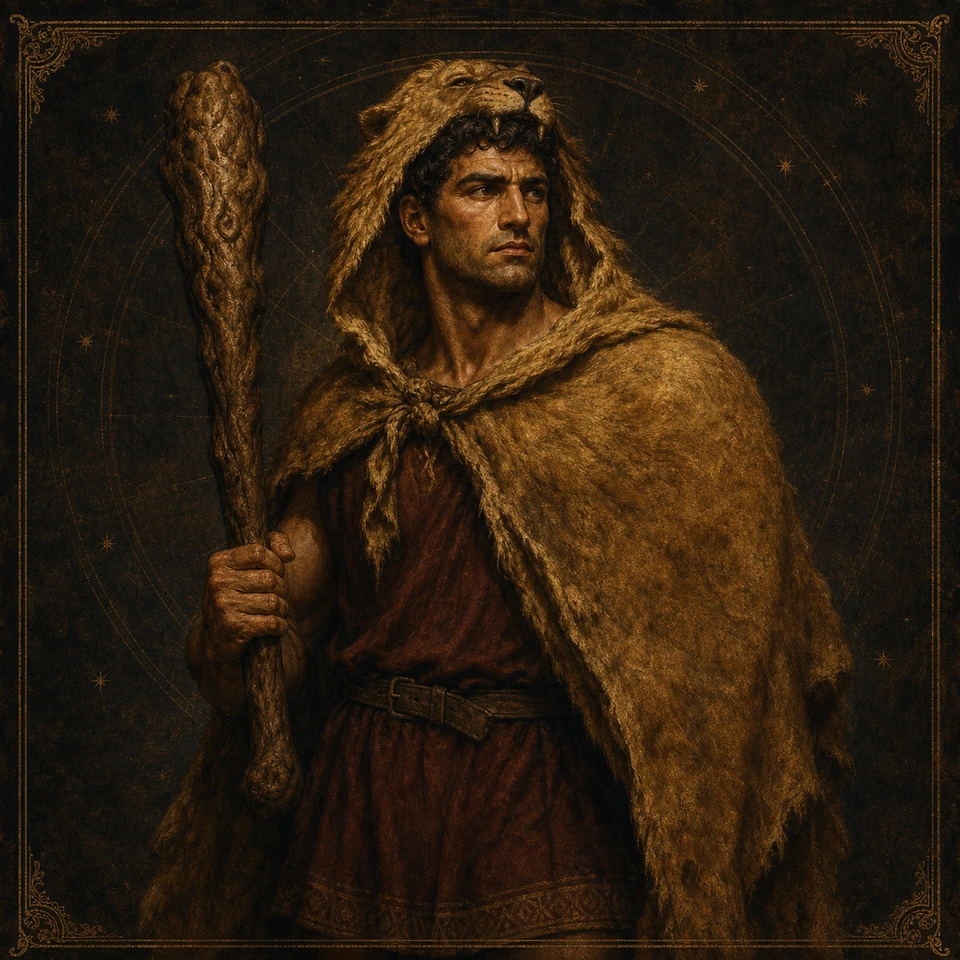
Pushing mortal endurance to the absolute limit, the deified hero Heracles blends raw strength with sharp strategy and negotiation. The son of Zeus and Alcmene, he achieved immortal status and marriage to Hebe through his grueling labors, earning distinct heroic and divine worship separated entirely from the Roman Hercules.
Overview
At Augeas' cattle yards, Heracles does not raise his club. He cuts channels and turns rivers through years of packed filth. At the Hesperides, he takes the weight of heaven from Atlas, then wins release from the burden by making the sky-bearer shoulder it again. These are acts of engineering, negotiation, endurance, and judgment. Heracles is not a mascot for brute force. Greek witnesses preserve a deified hero whose mastery is inseparable from service, error, grief, ritual limits, and the help of others.
Zeus fathers him with the mortal Alcmene, but Hera changes the timing of two births so that Eurystheus receives the promised rule. Strength does not free Heracles from that divine oath. Pseudo-Apollodorus places the household killings before Delphi and the labors: Hera sends madness, Heracles kills the children of Megara and two sons of Iphicles, Thespius purifies him, and the Pythia orders twelve years of service. Euripides writes a different catastrophe. His Heracles has already returned from the last labor when Iris and Lyssa enter under Hera's command. The frenzy turns his rescued household into imagined enemies until Athena strikes him unconscious with a stone. Amphitryon survives, and Theseus answers the awakened man's shame with friendship. These versions cannot be made into one chronology without destroying what each tragedy and mythographer says.
The ordered twelve in Pseudo-Apollodorus are neither a clean ladder of virtues nor twelve solitary victories. Iolaus burns the Hydra's necks and costs Heracles credit. Artemis confronts him over the hind. Athena supplies the noise that drives the Stymphalian birds into flight. Augeas' promise and Phyleus' testimony expose the bargain behind the stables. Hippolyta first offers her belt before Hera turns the Amazons toward battle. Atlas fetches the apples while Heracles bears heaven. Hades allows Cerberus to be taken only without weapons. Eurystheus defines the service, disputes success, and forces an original ten tasks into twelve.
Greek worship holds Heracles between heroic mortality and divine honor. Herodotus describes sacrifice to him as an immortal Olympian beside offerings made to him as a hero. At Cynosarges near Athens, Pausanias sees his altar with Hebe's and names Alcmene and Iolaus nearby. The cultic evidence does not erase the dead children, coerced labor, or violence. It gives the wounded, serving hero a sacred life that is larger than modern invulnerability.
Death also survives in incompatible forms. Sophocles' Trachiniae makes Deianeira's tragic intention central: trusting Nessus' dying instruction, she sends a robe meant to restore love; the cloth fastens poison to Heracles during sacrifice. He orders Hyllus to carry him to Zeus' height on Oeta and burn his body, yet the play ends before the pyre, death, or ascent is shown. Pseudo-Apollodorus continues through Poeas lighting the fire, thunder, a cloud-borne ascent, reconciliation with Hera, and marriage to Hebe. Hesiod knows the ageless marriage. The Odyssey places a phantom among the dead while declaring Heracles himself among the gods. Side by side, these witnesses make his final boundary stranger and more durable than a single tidy ending.
The lion skin and club identify him, but ancient bodies vary. A name-inscribed Attic cup shows the skin drawn over his head with club and sword belt; a Corinthian pyxis shows a beardless figure in a short chiton with a large club. Roman Hercules and Etruscan Hercle are not alternate spellings for the Greek hero. Greek Heracles belongs to the specific poems, theaters, objects, sanctuaries, and contested endings that bear his name.
Canonical identity
Canonical Identity
Heracles commands dual status as both an ancient Greek deified hero and a god, born to Zeus and the mortal woman Alcmene. His immense dignity does not rely on absolute invulnerability or isolation; Greek witnesses freely depict him enduring madness, bodily agony, profound guilt, coercion, reliance on companions, and disputed successes alongside his eventual divine honors. According to Pseudo-Apollodorus, he was initially called Alcides before the Pythia officially bestowed the name Heracles. He remains strictly independent of the Roman Hercules, the Etruscan Hercle, and the Tyrian deity Herodotus labels as Heracles, as shared attributes do not merge distinct cultural histories.
Linguistic Identity
Herakles serves as a highly common English transliteration of the original Greek spelling. Because no reviewed dialect-and-period evidence currently verifies a specific historical pronunciation, no phonetic guide is provided, as a modern English sound cannot adequately substitute for ancient speech.
Sources and evidence
TEXTUAL · Supported
Pseudo-Apollodorus says that the Pythia first called the son of Zeus and Alcmene Heracles and that he had previously been called Alcides.
- Source
- Pseudo-Apollodorus; edited and translated by James G. Frazer, Library (1921)
- Reviewed edition
- James G. Frazer edition and English translation, Harvard University Press and William Heinemann, 1921 · translated by James G. Frazer · edited by James G. Frazer · Perseus Digital Library / Scaife ATLAS
- Exact locator
- Book 2 · Chapter 4 · Section 12
- Scope
- Greek religion under Roman imperial rule · Ancient Greece
- Authority
- Pseudo-Apollodorus, Library
- Certainty
- High
The passage supports the name change and Alcides alias, not a lexical etymology or pronunciation.
Open exact reviewed sourceTEXTUAL · Supported
The Odyssey sees the shade of Heracles among the dead while saying Heracles himself lives among the gods with Hebe.
- Source
- Homer; translated by A. T. Murray, Odyssey (1919)
- Reviewed edition
- A. T. Murray English translation, London: William Heinemann; New York: G. P. Putnam's Sons, 1919 · translated by A. T. Murray · Perseus Digital Library / Scaife ATLAS
- Exact locator
- Book 11 · Line 601-604
- Scope
- Archaic Greece · Ancient Greece
- Authority
- Homer, Odyssey
- Certainty
- High
The passage preserves a difficult boundary between heroic death and divine immortality.
Open exact reviewed sourceTEXTUAL · Supported
Herodotus distinguishes two honors for Heracles: sacrifice to him as an immortal Olympian and offerings to him as a hero, after discussing Tyre and Thasos.
- Source
- Herodotus; translated by A. D. Godley, The Histories (1925)
- Reviewed edition
- A. D. Godley English translation, Loeb Classical Library volumes I-IV, 1920-1925 · translated by A. D. Godley · edited by A. D. Godley · Perseus Digital Library / Scaife ATLAS
- Exact locator
- Book 2 · Chapter 44 · Section 1-5
- Scope
- Classical Greece · Ancient Greece
- Authority
- Herodotus, Histories
- Certainty
- High
His inquiry preserves a dual cultic classification rather than one simple origin story.
Open exact reviewed source4 reviewed sources for this section
- Pseudo-Apollodorus; edited and translated by James G. Frazer, Library (1921)Harvard University Press and William Heinemann edition, 1921 · Perseus Digital Library / Scaife ATLAS
- Hesiod; edited and translated by Hugh G. Evelyn-White, Theogony (1914)Hesiod, the Homeric Hymns and Homerica, London and New York, 1914 · Perseus Digital Library / Scaife ATLAS
- Homer; translated by A. T. Murray, Odyssey (1919)A. T. Murray English translation, London: William Heinemann; New York: G. P. Putnam's Sons, 1919 · Perseus Digital Library / Scaife ATLAS
- Herodotus; translated by A. D. Godley, The Histories (1925)A. D. Godley English translation, Loeb Classical Library volumes I-IV, 1920-1925; Perseus eng2 component · Perseus Digital Library / Scaife ATLAS
Culture, tradition, period, and place
Heracles belongs to ancient Greek religion, heroic narrative, civic cult, theater, and visual art across many centuries and regions. Archaic poetry knows his labors, marriage, and unusual afterlife. Classical worship and historiography show that communities could approach him under both heroic and divine forms. Attic and Corinthian pottery makes the lion skin and club visible without forcing one age, beard, or costume upon every image.
The geography is as wide as the stories: Thebes and Tiryns in his mortal career, Nemea and Lerna in the Peloponnese, distant western lands around Geryon and the Hesperides, Delphi in the tripod conflict, Mount Oeta at death, Cynosarges near Athens in cult, and Thasos in Herodotus’s inquiry. These settings do not form one uniform sanctuary system. Each belongs to a particular deed, community, or witness.
Sources and evidence
TEXTUAL · Supported
Herodotus distinguishes two honors for Heracles: sacrifice to him as an immortal Olympian and offerings to him as a hero, after discussing Tyre and Thasos.
- Source
- Herodotus; translated by A. D. Godley, The Histories (1925)
- Reviewed edition
- A. D. Godley English translation, Loeb Classical Library volumes I-IV, 1920-1925 · translated by A. D. Godley · edited by A. D. Godley · Perseus Digital Library / Scaife ATLAS
- Exact locator
- Book 2 · Chapter 44 · Section 1-5
- Scope
- Classical Greece · Ancient Greece
- Authority
- Herodotus, Histories
- Certainty
- High
His inquiry preserves a dual cultic classification rather than one simple origin story.
Open exact reviewed sourceTEXTUAL · Supported
At Cynosarges near Athens, Pausanias saw altars of Heracles and Hebe beside altars of Alcmene and Iolaus.
- Source
- Pausanias; Spiro Greek edition and Jones/Ormerod translation volumes, Description of Greece (1935)
- Reviewed edition
- Spiro Greek edition and Jones/Ormerod English volumes represented by the Perseus CTS corpus, 1903-1935 · translated by W. H. S. Jones and H. A. Ormerod, volume-dependent · edited by Friedrich Spiro for the Greek edition · Perseus Digital Library / Scaife ATLAS
- Exact locator
- Book 1 · Chapter 19 · Section 3
- Scope
- Greek religion under Roman imperial rule · Attica
- Authority
- Pausanias, Description of Greece
- Certainty
- High
The sanctuary landscape brings wife, mother, and companion together without erasing their distinct identities.
Open exact reviewed sourceMATERIAL CULTURE · Supported
A name-inscribed Attic cup fragment shows Heracles with lion skin over his head, a raised club, and a sword belt.
- Source
- British Museum, British Museum Collection
- Reviewed edition
- Live record-level official museum collection · British Museum
- Exact locator
- MuseumObjectId Museum number 1905,0126.1 · Entry Attic white-ground cup fragment; Onesimos; circa 500-480 BC
- Scope
- Classical Greece · Attica
- Authority
- British Museum, collection catalogue
- Certainty
- High
The object supports a specific beardless iconographic form and named identity.
Open exact reviewed sourceMATERIAL CULTURE · Supported
A Corinthian pyxis shows a beardless Heracles in a short bordered chiton with a large club.
- Source
- British Museum, British Museum Collection
- Reviewed edition
- Live record-level official museum collection · British Museum
- Exact locator
- MuseumObjectId Museum number 1873,0915.8 (E814) · Entry Corinthian pyxis; circa 450-400 BC
- Scope
- Classical Greece · Ancient Greece
- Authority
- British Museum, collection catalogue
- Certainty
- High
The scene confirms that beard, nudity, and dress were not fixed in every ancient image.
Open exact reviewed source10 reviewed sources for this section
- Pseudo-Apollodorus; edited and translated by James G. Frazer, Library (1921)Harvard University Press and William Heinemann edition, 1921 · Perseus Digital Library / Scaife ATLAS
- Hesiod; edited and translated by Hugh G. Evelyn-White, Theogony (1914)Hesiod, the Homeric Hymns and Homerica, London and New York, 1914 · Perseus Digital Library / Scaife ATLAS
- Homer; translated by A. T. Murray, Odyssey (1919)A. T. Murray English translation, London: William Heinemann; New York: G. P. Putnam's Sons, 1919 · Perseus Digital Library / Scaife ATLAS
- Herodotus; translated by A. D. Godley, The Histories (1925)A. D. Godley English translation, Loeb Classical Library volumes I-IV, 1920-1925; Perseus eng2 component · Perseus Digital Library / Scaife ATLAS
- Pausanias; Spiro Greek edition and Jones/Ormerod translation volumes, Description of Greece (1935)Perseus CTS edition corpus, 1903-1935 · Perseus Digital Library / Scaife ATLAS
- British Museum, British Museum CollectionLive official museum collection · British Museum
- Anonymous Homeric Hymns; edited and translated by Hugh G. Evelyn-White, Homeric Hymns (1914)Hesiod, the Homeric Hymns and Homerica, London and New York, 1914 · Perseus Digital Library / Scaife ATLAS
- Euripides; translated by David Kovacs, Children of Heracles (1995)David Kovacs Greek text and English translation, Loeb Classical Library 484 · Perseus Digital Library
- Homer; Monro and Allen Greek edition with edition-specific translations, Iliad (1920)Perseus CTS edition corpus; Greek edition, Oxford, 1908-1920 · Perseus Digital Library / Scaife ATLAS
- Hesiod; edited and translated by Hugh G. Evelyn-White, Shield of Heracles (1914)Hesiod, the Homeric Hymns and Homerica, London and New York, 1914 · Perseus Digital Library / Scaife ATLAS
Historical development
No single surviving text invents Heracles whole. Archaic poetry already assumes a famous laboring hero who reaches divine marriage, and painted pottery gives individual deeds visual form. Classical tragedy does not merely repeat a fixed biography. Euripides places the madness after the last labor and makes Iris, Lyssa, Athena, Amphitryon, and Theseus decisive. Sophocles turns the death story toward Deianeira's terrible error and stops before the pyre is lit. Pseudo-Apollodorus later orders a continuous life, twelve labors, and a cloud-borne apotheosis.
Cult develops through local practice rather than narrative alone. Herodotus encounters heroic offering and Olympian sacrifice. Pausanias sees the Cynosarges altar cluster. These witnesses make a long Greek history visible without pretending that every city, poem, vase, or century agreed on one sequence. Roman, Etruscan, philosophical, athletic, and popular receptions require their own dated evidence.
Sources and evidence
TEXTUAL · Supported
Euripides places Heracles' madness after the last labor: Iris and Lyssa carry out Hera's will, Athena stops the frenzy, and Theseus answers the survivor's shame.
- Source
- Euripides; translated by Edward P. Coleridge, Heracles (catalogued as Heracles Mad) (1891)
- Reviewed edition
- Edward P. Coleridge English translation in The Plays of Euripides, Volume II, 1891; Perseus modernization · translated by Edward P. Coleridge · Perseus Digital Library / Scaife ATLAS
- Exact locator
- Entry Heracles · Line 1-25; 815-1041; 1086-1426
- Scope
- Classical Greece · Ancient Greece
- Authority
- Euripides, Heracles
- Certainty
- High
This post-labor chronology and dramatic household must remain separate from Pseudo-Apollodorus 2.4.12.
Open exact reviewed sourceTEXTUAL · Supported
Sophocles makes Deianeira send Nessus' blood on a robe in the hope of restoring Heracles' love; the garment tortures him, and he orders Hyllus to prepare a pyre on Oeta.
- Source
- Sophocles; translated and edited by Sir Richard Claverhouse Jebb, The Trachiniae (1892)
- Reviewed edition
- Sir Richard Claverhouse Jebb English translation and commentary in Sophocles: The Plays and Fragments, Part V, The Trachiniae, 1892; Perseus modernization · translated by Sir Richard Claverhouse Jebb · Perseus Digital Library / Scaife ATLAS
- Exact locator
- Entry Trachiniae · Line 531-820; 1040-1278
- Scope
- Classical Greece · Ancient Greece
- Authority
- Sophocles, Trachiniae
- Certainty
- High
The play ends before the pyre, death, or apotheosis is shown. Those later events are not imported from Pseudo-Apollodorus.
Open exact reviewed sourceTEXTUAL · Supported
Pseudo-Apollodorus arranges twelve labors under Eurystheus, from the Nemean lion to Cerberus, with two tasks rejected and replaced.
- Source
- Pseudo-Apollodorus; edited and translated by James G. Frazer, Library (1921)
- Reviewed edition
- James G. Frazer edition and English translation, Harvard University Press and William Heinemann, 1921 · translated by James G. Frazer · edited by James G. Frazer · Perseus Digital Library / Scaife ATLAS
- Exact locator
- Entry Library · Section 2.4.12-2.5.12
- Scope
- Greek religion under Roman imperial rule · Ancient Greece
- Authority
- Pseudo-Apollodorus, Library
- Certainty
- High
The familiar numbered cycle is preserved here as a later mythographic organization.
Open exact reviewed sourceTEXTUAL · Supported
Herodotus distinguishes two honors for Heracles: sacrifice to him as an immortal Olympian and offerings to him as a hero, after discussing Tyre and Thasos.
- Source
- Herodotus; translated by A. D. Godley, The Histories (1925)
- Reviewed edition
- A. D. Godley English translation, Loeb Classical Library volumes I-IV, 1920-1925 · translated by A. D. Godley · edited by A. D. Godley · Perseus Digital Library / Scaife ATLAS
- Exact locator
- Book 2 · Chapter 44 · Section 1-5
- Scope
- Classical Greece · Ancient Greece
- Authority
- Herodotus, Histories
- Certainty
- High
His inquiry preserves a dual cultic classification rather than one simple origin story.
Open exact reviewed sourceTEXTUAL · Supported
At Cynosarges near Athens, Pausanias saw altars of Heracles and Hebe beside altars of Alcmene and Iolaus.
- Source
- Pausanias; Spiro Greek edition and Jones/Ormerod translation volumes, Description of Greece (1935)
- Reviewed edition
- Spiro Greek edition and Jones/Ormerod English volumes represented by the Perseus CTS corpus, 1903-1935 · translated by W. H. S. Jones and H. A. Ormerod, volume-dependent · edited by Friedrich Spiro for the Greek edition · Perseus Digital Library / Scaife ATLAS
- Exact locator
- Book 1 · Chapter 19 · Section 3
- Scope
- Greek religion under Roman imperial rule · Attica
- Authority
- Pausanias, Description of Greece
- Certainty
- High
The sanctuary landscape brings wife, mother, and companion together without erasing their distinct identities.
Open exact reviewed source7 reviewed sources for this section
- Hesiod; edited and translated by Hugh G. Evelyn-White, Theogony (1914)Hesiod, the Homeric Hymns and Homerica, London and New York, 1914 · Perseus Digital Library / Scaife ATLAS
- Euripides; translated by Edward P. Coleridge, Heracles (catalogued as Heracles Mad) (1891)Edward P. Coleridge English translation in The Plays of Euripides, Volume II, 1891; modernized by Perseus · Perseus Digital Library / Scaife ATLAS
- Sophocles; translated and edited by Sir Richard Claverhouse Jebb, The Trachiniae (1892)Sophocles: The Plays and Fragments, Part V, The Trachiniae, Jebb English translation, 1892; modernized by Perseus · Perseus Digital Library / Scaife ATLAS
- Pseudo-Apollodorus; edited and translated by James G. Frazer, Library (1921)Harvard University Press and William Heinemann edition, 1921 · Perseus Digital Library / Scaife ATLAS
- Herodotus; translated by A. D. Godley, The Histories (1925)A. D. Godley English translation, Loeb Classical Library volumes I-IV, 1920-1925; Perseus eng2 component · Perseus Digital Library / Scaife ATLAS
- Pausanias; Spiro Greek edition and Jones/Ormerod translation volumes, Description of Greece (1935)Perseus CTS edition corpus, 1903-1935 · Perseus Digital Library / Scaife ATLAS
- British Museum, British Museum CollectionLive official museum collection · British Museum
Attested roles and historical themes
Roles, powers, and limits
Heracles acts through strength, but his finest deeds also require planning, restraint, bargaining, and trust. Rivers clear Augeas' yard. Iolaus' fire defeats the Hydra's returning heads. Artemis must be answered over the hind. Atlas must be persuaded to resume the sky. Cerberus may be taken only on Hades' condition that no weapon be used. These are acts of mastery under limits, not a catalogue of effortless domination.
Strength is never sovereignty. Hera and her agents can break his mind. Eurystheus commands him through oath and oracle. Apollo defends the Delphic tripod. Nessus' poison defeats the body that monsters could not. Athena can save a household by stopping him, and Theseus can save the awakened man from isolation. His divine role grows from this mortal record of labor, catastrophe, endurance, worship, death, and transformation. It does not erase the people harmed along the way.
Sources and evidence
TEXTUAL · Supported
Pseudo-Apollodorus says Hera drives Heracles mad, he kills his children by Megara, seeks purification, and is ordered to serve Eurystheus.
- Source
- Pseudo-Apollodorus; edited and translated by James G. Frazer, Library (1921)
- Reviewed edition
- James G. Frazer edition and English translation, Harvard University Press and William Heinemann, 1921 · translated by James G. Frazer · edited by James G. Frazer · Perseus Digital Library / Scaife ATLAS
- Exact locator
- Book 2 · Chapter 4 · Section 12
- Scope
- Greek religion under Roman imperial rule · Ancient Greece
- Authority
- Pseudo-Apollodorus, Library
- Certainty
- High
The killings are a catastrophe, not a test voluntarily chosen by the hero.
Open exact reviewed sourceTEXTUAL · Supported
Euripides places Heracles' madness after the last labor: Iris and Lyssa carry out Hera's will, Athena stops the frenzy, and Theseus answers the survivor's shame.
- Source
- Euripides; translated by Edward P. Coleridge, Heracles (catalogued as Heracles Mad) (1891)
- Reviewed edition
- Edward P. Coleridge English translation in The Plays of Euripides, Volume II, 1891; Perseus modernization · translated by Edward P. Coleridge · Perseus Digital Library / Scaife ATLAS
- Exact locator
- Entry Heracles · Line 1-25; 815-1041; 1086-1426
- Scope
- Classical Greece · Ancient Greece
- Authority
- Euripides, Heracles
- Certainty
- High
This post-labor chronology and dramatic household must remain separate from Pseudo-Apollodorus 2.4.12.
Open exact reviewed sourceTEXTUAL · Supported
Pseudo-Apollodorus arranges twelve labors under Eurystheus, from the Nemean lion to Cerberus, with two tasks rejected and replaced.
- Source
- Pseudo-Apollodorus; edited and translated by James G. Frazer, Library (1921)
- Reviewed edition
- James G. Frazer edition and English translation, Harvard University Press and William Heinemann, 1921 · translated by James G. Frazer · edited by James G. Frazer · Perseus Digital Library / Scaife ATLAS
- Exact locator
- Entry Library · Section 2.4.12-2.5.12
- Scope
- Greek religion under Roman imperial rule · Ancient Greece
- Authority
- Pseudo-Apollodorus, Library
- Certainty
- High
The familiar numbered cycle is preserved here as a later mythographic organization.
Open exact reviewed sourceTEXTUAL · Supported
After the Pythia refuses him, Heracles seizes the Delphic tripod, fights Apollo, and yields when Zeus separates them.
- Source
- Pseudo-Apollodorus; edited and translated by James G. Frazer, Library (1921)
- Reviewed edition
- James G. Frazer edition and English translation, Harvard University Press and William Heinemann, 1921 · translated by James G. Frazer · edited by James G. Frazer · Perseus Digital Library / Scaife ATLAS
- Exact locator
- Book 2 · Chapter 6 · Section 2
- Scope
- Greek religion under Roman imperial rule · Delphi
- Authority
- Pseudo-Apollodorus, Library
- Certainty
- High
The conflict concerns purification, divine jurisdiction, and compelled service.
Open exact reviewed sourceTEXTUAL · Supported
Sophocles makes Deianeira send Nessus' blood on a robe in the hope of restoring Heracles' love; the garment tortures him, and he orders Hyllus to prepare a pyre on Oeta.
- Source
- Sophocles; translated and edited by Sir Richard Claverhouse Jebb, The Trachiniae (1892)
- Reviewed edition
- Sir Richard Claverhouse Jebb English translation and commentary in Sophocles: The Plays and Fragments, Part V, The Trachiniae, 1892; Perseus modernization · translated by Sir Richard Claverhouse Jebb · Perseus Digital Library / Scaife ATLAS
- Exact locator
- Entry Trachiniae · Line 531-820; 1040-1278
- Scope
- Classical Greece · Ancient Greece
- Authority
- Sophocles, Trachiniae
- Certainty
- High
The play ends before the pyre, death, or apotheosis is shown. Those later events are not imported from Pseudo-Apollodorus.
Open exact reviewed sourceTEXTUAL · Supported
The poisoned garment of Deianeira burns Heracles, who builds a pyre on Oeta; after the fire, a cloud carries him to heaven and he marries Hebe.
- Source
- Pseudo-Apollodorus; edited and translated by James G. Frazer, Library (1921)
- Reviewed edition
- James G. Frazer edition and English translation, Harvard University Press and William Heinemann, 1921 · translated by James G. Frazer · edited by James G. Frazer · Perseus Digital Library / Scaife ATLAS
- Exact locator
- Book 2 · Chapter 7 · Section 7
- Scope
- Greek religion under Roman imperial rule · Ancient Greece
- Authority
- Pseudo-Apollodorus, Library
- Certainty
- High
The account joins bodily death, disappearance, immortality, reconciliation with Hera, and marriage.
Open exact reviewed sourceTEXTUAL · Supported
Hesiod says that Heracles finishes his grievous labors, takes Hebe as his wife on Olympus, and lives among the immortals without age or trouble.
- Source
- Hesiod; edited and translated by Hugh G. Evelyn-White, Theogony (1914)
- Reviewed edition
- Hugh G. Evelyn-White edition and English translation in Hesiod, the Homeric Hymns and Homerica, 1914 · translated by Hugh G. Evelyn-White · edited by Hugh G. Evelyn-White · Perseus Digital Library / Scaife ATLAS
- Exact locator
- Entry Theogony · Line 950-955
- Scope
- Archaic Greece · Ancient Greece
- Authority
- Hesiod, Theogony
- Certainty
- High
The marriage marks divine status after mortal suffering.
Open exact reviewed source5 reviewed sources for this section
- Pseudo-Apollodorus; edited and translated by James G. Frazer, Library (1921)Harvard University Press and William Heinemann edition, 1921 · Perseus Digital Library / Scaife ATLAS
- Euripides; translated by Edward P. Coleridge, Heracles (catalogued as Heracles Mad) (1891)Edward P. Coleridge English translation in The Plays of Euripides, Volume II, 1891; modernized by Perseus · Perseus Digital Library / Scaife ATLAS
- Sophocles; translated and edited by Sir Richard Claverhouse Jebb, The Trachiniae (1892)Sophocles: The Plays and Fragments, Part V, The Trachiniae, Jebb English translation, 1892; modernized by Perseus · Perseus Digital Library / Scaife ATLAS
- Hesiod; edited and translated by Hugh G. Evelyn-White, Theogony (1914)Hesiod, the Homeric Hymns and Homerica, London and New York, 1914 · Perseus Digital Library / Scaife ATLAS
- Homer; translated by A. T. Murray, Odyssey (1919)A. T. Murray English translation, London: William Heinemann; New York: G. P. Putnam's Sons, 1919 · Perseus Digital Library / Scaife ATLAS
Epithets and titles
Poetic Epithet
Lion-hearted
Lion-hearted
Greek hymnic tradition · Ancient Greek hymnic witnessHomeric Hymn 15 praises Heracles under this title while recalling his wandering, suffering, and divine marriage.
1 reviewed source for this section
- Anonymous Homeric Hymns; edited and translated by Hugh G. Evelyn-White, Homeric Hymns (1914)Hesiod, the Homeric Hymns and Homerica, London and New York, 1914 · Perseus Digital Library / Scaife ATLAS
Worship and cult
Herodotus offers unusually explicit evidence for the hero-god boundary. After investigating traditions at Tyre and Thasos, he judges that Greeks act correctly when they honor one Heracles with sacrifice as an immortal Olympian and another form with offerings as a hero. His explanation reflects a fifth-century inquiry across cultures, but the two ritual modes remain clear.
At Cynosarges outside Athens, Pausanias saw altars of Heracles and Hebe, with Alcmene and Iolaus honored nearby. The arrangement places divine wife, mortal mother, and heroic companion within one sacred landscape. It does not prove that every Heracles sanctuary repeated the same family cluster. Nor does it license a universal rite assembled from distant local practices. Cultic Heracles is historically real, but each altar, title, and ritual form needs its own place and witness.
Sources and evidence
TEXTUAL · Supported
Herodotus distinguishes two honors for Heracles: sacrifice to him as an immortal Olympian and offerings to him as a hero, after discussing Tyre and Thasos.
- Source
- Herodotus; translated by A. D. Godley, The Histories (1925)
- Reviewed edition
- A. D. Godley English translation, Loeb Classical Library volumes I-IV, 1920-1925 · translated by A. D. Godley · edited by A. D. Godley · Perseus Digital Library / Scaife ATLAS
- Exact locator
- Book 2 · Chapter 44 · Section 1-5
- Scope
- Classical Greece · Ancient Greece
- Authority
- Herodotus, Histories
- Certainty
- High
His inquiry preserves a dual cultic classification rather than one simple origin story.
Open exact reviewed sourceTEXTUAL · Supported
At Cynosarges near Athens, Pausanias saw altars of Heracles and Hebe beside altars of Alcmene and Iolaus.
- Source
- Pausanias; Spiro Greek edition and Jones/Ormerod translation volumes, Description of Greece (1935)
- Reviewed edition
- Spiro Greek edition and Jones/Ormerod English volumes represented by the Perseus CTS corpus, 1903-1935 · translated by W. H. S. Jones and H. A. Ormerod, volume-dependent · edited by Friedrich Spiro for the Greek edition · Perseus Digital Library / Scaife ATLAS
- Exact locator
- Book 1 · Chapter 19 · Section 3
- Scope
- Greek religion under Roman imperial rule · Attica
- Authority
- Pausanias, Description of Greece
- Certainty
- High
The sanctuary landscape brings wife, mother, and companion together without erasing their distinct identities.
Open exact reviewed source2 reviewed sources for this section
- Herodotus; translated by A. D. Godley, The Histories (1925)A. D. Godley English translation, Loeb Classical Library volumes I-IV, 1920-1925; Perseus eng2 component · Perseus Digital Library / Scaife ATLAS
- Pausanias; Spiro Greek edition and Jones/Ormerod translation volumes, Description of Greece (1935)Perseus CTS edition corpus, 1903-1935 · Perseus Digital Library / Scaife ATLAS
Temples, sanctuaries, and sacred places
At Cynosarges, Pausanias gives a clear view of Heracles in an Athenian sacred landscape. Pausanias locates it near Athens and names altars of Heracles, Hebe, Alcmene, and Iolaus. The site joins marriage and family memory to worship without collapsing those figures into attributes of Heracles.
Delphi is sacred ground in a different sense. Heracles arrives seeking purification and an answer, seizes the tripod when refused, and learns that strength cannot simply transfer Apollo’s oracle. Mount Oeta belongs to the death tradition, while Nemea, Lerna, Erymanthus, and Taenarum mark labors rather than automatically proving cult. Thasos enters Herodotus’s investigation of worship and origin. Other sanctuaries can be understood only through their own inscriptions, excavation reports, priesthood evidence, and festival calendars.
Sources and evidence
TEXTUAL · Supported
At Cynosarges near Athens, Pausanias saw altars of Heracles and Hebe beside altars of Alcmene and Iolaus.
- Source
- Pausanias; Spiro Greek edition and Jones/Ormerod translation volumes, Description of Greece (1935)
- Reviewed edition
- Spiro Greek edition and Jones/Ormerod English volumes represented by the Perseus CTS corpus, 1903-1935 · translated by W. H. S. Jones and H. A. Ormerod, volume-dependent · edited by Friedrich Spiro for the Greek edition · Perseus Digital Library / Scaife ATLAS
- Exact locator
- Book 1 · Chapter 19 · Section 3
- Scope
- Greek religion under Roman imperial rule · Attica
- Authority
- Pausanias, Description of Greece
- Certainty
- High
The sanctuary landscape brings wife, mother, and companion together without erasing their distinct identities.
Open exact reviewed sourceTEXTUAL · Supported
After the Pythia refuses him, Heracles seizes the Delphic tripod, fights Apollo, and yields when Zeus separates them.
- Source
- Pseudo-Apollodorus; edited and translated by James G. Frazer, Library (1921)
- Reviewed edition
- James G. Frazer edition and English translation, Harvard University Press and William Heinemann, 1921 · translated by James G. Frazer · edited by James G. Frazer · Perseus Digital Library / Scaife ATLAS
- Exact locator
- Book 2 · Chapter 6 · Section 2
- Scope
- Greek religion under Roman imperial rule · Delphi
- Authority
- Pseudo-Apollodorus, Library
- Certainty
- High
The conflict concerns purification, divine jurisdiction, and compelled service.
Open exact reviewed sourceTEXTUAL · Supported
Herodotus distinguishes two honors for Heracles: sacrifice to him as an immortal Olympian and offerings to him as a hero, after discussing Tyre and Thasos.
- Source
- Herodotus; translated by A. D. Godley, The Histories (1925)
- Reviewed edition
- A. D. Godley English translation, Loeb Classical Library volumes I-IV, 1920-1925 · translated by A. D. Godley · edited by A. D. Godley · Perseus Digital Library / Scaife ATLAS
- Exact locator
- Book 2 · Chapter 44 · Section 1-5
- Scope
- Classical Greece · Ancient Greece
- Authority
- Herodotus, Histories
- Certainty
- High
His inquiry preserves a dual cultic classification rather than one simple origin story.
Open exact reviewed source3 reviewed sources for this section
- Pausanias; Spiro Greek edition and Jones/Ormerod translation volumes, Description of Greece (1935)Perseus CTS edition corpus, 1903-1935 · Perseus Digital Library / Scaife ATLAS
- Pseudo-Apollodorus; edited and translated by James G. Frazer, Library (1921)Harvard University Press and William Heinemann edition, 1921 · Perseus Digital Library / Scaife ATLAS
- Herodotus; translated by A. D. Godley, The Histories (1925)A. D. Godley English translation, Loeb Classical Library volumes I-IV, 1920-1925; Perseus eng2 component · Perseus Digital Library / Scaife ATLAS
Festivals and processions
Herodotus and Pausanias establish worship but do not fix one universal festival date, procession route, or Greek-wide day of Heracles. Festivals called Herakleia belonged to particular cities and calendars; the shared name cannot supply the same officials, sequence, offerings, or date everywhere.
Narrative time is different from ritual time. The labors form a sequence of service, not a festival calendar. The pyre on Oeta belongs to a death account and is not an observance to imitate. Herodotus distinguishes heroic and divine honors without naming a complete festival program. Many communities honored Heracles, but their public calendars were local and cannot be reconstructed from the labor stories.
Sources and evidence
TEXTUAL · Supported
Pseudo-Apollodorus arranges twelve labors under Eurystheus, from the Nemean lion to Cerberus, with two tasks rejected and replaced.
- Source
- Pseudo-Apollodorus; edited and translated by James G. Frazer, Library (1921)
- Reviewed edition
- James G. Frazer edition and English translation, Harvard University Press and William Heinemann, 1921 · translated by James G. Frazer · edited by James G. Frazer · Perseus Digital Library / Scaife ATLAS
- Exact locator
- Entry Library · Section 2.4.12-2.5.12
- Scope
- Greek religion under Roman imperial rule · Ancient Greece
- Authority
- Pseudo-Apollodorus, Library
- Certainty
- High
The familiar numbered cycle is preserved here as a later mythographic organization.
Open exact reviewed sourceTEXTUAL · Supported
Herodotus distinguishes two honors for Heracles: sacrifice to him as an immortal Olympian and offerings to him as a hero, after discussing Tyre and Thasos.
- Source
- Herodotus; translated by A. D. Godley, The Histories (1925)
- Reviewed edition
- A. D. Godley English translation, Loeb Classical Library volumes I-IV, 1920-1925 · translated by A. D. Godley · edited by A. D. Godley · Perseus Digital Library / Scaife ATLAS
- Exact locator
- Book 2 · Chapter 44 · Section 1-5
- Scope
- Classical Greece · Ancient Greece
- Authority
- Herodotus, Histories
- Certainty
- High
His inquiry preserves a dual cultic classification rather than one simple origin story.
Open exact reviewed source3 reviewed sources for this section
- Herodotus; translated by A. D. Godley, The Histories (1925)A. D. Godley English translation, Loeb Classical Library volumes I-IV, 1920-1925; Perseus eng2 component · Perseus Digital Library / Scaife ATLAS
- Pausanias; Spiro Greek edition and Jones/Ormerod translation volumes, Description of Greece (1935)Perseus CTS edition corpus, 1903-1935 · Perseus Digital Library / Scaife ATLAS
- Pseudo-Apollodorus; edited and translated by James G. Frazer, Library (1921)Harvard University Press and William Heinemann edition, 1921 · Perseus Digital Library / Scaife ATLAS
Offerings, votives, and ritual evidence
Herodotus distinguishes sacrifice to Heracles as an immortal from offerings made to him as a hero. The difference is ritual and theological, not merely verbal. Worshippers could approach the famous figure through two modes of sacred presence. Herodotus does not name the animals, portions, libations, priestly offices, or spoken formulas in this passage.
Purification also appears in narrative. After killing his children in Pseudo-Apollodorus, Heracles receives purification from Thespius and consults Delphi. Later, after killing Iphitus, he again seeks relief and meets refusal at the oracle. Bloodshed demands religious response in these stories, but the scenes are not household instructions. The Delphic tripod, pyre, lion skin, club, bow, and captured creatures belong to particular narratives or images. None becomes an offering merely because Heracles touches it.
Sources and evidence
TEXTUAL · Supported
Herodotus distinguishes two honors for Heracles: sacrifice to him as an immortal Olympian and offerings to him as a hero, after discussing Tyre and Thasos.
- Source
- Herodotus; translated by A. D. Godley, The Histories (1925)
- Reviewed edition
- A. D. Godley English translation, Loeb Classical Library volumes I-IV, 1920-1925 · translated by A. D. Godley · edited by A. D. Godley · Perseus Digital Library / Scaife ATLAS
- Exact locator
- Book 2 · Chapter 44 · Section 1-5
- Scope
- Classical Greece · Ancient Greece
- Authority
- Herodotus, Histories
- Certainty
- High
His inquiry preserves a dual cultic classification rather than one simple origin story.
Open exact reviewed sourceTEXTUAL · Supported
Pseudo-Apollodorus says Hera drives Heracles mad, he kills his children by Megara, seeks purification, and is ordered to serve Eurystheus.
- Source
- Pseudo-Apollodorus; edited and translated by James G. Frazer, Library (1921)
- Reviewed edition
- James G. Frazer edition and English translation, Harvard University Press and William Heinemann, 1921 · translated by James G. Frazer · edited by James G. Frazer · Perseus Digital Library / Scaife ATLAS
- Exact locator
- Book 2 · Chapter 4 · Section 12
- Scope
- Greek religion under Roman imperial rule · Ancient Greece
- Authority
- Pseudo-Apollodorus, Library
- Certainty
- High
The killings are a catastrophe, not a test voluntarily chosen by the hero.
Open exact reviewed sourceTEXTUAL · Supported
After the Pythia refuses him, Heracles seizes the Delphic tripod, fights Apollo, and yields when Zeus separates them.
- Source
- Pseudo-Apollodorus; edited and translated by James G. Frazer, Library (1921)
- Reviewed edition
- James G. Frazer edition and English translation, Harvard University Press and William Heinemann, 1921 · translated by James G. Frazer · edited by James G. Frazer · Perseus Digital Library / Scaife ATLAS
- Exact locator
- Book 2 · Chapter 6 · Section 2
- Scope
- Greek religion under Roman imperial rule · Delphi
- Authority
- Pseudo-Apollodorus, Library
- Certainty
- High
The conflict concerns purification, divine jurisdiction, and compelled service.
Open exact reviewed source3 reviewed sources for this section
- Herodotus; translated by A. D. Godley, The Histories (1925)A. D. Godley English translation, Loeb Classical Library volumes I-IV, 1920-1925; Perseus eng2 component · Perseus Digital Library / Scaife ATLAS
- Pseudo-Apollodorus; edited and translated by James G. Frazer, Library (1921)Harvard University Press and William Heinemann edition, 1921 · Perseus Digital Library / Scaife ATLAS
- Pausanias; Spiro Greek edition and Jones/Ormerod translation volumes, Description of Greece (1935)Perseus CTS edition corpus, 1903-1935 · Perseus Digital Library / Scaife ATLAS
Iconography and material culture
A lion skin pulled over the head, a heavy club, and a sword belt make Heracles recognizable on the name-inscribed Attic cup fragment in the British Museum. A Corinthian pyxis presents another body: beardless, dressed in a short bordered chiton, and carrying a large club. Ancient art therefore repeats attributes while varying age, hair, beard, clothing, action, and context.
The lion skin is not generic wilderness costume. It comes from the Nemean labor, where the creature’s own hide becomes protection after its death. The club is a weapon of close force, not a royal sceptre. Bow, quiver, tripod, apples, cattle, Cerberus, and the pyre belong to other episodes and cannot all be piled into one timeless portrait. Later Roman and modern visual traditions require their own dated objects and reception histories.
Sources and evidence
MATERIAL CULTURE · Supported
A name-inscribed Attic cup fragment shows Heracles with lion skin over his head, a raised club, and a sword belt.
- Source
- British Museum, British Museum Collection
- Reviewed edition
- Live record-level official museum collection · British Museum
- Exact locator
- MuseumObjectId Museum number 1905,0126.1 · Entry Attic white-ground cup fragment; Onesimos; circa 500-480 BC
- Scope
- Classical Greece · Attica
- Authority
- British Museum, collection catalogue
- Certainty
- High
The object supports a specific beardless iconographic form and named identity.
Open exact reviewed sourceMATERIAL CULTURE · Supported
A Corinthian pyxis shows a beardless Heracles in a short bordered chiton with a large club.
- Source
- British Museum, British Museum Collection
- Reviewed edition
- Live record-level official museum collection · British Museum
- Exact locator
- MuseumObjectId Museum number 1873,0915.8 (E814) · Entry Corinthian pyxis; circa 450-400 BC
- Scope
- Classical Greece · Ancient Greece
- Authority
- British Museum, collection catalogue
- Certainty
- High
The scene confirms that beard, nudity, and dress were not fixed in every ancient image.
Open exact reviewed sourceTEXTUAL · Supported
Pseudo-Apollodorus arranges twelve labors under Eurystheus, from the Nemean lion to Cerberus, with two tasks rejected and replaced.
- Source
- Pseudo-Apollodorus; edited and translated by James G. Frazer, Library (1921)
- Reviewed edition
- James G. Frazer edition and English translation, Harvard University Press and William Heinemann, 1921 · translated by James G. Frazer · edited by James G. Frazer · Perseus Digital Library / Scaife ATLAS
- Exact locator
- Entry Library · Section 2.4.12-2.5.12
- Scope
- Greek religion under Roman imperial rule · Ancient Greece
- Authority
- Pseudo-Apollodorus, Library
- Certainty
- High
The familiar numbered cycle is preserved here as a later mythographic organization.
Open exact reviewed sourceTEXTUAL · Supported
After the Pythia refuses him, Heracles seizes the Delphic tripod, fights Apollo, and yields when Zeus separates them.
- Source
- Pseudo-Apollodorus; edited and translated by James G. Frazer, Library (1921)
- Reviewed edition
- James G. Frazer edition and English translation, Harvard University Press and William Heinemann, 1921 · translated by James G. Frazer · edited by James G. Frazer · Perseus Digital Library / Scaife ATLAS
- Exact locator
- Book 2 · Chapter 6 · Section 2
- Scope
- Greek religion under Roman imperial rule · Delphi
- Authority
- Pseudo-Apollodorus, Library
- Certainty
- High
The conflict concerns purification, divine jurisdiction, and compelled service.
Open exact reviewed source2 reviewed sources for this section
- British Museum, British Museum CollectionLive official museum collection · British Museum
- Pseudo-Apollodorus; edited and translated by James G. Frazer, Library (1921)Harvard University Press and William Heinemann edition, 1921 · Perseus Digital Library / Scaife ATLAS
Animals, plants, and embodied forms
Animals in the labors are opponents, captives, guarded possessions, or creatures under another deity’s protection. The Nemean lion is killed and skinned. The Ceryneian hind must be captured alive without violating Artemis. The Erymanthian boar and Cretan bull are brought back alive. Diomedes’ mares consume human flesh, Geryon’s cattle are stolen under command, and Cerberus can be taken only under terms set in the underworld.
This diversity resists a simple “sacred animal” list. The lion becomes a durable embodied attribute through its skin, but the Hydra, hind, boar, birds, bull, mares, cattle, and hound remain tied to their own encounters. No sacred flower, herb, or tree is established by these witnesses. A wooden club in art or story does not prove a universally sacred species of wood.
Sources and evidence
TEXTUAL · Supported
Pseudo-Apollodorus arranges twelve labors under Eurystheus, from the Nemean lion to Cerberus, with two tasks rejected and replaced.
- Source
- Pseudo-Apollodorus; edited and translated by James G. Frazer, Library (1921)
- Reviewed edition
- James G. Frazer edition and English translation, Harvard University Press and William Heinemann, 1921 · translated by James G. Frazer · edited by James G. Frazer · Perseus Digital Library / Scaife ATLAS
- Exact locator
- Entry Library · Section 2.4.12-2.5.12
- Scope
- Greek religion under Roman imperial rule · Ancient Greece
- Authority
- Pseudo-Apollodorus, Library
- Certainty
- High
The familiar numbered cycle is preserved here as a later mythographic organization.
Open exact reviewed sourceMATERIAL CULTURE · Supported
A name-inscribed Attic cup fragment shows Heracles with lion skin over his head, a raised club, and a sword belt.
- Source
- British Museum, British Museum Collection
- Reviewed edition
- Live record-level official museum collection · British Museum
- Exact locator
- MuseumObjectId Museum number 1905,0126.1 · Entry Attic white-ground cup fragment; Onesimos; circa 500-480 BC
- Scope
- Classical Greece · Attica
- Authority
- British Museum, collection catalogue
- Certainty
- High
The object supports a specific beardless iconographic form and named identity.
Open exact reviewed source2 reviewed sources for this section
- Pseudo-Apollodorus; edited and translated by James G. Frazer, Library (1921)Harvard University Press and William Heinemann edition, 1921 · Perseus Digital Library / Scaife ATLAS
- British Museum, British Museum CollectionLive official museum collection · British Museum
Relationships and genealogy
Zeus and the mortal Alcmene are Heracles' parents in Pseudo-Apollodorus. Alcmene must not be recast as a goddess merely to make the divine genealogy look symmetrical. Hesiod names Hebe as Heracles' immortal wife. Hera's hostility belongs to the madness and labor stories, while Pseudo-Apollodorus later tells of reconciliation at the apotheosis; one phase cannot cancel the other.
Family tragedy changes with the telling. Pseudo-Apollodorus says Heracles kills the children of Megara and two sons of Iphicles before purification and service. Euripides places the frenzy after the labors and gives Amphitryon, Megara, the children, Athena, and Theseus different dramatic roles. Sophocles makes Deianeira, Hyllus, Iole, Lichas, and Nessus central to the death story. Mortal kin, victims, heralds, and companions remain people in the story, not disposable scenery around the hero.
Sources and evidence
TEXTUAL · Supported
Pseudo-Apollodorus makes Zeus father Heracles with Alcmene, a mortal descendant of Perseus.
- Source
- Pseudo-Apollodorus; edited and translated by James G. Frazer, Library (1921)
- Reviewed edition
- James G. Frazer edition and English translation, Harvard University Press and William Heinemann, 1921 · translated by James G. Frazer · edited by James G. Frazer · Perseus Digital Library / Scaife ATLAS
- Exact locator
- Book 2 · Chapter 4 · Section 8
- Scope
- Greek religion under Roman imperial rule · Ancient Greece
- Authority
- Pseudo-Apollodorus, Library
- Certainty
- High
Divine paternity and mortal maternity are both essential to his identity.
Open exact reviewed sourceTEXTUAL · Supported
Pseudo-Apollodorus says Hera drives Heracles mad, he kills his children by Megara, seeks purification, and is ordered to serve Eurystheus.
- Source
- Pseudo-Apollodorus; edited and translated by James G. Frazer, Library (1921)
- Reviewed edition
- James G. Frazer edition and English translation, Harvard University Press and William Heinemann, 1921 · translated by James G. Frazer · edited by James G. Frazer · Perseus Digital Library / Scaife ATLAS
- Exact locator
- Book 2 · Chapter 4 · Section 12
- Scope
- Greek religion under Roman imperial rule · Ancient Greece
- Authority
- Pseudo-Apollodorus, Library
- Certainty
- High
The killings are a catastrophe, not a test voluntarily chosen by the hero.
Open exact reviewed sourceTEXTUAL · Supported
Euripides places Heracles' madness after the last labor: Iris and Lyssa carry out Hera's will, Athena stops the frenzy, and Theseus answers the survivor's shame.
- Source
- Euripides; translated by Edward P. Coleridge, Heracles (catalogued as Heracles Mad) (1891)
- Reviewed edition
- Edward P. Coleridge English translation in The Plays of Euripides, Volume II, 1891; Perseus modernization · translated by Edward P. Coleridge · Perseus Digital Library / Scaife ATLAS
- Exact locator
- Entry Heracles · Line 1-25; 815-1041; 1086-1426
- Scope
- Classical Greece · Ancient Greece
- Authority
- Euripides, Heracles
- Certainty
- High
This post-labor chronology and dramatic household must remain separate from Pseudo-Apollodorus 2.4.12.
Open exact reviewed sourceTEXTUAL · Supported
Sophocles makes Deianeira send Nessus' blood on a robe in the hope of restoring Heracles' love; the garment tortures him, and he orders Hyllus to prepare a pyre on Oeta.
- Source
- Sophocles; translated and edited by Sir Richard Claverhouse Jebb, The Trachiniae (1892)
- Reviewed edition
- Sir Richard Claverhouse Jebb English translation and commentary in Sophocles: The Plays and Fragments, Part V, The Trachiniae, 1892; Perseus modernization · translated by Sir Richard Claverhouse Jebb · Perseus Digital Library / Scaife ATLAS
- Exact locator
- Entry Trachiniae · Line 531-820; 1040-1278
- Scope
- Classical Greece · Ancient Greece
- Authority
- Sophocles, Trachiniae
- Certainty
- High
The play ends before the pyre, death, or apotheosis is shown. Those later events are not imported from Pseudo-Apollodorus.
Open exact reviewed sourceTEXTUAL · Supported
Hesiod says that Heracles finishes his grievous labors, takes Hebe as his wife on Olympus, and lives among the immortals without age or trouble.
- Source
- Hesiod; edited and translated by Hugh G. Evelyn-White, Theogony (1914)
- Reviewed edition
- Hugh G. Evelyn-White edition and English translation in Hesiod, the Homeric Hymns and Homerica, 1914 · translated by Hugh G. Evelyn-White · edited by Hugh G. Evelyn-White · Perseus Digital Library / Scaife ATLAS
- Exact locator
- Entry Theogony · Line 950-955
- Scope
- Archaic Greece · Ancient Greece
- Authority
- Hesiod, Theogony
- Certainty
- High
The marriage marks divine status after mortal suffering.
Open exact reviewed source4 reviewed sources for this section
- Pseudo-Apollodorus; edited and translated by James G. Frazer, Library (1921)Harvard University Press and William Heinemann edition, 1921 · Perseus Digital Library / Scaife ATLAS
- Euripides; translated by Edward P. Coleridge, Heracles (catalogued as Heracles Mad) (1891)Edward P. Coleridge English translation in The Plays of Euripides, Volume II, 1891; modernized by Perseus · Perseus Digital Library / Scaife ATLAS
- Sophocles; translated and edited by Sir Richard Claverhouse Jebb, The Trachiniae (1892)Sophocles: The Plays and Fragments, Part V, The Trachiniae, Jebb English translation, 1892; modernized by Perseus · Perseus Digital Library / Scaife ATLAS
- Hesiod; edited and translated by Hugh G. Evelyn-White, Theogony (1914)Hesiod, the Homeric Hymns and Homerica, London and New York, 1914 · Perseus Digital Library / Scaife ATLAS
Actual myths and source variants
The madness cannot be told as one fixed prelude. Pseudo-Apollodorus places it before the labors: Hera sends it, children die, Thespius purifies Heracles, and Delphi imposes service. Euripides places it after the last labor: Iris announces Hera's will, Lyssa resists before obeying, Heracles mistakes his household for enemies, and Athena ends the frenzy with a stone. Theseus then refuses to abandon him. The same catastrophe carries different chronology, victims, agents, survivors, and aftermath.
The twelve labors are preserved here as Pseudo-Apollodorus's ordered cycle. Each episode names only its actual participants. Iolaus belongs to the Hydra, Artemis and Apollo to the hind, Augeas and Phyleus to the stables, Hippolyta and Hera to the belt, Geryon and his guardians to the cattle, Atlas to the apples, and Hades and Cerberus to the descent. This prevents the familiar list from becoming twelve copies of the same generic struggle.
Death also separates by source. Sophocles follows Deianeira's fear, Nessus' poisoned instruction, Lichas' delivery of the robe, Hyllus' report, and Heracles' command for the Oeta pyre, then ends before death or ascent. Pseudo-Apollodorus continues through Poeas, fire, thunder, cloud, reconciliation, and Hebe. Hesiod and the Odyssey preserve still other divine endings. None is used to silently complete another.
Attic black-figure vessels add Triton to Heracles’ material opponents. British Museum oinochoe 1836,0224.105 and Met hydria 06.1021.48 show the grapple, but the Met record states that no surviving ancient text spells out the story. The painted action is secure; motive, dialogue, and ending remain lost.
Sources and evidence
TEXTUAL · Supported
Pseudo-Apollodorus says Hera drives Heracles mad, he kills his children by Megara, seeks purification, and is ordered to serve Eurystheus.
- Source
- Pseudo-Apollodorus; edited and translated by James G. Frazer, Library (1921)
- Reviewed edition
- James G. Frazer edition and English translation, Harvard University Press and William Heinemann, 1921 · translated by James G. Frazer · edited by James G. Frazer · Perseus Digital Library / Scaife ATLAS
- Exact locator
- Book 2 · Chapter 4 · Section 12
- Scope
- Greek religion under Roman imperial rule · Ancient Greece
- Authority
- Pseudo-Apollodorus, Library
- Certainty
- High
The killings are a catastrophe, not a test voluntarily chosen by the hero.
Open exact reviewed sourceTEXTUAL · Supported
Euripides places Heracles' madness after the last labor: Iris and Lyssa carry out Hera's will, Athena stops the frenzy, and Theseus answers the survivor's shame.
- Source
- Euripides; translated by Edward P. Coleridge, Heracles (catalogued as Heracles Mad) (1891)
- Reviewed edition
- Edward P. Coleridge English translation in The Plays of Euripides, Volume II, 1891; Perseus modernization · translated by Edward P. Coleridge · Perseus Digital Library / Scaife ATLAS
- Exact locator
- Entry Heracles · Line 1-25; 815-1041; 1086-1426
- Scope
- Classical Greece · Ancient Greece
- Authority
- Euripides, Heracles
- Certainty
- High
This post-labor chronology and dramatic household must remain separate from Pseudo-Apollodorus 2.4.12.
Open exact reviewed sourceTEXTUAL · Supported
Pseudo-Apollodorus arranges twelve labors under Eurystheus, from the Nemean lion to Cerberus, with two tasks rejected and replaced.
- Source
- Pseudo-Apollodorus; edited and translated by James G. Frazer, Library (1921)
- Reviewed edition
- James G. Frazer edition and English translation, Harvard University Press and William Heinemann, 1921 · translated by James G. Frazer · edited by James G. Frazer · Perseus Digital Library / Scaife ATLAS
- Exact locator
- Entry Library · Section 2.4.12-2.5.12
- Scope
- Greek religion under Roman imperial rule · Ancient Greece
- Authority
- Pseudo-Apollodorus, Library
- Certainty
- High
The familiar numbered cycle is preserved here as a later mythographic organization.
Open exact reviewed sourceTEXTUAL · Supported
Sophocles makes Deianeira send Nessus' blood on a robe in the hope of restoring Heracles' love; the garment tortures him, and he orders Hyllus to prepare a pyre on Oeta.
- Source
- Sophocles; translated and edited by Sir Richard Claverhouse Jebb, The Trachiniae (1892)
- Reviewed edition
- Sir Richard Claverhouse Jebb English translation and commentary in Sophocles: The Plays and Fragments, Part V, The Trachiniae, 1892; Perseus modernization · translated by Sir Richard Claverhouse Jebb · Perseus Digital Library / Scaife ATLAS
- Exact locator
- Entry Trachiniae · Line 531-820; 1040-1278
- Scope
- Classical Greece · Ancient Greece
- Authority
- Sophocles, Trachiniae
- Certainty
- High
The play ends before the pyre, death, or apotheosis is shown. Those later events are not imported from Pseudo-Apollodorus.
Open exact reviewed sourceTEXTUAL · Supported
The poisoned garment of Deianeira burns Heracles, who builds a pyre on Oeta; after the fire, a cloud carries him to heaven and he marries Hebe.
- Source
- Pseudo-Apollodorus; edited and translated by James G. Frazer, Library (1921)
- Reviewed edition
- James G. Frazer edition and English translation, Harvard University Press and William Heinemann, 1921 · translated by James G. Frazer · edited by James G. Frazer · Perseus Digital Library / Scaife ATLAS
- Exact locator
- Book 2 · Chapter 7 · Section 7
- Scope
- Greek religion under Roman imperial rule · Ancient Greece
- Authority
- Pseudo-Apollodorus, Library
- Certainty
- High
The account joins bodily death, disappearance, immortality, reconciliation with Hera, and marriage.
Open exact reviewed sourceTEXTUAL · Supported
Hesiod says that Heracles finishes his grievous labors, takes Hebe as his wife on Olympus, and lives among the immortals without age or trouble.
- Source
- Hesiod; edited and translated by Hugh G. Evelyn-White, Theogony (1914)
- Reviewed edition
- Hugh G. Evelyn-White edition and English translation in Hesiod, the Homeric Hymns and Homerica, 1914 · translated by Hugh G. Evelyn-White · edited by Hugh G. Evelyn-White · Perseus Digital Library / Scaife ATLAS
- Exact locator
- Entry Theogony · Line 950-955
- Scope
- Archaic Greece · Ancient Greece
- Authority
- Hesiod, Theogony
- Certainty
- High
The marriage marks divine status after mortal suffering.
Open exact reviewed sourceTEXTUAL · Supported
The Odyssey sees the shade of Heracles among the dead while saying Heracles himself lives among the gods with Hebe.
- Source
- Homer; translated by A. T. Murray, Odyssey (1919)
- Reviewed edition
- A. T. Murray English translation, London: William Heinemann; New York: G. P. Putnam's Sons, 1919 · translated by A. T. Murray · Perseus Digital Library / Scaife ATLAS
- Exact locator
- Book 11 · Line 601-604
- Scope
- Archaic Greece · Ancient Greece
- Authority
- Homer, Odyssey
- Certainty
- High
The passage preserves a difficult boundary between heroic death and divine immortality.
Open exact reviewed sourceMATERIAL CULTURE · Supported
Attic vases show Heracles wrestling Triton, while the Met catalogue warns that no surviving ancient text spells out the episode.
- Source
- The Metropolitan Museum of Art, Terracotta hydria, object 247220, accession 06.1021.48
- Reviewed edition
- Metropolitan Museum collection record for object 247220, accession 06.1021.48 · The Metropolitan Museum of Art
- Exact locator
- MuseumObjectId 06.1021.48 · RecordUrl https://www.metmuseum.org/art/collection/search/247220 · Entry Object description
- Scope
- Archaic Greece · Attica
- Authority
- Accession-level material record
- Certainty
- High
Exact source, edition, locator, culture, period, and place are retained; the claim is a close original paraphrase.
Open exact reviewed source7 reviewed sources for this section
- Pseudo-Apollodorus; edited and translated by James G. Frazer, Library (1921)Harvard University Press and William Heinemann edition, 1921 · Perseus Digital Library / Scaife ATLAS
- Euripides; translated by Edward P. Coleridge, Heracles (catalogued as Heracles Mad) (1891)Edward P. Coleridge English translation in The Plays of Euripides, Volume II, 1891; modernized by Perseus · Perseus Digital Library / Scaife ATLAS
- Sophocles; translated and edited by Sir Richard Claverhouse Jebb, The Trachiniae (1892)Sophocles: The Plays and Fragments, Part V, The Trachiniae, Jebb English translation, 1892; modernized by Perseus · Perseus Digital Library / Scaife ATLAS
- Hesiod; edited and translated by Hugh G. Evelyn-White, Theogony (1914)Hesiod, the Homeric Hymns and Homerica, London and New York, 1914 · Perseus Digital Library / Scaife ATLAS
- Homer; translated by A. T. Murray, Odyssey (1919)A. T. Murray English translation, London: William Heinemann; New York: G. P. Putnam's Sons, 1919 · Perseus Digital Library / Scaife ATLAS
- The Metropolitan Museum of Art, Terracotta hydria, object 247220, accession 06.1021.48Live official Metropolitan Museum collection record · The Metropolitan Museum of Art
- British Museum, oinochoe, museum number 1836,0224.105Live official British Museum collection record · British Museum
Myth Library
Each myth gathers its attested participants into one source-grounded account, while distinct source traditions remain readable in their own variants.
Birth And Divine Rivalry
Hera Delays the Birth of Heracles
Hera turns Zeus' oath against the unborn Heracles by advancing Eurystheus' birth and holding the Eileithyiae away from Alcmene.
- Role in this profile
- unborn descendant expected by Zeus to receive rule but displaced when his birth is delayed
- Place scope
- Ancient Greece
- Witnesses
- 1
- Variants
- 1
Tragic
The Madness and Service of Heracles
Pseudo-Apollodorus places the madness before purification and service, while Euripides places it after the last labor and gives Iris, Lyssa, Athena, Amphitryon, and Theseus decisive roles. The incompatible chronologies remain separate.
- Role in this profile
- in Pseudo-Apollodorus kills his family before service; in Euripides returns from the labors, is driven into frenzy, and awakens to the catastrophe
- Place scope
- Ancient Greece
- Witnesses
- 2
- Variants
- 2
Heroic Labor Cycle
The Twelve Labors of Heracles
Pseudo-Apollodorus orders ten commands into twelve credited labors after Eurystheus rejects the Hydra and Augean tasks. The cycle depends on companions, divine conditions, bargaining, travel, strategy, and violence as much as bodily strength.
- Role in this profile
- performs the dangerous tasks imposed through Eurystheus
- Place scope
- Ancient Greece
- Witnesses
- 1
- Variants
- 1
Death Pyre And Divinization
The Death and Apotheosis of Heracles
Sophocles stages Deianeira's fatal gift and Heracles' command for the Oeta pyre but ends before death or ascent. Pseudo-Apollodorus continues through the lit pyre, cloud-borne apotheosis, reconciliation with Hera, and marriage to Hebe; Hesiod and the Odyssey preserve other endings.
- Role in this profile
- suffers the poisoned garment, orders the pyre, and passes into divine life
- Place scope
- Ancient Greece
- Witnesses
- 4
- Variants
- 4
Sanctuary Conflict
Heracles and the Delphic Tripod
After the Delphic oracle refuses him an answer, Heracles seizes the tripod and struggles with Apollo until Zeus separates them; Pausanias later identifies a Delphic dedication showing the contest.
- Role in this profile
- refused petitioner who seizes the tripod and attempts to found his own oracle
- Place scope
- Delphi
- Witnesses
- 2
- Variants
- 2
Divine Marriage
Heracles Weds Hebe on Olympus
After his mortal labors, Heracles enters immortal life with Hebe, while different witnesses emphasize agelessness, a divided underworld presence, praise, or reconciliation with Hera.
- Role in this profile
- completes his mortal labors, enters the company of the immortals, and lives with Hebe as her husband
- Place scope
- Ancient Greece
- Witnesses
- 4
- Variants
- 4
Divine Intervention
Hebe Restores the Youth of Iolaus
Hebe and Zeus grant the aged Iolaus one day of restored youth so he can defend Heracles’ family and capture Eurystheus.
- Role in this profile
- is identified with Hebe in the pair of stars above Iolaus’ chariot
- Place scope
- Attica
- Witnesses
- 1
- Variants
- 1
Mythographic Synthesis
Gaia and the Gigantes
Pseudo-Apollodorus makes Gaia bear the Gigantes in anger over the Titans and seek a protective drug before their war with the gods; the Pergamon Altar adds Phoibe’s long-torch combat beside Asteria.
- Role in this profile
- delivers the mortal force required by prophecy and helps destroy the Gigantes
- Place scope
- Ancient Greece · Pergamon
- Witnesses
- 2
- Variants
- 2
Heroic Descent
Heracles and Cerberus
For his final labor, Heracles descends through Taenarum, encounters the captives Theseus and Pirithous, spares Menoetes at Persephone’s request, and brings Cerberus above only after Hades imposes weaponless mastery as the condition.
- Role in this profile
- hero who descends, masters Cerberus without weapons, and rescues Theseus
- Place scope
- Taenarum in Laconia
- Witnesses
- 1
- Variants
- 1
Compressed Epic Allusion
Heracles Wounds Hades at Pylos
Dione recalls how Heracles struck Hades with an arrow at Pylos. The wounded god went to Olympus, where Paean eased the divine injury with healing substances.
- Role in this profile
- mortal-born son of Zeus whose arrow pierces Hades at Pylos
- Place scope
- Ancient Greece
- Witnesses
- 1
- Variants
- 1
Heroic Conflict
Heracles and the Sons Named Cycnus
The Shield of Heracles and later mythography preserve related but nonidentical conflicts in which Heracles kills a son of Ares named Cycnus; the Shield continues with Ares' failed intervention and wound.
- Role in this profile
- killer of Cycnus and opponent who wounds Ares in the Shield
- Place scope
- Ancient Greece
- Witnesses
- 3
- Variants
- 3
Heroic Labor And Trick
Atlas, Heracles, and the Apples of the Hesperides
Heracles temporarily takes the sky while Atlas retrieves the Hesperidean apples, then escapes Atlas’ attempt to leave him with the burden by asking Atlas to shoulder it once more.
- Role in this profile
- laboring hero who takes the sky, receives the apples, and escapes through a counter-trick
- Place scope
- Ancient Greece
- Witnesses
- 3
- Variants
- 3
Heroic Quest And Divine Encounter
Heracles Seizes and Binds Nereus
Nymphs beside the Eridanus reveal sleeping Nereus to Heracles, who seizes and binds the changing god until he learns where the apples and Hesperides are.
- Role in this profile
- learns of Nereus from the river nymphs, seizes the god asleep, binds him, and refuses release until he speaks
- Place scope
- River Eridanus in the Heracles itinerary
- Witnesses
- 1
- Variants
- 1
Epic
Hera Beguiles Zeus on Ida
Hera borrows Aphrodite’s embroidered zone, bargains with Sleep, and draws Zeus into love and sleep on Mount Ida so Poseidon can aid the Achaeans.
- Role in this profile
- hero driven off course in the earlier deception recalled by Hypnos
- Place scope
- Mount Ida in the Troad
- Witnesses
- 1
- Variants
- 1
Heroic Journey Episode
Heracles and the Golden Cup of Helios
Scorched on the western road, Heracles aims his bow at Helios; the Sun admires his daring and lends him the golden vessel that carries the hero across Ocean toward Geryon.
- Role in this profile
- westward hero who challenges the Sun, crosses in the borrowed cup, and returns it
- Place scope
- Ancient Greece
- Witnesses
- 1
- Variants
- 1
Tragic Punishment And Mythographic Variant
Hephaestus Binds Prometheus
Hephaestus reluctantly binds Prometheus under violent command in tragedy, while Pseudo-Apollodorus gives a shorter Caucasus version.
- Role in this profile
- later liberator who kills the eagle and frees Prometheus in the mythographic sequence
- Place scope
- Scythian wilderness in Prometheus Bound · Mount Caucasus in Scythia
- Witnesses
- 2
- Variants
- 2
Genealogical Cycle
The Sons of Iapetus and Their Fates
Hesiod and Pseudo-Apollodorus preserve competing maternal genealogies for Iapetus’s four sons and attach different punishments and burdens to each brother.
- Role in this profile
- Hero who kills the eagle tormenting Prometheus
- Place scope
- Ancient Greece
- Witnesses
- 2
- Variants
- 2
Heroic Release
Heracles Frees Prometheus
Heracles kills the eagle tormenting Prometheus and releases him, with Hesiod stressing Zeus's consent and Pseudo-Apollodorus adding Chiron and the olive bond.
- Role in this profile
- archer who kills the eagle and frees Prometheus
- Place scope
- Ancient Greece
- Witnesses
- 2
- Variants
- 2
Anthropogony Fire Theft And Punishment
Prometheus Moulds Humans and Gives Them Fire
Pseudo-Apollodorus makes Prometheus mould humans from water and earth, give them hidden fennel fire, suffer the eagle, and receive release through Heracles.
- Role in this profile
- kills the eagle and releases Prometheus
- Place scope
- Ancient Greece
- Witnesses
- 1
- Variants
- 1
Tragic Substitution And Rescue
Thanatos Comes for Alcestis
Thanatos comes to claim Alcestis, but Heracles ambushes and physically overpowers Death at her tomb, compelling Alcestis’s release.
- Role in this profile
- waits at the tomb, grapples with Thanatos, and brings Alcestis home
- Place scope
- Ancient Greece
- Witnesses
- 1
- Variants
- 1
Materially Attested Visual Narrative
Heracles Wrestles Triton in Attic Art
Attic black-figure vessels show Heracles locked around Triton’s human upper body as the sea god’s scaled body runs into a single tail; no surviving ancient text narrates the contest.
- Role in this profile
- locks his arms around Triton in the recurring vase scene
- Place scope
- Attica
- Witnesses
- 2
- Variants
- 2
Equivalences, syncretisms, and identity boundaries
Greek Heracles, Roman Hercules, Etruscan Hercle, and the Tyrian god whom Herodotus calls Heracles remain culturally distinct. Herodotus' visit to Tyre records a Greek traveler's inquiry and comparison. It does not make the Tyrian god merely Greek, supply a complete Phoenician theology, or justify replacing every ancient Tyrian reference with a later modern label.
Greek texts make Heracles the mortal-born son of Zeus and Alcmene, laboring hero, recipient of heroic and divine honors, underworld presence, immortal husband of Hebe, and cult figure in named Greek places. Roman, Etruscan, and Phoenician histories developed in their own languages, institutions, objects, and sacred landscapes. A translated name or shared lion imagery does not prove identity.
Sources and evidence
TEXTUAL · Supported
Herodotus distinguishes two honors for Heracles: sacrifice to him as an immortal Olympian and offerings to him as a hero, after discussing Tyre and Thasos.
- Source
- Herodotus; translated by A. D. Godley, The Histories (1925)
- Reviewed edition
- A. D. Godley English translation, Loeb Classical Library volumes I-IV, 1920-1925 · translated by A. D. Godley · edited by A. D. Godley · Perseus Digital Library / Scaife ATLAS
- Exact locator
- Book 2 · Chapter 44 · Section 1-5
- Scope
- Classical Greece · Ancient Greece
- Authority
- Herodotus, Histories
- Certainty
- High
His inquiry preserves a dual cultic classification rather than one simple origin story.
Open exact reviewed sourceTEXTUAL · Supported
The Odyssey sees the shade of Heracles among the dead while saying Heracles himself lives among the gods with Hebe.
- Source
- Homer; translated by A. T. Murray, Odyssey (1919)
- Reviewed edition
- A. T. Murray English translation, London: William Heinemann; New York: G. P. Putnam's Sons, 1919 · translated by A. T. Murray · Perseus Digital Library / Scaife ATLAS
- Exact locator
- Book 11 · Line 601-604
- Scope
- Archaic Greece · Ancient Greece
- Authority
- Homer, Odyssey
- Certainty
- High
The passage preserves a difficult boundary between heroic death and divine immortality.
Open exact reviewed sourceTEXTUAL · Supported
Hesiod says that Heracles finishes his grievous labors, takes Hebe as his wife on Olympus, and lives among the immortals without age or trouble.
- Source
- Hesiod; edited and translated by Hugh G. Evelyn-White, Theogony (1914)
- Reviewed edition
- Hugh G. Evelyn-White edition and English translation in Hesiod, the Homeric Hymns and Homerica, 1914 · translated by Hugh G. Evelyn-White · edited by Hugh G. Evelyn-White · Perseus Digital Library / Scaife ATLAS
- Exact locator
- Entry Theogony · Line 950-955
- Scope
- Archaic Greece · Ancient Greece
- Authority
- Hesiod, Theogony
- Certainty
- High
The marriage marks divine status after mortal suffering.
Open exact reviewed source5 reviewed sources for this section
- Pseudo-Apollodorus; edited and translated by James G. Frazer, Library (1921)Harvard University Press and William Heinemann edition, 1921 · Perseus Digital Library / Scaife ATLAS
- Hesiod; edited and translated by Hugh G. Evelyn-White, Theogony (1914)Hesiod, the Homeric Hymns and Homerica, London and New York, 1914 · Perseus Digital Library / Scaife ATLAS
- Homer; translated by A. T. Murray, Odyssey (1919)A. T. Murray English translation, London: William Heinemann; New York: G. P. Putnam's Sons, 1919 · Perseus Digital Library / Scaife ATLAS
- Herodotus; translated by A. D. Godley, The Histories (1925)A. D. Godley English translation, Loeb Classical Library volumes I-IV, 1920-1925; Perseus eng2 component · Perseus Digital Library / Scaife ATLAS
- British Museum, British Museum CollectionLive official museum collection · British Museum
Correspondence index
Heracles' strongest ancient associations are concrete. Lion skin and club recur in art. Nemea, Delphi, Cynosarges, Thasos, Oeta, and the labor landscapes belong to named stories or cult settings. Herodotus attests both divine sacrifice and heroic offering. Endurance, boundary crossing, rescue, and protection emerge from action, but no ancient text turns them into a universal spell list.
No Greek passage or object used here assigns Heracles a zodiac sign, gemstone, fixed color, four-element rulership, weekday, moon phase, incense, or compass direction. The club's material, the pyre's fire, and the stars above Iolaus do not create wood, fire, or celestial rulerships. Contemporary devotion centered on strength or perseverance speaks from living practice; it cannot be backdated into ancient consensus.
Direct ancient correspondences
| Category | Direct correspondence | How and why | Evidence boundary |
|---|---|---|---|
| direction-place | Cynosarges, Thasos, Delphi, Oeta, and labor landscapesDirect historical association | Named cult places and narrative landscapes locate distinct forms of worship and action. | Ancient Cultic No compass direction is established 3 reviewed sources for this section
|
| offering-ritual-material | Divine sacrifice and heroic offeringDirect historical association | Herodotus explicitly distinguishes sacrifice to an immortal Heracles from offerings to a hero. | Ancient Cultic The passage establishes modes of honor but not a complete materials list 1 reviewed source for this section
|
Contextual evidence, not a general correspondence
| Category | Direct correspondence | How and why | Evidence boundary |
|---|---|---|---|
| metal-material | Lion hide, club, sword belt, and bowContextual evidence only | Ancient art and myth place these materials and objects in specific deeds and images. | Ancient Material Attributes and transferred weapons are not universal material rulerships 2 reviewed sources for this section
|
| animal-embodied-form | Nemean lion and labor creaturesContextual evidence only | The lion skin becomes a durable attribute, while other animals remain opponents, captives, or guarded beings. | Ancient Literary Narrative contact does not make every labor creature sacred to Heracles 2 reviewed sources for this section
|
| ritual-object-symbol-tool | Lion skin and clubContextual evidence only | The lion skin and club are repeated identifying attributes in accessioned Greek objects. | Ancient Material The Delphic tripod belongs to Apollo’s oracle and is an object of conflict, not Heracles’ general ritual tool 2 reviewed sources for this section
|
| intention-magical-power | Endurance, protection, and boundary crossingContextual evidence only | The myths repeatedly show labor, rescue, capture, descent, and survival under constraint. | Ancient Literary Narrative meanings do not guarantee victory, healing, invulnerability, or physical strength 1 reviewed source for this section
|
10 expected categories currently not evidenced
celestial-body · Not evidenced
No celestial body attested
No planet, star, or constellation is assigned to Heracles in these Greek witnesses.
- Layer
- Research Boundary
- Scope
- The stars in the Iolaus story are a narrative sign, not a celestial rulership
10 reviewed sources for this section
- Pseudo-Apollodorus; edited and translated by James G. Frazer, Library (1921)Harvard University Press and William Heinemann edition, 1921 · Perseus Digital Library / Scaife ATLAS
- Hesiod; edited and translated by Hugh G. Evelyn-White, Theogony (1914)Hesiod, the Homeric Hymns and Homerica, London and New York, 1914 · Perseus Digital Library / Scaife ATLAS
- Homer; translated by A. T. Murray, Odyssey (1919)A. T. Murray English translation, London: William Heinemann; New York: G. P. Putnam's Sons, 1919 · Perseus Digital Library / Scaife ATLAS
- Herodotus; translated by A. D. Godley, The Histories (1925)A. D. Godley English translation, Loeb Classical Library volumes I-IV, 1920-1925; Perseus eng2 component · Perseus Digital Library / Scaife ATLAS
- Pausanias; Spiro Greek edition and Jones/Ormerod translation volumes, Description of Greece (1935)Perseus CTS edition corpus, 1903-1935 · Perseus Digital Library / Scaife ATLAS
- British Museum, British Museum CollectionLive official museum collection · British Museum
- Anonymous Homeric Hymns; edited and translated by Hugh G. Evelyn-White, Homeric Hymns (1914)Hesiod, the Homeric Hymns and Homerica, London and New York, 1914 · Perseus Digital Library / Scaife ATLAS
- Euripides; translated by David Kovacs, Children of Heracles (1995)David Kovacs Greek text and English translation, Loeb Classical Library 484 · Perseus Digital Library
- Homer; Monro and Allen Greek edition with edition-specific translations, Iliad (1920)Perseus CTS edition corpus; Greek edition, Oxford, 1908-1920 · Perseus Digital Library / Scaife ATLAS
- Hesiod; edited and translated by Hugh G. Evelyn-White, Shield of Heracles (1914)Hesiod, the Homeric Hymns and Homerica, London and New York, 1914 · Perseus Digital Library / Scaife ATLAS
zodiac · Not evidenced
No zodiac sign attested
No zodiac sign belongs to Heracles in the surviving Greek witnesses cited for his myths and cult.
- Layer
- Research Boundary
- Scope
- Later astrological assignments require dated testimony
10 reviewed sources for this section
- Pseudo-Apollodorus; edited and translated by James G. Frazer, Library (1921)Harvard University Press and William Heinemann edition, 1921 · Perseus Digital Library / Scaife ATLAS
- Hesiod; edited and translated by Hugh G. Evelyn-White, Theogony (1914)Hesiod, the Homeric Hymns and Homerica, London and New York, 1914 · Perseus Digital Library / Scaife ATLAS
- Homer; translated by A. T. Murray, Odyssey (1919)A. T. Murray English translation, London: William Heinemann; New York: G. P. Putnam's Sons, 1919 · Perseus Digital Library / Scaife ATLAS
- Herodotus; translated by A. D. Godley, The Histories (1925)A. D. Godley English translation, Loeb Classical Library volumes I-IV, 1920-1925; Perseus eng2 component · Perseus Digital Library / Scaife ATLAS
- Pausanias; Spiro Greek edition and Jones/Ormerod translation volumes, Description of Greece (1935)Perseus CTS edition corpus, 1903-1935 · Perseus Digital Library / Scaife ATLAS
- British Museum, British Museum CollectionLive official museum collection · British Museum
- Anonymous Homeric Hymns; edited and translated by Hugh G. Evelyn-White, Homeric Hymns (1914)Hesiod, the Homeric Hymns and Homerica, London and New York, 1914 · Perseus Digital Library / Scaife ATLAS
- Euripides; translated by David Kovacs, Children of Heracles (1995)David Kovacs Greek text and English translation, Loeb Classical Library 484 · Perseus Digital Library
- Homer; Monro and Allen Greek edition with edition-specific translations, Iliad (1920)Perseus CTS edition corpus; Greek edition, Oxford, 1908-1920 · Perseus Digital Library / Scaife ATLAS
- Hesiod; edited and translated by Hugh G. Evelyn-White, Shield of Heracles (1914)Hesiod, the Homeric Hymns and Homerica, London and New York, 1914 · Perseus Digital Library / Scaife ATLAS
gemstone-crystal-mineral · Not evidenced
No gemstone attested
No gemstone or crystal is fixed for Heracles.
- Layer
- Research Boundary
- Scope
- Modern strength stones do not become ancient cult
10 reviewed sources for this section
- Pseudo-Apollodorus; edited and translated by James G. Frazer, Library (1921)Harvard University Press and William Heinemann edition, 1921 · Perseus Digital Library / Scaife ATLAS
- Hesiod; edited and translated by Hugh G. Evelyn-White, Theogony (1914)Hesiod, the Homeric Hymns and Homerica, London and New York, 1914 · Perseus Digital Library / Scaife ATLAS
- Homer; translated by A. T. Murray, Odyssey (1919)A. T. Murray English translation, London: William Heinemann; New York: G. P. Putnam's Sons, 1919 · Perseus Digital Library / Scaife ATLAS
- Herodotus; translated by A. D. Godley, The Histories (1925)A. D. Godley English translation, Loeb Classical Library volumes I-IV, 1920-1925; Perseus eng2 component · Perseus Digital Library / Scaife ATLAS
- Pausanias; Spiro Greek edition and Jones/Ormerod translation volumes, Description of Greece (1935)Perseus CTS edition corpus, 1903-1935 · Perseus Digital Library / Scaife ATLAS
- British Museum, British Museum CollectionLive official museum collection · British Museum
- Anonymous Homeric Hymns; edited and translated by Hugh G. Evelyn-White, Homeric Hymns (1914)Hesiod, the Homeric Hymns and Homerica, London and New York, 1914 · Perseus Digital Library / Scaife ATLAS
- Euripides; translated by David Kovacs, Children of Heracles (1995)David Kovacs Greek text and English translation, Loeb Classical Library 484 · Perseus Digital Library
- Homer; Monro and Allen Greek edition with edition-specific translations, Iliad (1920)Perseus CTS edition corpus; Greek edition, Oxford, 1908-1920 · Perseus Digital Library / Scaife ATLAS
- Hesiod; edited and translated by Hugh G. Evelyn-White, Shield of Heracles (1914)Hesiod, the Homeric Hymns and Homerica, London and New York, 1914 · Perseus Digital Library / Scaife ATLAS
plant-tree · Not evidenced
No sacred plant securely attested
The club does not establish a sacred tree species in the selected evidence.
- Layer
- Research Boundary
- Scope
- A wooden weapon is not a botanical cult association
10 reviewed sources for this section
- Pseudo-Apollodorus; edited and translated by James G. Frazer, Library (1921)Harvard University Press and William Heinemann edition, 1921 · Perseus Digital Library / Scaife ATLAS
- Hesiod; edited and translated by Hugh G. Evelyn-White, Theogony (1914)Hesiod, the Homeric Hymns and Homerica, London and New York, 1914 · Perseus Digital Library / Scaife ATLAS
- Homer; translated by A. T. Murray, Odyssey (1919)A. T. Murray English translation, London: William Heinemann; New York: G. P. Putnam's Sons, 1919 · Perseus Digital Library / Scaife ATLAS
- Herodotus; translated by A. D. Godley, The Histories (1925)A. D. Godley English translation, Loeb Classical Library volumes I-IV, 1920-1925; Perseus eng2 component · Perseus Digital Library / Scaife ATLAS
- Pausanias; Spiro Greek edition and Jones/Ormerod translation volumes, Description of Greece (1935)Perseus CTS edition corpus, 1903-1935 · Perseus Digital Library / Scaife ATLAS
- British Museum, British Museum CollectionLive official museum collection · British Museum
- Anonymous Homeric Hymns; edited and translated by Hugh G. Evelyn-White, Homeric Hymns (1914)Hesiod, the Homeric Hymns and Homerica, London and New York, 1914 · Perseus Digital Library / Scaife ATLAS
- Euripides; translated by David Kovacs, Children of Heracles (1995)David Kovacs Greek text and English translation, Loeb Classical Library 484 · Perseus Digital Library
- Homer; Monro and Allen Greek edition with edition-specific translations, Iliad (1920)Perseus CTS edition corpus; Greek edition, Oxford, 1908-1920 · Perseus Digital Library / Scaife ATLAS
- Hesiod; edited and translated by Hugh G. Evelyn-White, Shield of Heracles (1914)Hesiod, the Homeric Hymns and Homerica, London and New York, 1914 · Perseus Digital Library / Scaife ATLAS
color · Not evidenced
No canonical color attested
No ritual color is fixed for Heracles.
- Layer
- Research Boundary
- Scope
- Vase pigments and lion-hide color do not establish a color law
10 reviewed sources for this section
- Pseudo-Apollodorus; edited and translated by James G. Frazer, Library (1921)Harvard University Press and William Heinemann edition, 1921 · Perseus Digital Library / Scaife ATLAS
- Hesiod; edited and translated by Hugh G. Evelyn-White, Theogony (1914)Hesiod, the Homeric Hymns and Homerica, London and New York, 1914 · Perseus Digital Library / Scaife ATLAS
- Homer; translated by A. T. Murray, Odyssey (1919)A. T. Murray English translation, London: William Heinemann; New York: G. P. Putnam's Sons, 1919 · Perseus Digital Library / Scaife ATLAS
- Herodotus; translated by A. D. Godley, The Histories (1925)A. D. Godley English translation, Loeb Classical Library volumes I-IV, 1920-1925; Perseus eng2 component · Perseus Digital Library / Scaife ATLAS
- Pausanias; Spiro Greek edition and Jones/Ormerod translation volumes, Description of Greece (1935)Perseus CTS edition corpus, 1903-1935 · Perseus Digital Library / Scaife ATLAS
- British Museum, British Museum CollectionLive official museum collection · British Museum
- Anonymous Homeric Hymns; edited and translated by Hugh G. Evelyn-White, Homeric Hymns (1914)Hesiod, the Homeric Hymns and Homerica, London and New York, 1914 · Perseus Digital Library / Scaife ATLAS
- Euripides; translated by David Kovacs, Children of Heracles (1995)David Kovacs Greek text and English translation, Loeb Classical Library 484 · Perseus Digital Library
- Homer; Monro and Allen Greek edition with edition-specific translations, Iliad (1920)Perseus CTS edition corpus; Greek edition, Oxford, 1908-1920 · Perseus Digital Library / Scaife ATLAS
- Hesiod; edited and translated by Hugh G. Evelyn-White, Shield of Heracles (1914)Hesiod, the Homeric Hymns and Homerica, London and New York, 1914 · Perseus Digital Library / Scaife ATLAS
classical-element · Not evidenced
No classical element attested
No four-element rulership is assigned to Heracles.
- Layer
- Research Boundary
- Scope
- The pyre does not turn the deified hero into a fire god
10 reviewed sources for this section
- Pseudo-Apollodorus; edited and translated by James G. Frazer, Library (1921)Harvard University Press and William Heinemann edition, 1921 · Perseus Digital Library / Scaife ATLAS
- Hesiod; edited and translated by Hugh G. Evelyn-White, Theogony (1914)Hesiod, the Homeric Hymns and Homerica, London and New York, 1914 · Perseus Digital Library / Scaife ATLAS
- Homer; translated by A. T. Murray, Odyssey (1919)A. T. Murray English translation, London: William Heinemann; New York: G. P. Putnam's Sons, 1919 · Perseus Digital Library / Scaife ATLAS
- Herodotus; translated by A. D. Godley, The Histories (1925)A. D. Godley English translation, Loeb Classical Library volumes I-IV, 1920-1925; Perseus eng2 component · Perseus Digital Library / Scaife ATLAS
- Pausanias; Spiro Greek edition and Jones/Ormerod translation volumes, Description of Greece (1935)Perseus CTS edition corpus, 1903-1935 · Perseus Digital Library / Scaife ATLAS
- British Museum, British Museum CollectionLive official museum collection · British Museum
- Anonymous Homeric Hymns; edited and translated by Hugh G. Evelyn-White, Homeric Hymns (1914)Hesiod, the Homeric Hymns and Homerica, London and New York, 1914 · Perseus Digital Library / Scaife ATLAS
- Euripides; translated by David Kovacs, Children of Heracles (1995)David Kovacs Greek text and English translation, Loeb Classical Library 484 · Perseus Digital Library
- Homer; Monro and Allen Greek edition with edition-specific translations, Iliad (1920)Perseus CTS edition corpus; Greek edition, Oxford, 1908-1920 · Perseus Digital Library / Scaife ATLAS
- Hesiod; edited and translated by Hugh G. Evelyn-White, Shield of Heracles (1914)Hesiod, the Homeric Hymns and Homerica, London and New York, 1914 · Perseus Digital Library / Scaife ATLAS
weekday · Not evidenced
No weekday attested
No weekday belongs to Heracles in these witnesses.
- Layer
- Research Boundary
- Scope
- Modern calendars require their own authority
10 reviewed sources for this section
- Pseudo-Apollodorus; edited and translated by James G. Frazer, Library (1921)Harvard University Press and William Heinemann edition, 1921 · Perseus Digital Library / Scaife ATLAS
- Hesiod; edited and translated by Hugh G. Evelyn-White, Theogony (1914)Hesiod, the Homeric Hymns and Homerica, London and New York, 1914 · Perseus Digital Library / Scaife ATLAS
- Homer; translated by A. T. Murray, Odyssey (1919)A. T. Murray English translation, London: William Heinemann; New York: G. P. Putnam's Sons, 1919 · Perseus Digital Library / Scaife ATLAS
- Herodotus; translated by A. D. Godley, The Histories (1925)A. D. Godley English translation, Loeb Classical Library volumes I-IV, 1920-1925; Perseus eng2 component · Perseus Digital Library / Scaife ATLAS
- Pausanias; Spiro Greek edition and Jones/Ormerod translation volumes, Description of Greece (1935)Perseus CTS edition corpus, 1903-1935 · Perseus Digital Library / Scaife ATLAS
- British Museum, British Museum CollectionLive official museum collection · British Museum
- Anonymous Homeric Hymns; edited and translated by Hugh G. Evelyn-White, Homeric Hymns (1914)Hesiod, the Homeric Hymns and Homerica, London and New York, 1914 · Perseus Digital Library / Scaife ATLAS
- Euripides; translated by David Kovacs, Children of Heracles (1995)David Kovacs Greek text and English translation, Loeb Classical Library 484 · Perseus Digital Library
- Homer; Monro and Allen Greek edition with edition-specific translations, Iliad (1920)Perseus CTS edition corpus; Greek edition, Oxford, 1908-1920 · Perseus Digital Library / Scaife ATLAS
- Hesiod; edited and translated by Hugh G. Evelyn-White, Shield of Heracles (1914)Hesiod, the Homeric Hymns and Homerica, London and New York, 1914 · Perseus Digital Library / Scaife ATLAS
moon-phase · Not evidenced
No moon phase attested
No lunar phase is assigned to Heracles.
- Layer
- Research Boundary
- Scope
- Death and return to divine life do not create a lunar correspondence
10 reviewed sources for this section
- Pseudo-Apollodorus; edited and translated by James G. Frazer, Library (1921)Harvard University Press and William Heinemann edition, 1921 · Perseus Digital Library / Scaife ATLAS
- Hesiod; edited and translated by Hugh G. Evelyn-White, Theogony (1914)Hesiod, the Homeric Hymns and Homerica, London and New York, 1914 · Perseus Digital Library / Scaife ATLAS
- Homer; translated by A. T. Murray, Odyssey (1919)A. T. Murray English translation, London: William Heinemann; New York: G. P. Putnam's Sons, 1919 · Perseus Digital Library / Scaife ATLAS
- Herodotus; translated by A. D. Godley, The Histories (1925)A. D. Godley English translation, Loeb Classical Library volumes I-IV, 1920-1925; Perseus eng2 component · Perseus Digital Library / Scaife ATLAS
- Pausanias; Spiro Greek edition and Jones/Ormerod translation volumes, Description of Greece (1935)Perseus CTS edition corpus, 1903-1935 · Perseus Digital Library / Scaife ATLAS
- British Museum, British Museum CollectionLive official museum collection · British Museum
- Anonymous Homeric Hymns; edited and translated by Hugh G. Evelyn-White, Homeric Hymns (1914)Hesiod, the Homeric Hymns and Homerica, London and New York, 1914 · Perseus Digital Library / Scaife ATLAS
- Euripides; translated by David Kovacs, Children of Heracles (1995)David Kovacs Greek text and English translation, Loeb Classical Library 484 · Perseus Digital Library
- Homer; Monro and Allen Greek edition with edition-specific translations, Iliad (1920)Perseus CTS edition corpus; Greek edition, Oxford, 1908-1920 · Perseus Digital Library / Scaife ATLAS
- Hesiod; edited and translated by Hugh G. Evelyn-White, Shield of Heracles (1914)Hesiod, the Homeric Hymns and Homerica, London and New York, 1914 · Perseus Digital Library / Scaife ATLAS
festival-time · Not evidenced
No universal festival date attested
Herodotus and Pausanias do not preserve one Greek-wide feast day or procession for Heracles.
- Layer
- Research Boundary
- Scope
- Local Herakleia require city-specific evidence
10 reviewed sources for this section
- Pseudo-Apollodorus; edited and translated by James G. Frazer, Library (1921)Harvard University Press and William Heinemann edition, 1921 · Perseus Digital Library / Scaife ATLAS
- Hesiod; edited and translated by Hugh G. Evelyn-White, Theogony (1914)Hesiod, the Homeric Hymns and Homerica, London and New York, 1914 · Perseus Digital Library / Scaife ATLAS
- Homer; translated by A. T. Murray, Odyssey (1919)A. T. Murray English translation, London: William Heinemann; New York: G. P. Putnam's Sons, 1919 · Perseus Digital Library / Scaife ATLAS
- Herodotus; translated by A. D. Godley, The Histories (1925)A. D. Godley English translation, Loeb Classical Library volumes I-IV, 1920-1925; Perseus eng2 component · Perseus Digital Library / Scaife ATLAS
- Pausanias; Spiro Greek edition and Jones/Ormerod translation volumes, Description of Greece (1935)Perseus CTS edition corpus, 1903-1935 · Perseus Digital Library / Scaife ATLAS
- British Museum, British Museum CollectionLive official museum collection · British Museum
- Anonymous Homeric Hymns; edited and translated by Hugh G. Evelyn-White, Homeric Hymns (1914)Hesiod, the Homeric Hymns and Homerica, London and New York, 1914 · Perseus Digital Library / Scaife ATLAS
- Euripides; translated by David Kovacs, Children of Heracles (1995)David Kovacs Greek text and English translation, Loeb Classical Library 484 · Perseus Digital Library
- Homer; Monro and Allen Greek edition with edition-specific translations, Iliad (1920)Perseus CTS edition corpus; Greek edition, Oxford, 1908-1920 · Perseus Digital Library / Scaife ATLAS
- Hesiod; edited and translated by Hugh G. Evelyn-White, Shield of Heracles (1914)Hesiod, the Homeric Hymns and Homerica, London and New York, 1914 · Perseus Digital Library / Scaife ATLAS
incense-perfume · Not evidenced
No incense attested
The cited Greek cult passages prescribe no incense or perfume for Heracles.
- Layer
- Research Boundary
- Scope
- Later devotional choices should remain modern
10 reviewed sources for this section
- Pseudo-Apollodorus; edited and translated by James G. Frazer, Library (1921)Harvard University Press and William Heinemann edition, 1921 · Perseus Digital Library / Scaife ATLAS
- Hesiod; edited and translated by Hugh G. Evelyn-White, Theogony (1914)Hesiod, the Homeric Hymns and Homerica, London and New York, 1914 · Perseus Digital Library / Scaife ATLAS
- Homer; translated by A. T. Murray, Odyssey (1919)A. T. Murray English translation, London: William Heinemann; New York: G. P. Putnam's Sons, 1919 · Perseus Digital Library / Scaife ATLAS
- Herodotus; translated by A. D. Godley, The Histories (1925)A. D. Godley English translation, Loeb Classical Library volumes I-IV, 1920-1925; Perseus eng2 component · Perseus Digital Library / Scaife ATLAS
- Pausanias; Spiro Greek edition and Jones/Ormerod translation volumes, Description of Greece (1935)Perseus CTS edition corpus, 1903-1935 · Perseus Digital Library / Scaife ATLAS
- British Museum, British Museum CollectionLive official museum collection · British Museum
- Anonymous Homeric Hymns; edited and translated by Hugh G. Evelyn-White, Homeric Hymns (1914)Hesiod, the Homeric Hymns and Homerica, London and New York, 1914 · Perseus Digital Library / Scaife ATLAS
- Euripides; translated by David Kovacs, Children of Heracles (1995)David Kovacs Greek text and English translation, Loeb Classical Library 484 · Perseus Digital Library
- Homer; Monro and Allen Greek edition with edition-specific translations, Iliad (1920)Perseus CTS edition corpus; Greek edition, Oxford, 1908-1920 · Perseus Digital Library / Scaife ATLAS
- Hesiod; edited and translated by Hugh G. Evelyn-White, Shield of Heracles (1914)Hesiod, the Homeric Hymns and Homerica, London and New York, 1914 · Perseus Digital Library / Scaife ATLAS
Sources and evidence
MATERIAL CULTURE · Supported
A name-inscribed Attic cup fragment shows Heracles with lion skin over his head, a raised club, and a sword belt.
- Source
- British Museum, British Museum Collection
- Reviewed edition
- Live record-level official museum collection · British Museum
- Exact locator
- MuseumObjectId Museum number 1905,0126.1 · Entry Attic white-ground cup fragment; Onesimos; circa 500-480 BC
- Scope
- Classical Greece · Attica
- Authority
- British Museum, collection catalogue
- Certainty
- High
The object supports a specific beardless iconographic form and named identity.
Open exact reviewed sourceMATERIAL CULTURE · Supported
A Corinthian pyxis shows a beardless Heracles in a short bordered chiton with a large club.
- Source
- British Museum, British Museum Collection
- Reviewed edition
- Live record-level official museum collection · British Museum
- Exact locator
- MuseumObjectId Museum number 1873,0915.8 (E814) · Entry Corinthian pyxis; circa 450-400 BC
- Scope
- Classical Greece · Ancient Greece
- Authority
- British Museum, collection catalogue
- Certainty
- High
The scene confirms that beard, nudity, and dress were not fixed in every ancient image.
Open exact reviewed sourceTEXTUAL · Supported
Pseudo-Apollodorus arranges twelve labors under Eurystheus, from the Nemean lion to Cerberus, with two tasks rejected and replaced.
- Source
- Pseudo-Apollodorus; edited and translated by James G. Frazer, Library (1921)
- Reviewed edition
- James G. Frazer edition and English translation, Harvard University Press and William Heinemann, 1921 · translated by James G. Frazer · edited by James G. Frazer · Perseus Digital Library / Scaife ATLAS
- Exact locator
- Entry Library · Section 2.4.12-2.5.12
- Scope
- Greek religion under Roman imperial rule · Ancient Greece
- Authority
- Pseudo-Apollodorus, Library
- Certainty
- High
The familiar numbered cycle is preserved here as a later mythographic organization.
Open exact reviewed sourceTEXTUAL · Supported
Herodotus distinguishes two honors for Heracles: sacrifice to him as an immortal Olympian and offerings to him as a hero, after discussing Tyre and Thasos.
- Source
- Herodotus; translated by A. D. Godley, The Histories (1925)
- Reviewed edition
- A. D. Godley English translation, Loeb Classical Library volumes I-IV, 1920-1925 · translated by A. D. Godley · edited by A. D. Godley · Perseus Digital Library / Scaife ATLAS
- Exact locator
- Book 2 · Chapter 44 · Section 1-5
- Scope
- Classical Greece · Ancient Greece
- Authority
- Herodotus, Histories
- Certainty
- High
His inquiry preserves a dual cultic classification rather than one simple origin story.
Open exact reviewed sourceTEXTUAL · Supported
At Cynosarges near Athens, Pausanias saw altars of Heracles and Hebe beside altars of Alcmene and Iolaus.
- Source
- Pausanias; Spiro Greek edition and Jones/Ormerod translation volumes, Description of Greece (1935)
- Reviewed edition
- Spiro Greek edition and Jones/Ormerod English volumes represented by the Perseus CTS corpus, 1903-1935 · translated by W. H. S. Jones and H. A. Ormerod, volume-dependent · edited by Friedrich Spiro for the Greek edition · Perseus Digital Library / Scaife ATLAS
- Exact locator
- Book 1 · Chapter 19 · Section 3
- Scope
- Greek religion under Roman imperial rule · Attica
- Authority
- Pausanias, Description of Greece
- Certainty
- High
The sanctuary landscape brings wife, mother, and companion together without erasing their distinct identities.
Open exact reviewed source5 reviewed sources for this section
- Pseudo-Apollodorus; edited and translated by James G. Frazer, Library (1921)Harvard University Press and William Heinemann edition, 1921 · Perseus Digital Library / Scaife ATLAS
- Herodotus; translated by A. D. Godley, The Histories (1925)A. D. Godley English translation, Loeb Classical Library volumes I-IV, 1920-1925; Perseus eng2 component · Perseus Digital Library / Scaife ATLAS
- Pausanias; Spiro Greek edition and Jones/Ormerod translation volumes, Description of Greece (1935)Perseus CTS edition corpus, 1903-1935 · Perseus Digital Library / Scaife ATLAS
- British Museum, British Museum CollectionLive official museum collection · British Museum
- Euripides; translated by David Kovacs, Children of Heracles (1995)David Kovacs Greek text and English translation, Loeb Classical Library 484 · Perseus Digital Library
Later reception and living significance
Later ages inherited a figure already marked by bodily force, servitude, madness, family death, purification, dangerous labor, heroic worship, divine sacrifice, and apotheosis. Greek painted objects supplied the lion skin, club, changing clothing, and varied bodily types through which ancient viewers recognized him.
Roman Hercules, Renaissance moral allegory, modern athletics, film, comics, games, and fitness culture are later histories, not automatic continuations of one timeless symbol. Their claims begin with dated Roman, early modern, and modern witnesses. Contemporary Pagan practice likewise speaks through living people and communities, not by projection from Pseudo-Apollodorus. Ancient strength can inspire later meanings without silently authenticating them as ancient cult.
Sources and evidence
TEXTUAL · Supported
Pseudo-Apollodorus says Hera drives Heracles mad, he kills his children by Megara, seeks purification, and is ordered to serve Eurystheus.
- Source
- Pseudo-Apollodorus; edited and translated by James G. Frazer, Library (1921)
- Reviewed edition
- James G. Frazer edition and English translation, Harvard University Press and William Heinemann, 1921 · translated by James G. Frazer · edited by James G. Frazer · Perseus Digital Library / Scaife ATLAS
- Exact locator
- Book 2 · Chapter 4 · Section 12
- Scope
- Greek religion under Roman imperial rule · Ancient Greece
- Authority
- Pseudo-Apollodorus, Library
- Certainty
- High
The killings are a catastrophe, not a test voluntarily chosen by the hero.
Open exact reviewed sourceTEXTUAL · Supported
Herodotus distinguishes two honors for Heracles: sacrifice to him as an immortal Olympian and offerings to him as a hero, after discussing Tyre and Thasos.
- Source
- Herodotus; translated by A. D. Godley, The Histories (1925)
- Reviewed edition
- A. D. Godley English translation, Loeb Classical Library volumes I-IV, 1920-1925 · translated by A. D. Godley · edited by A. D. Godley · Perseus Digital Library / Scaife ATLAS
- Exact locator
- Book 2 · Chapter 44 · Section 1-5
- Scope
- Classical Greece · Ancient Greece
- Authority
- Herodotus, Histories
- Certainty
- High
His inquiry preserves a dual cultic classification rather than one simple origin story.
Open exact reviewed sourceMATERIAL CULTURE · Supported
A name-inscribed Attic cup fragment shows Heracles with lion skin over his head, a raised club, and a sword belt.
- Source
- British Museum, British Museum Collection
- Reviewed edition
- Live record-level official museum collection · British Museum
- Exact locator
- MuseumObjectId Museum number 1905,0126.1 · Entry Attic white-ground cup fragment; Onesimos; circa 500-480 BC
- Scope
- Classical Greece · Attica
- Authority
- British Museum, collection catalogue
- Certainty
- High
The object supports a specific beardless iconographic form and named identity.
Open exact reviewed source5 reviewed sources for this section
- Pseudo-Apollodorus; edited and translated by James G. Frazer, Library (1921)Harvard University Press and William Heinemann edition, 1921 · Perseus Digital Library / Scaife ATLAS
- Hesiod; edited and translated by Hugh G. Evelyn-White, Theogony (1914)Hesiod, the Homeric Hymns and Homerica, London and New York, 1914 · Perseus Digital Library / Scaife ATLAS
- Homer; translated by A. T. Murray, Odyssey (1919)A. T. Murray English translation, London: William Heinemann; New York: G. P. Putnam's Sons, 1919 · Perseus Digital Library / Scaife ATLAS
- Herodotus; translated by A. D. Godley, The Histories (1925)A. D. Godley English translation, Loeb Classical Library volumes I-IV, 1920-1925; Perseus eng2 component · Perseus Digital Library / Scaife ATLAS
- British Museum, British Museum CollectionLive official museum collection · British Museum
Evidence, conflicts, and research gaps
Pseudo-Apollodorus supplies the continuous birth, madness, labor, tripod, death, and apotheosis sequences. Euripides' Heracles controls the incompatible post-labor madness and Theseus aftermath. Sophocles' Trachiniae controls Deianeira's fatal gift, the robe's consequences, and the command for the Oeta pyre, but does not stage the death or apotheosis. Hesiod and the Odyssey preserve different glimpses of marriage and postmortem presence. Herodotus and Pausanias control the cited cult evidence. Two British Museum accessions control the material descriptions.
The gaps are concrete. Ancient Greek pronunciation lacks a reviewed dialect-and-period source. Local Herakleia, Theban and Peloponnesian sanctuaries, inscriptions, priesthoods, and excavated contexts need separate treatment. The ordered labors are closed for Pseudo-Apollodorus, not for every earlier poetic and visual variant. The Troy cycle, Argonautic appearances, many wives and children, philosophical reception, Roman Hercules, Etruscan Hercle, and living devotion remain outside the present positive evidence.
Sources and evidence
TEXTUAL · Supported
Pseudo-Apollodorus says that the Pythia first called the son of Zeus and Alcmene Heracles and that he had previously been called Alcides.
- Source
- Pseudo-Apollodorus; edited and translated by James G. Frazer, Library (1921)
- Reviewed edition
- James G. Frazer edition and English translation, Harvard University Press and William Heinemann, 1921 · translated by James G. Frazer · edited by James G. Frazer · Perseus Digital Library / Scaife ATLAS
- Exact locator
- Book 2 · Chapter 4 · Section 12
- Scope
- Greek religion under Roman imperial rule · Ancient Greece
- Authority
- Pseudo-Apollodorus, Library
- Certainty
- High
The passage supports the name change and Alcides alias, not a lexical etymology or pronunciation.
Open exact reviewed sourceTEXTUAL · Supported
Hera manipulates the timing of two births so that Eurystheus receives the kingship Zeus intended for his own descendant, while Heracles is born to Alcmene.
- Source
- Pseudo-Apollodorus; edited and translated by James G. Frazer, Library (1921)
- Reviewed edition
- James G. Frazer edition and English translation, Harvard University Press and William Heinemann, 1921 · translated by James G. Frazer · edited by James G. Frazer · Perseus Digital Library / Scaife ATLAS
- Exact locator
- Book 2 · Chapter 4 · Section 8
- Scope
- Greek religion under Roman imperial rule · Ancient Greece
- Authority
- Pseudo-Apollodorus, Library
- Certainty
- High
The episode begins the hostile relationship that shapes the labors.
Open exact reviewed sourceTEXTUAL · Supported
Pseudo-Apollodorus says Hera drives Heracles mad, he kills his children by Megara, seeks purification, and is ordered to serve Eurystheus.
- Source
- Pseudo-Apollodorus; edited and translated by James G. Frazer, Library (1921)
- Reviewed edition
- James G. Frazer edition and English translation, Harvard University Press and William Heinemann, 1921 · translated by James G. Frazer · edited by James G. Frazer · Perseus Digital Library / Scaife ATLAS
- Exact locator
- Book 2 · Chapter 4 · Section 12
- Scope
- Greek religion under Roman imperial rule · Ancient Greece
- Authority
- Pseudo-Apollodorus, Library
- Certainty
- High
The killings are a catastrophe, not a test voluntarily chosen by the hero.
Open exact reviewed sourceTEXTUAL · Supported
Pseudo-Apollodorus arranges twelve labors under Eurystheus, from the Nemean lion to Cerberus, with two tasks rejected and replaced.
- Source
- Pseudo-Apollodorus; edited and translated by James G. Frazer, Library (1921)
- Reviewed edition
- James G. Frazer edition and English translation, Harvard University Press and William Heinemann, 1921 · translated by James G. Frazer · edited by James G. Frazer · Perseus Digital Library / Scaife ATLAS
- Exact locator
- Entry Library · Section 2.4.12-2.5.12
- Scope
- Greek religion under Roman imperial rule · Ancient Greece
- Authority
- Pseudo-Apollodorus, Library
- Certainty
- High
The familiar numbered cycle is preserved here as a later mythographic organization.
Open exact reviewed sourceTEXTUAL · Supported
The poisoned garment of Deianeira burns Heracles, who builds a pyre on Oeta; after the fire, a cloud carries him to heaven and he marries Hebe.
- Source
- Pseudo-Apollodorus; edited and translated by James G. Frazer, Library (1921)
- Reviewed edition
- James G. Frazer edition and English translation, Harvard University Press and William Heinemann, 1921 · translated by James G. Frazer · edited by James G. Frazer · Perseus Digital Library / Scaife ATLAS
- Exact locator
- Book 2 · Chapter 7 · Section 7
- Scope
- Greek religion under Roman imperial rule · Ancient Greece
- Authority
- Pseudo-Apollodorus, Library
- Certainty
- High
The account joins bodily death, disappearance, immortality, reconciliation with Hera, and marriage.
Open exact reviewed sourceTEXTUAL · Supported
Hesiod says that Heracles finishes his grievous labors, takes Hebe as his wife on Olympus, and lives among the immortals without age or trouble.
- Source
- Hesiod; edited and translated by Hugh G. Evelyn-White, Theogony (1914)
- Reviewed edition
- Hugh G. Evelyn-White edition and English translation in Hesiod, the Homeric Hymns and Homerica, 1914 · translated by Hugh G. Evelyn-White · edited by Hugh G. Evelyn-White · Perseus Digital Library / Scaife ATLAS
- Exact locator
- Entry Theogony · Line 950-955
- Scope
- Archaic Greece · Ancient Greece
- Authority
- Hesiod, Theogony
- Certainty
- High
The marriage marks divine status after mortal suffering.
Open exact reviewed sourceTEXTUAL · Supported
The Odyssey sees the shade of Heracles among the dead while saying Heracles himself lives among the gods with Hebe.
- Source
- Homer; translated by A. T. Murray, Odyssey (1919)
- Reviewed edition
- A. T. Murray English translation, London: William Heinemann; New York: G. P. Putnam's Sons, 1919 · translated by A. T. Murray · Perseus Digital Library / Scaife ATLAS
- Exact locator
- Book 11 · Line 601-604
- Scope
- Archaic Greece · Ancient Greece
- Authority
- Homer, Odyssey
- Certainty
- High
The passage preserves a difficult boundary between heroic death and divine immortality.
Open exact reviewed sourceTEXTUAL · Supported
Herodotus distinguishes two honors for Heracles: sacrifice to him as an immortal Olympian and offerings to him as a hero, after discussing Tyre and Thasos.
- Source
- Herodotus; translated by A. D. Godley, The Histories (1925)
- Reviewed edition
- A. D. Godley English translation, Loeb Classical Library volumes I-IV, 1920-1925 · translated by A. D. Godley · edited by A. D. Godley · Perseus Digital Library / Scaife ATLAS
- Exact locator
- Book 2 · Chapter 44 · Section 1-5
- Scope
- Classical Greece · Ancient Greece
- Authority
- Herodotus, Histories
- Certainty
- High
His inquiry preserves a dual cultic classification rather than one simple origin story.
Open exact reviewed sourceTEXTUAL · Supported
At Cynosarges near Athens, Pausanias saw altars of Heracles and Hebe beside altars of Alcmene and Iolaus.
- Source
- Pausanias; Spiro Greek edition and Jones/Ormerod translation volumes, Description of Greece (1935)
- Reviewed edition
- Spiro Greek edition and Jones/Ormerod English volumes represented by the Perseus CTS corpus, 1903-1935 · translated by W. H. S. Jones and H. A. Ormerod, volume-dependent · edited by Friedrich Spiro for the Greek edition · Perseus Digital Library / Scaife ATLAS
- Exact locator
- Book 1 · Chapter 19 · Section 3
- Scope
- Greek religion under Roman imperial rule · Attica
- Authority
- Pausanias, Description of Greece
- Certainty
- High
The sanctuary landscape brings wife, mother, and companion together without erasing their distinct identities.
Open exact reviewed sourceMATERIAL CULTURE · Supported
A name-inscribed Attic cup fragment shows Heracles with lion skin over his head, a raised club, and a sword belt.
- Source
- British Museum, British Museum Collection
- Reviewed edition
- Live record-level official museum collection · British Museum
- Exact locator
- MuseumObjectId Museum number 1905,0126.1 · Entry Attic white-ground cup fragment; Onesimos; circa 500-480 BC
- Scope
- Classical Greece · Attica
- Authority
- British Museum, collection catalogue
- Certainty
- High
The object supports a specific beardless iconographic form and named identity.
Open exact reviewed sourceMATERIAL CULTURE · Supported
A Corinthian pyxis shows a beardless Heracles in a short bordered chiton with a large club.
- Source
- British Museum, British Museum Collection
- Reviewed edition
- Live record-level official museum collection · British Museum
- Exact locator
- MuseumObjectId Museum number 1873,0915.8 (E814) · Entry Corinthian pyxis; circa 450-400 BC
- Scope
- Classical Greece · Ancient Greece
- Authority
- British Museum, collection catalogue
- Certainty
- High
The scene confirms that beard, nudity, and dress were not fixed in every ancient image.
Open exact reviewed sourceTEXTUAL · Supported
After the Pythia refuses him, Heracles seizes the Delphic tripod, fights Apollo, and yields when Zeus separates them.
- Source
- Pseudo-Apollodorus; edited and translated by James G. Frazer, Library (1921)
- Reviewed edition
- James G. Frazer edition and English translation, Harvard University Press and William Heinemann, 1921 · translated by James G. Frazer · edited by James G. Frazer · Perseus Digital Library / Scaife ATLAS
- Exact locator
- Book 2 · Chapter 6 · Section 2
- Scope
- Greek religion under Roman imperial rule · Delphi
- Authority
- Pseudo-Apollodorus, Library
- Certainty
- High
The conflict concerns purification, divine jurisdiction, and compelled service.
Open exact reviewed sourceTEXTUAL · Supported
The gods require mortal aid against the Gigantes, and Heracles supplies the blows that complete their defeat.
- Source
- Pseudo-Apollodorus; edited and translated by James G. Frazer, Library (1921)
- Reviewed edition
- James G. Frazer edition and English translation, Harvard University Press and William Heinemann, 1921 · translated by James G. Frazer · edited by James G. Frazer · Perseus Digital Library / Scaife ATLAS
- Exact locator
- Book 1 · Chapter 6 · Section 1-2
- Scope
- Greek religion under Roman imperial rule · Ancient Greece
- Authority
- Pseudo-Apollodorus, Library
- Certainty
- High
The mortal participant is necessary within this later mythographic battle.
Open exact reviewed sourceTEXTUAL · Supported
Pseudo-Apollodorus makes Zeus father Heracles with Alcmene, a mortal descendant of Perseus.
- Source
- Pseudo-Apollodorus; edited and translated by James G. Frazer, Library (1921)
- Reviewed edition
- James G. Frazer edition and English translation, Harvard University Press and William Heinemann, 1921 · translated by James G. Frazer · edited by James G. Frazer · Perseus Digital Library / Scaife ATLAS
- Exact locator
- Book 2 · Chapter 4 · Section 8
- Scope
- Greek religion under Roman imperial rule · Ancient Greece
- Authority
- Pseudo-Apollodorus, Library
- Certainty
- High
Divine paternity and mortal maternity are both essential to his identity.
Open exact reviewed sourceTEXTUAL · Supported
Euripides places Heracles' madness after the last labor: Iris and Lyssa carry out Hera's will, Athena stops the frenzy, and Theseus answers the survivor's shame.
- Source
- Euripides; translated by Edward P. Coleridge, Heracles (catalogued as Heracles Mad) (1891)
- Reviewed edition
- Edward P. Coleridge English translation in The Plays of Euripides, Volume II, 1891; Perseus modernization · translated by Edward P. Coleridge · Perseus Digital Library / Scaife ATLAS
- Exact locator
- Entry Heracles · Line 1-25; 815-1041; 1086-1426
- Scope
- Classical Greece · Ancient Greece
- Authority
- Euripides, Heracles
- Certainty
- High
This post-labor chronology and dramatic household must remain separate from Pseudo-Apollodorus 2.4.12.
Open exact reviewed sourceTEXTUAL · Supported
Sophocles makes Deianeira send Nessus' blood on a robe in the hope of restoring Heracles' love; the garment tortures him, and he orders Hyllus to prepare a pyre on Oeta.
- Source
- Sophocles; translated and edited by Sir Richard Claverhouse Jebb, The Trachiniae (1892)
- Reviewed edition
- Sir Richard Claverhouse Jebb English translation and commentary in Sophocles: The Plays and Fragments, Part V, The Trachiniae, 1892; Perseus modernization · translated by Sir Richard Claverhouse Jebb · Perseus Digital Library / Scaife ATLAS
- Exact locator
- Entry Trachiniae · Line 531-820; 1040-1278
- Scope
- Classical Greece · Ancient Greece
- Authority
- Sophocles, Trachiniae
- Certainty
- High
The play ends before the pyre, death, or apotheosis is shown. Those later events are not imported from Pseudo-Apollodorus.
Open exact reviewed source8 reviewed sources for this section
- Pseudo-Apollodorus; edited and translated by James G. Frazer, Library (1921)Harvard University Press and William Heinemann edition, 1921 · Perseus Digital Library / Scaife ATLAS
- Euripides; translated by Edward P. Coleridge, Heracles (catalogued as Heracles Mad) (1891)Edward P. Coleridge English translation in The Plays of Euripides, Volume II, 1891; modernized by Perseus · Perseus Digital Library / Scaife ATLAS
- Sophocles; translated and edited by Sir Richard Claverhouse Jebb, The Trachiniae (1892)Sophocles: The Plays and Fragments, Part V, The Trachiniae, Jebb English translation, 1892; modernized by Perseus · Perseus Digital Library / Scaife ATLAS
- Hesiod; edited and translated by Hugh G. Evelyn-White, Theogony (1914)Hesiod, the Homeric Hymns and Homerica, London and New York, 1914 · Perseus Digital Library / Scaife ATLAS
- Homer; translated by A. T. Murray, Odyssey (1919)A. T. Murray English translation, London: William Heinemann; New York: G. P. Putnam's Sons, 1919 · Perseus Digital Library / Scaife ATLAS
- Herodotus; translated by A. D. Godley, The Histories (1925)A. D. Godley English translation, Loeb Classical Library volumes I-IV, 1920-1925; Perseus eng2 component · Perseus Digital Library / Scaife ATLAS
- Pausanias; Spiro Greek edition and Jones/Ormerod translation volumes, Description of Greece (1935)Perseus CTS edition corpus, 1903-1935 · Perseus Digital Library / Scaife ATLAS
- British Museum, British Museum CollectionLive official museum collection · British Museum
Direct connections and evidence
Explicit Source
Greek poetry makes Hebe the Olympian wife of Heracles
Theogony 950-955 joins marriage, completed labors, and ageless life.
1 attestation · high confidence
- Hesiod; edited and translated by Hugh G. Evelyn-White, TheogonyHugh G. Evelyn-White edition and English translation in Hesiod, the Homeric Hymns and Homerica, 1914 · translated by Hugh G. Evelyn-White · edited by Hugh G. Evelyn-White · Perseus Digital Library / Scaife ATLAS · Archaic Greece · Ancient Greece · Entry Theogony · Line 950-955
Explicit Source
Pseudo-Apollodorus names Zeus as the father of Heracles
Alcmene remains the mortal mother and is not omitted from the prose genealogy.
1 attestation · high confidence
- Pseudo-Apollodorus; edited and translated by James G. Frazer, LibraryJames G. Frazer edition and English translation, Harvard University Press and William Heinemann, 1921 · translated by James G. Frazer · edited by James G. Frazer · Perseus Digital Library / Scaife ATLAS · Greek religion under Roman imperial rule · Ancient Greece · Book 2 · Chapter 4 · Section 8
Explicit Source
Hera sends the madness that destroys Heracles' household before service in Pseudo-Apollodorus
Source-scoped opposition. It does not erase Pseudo-Apollodorus' later reconciliation at the apotheosis or create a universal cult rivalry.
1 attestation · high confidence
- Pseudo-Apollodorus; edited and translated by James G. Frazer, LibraryJames G. Frazer edition and English translation, Harvard University Press and William Heinemann, 1921 · translated by James G. Frazer · edited by James G. Frazer · Perseus Digital Library / Scaife ATLAS · Greek religion under Roman imperial rule · Ancient Greece · Book 2 · Chapter 4 · Section 12
Archive scope and classification
- Figure classification
- Deified hero · certain
- Pantheon or tradition shelf
- Greek
- Cultures
- Greek
- Traditions
- Ancient Greek religion
- Periods
- Archaic Greece, Classical Greece, Greek religion under Roman imperial rule
- Places
- Ancient Greece, Attica, Delphi
Greek poetry, tragedy, historiography, cult description, mythography, and material evidence identify Heracles as a deified hero honored in both heroic and divine modes. Coverage remains explicitly partial where pronunciation, local cult, early labor variants, reception, and non-entity relationships are unresolved.
Reviewed sources
- Hesiod; edited and translated by Hugh G. Evelyn-White, Theogony (1914)Hesiod, the Homeric Hymns and Homerica, London and New York, 1914 · Perseus Digital Library / Scaife ATLAS
- Anonymous Homeric Hymns; edited and translated by Hugh G. Evelyn-White, Homeric Hymns (1914)Hesiod, the Homeric Hymns and Homerica, London and New York, 1914 · Perseus Digital Library / Scaife ATLAS
- Homer; Monro and Allen Greek edition with edition-specific translations, Iliad (1920)Perseus CTS edition corpus; Greek edition, Oxford, 1908-1920 · Perseus Digital Library / Scaife ATLAS
- Homer; translated by A. T. Murray, Odyssey (1919)A. T. Murray English translation, London: William Heinemann; New York: G. P. Putnam's Sons, 1919 · Perseus Digital Library / Scaife ATLAS
- Pseudo-Apollodorus; edited and translated by James G. Frazer, Library (1921)Harvard University Press and William Heinemann edition, 1921 · Perseus Digital Library / Scaife ATLAS
- Pausanias; Spiro Greek edition and Jones/Ormerod translation volumes, Description of Greece (1935)Perseus CTS edition corpus, 1903-1935 · Perseus Digital Library / Scaife ATLAS
- British Museum, British Museum CollectionLive official museum collection · British Museum
- Herodotus; translated by A. D. Godley, The Histories (1925)A. D. Godley English translation, Loeb Classical Library volumes I-IV, 1920-1925; Perseus eng2 component · Perseus Digital Library / Scaife ATLAS
- Hesiod; edited and translated by Hugh G. Evelyn-White, Shield of Heracles (1914)Hesiod, the Homeric Hymns and Homerica, London and New York, 1914 · Perseus Digital Library / Scaife ATLAS
- Euripides; translated by David Kovacs, Children of Heracles (1995)David Kovacs Greek text and English translation, Loeb Classical Library 484 · Perseus Digital Library
- Euripides; translated by Edward P. Coleridge, Heracles (catalogued as Heracles Mad) (1891)Edward P. Coleridge English translation in The Plays of Euripides, Volume II, 1891; modernized by Perseus · Perseus Digital Library / Scaife ATLAS
- Sophocles; translated and edited by Sir Richard Claverhouse Jebb, The Trachiniae (1892)Sophocles: The Plays and Fragments, Part V, The Trachiniae, Jebb English translation, 1892; modernized by Perseus · Perseus Digital Library / Scaife ATLAS
- British Museum, oinochoe, museum number 1836,0224.105Live official British Museum collection record · British Museum
- The Metropolitan Museum of Art, Terracotta hydria, object 247220, accession 06.1021.48Live official Metropolitan Museum collection record · The Metropolitan Museum of Art