
Greek · God or goddess · Certain
Hebe
Ἥβη · Hḗbē
Pronunciation: /hɛ̌ː.bɛː/ · HEH-beh
Research and editorial review by Cody Manes · Reviewed 2026-08-31
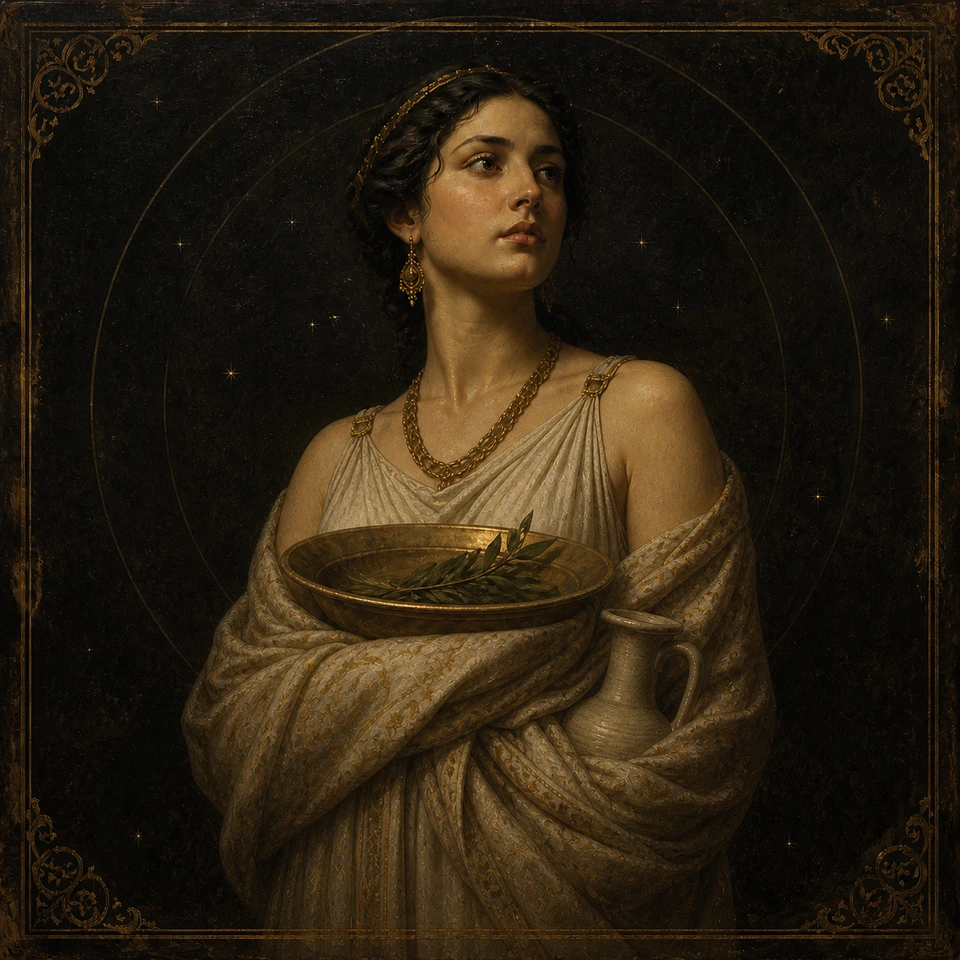
Radiating eternal vitality, Hebe serves the Olympians as a sacred cupbearer and chariot attendant. Beyond her role as the immortal wife of Heracles and the restorer of Iolaus's strength, she offered vital asylum and release to worshippers at Phlius.
Overview
On the golden floor of Olympus, the gods raise their cups and stare down at Troy. Peace may hold or war may begin again. Hebe moves among them with nectar while Zeus provokes Hera and Athena. A book later she is at Hera’s chariot, fitting eight-spoked bronze wheels to an iron axle before the goddesses drive into battle. Greek poetry introduces the goddess of youth through work performed at the center of divine power.
Her name is Ἥβη, Youth or the prime of life. Hesiod makes her a daughter of Zeus and Hera, sister of Ares and Eileithyia. She is a young adult goddess, never a child. Ancient images and texts connect her with long Greek dress, cups and pouring vessels, Hera’s household, and the marriage that awaits Heracles after his mortal labors. Her youth is therefore a force within kinship, ceremony, labor, and divine continuity, not an abstract beauty ideal.
That marriage is not told only once. Hesiod makes it the end of suffering: Heracles completes his ordeals, takes Hebe as his wife on snowy Olympus, and lives ageless and free from trouble. The Odyssey leaves his phantom in Hades while the hero himself feasts above with fair-ankled Hebe. A brief hymn praises the couple’s happiness. Pseudo-Apollodorus later adds reconciliation with Hera and sons named Alexiares and Anicetus.
Euripides gives Hebe’s youth a fierce, measured effect. Old Iolaus, defending the children of Heracles from Eurystheus, asks Hebe and Zeus for a single day of strength. Two stars darken the chariot yoke, interpreted as Hebe and Heracles. Iolaus emerges young, pursues the enemy, and binds him. The gift lasts long enough for one necessary act, not forever.
At Phlius, the goddess was once called Ganymeda. Her cypress grove offered asylum; freed prisoners hung their fetters on its trees; and a yearly festival bore the name Ivy-cutters. No image stood in the sanctuary. Athens gave her an altar beside Heracles at Cynosarges, while the Argive Heraion placed an ivory-and-gold Hebe beside Hera. Grove, iron chain, altar, cup, wheel, and bridal chariot each belong to a real scene. They are richer than a generic promise of eternal youth.
Roman Juventas remains a distinct Roman identity. Ganymede remains a distinct male cupbearer. Wings, eagles, and neoclassical nudity are absent from the Greek evidence assembled here; any later history for them needs its own dated sources. Hebe’s Greek evidence already presents a vivid figure: daughter, worker, bride, giver of one day’s vigor, and divine presence at places where human bonds could be cut loose.
Canonical identity
Canonical Identity
Hebe is an active member of the Olympian household, identified by ancient poetry as the daughter of Zeus and Hera, and the immortal wife of the deified Heracles. Her canonical identity centers strictly on youth and the prime of life. Pausanias records that at the sanctuary of Phlius, the goddess was previously worshipped under the local name Ganymeda, an association belonging specifically to that site's memory. She is fully distinct from the Roman Juventas, whose independent Roman identity does not replace the Greek Hebe.
Linguistic Identity
Her ancient Greek name, Ἥβη, translates directly to youth or the prime of life. A qualified fifth-century BC Attic reconstruction suggests the pronunciation /hɛ̌ː.bɛː/, roughly HEH-beh, characterized by long vowels and a falling pitch on the opening syllable. The modern English pronunciation HEE-bee and the modern Greek EE-vee represent later linguistic evolutions, not the ancient sound.
Sources and evidence
SCHOLARLY INTERPRETATION · Supported
The proper name Ἥβη means youth or the prime of life and has a qualified fifth-century BC Attic reconstruction /hɛ̌ː.bɛː/.
- Source
- Wiktionary contributors, Ἥβη
- Reviewed edition
- Wiktionary live revision reviewed 2026-08-30 · Wiktionary
- Exact locator
- Entry Ἥβη · Section Ancient Greek pronunciation and proper noun
- Scope
- Classical Greece · Attica
- Authority
- collaborative lexical reference
- Certainty
- Qualified
The guide HEH-beh approximates long vowels and cannot reproduce ancient pitch exactly.
Open exact reviewed source3 reviewed sources for this section
- Wiktionary contributors, ἭβηLive collaborative lexical entry reviewed 2026-08-30 · Wiktionary
- Hesiod; edited and translated by Hugh G. Evelyn-White, Theogony (1914)Hesiod, the Homeric Hymns and Homerica, London and New York, 1914 · Perseus Digital Library / Scaife ATLAS
- Pausanias; Spiro Greek edition and Jones/Ormerod translation volumes, Description of Greece (1935)Perseus CTS edition corpus, 1903-1935 · Perseus Digital Library / Scaife ATLAS
Culture, tradition, period, and place
Hebe moves across Greek epic, hymn, tragedy, sanctuary, and art. Archaic hexameter poetry places her on Olympus pouring nectar, working at Hera’s chariot, and living with Heracles after his labors. Fifth-century Athenian tragedy gives her power a sudden bodily effect when Iolaus receives one day of restored youth.
Cult evidence is local and concrete. At Phlius in the northeastern Peloponnese, a cypress grove held a sanctuary of the goddess, an asylum, freed prisoners’ fetters, and the yearly Ivy-cutters festival. Athens placed her altar beside Heracles at Cynosarges. At the Argive Heraion, an ivory-and-gold image of Hebe stood beside Hera. These places show worship through different civic and family settings.
5 reviewed sources for this section
- Homer; Monro and Allen Greek edition with edition-specific translations, Iliad (1920)Perseus CTS edition corpus; Greek edition, Oxford, 1908-1920 · Perseus Digital Library / Scaife ATLAS
- Hesiod; edited and translated by Hugh G. Evelyn-White, Theogony (1914)Hesiod, the Homeric Hymns and Homerica, London and New York, 1914 · Perseus Digital Library / Scaife ATLAS
- Anonymous Homeric Hymns; edited and translated by Hugh G. Evelyn-White, Homeric Hymns (1914)Hesiod, the Homeric Hymns and Homerica, London and New York, 1914 · Perseus Digital Library / Scaife ATLAS
- Euripides; translated by David Kovacs, Children of Heracles (1995)David Kovacs Greek text and English translation, Loeb Classical Library 484 · Perseus Digital Library
- Pausanias; Spiro Greek edition and Jones/Ormerod translation volumes, Description of Greece (1935)Perseus CTS edition corpus, 1903-1935 · Perseus Digital Library / Scaife ATLAS
Historical development
The earliest surviving poetic scenes do not give Hebe a birth story or independent adventure. They show her through divine household action. She pours nectar while Zeus, Hera, and Athena dispute Troy; she fits the wheels of Hera’s chariot; and she shares the ageless life granted to Heracles after mortal suffering.
Classical tragedy sharpens youth into a power that can change the course of battle for one day. Later mythography gives the marriage a fuller settlement, saying Heracles reconciles with Hera and that Hebe bears Alexiares and Anicetus. Pausanias, writing under Roman rule, preserves older local cult memories at Phlius, Athens, and the Argive Heraion. The surviving history grows by setting, not by one continuous biography.
8 reviewed sources for this section
- Homer; Monro and Allen Greek edition with edition-specific translations, Iliad (1920)Perseus CTS edition corpus; Greek edition, Oxford, 1908-1920 · Perseus Digital Library / Scaife ATLAS
- Hesiod; edited and translated by Hugh G. Evelyn-White, Theogony (1914)Hesiod, the Homeric Hymns and Homerica, London and New York, 1914 · Perseus Digital Library / Scaife ATLAS
- Anonymous Homeric Hymns; edited and translated by Hugh G. Evelyn-White, Homeric Hymns (1914)Hesiod, the Homeric Hymns and Homerica, London and New York, 1914 · Perseus Digital Library / Scaife ATLAS
- Euripides; translated by David Kovacs, Children of Heracles (1995)David Kovacs Greek text and English translation, Loeb Classical Library 484 · Perseus Digital Library
- Pseudo-Apollodorus; edited and translated by James G. Frazer, Library (1921)Harvard University Press and William Heinemann edition, 1921 · Perseus Digital Library / Scaife ATLAS
- Pausanias; Spiro Greek edition and Jones/Ormerod translation volumes, Description of Greece (1935)Perseus CTS edition corpus, 1903-1935 · Perseus Digital Library / Scaife ATLAS
- The Metropolitan Museum of Art, Open Access Collection and Collection APILive collection data and eligible public-domain images · The Metropolitan Museum of Art
- British Museum, British Museum CollectionLive official museum collection · British Museum
Attested roles and historical themes
Roles, powers, and limits
Hebe embodies youth, but Greek narrative makes that power precise. In Euripides, it can restore strength to an aged body for one decisive day. The gift serves protection and retribution: Iolaus needs enough speed and force to capture the persecutor of Heracles’ children. Nothing in the scene promises escape from age for ordinary worshippers.
Her Olympian tasks also matter. Pouring nectar sustains the formal feast of the gods; fitting bronze wheels requires readiness before divine battle. Marriage to Heracles places youth beside the hero’s release from mortal labor and age. These roles join service, vigor, renewal, and divine belonging without reducing Hebe to a fountain, a surface emblem of beauty, or a child.
Sources and evidence
TEXTUAL · Supported
In the Iliad, Hebe pours nectar while the gods sit with Zeus on a golden floor and look down toward Troy.
- Source
- Homer; Monro and Allen Greek edition with edition-specific translations, Iliad (1920)
- Reviewed edition
- Monro and Allen Greek edition represented by the Perseus CTS corpus, Oxford, 1908-1920 · edited by David Binning Monro and Thomas William Allen · Perseus Digital Library / Scaife ATLAS
- Exact locator
- Book 4 · Line 1-4
- Scope
- Archaic Greece · Ancient Greece
- Authority
- ancient literary witness
- Certainty
- High
The scene gives Hebe an active place in divine assembly rather than a decorative cup emblem.
Open exact reviewed sourceTEXTUAL · Supported
Hebe fits eight-spoked bronze wheels to Hera’s iron-axled chariot before Hera and Athena enter battle.
- Source
- Homer; Monro and Allen Greek edition with edition-specific translations, Iliad (1920)
- Reviewed edition
- Monro and Allen Greek edition represented by the Perseus CTS corpus, Oxford, 1908-1920 · edited by David Binning Monro and Thomas William Allen · Perseus Digital Library / Scaife ATLAS
- Exact locator
- Book 5 · Line 720-732
- Scope
- Archaic Greece · Ancient Greece
- Authority
- ancient literary witness
- Certainty
- High
The work is skilled divine service and is separate from the nectar-pouring scene.
Open exact reviewed source3 reviewed sources for this section
- Homer; Monro and Allen Greek edition with edition-specific translations, Iliad (1920)Perseus CTS edition corpus; Greek edition, Oxford, 1908-1920 · Perseus Digital Library / Scaife ATLAS
- Euripides; translated by David Kovacs, Children of Heracles (1995)David Kovacs Greek text and English translation, Loeb Classical Library 484 · Perseus Digital Library
- Hesiod; edited and translated by Hugh G. Evelyn-White, Theogony (1914)Hesiod, the Homeric Hymns and Homerica, London and New York, 1914 · Perseus Digital Library / Scaife ATLAS
Epithets and titles
Poetic Epithet
Fair-ankled
Fair-ankled
Greek epic tradition · Archaic Greek poetic witnessThe Odyssey uses the bodily epithet when naming Hebe as the wife of Heracles.
1 reviewed source for this section
- Homer; translated by A. T. Murray, Odyssey (1919)A. T. Murray English translation, London: William Heinemann; New York: G. P. Putnam's Sons, 1919 · Perseus Digital Library / Scaife ATLAS
Geographic Epithet
Ganymeda
Γανυμήδα · Local Phliasian name
Phlius in the northeastern Peloponnese · Older local name reported in the second century ADThe name belongs to the history of the Phliasian sanctuary.
1 reviewed source for this section
- Pausanias; Spiro Greek edition and Jones/Ormerod translation volumes, Description of Greece (1935)Perseus CTS edition corpus, 1903-1935 · Perseus Digital Library / Scaife ATLAS
Worship and cult
At Phlius, worship unfolds in a grove of cypress trees on the citadel. Pausanias calls the sanctuary especially holy and says its greatest honor concerned the pardon of suppliants. People entered seeking protection, and freed prisoners left the weight of captivity behind by hanging their fetters on the grove’s trees.
Athens supplies an altar rather than a full sanctuary account. At Cynosarges, Hebe stood beside Heracles within a cluster that also included Alcmene and Iolaus. The Argive Heraion placed her costly image next to Hera. The evidence ties worship to asylum, release, Heracles, and Hera, but does not preserve a universal priesthood or household rite.
Sources and evidence
TEXTUAL · Supported
Pausanias reports a cypress grove and holy sanctuary at Phlius whose goddess was formerly called Ganymeda and later Hebe.
- Source
- Pausanias; Spiro Greek edition and Jones/Ormerod translation volumes, Description of Greece (1935)
- Reviewed edition
- Spiro Greek edition and Jones/Ormerod English volumes represented by the Perseus CTS corpus, 1903-1935 · translated by W. H. S. Jones and H. A. Ormerod, volume-dependent · edited by Friedrich Spiro for the Greek edition · Perseus Digital Library / Scaife ATLAS
- Exact locator
- Book 2 · Chapter 13 · Section 3
- Scope
- Greek religion under Roman imperial rule · Ancient Greece
- Authority
- ancient literary witness
- Certainty
- High
Ganymeda is preserved as a local Phliasian name, not treated as a universal alias.
Open exact reviewed source1 reviewed source for this section
- Pausanias; Spiro Greek edition and Jones/Ormerod translation volumes, Description of Greece (1935)Perseus CTS edition corpus, 1903-1935 · Perseus Digital Library / Scaife ATLAS
Temples, sanctuaries, and sacred places
Phlius offers the fullest sacred landscape. Cypress trees enclosed a sanctuary whose old name for the goddess was Ganymeda. The grove received suppliants and the fetters of people released from imprisonment. Pausanias adds a striking absence: no image of the goddess stood openly or in secret there, a local rule explained by a sacred story he does not retell.
At Cynosarges outside Athens, altars joined Hebe with Heracles, Alcmene, and Iolaus. At the Argive Heraion, Naucydes’ ivory-and-gold Hebe stood beside the great goddess Hera. Grove, altar, and chryselephantine image are different kinds of sacred presence and should not be collapsed into one imagined temple plan.
Sources and evidence
TEXTUAL · Supported
At Cynosarges in Athens, Pausanias saw altars of Heracles and Hebe beside altars of Alcmene and Iolaus.
- Source
- Pausanias; Spiro Greek edition and Jones/Ormerod translation volumes, Description of Greece (1935)
- Reviewed edition
- Spiro Greek edition and Jones/Ormerod English volumes represented by the Perseus CTS corpus, 1903-1935 · translated by W. H. S. Jones and H. A. Ormerod, volume-dependent · edited by Friedrich Spiro for the Greek edition · Perseus Digital Library / Scaife ATLAS
- Exact locator
- Book 1 · Chapter 19 · Section 3
- Scope
- Greek religion under Roman imperial rule · Attica
- Authority
- ancient literary witness
- Certainty
- High
The altar places Hebe within a Heraclean sacred setting in Attica.
Open exact reviewed source1 reviewed source for this section
- Pausanias; Spiro Greek edition and Jones/Ormerod translation volumes, Description of Greece (1935)Perseus CTS edition corpus, 1903-1935 · Perseus Digital Library / Scaife ATLAS
Festivals and processions
The Phliasians celebrated a yearly festival called the Ivy-cutters. Its name survives; its procession, sacrifices, music, officials, and calendar date do not. Ivy therefore belongs to one named local observance, not automatically to every ancient image or modern rite of Hebe.
No independent Hebe festival is named at Cynosarges in the same passage, and Pausanias does not attach a feast day to the image at the Argive Heraion. Those silences matter because neighboring cults often shared spaces without sharing every ceremony.
Sources and evidence
TEXTUAL · Supported
Pausanias names the yearly Phliasian festival of Hebe the Ivy-cutters and says the sanctuary displayed no image of her.
- Source
- Pausanias; Spiro Greek edition and Jones/Ormerod translation volumes, Description of Greece (1935)
- Reviewed edition
- Spiro Greek edition and Jones/Ormerod English volumes represented by the Perseus CTS corpus, 1903-1935 · translated by W. H. S. Jones and H. A. Ormerod, volume-dependent · edited by Friedrich Spiro for the Greek edition · Perseus Digital Library / Scaife ATLAS
- Exact locator
- Book 2 · Chapter 13 · Section 4
- Scope
- Greek religion under Roman imperial rule · Ancient Greece
- Authority
- ancient literary witness
- Certainty
- High
The festival name is secure, while its ceremonies are not described.
Open exact reviewed source1 reviewed source for this section
- Pausanias; Spiro Greek edition and Jones/Ormerod translation volumes, Description of Greece (1935)Perseus CTS edition corpus, 1903-1935 · Perseus Digital Library / Scaife ATLAS
Offerings, votives, and ritual evidence
The clearest votive act is made of iron and memory. Prisoners released at Phlius dedicated their fetters on trees in the cypress grove. The object marked a real passage from confinement to freedom and remained visible within the sanctuary’s landscape. It is not evidence that chains were Hebe’s ordinary gift in every city.
Pausanias does not specify food, wine, incense, flowers, or animal sacrifice for Hebe in these passages. Epic nectar belongs to the gods’ feast, where Hebe pours it for immortals, not to a human offering recipe. The strongest ancient ritual language here is asylum, pardon, release, annual festival, altar, and dedicated fetters.
Sources and evidence
TEXTUAL · Supported
At the Phliasian sanctuary, suppliants received pardon and freed prisoners dedicated their fetters on trees in the grove.
- Source
- Pausanias; Spiro Greek edition and Jones/Ormerod translation volumes, Description of Greece (1935)
- Reviewed edition
- Spiro Greek edition and Jones/Ormerod English volumes represented by the Perseus CTS corpus, 1903-1935 · translated by W. H. S. Jones and H. A. Ormerod, volume-dependent · edited by Friedrich Spiro for the Greek edition · Perseus Digital Library / Scaife ATLAS
- Exact locator
- Book 2 · Chapter 13 · Section 3-4
- Scope
- Greek religion under Roman imperial rule · Ancient Greece
- Authority
- ancient literary witness
- Certainty
- High
The chains belong to a local release practice and do not become a general offering rule.
Open exact reviewed source2 reviewed sources for this section
- Pausanias; Spiro Greek edition and Jones/Ormerod translation volumes, Description of Greece (1935)Perseus CTS edition corpus, 1903-1935 · Perseus Digital Library / Scaife ATLAS
- Homer; Monro and Allen Greek edition with edition-specific translations, Iliad (1920)Perseus CTS edition corpus; Greek edition, Oxford, 1908-1920 · Perseus Digital Library / Scaife ATLAS
Iconography and material culture
Ancient material evidence presents Hebe as a young adult woman, not a child. Metropolitan Museum hydria 14.105.10 shows Heracles and Hebe together in a bridal chariot, giving visual form to their Olympian marriage. At the Argive Heraion, Pausanias saw her beside Hera in an ivory-and-gold statue by Naucydes.
A South Italian krater in the British Museum probably shows Hebe in a long girt chiton, embroidered hair covering, and jewelry, with a large phiale containing two branches and a white prochoos. Because the identification is probable, those vessels and branches remain tied to that object. Wings, exposed neoclassical nudity, and Roman Juventas imagery belong elsewhere.
Sources and evidence
TEXTUAL · Supported
At the Argive Heraion, Pausanias saw an ivory-and-gold image of Hebe by Naucydes standing beside Hera.
- Source
- Pausanias; Spiro Greek edition and Jones/Ormerod translation volumes, Description of Greece (1935)
- Reviewed edition
- Spiro Greek edition and Jones/Ormerod English volumes represented by the Perseus CTS corpus, 1903-1935 · translated by W. H. S. Jones and H. A. Ormerod, volume-dependent · edited by Friedrich Spiro for the Greek edition · Perseus Digital Library / Scaife ATLAS
- Exact locator
- Book 2 · Chapter 17 · Section 5
- Scope
- Greek religion under Roman imperial rule · Ancient Greece
- Authority
- ancient literary witness
- Certainty
- High
The costly image belonged beside Hera and should not be reconstructed from later neoclassical sculpture.
Open exact reviewed sourceMATERIAL CULTURE · Supported
Metropolitan Museum accession 14.105.10 shows Heracles and Hebe together in a bridal chariot on an Attic black-figure hydria attributed to the Mastos Painter.
- Source
- The Metropolitan Museum of Art, Open Access Collection and Collection API
- Reviewed edition
- Live collection records and API; eligible Open Access objects only · The Metropolitan Museum of Art
- Exact locator
- MuseumObjectId Accession 14.105.10 · Entry Herakles and Hebe in the bridal chariot; circa 530 BC
- Scope
- Archaic Greece · Attica
- Authority
- museum object record
- Certainty
- High
The cataloged scene gives material form to their marriage.
Open exact reviewed sourceMATERIAL CULTURE · Supported
British Museum 1865,0103.19 identifies a probable Hebe as a young woman with long girt chiton, embroidered hair covering, jewelry, a large phiale holding two branches, and a white prochoos.
- Source
- British Museum, British Museum Collection
- Reviewed edition
- Live record-level official museum collection · British Museum
- Exact locator
- MuseumObjectId Museum number 1865,0103.19 · Entry Probable Hebe; Iliupersis Painter; circa 370-350 BC
- Scope
- Classical Greece · Ancient Greece
- Authority
- museum object record
- Certainty
- High
The identification is probable, so its dress and vessels remain object-specific rather than universal.
Open exact reviewed source3 reviewed sources for this section
- The Metropolitan Museum of Art, Open Access Collection and Collection APILive collection data and eligible public-domain images · The Metropolitan Museum of Art
- British Museum, British Museum CollectionLive official museum collection · British Museum
- Pausanias; Spiro Greek edition and Jones/Ormerod translation volumes, Description of Greece (1935)Perseus CTS edition corpus, 1903-1935 · Perseus Digital Library / Scaife ATLAS
Animals, plants, and embodied forms
No sacred animal is securely assigned to Hebe in these witnesses. The epic scenes require horses for Hera’s chariot, but Hebe prepares the wheels rather than owning or transforming into the team. The Greek poetic, cult, and object witnesses assembled here do not establish an eagle as her ancient personal animal.
Plants are similarly local. Cypress trees form the grove at Phlius, and ivy survives in the festival name Ivy-cutters. The probable Hebe on the British Museum krater holds a phiale with two branches. Cypress, ivy, and those branches belong to distinct places or objects; none becomes a universal botanical emblem.
3 reviewed sources for this section
- Homer; Monro and Allen Greek edition with edition-specific translations, Iliad (1920)Perseus CTS edition corpus; Greek edition, Oxford, 1908-1920 · Perseus Digital Library / Scaife ATLAS
- Pausanias; Spiro Greek edition and Jones/Ormerod translation volumes, Description of Greece (1935)Perseus CTS edition corpus, 1903-1935 · Perseus Digital Library / Scaife ATLAS
- British Museum, British Museum CollectionLive official museum collection · British Museum
Relationships and genealogy
Hesiod names Hebe, Ares, and Eileithyia as children of Zeus and Hera. The genealogy makes Ares and Eileithyia her siblings within that poetic tradition. It also anchors her strongly in Hera’s household, a bond seen again when Hebe prepares Hera’s chariot and stands beside her at the Argive Heraion.
Heracles becomes Hebe’s husband after his labors. Hesiod, the Odyssey, and Homeric Hymn 15 all know the marriage, while Pseudo-Apollodorus adds reconciliation with Hera and names the couple’s sons Alexiares and Anicetus. Those sons are preserved as a later mythographic detail rather than projected backward into every earlier witness.
Sources and evidence
TEXTUAL · Supported
Hesiod names Hebe, Ares, and Eileithyia as children of Zeus and Hera.
- Source
- Hesiod; edited and translated by Hugh G. Evelyn-White, Theogony (1914)
- Reviewed edition
- Hugh G. Evelyn-White edition and English translation in Hesiod, the Homeric Hymns and Homerica, 1914 · translated by Hugh G. Evelyn-White · edited by Hugh G. Evelyn-White · Perseus Digital Library / Scaife ATLAS
- Exact locator
- Entry Theogony · Line 921-923
- Scope
- Archaic Greece · Ancient Greece
- Authority
- ancient literary witness
- Certainty
- High
The compact genealogy establishes both parents and the two sibling relationships.
Open exact reviewed sourceTEXTUAL · Supported
Pseudo-Apollodorus says that the reconciled Heracles married Hera’s daughter Hebe and that Alexiares and Anicetus were their sons.
- Source
- Pseudo-Apollodorus; edited and translated by James G. Frazer, Library (1921)
- Reviewed edition
- James G. Frazer edition and English translation, Harvard University Press and William Heinemann, 1921 · translated by James G. Frazer · edited by James G. Frazer · Perseus Digital Library / Scaife ATLAS
- Exact locator
- Book 2 · Chapter 7 · Section 7
- Scope
- Greek religion under Roman imperial rule · Ancient Greece
- Authority
- ancient literary witness
- Certainty
- High
This later mythographic witness supplies named children absent from the earlier marriage passages.
Open exact reviewed source6 reviewed sources for this section
- Hesiod; edited and translated by Hugh G. Evelyn-White, Theogony (1914)Hesiod, the Homeric Hymns and Homerica, London and New York, 1914 · Perseus Digital Library / Scaife ATLAS
- Homer; Monro and Allen Greek edition with edition-specific translations, Iliad (1920)Perseus CTS edition corpus; Greek edition, Oxford, 1908-1920 · Perseus Digital Library / Scaife ATLAS
- Homer; translated by A. T. Murray, Odyssey (1919)A. T. Murray English translation, London: William Heinemann; New York: G. P. Putnam's Sons, 1919 · Perseus Digital Library / Scaife ATLAS
- Anonymous Homeric Hymns; edited and translated by Hugh G. Evelyn-White, Homeric Hymns (1914)Hesiod, the Homeric Hymns and Homerica, London and New York, 1914 · Perseus Digital Library / Scaife ATLAS
- Pseudo-Apollodorus; edited and translated by James G. Frazer, Library (1921)Harvard University Press and William Heinemann edition, 1921 · Perseus Digital Library / Scaife ATLAS
- Pausanias; Spiro Greek edition and Jones/Ormerod translation volumes, Description of Greece (1935)Perseus CTS edition corpus, 1903-1935 · Perseus Digital Library / Scaife ATLAS
Actual myths and source variants
Three narratives define Hebe’s strongest actions. In the Iliad she moves through Olympus with nectar and bronze wheels while the gods decide and enter war. In several poetic traditions she marries Heracles after his labors, joining his new life among the immortals. In Euripides she and Zeus answer Iolaus with one day of restored youth, enough to overtake Eurystheus.
The marriage witnesses must remain distinct. Hesiod stresses ageless release, the Odyssey divides Heracles between a phantom below and a husband above, the hymn condenses his blessed state into praise, and the mythographer adds reconciliation and sons. These are not contradictions to smooth away. They show what different poets wanted the marriage to explain.
A fourth linked scene belongs to the Homeric Hymn to Apollo. Around Apollo’s music, Hebe dances with the Charites, Horai, Harmonia, and Aphrodite while other Olympians join or watch. The hymn places youth inside a coordinated divine company, distinct from her cup-bearing work and from the later marriage narratives.
Sources and evidence
TEXTUAL · Supported
Hesiod says that after Heracles completed his grievous labors he married Hebe on snowy Olympus and lived untroubled and ageless.
- Source
- Hesiod; edited and translated by Hugh G. Evelyn-White, Theogony (1914)
- Reviewed edition
- Hugh G. Evelyn-White edition and English translation in Hesiod, the Homeric Hymns and Homerica, 1914 · translated by Hugh G. Evelyn-White · edited by Hugh G. Evelyn-White · Perseus Digital Library / Scaife ATLAS
- Exact locator
- Entry Theogony · Line 950-955
- Scope
- Archaic Greece · Ancient Greece
- Authority
- ancient literary witness
- Certainty
- High
The marriage closes the poem’s Heracles sequence with immortal life.
Open exact reviewed sourceTEXTUAL · Supported
The Odyssey distinguishes Heracles’ phantom in Hades from Heracles himself feasting among the immortals with Hebe as his wife.
- Source
- Homer; translated by A. T. Murray, Odyssey (1919)
- Reviewed edition
- A. T. Murray English translation, London: William Heinemann; New York: G. P. Putnam's Sons, 1919 · translated by A. T. Murray · Perseus Digital Library / Scaife ATLAS
- Exact locator
- Book 11 · Line 601-604
- Scope
- Archaic Greece · Ancient Greece
- Authority
- ancient literary witness
- Certainty
- High
The passage preserves a difficult double presentation rather than narrating a simple bodily ascent.
Open exact reviewed sourceTEXTUAL · Supported
Homeric Hymn 15 praises Heracles as living happily on Olympus with fair-ankled Hebe after his labors.
- Source
- Anonymous Homeric Hymns; edited and translated by Hugh G. Evelyn-White, Homeric Hymns (1914)
- Reviewed edition
- Hugh G. Evelyn-White edition and English translation in Hesiod, the Homeric Hymns and Homerica, 1914 · translated by Hugh G. Evelyn-White · edited by Hugh G. Evelyn-White · Perseus Digital Library / Scaife ATLAS
- Exact locator
- Hymn 15 · Line 1-9
- Scope
- Archaic Greece · Ancient Greece
- Authority
- ancient literary witness
- Certainty
- High
The brief hymn makes the marriage part of Heracles’ blessed divine condition.
Open exact reviewed sourceTEXTUAL · Supported
In Euripides, Iolaus prays to Hebe and Zeus for one day of youth, two stars identified as Hebe and Heracles appear over the chariot, and the old man emerges young enough to overtake Eurystheus.
- Source
- Euripides; translated by David Kovacs, Children of Heracles (1995)
- Reviewed edition
- David Kovacs Greek text and English translation, Loeb Classical Library 484 · translated by David Kovacs · Perseus Digital Library
- Exact locator
- Entry Children of Heracles · Line 843-866
- Scope
- Classical Greece · Attica
- Authority
- ancient literary witness
- Certainty
- High
The restoration is temporary, martial, and embedded in the defense of Heracles’ children.
Open exact reviewed sourceTEXTUAL · Supported
The Homeric Hymn to Apollo places Hebe in a linked Olympian dance with the Charites, Horai, Harmonia, and Aphrodite around Apollo’s music.
- Source
- Anonymous Homeric Hymns; edited and translated by Hugh G. Evelyn-White, Homeric Hymns (1914)
- Reviewed edition
- Hugh G. Evelyn-White edition and English translation in Hesiod, the Homeric Hymns and Homerica, 1914 · translated by Hugh G. Evelyn-White · edited by Hugh G. Evelyn-White · Perseus Digital Library / Scaife ATLAS
- Exact locator
- Hymn 3 · Line 182-206
- Scope
- Archaic Greece · Ancient Greece
- Authority
- primary literary witness
- Certainty
- Certain
This source-scoped scene is shared with the canonical Apollo divine dance narrative.
Open exact reviewed source6 reviewed sources for this section
- Homer; Monro and Allen Greek edition with edition-specific translations, Iliad (1920)Perseus CTS edition corpus; Greek edition, Oxford, 1908-1920 · Perseus Digital Library / Scaife ATLAS
- Hesiod; edited and translated by Hugh G. Evelyn-White, Theogony (1914)Hesiod, the Homeric Hymns and Homerica, London and New York, 1914 · Perseus Digital Library / Scaife ATLAS
- Homer; translated by A. T. Murray, Odyssey (1919)A. T. Murray English translation, London: William Heinemann; New York: G. P. Putnam's Sons, 1919 · Perseus Digital Library / Scaife ATLAS
- Anonymous Homeric Hymns; edited and translated by Hugh G. Evelyn-White, Homeric Hymns (1914)Hesiod, the Homeric Hymns and Homerica, London and New York, 1914 · Perseus Digital Library / Scaife ATLAS
- Pseudo-Apollodorus; edited and translated by James G. Frazer, Library (1921)Harvard University Press and William Heinemann edition, 1921 · Perseus Digital Library / Scaife ATLAS
- Euripides; translated by David Kovacs, Children of Heracles (1995)David Kovacs Greek text and English translation, Loeb Classical Library 484 · Perseus Digital Library
Myth Library
Each myth gathers its attested participants into one source-grounded account, while distinct source traditions remain readable in their own variants.
Divine Household
Hebe Serves on Olympus
Hebe pours nectar as the gods watch Troy, then readies Hera’s chariot when divine argument becomes battlefield intervention.
- Role in this profile
- pours nectar in the divine council and later secures Hera’s bronze wheels before the goddesses drive to war
- Place scope
- Ancient Greece
- Witnesses
- 2
- Variants
- 2
Divine Marriage
Heracles Weds Hebe on Olympus
After his mortal labors, Heracles enters immortal life with Hebe, while different witnesses emphasize agelessness, a divided underworld presence, praise, or reconciliation with Hera.
- Role in this profile
- becomes the wife of Heracles on Olympus and, in later mythography, mother of Alexiares and Anicetus
- Place scope
- Ancient Greece
- Witnesses
- 4
- Variants
- 4
Divine Intervention
Hebe Restores the Youth of Iolaus
Hebe and Zeus grant the aged Iolaus one day of restored youth so he can defend Heracles’ family and capture Eurystheus.
- Role in this profile
- answers Iolaus’ prayer with Zeus and appears in the star-sign that precedes his one-day return to youth
- Place scope
- Attica
- Witnesses
- 1
- Variants
- 1
Divine Performance
The Charites in Apollo's Divine Dance
Apollo’s arrival on Olympus gathers the Charites into a linked divine dance with the Horai, Harmonia, Hebe, Aphrodite, Artemis, Ares, and Hermes.
- Role in this profile
- divine dancer embodying youth within the company
- Place scope
- Ancient Greece
- Witnesses
- 1
- Variants
- 1
Death Pyre And Divinization
The Death and Apotheosis of Heracles
Sophocles stages Deianeira's fatal gift and Heracles' command for the Oeta pyre but ends before death or ascent. Pseudo-Apollodorus continues through the lit pyre, cloud-borne apotheosis, reconciliation with Hera, and marriage to Hebe; Hesiod and the Odyssey preserve other endings.
- Role in this profile
- becomes the immortal wife of Heracles
- Place scope
- Ancient Greece
- Witnesses
- 4
- Variants
- 4
Equivalences, syncretisms, and identity boundaries
Roman Juventas is not simply another label for Hebe. The Roman goddess requires her own source-led civic and cult history; the Greek witnesses here do not authorize replacing one figure with the other.
Ganymeda requires a different boundary. Pausanias presents it as the earliest Phliasian name for the goddess later called Hebe, so it belongs within that local cult history. Ganymede, the male cupbearer in Greek myth, shares related language and function but is not Hebe under another gender. Similar names and cups do not erase persons.
1 reviewed source for this section
- Pausanias; Spiro Greek edition and Jones/Ormerod translation volumes, Description of Greece (1935)Perseus CTS edition corpus, 1903-1935 · Perseus Digital Library / Scaife ATLAS
Correspondence index
Youth is Hebe’s ancient identity, and one tragedy gives her a temporary act of bodily renewal. Cups, nectar, a pouring vessel, chariot wheels, ivy, cypress, and iron fetters all appear, but each has a specific setting: divine feast, probable vase image, battlefield preparation, named festival, local grove, or release vow.
No ancient planet, zodiac sign, gemstone, metal rulership, color, elemental scheme, weekday, moon phase, compass direction, incense, or general magical formula emerges. Phlius gives the strongest devotional pattern through sanctuary, asylum, pardon, festival, and dedicated fetters. Modern practice can respond to those histories without presenting new preferences as inherited Greek law.
Direct ancient correspondences
| Category | Direct correspondence | How and why | Evidence boundary |
|---|---|---|---|
| plant-tree | Cypress grove and Phliasian ivyDirect historical association | Cypress formed the grove at Phlius, and the yearly festival was called the Ivy-cutters. | Ancient Cultic Local cult setting and festival name, not a universal plant list 1 reviewed source for this section
|
| direction-place | Phlius, Cynosarges, and the Argive HeraionDirect historical association | Named sacred settings survive at Phlius, Athens, and the Argive Heraion. | Ancient Cultic Place evidence does not establish a compass direction 1 reviewed source for this section
|
| festival-time | Yearly Ivy-cutters at PhliusDirect historical association | Pausanias names an annual Phliasian festival called the Ivy-cutters. | Ancient Cultic The date and ceremonies are unresolved 1 reviewed source for this section
|
| offering-ritual-material | Freed prisoners’ fettersDirect historical association | People released from confinement dedicated their fetters on trees in Hebe’s Phliasian grove. | Ancient Cultic A local release vow, not a general instruction to use chains 1 reviewed source for this section
|
Contextual evidence, not a general correspondence
| Category | Direct correspondence | How and why | Evidence boundary |
|---|---|---|---|
| metal-material | Bronze wheels, iron fetters, ivory and goldContextual evidence only | Bronze belongs to Hera’s chariot, iron to freed prisoners’ fetters, and ivory and gold to the Argive cult image. | Ancient Material Each material remains tied to its scene or sanctuary rather than becoming a rulership 2 reviewed sources for this section
|
| ritual-object-symbol-tool | Cup, pouring vessel, and chariot wheelsContextual evidence only | Epic and vase imagery connect Hebe with nectar service, a phiale and prochoos, and the fitting of Hera’s wheels. | Ancient Literary Literary and object-specific attributes, not a universal ritual kit 2 reviewed sources for this section
|
| intention-magical-power | Youth, temporary renewal, and releaseContextual evidence only | Hebe embodies youth, restores Iolaus for one day, and receives released prisoners at Phlius. | Ancient Literary Mythic and cultic meanings do not promise medical rejuvenation 2 reviewed sources for this section
|
9 expected categories currently not evidenced
celestial-body · Not evidenced
No celestial body attested
No planet, star, or constellation is assigned to Hebe.
- Layer
- Research Boundary
- Scope
- The two stars in Euripides are a narrative sign, not an astronomical rulership
zodiac · Not evidenced
No zodiac sign attested
No zodiac sign belongs to Hebe in the reviewed Greek evidence.
- Layer
- Research Boundary
- Scope
- Later astrological assignments require dated testimony
gemstone-crystal-mineral · Not evidenced
No gemstone attested
No gemstone or crystal is named for Hebe.
- Layer
- Research Boundary
- Scope
- Modern crystal pairings do not become ancient cult
animal-embodied-form · Not evidenced
No sacred animal attested
Hera’s chariot horses do not become Hebe’s sacred species.
- Layer
- Research Boundary
- Scope
- Later eagle imagery requires its own artistic history
color · Not evidenced
No canonical color attested
No ritual color is fixed for Hebe.
- Layer
- Research Boundary
- Scope
- Vase pigments and precious materials do not establish color law
classical-element · Not evidenced
No classical element attested
No four-element rulership is assigned to Hebe.
- Layer
- Research Boundary
- Scope
- Youth is not evidence for air, fire, water, or earth
weekday · Not evidenced
No weekday attested
No weekday belongs to Hebe in these witnesses.
- Layer
- Research Boundary
- Scope
- Later devotional calendars need their own authority
moon-phase · Not evidenced
No moon phase attested
No lunar phase is assigned to Hebe.
- Layer
- Research Boundary
- Scope
- Renewal imagery alone cannot create a lunar association
incense-perfume · Not evidenced
No incense attested
No incense or perfume is prescribed for Hebe.
- Layer
- Research Boundary
- Scope
- Roman Juventas imagery cannot supply a Greek incense by substitution
5 reviewed sources for this section
- Homer; Monro and Allen Greek edition with edition-specific translations, Iliad (1920)Perseus CTS edition corpus; Greek edition, Oxford, 1908-1920 · Perseus Digital Library / Scaife ATLAS
- Euripides; translated by David Kovacs, Children of Heracles (1995)David Kovacs Greek text and English translation, Loeb Classical Library 484 · Perseus Digital Library
- Pausanias; Spiro Greek edition and Jones/Ormerod translation volumes, Description of Greece (1935)Perseus CTS edition corpus, 1903-1935 · Perseus Digital Library / Scaife ATLAS
- British Museum, British Museum CollectionLive official museum collection · British Museum
- The Metropolitan Museum of Art, Open Access Collection and Collection APILive collection data and eligible public-domain images · The Metropolitan Museum of Art
Later reception and living significance
The later history of Hebe’s appearance has not yet been traced object by object. Wings, eagles, and neoclassical nudity are not present in the Greek objects reviewed above, so those later forms remain outside her historical Greek iconography.
Contemporary devotion deserves testimony from the people who practice it. The ancient material offers rich starting points: service at the divine feast, skilled readiness, release from bonds, the limit of one day, and life beyond completed labor. None requires promises of medical rejuvenation or denial of aging.
5 reviewed sources for this section
- Homer; Monro and Allen Greek edition with edition-specific translations, Iliad (1920)Perseus CTS edition corpus; Greek edition, Oxford, 1908-1920 · Perseus Digital Library / Scaife ATLAS
- Euripides; translated by David Kovacs, Children of Heracles (1995)David Kovacs Greek text and English translation, Loeb Classical Library 484 · Perseus Digital Library
- Pausanias; Spiro Greek edition and Jones/Ormerod translation volumes, Description of Greece (1935)Perseus CTS edition corpus, 1903-1935 · Perseus Digital Library / Scaife ATLAS
- The Metropolitan Museum of Art, Open Access Collection and Collection APILive collection data and eligible public-domain images · The Metropolitan Museum of Art
- British Museum, British Museum CollectionLive official museum collection · British Museum
Evidence, conflicts, and research gaps
The Iliad controls the nectar and chariot scenes. Hesiod, the Odyssey, Homeric Hymn 15, and Pseudo-Apollodorus control different forms of the marriage to Heracles. Euripides controls the one-day renewal of Iolaus. Pausanias controls Phlius, Cynosarges, the Argive Heraion, Ganymeda, the Ivy-cutters, sanctuary asylum, and dedicated fetters. Metropolitan Museum and British Museum catalogs control the two vase descriptions.
Major gaps remain. The Phliasian sacred story explaining the absence of an image is not preserved here. The festival’s calendar and ceremonies are unknown. A full inscriptional survey, priesthood study, and history of later art still await review. The reconstructed pronunciation is qualified, and accountable public evidence for living devotion remains to be gathered.
10 reviewed sources for this section
- Wiktionary contributors, ἭβηLive collaborative lexical entry reviewed 2026-08-30 · Wiktionary
- Euripides; translated by David Kovacs, Children of Heracles (1995)David Kovacs Greek text and English translation, Loeb Classical Library 484 · Perseus Digital Library
- Hesiod; edited and translated by Hugh G. Evelyn-White, Theogony (1914)Hesiod, the Homeric Hymns and Homerica, London and New York, 1914 · Perseus Digital Library / Scaife ATLAS
- Homer; Monro and Allen Greek edition with edition-specific translations, Iliad (1920)Perseus CTS edition corpus; Greek edition, Oxford, 1908-1920 · Perseus Digital Library / Scaife ATLAS
- Homer; translated by A. T. Murray, Odyssey (1919)A. T. Murray English translation, London: William Heinemann; New York: G. P. Putnam's Sons, 1919 · Perseus Digital Library / Scaife ATLAS
- Anonymous Homeric Hymns; edited and translated by Hugh G. Evelyn-White, Homeric Hymns (1914)Hesiod, the Homeric Hymns and Homerica, London and New York, 1914 · Perseus Digital Library / Scaife ATLAS
- Pseudo-Apollodorus; edited and translated by James G. Frazer, Library (1921)Harvard University Press and William Heinemann edition, 1921 · Perseus Digital Library / Scaife ATLAS
- Pausanias; Spiro Greek edition and Jones/Ormerod translation volumes, Description of Greece (1935)Perseus CTS edition corpus, 1903-1935 · Perseus Digital Library / Scaife ATLAS
- The Metropolitan Museum of Art, Open Access Collection and Collection APILive collection data and eligible public-domain images · The Metropolitan Museum of Art
- British Museum, British Museum CollectionLive official museum collection · British Museum
Direct connections and evidence
Explicit Source
Hesiod names Hebe beside Eileithyia in one sibling group
The shared parentage is explicit in Hesiod's compact genealogy.
1 attestation · high confidence
- Hesiod; edited and translated by Hugh G. Evelyn-White, TheogonyHugh G. Evelyn-White edition and English translation in Hesiod, the Homeric Hymns and Homerica, 1914 · translated by Hugh G. Evelyn-White · edited by Hugh G. Evelyn-White · Perseus Digital Library / Scaife ATLAS · Archaic Greece · Ancient Greece · Entry Theogony · Line 921-923
Explicit Source
Hesiod names Hebe as a daughter of Zeus
Zeus and Hera are named together as her parents.
1 attestation · high confidence
- Hesiod; edited and translated by Hugh G. Evelyn-White, TheogonyHugh G. Evelyn-White edition and English translation in Hesiod, the Homeric Hymns and Homerica, 1914 · translated by Hugh G. Evelyn-White · edited by Hugh G. Evelyn-White · Perseus Digital Library / Scaife ATLAS · Archaic Greece · Ancient Greece · Entry Theogony · Line 921-923
Explicit Source
Hesiod names Hebe as a daughter of Hera
The same line also names Ares and Eileithyia.
1 attestation · high confidence
- Hesiod; edited and translated by Hugh G. Evelyn-White, TheogonyHugh G. Evelyn-White edition and English translation in Hesiod, the Homeric Hymns and Homerica, 1914 · translated by Hugh G. Evelyn-White · edited by Hugh G. Evelyn-White · Perseus Digital Library / Scaife ATLAS · Archaic Greece · Ancient Greece · Entry Theogony · Line 921-923
Explicit Source
Greek poetry makes Hebe the Olympian wife of Heracles
Theogony 950-955 joins marriage, completed labors, and ageless life.
1 attestation · high confidence
- Hesiod; edited and translated by Hugh G. Evelyn-White, TheogonyHugh G. Evelyn-White edition and English translation in Hesiod, the Homeric Hymns and Homerica, 1914 · translated by Hugh G. Evelyn-White · edited by Hugh G. Evelyn-White · Perseus Digital Library / Scaife ATLAS · Archaic Greece · Ancient Greece · Entry Theogony · Line 950-955
Explicit Source
Hesiod names Ares beside Hebe among the children of Zeus and Hera
Their shared parentage is explicit in one genealogical sequence.
1 attestation · high confidence
- Hesiod; edited and translated by Hugh G. Evelyn-White, TheogonyHugh G. Evelyn-White edition and English translation in Hesiod, the Homeric Hymns and Homerica, 1914 · translated by Hugh G. Evelyn-White · edited by Hugh G. Evelyn-White · Perseus Digital Library / Scaife ATLAS · Archaic Greece · Ancient Greece · Entry Theogony · Line 921-923
Archive scope and classification
- Figure classification
- God or goddess · certain
- Pantheon or tradition shelf
- Greek
- Cultures
- Greek
- Traditions
- Ancient Greek religion
- Periods
- Archaic Greece, Classical Greece, Greek religion under Roman imperial rule
- Places
- Ancient Greece, Attica
Identity, pronunciation, epic roles, cult at Phlius and Athens, Argive image, three major narratives, relationships, material evidence, correspondences, and Greek-Roman boundaries are reviewed.
Reviewed sources
- Hesiod; edited and translated by Hugh G. Evelyn-White, Theogony (1914)Hesiod, the Homeric Hymns and Homerica, London and New York, 1914 · Perseus Digital Library / Scaife ATLAS
- Anonymous Homeric Hymns; edited and translated by Hugh G. Evelyn-White, Homeric Hymns (1914)Hesiod, the Homeric Hymns and Homerica, London and New York, 1914 · Perseus Digital Library / Scaife ATLAS
- Homer; Monro and Allen Greek edition with edition-specific translations, Iliad (1920)Perseus CTS edition corpus; Greek edition, Oxford, 1908-1920 · Perseus Digital Library / Scaife ATLAS
- Homer; translated by A. T. Murray, Odyssey (1919)A. T. Murray English translation, London: William Heinemann; New York: G. P. Putnam's Sons, 1919 · Perseus Digital Library / Scaife ATLAS
- Pseudo-Apollodorus; edited and translated by James G. Frazer, Library (1921)Harvard University Press and William Heinemann edition, 1921 · Perseus Digital Library / Scaife ATLAS
- Pausanias; Spiro Greek edition and Jones/Ormerod translation volumes, Description of Greece (1935)Perseus CTS edition corpus, 1903-1935 · Perseus Digital Library / Scaife ATLAS
- The Metropolitan Museum of Art, Open Access Collection and Collection APILive collection data and eligible public-domain images · The Metropolitan Museum of Art
- British Museum, British Museum CollectionLive official museum collection · British Museum
- Wiktionary contributors, ἭβηLive collaborative lexical entry reviewed 2026-08-30 · Wiktionary
- Euripides; translated by David Kovacs, Children of Heracles (1995)David Kovacs Greek text and English translation, Loeb Classical Library 484 · Perseus Digital Library