Greek · Divine group · Certain
Muses
Μοῦσαι · Mousai
Pronunciation: Ancient vocalization unresolved
Research and editorial review by Cody Manes · Reviewed 2026-08-30
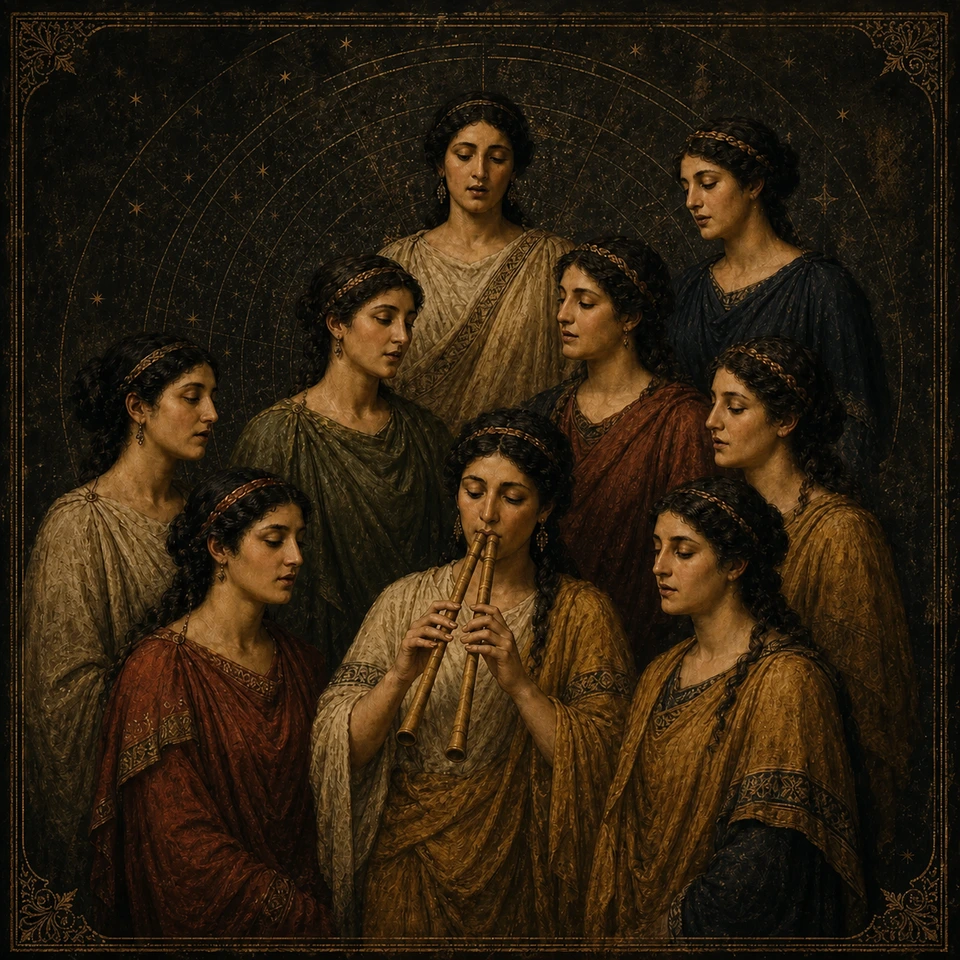
The Muses. Nine immortal sisters of ancient Greece who held dominion over divine song, theatrical performance, and the profound weight of memory. They served as the architects of persuasive speech, whispering inspiration into the minds of mortals and transforming the ephemeral into eternal art.
Overview
Night lies thick on Mount Helicon when the Muses move from the springs. They have washed in Permessus, Hippocrene, or Olmeius, danced around the altar of Zeus, and wrapped themselves in mist. Their song names the deathless gods. Then the poem turns toward a shepherd below the mountain. Hesiod is tending lambs when the goddesses confront him, call shepherds shameful bellies, and tell him something more unsettling than praise: they know how to make false things sound true, and they know how to speak truth when they choose.
They cut a staff from flowering laurel and place it in his hand. They breathe a voice into him and command him to sing what will be and what has been. Inspiration is not a soft mood descending on an already celebrated poet. It is rebuke, danger, equipment, and obligation. The Muses make song powerful enough to preserve the gods and deceptive enough to demand judgment.
Hesiod also gives the familiar nine their genealogy. Zeus comes to Mnemosyne in Pieria for nine nights. After a year she bears Clio, Euterpe, Thalia, Melpomene, Terpsichore, Erato, Polyhymnia, Urania, and Calliope. They are sisters within a collective, not nine interchangeable titles. Pausanias later reports Mimnermus’s distinction between elder daughters of Uranus and younger children of Zeus; the two genealogies remain side by side. The poem does not yet assign the complete later chart of history, flute, comedy, tragedy, dance, love poetry, hymns, astronomy, and epic. It gives them shared song, memory, joy, and public force.
That force reaches beyond poets. A singer favored by the Muses can make a grieving listener forget sorrow for a time. Calliope accompanies honored kings, and gracious speech can settle a dispute before violence begins. In the Homeric Hymn to Apollo, the sisters answer one another while singing of divine gifts and mortal suffering. Their voices do not erase pain; they make its difference from divine ease audible inside a celebration.
The same powers can withdraw song. At Dorium, Thamyris boasts that he will defeat the Muses even if they sing against him. They meet him, maim him, take his marvelous voice, and make him forget his craft. His story stands opposite Hesiod’s. One singer receives memory and vocation; another loses both after treating divine art as a trophy already won.
Cult and material evidence give the collective several bodies. Pausanias remembers three early Heliconian Muses named Melete, Mneme, and Aoide, then a later establishment of nine familiar names. He walks a grove filled with images, springs, memorials, a local festival, and games called the Museia. On the Sophilos Dinos, made around 580 to 570 BC, a group of Muses joins the gods at the wedding of Peleus and Thetis, and one plays pipes. The vessel names no woman by position and supplies no later emblem chart.
Canonical identity
Canonical Identity
The Muses comprise a divine collective of singers famously recognized through nine individual members: Clio, Euterpe, Thalia, Melpomene, Terpsichore, Erato, Polyhymnia, Urania, and Calliope. The plural group name does not function as an alias for any single sister. While Hesiod names these members directly, he does not assign the rigid art-category charts or fixed emblems that later traditions attached to them. Visual evidence, such as the Sophilos Dinos, depicts several Muses walking in procession with one playing pipes; this preserves an Archaic group scene without automatically defaulting the pipe player to Euterpe or identifying the sisters via later emblems.
Linguistic Identity
The Muses derive from the Greek Μοῦσαι. The ancient pronunciation remains unresolved and is therefore omitted.
Sources and evidence
TEXTUAL · Supported
Hesiod names nine Muses: Clio, Euterpe, Thalia, Melpomene, Terpsichore, Erato, Polyhymnia, Urania, and Calliope.
- Source
- Hesiod; edited and translated by Hugh G. Evelyn-White, Theogony (1914)
- Reviewed edition
- Hugh G. Evelyn-White edition and English translation in Hesiod, the Homeric Hymns and Homerica, 1914 · translated by Hugh G. Evelyn-White · edited by Hugh G. Evelyn-White · Perseus Digital Library / Scaife ATLAS
- Exact locator
- Entry Theogony · Line 75-79
- Scope
- Archaic Greece · Pieria
- Authority
- Hesiod’s Theogony in the Evelyn-White edition
- Certainty
- High
The nine names belong to individual members and are not aliases for the collective.
Open exact reviewed sourceMATERIAL CULTURE · Supported
The Sophilos Dinos shows a group of Muses in the wedding procession of Peleus and Thetis, with one Muse playing pipes.
- Source
- British Museum, British Museum Collection
- Reviewed edition
- British Museum object record 1971,1101.1, The Sophilos Dinos, Attic black-figure dinos and stand · British Museum
- Exact locator
- MuseumObjectId 1971,1101.1 · Entry Object description; circa 580-570 BC
- Scope
- Archaic Greece · Attica
- Authority
- British Museum accession catalogue
- Certainty
- High
The museum identifies both the group and the musical action on the Attic black-figure vessel.
Open exact reviewed source2 reviewed sources for this section
- Hesiod; edited and translated by Hugh G. Evelyn-White, Theogony (1914)Hesiod, the Homeric Hymns and Homerica, London and New York, 1914 · Perseus Digital Library / Scaife ATLAS
- British Museum, British Museum CollectionLive official museum collection · British Museum
Culture, tradition, period, and place
Helicon and Pieria form the oldest landscapes gathered here. Hesiod places dancing, springs, night song, and his own initiation on Helicon, while Mnemosyne bears the nine sisters in Pieria near Olympus. Homer remembers their dangerous meeting with Thamyris at Dorium. The Delian hymn brings their answering song into the Olympian hall.
Attic pottery around 580 to 570 BC places a group of Muses in a divine wedding procession. Centuries later Pausanias walks the Heliconian grove and preserves local memories of three early Muses as well as the familiar nine. These places and periods show development, not one unchanging national arrangement.
Sources and evidence
TEXTUAL · Supported
On Helicon, the Muses teach Hesiod song, give him a laurel staff, and tell him that they know how to voice falsehood and truth.
- Source
- Hesiod; edited and translated by Hugh G. Evelyn-White, Theogony (1914)
- Reviewed edition
- Hugh G. Evelyn-White edition and English translation in Hesiod, the Homeric Hymns and Homerica, 1914 · translated by Hugh G. Evelyn-White · edited by Hugh G. Evelyn-White · Perseus Digital Library / Scaife ATLAS
- Exact locator
- Entry Theogony · Line 1-35
- Scope
- Archaic Greece · Mount Helicon
- Authority
- Hesiod’s Theogony in the Evelyn-White edition
- Certainty
- High
Poetic authority arrives with an explicit warning about the powers of song.
Open exact reviewed sourceTEXTUAL · Supported
Hesiod names nine Muses: Clio, Euterpe, Thalia, Melpomene, Terpsichore, Erato, Polyhymnia, Urania, and Calliope.
- Source
- Hesiod; edited and translated by Hugh G. Evelyn-White, Theogony (1914)
- Reviewed edition
- Hugh G. Evelyn-White edition and English translation in Hesiod, the Homeric Hymns and Homerica, 1914 · translated by Hugh G. Evelyn-White · edited by Hugh G. Evelyn-White · Perseus Digital Library / Scaife ATLAS
- Exact locator
- Entry Theogony · Line 75-79
- Scope
- Archaic Greece · Pieria
- Authority
- Hesiod’s Theogony in the Evelyn-White edition
- Certainty
- High
The nine names belong to individual members and are not aliases for the collective.
Open exact reviewed sourceTEXTUAL · Supported
Hesiod makes the Muses daughters of Zeus and Mnemosyne after nine nights of union in Pieria.
- Source
- Hesiod; edited and translated by Hugh G. Evelyn-White, Theogony (1914)
- Reviewed edition
- Hugh G. Evelyn-White edition and English translation in Hesiod, the Homeric Hymns and Homerica, 1914 · translated by Hugh G. Evelyn-White · edited by Hugh G. Evelyn-White · Perseus Digital Library / Scaife ATLAS
- Exact locator
- Entry Theogony · Line 53-74
- Scope
- Archaic Greece · Pieria
- Authority
- Hesiod’s Theogony in the Evelyn-White edition
- Certainty
- High
The birth story joins divine authority, memory, song, and relief from care.
Open exact reviewed sourceTEXTUAL · Supported
Hesiod says the Muses give singers and lyre players their gift, and Calliope accompanies honored kings whose speech settles disputes.
- Source
- Hesiod; edited and translated by Hugh G. Evelyn-White, Theogony (1914)
- Reviewed edition
- Hugh G. Evelyn-White edition and English translation in Hesiod, the Homeric Hymns and Homerica, 1914 · translated by Hugh G. Evelyn-White · edited by Hugh G. Evelyn-White · Perseus Digital Library / Scaife ATLAS
- Exact locator
- Entry Theogony · Line 80-103
- Scope
- Archaic Greece · Ancient Greece
- Authority
- Hesiod’s Theogony in the Evelyn-White edition
- Certainty
- High
Poetic inspiration includes public judgment, memory, and relief from grief.
Open exact reviewed sourceTEXTUAL · Supported
In the Homeric Hymn to Apollo, the Muses answer one another in song about divine gifts and mortal suffering while Apollo plays among the gods.
- Source
- Anonymous Homeric Hymns; edited and translated by Hugh G. Evelyn-White, Homeric Hymns (1914)
- Reviewed edition
- Hugh G. Evelyn-White English translation of Homeric Hymn 3 to Apollo, 1914 · translated by Hugh G. Evelyn-White · edited by Hugh G. Evelyn-White · Perseus Digital Library / Scaife ATLAS
- Exact locator
- Hymn 3 · Line 182-206
- Scope
- Archaic Greece · Mount Olympus
- Authority
- The Homeric Hymn to Apollo in the Evelyn-White edition
- Certainty
- High
Their song frames the divine dance without becoming identical to Apollo’s music.
Open exact reviewed sourceTEXTUAL · Supported
The Iliad says the Muses meet the boastful singer Thamyris at Dorium, maim him, take his song, and make him forget his craft.
- Source
- Homer; Monro and Allen Greek edition with edition-specific translations, Iliad (1920)
- Reviewed edition
- A. T. Murray English translation, volumes I-II, 1924-1925 · translated by A. T. Murray · Perseus Digital Library / Scaife ATLAS
- Exact locator
- Book 2 · Line 594-600
- Scope
- Archaic Greece · Dorium
- Authority
- Homer’s Iliad in the A. T. Murray edition
- Certainty
- High
The scene shows danger and limit as well as inspiration.
Open exact reviewed sourceTEXTUAL · Supported
Pausanias says Otus and Ephialtes first sacrificed to three Heliconian Muses named Melete, Mneme, and Aoide, while Pierus later established nine with the familiar names.
- Source
- Pausanias; Spiro Greek edition and Jones/Ormerod translation volumes, Description of Greece (1935)
- Reviewed edition
- W. H. S. Jones and H. A. Ormerod English translation volumes, 1918-1935 · translated by W. H. S. Jones and H. A. Ormerod, volume-dependent · Perseus Digital Library / Scaife ATLAS
- Exact locator
- Book 9 · Chapter 29 · Section 1-3
- Scope
- Greek religion under Roman imperial rule · Mount Helicon
- Authority
- Pausanias’s Description of Greece in the Jones edition
- Certainty
- High
This local history preserves a three-member cult memory beside the canonical nine.
Open exact reviewed sourceTEXTUAL · Supported
Pausanias describes the grove of the Muses on Helicon, its images, Aganippe, Hippocrene, and the surrounding memorial landscape.
- Source
- Pausanias; Spiro Greek edition and Jones/Ormerod translation volumes, Description of Greece (1935)
- Reviewed edition
- W. H. S. Jones and H. A. Ormerod English translation volumes, 1918-1935 · translated by W. H. S. Jones and H. A. Ormerod, volume-dependent · Perseus Digital Library / Scaife ATLAS
- Exact locator
- Book 9 · Chapter 29-31 · Section 9.29.5; 9.30.1-3; 9.31.3
- Scope
- Greek religion under Roman imperial rule · Mount Helicon
- Authority
- Pausanias’s Description of Greece in the Jones edition
- Certainty
- High
The broad locator follows the traveler through a connected sacred landscape.
Open exact reviewed sourceMATERIAL CULTURE · Supported
The Sophilos Dinos shows a group of Muses in the wedding procession of Peleus and Thetis, with one Muse playing pipes.
- Source
- British Museum, British Museum Collection
- Reviewed edition
- British Museum object record 1971,1101.1, The Sophilos Dinos, Attic black-figure dinos and stand · British Museum
- Exact locator
- MuseumObjectId 1971,1101.1 · Entry Object description; circa 580-570 BC
- Scope
- Archaic Greece · Attica
- Authority
- British Museum accession catalogue
- Certainty
- High
The museum identifies both the group and the musical action on the Attic black-figure vessel.
Open exact reviewed sourceTEXTUAL · Supported
Pausanias says the Thespians celebrate a festival on Helicon and games called the Museia, with prizes for music and athletics.
- Source
- Pausanias; Spiro Greek edition and Jones/Ormerod translation volumes, Description of Greece (1935)
- Reviewed edition
- W. H. S. Jones and H. A. Ormerod English translation volumes, 1918-1935 · translated by W. H. S. Jones and H. A. Ormerod, volume-dependent · Perseus Digital Library / Scaife ATLAS
- Exact locator
- Book 9 · Chapter 31 · Section 3
- Scope
- Greek religion under Roman imperial rule · Mount Helicon
- Authority
- Pausanias, Description of Greece, Jones and Ormerod English edition
- Certainty
- High
The local festival and games are explicit, but Pausanias does not establish a universal Greek calendar or frequency in this passage.
Open exact reviewed sourceTEXTUAL · Supported
Pausanias reports that Mimnermus distinguished elder Muses as daughters of Uranus from younger Muses as children of Zeus.
- Source
- Pausanias; Spiro Greek edition and Jones/Ormerod translation volumes, Description of Greece (1935)
- Reviewed edition
- W. H. S. Jones and H. A. Ormerod English translation volumes, 1918-1935 · translated by W. H. S. Jones and H. A. Ormerod, volume-dependent · Perseus Digital Library / Scaife ATLAS
- Exact locator
- Book 9 · Chapter 29 · Section 4
- Scope
- Greek religion under Roman imperial rule · Mount Helicon
- Authority
- Pausanias reporting Mimnermus in the Jones and Ormerod English edition
- Certainty
- High
This source-scoped elder genealogy remains separate from Hesiod’s Pierian nine daughters of Zeus and Mnemosyne.
Open exact reviewed source5 reviewed sources for this section
- Hesiod; edited and translated by Hugh G. Evelyn-White, Theogony (1914)Hesiod, the Homeric Hymns and Homerica, London and New York, 1914 · Perseus Digital Library / Scaife ATLAS
- Homer; Monro and Allen Greek edition with edition-specific translations, Iliad (1920)Perseus CTS edition corpus; Greek edition, Oxford, 1908-1920 · Perseus Digital Library / Scaife ATLAS
- Anonymous Homeric Hymns; edited and translated by Hugh G. Evelyn-White, Homeric Hymns (1914)Hesiod, the Homeric Hymns and Homerica, London and New York, 1914 · Perseus Digital Library / Scaife ATLAS
- Pausanias; Spiro Greek edition and Jones/Ormerod translation volumes, Description of Greece (1935)Perseus CTS edition corpus, 1903-1935 · Perseus Digital Library / Scaife ATLAS
- British Museum, British Museum CollectionLive official museum collection · British Museum
Historical development
The Theogony already holds several layers together: Heliconian dancers, Olympian daughters of Zeus and Mnemosyne, nine named sisters, poetic initiation, and public gifts to singers and kings. The Iliad adds the power to destroy a rival singer. The Homeric Hymn to Apollo lets their song articulate the gulf between divine gifts and mortal suffering.
Sophilos gives the collective an Archaic Attic body in procession, with one Muse playing pipes. Pausanias later preserves a Boeotian history in which Otus and Ephialtes honor Melete, Mneme, and Aoide before Pierus establishes nine familiar names. He also reports Mimnermus’s elder daughters of Uranus beside younger children of Zeus. Local threefold memory, Hesiod’s Pierian nine, and the elder genealogy remain distinct historical layers.
Sources and evidence
TEXTUAL · Supported
On Helicon, the Muses teach Hesiod song, give him a laurel staff, and tell him that they know how to voice falsehood and truth.
- Source
- Hesiod; edited and translated by Hugh G. Evelyn-White, Theogony (1914)
- Reviewed edition
- Hugh G. Evelyn-White edition and English translation in Hesiod, the Homeric Hymns and Homerica, 1914 · translated by Hugh G. Evelyn-White · edited by Hugh G. Evelyn-White · Perseus Digital Library / Scaife ATLAS
- Exact locator
- Entry Theogony · Line 1-35
- Scope
- Archaic Greece · Mount Helicon
- Authority
- Hesiod’s Theogony in the Evelyn-White edition
- Certainty
- High
Poetic authority arrives with an explicit warning about the powers of song.
Open exact reviewed sourceTEXTUAL · Supported
Hesiod names nine Muses: Clio, Euterpe, Thalia, Melpomene, Terpsichore, Erato, Polyhymnia, Urania, and Calliope.
- Source
- Hesiod; edited and translated by Hugh G. Evelyn-White, Theogony (1914)
- Reviewed edition
- Hugh G. Evelyn-White edition and English translation in Hesiod, the Homeric Hymns and Homerica, 1914 · translated by Hugh G. Evelyn-White · edited by Hugh G. Evelyn-White · Perseus Digital Library / Scaife ATLAS
- Exact locator
- Entry Theogony · Line 75-79
- Scope
- Archaic Greece · Pieria
- Authority
- Hesiod’s Theogony in the Evelyn-White edition
- Certainty
- High
The nine names belong to individual members and are not aliases for the collective.
Open exact reviewed sourceTEXTUAL · Supported
Hesiod makes the Muses daughters of Zeus and Mnemosyne after nine nights of union in Pieria.
- Source
- Hesiod; edited and translated by Hugh G. Evelyn-White, Theogony (1914)
- Reviewed edition
- Hugh G. Evelyn-White edition and English translation in Hesiod, the Homeric Hymns and Homerica, 1914 · translated by Hugh G. Evelyn-White · edited by Hugh G. Evelyn-White · Perseus Digital Library / Scaife ATLAS
- Exact locator
- Entry Theogony · Line 53-74
- Scope
- Archaic Greece · Pieria
- Authority
- Hesiod’s Theogony in the Evelyn-White edition
- Certainty
- High
The birth story joins divine authority, memory, song, and relief from care.
Open exact reviewed sourceTEXTUAL · Supported
Hesiod says the Muses give singers and lyre players their gift, and Calliope accompanies honored kings whose speech settles disputes.
- Source
- Hesiod; edited and translated by Hugh G. Evelyn-White, Theogony (1914)
- Reviewed edition
- Hugh G. Evelyn-White edition and English translation in Hesiod, the Homeric Hymns and Homerica, 1914 · translated by Hugh G. Evelyn-White · edited by Hugh G. Evelyn-White · Perseus Digital Library / Scaife ATLAS
- Exact locator
- Entry Theogony · Line 80-103
- Scope
- Archaic Greece · Ancient Greece
- Authority
- Hesiod’s Theogony in the Evelyn-White edition
- Certainty
- High
Poetic inspiration includes public judgment, memory, and relief from grief.
Open exact reviewed sourceTEXTUAL · Supported
In the Homeric Hymn to Apollo, the Muses answer one another in song about divine gifts and mortal suffering while Apollo plays among the gods.
- Source
- Anonymous Homeric Hymns; edited and translated by Hugh G. Evelyn-White, Homeric Hymns (1914)
- Reviewed edition
- Hugh G. Evelyn-White English translation of Homeric Hymn 3 to Apollo, 1914 · translated by Hugh G. Evelyn-White · edited by Hugh G. Evelyn-White · Perseus Digital Library / Scaife ATLAS
- Exact locator
- Hymn 3 · Line 182-206
- Scope
- Archaic Greece · Mount Olympus
- Authority
- The Homeric Hymn to Apollo in the Evelyn-White edition
- Certainty
- High
Their song frames the divine dance without becoming identical to Apollo’s music.
Open exact reviewed sourceTEXTUAL · Supported
The Iliad says the Muses meet the boastful singer Thamyris at Dorium, maim him, take his song, and make him forget his craft.
- Source
- Homer; Monro and Allen Greek edition with edition-specific translations, Iliad (1920)
- Reviewed edition
- A. T. Murray English translation, volumes I-II, 1924-1925 · translated by A. T. Murray · Perseus Digital Library / Scaife ATLAS
- Exact locator
- Book 2 · Line 594-600
- Scope
- Archaic Greece · Dorium
- Authority
- Homer’s Iliad in the A. T. Murray edition
- Certainty
- High
The scene shows danger and limit as well as inspiration.
Open exact reviewed sourceTEXTUAL · Supported
Pausanias says Otus and Ephialtes first sacrificed to three Heliconian Muses named Melete, Mneme, and Aoide, while Pierus later established nine with the familiar names.
- Source
- Pausanias; Spiro Greek edition and Jones/Ormerod translation volumes, Description of Greece (1935)
- Reviewed edition
- W. H. S. Jones and H. A. Ormerod English translation volumes, 1918-1935 · translated by W. H. S. Jones and H. A. Ormerod, volume-dependent · Perseus Digital Library / Scaife ATLAS
- Exact locator
- Book 9 · Chapter 29 · Section 1-3
- Scope
- Greek religion under Roman imperial rule · Mount Helicon
- Authority
- Pausanias’s Description of Greece in the Jones edition
- Certainty
- High
This local history preserves a three-member cult memory beside the canonical nine.
Open exact reviewed sourceTEXTUAL · Supported
Pausanias describes the grove of the Muses on Helicon, its images, Aganippe, Hippocrene, and the surrounding memorial landscape.
- Source
- Pausanias; Spiro Greek edition and Jones/Ormerod translation volumes, Description of Greece (1935)
- Reviewed edition
- W. H. S. Jones and H. A. Ormerod English translation volumes, 1918-1935 · translated by W. H. S. Jones and H. A. Ormerod, volume-dependent · Perseus Digital Library / Scaife ATLAS
- Exact locator
- Book 9 · Chapter 29-31 · Section 9.29.5; 9.30.1-3; 9.31.3
- Scope
- Greek religion under Roman imperial rule · Mount Helicon
- Authority
- Pausanias’s Description of Greece in the Jones edition
- Certainty
- High
The broad locator follows the traveler through a connected sacred landscape.
Open exact reviewed sourceMATERIAL CULTURE · Supported
The Sophilos Dinos shows a group of Muses in the wedding procession of Peleus and Thetis, with one Muse playing pipes.
- Source
- British Museum, British Museum Collection
- Reviewed edition
- British Museum object record 1971,1101.1, The Sophilos Dinos, Attic black-figure dinos and stand · British Museum
- Exact locator
- MuseumObjectId 1971,1101.1 · Entry Object description; circa 580-570 BC
- Scope
- Archaic Greece · Attica
- Authority
- British Museum accession catalogue
- Certainty
- High
The museum identifies both the group and the musical action on the Attic black-figure vessel.
Open exact reviewed sourceTEXTUAL · Supported
Pausanias says the Thespians celebrate a festival on Helicon and games called the Museia, with prizes for music and athletics.
- Source
- Pausanias; Spiro Greek edition and Jones/Ormerod translation volumes, Description of Greece (1935)
- Reviewed edition
- W. H. S. Jones and H. A. Ormerod English translation volumes, 1918-1935 · translated by W. H. S. Jones and H. A. Ormerod, volume-dependent · Perseus Digital Library / Scaife ATLAS
- Exact locator
- Book 9 · Chapter 31 · Section 3
- Scope
- Greek religion under Roman imperial rule · Mount Helicon
- Authority
- Pausanias, Description of Greece, Jones and Ormerod English edition
- Certainty
- High
The local festival and games are explicit, but Pausanias does not establish a universal Greek calendar or frequency in this passage.
Open exact reviewed sourceTEXTUAL · Supported
Pausanias reports that Mimnermus distinguished elder Muses as daughters of Uranus from younger Muses as children of Zeus.
- Source
- Pausanias; Spiro Greek edition and Jones/Ormerod translation volumes, Description of Greece (1935)
- Reviewed edition
- W. H. S. Jones and H. A. Ormerod English translation volumes, 1918-1935 · translated by W. H. S. Jones and H. A. Ormerod, volume-dependent · Perseus Digital Library / Scaife ATLAS
- Exact locator
- Book 9 · Chapter 29 · Section 4
- Scope
- Greek religion under Roman imperial rule · Mount Helicon
- Authority
- Pausanias reporting Mimnermus in the Jones and Ormerod English edition
- Certainty
- High
This source-scoped elder genealogy remains separate from Hesiod’s Pierian nine daughters of Zeus and Mnemosyne.
Open exact reviewed source5 reviewed sources for this section
- Hesiod; edited and translated by Hugh G. Evelyn-White, Theogony (1914)Hesiod, the Homeric Hymns and Homerica, London and New York, 1914 · Perseus Digital Library / Scaife ATLAS
- Homer; Monro and Allen Greek edition with edition-specific translations, Iliad (1920)Perseus CTS edition corpus; Greek edition, Oxford, 1908-1920 · Perseus Digital Library / Scaife ATLAS
- Anonymous Homeric Hymns; edited and translated by Hugh G. Evelyn-White, Homeric Hymns (1914)Hesiod, the Homeric Hymns and Homerica, London and New York, 1914 · Perseus Digital Library / Scaife ATLAS
- Pausanias; Spiro Greek edition and Jones/Ormerod translation volumes, Description of Greece (1935)Perseus CTS edition corpus, 1903-1935 · Perseus Digital Library / Scaife ATLAS
- British Museum, British Museum CollectionLive official museum collection · British Museum
Attested roles and historical themes
Roles, powers, and limits
The Muses authorize song, preserve memory, praise gods, relieve grief, and shape persuasive speech. Hesiod’s singer can make a sorrowing listener forget pain for a time. Calliope accompanies honored kings whose gentle words settle disputes. In the hymn, the group sings divine gifts and mortal limits around Apollo’s music.
Their gift is neither automatic nor harmless. They warn Hesiod that speech can resemble truth without being true. They remove Thamyris’s voice and memory after his boast. They do not govern every art in every period through a timeless school-subject chart, and inspiration does not exempt a singer from skill, judgment, or consequence.
Sources and evidence
TEXTUAL · Supported
On Helicon, the Muses teach Hesiod song, give him a laurel staff, and tell him that they know how to voice falsehood and truth.
- Source
- Hesiod; edited and translated by Hugh G. Evelyn-White, Theogony (1914)
- Reviewed edition
- Hugh G. Evelyn-White edition and English translation in Hesiod, the Homeric Hymns and Homerica, 1914 · translated by Hugh G. Evelyn-White · edited by Hugh G. Evelyn-White · Perseus Digital Library / Scaife ATLAS
- Exact locator
- Entry Theogony · Line 1-35
- Scope
- Archaic Greece · Mount Helicon
- Authority
- Hesiod’s Theogony in the Evelyn-White edition
- Certainty
- High
Poetic authority arrives with an explicit warning about the powers of song.
Open exact reviewed sourceTEXTUAL · Supported
Hesiod says the Muses give singers and lyre players their gift, and Calliope accompanies honored kings whose speech settles disputes.
- Source
- Hesiod; edited and translated by Hugh G. Evelyn-White, Theogony (1914)
- Reviewed edition
- Hugh G. Evelyn-White edition and English translation in Hesiod, the Homeric Hymns and Homerica, 1914 · translated by Hugh G. Evelyn-White · edited by Hugh G. Evelyn-White · Perseus Digital Library / Scaife ATLAS
- Exact locator
- Entry Theogony · Line 80-103
- Scope
- Archaic Greece · Ancient Greece
- Authority
- Hesiod’s Theogony in the Evelyn-White edition
- Certainty
- High
Poetic inspiration includes public judgment, memory, and relief from grief.
Open exact reviewed sourceTEXTUAL · Supported
In the Homeric Hymn to Apollo, the Muses answer one another in song about divine gifts and mortal suffering while Apollo plays among the gods.
- Source
- Anonymous Homeric Hymns; edited and translated by Hugh G. Evelyn-White, Homeric Hymns (1914)
- Reviewed edition
- Hugh G. Evelyn-White English translation of Homeric Hymn 3 to Apollo, 1914 · translated by Hugh G. Evelyn-White · edited by Hugh G. Evelyn-White · Perseus Digital Library / Scaife ATLAS
- Exact locator
- Hymn 3 · Line 182-206
- Scope
- Archaic Greece · Mount Olympus
- Authority
- The Homeric Hymn to Apollo in the Evelyn-White edition
- Certainty
- High
Their song frames the divine dance without becoming identical to Apollo’s music.
Open exact reviewed sourceTEXTUAL · Supported
The Iliad says the Muses meet the boastful singer Thamyris at Dorium, maim him, take his song, and make him forget his craft.
- Source
- Homer; Monro and Allen Greek edition with edition-specific translations, Iliad (1920)
- Reviewed edition
- A. T. Murray English translation, volumes I-II, 1924-1925 · translated by A. T. Murray · Perseus Digital Library / Scaife ATLAS
- Exact locator
- Book 2 · Line 594-600
- Scope
- Archaic Greece · Dorium
- Authority
- Homer’s Iliad in the A. T. Murray edition
- Certainty
- High
The scene shows danger and limit as well as inspiration.
Open exact reviewed source3 reviewed sources for this section
- Hesiod; edited and translated by Hugh G. Evelyn-White, Theogony (1914)Hesiod, the Homeric Hymns and Homerica, London and New York, 1914 · Perseus Digital Library / Scaife ATLAS
- Homer; Monro and Allen Greek edition with edition-specific translations, Iliad (1920)Perseus CTS edition corpus; Greek edition, Oxford, 1908-1920 · Perseus Digital Library / Scaife ATLAS
- Anonymous Homeric Hymns; edited and translated by Hugh G. Evelyn-White, Homeric Hymns (1914)Hesiod, the Homeric Hymns and Homerica, London and New York, 1914 · Perseus Digital Library / Scaife ATLAS
Epithets and titles
No secure collective epithet was established. Heliconian and Olympian describe source and place contexts here rather than a complete epithet catalogue.
2 reviewed sources for this section
- Hesiod; edited and translated by Hugh G. Evelyn-White, Theogony (1914)Hesiod, the Homeric Hymns and Homerica, London and New York, 1914 · Perseus Digital Library / Scaife ATLAS
- Pausanias; Spiro Greek edition and Jones/Ormerod translation volumes, Description of Greece (1935)Perseus CTS edition corpus, 1903-1935 · Perseus Digital Library / Scaife ATLAS
Worship and cult
On Helicon, Pausanias reports that Otus and Ephialtes first sacrificed to three Muses named Practice, Memory, and Song. Pierus later established nine and changed the names to those current in Pausanias’s day. The account makes plurality itself part of local cult history.
The grove, springs, images, and memorials around Helicon create a landscape where worship, poetry, competition, and remembrance meet. The evidence secures cult and sacred place, but not a single ritual followed everywhere in Greece. Hesiod’s poetic washing and dances at springs belong to divine narrative and cannot alone supply instructions for human worship.
Sources and evidence
TEXTUAL · Supported
Pausanias says Otus and Ephialtes first sacrificed to three Heliconian Muses named Melete, Mneme, and Aoide, while Pierus later established nine with the familiar names.
- Source
- Pausanias; Spiro Greek edition and Jones/Ormerod translation volumes, Description of Greece (1935)
- Reviewed edition
- W. H. S. Jones and H. A. Ormerod English translation volumes, 1918-1935 · translated by W. H. S. Jones and H. A. Ormerod, volume-dependent · Perseus Digital Library / Scaife ATLAS
- Exact locator
- Book 9 · Chapter 29 · Section 1-3
- Scope
- Greek religion under Roman imperial rule · Mount Helicon
- Authority
- Pausanias’s Description of Greece in the Jones edition
- Certainty
- High
This local history preserves a three-member cult memory beside the canonical nine.
Open exact reviewed sourceTEXTUAL · Supported
Pausanias describes the grove of the Muses on Helicon, its images, Aganippe, Hippocrene, and the surrounding memorial landscape.
- Source
- Pausanias; Spiro Greek edition and Jones/Ormerod translation volumes, Description of Greece (1935)
- Reviewed edition
- W. H. S. Jones and H. A. Ormerod English translation volumes, 1918-1935 · translated by W. H. S. Jones and H. A. Ormerod, volume-dependent · Perseus Digital Library / Scaife ATLAS
- Exact locator
- Book 9 · Chapter 29-31 · Section 9.29.5; 9.30.1-3; 9.31.3
- Scope
- Greek religion under Roman imperial rule · Mount Helicon
- Authority
- Pausanias’s Description of Greece in the Jones edition
- Certainty
- High
The broad locator follows the traveler through a connected sacred landscape.
Open exact reviewed sourceTEXTUAL · Supported
On Helicon, the Muses teach Hesiod song, give him a laurel staff, and tell him that they know how to voice falsehood and truth.
- Source
- Hesiod; edited and translated by Hugh G. Evelyn-White, Theogony (1914)
- Reviewed edition
- Hugh G. Evelyn-White edition and English translation in Hesiod, the Homeric Hymns and Homerica, 1914 · translated by Hugh G. Evelyn-White · edited by Hugh G. Evelyn-White · Perseus Digital Library / Scaife ATLAS
- Exact locator
- Entry Theogony · Line 1-35
- Scope
- Archaic Greece · Mount Helicon
- Authority
- Hesiod’s Theogony in the Evelyn-White edition
- Certainty
- High
Poetic authority arrives with an explicit warning about the powers of song.
Open exact reviewed sourceTEXTUAL · Supported
Pausanias says the Thespians celebrate a festival on Helicon and games called the Museia, with prizes for music and athletics.
- Source
- Pausanias; Spiro Greek edition and Jones/Ormerod translation volumes, Description of Greece (1935)
- Reviewed edition
- W. H. S. Jones and H. A. Ormerod English translation volumes, 1918-1935 · translated by W. H. S. Jones and H. A. Ormerod, volume-dependent · Perseus Digital Library / Scaife ATLAS
- Exact locator
- Book 9 · Chapter 31 · Section 3
- Scope
- Greek religion under Roman imperial rule · Mount Helicon
- Authority
- Pausanias, Description of Greece, Jones and Ormerod English edition
- Certainty
- High
The local festival and games are explicit, but Pausanias does not establish a universal Greek calendar or frequency in this passage.
Open exact reviewed source2 reviewed sources for this section
- Pausanias; Spiro Greek edition and Jones/Ormerod translation volumes, Description of Greece (1935)Perseus CTS edition corpus, 1903-1935 · Perseus Digital Library / Scaife ATLAS
- Hesiod; edited and translated by Hugh G. Evelyn-White, Theogony (1914)Hesiod, the Homeric Hymns and Homerica, London and New York, 1914 · Perseus Digital Library / Scaife ATLAS
Temples, sanctuaries, and sacred places
Mount Helicon is the clearest sacred center. Hesiod names its altar of Zeus, springs, and dancing ground. Pausanias approaches the grove of the Muses, passes Aganippe, and continues among images, poets, and Hippocrene. Water, path, sculpture, and remembered song make the mountain legible as inhabited sacred terrain.
Pieria is the birthplace of the nine Olympian sisters in Hesiod, while Dorium carries the memory of Thamyris’s punishment. Olympus is their house and performance setting in the hymn. These narrative and cult places must not be flattened into one sanctuary plan or turned into evidence that every spring was theirs.
Sources and evidence
TEXTUAL · Supported
On Helicon, the Muses teach Hesiod song, give him a laurel staff, and tell him that they know how to voice falsehood and truth.
- Source
- Hesiod; edited and translated by Hugh G. Evelyn-White, Theogony (1914)
- Reviewed edition
- Hugh G. Evelyn-White edition and English translation in Hesiod, the Homeric Hymns and Homerica, 1914 · translated by Hugh G. Evelyn-White · edited by Hugh G. Evelyn-White · Perseus Digital Library / Scaife ATLAS
- Exact locator
- Entry Theogony · Line 1-35
- Scope
- Archaic Greece · Mount Helicon
- Authority
- Hesiod’s Theogony in the Evelyn-White edition
- Certainty
- High
Poetic authority arrives with an explicit warning about the powers of song.
Open exact reviewed sourceTEXTUAL · Supported
Hesiod makes the Muses daughters of Zeus and Mnemosyne after nine nights of union in Pieria.
- Source
- Hesiod; edited and translated by Hugh G. Evelyn-White, Theogony (1914)
- Reviewed edition
- Hugh G. Evelyn-White edition and English translation in Hesiod, the Homeric Hymns and Homerica, 1914 · translated by Hugh G. Evelyn-White · edited by Hugh G. Evelyn-White · Perseus Digital Library / Scaife ATLAS
- Exact locator
- Entry Theogony · Line 53-74
- Scope
- Archaic Greece · Pieria
- Authority
- Hesiod’s Theogony in the Evelyn-White edition
- Certainty
- High
The birth story joins divine authority, memory, song, and relief from care.
Open exact reviewed sourceTEXTUAL · Supported
Pausanias describes the grove of the Muses on Helicon, its images, Aganippe, Hippocrene, and the surrounding memorial landscape.
- Source
- Pausanias; Spiro Greek edition and Jones/Ormerod translation volumes, Description of Greece (1935)
- Reviewed edition
- W. H. S. Jones and H. A. Ormerod English translation volumes, 1918-1935 · translated by W. H. S. Jones and H. A. Ormerod, volume-dependent · Perseus Digital Library / Scaife ATLAS
- Exact locator
- Book 9 · Chapter 29-31 · Section 9.29.5; 9.30.1-3; 9.31.3
- Scope
- Greek religion under Roman imperial rule · Mount Helicon
- Authority
- Pausanias’s Description of Greece in the Jones edition
- Certainty
- High
The broad locator follows the traveler through a connected sacred landscape.
Open exact reviewed sourceTEXTUAL · Supported
The Iliad says the Muses meet the boastful singer Thamyris at Dorium, maim him, take his song, and make him forget his craft.
- Source
- Homer; Monro and Allen Greek edition with edition-specific translations, Iliad (1920)
- Reviewed edition
- A. T. Murray English translation, volumes I-II, 1924-1925 · translated by A. T. Murray · Perseus Digital Library / Scaife ATLAS
- Exact locator
- Book 2 · Line 594-600
- Scope
- Archaic Greece · Dorium
- Authority
- Homer’s Iliad in the A. T. Murray edition
- Certainty
- High
The scene shows danger and limit as well as inspiration.
Open exact reviewed sourceTEXTUAL · Supported
In the Homeric Hymn to Apollo, the Muses answer one another in song about divine gifts and mortal suffering while Apollo plays among the gods.
- Source
- Anonymous Homeric Hymns; edited and translated by Hugh G. Evelyn-White, Homeric Hymns (1914)
- Reviewed edition
- Hugh G. Evelyn-White English translation of Homeric Hymn 3 to Apollo, 1914 · translated by Hugh G. Evelyn-White · edited by Hugh G. Evelyn-White · Perseus Digital Library / Scaife ATLAS
- Exact locator
- Hymn 3 · Line 182-206
- Scope
- Archaic Greece · Mount Olympus
- Authority
- The Homeric Hymn to Apollo in the Evelyn-White edition
- Certainty
- High
Their song frames the divine dance without becoming identical to Apollo’s music.
Open exact reviewed sourceTEXTUAL · Supported
Pausanias says the Thespians celebrate a festival on Helicon and games called the Museia, with prizes for music and athletics.
- Source
- Pausanias; Spiro Greek edition and Jones/Ormerod translation volumes, Description of Greece (1935)
- Reviewed edition
- W. H. S. Jones and H. A. Ormerod English translation volumes, 1918-1935 · translated by W. H. S. Jones and H. A. Ormerod, volume-dependent · Perseus Digital Library / Scaife ATLAS
- Exact locator
- Book 9 · Chapter 31 · Section 3
- Scope
- Greek religion under Roman imperial rule · Mount Helicon
- Authority
- Pausanias, Description of Greece, Jones and Ormerod English edition
- Certainty
- High
The local festival and games are explicit, but Pausanias does not establish a universal Greek calendar or frequency in this passage.
Open exact reviewed source4 reviewed sources for this section
- Hesiod; edited and translated by Hugh G. Evelyn-White, Theogony (1914)Hesiod, the Homeric Hymns and Homerica, London and New York, 1914 · Perseus Digital Library / Scaife ATLAS
- Pausanias; Spiro Greek edition and Jones/Ormerod translation volumes, Description of Greece (1935)Perseus CTS edition corpus, 1903-1935 · Perseus Digital Library / Scaife ATLAS
- Homer; Monro and Allen Greek edition with edition-specific translations, Iliad (1920)Perseus CTS edition corpus; Greek edition, Oxford, 1908-1920 · Perseus Digital Library / Scaife ATLAS
- Anonymous Homeric Hymns; edited and translated by Hugh G. Evelyn-White, Homeric Hymns (1914)Hesiod, the Homeric Hymns and Homerica, London and New York, 1914 · Perseus Digital Library / Scaife ATLAS
Festivals and processions
On Helicon, Pausanias says the Thespians celebrate a festival and games called the Museia. The prizes reach beyond music to athletic events, placing artistic performance inside a named local gathering. The passage does not supply a universal Greek calendar date, a complete ritual program, or a frequency that can be projected onto every sanctuary.
The wedding procession on the Sophilos Dinos and the divine dance around Apollo are mythic performances, not records of that civic festival. The object, hymn, and Heliconian games illuminate different settings and must remain separate.
Sources and evidence
TEXTUAL · Supported
Pausanias describes the grove of the Muses on Helicon, its images, Aganippe, Hippocrene, and the surrounding memorial landscape.
- Source
- Pausanias; Spiro Greek edition and Jones/Ormerod translation volumes, Description of Greece (1935)
- Reviewed edition
- W. H. S. Jones and H. A. Ormerod English translation volumes, 1918-1935 · translated by W. H. S. Jones and H. A. Ormerod, volume-dependent · Perseus Digital Library / Scaife ATLAS
- Exact locator
- Book 9 · Chapter 29-31 · Section 9.29.5; 9.30.1-3; 9.31.3
- Scope
- Greek religion under Roman imperial rule · Mount Helicon
- Authority
- Pausanias’s Description of Greece in the Jones edition
- Certainty
- High
The broad locator follows the traveler through a connected sacred landscape.
Open exact reviewed sourceMATERIAL CULTURE · Supported
The Sophilos Dinos shows a group of Muses in the wedding procession of Peleus and Thetis, with one Muse playing pipes.
- Source
- British Museum, British Museum Collection
- Reviewed edition
- British Museum object record 1971,1101.1, The Sophilos Dinos, Attic black-figure dinos and stand · British Museum
- Exact locator
- MuseumObjectId 1971,1101.1 · Entry Object description; circa 580-570 BC
- Scope
- Archaic Greece · Attica
- Authority
- British Museum accession catalogue
- Certainty
- High
The museum identifies both the group and the musical action on the Attic black-figure vessel.
Open exact reviewed sourceTEXTUAL · Supported
In the Homeric Hymn to Apollo, the Muses answer one another in song about divine gifts and mortal suffering while Apollo plays among the gods.
- Source
- Anonymous Homeric Hymns; edited and translated by Hugh G. Evelyn-White, Homeric Hymns (1914)
- Reviewed edition
- Hugh G. Evelyn-White English translation of Homeric Hymn 3 to Apollo, 1914 · translated by Hugh G. Evelyn-White · edited by Hugh G. Evelyn-White · Perseus Digital Library / Scaife ATLAS
- Exact locator
- Hymn 3 · Line 182-206
- Scope
- Archaic Greece · Mount Olympus
- Authority
- The Homeric Hymn to Apollo in the Evelyn-White edition
- Certainty
- High
Their song frames the divine dance without becoming identical to Apollo’s music.
Open exact reviewed sourceTEXTUAL · Supported
Pausanias says the Thespians celebrate a festival on Helicon and games called the Museia, with prizes for music and athletics.
- Source
- Pausanias; Spiro Greek edition and Jones/Ormerod translation volumes, Description of Greece (1935)
- Reviewed edition
- W. H. S. Jones and H. A. Ormerod English translation volumes, 1918-1935 · translated by W. H. S. Jones and H. A. Ormerod, volume-dependent · Perseus Digital Library / Scaife ATLAS
- Exact locator
- Book 9 · Chapter 31 · Section 3
- Scope
- Greek religion under Roman imperial rule · Mount Helicon
- Authority
- Pausanias, Description of Greece, Jones and Ormerod English edition
- Certainty
- High
The local festival and games are explicit, but Pausanias does not establish a universal Greek calendar or frequency in this passage.
Open exact reviewed source3 reviewed sources for this section
- Pausanias; Spiro Greek edition and Jones/Ormerod translation volumes, Description of Greece (1935)Perseus CTS edition corpus, 1903-1935 · Perseus Digital Library / Scaife ATLAS
- British Museum, British Museum CollectionLive official museum collection · British Museum
- Anonymous Homeric Hymns; edited and translated by Hugh G. Evelyn-White, Homeric Hymns (1914)Hesiod, the Homeric Hymns and Homerica, London and New York, 1914 · Perseus Digital Library / Scaife ATLAS
Offerings, votives, and ritual evidence
Pausanias explicitly says that the early Heliconian founders sacrificed to the Muses. He does not give a complete offering list. The secure claim is the act of sacrifice and the named local group, not a reconstructed menu, prayer, or officiant.
Hesiod receives a flowering laurel staff, but this is a divine gift to a poet inside an initiation narrative, not an offering from a worshipper. The Sophilos Dinos is a painted vessel whose scene includes the Muses; its wine-bowl form does not prove that wine was their universal offering. Any present-day gift belongs to a documented modern practice rather than to these ancient scenes.
Sources and evidence
TEXTUAL · Supported
Pausanias says Otus and Ephialtes first sacrificed to three Heliconian Muses named Melete, Mneme, and Aoide, while Pierus later established nine with the familiar names.
- Source
- Pausanias; Spiro Greek edition and Jones/Ormerod translation volumes, Description of Greece (1935)
- Reviewed edition
- W. H. S. Jones and H. A. Ormerod English translation volumes, 1918-1935 · translated by W. H. S. Jones and H. A. Ormerod, volume-dependent · Perseus Digital Library / Scaife ATLAS
- Exact locator
- Book 9 · Chapter 29 · Section 1-3
- Scope
- Greek religion under Roman imperial rule · Mount Helicon
- Authority
- Pausanias’s Description of Greece in the Jones edition
- Certainty
- High
This local history preserves a three-member cult memory beside the canonical nine.
Open exact reviewed sourceTEXTUAL · Supported
On Helicon, the Muses teach Hesiod song, give him a laurel staff, and tell him that they know how to voice falsehood and truth.
- Source
- Hesiod; edited and translated by Hugh G. Evelyn-White, Theogony (1914)
- Reviewed edition
- Hugh G. Evelyn-White edition and English translation in Hesiod, the Homeric Hymns and Homerica, 1914 · translated by Hugh G. Evelyn-White · edited by Hugh G. Evelyn-White · Perseus Digital Library / Scaife ATLAS
- Exact locator
- Entry Theogony · Line 1-35
- Scope
- Archaic Greece · Mount Helicon
- Authority
- Hesiod’s Theogony in the Evelyn-White edition
- Certainty
- High
Poetic authority arrives with an explicit warning about the powers of song.
Open exact reviewed sourceMATERIAL CULTURE · Supported
The Sophilos Dinos shows a group of Muses in the wedding procession of Peleus and Thetis, with one Muse playing pipes.
- Source
- British Museum, British Museum Collection
- Reviewed edition
- British Museum object record 1971,1101.1, The Sophilos Dinos, Attic black-figure dinos and stand · British Museum
- Exact locator
- MuseumObjectId 1971,1101.1 · Entry Object description; circa 580-570 BC
- Scope
- Archaic Greece · Attica
- Authority
- British Museum accession catalogue
- Certainty
- High
The museum identifies both the group and the musical action on the Attic black-figure vessel.
Open exact reviewed source3 reviewed sources for this section
- Pausanias; Spiro Greek edition and Jones/Ormerod translation volumes, Description of Greece (1935)Perseus CTS edition corpus, 1903-1935 · Perseus Digital Library / Scaife ATLAS
- Hesiod; edited and translated by Hugh G. Evelyn-White, Theogony (1914)Hesiod, the Homeric Hymns and Homerica, London and New York, 1914 · Perseus Digital Library / Scaife ATLAS
- British Museum, British Museum CollectionLive official museum collection · British Museum
Iconography and material culture
Song, dance, the laurel staff, springs, and musical performance are strongly attested contexts. The Sophilos Dinos shows a group in procession and identifies one Muse as a pipe player. The vessel supports one pipe-playing member within a larger group without naming her Euterpe or turning one instrument into the emblem of every sister.
Hesiod’s staff is freshly cut flowering laurel. It marks his changed vocation, not a weapon or a general possession of all nine. The familiar chart of scrolls, globes, masks, lyres, and other member attributes is absent from both Hesiod’s list and this Archaic vessel. Each attribute therefore needs its own later dated history before it can be attached to a sister.
Sources and evidence
TEXTUAL · Supported
On Helicon, the Muses teach Hesiod song, give him a laurel staff, and tell him that they know how to voice falsehood and truth.
- Source
- Hesiod; edited and translated by Hugh G. Evelyn-White, Theogony (1914)
- Reviewed edition
- Hugh G. Evelyn-White edition and English translation in Hesiod, the Homeric Hymns and Homerica, 1914 · translated by Hugh G. Evelyn-White · edited by Hugh G. Evelyn-White · Perseus Digital Library / Scaife ATLAS
- Exact locator
- Entry Theogony · Line 1-35
- Scope
- Archaic Greece · Mount Helicon
- Authority
- Hesiod’s Theogony in the Evelyn-White edition
- Certainty
- High
Poetic authority arrives with an explicit warning about the powers of song.
Open exact reviewed sourceMATERIAL CULTURE · Supported
The Sophilos Dinos shows a group of Muses in the wedding procession of Peleus and Thetis, with one Muse playing pipes.
- Source
- British Museum, British Museum Collection
- Reviewed edition
- British Museum object record 1971,1101.1, The Sophilos Dinos, Attic black-figure dinos and stand · British Museum
- Exact locator
- MuseumObjectId 1971,1101.1 · Entry Object description; circa 580-570 BC
- Scope
- Archaic Greece · Attica
- Authority
- British Museum accession catalogue
- Certainty
- High
The museum identifies both the group and the musical action on the Attic black-figure vessel.
Open exact reviewed source2 reviewed sources for this section
- Hesiod; edited and translated by Hugh G. Evelyn-White, Theogony (1914)Hesiod, the Homeric Hymns and Homerica, London and New York, 1914 · Perseus Digital Library / Scaife ATLAS
- British Museum, British Museum CollectionLive official museum collection · British Museum
Animals, plants, and embodied forms
Laurel appears in Hesiod’s initiation when the Muses cut a flowering branch and place it in his hand. The plant belongs to that poetic commission and does not by itself establish an exclusive sacred tree or a safe ritual preparation. No animal is securely assigned to the collective here.
Helicon’s springs and mountain are environments, not embodied forms. Hesiod, Homer, the Homeric Hymn, Pausanias, and the Sophilos Dinos present singers, dancers, cult landscape, and human-shaped figures without assigning the collective a swan, bee, nightingale, Pegasus, or another animal.
Sources and evidence
TEXTUAL · Supported
On Helicon, the Muses teach Hesiod song, give him a laurel staff, and tell him that they know how to voice falsehood and truth.
- Source
- Hesiod; edited and translated by Hugh G. Evelyn-White, Theogony (1914)
- Reviewed edition
- Hugh G. Evelyn-White edition and English translation in Hesiod, the Homeric Hymns and Homerica, 1914 · translated by Hugh G. Evelyn-White · edited by Hugh G. Evelyn-White · Perseus Digital Library / Scaife ATLAS
- Exact locator
- Entry Theogony · Line 1-35
- Scope
- Archaic Greece · Mount Helicon
- Authority
- Hesiod’s Theogony in the Evelyn-White edition
- Certainty
- High
Poetic authority arrives with an explicit warning about the powers of song.
Open exact reviewed sourceTEXTUAL · Supported
Pausanias describes the grove of the Muses on Helicon, its images, Aganippe, Hippocrene, and the surrounding memorial landscape.
- Source
- Pausanias; Spiro Greek edition and Jones/Ormerod translation volumes, Description of Greece (1935)
- Reviewed edition
- W. H. S. Jones and H. A. Ormerod English translation volumes, 1918-1935 · translated by W. H. S. Jones and H. A. Ormerod, volume-dependent · Perseus Digital Library / Scaife ATLAS
- Exact locator
- Book 9 · Chapter 29-31 · Section 9.29.5; 9.30.1-3; 9.31.3
- Scope
- Greek religion under Roman imperial rule · Mount Helicon
- Authority
- Pausanias’s Description of Greece in the Jones edition
- Certainty
- High
The broad locator follows the traveler through a connected sacred landscape.
Open exact reviewed source5 reviewed sources for this section
- Hesiod; edited and translated by Hugh G. Evelyn-White, Theogony (1914)Hesiod, the Homeric Hymns and Homerica, London and New York, 1914 · Perseus Digital Library / Scaife ATLAS
- Homer; Monro and Allen Greek edition with edition-specific translations, Iliad (1920)Perseus CTS edition corpus; Greek edition, Oxford, 1908-1920 · Perseus Digital Library / Scaife ATLAS
- Anonymous Homeric Hymns; edited and translated by Hugh G. Evelyn-White, Homeric Hymns (1914)Hesiod, the Homeric Hymns and Homerica, London and New York, 1914 · Perseus Digital Library / Scaife ATLAS
- Pausanias; Spiro Greek edition and Jones/Ormerod translation volumes, Description of Greece (1935)Perseus CTS edition corpus, 1903-1935 · Perseus Digital Library / Scaife ATLAS
- British Museum, British Museum CollectionLive official museum collection · British Museum
Relationships and genealogy
Hesiod names Zeus and Mnemosyne as parents of the nine sisters. The genealogy is concrete: nine nights of union in Pieria, a full year, then the birth of nine daughters. Their mother makes memory part of their lineage, while their father places them within Olympian power.
Pausanias reports a conflict instead of smoothing it away. Mimnermus distinguished elder Muses as daughters of Uranus from younger Muses as children of Zeus. This elder line does not erase Hesiod’s Mnemosyne genealogy. Apollo performs with the Muses, but musical companionship is not parentage, marriage, or identity.
Sources and evidence
TEXTUAL · Supported
Hesiod makes the Muses daughters of Zeus and Mnemosyne after nine nights of union in Pieria.
- Source
- Hesiod; edited and translated by Hugh G. Evelyn-White, Theogony (1914)
- Reviewed edition
- Hugh G. Evelyn-White edition and English translation in Hesiod, the Homeric Hymns and Homerica, 1914 · translated by Hugh G. Evelyn-White · edited by Hugh G. Evelyn-White · Perseus Digital Library / Scaife ATLAS
- Exact locator
- Entry Theogony · Line 53-74
- Scope
- Archaic Greece · Pieria
- Authority
- Hesiod’s Theogony in the Evelyn-White edition
- Certainty
- High
The birth story joins divine authority, memory, song, and relief from care.
Open exact reviewed sourceTEXTUAL · Supported
In the Homeric Hymn to Apollo, the Muses answer one another in song about divine gifts and mortal suffering while Apollo plays among the gods.
- Source
- Anonymous Homeric Hymns; edited and translated by Hugh G. Evelyn-White, Homeric Hymns (1914)
- Reviewed edition
- Hugh G. Evelyn-White English translation of Homeric Hymn 3 to Apollo, 1914 · translated by Hugh G. Evelyn-White · edited by Hugh G. Evelyn-White · Perseus Digital Library / Scaife ATLAS
- Exact locator
- Hymn 3 · Line 182-206
- Scope
- Archaic Greece · Mount Olympus
- Authority
- The Homeric Hymn to Apollo in the Evelyn-White edition
- Certainty
- High
Their song frames the divine dance without becoming identical to Apollo’s music.
Open exact reviewed sourceTEXTUAL · Supported
Pausanias reports that Mimnermus distinguished elder Muses as daughters of Uranus from younger Muses as children of Zeus.
- Source
- Pausanias; Spiro Greek edition and Jones/Ormerod translation volumes, Description of Greece (1935)
- Reviewed edition
- W. H. S. Jones and H. A. Ormerod English translation volumes, 1918-1935 · translated by W. H. S. Jones and H. A. Ormerod, volume-dependent · Perseus Digital Library / Scaife ATLAS
- Exact locator
- Book 9 · Chapter 29 · Section 4
- Scope
- Greek religion under Roman imperial rule · Mount Helicon
- Authority
- Pausanias reporting Mimnermus in the Jones and Ormerod English edition
- Certainty
- High
This source-scoped elder genealogy remains separate from Hesiod’s Pierian nine daughters of Zeus and Mnemosyne.
Open exact reviewed source3 reviewed sources for this section
- Hesiod; edited and translated by Hugh G. Evelyn-White, Theogony (1914)Hesiod, the Homeric Hymns and Homerica, London and New York, 1914 · Perseus Digital Library / Scaife ATLAS
- Anonymous Homeric Hymns; edited and translated by Hugh G. Evelyn-White, Homeric Hymns (1914)Hesiod, the Homeric Hymns and Homerica, London and New York, 1914 · Perseus Digital Library / Scaife ATLAS
- Pausanias; Spiro Greek edition and Jones/Ormerod translation volumes, Description of Greece (1935)Perseus CTS edition corpus, 1903-1935 · Perseus Digital Library / Scaife ATLAS
Actual myths and source variants
On Helicon, the Muses first rebuke Hesiod, then disclose the double force of song, give him laurel, breathe voice into him, and send him to sing the gods. In Pieria, Mnemosyne bears nine named daughters after nine nights with Zeus. Pausanias preserves an elder Uranus genealogy separately. At Dorium, the boastful Thamyris meets the opposite gift: the Muses take his song and make him forget his craft.
The Homeric Hymn to Apollo adds a shared performance in which their answering voices make mortal suffering audible amid divine joy. These stories show birth, initiation, communal song, and punishment without blending every singer, genealogy, instrument, or later art category into one origin tale.
Sources and evidence
TEXTUAL · Supported
On Helicon, the Muses teach Hesiod song, give him a laurel staff, and tell him that they know how to voice falsehood and truth.
- Source
- Hesiod; edited and translated by Hugh G. Evelyn-White, Theogony (1914)
- Reviewed edition
- Hugh G. Evelyn-White edition and English translation in Hesiod, the Homeric Hymns and Homerica, 1914 · translated by Hugh G. Evelyn-White · edited by Hugh G. Evelyn-White · Perseus Digital Library / Scaife ATLAS
- Exact locator
- Entry Theogony · Line 1-35
- Scope
- Archaic Greece · Mount Helicon
- Authority
- Hesiod’s Theogony in the Evelyn-White edition
- Certainty
- High
Poetic authority arrives with an explicit warning about the powers of song.
Open exact reviewed sourceTEXTUAL · Supported
Hesiod makes the Muses daughters of Zeus and Mnemosyne after nine nights of union in Pieria.
- Source
- Hesiod; edited and translated by Hugh G. Evelyn-White, Theogony (1914)
- Reviewed edition
- Hugh G. Evelyn-White edition and English translation in Hesiod, the Homeric Hymns and Homerica, 1914 · translated by Hugh G. Evelyn-White · edited by Hugh G. Evelyn-White · Perseus Digital Library / Scaife ATLAS
- Exact locator
- Entry Theogony · Line 53-74
- Scope
- Archaic Greece · Pieria
- Authority
- Hesiod’s Theogony in the Evelyn-White edition
- Certainty
- High
The birth story joins divine authority, memory, song, and relief from care.
Open exact reviewed sourceTEXTUAL · Supported
The Iliad says the Muses meet the boastful singer Thamyris at Dorium, maim him, take his song, and make him forget his craft.
- Source
- Homer; Monro and Allen Greek edition with edition-specific translations, Iliad (1920)
- Reviewed edition
- A. T. Murray English translation, volumes I-II, 1924-1925 · translated by A. T. Murray · Perseus Digital Library / Scaife ATLAS
- Exact locator
- Book 2 · Line 594-600
- Scope
- Archaic Greece · Dorium
- Authority
- Homer’s Iliad in the A. T. Murray edition
- Certainty
- High
The scene shows danger and limit as well as inspiration.
Open exact reviewed sourceTEXTUAL · Supported
In the Homeric Hymn to Apollo, the Muses answer one another in song about divine gifts and mortal suffering while Apollo plays among the gods.
- Source
- Anonymous Homeric Hymns; edited and translated by Hugh G. Evelyn-White, Homeric Hymns (1914)
- Reviewed edition
- Hugh G. Evelyn-White English translation of Homeric Hymn 3 to Apollo, 1914 · translated by Hugh G. Evelyn-White · edited by Hugh G. Evelyn-White · Perseus Digital Library / Scaife ATLAS
- Exact locator
- Hymn 3 · Line 182-206
- Scope
- Archaic Greece · Mount Olympus
- Authority
- The Homeric Hymn to Apollo in the Evelyn-White edition
- Certainty
- High
Their song frames the divine dance without becoming identical to Apollo’s music.
Open exact reviewed sourceTEXTUAL · Supported
Pausanias reports that Mimnermus distinguished elder Muses as daughters of Uranus from younger Muses as children of Zeus.
- Source
- Pausanias; Spiro Greek edition and Jones/Ormerod translation volumes, Description of Greece (1935)
- Reviewed edition
- W. H. S. Jones and H. A. Ormerod English translation volumes, 1918-1935 · translated by W. H. S. Jones and H. A. Ormerod, volume-dependent · Perseus Digital Library / Scaife ATLAS
- Exact locator
- Book 9 · Chapter 29 · Section 4
- Scope
- Greek religion under Roman imperial rule · Mount Helicon
- Authority
- Pausanias reporting Mimnermus in the Jones and Ormerod English edition
- Certainty
- High
This source-scoped elder genealogy remains separate from Hesiod’s Pierian nine daughters of Zeus and Mnemosyne.
Open exact reviewed source4 reviewed sources for this section
- Hesiod; edited and translated by Hugh G. Evelyn-White, Theogony (1914)Hesiod, the Homeric Hymns and Homerica, London and New York, 1914 · Perseus Digital Library / Scaife ATLAS
- Homer; Monro and Allen Greek edition with edition-specific translations, Iliad (1920)Perseus CTS edition corpus; Greek edition, Oxford, 1908-1920 · Perseus Digital Library / Scaife ATLAS
- Anonymous Homeric Hymns; edited and translated by Hugh G. Evelyn-White, Homeric Hymns (1914)Hesiod, the Homeric Hymns and Homerica, London and New York, 1914 · Perseus Digital Library / Scaife ATLAS
- Pausanias; Spiro Greek edition and Jones/Ormerod translation volumes, Description of Greece (1935)Perseus CTS edition corpus, 1903-1935 · Perseus Digital Library / Scaife ATLAS
Myth Library
Each myth gathers its attested participants into one source-grounded account, while distinct source traditions remain readable in their own variants.
Divine Performance
The Charites in Apollo's Divine Dance
Apollo’s arrival on Olympus gathers the Charites into a linked divine dance with the Horai, Harmonia, Hebe, Aphrodite, Artemis, Ares, and Hermes.
- Role in this profile
- singers who answer one another and frame divine joy against mortal suffering
- Place scope
- Ancient Greece
- Witnesses
- 1
- Variants
- 1
Divine Birth And Genealogy
The Birth and Naming of the Muses
Mnemosyne bears nine Muses to Zeus in Hesiod, while later Greek witnesses preserve an ordered genealogy and materially different Heliconian traditions of three Muses, nine names, and elder or younger generations.
- Role in this profile
- daughters of Mnemosyne in the nine-Muse genealogy and the subject of alternate Heliconian counts and parentages
- Place scope
- Pieria · Boeotia
- Witnesses
- 3
- Variants
- 3
Poetic Initiation
The Muses Meet Hesiod on Helicon
The Heliconian Muses confront a shepherd, disclose the double power of song, and give Hesiod a laurel staff and a divine commission.
- Role in this profile
- meet the shepherd Hesiod, challenge him, give him a laurel staff, and commission divine song
- Place scope
- Mount Helicon
- Witnesses
- 1
- Variants
- 1
Divine Punishment And Lost Art
The Muses Silence Thamyris
Thamyris boasts that he can defeat the Muses in song, and at Dorium they take his art, memory, and bodily wholeness.
- Role in this profile
- meet Thamyris at Dorium and answer his boast by ending his song and memory of minstrelsy
- Place scope
- Dorium
- Witnesses
- 1
- Variants
- 1
Equivalences, syncretisms, and identity boundaries
Hesiod, Homer, the Homeric Hymn, Pausanias, and the Sophilos Dinos do not identify the Greek Muses with Roman Camenae, Charites, nymphs, or a generic personification of inspiration. Pausanias preserves Melete, Mneme, and Aoide before the familiar nine, an elder Uranus genealogy beside younger children of Zeus, and human daughters of Pierus who share the divine names. None becomes a casual alias for another.
Within the group, Clio is not another word for all Muses, and an attribute assigned to Urania cannot be transferred automatically to her sisters. Apollo’s musical companionship does not make him a Muse. Mnemosyne is their mother in Hesiod, not a tenth member. These boundaries let local and member-specific evidence retain its meaning.
Sources and evidence
TEXTUAL · Supported
Hesiod names nine Muses: Clio, Euterpe, Thalia, Melpomene, Terpsichore, Erato, Polyhymnia, Urania, and Calliope.
- Source
- Hesiod; edited and translated by Hugh G. Evelyn-White, Theogony (1914)
- Reviewed edition
- Hugh G. Evelyn-White edition and English translation in Hesiod, the Homeric Hymns and Homerica, 1914 · translated by Hugh G. Evelyn-White · edited by Hugh G. Evelyn-White · Perseus Digital Library / Scaife ATLAS
- Exact locator
- Entry Theogony · Line 75-79
- Scope
- Archaic Greece · Pieria
- Authority
- Hesiod’s Theogony in the Evelyn-White edition
- Certainty
- High
The nine names belong to individual members and are not aliases for the collective.
Open exact reviewed sourceTEXTUAL · Supported
Pausanias says Otus and Ephialtes first sacrificed to three Heliconian Muses named Melete, Mneme, and Aoide, while Pierus later established nine with the familiar names.
- Source
- Pausanias; Spiro Greek edition and Jones/Ormerod translation volumes, Description of Greece (1935)
- Reviewed edition
- W. H. S. Jones and H. A. Ormerod English translation volumes, 1918-1935 · translated by W. H. S. Jones and H. A. Ormerod, volume-dependent · Perseus Digital Library / Scaife ATLAS
- Exact locator
- Book 9 · Chapter 29 · Section 1-3
- Scope
- Greek religion under Roman imperial rule · Mount Helicon
- Authority
- Pausanias’s Description of Greece in the Jones edition
- Certainty
- High
This local history preserves a three-member cult memory beside the canonical nine.
Open exact reviewed sourceTEXTUAL · Supported
In the Homeric Hymn to Apollo, the Muses answer one another in song about divine gifts and mortal suffering while Apollo plays among the gods.
- Source
- Anonymous Homeric Hymns; edited and translated by Hugh G. Evelyn-White, Homeric Hymns (1914)
- Reviewed edition
- Hugh G. Evelyn-White English translation of Homeric Hymn 3 to Apollo, 1914 · translated by Hugh G. Evelyn-White · edited by Hugh G. Evelyn-White · Perseus Digital Library / Scaife ATLAS
- Exact locator
- Hymn 3 · Line 182-206
- Scope
- Archaic Greece · Mount Olympus
- Authority
- The Homeric Hymn to Apollo in the Evelyn-White edition
- Certainty
- High
Their song frames the divine dance without becoming identical to Apollo’s music.
Open exact reviewed sourceTEXTUAL · Supported
Hesiod makes the Muses daughters of Zeus and Mnemosyne after nine nights of union in Pieria.
- Source
- Hesiod; edited and translated by Hugh G. Evelyn-White, Theogony (1914)
- Reviewed edition
- Hugh G. Evelyn-White edition and English translation in Hesiod, the Homeric Hymns and Homerica, 1914 · translated by Hugh G. Evelyn-White · edited by Hugh G. Evelyn-White · Perseus Digital Library / Scaife ATLAS
- Exact locator
- Entry Theogony · Line 53-74
- Scope
- Archaic Greece · Pieria
- Authority
- Hesiod’s Theogony in the Evelyn-White edition
- Certainty
- High
The birth story joins divine authority, memory, song, and relief from care.
Open exact reviewed sourceTEXTUAL · Supported
Pausanias reports that Mimnermus distinguished elder Muses as daughters of Uranus from younger Muses as children of Zeus.
- Source
- Pausanias; Spiro Greek edition and Jones/Ormerod translation volumes, Description of Greece (1935)
- Reviewed edition
- W. H. S. Jones and H. A. Ormerod English translation volumes, 1918-1935 · translated by W. H. S. Jones and H. A. Ormerod, volume-dependent · Perseus Digital Library / Scaife ATLAS
- Exact locator
- Book 9 · Chapter 29 · Section 4
- Scope
- Greek religion under Roman imperial rule · Mount Helicon
- Authority
- Pausanias reporting Mimnermus in the Jones and Ormerod English edition
- Certainty
- High
This source-scoped elder genealogy remains separate from Hesiod’s Pierian nine daughters of Zeus and Mnemosyne.
Open exact reviewed source5 reviewed sources for this section
- Hesiod; edited and translated by Hugh G. Evelyn-White, Theogony (1914)Hesiod, the Homeric Hymns and Homerica, London and New York, 1914 · Perseus Digital Library / Scaife ATLAS
- Homer; Monro and Allen Greek edition with edition-specific translations, Iliad (1920)Perseus CTS edition corpus; Greek edition, Oxford, 1908-1920 · Perseus Digital Library / Scaife ATLAS
- Anonymous Homeric Hymns; edited and translated by Hugh G. Evelyn-White, Homeric Hymns (1914)Hesiod, the Homeric Hymns and Homerica, London and New York, 1914 · Perseus Digital Library / Scaife ATLAS
- Pausanias; Spiro Greek edition and Jones/Ormerod translation volumes, Description of Greece (1935)Perseus CTS edition corpus, 1903-1935 · Perseus Digital Library / Scaife ATLAS
- British Museum, British Museum CollectionLive official museum collection · British Museum
Correspondence index
The strongest associations are direct contexts: song, memory, persuasive speech, relief from grief, laurel in Hesiod’s initiation, springs and sacred place on Helicon, paired pipes on the Sophilos Dinos, and the danger of arrogant contest. Each remains attached to its witness.
No planet, zodiac sign, gemstone, metal, color, classical element, weekday, moon phase, compass direction, season, incense, or animal is established for the collective here. No named witness supports importing Mercury, air, yellow, sapphire, Wednesday, or any other ready-made cluster merely because the Muses inspire song.
Direct ancient correspondences
| Category | Direct correspondence | How and why | Evidence boundary |
|---|---|---|---|
| direction-place | Mount Helicon and PieriaDirect historical association | Helicon is their cult and poetic landscape, while Pieria is their Hesiodic birthplace. | Ancient Cultic These named places do not imply a compass direction. 2 reviewed sources for this section
|
Contextual evidence, not a general correspondence
| Category | Direct correspondence | How and why | Evidence boundary |
|---|---|---|---|
| plant-tree | Flowering laurelContextual evidence only | The Muses give Hesiod a flowering laurel staff at his initiation. | Ancient Literary This plant remains bound to the Helicon encounter rather than a universal prescription. 1 reviewed source for this section
|
| modern-offerings | Sacrifice attested, offering unspecifiedContextual evidence only | Pausanias says the early Heliconian founders sacrificed to three Muses. | Ancient Cultic The passage does not provide an offering list or transferable rite. 1 reviewed source for this section
|
| ritual-object-symbol-tool | Laurel staff and paired pipesContextual evidence only | Hesiod receives a laurel staff, and the Sophilos Dinos shows one Muse playing pipes. | Ancient Material Each object remains attached to its own initiation or procession scene. 2 reviewed sources for this section
|
| intention-magical-power | Song, memory, truthful speech, grief relief, and disciplined inspirationContextual evidence only | Hesiod joins the Muses to song, memory, judgment, and temporary relief from sorrow. | Ancient Literary Modern devotional reflection cannot promise genius or guaranteed artistic success. 2 reviewed sources for this section
|
11 expected categories currently not evidenced
celestial-body · Not evidenced
No celestial body
Urania’s later astronomical identity does not establish a planet for the collective.
- Layer
- Research Boundary
- Scope
- No celestial body remains unassigned until a dated source demonstrates the link.
zodiac · Not evidenced
No zodiac sign
No zodiac rulership is established.
- Layer
- Research Boundary
- Scope
- No zodiac sign remains unassigned until a dated source demonstrates the link.
gemstone-crystal-mineral · Not evidenced
No gemstone or mineral
No mineral is securely attached to their ancient cult here.
- Layer
- Research Boundary
- Scope
- No gemstone or mineral remains unassigned until a dated source demonstrates the link.
metal-material · Not evidenced
No canonical metal
Painted pottery and musical reeds do not establish a metal.
- Layer
- Research Boundary
- Scope
- No canonical metal remains unassigned until a dated source demonstrates the link.
animal · Not evidenced
No animal
No animal is securely assigned to the collective.
- Layer
- Research Boundary
- Scope
- No animal remains unassigned until a dated source demonstrates the link.
color · Not evidenced
No canonical color
No color is securely established for the group.
- Layer
- Research Boundary
- Scope
- No canonical color remains unassigned until a dated source demonstrates the link.
classical-element · Not evidenced
No classical element
No elemental rulership is established.
- Layer
- Research Boundary
- Scope
- No classical element remains unassigned until a dated source demonstrates the link.
weekday · Not evidenced
No weekday
No weekday is securely linked to the Muses.
- Layer
- Research Boundary
- Scope
- No weekday remains unassigned until a dated source demonstrates the link.
moon-phase · Not evidenced
No moon phase
No lunar phase is securely linked to the group.
- Layer
- Research Boundary
- Scope
- No moon phase remains unassigned until a dated source demonstrates the link.
festival-time · Not evidenced
No secure festival time
No universal annual feast is established by these witnesses.
- Layer
- Research Boundary
- Scope
- No secure festival time remains unassigned until a dated source demonstrates the link.
incense-perfume · Not evidenced
No incense or resin
No fumigant is securely specified.
- Layer
- Research Boundary
- Scope
- No incense or resin remains unassigned until a dated source demonstrates the link.
Sources and evidence
TEXTUAL · Supported
On Helicon, the Muses teach Hesiod song, give him a laurel staff, and tell him that they know how to voice falsehood and truth.
- Source
- Hesiod; edited and translated by Hugh G. Evelyn-White, Theogony (1914)
- Reviewed edition
- Hugh G. Evelyn-White edition and English translation in Hesiod, the Homeric Hymns and Homerica, 1914 · translated by Hugh G. Evelyn-White · edited by Hugh G. Evelyn-White · Perseus Digital Library / Scaife ATLAS
- Exact locator
- Entry Theogony · Line 1-35
- Scope
- Archaic Greece · Mount Helicon
- Authority
- Hesiod’s Theogony in the Evelyn-White edition
- Certainty
- High
Poetic authority arrives with an explicit warning about the powers of song.
Open exact reviewed sourceTEXTUAL · Supported
Hesiod says the Muses give singers and lyre players their gift, and Calliope accompanies honored kings whose speech settles disputes.
- Source
- Hesiod; edited and translated by Hugh G. Evelyn-White, Theogony (1914)
- Reviewed edition
- Hugh G. Evelyn-White edition and English translation in Hesiod, the Homeric Hymns and Homerica, 1914 · translated by Hugh G. Evelyn-White · edited by Hugh G. Evelyn-White · Perseus Digital Library / Scaife ATLAS
- Exact locator
- Entry Theogony · Line 80-103
- Scope
- Archaic Greece · Ancient Greece
- Authority
- Hesiod’s Theogony in the Evelyn-White edition
- Certainty
- High
Poetic inspiration includes public judgment, memory, and relief from grief.
Open exact reviewed sourceTEXTUAL · Supported
The Iliad says the Muses meet the boastful singer Thamyris at Dorium, maim him, take his song, and make him forget his craft.
- Source
- Homer; Monro and Allen Greek edition with edition-specific translations, Iliad (1920)
- Reviewed edition
- A. T. Murray English translation, volumes I-II, 1924-1925 · translated by A. T. Murray · Perseus Digital Library / Scaife ATLAS
- Exact locator
- Book 2 · Line 594-600
- Scope
- Archaic Greece · Dorium
- Authority
- Homer’s Iliad in the A. T. Murray edition
- Certainty
- High
The scene shows danger and limit as well as inspiration.
Open exact reviewed sourceTEXTUAL · Supported
Pausanias says Otus and Ephialtes first sacrificed to three Heliconian Muses named Melete, Mneme, and Aoide, while Pierus later established nine with the familiar names.
- Source
- Pausanias; Spiro Greek edition and Jones/Ormerod translation volumes, Description of Greece (1935)
- Reviewed edition
- W. H. S. Jones and H. A. Ormerod English translation volumes, 1918-1935 · translated by W. H. S. Jones and H. A. Ormerod, volume-dependent · Perseus Digital Library / Scaife ATLAS
- Exact locator
- Book 9 · Chapter 29 · Section 1-3
- Scope
- Greek religion under Roman imperial rule · Mount Helicon
- Authority
- Pausanias’s Description of Greece in the Jones edition
- Certainty
- High
This local history preserves a three-member cult memory beside the canonical nine.
Open exact reviewed sourceTEXTUAL · Supported
Pausanias describes the grove of the Muses on Helicon, its images, Aganippe, Hippocrene, and the surrounding memorial landscape.
- Source
- Pausanias; Spiro Greek edition and Jones/Ormerod translation volumes, Description of Greece (1935)
- Reviewed edition
- W. H. S. Jones and H. A. Ormerod English translation volumes, 1918-1935 · translated by W. H. S. Jones and H. A. Ormerod, volume-dependent · Perseus Digital Library / Scaife ATLAS
- Exact locator
- Book 9 · Chapter 29-31 · Section 9.29.5; 9.30.1-3; 9.31.3
- Scope
- Greek religion under Roman imperial rule · Mount Helicon
- Authority
- Pausanias’s Description of Greece in the Jones edition
- Certainty
- High
The broad locator follows the traveler through a connected sacred landscape.
Open exact reviewed sourceMATERIAL CULTURE · Supported
The Sophilos Dinos shows a group of Muses in the wedding procession of Peleus and Thetis, with one Muse playing pipes.
- Source
- British Museum, British Museum Collection
- Reviewed edition
- British Museum object record 1971,1101.1, The Sophilos Dinos, Attic black-figure dinos and stand · British Museum
- Exact locator
- MuseumObjectId 1971,1101.1 · Entry Object description; circa 580-570 BC
- Scope
- Archaic Greece · Attica
- Authority
- British Museum accession catalogue
- Certainty
- High
The museum identifies both the group and the musical action on the Attic black-figure vessel.
Open exact reviewed source4 reviewed sources for this section
- Hesiod; edited and translated by Hugh G. Evelyn-White, Theogony (1914)Hesiod, the Homeric Hymns and Homerica, London and New York, 1914 · Perseus Digital Library / Scaife ATLAS
- Homer; Monro and Allen Greek edition with edition-specific translations, Iliad (1920)Perseus CTS edition corpus; Greek edition, Oxford, 1908-1920 · Perseus Digital Library / Scaife ATLAS
- Pausanias; Spiro Greek edition and Jones/Ormerod translation volumes, Description of Greece (1935)Perseus CTS edition corpus, 1903-1935 · Perseus Digital Library / Scaife ATLAS
- British Museum, British Museum CollectionLive official museum collection · British Museum
Later reception and living significance
Pausanias already records historical change: three early Heliconian names stand beside the nine familiar sisters current in his own day, while Mimnermus’s elder Uranus genealogy remains distinct from the younger children of Zeus. The Sophilos Dinos preserves an earlier group in procession without the complete member-by-member attribute chart familiar from later teaching.
Later emblems, Roman identifications, academic subject charts, and contemporary Pagan practices developed in different settings and require dated witnesses of their own. They cannot be projected backward onto Sophilos or Hesiod. Hesiod’s warning about persuasive falsehood and the Iliad’s punishment of Thamyris remain ancient powers and dangers, not promises of effortless genius.
Sources and evidence
TEXTUAL · Supported
Pausanias says Otus and Ephialtes first sacrificed to three Heliconian Muses named Melete, Mneme, and Aoide, while Pierus later established nine with the familiar names.
- Source
- Pausanias; Spiro Greek edition and Jones/Ormerod translation volumes, Description of Greece (1935)
- Reviewed edition
- W. H. S. Jones and H. A. Ormerod English translation volumes, 1918-1935 · translated by W. H. S. Jones and H. A. Ormerod, volume-dependent · Perseus Digital Library / Scaife ATLAS
- Exact locator
- Book 9 · Chapter 29 · Section 1-3
- Scope
- Greek religion under Roman imperial rule · Mount Helicon
- Authority
- Pausanias’s Description of Greece in the Jones edition
- Certainty
- High
This local history preserves a three-member cult memory beside the canonical nine.
Open exact reviewed sourceMATERIAL CULTURE · Supported
The Sophilos Dinos shows a group of Muses in the wedding procession of Peleus and Thetis, with one Muse playing pipes.
- Source
- British Museum, British Museum Collection
- Reviewed edition
- British Museum object record 1971,1101.1, The Sophilos Dinos, Attic black-figure dinos and stand · British Museum
- Exact locator
- MuseumObjectId 1971,1101.1 · Entry Object description; circa 580-570 BC
- Scope
- Archaic Greece · Attica
- Authority
- British Museum accession catalogue
- Certainty
- High
The museum identifies both the group and the musical action on the Attic black-figure vessel.
Open exact reviewed sourceTEXTUAL · Supported
On Helicon, the Muses teach Hesiod song, give him a laurel staff, and tell him that they know how to voice falsehood and truth.
- Source
- Hesiod; edited and translated by Hugh G. Evelyn-White, Theogony (1914)
- Reviewed edition
- Hugh G. Evelyn-White edition and English translation in Hesiod, the Homeric Hymns and Homerica, 1914 · translated by Hugh G. Evelyn-White · edited by Hugh G. Evelyn-White · Perseus Digital Library / Scaife ATLAS
- Exact locator
- Entry Theogony · Line 1-35
- Scope
- Archaic Greece · Mount Helicon
- Authority
- Hesiod’s Theogony in the Evelyn-White edition
- Certainty
- High
Poetic authority arrives with an explicit warning about the powers of song.
Open exact reviewed sourceTEXTUAL · Supported
The Iliad says the Muses meet the boastful singer Thamyris at Dorium, maim him, take his song, and make him forget his craft.
- Source
- Homer; Monro and Allen Greek edition with edition-specific translations, Iliad (1920)
- Reviewed edition
- A. T. Murray English translation, volumes I-II, 1924-1925 · translated by A. T. Murray · Perseus Digital Library / Scaife ATLAS
- Exact locator
- Book 2 · Line 594-600
- Scope
- Archaic Greece · Dorium
- Authority
- Homer’s Iliad in the A. T. Murray edition
- Certainty
- High
The scene shows danger and limit as well as inspiration.
Open exact reviewed sourceTEXTUAL · Supported
Pausanias reports that Mimnermus distinguished elder Muses as daughters of Uranus from younger Muses as children of Zeus.
- Source
- Pausanias; Spiro Greek edition and Jones/Ormerod translation volumes, Description of Greece (1935)
- Reviewed edition
- W. H. S. Jones and H. A. Ormerod English translation volumes, 1918-1935 · translated by W. H. S. Jones and H. A. Ormerod, volume-dependent · Perseus Digital Library / Scaife ATLAS
- Exact locator
- Book 9 · Chapter 29 · Section 4
- Scope
- Greek religion under Roman imperial rule · Mount Helicon
- Authority
- Pausanias reporting Mimnermus in the Jones and Ormerod English edition
- Certainty
- High
This source-scoped elder genealogy remains separate from Hesiod’s Pierian nine daughters of Zeus and Mnemosyne.
Open exact reviewed source4 reviewed sources for this section
- Pausanias; Spiro Greek edition and Jones/Ormerod translation volumes, Description of Greece (1935)Perseus CTS edition corpus, 1903-1935 · Perseus Digital Library / Scaife ATLAS
- British Museum, British Museum CollectionLive official museum collection · British Museum
- Hesiod; edited and translated by Hugh G. Evelyn-White, Theogony (1914)Hesiod, the Homeric Hymns and Homerica, London and New York, 1914 · Perseus Digital Library / Scaife ATLAS
- Homer; Monro and Allen Greek edition with edition-specific translations, Iliad (1920)Perseus CTS edition corpus; Greek edition, Oxford, 1908-1920 · Perseus Digital Library / Scaife ATLAS
Evidence, conflicts, and research gaps
Hesiod supplies Helicon, poetic initiation, the Pierian birth, nine names, singers, kings, memory, and relief from grief. The Iliad preserves Thamyris. The Homeric Hymn to Apollo gives divine performance. Pausanias preserves threefold and ninefold cult history, the elder Uranus genealogy, the Heliconian grove, the Museia, and Hippocrene. The Sophilos Dinos carries a group of Muses through an Archaic wedding procession, with one playing pipes.
Ancient pronunciation remains unresolved. The individual sisters still need dated histories of their attributes and reception, while further inscriptions, contests, priesthoods, offerings, and local cults may preserve forms not gathered here. No unsupported planet, stone, color, plant, or animal fills those gaps.
Sources and evidence
TEXTUAL · Supported
On Helicon, the Muses teach Hesiod song, give him a laurel staff, and tell him that they know how to voice falsehood and truth.
- Source
- Hesiod; edited and translated by Hugh G. Evelyn-White, Theogony (1914)
- Reviewed edition
- Hugh G. Evelyn-White edition and English translation in Hesiod, the Homeric Hymns and Homerica, 1914 · translated by Hugh G. Evelyn-White · edited by Hugh G. Evelyn-White · Perseus Digital Library / Scaife ATLAS
- Exact locator
- Entry Theogony · Line 1-35
- Scope
- Archaic Greece · Mount Helicon
- Authority
- Hesiod’s Theogony in the Evelyn-White edition
- Certainty
- High
Poetic authority arrives with an explicit warning about the powers of song.
Open exact reviewed sourceTEXTUAL · Supported
Hesiod names nine Muses: Clio, Euterpe, Thalia, Melpomene, Terpsichore, Erato, Polyhymnia, Urania, and Calliope.
- Source
- Hesiod; edited and translated by Hugh G. Evelyn-White, Theogony (1914)
- Reviewed edition
- Hugh G. Evelyn-White edition and English translation in Hesiod, the Homeric Hymns and Homerica, 1914 · translated by Hugh G. Evelyn-White · edited by Hugh G. Evelyn-White · Perseus Digital Library / Scaife ATLAS
- Exact locator
- Entry Theogony · Line 75-79
- Scope
- Archaic Greece · Pieria
- Authority
- Hesiod’s Theogony in the Evelyn-White edition
- Certainty
- High
The nine names belong to individual members and are not aliases for the collective.
Open exact reviewed sourceTEXTUAL · Supported
Hesiod makes the Muses daughters of Zeus and Mnemosyne after nine nights of union in Pieria.
- Source
- Hesiod; edited and translated by Hugh G. Evelyn-White, Theogony (1914)
- Reviewed edition
- Hugh G. Evelyn-White edition and English translation in Hesiod, the Homeric Hymns and Homerica, 1914 · translated by Hugh G. Evelyn-White · edited by Hugh G. Evelyn-White · Perseus Digital Library / Scaife ATLAS
- Exact locator
- Entry Theogony · Line 53-74
- Scope
- Archaic Greece · Pieria
- Authority
- Hesiod’s Theogony in the Evelyn-White edition
- Certainty
- High
The birth story joins divine authority, memory, song, and relief from care.
Open exact reviewed sourceTEXTUAL · Supported
Hesiod says the Muses give singers and lyre players their gift, and Calliope accompanies honored kings whose speech settles disputes.
- Source
- Hesiod; edited and translated by Hugh G. Evelyn-White, Theogony (1914)
- Reviewed edition
- Hugh G. Evelyn-White edition and English translation in Hesiod, the Homeric Hymns and Homerica, 1914 · translated by Hugh G. Evelyn-White · edited by Hugh G. Evelyn-White · Perseus Digital Library / Scaife ATLAS
- Exact locator
- Entry Theogony · Line 80-103
- Scope
- Archaic Greece · Ancient Greece
- Authority
- Hesiod’s Theogony in the Evelyn-White edition
- Certainty
- High
Poetic inspiration includes public judgment, memory, and relief from grief.
Open exact reviewed sourceTEXTUAL · Supported
In the Homeric Hymn to Apollo, the Muses answer one another in song about divine gifts and mortal suffering while Apollo plays among the gods.
- Source
- Anonymous Homeric Hymns; edited and translated by Hugh G. Evelyn-White, Homeric Hymns (1914)
- Reviewed edition
- Hugh G. Evelyn-White English translation of Homeric Hymn 3 to Apollo, 1914 · translated by Hugh G. Evelyn-White · edited by Hugh G. Evelyn-White · Perseus Digital Library / Scaife ATLAS
- Exact locator
- Hymn 3 · Line 182-206
- Scope
- Archaic Greece · Mount Olympus
- Authority
- The Homeric Hymn to Apollo in the Evelyn-White edition
- Certainty
- High
Their song frames the divine dance without becoming identical to Apollo’s music.
Open exact reviewed sourceTEXTUAL · Supported
The Iliad says the Muses meet the boastful singer Thamyris at Dorium, maim him, take his song, and make him forget his craft.
- Source
- Homer; Monro and Allen Greek edition with edition-specific translations, Iliad (1920)
- Reviewed edition
- A. T. Murray English translation, volumes I-II, 1924-1925 · translated by A. T. Murray · Perseus Digital Library / Scaife ATLAS
- Exact locator
- Book 2 · Line 594-600
- Scope
- Archaic Greece · Dorium
- Authority
- Homer’s Iliad in the A. T. Murray edition
- Certainty
- High
The scene shows danger and limit as well as inspiration.
Open exact reviewed sourceTEXTUAL · Supported
Pausanias says Otus and Ephialtes first sacrificed to three Heliconian Muses named Melete, Mneme, and Aoide, while Pierus later established nine with the familiar names.
- Source
- Pausanias; Spiro Greek edition and Jones/Ormerod translation volumes, Description of Greece (1935)
- Reviewed edition
- W. H. S. Jones and H. A. Ormerod English translation volumes, 1918-1935 · translated by W. H. S. Jones and H. A. Ormerod, volume-dependent · Perseus Digital Library / Scaife ATLAS
- Exact locator
- Book 9 · Chapter 29 · Section 1-3
- Scope
- Greek religion under Roman imperial rule · Mount Helicon
- Authority
- Pausanias’s Description of Greece in the Jones edition
- Certainty
- High
This local history preserves a three-member cult memory beside the canonical nine.
Open exact reviewed sourceTEXTUAL · Supported
Pausanias describes the grove of the Muses on Helicon, its images, Aganippe, Hippocrene, and the surrounding memorial landscape.
- Source
- Pausanias; Spiro Greek edition and Jones/Ormerod translation volumes, Description of Greece (1935)
- Reviewed edition
- W. H. S. Jones and H. A. Ormerod English translation volumes, 1918-1935 · translated by W. H. S. Jones and H. A. Ormerod, volume-dependent · Perseus Digital Library / Scaife ATLAS
- Exact locator
- Book 9 · Chapter 29-31 · Section 9.29.5; 9.30.1-3; 9.31.3
- Scope
- Greek religion under Roman imperial rule · Mount Helicon
- Authority
- Pausanias’s Description of Greece in the Jones edition
- Certainty
- High
The broad locator follows the traveler through a connected sacred landscape.
Open exact reviewed sourceMATERIAL CULTURE · Supported
The Sophilos Dinos shows a group of Muses in the wedding procession of Peleus and Thetis, with one Muse playing pipes.
- Source
- British Museum, British Museum Collection
- Reviewed edition
- British Museum object record 1971,1101.1, The Sophilos Dinos, Attic black-figure dinos and stand · British Museum
- Exact locator
- MuseumObjectId 1971,1101.1 · Entry Object description; circa 580-570 BC
- Scope
- Archaic Greece · Attica
- Authority
- British Museum accession catalogue
- Certainty
- High
The museum identifies both the group and the musical action on the Attic black-figure vessel.
Open exact reviewed sourceTEXTUAL · Supported
Pausanias says the Thespians celebrate a festival on Helicon and games called the Museia, with prizes for music and athletics.
- Source
- Pausanias; Spiro Greek edition and Jones/Ormerod translation volumes, Description of Greece (1935)
- Reviewed edition
- W. H. S. Jones and H. A. Ormerod English translation volumes, 1918-1935 · translated by W. H. S. Jones and H. A. Ormerod, volume-dependent · Perseus Digital Library / Scaife ATLAS
- Exact locator
- Book 9 · Chapter 31 · Section 3
- Scope
- Greek religion under Roman imperial rule · Mount Helicon
- Authority
- Pausanias, Description of Greece, Jones and Ormerod English edition
- Certainty
- High
The local festival and games are explicit, but Pausanias does not establish a universal Greek calendar or frequency in this passage.
Open exact reviewed sourceTEXTUAL · Supported
Pausanias reports that Mimnermus distinguished elder Muses as daughters of Uranus from younger Muses as children of Zeus.
- Source
- Pausanias; Spiro Greek edition and Jones/Ormerod translation volumes, Description of Greece (1935)
- Reviewed edition
- W. H. S. Jones and H. A. Ormerod English translation volumes, 1918-1935 · translated by W. H. S. Jones and H. A. Ormerod, volume-dependent · Perseus Digital Library / Scaife ATLAS
- Exact locator
- Book 9 · Chapter 29 · Section 4
- Scope
- Greek religion under Roman imperial rule · Mount Helicon
- Authority
- Pausanias reporting Mimnermus in the Jones and Ormerod English edition
- Certainty
- High
This source-scoped elder genealogy remains separate from Hesiod’s Pierian nine daughters of Zeus and Mnemosyne.
Open exact reviewed source5 reviewed sources for this section
- Hesiod; edited and translated by Hugh G. Evelyn-White, Theogony (1914)Hesiod, the Homeric Hymns and Homerica, London and New York, 1914 · Perseus Digital Library / Scaife ATLAS
- Homer; Monro and Allen Greek edition with edition-specific translations, Iliad (1920)Perseus CTS edition corpus; Greek edition, Oxford, 1908-1920 · Perseus Digital Library / Scaife ATLAS
- Anonymous Homeric Hymns; edited and translated by Hugh G. Evelyn-White, Homeric Hymns (1914)Hesiod, the Homeric Hymns and Homerica, London and New York, 1914 · Perseus Digital Library / Scaife ATLAS
- Pausanias; Spiro Greek edition and Jones/Ormerod translation volumes, Description of Greece (1935)Perseus CTS edition corpus, 1903-1935 · Perseus Digital Library / Scaife ATLAS
- British Museum, British Museum CollectionLive official museum collection · British Museum
Direct connections and evidence
Explicit Source
Hesiod names the nine Muses as daughters of Mnemosyne
Collective daughter relation; alternate Muse counts and parentages remain source-scoped.
1 attestation · high confidence
- Hesiod; edited and translated by Hugh G. Evelyn-White, TheogonyHugh G. Evelyn-White edition and English translation in Hesiod, the Homeric Hymns and Homerica, 1914 · translated by Hugh G. Evelyn-White · edited by Hugh G. Evelyn-White · Perseus Digital Library / Scaife ATLAS · Archaic Greece · Pieria · Entry Theogony · Line 53-80; 915-917
Explicit Source
Hesiod names Zeus as father of the nine Muses
The parentage does not make the sisters interchangeable with Zeus or his other children.
1 attestation · high confidence
- Hesiod; edited and translated by Hugh G. Evelyn-White, TheogonyHugh G. Evelyn-White edition and English translation in Hesiod, the Homeric Hymns and Homerica, 1914 · translated by Hugh G. Evelyn-White · edited by Hugh G. Evelyn-White · Perseus Digital Library / Scaife ATLAS · Archaic Greece · Pieria · Entry Theogony · Line 53-74
Explicit Source
Pausanias reports Mimnermus’s elder Muses as daughters of Uranus
Conflicting elder genealogy only; it does not replace Hesiod’s younger nine daughters of Zeus and Mnemosyne.
1 attestation · high confidence
- Pausanias; Spiro Greek edition and Jones/Ormerod translation volumes, Description of GreeceW. H. S. Jones and H. A. Ormerod English translation volumes, 1918-1935 · translated by W. H. S. Jones and H. A. Ormerod, volume-dependent · Perseus Digital Library / Scaife ATLAS · Greek religion under Roman imperial rule · Mount Helicon · Book 9 · Chapter 29 · Section 4
Archive scope and classification
- Figure classification
- Divine group · certain
- Pantheon or tradition shelf
- Greek
- Cultures
- Greek
- Traditions
- Ancient Greek religion
- Periods
- Archaic Greece, Classical Greece, Greek religion under Roman imperial rule
- Places
- Mount Helicon, Pieria, Dorium, Attica
Collective and member identity, competing genealogies, major myths, Heliconian cult and Museia, material imagery, relationships, and correspondence limits are reviewed.
Reviewed sources
- Hesiod; edited and translated by Hugh G. Evelyn-White, Theogony (1914)Hesiod, the Homeric Hymns and Homerica, London and New York, 1914 · Perseus Digital Library / Scaife ATLAS
- Anonymous Homeric Hymns; edited and translated by Hugh G. Evelyn-White, Homeric Hymns (1914)Hesiod, the Homeric Hymns and Homerica, London and New York, 1914 · Perseus Digital Library / Scaife ATLAS
- Homer; Monro and Allen Greek edition with edition-specific translations, Iliad (1920)Perseus CTS edition corpus; Greek edition, Oxford, 1908-1920 · Perseus Digital Library / Scaife ATLAS
- Pausanias; Spiro Greek edition and Jones/Ormerod translation volumes, Description of Greece (1935)Perseus CTS edition corpus, 1903-1935 · Perseus Digital Library / Scaife ATLAS
- British Museum, British Museum CollectionLive official museum collection · British Museum